Volume 2 — Chapter XX. Policy And Government Of Queen Elizabeth. Her Foreign Relations (1558-1603). (continued 2)
Reading edition
The fruits of this exasperation were the counsels which queen Elizabeth received from all quarters for the destruction of her rival, so long a prisoner. The bishops, in a body, advised her to rid herself of the Queen of Scotland, "the origin and source of all the evils;" but Elizabeth shrank from the State crime which has sullied her name in the eyes of posterity. She would have wished that the natural enemies of Mary Stuart, the subjects whom she had misgoverned and who had revolted against her, might have steeped their hands in the blood of their sovereign. She dispatched Killigrew, one of her most skilful agents, to negotiate for the liberation of Mary Stuart, who was to be consigned to the justice of the people, in exchange for certain hostages of the great families of Scotland. "It was becoming too difficult to keep the Queen of Scotland (Killigrew was to say); she drew too many dangers upon the Kingdom, and the queen preferred to consign her into the hands of her subjects."
This attempt failed through the royal uprightness of the Earl of Mar, then engaged in the difficult task of reconciling the factions. After taking part in a banquet at the residence of Lord Morton, in the course of his patriotic negotiations, he fell ill and died, not without suspicion of foul play, and, on the 14th of October, 1572, Morton, who for a long time previously, had been a dependant of Elizabeth, was raised under her auspices to the dignity of Regent. Killigrew assisted him in negotiating for the surrender of Edinburgh Castle, which was reduced to the last extremities by the private treaty concluded by Lord Huntley and the Hamiltons. The secretary, Maitland, shut up in the castle with the brave Kircaldy of Grange, poisoned himself a few days after the capitulation, ending, by his voluntary death, a life of ingenious and subtile intrigues which were almost always doomed to final collapse. Kircaldy was hanged as a traitor, and Queen Mary lost her last friends in Scotland. Charles IX. had refused assistance to the faithful defenders of the citadel of Edinburgh, for fear that Elizabeth might support the Protestants, who depended upon La Rochelle. Secretly, she had several times come to their assistance, and she encouraged the naval expedition of the Earl of Montgomery in their favour. When the unhappy Charles IX. died in 1574, haunted upon his deathbed by the remembrance of his victims, the efforts of the French reformers were suddenly seconded by the support of the Duke of Alençon leagued against his brother, Henry III., who had returned from Poland to ascend that throne of France whereon the sons of Catherine of Medicis sat successively, to the misfortune and shame of their country. When the new king had discovered the plot, the Duke of Alençon was already engaged in concert with the young King of Navarre in raising an army: both asked assistance of Elizabeth, but she preferred the position of mediator, and it was through her good offices that the peace of St. Germain was concluded in 1576, securing to the Protestants the free exercise of their religion, and to the Duke of Alençon the appanage and title of Duke of Anjou. The peace was not of long duration, and the formation of the League, the progress of the influence of the Guises in the kingdom, and their authority over King Henry III. as well as the fanatical party, soon put arms once more into the hands of the reformers. A brilliant prospect was opened up at the same time in the Low Countries to the new Duke of Anjou.
The affairs of the Prince of Orange and the cause of liberty in the United Provinces had been under a cloud since the commencement of the struggle; but through defeat after defeat, from disaster after disaster oppression after oppression, the indomitable courage of William the Taciturn and his fellow-citizens had by degrees gained so much ground, that Spain was upon the point of losing for ever half of the Low Countries. The Duke of Alba had been recalled after that government, the fearful memory of which yet causes us to tremble. His successor, the great commander Requesens, died in 1576; shortly afterwards the Prince of Orange, not knowing where to look for a support in his growing embarrassments offered the Protectorate of Holland and Zealand to Queen Elizabeth, as the descendant of the former sovereigns of the country through Philippine of Hainault, wife of Edward III. The Queen of England refused, not desiring, she said, to encourage the subjects of her good brother the King of Spain in revolt. William the Taciturn offered the sovereignty to the Duke of Anjou. Don Juan of Austria, then governor of the Low Countries, longed to invade England, to deliver Queen Mary, marry her, and sit with her upon the throne of Elizabeth. The project was chimerical, and was not encouraged by Philip II.; but it was a plausible pretext for Elizabeth with regard to the King of Spain. She affirmed that the offensive and defensive alliance which she had concluded with the Prince of Orange, was solely intended to defend the Low Countries against the invasions of France, and to protect England from the invasions of Don Juan. Queen Elizabeth had already given a great deal of money to the revolted provinces; she gave yet more upon the pledges which the State-general furnished her; but the Duke of Anjou took no steps, and the patriotic armies were twice defeated by Alexander Farnèse, nephew of the King of Spain. The French prince excused himself for his tardiness by the fear of offending the Queen of England. He had resumed his matrimonial negotiations with her. The agent whom he sent to London, M. de Simier was a man of talents and of pleasant manners; he obtained great influence over the queen, and revealed to her a circumstance of which she was ignorant, namely, the secret marriage of the Earl of Leicester with the widow of the Earl of Essex, then very recently deceased. Elizabeth flew into a passion; the man who had occupied for thirty years the first place at her court was closely confined in his mansion at Greenwich. Simier did still more: he induced his master to attempt a romantic venture with the queen; in the middle of the summer of 1580 the Duke of Anjou appeared in England under a disguise. He was short, lean, marked with small-pox; but his amorous ardour, his youth, his journey, pleased the queen. When the duke was about to return, it seemed that, for the first time, Elizabeth really wished to contract a princely union. The council was much divided: the queen was forty-eight years of age, the prince was very young and a Catholic. The most skilful politicians could not contrive to discover the secret feelings of their sovereign; but the time of petitions for her marriage had gone by; the queen bitterly felt it. The negotiations with Simier continued with alternations of favour and discontent on the part of Elizabeth. It was at length announced that the marriage would take place in six weeks. The States-general of the Low Countries proclaimed the Duke of Anjou, and when he entered the provinces with an army of sixteen thousand men, his royal affianced wife sent him a present of a hundred thousand crowns. After having achieved several successes and delivered the city of Cambray, besieged by the Spaniards, he repaired to England, where he was favorably received. The queen gave him her ring, and commanded that the contract should be prepared. There was rejoicing at the marriage in Paris and in the Low Countries. Even in England it was believed that the queen was at length about to take a husband. This was the 22nd of November, 1581. When the duke appeared before the queen on the morning of the 23rd, he found her pale and in tears; it is said that she had changed her mind during the night upon the representations of her ladies, and at the idea of the danger which threatened her if she should have children; she declared to the prince that she would never marry. The duke in a passion, returned to his residence, throwing the ring upon the ground, and accusing the women of England of being as capricious as the waves of their seas. The change which had been wrought in the designs of the queen was not yet made public; the Protestant preachers thundered against the Catholic marriage, and libels abounded against the Duke of Anjou, which were severely punished by the queen, who accompanied the prince as far as Canterbury, weeping bitterly at his departure. She was never to see him again; the defeats suffered by his arms in the Low Countries, his retreat into France, and his death in the month of June, 1584, caused so much grief to the queen, that the ambassador of her Majesty in Paris dared not write her the details of his last moments, fearing "to cause her too much sorrow."
The affairs of Scotland caused great anxieties to Elizabeth. As long as Morton governed she was assured of the support of a mortal enemy of Queen Mary; but the great Scottish noblemen, had become wearied of the iron hand of a master sullied by so many crimes; and in 1578 the assembly of the nobility declared the young king, then thirteen years of age, competent to exercise his authority himself. Morton retired to Lochleven Castle, then reappeared at Court, powerful with the young king, and abusing his power as usual; but the ground was undermined beneath his feet; King James had a favorite, the first of a long list, Esme Stuart, his cousin, son of a brother of the Earl of Lennox. The young monarch had raised him to the title of Duke of Lennox; he was seconded by another Stuart, son of Lord Ochiltree; both accused Morton of the murder of Darnley. The earl was arrested. Queen Elizabeth sent Randolph, her former agent, to Scotland, to plead in his favour. It was even attempted to intimidate the Scots by movements of troops; but all was useless; Elizabeth did not wish to wage war to save the head of Morton; he was condemned, and perished upon the scaffold. The young Duke of Lennox and Stuart, who had become Earl of Arran, governed the kingdom in the name of James VI.
This revolution in Scotland, this resistance to the pressure of Elizabeth and even the Protestant princes of the continent, revived the hopes of the Catholics. James had been brought up with great care in the Protestant religion. His tutor, George Buchanan, celebrated for his genius and learning, was a distinguished theologian, and had inspired the taste for that science in him, but it was hoped that the Catholic blood of the Guises would strengthen his power, and that the desire of delivering his mother would inspire in the young monarch opinions favourable to the intrigues which were still in progress on her behalf. The Earl of Arran, who wished to supplant Lennox in the favour of James, lent himself to these manœuvres. Queen Mary offered to legalize the irregular assession of her son, and to abdicate in his favour. But at the moment when the agents of the Catholic party abroad brought to James the approval of the the Pope and of Spain, he was lured into the residence of the Earl of Gowrie, son of old Ruthven, where he suddenly found himself a prisoner. The power fell again entirely into the hands of the Protestant lords. Arran was cast into prison. Lennox fled to France, where he perished shortly afterwards, and Queen Mary, trembling for her only son, wrote to Elizabeth, imploring her to preserve the life of the young king. James had already contrived to deliver himself from the snares of his enemies; he had promised pardon, he was free, and lived in the midst of a crowd of contradictory and confused intrigues which occasionally embarrassed even the penetration of Walsingham, who had been sent to Scotland by Queen Elizabeth. Meanwhile, the presence of the son upon the throne of Scotland had awakened the hopes of the mother in her prison, as well as the ardour of her friends in England and on the Continent. A number of isolated Catholic plots, of no serious importance, were constantly renewed and inevitably followed by torture and the gallows. The penal law against the Catholic priests were applied with extreme rigour, being often favoured by public opinion, which saw in them only so many conspirators. The most celebrated victim of this persecution was the Jesuit Campion, a distinguished and able man, whose execution excited a certain amount of passion. Burleigh was compelled to exonerate himself for having ordered him to be tortured. The wooden horse had been applied so gently, he affirmed, that the Jesuit had been able to walk at once to sign his confession. The prisons were filled with Catholics; those whom the persecutors dared not send to gallows, sometimes died there of grief and suffering. This was the fate of the Earl of Arundel, son of the Duke of Norfolk, formerly in great favour with Elizabeth. Having become a Catholic and fallen into disgrace, he was arrested while endeavouring to escape; being thrown into the Tower, he languished there for several years, and finally died without being permitted to see his wife and children again. The formidable abuses of absolute power manifested themselves vigorously, for the strong intellect of Burleigh had not, any more than that of his mistress, conceived the least idea of the rights of conscience. While Elizabeth forbade the Catholic priests to say mass, she drove from their livings the nonconformist ministers until 1589, and caused the anabaptists and heretics to be burned. A circumstance which aggravated the situation of the Catholics, was the suspicion, very often well founded, that they had a secret understanding with foreign countries, and mixed politics with the religious interests. In 1584, the ambassador of Spain, Mendoza, received his passports and quitted the kingdom, much compromised by the revelations of Francis Throgmorton, who was condemned to death for having conspired against the queen, with the object of delivering Mary Stuart. Parliament voted fresh measures against the Catholic priests; these measures were attacked by a Welsh member named Parry, who was sent to the Tower; his confessions were so complete, he denounced so many accomplices, he revealed dangers so imminent, that he was suspected of being simply the instrument of the Protestant party, intended to prove the peril which surrounded the queen. But if Parry had counted upon pardon, he was mistaken; he was executed on the 25th of February, 1585, retracting at the last moment all his revelations, and exclaiming upon the scaffold, "God grant that in taking my life Queen Elizabeth may not have killed the best keeper of her park." It was supposed that Parry was mad, but his accusations agitated the Catholics, who resolutely protested against any disloyal project and in particular against the theory of permissible assassination, which Parry had attributed to their Church. The gentleman who presented this protest to the queen was cast into prison where he died. A Protestant association was formed, to protect the life of her Majesty, and to avenge her death in case of crime. The Earl of Leicester placed himself at the head of the movement, which received the sanction of Parliament. Mary Stuart looked upon this league as her death-warrant; she trembled, with good reason, in her prison, for her son made no effort in her favour; he was negotiating with the Queen of England for a treaty of alliance against the Catholic powers, without the name of Mary being uttered between them. In reply to the pathetic appeals of his mother, James VI. contented himself with replying that she was Queen-Mother, and had nothing to do with the affairs of Scotland. "I love my mother, as I ought, by duty and by nature," he said to the French ambassador, "but I cannot approve of her conduct, and I know that she wishes no more good to me than to the Queen of England." The end of the long drama was approaching.
The Protestant policy had completely gained the ascendant in the councils of Elizabeth; she was still officially at peace with Spain; but, for many years her great admirals, Drake, Hawkins, and Sir Walter Raleigh, freely overran the seas, taking possession of all the Spanish vessels which they encountered, furnished with letters of marque, pillaging at times the Spanish towns, and constantly the Spanish settlements in America. For a long while, moreover, the cause of liberty in the Low Countries had been secretly protected by the money and assistance of Elizabeth, and she had recently lent her brilliant support by sending an army of six thousand men, under the orders of the Earl of Leicester, to support the war which had lost (a year before, on the 10th of July, 1584,) its illustrious chief, William the Taciturn, by the dagger of Balthazar Gérard, an assassin in the pay of Philip II. The Queen of England again declined the Protectorate of the United Provinces; but she accepted as a pledge of her close alliance with that rising state the surrender of the towns of Brill and Flushing. On his own motive, and without consulting the queen, Leicester even went so far as to cause himself to be nominated governor by the States-general of the Low Countries. But he had presumed too much upon his past influence over his queen; she had never forgiven him for his marriage with the Countess of Essex; he gained no success in the Low Countries; his military talents were not as great as his political skill. Elizabeth flew into a passion against him, with a violence which gave uneasiness to the members of the council; great difficulty was experienced in preventing her from recalling Leicester at once, and the States-general, who had thought to satisfy the Court of England, soon perceived with grief that Elizabeth was growing cold toward their cause.
A fresh effort was being prepared in favour of Queen Mary, the last link of the long succession of plots which were to bring her to the scaffold. Anthony Babington, a young man of good birth, a fervent Catholic, rich, for a long while devoted to the unhappy captive, engaged in a project of conspiracy, supported, it is said, by the Duke of Parma, Alexander Farnèse, who was to make a descent upon England as soon as he should succeed in assassinating Queen Elizabeth. Babington was desirous of delivering Mary Stuart and placing her upon the throne; he did not take heed of the means proposed by Savage, the prime mover in the plot, and he gathered around him a few friends as bold and imprudent as himself. It appears certain that from this point Walsingham was aware of the conspiracy, but he allowed matters to proceed until Queen Mary had written twice to Babington. As soon as the captive was compromised, the accomplices were all arrested. Savage and Babington alone had desired and plotted the murder of the queen; a few of the conspirators contemplated only the deliverance of Mary Stuart, others limited themselves to keeping silence concerning the conspiracy. "It is my cruel destiny," exclaimed Jones, before the tribunal, "that I should betray my friend whom I love as myself or fail in my allegiance, and become a false friend or a miserable traitor. My tender feeling for Thomas Salisbury has ruined me, but God knows that I meditated no treason." The less guilty among the conspirators were condemned to be hanged; the chiefs of the conspiracy suffered the horrible punishment at traitors. They were so young and of such good appearance that their punishment caused a certain degree of emotion in London. These were the last victims of the beauty and misfortunes of Mary Stuart.
The captive queen had been transferred from prison to prison, each day more closely confined, each day treated with less consideration and respect. She had at one time reproached Lord Shrewsbury for too much severity, but she felt herself protected by his honour; Lord Shrewsbury was no longer her guardian, she was entrusted to Sir Amyas Pawlet and Sir Drew Drury, fierce Protestants, almost Puritans, who felt no pity for the corrupt, murderous, and idolatrous woman whom they held in their hands. Mary had been removed from Chartley Castle, in Staffordshire, a few days before the arrest of Babington; when she was taken back there, she found all her coffers open, her papers abstracted: her two secretaries, Nam and Curie, had been taken to London. She looked for a moment at the havoc, then, turning towards Pawlet, "There are two things, sir, which you cannot take from me," she said, with dignity, "the royal blood which gives me the right to the succession, and the attachment which unites me to the faith of my ancestors." Alas! Mary would willingly have repurchased her life and liberty at the price of the faith of her ancestors; she had formerly made the offer to Elizabeth, but the approach of death, which she felt to be inevitable, brought her back to the real convictions of her soul. Throughout all the faults and crimes of her life, she had been sincerely Catholic; purified by long sufferings, she was to die a Catholic, leaving to a rival whose life she had embittered, the odious stain of her execution.
Parliament now voted a law, which, without naming Mary, condemned her by anticipation. The council of Elizabeth urged the queen to place the captive upon her trial. The repeated plots of which she had been the occasion, the inexhaustible interest which she had excited in Europe, appeared to Burleigh, Walsingham, and Sadler, sufficient reasons for her destruction. Elizabeth hesitated, irresolute and perplexed; she foresaw, perhaps, better than her councillors the harm which would be done her by the death of her relative, who had taken refuge under her protection and was without defence in her hands. Leicester, who had recently returned to England proposed to have recourse to poison; Walsingham opposed this suggestion resolutely; he was specially entrusted with the matter. Burleigh was old, and perhaps had a repugnance, like the queen, to striking the last blow; but Walsingham insisted upon a trial in due form and a public condemnation. "That conduct is alone worthy of your Grace," he said. He carried with him the majority of the council, and the queen nominated a commission entrusted to try "her good sister, the Queen of Scotland," according to the new law of Parliament, against "any person claiming the succession who might have encouraged or supported plots, invasions, or attempts against the safety of the of kingdom and the person of the queen." It was not necessary to bring together the great names which formed the commission for signing a sentence already written in the law itself.
Mary was brought, a few days after the execution of Babington, to Fotheringay Castle, in Northamptonshire. It was there that the commissioners arrived, on the 11th of October, 1586, the bearers of a letter of Queen Elizabeth, which informed the captive that she was compromised in the recent conspiracy, and that she was about to be tried upon that count, as well as several other points, according to the laws of England, under the protection of which she had lived. Mary was old before her time, infirm and overwhelmed with sorrows, but her royal pride was aroused by this arrogant pretension of her rival. "I do not recognize the laws of England," she replied; "and I know that what the Parliament has just voted is directed against me; but I will not derogate from the honour of my ancestors, Kings of Scotland, by submitting to be tried as the subject of my sister of England, and as a criminal." The legists were before her when she made this protest "We will try you then as absent and contumacious," said Burleigh. "Look to your conscience," replied Mary. "If you are innocent, you have nothing to fear," insisted the old chamberlain, Hatton: "but in rejecting the trial, you sully your reputation with eternal infamy." Mary at length yielded, on condition that her protest should be admitted. Protestation and resistance was equally useless.
On the 14th of October, the commissioners assembled in the great hall of Fotheringay Castle. A throne, with a canopy, occupied the place of Queen Elizabeth; lower down, a chair without a canopy awaited Queen Mary. The judges were surrounded by their assessors, with tables for their documents. The accused queen had neither assessors, advocates, nor documents; but her pride, her skill, her presence of mind sufficed, for two days, to hold in check the most able lawyers of England. It was no longer a question of defending herself from past accusations, from the murder of her husband, or her complicity with Bothwell; she was accused of having participated in plots for the overthrow and death of the Queen of England, and, notwithstanding her denials, it is difficult for history to exonerate her from this crime. She had probably implicated herself in the conspiracies against Elizabeth at the time when she was yet a sovereign and free. What a temptation to do so when she was detained, a prisoner, in defiance of justice as well as royal hospitality! The light of those eyes which had made so many victims was extinguished, the elegant figure bent, but the subtle wit, the majestic grace, the infinite seductiveness which had been the danger and the charm of Mary Stuart still existed. She covered her face with her hands when the Earl of Arundel, still in prison at the Tower was mentioned. "Alas!" she exclaimed, "what has the noble House of Howard endured for my sake?" She asked that her two secretaries, whose depositions had been read, should be brought before her. They were in London, and she challenged the authenticity of their testimony, as well as that of a letter written, it was said, by her, to provoke an invasion of England. "I think that that document is the work of the secretary of State, Walsingham," she said. Walsingham rose, protesting that he had never acted through malice, and had done nothing which was unworthy of an honest man. He, no doubt, congratulated himself inwardly on having rejected the suggestion of poison put forth by the Earl of Leicester. The weight of the accusation rested upon the recent conspiracy of Babington, and upon the testimony of the two secretaries. Mary demanded to be heard by Parliament and to see the queen in person. The instructions of the commissioners were formal. Elizabeth would not see the captive. When the judges quitted Fotheringay and assembled at Westminster, the witnesses were summoned before them, but the accused was not there. On the 25th of October, 1586, in the Star Chamber, the commissioners declared that Mary Stuart, daughter of James V., known as the Queen of Scotland, had taken part in the conspiracy of Anthony Babington and in several others to the prejudice of and against the life of her Majesty the Queen of England, in the name and under the pretext of her pretended rights to the crown; consequent upon which, she was condemned to death, without this sentence being in any wise prejudicial to James VI., King of Scotland, who retained all his rights and privileges as though the said condemnation had not existed.
The sentence was passed, but Elizabeth hesitated to put it in execution, as she had hesitated to bring her royal cousin to trial. Parliament made an effort to deliver her from the odious responsibility which she dreaded, and, on the 12th of November, the two Houses implored the queen to provide for her safety, by causing, as soon as possible, the punishment which her crimes deserved, to fall upon the guilty head. Elizabeth replied to her faithful subjects, while dwelling upon the absence of any rancour in her soul, "If we were two milk-maids, with pails upon our arms, and it was merely a question which involved my own life, without endangering the religion and welfare of my people, I would willingly pardon all her offences." She prayed God to enlighten her upon the course to follow, promising to make known her resolution within a short time. In the meanwhile, she caused the two Houses, through the chancellor, to be asked whether there was not some means of placing her life in safety without interfering with that of Mary. Parliament replied in the negative. But the hesitations of Elizabeth were not yet at an end; a fresh speech expounded her scruples to her people. "Many opprobrious books and pamphlets (she said) accuse me of being a tyrant, which is indeed news to me; but what would they now say if a maiden queen should shed the blood of her own kinswoman? Yet it were a foolish course to cherish a sword to cut my own throat, and I am infinitely beholden to you who seek to preserve my life. If I should say I will not do what you require, it might peradventure be saying more than I should mean, and if I should say I will do it, it might, perhaps, breed greater perils than those from which you would protect me; for an answer, I will dismiss you, then, without an answer." The sentence of death was meanwhile posted up in all parts of London, and greeted with shouts of joy by the people.
Lord Buckhurst was chosen to announce her condemnation to Mary; it was hoped that some confession would be obtained from her, in the agitation and despair of an approaching death. But whatever might have been the crimes of Mary in the past, and her wrongs towards Queen Elizabeth, her courage had not relaxed in misfortune, and did not abandon her at the supreme hour. A bishop had accompanied the fatal messenger; the queen refused to see him, asking for her chaplain, "I am weary of this world," she said, "and glad that my troubles are about to end." She repeated that she had never taken part in any plot against the life of Elizabeth, and her last care was to write to the Pope and the Archbishop of Glasgow, to enjoin that her reputation should be cleared of all stain; it was a task above the power of those to whom it was entrusted by the unfortunate woman, who could not appeal to her son to defend her.
In her quality of a condemned person, the Queen of Scotland was degraded from all the honours which had hitherto been rendered her. Her jailor, Sir Amyas Pawlet, would sit down before her without permission. "I am an anointed queen," said the fallen sovereign; "in spite of the Queen of England, her council, and her heretical judges, I will still die a queen." The last letter of Mary to Elizabeth was truly a royal epistle, without complaints or recriminations, thanking God inasmuch as He was good enough to put an end to a sorrowful pilgrimage, and asking no other favour than that of dying in the presence of her servants, to whom she begged the queen to cause the small legacies indicated in her will to be given. It was in the name of Jesus Christ, of their kinship, of the memory of Henry VII., their ancestor, and of the royal dignity which was common to them, that the captive, upon the point of dying, proudly demanded these modest favours of her triumphant rival.
The King of France, Henry III., had not absolutely abandoned his sister-in-law in her extremity; he sent to the court of England an ambassador extraordinary to plead her cause. Elizabeth delayed before giving him an audience; when she admitted him into her presence, with great ceremony, it was not without keen tokens of emotion that she affirmed that the Queen of Scotland had three times attempted her life. All the arguments of Bellièvre were useless; when he declared that his sovereign would consider as a cause of rupture the execution of a Dowager Queen of France, Elizabeth flew into a passion. The emissary received his passports. The ordinary ambassador, M. de l'Aubespine, accused of having been implicated in a fresh conspiracy against the life of the queen, saw his secretary cast into prison. A third emissary was no more successful.
While he was interceding for Mary with the Queen of England, King Henry III. was endeavouring to awaken in the breast of James VI. the natural feelings of a son for his mother. What more cruel condemnation of the conduct of the King of Scotland could be imagined than the fact that it shocked and scandalized Henry III.! He succeeded in obtaining a preliminary mission to Elizabeth, but by a personage of so little importance, and so deep in the interests of England, that France was not satisfied with this proceeding, which, nevertheless, aroused the anger of Queen Elizabeth. James hastened to write, excusing himself humbly, alleging that he in nowise imputed to her the blame of what she had done against his mother. Sir Robert Melville accompanied the second embassy. "Why does the Queen of Scotland seem so dangerous to you?" asked the emissaries. "Because she is a Papist and wishes to succeed to my throne," said Elizabeth, flatly. "Does her grace still live?" said Melville, tremblingly. "I think so," replied the queen, "but I would not answer for it in an hour." The old servant of Mary interceded ardently for her, but his colleague, Gray, assured the ministers that it was not a dangerous affair, adding coarsely, "A dead woman does not bite." Walsingham was seriously astonished that a Protestant monarch should not feel that the existence of his mother was incompatible with the safety of the Reformed Churches in England and Scotland. James VI. recalled his ambassadors and contented himself with recommending his mother to the prayers of all his subjects; the greater number of Presbyterian pastors refused to obey his orders.
Elizabeth had repelled all foreign intervention; meanwhile, she still hesitated; she was heard to mutter between her teeth, in Latin "Aut ferire, aut feriri; ne feriare, feri." (Either to strike or to be stricken; in order not to be stricken, strike). The warrant had been ready for six weeks, when the queen signed it, in private, on the 1st of February, consigning it to the secretary of state, Davison, "without other orders," as she subsequently asserted. She only suggested that Sir Amyas Pawlet might spare her all that trouble, and she commanded that he should be written to in that strain, Pawlet formally refused, saying that his property and life were at the disposition of her majesty, but that God did not permit him to sacrifice his conscience, nor to leave an infamous stain upon his name. None would incur the responsibility of the crime; the queen did not even command the warrant to be sent. It went, however, without her having inquired into it, a precaution which was useful to her subsequently. On the 7th of February, while the scaffold was being erected in the courtyard of Fotheringay, Elizabeth told Davison that he should write again to Sir Amyas. "It is useless, I think," began the secretary; she did not allow him time to explain himself, and turned towards one of her ladies who was entering. Davison was never to see his mistress again.
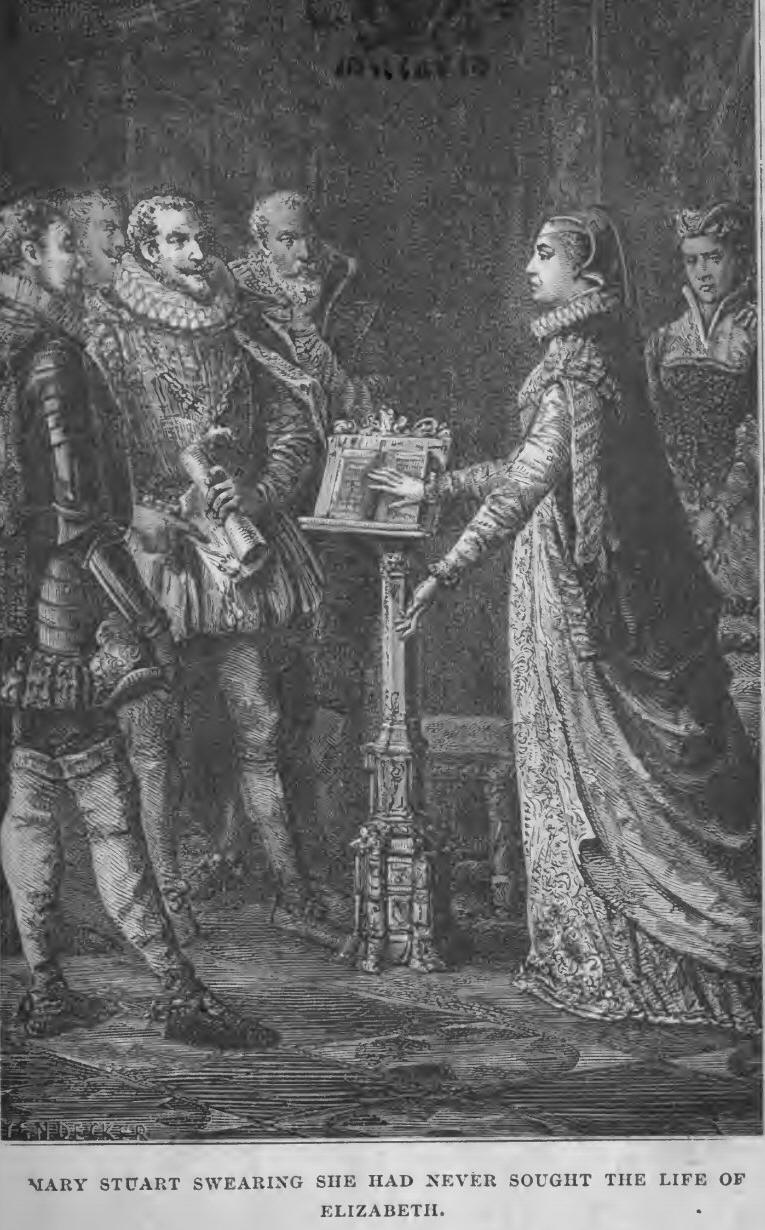
The Earl of Shrewsbury now arrived at Fotheringay. Queen Mary immediately understood what the arrival of the Earl-Marshal meant. When the sentence was read, Mary made the sign of the cross, then, without agitation, she said that death was welcome, but that she had not expected, after being detained twenty years in prison, that her sister Elizabeth would thus dispose of her. She at the same time placed her hand upon a book beside her, swearing that she had never contemplated nor sought the death of Elizabeth. "That is a Popish Bible," exclaimed the Earl of Kent, brutally, "your oath is of no value." "It is a Catholic testament," said the captive, "and therefore, my lord, as I believe that to be the true version my oath is the more to be relied on;" and she asked what would be the time of the execution. "Tomorrow morning, at eight o'clock," said Lord Salisbury, in great agitation. "Your death will be the life of our religion," said Kent, "as your life would have been its death." The queen smiled bitterly. She was left alone with her servants: she bade farewell to them, drinking to their health at her last repast, and asking pardon of them all. She passed a portion of the night in writing to her confessor, to the King of France, and to the Duke of Guise.
Mary Stuart Swearing She Had Never Sought The Life Of Elizabeth.
At eight o'clock the sheriff of the county entered the oratory where she was in prayer; she raised herself immediately, took the crucifix from the altar, and advanced with a firm step; she was clad in the rich and sober costume of a Dowager Queen. At the door of the antechamber, she found her faithful servant, Melville, who for three weeks had waited in vain to be permitted to see her. He threw himself upon his knees before her, weeping and sobbing. "Cease to lament, good Melville," said the queen, "for thou shalt now see a final period to Mary Stuart's troubles; the world, my servant, is naught but vanity, and subject to more sorrow than an ocean of tears can wash away. But, I pray thee, take this message when thou goest, that I die true to my religion, to Scotland and to France. Commend me to my son, and tell him that I have done nothing to prejudice the kingdom of Scotland." She asked that her servants might be present at her execution. The Earl of Kent refused; she insisted, with warmth: "In regard of womanhood," she said, "your mistress would not deny me to have some of my women about me at my death." The point was conceded: two of the ladies of the queen accompanied her to the scaffold, as well as Melville and a few servants. When the sentence had been read, Mary reminded the spectators that she was a sovereign princess, and had nothing to do with the laws of England, that she died by injustice and violence, without ever having conspired against the life of Elizabeth. The Dean of Peterborough began to speak; the queen interrupted him several times. "I am fixed in the ancient religion," she said, "and, by God's grace, I will shed my blood for it." Seeing that she could not impose silence upon him, she turned round looking on the other side of the scaffold but he followed her movements, and proceeded to place himself in front of her. While he prayed aloud in English, the queen repeated in Latin the Penitential Psalms, with profound contrition. When the dean had finished, she prayed aloud in English for the Church, her son, and Queen Elizabeth. She kissed the crucifix; the Earl of Kent exclaimed, "Madam, you had better put such Popish trumpery out of your hand and carry Christ in your heart." "I can hardly bear this emblem in my hand without at the same time bearing Him in my heart," said the queen. The executioners laid hands upon her to undress her; as her women burst into sobs in their indignation, she placed her finger to her lips and embraced them, saying to the spectators, "I am not accustomed to be undressed by such attendants, nor to put off my clothes before so much company." Her eyes were bound with a handkerchief embroidered with gold, and the executioners conducted her to the block. She laid her head upon it without trembling. "Into Thy hands, O Lord, I commend my spirit," she said aloud. The executioner was more agitated than the victim; he was compelled to strike three times. When he raised the bleeding head, exclaiming, "God save Queen Elizabeth," the dean and the Earl of Kent alone replied, "Thus perish all her enemies." No one said Amen. The queen's little lap-dog had hidden himself in her clothing; he could not be separated from the body while it remained upon the scaffold.
The news of the execution soon spread abroad in London, and many people manifested their joy thereat, before anyone dared to announce the fact to the queen. She feigned great anger, shedding tears, and asserting that she had given no order. The secretary of state, Davison, was sent to the Tower; Burleigh and the other ministers were disgraced. Walsingham had been prudent enough to absent himself; when he reappeared, his colleagues were not long in returning into favour, but a victim was necessary. Davison remained in prison during all the remainder of the reign of Elizabeth, and his whole fortune was confiscated to pay the fine which was imposed upon him.
The first care of Elizabeth was to communicate to King James the grief which she experienced at the unhappy event which had occurred without her knowledge in her kingdom. The king wept on learning the death of his mother, asserting that he would move heaven and earth in his vengeance. His anger was immediately appeased; the pension which he received from Elizabeth was increased; one of the obstacles which might impede his succession to the throne of England had disappeared. The royal Pretender consoled himself with this expectation. "Could an only son forget his mother?" Mary Stuart had asked on learning her condemnation. The conduct of King James proved that he could.
King Henry III. would have been much embarrassed to accomplish his threats and to wage war in England to avenge his unhappy sister-in-law. He groaned under the yoke of the League and of the Guises, and no doubt easily forgave Elizabeth for the blow which she had struck at the haughty House of Lorraine. L'Aubespine reproached Elizabeth for the assistance which she had so long been giving to Henry of Navarre. "I have done nothing against your sovereign," said the queen, resorting to her former argument; "I support the King of Navarre against the Duke of Guise." L'Aubespine did not persist.
For a long time past, the expeditions of the English Buccaneers in the West Indies had completed the exasperation occasioned to Philip by the assistance accorded by Elizabeth to the rebels of the Low Countries. The death of Queen Mary furnished him with a natural pretext for the bursting forth of his resentment. The Queen of England made some efforts to appease it as she had appeased the anger of the Kings of France and Scotland. In the Netherlands her arms had not been covered with glory. Leicester was the weakest and most incompetent of the generals, and in his absence, while he was in England to assist in the condemnation of Mary Stuart, a body of his troops commanded by malcontent officers, had restored Deventer to the King of Spain, passing at the same time into his service. The return of the Earl into the Low Countries did not repair matters. The Dutch were discontented and uneasy; the queen recalled her forces, retaining merely the hostage towns, and she accepted the provisional nomination of Maurice of Nassau, son of William the Taciturn, as Stadtholder of the United Provinces. She had even opened up a secret negotiation with the Duke of Parma, who still held out in the Low Countries, but although endeavouring to preserve the peace, she understood that war was becoming imminent, and the great preparations to which the King of Spain was devoting himself were not unknown to her. As a preliminary to hostilities, Sir Francis Drake was despatched with a fleet of thirty vessels, with orders to destroy, even in their ports, all the Spanish vessels which he might encounter. Never was a mission executed with more satisfaction and success. On the 19th of April, 1587, that bold seaman forced the entrance of the port of Cadiz, where he destroyed thirty great vessels; then, following the coast-line as far as Cape St. Vincent, he captured, burnt, and sunk a hundred other ships, and destroyed on his way, four fortresses. At length he entered the Tagus, recently become tributary to Philip II., who had taken possession of Portugal, to console himself for the loss of Holland, and Drake took possession, under cover of the Spanish standard, of the St. Philip, the largest vessel of the royal navy, laden with a precious cargo, The exploits of Drake delayed by more than a year the expedition which the King of Spain contemplated, and gave time to Elizabeth to complete her preparations. "I have singed the King of Spain's beard," said the victorious admiral on returning to England. The anger of Philip redoubled under these insults. The Pope, Sixtus the Fifth, had supplied him with money and renewed the bull of excommunication against Elizabeth. All the vessels of the kingdoms of Naples and Sicily were confiscated for the service of the king. The republic of Venice and that of Genoa lent their fleets to him. Every where in all the ports of Spain vessels were in course of construction. A fleet of flat-bottomed vessels prepared in Flanders were to transport to England the Duke of Parma and his thirty thousand soldiers. The humblest Spanish sailor thought himself assured of the conquest of England. Philip II., promised himself the triumph of the Catholic faith in this haunt of the heretics. It is allowable to doubt that the Pope Sixtus the Fifth was as sure of success. "Un gran cervello di principessa" (She has the mind of a great princess), he often said in speaking of Elizabeth. But Europe, Protestant or Catholic, had not yet lost the habit of trembling before the power of Spain. All eyes were fixed upon England, against which country so many preparations were being made.
Meanwhile England did not remain idle. In the month of November, 1587, the queen convoked a council of war, to which she had summoned all the distinguished soldiers and seamen of that time, and which was destined to found the great navy of England. Sir Walter Raleigh took a large share in the deliberations, and vigorously maintained the opinion, that it was necessary both to meet the enemies at sea, and to prepare for them on land. The fleet of Elizabeth was not large. She had never waged war, and the money of which she could dispose did not suffice for the demands she received from all the Protestant countries, opposed and struggling for their faith. Thirty-six vessels only composed the royal navy, but merchant ships abounded. The progress of wealth had been rapid during the reign of Elizabeth; the devotion of her subjects provided for all wants; private persons armed the commercial ships for war, to do homage to the queen with them, and the great seamen who had acquired their renown and experience in waging war as buccaneers against the Spanish in all the seas of the world—Drake, Hawkins, Frobisher—took command of the vessels, under the orders of the High Admiral, Lord Howard of Effingham. A hundred and ninety-one ships were at length gathered together, and the Dutch sent to the assistance of their allies sixty others manned by the fierce Zealanders, ever eager to fight the Spaniards. The fleet was disposed in squadrons to cover the coasts, while the land forces, under the orders of Leicester, assembled from all parts to resist the invasion. All the ancient fortifications were repaired, and new redoubts were raised as though by enchantment. A camp was formed at Tilbury Fort, opposite Gravesend. The queen repaired thither herself, to be present at a review. Her subjects had vied with each other in devotion. Catholics as well as Protestants had generously responded to her appeal. Catholic gentlemen, when command was refused them, enrolled themselves as private soldiers. A hundred and thirty thousand men were raised in the kingdom. When the queen assembled her forces at Tilbury, she had around her more than sixty thousand men. The Earls of Essex and Leicester marched at the bridle of her war-horse; she carried in her hand the staff of command. All her courage glistened in her eyes. "My loving people," she said, "we have been persuaded by some that are careful for our safety to take heed how we commit ourselves to armed multitudes for fear of treachery, but I assure you that I do not desire to live to distrust my faithful and loving people. Let tyrants fear! I have always borne myself so that, under God, I place my chiefest strength and safeguard in the loyal hearts and good will of my subjects; and therefore I am come amongst you at this time, not as for my recreation and sport, but being resolved in the midst and heat of battle to live or die amongst you all, to lay down for my God, for my kingdom, and for my people, my honour and my blood even in the dust. I know that I have but the body of a weak and feeble woman; but I have the heart of a king and of a King of England too, and think foul scorn that Parma or Spain should dare to invade the borders of my realms. To which rather than any dishonour shall grow by me I myself will take up arms." The popular enthusiasm was great, but general terror equalled the enthusiasm. The terrible reputation of the Spanish troops had preceded them. The inexperienced recruits who formed the greater portion of the land forces would have been unable to resist the veterans of the Duke of Parma; the English navy was to save England.
The invincible Armada, as the Spaniards arrogantly called it, issued forth from the Tagus on the 29th of May, 1588. It numbered about a hundred and thirty ships, of which some were enormous. The sea appeared to fight in favour of England, in directing the course of the invaders towards Corunna, where the fleet was to take reinforcements. In the vicinity of Cape Finisterre a storm arose which dispersed the squadron and destroyed a certain number of vessels. The news of the disaster arrived in England; the people thought themselves delivered of the enemy. Elizabeth, always economical, immediately wrote to Lord Howard to disarm the four largest vessels of the fleet, and to disband the crews. The Admiral refused to do so, saying that he would prefer to maintain them with his private fortune; this was fortunate for him, for the Armada had re-formed, and on the 19th of June it was signalled in the vicinity of Plymouth. It advanced majestically, in the form of a crescent, covering the sea, measuring from one horn of the crescent to the other a space of three leagues. An immediate landing was expected, but the orders of Philip were to approach the coast of Flanders, there to rally the Duke of Parma, his fleet and his soldiers. Lord Howard followed the enemy, in readiness to attack the ships separated from the squadron by accidents of the sea. Thus began a series of combats, all disastrous to the Spaniards, though often impeded on the side of the English by the failure of supplies. On the 22nd, 23rd, 24th, 25th, 26th of July, Howard, Drake, Hawkins, Frobisher, engaged either in concert or separately, fought almost without intermission. On the 28th at length, "this morrice-dance upon the waters," as Sir Henry Wotton called it, was approaching its end. The Duke of Medina-Sidonia, a Spanish Admiral, had asked assistance of the Duke of Parma; he was in the vicinity of Calais, but the English vessels blockaded the Strait between Nieuport and Dunkirk. The Flemings could not pass; a great battle began. The Spaniards presented a compact mass which impeded the movements of the English vessels, smaller than theirs. During the night, fire-ships were launched against them. The Spaniards had had terrible experience of this method of warfare from the Dutch in the Scheldt; confusion spread through the squadron. The vessels quitted their positions and crowded all sail to escape from the explosion of the fire-ships; in vain did their admiral endeavour to reassemble them; the English attacked the isolated vessels at their ease. Everywhere minor encounters were signalled; almost everywhere the English were the victors. The Duke of Medina-Sidonia had already taken the course of abandoning any invasion and of returning to Spain by doubling Scotland. The English pursued him. "We have the Spaniards before us," wrote Drake to Walsingham, "and with the grace of God, we intend to join them yet. God grant that the Duke of Parma be watched, for, with the grace of God, if we are living, we will not delay in seizing the Duke of Medina-Sidonia, so that he may wish himself at St. Mary amidst his vines." The failure of supplies put an end to the pursuit; it was necessary to abandon the Spaniards to the mercy of the sea. A terrible storm assailed them near the Orkney Islands. A great number of vessels stranded upon the coast of Scotland, and the crews were made prisoners. Those ships that were driven to Ireland did not save one man. The English colonists cut them to pieces to prevent them from seconding the Irish insurrection. When the Duke of Medina-Sidonia returned in the month of September, to Santander, in the Bay of Biscay, he had but sixty vessels, and those in bad condition, while their crews, overwhelmed with fatigue, looked like spectres. The English had lost but one ship of importance. For some time people feared a descent of the Duke of Parma, "who," wrote Drake, "I take to be as a bear robbed of her whelps;" but the alarm soon subsided, and the queen caused the camp at Tilbury to be raised. The army was disbanded, and the Earl of Leicester set out for his castle at Kenilworth. He died there on the 4th of September, shortly after his arrival. The queen, whose favorite he had been for thirty years, did not appear greatly afflicted at his loss; she caused his effects to be sold at auction, to pay his debts to the public treasury. She had chosen a new favourite, as yet almost a child, the Earl of Essex, son-in-law of Leicester. The charm of his person, the gaiety and frankness of his manners, amused Elizabeth. She was fifty-five years of age; Essex was not twenty, when, in 1587, she made him Knight of the Garter, and captain-general of the cavalry. At the death of Leicester, he was raised to the dangerous position of titled favourite at the court of an imperious, exacting woman, accustomed to the most extravagant flatteries, and moreover jealous yet of her beauty and personal charms. The greatness of Essex was to cost him dearly.
A fruitless expedition to Spain, in favour of Don Antonio, Pretender to the crown of Portugal, did more honour to the bravery of the Earl of Essex than to his military talents. When he returned to England, he imprudently entered into a fierce struggle against the influence of the Cecils. Walsingham had died, in 1590, and Burleigh desired to have his office bestowed upon his son, Robert Cecil. Essex supported the cause of the unhappy Davison, unjustly disgraced for several years; the queen gave the office to Burleigh, authorizing him to obtain the assistance of his son. Hence there sprang a constant hostility which was to terminate in the ruin of Essex. Elizabeth had often differed in opinion from her great minister; she had offended him, ill-used him, vexed him, but none had ever succeeded in destroying his influence with her. Leicester had attempted it in vain. Essex was endeavouring to attain the same object in his turn, with as little chance of success. The queen knew to whom she owed in a great measure the prosperity of her reign, and the memory of the father was destined to constantly increase in her eyes the services and merits of the son.
The Earl of Essex consoled himself for his defeat at court, by departing for France at the head of the troops whom Elizabeth sent to the assistance of Henry of Navarre, now become Henry IV., king of France. Henry III. was stabbed by Jacques Clément, on the 21st of July, 1589, and since then, his legitimate successor was labouring to rescue his kingdom from the Leaguers obeying the Duke of Guise, and supported by Spain. He was besieging Rouen when the Earl of Essex joined him, at the head of the English reinforcements. He distinguished himself in the skirmishes, in one of which his brother, Walter Devereux, was killed: but the impatient attachment of his mistress recalled him to England. Duplessis-Mornay advised Henry IV. to send back Essex to Queen Elizabeth, if he wished to obtain of the latter fresh aids in men and money, which were becoming every day more necessary in order to check the attacks of the Duke of Parma, who had recently entered France. The war was popular in England, the English gentlemen having always been eager to enroll themselves in the ranks of the Huguenots. The queen had been, for a long while past, the faithful ally of Henry of Navarre. When he resolved, in 1593, to secure the peace of his kingdom and the establishment of his throne by adjuring Protestantism, indignation in England was violent. Elizabeth accused the king of treachery, but the Edict of Nantes soon satisfied the English Protestants, while securing to their brethren the free exercise of their religion, and the hostilities which continued between France and Spain, served the policy of Elizabeth too well for her to withdraw from her ally the efficacious support which she had always given him. The moment would not have been propitious for abandoning him; for the Spanish armies had again penetrated into France, and in the month of April, 1596, the Archduke Albert of Austria took possession of Calais which Elizabeth claimed of Henry IV., in exchange for her services. Amiens, Doullens, Cambray, were taken in succession. "It is very well to make a King of France," exclaimed Henry IV., on placing himself at the head of his troops; "it is time to make a King of Navarre," and he repulsed and defeated his enemies, while Queen Elizabeth, carrying war to their coasts, sent the Earl of Essex to Spain with Sir Walter Raleigh. The fleet commanded by Lord Howard bombarded Cadiz. Essex stormed the town and took possession of it; he wished to retain his prize, but, the council of England not approving that measure, Cadiz was delivered up to the flames before the English weighed anchor to return to their country. A second expedition directed against the Azores, brought about few results. The influence of the Cecils over the queen was still hostile to Essex, notwithstanding an apparent reconciliation. The earl retired to Wamstead House, inhabited by his wife, the daughter of Walsingham, and widow of the celebrated Sir Philip Sydney, the Christian hero of the chivalry of the sixteenth century, slain at thirty years of age, before Zutphen. The jealousy and affection of the queen soon recalled Essex to court; he was nominated earl-marshal. Notwithstanding the opposition of the court of England, the King of France had concluded, in 1598, with Philip II., the treaty of Verdun, and Sir Robert Cecil, who had been on a mission to Paris, brought back the Spanish proposals for peace. Essex, who only lived for war, and who could not exert his influence elsewhere, rose vigorously against these overtures. The queen was not in favour of peace, but the Cecils dwelt upon the embarrassments of the situation, upon the gravity of affairs in Ireland, upon the distress of the treasury. Burleigh, drawing from his pocket a book of Psalms, showed this prophetic verse: "The bloodthirsty man shall not live half his days." The quarrel became bitter. Essex flew into a passion, and turned his back upon the queen, who had reprimanded him. Elizabeth rose and gave a box on the ear to her insolent subject. Essex had his hand upon his sword: "I would not have such an affront from the hands of the king, her father," he said, "and I will not accept it of a petticoat." Lord Howard arrested his arm, and the earl impetuously quitted the council, to proceed to Wamstead, where he remained in retirement for four months. When he reappeared at the court, still powerful in appearance, Burleigh had disappeared from the scene; he died on the 4th of August, 1598, at the age of seventy-eight. His loss had cost his mistress bitter tears. Sir Robert Cecil, able and sagacious, but more corrupt than his father, and less faithfully attached to the interests of the queen, could not replace with Elizabeth the constant and sincere union of the sovereign and the minister, during forty years. The great consolation of the queen at this period was the death of Philip II. The war soon languished, and peace being concluded at the end of the year 1598, between the Spaniards and the United Provinces, delivered Elizabeth from the enormous subsidies which she had for a long time furnished her Dutch allies. The States-general recognized their debt to her Majesty, and undertook to discharge it by degrees. People in England were now only occupied with the imaginary or real plots which were discovered every day against the life of the queen, some hatched, it was said, by the Catholics, who still groaned under the weight of the most oppressive penal laws, others attributed to the Spanish influence. The King of Scotland was even accused of a project of assassination. He defended himself warmly against the charge. The queen wrote him that she could not think him guilty; but her confidence in his honour was so like a pardon for the alleged crime, that King James was not content, and demanded the trial of the accused, Valentine. The court of England contented itself with detaining in prison the wretch who had dared to tarnish the name of James VI.; when the latter succeeded to the throne, he enjoyed the pleasure of sending Valentine to the galleys.
The state of Ireland had for a long while preoccupied Queen Elizabeth and her ministers. A serious insurrection at the beginning of the reign had for a moment placed Shane O'Neil at the head of all the Irish of pure race. He had been betrayed and assassinated, but his country was not subjugated. The projects of colonization of the Earl of Essex, father of the favourite of Elizabeth, and encouraged by her, had not succeeded better than the devastating campaigns of the Lords-Lieutenant, Sir Henry Sidney and Fitzwilliam. The English had undertaken to civilize Ireland by destroying its inhabitants, as they had undertaken to establish Protestantism by prohibiting Catholic worship in a country entirely devoted to that religion. Both efforts had justly failed, and the jealous rivalries of the Irish noblemen, the ever-recurring quarrels of the Butler's and the Fitzgeralds, the revolts, the submissions, the arrests, the murders of the chiefs of these two houses, the rival pretensions of the Earls of Ormond and Desmond wearied the patience of the queen and council, exhausted the public treasury, and maintained the hopes of the enemies of England. Two adventurers, Stuckely and Fitzmaurice, conceived the idea of taking advantage of the papal pretensions to the possession of the islands, to attempt a bold stroke upon Ireland. They obtained a bull relieving the Irish of their allegiance to Elizabeth, besides assistance in money, a few soldiers and some arms. Stuckely remained in Portugal, and perished at the battle of Alcazar against the Moors, but Fitzmaurice, brother of the Earl of Desmond, landed in Ireland, in 1579, in the hope of bringing about an insurrection. He was coldly received, and compelled to take refuge at the residence of his brother. A reinforcement of pontifical soldiers, besieged in the fortress of Smerwick, were put to the sword by Sir Walter Raleigh. The Earl of Desmond, suspected of having taken part in the insurrection, was beheaded by the English troops, who seized him in a hut; Lord Grey de Wilton, who had become Lord-Lieutenant, restrained the revolt with a hand of iron, without obtaining any amelioration in the moral or material situation of the country. Sir John Perrot succeeded him in 1585; as severe as Lord Grey, but more just, he had the misfortune to give himself up in a fit of exasperation, to bitter words, not only against the queen, but against her "dancing chancellor," Hatton. The vengeance of the minister and the anger of the sovereign appeared to slumber, but when Perrot, weary of asking in vain for assistance and money, obtained his recall, he was accused of high treason, overwhelmed by the testimony of men whose excesses he had restrained during his government, and was soon condemned to death. His son had married a sister of Essex, and the influence of the earl counterbalanced that of his enemies. Grief or poison averted his execution, he died on the 20th of June, 1591, at the moment when the power of the Earl of Tyrone, Hugh, son of O'Neil, baron of Duncannon, was becoming great in Ireland. He was regarded by his fellow-citizens as the legitimate sovereign of Ulster. He claimed for his country liberty of conscience and the maintenance of ancient local customs, savage privileges having little compatibility with civilization. At the same time he also claimed all the property which had formerly belonged to his ancestors. Skilful and of noble appearance, he had contrived to discipline his fierce soldiers, and he conducted them in battle array against the troops of the queen. Sir John Norris had died of grief and anger. Sir Henry Bagnall was defeated and killed at Blackwater, in County Tyrone, and the insurrection spread throughout the whole of Ireland. It was asserted that the Pope and the King of Spain had promised assistance to the rebels. In this perilous situation the council of the queen decided that no other but the Earl of Essex could take command of the army. For a long time he refused. The viceroys of Ireland had all suffered disgrace or death. He finally yielded to the personal entreaties of Elizabeth, and left London in the month of March, 1599, accompanied by the flower of the English nobility. His absence was to inflict upon him a mortal blow. The troops were despatched slowly, ill armed, ill fed. In vain he demanded reinforcements. Sir Walter Raleigh and Sir Robert Cecil assured the queen that her general had no other desire than to prolong the war. When he entered the province of Ulster, the centre of the rebellion, he had less than six thousand men with him. He concluded an armistice with the Earl of Tyrone, then without waiting for authority for this settlement he embarked in haste for England. Scarcely arrived in London, he repaired to the palace of the queen; she was at her toilet; he entered and threw himself upon his knees before her, kissing her hands. When he issued forth, he appeared radiant, congratulating himself after suffering far from home stormy troubles and inward griefs, and finding once more peace and quietude in his own country. On the morrow everything was changed. The Earl received orders to remain a prisoner in his apartment. Sir John Harrington, who had accompanied Essex to Ireland, was summoned to appear before the queen: "she chafed much, walked to and fro, looked with discomposure in her visage," says Sir John, "and when I kneeled to her she clutched at my girdle, saying, 'By God's son I am no queen, that man is above me! Who gave him command to come here so soon? I did send him on other business.' She bid me go home, I did not stay to be bidden twice. If all the Irish rebels had been at my heels, I should not have made better speed." On the morrow, Essex was summoned before the council. He replied with gravity and moderation, but was consigned to the care of the keeper of the seals. All the affection of the queen for the Earl appeared to have turned to anger. She forbade the friends, the physicians, and particularly the wife of the prisoner, to have any access to his person. He was ill, and had been detained for eight months, when, in the month of May, 1600, he wrote to the queen, reminding her of her former favour, of which his enemies had been so jealous that they continued to hate him habitually, "now that he was forgotten and thrown into a corner, like a dishonoured corpse." On the 26th of August, liberty was restored to him, but orders were given to him not to appear at court. Terrible is the intoxication of love of power and royal favour! Essex was learned; he had a taste for arts and literature; he might have retired into the country, and concealed the check he had received, but he desired to tempt fortune once more. His secretary, Cuffs, an enterprising man, without principle, urged him to attempt the rule of his enemies by a bold stroke. He was beloved by the population of London. An insurrection might rid him of Cecil, Raleigh, Cobham, the party of the court, as they were called, the earl opened the doors of his house to all malcontents, and assembled together the officers who had served under him. He involved in his cause King James VI., asserting that Cecil and his friends were endeavoring to banish him from the succession, in favour of the Infanta of Spain, Clara-Eugenia, daughter of Philip II., married to the Archduke Albert. Secret advices warned the Earl that his projects were known to the council. He resolved to act. He was surrounded by his friends on Sunday, the 8th of February, 1601, preparing to march to the City to rouse to insurrection the populace assembled at the cross of St. Paul's, at the moment of the sermon, and thus to open up a way for himself to the queen with the assistance of the mob. The keeper of the seals, and Lord Egerton and Sir William Knollys, arrived at his house at the same moment, demanding an explanation of this noisy assemblage. "There is a plot against my life: letters have been forged in my name; men have been hired to murder me in my bed," exclaimed Essex violently; then, as the magistrates promised justice, he invited them to enter an inner apartment; the door was closed upon them. Essex hastened to the City with Lord Rutland, Lord Southampton and a few others. The streets were deserted; no sermon had been delivered at the cross of St. Paul's. The citizens remained shut up in their houses. The aldermen had received the orders of the queen. Essex called every one to arms; none responded. He had great difficulty in re-entering his house, which he in vain endeavoured to defend. At the sight of the cannon leveled against the walls, he, as well as his friends, surrendered, and he was conducted to the Tower with the Earl of Southampton. When the accused appeared before the peers, on the 19th of February, Essex asserted that he had only obeyed the law of nature in defending his reputation and his life. The indictment of the crown was supported by Francis Bacon, whose career was soon to present so strange a mixture of greatness and infamy. He owed his elevation to the friendship and the protection of the Earl of Essex. He was less violent than his compeer, Coke, who accused the Earl of having desired to raise an insurrection. "He would have called a Parliament, and a bloody Parliament would that have been, where my Lord of Essex, that now stands all in black, would have worn a bloody robe; but now, in God's just judgment, he of his earldom shall be Robert the Last, that of a kingdom thought to be Robert the First." All the arguments of Essex were demolished by Bacon, although the latter reminded him of the language which he had himself used regarding the party which he now supported. No witness was confronted with the accused, whose condemnation to death was unanimously pronounced by the peers.
When the usual question was put to the two earls, whether they knew of any reason why they should not be condemned, Essex did not complain of the fate which awaited him. He was weary of life, he said, but he interceded keenly for his friend. Lord Southampton. He was urged to ask mercy of the queen. "Do not accuse me of pride," said the Earl, "but I could not ask for mercy in that way, though with all humility I pray her Majesty's forgiveness; I would rather die than live in misery; I have cleared my accounts, and have forgiven all the world." A confession signed by Essex was circulated, but many people believed it to be forged. It was also asserted that he had expressly asked to be executed in secret, although that fact was formally denied by King Henry IV. "Quite on the contrary," said the monarch, "he would have desired nothing so much as to die in public." The popularity of the Earl of Essex was dreaded, and the prolonged emotion which his death caused proved that this dread was not without foundation. He was beheaded on the 25th of February, 1601, at eight o'clock in the morning, in an outer court of the Tower. He was not thirty-three years of age. Sir Walter Raleigh witnessed the execution from a window, as well as that of several of the friends of the Earl. He did not know that the day would come in like manner when other eyes would in their turn come to contemplate his death. The Earl of Southampton remained in prison until the accession of King James, with whom he was soon in great favour.
If the King of Scotland had now found himself, as his mother had been, under the rule of the English law, he would have incurred serious dangers. His correspondence with Essex had compromised him so much that he felt compelled to send ambassadors to London to exonerate himself with Elizabeth. Sir Robert Cecil was in the service of the King of Scotland, faithful to the instinct of the courtier, who turns to the rising sun. The queen was appeased and increased the pay of her successor. If the chroniclers do not wrong her, she had shortly before been concerned in a strange plot, in which the king had narrowly escaped perishing by the hand of the sons of the Earl of Gowrie, beheaded for rebellion in 1584. The queen and her destined successor had little liking for each other, and bitter recollections estranged them. In despatching his emissaries to London, the King of Scotland had recommended them to proceed prudently between the two precipices of the queen and the people. The emissaries were sufficiently skilful to secure the best of guides. It was then that Sir Robert Cecil began with King James a correspondence which would have cost him his head if his mistress had been aware of it. Less skilful, Sir Walter Raleigh and Cobham did not contrive to gain in time the good graces of the future monarch, a fatal imprudence, as one of them afterwards found.
The war continued in Ireland, supported by a considerable body of Spaniards. Lord Mountjoy had besieged them in Kinsale and pressed them vigorously, when the Earl of Tyrone advanced, at the head of six thousand Irish, to second his allies. He was repulsed after a desperate fight; the Spaniards were obliged to capitulate and re-embark in their vessels. Mountjoy pursued Tyrone from retreat to retreat, until he was compelled to surrender, towards the end of 1602. The expenses of the war had been enormous; the Queen had convoked Parliament for the last time in the month of October, 1601. She was sick and depressed in spirits; but she appeared before the Houses more magnificently attired than ever, and obtained considerable supplies. The Commons, however, had determined to cause their favours to be paid for. They protested violently against the monopolies granted or sold by the Crown, which allowed the possessors to fix the price of articles of first necessity as suited them. The sale of wine, oil, salt, tin, steel and coal, were all objects of these monopolies. It was asked why bread was not among the number. "If no remedy is found for these," said a member, "bread will be there before the next Parliament." The discussion, formal and categorical in its nature, lasted four days. The ministers endeavoured to defend the prerogative, but Parliament held firm; the spirit of the Puritans had constantly gained ground during recent years, and the queen was compelled to yield. A promise was given to abolish the existing monopolies, and not to grant fresh ones. This engagement was not strictly kept, but the worst features of the evil diminished. Elizabeth no longer governed as of old. The energy of her will yielded to the growing feebleness of her body. She had always contrived to know the moment when it was necessary to make concessions; and she felt, besides, with bitter sorrow, that her popularity had diminished among the nation. The day of complete decline was approaching. The anxieties of absolute power, remorse for past cruelties, and regret for the death of the Earl of Essex, weighed upon that head, bent with age and sickness. Elizabeth did not seek confidants. Secret in her griefs as in her resolves, she bore alone the burden of her weariness; but the beginning of the year 1603 saw her strength diminishing day by day. She no longer showed herself in public, alleging the sorrow which she experienced at the recent death of the Countess Nottingham. She no longer slept, and scarcely ate; "She remains seated upon cushions," wrote the French Ambassador, at the beginning of March, "refusing to take any medicine or to go to bed." She no longer rose, yet she did not lie down; her eyes remained fixed upon the ground, and days elapsed without her saying a word. On the 21st of March her women put her to bed, and she listened attentively to the prayers of the Archbishop of Canterbury, Whitgift. On the morrow, the 22nd of March, Cecil, the Lord Admiral, and Lord Keeper of the Seals, approached her to ask her to name her successor. She trembled. "I told you my seat has been the seat of Kings; I will have no rascal to succeed me." The lords looked at each other, uncertain as to the meaning of her words. "I tell you that I will have no rascal. I must have a king, and who could that be but my cousin of Scotland?" "Is your Grace quite determined?" asked Cecil. She made a sign indicating yes, asking that she should be left in peace. She had again seen the archbishop, and was speechless when the lords of the council returned. "May your Grace deign to make a sign to indicate if you have chosen the the King of Scotland for your successor," they asked again. She raised herself, and joined her hands above her head as though to form a crown. Then she sank back upon her pillows and died in the night of the 24th of March, 1603, without having uttered a word. She was nearly seventy, and had wielded the sceptre for forty-five years.
Queen Elizabeth had willed and accomplished great things. She had governed England despotically, but was skilful, nevertheless, in observing the national tendencies and in yielding to them when resistance became dangerous. Under the influence and upon the advice of her faithful minister, Lord Burleigh, she had often been the arbitrator of Europe, constantly the patron and protector of the persecuted Protestants. She had tarnished the brilliancy of her reign, and for ever sullied her glory, by weaknesses and bad passions, while obstinately refusing to devote herself to the duties and to share in the legitimate happiness of a woman's life. Courageous, proud, farsighted, and persevering, she had displayed many great intellectual faculties and moral qualities, but rarely or never the tender and modest virtues which both inspire and retain private affections. She had long contrived to inspire sentiments of another nature. When in the midst of her glorious career, Elizabeth, asking a lady of her court how she preserved the affection of her husband, the latter replied, "By assuring him of mine, madam," the queen exclaimed, "It is thus that I possess the love of my many husbands, the people of England, by causing them to feel that which I bear to them." She had indeed possessed the love of her people, and she had made common cause with them during long years, and through great trials. When she died, the evils and dangers inherent in absolute power had done their worst. The English nation began to grow weary of the domination of its great queen, and to contemplate political and religious liberties which had no place in the mind or heart of Elizabeth Tudor.