HERBS AND MEDICINAL PLANTS
Reading edition
Among commodities which the early Jamestown settlers searched for were herbs and medicinal plants. It is possible that Thomas Wotton and Will Wilkinson, surgeons with the first colony, were the first members of the English medical profession to collect and experiment with New World plants.
The few colonists who wrote of their travels in Virginia frequently made mention of the herbs and native plants. George Percy related that five days after the settlers had planted their colony at Jamestown, May 19, 1607, that "One of the savages brought us on the way to the wood-side, where there was a garden of tobacco and other fruits and herbes."
On an exploring trip upriver from Jamestown in late May, 1607, Gabriel Archer recorded that "One [savage] shewed us the herbe called in their tongue wisacan, which they say heales poysoned woundes, it is like lyverwort or bloudwort."
John Smith mentioned the spring herbs, though he did not know their names: "Many hearbes in the spring time there are common dispersed throughout the woods, good for brothes and sallets, as violets, purslin, sorrell, &c. Besides many we used whose names we know not."
The first supply, approximately 120 settlers, reached Jamestown in midwinter and early spring, 1608. Among the group was a physician, Dr. Walter Russell; a surgeon, Post Ginnatt; and two apothecaries, Thomas Feld and John Harford. There is no record, however, indicating that these men used Virginia plants and herbs for medicinal purposes.
The man who first made intensive experiments with native plants was Doctor Lawrence Bohun. Arriving at Jamestown in 1610, he is mentioned several times by William Strachey, who also reached Jamestown in 1610, in The Historie of Travell into Virginia Britania 1612:
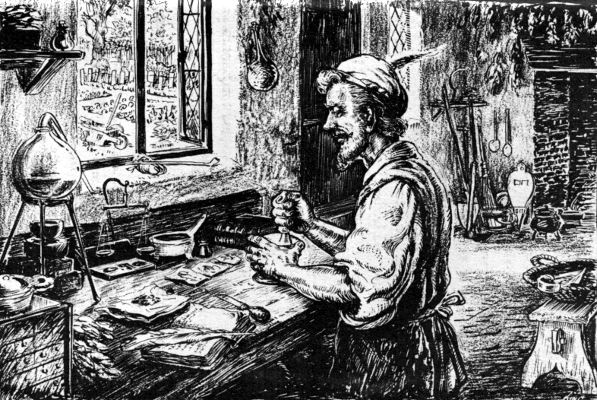
Doctor Lawrence Bohun Experimenting With Herbs At Jamestown, 1610
Conjectural sketch
There groweth in the Island of James-towne a smale tree of leaves, armes and fruict, like the myrtle-tree, the fruict thereof hath a tast with the mirtle, but much more bynding, these trees grow in great plentye, rownd about a standing pond of fresh water in the middle of the Island; the pill or rynd whereof is of so great force against inveterate dissentericall fluxes of which Doctor Bohoune made open experiment in many of our men labouring with such diseases and therefore wisheth all such phisitians as shall goe thither to make use thereof.
As early as 1610 the Virginia Company of London instructed the colonists to send the following plants to England: sassafras, bayberries, "poccone to be gotten from the Indians," "galbrand [galbanum] groweth like fennell," sarsaparilla, and walnut oil. Other plants, both native and exotic, which were cultivated at Jamestown for medicinal purposes included mastic, woodbine, senna, snakeroot, dittany, mechoacan, pepper-wort, Jamestown (or Jimson) weed, wild cherry, and rhubarb.
Most of the herbs which were cultivated in English gardens grew successfully in Virginia, especially the ones listed in John Gerard's The Herbal (London, 1597), and William Lawson's The Country Housewifes Garden (London, 1617). Many contemporary records reveal that several herbs were used for medicinal purposes as well as for improving the flavor of certain foods and beverages.
A few herbs still grow on Jamestown Island, and together with the native sassafras, bayberry, wild bergamot, and bee balm, they remind us that the wilderness physicians, surgeons, and apothecaries did everything in their power to keep the English settlers alive and well three centuries ago.
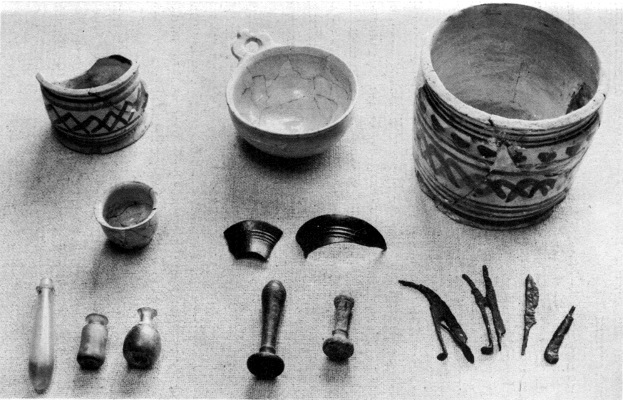
Photo courtesy National Park Service
Items Used By Jamestown Doctors And Apothecaries
The drug jars, ointment pot, vials, and mortar and pestle fragments remind us that physicians, surgeons, and apothecaries experimented with herbs and native plants three centuries ago—attempting to keep the Jamestown colonists alive and well.