A JAMESTOWN BLACKSMITH SHOP
Reading edition
A blacksmith, James Read by name, was a member of the first group of colonists who planted the Jamestown settlement in 1607. Perhaps he helped forge the small chisels which Captain John Smith mentioned (writing of the month of September, 1607):
As yet we have no houses to cover us, our tents were rotten, and our cabbins worse than nought: our best commoditie was iron which we made into little chissels.
Many small chisels have been unearthed at Jamestown, and one may wonder whether any were made during the hard autumn of 1607, when the state of the new colony was at such a low ebb.
Another early Jamestown blacksmith was Richard Dole, who arrived on the supply ship Phoenix, April 20 1608. Read and Dole were the vanguards of many ironworkers who emigrated to Virginia at various periods of time throughout the seventeenth century.
In 1955 archeologists discovered the site of an early seventeenth century forge or smithery near historic Jamestown church. Large quantities of slag were unearthed together with pieces of bar iron, weapons, tool fragments, and several partially-completed iron handles, chisels, and nails. A few blacksmiths' tools and a small anvil were also found. Associated cultural material found indicated that the forge operated between 1610 and 1625, and there was good evidence that it may have been located in an armourer's shop. The forge site appears to be the oldest one used by the English which has been discovered in America.
The sketch showing the Jamestown blacksmith at work is based on a 1685 engraving by Johann Comenius.
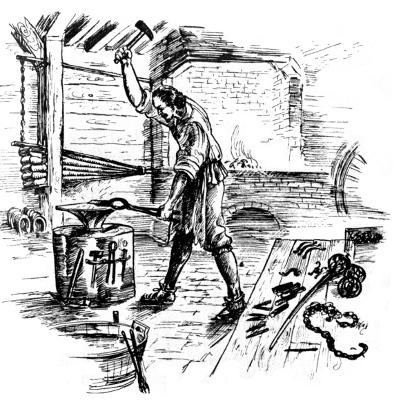
A Jamestown Blacksmith Working In A Forge Shop
Conjectural sketch
Photo courtesy National Park Service.
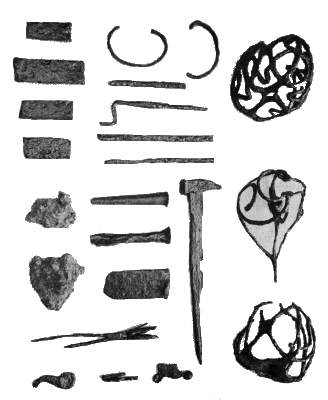
Iron Objects Excavated At Jamestown Near The Site Of An Early Seventeenth-Century Forge. Shown are blacksmiths' tools, bar iron, sword guards, slag, and a few incomplete iron objects. It appears that the forge, located a short distance west of historic Jamestown church, was in operation as early as 1625.
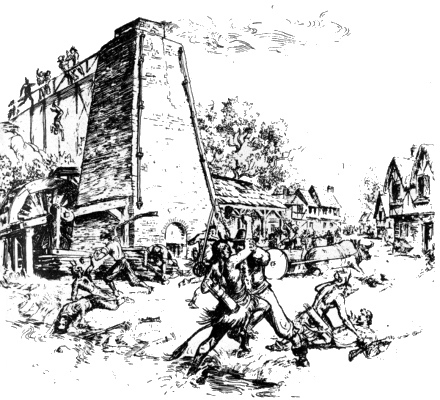
The Indian Massacre At Falling Creek, March 22 1622
Conjectural sketch
In 1620-21 the Jamestown colonists established an iron furnace at Falling Creek—about eighty miles upriver from Jamestown. It was the first ironworks built in America by Englishmen, and the furnace was the first one (of which there is definite record) in which iron was smelted. The contemporary records also indicate that a few tools were made in the forge shop. The enterprise was short-lived, however, for in 1622 the Indians massacred the ironworkers and their families and destroyed the furnace. Although never rebuilt, its importance cannot be overstressed, for the Falling Creek site can rightfully claim the honor of being the birthplace of the American iron industry.
The Black-Smith.
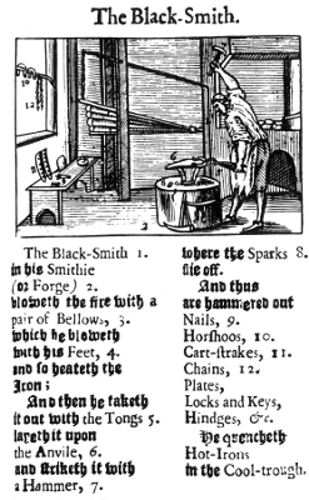
The Black-Smith 1 in his Smithie (or Forge) 2 bloweth the fire with a pair of Bellows, 3 which he bloweth with his Feet, 4 and so heateth the Iron; And then he taketh it out with the Tongs 5 layeth it upon the Anvile, 6 and striketh it with a Hammer, 7 where the Sparks 8 flie off. And thus are hammered out Nails 9, Horshoos 10, Cart-strakes 11, Chains 12, Plates, Locks and Keys, Hindges, &c. He quencheth Hot-Irons in the Cool-trough.
Courtesy Folger Shakespeare Library, Washington, D. C.
A Seventeenth-Century Blacksmith At Work
A forge or smithery at Jamestown may have resembled the one in this 1685 engraving.
From Orbis Sensualium Pictus by Johann Comenius (London, 1685).