VOLUME XII (continued 5)
William F. Fleming translation
POWER.
The Two Powers.
SECTION I.
Whoever holds both the sceptre and the censer has his hands completely occupied. If he governs a people possessed of common sense he may be considered as a very able man; but if his subjects have no more mind than children or savages, he may be compared to Bernier's coachman, who was one day suddenly surprised by his master in one of the public places of Delhi, haranguing the populace, and distributing among them his quack medicines. "What! Lapierre," says Bernier to him, "have you turned physician?" "Yes, sir," replied the coachman; "like people, like doctor."
The dairo of the Japanese, or the grand lama of Thibet, might make just the same remark. Even Numa Pompilius, with his Egeria, would have answered Bernier in the same manner. Melchizedek was probably in a similar situation, as well as the Anius whom Virgil introduces in the following two lines of the third book of his "Æneid":
Rex Anius, rex idem hominum Phœbique sacerdos, Vittis et sacra redimitus tempora lauro.—VIRGIL. Anius, the priest and king, with laurel crowned His hoary locks with purple fillets bound.—DRYDEN.
This charlatan Anius was merely king of the isle of Delos, a very paltry kingdom, which, next to those of Melchizedek and Yvetot, was one of the least considerable in the world; but the worship of Apollo had conferred on it a high reputation; a single saint is enough to raise any country into credit and consequence.
Three of the German electors are more powerful than Anius, and, like him, unite the rights of the mitre with those of the crown; although in subordination, at least apparently so, to the Roman emperor, who is no other than the emperor of Germany. But of all the countries in which the plenitude of ecclesiastical and the plenitude of royal claims combine to form the most full and complete power that can be imagined, modern Rome is the chief.
The pope is regarded in the Catholic part of Europe as the first of kings and the first of priests. It was the same in what was called "pagan" Rome; Julius Cæsar was at once chief pontiff, dictator, warrior, and conqueror; distinguished also both for eloquence and gallantry; in every respect the first of mankind; and with whom no modern, except in a dedication, could ever be compared.
The king of England, being the head also of the Church, possesses nearly the same dignities as the pope. The empress of Russia is likewise absolute mistress over her clergy, in the largest empire existing upon earth. The notion that two powers may exist, in opposition to each other, in the same state, is there regarded even by the clergy themselves as a chimera equally absurd and pernicious.
In this connection I cannot help introducing a letter which the empress of Russia, Catherine II., did me the honor to write to me at Mount Krapak, on Aug. 22, 1765, and which she permitted me to make use of as I might see occasion:
"The Capuchins who are tolerated at Moscow (for toleration is general throughout the Russian empire, and the Jesuits alone are not suffered to remain in it), having, in the course of the last winter, obstinately refused to inter a Frenchman who died suddenly, under a pretence that he had not received the sacraments, Abraham Chaumeix drew up a factum, or statement, against them, in order to prove to them that it was obligatory upon them to bury the dead. But neither this factum, nor two requisitions of the governor, could prevail on these fathers to obey. At last they were authoritatively told that they must either bury the Frenchman or remove beyond the frontiers. They actually removed accordingly; and I sent some Augustins from this place, who were somewhat more tractable, and who, perceiving that no trifling or delay would be permitted, did all that was desired on the occasion. Thus Abraham Chaumeix has in Russia become a reasonable man; he absolutely is an enemy to persecution; were he also to become a man of wit and intellect, he would make the most incredulous believe in miracles; but all the miracles in the world will not blot out the disgrace of having been the denouncer of the 'Encyclopædia.'
"The subjects of the Church, having suffered many, and frequently tyrannical, grievances, which the frequent change of masters very considerably increased, towards the end of the reign of the empress Elizabeth, rose in actual rebellion; and at my accession to the throne there were more than a hundred thousand men in arms. This occasioned me, in 1762, to execute the project of changing entirely the administration of the property of the clergy, and to settle on them fixed revenues. Arsenius, bishop of Rostow, strenuously opposed this, urged on by some of his brother clergy, who did not feel it perfectly convenient to put themselves forward by name. He sent in two memorials, in which he attempted to establish the absurd principle of two powers. He had made the like attempt before, in the time of the empress Elizabeth, when he had been simply enjoined silence; but his insolence and folly redoubling, he was now tried by the metropolitan of Novgorod and the whole synod, condemned as a fanatic, found guilty of attempts contrary to the orthodox faith, as well as to the supreme power, deprived of his dignity and priesthood, and delivered over to the secular arm. I acted leniently towards him; and after reducing him to the situation of a monk, extended his punishment no farther."
Such are the very words of the empress; and the inference from the whole case is that she well knows both how to support the Church and how to restrain it; that she respects humanity as well as religion; that she protects the laborer as well as the priest; and that all orders in the state ought both to admire and bless her.
I shall hope to be excused for the further indiscretion of transcribing here a passage contained in another of her letters, written on November 28, 1765:
"Toleration is established among us; it constitutes a law of the state; persecution is prohibited. We have indeed fanatics who, as they are not persecuted by others, burn themselves; but if those of other countries also did the same, no great harm could result; the world, in consequence of such a system, would have been more tranquil, and Calas would not have been racked to death."
Do not imagine that she writes in this style from a feeling of transient and vain enthusiasm, contradicted afterwards in her practice, nor even from a laudable desire of obtaining throughout Europe the suffrages and applause of those who think, and teach others the way to think. She lays down these principles as the basis of her government. She wrote with her own hand, in the "Council of Legislations," the following words, which should be engraved on the gates of every city in the world:
"In a great empire, extending its sway over as many different nations as there are different creeds among mankind, the most pernicious fault would be intolerance."
It is to be observed that she does not hesitate to put intolerance in the rank of faults—I had nearly said offences. Thus does an absolute empress, in the depths of the North, put an end to persecution and slavery—while in the South—.
Judge for yourself, sir, after this, whether there will be found a man in Europe who will not be ready to sign the eulogium you propose. Not only is this princess tolerant, but she is desirous that her neighbors should be so likewise. This is the first instance in which supreme power has been exercised in establishing liberty of conscience. It constitutes the grandest epoch with which I am acquainted in modern history.
The case of the ancient Persians forbidding the Carthaginians to offer human sacrifices is a somewhat similar instance. Would to God, that instead of the barbarians who formerly poured from the plains of Scythia, and the mountains of Imaus and Caucasus, towards the Alps and Pyrenees, carrying with them ravage and desolation, armies might be seen at the present day descending to subvert the tribunal of the Inquisition—a tribunal more horrible than even the sacrifices of human beings which constitute the eternal reproach of our forefathers.
In short, this superior genius wishes to convince her neighbors of what Europe is now beginning to comprehend, that metaphysical unintelligible opinions, which are the daughters of absurdity, are the mothers of discord; and that the Church, instead of saying: "I come to bring, not peace, but the sword," should exclaim aloud: "I bring peace, and not the sword." Accordingly the empress is unwilling to draw the sword against any but those who wish to crush the dissidents.
SECTION II.
Conversation Between The Reverend Father Bouvet, Missionary Of The Company Of Jesus, And The Emperor Camhi, In The Presence Of Brother Attiret, A Jesuit; Extracted From The Private Memoirs Of The Mission, In 1772.
FATHER BOUVET.
Yes, may it please your sacred majesty, as soon as you will have had the happiness of being baptized by me, which I hope will be the case, you will be relieved of one-half of the immense burden which now oppresses you. I have mentioned to you the fable of Atlas, who supported the heavens on his shoulders. Hercules relieved him and carried away the heavens. You are Atlas, and Hercules is the pope. There will be two powers in your empire. Our excellent Clement will be the first. Upon this plan you will enjoy the greatest of all advantages; those of being at leisure while you live, and of being saved when you die.
THE EMPEROR.
I am exceedingly obliged to my dear friend, the pope, for condescending to take so much trouble; but how will he be able to govern my empire at the distance of six thousand leagues?
FATHER BOUVET.
Nothing, may it please your Imperial Majesty, can be more easy. We are his vicars apostolic, and he is the vicar of God; you will therefore be governed by God Himself.
THE EMPEROR.
How delightful that will be! I am not, however, quite easy on the subject. Will your vice-god share the imperial revenues with myself? For all labor ought to be paid for.
FATHER BOUVET.
Our vice-god is so kind and good that in general he will not take, at most, more than a quarter, except in cases of disobedience. Our emoluments will not exceed fifty million ounces of pure silver, which is surely a trifling object in comparison with heavenly advantages.
THE EMPEROR.
Yes, it is certainly, as you say, giving them almost for nothing. I suppose your celebrated and benevolent city derives just about the same sum from each of my three neighbors—the Great Mogul, the Emperor of Japan, and the Empress of Russia; and also from the Persian and the Turkish empires?
FATHER BOUVET.
I cannot exactly say that is yet the case; but, with Gods help and our own, I have no doubt it will be so.
THE EMPEROR.
And how are you, who are the vicars apostolic, to be paid?
FATHER BOUVET.
We have no regular wages; but we are somewhat like the principal female character in a comedy written by one Count Caylus, a countryman of mine; all that I ... is for myself.
THE EMPEROR.
But pray inform me whether your Christian princes in Europe pay your Italian friend or patron in proportion to the assessment laid on me.
FATHER BOUVET.
No, they do not! One-half of Europe has separated from him and pays him nothing; and the other pays him no more than it is obliged to pay.
THE EMPEROR.
You told me some time since that he was sovereign of a very fine and fertile territory.
FATHER BOUVET.
Yes; but it produces very little to him; it lies mostly uncultivated.
THE EMPEROR.
Poor man! he does not know how to cultivate his own territory, and yet pretends to govern mine.
FATHER BOUVET.
Formerly, in one of our councils—that is, in one of our assemblies of priests, which was held in a city called Constance—our holy father caused a proposition to be made for a new tax for the support of his dignity. The assembly replied that any necessity for that would be perfectly precluded by his attending to the cultivation of his own lands. This, however, he took effectual care not to do. He preferred living on the produce of those who labor in other kingdoms. He appeared to think that this manner of living had an air of greater grandeur.
THE EMPEROR.
Well, go and tell him from me, that I not only make those about me labor, but that I also labor myself; and I doubt much whether it will be for him.
FATHER BOUVET.
Holy Virgin! I am absolutely taken for a fool!
THE EMPEROR.
Begone, this instant! I have been too indulgent.
BROTHER ATTIRET TO FATHER BOUVET.
I was right, you see, when I told you that the emperor, with all his excellence of heart, had also more understanding than both of us together.
PRAYER (PUBLIC), THANKSGIVING, ETC.
Very few forms of public prayers used by the ancients still remain. We have only Horace's beautiful hymn for the secular games of the ancient Romans. This prayer is in the rhythm and measure which the other Romans long after imitated in the hymn, "Ut queat laxis resonare fibris."
The Pervigilium Veneris is written in a quaint and affected taste, and seems unworthy of the noble simplicity of the reign of Augustus. It is possible that this hymn to Venus may have been chanted in the festivals celebrated in honor of that goddess; but it cannot be doubted that the poem of Horace was chanted with much greater solemnity.
It must be allowed that this secular poem of Horace is one of the finest productions of antiquity; and that the hymn, "Ut queat laxis," is one of the most flat and vapid pieces that appeared during the barbarous period of the decline of the Latin language. The Catholic Church in those times paid little attention to eloquence and poetry. We all know very well that God prefers bad verses recited with a pure heart, to the finest verses possible chanted by the wicked. Good verses, however, never yet did any harm, and—all other things being equal—must deserve a preference.
Nothing among us ever approached the secular games, which were celebrated at the expiration of every hundred and ten years. Our jubilee is only a faint and feeble copy of it. Three magnificent altars were erected on the banks of the Tiber. All Rome was illuminated for three successive nights; and fifteen priests distributed the lustral water and wax tapers among the men and women of the city who were appointed to chant the prayers. A sacrifice was first offered to Jupiter as the great god, the sovereign master of the gods; and afterwards to Juno, Apollo, Latona, Diana, Pluto, Proserpine, and the Fates, as to inferior powers. All these divinities had their own peculiar hymns and ceremonies. There were two choirs, one of twenty-seven boys, and the other of twenty-seven girls, for each of the divinities. Finally, on the last day, the boys and girls, crowned with flowers, chanted the ode of Horace.
It is true that in private houses his other odes, for Ligurinus and Liciscus and other contemptible characters, were heard at table; performances which undoubtedly were not calculated to excite the finest feelings of devotion; but there is a time for all things, "pictoribus atque poetis." Caraccio, who drew the figures of Aretin, painted saints also; and in all our colleges we have excused in Horace what the masters of the Roman Empire excused in him without any difficulty.
As to forms of prayer, we have only a few slight fragments of that which was recited at the mysteries of Isis. We have quoted it elsewhere, but we will repeat it here, because it is at once short and beautiful:
"The celestial powers obey thee; hell is in subjection to thee; the universe revolves under thy moving hand; thy feet tread on Tartarus; the stars are responsive to thy voice; the seasons return at thy command; the elements are obedient to thy will."
We repeat also the form supposed to have been used in the worship of the ancient Orpheus, which we think superior even to the above respecting Isis:
"Walk in the path of justice; adore the sole Master of the Universe; He is One Alone, and self-existent; all other beings owe their existence to Him; He acts both in them and by them; He sees all, but has never been Himself seen by mortal eyes."
It is not a little extraordinary that in the Leviticus and Deuteronomy of the Jews, there is not a single public prayer, not one single formula of public worship. It seems as if the Levites were fully employed in dividing among themselves the viands that were offered to them. We do not even see a single prayer instituted for their great festivals of the Passover, the Pentecost, the trumpets, the tabernacles, the general expiation, or the new moon.
The learned are almost unanimously agreed that there were no regular prayers among the Jews, except when, during their captivity at Babylon, they adopted somewhat of the manners, and acquired something of the sciences, of that civilized and powerful people. They borrowed all from the Chaldaic Persians, even to their very language, characters, and numerals; and joining some new customs to their old Egyptian rites, they became a new people, so much the more superstitious than before, in consequence of their being, after the conclusion of a long captivity, still always dependent upon their neighbors.
... In rebus acerbis Arcius advertunt animos ad religionem. —LUCRETIUS, book iii., 52, 53. ... The common rout, When cares and dangers press, grow more devout. —CREECH.
With respect to the ten other tribes who had been previously dispersed, we may reasonably believe that they were as destitute of public forms of prayer as the two others, and that they had not, even up to the period of their dispersion, any fixed and well-defined religion, as they abandoned that which they professed with so much facility, and forgot even their own name, which cannot be said of the small number of unfortunate beings who returned to rebuild Jerusalem.
It is, therefore, at that period that the two tribes, or rather the two tribes and a half, seemed to have first attached themselves to certain invariable rites, to have written books, and used regular prayers. It is not before that time that we begin to see among them forms of prayer. Esdras ordained two prayers for every day, and added a third for the Sabbath; it is even said that he instituted eighteen prayers, that there might be room for selection, and also to afford variety in the service. The first of these begins in the following manner:
"Blessed be Thou, O Lord God of our fathers, the God of Abraham, Isaac, and Jacob; the great God, the powerful, the terrible, the most high, the liberal distributor of good things, the former and possessor of the world, who rememberest good actions, and sendest a Redeemer to their descendants for Thy name's sake. O King, our help and Saviour, our buckler, blessed be Thou, O Lord, the buckler of our father Abraham."
It is asserted that Gamaliel, who lived in the time of Jesus Christ, and who had such violent quarrels with St. Paul, ordered a nineteenth prayer, which is as follows:
"Grant peace, benefits, blessing, favor, kindness, and piety to us, and to Thy people Israel. Bless us, O our Father! bless us altogether with the light of Thy countenance; for by the light of Thy countenance Thou hast given us, O Lord our God, the law of life, love, kindness, equity, blessing, piety, and peace. May it please Thee to bless, through all time, and at every moment, Thy people Israel, by giving them peace. Blessed be Thou, O Lord, who blessest Thy people Israel by giving them peace. Amen."
There is one circumstance deserving of remark with regard to many prayers, which is, that every nation has prayed for the direct contrary events to those prayed for by their neighbors.
The Jews, for example, prayed that God would exterminate the Syrians, Babylonians, and Egyptians; and these prayed that God would exterminate the Jews; and, accordingly, they may be said to have been so, with respect to the ten tribes, who have been confounded and mixed up with so many nations; and the remaining two tribes were more unfortunate still; for, as they obstinately persevered in remaining separate from all other nations in the midst of whom they dwelt, they were deprived of the grand advantages of human society.
In our own times, in the course of the wars that we so frequently undertake for the sake of particular cities, or even perhaps villages, the Germans and Spaniards, when they happened to be the enemies of the French, prayed to the Holy Virgin, from the bottom of their hearts, that she would completely defeat the Gauls and the Gavaches, who in their turn supplicated her, with equal importunity, to destroy the Maranes and the Teutons.
In England advocates of the red rose offered up to St. George the most ardent prayers to prevail upon him to sink all the partisans of the white rose to the bottom of the sea. The white rose was equally devout and importunate for the very opposite event. We can all of us have some idea of the embarrassment which this must have caused St. George; and if Henry VII. had not come to his assistance, St. George would never have been able to get extricated from it.
SECTION II.
We know of no religion without prayers; even the Jews had them, although there was no public form of prayer among them before the time when they sang their canticles in their synagogues, which did not take place until a late period.
The people of all nations, whether actuated by desires or fears, have invoked the assistance of the Divinity. Philosophers, however, more respectful to the Supreme Being, and rising more above human weakness, have been habituated to substitute, for prayer, resignation. This, in fact, is all that appears proper and suitable between creature and Creator. But philosophy is not adapted to the great mass of mankind; it soars too high above the vulgar; it speaks a language they are unable to comprehend. To propose philosophy to them would be just as weak as to propose the study of conic sections to peasants or fish-women.
Among the philosophers themselves, I know of no one besides Maximus Tyrius who has treated of this subject. The following is the substance of his ideas upon it: "The designs of God exist from all eternity. If the object prayed for be conformable to His immutable will, it must be perfectly useless to request of Him the very thing which He has determined to do. If He is prayed to for the reverse of what He has determined to do, He is prayed to be weak, fickle, and inconstant; such a prayer implies that this is thought to be His character, and is nothing better than ridicule or mockery of Him. You either request of Him what is just and right, in which case He ought to do it, and it will be actually done without any solicitation, which in fact shows distrust of His rectitude; or what you request is unjust, and then you insult Him. You are either worthy or unworthy of the favor you implore: if worthy, He knows it better than you do yourself; if unworthy, you commit an additional crime in requesting that which you do not merit."
In a word, we offer up prayers to God only because we have made Him after our own image. We treat Him like a pasha, or a sultan, who is capable of being exasperated and appeased. In short, all nations pray to God: the sage is resigned, and obeys Him. Let us pray with the people, and let us be resigned to Him with the sage.
We have already spoken of the public prayers of many nations, and of those of the Jews. That people have had one from time immemorial, which deserves all our attention, from its resemblance to the prayer taught us by Jesus Christ Himself. This Jewish prayer is called the Kadish, and begins with these words: "O, God! let Thy name be magnified and sanctified; make Thy kingdom to prevail; let redemption flourish, and the Messiah come quickly!"
As this Kadish is recited in Chaldee it has induced the belief that it is as ancient as the captivity, and that it was at that period that the Jews began to hope for a Messiah, a Liberator, or Redeemer, whom they have since prayed for in the seasons of their calamities.
The circumstance of this word "Messiah" being found in this ancient prayer has occasioned much controversy on the subject of the history of this people. If the prayer originated during the Babylonish captivity, it is evident that the Jews at that time must have hoped for and expected a Redeemer. But whence does it arise, that in times more dreadfully calamitous still, after the destruction of Jerusalem by Titus, neither Josephus nor Philo ever mentioned any expectation of a Messiah? There are obscurities in the history of every people; but those of the Jews form an absolute and perpetual chaos. It is unfortunate for those who are desirous of information, that the Chaldæans and Egyptians have lost their archives, while the Jews have preserved theirs.
PREJUDICE.
Prejudice is an opinion without judgment. Thus, throughout the world, children are inspired with opinions before they can judge. There are universal and necessary prejudices, and these even constitute virtue. In all countries, children are taught to acknowledge a rewarding and punishing God; to respect and love their fathers and mothers; to regard theft as a crime, and interested lying as a vice, before they can tell what is a virtue or a vice. Prejudice may, therefore, be very useful, and such as judgment will ratify when we reason.
Sentiment is not simply prejudice, it is something much stronger. A mother loves not her son because she is told that she must love him; she fortunately cherishes him in spite of herself. It is not through prejudice that you run to the aid of an unknown child nearly falling down a precipice, or being devoured by a beast.
But it is through prejudice that you will respect a man dressed in certain clothes, walking gravely, and talking at the same time. Your parents have told you that you must bend to this man; you respect him before you know whether he merits your respect; you grow in age and knowledge; you perceive that this man is a quack, made up of pride, interest, and artifice; you despise that which you revered, and prejudice yields to judgment. Through prejudice, you have believed the fables with which your infancy was lulled: you are told that the Titans made war against the gods, that Venus was amorous of Adonis; at twelve years of age you take these fables for truth; at twenty, you regard them as ingenious allegories.
Let us examine, in a few words, the different kinds of prejudices, in order to arrange our ideas. We shall perhaps be like those who, in the time of the scheme of Law, perceived that they had calculated upon imaginary riches.
Prejudices Of The Senses.
Is it not an amusing thing, that our eyes always deceive us, even when we see very well, and that on the contrary our ears do not? When your properly-formed ear hears: "You are beautiful; I love you," it is very certain that the words are not: I hate you; you are ugly; but you see a smooth mirror—it is demonstrated that you are deceived; it is a very rough surface. You see the sun about two feet in diameter; it is demonstrated that it is a million times larger than the earth.
It seems that God has put truth into your ears, and error into your eyes; but study optics, and you will perceive that God has not deceived you, and that it was impossible for objects to appear to you otherwise than you see them in the present state of things.
Physical Prejudices.
The sun rises, the moon also, the earth is immovable; these are natural physical prejudices. But that crabs are good for the blood, because when boiled they are of the same color; that eels cure paralysis, because they frisk about; that the moon influences our diseases, because an invalid was one day observed to have an increase of fever during the wane of the moon: these ideas and a thousand others were the errors of ancient charlatans, who judged without reason, and who, being themselves deceived, deceived others.
Historical Prejudices.
The greater part of historians have believed without examining, and this confidence is a prejudice. Fabius Pictor relates, that, several ages before him, a vestal of the town of Alba, going to draw water in her pitcher, was violated, that she was delivered of Romulus and Remus, that they were nourished by a she-wolf. The Roman people believed this fable; they examined not whether at that time there were vestals in Latium; whether it was likely that the daughter of a king should go out of her convent with a pitcher, or whether it was probable that a she-wolf should suckle two children, instead of eating them: prejudice established it.
A monk writes that Clovis, being in great danger at the battle of Tolbiac, made a vow to become a Christian if he escaped; but is it natural that he should address a strange god on such an occasion? Would not the religion in which he was born have acted the most powerfully? Where is the Christian who, in a battle against the Turks, would not rather address himself to the holy Virgin Mary, than to Mahomet? He adds, that a pigeon brought the vial in his beak to anoint Clovis, and that an angel brought the oriflamme to conduct him: the prejudiced believed all the stories of this kind. Those who are acquainted with human nature well know, that the usurper Clovis, and the usurper Rollo, or Rol, became Christians to govern the Christians more securely; as the Turkish usurpers became Mussulmans to govern the Mussulmans more securely.
Religious Prejudices.
If your nurse has told you, that Ceres presides over corn, or that Vishnu and Xaca became men several times, or that Sammonocodom cut down a forest, or that Odin expects you in his hall near Jutland, or that Mahomet, or some other, made a journey to heaven; finally, if your preceptor afterwards thrusts into your brain what your nurse has engraven on it, you will possess it for life. If your judgment would rise above these prejudices, your neighbors, and above all, the ladies, exclaim "impiety!" and frighten you; your dervish, fearing to see his revenue diminished, accuses you before the cadi; and this cadi, if he can, causes you to be impaled, because he would command fools, and he believes that fools obey better than others; which state of things will last until your neighbors and the dervish and cadi begin to comprehend that folly is good for nothing, and that persecution is abominable.
PRESBYTERIAN.
The Anglican religion is predominant only in England and Ireland; Presbyterianism is the established religion of Scotland. This Presbyterianism is nothing more than pure Calvinism, such as once existed in France, and still exists at Geneva.
In comparison with a young and lively French bachelor in divinity, brawling during the morning in the schools of theology, and singing with the ladies in the evening, a Church-of-England divine is a Cato; but this Cato is himself a gallant in presence of the Scottish Presbyterians. The latter affect a solemn walk, a serious demeanor, a large hat, a long robe beneath a short one, and preach through the nose. All churches in which the ecclesiastics are so happy as to receive an annual income of fifty thousand livres, and to be addressed by the people as "my lord," "your grace," or "your eminence," they denominate the whore of Babylon. These gentlemen have also several churches in England, where they maintain the same manners and gravity as in Scotland. It is to them chiefly that the English are indebted for the strict sanctification of Sunday throughout the three kingdoms. They are forbidden either to labor or to amuse themselves. No opera, no concert, no comedy, in London on a Sunday. Even cards are expressly forbidden; and there are only certain people of quality, who are deemed open souls, who play on that day. The rest of the nation attend sermons, taverns, and their small affairs of love.
Although Episcopacy and Presbyterianism predominate in Great Britain, all other opinions are welcome and live tolerably well together, although the various preachers reciprocally detest one another with nearly the same cordiality as a Jansenist damns a Jesuit.
Enter into the Royal Exchange of London, a place more respectable than many courts, in which deputies from all nations assemble for the advantage of mankind. There the Jew, the Mahometan, and the Christian bargain with one another as if they were of the same religion, and bestow the name of infidel on bankrupts only. There the Presbyterian gives credit to the Anabaptist, and the votary of the establishment accepts the promise of the Quaker. On the separation of these free and pacific assemblies, some visit the synagogue, others repair to the tavern. Here one proceeds to baptize his son in a great tub, in the name of the Father, Son, and Holy Ghost; there another deprives his boy of a small portion of his foreskin, and mutters over the child some Hebrew words which he cannot understand; a third kind hasten to their chapels to wait for the inspiration of the Lord with their hats on; and all are content.
John Calvin.
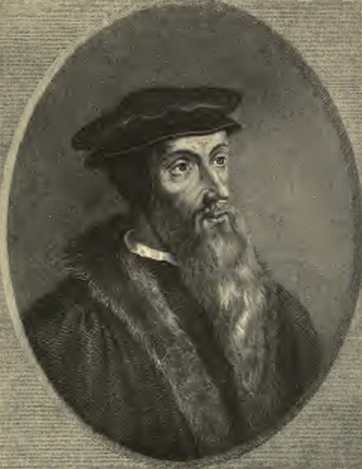
Was there in London but one religion, despotism might be apprehended; if two only, they would seek to cut each others throats; but as there are at least thirty, they live together in peace and happiness.
PRETENSIONS.
There is not a single prince in Europe who does not assume the title of sovereign of a country possessed by his neighbor. This political madness is unknown in the rest of the world. The king of Boutan never called himself emperor of China; nor did the sovereign of Tartary ever assume the title of king of Egypt.
The most splendid and comprehensive pretensions have always been those of the popes; two keys, saltier, gave them clear and decided possession of the kingdom of heaven. They bound and unbound everything on earth. This ligature made them masters of the continent; and St. Peter's nets gave them the dominion of the seas.
Many learned theologians thought, that when these gods were assailed by the Titans, called Lutherans, Anglicans, and Calvinists, etc., they themselves reduced some articles of their pretensions. It is certain that many of them became more modest, and that their celestial court attended more to propriety and decency; but their pretensions were renewed on every opportunity that offered. No other proof is necessary than the conduct of Aldobrandini, Clement VIII., to the great Henry IV., when it was deemed necessary to give him an absolution that he had no occasion for, on account of his being already absolved by the bishops of his own kingdom, and also on account of his being victorious.
Aldobrandini at first resisted for a whole year, and refused to acknowledge the duke of Nemours as the ambassador of France. At last he consented to open to Henry the gate of the kingdom of heaven, on the following conditions:
1. That Henry should ask pardon for having made the sub-porters—that is, the bishops—open the gate to him, instead of applying to the grand porter.
2. That he should acknowledge himself to have forfeited the throne of France till Aldobrandini, by the plenitude of his power, reinstated him on it.
3. That he should be a second time consecrated and crowned; the first coronation having been null and void, as it was performed without the express order of Aldobrandini.
4. That he should expel all the Protestants from his kingdom; which would have been neither honorable nor possible. It would not have been honorable, because the Protestants had profusely shed their blood to establish him as king of France; and it would not have been possible, as the number of these dissidents amounted to two millions.
5. That he should immediately make war on the Grand Turk, which would not have been more honorable or possible than the last condition, as the Grand Turk had recognized him as king of France at a time when Rome refused to do so, and as Henry had neither troops, nor money, nor ships, to engage in such an insane war with his faithful ally.
6. That he should receive in an attitude of complete prostration the absolution of the pope's legate, according to the usual form in which it is administered; that is in fact, that he should be actually scourged by the legate.
7. That he should recall the Jesuits, who had been expelled from his kingdom by the parliament for the attempt made to assassinate him by Jean Châtel, their scholar.
I omit many other minor pretensions. Henry obtained a mitigation of a number of them. In particular, he obtained the concession, although with a great deal of difficulty, that the scourging should be inflicted only by proxy, and by the hand of Aldobrandini himself.
You will perhaps tell me, that his holiness was obliged to require those extravagant conditions by that old and inveterate demon of the South, Philip II., who was more powerful at Rome than the pope himself. You compare Aldobrandini to a contemptible poltroon of a soldier whom his colonel forces forward to the trenches by caning him.
To this I answer, that Clement VIII. was indeed afraid of Philip II., but that he was not less attached to the rights of the tiara; and that it was so exquisite a gratification for the grandson of a banker to scourge a king of France, that Aldobrandini would not altogether have conceded this point for the world.
You will reply, that should a pope at present renew such pretensions, should he now attempt to apply the scourge to a king of France, or Spain, or Naples, or to a duke of Parma, for having driven the reverend fathers, the Jesuits, from their dominions, he would be in imminent danger of incurring the same treatment as Clement VII. did from Charles V., and even of experiencing still greater humiliations; that it is necessary to sacrifice pretensions to interests; that men must yield to times and circumstances; and that the sheriff of Mecca must proclaim Ali Bey king of Egypt, if he is successful and firm upon the throne. To this I answer, that you are perfectly right.
Pretensions Of The Empire; Extracted From Glafey And Schwedar.
Upon Rome (none). Even Charles V., after he had taken Rome, claimed no right of actual domain.
Upon the patrimony of St. Peter, from Viterbo to Civita Castellana, the estates of the countess Mathilda, but solemnly ceded by Rudolph of Hapsburg.
Upon Parma and Placentia, the supreme dominion as part of Lombardy, invaded by Julius II., granted by Paul III., to his bastard Farnese: homage always paid for them to the pope from that time; the sovereignty always claimed by the seigneurs of Lombardy; the right of sovereignty completely ceded to the emperor by the treaties of Cambray and of London, at the peace of 1737.
Upon Tuscany, right of sovereignty exercised by Charles V.; an estate of the empire, belonging now to the emperor's brother.
Upon the republic of Lucca, erected into a duchy by Louis of Bavaria, in 1328; the senators declared afterwards vicars of the empire by Charles IV. The Emperor Charles VI., however, in the war of 1701, exercised in it his right of sovereignty by levying upon it a large contribution.
Upon the duchy of Milan, ceded by the Emperor Wincenslaus to Galeas Visconti, but considered as a fief of the empire.
Upon the duchy of Mirandola, reunited to the house of Austria in 1711 by Joseph I.
Upon the duchy of Mantua, erected into a duchy by Charles V.; reunited in like manner in 1708.
Upon Guastalla, Novellara, Bozzolo, and Castiglione, also fiefs of the empire, detached from the duchy of Mantua.
Upon the whole of Montferrat, of which the duke of Savoy received the investiture at Vienna in 1708.
Upon Piedmont, the investiture of which was bestowed by the emperor Sigismund on the duke of Savoy, Amadeus VIII.
Upon the county of Asti, bestowed by Charles V., on the house of Savoy: the dukes of Savoy always vicars in Italy from the time of the emperor Sigismund.
Upon Genoa, formerly part of the domain of the Lombard kings. Frederick Barbarossa granted to it in fief the coast from Monaco to Portovenere; it is free under Charles V., in 1529; but the words of the instrument are In civitate nostra Genoa, et salvis Romani imperii juribus.
Upon the fiefs of Langues, of which the dukes of Savoy have the direct domain.
Upon Padua, Vicenza, and Verona, rights fallen into neglect.
Upon Naples and Sicily, rights still more fallen into neglect. Almost all the states of Italy are or have been in vassalage to the empire.
Upon Pomerania and Mecklenburg, the fiefs of which were granted by Frederick Barbarossa.
Upon Denmark, formerly a fief of the empire; Otho I. granted the investiture of it.
Upon Poland, for the territory on the banks of the Vistula.
Upon Bohemia and Silesia, united to the empire by Charles IV., in 1355.
Upon Prussia, from the time of Henry VII.; the grand master of Prussia acknowledged a member of the empire in 1500.
Upon Livonia, from the time of the knights of the sword. Upon Hungary, from the time of Henry II.
Upon Lorraine, by the treaty of 1542; acknowledged an estate of the empire, paying taxes to support the war against the Turks.
Upon the duchy of Bar down to the year 1311, when Philip the Fair, who conquered it, did homage for it.
Upon the duchy of Burgundy, by virtue of the rights of Mary of Burgundy.
Upon the kingdom of Arles and Burgundy on the other side of the Jura, which Conrad the Salian, possessed in chief by his wife.
Upon Dauphiny, as part of the kingdom of Arles; the emperor Charles IV. having caused himself to be crowned at Arles in 1365, and created the dauphin of France his viceroy.
Upon Provence, as a member of the kingdom of Arles, for which Charles of Anjou did homage to the empire.
Upon the principality of Orange, as an arrière-fief of the empire.
Upon Avignon, for the same reason.
Upon Sardinia, which Frederick II. erected into a kingdom.
Upon Switzerland, as a member of the kingdoms of Arles and Burgundy.
Upon Dalmatia, a great part of which belongs at present wholly to the Venetians, and the rest to Hungary.
PRIDE.
Cicero, in one of his letters, says familiarly to his friend: "Send to me the persons to whom you wish me to give the Gauls." In another, he complains of being fatigued with letters from I know not what princes, who thank him for causing their provinces to be erected into kingdoms; and he adds that he does not even know where these kingdoms are situated.
It is probable that Cicero, who often saw the Roman people, the sovereign people, applaud and obey him, and who was thanked by kings whom he knew not, had some emotions of pride and vanity.
Though the sentiment is not at all consistent in so pitiful an animal as man, yet we can pardon it in a Cicero, a Cæsar, or a Scipio; but when in the extremity of one of our half barbarous provinces, a man who may have bought a small situation, and printed poor verses, takes it into his head to be proud, it is very laughable.
PRIESTS.
Priests in a state approach nearly to what preceptors are in private families: it is their province to teach, pray, and supply example. They ought to have no authority over the masters of the house; at least until it can be proved that he who gives the wages ought to obey him who receives them. Of all religions the one which most positively excludes the priesthood from civil authority, is that of Jesus. "Give unto Cæsar the things which are Cæsar's."—"Among you there is neither first nor last."—"My kingdom is not of this world."
The quarrels between the empires and the priesthood, which have bedewed Europe with blood for more than six centuries, have therefore been, on the part of the priests, nothing but rebellion at once against God and man, and a continual sin against the Holy Ghost.
From the time of Calchas, who assassinated the daughter of Agamemnon, until Gregory XII., and Sixtus V., two bishops who would have deprived Henry IV., of the kingdom of France, sacerdotal power has been injurious to the world.
Prayer is not dominion, nor exhortation despotism. A good priest ought to be a physician to the soul. If Hippocrates had ordered his patients to take hellebore under pain of being hanged, he would have been more insane and barbarous than Phalaris, and would have had little practice. When a priest says: Worship God; be just, indulgent, and compassionate; he is then a good physician; when he says: Believe me, or you shall be burned; he is an assassin.
The magistrate ought to support and restrain the priest in the same manner as the father of a family insures respect to the preceptor, and prevents him from abusing it. The agreement of Church and State is of all systems the most monstrous, for it necessarily implies division, and the existence of two contracting parties. We ought to say the protection given by government to the priesthood or church.
But what is to be said and done in respect to countries in which the priesthood have obtained dominion, as in Salem, where Melchizedek was priest and king; in Japan, where the dairo has been for a long time emperor? I answer, that the successors of Melchizedek and the dairos have been set aside.
The Turks are wise in this; they religiously make a pilgrimage to Mecca; but they will not permit the xerif of Mecca to excommunicate the sultan. Neither will they purchase from Mecca permission not to observe the ramadan, or the liberty of espousing their cousins or their nieces. They are not judged by imans, whom the xerif delegates; nor do they pay the first year's revenue to the xerif. What is to be said of all that? Reader, speak for yourself.
PRIESTS OF THE PAGANS.
Father Navarette, in one of his letters to Don John of Austria, relates the following speech of the dalai-lama to his privy council: "My venerable brothers, you and I know very well that I am not immortal; but it is proper that the people should think so. The Tartars of great and little Thibet are people with stiff necks and little information, who require a heavy yoke and gross inventions. Convince them of my immortality, and the glory will reflect on you, and you will procure honors and riches.
"When the time shall come in which the Tartars will be more enlightened, we may then confess that the grand lamas are not now immortal, but that their predecessors were so; and that what is necessary for the erection of a grand edifice, is no longer so when it is established on an immovable foundation.
"I hesitated at first to distribute the agremens of my water-closet, properly inclosed in crystals ornamented with gilded copper, to the vassals of my empire; but these relics have been received with so much respect, that the usage must be continued, which after all exhibits nothing repugnant to sound morals, and brings much money into our sacred treasury.
"If any impious reasoner should ever endeavor to persuade the people that one end of our sacred person is not so divine as the other—should they protest against our relics, you will maintain their value and importance to the utmost of your power.
"And if you are finally obliged to give up the sanctity of our nether end, you must take care to preserve in the minds of the reasoners the most profound respect for our understanding, just as in a treaty with the Moguls, we have ceded a poor province, in order to secure our peaceable possession of the remainder.
"So long as our Tartars of great and little Thibet are unable to read and write, they will remain ignorant and devout; you may therefore boldly take their money, intrigue with their wives and their daughters, and threaten them with the anger of the god Fo if they complain.
"When the time of correct reasoning shall arrive—for it will arrive some day or other—you will then take a totally opposite course, and say directly the contrary of what your predecessors have said, for you ought to change the nature of your curb in proportion as the horses become more difficult to govern. Your exterior must be more grave, your intrigues more mysterious, your secrets better guarded, your sophistry more dazzling, and your policy more refined. You will then be the pilots of a vessel which is leaky on all sides. Have under you subalterns continually employed at the pumps, and as caulkers to stop all the holes. You will navigate with difficulty, but you will still proceed, and be enabled to cast into the fire or the water, as may be most convenient, all those who would examine whether you have properly refitted the vessel.
"If among the unbelievers is a prince of Calkas, a chief of the Kalmucks, a prince of Kasan, or any other powerful prince, who has unhappily too much wit, take great care not to quarrel with him. Respect him, and continually observe that you hope he will return to the holy path. As to simple citizens, spare them not, and the better men they are, the more you ought to labor to exterminate them; for being men of honor they are the most dangerous of all to you. You will exhibit the simplicity of the dove, the prudence of the serpent, and the paw of the lion, according to circumstances."
The dalai-lama had scarcely pronounced these words when the earth trembled; lightnings sparkled in the firmament from one pole to the other; thunders rolled, and a celestial voice was heard to exclaim, "Adore God and not the grand lama."
All the inferior lamas insisted that the voice said, "Adore God and the grand lama;" and they were believed for a long time in the kingdom of Thibet; but they are now believed no longer.
PRIOR, BUTLER, AND SWIFT.
It was not known to France that Prior, who was deputed by Queen Anne to adjust the treaty of Utrecht with Louis XIV., was a poet. France has since repaid England in the same coin, for Cardinal Dubois sent our Destouches to London, where he passed as little for a poet as Prior in France. Prior was originally an attendant at a tavern kept by his uncle, when the earl of Dorset, a good poet himself and a lover of the bottle, one day surprised him reading Horace; in the same manner as Lord Ailsa found his gardener reading Newton. Ailsa made his gardener a good geometrician, and Dorset made a very agreeable poet of his vintner.
It was Prior who wrote the history of the soul under the title of "Alma," and it is the most natural which has hitherto been composed on an existence so much felt, and so little known. The soul, according to "Alma," resides at first, in the extremities; in the feet and hands of children, and from thence gradually ascends to the centre of the body at the age of puberty. Its next step is to the heart, in which it engenders sentiments of love and heroism; thence it mounts to the head at a mature age, where it reasons as well as it is able; and in old age it is not known what becomes of it; it is the sap of an aged tree which evaporates, and is not renewed again. This work is probably too long, for all pleasantry should be short; and it might even be as well were the serious short also.
Prior made a small poem on the battle of Hochstädt. It is not equal to his "Alma"; there is, however, one good apostrophe to Boileau, who is called a satirical flatterer for taking so much pains to sing that Louis did not pass the Rhine. Our plenipotentiary finished by paraphrasing, in fifteen hundred verses, the words attributed to Solomon, that "all is vanity". Fifteen thousand verses might be written on this subject; but woe to him who says all which can be said upon it!
At length Queen Anne dying, the ministry changed, and the peace adjusted by Prior being altogether unpopular, he had nothing to depend upon except an edition of his works; which were subscribed for by his party: after which he died like a philosopher, which is the usual mode of dying of all respectable Englishmen.
Hudibras.
There is an English poem which it is very difficult to make foreigners understand, entitled "Hudibras." It is a very humorous work, although the subject is the civil war of the time of Cromwell. A struggle which cost so much blood and so many tears, originated a poem which obliges the most serious reader to smile. An example of this contrast is found in our "Satire of Menippus." Certainly the Romans would not have made a burlesque poem on the wars of Pompey and Cæsar, or the proscription of Antony and Octavius. How then is it that the frightful evils of the League in France, and of the wars between the king and parliament in England, have proved sources of pleasantry? because at bottom there is something ridiculous hid beneath these fatal quarrels. The citizens of Paris, at the head of the faction of Sixteen, mingled impertinence with the miseries of faction. The intrigues of women, of the legates and of the monks, presented a comic aspect, notwithstanding the calamities which they produced. The theological disputes and enthusiasm of the Puritans in England, were also very open to raillery; and this fund of the ridiculous, well managed, might pleasantly enough aid in dispersing the tragical horrors which abound on the surface. If the bull Unigenitus caused the shedding of blood, the little poem "Philotanus" was no less suitable to the subject; and it is only to be complained of for not being so gay, so pleasant, and so various as it might have been; and for not fulfilling in the course of the work the promise held out by its commencement.
The poem of "Hudibras" of which I speak, seems to be a composition of the satire of "Menippus" and of "Don Quixote." It surpasses them in the advantage of verse and also in wit; the former indeed does not come near it; being a very middling production; but notwithstanding his wit, the author of "Hudibras" is much beneath "Don Quixote." Taste, vivacity, the art of narrating and of introducing adventures, with the faculty of never being tedious, go farther than wit; and moreover, "Don Quixote" is read by all nations, and "Hudibras" by the English alone.
Butler, the author of this extraordinary poem, was contemporary with Milton, and enjoyed infinitely more temporary popularity than the latter, because his work was humorous, and that of Milton melancholy. Butler turned the enemies of King Charles II. into ridicule, and all the recompense he received was the frequent quotation of his verses by that monarch. The combats of the knight Hudibras were much better known than the battles between the good and bad angels in "Paradise Lost"; but the court of England treated Butler no better than the celestial court treated Milton; both the one and the other died in want, or very near it.
A man whose imagination was impregnated with a tenth part of the comic spirit, good or bad, which pervades this work, could not but be very pleasant; but he must take care how he translates "Hudibras." It is difficult to make foreign readers laugh at pleasantries which are almost forgotten by the nation which has produced them. Dante is little read in Europe, because we are ignorant of so much of his allusion; and it is the same with "Hudibras." The greater part of the humor of this poem being expended on the theology and theologians of its own time, a commentary is eternally necessary. Pleasantry requiring explanation ceases to be pleasantry; and a commentator on bon mots is seldom capable of conveying them.
Of Dean Swift.
How is it that in France so little is understood of the works of the ingenious Doctor Swift, who is called the Rabelais of England? He has the honor, like the latter, of being a churchman and an universal joker; but Rabelais was not above his age, and Swift is much above Rabelais.
Our curate of Meudon, in his extravagant and unintelligible book, has exhibited extreme gayety and equally great impertinence. He has lavished at once erudition, coarseness and ennui. A good story of two pages is purchased by a volume of absurdities. There are only some persons of an eccentric taste who pique themselves upon understanding and valuing the whole of this work. The rest of the nation laugh at the humor of Rabelais, and despise the work; regarding him only as the first of buffoons. We regret that a man who possessed so much wit, should have made so miserable a use of it. He is a drunken philosopher, who wrote only in the moments of his intoxication.
Dr. Swift is Rabelais sober, and living in good company. He has not indeed the gayety of the former, but he has all the finesse, sense, discrimination, which is wanted by our curate of Meudon. His verse is in a singular taste, and almost inimitable. He exhibits a fine vein of humor, both in prose and in verse; but in order to understand it, it is necessary to visit his country.
In this country, which appears so extraordinary to other parts of Europe, it has excited little surprise that Doctor Swift, dean of a cathedral, should make merry in his "Tale of a Tub" with Catholicism, Lutheranism, and Calvinism; his own defence is that he has not meddled with Christianity. He pretends to respect the parent, while he scourges the children. Certain fastidious persons are of opinion that his lashes are so long they have even reached the father.
This famous "Tale of a Tub" is the ancient story of the three invisible rings which a father bequeathed to his three children. These three rings were the Jewish, the Christian, and the Mahometan religions. It is still more an imitation of the history of Mero and Enégu by Fontenelle. Mero is the anagram of Rome; Enégu of Geneva, and they are two sisters who aspire to the succession of the kingdom of their father. Mero reigns the first, and Fontenelle represents her as a sorceress, who plays tricks with bread and effects conjuration with dead bodies. This is precisely the Lord Peter of Swift, who presents a piece of bread to his two brothers, and says to them, "Here is some excellent Burgundy, my friends; this partridge is of a delicious flavor." Lord Peter in Swift performs the same part with the Mero of Fontenelle.
Thus almost all is imitation. The idea of the "Persian Letters" was taken from that of the "Turkish Spy." Boyardo imitated Pulci; Ariosto, Boyardo; the most original wits borrow from one another. Cervantes makes a madman of his Don Quixote, but is Orlando anything else? It would be difficult to decide by which of the two knight-errantry is more ridiculed, the grotesque portraiture of Cervantes, or the fertile imagination of Ariosto. Metastasia has borrowed the greater part of his operas from our French tragedies; and many English authors have copied us and said nothing about it. It is with books as with the fires in our grates; everybody borrows a light from his neighbor to kindle his own, which in its turn is communicated to others, and each partakes of all.
PRIVILEGE—PRIVILEGED CASES.
Custom, which almost always prevails against reason, would have the offences of ecclesiastics and monks against civil orders, which are very frequent, called privileged offences; and those offences common which regard only ecclesiastical discipline, cases that are abandoned to the sacerdotal hierarchy, and with which the civil power does not interfere.
The Church having no jurisdiction but that which sovereigns have granted it, and the judges of the Church being thus only judges privileged by the sovereign, those cases should be called privileged which it is their province to judge, and those common offences which are punishable by the prince's officers. But the canonists, who are very rarely exact in their expressions, particularly when treating of regal jurisprudence, having regarded a priest called the official, as being of right the sole judge of the clergy, they have entitled that privilege, which in common law belongs to lay tribunals, and the ordinances of the monarch have adopted this expression in France.
To conform himself to this custom, the judge of the Church takes cognizance only of common crime; in respect to privileged cases he can act only concurrently with the regal judge, who repairs to the episcopal court, where, however, he is but the assessor of the judge of the Church. Both are assisted by their register; each separately, but in one another's presence, takes notes of the course of the proceedings. The official who presides alone interrogates the accused; and if the royal judge has questions to put to him, he must have permission of the ecclesiastical judge to propose them.
This procedure is composed of formalities, and produces delays which should not be admitted in criminal jurisprudence. Judges of the Church who have not made a study of laws and formalities are seldom able to conduct criminal proceedings without giving place to appeals, which ruin the accused in expense, make him languish in chains, or retard his punishment if he is guilty.
Besides, the French have no precise law to determine which are privileged cases. A criminal often groans in a dungeon for a whole year, without knowing what tribunal will judge him. Priests and monks are in the state and subjects of it. It is very strange that when they trouble society they are not to be judged, like other citizens, by the officers of the sovereign.
Among the Jews, even the high priest had not the privilege which our laws grant to simple parish priests. Solomon deposed the high priest Abiathar, without referring him to the synagogue to take his trial. Jesus Christ, accused before a secular and pagan judge, challenged not his jurisdiction. St. Paul, translated to the tribunal of Felix and Festus, declined not their judgment. The Emperor Constantine first granted this privilege to bishops. Honorius and Theodosius the younger extended it to all the clergy, and Justinian confirmed it.
In digesting the criminal code of 1670, the counsellor of state, Pussort, and the president of Novion, wished to abolish the conjoint proceeding, and to give to royal judges alone the right of judging the clergy accused of privileged cases; but this so reasonable desire was combated by the first president De Lamoignon, and the advocate-general Talon, and a law which was made to reform our abuses confirmed the most ridiculous of them.
A declaration of the king on April 26, 1657, forbids the Parliament of Paris to continue the proceeding commenced against Cardinal Retz, accused of high treason. The same declaration desires that the suits of cardinals, archbishops, and bishops of the kingdom, accused of the crime of high treason, are to be conducted and judged by ecclesiastical judges, as ordered by the canons.
But this declaration, contrary to the customs of the kingdoms, has not been registered in any parliament, and would not be followed. Our books relate several sentences which have doomed cardinals, archbishops, and bishops to imprisonment, deposition, confiscation, and other punishments. These punishments were pronounced against the bishop of Nantes, by sentence of June 25, 1455; against Jean de la Balue, cardinal and bishop of Angers, by sentence dated July 29, 1469; Jean Hebert, bishop of Constance, in 1480; Louis de Rochechouart, bishop of Nantes, in 1481; Geoffroi de Pompadour, bishop of Périgueux, and George d'Amboise, bishop of Montauban, in 1488; Geoffroi Dintiville, bishop of Auxerre, in 1531; Bernard Lordat, bishop of Pumiers, in 1537; Cardinal de Châtillon, bishop of Beauvais, the 19th of March, 1569; Geoffroi de La Martonie, bishop of Amiens, the 9th of July, 1594; Gilbert Génébrard, archbishop of Aix, the 26th of January, 1596; William Rose, bishop of Senlis, September 5, 1598; Cardinal de Sourdis, archbishop of Bordeaux, November 17, 1615.
The parliament sentenced Cardinal de Bouillon to be imprisoned, and seized his property on June 20, 1710.
Cardinal de Mailly, archbishop of Rheims, in 1717, made a law tending to destroy the ecclesiastical peace established by the government. The hangman publicly burned the law by sentence of parliament.
The sieur Languet, bishop of Soissons, having maintained that he could not be judged by the justice of the king even for the crime of high treason, was condemned to pay a fine of ten thousand livres.
In the shameful troubles excited by the refusal of sacraments, the simple presidial of Nantes condemned the bishop of that city to pay a fine of six thousand francs for having refused the communion to those who demanded it.
In 1764, the archbishop of Auch, of the name of Montillet, was fined, and his command, regarded as a defamatory libel, was burned by the executioner at Bordeaux.
These examples have been very frequent. The maxim, that ecclesiastics are entirely amenable to the justice of the king, like other citizens, has prevailed throughout the kingdom. There is no express law which commands it; but the opinion of all lawyers, the unanimous cry of the nation, and the good of the state, are in themselves a law.
TABLE OF CONTENTS
LIST OF PLATES—Vol. VIII MONEY. MONSTERS. MORALITY. MOSES. MOTION. MOUNTAIN. NAIL. NATURE. NECESSARY—NECESSITY. NEW—NOVELTIES. NUDITY. NUMBER. NUMBERING. OCCULT QUALITIES. OFFENCES (LOCAL). ONAN. OPINION. OPTIMISM. ORACLES. ORDEAL. ORDINATION. ORIGINAL SIN. OVID. PARADISE. PASSIONS. PAUL PERSECUTION. PETER (SAINT). PETER THE GREAT AND J.J. ROUSSEAU. PHILOSOPHER. PHILOSOPHY. PHYSICIANS. PIRATES OR BUCCANEERS. PLAGIARISM. PLATO. POETS. POISONINGS. POLICY. POLYPUS. POLYTHEISM. POPERY. POPULATION. POSSESSED. POST. POWER—OMNIPOTENCE. POWER. PRAYER (PUBLIC), THANKSGIVING, ETC. PREJUDICE. PRESBYTERIAN. PRETENTIONS PRIDE. PRIESTS. PRIESTS OF THE PAGANS. PRIOR, BUTLER, AND SWIFT. PRIVILEGE—PRIVILEGED CASES