VOLUME XII (continued 2)
William F. Fleming translation
I have carried the number of inhabitants which compose the empire of Russia to twenty-four millions, in the statements which have been sent to me; but I have not guaranteed this valuation, because I know very little about it. I believe that Germany possessed as many people, reckoning the Hungarians. If I am deceived by one or two millions, we know it is a trifle in such a case.
I beg pardon of the King of Spain, if I have only awarded him seven millions of subjects in our continent. It is a very small number; but Don Ustaris, employed in the ministry, gives him no more. We reckon from about nine to ten millions of free beings in the three kingdoms of Great Britain. In France we count between sixteen and twenty millions. This is a proof that Doctor Gad has nothing wherewith to reproach the ministry of France.
As to the capital towns, opinions are further divided. According to some calculators, Paris has seven hundred thousand inhabitants, and according to others five hundred thousand. It is thus with London, Constantinople, and Grand Cairo.
As to the subjects of the pope, they will make a crowd in paradise, but the multitude is moderate on earth. Why so?—because they are subjects of the pope. Would Cato the Censor have ever believed the Romans would come to that pass?
OCCULT QUALITIES.
Occult qualities have for a very long time been much derided; it would be more proper to deride those who do not believe in them. Let us for the hundredth time repeat that every principle, every primitive source of any of the works which come from the hand of the demiourgos, is occult, and eternally hidden from mortals.
What is the centripetal force, the force of gravitation, which acts without contact at such immense distances? What causes our hearts to beat sixty times a minute? What other power changes this grass into milk in the udder of a cow? and this bread into the flesh, blood, and bone of that child, who grows proportionally while he eats it, until he arrives at the height determined by nature, after which there is no art which can add a line to it.
Vegetables, minerals, animals, where is your originating principle? In the hands of Him who turns the sun on its axis, and who has clothed it with light. This lead will never become silver, nor this silver gold; this gold will never become diamond, nor this straw be transformed into lemons and bananas. What corpuscular system of physics, what atoms, determine their nature? You know nothing about it, and the cause will be eternally occult to you. All that surrounds us, all within us, is an enigma which it is not in the power of man to divine.
The furred ignoramus ought to have been aware of this truth when he said that beasts possess a vegetative and sensitive soul, and man a soul which is vegetative, sensitive, and intellectual. Poor man, kneaded up of pride, who has pronounced only words—have you ever seen a soul? Know you how it is made? We have spoken much of the soul in these inquiries, but have always confessed our ignorance. I now repeat this confession still more emphatically, since the more I read, the more I meditate, and the more I acquire, the more am I enabled to affirm that I know nothing.
OFFENCES (LOCAL).
If we travel throughout the whole earth, we still find that theft, murder, adultery, calumny, etc., are regarded as offences which society condemns and represses; but that which is approved in England and condemned in Italy, ought it to be punished in Italy, as if it were one of the crimes against general humanity? That which is a crime only in the precincts of some mountains, or between two rivers, demands it not from judges more indulgence than those outrages which are regarded with horror in all countries? Ought not the judge to say to himself, I should not dare to punish in Ragusa what I punish at Loretto? Should not this reflection soften his heart, and moderate the hardness which it is too apt to contract in the long exercise of his employment? The "Kermesses" of Flanders are well known; they were carried in the last century to a degree of indecency, revolting to the eyes of all persons who were not accustomed to such spectacles.
The following is the manner in which Christmas is celebrated in some countries. In the first place appears a young man half-naked, with wings on his shoulders; he repeats the Ave Maria to a young girl, who replies "fiat," and the angel kisses her on the mouth; after which a child, shut up in a great cock of pasteboard, imitates the crowing of the cock. "Puer natus est nobis." A great ox bellows out "ubi"; a sheep baas out "Bethlehem"; an ass brays "hihanus", to signify "eamus"; and a long procession, preceded by four fools with bells and baubles, brings up the rear. There still remain some traces of this popular devotion, which among a civilized and educated people would be taken for profanation. A Swiss, out of patience, and possibly more intoxicated than the performers of the ox and the ass, took the liberty of remonstrating with them at Louvain, and was rewarded with no small number of blows; they would indeed have hanged him, and he escaped with great difficulty.
The same man had a dangerous quarrel at The Hague for violently taking the part of Barnevelt against an outrageous Gomarist. He was imprisoned at Amsterdam for saying that priests were the scourge of humanity, and the source of all our misfortunes. "How!" said he, "if we maintain that good works are necessary to salvation, we are sent to a dungeon; and if we laugh at a cock and an ass we risk hanging!" Ridiculous as this adventure was, it is sufficient to convince us that we may be criminal in one or two points in our hemisphere, and innocent in all the rest of the world.
ONAN.
The race of Onan exhibits great singularities. The patriarch Judah, his father, lay with his daughter-in-law, Tamar the Phœnician, in the highroad; Jacob, the father of Judah, was at the same time married to two sisters, the daughters of an idolater; and deluded both his father and father-in-law. Lot, the granduncle of Jacob, lay with his two daughters. Saleum, one of the descendants of Jacob and of Judah, espoused Rahab the Canaanite, a prostitute. Boaz, son of Saleum and Rahab, received into his bed Ruth the Midianite; and was great grandfather of David. David took away Bathsheba from the warrior Uriah, her husband, and caused him to be slain, that he might be unrestrained in his amour. Lastly, in the two genealogies of Christ, which differ in so many points, but agree in this, we discover that he descended from this tissue of fornication, adultery, and incest.
Nothing is more proper to confound human prudence; to humble our limited minds; and to convince us that the ways of Providence are not like our ways. The reverend father Dom Calmet makes this reflection, in alluding to the incest of Judah with Tamar, and to the sin of Onan, spoken of in the 38th chapter of "Genesis": "Scripture," he observes, "gives us the details of a history, which on the first perusal strikes our minds as not of a nature for edification; but the hidden sense which is shut up in it is as elevated as that of the mere letter appears low to carnal eyes. It is not without good reasons that the Holy Spirit has allowed the histories of Tamar, of Rahab, of Ruth, and of Bathsheba, to form a part of the genealogy of Jesus Christ."
It might have been well if Dom Calmet had explained these sound reasons, by which we might have cleared up the doubts and appeased the scruples of all the honest and timorous souls who are anxious to comprehend how this Supreme Being, the Creator of worlds, could be born in a Jewish village, of a race of plunderers and of prostitutes. This mystery, which is not less inconceivable than other mysteries, was assuredly worthy the explanation of so able a commentator—but to return to our subject.
We perfectly understand the crime of the patriarch Judah, and of the patriarchs Simeon and Levi, his brothers, at Sichem; but it is more difficult to understand the sin of Onan. Judah had married his eldest son Er to the Phœnician, Tamar. Er died in consequence of his wickedness, and the patriarch wished his second son to espouse the widow, according to an ancient law of the Egyptians and Phœnicians, their neighbors, which was called raising up seed for his brother. The first child of this second marriage bore the name of the deceased, and this Onan objected to. He hated the memory of his brother, or to produce a child to bear the name of Er; and to avoid it took the means which are detailed in the chapter of "Genesis" already mentioned, and which are practised by no species of animals but apes and human beings.
An English physician wrote a small volume on this vice, which he called after the name of the patriarch who was guilty of it. M. Tissot, the celebrated physician of Lausanne, also wrote on this subject, in a work much more profound and methodical than the English one. These two works detail the consequences of this unhappy habit—loss of strength, impotence, weakness of the stomach and intestines, tremblings, vertigo, lethargy, and often premature death.
M. Tissot, however, to console us for this evil, relates as many examples of the mischiefs of repletion in both sexes. There cannot be a stronger argument against rash vows of chastity. From the examples afforded, it is impossible to avoid being convinced of the enormous folly of condemning ourselves to these turpitudes in order to renounce a connection which has been expressly commanded by God Himself. In this manner think the Protestants, the Jews, the Mahometans, and many other nations; the Catholics offer other reasons in favor of converts. I shall merely say of the Catholics what Dom Calmet says of the Holy Ghost—That their reasons are doubtless good, could we understand them.
OPINION.
What is the opinion of all the nations of the north of America, and those which border the Straits of Sunda, on the best of governments, and best of religions; on public ecclesiastical rights; on the manner of writing history; on the nature of tragedy, comedy, opera, eclogue, epic poetry; on innate ideas, concomitant grace, and the miracles of Deacon Paris? It is clear that all these people have no opinions on things of which they have no ideas.
They have a confused feeling of their customs, and go not beyond this instinct. Such are the people who inhabit the shores of the Frozen Sea for the space of fifteen hundred leagues. Such are the inhabitants of the three parts of Africa, and those of nearly all the isles of Asia; of twenty hordes of Tartars, and almost all men solely occupied with the painful and continual care of providing their subsistence. Such are, at two steps from us, most of the Morlachians, many of the Savoyards, and some citizens of Paris.
When a nation begins to be civilized, it has some opinions which are quite false. It believes in spirits, sorcerers, the enchantment of serpents and their immortality; in possessions of the devil, exorcisms, and soothsayers. It is persuaded that seeds must grow rotten in the earth to spring up again, and that the quarters of the moon are the causes of accesses of fever.
A Talapoin persuades his followers that the god Sammonocodom sojourned some time at Siam, and that he cut down all the trees in a forest which prevented him from flying his kite at his ease, which was his favorite amusement. This idea takes root in their heads; and finally, an honest man who might doubt this adventure of Sammonocodom, would run the risk of being stoned. It requires ages to destroy a popular opinion. Opinion is called the queen of the world; it is so; for when reason opposes it, it is condemned to death. It must rise twenty times from its ashes to gradually drive away the usurper.
OPTIMISM.
I beg of you, gentlemen, to explain to me how everything is for the best; for I do not understand it. Does it signify that everything is arranged and ordered according to the laws of the impelling power? That I comprehend and acknowledge. Do you mean that every one is well and possesses the means of living—that nobody suffers? You know that such is not the case. Are you of the opinion that the lamentable calamities which afflict the earth are good in reference to God; and that He takes pleasure in them? I credit not this horrible doctrine; neither do you.
Have the goodness to explain how all is for the best. Plato, the dialectician, condescended to allow to God the liberty of making five worlds; because, said he, there are five regular solids in geometry, the tetrahedron, the cube, the hexahedron, the dodecahedron, and the icosahedron. But why thus restrict divine power? Why not permit the sphere, which is still more regular, and even the cone, the pyramid of many sides, the cylinder, etc.?
God, according to Plato, necessarily chose the best of all possible worlds; and this system has been embraced by many Christian philosophers, although it appears repugnant to the doctrine of original sin. After this transgression, our globe was no more the best of all possible worlds. If it was ever so, it might be so still; but many people believe it to be the worst of worlds instead of the best.
Leibnitz takes the part of Plato; more readers than one complain of their inability to understand either the one or the other; and for ourselves, having read both of them more than once, we avow our ignorance according to custom; and since the gospel has revealed nothing on the subject, we remain in darkness without remorse.
Leibnitz, who speaks of everything, has treated of original sin; and as every man of systems introduces into his plan something contradictory, he imagined that the disobedience towards God, with the frightful misfortunes which followed it, were integral parts of the best of worlds, and necessary ingredients of all possible felicity: "Calla, calla, senor don Carlos; todo che se haze es por su ben."
What! to be chased from a delicious place, where we might have lived for ever only for the eating of an apple? What! to produce in misery wretched children, who will suffer everything, and in return produce others to suffer after them? What! to experience all maladies, feel all vexations, die in the midst of grief, and by way of recompense be burned to all eternity—is this lot the best possible? It certainly is not good for us, and in what manner can it be so for God? Leibnitz felt that nothing could be said to these objections, but nevertheless made great books, in which he did not even understand himself.
Lucullus, in good health, partaking of a good dinner with his friends and his mistress in the hall of Apollo, may jocosely deny the existence of evil; but let him put his head out of the window and he will behold wretches in abundance; let him be seized with a fever, and he will be one himself.
I do not like to quote; it is ordinarily a thorny proceeding. What precedes and what follows the passage quoted is too frequently neglected; and thus a thousand objections may rise. I must, notwithstanding, quote Lactantius, one of the fathers, who, in the thirteenth chapter on the anger of God, makes Epicurus speak as follows: "God can either take away evil from the world and will not; or being willing to do so, cannot; or He neither can nor will; or, lastly, He is both able and willing. If He is willing to remove evil and cannot, then is He not omnipotent. If He can, but will not remove it, then is He not benevolent; if He is neither able nor willing, then is He neither powerful nor benevolent; lastly, if both able and willing to annihilate evil, how does it exist?"
The argument is weighty, and Lactantius replies to it very poorly by saying that God wills evil, but has given us wisdom to secure the good. It must be confessed that this answer is very weak in comparison with the objection; for it implies that God could bestow wisdom only by allowing evil—a pleasant wisdom truly! The origin of evil has always been an abyss, the depth of which no one has been able to sound. It was this difficulty which reduced so many ancient philosophers and legislators to have recourse to two principles—the one good, the other wicked. Typhon was the evil principle among the Egyptians, Arimanes among the Persians. The Manichæans, it is said, adopted this theory; but as these people have never spoken either of a good or of a bad principle, we have nothing to prove it but the assertion.
Among the absurdities abounding in this world, and which may be placed among the number of our evils, that is not the least which presumes the existence of two all-powerful beings, combating which shall prevail most in this world, and making a treaty like the two physicians in Molière: "Allow me the emetic, and I resign to you the lancet."
Basilides pretended, with the platonists of the first century of the church, that God gave the making of our world to His inferior angels, and these, being inexpert, have constructed it as we perceive. This theological fable is laid prostrate by the overwhelming objection that it is not in the nature of a deity all-powerful and all-wise to intrust the construction of a world to incompetent architects.
Simon, who felt the force of this objection, obviates it by saying that the angel who presided over the workmen is damned for having done his business so slovenly, but the roasting of this angel amends nothing. The adventure of Pandora among the Greeks scarcely meets the objection better. The box in which every evil is enclosed, and at the bottom of which remains Hope, is indeed a charming allegory; but this Pandora was made by Vulcan, only to avenge himself on Prometheus, who had stolen fire to inform a man of clay.
The Indians have succeeded no better. God having created man, gave him a drug which would insure him permanent health of body. The man loaded his ass with the drug, and the ass being thirsty, the serpent directed him to a fountain, and while the ass was drinking, purloined the drug.
The Syrians pretended that man and woman having been created in the fourth heaven, they resolved to eat a cake in lieu of ambrosia, their natural food. Ambrosia exhaled by the pores; but after eating cake, they were obliged to relieve themselves in the usual manner. The man and the woman requested an angel to direct them to a water-closet. Behold, said the angel, that petty globe which is almost of no size at all; it is situated about sixty millions of leagues from this place, and is the privy of the universe—go there as quickly as you can. The man and woman obeyed the angel and came here, where they have ever since remained; since which time the world has been what we now find it. The Syrians will eternally be asked why God allowed man to eat the cake and experience such a crowd of formidable ills?
I pass with speed from the fourth heaven to Lord Bolingbroke. This writer, who doubtless was a great genius, gave to the celebrated Pope his plan of "all for the best," as it is found word for word in the posthumous works of Lord Bolingbroke, and recorded by Lord Shaftesbury in his "Characteristics." Read in Shaftesbury's chapter of the "Moralists" the following passage:
"Much may be replied to these complaints of the defects of nature—How came it so powerless and defective from the hands of a perfect Being?—But I deny that it is defective. Beauty is the result of contrast, and universal concord springs out of a perpetual conflict.... It is necessary that everything be sacrificed to other things—vegetables to animals, and animals to the earth.... The laws of the central power of gravitation, which give to the celestial bodies their weight and motion, are not to be deranged in consideration of a pitiful animal, who, protected as he is by the same laws, will soon be reduced to dust."
Bolingbroke, Shaftesbury, and Pope, their working artisan, resolve their general question no better than the rest. Their "all for the best" says no more than that all is governed by immutable laws; and who did not know that? We learn nothing when we remark, after the manner of little children, that flies are created to be eaten by spiders, spiders by swallows, swallows by hawks, hawks by eagles, eagles by men, men by one another, to afford food for worms; and at last, at the rate of about a thousand to one, to be the prey of devils everlastingly.
There is a constant and regular order established among animals of all kinds—a universal order. When a stone is formed in my bladder, the mechanical process is admirable; sandy particles pass by small degrees into my blood; they are filtered by the veins; and passing the urethra, deposit themselves in my bladder; where, uniting agreeably to the Newtonian attraction, a stone is formed, which gradually increases, and I suffer pains a thousand times worse than death by the finest arrangement in the world. A surgeon, perfect in the art of Tubal-Cain, thrusts into me a sharp instrument; and cutting into the perineum, seizes the stone with his pincers, which breaks during the endeavors, by the necessary laws of mechanism; and owing to the same mechanism, I die in frightful torments. All this is "for the best", being the evident result of unalterable physical principles, agreeably to which I know as well as you that I perish.
If we were insensitive, there would be nothing to say against this system of physics; but this is not the point on which we treat. We ask if there are not physical evils, and whence do they originate? There is no absolute evil, says Pope in his "Essay on Man"; or if there are particular evils, they compose a general good. It is a singular general good which is composed of the stone and the gout—of all sorts of crime and sufferings, and of death and damnation.
The fall of man is our plaister for all these particular maladies of body and soul, which you call "the general health"; but Shaftesbury and Bolingbroke have attacked original sin. Pope says nothing about it; but it is clear that their system saps the foundations of the Christian religion, and explains nothing at all.
In the meantime, this system has been since approved by many theologians, who willingly embrace contradictions. Be it so; we ought to leave to everybody the privilege of reasoning in their own way upon the deluge of ills which overwhelm us. It would be as reasonable to prevent incurable patients from eating what they please. "God," says Pope, "beholds, with an equal eye, a hero perish or a sparrow fall; the destruction of an atom, or the ruin of a thousand planets; the bursting of a bubble, or the dissolution of a world."
This, I must confess, is a pleasant consolation. Who does not find a comfort in the declaration of Lord Shaftesbury, who asserts, "that God will not derange His general system for so miserable an animal as man?" It must be confessed at least that this pitiful creature has a right to cry out humbly, and to endeavor, while bemoaning himself, to understand why these eternal laws do not comprehend the good of every individual.
This system of "all for the best" represents the Author of Nature as a powerful and malevolent monarch, who cares not for the destruction of four or five hundred thousand men, nor of the many more who in consequence spend the rest of their days in penury and tears, provided He succeeds in His designs.
Far therefore from the doctrine—that this is the best of all possible worlds—being consolatory, it is a hopeless one to the philosophers who embrace it. The question of good and evil remains in irremediable chaos for those who seek to fathom it in reality. It is a mere mental sport to the disputants, who are captives that play with their chains. As to unreasoning people, they resemble the fish which are transported from a river to a reservoir, with no more suspicion that they are to be eaten during the approaching Lent, than we have ourselves of the facts which originate our destiny.
Let us place at the end of every chapter of metaphysics the two letters used by the Roman judges when they did not understand a pleading. N.L. non liquet—it is not clear. Let us, above all, silence the knaves who, overloaded like ourselves with the weight of human calamities, add the mischief of their calumny; let us refute their execrable imposture by having recourse to faith and Providence.
Some reasoners are of opinion that it agrees not with the nature of the Great Being of Beings for things to be otherwise than they are. It is a rough system, and I am too ignorant to venture to examine it.
ORACLES.
SECTION I.
After the sect of the Pharisees among the Jews had become acquainted with the devil, some reasoners among them began to entertain the idea that the devil and his companions inspired, among all other nations, the priests and statues that delivered oracles. The Sadducees had no belief in such beings. They admitted neither angels nor demons. It appears that they were more philosophic than the Pharisees, and consequently less calculated to obtain influence and credit with the people.
The devil was the great agent with the Jewish populace in the time of Gamaliel, John the Baptist, James Oblia, and Jesus his brother, who was our Saviour, Jesus Christ. Accordingly, we perceive that the devil transports Jesus sometimes into the wilderness, sometimes to the pinnacle of the temple, and sometimes to a neighboring hill, from which might be discovered all the kingdoms of the world; the devil takes possession, when he pleases, of the persons of boys, girls, and animals.
The Christians, although mortal enemies of the Pharisees, adopted all that the Pharisees had imagined of the devil; as the Jews had long before introduced among themselves the customs and ceremonies of the Egyptians. Nothing is so common as to imitate the practices of enemies, and to use their weapons.
In a short time the fathers of the church ascribed to the devil all the religions which divided the earth, all pretended prodigies, all great events, comets, plagues, epilepsies, scrofula, etc. The poor devil, who was supposed to be roasting in a hole under the earth, was perfectly astonished to find himself master of the world. His power afterwards increased wonderfully from the institution of monks.
The motto or device of all these newcomers was, "Give me money and I will deliver you from the devil." But both the celestial and terrestrial power of these gentry received at length a terrible check from the hand of one of their own brotherhood, Luther, who, quarreling with them about some beggarly trifle, disclosed to the world all the trick and villainy of their mysteries. Hondorf, an eye-witness, tells us that the reformed party having expelled the monks from a convent at Eisenach in Thuringia, found in it a statue of the Virgin Mary and the Infant Jesus, contrived with such art that, when offerings were placed upon the altar, the Virgin and Child bent their heads in sign of grateful acknowledgment, but turned their backs on those who presented themselves with empty hands.
In England the case was much worse. When by order of Henry VIII., a judicial visitation took place of all the convents, half of the nuns were found in a state of pregnancy; and this, at least it may be supposed, was not by the operation of the devil. Bishop Burnet relates that in a hundred and forty-four convents the depositions taken by the king's commissioners attested abominations which those of Sodom and Gomorrah did not even approach. In fact, the English monks might naturally be expected to be more dissolute than the inhabitants of Sodom, as they were richer. They were in possession of the best lands in the kingdom. The territory of Sodom and Gomorrah, on the contrary, produced neither grain, fruit, nor pulse; and being moreover deficient even in water fit to drink, could be neither more nor less than a frightful desert, inhabited by miserable wretches too much occupied in satisfying their absolute necessities to have much time to devote to pleasures.
In short, these superb asylums of laziness having been suppressed by act of parliament, all the instruments of their pious frauds were exposed in the public places; the famous crucifix of Brocksley, which moved and marched like a puppet; phials of a red liquid which was passed off for blood shed by the statues of saints when they were dissatisfied with the court; candlesticks of tinned iron, in which the lighted candles were carefully placed so as to make the people believe they were the same candles that were always burning; speaking tubes—sarbacans—which communicated between the sacristy and the roof of the church, and by which celestial voices were occasionally heard by apparently devotees, who were paid for hearing them; in short, everything that was ever invented by knavery to impose upon imbecility.
Many sensible persons who lived at this period, being perfectly convinced that the monks, and not the devils, had employed all these pious stratagems, began to entertain the idea that the case had been very similar with the religions of antiquity; that all the oracles and all the miracles so highly vaunted by ancient times had been merely the tricks of charlatans; that the devil had never had anything to do with such matters; and that the simple fact was, that the Greek, Roman, Syrian, and Egyptian priests had been still more expert than our modern monks.
The devil, therefore, thus lost much of his credit; insomuch that at length the honest Bekker, whose article you may consult, wrote his tiresome book against the devil, and proved by a hundred arguments that he had no existence. The devil himself made no answer to him, but the ministers of the holy gospel, as you have already seen, did answer him; they punished the honest author for having divulged their secret, and took away his living; so that Bekker fell a victim to the nullity of Beelzebub.
It was the lot of Holland to produce the most formidable enemies of the devil. The physician Van Dale—a humane philosopher, a man of profound learning, a most charitable citizen, and one whose naturally bold mind became proportionately bolder, in consequence of his intrepidity being founded on virtue—undertook at length the task of enlightening mankind, always enslaved by ancient errors, and always spreading the bandage that covers their eyes, until at last some powerful flash of light discovers to them a corner of truth of which the greater number are completely unworthy. He proved, in a work abounding in the most recondite learning, that the devils had never delivered a single oracle, had never performed a single prodigy, and had never mingled in human affairs at all; and that there never had in reality been any demons but those impostors who had deceived their fellow men. The devil should never ridicule or despise a sensible physician. Those who know something of nature are very formidable enemies to all juggling performers of prodigies. If the devil would be advised by me, he would always address himself to the faculty of theology, and never to the faculty of medicine.
Van Dale proved, then, by numberless authorities, not merely that the Pagan oracles were mere tricks of the priests, but that these knaveries, consecrated all over the world, had not ceased at the time of John the Baptist and Jesus Christ, as was piously and generally thought to be the case. Nothing was more true, more clear, more decidedly demonstrated, than this doctrine announced by the physician Van Dale; and there is no man of education and respectability who now calls it in question.
The work of Van Dale is not, perhaps, very methodical, but it is one of the most curious works that ever came from the press. For, from the gross forgeries of the pretended Histape and the Sibyls; from the apocryphal history of the voyage of Simon Barjonas to Rome, and the compliments which Simon the magician sent him through the medium of his dog; from the miracles of St. Gregory Thaumaturgus, and especially the letter which that saint wrote to the devil, and which was safely delivered according to its address, down to the miracles of the reverend fathers, the Jesuits, and the reverend fathers, the Capuchins, nothing is forgotten. The empire of imposture and stupidity is completely developed before the eyes of all who can read; but they, alas! are only a small number.
Far indeed was that empire, at that period, from being destroyed in Italy, France, Spain, the states of Austria, and more especially in Poland, where the Jesuits then bore absolute sway. Diabolical possessions and false miracles still inundated one-half of besotted and barbarized Europe. The following account is given by Van Dale of a singular oracle that was delivered in his time at Terni, in the States of the Pope, about the year 1650; and the narrative of which was printed at Venice by order of the government:
A hermit of the name of Pasquale, having heard that Jacovello, a citizen of Terni, was very covetous and rich, came to Terni to offer up his devotions in the church frequented by the opulent miser, soon formed an acquaintance with him, flattered him in his ruling passion, and persuaded him that it was a service highly acceptable to God to take as much care as possible of money; it was indeed expressly enjoined in the gospel, as the negligent servant who had not put out his lord's money to interest at five hundred per cent was thrown into outer darkness.
In the conversations which the hermit had with Jacovello, he frequently entertained him with plausible discourses held by crucifixes and by a quantity of Italian Virgin Marys. Jacovello agreed that the statues of saints sometimes spoke to men, and told him that he should believe himself one of the elect if ever he could have the happiness to hear the image of a saint speak.
The friendly Pasquale replied that he had some hope he might be able to give him that satisfaction in a very little time; that he expected every day from Rome a death's head, which the pope had presented to one of his brother hermits; and that this head spoke quite as distinctly and sensibly as the trees of Dodona, or even the ass of Balaam. He showed him the identical head, in fact, four days after this conversation. He requested of Jacovello the key of a small cave and an inner chamber, that no person might possibly be a witness of the awful mystery. The hermit, having introduced a tube from this cave into the head, and made every other suitable arrangement, went to prayer with his friend Jacovello, and the head at that moment uttered the following words: "Jacovello, I will recompense thy zeal. I announce to thee a treasure of a hundred thousand crowns under a yew tree in thy garden. But thou shalt die by a sudden death if thou makest any attempt to obtain this treasure until thou hast produced before me a pot containing coin amounting to ten gold marks."
Jacovello ran speedily to his coffers and placed before the oracle a pot containing the ten marks. The good hermit had had the precaution to procure a similar vessel which he had filled with sand, and he dexterously substituted that for the pot of Jacovello, on his turning his back, and then left the pious miser with one death's head more, and ten gold marks less, than he had before. Nearly such is the way in which all oracles have been delivered, beginning with those of Jupiter Ammon, and ending with that of Trophonius.
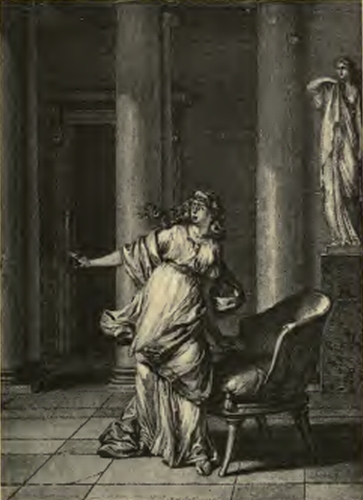
One of the secrets of the priests of antiquity, as it is of our own, was confession in the mysteries. It was by this that they gained correct and particular information about the affairs of families, and qualified themselves in a great measure to give pertinent and suitable replies to those who came to consult them. To this subject applies the anecdote which Plutarch has rendered so celebrated. A priest once urging an initiated person to confession, that person said: "To whom should I confess?" "To God," replied the priest. "Begone then, man," said the desired penitent; "begone, and leave me alone with God."
The Initial Banishing of the Priest.—Begone and leave me alone with God.
It would be almost endless to recount all the interesting facts and narratives with which Van Dale has enriched his book. Fontenelle did not translate it. But he extracted from it what he thought would be most suitable to his countrymen, who love sprightly anecdote and observation better than profound knowledge. He was eagerly read by what in France is called good company; and Van Dale, who had written in Latin and Greek, had been read only by the learned. The rough diamond of Van Dale shone with exquisite brilliancy after the cutting and polish of Fontenelle: the success of the work was such that the fanatics became alarmed. Notwithstanding all Fontenelle's endeavors to soften down the expressions of Van Dale, and his explaining himself sometimes with the license of a Norman, he was too well understood by the monks, who never like to be told that their brethren have been impostors.
A certain Jesuit of the name of Baltus, born near Messina, one of that description of learned persons who know how to consult old books, and to falsify and cite them, although after all nothing to the purpose, took the part of the devil against Van Dale and Fontenelle. The devil could not have chosen a more tiresome and wretched advocate; his name is now known solely from the honor he had of writing against two celebrated men who advocated a good cause.
Baltus likewise, in his capacity of Jesuit, caballed with no little perseverance and bitterness on the occasion, in union with his brethren, who at that time were as high in credit and influence as they have since been plunged deep in ignominy. The Jansenists, on their part, more impassionate and exasperated than even the Jesuits, clamored in a still louder tone than they did. In short, all the fanatics were convinced that it would be all over with the Christian religion, if the devil were not supported in his rights.
In the course of time the books of Jansenists and Jesuits have all sunk into oblivion. That of Van Dale still remains for men of learning, and that of Fontenelle for men of wit. With respect to the devil, he resembles both Jesuits and Jansenists, and is losing credit from day to day.
SECTION II.
Some curious and surprising histories of oracles, which it was thought could be ascribed only to the power of genii, made the Christians think they were delivered by demons, and that they had ceased at the coming of Christ. They were thus enabled to save the time and trouble that would have been required by an investigation of the facts; and they thought to strengthen the religion which informed them of the existence of demons by referring to those beings such events.
The histories however that were circulated on the subject of oracles are exceedingly suspicious. That of Thamus, to which Eusebius gives credit, and which Plutarch alone relates, is followed in the same history by another story so ridiculous, that that would be sufficient to throw discredit upon it; but it is, besides, incapable of any reasonable interpretation. If this great Pan were a demon, can we suppose the demons incapable of communicating the event of his death to one another without employing Thamus about it? If the great Pan were Jesus Christ, how came it that not a single Pagan was undeceived with respect to his religion, and converted to the belief that this same Pan was in fact Jesus Christ who died in Judæa, if God Himself compelled the demons to announce this death to the pagans?
The history of Thulis, whose oracle is clear and positive on the subject of the Trinity, is related only by Suidas. This Thulis, king of Egypt, was not certainly one of the Ptolemies. What becomes of the whole oracle of Serapis, when it is ascertained that Herodotus does not speak of that god, while Tacitus relates at length how and why one of the Ptolemies brought the god Serapis from Pontus, where he had only until then been known?
The oracle delivered to Augustus about the Hebrew infant who should be obeyed by all the gods, is absolutely inadmissible. Cedrenus quotes it from Eusebius, but it is not now to be found in him. It certainly is not impossible that Cedrenus quotes it from Eusebius, but it is not now to be found in him. It certainly is not impossible that Cedrenus may have made a false quotation, or have quoted a work falsely ascribed to Eusebius; but how is it to be accounted for, that all the early apologists for Christianity should have preserved complete silence with respect to an oracle so favorable to their religion?
The oracles which Eusebius relates from Porphyry, who was attached to paganism, are not of a more embarrassing nature than those just noticed. He gives them to us stripped of all the accompanying circumstances that attended them in the writings of Porphyry. How do we know whether that pagan did not refute them. For the interest of his cause it would naturally have been an object for him to do so; and if he did not do it, most assuredly it was from some concealed motive, such, for instance, as presenting them to the Christians only for an occasion to prove and deride their credulity, if they should really receive them as true and rest their religion on such weak foundations.
Besides, some of the ancient Christians reproached the pagans with being the dupes of their priests. Observe how Clement of Alexandria speaks of them: "Boast as long as you please of your childish and impertinent oracles, whether of Claros or the Pythian Apollo, of Dindymus or Amphilocus; and add to these your augurs and interpreters of dreams and prodigies. Bring forward also those clever gentry who, in the presence of the mighty Pythian Apollo, effect their divinations through the medium of meal or barley, and those also who, by a certain talent of ventriloquism, have obtained such high reputation. Let the secrets of the Egyptian temples, and the necromancy of the Etruscans, remain in darkness; all these things are most certainly nothing more than decided impostures, as completely tricks as those of a juggler with his cups and balls. The goats carefully trained for the divination, the ravens elaborately instructed to deliver the oracles, are—if we may use the expression—merely accomplices of the charlatans by whom the whole world has thus been cheated."
Eusebius, in his turn, displays a number of excellent reasons to prove that oracles could be nothing but impostures; and if he attributes them to demons, it is the result of deplorable prejudices or of an affected respect for general opinion. The pagans would never admit that their oracles were merely the artifices of their priests; it was imagined therefore, by rather an awkward process of reasoning, that a little was gained in the dispute by admitting the possibility, that there might be something supernatural in their oracles, and insisting at the same time, that if there were, it was the operation, not of the deity, but of demons.
It is no longer necessary now, in order to expose the finesse and stratagems of priests, to resort to means which might themselves appear too strongly marked by those qualities. A time has already been when they were completely exhibited to the eyes of the whole world—the time, I mean when the Christian religion proudly triumphed over paganism under Christian emperors.
Theodoret says that Theophilus, bishop of Alexandria, exhibited to the inhabitants of that city the hollow statues into which the priests entered, from secret passages, to deliver the oracles. When, by Constantine's order, the temple of Æsculapius at Ægea, in Cilicia, was pulled down, there was driven out of it, says Eusebius in his life of that emperor, not a god, nor a demon, but the human impostor who had so long duped the credulity of nations. To this he adds the general observation that, in the statues of the gods that were thrown down, not the slightest appearance was found of gods, or demons, or even any wretched and gloomy spectres, but only hay, straw, or the bones of the dead.
The greatest difficulty respecting oracles is surmounted, when it is ascertained and admitted, that demons had no concern with them. There is no longer any reason why they should cease precisely at the coming of Jesus Christ. And moreover, there are many proofs that oracles continued more than four hundred years after Jesus Christ, and that they were not totally silenced but by the total destruction of paganism.
Suetonius, in the life of Nero, says the oracle of Delphi warned that emperor to be aware of seventy-three years, and that Nero concluded he was to die at that age, never thinking upon old Galba, who, at the age of seventy-three, deprived him of the empire.
Philostratus, in his life of Apollonius of Tyana, who saw Domitian, informs us that Apollonius visited all the oracles of Greece, and that of Dodona, and that of Delphos; and that of Amphiaraus. Plutarch, who lived under Trajan, tells us that the oracles of Delphos still subsisted, although there was then only one priestess, instead of two or three. Under Adrian, Dion Chrysostom relates that he consulted the oracle of Delphos; he obtained from it an answer which appeared to him not a little perplexed, and which in fact was so.
Under the Antonines, Lucian asserts that a priest of Tyana went to inquire of the false prophet Alexander, whether the oracles which were then delivered at Dindymus, Claros, and Delphos, were really answers of Apollo, or impostures? Alexander had some fellow-feeling for these oracles, which were of a similar description to his own, and replied to the priest, that that was not permitted to be known; but when the same wise inquirer asked what he should be after his death, he was boldly answered, "You will be a camel, then a horse, afterwards a philosopher, and at length a prophet as great as Alexander."
After the Antonines, three emperors contended for the empire. The oracle of Delphos was consulted, says Spartian, to ascertain which of the three the republic might expect as its head. The oracle answered in a single verse to the following purport: The black is better; the African is good; the white is the worst. By the black was understood Pescennius Niger; by the African, Severus Septimus, who was from Africa; and by the white, Claudius Albinus.
Dion, who did not conclude his history before the eighth year of Alexander Severus, that is, the year 230, relates that in his time Amphilocus still delivered oracles in dreams. He informs us also, that there was in the city of Apollonia an oracle which declared future events by the manner in which the fire caught and consumed the incense thrown upon an altar.
Under Aurelian, about the year 272, the people of Palmyra, having revolted, consulted an oracle of Sarpedonian Apollo in Cilicia; they again consulted that of the Aphacian Venus. Licinus, according to the account of Sozomen, designing to renew the war against Constantine, consulted the oracle of Apollo of Dindymus, and received from it in answer two verses of Homer, of which the sense is—Unhappy old man, it becomes not you to combat with the young! you have no strength, and are sinking under the weight of age.
A certain god, scarcely if at all known, of the name of Besa, if we may credit Ammianus Marcellinus, still delivered oracles on billets at Abydos, in the extremity of the Thebais, under the reign of Constantius. Finally, Macrobius, who lived under Arcadius and Honorius, sons of Theodosius, speaks of the god of Heliopolis of Syria and his oracle, and of the fortunes of Antium, in terms which distinctly imply that they all still subsisted in his time.
We may observe that it is not of the slightest consequence whether these histories are true or whether the oracles in fact delivered the answers attributed to them; it is completely sufficient for the purpose that false answers could be attributed only to oracles which were in fact known still to subsist; and the histories which so many authors have published clearly prove that they did not cease but with the cessation of paganism itself.
Constantine pulled down but few temples, nor indeed could he venture to pull them down but on a pretext of crimes committed in them. It was on this ground that he ordered the demolition of those of the Aphacian Venus, and of Æsculapius which was at Ægea in Cilicia, both of them temples in which oracles were delivered. But he forbade sacrifices to the gods, and by that edict began to render temples useless.
Many oracles still subsisted when Julian assumed the reins of empire. He re-established some that were in a state of ruin; and he was even desirous of being the prophet of that of Dindymus. Jovian, his successor, began his reign with great zeal for the destruction of paganism; but in the short space of seven months, which comprised the whole time he reigned, he was unable to make any great progress. Theodosius, in order to attain the same object, ordered all the temples of the pagans to be shut up. At last, the exercise of that religion was prohibited under pain of death by an edict of the emperors Valentinian and Marcian, in the year 451 of the vulgar era; and the destruction of paganism necessarily involved that of oracles.
This conclusion has nothing in it surprising or extraordinary: it is the natural consequence of the establishment of a new worship. Miraculous facts, or rather what it is desired should be considered as such, diminish in a false religion, either in proportion as it becomes firmly established and has no longer occasion for them, or in proportion as it gradually becomes weaker and weaker, because they no longer obtain credit. The ardent but useless desire to pry into futurity gave birth to oracles; imposture encouraged and sanctioned them; and fanaticism set the seal; for an infallible method of making fanatics is to persuade before you instruct. The poverty of the people, who had no longer anything left them to give; the imposture detected in many oracles, and thence naturally concluded to exist in all; and finally the edicts of the Christian emperors; such are the real causes of the establishment, and of the cessation, of this species of imposture. The introduction of an opposite state of circumstances into human affairs made it completely disappear; and oracles thus became involved in the vicissitudes accompanying all human institutions.
Some limit themselves to observing that the birth of Jesus Christ is the first epoch of the cessation of oracles. But why, on such an occasion, should some demons have fled, while others remained? Besides, ancient history proves decidedly that many oracles had been destroyed before this birth. All the distinguished oracles of Greece no longer existed, or scarcely existed, and the oracle was occasionally interrupted by the silence of an honest priest who would not consent to deceive the people. "The oracle of Delphi," says Lucian, "remains dumb since princes have become afraid of futurity; they have prohibited the gods from speaking, and the gods have obeyed them."
ORDEAL.
It might be imagined that all the absurdities which degrade human nature were destined to come to us from Asia, the source at the same time of all the sciences and arts! It was in Asia and in Egypt that mankind first dared to make the life or death of a person accused, dependent on the throw of a die, or something equally unconnected with reason and decided by chance—on cold water or hot water, on red hot iron, or a bit of barley bread. Similar superstition, we are assured by travellers, still exists in the Indies, on the coast of Malabar, and in Japan.
This superstition passed from Egypt into Greece. There was a very celebrated temple at Trezène in which every man who perjured himself died instantly of apoplexy. Hippolytus, in the tragedy of "Phædra," in the first scene of the fifth act, addresses the following lines to his mistress Aricia:
Aux portes de Trezène, et parmi ces tombeaux, Des princes de ma race antiques sepultures, Est un temple sacré formidable aux parjures. C'est là que les mortels n'osent jurer en vain; Le perfide y reçoit un châtiment soudain; Et, craignant d'y trouver la mort inévitable, Le mensonge n'a point de frem plus redoubtable. At Trezène's gates, amidst the ancient tombs In which repose the princes of my race, A sacred temple stands, the perjurer's dread. No daring mortal there may falsely swear, For swift the vengeance which pursues his crime, Inevitable death his instant lot; Nowhere has falsehood a more awful curb.
The learned commentator of the great Racine makes the following remark on these Trezenian proofs or ordeals:
"M. de la Motte has remarked that Hippolytus should have proposed to his father to come and hear his justification in this temple, where no one dared venture on swearing to a falsehood. It is certain, that in such a case Theseus could not have doubted the innocence of that young prince; but he had received too convincing evidence against the virtue of Phædra, and Hippolytus was not inclined to make the experiment. M. de la Motte would have done well to have distrusted his own good taste, when he suspected that of Racine, who appears to have foreseen the objection here made. In fact, Theseus is so prejudiced against Hippolytus that he will not even permit him to justify himself by an oath."
I should observe that the criticism of La Motte was originally made by the deceased marquis de Lassai. He delivered it at M. de la Faye's, at a dinner party at which I was present together with the late M. de la Motte, who promised to make use of it; and, in fact, in his "Discourses upon Tragedy," he gives the honor of the criticism to the marquis de Lassai. The remark appeared to me particularly judicious, as well as to M. de la Faye and to all the guests present, who—of course excepting myself—were the most able critics in Paris. But we all agreed that Aricia was the person who should have called upon Theseus to try the accused by the ordeal of the Trezenian temple; and so much the more so, as Theseus immediately after talks for a long time together to that princess, who forgets the only thing that could clear up the doubts of the father and vindicate the son. The commentator in vain objects that Theseus has declared to his son he will not believe his oaths:
Toujours les scélérats ont recours au parjure. —Phedra. Act iv., scene 2. The wicked always have recourse to oaths.
There is a prodigious difference between an oath taken in a common apartment, and an oath taken in a temple where the perjured are punished by sudden death. Had Aricia said but a single word on the subject, Theseus could have had no excuse for not conducting Hippolytus to this temple; but, in that case, what would have become of the catastrophe?
Hippolytus, then, should not have mentioned at all the appalling power of the temple of Trezene to his beloved Aricia; he had no need whatever to take an oath of his love to her, for of that she was already most fully persuaded. In short, his doing so is an inadvertence, a small fault, which escaped the most ingenious, elegant, and impassioned tragedian that we ever had.
From this digression, I return to the barbarous madness of ordeals. They were not admitted in the Roman republic. We cannot consider as of one of these ordeals, the usage by which the most important enterprises were made to depend upon the manner in which the sacred pullets ate their vetches. We are here considering only ordeals applied to ascertain the guilt or innocence of men. It was never proposed to the Manliuses, Camilluses, or Scipios, to prove their innocence by plunging their hands into boiling water without its scalding them.
These suggestions of folly and barbarism were not admitted under the emperors. But the Tartars who came to destroy the empire—for the greater part of these plunderers issued originally from Tartary—filled our quarter of the world with their ridiculous and cruel jurisprudence, which they derived from the Persians. It was not known in the Eastern Empire till the time of Justinian, notwithstanding the detestable superstition which prevailed in it. But from that time the ordeals we are speaking of were received. This manner of trying men is so ancient that we find it established among the Jews in all periods of their history.
Korah, Dathan, and Abiram dispute the pontificate with the high priest Aaron in the wilderness; Moses commands them to bring him two hundred and fifty censors, and says to them: Let God choose between their censors and that of Aaron. Scarcely had the revolted made their appearance in order to submit to this ordeal, before they were swallowed up by the earth, and fire from heaven struck two hundred and fifty of their principal adherents; after which, the Lord destroyed fourteen thousand seven hundred more men of that party. The quarrel however for the priesthood still continued between the chiefs of Israel and Aaron. The ordeal of rods was then employed; each man presented his rod, and that of Aaron was the only one which budded.
Although the people of God had levelled the walls of Jericho by the sound of trumpets, they were overcome by the inhabitants of Ai. This defeat did not appear at all natural to Joshua; he consulted the Lord, who answered that Israel had sinned; that some one had appropriated to his own use a part of the plunder that had been taken at Jericho, and there devoted as accursed. In fact, all ought to have been burned, together with the men and women, children and cattle, and whoever had preserved and carried off any part was to be exterminated. Joshua, in order to discover the offender, subjected all the tribes to the trial by lot. The lot first fell on the tribe of Judah, then on the family of Zarah, then on the house of Zabdi, and finally on the grandson of Zabdi, whose name was Acham.
Scripture does not explain how it was that these wandering tribes came to have houses; neither does it inform us what kind of lots were made use of on the occasion; but it is clear from the text, that Acham, being convicted of stealing a small wedge of gold, a scarlet mantle, and two hundred shekels of silver, was burned to death in the valley of Achor, together with his sons, his sheep, his oxen, and his asses; and even his very tent was burned with him.
The promised land was divided by lot; lots were drawn respecting the two goats of expiation which should be sacrificed to the Lord, and which should go for a scapegoat into the wilderness. When Saul was to be chosen king, lots were consulted, and the lot fell on the tribe of Benjamin, on the family of Metri belonging to that tribe, and finally on Saul, the son of Kish, in the family of Metri.
The lot fell on Jonathan to be punished for having eaten some honey at the end of a rod. The sailors of Joppa drew lots to learn from God what was the cause of the tempest. The lot informed them that it was Jonah; and they threw him into the sea.
All these ordeals by lot, which among other nations were merely profane superstitions, were the voice of God Himself when employed by His cherished and beloved people; and so completely and decidedly the voice of God that even the apostles filled the place of the apostle Judas by lot. The two candidates for the succession were Matthias and Barnabas. Providence declared in favor of St. Matthias.
Pope Honorius, the third of that name, forbade by a decretal from that time forward the method of choosing bishops by lot. Deciding by lots was a very common practice, and was called by the pagans, "sortilegium." Cato, in the "Pharsalia," says, "Sortilegis egeant dubil...."
There were other ordeals among the Jews in the name of the Lord; as, for example, the waters of jealousy. A woman suspected of adultery was obliged to drink of that water mixed with ashes, and consecrated by the high priest. If she was guilty she instantly swelled and died. It is upon the foundation of this law that the whole Christian world in the West established oracles for persons under juridical accusation, not considering that what was ordained even by God Himself in the Old Testament was nothing more or less than an absurd superstition in the New.
Duel by wager of battle was one of those ordeals, and lasted down to the sixteenth century. He who killed his adversary was always in the right. The most dreadful of all these curious and barbarous ordeals, was that of a man's carrying a bar of red-hot iron to the distance of nine paces without burning himself. Accordingly, the history of the middle ages, fabulous as it is, does not record any instance of this ordeal, nor of that which consisted in walking over nine burning ploughshares. All the others might be doubted, or the deceptions and tricks employed in relation to them to deceive the judges might be easily explained. It was very easy, for example, to appear to pass through the trial of boiling water without injury; a vessel might be produced half full of cold water, into which the judicial boiling water might be put; and the accused might safely plunge his arm up to the elbow in the lukewarm mixture, and take up from the bottom the sacred blessed ring that had been thrown into it for that purpose.
Oil might be made to boil with water; the oil begins to rise and appears to boil when the water begins to simmer, and the oil at that time has acquired but a small degree of heat. In such circumstances, a man seems to plunge his hand into boiling water; but, in fact, moistens it with the harmless oil, which preserves it from contact with and injury by the water.
A champion may easily, by degrees, harden and habituate himself to holding, for a few seconds, a ring that has been thrown into the fire, without any very striking or painful marks of burning. To pass between two fires without being scorched is no very extraordinary proof of skill or address, when the movement is made with great rapidity and the face and hands are well rubbed with ointment. It is thus that the formidable Peter Aldobrandini, or "The Fiery Peter," as he was called, used to manage—if there is any truth in his history—when he passed between two blazing fires at Florence, in order to demonstrate, with God's help, that his archbishop was a knave and debauchee. O, charlatans! charlatans! henceforth disappear forever from the pages of history!
There existed a rather ludicrous ordeal, which consisted in making an accused person try to swallow a piece of barley bread, which it was believed would certainly choke him if he were guilty. I am not, however, so much diverted with this case as with the conduct of Harlequin, when the judge interrogated him concerning a robbery of which Dr. Balouard accused him. The judge was sitting at table, and drinking some excellent wine at the time, when Harlequin was brought in; perceiving which, the latter takes up the bottle, and, pouring the whole of its contents into a glass, swallows it at a draught, saying to the doctor: "If I am guilty of what you accuse me, sir, I hope this wine will prove poison to me."
ORDINATION.
If a soldier, charged by the king of France with the honor of conferring the order of St. Louis upon another soldier, had not, when presenting the latter with the cross, the intention of making him a knight of that order, would the receiver of the badge be on that account the less a member of the order than if such intention had existed? Certainly not.
How was it, then, that many priests thought it necessary to be re-ordained after the death of the celebrated Lavardin, bishop of Mans? That singular prelate, who had instituted the order of "Good Fellows"—Des Coteaux—bethought himself on his deathbed of a singular trick, in the way of revenge, on a class of persons who had much annoyed him. He was well known as one of the most daring freethinkers of the age of Louis XIV., and had been publicly upbraided with his infidel sentiments, by many of those on whom he had conferred orders of priesthood. It is natural at the approach of death, for a sensitive and apprehensive soul to revert to the religion of its early years. Decency alone would have required of the bishop, that at least at his death he should give an example of edification to the flock to which he had given so much scandal by his life. But he was so deeply exasperated against his clergy, as to declare, that not a single individual of those whom he had himself ordained was really and truly a priest; that all their acts in the capacity of priests were null and void; and that he never entertained the intention of conferring any sacrament.
Such reasoning seems certainly characteristic, and just such as might be expected from a drunken man; the priests of Mans might have replied to him, "It is not your intention that is of any consequence, but ours. We had an ardent and determined desire to be priests; we did all in our power to become such. We are perfectly ingenuous and sincere; if you are not so, that is nothing at all to us." The maxim applicable to the occasion is, "quic quid accipitur ad modum recipientis accipitur," and not "ad modum dantis." "When our wine merchant has sold us a half a hogshead of wine, we drink it, although he might have a secret intention to hinder us from drinking it; we shall still be priests in spite of your testament."
Those reasons were sound and satisfactory. However, the greater number of those who had been ordained by that bishop did not consider themselves as real and authorized priests, and subjected themselves to ordination a second time. Mascaron, a man of moderate talents, but of great celebrity as a preacher, persuaded them, both by his discourses and example, to have the ceremony repeated. The affair occasioned great scandal at Mans, and Paris, and Versailles; but like everything else was soon forgotten.
ORIGINAL SIN.
SECTION I.
This is a subject on which the Socinians or Unitarians take occasion to exult and triumph. They denominate this foundation of Christianity its "original sin." It is an insult to God, they say; it is accusing Him of the most absurd barbarity to have the hardihood to assert, that He formed all the successive generations of mankind to deliver them over to eternal tortures, under the pretext of their original ancestor having eaten of a particular fruit in a garden. This sacrilegious imputation is so much the more inexcusable among Christians, as there is not a single word respecting this same invention of original sin, either in the Pentateuch, or in the prophets, or the gospels, whether apocryphal or canonical, or in any of the writers who are called the "first fathers of the Church."
It is not even related in the Book of Genesis that God condemned Adam to death for eating an apple. God says to him, indeed, "in the day that thou eatest thereof thou shalt surely die." But the very same Book of Genesis makes Adam live nine hundred and thirty years after indulging in this criminal repast. The animals, the plants, which had not partaken of this fruit, died at the respective periods prescribed for them by nature. Man is evidently born to die, like all the rest.
Moreover, the punishment of Adam was never, in any way, introduced into the Jewish law. Adam was no more a Jew than he was a Persian or Chaldæan. The first chapters of Genesis—at whatever period they were composed—were regarded by all the learned Jews as an allegory, and even as a fable not a little dangerous, since that book was forbidden to be read by any before they had attained the age of twenty-one.
In a word, the Jews knew no more about original sin than they did about the Chinese ceremonies; and, although divines generally discover in the Scripture everything they wish to find there, either "totidem verbis," or "totidem literis," we may safely assert that no reasonable divine will ever discover in it this surprising and overwhelming mystery.
We admit that St. Augustine was the first who brought this strange notion into credit; a notion worthy of the warm and romantic brain of an African debauchee and penitent, Manichæan and Christian, tolerant and persecuting—who passed his life in perpetual self-contradiction.
What an abomination, exclaim the strict Unitarians, so atrociously to calumniate the Author of Nature as even to impute to Him perpetual miracles, in order that He may damn to all eternity the unhappy race of mankind, whom he introduces into the present life only for so short a span! Either He created souls from all eternity, upon which system, as they must be infinitely more ancient than the sin of Adam, they can have no possible connection with it; or these souls are formed whenever man and woman sexually associate; in which case the Supreme Being must be supposed continually watching for all the various associations of this nature that take place, to create spirits that He will render eternally miserable; or, finally, God is Himself the soul of all mankind, and upon this system damns Himself. Which of these three suppositions is the most absurd and abominable? There is no fourth. For the opinion that God waits six weeks before He creates a damned soul in a fœtus is, in fact, no other than that which creates it at the moment of sexual connection: the difference of six weeks cannot be of the slightest consequence in the argument. I have merely related the opinion of the Unitarians; but men have now attained such a degree of superstition that I can scarcely relate it without trembling.
SECTION II.
It must be acknowledged that we are not acquainted with any father of the Church before St. Augustine and St. Jerome, who taught the doctrine of original sin. St. Clement of Alexandria, notwithstanding his profound knowledge of antiquity, far from speaking in any one passage of his works of that corruption which has infected the whole human race, and rendered it guilty from its birth, says in express words, "What evil can a new-born infant commit? How could it possibly prevaricate? How could such a being, which has, in fact, as yet done no one thing, fall under the curse of Adam?"
And it is worth observing that he does not employ this language in order to combat the rigid opinion of original sin, which was not at that time developed, but merely to show that the passions, which are capable of corrupting all mankind, have, as yet, taken no hold of this innocent infant. He does not say: This creature of a day would not be damned if it should now die, for no one had yet conjectured that it would be damned. St. Clement could not combat a system absolutely unknown.
The great Origen is still more decisive than St. Clement of Alexandria. He admits, indeed, in his exposition of the Epistle of Paul to the Romans, that sin entered into the world by Adam, but he maintains that it is the inclination to sin that thus entered; that it is very easy to commit evil, but that it is not on that account said, man will always commit evil, and is guilty even as soon as he is born.
In short, original sin, in the time of Origen, consisted only in the misfortune of resembling the first man by being liable to sin like him. Baptism was a necessary ordinance; it was the seal of Christianity; it washed away all sins; but no man had yet said, that it washed away those which the subject of it had not committed. No one yet asserted that an infant would be damned, and burned in everlasting flames, in consequence of its dying within two minutes of its birth. And an unanswerable proof on this point is, that a long period passed away before the practice of baptizing infants became prevalent. Tertullian was averse to their being baptized; but, on the persuasion that original sin—of which these poor innocents could not possibly be guilty—would affect their reprobation, and expose them to suffer boundless and endless torture, for a deed of which it was impossible for them to have the slightest knowledge: to refuse them the consecrated bath of baptism, would be wilfully consigning them to eternal damnation. The souls of all the executioners in the world, condensed into the very essence of ingenious cruelty, could not have suggested a more execrable abomination.
In a word, it is an incontestable fact that Christians did not for a certain period baptize their infants, and it is therefore equally incontestable that they were very far from damning them.
This, however, is not all; Jesus Christ never said: "The infant that is not baptized will be damned." He came on the contrary to expiate all sins, to redeem mankind by His blood; therefore, infants could not be damned. Infants would, of course, a fortiori, and, preferably, enjoy this privilege. Our divine Saviour never baptized any person. Paul circumcised his disciple Timothy, but is nowhere said to have baptized him.
In a word, during the two first centuries, the baptism of infants was not customary; it was not believed, therefore, that infants would become victims of the fault of Adam. At the end of four hundred years their salvation was considered in danger, and great uncertainty and apprehension existed on the subject.
In the fifth century appears Pelagius. He treated the opinion of original sin as monstrous. According to him, this dogma, like all others, was founded upon a mere ambiguity. God had said to Adam in the garden: "In the day in which thou shalt eat of the tree of knowledge, thou shalt die." But, he did not die; and God pardoned him. Why, then, should He not spare His race to the thousandth generation? Why should He consign to infinite and eternal torments the innocent infants whose father He received back into forgiveness and favor?
Pelagius considered God, not merely as an absolute master, but as a parent, who left His children at perfect liberty, and rewarded them beyond their merits, and punished them less than their faults deserved. The language used by him and his disciples was: "If all men are born objects of the eternal wrath of that Being who confers on them life; if they can possibly be guilty before they can even think, it is then a fearful and execrable offence to give them being, and marriage is the most atrocious of crimes. Marriage, on this system, is nothing more or less than an emanation from the Manichæan principle of evil; and those who engage in it, instead of adoring God, adore the devil."
Pelagius and his partisans propagated this doctrine in Africa, where the reputation and influence of St. Augustine were unbounded. He had been a Manichæan, and seemed to think himself called upon to enter the lists against Pelagius. The latter was ill able to resist either Augustine or Jerome; various points, however, were contested, and the dispute proceeded so far that Augustine pronounced his sentence of damnation upon all children born, or to be born, throughout the world, in the following terms: "The Catholic faith teaches that all men are born so guilty that even infants are certainly damned when they die without having been regenerated in Jesus."
It would be but a wretched compliment of condolence to offer to a queen of China, or Japan, or India, Scythia, or Gothia, who had just lost her infant son to say: "Be comforted, madam; his highness the prince royal is now in the clutches of five hundred devils, who turn him round and round in a great furnace to all eternity, while his body rests embalmed and in peace within the precincts of your palace."
The astonished and terrified queen inquires why these devils should eternally roast her dear son, the prince royal. She is answered that the reason of it is that his great-grandfather formerly ate of the fruit of knowledge, in a garden. Form an idea, if possible, of the looks and thoughts of the king, the queen, the whole council, and all the beautiful ladies of the court!
The sentence of the African bishop appeared to some divines—for there are some good souls to be found in every place and class—rather severe, and was therefore mitigated by one Peter Chrysologus, or Peter Golden-tongue, who invented a suburb to hell, called "limbo", where all the little boys and girls that died before baptism might be disposed of. It is a place in which these innocents vegetate without sensation; the abode of apathy; the place that has been called "The paradise of fools." We find this very expression in Milton. He places this paradise somewhere near the moon!
Explication Of Original Sin.
The difficulty is the same with respect to this substituted limbo as with respect to hell. Why should these poor little wretches be placed in this limbo? what had they done? how could their souls, which they had not in their possession a single day, be guilty of a gormandizing that merited a punishment of six thousand years?
St. Augustine, who damns them, assigns as a reason, that the souls of all men being comprised in that of Adam, it is probable that they were all accomplices. But, as the Church subsequently decided that souls are not made before the bodies which they are to inhabit are originated, that system falls to the ground, notwithstanding the celebrity of its author.
Others said that original sin was transmitted from soul to soul, in the way of emanation, and that one soul, derived from another, came into the world with all the corruption of the mother-soul. This opinion was condemned.
After the divines had done with the question, the philosophers tried at it. Leibnitz, while sporting with his monads, amused himself with collecting together in Adam all the human monads with their little bodies of monads. This was going further than St. Augustine. But this idea, which was worthy of Cyrano de Bergerac, met with very few to adopt and defend it. Malebranche explains the matter by the influence of the imagination on mothers. Eve's brain was so strongly inflamed with the desire of eating the fruit that her children had the same desire; just like the irresistibly authenticated case of the woman who, after having seen a man racked, was brought to bed of a dislocated infant.
Nicole reduced the affair to "a certain inclination, a certain tendency to concupiscence, which we have derived from our mothers. This inclination is not an act; but it will one day become such." Well said, Nicole; bravo! But, in the meantime, why am I to be damned? Nicole does not even touch the difficulty, which consists in ascertaining how our own souls, which have but recently been formed, can be fairly made responsible for the fault of another soul that lived some thousands of years ago.
What, my good friends, ought to be said upon the subject? Nothing. Accordingly, I do not give my explication of the difficulty: I say not a single word.
OVID.
Scholars have not failed to write volumes to inform us exactly to what corner of the earth Ovidius Naso was banished by Octavius Cepias, surnamed Augustus. All that we know of it is, that, born at Sulmo and brought up at Rome, he passed ten years on the right shore of the Danube, in the neighborhood of the Black Sea. Though he calls this land barbarous, we must not fancy that it was a land of savages. There were verses made there; Cotis, the petty king of a part of Thrace, made Getic verses for Ovid. The Latin poet learned Getic, and also composed lines in this language. It seems as if Greek poetry should have been understood in the ancient country of Orpheus, but this country was then peopled by nations from the North, who probably spoke a Tartar dialect, a language approaching to the ancient Slavonian. Ovid seemed not destined to make Tartar verses. The country of the Tomites, to which he was banished, was a part of Mysia, a Roman province, between Mount Hemus and the Danube. It is situated in forty-four and a half degrees north latitude, like one of the finest climates of France; but the mountains which are at the south, and the winds of the north and east, which blow from the Euxine, the cold and dampness of the forests, and of the Danube, rendered this country insupportable to a man born in Italy. Thus Ovid did not live long, but died there at the age of sixty. He complains in his "Elegies" of the climate, and not of the inhabitants. "Quos ego, cum loca sim vestra perosus, amo."
These people crowned him with laurel, and gave him privileges, which prevented him not from regretting Rome. It was a great instance of the slavery of the Romans and of the extinction of all laws, when a man born of an equestrian family, like Octavius, exiled a man of another equestrian family, and when one citizen of Rome with one word sent another among the Scythians. Before this time, it required a "plebiscitum", a law of the nation, to deprive a Roman of his country. Cicero, although banished by a cabal, had at least been exiled with the forms of law.
The crime of Ovid was incontestably that of having seen something shameful in the family of Octavius:
Cur aliquid vidi, cur noxia lumina feci? Why saw I aught, or why discover crime?
The learned have not decided whether he had seen Augustus with a prettier boy than Mannius, whom he said he would not have because he was too ugly; whether he saw some page in the arms of the empress Livia, whom this Augustus had espoused, while pregnant by another; whether he had seen the said Augustus occupied with his daughter or granddaughter; or, finally, whether he saw him doing something still worse, "torva tu entibus hircis?" It is most probable that Ovid detected an incestuous correspondence, as an author, almost contemporary, named Minutionus Apuleius, says: "Pulsum quoque in exilium quod Augusti incestum vidisset."
Octavius made a pretext of the innocent book of the "Art of Love," a book very decently written, and in which there is not an obscene word, to send a Roman knight to the Black Sea. The pretence was ridiculous. How could Augustus, of whom we have still verses filled with obscenities, banish Ovid for having several years before given to his friends some copies of the "Art of Love"? How could he impudently reproach Ovid for a work written with decorum, while he approved of Horace, who lavishes allusions and phrases on the most infamous prostitution, and who proposed girls and boys, maid servants and valets indiscriminately? It is nothing less than impudence to blame Ovid and tolerate Horace. It is clear that Octavius alleged a very insufficient reason, because he dared not allude to the real one. One proof that it related to some secret adventure of the sacred imperial family is that the goat of Caprea—Tiberius, immortalized by medals for his debaucheries; Tiberius, that monster of lust and dissimulation—did not recall Ovid, who, rather than demand the favor from the author of the proscriptions and the poisoner of Germanicus, remained on the shores of the Danube.
If a Dutch, Polish, Swedish, English, or Venetian gentleman had by chance seen a stadtholder, or a king of Great Britain, Sweden, or Poland, or a doge of Venice, commit some great sin, even if it was not by chance that he saw it; if he had even sought the occasion, and was so indiscreet as to speak of it, this stadtholder, king, or doge could not legally banish him.
We can reproach Ovid almost as much as Augustus and Tiberius for having praised them. The eulogiums which he lavishes on them are so extravagant that at present they would excite indignation if he had even given them to legitimate princes, his benefactors, instead of to tyrants, and to his tyrants in particular. You may be pardoned for praising a little too much a prince who caresses you; but not for treating as a god one who persecutes you. It would have been a hundred times better for him to have embarked on the Black Sea and retired into Persia by the Palus Mæotis, than to have written his "Tristia." He would have learned Persian as easily as Getic, and might have forgotten the master of Rome near the master of Ecbatana. Some strong minds will say that there was still another part to take, which was to go secretly to Rome, address himself to some relations of Brutus and Cassius, and get up a twelfth conspiracy against Octavius; but that was not in elegiac taste.
Poetical panegyrics are strange things! It is very clear that Ovid wished with all his heart, that some Brutus would deliver Rome from that Augustus, to whom in his verses he wished immortality. I reproach Ovid with his "Tristia" alone. Bayle forms his system on the philosophy of chaos so ably exhibited in the commencement of the "Metamorphoses":
Ante mare et terras, et quod tegit omnia cœlum, Unus erat toto naturæ vultus in orbe.
Bayle thus translates these first lines: "Before there was a heaven, an earth, and a sea, nature was all homogeneous." In Ovid it is, "The face of nature was the same throughout the universe," which means not that all was homogeneous, but heterogeneous—this assemblage of different things appeared the same; "unus vultus." Bayle criticises chaos throughout. Ovid, who in his verses is only the poet of the ancient philosophy, says that things hard and soft, light and heavy, were mixed together:
Mollia cum duris, sine pondere habentia pondus. —OVID'S Met., b. i., l. 20.
And this is the manner in which Bayle reasons against him: "There is nothing more absurd than to suppose a chaos which had been homogeneous from all eternity, though it had the elementary qualities, at least those which we call alteratives, which are heat, cold, humidity, and dryness, as those which we call matrices, which are lightness and weight, the former the cause of upper motion, the latter of lower. Matter of this nature cannot be homogeneous, and must necessarily contain all sorts of heterogeneousness. Heat and cold, humidity and dryness, cannot exist together, unless their action and reaction temper and convert them into other qualities which assume the form of mixed bodies; and as this temperament can be made according to innumerable diversities of combinations, chaos must contain an incredible number of compound species. The only manner of conceiving matter homogeneous is by saying that the alterative qualities of the elements modify all the molecules of matter in the same degree in such a way, that throughout there is the same warmth, the same softness, the same odor, etc. But this would be to destroy with one hand that which has been built up with the other; it would be by a contradiction in terms to call chaos the most regular, the most marvellous for its symmetry, and the most admirable in its proportions that it is possible to conceive. I allow that the taste of man approves of a diversified rather than of a regular work; but our reason teaches us that the harmony of contrary qualities, uniformly preserved throughout the universe, would be as admirable a perfection as the unequal division of them which has succeeded chaos. What knowledge and power would not the diffusion of this uniform harmony throughout nature demand! It would not be sufficient to place in any compound an equal quantity of all the four ingredients; of one there must be more and of another less, according as their force is greater or less for action or resistance; for we know that philosophers bestow action and reaction in a different degree on the elementary qualities. All would amount to an opinion that the power which metamorphosed chaos has withdrawn it, not from a state of strife and confusion as is pretended, but from a state of the most admirable harmony, which by the adjustment of the equilibrium of contrary forces, retained it in a repose equivalent to peace. It is certain, therefore, that if the poets will insist on the homogeneity of chaos, they must erase all which they have added concerning the wild confusion of contrary seeds, of the undigested mass, and of the perpetual combat of conflicting principles.
"Passing over this contradiction we shall find sufficient subject for opposing them in other particulars. Let us recommence the attack on eternity. There is nothing more absurd than to admit, for an infinite time, the mixture of the insensible particles of four elements; for as soon as you suppose in them the activity of heat, the action and reaction of the four primary qualities, and besides these, motion towards the centre in the elements of earth and water, and towards the circumference in those of fire and air, you establish a principle which necessarily separates these four kinds of bodies, the one from the other, and for which a definite period alone is necessary. Consider a little, that which is denominated "the vial of the four elements". There are put into it some small metallic particles, and then three liquids, the one much lighter than the other. Shake these well together, and you no longer discern any of these component parts singly; each is confounded with the other. But leave your vial at rest for a short time, and you will find every one of them resume its pristine situation. The metallic particles will reassemble at the bottom of the vial, the lightest liquid will rise to the top, and the others take their stations according to their respective degrees of gravity. Thus a very short time will suffice to restore them to the same relative situation which they occupied before the vial was shaken. In this vial you behold the laws which nature has given in this world to the four elements, and, comparing the universe to this vial, we may conclude, that if the earth reduced to powder had been mingled with the matter of the stars, and with that of air and of water, in such a way as that the compound exhibited none of the elements by themselves, all would have immediately operated to disengage themselves, and at the end of a certain time, the particles of earth would form one mass, those of fire another; and thus of the others in proportion to the lightness or heaviness of each of them."
I deny to Bayle, that the experiment of the vial infers a definite period for the duration of chaos. I inform him, that by heavy and light things, Ovid and the philosophers intended those which became so after God had placed His hand on them. I say to him: "You take for granted that nature arranged all, and bestowed weight upon herself. You must begin by proving to me that gravity is an essential quality of matter, a position which has never been proved." Descartes, in his romance has pretended that body never became heavy until his vortices of subtle matter began to push them from the centre. Newton, in his correct philosophy, never says that gravitation or attraction is a quality essential to matter. If Ovid had been able to divine the "Principia" of Newton, he would have said: "Matter was neither heavy nor in motion in my chaos; it was God who endowed it with these properties; my chaos includes not the forces you imagine"—"nec quidquam nisi pondus iners;" it was a powerless mass; "pondus" here signifies not weight but mass.
Nothing could possess weight, before God bestowed on matter the principle of gravitation. In whatever degree one body is impelled towards the centre of another, would it be drawn or impelled by another, if the Supreme Power had not bestowed upon it this inexplicable virtue? Therefore Ovid will not only turn out a good philosopher but a passable theologian.
You say: "A scholastic theologian will admit without difficulty, that if the four elements had existed independently of God, with all the properties which they now possess, they would have formed of themselves the machine of the world, and have maintained it in the state which we now behold. There are therefore two great faults in the doctrine of chaos; the first of which is, that it takes away from God the creation of matter, and the production of the qualities proper to air, fire, earth, and water; the other, that after taking God away, He is made to appear unnecessarily on the theatre of the world, in order to assign their places to the four elements. Our modern philosophers, who have rejected the faculties and the qualities of the peripatetician physics, will find the same defects in the description of the chaos of Ovid; for that which they call general laws of motion, mechanical principles, modifications of matter, the form, situation, and arrangement of atoms, comprehends nothing beyond the active and passive virtue of nature, which the peripatetics understand by the alterative and formative qualities of the four elements. Seeing, therefore, that, according to the doctrine of this school, these four bodies, separated according to their natural heaviness and lightness, form a principle which suffices for all generation, the Cartesians, Gassendists, and other modern philosophers, ought to maintain that the motion, situation, and form of the particles of matter, are sufficient for the production of all natural effects, without excepting even the general arrangement which has placed the earth, the air, the water, and the stars where we see them. Thus, the true cause of the world, and of the effect which it produces, is not different from the cause which has bestowed motion on particles of matter—whether at the same time that it assigned to each atom a determinate figure, as the Gassendists assert, or that it has only given to particles entirely cubic, an impulsion which, by the duration of the motion according to certain laws, makes it ultimately take all sorts of forms—which is the hypothesis of the Cartesians. Both the one and the other consequently agree, that if matter had been, before the generation of the present world, as Ovid describes, it would have been capable of withdrawing itself from chaos by its own necessary operation, without the assistance of God. Ovid may therefore be accused of two oversights—having supposed, in the first place, that without the assistance of the Divinity, matter possessed the seeds of every compound, heat, motion, etc.; and in the second, that without the same assistance it could extricate itself from confusion. This is to give at once too much and too little to both God and matter; it is to pass over assistance when most needed, and to demand it when no longer necessary."