VOLUME XI (continued 3)
William F. Fleming translation
"Et inspiravit in faciem ejus spiraculum vitæ, et factus est homo in animam viventem." (And breathed into his nostrils the breath of life, and man became a living soul.)
"Sanguinem enim animarum vestrarum requiram de manu cunctarum betiarum, et de manu hominis," etc. (I shall require back your souls from the hands of man and beast.)
Souls here evidently signify lives. The sacred text certainly did not mean that beasts had swallowed the souls of men, but their blood, which is their life; and as to the hands given by this text to beasts, it signifies their claws.
In short, more than two hundred passages may be quoted in which the soul is used for the life, both of beasts and man; but not one which explains either life or soul.
If life be the faculty of sensation, whence this faculty? In reply to this question, all the learned quote systems, and these systems are destructive of one another. But why the anxiety to ascertain the source of sensation? It is as difficult to conceive the power which binds all things to a common centre as to conceive the cause of animal sensation. The direction of the needle towards the pole, the paths of comets, and a thousand other phenomena are equally incomprehensible.
Properties of matter exist, the principle of which will never be known to us; and that of sensation, without which there cannot be life, is among the number.
Is it possible to live without experiencing sensation? No. An infant which dies in a lethargy that has lasted from its birth has existed, but not lived.
Let us imagine an idiot unable to form complex ideas, but who possesses sensation; he certainly lives without thinking, forming simple ideas from his sensations. Thought, therefore, is not necessary to life, since this idiot has lived without thinking.
Hence, certain thinkers think that thought is not of the essence of man. They maintain that many idiots who think not, are men; and so decidedly men as to produce other men, without the power of constructing a single argument.
The doctors who maintain the essentiality of thought, reply that these idiots have certain ideas from their sensation. Bold reasoners rejoin, that a well-taught mind possesses more consecutive ideas, and is very superior to these idiots, whence has sprung a grand dispute upon the soul, of which we shall speak—possibly at too great a length—in the article on "Soul."
LOVE.
There are so many kinds of love, that in order to define it, we scarcely know which to direct our attention to. Some boldly apply the name of "love" to a caprice of a few days, a connection without attachment, passion without affection, the affectations of cicisbeism, a cold usage, a romantic fancy, a taste speedily followed by a distaste. They apply the name to a thousand chimeras.
Should any philosophers be inclined profoundly to investigate a subject in itself so little philosophical, they may recur to the banquet of Plato, in which Socrates, the decent and honorable lover of Alcibiades and Agathon, converses with them on the metaphysics of love.
Lucretius speaks of it more as a natural philosopher; and Virgil follows the example of Lucretius. "Amor omnibus idem."
It is the embroidery of imagination on the stuff of nature. If you wish to form an idea of love, look at the sparrows in your garden; behold your doves; contemplate the bull when introduced to the heifer; look at that powerful and spirited horse which two of your grooms are conducting to the mare that quietly awaits him, and is evidently pleased at his approach; observe the flashing of his eyes, notice the strength and loudness of his neighings, the boundings, the curvetings, the ears erect, the mouth opening with convulsive gaspings, the distended nostrils, the breath of fire, the raised and waving mane, and the impetuous movement with which he rushes towards the object which nature has destined for him; do not, however, be jealous of his happiness; but reflect on the advantages of the human species; they afford ample compensation in love for all those which nature has conferred on mere animals—strength, beauty, lightness, and rapidity.
There are some classes, however, even of animals totally unacquainted with sexual association. Fishes are destitute of this enjoyment. The female deposits her millions of eggs on the slime of the waters, and the male that meets them passes over them and communicates the vital principle, never consorting with, or perhaps even perceiving the female to whom they belong.
The greater part of those animals which copulate are sensible of the enjoyment only by a single sense; and when appetite is satisfied, the whole is over. No animal, besides man, is acquainted with embraces; his whole frame is susceptible; his lips particularly experience a delight which never wearies, and which is exclusively the portion of his species; finally, he can surrender himself at all seasons to the endearments of love, while mere animals possess only limited periods. If you reflect on these high pre-eminences, you will readily join in the earl of Rochester's remark, that love would impel a whole nation of atheists to worship the divinity.
As men have been endowed with the talent of perfecting whatever nature has bestowed upon them, they have accordingly perfected the gift of love. Cleanliness, personal attention, and regard to health render the frame more sensitive, and consequently increase its capacity of gratification. All the other amiable and valuable sentiments enter afterwards into that of love, like the metals which amalgamate with gold; friendship and esteem readily fly to its support; and talents both of body and of mind are new and strengthening bonds.
Nam facit ipsa suis interdum femina factis, Morigerisque modis, et mundo corpore cultu Ut facile insuescat secum vir degere vitam. —LUCRETIUS, iv, 1275.
Self-love, above all, draws closer all these various ties. Men pride themselves in the choice they have made; and the numberless illusions that crowd around constitute the ornament of the work, of which the foundation is so firmly laid by nature.
Such are the advantages possessed by man above the various tribes of animals. But, if he enjoys delights of which they are ignorant, howe many vexations and disgusts, on the other hand, is he exposed to, from which they are free! The most dreadful of these is occasioned by nature's having poisoned the pleasures of love and sources of life over three-quarters of the world by a terrible disease, to which man alone is subject; nor is it with this pestilence as with various other maladies, which are the natural consequences of excess. It was not introduced into the world by debauchery. The Phrynes and Laises, the Floras and Messalinas, were never attacked by it. It originated in islands where mankind dwelt together in innocence, and has thence been spread throughout the Old World.
If nature could in any instance be accused of despising her own work, thwarting her own plan, and counteracting her own views, it would be in this detestable scourge which has polluted the earth with horror and shame. And can this, then, be the best of all possible worlds? What! if Cæsar and Antony and Octavius never had this disease, was it not possible to prevent Francis the First from dying of it? No, it is said; things were so ordered all for the best; I am disposed to believe it; but it is unfortunate for those to whom Rabelais has dedicated his book.
Erotic philosophers have frequently discussed the question, whether Héloïse could truly love Abélard after he became a monk and mutilated? One of these states much wronged the other.
Be comforted, however, Abélard, you were really beloved; imagination comes in aid of the heart. Men feel a pleasure in remaining at table, although they can no longer eat. Is it love? is it simply recollection? is it friendship? It is a something compounded of all these. It is a confused feeling, resembling the fantastic passions which the dead retained in the Elysian Fields. The heroes who while living had shone in the chariot races, guided imaginary chariots after death. Héloïse lived with you on illusions and supplements. She sometimes caressed you, and with so much the more pleasure as, after vowing at Paraclet that she would love you no more, her caresses were become more precious to her in proportion as they had become more culpable. A woman can never form a passion for a eunuch, but she may retain her passion for her lover after his becoming one, if he still remains amiable.
The case is different with respect to a lover grown old in the service; the external appearance is no longer the same; wrinkles affright, grizzly eyebrows repel, decaying teeth disgust, infirmities drive away; all that can be done or expected is to have the virtue of being a patient and kind nurse, and bearing with the man that was once beloved, all which amounts to—burying the dead.
LOVE OF GOD.
The disputes that have occurred about the love of God have kindled as much hatred as any theological quarrel. The Jesuits and Jansenists have been contending for a hundred years as to which party loved God in the most suitable and appropriate manner, and which should at the same time most completely harass and torment their neighbor.
When the author of "Telemachus," who was in high reputation at the court of Louis XIV., recommended men to love God in a manner which did not happen to coincide with that of the author of the "Funeral Orations", the latter, who was a complete master of the weapons of controversy, declared open war against him, and procured his condemnation in the ancient city of Romulus, where God was the very object most loved, after domination, ease, luxury, pleasure, and money.
If Madame Guyon had been acquainted with the story of the good old woman, who brought a chafingdish to burn paradise, and a pitcher of water to extinguish hell, that God might be loved for Himself alone, she would not perhaps have written so much as she did. She must inevitably have felt that she could herself never say anything better than that; but she loved God and nonsense so sincerely that she was imprisoned for four months, on account of her affectionate attachment; treatment decidedly rigorous and unjust. Why punish as a criminal a woman whose only offence was composing verse in the style of the Abbé Cotin, and prose in the taste of the popular favorite Punchinello? It is strange that the author of "Telemachus" and the frigid loves of Eucharis should have said in his "Maxims of Saints," after the blessed Francis de Sales: "I have scarcely any desires; but, were I to be born again, I should not have any at all. If God came to me, I would also go to Him; if it were not His will to come to me, I would stay where I was, and not go to Him."
His whole work turns upon this proposition. Francis de Sales was not condemned, but Fénelon was. Why should that have been? the reason is, that Francis de Sales had not a bitter enemy at the court of Turin, and that Fénelon had one at Versailles.
The most sensible thing that was written upon this mystical controversy is to be found perhaps in Boileau's satire, On the Love of God, although that is certainly by no means his best work.
Qui fait exactement ce que, ma loi commande, A pour moi, dit ce Dieu, l'amour que je demande. —EP. xii. 99. Attend exactly to my law's command, Such, says this God, the worship I demand.
If we must pass from the thorns of theology to those of philosophy, which are not so long and are less piercing, it seems clear that an object may be loved by any one without any reference to self, without any mixture of interested self-love. We cannot compare divine things to earthly ones, or the love of God to any other love. We have an infinity of steps to mount above our grovelling human inclinations before we can reach that sublime love. Since, however, we have nothing to rest upon except the earth, let us draw our comparisons from that. We view some masterpiece of art, in painting, sculpture, architecture, poetry, or eloquence; we hear a piece of music that absolutely enchants our ears and souls; we admire it, we love it, without any return of the slightest advantage to ourselves from this attachment; it is a pure and refined feeling; we proceed sometimes so far as to entertain veneration or friendship for the author; and were he present should cordially embrace him.
This is almost the only way in which we can explain our profound admiration and the impulses of our heart towards the eternal architect of the world. We survey the work with an astonishment made up of respect and a sense of our own nothingness, and our heart warms and rises as much as possible towards the divine artificer.
But what is this feeling? A something vague and indeterminate—an impression that has no connection with our ordinary affections. A soul more susceptible than another, more withdrawn from worldly business and cares, may be so affected by the spectacle of nature as to feel the most ardent as well as pious aspirations towards the eternal Lord who formed it. Could such an amiable affection of the mind, could so powerful a charm, so strong an evidence of feeling, incur censure? Was it possible in reality to condemn the affectionate and grateful disposition of the archbishop of Cambray? Notwithstanding the expressions of St. Francis de Sales, above given, he adhered steadily to this assertion, that the author may be loved merely and simply for the beauty of his works. With what heresy could he be reproached? The extravagances of style of a lady of Montargis, and a few unguarded expressions of his own, were not a little injurious to him.
Where was the harm that he had done? Nothing at present is known about the matter. This dispute, like numberless others, is completely annihilated. Were every dogmatist to say to himself: A few years hence no one will care a straw for my dogmas, there would be far less dogmatizing in the world than there is! Ah! Louis the Fourteenth! Louis the Fourteenth! when two men of genius had departed so far from the natural scope and direction of their talents, as to write the most obscure and tiresome works ever written in your dominions, how much better would it have been to have left them to their own wranglings!
Pour finir tous ces débats-là, Tu n'avais qu'à les laisser faire. To end debates in such a tone 'Twas but to leave the men alone.
It is observable under all the articles of morality and history, by what an invisible chain, by what unknown springs, all the ideas that disturb our minds and all the events that poison our days are bound together and brought to co-operate in the formation of our destinies. Fénelon dies in exile in consequence of holding two or three mystical conversations with a pious but fanciful woman. Cardinal Bouillon, nephew of the great Turenne, is persecuted in consequence of not himself persecuting at Rome the archbishop of Cambray, his friend: he is compelled to quit France, and he also loses his whole fortune.
By a like chain of causes and effects, the son of a solicitor at Vire detects, in a dozen of obscure phrases of a book printed at Amsterdam, what is sufficient to fill all the dungeons of France with victims; and at length, from the depth of those dungeons arises a cry for redress and vengeance, the echo of which lays prostrate on the earth an able and tyrannical society which had been established by an ignorant madman.
LOVE (SOCRATIC LOVE).
If the love called Socratic and Platonic is only a becoming sentiment, it is to be applauded; if an unnatural license, we must blush for Greece.
It is as certain as the knowledge of antiquity can well be, that Socratic love was not an infamous passion. It is the word "love" which has deceived the world. Those called the lovers of a young man were precisely such as among us are called the minions of our princes—honorable youths attached to the education of a child of distinction, partaking of the same studies and the same military exercises—a warlike and correct custom, which has been perverted into nocturnal feasts and midnight orgies.
The company of lovers instituted by Laius was an invincible troop of young warriors, bound by oath each to preserve the life of any other at the expense of his own. Ancient discipline never exhibited anything more fine.
Sextus Empiricus and others have boldly affirmed that this vice was recommended by the laws of Persia. Let them cite the text of such a law; let them exhibit the code of the Persians; and if such an abomination be even found there, still I would disbelieve it, and maintain that the thing was not true, because it is impossible. No; it is not in human nature to make a law which contradicts and outrages nature itself—a law which would annihilate mankind, if it were literally observed. Moreover, I will show you the ancient law of the Persians as given in the "Sadder." It says, in article or gate 9, that the greatest sin must not be committed. It is in vain that a modern writer seeks to justify Sextus Empiricus and pederasty. The laws of Zoroaster, with which he is unacquainted, incontrovertibly prove that this vice was never recommended to the Persians. It might as well be said that it is recommended to the Turks. They boldly practise it, but their laws condemn it.
How many persons have mistaken shameful practices, which are only tolerated in a country, for its laws. Sextus Empiricus, who doubted everything, should have doubted this piece of jurisprudence. If he had lived in our days, and witnessed the proceedings of two or three young Jesuits with their pupils, would he have been justified in the assertion that such practices were permitted by the institutes of Ignatius Loyola?
It will be permitted to me here to allude to the Socratic love of the reverend father Polycarp, a Carmelite, who was driven away from the small town of Gex in 1771, in which place he taught religion and Latin to about a dozen scholars. He was at once their confessor, tutor, and something more. Few have had more occupations, spiritual and temporal. All was discovered; and he retired into Switzerland, a country very distant from Greece.
The monks charged with the education of youth have always exhibited a little of this tendency, which is a necessary consequence of the celibacy to which the poor men are condemned.
This vice was so common at Rome that it was impossible to punish a crime which almost every one committed. Octavius Augustus, that murderer, debauchee, and coward, who exiled Ovid, thought it right in Virgil to sing the charms of Alexis. Horace, his other poetical favorite, constructed small odes on Ligurinus; and this same Horace, who praised Augustus for reforming manners, speak in his satires in much the same way of both boys and girls. Yet the ancient law "Scantinia," which forbade pederasty, always existed, and was put in force by the emperor Philip, who drove away from Rome the boys who made a profession of it. If, however, Rome had witty and licentious students, like Petronius, it had also such preceptors as Quintilian; and attend to the precautions he lays down in his chapter of "The Preceptor," in order to preserve the purity of early youth. "Cavendum non solum crimine turpitudinis, sed etiam suspicione." We must not only beware of a shameful crime but even of the suspicion of it. To conclude, I firmly believe that no civilized nation ever existed which made formal laws against morals.
Observations By Another Hand.
We may be permitted to make a few additional reflections on an odious and disgusting subject, which however, unfortunately, forms a part of the history of opinions and manners.
This offence may be traced to the remotest periods of civilization. Greek and Roman history in particular allows us not to doubt it. It was common before people formed regular societies, and were governed by written laws.
The latter fact is the reason that the laws have treated it with so much indulgence. Severe laws cannot be proposed to a free people against a vice, whatever it may be, which is common and habitual. For a long time many of the German nations had written laws which admitted of composition and murder. Solon contented himself with forbidding these odious practices between the citizens and slaves. The Athenians might perceive the policy of this interdiction, and submit to it; especially as it operated against the slaves only, and was enacted to prevent them from corrupting the young free men. Fathers of families, however lax their morals, had no motive to oppose it.
The severity of the manners of women in Greece, the use of public baths, and the passion for games in which men appeared altogether naked, fostered this turpitude, notwithstanding the progress of society and morals. Lycurgus, by allowing more liberty to the women, and by certain other institutions, succeeded in rendering this vice less common in Sparta than in the other towns of Greece.
When the manners of a people become less rustic, as they improve in arts, luxury, and riches, if they retain their former vices, they at least endeavor to veil them. Christian morality, by attaching shame to connections between unmarried people, by rendering marriage indissoluble, and proscribing concubinage by ecclesiastical censures, has rendered adultery common. Every sort of voluptuousness having been equally made sinful, that species is naturally preferred which is necessarily the most secret; and thus, by a singular contradiction, absolute crimes are often made more frequent, more tolerated, and less shameful in public opinion, than simple weaknesses. When the western nations began a course of refinement, they sought to conceal adultery under the veil of what is called gallantry. Then men loudly avowed a passion in which it was presumed the women did not share. The lovers dared demand nothing; and it was only after more than ten years of pure love, of combats and victories at tournaments that a cavalier might hope to discover a moment of weakness in the object of his adoration. There remains a sufficient number of records of these times to convince us that the state of manners fostered this species of hypocrisy. It was similar among the Greeks, when they had become polished. Connections between males were not shameful; young people united themselves to each other by oaths, but it was to live and die for their country. It was usual for a person of ripe age to attach himself to a young man in a state of adolescence, ostensibly to form, instruct, and guide him; and the passion which mingled in these friendships was a sort of love—but still innocent love. Such was the veil with which public decency concealed vices which general opinion tolerated.
In short, in the same manner as chivalric gallantry is often made a theme for eulogy in modern society, as proper to elevate the soul and inspire courage, was it common among the Greeks to eulogize that love which attached citizens to each other.
Plato said that the Thebans acted laudably in adopting it, because it was necessary to polish their manners, supply greater energy to their souls and to their spirits, which were benumbed by the nature of their climate. We perceive by this, that a virtuous friendship alone was treated of by Plato. Thus, when a Christian prince proclaimed a tournament, at which every one appeared in the colors of his mistress, it was with the laudable intention of exciting emulation among its knights, and to soften manners; it was not adultery, but gallantry, that he would encourage within his dominions. In Athens, according to Plato, they set bounds to their toleration. In monarchical states, it was politic to prevent these attachments between men, but in republics they materially tended to prevent the double establishment of tyranny. In the sacrifice of a citizen, a tyrant knew not whose vengeance he might arm against himself, and was liable, without ceasing, to witness conspiracies grow out of the resolutions which this ambiguous affection produced among men.
In the meantime, in spite of ideas so remote from our sentiments and manners, this practice was regarded as very shameful among the Greeks, every time it was exhibited without the excuse of friendship or political ties. When Philip of Macedon saw extended on the field of battle of Chæronea, the soldiers who composed the sacred battalion or band of friends at Thebes, all killed in the ranks in which they had combated: "I will never believe," he exclaimed, "that such brave men have committed or suffered anything shameful." This expression from a man himself soiled with this infamy furnishes an indisputable proof of the general opinion of Greece.
At Rome, this opinion was still stronger. Many Greek heroes, regarded as virtuous men, have been supposed addicted to the vice; but among the Romans it was never attributed to any of those characters in whom great virtue was acknowledged. It only seems, that with these two nations no idea of crime or even dishonor was attached to it unless carried to excess, which renders even a passion for women disgraceful.
Pederasty is rare among us, and would be unknown, but for the defects of public education.
Montesquieu pretends that it prevails in certain Mahometan nations, in consequence of the facility of possessing women. In our opinion, for "facility" we should read difficulty.
LUXURY.
SECTION I.
In a country where all the inhabitants went bare-footed, could luxury be imputed to the first man who made a pair of shoes for himself? Or rather, was he not a man of sense and industry?
Is it not just the same with him who procured the first shirt? With respect to the man who had it washed and ironed, I consider him as an absolute genius, abundant in resources, and qualified to govern a state. Those however who were not used to wear clean shirts, considered him as a rich, effeminate coxcomb who was likely to corrupt the nation.
"Beware of luxury," said Cato to the Romans; "you have conquered the province of Phasis, but never eat any pheasants. You have subjugated the country in which cotton grows; still however continue to sleep on the bare ground. You have plundered the gold, and silver, and jewels of innumerable nations, but never become such fools as to use them. After taking everything, remain destitute of everything. Highway robbers should be virtuous and free."
Lucullus replied, "You should rather wish, my good friend, that Crassus, and Pompey, and Cæsar, and myself should spend all that we have taken in luxury. Great robbers must fight about the division of the spoil; but Rome will inevitably be enslaved, and it will be enslaved by one or other of us much more speedily, and much more securely, if we place that value upon money that you do, than if we spend it in superfluities and pleasures. Wish that Pompey and Cæsar may so far impoverish themselves as not to have money enough to pay the armies."
Not long since a Norwegian was upbraiding a Dutchman with luxury. "Where now," says he, "are the happy times when a merchant, quitting Amsterdam for the great Indies, left a quarter of smoked beef in his kitchen and found it untouched on his return? Where are your wooden spoons and iron forks? Is it not shameful for a sensible Dutchman to sleep in a bed of damask?"
"Go to Batavia," replied the Amsterdammer; "gain, as I have done, ten tons of gold; and then see if you have not some inclination to be well clothed, well fed, and well lodged."
Since this conversation, twenty volumes have been written about luxury, and these books have neither increased nor diminished it.
SECTION II.
Luxury has been declaimed against for the space of two thousand years, both in verse and prose; and yet it has been always liked.
What has not been said of the Romans? When, in the earlier periods of their history, these banditti ravaged and carried off their neighbor's harvests; when, in order to augment their own wretched village, they destroyed the poor villages of the Volsci and Samnites, they were, we are told, men disinterested and virtuous. They could not as yet, be it remembered, carry away gold, and silver; and jewels, because the towns which they sacked and plundered had none; nor did their woods and swamps produce partridges or pheasants; yet people, forsooth, extol their temperance!
When, by a succession of violences, they had pillaged and robbed every country from the recesses of the Adriatic to the Euphrates, and had sense enough to enjoy the fruit of their rapine; when they cultivated the arts, and tasted all the pleasures of life, and communicated them also to the nations which they conquered; then, we are told, they ceased to be wise and good.
All such declamations tend just to prove this—that a robber ought not to eat the dinner he has taken, nor wear the habit he has stolen, nor ornament his finger with the ring he has plundered from another. All this, it is said, should be thrown into the river, in order to live like good people; but how much better would it be to say, never rob—it is your duty not to rob? Condemn the brigands when they plunder; but do not treat them as fools or madmen for enjoying their plunder. After a number of English sailors have obtained their prize money for the capture of Pondicherry, or Havana, can they be blamed for purchasing a little pleasure in London, in return for the labor and pain they have suffered in the uncongenial climes of Asia or America?
The declaimers we have mentioned would wish men to bury the riches that might be accumulated by the fortune of war, or by agriculture, commerce, and industry in general. They cite Lacedæmon; why do they not also cite the republic of San Marino? What benefit did Sparta do to Greece? Had she ever a Demosthenes, a Sophocles, an Apelles, or a Phidias? The luxury of Athens formed great men of every description. Sparta had certainly some great captains, but even these in a smaller number than other cities. But allowing that a small republic like Lacedæmon may maintain its poverty, men uniformly die, whether they are in want of everything, or enjoying the various means of rendering life agreeable. The savage of Canada subsists and attains old age, as well as the English citizen who has fifty thousand guineas a year. But who will ever compare the country of the Iroquois to England?
Let the republic of Ragusa and the canton of Zug enact sumptuary laws; they are right in so doing. The poor must not expend beyond their means; but I have somewhere read, that if partially injurious, luxury benefits a great nation upon the whole.
Sachez surtout que le luxe enrichit Un grand état, s'il en perd un petit.
If by luxury you mean excess, we know that excess is universally pernicious, in abstinence as well as gluttony, in parsimony or profusion. I know not how it has happened, that in my own village, where the soil is poor and meagre, the imposts heavy, and the prohibition against a man's exporting the corn he has himself sown and reaped, intolerable, there is hardly a single cultivator who is not well clothed, and who has not an ample supply of warmth and food. Should this cultivator go to plough in his best clothes and with his hair dressed and powdered, there would in that case exist the greatest and most absurd luxury; but were a wealthy citizen of Paris or London to appear at the play in the dress of this peasant, he would exhibit the grossest and most ridiculous parsimony.
Est modus in rebus, sunt certi denique fines, Quos ultra citraque nequit consistere rectum. —HORACE, i. sat. i. v. 106. Some certain mean in all things may be found, To mark our virtues, and our vices, bound. —FRANCIS.
On the invention of scissors, which are certainly not of the very highest antiquity, what was not said of those who pared their nails and cut off some of their hair that was hanging down over their noses? They were undoubtedly considered as prodigals and coxcombs, who bought at an extravagant price an instrument just calculated to spoil the work of the Creator. What an enormous sin to pare the horn which God Himself made to grow at our fingers' ends! It was absolutely an insult to the Divine Being Himself. When shirts and socks were invented, it was far worse. It is well known with what wrath and indignation the old counsellors, who had never worn socks, exclaimed against the young magistrates who encouraged so dreadful and fatal a luxury.
MADNESS.
What is madness? To have erroneous perceptions, and to reason correctly from them? Let the wisest man, if he would understand madness, attend to the succession of his ideas while he dreams. If he be troubled with indigestion during the night, a thousand incoherent ideas torment him; it seems as if nature punished him for having taken too much food, or for having injudiciously selected it, by supplying involuntary conceptions; for we think but little during sleep, except when annoyed by a bad digestion. Unquiet dreams are in reality a transient madness.
Madness is a malady which necessarily hinders a man from thinking and acting like other men. Not being able to manage property, the madman is withheld from it; incapable of ideas suitable to society, he is shut out from it; if he be dangerous, he is confined altogether; and if he be furious, they bind him. Sometimes he is cured by baths, by bleeding, and by regimen.
This man is not, however, deprived of ideas; he frequently possesses them like other men, and often when he sleeps. We might inquire how the spiritual and immortal soul, lodged in his brain, receives all its ideas correctly and distinctly, without the capacity of judgment. It perceives objects, as the souls of Aristotle, of Plato, of Locke, and of Newton, perceived them. It hears the same sounds, and possesses the same sense of feeling—how therefore, receiving impressions like the wisest, does the soul of the madman connect them extravagantly, and prove unable to disperse them?
If this simple and eternal substance enjoys the same properties as the souls which are lodged in the sagest brains, it ought to reason like them. Why does it not? If my madman sees a thing red, while the wise men see it blue; if when my sages hear music, my madman hears the braying of an ass; if when they attend a sermon, he imagines himself to be listening to a comedy; if when they understand yes, he understands no; then I conceive clearly that his soul ought to think contrary to theirs. But my madman having the same perceptions as they have, there is no apparent reason why his soul, having received all the necessary materials, cannot make a proper use of them. It is pure, they say, and subject to no infirmity; behold it provided with all the necessary assistance; nothing which passes in the body can change its essence; yet it is shut up in a close carriage, and conveyed to Charenton.
This reflection may lead us to suspect that the faculty of thought, bestowed by God upon man, is subject to derangement like the other senses. A madman is an invalid whose brain is diseased, while the gouty man is one who suffers in his feet and hands. People think by means of the brain, and walk on their feet, without knowing anything of the source of either this incomprehensible power of walking, or the equally incomprehensible power of thinking; besides, the gout may be in the head, instead of the feet. In short, after a thousand arguments, faith alone can convince us of the possibility of a simple and immaterial substance liable to disease.
The learned may say to the madman: "My friend, although deprived of common sense, thy soul is as pure, as spiritual, and as immortal, as our own; but our souls are happily lodged, and thine not so. The windows of its dwelling are closed; it wants air, and is stifled."
The madman, in a lucid interval, will reply to them: "My friends, you beg the question, as usual. My windows are as wide open as your own, since I can perceive the same objects and listen to the same sounds. It necessarily follows that my soul makes a bad use of my senses; or that my soul is a vitiated sense, a depraved faculty. In a word, either my soul is itself diseased, or I have no soul."
One of the doctors may reply: "My brother, God has possibly created foolish souls, as well as wise ones."
The madman will answer: "If I believed what you say, I should be a still greater madman than I am. Have the kindness, you who know so much, to tell me why I am mad?"
Supposing the doctors to retain a little sense, they would say: "We know nothing about the matter."
Neither are they more able to comprehend how a brain possesses regular ideas, and makes a due use of them. They call themselves sages, and are as weak as their patient.
If the interval of reason of the madman lasts long enough, he will say to them: "Miserable mortals, who neither know the cause of my malady, nor how to cure it! Tremble, lest ye become altogether like me, or even still worse than I am! You are not of the highest rank, like Charles VI. of France, Henry VI. of England, and the German emperor Wincenslaus, who all lost their reason in the same century. You have not nearly so much wit as Blaise Pascal, James Abadie, or Jonathan Swift, who all became insane. The last of them founded a hospital for us; shall I go there and retain places for you?"
N.B. I regret that Hippocrates should have prescribed the blood of an ass's colt for madness; and I am still more sorry that the "Manuel des Dames" asserts that it may be cured by catching the itch. Pleasant prescriptions these, and apparently invented by those who were to take them!
MAGIC.
Magic is a more plausible science than astrology and the doctrine of genii. As soon as we began to think that there was in man a being quite distinct from matter, and that the understanding exists after death, we gave this understanding a fine, subtile, aerial body, resembling the body in which it was lodged. Two quite natural reasons introduced this opinion; the first is, that in all languages the soul was called spirit, breath, wind. This spirit, this breath, this wind, was therefore very fine and delicate. The second is, that if the soul of a man had not retained a form similar to that which it possessed during its life, we should not have been able after death to distinguish the soul of one man from that of another. This soul, this shade, which existed, separated from its body, might very well show itself upon occasion, revisit the place which it had inhabited, its parents and friends, speak to them and instruct them. In all this there is no incompatibility.
As departed souls might very well teach those whom they came to visit the secret of conjuring them, they failed not to do so; and the word "Abraxa", pronounced with some ceremonies, brought up souls with whom he who pronounced it wished to speak. I suppose an Egyptian saying to a philosopher: "I descend in a right line from the magicians of Pharaoh, who changed rods into serpents, and the waters of the Nile into blood; one of my ancestors married the witch of Endor, who conjured up the soul of Samuel at the request of Saul; she communicated her secrets to her husband, who made her the confidant of his own; I possess this inheritance from my father and mother; my genealogy is well attested; I command the spirits and elements."
The philosopher, in reply, will have nothing to do but to demand his protection; for if disposed to deny and dispute, the magician will shut his mouth by saying: "You cannot deny the facts; my ancestors have been incontestably great magicians, and you doubt it not; you have no reason to believe that I am inferior to them, particularly when a man of honor like myself assures you that he is a sorcerer."
The philosopher, to be sure, might say to him: "Do me the pleasure to conjure up a shade; allow me to speak to a soul; change this water into blood, and this rod into a serpent."
The magician will answer: "I work not for philosophers; but I have shown spirits to very respectable ladies, and to simple people who never dispute; you should at least believe that it is very possible for me to have these secrets, since you are forced to confess that my ancestors possessed them. What was done formerly can be done now; and you ought to believe in magic without my being obliged to exercise my art before you."
These reasons are so good that all nations have had sorcerers. The greatest sorcerers were paid by the state, in order to discover the future clearly in the heart and liver of an ox. Why, therefore, have others so long been punished with death? They have done more marvellous things; they should, therefore, be more honored; above all, their power should be feared. Nothing is more ridiculous than to condemn a true magician to be burned; for we should presume that he can extinguish the fire and twist the necks of his judges. All that we can do is to say to him: "My friend, we do not burn you as a true sorcerer, but as a false one; you boast of an admirable art which you possess not; we treat you as a man who utters false money; the more we love the good, the more severely we punish those who give us counterfeits; we know very well that there were formerly venerable conjurors, but we have reason to believe that you are not one, since you suffer yourself to be burned like a fool."
It is true, that the magician so pushed might say: My conscience extends not so far as to extinguish a pile without water, and to kill my judges with words. I can only call up spirits, read the future, and change certain substances into others; my power is bounded; but you should not for that reason burn me at a slow fire. It is as if you caused a physician to be hanged who could cure fever, and not a paralysis.
The judges might, however, still reasonably observe: Show us then some secret of your art, or consent to be burned with a good grace.
MALADY—MEDICINE.
I will suppose that a fair princess who never heard speak of anatomy is ill either from having eaten or danced too much, or having done too much of what several princesses occasionally do. I suppose the following controversy takes place:
PHYSICIAN.
Madam, for your health to be good, it is necessary for your cerebrum and cerebellum to distribute a fine, well-conditioned marrow, in the spine of your back down to your highness's rump; and that this marrow should equally animate fifteen pairs of nerves, each right and left. It is necessary that your heart should contract and dilate itself with a constantly equal force; and that all the blood which it forces into your arteries should circulate in all these arteries and veins about six hundred times a day. This blood, in circulating with a rapidity which surpasses that of the Rhone, ought to dispose on its passage of that which continually forms the lymph, urine, bile, etc., of your highness—of that which furnishes all these secretions, which insensibly render your skin soft, fresh, and fair, that without them would be yellow, gray, dry, and shrivelled, like old parchment.
PRINCESS.
Well, sir, the king pays you to attend to all this: fail not to put all things in their place, and to make my liquids circulate so that I may be comfortable. I warn you that I will not suffer with impunity.
PHYSICIAN.
Madam, address your orders to the Author of nature. The sole power which made millions of planets and comets to revolve round millions of suns has directed the course of your blood.
PRINCESS.
What! are you a physician, and can you prescribe nothing?
PHYSICIAN.
No, madam; we can only take away from, we can add nothing to nature. Your servants clean your palace, but the architect built it. If your highness has eaten greedily, I can cleanse your entrails with cassia, manna, and pods of senna; it is a broom which I introduce to cleanse your inside. If you have a cancer, I must cut off your breast, but I cannot give you another. Have you a stone in your bladder? I can deliver you from it. I can cut off a gangrened foot, leaving you to walk on the other.
In a word, we physicians perfectly resemble teethdrawers, who extract a decayed tooth, without the power of substituting a sound one, quacks as they are.
PRINCESS.
You make me tremble; I believed that physicians cured all maladies.
PHYSICIAN.
We infallibly cure all those which cure themselves. It is generally, and with very few exceptions, with internal maladies as with external wounds. Nature alone cures those which are not mortal. Those which are so will find no resource in it.
PRINCESS.
What! all these secrets for purifying the blood, of which my ladies have spoken to me; this Baume de Vie of the Sieur de Lievre; these packets of the Sieur Arnauld; all these pills so much praised by femmes de chambre—
PHYSICIAN.
Are so many inventions to get money, and to flatter patients, while nature alone acts.
PRINCESS.
But there are specifics?
PHYSICIAN.
Yes, madam, like the water of youth in romances.
PRINCESS.
In what, then, consists medicine?
PHYSICIAN.
I have already told you, in cleaning and keeping in order the house which we cannot rebuild.
PRINCESS.
There are, however, salutary things, and others hurtful?
PHYSICIAN.
You have guessed all the secret. Eat moderately that which you know by experience will agree with you. Nothing is good for the body but what is easily digested. What medicine will best assist digestion? Exercise. What best recruit your strength? Sleep. What will diminish incurable ills? Patience. What change a bad constitution? Nothing. In all violent maladies, we have only the recipe of Molire, "seipnare, purgare;" and, if we will, "clisterium donare." There is not a fourth. All, I have told you amounts only to keeping a house in order, to which we cannot add a peg. All art consists in adaptation.
PRINCESS.
You puff not your merchandise. You are an honest man. When I am queen, I will make you my first physician.
PHYSICIAN.
Let nature be your first physician. It is she who made all. Of those who have lived beyond a hundred years, none were of the faculty. The king of France has already buried forty of his physicians, as many chief physicians, besides physicians of the establishment, and others.
PRINCESS.
And, truly, I hope to bury you also.
MAN.
To know the natural philosophy of the human race, it is necessary to read works of anatomy, or rather to go through a course of anatomy.
To be acquainted with the man we call "moral," it is above all necessary to have lived and reflected. Are not all moral works contained in these words of Job? "Man that is born of a woman hath but a few days to live, and is full of trouble. He cometh forth like a flower, and is cut down: he fleeth as a shadow, and continueth not."
We have already seen that the human race has not above two-and-twenty years to live, reckoning those who die at their nurses' breasts, and those who for a hundred years drag on the remains of a miserable and imbecile life.
It is a fine apologue, that ancient fable of the first man who was at first destined to live twenty years at most, and who reduced it to five years by estimating one life with another. The man was in despair, and had near him a caterpillar, a butterfly, a peacock, a horse, a fox, and an ape.
"Prolong my life," said he to Jupiter; "I am more worthy than these animals; it is just that I and my family should live long to command all beasts." "Willingly," said Jupiter; "but I have only a certain number of days to divide among the whole of the beings to whom I have granted life. I can only give to thee by taking away from others; for imagine not, that because I am Jupiter, I am infinite and all-powerful; I have my nature and my limits. Now I will grant thee some years more, by taking them from these six animals, of which thou art jealous, on condition that thou shalt successively assume their manner of living. Man shall first be a caterpillar, dragging himself along in his earliest infancy. Until fifteen, he shall have the lightness of a butterfly; in his youth, the vanity of a peacock. In manhood he must undergo the labors of a horse. Towards fifty, he shall have the tricks of a fox; and in his old age, be ugly and ridiculous like an ape. This, in general, is the destiny of man."
The dream of human life.
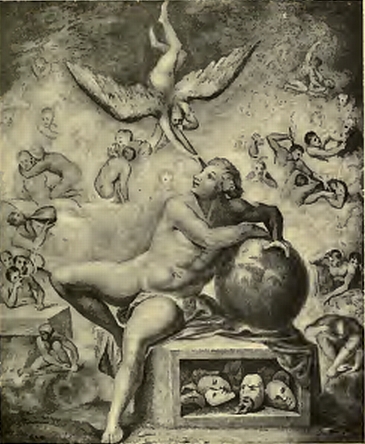
Remark further, that notwithstanding these bounties of Jupiter, the animal man has still but two or three and twenty years to live, at most. Taking mankind in general, of this a third must be taken away for sleep, during which we are in a certain sense dead; thus there remain fifteen, and from these fifteen we must take at least eight for our first infancy, which is, as it has been called, the vestibule of life. The clear product will be seven years, and of these seven years the half at least is consumed in grief of all kinds. Take three years and a half for labor, fatigue, and dissatisfaction, and we shall have none remaining. Well, poor animal, will you still be proud?
Unfortunately, in this fable Jupiter forgot to dress this animal as he clothed the ass, horse, peacock, and even the caterpillar. Man had only his bare skin, which, continually exposed to the sun, rain, and hail, became chapped, tanned, and spotted. The male in our continent was disfigured by spare hairs on his body, which rendered him frightful without covering him. His face was hidden by these hairs. His skin became a rough soil which bore a forest of stalks, the roots of which tended upwards, and the branches of which grew downwards. It was in this state and in this image, that this animal ventured to paint God, when in course of time he learned the art of description.
The female being more weak, became still more disgusting and frightful in her old age; and, in short, without tailors, and mantua-makers, one-half of mankind would never have dared to show itself to the other. Yet, before having clothes, before even knowing how to speak, some ages must have passed away—a truth which has been proved, but which must be often repeated.
It is a little extraordinary that we should have harassed an innocent, estimable man of our time, the good Helvetius, for having said that if men had not hands, they could not build houses and work tapestry. Apparently, those who have condemned this proposition, have discovered a secret for cutting stones and wood, and working at the needle with their feet.
I liked the author of the work "On Mind". This man was worth more than all his enemies together; but I never approved either the errors of his book, or the trivial truths which he so emphatically enforced. I have, however, boldly taken his part when absurd men have condemned him for these same truths.
I have no terms to express the excess of my contempt for those who, for example's sake, would magisterially proscribe this passage: "The Turks can only be considered deists." How then, pedant! would you have them regarded as atheists, because they adore only one God!
You condemn this other proposition: "The man of sense knows that men are what they must be; that all hatred against them is unjust; that a fool commits fooleries as a wild stock bears bitter fruits."
So, crabbed stocks of the schools, you persecute a man because he hates you not! Let us, however, leave the schools, and pursue our subject.
Reason, industrious hands, a head capable of generalizing ideas, a language pliant enough to express them—these are great benefits granted by the Supreme Being to man, to the exclusion of other animals.
The male in general lives rather a shorter time than the female. He is also generally larger in proportion. A man of the loftiest stature is commonly two or three inches higher than the tallest woman.
His strength is almost always superior; he is more active; and having all his organs stronger, he is more capable of a fixed attention. All arts have been invented by him, and not by woman. We should remark, that it is not the fire of imagination, but persevering meditation and combination of ideas which have invented arts, as mechanics, gunpowder, printing, dialling, etc.
Man alone knows that he must die, and knows it only by experience. A child brought up alone, and transported into a desert island, would dream of death no more than a plant or a cat.
A singular man has written that the human body is a fruit, which is green until old age, and that the moment of death is that of maturity. A strange maturity, ashes and putrefaction! The head of this philosopher was not ripe. How many extravagances has the rage for telling novelties produced?
The principal occupations of our race are the provision of food, lodging, and clothing; all the rest are nearly accessory; and it is this poor accessory which has produced so many ravages and murders.
Different Races Of Men.
We have elsewhere seen how many different races of men this globe contains, and to what degrees the first negro and the first white who met were astonished at one another.
It is likely enough that several weakly species of men and animals have perished. It is thus that we no longer discover any of the murex, of which the species has probably been devoured by other animals who several ages after visited the shores inhabited by this little shellfish.
St. Jerome, in his "History of the Father of the Desert", speaks of a centaur who had a conversation with St. Anthony the hermit. He afterwards gives an account of a much longer discourse that the same Anthony had with a satyr.
St. Augustine, in his thirty-third sermon, addressed "To his Brothers in the Desert," tell things as extraordinary as Jerome. "I was already bishop of Hippo, when I went into Ethiopia with some servants of Christ, there to preach the gospel. In this country we saw many men and women without heads, who had two great eyes in their breasts. In countries still more southerly, we saw a people who had but one eye in their foreheads," etc.
Apparently, Augustine and Jerome then spoke "with economy"; they augmented the works of creation to raise greater admiration of the works of God. They sought to astonish men by fables, to render them more submissive to the yoke of faith.
We can be very good Christians without believing in centaurs, men without heads, or with only one eye, one leg, etc. But can we doubt that the interior structure of a negro may be different to that of a white, since the mucous netted membrane beneath the skin is white in the one, and black in the other? I have already told you so, but you are deaf.
The Albinos and the Darians—the first originally of Africa, and the second of the middle of America—are as different from us as from the negroes. There are yellow, red, and gray races. We have already seen that all the Americans are without beards or hair on their bodies, except the head and eyebrows. All are equally men, but only as a fir, an oak, and a pear tree are equally trees; the pear tree comes not from the fir, nor the fir from the oak.
But whence comes it, that in the midst of the Pacific Ocean, in an island named Otaheite, the men are bearded? It is to ask why we are so, while the Peruvians, Mexicans, and Canadians are not. It is to ask, why apes have tails, and why nature has refused us an ornament which, at least among us, is an extreme rarity.
The inclinations and characters of men differ as much as their climates and governments. It has never been possible to compose a regiment of Laplanders and Samoyeds, whilst the Siberians, their neighbors, become intrepid soldiers.
Neither can you make good grenadiers of a poor Darian or an Albino. It is not because they have partridge eyes, or that their hair and eyebrows are like the finest and whitest silk; but it is because their bodies, and consequently their courage, partake of the most extreme weakness. There is none but a blind man, and even an obstinate blind man, who can deny the existence of all these different species. It is as great and remarkable as that of apes.
That All Races Of Men Have Constantly Lived In Society.
All the men whom we have discovered in the most uncultivated and frightful countries herd together like beavers, ants, bees, and several other species of animals.
We have never seen countries in which they lived separate; or in which the male only joined with the female by chance, and abandoned her the moment after in disgust; or in which the mother estranged herself from her children, after having brought them up; or in which human beings lived without family and society. Some poor jesters have abused their understandings so far as to hazard the astonishing paradox, that man is originally created to live alone, and that it is society which has depraved his nature. They might as well say that herrings were created to swim alone in the sea; and that it is by an excess of corruption, that they pass in a troop from the Frozen Ocean to our shores; that formerly cranes flew in the air singly, and that, by a violation of their natural instinct, they have subsequently chosen to travel in company.
Every animal has its instinct, and the instinct of man, fortified by reason, disposes him towards society, as towards eating and drinking. So far from the want of society having degraded man, it is estrangement from society which degrades him. Whoever lived absolutely alone, would soon lose the faculty of thinking and expressing himself; he would be a burden to himself, and it would only remain to metamorphose him into a beast. An excess of powerless pride, which rises up against the pride of others, may induce a melancholy man to fly from his fellows; but it is a species of depravity, and punishes itself. That pride is its own punishment, which frets itself into solitude and secretly resents being despised and forgotten. It is enduring the most horrible slavery, in order to be free.
We have enlarged the bounds of ordinary folly so far as to say that it is not natural for a man to be attached to a woman during the nine months of her pregnancy. The appetite is satisfied, says the author of these paradoxes; the man has no longer any want of woman, nor the woman of man; and the latter need not have the least care, nor perhaps the least idea of the effects of the transient intercourse. They go different ways, and there is no appearance, until the end of nine months, that they have ever been known to one another. Why should he help her after her delivery? Why assist to bring up a child whom he cannot instinctively know belongs to him alone?
All this is execrable; but happily nothing is more false. If this barbarous indifference was the true instinct of nature, mankind would always have acted thus. Instinct is unchangeable, its inconsistencies are very rare; the father would always abandon the mother, and the mother would abandon her child. There would have been much fewer men on earth than voracious animals; for the wild beasts better provided and better armed, have a more prompt instinct, more sure means of living, and a more certain nourishment than mankind.
Our nature is very different from the frightful romance which this man, possessed of the devil, has made of it. Except some barbarous souls entirely brutish, or perhaps a philosopher more brutal still, the roughest man, by a prevailing instinct, loves the child which is not yet born, the womb which bears it; and the mother redoubles her love for him from whom she has received the germ of a being similar to himself.
The instinct of the colliers of the Black Forest speaks to them as loudly, and animates them as strongly in favor of their children as the instinct of pigeons and nightingales induces them to feed their little ones. Time has therefore been sadly lost in writing these abominable absurdities.
The great fault of all these paradoxical books lies in always supposing nature very different from what it is. If the satires on man and woman written by Boileau were not pleasantries, they would sin in the essential point of supposing all men fools and all women coquettes.
The same author, an enemy to society, like the fox without a tail who would have his companions cut off theirs, thus in a magisterial style expresses himself:
"The first who, having enclosed an estate, took upon himself to say: 'This is mine,' and found people simple enough to believe him, was the true founder of society. What crimes, wars, murders, miseries, and horrors, might have been spared to mankind if some one, seizing the stakes, or filling up the pit, had cried to his companions: 'Take care how you listen to this impostor; you are lost if you forget that the fruits are common to all, and that the earth belongs to nobody!'"
Thus, according to this fine philosopher, a thief, a destroyer, would have been the benefactor of mankind, and we should punish an honest man who says to his children: "Let us imitate our neighbor; he has enclosed his field, the beasts will no longer ravage it, his land will become more fertile; let us work ours as he has labored his; it will aid us, and we shall improve it. Each family cultivating its own enclosure, we shall be better fed, more healthy, more peaceable, and less unhappy. We will endeavor to establish a distributive justice, which will console our unhappy race; and we shall be raised above the foxes and polecats, to whom this babbler would compare us."
Would not this discourse be more sensible and honest than that of the savage fool who would destroy the good man's orchard? What philosophy therefore is that which says things that common sense disclaims from China to Canada? Is it not that of a beggar, who would have all the rich robbed by the poor, in order that fraternal union might be better established among men?
It is true, that if all the hedges, forests, and plains were covered with wholesome and delicious fruits, it would be impossible, unjust, and ridiculous, to guard them.
If there are any islands in which nature produces food and all necessaries without trouble, let us go and live there, far from the trash of our laws; but as soon as you have peopled them, we must return to meum and tuum, and to laws which are often very bad, but which we cannot rationally abolish.
Is Man Born Wicked?
Is it not demonstrated that man is not born perverse and the child of the devil? If such was his nature, he would commit enormous crimes and barbarities as soon as he could walk; he would use the first knife he could find, to wound whoever displeased him. He would necessarily resemble little wolves and foxes, who bite as soon as they can.
On the contrary, throughout the world, he partakes of the nature of the lamb, while he is an infant. Why, therefore, and how is it, that he so often becomes a wolf and fox? Is it not that, being born neither good nor wicked, education, example, the government into which he is thrown—in short, occasion of every kind—determines him to virtue or vice?
Perhaps human nature could not be otherwise. Man could not always have false thoughts, nor always true affections; be always sweet, or always cruel.
It is demonstrable that woman is elevated beyond men in the scale of goodness. We see a hundred brothers enemies to each other, to one Clytemnestra.
There are professions which necessarily render the soul pitiless—those of the soldier, the butcher, the officer of justice, and the jailer; and all trades which are founded on the annoyance of others.
The officer, the soldier, the jailer, for example, are only happy in making others miserable. It is true, they are necessary against malefactors, and so far useful to society; but of a thousand men of the kind, there is not one who acts from the motive of the public good, or who even reflects that it is a public good.
It is above all a curious thing to hear them speak of their prowess as they count the number of their victims; their snares to entrap them, the ills which they have made them suffer, and the money which they have got by it.
Whoever has been able to descend to the subaltern detail of the bar; whoever has only heard lawyears reason familiarly among themselves, and applaud themselves for the miseries of their clients, must have a very poor opinion of human nature.
There are more frightful possessions still, which are, however, canvassed for like a canonship. There are some which change an honest man into a rogue, and which accustom him to lie in spite of himself, to deceive almost without perceiving it, to put a blind before the eyes of others, to prostrate himself by the interest and vanity of his situation, and without remorse to plunge mankind into stupid blindness.
Women, incessantly occupied with the education of their children, and shut up in their domestic cares, are excluded from all these professions, which pervert human nature and render it atrocious. They are everywhere less barbarous than men.
Physics join with morals to prevent them from great crimes; their blood is milder; they are less addicted to strong liquors, which inspire ferocity. An evident proof is, that of a thousand victims of justice in a thousand executed assassins, we scarcely reckon four women. It is also proved elsewhere, I believe, that in Asia there are not two examples of women condemned to a public punishment. It appears, therefore, that our customs and habits have rendered the male species very wicked.
If this truth was general and without exceptions, the species would be more horrible than spiders, wolves, and polecats are to our eyes. But happily, professions which harden the heart and fill it with odious passions, are very rare. Observe, that in a nation of twenty millions, there are at most two hundred thousand soldiers. This is but one soldier to two hundred individuals. These two hundred thousand soldiers are held in the most severe discipline, and there are among them very honest people, who return to their villages and finish their old age as good fathers and husbands.
The number of other trades which are dangerous to manners, is but small. Laborers, artisans, and artists are too much occupied often to deliver themselves up to crime. The earth will always bear detestable wretches, and books will always exaggerate the number, which, rather than being greater, is less than we say.
If mankind had been under the empire of the devil, there would be no longer any person upon earth. Let us console ourselves: we have seen, and we shall always see, fine minds from Pekin to la Rochelle; and whatever licentiates and bachelors may say, the Tituses, Trajans, Antoninuses, and Peter Bayles were very honest men.
Of Man In The State Of Pure Nature.
What would man be in the state which we call that of pure nature? An animal much below the first Iroquois whom we found in the north of America. He would be very inferior to these Iroquois, since they knew how to light fires and make arrows. He would require ages to arrive at these two arts.
Man, abandoned to pure nature, would have, for his language, only a few inarticulate sounds; the species would be reduced to a very small number, from the difficulty of getting nourishment and the want of help, at least in our harsh climates. He would have no more knowledge of God and the soul, than of mathematics; these ideas would be lost in the care of procuring food. The race of beavers would be infinitely preferable.
Man would then be only precisely like a robust child; and we have seen many men who are not much above that state, as it is. The Laplanders, the Samoyeds, the inhabitants of Kamchatka, the Kaffirs, and Hottentots are—with respect to man in a state of pure nature—that which the courts of Cyrus and Semiramis were in comparison with the inhabitants of the Cévennes. Yet the inhabitants of Kamchatka and the Hottentots of our days, so superior to men entirely savage, are animals who live six months of the year in caverns, where they eat the vermin by which they are eaten.
In general, mankind is not above two or three degrees more civilized than the Kamchatkans. The multitude of brute beasts called men, compared with the little number of those who think, is at least in the proportion of a hundred to one in many nations.
It is pleasant to contemplate on one side, Father Malebranche, who treats familiarly of "the Word"; and on the other, these millions of animals similar to him, who have never heard speak of "the Word," and who have not one metaphysical idea.
Between men of pure instinct and men of genius floats this immense number occupied solely with subsisting.
This subsistence costs us so much pains, that in the north of America an image of God often runs five or six leagues to get a dinner; whilst among us the image of God bedews the ground with the sweat of his brow, in order to procure bread.
Add to this bread—or the equivalent—a hut, and a poor dress, and you will have man such as he is in general, from one end of the universe to the other: and it is only in a multitude of ages that he has been able to arrive at this high degree of attainment.
Finally, after other ages, things got to the point at which we see them. Here we represent a tragedy in music; there we kill one another on the high seas of another hemisphere, with a thousand pieces of cannon. The opera and a ship of war of the first rank always astonish my imagination. I doubt whether they can be carried much farther in any of the globes with which the heavens are studded. More than half the habitable world, however, is still peopled with two-footed animals, who live in the horrible state approaching to pure nature, existing and clothing themselves with difficulty, scarcely enjoying the gift of speech, scarcely perceiving that they are unfortunate, and living and dying almost without knowing it.
Examination Of A Thought Of Pascal On Man.
"I can conceive a man without hands or feet, and I could even conceive him without a head, if experience taught me not that it is with the head he thinks. It is therefore thought which makes the being of man, without which we cannot conceive him."—(Thoughts of Pascal.)
How! conceive a man, without feet, hands, and head? This would be as different a thing from a man as a gourd.
If all men were without heads, how could yours conceive that there are animals like yourselves, since they would have nothing of what principally constitutes your being? A head is something; the five senses are contained in it, and thought also. An animal, which from the nape of its neck downwards might resemble a man, or one of those apes which we call ourang-outang or the man of the woods, would no more be a man than an ape or a bear whose head and tail were cut off.
It is therefore thought which makes the being of a man. In this case, thought would be his essence, as extent and solidity are the essence of matter. Man would think essentially and always, as matter is always extended and solid. He would think in a profound sleep without dreams, in a fit, in a lethargy, in the womb of his mother. I well know that I never thought in any of these states; I confess it often; and I doubt not that others are like myself.
If thought was as essential to man as extent is to matter, it would follow that God cannot deprive this animal of understanding, since he cannot deprive matter of extent—for then it would be no longer matter. Now, if understanding be essential to man, he is a thinking being by nature, as God is God by nature.
If desirous to define God, as such poor beings as ourselves can define Him, I should say, that thought is His being, His essence; but as to man—!
We have the faculties of thinking, walking, talking, eating, and sleeping, but we do not always use these faculties, it is not in our nature.
Thought, with us, is it not an attribute? and so much an attribute that it is sometimes weak, sometimes strong, sometimes reasonable, and sometimes extravagant? It hides itself, shows itself, flies, returns, is nothing, is reproduced. Essence is quite another thing; it never varies; it knows nothing of more or less.
What, therefore, would be the animal supposed by Pascal? A being of reason. He might just as well have supposed a tree to which God might have given thought, as it is said that the gods granted voices to the trees of Dodona.
Operation Of God On Man.
People who have founded systems on the communication of God with man have said that God acts directly physically on man in certain cases only, when God grants certain particular gifts; and they have called this action "physical premotion." Diocles and Erophiles, those two great enthusiasts, maintain this opinion, and have partisans.
Now we recognize a God quite as well as these people, because we cannot conceive that any one of the beings which surround us could be produced of itself. By the fact alone that something exists, the necessary Eternal Being must be necessarily the cause of all. With these reasoners, we admit the possibility of God making himself understood to some favorites; but we go farther, we believe that He makes Himself understood by all men, in all places, and in all times, since to all he gives life, motion, digestion, thought, and instinct.
Is there in the vilest of animals, and in the most sublime philosophers, a being who can will motion, digestion, desire, love, instinct, or thought? No; but we act, we love, we have instincts; as for example, an invincible liking to certain objects, an insupportable aversion to others, a promptitude to execute the movements necessary to our preservation, as those of sucking the breasts of our nurses, swimming when we are strong and our bosoms large enough, biting our bread, drinking, stooping to avoid a blow from a stone, collecting our force to clear a ditch, etc. We accomplish a thousand such actions without thinking of them, though they are all profoundly mathematical. In short, we think and feel without knowing how.
In good earnest, is it more difficult for God to work all within us by means of which we are ignorant, than to stir us internally sometimes, by the efficacious grace of Jupiter, of which these gentlemen talk to us unceasingly?
Where is the man who, when he looks into himself, perceives not that he is a puppet of Providence? I think—but can I give myself a thought? Alas! if I thought of myself, I should know what ideas I might entertain the next moment—a thing which nobody knows.
I acquire a knowledge, but I could not give it to myself. My intelligence cannot be the cause of it; for the cause must contain the effect: Now, my first acquired knowledge was not in my understanding; being the first, it was given to me by him who formed me, and who gives all, whatever it may be.
I am astonished, when I am told that my first knowledge cannot alone give me a second; that it must contain it.
The proof that we give ourselves no ideas is that we receive them in our dreams; and certainly, it is neither our will nor attention which makes us think in dreams. There are poets who make verses sleeping; geometricians who measure triangles. All proves to us that there is a power which acts within us without consulting us.
All our sentiments, are they not involuntary? Hearing, taste, and sight are nothing by themselves. We feel, in spite of ourselves: we do nothing of ourselves: we are nothing without a Supreme Power which enacts all things.
The most superstitious allow these truths, but they apply them only to people of their own class. They affirm that God acts physically on certain privileged persons. We are more religious than they; we believe that the Great Being acts on all living things, as on all matter. Is it therefore more difficult for Him to stir all men than to stir some of them? Will God be God for your little sect alone? He is equally so for me, who do not belong to it.
A new philosopher goes further than you; it seemed to him that God alone exists. He pretends that we are all in Him; and we say that it is God who sees and acts in all that has life. "Jupiter est quodcumque vides; quodcumque moveris."
To proceed. Your physical premotion introduces God acting in you. What need have you then of a soul? Of what good is this little unknown and incomprehensible being? Do you give a soul to the sun, which enlightens so many globes? And if this star so great, so astonishing, and so necessary, has no soul, why should man have one? God who made us, does He not suffice for us? What, therefore, is become of the axiom? Effect not that by many, which can be accomplished by one.
This soul, which you have imagined to be a substance, is therefore really only a faculty, granted by the Great Being, and not by a person. It is a property given to our organs, and not a substance. Man, his reason uncorrupted by metaphysics, could never imagine that he was double; that he was composed of two beings, the one mortal, visible, and palpable—the other immortal, invisible, and impalpable. Would it not require ages of controversy to arrive at this expedient of joining together two substances so dissimilar; tangible and intangible, simple and compound, invulnerable and suffering, eternal and fleeting?
Men have only supposed a soul by the same error which made them suppose in us a being called memory, which being they afterwards made a divinity.
They made this memory the mother of the Muses; they embodied the various talents of nature in so many goddesses, the daughters of memory. They also made a god of the secret power by which nature forms the blood of animals, and called it the god of sanguification. The Roman people indeed had similar gods for the faculties of eating and drinking, for the act of marriage, for the act of voiding excrements. They were so many particular souls, which produced in us all these actions. It was the metaphysics of the populace. This shameful and ridiculous superstition was evidently derived from that which imagined in man a small divine substance, different from man himself.
This substance is still admitted in all the schools; and with condescension we grant to the Great Being, to the Eternal Maker, to God, the permission of joining His concurrence to the soul. Thus we suppose, that for will and deed, both God and our souls are necessary.
But to concur signifies to aid, to participate. God therefore is only second with us; it is degrading Him; it is putting Him on a level with us, or making Him play the most inferior part. Take not from Him His rank and pre-eminence: make not of the Sovereign of Nature the mere servant of mankind.
Two species of reasoners, well credited in the world—atheists and theologians—will oppose our doubts.
The atheists will say, that in admitting reason in man and instinct in brutes, as properties, it is very useless to admit a God into this system; that God is still more incomprehensible than a soul; that it is unworthy a sage to believe that which he conceives not. They let fly against us all the arguments of Straton and Lucretius. We will answer them by one word only: "You exist; therefore there is a God."
Theologians will give us more trouble. They will first tell us: "We agree with you that God is the first cause of all; but He is not the only one." A high priest of Minerva says expressly: "The second agent operates by virtue of the first; the first induces a second; the second involves a third; all are acting by virtue of God, and He is the cause of all actions acting."
We will answer, with all the respect we owe to this high priest: "There is, and there can only exist, one true cause. All the others, which are subsequent, are but instruments. I discover a spring—I make use of it to move a machine; I discovered the spring and made the machine. I am the sole cause. That is undoubted."
The high priest will reply: "You take liberty away from men." I reply: "No; liberty consists in the faculty of willing, and in that of doing what you will, when nothing prevents you. God has made man upon these conditions, and he must be contented with them."
My priest will persist, and say, that we make God the author of sin. Then we shall answer him: "I am sorry for it; but God is made the author of sin in all systems, except in that of the atheists. For if He concurs with the actions of perverse men, as with those of the just, it is evident that to concur is to do, since He who concurs is also the creator of all."
If God alone permits sin, it is He who commits it; since to permit and to do is the same thing to the absolute master of all. If He foresees that men will do evil, he should not form men. We have never eluded the force of these ancient arguments; we have never weakened them. Whoever has produced all, has certainly produced good and evil. The system of absolute predestination, the doctrine of concurrence, equally plunge us into this labyrinth, from which we cannot extricate ourselves.
All that we can say is, that evil is for us, and not for God. Nero assassinates his preceptor and his mother; another murders his relations and neighbors; a high priest poisons, strangles, and beheads twenty Roman lords, on rising from the bed of his daughter. This is of no more importance to the Being, the Universal Soul of the World, than sheep eaten by the wolves or by us, or than flies devoured by spiders. There is no evil for the Great Being; to Him it is only the play of the great machine which incessantly moves by eternal laws. If the wicked become—whether during their lives or subsequently—more unhappy than those whom they have sacrificed to their passions; if they suffer as they have made others suffer, it is still an inevitable consequence of the immutable laws by which the Great Being necessarily acts. We know but a very small part of these laws; we have but a very weak portion of understanding; we have only resignation in our power. Of all systems, is not that which makes us acquainted with our insignificance the most reasonable? Men—as all philosophers of antiquity have said—made God in their own image; which is the reason why the first Anaxagoras, as ancient as Orpheus, expresses himself thus in his verses: "If the birds figured to themselves a God, he would have wings; that of horses would run with four legs."
The vulgar imagine God to be a king, who holds his seat of justice in his court. Tender hearts represent him as a father who takes care of his children. The sage attributes to Him no human affection. He acknowledges a necessary eternal power which animates all nature, and resigns himself to it.
General Reflection On Man.
It requires twenty years to raise man from the state of a plant, in which he abides in his mother's womb, and from the pure animal state, which is the lot of his earliest infancy, to that in which the maturity of reason begins to dawn. He has required thirty ages to become a little acquainted with his own bodily structure. He would require eternity to become acquainted with his soul. He requires but an instant to kill himself.
MARRIAGE.
SECTION I.
I once met with a reasoner who said: "Induce your subjects to marry as early as possible. Let them be exempt from taxes the first year; and let their portion be assessed on those who at the same age are in a state of celibacy.
"The more married men you have, the fewer crimes there will be. Examine the frightful columns of your criminal calendars; you will there find a hundred youths executed for one father of a family.
"Marriage renders men more virtuous and more wise. The father of a family is not willing to blush before his children; he is afraid to make shame their inheritance.
"Let your soldiers marry, and they will no longer desert. Bound to their families, they will be bound to their country. An unmarried soldier is frequently nothing but a vagabond, to whom it matters not whether he serves the king of Naples or the king of Morocco."
The Roman warriors were married: they fought for their wives and their children; and they made slaves of the wives and the children of other nations.
A great Italian politician, who was, besides, learned in the Eastern tongues, a thing rare among our politicians, said to me in my youth: "Caro figlio," remember that the Jews never had but one good institution—that of abhorring virginity. If that little nation of superstitious jobbers had not regarded marriage as the first of the human obligations—if there had been among them convents of nuns—they would have been inevitably lost.
The Marriage Contract.
Marriage is a contract in the law of nations, of which the Roman Catholics have made a sacrament.
But the sacrament and the contract are two very different things; with the one are connected the civil effects, with the other the graces of the church.
So when the contract is conformable to the law of nations, it must produce every civil effect. The absence of the sacrament can operate only in the privation of spiritual graces.
Such has been the jurisprudence of all ages, and of all nations, excepting the French. Such was the opinion of the most accredited fathers of the Church. Go through the Theodosian and Justinian codes, and you will find no law proscribing the marriages of persons of another creed, not even when contracted between them and Catholics.
It is true, that Constantius—that son of Constantine as cruel as his father—forbade the Jews, on pain of death, to marry Christian women; and that Valentinian, Theodosius, and Arcadius made the same prohibition, under the like penalty, to the Jewish women. But under the emperor Marcian these laws had ceased to be observed; and Justinian rejected them from his code. Besides, they were made against the Jews only; no one ever thought of applying them to the marriage of pagans or heretics with the followers of the prevailing religion.
Consult St. Augustine, and he will tell you that in his time the marriages of believers with unbelievers were not considered illicit, because no gospel text had condemned them: "Quæ matrimonia cum in fidelibus, nostris temporibus, jam non putantur esse peccata; quoniam in Novo Testamento nihil inde preceptum est, et ideo aut licere creditum est, aut velut dubium derelictum."
Augustine says, moreover, that these marriages often work the conversion of the unbelieving party. He cites the example of his own father, who embraced the Christian religion because his wife, Manica, professed Christianity. Clotilda, by the conversion of Clovis, and Theolinda, by that of Agilulf, king of the Lombards, rendered greater service to the Church than if they had married orthodox princes.
Consult the declaration of Pope Benedict XIV. of Nov. 4, 1741. You will find in it these words: "Quod vero spectat ad ea conjugia quæ, absque forma a Tridentino statuta, contrahuntur a catholicis cum hæreticis, sive catholicus vir hæriticam feminam ducat, sive catholica fæmina heretico viro nubat; si hujusmodi matrimonium sit contractum aut in posterum contracti contingat, Tridentini forma non servata, declarat Sanctitas sua, alio non concurrente impedimento, validum habendum esse, sciat conjux catholicus se istius matrimonii vinculo perpetuo ligatum."—With respect to such marriages as, transgressing the enactment of the Council of Trent, are contracted by Catholics with heretics; whether by a Catholic man with a heretical woman, or by a Catholic woman with a heretical man; if such matrimony already is, or hereafter shall be contracted, the rules of the council not being observed, his holiness declares, that if there be no other impediment, it shall be held valid, the Catholic man or woman understanding that he or she is by such matrimony bound until death.
By what astonishing contradiction is it, that the French laws in this matter are more severe than those of the Church? The first law by which this severity was established in France was the edict of Louis XIV., of November, 1680, which deserves to be repeated.
"Louis,... The canons of the councils having forbidden marriages of Catholics with heretics, as a public scandal and a profanation of the sacrament, we have deemed it the more necessary to prevent them for the future, as we have found that the toleration of such marriages exposes Catholics to the continual temptation of perverting it, etc. For these causes,... it is our will and pleasure, that in future our subjects of the Roman Catholic and Apostolic religion may not, under any pretext whatsoever, contract marriage with those of the pretended reformed religion, declaring such marriages to be invalid, and the issue of them illegitimate."
It is singular enough, that the laws of the Church should have been made the foundation for annulling marriages which the Church never annulled. In this edict we find the sacrament confounded with the civil contract; and from this confusion have proceeded the strange laws in France concerning marriage.
St. Augustine approved marriages of the orthodox with heretics, for he hoped that the faithful spouse would convert the other; and Louis XIV. condemns them, lest the heterodox should pervert the believer.
In Franche-Comté there exists a yet more cruel law. This is an edict of the archduke Albert and his wife Isabella, of Dec. 20, 1599, which forbids Catholics to marry heretics, on pain of confiscation of body and goods.
The same edict pronounces the same penalty on such as shall be convicted of eating mutton on Friday or Saturday. What laws! and what law-givers!—"A quels maîtres, grand Dieu, livrez-vous l'univers!"
SECTION II.
If our laws reprove marriages of Catholics with persons of a different religion, do they grant the civil effects at least to marriages of French Protestants with French persons of the same sect?
There are now in the kingdom a million of Protestants; yet the validity of their marriage is still a question in the tribunals.
Here again is one of those cases in which our jurisprudence is contradictory to the decisions of the Church, and also to itself.
In the papal declaration, quoted in the foregoing section, Benedict XIV. decides that marriages of Protestants, contracted according to their rites, are no less valid than if they had been performed according to the forms established by the Council of Trent; and that a husband who turns Catholic cannot break this tie and form a new one with a person of his new religion.
Barak Levi, by birth a Jew, and a native of Haguenan, had there married Mendel Cerf, of the same town and the same religion.
This Jew came to Paris in 1752; and on May 13, 1754, he was baptized. He sent a summons to his wife at Haguenan to come and join him at Paris. In a second summons he consented that this wife, when she had come to join him, should continue to live in her own Jewish sect.
To these summonses Mendel Cerf replied that she would not return with him, and that she required him to send her, according to the Jewish forms, a bill of divorce, in order that she might marry another Jew.
Levi was not satisfied with this answer; he sent no bill of divorce; but he caused his wife to appear before the official of Strasburg, who, by a sentence of Sept. 7, 1754, declared that, in the sight of the Church, he was at liberty to marry a Catholic woman.
Furnished with this sentence, the Christianized Jew came into the diocese of Soissons, and there made promise of marriage to a young woman of Villeneuve. The clergyman refused to publish the banns. Levi communicated to him the summonses he had sent to his wife, the sentence of the official of Strasburg, and a certificate from the secretary of the bishopric of that place, attesting, that in that diocese baptized Jews had at all times been permitted to contract new marriages with Catholics, and that this usage had constantly been recognized by the Supreme Council of Colmar. But these documents appeared to the parson of Villeneuve to be insufficient. Levi was obliged to summon him before the official of Soissons.