VOLUME XI (continued 2)
William F. Fleming translation
We have two editions of this Salic law; one by a person by the name of Herold, the other by Francis Pithou; and these are different, which is by no means a favorable presumption. When the text of a law is given differently in two documents, it is not only evident that one of the two is false, but it is highly probable that they are both so. No custom or usage of the Franks was written in our early times, and it would be excessively strange that the law of the Salii should have been so. This law, moreover, is in Latin, and it does not seem at all probable that, in the swamps between Suabia and Batavia, Clovis, or his predecessors, should speak Latin.
It is supposed that this law has reference to the kings of France; and yet all the learned are agreed that the Sicambri, the Franks, and the Salii, had no kings, nor indeed any hereditary chiefs.
The title of the Salic law begins with these words: "In Christi nomine"—"In the name of Christ." It was therefore made out of the Salic territory, as Christ was no more known by these barbarians than by the rest of Germany and all the countries of the North.
This law is stated to have been drawn up by four distinguished lawyers of the Frank nation; these, in Herold's edition, are called Vuisogast, Arogast, Salegast, and Vuindogast. In Pithou's edition, the names are somewhat different. It has been unluckily discovered that these names are the old names, somewhat disguised, of certain cantons of Germany.
In whatever period this law was framed in bad Latin, we find, in the article relating to allodial or freehold lands, "that no part of Salic land can be inherited by women." It is clear that this pretended law was by no means followed. In the first place, it appears from the formulæ of Marculphus that a father might leave his allodial land to his daughter, renouncing "a certain Salic law which is impious and abominable."
Secondly, if this law be applied to fiefs, it is evident that the English kings, who were not of the Norman race, obtained all their great fiefs in France only through daughters.
Thirdly, it is alleged to be necessary that a fief should be possessed by a man, because he was able as well as bound to fight for his lord; this itself shows that the law could not be understood to affect the rights to the throne. All feudal lords might fight just as well for a queen as for a king. A queen was not obliged to follow the practice so long in use, to put on a cuirass, and cover her limbs with armor, and set off trotting against the enemy upon a carthorse.
It is certain, therefore, that the Salic law could have no reference to the crown, neither in connection with allodial lands, nor feudal holding and service.
Mézeray says, "The imbecility of the sex precludes their reigning." Mézeray speaks here like a man neither of sense nor politeness. History positively and repeatedly falsifies his assertion. Queen Anne of England, who humbled Louis XIV.; the empress-queen of Hungary, who resisted King Louis XV., Frederick the Great, the elector of Bavaria, and various other princes; Elizabeth of England, who was the strength and support of our great Henry; the empress of Russia, of whom we have spoken already; all these decidedly show that Mézeray is not more correct than he is courteous in his observation. He could scarcely help knowing that Queen Blanche was in fact the reigning monarch under the name of her son; as Anne of Brittany was under that of Louis XII.
Velly, the last writer of the history of France, and who on that very account ought to be the best, as he possessed all the accumulated materials of his predecessors, did not, however, always know how to turn his advantages to the best account. He inveighs with bitterness against the judicious and profound Rapin de Thoyras, and attempts to prove to him that no princess ever succeeded to the crown while any males remained who were capable of succeeding. That we all know perfectly well, and Thoyras never said the contrary.
In that long age of barbarism, when the only concern of Europe was to commit usurpations and to sustain them, it must be acknowledged that kings, being often chiefs of banditti or warriors armed against those banditti, it was not possible to be subject to the government of a woman. Whoever was in possession of a great warhorse would engage in the work of rapine and murder only under the standard of a man mounted upon a great horse like himself. A buckler of oxhide served for a throne. The caliphs governed by the Koran, the popes were deemed to govern by the Gospel. The South saw no woman reign before Joan of Naples, who was indebted for her crown entirely to the affection of the people for King Robert, her grandfather, and to their hatred of Andrew, her husband. This Andrew was in reality of royal blood, but had been born in Hungary, at that time in a state of barbarism. He disgusted the Neapolitans by his gross manners, intemperance, and drunkenness. The amiable king Robert was obliged to depart from immemorial usage, and declare Joan alone sovereign by his will, which was approved by the nation.
In the North we see no queen reigning in her own right before Margaret of Waldemar, who governed for some months in her own name about the year 1377.
Spain had no queen in her own right before the able Isabella in 1461. In England the cruel and bigoted Mary, daughter of Henry VIII., was the first woman who inherited the throne, as the weak and criminal Mary Stuart was in Scotland in the sixteenth century. The immense territory of Russia had no female sovereign before the widow of Peter the Great.
The whole of Europe, and indeed I might say the whole world, was governed by warriors in the time when Philip de Valois supported his right against Edward III. This right of a male who succeeded to a male, seemed the law of all nations. "You are grandson of Philip the Fair," said Valois to his competitor, "but as my right would be superior to that of the mother, it must be still more decidedly superior to that of the son. Your mother, in fact, could not communicate a right which she did not possess."
It was therefore perfectly recognized in France that a prince of the blood royal, although in the remotest possible degree, should be heir to the crown in exclusion even of the daughter of the king. It is a law on which there is now not the slightest dispute whatever. Other nations have, since the full and universal recognition of this principle among ourselves, adjudged the throne to princesses. But France has still observed its ancient usage. Time has conferred on this usage the force of the most sacred of laws. At what time the Salic law was framed or interpreted is not of the slightest consequence; it does exist, it is respectable, it is useful; and its utility has rendered it sacred.
Examination Whether Daughters Are In All Cases Deprived Of Every Species Of Inheritance By This Salic Law.
I have already bestowed the empire on a daughter in defiance of the Golden Bull. I shall have no difficulty in conferring on a daughter the kingdom of France. I have a better right to dispose of this realm than Pope Julian II., who deprived Louis XII. of it, and transferred it by his own single authority to the emperor Maximilian. I am better authorized to plead in behalf of the daughters of the house of France, than Pope Gregory XIII. and Cordelier Sextus-Quintus were to exclude from the throne our princes of the blood, under the pretence actually urged by these excellent priests, that Henry IV. and the princes of Condé were a "bastard and detestable race" of Bourbon—refined and holy words, which deserve ever to be remembered in order to keep alive the conviction of all we owe to the bishops of Rome. I may give my vote in the states-general, and no pope certainly can have any suffrage on it. I therefore give my vote without hesitation, some three or four hundred years from the present time, to a daughter of France, then the only descendant remaining in a direct line from Hugh Capet. I constitute her queen, provided she shall have been well educated, have a sound understanding, and be no bigot. I interpret in her favor that law which declares "que fille ne doit mie succéder"—that a daughter must in no case come to her succession. I understand by the words, that she must in no case succeed as long as there shall be any male. But on failure of males, I prove that the kingdom belongs to her by nature, which ordains it, and for the benefit of the nation.
I invite all good Frenchmen to show the same respect as myself for the blood of so many kings. I consider this as the only method of preventing factions which would dismember the state. I propose that she shall reign in her own right, and that she shall be married to some amiable and respectable prince, who shall assume her name and arms, and who, in his own right, shall possess some territory which shall be annexed to France; as we have seen Maria Theresa of Hungary united in marriage to Francis, duke of Lorraine, the most excellent prince in the world.
What Celt will refuse to acknowledge her, unless we should discover some other beautiful and accomplished princess of the issue of Charlemagne, whose family was expelled by Hugh Capet, notwithstanding the Salic law? or unless indeed we should find a princess fairer and more accomplished still, an unquestionable descendant from Clovis, whose family was before expelled by Pepin, his own domestic, notwithstanding, be it again remembered, the Salic law.
I shall certainly find no involved and difficult intrigues necessary to obtain the consecration of my royal heroine at Rheims, or Chartres, or in the chapel of the Louvre—for either would effectually answer the purpose; or even to dispense with any consecration at all. For monarchs reign as well when not consecrated as when consecrated. The kings and queens of Spain observe no such ceremony.
Among all the families of the king's secretaries, no person will be found to dispute the throne with this Capetian princess. The most illustrious houses are so jealous of each other that they would infinitely prefer obeying the daughter of kings to being under the government of one of their equals.
Recognized by the whole of France, she will receive the homage of all her subjects with a grace and majesty which will induce them to love as much as they revere her; and all the poets will compose verses in her honor.
LAW (CIVIL AND ECCLESIASTICAL).
The following notes were found among the papers of a lawyer, and are perhaps deserving some consideration:
That no ecclesiastical law should be of any force until it has received the express sanction of government. It was upon this principle that Athens and Rome were never involved in religious quarrels.
These quarrels fall to the lot of those nations only that have never been civilized, or that have afterwards been again reduced to barbarism.
That the magistrate alone should have authority to prohibit labor on festivals, because it does not become priests to forbid men to cultivate their fields.
That everything relating to marriages depends solely upon the magistrate, and that the priests should be confined to the august function of blessing them.
That lending money at interest is purely an object of the civil law, as that alone presides over commerce.
That all ecclesiastical persons should be, in all cases whatever, under the perfect control of the government, because they are subjects of the state.
That men should never be so disgracefully ridiculous as to pay to a foreign priest the first year's revenue of an estate, conferred by citizens upon a priest who is their fellow-citizen.
That no priest should possess authority to deprive a citizen even of the smallest of his privileges, under the pretence that that citizen is a sinner; because the priest, himself a sinner, ought to pray for sinners, and not to judge them.
That magistrates, cultivators, and priests, should alike contribute to the expenses of the state, because all alike belong to the state.
That there should be only one system of weights and measures, and usages.
That the punishment of criminals should be rendered useful. A man that is hanged is no longer useful; but a man condemned to the public works is still serviceable to his country, and a living lecture against crime.
That the whole law should be clear, uniform, and precise; to interpret it is almost always to corrupt it.
That nothing should be held infamous but vice.
That taxes should be imposed always in just proportion.
That law should never be in contradiction to usage; for, if the usage is good, the law is worth nothing.
LAWS.
SECTION I.
It is difficult to point out a single nation living under a system of good laws. This is not attributable merely to the circumstance that laws are the productions of men, for men have produced works of great utility and excellence; and those who invented and brought to perfection the various arts of life were capable of devising a respectable code of jurisprudence. But laws have proceeded, in almost every state, from the interest of the legislator, from the urgency of the moment, from ignorance, and from superstition, and have accordingly been made at random, and irregularly, just in the same manner in which cities have been built. Take a view of Paris, and observe the contrast between that quarter of it where the fish-market (Halles) is situated, the St. Pierre-aux-bœufs, the streets Brisemiche and Pet-au-diable and the beauty and splendor of the Louvre and the Tuileries. This is a correct image of our laws.
It was only after London had been reduced to ashes that it became at all fit to be inhabited. The streets, after that catastrophe, were widened and straightened. If you are desirous of having good laws, burn those which you have at present, and make fresh ones.
The Romans were without fixed laws for the space of three hundred years; they were obliged to go and request some from the Athenians, who gave them such bad ones that they were almost all of them soon abrogated. How could Athens itself be in possession of a judicious and complete system? That of Draco was necessarily abolished, and that of Solon soon expired.
Our customary or common law of Paris is interpreted differently by four-and-twenty commentaries, which decidedly proves, the same number of times, that it is ill conceived. It is in contradiction to a hundred and forty other usages, all having the force of law in the same nation, and all in contradiction to each other. There are therefore, in a single department in Europe, between the Alps and the Pyrenees, more than forty distinct small populations, who call themselves fellow-countrymen, but who are in reality as much strangers to one another as Tonquin is to Cochin China.
It is the same in all provinces of Spain. It is in Germany much worse. No one there knows what are the rights of the chief or of the members. The inhabitant of the banks of the Elbe is connected with the cultivator of Suabia only in speaking nearly the same language, which, it must be admitted, is rather an unpolished and coarse one.
The English nation has more uniformity; but having extricated itself from servitude and barbarism only by occasional efforts, by fits and convulsive starts, and having even in its state of freedom retained many laws formerly promulgated, either by the great tyrants who contended in rivalship for the throne, or the petty tyrants who seized upon the power and honors of the prelacy, it has formed altogether a body of laws of great vigor and efficacy, but which still exhibit many bruises and wounds, very clumsily patched and plastered.
The intellect of Europe has made greater progress within the last hundred years than the whole world had done before since the days of Brahma, Fohi, Zoroaster, and the Thaut of Egypt. What then is the cause that legislation has made so little?
After the fifth century, we were all savages. Such are the revolutions which take place on the globe; brigands pillaging and cultivators pillaged made up the masses of mankind from the recesses of the Baltic Sea to the Strait of Gibraltar; and when the Arabs made their appearance in the South, the desolation of ravage and confusion was universal.
In our department of Europe, the small number, being composed of daring and ignorant men, used to conquest and completely armed for battle, and the greater number, composed of ignorant, unarmed slaves, scarcely any one of either class knowing how to read or write—not even Charlemagne himself—it happened very naturally that the Roman Church, with its pen and ceremonies, obtained the guidance and government of those who passed their life on horseback with their lances couched and the morion on their heads.
The descendants of the Sicambri, the Burgundians, the Ostrogoths, Visigoths, Lombards, Heruli, etc., felt the necessity of something in the shape of laws. They sought for them where they were to be found. The bishops of Rome knew how to make them in Latin. The barbarians received them with greater respect in consequence of not understanding them. The decretals of the popes, some genuine, others most impudently forged, became the code of the new governors, "regas"; lords, "leus"; and barons, who had appropriated the lands. They were the wolves who suffered themselves to be chained up by the foxes. They retained their ferocity, but it was subjugated by credulity and the fear which credulity naturally produces. Gradually Europe, with the exception of Greece and what still belonged to the Eastern Empire, became subjected to the dominion of Rome, and the poet's verse might be again applied as correctly as before: Romanos rerum dominos gentemque togatam.—Æneid, i, 286.
The subject world shall Rome's dominion own, And prostrate shall adore the nation of the gown. —DRYDEN.
Almost all treaties being accompanied by the sign of the cross, and by an oath which was frequently administered over some relics, everything was thus brought within the jurisdiction of the Church. Rome, as metropolitan, was supreme judge in causes, from the Cimbrian Chersonesus to Gascony; and a thousand feudal lords, uniting their own peculiar usages with the canon law, produced in the result that monstrous jurisprudence of which there at present exist so many remains. Which would have been better—no laws at all, or such as these?
It was beneficial to an empire of more vast extent than that of Rome to remain for a long time in a state of chaos; for, as every valuable institution was still to be formed, it was easier to build a new edifice than to repair one whose ruins were looked upon as sacred.
The legislatrix of the North, in 1767, collected deputies from all the provinces which contained about twelve hundred thousand square leagues. There were Pagans, Mahometans of the sect of Ali, and others of the sect of Omar, and about twelve different sects of Christians. Every law was distinctly proposed to this new synod; and if it appeared conformable to the interest of all the provinces, it then received the sanction of the empress and the nation.
The first law that was brought forward and carried, was a law of toleration, that the Greek priest might never forget that the Latin priest was his fellow-man; that the Mussulman might bear with his Pagan brother; and that the Roman Catholic might not be tempted to sacrifice his brother Presbyterian.
The empress wrote with her own hand, in this grand council of legislation, "Among so many different creeds, the most injurious error would be intolerance."
It is now unanimously agreed that there is in a state only one authority; that the proper expressions to be used are, "civil power," and "ecclesiastical discipline"; and that the allegory of the two swords is a dogma of discord.
She began with emancipating the serfs of her own particular domain. She emancipated all those of the ecclesiastical domains. She might thus be said to have created men out of slaves.
The prelates and monks were paid out of the public treasury. Punishments were proportioned to crimes, and the punishments were of a useful character; offenders were for the greater part condemned to labor on public works, as the dead man can be of no service to the living.
The torture was abolished, because it punishes a man before he is known to be guilty; because the Romans never put any to the torture but their slaves; and because torture tends to saving the guilty and destroying the innocent.
This important business had proceeded thus far, when Mustapha III., the son of Mahmoud, obliged the empress to suspend her code and proceed to fighting.
SECTION II.
I have attempted to discover some ray of light in the mythological times of China which precede Fohi, but I have attempted in vain.
At the period, however, in which Fohi flourished, which was about three thousand years before the new and common era of our northwestern part of the world, I perceive wise and mild laws already established by a beneficent sovereign. The ancient books of the Five Kings, consecrated by the respect of so many ages, treat of the institution of agriculture, of pastoral economy, of domestic economy, of that simple astronomy which regulates the different seasons, and of the music which, by different modulations, summoned men to their respective occupations. Fohi flourished, beyond dispute, more than five thousand years ago. We may therefore form some judgment of the great antiquity of an immense population, thus instructed by an emperor on every topic that could contribute to their happiness. In the laws of that monarch I see nothing but what is mild, useful and amiable.
I was afterwards induced to inspect the code of a small nation, or horde, which arrived about two thousand years after the period of which we have been speaking, from a frightful desert on the banks of the river Jordan, in a country enclosed and bristled with peaked mountains. These laws have been transmitted to ourselves, and are daily held up to us as the model of wisdom. The following are a few of them:
"Not to eat the pelican, nor the ossifrage, nor the griffin, nor the ixion, nor the eel, nor the hare, because the hare ruminates, and has not its foot cloven."
"Against men sleeping with their wives during certain periodical affections, under pain of death to both of the offending parties."
"To exterminate without pity all the unfortunate inhabitants of the land of Canaan, who were not even acquainted with them; to slaughter the whole; to massacre all, men and women, old men, children, and animals, for the greater glory of God."
"To sacrifice to the Lord whatever any man shall have devoted as an anathema to the Lord, and to slay it without power of ransom."
"To burn widows who, not being able to be married again to their brothers-in-law, had otherwise consoled themselves on the highway or elsewhere," etc.
A Jesuit, who was formerly a missionary among the cannibals, at the time when Canada still belonged to the king of France, related to me that once, as he was explaining these Jewish laws to his neophytes, a little impudent Frenchman, who was present at the catechising, cried out, "They are the laws of cannibals." One of the Indians replied to him, "You are to know, Mr. Flippant, that we are people of some decency and kindness. We never had among us any such laws; and if we had not some kindness and decency, we should treat you as an inhabitant of Canaan, in order to teach you civil language."
It appears upon a comparison of the code of the Chinese with that of the Hebrews, that laws naturally follow the manners of the people who make them. If vultures and doves had laws, they would undoubtedly be of a very different character.
SECTION III.
Sheep live in society very mildly and agreeably; their character passes for being a very gentle one, because we do not see the prodigious quantity of animals devoured by them. We may, however, conceive that they eat them very innocently and without knowing it, just as we do when we eat Sassenage cheese. The republic of sheep is a faithful image of the age of gold.
A hen-roost exhibits the most perfect representation of monarchy. There is no king comparable to a cock. If he marches haughtily and fiercely in the midst of his people, it is not out of vanity. If the enemy is advancing, he does not content himself with issuing an order to his subjects to go and be killed for him, in virtue of his unfailing knowledge and resistless power; he goes in person himself, ranges his young troops behind him, and fights to the last gasp. If he conquers, it is himself who sings the "Te Deum." In his civil or domestic life, there is nothing so gallant, so respectable, and so disinterested. Whether he has in his royal beak a grain of corn or a grub-worm, he bestows it on the first of his female subjects that comes within his presence. In short, Solomon in his harem was not to be compared to a cock in a farm-yard.
If it be true that bees are governed by a queen to whom all her subjects make love, that is a more perfect government still.
Ants are considered as constituting an excellent democracy. This is superior to every other state, as all are, in consequence of such a constitution, on terms of equality, and every individual is employed for the happiness of all. The republic of beavers is superior even to that of ants; at least, if we may judge by their performances in masonry.
Monkeys are more like merry-andrews than a regularly governed people; they do not appear associated under fixed and fundamental laws, like the species previously noticed.
We resemble monkeys more than any other animals in the talent of imitation, in the levity of our ideas, and in that inconstancy which has always prevented our having uniform and durable laws.
When nature formed our species, and imparted to us a certain portion of instinct, self-love for our own preservation, benevolence for the safety and comfort of others, love which is common to every class of animal being, and the inexplicable gift of combining more ideas than all the inferior animals together—after bestowing on us this outfit she said to us: "Go, and do the best you can."
There is not a good code of laws in any single country. The reason is obvious: laws have been made for particular purposes, according to time, place, exigencies, and not with general and systematic views.
When the exigencies upon which laws were founded are changed or removed, the laws themselves become ridiculous. Thus the law which forbade eating pork and drinking wine was perfectly reasonable in Arabia, where pork and wine are injurious; but at Constantinople it is absurd.
The law which confers the whole fief or landed property on the eldest son, is a very good one in a time of general anarchy and pillage. The eldest is then the commander of the castle, which sooner or later will be attacked by brigands; the younger brothers will be his chief officers, and the laborers his soldiers. All that is to be apprehended is that the younger brother may assassinate or poison the elder, his liege lord, in order to become himself the master of the premises; but such instances are uncommon, because nature has so combined our instincts and passions, that we feel a stronger horror against assassinating our elder brother, than we feel a desire to succeed to his authority and estate. But this law, which was suitable enough to the owners of the gloomy, secluded, and turreted mansions, in the days of Chilperic, is detestable when the case relates wholly to the division of family property in a civilized and well-governed city.
To the disgrace of mankind, the laws of play or gaming are, it is well known, the only ones that are throughout just, clear, inviolable, and carried into impartial and perfect execution. Why is the Indian who laid down the laws of a game of chess willingly and promptly obeyed all over the world, while the decretals of the popes, for example, are at present an object of horror and contempt? The reason is, that the inventor of chess combined everything with caution and exactness for the satisfaction of the players, and that the popes in their decretals looked solely to their own advantage. The Indian was desirous at once of exercising the minds of men and furnishing them with amusement; the popes were desirous of debasing and brutifying them. Accordingly, the game of chess has remained substantially the same for upwards of five thousand years, and is common to all the inhabitants of the earth; while the decretals are known only at Spoleto, Orvieto, and Loretto, and are there secretly despised even by the most shallow and contemptible of the practitioners.
SECTION IV.
During the reigns of Vespasian and Titus, when the Romans were disembowelling the Jews, a rich Israelite fled with all the gold he had accumulated by his occupation as a usurer, and conveyed to Ezion-Geber the whole of his family, which consisted of his wife, then far advanced in years, a son, and a daughter; he had in his train two eunuchs, one of whom acted as a cook, and the other as a laborer and vine-dresser; and a pious Essenian, who knew the Pentateuch completely by heart, acted as his almoner. All these embarked at the port of Ezion-Geber, traversed the sea commonly called Red, although it is far from being so, and entered the Persian Gulf to go in search of the land of Ophir, without knowing where it was. A dreadful tempest soon after this came on, which drove the Hebrew family towards the coast of India; and the vessel was wrecked on one of the Maldive islands now called Padrabranca, but which was at that time uninhabited.
The old usurer and his wife were drowned; the son and daughter, the two eunuchs, and the almoner were saved. They took as much of the provisions out of the wreck as they were able; erected for themselves little cabins on the island, and lived there with considerable convenience and comfort. You are aware that the island of Padrabranca is within five degrees of the line, and that it furnishes the largest cocoanuts and the best pineapples in the world; it was pleasant to have such a lovely asylum at a time when the favorite people of God were elsewhere exposed to persecution and massacre; but the Essenian could not refrain from tears when he reflected, that perhaps those on that happy island were the only Jews remaining on the earth, and that the seed of Abraham was to be annihilated.
"Its restoration depends entirely upon you," said the young Jew; "marry my sister." "I would willingly," said the almoner, "but it is against the law. I am an Essenian; I have made a vow never to marry; the law enjoins the strictest observance of a vow; the Jewish race may come to an end, if it must be so; but I will certainly not marry your sister in order to prevent it, beautiful and amiable as I admit she is."
"My two eunuchs," resumed the Jew, "can be of no service in this affair; I will therefore marry her myself, if you have no objection; and you shall bestow the usual marriage benediction."
"I had a hundred times rather be disembowelled by the Roman soldiers," said the almoner, "than to be instrumental to your committing incest; were she your sister by the father's side only, the law would allow of your marriage; but as she is your sister by the same mother, such a marriage would be abominable."
"I can readily admit," returned the young man, "that it would be a crime at Jerusalem, where I might see many other young women, one of whom I might marry; but in the isle of Padrabranca, where I see nothing but cocoanuts, pineapples, and oysters, I consider the case to be very allowable."
The Jew accordingly married his sister, and had a daughter by her, notwithstanding all the protestations of the Essenian; and this was the only offspring of a marriage which one of them thought very legitimate, and the other absolutely abominable.
After the expiration of fourteen years, the mother died; and the father said to the almoner, "Have you at length got rid of your old prejudices? Will you marry my daughter?" "God preserve me from it," said the Essenian. "Then," said the father, "I will marry her myself, come what will of it; for I cannot bear that the seed of Abraham should be totally annihilated." The Essenian, struck with inexpressible horror, would dwell no longer with a man who thus violated and defiled the law, and fled. The new-married man loudly called after him, saying, "Stay here, my friend. I am observing the law of nature, and doing good to my country; do not abandon your friends." The other suffered him to call, and continue to call, in vain; his head was full of the law; and he stopped not till he had reached, by swimming, another island.
This was the large island of Attola, highly populous and civilized; as soon as he landed he was made a slave. He complained bitterly of the inhospitable manner in which he had been received; he was told that such was the law, and that, ever since the island had been very nearly surprised and taken by the inhabitants of that of Ada, it had been wisely enacted that all strangers landing at Attola should be made slaves. "It is impossible that can ever be a law," said the Essenian, "for it is not in the Pentateuch." He was told in reply, that it was to be found in the digest of the country; and he remained a slave: fortunately he had a kind and wealthy master, who treated him very well, and to whom he became strongly attached.
Some murderers once came to the house in which he lived, to kill his master and carry off his treasure. They inquired of the slaves if he was at home, and had much money there. "We assure you, on our oaths," said the slaves, "that he is not at home." But the Essenian said: "The law does not allow lying; I swear to you that he is at home, and that he has a great deal of money." The master was, in consequence, robbed and murdered; the slaves accused the Essenian, before the judges, of having betrayed his master. The Essenian said, that he would tell no lies, and that nothing in the world should induce him to tell one; and he was hanged.
This history was related to me, with many similar ones, on the last voyage I made from India to France. When I arrived, I went to Versailles on business, and saw in the street a beautiful woman, followed by many others who were also beautiful. "Who is that beautiful woman?" said I to the barrister who had accompanied me; for I had a cause then depending before the Parliament of Paris about some dresses that I had had made in India, and I was desirous of having my counsel as much with me as possible. "She is the daughter of the king," said he, "she is amiable and beneficent; it is a great pity that, in no case or circumstance whatever, such a woman as that can become queen of France." "What!" I replied, "if we had the misfortune to lose all her relations and the princes of the blood—which God forbid—would not she, in that case, succeed to the throne of her father?" "No," said the counsellor; "the Salic law expressly forbids it." "And who made this Salic law?" said I to the counsellor. "I do not at all know," said he; "but it is pretended, that among an ancient people called the Salii, who were unable either to read or write, there existed a written law, which enacted, that in the Salic territory a daughter should not inherit any freehold." "And I," said I to him, "I abolish that law; you assure me that this princess is amiable and beneficent; she would, therefore, should the calamity occur of her being the last existing personage of royal blood, have an incontestable right to the crown: my mother inherited from her father; and in the case supposed, I am resolved that this princess shall inherit from hers."
On the ensuing day, my suit was decided in one of the chambers of parliament, and I lost everything by a single vote; my counsellor told me, that in another chamber I should have gained everything by a single vote. "That is a very curious circumstance," said I: "at that rate each chamber proceeds by a different law." "That is just the case," said he: "there are twenty-five commentaries on the common law of Paris: that is to say, it is proved five and twenty times over, that the common law of Paris is equivocal; and if there had been five and twenty chambers of judges, there would be just as many different systems of jurisprudence. We have a province," continued he, "fifteen leagues distant from Paris, called Normandy, where the judgment in your cause would have been very different from what it was here." This statement excited in me a strong desire to see Normandy; and I accordingly went thither with one of my brothers. At the first inn, we met with a young man who was almost in a state of despair. I inquired of him what was his misfortune; he told me it was having an elder brother. "Where," said I, "can be the great calamity of having an elder brother? The brother I have is my elder, and yet we live very happily together." "Alas! sir," said he to me, "the law of this place gives everything to the elder brother, and of course leaves nothing for the younger ones." "That," said I, "is enough, indeed, to disturb and distress you; among us everything is divided equally; and yet, sometimes, brothers have no great affection for one another."
These little adventures occasioned me to make some observations, which of course were very ingenious and profound, upon the subject of laws; and I easily perceived that it was with them as it is with our garments: I must wear a doliman at Constantinople, and a coat at Paris.
"If all human laws," said I, "are matters of convention, nothing is necessary but to make a good bargain." The citizens of Delhi and Agra say that they have made a very bad one with Tamerlane: those of London congratulate themselves on having made a very good one with King William of Orange. A citizen of London once said to me: "Laws are made by necessity, and observed through force." I asked him if force did not also occasionally make laws, and if William, the bastard and conqueror, had not chosen simply to issue his orders without condescending to make any convention or bargain with the English at all. "True," said he, "it was so: we were oxen at that time; William brought us under the yoke, and drove us with a goad; since that period we have been metamorphosed into men; the horns, however, remain with us still, and we use them as weapons against every man who attempts making us work for him and not for ourselves."
With my mind full of all these reflections, I could not help feeling a sensible gratification in thinking, that there exists a natural law entirely independent of all human conventions: The fruit of my labor ought to be my own: I am bound to honor my father and mother: I have no right over the life of my neighbor, nor has my neighbor over mine, etc. But when I considered, that from Chedorlaomer to Mentzel, colonel of hussars, every one kills and plunders his neighbor according to law, and with his patent in his pocket, I was greatly distressed.
I was told that laws existed even among robbers, and that there were laws also in war. I asked what were the laws of war. "They are," said some one, "to hang up a brave officer for maintaining a weak post without cannon; to hang a prisoner, if the enemy have hanged any of yours; to ravage with fire and sword those villages which shall not have delivered up their means of subsistence by an appointed day, agreeably to the commands of the gracious sovereign of the vicinage." "Good," said I, "that is the true spirit of laws." After acquiring a good deal of information, I found that there existed some wise laws, by which a shepherd is condemned to nine years' imprisonment and labor in the galleys, for having given his sheep a little foreign salt. My neighbor was ruined by a suit on account of two oaks belonging to him, which he had cut down in his wood, because he had omitted a mere form of technicality with which it was almost impossible that he should have been acquainted; his wife died, in consequence, in misery; and his son is languishing out a painful existence. I admit that these laws are just, although their execution is a little severe; but I must acknowledge I am no friend to laws which authorize a hundred thousand neighbors loyally to set about cutting one another's throats. It appears to me that the greater part of mankind have received from nature a sufficient portion of what is called common sense for making laws, but that the whole world has not justice enough to make good laws.
Simple and tranquil cultivators, collected from every part of the world, would easily agree that every one should be free to sell the superfluity of his own corn to his neighbor, and that every law contrary to it is both inhuman and absurd; that the value of money, being the representative of commodities, ought no more to be tampered with than the produce of the earth; that the father of a family should be master in his own house; that religion should collect men together, to unite them in kindness and friendship, and not to make them fanatics and persecutors; and that those who labor ought not to be deprived of the fruits of their labor, to endow superstition and idleness. In the course of an hour, thirty laws of this description, all of a nature beneficial to mankind, would be unanimously agreed to.
But let Tamerlane arrive and subjugate India, and you will then see nothing but arbitrary laws. One will oppress and grind down a whole province, merely to enrich one of Tamerlane's collectors of revenue; another will screw up to the crime of high treason, speaking contemptuously of the mistress of a rajah's chief valet; a third will extort from the farmer a moiety of his harvest, and dispute with him the right to the remainder; in short, there will be laws by which a Tartar sergeant will be authorized to seize your children in the cradle—to make one, who is robust, a soldier—to convert another, who is weak, into a eunuch—and thus to leave the father and mother without assistance and without consolation.
But which would be preferable, being Tamerlane's dog or his subject? It is evident that the condition of his dog would be by far the better one.
LAWS (SPIRIT OF).
It would be admirable, if from all the books upon laws by Bodin, Hobbes, Grotius, Puffendorf, Montesquieu, Barbeyrac, and Burlamaqui, some general law was adopted by the whole of the tribunals of Europe upon succession, contracts, revenue offences, etc. But neither the citations of Grotius, nor those of Puffendorf, nor those of the "Spirit of Laws," have ever led to a sentence in the Châtelet of Paris or the Old Bailey of London. We weary ourselves with Grotius, pass some agreeable moments with Montesquieu; but if process be deemed advisable, we run to our attorney.
It has been said that the letter kills, but that in the spirit there is life. It is decidedly the contrary in the book of Montesquieu; the spirit is diffusive, and the letter teaches nothing.
False Citations In The "Spirit Of Laws", And False Consequences Drawn From Them By The Author.
It is observed, that "the English, to favor liberty, have abstracted all the intermediate powers which formed part of their constitution."
On the contrary, they have preserved the Upper House, and the greater part of the jurisdictions which stand between the crown and the people.
"The establishment of a vizier in a despotic state is a fundamental law."
Montesquieu.
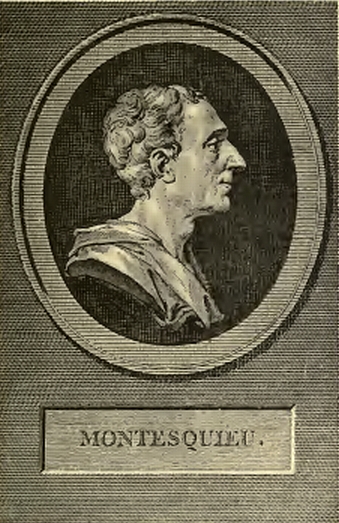
A judicious critic has remarked that this is as much as to say that the office of the mayors of the palace was a fundamental office. Constantine was highly despotic, yet had no grand vizier. Louis XIV. was less despotic, and had no first minister. The popes are sufficiently despotic, and yet seldom possess them.
"The sale of employments is good in monarchical states, because it makes it the profession of persons of family to undertake employments, which they would not fulfil from disinterested motives alone."
Is it Montesquieu who writes these odious lines? What! because the vices of Francis I. deranged the public finances, must we sell to ignorant young men the right of deciding upon the honor, fortune, and lives of the people? What! is it good in a monarchy, that the office of magistrate should become a family provision? If this infamy was salutary, some other country would have adopted it as well as France; but there is not another monarchy on earth which has merited the opprobrium. This monstrous anomaly sprang from the prodigality of a ruined and spendthrift monarch, and the vanity of certain citizens whose fathers possessed money; and the wretched abuse has always been weakly attacked, because it was felt that reimbursement would be difficult. It would be a thousand times better, said a great jurisconsult, to sell the treasure of all the convents, and the plate of all the churches, than to sell justice. When Francis I. seized the silver grating of St. Martin, he did harm to no one; St. Martin complained not, and parted very easily with his screen; but to sell the place of judge, and at the same time make the judge swear that he has not bought it, is a base sacrilege.
Let us complain that Montesquieu has dishonored his work by such paradoxes—but at the same time let us pardon him. His uncle purchased the office of a provincial president, and bequeathed it to him. Human nature is to be recognized in everything, and there are none of us without weakness.
"Behold how industriously the Muscovite government seeks to emerge from despotism."
Is it in abolishing the patriarchate and the active militia of the strelitzes; in being the absolute master of the troops, of the revenue, and of the church, of which the functionaries are paid from the public treasury alone? or is it proved by making laws to render that power as sacred as it is mighty? It is melancholy, that in so many citations and so many maxims, the contrary of what is asserted should be almost always the truth.
"The luxury of those who possess the necessaries of life only, will be zero; the luxury of those who possess as much again, will be equal to one; of those who possess double the means of the latter, three; and so on."
The latter will possess three times the excess beyond the necessaries of life; but it by no means follows that he will possess three times as many luxuries; for he may be thrice as avaricious, or may employ the superfluity in commerce, or in portions to his daughters. These propositions are not affairs of arithmetic, and such calculations are miserable quackery.
"The Samnites had a fine custom, which must have produced admirable results. The young man declared the most worthy chose a wife where he pleased; he who had the next number of suffrages in his favor followed, and so on throughout."
The author has mistaken the Sunites, a people of Scythia, for the Samnites, in the neighborhood of Rome. He quotes a fragment of Nicholas de Demas, preserved by Stobæus: but is the said Nicholas a sufficient authority? This fine custom would moreover be very injurious in a well-governed country; for if the judges should be deceived in the young man declared the most worthy; if the female selected should not like him; or if he were objectionable in the eyes of the girl's parents, very fatal results might follow.
"On reading the admirable work of Tacitus on the manners of the Germans, it will be seen that it is from them the English drew the idea of their political government. That admirable system originated in the woods."
The houses of peers and of commons, and the English courts of law and equity, found in the woods! Who would have supposed it? Without doubt, the English owe their squadrons and their commerce to the manners of the Germans; and the sermons of Tillotson to those pious German sorcerers who sacrificed their prisoners, and judged of their success in war by the manner in which the blood flowed. We must believe, also, that the English are indebted for their fine manufactures to the laudable practice of the Germans, who, as Tacitus observers, preferred robbery to toil.
"Aristotle ranked among monarchies the governments both of Persia and Lacedæmon; but who cannot perceive that the one was a despotism, the other a republic?"
Who, on the contrary, cannot perceive that Lacedæmon had a single king for four hundred years, and two kings until the extinction of the Heraclidæ, a period of about a thousand years? We know that no king was despotic of right, not even in Persia; but every bold and dissembling prince who amasses money, becomes despotic in a little time, either in Persia or Lacedæmon; and, therefore, Aristotle distinguishes every state possessing perpetual and hereditary chiefs, from republics.
"People of warm climates are timid, like old men; those of cold countries are courageous, like young ones."
We should take great care how general propositions escape us. No one has ever been able to make a Laplander or an Esquimaux warlike, while the Arabs in fourscore years conquered a territory which exceeded that of the whole Roman Empire. This maxim of M. Montesquieu is equally erroneous with all the rest on the subject of climate.
"Louis XIII. was extremely averse to passing a law which made the negroes of the French colonies slaves; but when he was given to understand that it was the most certain way of converting them, he consented."
Where did the author pick up this anecdote? The first arrangement for the treatment of the negroes was made in 1673, thirty years after the death of Louis XIII. This resembles the refusal of Francis I. to listen to the project of Christopher Columbus, who had discovered the Antilles before Francis I. was born.
"The Romans never exhibited any jealousy on the score of commerce. It was as a rival, not as a commercial nation, that they attacked Carthage."
It was both as a warlike and as a commercial nation, as the learned Huet proves in his "Commerce of the Ancients," when he shows that the Romans were addicted to commerce a long time before the first Punic war.
"The sterility of the territory of Athens established a popular government there, and the fertility of that of Lacedæmon an aristocratic one."
Whence this chimera? From enslaved Athens we still derive cotton, silk, rice, corn, oil, and skins; and from the country of Lacedæmon nothing. Athens was twenty times richer than Lacedæmon. With respect to the comparative fertility of the soil, it is necessary to visit those countries to appreciate it; but the form of a government is never attributed to the greater or less fertility. Venice had very little corn when her nobles governed. Genoa is assuredly not fertile, and yet is an aristocracy. Geneva is a more popular state, and has not the means of existing a fortnight upon its own productions. Sweden, which is equally poor, has for a long time submitted to the yoke of a monarchy; while fertile Poland is aristocratic. I cannot conceive how general rules can be established, which may be falsified upon the slightest appeal to experience.
"In Europe, empires have never been able to exist." Yet the Roman Empire existed for five hundred years, and that of the Turks has maintained itself since the year 1453.
"The duration of the great empires of Asia is principally owing to the prevalence of vast plains." M. Montesquieu forgets the mountains which cross Natolia and Syria, Caucasus, Taurus, Ararat, Imaus, and others, the ramifications of which extend throughout Asia.
After thus convincing ourselves that errors abound in the "Spirit of Laws"; after everybody is satisfied that this work wants method, and possesses neither plan nor order, it is proper to inquire into that which really forms its merit, and which has led to its great reputation.
In the first place, it is written with great wit, while the authors of all the other books on this subject are tedious. It was on this account that a lady, who possessed as much wit as Montesquieu, observed, that his book was "l'esprit sur les lois." It can never be more correctly defined.
A still stronger reason is that the book exhibits grand views, attacks tyranny, superstition, and grinding taxation—three things which mankind detest. The author consoles slaves in lamenting their fetters, and the slaves in return applaud him.
One of the most bitter and absurd of his enemies, who contributed most by his rage to exalt the name of Montesquieu throughout Europe, was the journalist of the Convulsionaries. He called him a Spinozist and deist; that is to say, he accused him at the same time of not believing in God and of believing in God alone.
He reproaches him with his esteem for Marcus Aurelius, Epictetus, and the Stoics; and for not loving Jansenists—the Abbé de St. Cyran and Father Quesnel. He asserts that he has committed an unpardonable crime in calling Bayle a great man.
He pretends that the "Spirit of Laws" is one of those monstrous works with which France has been inundated since the Bull Unigenitus, which has corrupted the consciences of all people.
This tatterdemalion from his garret, deriving at least three hundred per cent. from his ecclesiastical gazette, declaimed like a fool against interest upon money at the legal rate. He was seconded by some pedants of his own sort; and the whole concluded in their resembling the slaves placed at the foot of the statue of Louis XIV.; they are crushed, and gnaw their own flesh in revenge.
Montesquieu was almost always in error with the learned, because he was not learned; but he was always right against the fanatics and promoters of slavery. Europe owes him eternal gratitude.
LENT.
SECTION I.
Our questions on Lent will merely regard the police. It appeared useful to have a time in the year in which we should eat fewer oxen, calves, lambs, and poultry. Young fowls and pigeons are not ready in February and March, the time in which Lent falls; and it is good to cease the carnage for some weeks in countries in which pastures are not so fertile as those of England and Holland.
The magistrates of police have very wisely ordered that meat should be a little dearer at Paris during this time, and that the profit should be given to the hospitals. It is an almost insensible tribute paid by luxury and gluttony to indigence; for it is the rich who are not able to keep Lent—the poor fast all the year.
There are very few farming men who eat meat once a month. If they ate of it every day, there would not be enough for the most flourishing kingdom. Twenty millions of pounds of meat a day would make seven thousand three hundred millions of pounds a year. This calculation is alarming.
The small number of the rich, financiers, prelates, principal magistrates, great lords, and great ladies who condescend to have maigre served at their tables, fast during six weeks on soles, salmon, turbots, sturgeons, etc.
One of our most famous financiers had couriers, who for a hundred crowns brought him fresh sea fish every day to Paris. This expense supported the couriers, the dealers who sold the horses, the fishermen who furnished the fish, the makers of nets, constructors of boats, and the druggists from whom were procured the refined spices which give to a fish a taste superior to that of meat. Lucullus could not have kept Lent more voluptuously.
It should further be remarked that fresh sea fish, in coming to Paris, pays a considerable tax. The secretaries of the rich, their valets de chambre, ladies' maids, and stewards, partake of the dessert of Crœsus, and fast as deliciously as he.
It is not the same with the poor; not only if for four sous they partake of a small portion of tough mutton do they commit a great sin, but they seek in vain for this miserable aliment. What do they therefore feed upon? Chestnuts, rye bread, the cheeses which they have pressed from the milk of their cows, goats or sheep, and some few of the eggs of their poultry.
There are churches which forbid them the eggs and the milk. What then remains for them to eat? Nothing. They consent to fast; but they consent not to die. It is absolutely necessary that they should live, if it be only to cultivate the lands of the fat rectors and lazy monks.
We therefore ask, if it belongs not to the magistrates of the police of the kingdom, charged with watching over the health of the inhabitants, to give them permission to eat the cheeses which their own hands have formed, and the eggs which their fowls have laid?
It appears that milk, eggs, cheese, and all which can nourish the farmer, are regulated by the police, and not by a religious rule.
We hear not that Jesus Christ forbade omelets to His apostles; He said to them: "Eat such things as are set before you."
The Holy Church has ordained Lent, but in quality of the Church it commands it only to the heart; it can inflict spiritual pains alone; it cannot as formerly burn a poor man, who, having only some rusty bacon, put a slice of it on a piece of black bread the day after Shrove Tuesday.
Sometimes in the provinces the pastors go beyond their duty, and forgetting the rights of the magistracy, undertake to go among the innkeepers and cooks, to see if they have not some ounces of meat in their saucepans, some old fowls on their hooks, or some eggs in a cupboard; for eggs are forbidden in Lent. They intimidate the poor people, and proceed to violence towards the unfortunates, who know not that it belongs alone to the magistracy to interfere. It is an odious and punishable inquisition.
The magistrates alone can be rightly informed of the more or less abundant provisions required by the poor people of the provinces. The clergy have occupations more sublime. Should it not therefore belong to the magistrates to regulate what the people eat in Lent? Who should pry into the legal consumption of a country if not the police of that country?
SECTION II.
Did the first who were advised to fast put themselves under this regimen by order of the physician, for indigestion? The want of appetite which we feel in grief—was it the first origin of fast-days prescribed in melancholy religions?
Did the Jews take the custom of fasting from the Egyptians, all of whose rites they imitated, including flagellation and the scape-goat? Why fasted Jesus for forty days in the desert, where He was tempted by the devil—by the "Chathbull"? St. Matthew remarks that after this Lent He was hungry; He was therefore not hungry during the fast.
Why, in days of abstinence, does the Roman Church consider it a crime to eat terrestrial animals, and a good work to be served with soles and salmon? The rich Papist who shall have five hundred francs' worth of fish upon his table shall be saved, and the poor wretch dying with hunger, who shall have eaten four sous' worth of salt pork, shall be damned.
Why must we ask permission of the bishop to eat eggs? If a king ordered his people never to eat eggs, would he not be thought the most ridiculous of tyrants? How strange the aversion of bishops to omelets!
Can we believe that among Papists there have been tribunals imbecile, dull, and barbarous enough to condemn to death poor citizens, who had no other crimes than that of having eaten of horseflesh in Lent? The fact is but too true; I have in my hands a sentence of this kind. What renders it still more strange is that the judges who passed such sentences believed themselves superior to the Iroquois.
Foolish and cruel priests, to whom do you order Lent? Is it to the rich? they take good care to observe it. Is it to the poor? they keep Lent all the year. The unhappy peasant scarcely ever eats meat, and has not wherewithal to buy fish. Fools that you are, when will you correct your absurd laws?
LEPROSY, ETC.
This article relates to two powerful divinities, one ancient and the other modern, which have reigned in our hemisphere. The reverend father Dom Calmet, a great antiquarian, that is, a great compiler of what was said in former times and what is repeated at the present day, has confounded lues with leprosy. He maintains that it was the lues with which the worthy Job was afflicted, and he supposes, after a confident and arrogant commentator of the name of Pineida, that the lues and leprosy are precisely the same disorder. Calmet is not a physician, neither is he a reasoner, but he is a citer of authorities; and in his vocation of commentator, citations are always substituted for reasons. When Astruc, in his history of lues, quotes authorities that the disorder came in fact from San Domingo, and that the Spaniards brought it from America, his citations are somewhat more conclusive.
There are two circumstances which, in my opinion, prove that lues originated in America; the first is, the multitude of authors, both medical and surgical, of the sixteenth century, who attest the fact; and the second is, the silence of all the physicians and all the poets of antiquity, who never were acquainted with this disease, and never had even a name for it. I here speak of the silence of physicians and of poets as equally demonstrative. The former, beginning with Hippocrates, would not have failed to describe this malady, to state its symptoms, to apply to it a name, and suggest some remedy. The poets, equally as malicious and sarcastic as physicians are studious and investigative, would have detailed in their satires, with minute particularity, all the symptoms and consequences of this dreadful disorder; you do not find, however, a single verse in Horace or Catullus, in Martial or Juvenal, which has the slightest reference to lues, although they expatiate on all the effects of debauchery with the utmost freedom and delight.
It is very certain that smallpox was not known to the Romans before the sixth century; that the American lues was not introduced into Europe until the fifteenth century; and that leprosy is as different from those two maladies, as palsy from St. Guy's or St. Vitus' dance.
Leprosy was a scabious disease of a dreadful character. The Jews were more subject to it than any other people living in hot climates, because they had neither linen, nor domestic baths. These people were so negligent of cleanliness and the decencies of life that their legislators were obliged to make a law to compel them even to wash their hands.
All that we gained in the end by engaging in the crusades, was leprosy; and of all that we had taken, that was the only thing that remained with us. It was necessary everywhere to build lazarettos, in which to confine the unfortunate victims of a disease at once pestilential and incurable.
Leprosy, as well as fanaticism and usury, had been a distinguishing characteristic of the Jews. These wretched people having no physicians, the priests took upon themselves the management and regulation of leprosy, and made it a concern of religion. This has occasioned some indiscreet and profane critics to remark that the Jews were no better than a nation of savages under the direction of their jugglers. Their priests in fact never cured leprosy, but they cut off from society those who were infected by it, and thus acquired a power of the greatest importance. Every man laboring under this disease was imprisoned, like a thief or a robber; and thus a woman who was desirous of getting rid of her husband had only to secure the sanction of the priest, and the unfortunate husband was shut up—it was the "lettre de cachet" of the day. The Jews and those by whom they were governed were so ignorant that they imagined the moth-holes in garments, and the mildew upon walls, to be the effects of leprosy. They actually conceived their houses and clothes to have leprosy; thus the people themselves, and their very rags and hovels, were all brought under the rod of the priesthood.
One proof that, at the time of the first introduction of the lues, there was no connection between that disorder and leprosy, is that the few lepers that remained at the conclusion of the fifteenth century were offended at any kind of comparison between themselves and those who were affected by lues.
Some of the persons thus affected were in the first instance sent to the hospital for lepers, but were received by them with indignation. The lepers presented a petition to be separated from them; as persons imprisoned for debt or affairs of honor claim a right not to be confounded with the common herd of criminals.
We have already observed that the Parliament of Paris, on March 6, 1496, issued an order, by which all persons laboring under lues, unless they were citizens of Paris, were enjoined to depart within twenty-four hours, under pain of being hanged. This order was neither Christian, legal, nor judicious; but it proves that lues was regarded as a new plague which had nothing in common with leprosy; as lepers were not hanged for residing in Paris, while those afflicted by lues were so.
Men may bring the leprosy on themselves by their uncleanliness and filth, just as is done by a species of animals to which the very lowest of the vulgar may too naturally be compared; but with respect to lues, it was a present made to America by nature. We have already reproached this same nature, at once so kind and so malicious, so sagacious and yet so blind, with defeating her own object by thus poisoning the source of life; and we still sincerely regret that we have found no solution of this dreadful difficulty.
We have seen elsewhere that man in general, one with another, or (as it is expressed) on the average, does not live above two-and-twenty years; and during these two-and-twenty years he is liable to two-and-twenty thousand evils, many of which are incurable.
Yet even in this dreadful state men still strut and figure on the stage of life; they make love at the hazard of destruction; and intrigue, carry on war, and form projects, just as if they were to live in luxury and delight for a thousand ages.
LETTERS (MEN OF).
In the barbarous times when the Franks, Germans, Bretons, Lombards, and Spanish Mozarabians knew neither how to read nor write, we instituted schools and universities almost entirely composed of ecclesiastics, who, knowing only their own jargon, taught this jargon to those who would learn it. Academies were not founded until long after; the latter have despised the follies of the schools, but they have not always dared to oppose them, because there are follies which we respect when they are attached to respectable things.
Men of letters who have rendered the most service to the small number of thinking beings scattered over the earth are isolated scholars, true sages shut up in their closets, who have neither publicly disputed in the universities, nor said things by halves in the academies; and such have almost all been persecuted. Our miserable race is so created that those who walk in the beaten path always throw stones at those who would show them a new one.
Montesquieu says that the Scythians put out the eyes of their slaves that they might be more attentive to the making of their butter. It is thus that the Inquisition acts, and almost every one is blinded in the countries in which this monster reigns. In England people have had two eyes for more than a hundred years. The French are beginning to open one eye—but sometimes men in place will not even permit us to be one-eyed.
These miserable statesmen are like Doctor Balouard of the Italian comedy, who will only be served by the fool Harlequin, and who fears to have too penetrating a servant.
Compose odes in praise of Lord Superbus Fatus, madrigals for his mistress; dedicate a book of geography to his porter, and you will be well received. Enlighten men, and you will be crushed.
Descartes is obliged to quit his country; Gassendi is calumniated; Arnaud passes his days in exile; all the philosophers are treated as the prophets were among the Jews.
Who would believe that in the eighteenth century, a philosopher has been dragged before the secular tribunals, and treated as impious by reasoning theologians, for having said that men could not practise the arts if they had no hands? I expect that they will soon condemn to the galleys the first who shall have the insolence to say that a man could not think if he had no head; for a learned bachelor will say to him, the soul is a pure spirit, the head is only matter; God can place the soul in the heel as well as in the brain; therefore I denounce you as a blasphemer.
The great misfortune of a man of letters is not perhaps being the object of the jealousy of his brothers, the victim of cabals, and the contempt of the powerful of the world—it is being judged by fools. Fools sometimes go very far, particularly when fanaticism is joined to folly, and folly to the spirit of vengeance. Further, the great misfortune of a man of letters is generally to hold to nothing. A citizen buys a little situation, and is maintained by his fellow-citizens. If any injustice is done to him, he soon finds defenders. The literary man is without aid; he resembles the flying fish; if he rises a little, the birds devour him; if he dives, the fishes eat him up. Every public man pays tribute to malignity; but he is repaid in deniers and honors.
LIBEL.
Small, offensive books are termed libels. These books are usually small, because the authors, having few reasons to give, and usually writing not to inform, but mislead, if they are desirous of being read, must necessarily be brief. Names are rarely used on these occasions, for assassins fear being detected in the employment of forbidden weapons.
In the time of the League and the Fronde, political libels abounded. Every dispute in England produces hundreds; and a library might be formed of those written against Louis XIV.
We have had theological libels for sixteen hundred years; and what is worse, these are esteemed holy by the vulgar. Only see how St. Jerome treats Rufinus and Vigilantius. The latest libels are those of the Molinists and Jansenists, which amount to thousands. Of all this mass there remains only "The Provincial Letters."
Men of letters may dispute the number of their libels with the theologians. Boileau and Fontenelle, who attacked one another with epigrams, both said that their chambers would not contain the libels with which they had been assailed. All these disappear like the leaves in autumn. Some people have maintained that anything offensive written against a neighbor is a libel.
According to them, the railing attacks which the prophets occasionally sang to the kings of Israel, were defamatory libels to excite the people to rise up against them. As the populace, however, read but little anywhere, it is believed that these half-disclosed satires never did any great harm. Sedition is produced by speaking to assemblies of the people, rather than by writing for them. For this reason, one of the first things done by Queen Elizabeth of England on her accession, was to order that for six months no one should preach without express permission.
The "Anti-Cato" of Cæsar was a libel, but Cæsar did more harm to Cato by the battle of Pharsalia, than by his "Diatribes". The "Philippics" of Cicero were libels, but the proscriptions of the Triumvirs were far more terrible libels.
St. Cyril and St. Gregory Nazianzen compiled libels against the emperor Julian, but they were so generous as not to publish them until after his death.
Nothing resembles libels more than certain manifestoes of sovereigns. The secretaries of the sultan Mustapha made a libel of his declaration of war. God has punished them for it; but the same spirit which animated Cæsar, Cicero, and the secretaries of Mustapha, reigns in all the reptiles who spin libels in their garrets. "Natura est semper sibi consona." Who would believe that the souls of Garasse, Nonnotte, Paulian, Fréron, and he of Langliviet, calling himself La Beaumelle, were in this respect of the same temper as those of Cæsar, Cicero, St. Cyril, and of the secretary of the grand seignior? Nothing is, however, more certain.
LIBERTY.
Either I am much deceived, or Locke has very well defined liberty to be "power". I am still further deceived, or Collins, a celebrated magistrate of London, is the only philosopher who has profoundly developed this idea, while Clarke has only answered him as a theologian. Of all that has been written in France on liberty, the following little dialogue has appeared to me the most comprehensive:
A. A battery of cannon is discharged at our ears; have you the liberty to hear it, or not to hear it, as you please?
B. Undoubtedly I cannot hinder myself from hearing it.
A. Are you willing that these cannon shall take off your head and those of your wife and daughter who walk with you?
B. What a question! I cannot, at least while I am in my right senses, wish such a thing; it is impossible.
A. Good; you necessarily hear these cannon, and you necessarily wish not for the death of yourself and your family by a discharge from them. You have neither the power of not hearing it, nor the power of wishing to remain here.
B. That is clear.
A. You have, I perceive, advanced thirty paces to be out of the reach of the cannon; you have had the power of walking these few steps with me.
B. That is also very clear.
A. And if you had been paralytic, you could not have avoided being exposed to this battery; you would necessarily have heard, and received a wound from the cannon; and you would have as necessarily died.
B. Nothing is more true.
A. In what then consists your liberty, if not in the power that your body has acquired of performing that which from absolute necessity your will requires?
B. You embarrass me. Liberty then is nothing more than the power of doing what I wish?
A. Reflect; and see whether liberty can be understood otherwise.
B. In this case, my hunting dog is as free as myself; he has necessarily the will to run when he sees a hare; and the power of running, if there is nothing the matter with his legs. I have therefore nothing above my dog; you reduce me to the state of the beasts.
A. These are poor sophisms, and they are poor sophists who have instructed you. You are unwilling to be free like your dog. Do you not eat, sleep, and propagate like him, and nearly in the same attitudes? Would you smell otherwise than by your nose? Why would you possess liberty differently from your dog?
B. But I have a soul which reasons, and my dog scarcely reasons at all. He has nothing beyond simple ideas, while I have a thousand metaphysical ideas.
A. Well, you are a thousand times more free than he is; you have a thousand times more power of thinking than he has; but still you are not free in any other manner than your dog is free.
B. What! am I not free to will what I like?
A. What do you understand by that?
B. I understand what all the world understands. Is it not every day said that the will is free?
A. An adage is not a reason; explain yourself better.
B. I understand that I am free to will as I please.
A. With your permission, that is nonsense; see you not that it is ridiculous to say—I will will? Consequently, you necessarily will the ideas only which are presented to you. Will you be married, yes or no?
B. Suppose I answer that I will neither the one nor the other.
A. In that case you would answer like him who said: Some believe Cardinal Mazarin dead, others believe him living; I believe neither the one nor the other.
B. Well, I will marry!
A. Aye, that is an answer. Why will you marry?
B. Because I am in love with a young, beautiful, sweet, well-educated, rich girl, who sings very well, whose parents are very honest people, and I flatter myself that I am beloved by her and welcome to the family.
A. There is a reason. You see that you cannot will without a motive. I declare to you that you are free to marry, that is to say, that you have the power of signing the contract, keeping the wedding, and sleeping with your wife.
B. How! I cannot will without a motive? Then what will become of the other proverb—"Sit pro ratione voluntas"—my will is my reason—I will because I will?
A. It is an absurd one, my dear friend; you would then have an effect without a cause.
B. What! when I play at odd or even, have I a reason for choosing even rather than odd?
A. Undoubtedly.
B. And what is the reason, if you please?
A. It is, that the idea of even is presented to your mind rather than the opposite idea. It would be extraordinary if there were cases in which we will because there is a motive, and others in which we will without one. When you would marry, you evidently perceive the predominant reason for it; you perceive it not when you play at odd or even, and yet there must be one.
B. Therefore, once more, I am not free.
A. Your will is not free, but your actions are. You are free to act when you have the power of acting.
B. But all the books that I have read on the liberty of indifference—
A. What do you understand by the liberty of indifference?
B. I understand spitting on the right or the left hand—sleeping on the right or left side—walking up and down four times or five.
A. That would be a pleasant liberty, truly! God would have made you a fine present, much to boast of, certainly! What use to you would be a power which could only be exercised on such futile occasions? But in truth it is ridiculous to suppose the will of willing to spit on the right or left. Not only is the will of willing absurd, but it is certain that several little circumstances determine these acts which you call indifferent. You are no more free in these acts than in others. Yet you are free at all times, and in all places, when you can do what you wish to do.
B. I suspect that you are right. I will think upon it.
LIBERTY OF OPINION.
Towards the year 1707, the time at which the English gained the battle of Saragossa, protected Portugal, and for some time gave a king to Spain, Lord Boldmind, a general officer who had been wounded, was at the waters of Barèges. He there met with Count Medroso, who having fallen from his horse behind the baggage, at a league and a half from the field of battle, also came to take the waters. He was a familiar of the Inquisition, while Lord Boldmind was only familiar in conversation. One day after their wine, he held this dialogue with Medroso:
BOLDMIND.
—You are then the sergeant of the Dominicans? You exercise a villainous trade.
MEDROSO.
—It is true; but I would rather be their servant than their victim, and I have preferred the unhappiness of burning my neighbor to that of being roasted myself.
BOLDMIND.
—What a horrible alternative! You were a hundred times happier under the yoke of the Moors, who freely suffered you to abide in all your superstitions, and conquerors as they were, arrogated not to themselves the strange right of sending souls to hell.
MEDROSO.
—What would you have? It is not permitted us either to write, speak, or even to think. If we speak, it is easy to misinterpret our words, and still more our writings; and as we cannot be condemned in an auto-da-fé for our secret thoughts, we are menaced with being burned eternally by the order of God himself, if we think not like the Jacobins. They have persuaded the government that if we had common sense the entire state would be in combustion, and the nation become the most miserable upon earth.
BOLDMIND.
—Do you believe that we English who cover the seas with vessels, and who go to gain battles for you in the south of Europe, can be so unhappy? Do you perceive that the Dutch, who have ravished from you almost all your discoveries in India, and who at present are ranked as your protectors, are cursed of God for having given entire liberty to the press, and for making commerce of the thoughts of men? Has the Roman Empire been less powerful because Tullius Cicero has written with freedom?
MEDROSO.
—Who is this Tullius Cicero? I have never heard his name pronounced at St. Hermandad.
BOLDMIND.
—He was a bachelor of the university of Rome, who wrote that which he thought, like Julius Cæsar, Marcus Aurelius, Titus Lucretius Carus, Plinius, Seneca, and other sages.
MEDROSO.
—I know none of them; but I am told that the Catholic religion, Biscayan and Roman, is lost if we begin to think.
BOLDMIND.
—It is not for you to believe it; for you are sure that your religion is divine, and that the gates of hell cannot prevail against it. If that is the case, nothing will ever destroy it.
MEDROSO.
—No; but it may be reduced to very little; and it is through having thought, that Sweden, Denmark, all your island, and the half of Germany groan under the frightful misfortune of not being subjects of the pope. It is even said that, if men continue to follow their false lights, they will soon have merely the simple adoration of God and of virtue. If the gates of hell ever prevail so far, what will become of the holy office?
BOLDMIND.
—If the first Christians had not the liberty of thought, does it not follow that there would have been no Christianity?
MEDROSO.
—I understand you not.
BOLDMIND.
—I readily believe it. I would say, that if Tiberius and the first emperors had fostered Jacobins, they would have hindered the first Christians from having pens and ink; and had it not been a long time permitted in the Roman Empire to think freely, it would be impossible for the Christians to establish their dogmas. If, therefore, Christianity was only formed by liberty of opinion, by what contradiction, by what injustice, would you now destroy the liberty on which alone it is founded?
When some affair of interest is proposed to us, do we not examine it for a long time before we conclude upon it? What interest in the world is so great as our eternal happiness or misery? There are a hundred religions on earth which all condemn us if we believe your dogmas, which they call impious and absurd; why, therefore, not examine these dogmas?
MEDROSO.
—How can I examine them? I am not a Jacobin.
BOLDMIND.
—You are a man, and that is sufficient.
MEDROSO.
—Alas! you are more of a man than I am.
BOLDMIND.
—You have only to teach yourself to think; you are born with a mind, you are a bird in the cage of the Inquisition, the holy office has clipped your wings, but they will grow again. He who knows not geometry can learn it: all men can instruct themselves. Is it not shameful to put your soul into the hands of those to whom you would not intrust your money? Dare to think for yourself.
MEDROSO.
—It is said that if the world thought for itself, it would produce strange confusion.
BOLDMIND.
—Quite the contrary. When we assist at a spectacle, every one freely tells his opinion of it, and the public peace is not thereby disturbed; but if some insolent protector of a poet would force all people of taste to proclaim that to be good which appears to them bad, blows would follow, and the two parties would throw apples of discord at one another's heads, as once happened at London. Tyrants over mind have caused a part of the misfortunes of the world. We are happy in England only because every one freely enjoys the right of speaking his opinion.
MEDROSO.
—We are all very tranquil at Lisbon, where no person dares speak his.
BOLDMIND.
—You are tranquil, but you are not happy: it is the tranquillity of galley-slaves, who row in cadence and in silence.
MEDROSO.
—You believe, then, that my soul is at the galleys?
BOLDMIND.
—Yes, and I would deliver it.
MEDROSO.
—But if I find myself well at the galleys?
BOLDMIND.
—Why, then, you deserve to be there.
LIBERTY OF THE PRESS.
What harm can the prediction of Jean Jacques do to Russia? Any? We allow him to explain it in a mystical, typical, allegorical sense, according to custom. The nations which will destroy the Russians will possess the belles-lettres, mathematics, wit, and politeness, which degrade man and pervert nature.
From five to six thousand pamphlets have been printed in Holland against Louis XIV., none of which contributed to make him lose the battles of Blenheim, Turin, and Ramillies.
In general, we have as natural a right to make use of our pens as our language, at our peril, risk, and fortune. I know many books which fatigue, but I know of none which have done real evil. Theologians, or pretended politicians, cry: "Religion is destroyed, the government is lost, if you print certain truths or certain paradoxes. Never attempt to think, till you have demanded permission from a monk or an officer. It is against good order for a man to think for himself. Homer, Plato, Cicero, Virgil, Pliny, Horace, never published anything but with the approbation of the doctors of the Sorbonne and of the holy Inquisition."
"See into what horrible decay the liberty of the press brought England and Holland. It is true that they possess the commerce of the whole world, and that England is victorious on sea and land; but it is merely a false greatness, a false opulence: they hasten with long strides to their ruin. An enlightened people cannot exist."
None can reason more justly, my friends; but let us see, if you please, what state has been lost by a book. The most dangerous, the most pernicious of all, is that of Spinoza. Not only in the character of a Jew he attacks the New Testament, but in the character of a scholar he ruins the Old; his system of atheism is a thousand times better composed and reasoned than those of Straton and of Epicurus. We have need of the most profound sagacity to answer to the arguments by which he endeavors to prove that one substance cannot form another.
Like yourself, I detest this book, which I perhaps understand better than you, and to which you have very badly replied; but have you discovered that this book has changed the face of the world? Has any preacher lost a florin of his income by the publication of the works of Spinoza? Is there a bishop whose rents have diminished? On the contrary, their revenues have doubled since his time: all the ill is reduced to a small number of peaceable readers, who have examined the arguments of Spinoza in their closets, and have written for or against them works but little known.
For yourselves, it is of little consequence to have caused to be printed "ad usum Delphini," the atheism of Lucretius—as you have already been reproached with doing—no trouble, no scandal, has ensued from it: so leave Spinoza to live in peace in Holland. Lucretius was left in repose at Rome.
But if there appears among you any new book, the ideas of which shock your own—supposing you have any—or of which the author may be of a party contrary to yours—or what is worse, of which the author may not be of any party at all—then you cry out Fire! and let all be noise, scandal, and uproar in your small corner of the earth. There is an abominable man who has printed that if we had no hands we could not make shoes nor stockings. Devotees cry out, furred doctors assemble, alarms multiply from college to college, from house to house, and why? For five or six pages, about which there no longer will be a question at the end of three months. Does a book displease you? refute it. Does it tire you? read it not.
Oh! say you to me, the books of Luther and Calvin have destroyed the Roman Catholic religion in one-half of Europe? Why say not also, that the books of the patriarch Photius have destroyed this Roman religion in Asia, Africa, Greece, and Russia?
You deceive yourself very grossly, when you think that you have been ruined by books. The empire of Russia is two thousand leagues in extent, and there are not six men who are aware of the points disputed by the Greek and Latin Church. If the monk Luther, John Calvin, and the vicar Zuinglius had been content with writing, Rome would yet subjugate all the states that it has lost; but these people and their adherents ran from town to town, from house to house, exciting the women, and were maintained by princes. Fury, which tormented Amata, and which, according to Virgil, whipped her like a top, was not more turbulent. Know, that one enthusiastic, factious, ignorant, supple, vehement Capuchin, the emissary of some ambitious monks, preaching, confessing, communicating, and caballing, will much sooner overthrow a province than a hundred authors can enlighten it. It was not the Koran which caused Mahomet to succeed: it was Mahomet who caused the success of the Koran.
No! Rome has not been vanquished by books; it has been so by having caused Europe to revolt at its rapacity; by the public sale of indulgences; for having insulted men, and wishing to govern them like domestic animals; for having abused its power to such an extent that it is astonishing a single village remains to it. Henry VIII., Elizabeth, the duke of Saxe, the landgrave of Hesse, the princes of Orange, the Condés and Colignys, have done all, and books nothing. Trumpets have never gained battles, nor caused any walls to fall except those of Jericho.
You fear books, as certain small cantons fear violins. Let us read, and let us dance—these two amusements will never do any harm to the world.
LIFE.
The following passage is found in the "Système de la Nature," London edition, page 84: "We ought to define life, before we reason concerning soul; but I hold it to be impossible to do so."
On the contrary, I think a definition of life quite possible. Life is organization with the faculty of sensation. Thus all animals are said to live. Life is attributed to plants, only by a species of metaphor or catachresis. They are organized and vegetate; but being incapable of sensation, do not properly possess life.
We may, however, live without actual sensation; for we feel nothing in a complete apoplexy, in a lethargy, or in a sound sleep without dreams; but yet possess the capacity of sensation. Many persons, it is too well known, have been buried alive, like Roman vestals, and it is what happens after every battle, especially in cold countries. A soldier lies without motion, and breathless, who, if he were duly assisted, might recover; but to settle the matter speedily, they bury him.
What is this capacity of sensation? Formerly, life and soul meant the same thing, and the one was no better understood than the other; at bottom, is it more understood at present?
In the sacred books of the Jews, soul is always used for life.
"Dixit etiam Deus, producant aquæ reptile animæ viventis." (And God said, let the waters bring forth abundantly the moving creature which hath a living soul.)
"Creavit Deus cete grandia, et omnem animam viventem, atque motabilem quam produxerant aquæ. (And God created great dragons (tannitiim), and every living soul that moveth, which the waters brought forth.) It is difficult to explain the creation of these watery dragons, but such is the text, and it is for us to submit to it.
"Producat terra animam viventem in genere suo, jumenta et reptilia." (Let the earth produce the living soul after its kind, cattle and creeping things.)
"Et in quibus est anima vivens, ad vescendum." (And to everything wherein there is a living soul [every green herb], for meat.)