REMY DE GOURMONT
Arthur Ransome translation
WITH PREFACE
AND APPENDIX
BY ARTHUR RANSOME
JOHN W. LUCE AND COMPANY
BOSTON MCMXII
CONTENTS
TRANSLATOR'S PREFACE. By Arthur Ransome
A Night in the Luxembourg. By Remy de Gourmont
Preface
A Night in the Luxembourg
Final Note
APPENDIX: REMY de GOURMONT. By Arthur Ransome
AUTOGRAPHS—
KOPH
Reduced facsimile of the last page of M. Rose's Manuscript
TRANSLATOR'S PREFACE
A general, but necessarily inadequate, account of the personality and works of one of the finest intellects of his generation will be found in the Appendix. I am here concerned only with Une Nuit au Luxembourg, which, though it is widely read in almost every other European language, is now for the first time translated into English.
This book, at once criticism and romance, is the best introduction to M. de Gourmont's very various works. It created a "sensation" in France. I think it may do as much in England, but I am anxious lest this "sensation" should be of a kind honourable neither to us nor to the author of a remarkable book. I do not wish a delicate and subtle artist, a very noble philosopher, noble even if smiling, nobler perhaps because he smiles, to be greeted with accusations of indecency and blasphemy. But I cannot help recognising that in England, as in many other countries, these accusations are often brought against such philosophers as discuss in a manner other than traditional the subjects of God and woman. These two subjects, with many others, are here the motives of a book no less delightful than profound.
The duty of a translator is not comprised in mere fidelity. He must reproduce as nearly as he can the spirit and form of his original, and, since in a work of art spirit and form are one, his first care must be to preserve as accurately as possible the contours and the shading of his model. But he must remember (and beg his readers to remember) that the intellectual background on which the work will appear in its new language is different from that against which it was conceived. When the new background is as different from the old as English from French, he cannot but recognise that it disturbs the chiaroscuro of his work with a quite incalculable light. It gives the contours a new quality and the shadows a new texture. His own accuracy may thus give his work an atmosphere not that which its original author designed.
I have been placed in such a dilemma in translating this book. Certain phrases and descriptions were, in the French, no more than delightful sporting of the intellect with the flesh that is its master. In the English, for us, less accustomed to plain-speaking, and far less accustomed to a playful attitude towards matters of which we never speak unless with great solemnity, they became wilful parades of the indecent. It is important to remember that they were not so in the French, but were such things as might well be heard in a story told in general conversation—if the talkers were Frenchmen of genius.
There is no ugliness in the frank acceptance of the flesh, that is a motive, one among many, in this book, and perhaps more noticeable by us than the author intended. No doubt it never occurred to M. de Gourmont that he was writing for the English. We are only fortunate listeners to a monologue, and must not presume upon our position to ask him to remember we are there.
The character of that monologue is such, I think, as to justify me in tampering very little with its design. Not only is Une Nuit au Luxembourg not a book for children or young persons—if it were, the question would be altogether different—but it is not a book for fools, or even for quite ordinary people. I think that no reader who can enjoy the philosophical discussion that is its greater part will quarrel with its Epicurean interludes. He will either forgive those passages of which I am speaking as the pardonable idiosyncrasy of a great man, or recognise that they are themselves illustrations of his philosophy, essential to its exposition, and raised by that fact into an intellectual light that justifies their retention.
The prurient minds who might otherwise peer at these passages, and enjoy the caricatures that their own dark lanterns would throw on the muddy wall of their comprehension, will, I think, be repelled by the nobility of the book's philosophy. They will seek their truffles elsewhere, and find plenty.
M. de Gourmont is perhaps more likely to be attacked for blasphemy, but only by those who do not observe his piety towards the thing that he most reverences, the purity and the clarity of thought. He worships in a temple not easy to approach, a temple where the worshippers are few, and the worship difficult. It is impossible not to respect a mind that, in its consuming desire for liberty, strips away not fetters only but supports. Fetters bind at first, but later it is hard to stand without them.
His book is not a polemic against Christianity, in the same sense as Nietzsche's Anti-Christ, though it does propose an ethic and an ideal very different from those we have come to consider Christian. When he smiles at the Acts of the Apostles as at a fairy tale, he adds a sentence of incomparable praise and profound criticism: "These men touch God with their hands." It may shock some people to find that the principal speaker in the book is a god who claims to have inspired, not Christ alone, but Pythagoras, Epicurus, Lucretius, St. Paul and Spinoza with the most valuable of their doctrines. It will not, I think, shock any student of comparative religion. He will find it no more than a poet's statement of an idea that has long ceased to disturb the devout, the idea that all religions are the same, or translations of the same religion. We recognise in the sayings of Confucius some of the loveliest of the sayings of Christ, and we find them again in Mohammed. Why not admit that the same voice whispered in their ears, for this, unless we think that the Devil can give advice as good as God's, we cannot help but believe. And that other idea, that the gods die, though their lives are long, should not shock those who know of Odin, notice the lessening Christian reverence for the Jewish Jehovah, and remember the story, so often and so sweetly told, of the voices on the Grecian coast, with their cry, "Great Pan is dead! Great Pan is dead!" Turning from particular ideas to the rule of life that the book proposes, we find a crystal-line Epicureanism. Virtue is, to be happy; and sin is, where we put it. "Human wisdom is to live as if one were never to die, and to gather the present minute as if it were to be eternal." This is no doctrine that is easy to follow. The god does not offer it to the first comer, but to one who has schooled his mind to see hard things, and, having seen them, to rise above them. M. de Gourmont will tell no lies that he can avoid, especially when speaking to himself, but, if he burn himself, Phoenix-like, in the ashes of a sentimental universe, he has at least the hope of rising from the pyre with stronger wings and more triumphant flight. He will start with no more than the assumption that the universe as we know it is the product of a series of accidents. He will not persuade himself that man is the climax of a carefully planned mechanical process of evolution, nor will he hide his origin in imagery like that of Genesis, or like that which certain modern scientists are quite unable to avoid. He turns science against the scientists with the irrefutable remark that only a change in the temperature saved us from the dominion of ants. Instinct for him is arrested intellect, and he is ready to imagine man in the future doing mechanically what now he does by intention. Such ideas would crush a feeble brain or bind it with despair. They lead him to the Epicureanism that is the only philosophy that they do not overthrow. Our roses and our women make us the equals of the gods, and even envied by them.
All his criticism, not of one or two ideas alone, but of the history of philosophy, the history of woman, the history of man and the history of religion, is made with a mastery so absolute as to dare to be playful. The winter night was changed to a spring morning as the god walked in the Luxembourg, and the wintry cold of nineteenth-century science melts in the warmth of a spring-time no less magical. The book might be grim. It is clear-eyed and sparkling with dew, like a sonnet by Ronsard.
"Comme on voit sur une branche au mois de mai la rose,"
so one sees the philosophy of M. de Gourmont, not quarried stone, but a flower, so light, so delicate, as to make us forget the worlds that have been overthrown in its manufacture.
I remember near the end of The Pilgrim's Progress there is a passage of dancing. Giant Despair has been killed, and Doubting Castle demolished. The pilgrims were "very jocund and merry." "Now Christiana, if need was, could play upon the viol, and her daughter Mercy upon the lute; so, since they were so merry disposed, she played them a lesson, and Ready-to-halt would dance. So he took Despondency's daughter, Much-afraid, by the hand, and to dancing they went in the road. True, he could not dance without one crutch in his hand; but I promise you he footed it well; also the girl was to be commended, for she answered the music handsomely." Just so, in this book, on a journey no less perilous among ideas, there is an atmosphere of genial entertainment, a delight in the things of the senses illumined by a delight in the things of the mind. And in this there is no irreverence. Only those who have ceased to believe have forgotten how to dance in the presence of their God.
Perhaps the technician alone will observe the skill with which M. de Gourmont has handled the most difficult of literary forms. In translating a book one becomes fairly intimate with it, and not the least pleasure of my intimacy with Une Nuit au Luxembourg has been to notice the ease and the grace with which its author turns, always at the right moment, from ideas to images, from romance to thought. "The exercise of thought is a game," he says, "but this game must be free and harmonious." And the outward impression given by this subtly constructed book is that of an intellect playing harmoniously with itself in a state of joyful liberty. M. de Gourmont is a master of his moods, knowing how to serve them; and no less admirable than the loftiest moment of the discussion, is the Callot-like grotesque of the three goddesses, seen not as divinities but as sins, or the Virgilian breakfast under the trees.
It is possible that Une Nuit au Luxembourg may be for a few in our generation what Mademoiselle de Maupin was for a few in the generation of Swinburne, a "golden book of spirit and sense." Ideas are dangerous metal in which to mould romances, because from time to time they tarnish. Voltaire has had his moments of being dull, and Gautier's ideas do not excite us now. M. de Gourmont's may not move us to-morrow. Let us enjoy them to-day, and share the pleasure that the people of the day after to-morrow will certainly not refuse.
ARTHUR RANSOME.
A NIGHT IN THE LUXEMBOURG
BY REMY DE GOURMONT
PREFACE
There appeared in Le Temps of the 13th of February, 1906:—
"OBITUARY
"We have just learned of the sudden death of one of our confrères on the foreign press, M. James Sandy Rose, deceased yesterday, Sunday, in his rooms at 14 Rue de Médicis. Notwithstanding this English name, he was a Frenchman; born at Nantes in 1865, his true name was Louis Delacolombe. He was brought up in the United States, returned to France ten years ago, and from that time till his death was the highly valued correspondent of the Northern Atlantic Herald."
On the following day, the 14th of February, the same journal printed this note among its miscellaneous news:—
"THE MYSTERY OF THE RUE DE MEDICIS
"We announced yesterday the sudden death of M. James Sandy Rose, our confrère on the foreign press. His death seems to have taken place under suspicious circumstances. At present a woman of the Latin Quarter, Blanche B——, is strongly suspected of having been at least an accomplice to it. This woman is known for her habit of dressing in very light colours, even in mid-winter, and it was this that made the concierge notice her. She lives, moreover, behind the house of the crime—assuming that there has been a crime—in the Rue de Vaugirard. This is what is said to have happened:—
"Because M. J. S. Rose, who was of fairly regular habits, had not been seen for some days, his door was broken open, and he was discovered inanimate. He had been dead for a few hours only, a fact which does not agree with the length of time during which he had remained invisible, and still further complicates the question. It is supposed that the woman B——, after passing the night with him, put him to sleep by means of a narcotic (from which the unhappy man did not awake), or strangled him at a moment when he was defenceless; then, her theft accomplished, she would seem to have fled precipitately. An extraordinary circumstance is that in her haste she forgot her dress, and must have gone out enveloped in a big cloak. At least there is no other explanation of the presence of an elegant white robe in the rooms of M. Rose, who lived alone...."
On the next day again, there was a third echo:—
"THE MYSTERY OF THE RUE DE MEDICIS
"It appears that the young woman at first implicated in this affair has been for a fortnight at Menton with M. Pap——, a deputy from the banks of the Danube. They have both written from that place to mutual friends. The inquiry makes no progress; on the contrary..."
Other papers, that I then had the curiosity to examine, had embroidered my friend's death with still madder tales. As the police, with very good reason, made no communications to the press, the journalists pushed unreason to insanity; then, as their imaginations could go no further, they were silent.
In reality, the mixing up of Blanche B—— with the story was due solely to the chatter of a young clerk, a neighbour of M. James Sandy Rose, who had noticed a woman's dress of white material in the room. I recount, at the end of the volume, the facts which disturbed this pubescent imagination. Neither the police, who immediately lost interest in the affair, nor justice, which had never taken any, would have been able to implicate anybody in a "mystery" which, if it is really a mystery, is not one of those that police or magistrates can resolve.
For some days following, Le Temps left the Rue de Médicis alone. At the end of a fortnight, a very talkative young journalist, accompanied by an old gentleman who, like him, took notes in a pocketbook, but said nothing, came and rang at my door. He came with the intention of questioning me. I was willing enough to reply that M. James S. Rose had died of apoplexy, or, at least, suddenly; that I was his friend, and that he had made me his heir; that the rumours of crime were absurd, and the rumours of "mystery" ridiculous.
"What is there," I said, "more normal than death?"
The old gentleman acquiesced, while the young journalist murmured—
"And yet...."
"The only thing of interest," I continued, "in this banal story, sad, perhaps, for me alone, is that M. James Sandy Rose leaves an unpublished work which in his will he has charged me to bring out. I am going to do this...."
I threw a persuasive glance at the young journalist.
"It is one of the most curious books I have ever read, and, though the author was my familiar friend, it is a revelation to me...."
"Really?"
"It is indeed so. The public, without knowing what there is in the book, await it with impatience."
"Ah!"
"When you have read it, when you have merely seen it, you will agree with me."
This innocent advertisement was duly inserted in Le Temps and in Le Nouveau Courrier des Provinces, to which the old gentleman had been asked to contribute. I gained some moments of amusement, nothing more.
Here is the book, of course without commentaries. In accordance with the imperative requirements of the will, I have not corrected its style, but revised it where that was necessary, for Louis Delacolombe, educated in English, had retained some traces of his school-years in his language. I think that it was written as fast as the pen would move, and with a feverish hand, in the space of a few days.
I have summarised in a final note the results of my personal inquiry. There is no need to read it, but I think, however, that it will interest those whose curiosity is aroused by my friend's enigmatical narrative.
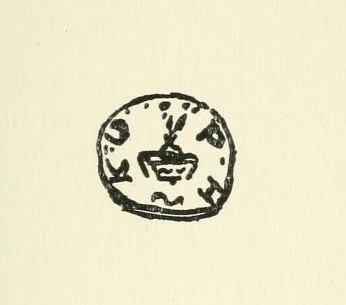
P. S.—The drawing below, which is from the hand of M. Sandy Rose, and which I have inserted at the place that he had indicated, may have a meaning, but, if so, I have been unable to penetrate it. It seems to represent a Greek medal dedicated to the goddess Core. But KOPH means also young girl, and even doll. Besides, are such medals known?
A NIGHT IN THE LUXEMBOURG...
I am certainly drunk, yet my lucidity is very great. Drunk with love, drunk with pride, drunk with divinity, I see clearly things that I do not very well understand, and these things I am about to narrate. My adventure unrolls before my eyes with perfect sharpness of outline; it is a piece of faery in which I am still taking part; I am still in the midst of lights, of gestures, of voices.... She is there. I have only to turn my head to observe her; I have only to rise to go and touch her body with my hands, and with my lips.... She is there. A privileged spectator, I have carried away with me the queen of the spectacle, a proof that the spectacle was one of the days of my actual life. That day was a night, but a night lit by a Spring sun, and, behold, it continues, night or day, I do not know.... The queen is there. But I must write.
The abridged story of my adventure will appear to-morrow morning in the Northern Atlantic Herald, and will soon make the circuit of the American press, to return to us through the English agencies: but that does not satisfy me. I telegraphed, because it was my duty; I write, because it is my pleasure. Besides, experience has taught me that news gains rather in precision than in exactitude in its journeys from cable to cable, and I am anxious for exactitude.
With what happiness I am going to write! I feel in my head, in my fingers, an unheard-of facility....
On the first intelligence of the pious riots that transformed into fortresses our peaceful churches, peaceful after the manner of old haunted castles, the newspaper that I have represented for ten years asked me, with a certain impatience, for details. As I live in the Rue de Médicis, having a long-standing passion for the Luxembourg, its trees, its women, its birds, I went down towards the Place Saint-Sulpice. The square was occupied by children, playing as they returned from school; round it rolled great empty omnibuses; now and again a tramcar widowed of a horse left with difficulty, while another struggled up and turned round without grace. My prolonged stay in Paris has made me an idler like every one else. Nothing astonishes me, and everything amuses me. Besides, I am by nature at once sceptical and inquisitive. That is why, when I lifted my eyes towards the church, my attention was vividly excited by the fact that the windows on the side towards the Rue Palatine seemed lit by the rays of a brilliant sunset. But the sun had not shone that day, and, even if the sky had been clear, no reflection could, at that late hour, light the south side of the church of Saint-Sulpice. I thought of a fire, but no trace of one was to be seen in the sky. Something unusual was certainly going on inside. I hurried towards the door in the Rue Palatine. As I advanced, without losing sight of the windows, I perceived that the light seemed to be coming down the length of the church, as if blazing torches were being carried about in this transept of the nave. At the moment when I went in, the windows by the choir began to shine, while those nearer the front of the church were now obscure.
Pushing open the door, I went towards the chapel of the Virgin, behind the high altar. It seemed lit up as if for a feast-day, and yet I heard no chanting, no music, I perceived no noise. I advanced with steps that I thought precipitate, but which were, on the contrary, very slow, for, to my great shame, I felt myself trembling; in the deep silence of this mournful basilica my heart, it seemed to me, beat like a bell. At one moment the lights of the chapel shone with such brilliance that I had to shut my eyes. When I reopened them, it was dark, and some lamps alone shed their vague, accustomed lights in the now complete obscurity.
A man stood upright, his hand resting on the closed railings of the chapel. He seemed in every way ordinary. Nothing was remarkable but the profound attention with which he was observing the statue of the Virgin. I wished to keep on my way, anxious to question some priest or sacristan, first on the luminous phenomenon, which puzzled me very much, and then, as was my duty, on the events which were doubtless preparing for the next day; I wished to keep on my way, I was in a hurry to finish my business, for I do not find churches, especially at evening, agreeable resting-places; I wished to go away, I wished to speak, but I felt that I was fastened to the flag-stones, I trembled more and more, and, finally, I could not prevent myself from observing the unknown man. I saw him in profile. His hair, worn short, slightly curled, seemed to me to be chestnut, like his beard, which was full, not very thick on the cheeks, and of moderate length. His clothes were much like my own; they were those of a gentleman, correct but unpretentious. I felt I was going mad, in my inability to explain the interest that stopped me before so common a sight. I understood no better the attention with which the unknown stared at the Virgin.
A connoisseur of art would have quickly passed on; a devotee would have knelt. I was beginning to lose my head, to think that I was ill, when the man, so ordinary and yet so singular, turned his eyes towards me. These eyes, extremely brilliant, completed my discomfiture. I lowered my own, not before I had observed that the very pale face was one of the gentlest and most understanding I had ever seen. I even thought that I discerned on those delicate features a smile of infinitely benevolent irony, like those I have seen in certain portraits of beautiful Lombard women. This smile enchanted and intimidated me at the same time. "It would be a great happiness," I said to myself, my eyes still lowered, "if I could once again enjoy that smile," but I dared not look at the unknown, who, I divined, was still observing me. I no longer trembled, but felt myself in that state of happy confusion which one experiences in the presence of a woman whom one loves and fears. I expected nothing, and yet it seemed to me that something was going to happen.
We were about three paces from each other. By stretching our arms we should have been able to touch each other's hands.
"Come," said he.
This single word sufficed to put an end to all my disquietude. The voice was very agreeable. It filled me with a gentle emotion. At the same time I became as free and as content as in the presence of a very old and dearly loved friend. It seemed to me that I had known from all time this unknown of a moment before. I found that I was familiar with his face, his manner, his look, his voice, his mind, his very clothes. An irresistible force moved me to answer him, and to answer him in these words:—
"I follow you, my friend."
All my surprise had disappeared, and, although I was perfectly conscious that the adventure was singular, I was in such a state of mind that I did not feel its singularity.
I went up to him. He took my arm, and the action seemed quite natural. Were we not old friends? Had I not known him since I was three or four years old? Yes, and although he was certainly much older than I, he had played with me in my cot. All this settled itself clearly in my head. I repeat, from that moment until sunrise the next morning, that is to say, all the time I spent with him, I had not one moment of astonishment. What happened, what I heard, what I said, the unusual phenomena, everything seemed to me to be perfectly in place.
So I went up to him, and, when his arm was passed under mine, which I folded very respectfully and with a lover's joy, a long and precious conversation began between us.
HE
It is this that they call my mother! They are full of such good intentions. Admit, my friend, that they are good people.
I
Very good people. You do not think your mother well portrayed?
HE
I have had so many mothers that this image doubtless resembles one of the women who have believed that they gave birth to me; it is their innocence that makes me smile, their virginal conception of maternity, the white robe, the blue scarf. And yet, this church, one of the ugliest in the whole world, is one of the least puerile. The priests who serve it have preserved some intellectual illusion. They have a scrupulous and argumentative piety. The miracles anciently described seem to them proved by their very antiquity. They know that I walked on the waters, one tempestuous evening, but, if they had seen the windows of their church on fire with lights, would they have believed their eyes? You saw, you believed, and you came, my friend. That light shone for you alone.
I
Oh, my friend!
HE
To speak to mankind I need a man as intermediary, and I chose you, I gave you a sign. You were not obliged to respond. My power is not such as to compel men's wills. I can seduce; but I cannot command.
I
I was greatly surprised, I was frightened, but I walked as if to happiness, as if towards a moment of love. But why did the light go out, at the moment when I came near you?
HE
Because your curiosity had become desire. No longer could anything stop you. The iron was on its way towards the magnet. Are you happy?
I
It seems to me that my life is being fulfilled; it seems to me that my past days were only a preparation for the present hour.
HE
Then you are happy? You are going to be much more so. There are things of which mankind have always appeared to be ignorant. When you have heard them from my lips you will, in that moment, have received the courage to repeat them, and that will win you an eternal glory, a glory that will last as long as the earth itself, perhaps as long as the civilisation of which you are a part.
I
Is there not another eternity, a true eternity?
My master—for I now felt that this old friend was my master still more than my friend—my master was kind enough to smile, looking at me with tender irony, but he did not answer my question.
"Let us go," he said, after a moment's silence, "and walk in the Luxembourg."
I
Not really?
This time, he laughed indeed. He laughed softly.
We walked all round the sombre church, and left it by the Rue Palatine. I noticed that he took no holy water, and, even, as I stretched out my hand towards the stone shell, he murmured:
"Useless."
It was now night. We reached the Rue Servandoni in silence. The rare passengers met or passed us without emotion, without curiosity. A young woman, however, who was coming slowly down the street, observed my companion with eyes that seemed on fire. Perhaps, if he had been alone, she would have been still bolder. An idea, madder than the young woman's glance, crossed my mind.
"She looked at you," I said, "as if she knew you."
HE
Everybody recognises me, when I wish it. That young woman does not know who I am. She thinks me a man like other men, and yet, if I had been alone, her glance would have been much more lively, for she desires soft words, she desires kisses. But what would be her destiny, if I yielded to her mute sympathy! The women whom I love lose all reasonable notions of life, and I have no sooner touched their hands, caressed their hair, than all their flesh weeps with pleasure. If I insist, they melt like figs in my sunlight. Sweet flavour and cruel! If I withdraw myself from them they die of grief, and if I stay with them they die of love.
I
The mystics have said something of that.
HE
Something of it they have shown, but wrapped in the withered herbs of their piety.
I
Saint Teresa ...
HE
She believed that I loved her with passion. That fatuity made me leave her. Hers was the solidest woman's heart I have ever met, and with it what facility in self-deceit. She really thought she died in my arms: I was far away. However, in that supreme moment, I consoled her with a thought, for she had earned it by her constancy. What she wrote herself is not without interest for mankind, but the priests, who set themselves to excite her genius, inspired her with many follies, such as her vision of hell. I shall not tell you, my friend, who are the women I have most loved. Scarcely one of them has left a name among you. A woman who is loved and loves does not pass her time, like the illustrious Teresa, in describing the stations of love. She lives and she dies, and that is all.
While I was considering these words, which a little troubled my understanding, we had arrived before the railing of the garden. There I stopped, observing the sombre drawing of the great naked trees. Heavy black clouds were passing in the sky, that was very feebly lit by an invisible crescent of moon.
"How gloomy," I said, "is this park on a winter evening, and gloomier still through these bars."
But the gate opened a little way, and we went in. I had seen so many strange things, heard so many strange words, felt so many strange emotions, that this new miracle gave me but a mediocre surprise. We were in the garden.
"Let us go," he said, "towards the roses."
I
Towards the rose-trees.
HE
Towards the roses.
A soft and clear daylight was born as we advanced. The trees, suddenly in leaf, the chestnuts blossoming in shafts of white and red, were filled with the songs of birds. Blackbirds, on the topmost branches, launched their shrill calls. Bees were already murmuring by; a fly settled on my hand.
The great flower-bed was in full bloom. A perfume enveloped me with a precious sweetness. We disturbed a cat that was stalking two cooing pigeons. My friend plucked a red rose, then a white, then a yellow. At this moment it seemed to be five o'clock in the morning of a beautiful summer day.
I
I am happy. I am happy.
HE
Roses, these roses, are enough to make me jealous of men. The rose of your gardens, the woman of your civilisation, these are two creations that make you the equals of the gods. And to think that you still regret the earthly paradise! Eve! Eve, my friend, was a milkmaid, the pleasure of a bird-catcher or an early-rising oxherd. Eve, when you have all these real young women to enchant your eyes and make desperate your dreams!
I
She was, however, a divine work. Your father ...
But I said no more, trembling with happiness. Three young women were coming towards us. They were dressed in white. Delicate garlands of flowers adorned their corn-coloured hair. They walked slowly, holding each other's hands; their smiles made a light within the light. At the sight of the new roses, they all cried out together like children, and stayed, stretching their arms towards the rose-trees, timorous and troubled by desire.
I watched, a prisoner of the spell, but my friend, with the ease of a king, made a few steps towards them, and offered them the roses he had plucked. They took them, blushing, and slipped them into their girdles. She who was the tallest, who had the most beautiful hair, and the most beautiful eyes, thanked him with a smile and a few words, and then added:—
"We were looking for you."
HE
They say that when one looks for me, he always finds me.
Then there was charming laughter, laughter that made my heart laugh.
SHE
How beautiful are the roses on this earth!
Oh! I love this big red one!
HE
Take it for your hair, my friend.
SHE
I am happy.
I too dared to pluck a rose.
"The one which is red and yellow, the one with many thorns," said close to me the voice of another of the young women.
She had rightly divined that I was thinking of her.
I
The one that makes the hands bleed, and the heart, perhaps.
THE OTHER
Do not prick your fingers. I should be wretched.
I
And what if I pricked my heart?
She lowered her eyes without answering, took the rose and rejoined her companion. She was more feminine, more human. She who had my friend's favour seemed of a higher nature, and her very childishnesses could not but be divine.
The third young woman was not forgotten. She was small and frail, timid, with a heaven of innocence in her eyes. She did not leave the tallest, whose sister or chosen friend she seemed to be. She was not forgotten; but she disdained the flower I meant for her, and, going into the flower-bed, plucked herself a whole bouquet of roses. My friend observed her with complacency.
HE
Spoilt child.
THE LITTLE ONE
I have them of all colours. For me! For me! For me!
And taking them one after another, she inhaled their scent with a selfish delight.
My friend walked on with two of the young women. I followed him with the other, with her who seemed to have chosen me.
THE OTHER
Look! Are you bleeding? I warned you.
A drop of blood had been crushed on my finger. I looked at the young woman without answering. She had not the ironic air of which I suspected her. Reassured, I came up to her again; she laid her hand on my arm.
While these charming scenes were occurring, I was adapting myself to my singular circumstances. The continuation of the adventure soon seemed most natural. We were walking in the morning in a beautiful, solitary and flowery park. Such things happen in life as well as in dreams, and I was soon quite at my ease.
We were now walking in a wood of young chestnuts. Red stalks fell now and again at our feet. We went down steps and climbed others; we saw ponds and pools, stone statues and orange-trees, a cyclop and the nakedness of a nymph, flowers of every colour, trees of all forms, bushes of all leaves, and pigeons which, with slanting flight, dropped on the lawns amid the fluttering of startled sparrows.
THE OTHER
My name? What an idea! You will learn it if you are destined to know it. It is not mysterious. Call me friend; for this day, I will permit you to do so.
I
Are we to have a whole day?
THE OTHER
Does a day seem long to you?
I
Long and short at the same time in your company.
THE OTHER
You will see that it will be short.
I
Alas!
THE OTHER
Where are they? I have lost sight of them. Ah. There they are. Yonder, under the cherry-tree in bloom.
I
And she?
THE OTHER
What do you mean?
I
Her name?
THE OTHER
She? She is SHE, she is life, she is youth, she is beauty, she is love. She!
I
I ask nothing further. I am happy.
THE OTHER
Already?
I
I am happy, and I still desire, but without anxiety. I desire with delight, with calm. I feel a divine peace, a peace full of present pleasures and of pleasures to come.
THE OTHER
With him one is always happy, one becomes accustomed to one's happiness, and yet one feels it continually increase. I said "already." Do not interpret that word according to your ideas of yesterday.
I
None the less, it gave me something to dream of.
She lowered her eyes, as she had lowered them before, without confusion, with more than human coquetry. When her eyelids lifted, slowly, it seemed to me that I saw in her look a dawn of tenderness. She took my hand and hurried me along.
THE OTHER
Come quickly, they are waiting for us.
Under a green arbour, rustic chairs were arranged round a heavy table of axe-hewn wood. A bowl of milk, cups of flowers, brown bread, strawberries; it was Virgilian. The little one spread the petals of a red rose on the milk into which she was dropping the strawberries.
THE LITTLE ONE
They are my lips. I give you my kisses.
She blushed deeply as she said it, and her big friend drew her into her arms and kissed her eyes.
When we had begun to take this matutinal repast, my friend, taking no further notice of the young women, renewed the conversation their arrival had interrupted. We were seated facing each other, two of our companions together on one side, and on the other the little one, who was busied in arranging according to their shades all kinds of flowers that she had picked in the course of the walk.
HE
My father ... You were speaking of my father. I am afraid you have an exaggerated idea of him. He was certainly very powerful, fairly intelligent, just, but, admit it, he was not good ...
I
You speak as if he no longer existed.
HE
He is not dead, but he is old. The gods end by growing old. He has retired into the eternal silence of disabused intellects. He still gives advice, he alone is capable of explaining certain human evolutions, but the indifference of age has dried up his heart. He has never much loved mankind, and now has turned from them entirely. I, on the other hand, love them....
I
Lord....
I rose, to fall on my knees. He calmed my emotion with a gesture.
HE
Why "Lord"? I am not your lord. Listen to me, and reassure yourself. Observe these beautiful young women, their quiet, and their smiles. They play with flowers, they watch you with amused eyes: are you afraid of them? And yet, would you not say that they were goddesses? Ah! How your women are nearer than you men to nature, nearer to the divine! If you had had a mistress, I should have asked you to go and fetch her: she would have looked at me without timidity.
The young women began to laugh. All three were now on the same side of the table, and, as they leaned over their scented harvest, murmuring like bees, stirring like lilies where the wind passes, one did not know if they were listening to the words of the master or to the words of the flowers.
This spectacle helped to reassure me, after my friend's sayings, which, however, I did not understand.
HE
The religious conception of the world that you now have, the conception that you call Christian, from the name that was given me on the occasion of one of my earthly visits, is one of the feeblest that humanity has ever imagined. Practical intelligence has, in a certain sense, made progress since the Greek philosophers before Socrates, but speculative intelligence has almost consistently gone backward. To make a system that should have some distant relation to the truth, the cinematic philosophy of Epicurus would have to be poured into the fables of pagan mythology. Take, if you like, if Latin thought is more familiar to you, the poem of Lucretius, and Ovid's "Metamorphoses"; attempt an interpretation which should derive part from universal determinism, and part from divine caprice.... It is difficult? Why? Are not men apt in appearance to initiative, though ruled, as you know, and very narrowly, by fatal physical laws? You are free, when you think yourselves free. It is the same with the gods, but the liberty of the gods is exercised on a very much more extensive material, a material which, without being infinite (infinity does not exist), is immense. Their power, superior though it is, is of the same order as human power. Greece touched the knot of the question, and, if she did not untie it, it is that it is not to be untied: the creator of the world, the regulator of the world, is Destiny. Fatality rules over the gods, as the gods rule over men, and under her hand, my friend, we are all equal, exactly as you are under death, genii, kings, and beggars alike.
To dissimulate the trouble into which these words threw me, I turned towards the young women. There were but two of them.
SHE
The little one has gone off to look for more flowers. Some of them fade so quickly. One would say that the warmth of the earth is enough to dry them up.
THE OTHER
How many times love has been killed by kisses.
I
Do not say so, my friend; that was not love, but caprice.
THE OTHER
Caprice and love hide under the same dress.
I wanted to lay my hand on hers. She took it away, and I had but a finger, but I pressed it unresisted.
THE LITTLE ONE
Here are other flowers.
THE OTHER
They will fade too.
HE
No, they will not fade.
THE LITTLE ONE
There, you see.
I
I have needed this diversion, my friend, to accustom myself to your discourse.
HE
Yes, you are a man, and such you will remain. It is necessary that you should remain a man.
I
Shall I not become superior to other men, when I have heard, when I have understood?
HE
Yes, if you understand.
I
The Christian phase, then, has been an error of humanity?
HE
Humanity has never lived but in error, and, besides, there is no truth, since the world is perpetually changing. You have acquired the notion of evolution, which, within certain limits, is correct, but you have wished at the same time to preserve the notion of truth: that is contradictory. If you were to succeed in constructing, in your intellect, a true image of the world, it would be already untrue for your grandchildren. For, if the world evolves, you likewise evolve, and man, from one generation to another, is not the same man. You ceaselessly struggle to find the likeness of the old man in the portrait of the child. It is a game. After all, it is something for you to do.
I
Yes, the search for truth is one of the great occupations of men. One is held happy when one has found it; and, if one is unable to find it oneself, one shares in a neighbour's discovery. The neighbour never refuses. This need of truth torments men about the time that their carnal passions let them rest.
HE
Nature was cruel in allowing her creatures to survive the period of physical expansion. But of this very cruelty you have taken advantage, and I think that many old men among you are happier than many of the young. In Truth, at last, they find a faithful mistress.
As he said this, I could not prevent myself from glancing at the young woman whom I have called "The Other." She looked at me, too, but lowered her eyes, blushing.
HE
I cannot modify even for an instant the form of your human brain, the habits of your understanding. That is why I enter into all your fantasies of language, and use even your abstract words. Do not let that dupe you. It is not approval. Truth is an illusion, and illusion is a truth.
I
None the less, your presence here, your words....
HE
You will no longer believe in me when you no longer see me, and you will never know if this night, this winter night, clear and warm as a summer morning, if this night of happiness was a truth or an illusion.
It seemed to me, for the space of less than a second, that the whole spectacle before me went back into the nothingness of dreams, but my eyes, that I had not closed, found the light again, and I was comforted.
HE
I shall, then, not tell you the truth, because no concordance is possible between your mind, served by your senses, and that which is outside your senses. There is a representation; it is inexact, because it is fragmentary and momentary. A few little cubes of mosaic have fallen from the vault; you put them in the palm of your hand, you set their tints side by side, and you believe you have reconstructed the drama of the world. I shall not tell you the truth; I shall tell you what you wish to know. When you know it, you will know no more of it, but you will be satisfied.
I
Master of enigmas and of parables....
HE
The gospels, my gospels! Poor and happy books! What a strange fate had these pious dreams of some Jews disturbed by drunken prophets! Imposture has made in them such naïve arabesques with faith! Have you read the Acts of the Apostles? It is not as good as "Aladdin and the Marvellous Lamp," but how moving it is! These men touch God with their hands. And it is pastoral and fairy tale at once. It is a pantheism of ingenuous conjurors. Behold me a carpenter, a fisherman, a prophet, a magician; I am hanged and buried; I am resuscitated and mount to heaven; thence I re-descend in the form of tongues of fire. I am one, I am two, I am three; I am a dove, I am a lamb, I am God, and all at once. And the nations understand; the doctors explain. Everybody believes. Truth reigns. Happiness is poured into pacified hearts.
I
Is not that what you intended?
HE
Jesus, whom I inspired with some elementary ideas, made a mistake in taking twelve disciples. He would have done wrong to take a single one. My ideas, falling into these twelve heads, became twelve different kinds of folly. It was then that I interested myself in Paul. It was too late. Besides, I abandoned him almost at once. None the less, the Church that he founded has become a curious institution.
I
Men have thought it divine.
HE
For nearly twenty centuries I have watched with sorrow its ironical development. It has made me curse, it has made me scorn....
I
It has also made you love.
HE
With what love! Ah! my beautiful feast-days of Ephesus and Corinth!
I
What are you saying?
HE
You hear in this moment the confession of a god. A moment unique in your life, and rare in the life of humanity. Take the hand of your friend, and carry it to your lips. You will listen to me more wisely if your heart is at peace. Call her Elise; she will answer your smile with a smile.
I obeyed with joy. Elise let me take her hand, and I tenderly kissed it. Her friend watched us with an air of kindly complicity. Delightful betrothal!
I
I love you, Elise. Do you love me?
ELISE
I love you, my friend. But give me my hand again, that I may arrange these flowers for the feast-day of our hearts. Let us listen to our master and be wise.
I let fall Elise's hand, after kissing it once more. A very sweet smile thanked me, and I saw, under the white robe, her bosom swell with love.
The little one, tired of running about, had sat down on a low chair, leaning her head against the knees of her comrade, who, absently, was playing with her yellow hair. My master, his eyes on this charming picture, whose emotion he seemed to make his own, said nothing. After several moments of a silence that enriched my life, he spoke again:—
HE
If I have sometimes come to visit men, it has been for love of their women. Not that, like the gods whose stories are written by the poets, I desire a multiplicity of embraces. I come less to love than to let myself be loved. I belong to those who wish to make me theirs, and I make myself for their hearts the ideal man whom earth refuses them.
For you have created woman, you men, and you have remained inferior to your creation. You have not known how to acquire the gifts that would have completed the miracle, and your loves are always lame. You take, and you do not give; you impoverish the fields that are fertilised by your desire, and the women you have loved die of thirst as they look at the dryness of your eyes.
All three were listening, very attentively. Elise, however, was good enough to take my fingers and press them, while her two friends rose, and were going to kiss the hand of the master. But he opened his arms, and they fell on his breast as fall two flowers plucked by the wind. Elise and I watched with pleasure this charming episode, and I said to myself, naïvely: "He welcomes these two women as he would have welcomed all women, and I understand that he can belong at the same time to all at once and to each one in particular." Elise's hand, meanwhile, began to grow restless in mine. She said in a whisper and unevenly, these enigmatic words:—
ELISE
Friend, friend, are we not more beautiful than women?
Yes, Elise was more beautiful than a woman. I thought I was looking at a divinity. I thought I was becoming a god. My mouth took possession of her mouth, and my left arm supported her head, while my right hand sought under the agitation of her bosom the beating of the heart that I desired. It became dark night except in my head and in my senses, and it seemed to me that Elise was mine, and that cries left our moist and trembling mouths. But perhaps it was only an illusion. And yet, I perfectly remember that, when the light came back, our eyes were full of gratitude and of understanding. Moreover, we were now so close to one another that we seemed but a single body.
Insensibly we recovered our former attitudes. The little one, when once more we looked at the external world, was sleeping on her friend's knees, and our master was meditating, his head on his hand. What had passed before us, what mysterious accomplishment, I did not then think of asking myself, and now, if I were to ask, I should not know what to answer. Illusion had doubtless buried us all alike in a rain of roses, and the magician had not escaped his own magic.
The great happiness I felt quickened my intelligence. When our master began to speak again, I felt that a soft beam of sunlight was falling upon me.
HE
I told you that the religion of the ancient Greeks was that which translated with least ugliness and least falsity the true state of the world which is invisible to you. There are gods, that is to say, a race of men as superior to other men as you are superior to the most intelligent or the best domesticated animals. You have conquered the earth; my ancestors conquered space, and colonised the greater number of the planets that gravitate round the sun. Our possible domain does not extend beyond the solar system; our actual domain does not stretch beyond Jupiter, where my father dwells, and its limit in the direction of the sun is this earth upon which we are. For a great number of centuries I have chosen Mars as a resting-place, and this brought me near you, and gave me certain humane inclinations. The other planets, by reason either of their distance from or of their nearness to the sun, are inaccessible to me, almost as much so as to yourselves. I do not know what goes on in them. As for the infinite worlds which are spread beyond our sphere, they are for me as for you the unknown and the unknowable.
What I have just told you will not seem very new. Many of your philosophers have had imaginations that at some point touched this truth. Voltaire made Micromegas to tease you; but, submitting to the appearances of physical laws, he made an immoderate giant of him. Why so? Are not the ants, next to men, the most intelligent of terrestrial animals? I think I remember that at a far-distant epoch, that your geologists call, I believe, the coal age, the termites displayed on your globe a sort of genius. These little beings, so fragile, were cut short in their development by the lowering of the temperature. They no longer live but with a slackened vitality, like other insects; their intelligence, no longer nourished by an abundant physical activity, has congealed; they stopped at a point thenceforth impassable for them, and what they once accomplished by choice and will, they now no longer do except mechanically. But let us leave Micromegas....
I Micromegas has almost ceased to interest us. You have said, a little quickly for my intelligence, many things that would delight me if I better understood them. This slackened life ....
HE
Terrestrial life is precarious since it is at the mercy of atmospherical circumstances. Animals that have not a very high temperature are destined to expend their strength in a perpetual labour of adaptation. If the original heat had increased instead of diminishing, the termites and the ants would perhaps be two great nations, sharing between them the empire of the world, and man would be one of their preys. But you discovered the art of fire and raised yourself above all other animals. Fire, in giving you a constant summer, also gave you leisure. Thence your civilisations, proud daughters of idleness, who deny their mother. It is from idleness that everything has been born among men. From the year in which one of your ancestors was able to pass the winter beside his fire, date the arts, the sciences, games, love, all delights. Leisure is indeed the greatest and the most beautiful of man's conquests. But, though you have known how to conquer, though you have known how to create, you have scarcely ever known how to use your conquests or your creations. After conquering leisure, you disdained it, and slaves, ashamed of the inactivity of their domesticated hands, set themselves to preach among you the sanctity of labour. Poor madmen! And are you not already on the way to spoil woman? Have you not already succeeded in insinuating into her heart the shameful principles of Jewish morality? Have you not resolved, in your narrow masculine pride, to undo the work of your ancestors and to reduce to the position of mean and lesser men these creatures who used to dominate you with all their beauty and with all their tenderness? You educate them; you teach them the useless stupidities that make your own brains ugly; soon you will forbid them ornament, you will forbid them love, you will forbid them to make you happy! But I will take up this discourse later. It is a digression due to your curiosity. We were speaking of Micromegas. Well, I am, if you will, Micromegas, reduced to our human proportions. No more than he have I absolute power over men; I cannot even crush them, like that Titan, in absent-mindedness or in pleasure. I have scarcely any power over men: I can, when I strongly wish it, insinuate into them some few of my ideas. It is this that men have called my incarnations. I have never become incarnate. My own flesh, almost immortal, and almost incorruptible, suffices me.
I
Almost....
HE
The gods are born and die, so my father has told me. I have not seen one die, I have not seen one born. But I was born, since I have a father and a mother.
I
Your mother Mary....
HE
Credulous and inattentive child! What matter the successive names that are given us by men? The Greeks called my mother Latona; they knew me under the name of Apollo. Their religion was full of fables, but they were not ignorant of the essence of things. I know nothing of how the elementary truths were revealed to them. Perhaps my father, in primitive ages.... I did not begin to busy myself with men until about the time of Pythagoras. I inspired him with some happy ideas; he passed for divine, and is one of the rare disciples for whom I have never had to blush. Pythagoras civilised the shores of the Mediterranean. His thought, sustained by me, hovered like a light white cloud over the blue waves of that maternal sea.
But Epicurus was perhaps still nearer to my heart. His natural and more genial sensibility produced, under my breath, a more beautiful intellectual flower. He knew one part of wisdom, and was not the dupe of analogies. Intelligent, he did not go and suppose a universal intelligence, inventing systems, poems, and useful practices for the happiness of man; he did not go and suppose a supreme creator. He understood that the temperaments of men are diverse, and did not advise a uniform pleasure. He taught pleasure, that is to say the art of being happy according to one's nature. I loved Epicurus. I showed myself to him in the form of an older friend, a traveller who wandered over the world in search of wisdom. Once or twice a year, he saw me arrive with joy, put his slaves at my orders, did not hide from me his wife, who for a long time was pretty, and for whom I felt a tender friendship. She was only jealous of her husband's tenderness, and never prevented him from enjoying the caresses of a beautiful stranger. She herself was insensible neither to Ionian nor to Asiatic beauty, and this pure and charming couple often partook of pleasures that they did not give to each other. I accepted these voluptuous customs; the indulgent night more than once heard our sighs mingle with those of the sea which came to break its perfumed waves at our feet.
These things occurred at the hour when the young slaves came, before going to sleep, to wash away on the beach the stains of the day's work. They played, they laughed, and we loved to join them in the water, still warm from the fires of the afternoon. Tired by a long philosophical talk, we found a singular refreshment in the caresses of the waves, and a strength that we willingly abandoned in the arms of the young women. Then they came and sat beside us on the sand, and sang, while we dreamed of nature increate. These songs did not fail to attract an ardent youth; we knew it, and when we were rested and refreshed, we went and stretched ourselves upon our mats, letting new pleasures be born, new flowers, in place of those we had plucked.
My friend, the teachers who poison your sensibility and stifle your intelligence have made you believe for some centuries past that the pleasure of Epicurus was a pleasure wholly spiritual. Epicurus had too much wisdom to disdain any kind of pleasure. He wished to know, and he knew, all enjoyments that may become human enjoyments; he abused nothing but made use of everything in his harmonious life.
It was during the early hours of one of those happy evenings that we found, a result of long meditations, of long discussions, the atomic system. It was a great intellectual achievement, the greatest that has ever been produced among you or outside your sphere. To conceive the world as the product of a series of accidents, that is to say of a series of facts rebounding to infinity one on another, is a conclusion at which the noblest minds of your time dare hardly stop, although it attracts them. Twenty centuries of Platonism have so deranged man's understanding that the simple truths no longer find a footing in it. And yet, all the systems that you have imagined can be disproved, and that of Epicurus cannot. Would you like me to explain it to you, not as your professors of philosophy have defaced it, but as we established it in our Ionian evenings?
I
We scarcely know the system of Epicurus but by Lucretius' poem....
HE
The most beautiful, perhaps, of the works of men.... Ah! if men had chosen for Bible that admirable book!
I
Ought we to recognise in it a little of your thought?
HE
Much, my friend, much. It was I who guided the young Lucretius towards Zeno, from whose mouth he learnt to love and understand our Epicurus. I found again in this sombre Roman genius something of the voluptuous habit of mind that ennobled Epicurus, a similar desire of knowledge, and at the same time a respect for the secret movements of life. His existence would have been that of a dreamer, if the future had not tormented him with his passions. He was loved, and was persecuted by jealousy, he, who asked nothing from his mistress but peace for his flesh and peace for his thought. He loved. Love made an observer of the dreamer. He wished to learn the cause of love, and learnt that love was life itself; he wished to learn the cause of life, and learnt that life, that is to say eternal movement, was its own cause. The great adventures of ambition that he witnessed also did much to detach him from social pleasures. The actions of animals, so simple, so precise, seemed to him more interesting than the bloody combats of a few madmen who bought by a crime the certainty of dying by a crime. At the time when he wrote his poem, I was almost his only guest at his villa Lucretia, not far from Albanum. It was a farm rather than a pleasure-house, and often, returning from a walk, we lent a hand in the harvest or the vintage. Memmius, if he was there, watched us or played with the girls. Memmius was a mundane sage and rather libertine. In the evening we took up our talk again. I revealed to him in their entirety the mysteries that Zeno, very jealous, had half hidden from him. On my next visit he read me the last pages of the poem, and I recognised with joy in this language, less supple but more solid than the Greek, the ideas and the genius of the noble Epicurus: "Ancestress of the Romans, O joy of men and gods, noble Venus, it is thou who, under the vault of heaven where the stars revolve, dost people the ship-carrying sea and the fruit-bearing earth; to thee all that has life owes its birth and its sight of the light of the sun....
I
"At thy coming, O goddess, the winds take flight, and the clouds retire....
HE
"For thee the earth scatters the scent of her flowers, for thee laugh the waves of the deep...."
I
Lucretius is now but lightly valued among men. He is held immoral, having spoken of love without hypocrisy and of death without illusions.
HE
Yes, he knew too many things wounding to your childish sensibility.
I
I remember a sentence of Bossuet, a sentence that implies a scorn of antiquity: "As soon as the cross began to appear in this world, all that men used to adore on the earth was buried in oblivion. The world opened its eyes and was astonished at its ignorance...."
HE
And it is I! It is I! So many absurdities in my name!... But our young women have fallen asleep, their hair mingled with the flowers they were arranging. Let them be. Take away these lilacs which would give them headaches. O divine creatures, you know all, knowing love, and you have no need of our vain philosophies.
He rose, and, walking round the table, kissed all three upon the cheek. Then he sat down again beside me, and spoke:
HE
I shall not tell you what matter is; I do not know. Matter is that which is, that which has always been, that which will always be. With Epicurus, I conceived it as an infinity of atoms, or of points, meeting at hazard, and forming groups here and there; it appears to me now more like a tissue, but that comes to the same thing, since there must always be space between the continuous elements of this tissue. Otherwise we should have a mass, immobile, and consequently inert. One cannot suppress space, whose reality, however, it is impossible to conceive; for if space is empty it is nothing, and yet without this nothingness nothing could exist.
In admitting matter in the form of a tissue, we suppose an infinity of lines cutting each other in all ways; but a line is made up of points. Let us return then to points; that is clearer, though not much so.
Your chemistry believed that it reached the limits of analysis, in discovering the molecules that it counts and weighs. But it is evident that a ponderable point can be cut into two points equally ponderable, and so on to infinity, and so on without limit of space or of time. There would be, then, two infinites: one above us, since every number can be increased; the other below us, since every number can be diminished. However, since space must be considered as an absolute void, as a perfect nothingness, as nothing, it is possible that each of these two infinites would abut sharply on this void, on this nothing. The world is perhaps limited. This tissue is, perhaps, a sphere isolated in the midst of the nothingness. As one does not well see how something can come out of the nothingness, or how something can become nothingness, we shall conclude that the eternity of matter coincides with the eternity of this nothingness. In this way we shall have being and not-being. But, as not-being is perfectly inconceivable though necessary to the existence of being, we shall leave it aside; what else should we do with it?
I am aware that one of your learned men has lately been able to speak with a certain logic of the final annulment of matter; I do not think that this idea has a really perceptible meaning, either for men or for gods. What is, is. Disintegration, moreover, does not signify destruction, but change. The face of things has changed and will change again, but the very essence of things is as eternal as chance. This universe is only one of the innumerable tricks of chance, one of the fortuitous moments in the eternal movement ... You find this tedious?
I
What is more interesting, next to our personal life, than the personal life of the world?
HE
You will die, and the world as you see it will die also. The movement that created it by accident will destroy it by its own continuity. The vulgar eternity that you conceive is only a moment. Have you seen a top spinning? There is a moment, about the middle of its gyration, when the circles described by one of the points on its circumference are all described with a sensibly equal speed. The solar system, by its precision, should make us admit that the top of which we form some of the atoms is pretty nearly half way through its spin. Motion is not perpetual, as you know; so the gyration will go on with necessarily slackening speed, until the top lies down on its side and dies.
I
Oh! our dreams of eternity!
HE
Do I touch them? A man dies, a man is born. A world dies, a world is born.
I
Renewal is not eternity.
HE
It is not of eternity you dream, but of immobility. The eternity you have conceived is only a stoppage of movement. What should be conceived is the perpetuity of movement. Men, gods, and worlds; eternal movement walks us for a moment among the infinities of chance.
I
And so all human effort, our philosophies, our sciences, the dolorous and superb edifice of our civilisations....
HE
Destiny is more beautiful than all civilisations.
I
But, if they must perish, let their memory at least remain in the intelligence of the gods!
HE
Can the gods survive the world that gave them birth? We are your brothers in mortality. Epicurus knew it. He never considered the gods as other than provisional immortals. Nor had he the singular idea of a unique god, infinite, eternal, &c. That belief had already been imported from Asia into Greece, but the Greeks, not understanding it, presented their whole pantheon in a body with an ironic immortality. Plato and Aristotle took it up, and tried to make it reasonable, but only succeeded in showing more clearly its philosophical inanity. I did not let Epicurus, whom I loved, lose his way in this metaphysic. God is a dream, charming or cruel, useful or dangerous according to the heads in which it reigns, but no more than a dream. Need I explain to you the impossibility of God? God for men is a matter not of reasoning but of sentiment. Your better philosophers have understood him so well that after denying him in their intellects they have hurried to affirm him in their hearts. That is what I should do, perhaps, if we had to remain on the level of humanity; but I am come to raise you above men,—for an instant, before letting you fall back again.
I
Master, have I displeased you?
HE
Almost all those whom I have raised above the earth have fallen again. The happiest died, some moments before their perjury; the others denied me. But listen. Have you ever reflected on the incontestable mathematical truths? In any case, you know that one is one, and that nothing in the world can make one two, or two one. In the human brain, every impression, every sensation, every image, every idea, must find for lodging a separate habitation. Who then has imagined a central cell to replace the soul? A useless imagination, since this cell could only be a reduction of the brain, as the brain is a reduction of the world. A unique centre of knowledge is an absurd conception; this unique centre is necessarily composed of as many receptive as there are knowable elements. In the same way, God cannot be conceived as a simple being. If he existed, he could exist only in complexity; he would be much like a man, he would be much like me, who am a superman. Multiply yourself to infinity and you have the only really conceivable Almighty. The religions and modest philosophies that have imagined God in the form of a perfect man have at least remained within the limits of a reasonable analogy. I, the one of the gods whom men adore, I tell it you in all divine humility: I am a man and God is a man. You will never transcend this respectable conception without going into the absurd. What is the God of your metaphysicians? An abstraction whose reality is no more possible than that of heat, good, penetrability, truth, beauty, or weight.
The religion of the Greeks was charming, above all in later times; your own has now and then given me some gratification. The Ancients knew the religion of beauty and pleasure, you know that of grace and tenderness. I scorn your philosophies, which are only adroit intellectual structures; I have never been able to scorn your legends and your superstitions, the traditional obeisance that your mind makes to your sensibility. But this is the field reserved for the exercises of the populace, children and timorous women. There are no noble human creatures but those who are in love with themselves and study to extract from their natures all the vain happiness contained in them. Vain but real, and only reality. To know that one has but one life, and that it is limited! There is one hour and only one for gathering the grapes from the vine; in the morning the grape is sour; in the evening it is too sweet. Lose your days neither in weeping for the past nor in weeping for the future. Live your hours, live your minutes. Joys are flowers that the rain will tarnish, or that will throw their petals to the wind.
I
Epicurus! Epicurus!
HE
Yes, I wish you to be a new Epicurus, and to teach the men of to-day what my friend taught long ago to the Athenians. Apostles have spoken in my name who have succeeded in spreading over the earth a doctrine of despair. They taught the scorn of all that is human, of all that is genial, of all that is luminous. Unfitted for natural pleasures, they sought pleasure in their own misery and in the misery in which they plunged their brothers. They called the earth a valley of tears, but the tears were those whose abundant flow was caused by their own malignity. Baleful to themselves, they were baleful to the men who became the slaves of their sombre dreams. After promising their faithful an eternity of chimerical joys in return for the true and simple joys they stole from them, they took even hope from the heart of man, they imagined hell. Sons of the ancient priests of Baal, they set up in my name the cruel idol of their fathers, and made of me the hideous and prescient creator of those whose destiny was damnation. These monsters, however, did not discourage me, and I sustained by my inspiration every effort of natural wisdom that I saw among all these horrors.
Alas! They hold you yet, and those who combat them, different priests, are sometimes priests more baleful still. Your morality is to-day the lowest and the saddest that has ever reigned. The external hell, in which you now scarcely believe, has entered into your hearts, where it devours all your joys.
I
Yes, we are sad. In us, the fear of sin has survived the belief in sin. We dare not enjoy anything. We scorn the man who sits down in the sunlight to drink the first rays of the Spring, but while we scorn him we envy him his baseness, for we call all unproductive leisure base. When we can no longer work, we go and wratch those who are working.
HE
Your social state is an exhibition of madness. The Roman slaves had a life less hard than that of many of your work-people. After the Semitic fashion, you make even the women work! Rich and poor, all alike, you know nothing of the joys of leisure. You give to work all the hours of your days, some to get bread, others to achieve a pleasure that fatigue prevents them from enjoying, and others again, the maddest of all, to increase their wealth. You have reached that degree of imbecility in which labour is looked upon as not only honourable but sacred, when, actually, it is but a sad necessity. You have lifted this necessity to the rank of the virtues, when it is, without doubt, no more than the vice of a perverted being for whom life, short as it is, is only a lengthy tedium.
I
And of this work, which at least allows us to breathe and to eat, there is not enough for all. Thousands of beings in the most civilised towns die every day of hunger, and with a slow death. They are in agony for ten, for twenty years ...
HE
Increase and multiply. That is the work of my father. He was seized with a sort of jealous and mischievous love for the Jews, a sufficiently restless little people, and showed himself curious to encourage their natural pride so far as to make it immoderate. The result was comic and sad. These ignorant Bedouins believed themselves destined to dominate the world, and then disappeared as a nation at the very moment when this domination was accomplished. A singular fate for the Jews, to have given mankind a religion in which they do not believe themselves!
Alas! At the request of my ageing father, who began to find these prolific barbarians tedious, after having tried to enlighten Jesus, who had too many disciples, I interested myself in Saint Paul. I came to him as I have come to you; he was dazzled, and believed that the vision had given him a divine mission. I followed him in his journeys. His energy amused me; but at Athens, I ranged myself with his opponents, whose laughter I excited. Later on, I let him die without consolations; his pride sufficed him.
I thought this man less mad than the other thaumaturgists who, like him, amused the crowds, but the idea of God went to his head, and he began to believe in me, supposing me omnipotent. It was then that I ceased to visit him, for I do not care to make myself the facile accomplice of religious divagations. Left to himself, he went on hearing me; my voice sounded like a buzzing in his deaf ears. His faith grew measureless, and he accepted martyrdom. How different from the charming Epicurus, for whom our conversations were never more than a lofty diversion! But this Paul, although hallucinated, was not incapable of a certain imposture, and it was assuredly to magnify himself in the eyes of fools that he pretended to have been ravished to heaven. It is true that he believed in my resurrection. What tales! One would say that men only give words a precise meaning in order to have the pleasure of using them in an opposite sense. Your brain plays very singular tricks. The dead are dead. The dead are not dead. The dead are living. The dead alone are alive. What jugglers you are!
I ceased to do anything but amuse myself with the developments of the new religion. It produced very charming feminine souls. What a priceless creature was Saint Cecilia, what an ingenuous lover. Perhaps no other woman has known nights so delicious as those that Cecilia passed with the angel who came to visit her....
I
Valerian found Cecilia praying in her bed with an angel.
HE
Poor Valerian! He never suspected the purity of his betrothed. He loved her too well to be disturbed even by the evidence. And so he well deserved the eternal crown that the Church decreed him. If women were better cognisant of the story of that excellent young man, with what favour would they not decorate his memory and his image! Cecilia never ceased to love him. An enchantment enveloped these simple hearts. I completed their happiness by letting them die in ecstasy with the certainty of finding beyond death their interrupted kisses, and of finding them eternal.
I learnt, my friend, to understand the peculiar beauty that the new religion concealed within itself; it held more grace than the purest paganism, and I know not what of simplicity and tenderness that I had not met before. Stoic insensibility became ridiculous; suffering was the fashion; the crowns of roses were changed to crowns of thorns. There were long centuries of stupor, and when the human soul awoke again and wished to smile, its smile was half of melancholy. Perhaps men will never recover from the wound that Christianity has given them. Sometimes it has seemed to heal over; at the slightest shock, at the slightest fever, it opens again and bleeds. Happy are those who suffer! That insensate saying still haunts your enfeebled hearts, and you fear joy, from vanity. You accepted the anathema hurled at the happiness of living by a few despairing Jews, and when you have laughed you ask pardon from your brothers, because it is written: "Happy are those who suffer."
Man, who is always making a pretence of revolt, is the most obedient of domesticated animals. He has accepted the most infamous prescriptions of all the moralities in turn, and among you it has always been a title to honour to kneel before a decalogue and receive blows from a rope on the back. The great hypocrites have always been your chosen masters, and one still hears you neigh at the idea of sacrifice. Your sensibility has flowered ill; your intelligence is inadequate. It has always shown itself the dupe of the directors of conscience who have succeeded each other on your shoulders. The preachers of virtue rarely practise it. You have always had to deal with thirsty throats whose only care has been to make you believe that the fountain has been poisoned.
The moralist is the eternal old man who makes a terrible picture of love to the young girl of whom he is amorous. Advice that fetters the development of energy is always hypocritical, that is to say interested, advice. There is also the naïve imitation of hypocrisy; there are the fools, the vain, the subaltern rogues: but these are the masters whom it is necessary to unmask.
I
What! Have there never been sincere great minds, true friends of mankind?
HE
What I have just said to you must not be taken tragically. The greatest hypocrites are never perfect hypocrites. There is in them always one part of sincerity. The exercise of sincerity is the most natural thing in man. It needs a strong will to create a fictitious character for oneself; it also needs much talent, perhaps even genius. The hypocrite, in showing himself under a fictitious aspect, diminishes his pleasure in living; he will recover it in its entirety only when he has moulded to his pattern a great number of disciples; hence the proselytism of all the great creators of social lies. But hypocrisy ceases when the new environment has been created, itself the creator of new characters. The early Protestants feigned a certain rigidity of manners in order to depreciate the Papists. This hypocrisy became traditional, then hereditary, and it is with veritable good faith that the Calvinists banish from life all that might make its beauty and its sweetness. The Catholics, for strategical purposes, have set, in their sermons at least, a still higher value on the scorn of pleasure, and it is in all naïveté and good faith, like the Calvinists, that they prescribe several virtues whose practice would fling humanity back beyond the state of savagery. The philosophers, moreover, do not to-day hold views different from these, and they would be much astonished, from what they say, to see civilisation, with its delicious complications, fall into ruin, and make the earth like the fields where once was Troy, and the deserts where rises still the phantom of Timgad.
The moral theories of humanity and the form that they give to its daily life must be separately considered.
I have spoken to you of the great hypocrites. There have also been men of great simplicity. Neither have had on the general march of events the influence you might suppose. The world of ideas and of words is one world, and the world of facts and of action is another. They doubtless react on each other, but so slightly, so gently, and with so much delay, that their reciprocal influences are very hard to establish. Hardly before the last fifty or sixty years have the social ideas of Christianity seemed occasionally to take an active form, and then with what timidity! Perhaps Christianity will one day be realised in practice, but it will then have long disappeared as religion, philosophy, or system of ethics. And a new discord between thought and life will be apparent.
Even this much post-dated realisation of the great social doctrines is, perhaps, only an allusion. The field of thought and the parallel field of action are finite; and so the same thoughts must return after a turn of the wheel, and the same acts. Their coincidence, near or distant, is perhaps fortuitous. It is in vain that you think and speak; action enrolls itself upon another plane, and the two planes are perhaps eternally incapable of intersection.
At most it is admissible that the vague spectacle of things inspires in man a chirruping like that which takes the birds at sunrise. But would you say that it was this chirruping that made the sun rise? Your reasonings on the power of ideas, which would make them the creators of action, resemble that supposition. The ideas of man can never be other than ideas after the fact. The future? Do you even know what sort of weather we shall have to-morrow? The future that you pretend to forsee is only a past arranged by your imagination and your sensibility. You believe that what you wish to happen will happen. Children!
The exercise of thought is a game, but this game must be free and harmonious. The more useless you conceive it, the more beautiful you should wish it to be. Beauty; that is, perhaps, its only possible merit. In any case you must not permit in it those little creeping ideas that haunt corrupted brains, as wood-lice haunt rotten wood.
I
Our thoughts, then, are freer than our actions?
HE
One can more easily retain in them the illusion of liberty. We are all of us, men and gods, in the power of destiny, and nothing happens that is not the logical and necessary consequence of previous movements of eternal matter. We are vessels fitfully carried by winds and currents towards an unknown end; but it is one thing to descend the unconquerable stream steering between the rocks, and another to spin rudderless and derelict. Thought is a rudder that must never be loosed nor entrusted to unworthy hands.
But these ideas are very general, and can scarcely, I think, bring you much consolation. I am like the apocalyptic preachers who replace reasoning by personifications of abstract things. I have not come to you to offer you models of eloquence or stimulating enigmas. If I make yet one more effort in favour of men, I wish it to be unambiguous and clear. But, alas! there are questions where the very gods lose themselves like children in a forest. The reason of things escapes us as it escapes yourselves. We too are dust of infinity, a little more brilliant, that is all.
Our assemblies, however, consider some problems as solved. They trouble you still. We have enslaved them, and our intelligence is their master. I will put their solutions in your hands, and then we will go for a walk in this springtime that perhaps you will never see again....
I
Never? Never?
HE
So beautiful, so tender, so limpid, so perfumed. I have no power over your human destiny and do not know it. Before descending....
I
And how, master, did you descend among us?
HE
What a little girl's question! I come on earth as easily and as naturally as you go to America. How? The knowledge would be very useless to you, and could only tempt you to puerile and dangerous experiments. But there is another question that you dare not ask me, and to which I shall reply, for it is in your head if not upon your lips. Dearest children, bring us more flowers, bring us fruits, give us your smiles.
The three young women awoke, and came to present their brows to us. My friend offered me her lips by mistake; I took advantage of this, which made her blush. She fled, rejoining her companions.
It was clear and hot, though the sun was not visible. The light seemed to come from everywhere, and objects threw no shadows. This phenomenon, instead of frightening me, increased my sensation of happiness. It seemed to me that I had reached at last a state of beatitude long desired. Love sang in my heart. I observed with tenderness the folds of my friend's white dress, which floated behind her as she ran. Her garland of flowers fell, and, as she stooped to pick it up, her candid breasts showed at the edge of her corsage. I could not prevent myself from rushing towards her, in a frenzy, my mouth full of kisses and troubled words.
I
You have not hurt yourself?
ELISE
But I have not fallen.
And she laughed, while she was fastening her hair. I had taken the garland, meanwhile, and was inhaling it like a bouquet. That made her laugh still more.
I
Flowers, Elise, have no longer their own odour when they have slept in your hair or on your neck; it is as if they had become you. It is your fragrance that I breathe....
ELISE
As you like....
Elise also no longer knew very well what she was saying. Or was she, perhaps, reading my heart! Like my master, she had just replied to a prayer that I dared not formulate.
I stretched out both arms to take with open hands the flower that I desired, the flower that was being given me, but Elise was already in flight. I caught her up in the middle of a thicket of lilacs. It was there that she gave me my happiness.
Her dress, which was only a tunic, fell slowly, unveiling the loveliness of my divinity, who seemed to me to be Beauty herself. She was so beautiful that my admiration, for an instant, was stronger than my desire. My transport had carried me to the summit of a mountain so high that I became dizzy and my head spun. When I came to myself, it seemed to me that I had put on a new dignity, and that the resurrection that had snatched me from a delicious death was my entry into a more precious life.
My friend, once more dressed in her robe, her garland of flowers on her refastened hair, was picking branches of lilac. I rose to help her, for an enormous sheaf was already filling her white arms; she gave it me, and then she made a harvest of pinks and roses, and we returned to my master.
He did not seem to have noticed our absence. He praised the flowers and breathed their scents, thanking my friend, who was blushing a little, for her graciousness. The two other young women came back with cherries and early peaches, less soft than their rosy cheeks. I followed the example of my master, who kissed the hands of the young fruit-bearers, and congratulated them on being the picture of pleasure, of abundance, and of generosity.
Instead of sitting down, they crouched at the feet of their master, and offered him the finest of the fruits, looking in his face for signs of content. There was a divine charm in this simple, pastoral picture, and, for a long time, I observed it with joy. These three beings seemed in such perfect communion that the sweetest aroma of peace surrounded their bodies. Satisfied, he touched their cheeks and their hair.
HE
Children, I love you.
They took again their places round the table. My friend, who had leaned her head on my shoulder, sat up to welcome them. They spoke in a whisper.
HE
I would tell you, my friend, in answer to your secret desire, that our life, up there, or rather yonder, is very different from the life of men. To begin with, the gods are very few in number, two or three thousand at most, men and women. I say, men and women, because that is all we are, with superior faculties. Raise by many powers the genius of your geniuses, and you have the measure of those among us who dominate the others. The lesser among us are also gods, that is to say that their sensibility, their intelligence, their force and their beauty attain a degree that you can with difficulty conceive. Your arts, your sciences, your noblest passions are instincts in us; indeed, we attach but small importance to them. The length of our life has ended by teaching us the uselessness of all that is not pure sensation, and our principal care is the cultivation of our senses, which are, in fact, highly developed. We deliver ourselves to every pleasure with a divine frankness, and it would be difficult for those of us who have not associated with men to understand the meanings you have given to the words lust, gluttony, and idleness. On the other hand, the pleasures of relativity are unknown to us, and we are ignorant of vanity, deceit, envy, or anger. Our pride is only the consciousness of the force that we feel is living in ourselves.
Our women differ little from yours, that is to say that they bear the same relation to us as yours to you. We do not consider them inferior but different, and this difference makes our common happiness. They are admirable creatures of pleasure, but the pride that is natural to them makes them selfish. My friend, even for a god, above all for a god, perhaps, your women equal ours. They know how to forget themselves in love; they know how to find their happiness in the happiness that they give. If their senses are less delicate, their flesh less odorous, their arts of pleasure more rudimentary, their hearts are more sensitive. Ah! to read in their eyes their gratitude for the pleasure they have given.