REMY DE GOURMONT (continued 2)
Arthur Ransome translation
The three young women, who had listened attentively, lowered their heads, smiling at each other out of the corners of their eyes. My friend, however, dared to speak.
ELISE
But we are also grateful for the pleasure that is given us. Our sensibility is not only in our hearts.
I
Women do seem to have no other pleasure than the pleasure they give.
ELISE
I do not believe that.
HE
Dear creature of pleasure, it is none the less true.
ELISE
It is true, since you say it, but these women are not true women.
HE
They are different from you, my friend; that is all. But I agree with you; true women both give and receive.
ELISE
That is true indeed!
I
Divine friend, how I love you!
ELISE
And I, I detest you.
I stretched out my arms to draw to me those lips that I desired, but she took my hands in hers, and kissed them passionately.
HE
And you envy the gods!
I
I envy neither the gods nor any man, and I desire no other woman, since I have known Elise.
HE
My coming upon earth, this time, will at least have given happiness to one human being.
ELISE
Or two.
I
What a dream! Do not awake us!
HE
You shall not be awakened.
The two young women looked at me curiously. I even thought that I discerned some sort of pity in their eyes. My master divined my thought.
HE
Yes, my friend, they are immortals. They came as I have come. Is it more surprising to see goddesses on earth than to see a god?
I turned towards Elise, paling with emotion.
HE
She too. But do not be afraid, for she loves you, and love has given her a heart exactly like your man's heart. She has become a woman in giving herself to you, and she will never leave you.
ELISE
Never. Never so long as you live, my mortal lover. Never, and your memory shall share my immortality.
I
Now I understand the superhuman happiness I found in your arms, O queen! But is that possible? Have the times of mythology returned?
HE
You see it. They have never been abolished, moreover, unless in your beliefs, unless in what you believe that you believe. For is not Christianity, just like the religions it thought it destroyed, the story of the relations between gods and men? Does the visit of a dove to the loveliest of the Jewish women differ so much from the visit of the swan to the voluptuous Leda? The spirit in which you consider these divine anecdotes, changes with the centuries, but the anecdotes are always the same, because love is always the same. If your priests were to hear me, they would say that I blasphemed, I who was that swan, I who was that dove. But when they say that I was the son of the dove, they think they are stating a great truth, and perhaps they are right, since that fable has changed the colour of heaven. But the colour of heaven will change again, and they will not perceive it.
All your science hitherto has consisted in giving different names to different appearances. Some day, perhaps, you will learn that the same thing happens always, that is to say nothing, and you will leave the illegible romance of the infinite, and live your own lives. It is worth the trouble. Some day you will learn this, and you will be much astonished at having lost centuries upon centuries in vainly observing phenomena of which you perceive only the broken reflections in a sea that is shaken by the storms of your imagination.
The life of the gods, my friend, differs from yours in this above all, that it is for them without finality. Our acts are sufficient to themselves, and we do not look for their justification in immediate or distant consequences. The wretchedness of your activity is, that it foresees repose. Our end is in the act; yours in the effects of the act. But, since happiness is in the act, you pass it by, and when you rest it is in weariness and boredom. For us, to live is to act, and to act is to be happy. Perhaps, rather than supermen, we are superior animals: intuition serves us as instinct, and if sometimes we know regret we are always ignorant of remorse. Passion, which may mislead us for a moment, leaves us satisfied, as soon as we have obeyed it, even if our desire has been unable to realise itself in its entirety, even if our curiosity has had to stop half-way. There remains to us then the having exercised against an obstacle our faculties of action; we bear no malice against the obstacle. We are like children who have lost in a game, and are, all the same, very happy to have played.
I
True, man wishes to win, always to win, and, beaten, if he does not suffer in his vanity, he suffers in his pride.
HE
Which is not a genuine pride. Pride worthy of the name does not rebel against superior forces. It yields as quickly as possible and retires into itself, proud of what it is and disdainful of what it is not. Your human pride is often no more than a blind folly. The pride of the gods is clear-sighted. But what need have you of knowing us, since you have no power over us? Your prayers move us, as the songs of the birds move you, according to our mood; we find them painful or agreeable, and in either case pass on, thinking of serious matters, that is to say of the living of our lives. The gods, my friend, are selfish, and, if they busy themselves with men, it is from caprice, in order to vary their pleasures. Your joys, to tell you the truth, touch us more nearly than your sorrows, and, if we had the power, we would more willingly send new happinesses to the happy than joys to the doleful. For we hold in great scorn intellectual disorder, and unbalanced sensibility: now unhappiness is produced by one of these two troubles, or by both. He who is master of neither his nerves nor his thought does not seem to us very worthy of pity. Help, moreover, would be useless to him. Help would be for him no more than the brief sunbeam that passes between two storm-clouds that the wind has separated for a moment. And then, we have no power. Ruled, like you, by destiny, we contemplate the eternal movement of things, with a more perspicacious eye, but as powerless to alter their course.
None the less, I am not pitiless. Physical evil breaks my heart, and it is precisely that which is altogether beyond my power, that which is without a remedy. Life eternally devours itself. Every organism is a prey. The living is eaten alive. Every animal is a feast, and every animal is a guest. The healthy state is to be a feast. The gods do not escape this dilemma; they are so organised as to be a durable feast, that is all. They resist the attacks of the infinitely little, as a mountain resists a colony of ants. But let time pass, and century after century go by, and the ants will have got the better of the mountain, though they are, nevertheless, destined themselves to perish under invisible bites.
We shall see, as I have already told you, and it pains me to think of it, humanity disappear, and with it all the? animal species that people the earth to-day. Other forms are elaborating in the mysteries of eternal matter. The water of the oceans ferments and swells with life round the magnetic poles. That which is born rises tirelessly against that which has been born. The sorrow of living is the obscure consciousness of feeling oneself dying.
But when I see humanity disappear, it is at first in the manner of the ants and the bees, and of all the other animalities, once intelligent and creative, now reduced to mechanical existence. You will come to resemble marvellous clocks. Your mathematical complexity will be the admiration of the intelligences which have succeeded your own.
Their multiple and contradictory activity will stop sometimes, struck by surprise, to observe the sureness of your movements, and you will still be one of the terms, though no longer the same, in the disturbing problem of intelligence and instinct.
I have also sometimes thought that on your earth there would be a slow return towards primordial unity. Every organism would be re-absorbed into that formless yet living jelly, which has been differentiated, little by little, in the course of time, into myriads of dissimilar beings. The movement, after reaching its climax, would retrace its steps. Evolution would continue in retrogression. The vertebrate would become once more the annelid, the annelid the nothing that creeps like a spot of oil on the surface of water.
As for the destruction of our solar world by a cataclysm, it is a theatrical idea, but though theatrical, not impossible. It is at once dramatic and vulgar, within the reach of everybody, and without philosophical or scientific interest. Anybody can conceive a shock, and a bursting in pieces, as he conceives a fire, a wreck, or an explosion. If it is the truth, it is without interest. The truth is a bridge that must be crossed to gain the other side of the stream.
He rose. The young women, enchanted, shook their dresses, and arranged the folds of them. Elise threw me a tender look and joined her companions, who were already moving away.
HE
Just so. Let us walk a little. Besides, my discourse is nearing its end. We have stirred up many ideas. In putting them in their places in your head, you will consider them with care. Order is almost the whole of knowledge.
Come. The morning is about to be born, the real morning, and I do not wish to disturb that to which men are accustomed. I have never done so. The duty of the gods is to respect logic.
We took a long walk through the fresh, flowering paths. It seemed to me that the familiar garden became an immense and magical forest. The perspectives stretched out under tall trees to a stream that flowed slowly under the poplars that edged it. Then the stream disappeared; it was a glade where roebuck passed in troops. We went on and the appearances changed continually. At certain moments I found again the garden of my summer mornings, with its lawns, its flower-beds, its trees, from which doves kept falling, its paths, its seats; I seemed to hear the laughter of the children, the disputes of the players, the murmur of the couples. All this went on in my head, accompanied by my friend's words, and I was drunk, with love, with ideas, and with loveliness.
HE
We have settled several great questions with the logical intrepidity of our minds....
I
As for me, I hear and I believe.
HE
An understanding auditor is half of the discourse. The solitary sinks and loses himself in the whirlwind of his reasonings. A word, even a look, is enough to give him back his equilibrium.
I was saying, then, that we have done like the philosophers. We have solved the great questions of metaphysic, by attacking them at the head, that is to say at the part that is unattackable. To their affirmation of an absolute and at the same time conscious god, we have opposed, as we have a right to do, a simple and categorical denial. We could take up the attack at the other end, begin from ourselves, seek our cause, find God, seek the cause of God, and so on to infinity. However large a number one conceives, a larger is always possible. And so this terrible God recoils as one draws near him into the depths of the abysses, and the tired intelligence, like a huntsman who yields to the ruses of his quarry, turns round, goes home and thinks of supper, that is to say of practical life.
These subtle games give the mind a juggler's skill. They are neither without attraction nor without utility, but they are games. Drunkenness is to be found in them, but not happiness. Now, happiness is the important matter. One must be happy. Let us, then, limit ourselves to the affirmation that the world is not governed by an intelligence at once infinite and conscious. For lack of another word, let us stop at the idea of chance, as in the time of my dear Epicurus. Nothing has been found more beautiful, more clear, nothing that better satisfies the mind of a man or the mind of a god. It comes to the same thing as saying: that which is, is. This simple proposition admits of no objection; it defies every sophism and every artifice.
The idea of God is only the shadow of man projected in the infinite. Make use of this sentence as supreme refutation and you will find few minds capable of disentangling its meaning or even of relishing its irony.
I do not speak to you of the gods of the nurses, of the little naughty children, and of the good labourers. People sometimes amuse themselves in narrating my appearance on earth, and I am to be seen, in these poor tales, drinking thin wine, gossiping with housekeepers, encouraging strikes, singing the internationale, denouncing silk dresses, furs, and white gloves. I appear to the astonished populace as a half-tipsy dolt and a good fellow, and yet at sight of me civilised men fly for their lives and give place to the mob. The divine ideal of the priests does not much differ from this, and, after all, if I had to choose, I should perhaps prefer the company of labourers to that of seminarists. But I have never been accessible to such humble desires, and, moreover, I am not God, I am only a god. That is why I laugh at the confusion of the catechisms, of the pious dreams and of the revolutionary dreams alike. I have no power, but I have never desired either the reign of equality or that of sanctity. I would rather breathe your flowers than your souls, your women than your intellects. Your flowers! Shall I tell you? We have no flowers; we have only those that grow wild in our uncultivated fields, our pathless forests! The gods do not work....
My master plucked a magnificent pearly rose, a rose as lovely as a woman's face, and remained for a long time silent. I understood that he was meditating. He murmured—
"Work: this rose is a work...."
He compared it in his mind to the frail graces of the eglantine.
HE
All is contradiction. I would say no more. Those who created this rose are not those who enjoy it. No payment is the equivalent of the pleasure I feel in breathing its scent; and I, I have done nothing but pass by, and pluck it. Men rebel. How will you prevent them from rebellion? They are right....
He stopped, observing, but without seeing it, the delicious landscape that surrounded us. The emotional silence was only disturbed by the murmur of the bees, the shrill cries of the little birds, or the light falling of the doves who dropped from the trees with a noise of silk dresses.
I was chewing bits of grass, with an air, like his, of preoccupation, but I was thinking of next to nothing.
HE
They are right. And yet rebellion is useless. It is ugly. Happiness is not in revolt. You should find a balance. You do not know how to rest. I did not scorn work just now, but praised idleness. Take these two ideas and plait them harmoniously together. Your life, short as it is, would be as good as ours, if you were to succeed in uniting these two alternatives. The same people should turn by turn rest and work. But, to make oneself worthy of leisure! Perhaps more intelligence is needed to know how to do nothing than to know how to work.
The present state of things cannot last. But can one ever tell? And if, by chance, it should last? Then, there would be formed two castes among men. They exist already in sketch, they would come to exist in precise drawings with violent contours. It would be almost impossible for a slave to become a master. But a master would always be able to become a slave. Your masters of the day are only slaves who, freed for a moment, will necessarily fall back into the servitude that is their destiny.
You see, I am amusing myself with prophecy. None the less, what I know of the order of things is what is apparent to the eyes of all. Do not take my words too seriously. On the whole, since men have had laws, these laws have not varied. No doubt, from that moment, your evolution was complete. Perhaps you will never be able further to modify yourselves, if not by external means. Hence the need of material progress, which is only grandiose vanity. At the end of the swiftest journeys, the man and the woman meet face to face, seeking in each other's eyes the motive of living, that is to say happiness.
Earth has become a narrow cage for you. However, birds that you are, it is your cage, and you are forbidden to leave it. You can paint it in the tenderest colours; it is a cage, and it is your cage. You will no longer go to heaven, the stars have fallen. If this heaven of which the childhood of humanity dreamed is a paradise, all the seats in it are taken. We have no need of you, and are happy where we are; we shall never give place to you. Besides, at what moment would you undertake the journey? At your death? When one is dead, it is a little late for travelling. The immortality of the soul was without doubt the masterpiece of the ecclesiastical imagination. With this truth in his pocket, a man may wander through all countries, and always find servants. The woman who has lost her lover kisses the feet of the impostor who promises her the renewal in the beyond of her temporal felicities. The priest offers his slipper with indifference. They are the happiest of men, for they have ended by believing in a fable so productive. How should they deny the truth and beauty of this marvellous tree whose fruits are gold and love together?
Those who promise a terrestrial paradise are no less baleful to human energy. They too teach sacrifice, the scorn of the present hour, and walking and working with eyes fixed on the future. Priests of religion, priests of politics, all sell very dearly the tickets of a lottery that will never be drawn. Do they know it? Tile merchants of perhaps are not necessarily merchants of lies. Some of them are the first to be duped by the secrets they have inherited, and they make victims of themselves for the vanity of leading a more numerous troop of victims to the sacrifice.
A tradition encourages you to honour the martyr for his faith. The martyr is only an obstinate man. He is in the wrong, since he is conquered. The death that menaces him should have enlightened his understanding.
The wise man has but one belief: himself; the wise man has but one fatherland: life.
Do not imagine that I am teaching you the vulgar selfishness of the comedies and the drinking songs. Oneself may cover a world. The brutes are the only solitaries. A man's sensibility is a surface whose extent he alone is capable of measuring. One being often includes many beings. If it does not include at least two, it is not human, perhaps not animal; it is one of the stones in the road under the feet of other men. True selfishness is a harmony.
But this harmony must be composed by oneself, and woven with one's own hands. To receive happiness ready-made would be offering one's neck to the rope. Christianity found a very beautiful formula:—to work out one's salvation. Now that is a personal work. If some one should propose a method to you, examine it. If you are being offered salvation already prepared, turn away your head: the food is poisoned.
Also, I bring you no commandment. I submit a system to you: the living of one's life. What do those movements of the world matter to you that do not touch your sensibility? Keep your tears for your own pains, and for those that scratch you like brambles as you pass. There is no other ethic than this: the conquest of pain. If it wounds you, be silent, and think of your revenge. Words are snares. Joint responsibility? Have you felt the prick? No? Then you have no share in the responsibility. Do not judge by the intellect the affairs of sensibility, and, when your business is to understand, be insensible to all that is not reason.
I
But how conquer pain?
HE
Physical pain is the business of your doctors.... The remedy for moral pain is confidence in oneself. To yield to pain is to accept the worst of humiliations. To suffer because of a woman is to make oneself the slave of a woman. But there are moments when it must be pleasant not to deny one's pain. One makes a pleasure of it.
1
I have known such moments.
HE
There are unconquerable evils. Then the idea that life has an end will help to support the weight of it. Finally, my friend, there is the supreme act that your resigned morality blames, the act the vision of which gave so much energy to the careless life of the ancients: there is suicide.
Suicide is a monster that one would have to train oneself to observe with calm. Compared to certain physical evils, to certain pains, to certain forfeitures, it would soon appear as a friend, very ugly, but cordial. Does it not deserve the gentlest names? Is it not the consoler? Is it not deliverance?
But one must not play with suicide. Amorous children have made of it a gesture as puerile as their souls. This supreme refuge from great pains should not be the remedy for little deceptions. If your morality had chosen, instead of the teasing rôle of a jealous old maid, that of an amiable and prudent friend, it would have taught you the art of wrestling with Destiny, and, when her grip is invincible and cruel, the supreme feint, which is to vanish in smoke. To have made a cowardice of suicide is a singular idea. It is explicable in the order of religious beliefs; it is mad for the man who believes neither in the survival of the soul nor, above all, in future compensations.
Since, whether you will or no, my friend, death is your destiny, at least live. Do not always look at your feet, but do not look too far before you. To be born, to appear, to disappear: forget the last term. Human wisdom is to live as if one were never to die, and to gather the present minute as if it were to be eternal.
I
If the present minute could but last for ever!
HE
Why not? How long have you spent with me? Do you know? Two hours or an eternity?
I
It seems to me that I have always known you, always seen you, always heard you.
HE
Very well! That is how to live.
I
Do you, who deny blessed eternity to men, give it them by your presence and your words? Who are you then?
HE
Have I not told you? See, he doubts already.
I
It is that I am too happy.
HE
Poor men, divine sensations are too strong for the fragility of your nerves. What would you do with an eternity? You would spend it in trembling lest you should lose it. Happiness, for you, is not possession but desire. When you no longer have anything to desire, boredom comes, sits down on your knees, and slowly crushes you. You find the woman who has made you drunk heavier than a mountain when the drunkenness passes away, and you groan if the head that is still wet with your kisses leans too lovingly on your arm or on your shoulder.
You find happiness only in closing your eyes; on opening them again you find boredom. Since you do not know how to live, dream, believe. You would be glad, would you not, if you were able to doubt my words? Well! I give you leave. Do like so many other men. Accept the practice of a belief that makes you laugh, and of an ethic that you scorn ...
I
No, no, I am free! You have loosed my hands, you have taught me to breathe.
HE
Ah! So the method I propose to you is not so bad! I believe, indeed, that, of all those that can rule the life of a wise man, it is the most voluptuous. If doubt has no longer a place in your intelligence, put it into your actions. Knowing the vanity of everything, of religions, of philosophies and of ethics, submit outwardly to customs, to prejudices, and to tradition. Time your step to the rhythm of the popular mind.
I
What! Submission?
HE
Do you prefer revolt?
I
I am not a slave.
HE
Very true. But liberty is an internal joy. One is the more free the less one seeks to appear so. A woman is less beautiful when she has divulged her beauty. A man is less free when he makes a parade of his liberty. One must hide one's good fortunes.
My friend, I have shown you the philosophy of the gods. Accept its method if you feel yourself strong enough to follow it without despair. We are, and that suffices us. Can you say as much? you who cannot take a step towards happiness without taking one towards death? Hope, if you have need of hope. Drink, if you are thirsty. Do you think that I am jeering, and that, after having treated you as a god, I am treating you first as a man and then as a child? No. The truth is that every question immediately receives in my mind all the different and even contradictory solutions that can answer it. I see, would you believe it, the six sides of the cube at one glance. I know that the least reasonable of things is reason; I know that nothing is more cruel than sentiment. There is not one of your systems of which I cannot make a circuit in two or three thoughts. They are curious ruins; some of them still attract such a concourse of people that one forgets that they are ruins. Travel, and make pilgrimages. I have favoured the materialism of Epicurus, Saint Paul's Christianity, Spinoza's pantheism. Have I spoken to you of Spinoza? I loved him much also. We used to drink milk while we were discovering the identity of reality and perfection. He was one of the two completely happy men I have known; the other was Epicurus. Spinoza found happiness in asceticism; Epicurus, in pleasure. They both lived smiling. I regretted them equally. There are two masters for mankind, and nearer to mankind than myself.
I remember one of Spinoza's propositions: "Each man necessarily desires or repulses, according to the laws of his nature, what he considers good or bad." That means: every one naturally desires to be happy. Great commonplace, and great truth: there is no other philosophy, there is no other method. Virtue is, to be happy.
They are, then, very wicked, those among you, who, keeping power, that is to say force, in their own hands, use it to forbid men access to the road that displeases themselves. What! I should have used my power to undeceive Cecilia, whose innocent kisses were prayers, whose life was a happy walk towards martyrdom and heaven! What infatuation, to believe oneself in possession of the truth, and, then, what childishness, to believe that the truth is necessarily useful! My friend, what is true is true, and what is beautiful is beautiful, and between these terms, and between all that could be inserted, there is no necessary relation. I smile at human illusions, but I would not make them one in a single and compulsory illusion.
You love Elise; obey your desires even if they seem absurd to you. She will do the same for you, and you will both taste great joys.
We had returned, little by little, to our starting point. The young women joined us near the rose-garden. A different light had replaced the springtime brilliance that surrounded us. The real morning had just been born, a clear, cold winter morning. I wished to pluck a rose, but they disappeared as I stretched out my hand. Elise took my arm and pressed close to me.
ELISE
I am cold.
I doubted her divinity, I doubted myself, and the enchanted, luminous night I had just lived. My master's last words were disturbing the certainty that he had at first established in my mind. I, who had believed myself a god, became again a man.
HE
That is the effect of doubt. Then you no longer believe in me?
I
I believe in you.
Instantly, things recovered their magical appearance, and I was happy again. I gently pressed Elise's arm, and she looked at me with tenderness.
Meanwhile, the two young friends, who were walking before us, had come upon the steps of the Museum. We followed them. They examined in silence the cold nudity of all those women of stone, but sometimes I heard them laugh.
ELISE
And so these are your women.
I
They are not our women. These figures represent our ideal of the goddesses.
ELISE
Truly, this one is like me.
I
There are women as beautiful as that among us, but one does not know them. Each one of us thinks he has held in his arms the most beautiful woman in the world; when he reflects, he is no longer very sure of it, for, in the depths of his desire, an image ceaselessly forms, and ceaselessly vanishes, whose beauty no created thing could equal.
ELISE
So reality always deceives you. How do you manage to be happy?
I
We have desire.
I had spoken like a man, and not like one whose mistress is an immortal. Elise seemed indifferent to the obscure sorrow that darkened my words.
My nature now was double. When I thought of my master, of Elise, of the hours passed in the garden, I felt that I was caressed and upheld by warm waves of joy; when I considered the things of earth, I was cold, and I was sorrowful.
Elise left me once more to go and join her companions. My master called me. He was seated at the entrance to the hall, and was looking at nothing.
HE
I have still a few words to say to you, and these are the most important. You must forget our conversation.
I
Master, it is impossible. It is part of myself, it has entered into my flesh, into my blood, into my bones.
HE
Ah, well, you shall know then that I could have told you the exact opposite, and that that also would have been the truth. Another god may descend and speak to you and give you other teaching. In which will you put your trust?
I
Master, you disturb me. Can such a miracle be repeated?
HE
When one believes in a miracle, it may become a daily occurrence. You see, you would do better to forget.
I
I shall not forget.
HE
And what if I were to prove to you that I do not exist, that I am only a part of yourself, that responds to another part of yourself?
I
Master, I believe in you, and not in myself.
HE
Behold man with a true Christian nature, man after the fall! You will never wash away sin, or, rather, you will never wash away penitence. Why do you not hold your own against me? What a domestic animal has man become! Have you not at the bottom of your heart a secret desire? Does the god that I appear to you satisfy fully your need of worship and humiliation? Speak, my friend, I am what you desire that I should be. Choose. The phantasmagorias are at your command.
I
Well, yes, I should have wished you to be He, to perfect in my eyes the legends of my childhood.... But you have spoken, and I no longer believe but in you, in you alone.
HE
Choose. There is yet time. Choose.
I
I have chosen.
At that very instant, all pleasure vanished, and I felt ill, with that overwhelming illness that follows nights of debauch. Nothing, however, had changed around me, and I was standing among the same marbles, though they were frozen and made me almost ashamed and almost afraid. I heard the laughter of the young women in the neighbouring hall, but it seemed to me to come from a bevy of hoydens. My master, still seated there, was looking at me, but with eyes in which I thought I saw I know not what cruel mockery, I know not what mournful reproaches. I was seized with anguish, I breathed with difficulty, I was cold, the memory of my nocturnal lusts disgusted my heart. I was about to faint, perhaps, when my master spoke.
HE
So you have chosen. It is well. Good-bye.
I
Oh! No! Not yet!
HE
Would you care to salute those charming young women? Here they are.
I saw them advancing towards me, naked, and smiling from head to foot, with a docile smile. They held each other by their necks, their arms entwined, like the three graces, but their hips swayed to an evil rhythm.
I
How ugly they are! Sorceresses!
HE
They are your sins.
I
I detest them.
They turned and fled. Their buttocks, joined like three curious faces, made an obscene and singular diagram.
HE
Women belong to metaphysics.
I was too disturbed to understand this saying. I was thinking of Elise, whom I had loved so passionately, and I wept at seeing her thus. I wept also over myself and my lust.
HE
Women are creations of sensibility, of intelligence, or of faith; that depends on the moment, it depends on the man. The difference between the goddess and the girl of the public harem is made by the idea of sin. As a sinner, you see courtesans where, as a god, I see divinities. The world is what you make it, creator without knowing it. Since you have chosen, good-bye, good-bye!
I
Elise.
She whom I had loved, she whom I loved still, ran towards me, in the form of the young woman who had so moved my heart. She offered me her hands and her lips, as if she had returned from a journey, and she pressed me passionately in her arms.
HE
Then you have not chosen?
I
I cannot separate from her I love.
ELISE
I remain among men.
I
For ever?
ELISE
I remain.
HE
I will come back for you. Good-bye then, my friend, and this time really good-bye. You sought truth and you have found love. Good-bye.
Elise drew me along. By the door, I turned. My master had disappeared.
This separation, which I was expecting, caused me but a brief sorrow. I was holding Elise by the hand, I was holding a certainty.
We were now going silently along the deserted street. The joy that filled my heart lit up the sky, the trees, the houses and everything else.
Soon, like any other couple after a morning walk, we went home. Elise had not at any moment the air of a stranger.
Our day was short, that of two lovers mindful of living. My friend complied with all our customs. But for the memory of the night of magic that had placed her in my arms, I should not have distinguished her divine grace from that of a Parisian.
We made with profound joy the discovery of our souls and of our bodies. It seemed to us that we had known each other always, and always belonged to each other; it seemed also, at every kiss, that we touched each other for the first time: these feelings, no more contradictory than delightful, increased our intoxication, our heads turned, we could no longer find words for our ideas, and we said a great many childish things.
I did not, however, so far lose my reason as to forget that, alone among all men, without doubt, I held in my arms an immortal. Much pride was mingled with my love, and also much curiosity.
My goddess much resembles Giorgione's Venus. While I write this, she is sleeping in the same pose, her right arm folded under her head. The body is tapering, the breasts are two upturned cups; the face, of a pure oval, has great charm, with its very red mouth, and its large lowered eyelids that hide from me beautiful eyes of a glaucous and changeful blue. From head to foot she has the complexion of a blonde, but this whiteness is as if melted in gilded rose, because she is accustomed to wear only light and almost transparent veils. Her hair is of that rare chestnut colour, a colour which we scarcely know but by its name; but her eyelashes are much darker, of a very sombre brown.
I have kissed with piety the miracle of her feet, fresh as a spring, and with nails that shone like drops of dew under my lamp.
She accepts homage like caresses, and caresses as a flower accepts the evening rain. She is more feminine than the most sensitive of women, more trembling than the tenderest violins. The kiss that her mouth gives has first passed like a wave of harmony along her whole body, and the kiss that she receives makes her melt voluptuously like snow that has lingered in the sunlight.
O snow with the odour of violets, O flesh with the taste of figs!
1 have eaten and I have drunken, and now I write the praise of my delight, among some metaphysical memories. Of the life that goes on up there, or yonder, she has told me something more than my master. She has told me that perfect pleasure is a gift too common among the gods much to excite their gratitude. They walk under the trees of the orchard, and pluck the gilded fruit whose weight bends them within reach of their hands. More lively and more sensitive, the divine females feel now and then some vexation at being unable to knot their arms about the conquered male; there is sometimes melancholy in their eyes, at seeing light shoulders moving away that happiness has not crushed, and knees that gratitude has not bowed.
We speak.
ELISE
Tell me, you whom I love, are all men like you?
I
Men are not gods during love, but they are gods afterwards.
ELISE
That is to say that they become indifferent.
I
No, satisfied, and surfeited.
ELISE
Then they are not always hungry?
I
Alas! No.
ELISE
But, at least, they do not disdain the mouth whose moisture has made them drunk?
I
They forget even the taste of it.
ELISE
They too? I feel like crying.
I
There are some who love tears.
ELISE
You love tears?
I
How do I know? When one is happy, one no longer loves anything but one's own happiness.
Thereupon she dreamed for a long time, perhaps without very well understanding, for there came no more words to her mouth, but only kisses.
With the details I could get from her, in our clearer moments, on the life of the immortals, I pictured their dwelling-place as an earthly paradise of the kind described to us in the Jewish legends. It is probable that ancient indiscretions had long ago informed some Asiatic poet. The popular mind, friendly to confusions, placed at the beginning of our world a paradisiac state which is parallel to our world, and otherwise closed to men. The Greeks, with their adventures of the gods among us, also divined a little of the truth that had just been revealed to me in these two mythological nights. I understood that men do not invent, but remember. How I rejoiced at sharing in these mysteries! What moments! how express their odour, how paint their brilliance and their beauty?
I shall continue every morning to keep the journal of the happiness of my heart and the satisfactions of my intellect. Lover of an immortal, I see the Arcana open at last before my one-time sorrowful desire. The Arcana! For I feel that I am about to enter into the Unity.
But I have been writing for a long time, I am tired. My mistress is waiting for me. She sleeps, she is still sleeping. Perhaps, with them, there is no sleep. She tastes for the first time the happiness of not living....
FINAL NOTE
M. JAMES SANDY ROSE was found sitting at his work-table, his head laid on his desk. He seemed asleep, and he was dead. The pen had escaped from his fingers, and rolled to the ground, leaving a large blot of ink on the paper. After the word "vivre "[1] comes the first letter of a word that ends in a serpentine scrawl. This letter is doubtless a V, and perhaps, as would have been fairly characteristic of his style, he was going to begin a new phrase with this same word, Vivre, when death struck him down.
All this is of small importance. Besides, we are giving a facsimile of the last page of this manuscript whose singular aspect has, no doubt, a psychological value.
It has already been seen that the death of M. J. Sandy Rose was spoken of by the newspapers under the title of "The Mystery of the Rue de Médicis."
Their account, without being altogether inaccurate, was very incomplete. Here is exactly what happened, or at least what I saw and knew.
Sandy Rose called at my rooms almost every day at about five o'clock, on his way to the post. I live in the Rue de Tournon, behind an old garden. We used to go out together, and often dined together. On the 11th of February, as I had not seen him for three or four days, I decided to go to his rooms. It was half-past three. The concierge, at first, dissuaded me from going up, and assured me that M. Sandy Rose was away. A bundle of letters and several telegrams were awaiting him.
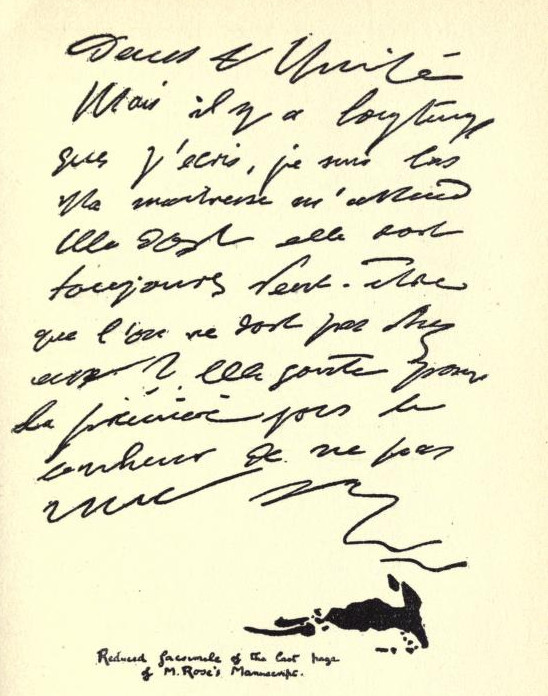
Reduced facsimile of the last page of M. Rose's Manuscript.
"What if he is ill?" I said. "What if he is dead?"
"Oh! But how am I to find out? How am I to open his door? We should have to have a locksmith, witnesses, the commissaire...."
Without answering, I bolted up the stair-case. When I reached the door, on the fifth landing, I rang, knocked very loudly, and then bent to look through the crack, or glue my ear to the keyhole. It was dark, a small iron thing went into my eye. The key was in the door.
At that moment, I heard the voice of the concierge, who had followed me.
"Well! You see!"
"The key is in the door."
"Impossible; it was not there yesterday evening, and he has certainly not come in."
"Look!"
And I turned the key. The door opened. The flat consisted of the kitchen, on the left as one went in, and three rooms opening into each other, along the street. We opened three more doors. The last let us see the spectacle I have described.
The death was recent. The body was cold, but not frozen, and the fingers of the right hand, which was hanging over the arm of the chair, were still supple. Later on the doctor declared that death must have occurred about twelve hours before my arrival.
Two young clerks, brothers, who live in a neighbouring room, came home at this moment. We sent one of them in search of the police, and the other remained with me, while the concierge went back to her lodge.
While waiting for the police to draw up their official statement, I made a mental inventory of my friend's room. Its aspect seemed to me odd. The bed, a great four-posted one, very large and almost sumptuous, the only luxury, moreover, of this sentimental and libertine youth, was in disorder. It told of a night of frenzied passion, or of an attack of hallucinatory fever. The counterpanes were dangling, the pillows were one at the foot and one in the middle of the bed; two candles at the bed-side had burned themselves out. A man's clothes had been flung on a sofa, and among these clothes I found a woman's dress, of antique or rather empire fashion, a sort of tea-gown of spongy white linen, very fine, with a gathered belt, much lacework, and blue and yellow embroideries. I saw besides some plain white silk stockings, yellow garters with paste buckles, and one slipper in blue morocco; I did not find the other.
The man's clothes were those of my friend, who was dressed at the moment in a grey flannel suit and a brown dressing-gown. Nothing could be simpler. But the dress, and the silk stockings? Did Sandy Rose amuse himself with robing his mistress magnificently, before unrobing her? The presence of a woman seemed proved by this theatrical costume. The stockings had been worn; some one had even walked bare-foot in one of them, doubtless looking for the slipper that had slid away under a piece of furniture.
On the mantelpiece, I found a big tortoiseshell comb, a necklace of pearls, no doubt false, another of amethysts, some ancient rings, and two bracelets, one of braided gold, the other of cameos.
I opened a little door. The state of the washing-stand showed that it had been recently used. There were still drops of water on the marble, and the towels were damp. On a comb, I found some woman's hairs, blond, very long; a powder-box was open. A perfume that I could not identify, was floating in this closet, something like peppered, highly peppered, jessamine.
In the fireplace of the room a log was still burning, among dead pieces of coal.
I returned to the table on which was resting the lifeless head of my unfortunate friend. He seemed asleep, and I was glad of it, for, if a tragic story is to be as it should, the dead must seem to sleep.
There was nothing on the table but a quantity of sheets of paper covered with big irregular handwriting, nothing but that and an ink-pot. The pen had fallen down.
At this moment the commissaire arrived with a scribe. Notes were taken. The doctor who had come attested something.
"Natural death?"
"The most natural in the world."
And he pointed first to the bed and then to the writing-table.
"Sexual followed by cerebral excesses. These papers, perhaps, will give us an explanation."
Meanwhile the commissaire, who had opened a drawer, found a will that left everything to me; the doctor, happy to do nothing, stopped putting together the sheets of the manuscript.
"I do not dispute them with you. I have signed. I am off."
My rights were soon legally confirmed. Meanwhile I thought of the woman who had worn the white dress with yellow embroideries and put her feet in the slippers of blue morocco. I sought her and did not find her. Singular rumours went about, set on foot by the journalists. M. Sandy Rose had been strangled by a woman with whom he had spent the night. She had disappeared at dawn, taking money and jewels. I had no difficulty in exposing the absurdity of this hypothesis, firstly because we had noticed no trace of violence on the body of the defunct, and secondly because many precious stones, as well as a quantity of gold pieces, were found in the same drawer as the will, which was not locked.
Little by little there came to be silence concerning the story, and I was alone in sometimes thinking of it.
It is certain that Sandy Rose went home on Thursday morning, the 8th of February, about nine o'clock, accompanied by a woman. He took his letters: no letter or paper of earlier date was found in the Sunday packet. It is also certain that he went out with this woman about midday, and that they returned about eight, this time without speaking to the concierge, without answering her question: "Monsieur Sandy Rose, aren't you going to take your letters?" Finally, from that moment on, the concierge saw no one, neither Sandy Rose nor the lady, whose name she did not know, though, she says, she had noticed her light-coloured, almost white, dress; and adds,
"I was surprised at it, because of the colour." On Friday morning, she knocked, at the hour at which she was accustomed to come and clean out the rooms. She knocked again in the afternoon, and rang the bell; in vain. It was the same on Saturday and Sunday, and she had therefore concluded that he was away, as was not unlikely, for my friend sometimes went to spend a week at Menton, and never went alone.
These little facts, whose accuracy I cannot doubt, do not contradict certain details that have been read in my friend's manuscript, but I am far from offering them as a proof of the veracity of his story. I give on the one hand the manuscript, as the will obliges me, and on the other the result of my inquiry, as friendship demands; that is all.
I must note one last detail. No trace of food was found in the flat, except some paper that had been used in wrapping up cakes, or perhaps a pâté, and six empty champagne bottles. But there is nothing to prove that these relics are contemporaneous with the period that interests us. It is, however, probable enough.
The telegram mentioned on page 36 has not been printed by the Northern Atlantic Herald. It is even doubtful if it was ever sent off. At least, the inquiries I have made have been without result.
APPENDIX[1]
REMY DE GOURMONT
BY
ARTHUR RANSOME
I
M. de Gourmont lives on the fourth floor of an old house in the Rue des Saints-Pères. A copper chain hangs as bell-rope to his door. The rare visitor, for it is well known that for many years he has been a solitary and seldom receives even his friends, pulls the chain and waits. The door opens a few inches, ready to be closed immediately, by a man of middle size, in a brown monk's robe, with a small, round, grey felt cap. The robe is fastened with silver buckles, in which are set large blue stones. The admitted visitor walks through a passage into a room whose walls are covered with books. In the shadow at the back of the room is a loaded table. Another table, with a sloping desk upon it, juts out from the window. M. de Gourmont sits in a big chair before the desk, placing his visitor on the opposite side of the table, with the light falling on his face so that he can observe his slightest expression. He pokes at the little, brimless skull-cap, and twists it a quarter of a circle on his head. He rolls and lights cigarettes. In conversation he often disguises his face with his hand, but now and again looks openly and directly at his visitor. His eyes are always questioning, and almost always kindly. His face was beautiful in the youth of the flesh, and is now beautiful in the age of the mind, for there is no dead line in it, no wrinkle, no minute feature not vitalised by intellectual activity. The nose is full and sensitive, with markedly curved nostrils. There is a little satiric beard. The eyebrows lift towards the temples, as in most men of imagination. The eyes are weighted below, as in most men of critical thought. The two characteristics are, in M. de Gourmont, as in his work, most noticeable together. The lower lip, very full, does not pout, but falls curtain-like towards the chin. It is the lip of a sensualist, and yet of one whose sensuality has not clogged but stimulated the digestive processes of his brain. Omar might have had such a lip, if he had been capable not only of his garlands of roses, but also of the essays of Montaigne.
He was born in a château in Normandy on April 4th, 1858. Among his ancestors was Gilles de Gourmont, a learned printer and engraver of the fifteenth century. He has himself collected old woodcuts, and in L'Ymagier amused himself by setting the most ancient specimens of the craft, among which he is proud to show some examples of the work of his family, side by side with drawings by Whistler and Gauguin. He came to Paris in 1883, when he obtained a post in the Bibliothèque Nationale. Huysmans was "sous-chef de bureau la direction de la Sûreté générale," and M. de Gourmont, who made his acquaintance through the dedication of a book, used to call for him between four and five of the afternoon, and walk with him across the river to a café, that has since disappeared, where he listened to the older man's rather savage characterisations of men, women, movements and books. A few years later he was held to be lacking in patriotism, and relieved of his post on account of an article urging the necessity of Franco-German agreement. He wrote incessantly. Merlette, a rather naïve and awkward little novel, published in 1886, did not promise the work he was to do. It was no more than an exercise. The exercise was well done, but that was all. It was the work of a good brain as yet uncertain of its personal impulse. But about this time he was caught in the stream of a movement for which he had been waiting, for which, indeed, the art of his time had been waiting, the movement that was introduced to English readers by Mr. Arthur Symons's admirable series of critical portraits.[2] In 1890 he published Sixtine, dedicated to Villiers de l'Isle Adam, who had died the year before. In 1892 appeared Le Latin Mystique, a book on the Latin poets of the Middle Ages. He has always been "a delicate amateur of the curiosities of beauty," though the character that Mr. Symons gave him has since become very inadequate. He edited Gérard de Nerval, Aucassin et Nicolette, and Rutebeuf's La Miracle de Théophile, and wrote Lilith, 1892, and Théodat, a dramatic poem in prose that was produced by my friend M. Paul Fort at the Théâtre d'Art on December 11th of the same year. Several other curious works of this period were united in Le Pèlerin du Silence. I extract from the bibliography by M. van Bever, printed in Poètes d'aujourd'hui, a list of the more important books that have followed these very various beginnings:—Le Livre des Masques, 1896; Les Chevaux de Diomède, 1897; Le IIme Livre des Masques, 1898; Esthétique de la langue française, 1899; La Culture des Idées, 1900; Le Chemin de Velours, 1902; Le Problème du Style, 1902; Physique de l'Amour, 1903; Une Nuit au Luxembourg, 1906; besides four volumes of literary and philosophical criticism, and four volumes of comment on contemporary events.
All this mass of work is vitalised by a single motive. Even the divisions of criticism and creation (whose border line is very dim) are made actually one by a desire common to both of them, a desire not expressed in them, but satisfied, a desire for intellectual freedom. The motto for the whole is written in Une Nuit au Luxembourg: "L'exercice de la pensée est un jeu, mais il faut que ce jeu soit libre et harmonieux." I am reminded of this sentence again and again in thinking of M. de Gourmont and his books. There must be no loss of self-command, none of the grimaces and the awkward movements of the fanatic, the man with whom thought plays. The thinker must be superior to his thought. He must make it his plaything instead of being sport for it. His eyes must be clear, not hallucinated; his arms his own, not swung with the exaggerated gestures of the preacher moved beyond himself by his own words. M. de Gourmont seems less an artist than a man determined to conquer his obsessions, working them out one by one as they assail him, in order to regain his freedom. It is a fortunate accident that he works them out by expressing them, twisting into garlands the brambles that impede his way.
II
M. de Gourmont almost immediately left the half-hearted realism of Merlette, and, just as in his scientific writings he is more profoundly scientific than the men of science, so in his works of this period he carried to their uttermost limits the doctrines of the symbolists. In his critical work the historian must look for the manifestoes and polemics of the group that gathered in Mallarmé's rooms in the Rue de Rome. The theories are in Idéalisme, published in 1893, and in such essays as his defence of Mallarmé, written in 1898, and included in the Promenades Littéraires. Of their practice he supplies plenty of examples. "Nommer un objet, c'est supprimer les trois quarts de la jouissance du poème qui est faite du bonheur de deviner peu à peu; le suggérer voilà le rêve." Mallarmé wrote that in 1891, and during the 'nineties, Remy de Gourmont was publishing mysterious little books of poetry and prose, of which small limited editions were issued on rare paper, in curious covers, with lithographed decorations as reticent as the writing. There is the Histoire tragique de la Princesse Phénissa expliquée en quatre épisodes, a play whose action might be seen through seven veils, a play whose motive, never stated directly, is, perhaps, the destruction of the future for the sake of the present. There is Le Fantôme, the story of a liaison between a man and a woman if you will, between the intellect and the flesh if you will, that begins with such an anthem as might have been sung by some of those strange beings whom Poe took "into the starry meadows beyond Orion, where, for pansies and violets and heartsease, are the beds of the triplicate and triple-tinted suns." The man—is it a man?—who tells the story, ends with a regret for something too real to be visible, something that is seen because it is not visible:—"Je me sentais froid, j'avais peur—car je la voyais, sans pouvoir m'opposer? cette transformation douloureuse—je la voyais s'en aller rejoindre le groupe des femmes indécises d'où mon amour l'avait tirée—je la voyais redevenir le fantôme qu'elles sont toutes." There is Le Livre des Litanies, with its wonderful incantation, from which I take the beginning and end:—
"Fleur hypocrite, "Fleur du silence. "Rose couleur de cuivre, plus frauduleuse que nos joies, rose couleur de cuivre, embaume-nous dans tes mensonges, fleur hypocrite, fleur du silence.
"Rose améthyste, étoile matinale, tendresse épiscopale, rose améthyste, tu dors sur des poitrines dévotes et douillettes, gemme offerte à Marie, ô gemme sacristine, fleur hypocrite, fleur du silence.
"Rose cardinale, rose couleur du sang de l'Eglise romaine, rose cardinale, tu fais rêver les grands yeux des mignons et plus d'un t'épingla au noeud de sa jarretière, fleur hypocrite, fleur du silence.
"Rose papale, rose arrosée des mains qui bénissent le monde, rose papale, ton coeur d'or est en cuivre, et les larmes qui perlent sur ta vaine corolle, ce sont les pleurs du Christ, fleur hypocrite, fleur du silence.
"Fleur hypocrite,
"Fleur du silence."
III
These, and other things like them, made it possible for M. de Gourmont to proceed in the discovery of himself. He drank his mood to the dregs, leaving no untried experiment to clog his mind with a regret as he moved on. "I have always been excessive," he says; "I do not like to stop half-way." He follows each impulse as far as it will take him, lest, by chance, he should leave some flower untasted in a by-path he has seen but not explored. Unlike most authors, he never has to copy himself, and does not feel bound, because he has written one book whose prose is malachite green, to produce another of the same colour. "Un artiste," said Wilde, "ne recommence jamais deux fois la même chose ... ou bien c'est qu'il n'avait pas réussi." The surest way to fail in an experiment is to make it with a faint heart. M. de Gourmont always burns his boats.
Some preoccupations, however boldly attacked, are not to be conquered at a blow. The preoccupation of sex is unlike that of a theory of art. Conquered again and again by expression, it returns with a new face, a new mystery, a new power of binding the intellect, a new Gorgon to be seen in the mirror of art and decapitated. As the man changes, so does Medusa vary her attack, and so must he vary the manner of her death. Now he will write a Physique de l'Amour, and, like Schopenhauer, relieve himself of the problem of sex by reducing it to lowest terms. Now he will conquer it by the lyrical and concrete expression of a novel or a poem. Sex continually disturbs him, but the disturbance of the flesh is always, sooner or later, pacified by the mind. All his later novels are, like Sixtine, "romans de la vie cérébrale." Sixtine is the story of a writer's courtship of a woman no more subtle than himself, but far more ready with her subtlety. It displays the workings of the man's mind and the states of emotion through which he passes, by including in the text, as they were written, the stories and poems composed under the influence of the events. The man is intensely analytic, afterwards. Emotion blurs the windows of his brain, and cleans hers to a greater lucidity. He always knows what he ought to have done. "Nul n'avait à un plus haut degré la présence d'esprit du bas de l'escalier." More than once the woman was his, if he had known it before he left her. Finally, she is carried off by a rival whose method he has himself suggested. The book is a tragedy of self-consciousness, whose self-conscious heroine is a prize for the only man who is ignorant of himself, and, in the blindness of that ignorance, is able to act. But there is no need to analyse the frameworks of M. de Gourmont's novels. Frameworks matter very little. They are all vitalised by an almost impatient knowledge of the subtlety of a woman's mind in moments of pursuit or flight, and of the impotence of a man whose brain seeks to be an honest mediator between itself and his flesh. His men do not love like the heroes of ordinary books, and are not in the least likely to suggest impossible ideals to maidens. They are unfaithful in the flesh nearly always. They use one experience as an anæsthetic for the pain they are undergoing in another. They seek to be masters of themselves by knowledge, and are unhappy without thinking of suicide on that account. Unhappiness no less than joy is a thing to be known. They fail, not getting what they want, and are victorious in understanding, with smiling lips, their non-success.
IV
One afternoon, in the Rue des Saints-Pères, M. de Gourmont confirmed the impression already given me by his books and his eyebrows. "I have always been both romanesque and critique. Side by side he has built separate piles of books. While writing the curiosities of symbolism that are collected in Le Pèlerin du Silence, he was preparing the Livres des Masques, two series of short critical portraits of the writers of his time, which, in the case of those who survive, are as true to-day as when they were written. It has been so throughout. In the one pile are little volumes of poetry like Les Saintes du Paradis, and such romances as those we have been discussing; in the other are works of science like the Physique de l'Amour, books benevolently polemical like Le Problème du Style, and collections of criticism in which an agile intelligence collaborates with a wakeful sense of beauty.
In this critical work, as in what is more easily recognised as creative, M. de Gourmont builds for freedom. He will be bound neither by his own preoccupations nor by other men's thoughts. It is characteristic of him that his most personal essays in criticism are "Dissociations of Ideas." The dissociation of ideas is a method of thought that separates the ideas put into double harness by tradition, just as the chemist turns water into hydrogen and oxygen, with which, severally, he can make other compounds. This, like most questions of thought, is a question of words. Words are the liberators of ideas, since without them ideas cannot escape from the flux of feeling into independent life. They are also their gaolers, since they are terribly cohesive, and married words cling together, binding in a lover's knot the ideas they represent. All men using words in combination abet these marriages, though in doing so they are making bars of iron for the prisons in which they speculate on the torn fragment of sky that their window lets them perceive. Nothing is easier than, by taking words and their associations as they are commonly used, to strengthen the adherence of ideas to each other. Nothing needs a more awakened intelligence than to weaken the bonds of such ideas by separating the words that bind them. That is the method of M. de Gourmont. He separates, for example, the idea of Stéphane Mallarmé and that of "decadence," the idea of glory and that of immortality, the idea of success and that of beauty. It is, too, a dissociation of ideas when he inquires into the value of education, these two ideas of worth and knowledge being commonly allied. The method, or rather the consciousness of the method, is fruitful in material for discussion, though this advantage cannot weigh much with M. de Gourmont, whose brain lacks neither motive power nor grist to grind. It is, for him, no more than a recurrent cleaning of the glasses through which he looks at the subjects of his speculation.
He speculates continually, and, if questions are insoluble, is not content until he has so posed them as to show the reason of their insolubility. He prefers a calm question mark to the more emotional mark of exclamation, and is always happy when he can turn the second into the first. He is extraordinarily thorough, moving always in mass and taking everything with him, so that he has no footsteps to retrace in order to pick up baggage left behind. Unlike Theseus, he unrolls no clue of thread when he enters the cavern of the Minotaur. He will come out by a different way or not at all. The most powerful Minotaur of our day does not dismay him. Confident in his own probity, he will walk calmly among the men of science and bring an Esthétique de la langue française, or a Physique de l'Amour, meat of unaccustomed richness, to lay before their husk-fed deity.
In criticism, as in creation, he does not like things half-done. The story of the origin of one of these books is the story of them all. There is a foolish little book by M. Albalat, which professes to teach style in twenty-seven lessons. M. de Gourmont read it and smiled; he wrote an article, and still found something to smile at; he wrote a book, Le Problème du Style, in which, mocking M. Albalat through a hundred and fifty-two courteous pages, he showed, besides many other things, that style is not to be taught in twenty-seven lessons, and, indeed, is not to be taught at all. Then he felt free to smile at something else.
M. de Gourmont is careful to say that he brought to the Esthétique de la langue française, "ni lois, ni règles, ni principes peut-être; je n'apporte rien qu'un sentiment esthétique assez violent et quelques notions historiques: voilà ce que je jette au hasard dans la grande cuve où fermente la langue de demain." An æsthetic feeling and some historical notions were sufficiently needed in the fermenting vat where the old French language, in which there is hardly any Greek, is being horribly adulterated with grainless translations of good French made by Hellenists of the dictionary. M. de Gourmont is in love with his language, but knows that she is rather vain and ready to wear all kinds of borrowed plumes, whether or not they suit her. He would take from her her imitation ostrich feathers, and would hide also all ribbons from the London market, unless she first dyes them until they fall without discord into the scheme of colour that centuries have made her own. Why write "high life," for example, or "five o'clock," or "sleeping"?
Why shock French and English alike by writing "Le Club de Rugby" on a gate in Tours? A kingfisher in England flies very happily as martin-pècheur in France, and the language is not so sterile as to be unable to breed words from its own stock for whatever needs a name.
Physique de l'Amour; Essai sur l'instinct sexuel, "qui n'est qu'un essai, parce que la matière de son idée est immense, représente pourtant une ambition: on voudrait agrandir la psychologie générale de l'amour, la faire commencer au commencement même de l'activité mâle et femelle, situer la vie sexuelle de l'homme dans le plan unique de la sexualité universelle." It is a book full of illustration, a vast collection of facts, and throws into another fermenting vat than that of language some sufficiently valuable ideas. It lessens the pride of man, and, at the same time, gives him a desperate courage, as it shows him that even in the eccentricities of his love-making he is not alone, that the modesty of his women is a faint hesitation beside the terrified flight of the she-mole, that his own superiority is but an accident, and that he must hold himself fortunate in that nature does not treat him like the male bee, and toss his mangled body disdainfully to earth as soon as he has done her work. M. de Gourmont's books do not flatter humanity. They clear the eyes of the strong, and anger the weak who cannot bear to listen to unpalatable truths. This book is in its eighth edition in France, and has been published in all European languages except our own.
V
M. de Gourmont's most obvious quality is versatility, and though, as I have tried to point out, it is not difficult to find a unity of cause or intention in his most various expressions, his lofty and careless pursuit of his inclinations, his life of thought for its own sake, has probably cost him a wide and immediate recognition. That loss is not his, but is borne by those who depend for their reading on the names that float upward from the crowd. Even his admirers complain: some that he has not given them more poems; others that his Physique de l'Amour stands alone on its shelf; others that a critic such as he should have spent time on romances; others, again, that a writer of such romances should have used any of his magnificent power in what they cannot see to be creative work. M. de Gourmont is indifferent to all alike, and sits aloft in the Rue des Saints-Pères, indulging his mind with free and harmonious play.
In one of his books, far more than in the others, two at least of his apparently opposite activities have come to work in unison. All his romances, after and including Sixtine, are vitalised by a never-sleeping intellect; but one in particular is a book whose essence is both critical and romantic, a book of thought coloured like a poem and moving with a delicate grace of narrative. Une Nuit au Luxembourg was published in 1906, and is the book that opens most vistas in M. de Gourmont's work. A god walks in the gardens behind the Odéon, and a winter's night is a summer's morning, on which the young journalist who has dared to say "My friend" to the luminous unknown in the church of Saint-Sulpice, hears him proclaim the forgotten truth that in one age his mother has been Mary, and in another Latona, and the new truth that the gods are not immortal though their lives are long. Flowers are in bloom where they walk, and three beautiful girls greet them with divine amity. Most of the book is written in dialogue, and in this ancient form, never filled with subtler essences, doubts are born and become beliefs, beliefs become doubts and die, while the sun shines, flowers are sweet, and girls' lips soft to kiss. Where there is God he will not have Love absent, and where Love is he finds the most stimulating exercise for his brain. Ideas are given an æsthetic rather than a scientific value, and are used like the tints on a palette. Indeed, the book is a balanced composition in which each colour has its complement. Epicurus, Lucretius, St. Paul, Christianity, the replenishment of the earth by the Jews; it is impossible to close the book at any page without finding the mind as it were upon a spring-board and ready to launch itself in delightful flight. There are many books that give a specious sensation of intellectual business while we read them. There are very few that leave, long after they are laid aside, stimuli to independent activity.
VI
"Il ne faut pas chercher la vérité; mais devant un homme comprendre quelle est sa vérité." We must not seek in a man's work for the truth, since there are as many truths as brains; but it is worth while to define an answer here and an answer there out of the many. What is the answer of Remy de Gourmont? Quelle est sa vérité? Of what kind is his truth? Does he bring rosemary for remembrance or poppy for oblivion? Not in what he says, but in the point from which he says it, we must look for our indications. His life, like Sixtine, is a "roman de la vie cérébrale." It is the spectacle of a man whose conquests are won by understanding. For him the escape of mysticism was inadequate, and an invitation to cowardice. He would not abdicate, but, since those empires are unstable whose boundaries are fixed, conquer continually. The conquests of the mind are not won by neglect. It is not sufficient to refuse to see. The conqueror must see so clearly that life blushes before his sober eyes, and, understood, no longer dominates. Remy de Gourmont has suffered and conquered his suffering in understanding it. He would extend this dominion. He would realise all that happens to him, books, a chance visitor, a meeting in the street, the liquid bars of light across the muddy Seine. He would transmute all into the mercurial matter of thought, until, at last impregnable, he should see life from above, having trained his digestive powers to the same perfection as his powers of reception. Although one of the Symbolists, he has moved far from the starting-point assigned to that school by Mr. Symons. His books are not "escapes from the thought of death." The thought of death is to him like any other thought, a rude playfellow to be mastered and trained to fitness for that free and harmonious game. The life of the brain, the noblest of all battles, that of a mind against the universe which it creates, has come to seem more important to him than the curiosities of beauty of which he was once enamoured. It has, perhaps, made him more of a thinker than an artist. In his desire to conquer his obsessions he has sometimes lost sight of the unity that is essential to art, a happy accident in thought. His later books have been the by-products of a more intimate labour. He has left them by the road whose end he has not hoped to reach, whose pursuit suffices him. In Une Nuit au Luxembourg, the thinker is now and then a little contemptuous of the artist. The reader is moved by something beside a purely æsthetic emotion. Beside the breath of loveliness that blows fitfully, almost carelessly, through those flowering trees, there is a sturdier wind that compels a bracing of the shoulders and an opening of the chest. The spectacle of that mind, playing with gods and worlds, so certain of its own balance, wakes a feeling of emulation which has nothing to do with art. This feeling of emulation, never far from a feeling of beauty, is the characteristic gift of M. de Gourmont's work. There was an artist; there was a thinker; there is a philosopher whose thought loses nothing through being beautiful, whose art loses little through being the pathway of the most daring, the surest-footed thought.