A Naval Expositor. (continued 2)
Reading edition
Mizon Course
When the Tack is taken off from the Mast forward, it is called a Bon-adventure Mizon.
Moar
Signifies the laying out the Anchors of a Ship so, as is best and safest for her riding.
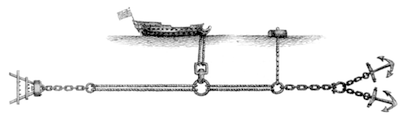
Moarings
Are laid out in Harbour, and consists of Claws, Pendant Chains, Cables, Bridles, Anchors, Swivel, Jews-harp, Buoys, and Chains for Ships to ride at, either when under Orders of fitting for the Sea, or are laid up in Ordinary.
Monkey
A Block made of Iron with a Catch, made use of in Ginns for driving Piles.

Monk Seam
Sewing the Edges or Selvedges of Sails together, over one another on both Sides, to make it the Stronger.
Mooter
Is the Person who (after the Tree-nails which are received into Store, rough from the Merchant) makes them smooth, and of proper Sizes, before they are drove through the Plank used on Ships Sides, Decks, Wharfs, &c.
Mortar
A Preparation of Lyme, Sand, &c. mixed up with Water, and used in Buildings.
Mouse
Is a large Knot artificially made by the Riggers on the Ship's Stays.
Nails
Brads
Battin
Used by the House Carpenters and Joyners.
Filling
Used on Ships Bottoms when ordered to the West Indies, between the Spaces of the Sheathing Nails.
Flooring
Used by the House Carpenters.
Keelband
Used by the Boat Builders.
Clamp
Used by the Shipwrights.
Filling
Used on Ships Bottoms ordered to the West Indies.
Lead
For nailing Lead.
Port; Double and Single
Used by the Shipwrights, and are drove into the Beams for the Mens Hammacoes to hang on.
Rother
Used by the Shipwrights to nail on the Rother Irons.
Rove & Clench.
Used by the Boat Builder on Boats.
Scupper
Has a broad and flat Head, and used for nailing the Leather Scuppers to the Ship's Sides.
Sharp of Sorts
Used by Shipwrights, House Carpenters and Joyners.
Sheathing
Used For nailing on the Sheathing Board.
Spikes
Used By the Shipwrights and House Carpenters.
Tacks
Used By the Joyners and Oar-makers for fining Oars.
Timber
Used by the Shipwrights and House Carpenters.
Weight
Used by the Shipwrights and House Carpenters.
Wherry
Used by the Boat Builders.
Woolding
Drove through the Ropes that Woold the Ship's Masts.
Needles
Boltrope Sail
Are allowed the Boatswains for repairing the Ship's Sails when at Sea.
Navel Hoods
Are large Pieces of Stuff fayd against the Hawse Holes, and fills out to the outer Edge of the Cheeks, to keep the Cable from rubbing them.
Naveline
Is a Rope reeved through a Block made fast to the middle Rib, and another Block being made fast at the Mast-head, the Line goes through them, which makes a Tackle to hoist the Parrel.
Navigation
The Art of sailing or conducting a Ship or Vessel the safest and most commodious Way from one Place to another.
Neap
When a Ship wants Water to float her, so that she cannot get out of a Harbour, off the Ground, or out of the Dock, she is neaped, and are those Tides which happen seven Days after the Moon's Change or Full.
Netting
Is twice laid Cordage bigger than Lashing, and is used for Stantion Ropes, &c.
Nettings
Are a Sort of Grate made with small twice laid Rope, and seized together with Rope Yarn or Twine, and are fixed on the Quarters and in the Tops.
Nippers
Are made of Rope Yarns, and several Turns are taken round the Cable and Voyal when heaving at the Main or Jeer Capston, in order to weigh the Anchor.
Oars
Barge
Are made out of New England or Dantzick Rafters.

Boat
Are made out either of English Ash, or Firr Rafters from Norway.

Ship
Are generally cut out of Firr Timber.

Oazy Ground
Such as is soft, slimy or muddy.
Ocham
Black
Is picked out of old Cables or Junk, in order to caulk the Seams, Tree-nails and Bends of a Ship, for preventing Leaks.
White
Comes from the flyings of dress'd Hemp, and used for caulking the Seams of Ships.
Offin
Is a good Distance from the Shore where there is deep Water, and no Need of a Pilot to Conduct the Ship. Thus if a Ship from Shore be seen sailing out to Seaward, they say, She stands for the Offin; and if a Ship having the Shore near her, have another a good Way without her, or towards the Sea, they say, That Ship is in the Offin.
Offward
If a Ship, being a-ground by the Shore, doth Heel towards the Water Side, they say, She Heels Offward.
Orlop
A Platform under the Gun-deck for stowing the Cables, and where the Officers Store-rooms, &c. are built.
Over Rake
When the Waves break in upon a Ship riding at Anchor, and the Head Sea washes over her, then the Waves Over-Rake her.
Oven Lids
Are made of Iron to stop the Mouth of the Oven on board a Ship.

Out licker
Is a Piece fayd down to the upper Rail, and to the cross Piece in the Head, to carry the Foretack farther from the Middle of the Ship.
Owler
A Master of a Ship, or other Person that conveys Wool, or other prohibited Goods in the Night to the Sea Side, in order to Ship off, contrary to Law.
Oyl
Is used for sundry Services on board a Ship, by the Boatswains in mixing it with Blacking or Tar.
Palleting
The Floor of the Bread-room and Magazine of Powder, generally wrought of ordinary Deal, and is laid above the Keelson, for keeping the Bread and Powder dry, in Case there should be more Water in Hold than usual.
Palms
Are round Pieces of Iron, stamp'd full with round Impressions; are sewed to Leather, which comes into the Palm of the Sail-makers Hand, and are made use of by them to prevent the Needles running into them, when sewing the Seams or Boltropes on the Sails.

Pannel
In Joynery, &c. a square Piece of thin Wood, sometimes carved, framed, or groved in a larger Piece between Stiles.
Parbuncle
Is the Name given a Rope Contrived almost like a Pair of Slings; it is seized both Ends together, and then put double about any heavy Thing that is to be hoisted in or out of a Ship, and by having a Hook of a Runner or Tackle hitched into it, they hoist up any Cask or Box.
Parsling
Are Pieces of old Canvas cut about four Inches broad, and wrapped round Shrouds, Stays, Straps for Blocks, &c. before served with spun Yarn.
Parrells
Are made of Ribs and Trucks, and Ropes reeved through them, which having both their Ends fastened round about the Masts, the Yards by their Means go up and down the Masts with greater Ease; these also with the Breast Ropes fasten the Yards to the Masts.

Partners
Are Pieces of thick Stuff, through which Holes for the Masts and Capstons are cut on each Deck; they are wrought considerably thicker than the Plank of the Deck, so far as between the respective Beams where they are placed.
Paunch
Are those Mats made of Sinnet, which in a Ship are made fast to the Main and Fore Yards, to keep them from galling against the Masts.
Pawle
Is made of Iron, bolted at one End to the Beams through the Deck close to the Capston, but yet so easily as that it can turn about. Its Use is to stop the Capston from turning back, by being made to catch hold of the Whelps, therefore they say, Heave a Pawl; that is, heave a little more for the Pawl to get hold of the Whelps, and this they call Pawling the Capston; and droping Pawls are bolted to the Beams, and fall on the Drum-head, where, on the Top, are Holes cut for receiving the Iron Pawl.
Paying
Laying over the Seams of a Ship a Coat of hot Pitch, is called Paying her; or when she is a graving, and her Soil burned off, and a new Coat of Tallow, Pitch, Rozin and Brimstone boiled together, is put upon her, that is also called Paying of a Ship.
Peek
Used in these Senses: An Anchor is said to be a Peek, when the Ship being about to weigh, comes so over her Anchor, that the Cable is perpendicular between the Hawse and the Anchor, and to bring the Ship thus, is called heaving a Peek.
Also Peek the Mizon, that is, put the Mizon Yard right up and down by the Mast.
A Ship is said to ride a Peek when she lies with her Main and Fore Yards hoisted up, and then having one End of the Yards brought down to the Gunwale, the other is raised up an End.
The Reason why they thus Peek up their Yards is, least lying in a River (and they hardly ever use it but then) with their Yards a-cross, another Ship should come foul of them and break their Yards.
Pendants
Short Ropes, one End of which is fastened either to the Head of the Mast, End of the Yards, on the Main Stay, or Back of the Rother; and at the other End hath a Thimble spliced in, or a Block to reeve a Fall through.
Pendants of Tackles
Are of the same Size as the Main and Fore Shrouds, made with an Eye at the upper End, to go over the Head of the Mast when single, but when double, are put over Head by a Hitch, with a single Block at their lower End for the Runners to be reeved through.
Pentecontore
A Vessel with Fifty Oars.
Pillars
Some are turned in the Form of a Column, and others are square, and placed generally under the Beams to support them, and the Decks.

Piles
Are large Stakes drove into the Earth for a Foundation to build on, or to make Dams, &c.
Pilot
Is he which directs the Men at the Wheel how to steer.
Pillow
The Piece of Timber whereon the Bowsprit resteth close by the Stem.
Pins
Block
For the Shives to run on.
Turn'd
To belay Ropes to.
Tyle
Used by the Bricklayers in Slates and Tyles.
Pintles
Are those Hooks by which the Rother hangs to the Stern Post.

Pirate
A Person or Vessel that robs on the High Seas, or makes Descents on the Coasts, &c. without Permission or Authority of any Prince or State.
Pitch
For paying Seams, and all out-board work after caulked.
Pitches
When a Ship falls with her Head too much into the Sea, or beats against it so as to endanger her Top Masts, they say, She will Pitch her Masts by the Board.
Plain Sailing
Is the Art of finding all the Varieties of the Ship's Motion.
Plank
Is sawed out of the strongest Beech, Elm, and Oak Timber, brought on to the Ship's Sides, and the latter used for laying their Decks, is cut from four Inches to one Inch and an Half thick; all above four Inches is called thick Stuff; and that cut out of Timber which grows compassing two Ways, is called Croaky; and such whose Edges happen to be circular, is called Snying.
Plates
Backstay Chain
Has a dead Eye, Iron bound at one End, through which the Lanyards of the Shrouds and Back Stays are reeved; and the other End has an Eye through which the Chain Bolt is drove into the Ship's Sides.

Puttock
Are for Fore-top-mast Shrouds, as the Chain are for the low Shrouds, but with this difference, the dead Eyes are bound into the Plates, and they have Hooks at the End of them.

Top
Are square and small, nailed on the Rim, through which the Puttock Plates go, and prevent their wearing the Top away.

Platts
Are made flat, out of Rope Yarn, and waved one over another, their Use is to save the Cable from galling in the Hawse.
Pointing
Is when the Strands of a Cable, or Rope about two Feet, are untwisted, and afterwards made less towards the End, in a tapering Manner, where it is made fast, with Marline wove into the Yarns; the Design of which is, to keep the Rope from raffling out, or that none may be cut off and stole away.
Pointers
Are Pillars in an oblique Position from the Floor Rider-heads on each Side, (pointing) or meeting each other at the Middle of the Gundeck Beams.
Poop
Is the Floor or Deck over the Round-house, being the highest or uppermost Part of the Hull of a Ship.
Ports
Are those Holes in a Ship's Side through which her Guns are put out.
Port the Helm
Signifies to put the Helm to the Left or Larboard Side; but they never say, Larboard the Helm, but always Port; though it is proper to say, Starboard the Helm, when it is put to the Right Side. A Ship is also said to heel a Port, when she swims not upright, but leans to the Left Side.
Port Last
The same as the Gunwale of a Ship; therefore a Yard is down a Port Last, when it lies down on the Gunwale.
Potts
Are allowed the Boatswains for dressing their Victuals in, and to the Carpenters for heating Pitch.

Preventers
Are Ropes of different Sizes, cut into short Lengths, and knotted at each End, to be ready in Case a Shroud should be shot or broke, that they may be seized to them.
Puddenings
Are seized round the Mast, and tapers to each End from the Middle, where it is swelled pretty large for the Low-yards (when lowered down) to rest on; and the Rings of the Anchors are also puddened, to prevent the Galling of the Cable.

Pumps
Lead
Some Ships have one fixed, whose Pipe goes down the Knee of the Head, and is there placed for washing the Decks.

Hand
Hangs over the Side, and lashed there for washing the Decks, and sometimes are put down into the Well, for freeing the Ship when she makes more Water than the Chain Pumps can throw out.

Pump Bolt
Goes through the Head, and the Brakeworks on it.
Pump Hand
Boxes Lower
Are small and short, having a Flap, and a large Staple drove into it, to draw it up on Occasion.

Ditto Upper
Are fixed to the Spear.

Brake
Is the Handle.

Hook
A long Rod of Iron with a Hook at the End, to draw up or put down the lower Box.

Stave or Spear
Is a long Rod of Iron with an Eye at the upper End, which Hooks to the Brake, and to the lower End of which the upper Box is fixed.

Pumps Chain
Are placed in the Well, and works with Chains.
Ditto Axletrees
Are fixed in the Center of the Wheels, which are turned round with Winches put on at each End.

Pumps Chain
Bolsters
A round Piece of Iron with a Hole in the Middle, and are for opening an Ess or Hook when any want shifting.

Burrs
Are round thin Pieces of Iron, very little less than the Bore of the Pump, which are placed between every Length of the Chain, and on each of them the Leather is put for bringing up the Water.

Chains
No Ship goes to Sea without a Spare one, which is kept ready leathered in case those in the Pumps should be wore out.

Dale
Is a round hollow Trunk, which conveys the Water through the Ship's Sides.

Esses
Are for repairing the Chains in Case any break or give way.

Fidds
Are for opening an Ess or Hook when old ones are to be taken out, or new put into the Chain.

Hooks
For repairing the Chains when any are wanting.

Rowles
Are put into the lower End of the Pump for the Chain to work on.

Sprockets
Are made not unlike a large Horse Shoe, drove into the Wheel, and the Chain works on them.

Swivels
Are for repairing the Chains when wanting.

Wedges
Are drove in on all sides of the Axle-tree, to keep the Wheels fast on it.

Wheels
Are turned out of Elm, in which the Sprockets are drove, and when so fitted, the Chains work round them.

Winches
Are the Handles put on each End of the Axle-tree, by which the Men work the Pump.
Purchase
The same as draw, but when they cannot haul any Thing with the Tackle, they say, The Tackle will not Purchase.
Purser
Is the Officer charged with all Sorts of Provisions allowed the Ship.
Puttock Shrouds
Are short Shrouds which go from the Fore, Main, and Mizon Shrouds to the Top, where the Plates are fixed with dead Eyes in them, through which the Lanyards are reeved for setting up the Top-mast Shrouds.
Puttock Staves
Go a-cross the lower Shrouds, and the Ends of the Puttock Shrouds are hitched round them.
Quarter
Is the After-part of the Ship without-board Aloft.
Quartering
Is when a Ship sails upon a Quarter Wind.
Quarter Pieces
Are two Pieces of carved Work reconciled to each End of the Tafferel, and when regularly suited to the same with a just Disposition of Figures, compleats the beautiful Symetry of the whole Stern and Gallery.
Quarter Tackle Pendants
Fastened on the Quarters of the Yard, and are used for taking in or hoisting Provisions, &c. out of the Hold, or upon Deck.
Rabbet
Is letting in a Ship's Plank to her Keel, which in the Run of her are hollowed away, and is called the Rabbet of her Keel.
Racks
Stand in the Cook-Room, at each End of the Grates, for the Spits to lye on to roast Victuals.

Rafters
Are brought from New England and Dantzick, and being Ash, Barge, Pinnace and Wherry Oars, are made out of them.
Rails
Are generally composed of some regular Members of Architecture, they lye over and under the Banisters and Lights of the Stern and Galleries; are also ranged along the Side under several Denominations, as Sheer Rail, Plansheer Rail, Drift Rail, &c. they are also the principal Ornament in composing the Head of a Ship.
Rake
Is so much of a Ship's Hull as over-hangs the Stem and Stern; that Part of it Afore is called her Rake Forward, and that Abaft at the Stern Post, is called her Rake Aft.
Ranges
Are a Sort of Cleats, to which they belay or fasten the Spritsail, Fore, Main or Mizon Sheats.
Ratlings
Are small Ropes which make the Steps to get up the Shrouds, therefore are called Ratlings.
Reach
The Distance of two Points of Land which bear in a right Line to one another.
Reckonings
In Navigation, the estimating of the Quantity of the Ship's Way, or of the Run between one Place and another.
Reef
When there is a great Gale of Wind, they commonly Roll up Part of the Sail at the Head, by which Means it becomes Shoaler, and so draws not so much Wind; and this contracting or taking up the Sail they call Reefing, which is done with the Reef Tackle Pendants, Tyes, and Falls.
Reeming Irons
Are used by the Caulkers for opening the Seams of the Planks of Ships on the Stocks before caulked.

Reeve
Is to put a Rope through a Block; and, to pull a Rope out of a Block, is called Unreeving.
Reflux
Of the Sea, the Ebbing of the Water, or its Return from the Shore.
Rends
In a Ship, are the same as the Seams between her Planks.
Rhombs
The Points of the Compass.
Ribbs
Are the Timbers when the Planks are off, so called, because are bending like the Ribs of a Carcase; also those which belong to the Parrels are called Parrel Ribs.
Ride
A Ship is said to Ride, when her Anchors hold fast, so that she drives not away by the Force of Wind or Tide; and a Ship is said to Ride well when in a Head Sea, so as that the Waves do not wash over her.
Ride
Betwixt Wind and Tide
When the Wind hath equal Force over her one Way, and the Tide another; but if the Wind hath more Power over her than the Tide, she is said to Ride Wind Rode.
A Cross
When she Rides with her Fore and Main-Yards hoisted up.
Hawse-full
When in Stress of Weather she falls so deep into the Sea with her Head, that Water runs in at her Hawses.
A Peek
When one End of the Yards are peeked up, and the other hangs down; this is also said of a Ship, when in weighing she is brought directly over her Anchor.
Portoise
When her Yards are struck upon the Deck, or when are down a Portlast.
A Thwart
When her Side lies a-cross the Tide.
Riders
Are Timbers of a large Scantling fay'd within Side of the Foot Waaling; the Floor Riders are wrought over the Keelson; and the lower Futtock Riders Scarphs to the Floor Riders from the Keelson to the Orlop Beams.
Rigging
Are all the Ropes whatsoever belonging to a Ship's Masts, Yards, or any Part about her; and she is well rigg'd when all her Ropes are of their fit Length and Size, in Proportion to her Burden.
Right the Helm
A Sea Phrase used by him that Conds to the Men at the Helm or Steering Wheel, ordering them to keep the Helm even in the Middle of the Ship.
Right Sailing
Is when a Voyage is performed on some one of the four Cardinal Points.
Rings
Hatch
Are drove into the Hatches to open or shut them.

Port
Are drove into the Ports, and to which the Ropes are fastened to open or shut them.

Rings & Forelocks
Are put on the Ends of Bolts to prevent their starting out.

Riping Chissels
Are used by the Shipwrights in breaking up old Ships.

Riseing Timbers
Are large Pieces of Timber fay'd to the Keel, to the Stem Afore, and from the Keel to the Stern Post Abaft; its Use is to fashion out the lower Part of the Ship Afore and Abaft; and also to fasten the half Timbers into it; it is bolted to the Keel, Stem, and Stern Post respectively; there is also a thinner Piece of dead Wood in the Midships, fay'd on the Keel for the Breach of the Floor Timbers to be let into.
Road
A place of Anchorage at some Distance from the Shore, and sheltered from Winds, where Vessels usually Moar to wait for a Wind or Tide proper to carry them into Harbour, or set sail.
Rock Staff
With which the Smiths blow their Bellows.
Ropes
Of a Ship are, in general, all her Cordage; but those which have particular Names given them are as follows:
Auning
Are for spreading the Aunings.
Bell
Made fast to the Crank for striking it.
Boat
By which the Boats at the Ship's Stern are towed.
Bolt
Are laid white, stoved in an Oven, and then tarr'd; are the Head and Body Ropes sewed round the Sails.
Breast
Made fast to the Shrouds in the Chains, to support the Man that heaves the Lead.
Bucket
To hawl up Water.
Canhook
Seized to each Hook, to hoist Butts, Hogsheads, and other Casks on board.
Catt
For hoisting up the Anchors, in order to be stowed at the Bow.
Davit
Reeved through a Hole which is made at each End, for hauling the Davit to either Side of the Fore Castle.
Entering
To take hold of, for going up the Ship's Side.
Luffhook
Is for bousing the Tack aboard, when it blows hard, and is a Sort of a Preventer to the Tack.
Grapnel
Being bent to a Grapnel, either the Long-Boat, Pinnace or Yawl rides by it.
Guess
Is for keeping the Long-Boat, Pinnace or Yawl from steeving, or going too much in and out when towing.
Parrel
Is reeved through the Ribs and Trucks, which, with the Breast Ropes, lashes the Parrel to the Masts.
Rother
Reeved through a Hole in the Boat's Rother.
Slip
For triseing up the Bites of the Cable to the Rails of the Head.
Stantion
Reeved through the Eyes of the Stantions.
Swabb
Serves as a Handle to them.
Top
Are those with which the Top-masts are set or struck; they are reeved through an Iron-bound Block, which hooks under the Cap, and then reeved through the Heel of the Top-mast, where a Brass Shiver is placed athwart Ships; the other Part of them comes down to the Top Tackle Falls, which has double Blocks Iron-bound, and hooks to Ring Bolts upon the Deck.
Tiller
To keep the Tiller steady, that it may not fly from Side to Side.
Wast
For Boats to make fast to, along-side.
Wheel
Goes round the Spindle of the Steering Wheel, and from thence to the Tiller, and are generally white Rope.
Ropebands
Are made out of old Rope, Junk, &c. reeved through the Head Holes of the Sails, which make them fast to the Yards, and are vulgarly called Robins.
Rope Yarn
Is the Yarn of any Rope untwisted, but commonly made out of Junk; its Use is to make Sinnet, Mats, &c.
Roves
Are small square Pieces of Iron, with a Hole punched in the Middle of them, through which the Nail goes, where it is clenched, and fastens the Boards of Pinnaces, Yawles, or Wherries to one another.

Rother
A Piece of Timber suitably formed, and hung with Irons called Pintles and Braces to the Stern Post; its Use is to traverse and govern the Ship under Sail.

Rother Irons
Are the Cheeks of Iron which is fastened to the Stern Post of Ships or Boats, and into which the Pintles go.

Rother Tackles
Are for Succour in Case the Tiller should break, and the Pendants are spliced to short Chains at the Back of the Rother, and the Falls come in on each Quarter of the Ship.
Round House
When the Poop is made so long as to come near, or to the Mizon Mast, there is (besides the Cabbins Abaft) an outer Apartment, which is called the Round House.
Rowle
Is a round Piece of Wood wherein the Whipstaff goes, being made to turn about, that it may carry over the Staff the easier from Side to Side.
Rowlucks
Are spaces left on the Gunwale, where two Thoals are let in at such a Distance from each other, as to admit the Oar at the End of the Loom to lie on, for rowing the Boat.
Rowse
The Cable or Hawser, that is, take it in or out.
Rozin
Is used for Paying the Ship's Sides, Boats, Blocks, &c.
Rufftrees
Are slight Rails let into Iron Stantions, generally on the Quarter Deck and Fore Castle, against which a Weather Sail is fixed for Shelter to the Men; and likewise to keep and prevent them from tumbling over-board at Sea.
Run
So much of the After-part of a Ship as is under Water, is called her Run.
Rundlets
Are allowed the Boatswains to keep Oyl in.

Runner
Is a Rope reeved in a single Block seized to the End of a Pendant, and has at the one End a Hook to hitch into any Thing, and at the other End a long Tackle Block, into which is reeved the Fall of the Tackle or Garnet, by which Means it Purchases more than a Tackle Fall can do alone, and they, with the Halyards, hoist up the Topsail Yards, as the Ties do the Top-gallant Yards.
Rungheads
The Floor Timber Heads.
Saddles
Are used by the Smiths to turn Thimbles hollow on.

Sail
Every Yard in a Ship hath its proper Sail, (except the Cross Jack) and takes its Name from the Yard; and those which are not bent to the Yards, are, the Flying Jibb, Fore, Fore-top, Main, Main-top, Main-top-gallant, Mizon and Mizon Top-mast Stay Sails, Main and Main-top Studding Sails.
Salvagees
Are made with three flat Strands breeded, or by a small Turn put into several Rope Yarns cut into proper Lengths, and are used when a Shroud or Back Stay wants setting up, which is done by taking a Turn with the Salvagee round the Rope, to which they hook a Tackle Fall, and by bousing thereon, brings down the Shrouds or Back Stays to their proper Position.
Sand
Is used by the Bricklayers for making Mortar, and at the Kilns for stoving Plank.
Saucers
Are round thick Pieces of Iron, on which the Spindle of the Capstons work.

Saws
Hack
Are made of Scythes, and jag'd at the Edges, and are for cutting and sawing off Bolts.

Mill'd
Are used by the Masons to saw Stones.

Two hand & Whip
Are allowed to the Carpenters of all Ships that go to Sea, for the several Services they are wanted for.

Scale
A Mathematical Instrument, consisting of one or more Lines drawn on Wood, Metal, or other Matter, divided into unequal Parts; of great Use in laying down Distances in Proportion, or in measuring Distances already laid down.
Scantling
A Measure, Size or Standard, whereby Dimensions of Things are determined.
Scarfed
Is the same as pieced, fastened, or joined in; thus they say, the Stem of a Ship is Scarfed into her Keel, and they imply by it, that the two Pieces are so shaped as to join with one another close and even, which is called Wood and Wood.
Scavel Spitters
Are a small Spade, only shod half Way, and are used for digging Clay.

Schoolmaster
No one to be warranted who has not been examined at Trinity House, and produces a Certificate of his being well skilled in Navigation, &c. who is to instruct Voluntiers, and other Youths of the Ship; to inform against such as are Idle; and not to be paid his Wages without a Certificate from the Captain.
Scoops
Are for throwing Water out of Boats, Lighters, &c.

Scrapers
Are used for scraping the Ship's Sides, Decks, Boats, &c.

Screw
Plates
To cut Screws.
Tapps
To make or cut the Nutts.
Screws for Hatches
Are made with a very nice Worm, that works in a Nutt let into a Sort of Drum-head, which lifts up or lowers them down to let in or out Water into the Docks or Bason.

Screws Wood
Are for lifting great Bodies, and are generally placed at the Bow of a Ship when to be launched off a Slip, to start her.

Scribeing
In Joynery, &c. is when one Side of a Piece of Stuff being fitted to the Side of some other Piece, which last is not Regular, to make the two close together all the Way.
Scuppers
Are made of Leather, and laid to convey the Water from off the Ship's Decks, for which Holes are cut in the Ship's Sides.
Scuttles
Are square Holes big enough for the Body of a Man to go down on Occasion into any Room below; also the little Windows or long Holes which are cut out in Cabbins to let in Light, are called Scuttles.
Sea Gate
When two Ships are aboard one another, by Means of a Wave or Billow, then they lie in a Sea Gate.
Seams
Are where the Planks of a Ship, or Boards in a Boat meet and join together; also Sails are sewed with a flat or round Seam.
Sea Yoke
When the Sea is so rough that the Helm cannot be governed by Hand, they make a Yoke to steer by, having two Blocks seized to the End of the Helm or Tiller, and reeving two Falls through them, they govern the Helm.
Seizing
Is the same as fastening two Ropes together; or a Block to the End of a Tackle or Pendant is called Seizing it.
Send
When a Ship either at an Anchor or under Sail, falls with her Head or Stern deep into the Trough or hollow of the Sea between two Waves or Billows, they say she sends much a-head or a-stern.
Serve
To Serve a Rope, is to lay spun Yarn round it with a Serving Mallet, which preserves it from wet, fretting or galling in any Place.
Sett
When the Seamen observe on what Point of the Compass the Sun, Land, &c. bears, they call it, Setting the Sun, or Land by their Compass.
Setts for Saws
Are for setting the Teeth when out of Order, so as they may cut with the greater Exactness.

Settle
When a Deck of a Ship sinks lower than it was, when first laid; is called Settling.
Sew
When a Ship at low Water comes to be on the Ground to lie dry, they say, she is Sewed; and if she be not quite left dry, they say, she Sews to such a Part.
Shakles
Are those Rings with which the Ports are shut fast, by lashing the Port Bar to them. There are also Shakles put on the Bilbow Bolts for confining the Men that have been guilty of Faults.

Shank-painter
A short Chain fastened under the Fore Shrouds by a Bolt to the Ship's Side, having at the other End a Rope spliced to the End of the Chain, on which the After-part of the Anchor Rests, when it lies by the Ship's Side.
Sheer
When a Ship is not steered steadily, then they say she Sheers, or goes Sheering, or when at an Anchor she goes in and out by Means of the swift running of the Tide.
Sheers
Are two Masts or Yards set a-cross at the upper End of one another, and are used generally for setting or taking out Ships Masts, where there is no Hulk to do that Office.
Sheathing
Is casing that Part of a Ship which is to be under Water, with Firr Board of an Inch thick, which, by laying Hair and Tar mixed together upon the Inside of the Boards, and then nailing them on, is to prevent the Worm from eating her Bottom.
Sheats
Are Ropes bent to the Clews of the Sails, serving in the lower Sails to hawl Aft the Clew of the Sail; but in Top-sails they serve to hawl home the Clew of the Sail close to the Yard-Arm.
Shifters
Certain Men employed by the Cooks to shift or change the Water in which the Flesh or Fish is put and laid for some Time, in order for boiling.
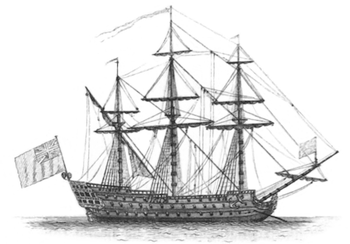
Ships
Of War are masted with three Masts and a Bow-sprit, and sailed with square Sails.
Advice Boats
Now out of Use, but were formerly fitted with two Masts, and square Sails.
Belander
Has Rigging and Sails not unlike a Hoy, but is broader and flatter; the covering of the Deck is raised up half a Foot higher than the Gunwale, between which, and the Deck, there is a Passage left free for the Men to walk; are seldom above twenty-four Tun, and can lie nearer the Wind than a Vessel with cross Sails can do.

Bomb Vessels
Go sometimes with three Masts and square Sails; sometimes Ketch fashion, with one and a Mizon.

Brigantines
Not now used, but were built light for rowing or sailing, and had two Masts and square Sails.

Hagboats
Are masted and sailed Ship fashion, but built in Figure after the Manner of Dutch Fly Boats.

Hoys
Are fitted with one Mast and a Spreet-sail, and sometimes with Shoulder of Mutton Sails, whose Yards are not a-cross, but stands Fore and Aft like a Mizon, so can lie nearer the Wind.

Hulks
They are generally old Ships cut down to the Gun Deck, and fitted with a large Wheel for Men to go in when Careening; and has several Capstons fixed on the Deck for setting Ships Masts.

Ketches
Fitted with two Masts, and their Main-sail and Top-sail stands square as Ships do; and their Fore-sail and Jibbs stands as Hoys do.

Lighters
Are made use of for laying down or shifting the Moarings; for bringing a-shore or carrying off Ships Cables, Anchors, &c. or taking in Ballast out of Ships that are to be docked, &c.

Pinks
Are masted, and sail with three Masts, Ship fashion, but round sterned, with a small Lute or Projection Abaft over the Rother.

Punts
Are built four square, and used about the Docks for fetching Clay, and other Services as the Master Shipwright wants them for.

Shallop
Is a small Light Vessel, with only a small Main and Fore-mast, and Lugg-sails to haul up and let down on Occasion.

Sloops
Are sailed and masted as Mens Fancies lead them, sometimes with one Mast, with two, and with three, with Bermudoes, Shoulder of Mutton, Square, Lugg, and Smack Sails; they are in Figure either square or round Stern'd.

Smacks
Are necessary Transporting Vessels, with one Mast and half Spreet-sail.

Yachts
One Mast with an half Spreet or Smack Sail, and sometimes Ketch fashion.

Shivers
Are those little round Wheels in Blocks in which the Rope runs, they turn with the Rope; and the Voyal Blocks have Pieces of Brass in their Centers, (which are called Coaks) with Holes in them, into which the Iron Pin of the Block goes, and on which they turn. These Shivers are of Lignum Vitæ, but those in the Heels of Topmasts, and in great Ships, Catheads are generally Brass.

Shoal
When a Ship sails towards a Shore, and they find by Sounding the Water grows shallow by Degrees; or when a Sail is too deep, and any Canvas is cut from its Depth, then they say the Sail is Shoaled.
Shoe for an Anchor
Is made of a Piece of Baulk, or thick Stuff, one End cut with a Hole for the Bill of the Anchor to go into, and the other with a triangular Notch to receive the Stock, which keeps off the Sheats, Tacks, and other running Rigging from gauling or being entangled with the Flooks.
Shot of a Cable
Is the splicing two or three Cables together, that a Ship may ride safe in deep Water, and in great Roads.
Shovels
Are allowed the Boatswains for trimming, heaving in or out their Ballast, or cleaning the Ship.

Shrouds
Are great Ropes in a Ship which come down both Sides of all Masts; they are fastened below to the Chains by the Ship's Side with Lanyards, and aloft are seized so as to have an Eye, which goes over the Head of the Mast; and so are the Pendants and Swifters, they are Parcelled and Served, to prevent the Masts gauling them. The Top-mast Shrouds are fastened to the Puttock Plates by dead Eyes and Lanyards, as the others are; the Terms are, Ease the Shrouds, that is, slacken them; set up the Shrouds, that is, set them stiffer.
Signals
Are given for the beginning of a Battle, or an Attack at Sea, by Cannon, Lights, Sails, Flags, &c. in the Day, Night, in a Fog, in Distress, or calling Officers on board the Admiral.
Sinnet
Is made of Rope Yarn, consisting generally of two, six, or nine Threads, which are divided into three Parts, and are platted over one another, and then is beaten smooth and flat with a Mallet; is to serve the Ropes, that is, to keep them from gauling.
Skeets
Are for weting Yachts Sails, or the Ship's Sides in ordinary the Summer Season.

Skek
Usually called the Skeg, is that little Part of the Keel, which is cut slaunting, and is left a little without the Stern Post.
Skids
Are wooden Fenders fay'd on the Outside of the Ship, for the Conveniency of hoisting in Boats, Provisions, &c.

Skimmers
Made with a round Hoop of Iron, and a Socket for a Pole or Spar to go into, as a Handle in the Middle of the Hoop. A Net is made of Rope Yarn, not unlike an Oyster Drudge, and they are used by the Scavengers for clearing Chips, &c. which float on the Surface of the Water, from getting into the Joints of the Gates, or into the Drains of the Docks.

Slatch
After long foul Weather, if there come a small interval of fair, they say, this is a Slatch of fair Weather.
Sleepers
Are commonly three Strakes of Foot Waaling thicker than the rest, wrought over the Wrungheads.
Slices
Are used by the Smiths to clear and keep their Fire together.
Slideing Rule
A Mathematical Instrument serving to work Questions in Gauging, measuring Timber without the Use of Compasses, merely by the slideing of the Parts of the Instrument one by another, the Lines and Divisions whereof give the Answer by Inspection.
Slings
Boat
Are fixed with Thimbles and Tackle Hooks, which hook into small Ringbolts drove in the Stem, Midships and Stern of the Boats, for hoisting them in or out of the Ship.
Buoy
Are fixed round them, which not only is a Means to defend them from being staved, but also the Buoy-ropes are seized to one of their Ends.
Butt Gun Hogshead
Are made use of for hoisting them in or out of the Ship.
Snipe Bills
Are a Sort of Hooks used for fastening the Axle-trees of the Chain Pumps to the Bitts.

Snorters
The Smiths put them on one End of the Beak Iron, to turn any of their Work with.
Soap
Is used for Paying the Slips to make them slippery, that the Ships, when to be launched in their Cradles, or Buildge ways, meet with no Obstruction or Stop in their Run.
Sodder
Used by the Plumber for soddering of Pipes, Furnace, and Water Cocks, &c.
Sounding
Is when the Depth of Water is tryed either by an Inch or three Quarter Rope, with a deep Sea Lead at the End of it; is marked at two, three, or four Fathom with a Piece of black Leather betwixt the Strands, but at five Fathom is marked with a Piece of white Leather or Cloth.
Spanshakle
Is a large Clasp of Iron, which goes round the End of the Davit upon the Fore-Castle, having a long Bolt, which goes through a Fore-Castle Beam, and also Forelocks through an upper Deck Beam in the Midships.

Sparrs
Cant
Are from 33 to 35ft long, 5 Hands, Wrought into Booms,
Barling
Are from 30 to 28ft long, 4 Hands, Wrought into Top-gallant-masts,
Boom
Are from 24 to 20ft long, 3 Hands, Wrought into Flag Staffs, Boats Masts, &c.,
Midling
Are from 20 to 16ft long, Delivered into Store.
Small
Are from 16 to 11ft long, Six Score to the hundred. Both for Bowsprits, Boat Hooks, Mop Staves, &c.
Spell
Signifies doing any Work for a short Time, and then leaving it. Therefore a fresh Spell is when fresh Men come to work; and to give a Spell, is all one as to say, Work in such a one's Room.
Spiles
Are small Wood Pins, which are drove into the Nail-holes, when a Ship's Sheathing is taken off.
Spindle
Is the smallest Part of a Ship's Capston; and where the Vane flies at the Mast Head, is also called a Spindle, and made of Iron.

Spitts
Are allowed the Boatswains, and used for roasting the Officers Victuals.

Spirketing
Are Strakes of thick Plank wrought from the lower Edge of each Port to each Deck respectively within Side of the Ship.
Splice
When the Ends of two Pieces of Cable or Rope are untwisted, and the several Strands are wrought into one another by a Fid, it is called a Splice.
Split
When a Sail is blown to pieces, it is Split.
Spooning
When a Ship being under Sail in a Storm at Sea, and cannot bear it, but is forced to put before the Wind, then she Spoons.
Spring
When a Mast is only crack'd, but not quite broken in any Part of it, as in the Partners, Hounds, &c. then it is Sprung.
Spunyarn
Is made out of Junk, old Cordage, &c.
Spurketts
The Holes or Spaces between the Futtocks or Rungs by the Ship's Sides,
Standing-part
Of the Sheat, is that which is made fast to a Ring at the Ship's Quarter; when they say over-haul the Sheat, they mean haul upon the Standing Part; and the Standing Part of a Tackle is the End of the Rope where the Block is seized or fastened.
Standing Rigging
Are those Ropes which do not run in any Block, but are set taught, or let slack, as occasion serves, as the Shrouds, Stays, Back-stays, &c.
Standards
Are a Sort of Knees fay'd from the Deck to the Sides of the Ship within-board, to strengthen her in the same Manner as Knees, but are bigger.

Stantions
Iron
Are fixed on the Quarters of a Ship, to which the Nettings are generally seized; they stand likewise in the Waste, at the Entering Place, and in the Tops.

Wood
Are those Timbers which being set up Pillarwise, do support and strengthen the Decks, &c.

Staples
Are drove into Ships false Keels, Ports, and several other Uses they are applicable to.

Starboard
The Right Hand Side of a Ship, as Larboard is the Left; thus they say, Starboard the Helm, or Helm a Starboard, when he that Conds would have the Men at the Helm or Steering Wheel put the Helm to the Right Side of the Ship.
Stays
Are Ropes made with four Strands and a Heart in the Middle, whose Uses are to keep the Masts and Top-masts from falling. To bring a Ship upon the Stays, or to Stay her, is in order to her Tacking.
Steady
A Word of Command at Sea from him that Conds, to the Men at the Helm or Steering Wheel, to keep the Ship Steady in her Course, and not to make Angles or Yaws (as they call them) in and out.
Steelyards
A Kind of Ballance used for weighing large Anchors, whose Weight are found by the Use of one single Weight placed on the Beam, with the proper Pea hanging at the End of the Beam.
Steer
To guide or govern a Ship by the Helm or Steering Wheel.
Steerage
Is always before the Bulk-head of the great Cabbin, and in which the Admirals or Captains generally dine.
Steeve
The Bowsprit of a Ship Steeves when either stands too upright, and not streight enough forward.
Stem
A Curve Piece of Timber projecting from the foremost End of the Keel to the Height of the Bowsprit, into which the Body of the Ship terminates Afore, and all the whooding Ends of the out-board Planks are rabbited.
Steps
For Masts, are large Pieces of Timber fay'd cross the Keelson in the Hold into which the Heels of the Masts are fitted. And Steps for Capstons are fitted on the Decks respectively for their Use; other Steps for Ladders are for going from one Deck to another.
Stern
Is all that Part of a Ship as is right Aft, and adorned with Sash Lights.
Stern fasts
Are large Ropes which come out at the Gun-room, or After-Ports of a Ship, in order to lash her fast to a Wharf, &c.
Stern Post
A streight Piece of Timber tennanted into the After-End of the Keel, with an agreeable Rake or Declination from the Perpendicular; into this are all the Transoms scored and bolted, and all the whooding Ends of the out-board Plank of the Bottom rabbited; and on this Post hangs the Rother.
Steward
Is he that acts for the Purser, receives and issues all Provisions out to the several Messes of Victuals, &c. to the Ship's Company.
Stiles
In Carpentry, &c. are the upright Pieces which go from the Bottom to the Top of the Wainscot.
Stirrup
Is an Iron Plate that turns up on each Side of a Ship's Keel, at her Fore-foot or Stern, where it is bolted.
Stoaked
When the Water in the Bottom of a Ship cannot come to the Well, or pass through the Limber-holes, but something Choaks them up, so that the Pumps will not work, then they say she is Stoaked.
Stocks
A Ship is said to be on the Stocks when building.
Stone
Flatner
Is used by the Bricklayers for bringing up the Foundations of Houses, &c.
Grind
For the Workmen to whet their Tools, &c.
Gun
Is laid in the Bottom of the Dock Dreins.
Gutter
Is laid at the Officers Lodgings and Store-houses for carrying off the Water.
Stone
Load
Are used for touching the Needles of Azimuth or Brass Box Compasses.
Marble
Is brought from Plymouth, and burnt in the Kiln to make Lime.
Paving Smooth
Laid at the Bottoms of Cellars, Kitchens, and Courts of the Officers Houses, &c.
Portland Block
Is used at, and for the Service of the Stone Docks.
Rub
Are for the House Carpenters and Joyners to whet their Tools on.
Stools
The Ship's Poop and Top Lanterns stand on them, which are supported by the Cranks.

Stopper
Is a Piece of Cable-laid Rope, having a Whale Knot at one End, with a Lanyard fastened to it, and the other End is spliced round a Thimble in the Ring-bolts upon Deck, and at the Bitts; its Use is to stop the Cable, that it do not run out too fast; they take Turns with the Lanyard about the Cable, and the Whale Knot stops it, so that it cannot slip away faster than is necessary.
Stoves
Are square Boxes made of Plank filled with Bricks, and when fitted with an Iron Ring and small Bars, are for burning Charcoal, in order for the Cook to dress the Admiral's or Captain's Victuals on.
Strakes
Are the uniform Ranges of Planks on the Bottom, Decks and Sides of the Ships, and the Garboard is that which is next the Keel.
Strap
Is a Rope spliced about any Block, or made with an Eye to fasten it any where on Occasion.
Stream
When a Ship would only stop a Tide in fair Weather and smooth Water, they generally ride only by their Stream Anchor.
Streight
A narrow Sea Passage between two Lands.
Stretch
When a Ship with all her Sails drawing, steers out of a Road where she has lain at an Anchor, then they say she is stretching away for Sea.
Strike
A Word variously used. When a Ship in Fight, or on meeting with a Man of War, lets down or lowers her Topsails at least half Mast high, she Strikes, meaning, she yields or submits, or pays her Devoir to the Man of War she passes by. When a Ship touches Ground in Shoal Water, they say, she Strikes. When any Topmast is to be taken down, the Word is, Strike the Topmast. And when any Thing is let or lowered down into the Hold, they call it Striking down into the Hold.
String
Is that strake of Plank within Side of the Ship that is wrought over the upper Deck Ports in the Wast.
Surge
When heaving at the Capston, if the Cable, Voyal, or Messenger happen to slip a little, they call it Surging.
Swabber
Is to see that the Ship's Decks are kept neat and clean.
SwallowTails
Are Bolts forged at one End not unlike a Bird's Tail, sharpened and hardened; are used in breaking up old Ships, for cutting off the Tree-nails and Bolts after they are almost sawed through with a Hack Saw; then they put the Swallow Tail thereon, which clips the Bolt, and by driving it with a Maul, cuts and separates the same. As also a strong forked fastening together two Pieces of Timber.
Sweep
When the Mold of a Ship begins to compass in at the Rung-heads, they call it the Sweep of her; as they do when a Hawser is dragged along the Ground at the Bottom of the Sea, to recover any Thing that is sunk, Sweeping for it.
Swifters
Are esteemed a Part of the Gang of Fore and Main Shrouds, (where they have odd ones) and of the same Size which are for succouring those Masts.
Swifting
A Boat, is compassing her Gunwale round with a good Rope. A Ship is either bringing her a-ground, or on a Carreen; and the Capston Bars, is straining a Rope all round the outer Ends of them, to prevent their flying out of the Drum-head.
Swivels
Are made use of at the Moarings in Harbour, to which the Cables and Bridles are bent, that the Ships may swing round either upon Tide of Ebb or Flood.

Tables
Deal
Are allowed the Warrant Officers for their Cabbins.

Wainscot
Allowed the Admirals and Commanders for their Cabbins, &c.
Tack about
When a Ship's Head is to be brought about so as to lie a contrary Way.
Tacks
Are Ropes Cable-laid tapering, having a Whale Knot at one End, which is seized or fastened into the Clew of the Sail, reeved through the Chess-trees, and then brought through a Hole in the Ship's Side; its Use is to carry forward the Clew of the Sail, to make it stand close by a Wind; and whenever the Sails are thus trimmed, the Fore and Main Tacks are brought close by the Board, and hauled as forward on as they can be, and are usually belayed to the Bitts or a Kevel to fasten them.
Tackles
In a Ship, are Ropes running in three or four Parts, having at one End a Pendant with a Block fastened to it, and also a Tackle Hook for heaving any Thing in or out of the Ship.
Taffarel
Is the uppermost Part of a Ship's Stern Abaft, and always carved.
Tallow
Is for Paying Ship's Bottoms, and also allowed to the Boatswains and Carpenters for several Uses it is proper for.
Tarr
Is used for Tarring white Yarn at the Rope Yard, by the Riggers, and Boatswains for Ships Rigging, and for Tarpawlings, Paying Ships Sides, Weather Boards, &c.
Tarras
Used by the Masons in the Stone Work of the Docks, and for pointing or repairing the Joints, which from Time to Time stand in Need of Repair.
Tarpawling
Is a Piece of Canvas well Tarr'd over, to lay on the Hatches, Grateings, or any Place to keep off Rain.
Taught
Is the same as setting the Rope stiff or fast, they say, Set Taught the Shrouds, Stays, or any other Ropes, which are too slack and loose.
Taunt
When the Masts of a Ship are too tall, they say, She is Taunt masted.
Tier
The several Ranks of Guns placed on the Decks are called the Lower, Middle, or Upper Tier.
Tender
Is a small Vessel taken up on Contract for attending the Men of War, and employed for pressing Seamen, &c.
Thauts
Are for the Men which row the Boats to sit on.
Thimbles
Are a Sort of round Rings, whose Edges are turned up, and the Ropes go round in the hollow Part of the Outside of them when they are seized, in order to prevent the Tackle Hook from galling the Rope.

Thoals
Are those Pins in the Gunwale of a Boat, between which the Men put their Oars when they row.

Thrums
Are allowed the Boatswains and Carpenters to make Mops; and also to the Master Caulker for Mops to Pay the Ships Bottoms.
Thwart Ship
Is across the Ship.
Tides
Two periodical Motions of the Waters of the Sea, called the Flux and Reflux, or the Ebb and Flow.
Ties
Or Runners, are those Ropes by which the Yards hang, and they with the Halyards carry or hoist the Yards up.
Tiller
The very same with the Helm of a Ship, and are also used in small Ships and Boats for Steering them.

Tiller for Saws
Are Handles for Whip Saws.

Timber
Ash
Is used by the Master House Carpenter in Wheelwright Work.
Beech
Is used for Ways at the Bottom of the Dock, and sometimes cut into Keel-pieces.
Elm
Is used for making Drumheads, for Capstons, Ships Caps, Keel-pieces, Lyons, Tafferels, &c.
Firr
Is used for making Davits, by the House Carpenters for Girders, and such like large Uses in Building.
Oak Compass
Is used by the Shipwrights, and converted for the Compassing Timbers of a Ship.
Streight
Is used by the Shipwrights for Beams on board a Ship, and for other Services that it is requisite to be used on, and also by the House Carpenter in his Way of building.
Timbers
Are those which Form the Body of a Ship, as Floor Timbers, Futtocks, &c.
Timbers Top
Are the upper Timbers in the Frame of a Ship, forming her Sides, &c.
Tin Plates; Double and Single
Are used for lining the Bread, Cook, and Powder Rooms of Ships, covering the Tops of their Galleries, and for fining Oars, &c.
Tight
When a Ship lets in but very little Water, she is Tight, which is known by the Smell o£ that pumped out, for if she lets in but little, it will always stink, otherwise not.
Tire Cable
The Row in the Middle of the Coiled Cable.
Toggle
A short Piece of Wood made tapering at each End, having a Score cut in the Middle of it, where a Rope is usually fastened, and when put through the Bite of another, there is no Occasion of seizing them together.
Top
Is a round Frame of Boards which lie upon the Cross-trees, near the Head of the standing Masts.

Top Armours
Are cut out of red Kersey, and tabled round with Canvas, hung about the Top for Show, and also cover the Men which are in the Tops in a Fight.
Tops Laying
Are used by the Rope-makers; those made with three Scores are for closing three Strand Ropes, and those with four are for Stays, and has a Hole bored in their Center, through which the Heart of the Stay passes.

Tools
Bolt
To make Saucer Head Bolts in.
Nail
To Head Nails in.
Thread
Is for making, altering, and repairing Colours in Store, or on board the Ship.
Tow
Whatever is drawn after a Boat or Ship with a Rope, &c. is said to be Towed.
Trail-board
Is a carved Board let into, or nailed on the Knee of the Head, just below the Lyon.
Transoms
Are large Pieces of Timber forming the Buttock, or After-part of the Ship on both Sides; they are transversely situate on the Post, and in the Middle bolted to it; their Ends are fastened to the After-Timbers on each Side respectively, called Fashion Pieces; they are denominated severally according to their Elevations, as Wing Transoms, Deck Transoms, Transoms under the Deck, &c. All which, as Post Transoms, and Fashion Pieces, being framed together, is commonly called the Stern Frame.
Traverse
A Ship when she makes Angles in and out, and cannot keep directly to her true Course, is called a Traverse. In Navigation, is the Variation of the Ship's Course, upon shifting of Winds, &c. And a Traverse Board, is a little round Board which hangs up, and bored full of Holes upon Lines, shewing the Points of the Compass upon it; by moving a little Peg from Hole to Hole, the Men at the Helm or Steering Wheel keeps an Account how many Glasses (that is, Half Hours) the Ship Steers upon any Point.
Treenails
Are long Pins of Wood, whence they are called Tree-nails, made out of Oak, to fasten the Planks to the Timbers, and are always Caulked with Ocham to prevent any Leak.
Tressle trees
Are those Timbers that stand Fore and Aft at the Mast-head, for the Tops to lie on.
Tressle
A wooden Frame to bear up Tables, Deals, Scaffolds, &c.
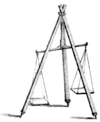
Triangles
Are made out of large Spars, having their lower Ends ferrilled with a Ring, and a Spud drove into them, which runs into the Ground to steddy them; their upper End has a Bolt that goes through the three Parts, where a Staple is fixed for hanging a Scale Beam, when they are made use of for weighing Stores without Doors, as are received or delivered into the Yard.
Trip
A Ship goes with her Topsails a Trip she carries them hoisted up to the highest, and when the Wind blows not too hard.
Trim
Of a Ship, is her best Posture, with respect to her Proportion of Ballast, the standing of her Masts, &c. for Sailing, and the best Way to make her Sail well, and to find her Trim, depends very much on Experience and Judgment.
Trise
For hauling up any Thing by a single Rope, that do not run in a Block, but is done by Hand or main Strength. Thus if any Cask, Chest, or other Goods hath only a Rope fastened to it, and without a Tackle is pulled up into the Ship by Hand, it is Trised up.
Trivets
Are used by the Caulkers for large Kettles to stand on for heating Stuff when Paying Ships.

Trough
Is the Hollow or Cavity made between any two Waves or Billows in a rowling Sea.
Trucks
Acorn
Are put on the End or Top of the Vane Spindle at the Mast-head.

Flaggstaff
Are put on the Ends of them, and also on the Ensign and Jack Staffs.

Parrel
The Rope is reeved through them, and are placed between the Ribs of the Parrel.

Seizing
Are made fast to the Shrouds for the Running Rigging to go through.

Truss
Is a Tackle fastened to the Parrel at the Yard, which binds it fast when the Ship rowls, lying either a-hull or at an Anchor, and the Fore, Main, and Mizon Yards have them.
Try
A Ship is said to Try, when she hath no more Sails abroad but her Main Course, when her Tacks are close aboard, the Bowlings set up, and the Sheats hauled close Aft, or when, the Helm or Steering Wheel is so fastened as to prevent their having any Power of the Tiller, so as she is let lie in the Sea, and sometimes when it blows so hard that she cannot bear her Main Course, they make her lie a-Try, under her Mizon only.
Tuck
Is when a Ship is not round Buttock'd, as commonly English Ships are, (Sixth Rates lately excepted) under the Wing Transom, they say she is Square Tuck't. Dutch Men of War, and their Merchant Ships, are generally built with square Tucks.
Tue Iron
Are for the Smith's Bellows to blow through.
Turpentine
Is used for Paying Ships Sides, Masts, Boats, &c.
Twine
Sail
Is used by the Sail-makers for making and repairing Sails; allowed the Boatswains for repairing the Sails when they want at Sea, for whiping Ropes, and such like Uses.
Mark
Is put into all Cordage, from three Inches downwards, as the King's Mark.
Tiles
Are used by the bricklayers on the Roofs of Lodgings, Storehouses, &c.
Tyminoguy
A Rope, one End nailed to the Outside of the Stock of an Anchor, stowed at the Bow, and the other fastened or belayed to the Ship's Sides on the Fore-Castle; its Use is for preventing the Fore-Sheats (when getting under Sail) droping down between the Anchor Stock and Ship's Side.
Veer
Veering out a Rope, is letting it go by Hand, or letting it run out of its self. Thus they Veer more Cable, that is, Let more Cable run out; but this Word is not used for the letting out of any Running Rope except the Sheat, but of that they say, Veer more Sheat, that is, Let more of it run out. The Word Veer is also used in Reference to the Wind, for when it changeth often and suddenly, they say The Wind Veereth.
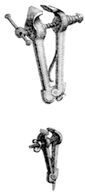
Vice
There are two Sorts, Bench and Hand; the former are fixed to a Bench in the Smith's Shop, and used by them for holding fast their Work, when to be filed or cleaned, as the other is (being small) held in the Hand when made use of.
Viol
A Cable-laid Rope, which being reeved through a large Block lashed at the Main-mast, is made use of by heaving at the Jeer Capston to weigh the Anchor when Nippers are brought on about the Cable.
Vinegar
Is allowed for washing the Ships between Decks when abroad, for preventing any Contagion spreading among the Men.
Umbrello's
Are Screens hung at the Stern over the Ship's Lights, to keep out the Sun, and are generally covered with Canvas or Kersey.
Unmoar
When a Ship or Vessel that Rides at two Anchors begins to get them up in order to Sail, she is Unmoaring.
Uphroes
Are a Kind of Spar brought from Norway, from thirty two Feet to twenty eight Feet long, and four Inches by three and an half square at the Top End.
Waals
Are those protuberant Strakes of Plank (or thick Stuff) wrought thicker than the Rest on the Sides of a Ship, the Appearance of which gives her Sheer, that is, the beautiful Rising they commonly have Fore and Aft above Water.
Waft
To make a Waft is to hoist up an Ensign rowled up to the Top of the Staff, as a Sign for the Men to come on board, or that a Ship is in Danger by a Leak, &c. and therefore wants Help from the Shore, or from some other Ship.
Wake
Is the smooth Water that runs from a Ship's Stern when under Sail, and by it a good Guess may be made of the Speed she makes. Also when one Ship giving Chace to another, is got as far into the Wind as she, and sails directly after her, they say, She has got into her Wake.
Wale Rear'd
Not Ship shape, but built right up after she comes to her Bearing.
Walt
A Ship is Walt when she hath not her due Ballast, that is, not enough to enable her to bear her Sails.
Warp
Is to haul or transport a Ship by a Cablet or Hawser (proper for that Purpose) bent to an Anchor or a Buoy; it is used when a Wind is wanting to carry her into or out of an Harbour, or to Moarings, and this is termed Warping; and the Cablet or Hawser used on this Occasion is called a Warp.
Wast
The Ship's Sides between the Quarter Deck and Fore-castle is commonly called so.
Boards
Are sometimes set upon the Sides of a Boat, to keep the Sea from breaking into her.
Cloths
Is Kersey, tabled with Canvas, and hung round the Wast, Quarter Deck, and Poop of a Ship for Ornament.
Trees
In small Ships only, are the same as Ruff Trees.
Watch
Signifies the Space of four Hours, because half of the Ship's Company Watch and do Duty in their Turns, so long at a Time, who are divided into two Parts, the Larboard, and the Starboard Watch.
Water-born
Is when a Ship, even and just with the Ground, first begins to float or swim, being born up by the Water.
Water Line
Is that which goes round the Ship at the Surface of the Water, and shews the true Shape of her Body.
Water Shot
Is a Sort of riding at Anchor, when a Ship is moared neither a-cross the Tide, nor right up and down, but betwixt both.
Water ways
Is that Strake of Plank on the Flat of each Deck respectively next the Ship's Side, for turning the Water out of the Seams.
Way of a Ship
Is sometimes the same with the Rake or Run of her Fore and Aft; but is mostly used as to her Sailing, for when she goes apace, they say, She makes good or fresh Way. And because most Ships are apt to fall a little to Leeward of their Course, they always in casting up the Logboard allow something for her Leeway, which is one Point or more, according to her Sailing.
Weather Coyl
When a Ship being a-hull, has her Head brought about so as to lie that Way which her Stern did before, without loosing of any Sail, but only by bearing up of the Helm, this is called Weather Coyling of her.
Weather Gage
That Ship is said to have the Weather Gage of another, when she is to Windward of her.
Weathering
A doubling or getting to Windward of a Point or Place.
Wedges Iron
Are for splitting Wood.

Wedges Wood
Are made out of Beech or Elm for splitting Wood, or to be put between the Wrain Staves and Ships Sides for setting too of Planks, and for barring in of Ports, &c.

Weighing
Is drawing up an Anchor out of the Ground, in order to set Sail.
Welding
When the Smiths give their Iron a proper Heat in the Forge, in order to double up the same when wanted to weld a Work in the Doublings, so as to be in one Piece thick enough for the Purpose it is wanted for.
Well
A square Place, parted off and planked round the Main-mast from the Gundeck down to the Foot-waaling, to keep the Ballast, &c. from the Pumps placed therein.
Whale-knot
Is a round Knot or Knob made with three Strands of a Rope at one End of the Tacks, Topsail Sheats and Stoppers, so that they cannot slip.
Wheels Steering
Are placed on the Quarter Deck, fixed to an Axis, round which go the Wheelrope, which is made fast to the Tiller in the Gun-Room, it passes through Blocks at the Side, and from thence comes up to the Wheel in the Midships.
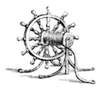
Whelps
Are those Brackets set Edge ways upon the Barrel of a Capston, which give the Sweep to it, and are so contrived that a Voyal or Cable brought about them may not surge so much as it would do, if the Body of the Capston was quite round and smooth.

Whipstaff
Is fastened into the Helm, for him that Steers to hold in his Hand, thereby to move the Helm and Steer the Ship: It goes through the Rowl, and made fast to the Tiller with a Ring.

Whirles
Used by the Rope-makers when either laying small Cordage, or spinning Yarn, and are placed in the Heads of the Wheels and Works in Brasses fixed therein.

Whoodings
Are the Ends of the Bottom Planks at the Extremities of the Ship, rabbited into the Stem Afore, and into the Post Abaft.
Winches Iron
Are Handles for turning round Grindstones, Wheels of Chain Pumps, &c.

Wind
Bringing a Ship's Head about, is called Winding of her, and when rides at an Anchor, she is said to wind up. Also when she is under Sail, they use to enquire, How she Winds, that is, which way she lies with her Head; so, to Wind the Boat, is to turn her Head about.
Wind Taught
Implying as much as stiff in the Wind, for a Thing is Taught, when it is stiff. Thus too much Rigging over Head, or any Thing holding Wind Aloft, is said to hold a Ship Wind Taught; by which is meant, she stoops too much in her Sailing in a stiff Gale of Wind. So also, when a Ship rides in Stress of Wind and Weather, they strike down her Topmasts, which holds too much Wind, or be Wind Taught.
Winding Tackle Pendant
Is a Cable-laid Rope brought about the Head of the Mast, having a treble Block with three Shivers in it, seized fast to the End, through which and a double Block, the Fall is reeved, so brought to the Capston by a Snatch Block, whereby the Guns, or any other heavy Stores, are hoisted in or out.
Windlass
Is a Piece of Timber having six or eight Squares, and is fixed thwart Ship Abaft the Forecastle; in small Ships, Hoys, &c. this Windlass will Purchase as much as a Capston in weighing of an Anchor, and without any Danger to those that heave, because they heave here about with Handspikes, put into several Holes made in the Windlass, of which though one should happen to break, yet would the Windlass paul of itself, without any further Danger.

Wind sails
Are used for drawing fresh Air into the Holds of Ships, by cooling every Part, which contributes towards preserving them from Decay.
Wood Hard
Live Oak
Is for making Reeming Beetles and Coggs for the Wheels, used for working the Chain Pumps which throws the Water out of the Docks.
Lignum Vitæ
Is used for making Shivers and Pins for Blocks.
Wood & Wood
Are two Pieces of Timber nicely let in or fay'd to each other, that the Wood of one joyns close to the other.
Wood Faggots
Are used in heating the Kilns for stoving Plank, and also the Oven where the Sail-makers stove the Bolt-ropes.
Woodmeil
A hairy coarse Stuff made of Island Wool, and supplied to the Carpenters of Ships at some of his Majesty's Yards for lining of Ports, &c.
Woolding
Signifies the winding of Ropes at certain Distances about a Mast, in order to strengthen it.
Woolers Double and Single Hand
Used at the Rope Yard, and the Men that work with them, are a great Help to those that heave at the Hooks in laying or closing Cables.
Worming
Is twice-laid Cordage, and used for Worming Stays, Shrouds, &c. which is laid betwixt the Strands, in order to strengthen or succour them, or for making Netings on the Quarters, Wast, and Tops of Ships for Shelter to the Men when in Action.
Wrain Staves
Are a Sort of thick Billets, tapered so at each End that they may go into the Ring of the Wrain Bolt, and are for bringing too Planks or thick Stuff to the Compassing Parts of a Ship's Side, &c.

Wreck
Is when a Ship is drove ashore in a Storm, or Perishes on the Sea, and no Man escapes alive out of her.
Yards
New England are wrought in eight squares in the Middle, and from thence in their several Quarters are tapered to the Ends in sixteen Squares, and received by the Inches in Diameter they are in the Slings; the Top and Top-gallant are generally made out of Gottenbro' or Norway Masts, all which are made of suitable Dimensions in Diameter and Length for their proper Sails to be bent to them, which are hoisted up and lowered down by the Jeers, Halyards, Lifts, &c.
Yare
Is a Sea Word for Nimble, Ready, Quick, or Expeditious.
Yarn
That which the Rope-makers spin out of the Hemp for making Cordage, is called Yarn; and when Four hundred Threads are warped off the Winches, and a slight Turn is put into it, it is called a Hall, in order to be Tarred, which is done by four Men running in a large Wheel, that draws it through a Furnace of boiling Tar, and is pressed so very dry by a Nipper, that it will not soil one's Hand.
Yawes
A Ship makes Yawes, when through the Fault of him at the Helm or Steering Wheel she is not kept steady in her Course, but makes Angles in and out.