LETTERS (continued 3)
Reading edition
I have got my tent raised up on logs, with a good bunk of poles and a turf fireplace. Have a big pile of wood to burn tonight, and will have a good fire to drive away Jack Frost.
LXXXIII
Camp opposite Fredericksburg, Va.,
January 9, 1863.
CHARLIE VICKERY is going home on furlough tomorrow. So am I—in about sixteen months. We have moved camp about a mile and a half, and already have very comfortable winter quarters fixed up. Yesterday I wrote home for a box. The chances are good for our staying here long enough for me to get it. I am tenting now with George Lawrence, who was one of my tent’s crew at Camp Sullivan. Of my six tentmates there, two have been killed, one died of disease, and one joined the cavalry. Ed. Bailey [Major commanding the regiment] is under arrest on charges of disobeying orders of General Carr. I don’t imagine it is anything very serious.
LXXXIV
Camp opposite Fredericksburg, Va.,
January 16, 1863.
EVERYTHING seems to be going wrong today. The wind has been blowing a perfect hurricane; last night it rained hard; just now there is a good prospect of our having to leave the snug huts we have built and go somewhere—the Lord only knows where. Marston has been appointed Brigadier-General, and the story persists that he has had this regiment detached for special duty at Washington and that the order is now at headquarters.
Bill Ramsdell’s “furlough” appears to be still in good working order. There are doubtless some details under the surface that we don’t know, but I’ll bet on Bill. So will all the old boys. He was not the type of patriot who couldn’t serve his country unless he was ornamented with shoulder straps, and there is a quite general sentiment that smaller men than he is have refused him a square deal.
There was a terrible catastrophy in my tent last night. Over our bunk was a shelf loaded with a miscellaneous assortment of a little of everything—letters, papers, portfolio, a dish of cooked rice and a can of molasses. All of a sudden, Lawrence, in performing some of his antics, sent the shelf flying, and such a mess! The molasses seemed to have a chemical affinity for everything there was in that tent, and it is unnecessary to say it was a total loss.
Perk. Lane, Rod. Manning and the other boys who went into the cavalry are visiting in camp. Their regiment is near here. Hen. Pillsbury and Joe Hubbard are here and well. Joe is captain of Company B. He is one of the best fellows and most popular officers in the regiment.
LXXXV
Camp near Falmouth, Va.,
January 24, 1863.
SINCE last Tuesday we have been paddling around in the rain and mud to our heart’s content—and a good deal more. The short of the story is that Gen. Burnside intended to cross the Rappahannock a few miles above here and attack the enemy, but owing to continuous rains the roads became impassable and the army was obliged to wallow back to its old position and wait for better conditions. Our division left camp Tuesday noon, in a pouring rain, and accomplished about a mile and a half, under difficulties. Then we waited until about nine o’clock at night, when we were ordered back to our camps. Wednesday we tried it again and managed to get about six miles. The mud was simply awful, and it was almost an utter impossibility to move the wagons and artillery at all. The Manchester battery was striddled along the road, a gun here and a caisson there, over a stretch of three miles. And that was the way everything on wheels was hung up. General Burnside had issued an address to the army, saying they were soon to meet the enemy and enjoining them to display their old-time bravery. But God willed that the battle should not take place just at present, and with the elements at command He prevented it. Yesterday the division made its way back to the old camps. Lawrence and I rehabilitated our old shanty and are now as comfortable and cozy as you please.
I saw George Dakin day before yesterday—the first time since he went into the army. I got a letter from Addie and expect my box is on the way. I am actually suffering for something good to eat. Have you seen the picture I sent Addie? Did you ever see a more disreputable-looking outlaw?
LXXXVI
Headquarters Sickles’ Division,
Near Falmouth, Va.,
Sunday, February 8, 1863.
HAVE you begun to wonder why I have not written for a fortnight? Well, I have made another lightning change and am now on the provost guard at division headquarters. I am not prepared to say that I exactly relish the change. I was denned in for a comfortable, easy-going winter, without much work, when I was pitchpoled into this place, where it is nothing but hard work. Lawrence and I were notified by the Orderly Sergeant that we were detailed for special duty, that we were to take our entire outfit with us, and report to the Adjutant. We dismantled our shack, packed up, and reported. We found nine more victims, from other companies. I was placed in charge of the squad and ordered to report to the Provost Marshal at Sickles’ headquarters. It snowed and was awful cold. Along with detachments from other regiments of the division we were quartered two nights in a barn, which was dry enough, but we came near freezing. Then we pitched our tents and began to hustle to make ourselves comfortable. In company with four from my own squad and two from the First Massachusetts, I am now comfortably housed in a log and canvas palace, 17x7 feet, inside measurement, with a big fireplace and good bunks.
I have been promoted, “for gallant and meritorious”—cheek. When I reported my squad, I gave in, of course, the names and rank of all as privates. My first detail was for guard duty. I stood a post for two hours, and I did a lot of thinking. I had been taking things in, and had discovered that a private soldier on provost guard had about the worst job in the army. It was not only guard duty, but police duty of all kinds, and they were hewers of wood and luggers of water for everybody. I wasn’t brought up that way. And at last I made a guess, and I guess that I made a pretty good guess. When I came off post I marched up to the Marshal’s tent, saluted, and delivered the following oration: “Captain, I am Private Haynes of the Second New Hampshire. The order for detail from my regiment called for ten privates and a corporal. We are very short of non-commissioned officers, so I was placed in charge as an acting corporal. It was my oversight in not so stating when I reported my detachment. So I was given a post as sentry today and have stood it, but I thought it best to call your attention to the matter.” When the next relief was called Sergeant-Major Featherstone announced: “Corporal Haynes takes charge of this relief.” Relieved from a common laborer’s drudgery and from the heavier part of guard duty, I will get along, probably, as comfortably as I would with the regiment. And I am in position to make it easier for my boys from the Second. Featherstone seems to have a pretty high idea of the average capacity of my New Hampshire Yankees. The other day he called on me for a skilled wood worker, who could do repair work mainly. I recommended my bunkmate Lawrence, and now George has the softest job of any man on the Guard—nothing to do but whittle. And the axe-helves and tool handles he turns out to replace the broken ones are really a credit to his skill.
My box has not come yet. The express matter is at Belle Plain, but it is hard to get anything but army supplies up over the railroad. I have not seen James for some time. His camp is a mile and a half from here, and I have to stick pretty close to these headquarters, just now. I have heard that the Ninth Army Corps, to which his regiment belongs, is on the way to North Carolina. If so, I shall not see him again. He was over here a few days ago, but I was off in the woods with a squad of men. [I never saw him again. He was killed, the following year, at Spottsylvania.]
LXXXVII
Headquarters Berry’s Division,
Near Falmouth, Va.,
February 15, 1863.
OUT I go again into the cold—the same old story. Somebody else is enjoying the cozy quarters I helped build over at the Fitzhugh house, while I am sitting in my little shelter tent, hardly big enough for two, with the rain pouring and all my surroundings wet and uncomfortable. It all comes from the fact that Sickles, having been put in command of the corps, retains his old quarters as corps headquarters, while Berry, put in command of the division, has to set up housekeeping somewhere else, taking the division provost guard along with him, of course. We are now about two miles from the camp of the Second, and fully a mile from any of the division, and it is said we are to move again in a day or two. The entire brigade is out on picket now. Went out three days ago, and rations have been sent out for three days more. They are out six or seven miles, above Falmouth. My box has not reached me yet, and I am getting a little mad about it. Many of the boys have got theirs, which started at the same time; but there is still a great pile at the landing and mine is probably among them.
Charlie Vickery has got back looking like a new man. I was glad to see him, for he brought me a half-dollar’s worth of postage stamps just as I was all out and wondering where I would get more.
The furlough excitement might as well be set down as a delusion, except for the favored few. Only one man in my company—Dave Perkins, the orderly sergeant—has got one yet. One a week—or every ten days! You see, by the time the last man gets his furlough it will be time for his discharge. It will not be many weeks before Uncle Joe Hooker will be making a forward movement and the furloughs will be shut off with a snap. As a matter of form, and just to see what he would say, I asked Lieutenant Gordon, commanding the company, to send my name in among the first. He said he should give the married men the preference. When I asked him if the men who were engaged had any special standing, he looked as if he thought I was trifling.
Major Bailey was before a court martial a few days ago. Ed must be getting used to it. The charge was, I believe, disrespect of superior officers. I have not heard the result.
LXXXVIII
Headquarters Berry’s Division,
Near Falmouth, Va.,
February 23, 1863.
A WEEK ago or so, the story was afloat that the regiment was going home right away, “and no mistake.” Col. Marston had been down here, and had the consent of the President, the Secretary of War, and General Hooker, and we were sure to go. All the officers took stock in the story, and I did really hope that by next Saturday we might be in Manchester. But even now the hopes of going have died out and the excitement subsided. Such stories have been let loose every two or three weeks as regular as clockwork.
You would have screamed if you could have seen the ridiculous sleighride I did today. It was a lark of the General’s staff officers. They had a set of sleigh-runners made and a wagon body mounted on them. The sleighing would not have been called sleighing at all up in New Hampshire. But they started out, with one lady in the party, tipped over twice, and then went to smash entirely.
Ed. Bailey’s commission as Lieutenant-Colonel has come. His court martial is ended, and whatever the findings he is returned to duty. Frank Wasley is now Sergeant-Major. One of the boys saw my box at the landing yesterday. There are several inches of snow on the ground, which fell yesterday; but it is warm today and the snow will not last long.
Wednesday.—I have been busy the past two days. Yesterday my patience about gave out. We had two choppers out in the woods, and along in the afternoon I was sent out with teams and a squad of men to gather up and bring in the wood they had down. Before we got to the woods we met one of the choppers, who told me there was no need to go any farther, as there was no wood cut; that they would not allow him to chop anywhere, as the trees were wanted to build corduroy roads with. Of course I turned around and went back—a distance of two miles. We had not been in camp fifteen minutes before the other chopper came in and said he had been chopping all day and had lots of wood down. The first chopper had not been out at all, but had been having a glorious drunk, and told me the story he did to get himself out of a scrape. Of course we had to go out again—and of all the times! It looked sometimes as if we never would get out of the woods. The teams got stuck, and chains broke. There was an apology for a road, but its main features were stumps, roots and bog holes. Nothing but an army wagon could ever have stood the strain, and nothing but a team of army mules, guided by army mule drivers, would ever have attempted to get in and out of that place. But we got our wood, and were back at headquarters, tired but triumphant, about eight o’clock in the evening.
Captain Gordon told me, yesterday, that Colonel Marston had declined his Brigadiership and was coming back to take command of the regiment, much to Bailey’s disappointment.
George Lawrence is expecting a furlough to come along tomorrow, and he says: “Finish a long letter and I will carry it as far as Lawrence for you.” But I guess it will go as quickly by mail.
NOTE
The interval of time between the preceding and the following letters is explained by the fact that the stories and rumors of “going home” actually materialized at this time. The regiment left the Army of the Potomac February 26 and arrived in New Hampshire March 3. It left the state for the front again May 25, arriving in Washington May 27. The “Soldier Boy” and “The Girl I left behind me” were married March 9.
LXXXIX
Washington, D. C., May 27, 1863.
GOT into Washington this morning at half-past six—less than forty-eight hours on the route from New Hampshire. George Slade lost his knapsack somewhere on the way. Mrs. Wasley was at Concord and rode down on the train. The last I saw of her she was standing on the plank walk, her eyes full of tears. I was glad you did not come to the depot when the regiment passed through. George Slade’s wife was at Concord, almost heart-broken. [It was their last farewell—George never came back.]
We are stopping now at the “Soldier’s Rest.” Captain Gordon tells me we are ordered to report to General Casey, in command of the defenses of Washington, and will probably stay about here some time. The Fourteenth New Hampshire are here, camped on the hill not far away.
We rode from Norwich, Conn., to Jersey City on an old freight boat. There were no bunks, and I found the deck planks of about the usual quality and finish. The good grub the family so liberally stocked me up with at Manchester is not all gone yet, notwithstanding I have shared it freely with the poor and needy. I saw Norm. Gunnison at Philadelphia. He was discharged for disability, not long ago, and is now working on some newspaper.
XC
Camp Marston, Washington, D. C.,
May 30, 1863.
WE are now fairly settled down in camp on what is known as East Capitol Hill, with nothing to do but eat, sleep, and drill, and make ourselves as comfortable as we can. The camp is right out in the open, with not as much as a huckleberry bush for shade. But we have A-tents to sleep in, which are roomy and comfortable—much more so than our “shelters.” There are only three in my tent—Herm. Sleeper, “Curley” Converse, and yours truly. George Slade did come in, but he was detailed as company cook and now has a tent of his own.
I saw Farnsworth over in the city day before yesterday—[Major Simeon D., Paymaster, onetime publisher of the Manchester American.] We were marching toward Long Bridge, headed for Camp Chase on Arlington Heights, and I had a chance to speak to him a moment. Our destination was changed however before we reached the bridge and we were about-faced and marched to our present camp.
I saw Captain Bruce [John N.] Tuesday. He is a sergeant in the Fourteenth. He tapped his chevrons and observed, with a smile: “Coming up, you see!” Which reminded me of the old, old times before the war, when he used to parade the streets of Manchester at the head of his crack company, the admiration and envy of every boy in town.
“Old Beauregard” [Orrin S. Gardner,] the old sinner whose picture I sent home once, has deserted. Before we left the state he was arrested and put in the guard house on mere suspicion that he was going to desert; but the morning we started off he was missing sure enough and has not since been heard from. My own private opinion is if he had been let alone he’d have been all right.
General Martindale was in camp yesterday, and the camp gossips greased up the old rumor machine and ground out the following: Martindale said he should try to keep us here, as he wanted one such regiment in this place. And it is supposed that Marston is doing what he can to keep us in the defenses.
Afternoon.—One of our boys has just come in from the Fourteenth and says they are going to march tomorrow. I wish we could move over to their camp, as it is a delightful location, with shade trees and nice clean grounds.
Our batch of brand-new lieutenants are having the usual experience in getting fitted into their places, and are subjected to the merciless criticism of the old men for any blunder they may happen to make. Frank Wasley was officer of the guard yesterday and got badly rattled and mixed up. It was especially mortifying, as many officers from other regiments were out to see our guard mount. We are to be inspected tomorrow forenoon by an officer from General Casey’s staff, and I have been polishing up my old Springfield. I have been in swimming once in the East Branch.
Sunday.—Two of our boys who were in the city yesterday saw General Marston and asked him what was to be done with us. He said we would be with our old division in the Army of the Potomac within eight days.
Our inspection is over. It was not an exhausting ordeal. The inspecting officer, as it was very hot and dusty, probably was as anxious as we were to have it over with. He directed the Quartermaster to draw straw enough to bed every tent.
I have sure-enough cow’s milk in my coffee quite often now. Quite a number of cows find free pasturage and very good grazing on the open lands in the vicinity of the camp.
XCI
Camp Marston, Washington, D. C.,
Saturday, June 6, 1863.
JUST at present we are not living very high—not near as well as we did at Falmouth. But George Slade is cook for the company, and he says: “When you want something special, Mart, just give me the wink, and if it’s in the cook house you’ll get it.” This noon we had boiled potatoes and boiled salt pork. Tonight we are to have hasty pudding and molasses. Somebody has been stealing everything eatable lying around loose in the cook house, and Slade has gone down to the city to buy some ipecac. He will set his trap and there is bound to be some awfully sick fellows about camp before long.
I cut a lot of bullrushes down by the East Branch this afternoon—enough to thickly carpet the whole floor of our tent—and they make a glorious bed indeed.
Monday evening the third brigade of the Pennsylvania Reserve Corps, who have been camped on this side for some time, crossed the river, and the Second and Fourteenth New Hampshire and Thirty-fourth Massachusetts are now the only troops on this side. The Fourteenth is doing provost and guard duty in the city.
We got a belated mail last Tuesday. I had a letter from Frank Morrill dated March 2, one from you dated February 24, and a paper from Roger mailed in February. This mail had been hung up in Washington ever since we went home. Of course the boys had lots of fun circulating items of “news.”
Last Wednesday, as I had a pass, I went down to the city, sight seeing. In the forenoon I visited the Patent Office and was greatly interested. Besides the models of inventions there were many relics and curios—Washington’s effects, the presents from the Emperor of Japan, treaties made with various nations, the coat Gen. Jackson wore at New Orleans, and thousands of other objects of interest. In the afternoon I went down to the Capitol. I have been there many times before, but never tire of looking over that building. There are now about five hundred men at work on it. The next time I have a pass I am going down to the Navy Yard.
Gen. Marston was up here Wednesday, looking fat and hearty.
Our cooks have got a barrel of potatoes and a lot of cooking utensils, bought from the “company funds.” This is about the first use that has ever been made of this fund. Our company’s fund now amounts to several hundred dollars, and some of the boys were making ugly inquiries as to why it was not being used for the benefit of the men to whom it belongs.
The drummers and fifers of the regiment have been on exhibition for the past half hour, at the same time giving us a concert that it would not be easy to catalogue. Of all the rattletybang and screeching! On dress parade they made a blunder, then had a big jabbering over it, and came pretty near having a fight. As a punishment they were mounted on barrels out on the parade ground and ordered to do their best. They have a very appreciative and enthusiastic audience, but are about the maddest set of men I ever saw. I wouldn’t be surprised if, after we get paid off, some of the indignant musicians turned up missing.
Sunday, June 7.
We had a good rain last night and it is cool and nice today. We have had our morning inspection and expect to be gone over, later, by one of Gen. Casey’s staff officers. We had forty rounds of cartridges dealt out this morning. They are called “musket shells”—made to explode—and woe to the Johnny that stops one! We had boiled ham this morning. I got a big bone for my ration, gnawed off all I wanted for breakfast, and have enough left for supper, when no meat ration is served. Just think of it—your husband hiding away bones, like a dog, against future needs.
Alba Woods just sailed down by my tent spreading a story he heard in another company—that Companies I and F are going up to Chain Bridge today. I don’t care a darn, one way or the other.
Being right here in Washington, we put on a good many airs—white gloves, shiny boots, &c. To see the regiment on dress parade now one would hardly recognize it as the same set of men that we have seen plugging through the Virginia mud or dust, dirty, ragged, and lousy.
We have another man in our tent—one of the Seventeenth—James C. Rand. He is nineteen years old, was married just before he came away, and was in the Sixth New Hampshire a while.
XCII
Camp Marston, Washington, D. C.,
June 10, 1863.
YOU must not be disappointed if I make a short letter of this. I came off guard this forenoon and am going to have a pass to the city. Tomorrow morning, at sunrise, we start to rejoin the army on the Rappahannock, and I will write more as soon as we are with the old crowd again.
XCIII
Ten Miles above Falmouth, Va.,
June 12, 1863.
DO not know when I shall have a chance to finish or to send this letter, but just now I have plenty of time to begin it. We left Washington about noon yesterday, on the steamer “Hugh Jenkins,” for Acquia Creek. There we took a train for Stoneman’s Switch, where we arrived about dark and bivouacked for the night. I did not go to the trouble to pitch any tent, but “Curley” Converse and I made up a bed together and slept soundly. I woke up once during the night and found the rain beating in my face, which was very easily remedied by simply pulling my head down under the blankets. This morning we were off again at about sunrise. I understand our destination is Warrenton, about forty miles from Falmouth. The rest of the Third Corps started yesterday, and is on ahead somewhere. We may not catch up with them before they reach Warrenton. We halted here about noon, having made a march of a dozen miles or so during the forenoon. Notwithstanding the showers in the night, the roads were dusty and the march fatiguing.
I made a pretty busy day of it the day before we left Washington. I went down to the city in the forenoon, after getting off guard. First, up to the post office and posted my letters. Then down to a Dutch cobbler’s shop, where I had some staving thick soles and heels put on my boots. I waited while he did the job, and when he got through it was dinner time. So I went into a restaurant and ate ham and eggs, strawberries and cream, and other luxuries. I didn’t know as I should have another chance at a decent meal for eleven months, and I filled up accordingly. Then I went around and laid in a big stock of writing materials and stamps and was ready to go to the front.
About two miles back from here is a little brick church, known as “Hartwood Church,” which possesses a great deal of interest on account of the pictures and inscriptions on the walls. There is a picture, drawn by one of our cavalrymen, representing a cavalry charge. It is on a grand scale, drawn with charcoal, and is wonderfully well done. The cavalryman artist—so the story goes—began it for his own amusement, and was “laying on the colors” when the Rebs dropped in and took him prisoner. They insisted on his finishing up his picture, so he drew in a lot of ragged, unkempt Rebs running as fast as their legs would carry them; and the artist’s captors laughed and roared and thoroughly enjoyed the lampoon on themselves. There is an inscription on the wall which is a rather neat little puzzle—“Major BBBB CCCC.” Have you made it out? Major Forbes’ Forces.
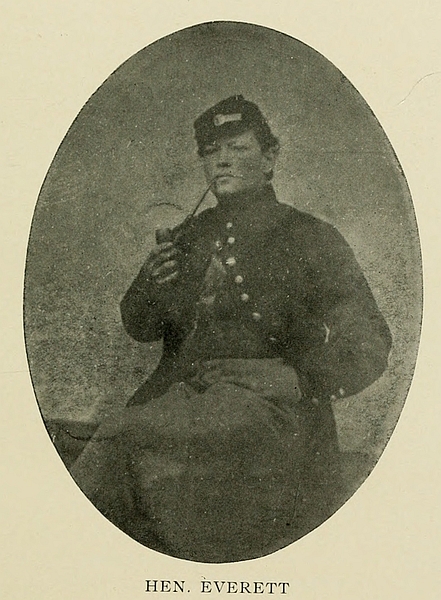
We have run across a good many of our old brigade boys, and they were mighty glad to see the Second again. Ran across Hen. Everett today. Also Stearns, who used to keep store in Manchester. He was on a sutler’s wagon—is sutler for some Pennsylvania regiment, I understand. A two-years regiment, whose term had expired, passed us on its way home today.
Rappahannock Station, June 13.
We have had a hard march today and I am very tired. The dust was simply stifling, and some merciless old rascal on horseback, at the head of the column, evidently set the pace and gauged the capacity of the men at what he and his horse could do. We were hustled right along, hour after hour, without a moment’s rest. Fool orders were read in the morning, that if three men straggled from any one company the officers of that company would be tried by court martial. But this did not prevent straggling, for many men simply could not keep up—especially our Seventeenth recruits.
We are getting mighty hard up for grub and are anxiously looking for our supply train. When I started out this morning I had a piece of boiled salt pork about as big as two fingers. At noon we halted about three-quarters of an hour for rest and refreshments. We were short on both. Other troops had camped on the same ground and moved on, and among the embers of one of their campfires I saw some ribs of fresh pork. Some old Virginia razor-back had died to make a Yankee holiday, and perfectly good pork had been recklessly and wastefully thrown onto the coals. I pulled out a chunk that looked good to me, carefully scraped and pared off the charred outside, and never had a better pork roast than I got by picking those ribs. Tonight I made a sumptuous repast on hardtack and water. I missed, however, the “one day’s solitary” that usually goes with that fare up in New Hampshire.
We do not know whether or not we are to go back to our old brigade, but we are now with the old Excelsior Brigade. Rappahannock Station, where we are camped, is a fine location—open, rolling country, with two or three little redoubts in sight from our camp. The rebels are on the other side of the river, and we have a strong force here, facing them. It is getting so dark I can hardly see, so good night.
Sunday, June 14.
We drew three days rations today and are under orders to be ready to march at a moment’s notice. Three regiments from this brigade are on picket, and it is very evident that trouble is apprehended in some direction. We will probably move from here very soon, and the fact that our wagon trains are not brought up here is a pretty good indication that we are going to move fast and don’t want to be encumbered with a train.
I had as much beefsteak as I could eat this morning. George Lawrence cut up the fresh beef, and as pay for his trouble took what he wanted for breakfast. This noon we were served with “beef soup”—the water in which our fresh beef was boiled, with hardtack crumbled into it.
We are camped, I am told, on one of the estates of John Randolph, well known in Virginia history. One of the natives tells me the soldiers have burned thirty-five miles of fences on this plantation. I suppose while I am here by the Rappahannock, crouched in my tent and wondering if those dark clouds over yonder mean rain, you are listening to the words and admonitions of good old Parson Wallace.
We have just had a little excitement. Three foolish hogs ventured out into sight upon the meadow on our front, and more than two hundred whooping savages started out in chase and killed two with clubs.
We have just got word that we are to march tonight at sunset, and of course are speculating as to the movement. The favorite opinion of our most astute camp strategists is that Hooker is going to fall back to Washington and the Potomac, and that we are way up here as a sort of rear guard, to give the rebels a hack if they try to crowd too hard. I have got back again to the old, careless army spirit of don’t-care-a-cent, and take everything as philosophically as circumstances will permit. We have just heard the roar of guns in the direction of Warrenton, which is ominous. I have had all the cherries I could eat today. Have been jotting this letter down, bit by bit, through the day. The old fellow who lives in a house near the camp has a son who is a colonel in the rebel army. “Curley” Converse is smashing up a blacking brush that he won’t carry any further and won’t leave for the enemy. He says: “If I had a house out here I would burn it up before I would let those fellows have the use of it.” I must pack up now and be ready to march.
Manassas Junction, Tuesday, June 16.
After a most exhausting march we find ourselves here at Manassas once more. We left Rappahannock Station Sunday night at ten o’clock and marched to Catlett’s Station—about fifteen miles—arriving there yesterday morning at seven o’clock. At two o’clock in the afternoon we continued on to this place—another fifteen miles. When we arrived here, about midnight, I was actually all in. Half a dozen of us, all in the same condition, consulted together and decided that if the column passed out of the line of rebel redoubts we would drop out, get a little rest and sleep, and chase on and catch up with the regiment early in the morning. We fell out, went up into one of the redoubts, laid down on the grass carpet that covered everything, and slept. We were up before sunrise, and the first thing to greet our vision as we looked over the parapet was the old regiment bivouacked out on the plain, only a few rods beyond.
It was a frightfully hot day yesterday and a number of the men were sunstruck. George Lawrence was one of the victims. Every one of the Seventeenth men gave out. We marched over the same road as a year ago, and several men were sunstruck at that time.
I saw Sam. Newell yesterday—one of the boys who went from our company into the regulars. He said Perk. Lane was either killed or wounded and taken prisoner, in the fight at Beverly Ford. The last seen of him he was shot from his horse and surrounded by rebels. Nich. Biglin—our famous “Heenan”—has gone up to one of the gaps in the mountains, with the pioneers, to obstruct the roads against the rebels.
During our march night before last our whole division made one of the most ridiculous breaks on record. We were marching along the railroad when, at a highway crossing, a runaway horse bolted into the column. It got the right of way right there, and the men beyond, unable to see what the trouble was, got off the track without stopping to ask any questions. It went through the whole division like the tumble of a row of bricks, and the ditches, stumps and pitfalls made an awful mess of things.
There has just been a little excitement out in camp. Some of the men rushed a couple of sutlers’ carts that were passing. One of the sutlers whipped up and managed to get away after a smart chase, but the other was not as fortunate. The raiders surrounded his cart and tipped it over, and would doubtless have robbed him of his stock but for a mounted officer who plunged into the crowd and put a stop to the lawless raid.
XCIV
Camp near Centreville, Va.,
June 18, 1863.
I HEARD, last night, that a mail was to go out this morning. I had an unfinished letter in my knapsack, but it was so dark I could not see to write; so I did it up just as it was and put it in the bag. They say we will get a mail before long, and then I shall expect enough accumulated reading matter to keep me busy for a while. Today is the hottest yet. I could not stand it in camp, so I went over and filled my canteen with cool, fresh water, gathered up my writing materials, and came down here into the shade of the bushes. Now I will tell you what we have been doing.
As I have written you, we got into Manassas about twelve o’clock Monday night. We lay on the plains all day Tuesday, and drew three days’ rations. The meat ration was salt pork only, but we were very glad to get that. I had the use of a fry-pan for a short time, sliced and fried the whole of my ration, and carefully packed it away in my haversack, convenient for transportation.
We turned in for a night’s sleep, Monday, but didn’t get it. An orderly came in about midnight, with orders, and the regiment was moved out about two miles on the Centreville road and deployed as pickets. I was on camp guard that night, and had not had a wink of sleep when we started. O, how sleepy I was! I actually fell asleep walking in the ranks, until I would wake myself by running into the man ahead of me. When the regiment was distributed as pickets, the camp guard detail was held in reserve, and had nothing to do but wait for something to turn up. I sat down without loosening a buckle of my equipments, leaned my back against a small tree, and was asleep on the instant. I slept perhaps a couple hours, and then woke up out of a nightmare. I dreamed I was in swimming and dove to the bottom, but when I tried to come up again it was no go. I kicked and struggled in vain. When at last I awoke I found I had slipped away from my tree and was lying with my head down hill, but so cumbered with my harness that I had hard work to straighten myself out again.
Wednesday morning the entire Fifth Corps passed us, and then our regiment marched down to Blackburn’s Ford and waited for the division to come up. We got away from the Ford about three o’clock in the afternoon and marched three or four miles, to our present position about a mile out of Centreville on the old Bull Run road.
What I am suffering for now is a newspaper, so I can find out what is going on. I have not seen one since we left Washington.
Gum Springs, Va., Sunday, June 21.
We have made another hitch, about a dozen miles, and now find ourselves in this great Virginia metropolis, consisting of a meeting house, a cooper’s shop, and half a dozen houses and hog pens, none in very good repair. We marched here day before yesterday, leaving Centreville after noon and arriving here before sunset. The fool camp story now being passed from mouth to mouth is that the corps is now surrounded by the rebels. There can be no question, though, that there are any quantity of guerrillas lurking around, and a man outside the camp lines does well to keep his eye peeled. [This was Mosby’s country.] It is said they picked up some thirty stragglers on the march up here. Yesterday they scooped in one of General Birney’s aides and two of his orderlies. A couple of them made the mistake of their lives yesterday. The lieutenant-colonel of one of the New Jersey regiments with which we are now brigaded had dismounted and gone some distance from his horse, when he spied two innocent-looking “farmers,” with shot-guns in their hands, coming the sneak act. At the proper moment they looked into the yawning muzzles of two six-shooters, with a very determined Yankee behind them, and didn’t hesitate a moment in accepting his polite invitation to drop their guns and come along.
We had one of the heaviest rains I ever saw, Thursday afternoon. I did not have any tent pitched, but sat down on my knapsack, covered myself in with my rubber poncho and let her rain. It did much good by laying the dust for a few hours. That night there was a very large detail from our regiment, for picket, and my good luck kept me off the job. Charlie Parrott [killed, a few days later, at Gettysburg] was one of the detail, and I loaned him my poncho in exchange for his piece of shelter tent. That night several of us joined together and patched up a shelter with as many gable ends, almost, as there were pieces of tent. We made a very thick bed of leaves and bushes and managed to keep pretty dry and comfortable, notwithstanding there was a good deal of rain through the night.
We are camped in a very pretty location, on a little ridge with a railroad along its crest and a little creek at the foot. Just across the creek is the little hamlet of Gum Springs. There is a spring there with reputed medicinal qualities. Ed. Kenniston and I have pitched our tent in the shade of a mammoth persimmon tree.
There is a commotion now in that select corps familiarly known as “bummers,” such as cooks, officers’ waiters, &c. There is an order that every enlisted man shall tote a gun. This means that our kettles will be thrown away and every man be his own meat cook. But that won’t make much change. We have been on a salt pork diet, almost exclusively, and every man has been privileged to fry, broil, or eat raw, according to his fancy.
The big guns are booming over towards the mountains, and in compliance with orders we have put ourselves in marching order—knapsacks packed, &c. But I have pulled my portfolio out to write a little more. We may move today, or we may not, but we are ready. Several prisoners have been brought in today—probably scouts or guerrillas. Our bands are playing all the time and making all the noise they can, possibly merely for their own amusement. The firing off to the west is growing heavier, and there is evidently a lively little fight on somewhere.
Monday Morning, June 22.
Late yesterday the long-expected mail came, and with the rest were two letters from you. We were formed in line, ready to march, when the mail was distributed, and as I looked down the ranks I could see many a man leaning on his gun and eagerly scanning his news from home. We didn’t have a very long march—about six rods. The corps was placed in battle order ready to entertain company in case the Johnnies should see fit to honor us with a call.
I was on guard last night, but only had to stand one round, so got a good sleep. The mail goes out at ten o’clock this forenoon. I ran across an old friend the other day, in the Seventeenth Maine—George Parker, who once lived on the Corporation. I am pretty well supplied with meat now. When George Slade distributed the rations he saved me out an extra piece big enough for a good square meal. It pays to be all hunks with the cook.
XCV
Taneytown, Md., June 29, 1863.
I AM awful, awful tired; but we got a mail tonight, the first in some time, and as a mail goes out tomorrow morning I must write a few lines to let you know I am alive and well, but pretty well used up from the tremendous marches we have been making. We have been constantly on the move, tramping from sun rise to sun set, and sometimes far into the night; but we are now halted a little earlier in the day than usual, within five miles of the Pennsylvania line. There is much I would like to write, but as it is almost dark now I must wait until we get into camp for a day or two, if we ever do. Good night! Send me a few stamps.
XCVI
Taneytown, Md., June 30, 1863.
MY NOTE of last evening will let you know I am still alive. As there are no signs as yet of an immediate movement, I will commence a letter, not knowing when I will have a chance to finish or to send it. The Second Regiment, in company with two other regiments, left Gum Springs on the afternoon of Wednesday, the 24th, marched out about three miles on the Leesburg road, camped, and threw out patrols on the road and in the neighborhood. The boys foraged about and brought in an unusual abundance of fresh meat of all kinds. As for myself, I not only gorged at supper, but had my haversack loaded when we started in the morning. There was a house close to camp, occupied, so far as we could see, only by two solitary women. Some of the boys discovered a great quantity of bacon in storage—enough, in fact, for a small army. They intimated to the women that it looked very much as if they had unearthed a guerrilla base of supplies. It probably was a good guess, and the women were very much frightened. But our men wanted that bacon, and a business arrangement was concluded under which the women were paid a fair price for it in good Yankee money.
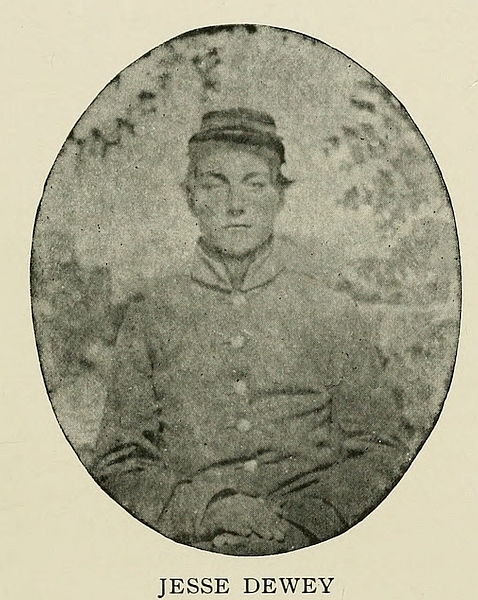
Thursday forenoon the whole corps marched past us and we fell in and brought up the rear of the column. That was a hard day’s march. Late in the afternoon we reached the Potomac at Edwards’ Ferry. There were three pontoon bridges over the river, on which we crossed over into Maryland. As it was near night and raining we expected to halt somewhere near the ferry. But we were not permitted even to cross the canal to the turnpike beyond. Instead, were switched onto the towpath of the Ohio and Chesapeake Canal, heading up stream. The night settled down, dark and gloomy, but no halt or rest. There was no place for either. The path was but a mule track with the canal on one side and the river on the other. Occasionally there was a little point or elbow of land on the river side. Then the rain came, and we were soaked. The towpath became muddy and slippery. The men had not had a chance since morning to cook coffee. By ten o’clock there was no organization left. The division was a straggling, swearing, disgusted mob. The men “went into camp” whenever and wherever they could find a place big enough to lie down on. I dug along until I was all in. I slid down the bank to the river’s edge, along with Jess. Dewey and Joe Gleason, and camped down on a pile of brush. Jess, was a fair example of the utter demoralization. He was the color-sergeant and had the regimental colors with him. “Anybody that wants to carry the flag can have it,” he said, “but I won’t lug it another inch.” The rain was pouring, and all I could do was to cover myself with my piece of shelter tent and take what came. I had lost my good old rubber poncho at Edwards’ Ferry—sat down on it while waiting a passage, and forgot to pick it up when I started for the bridge.
Friday morning we cooked coffee, had a good breakfast, and started up the towpath again. There was no chance to get out of the trap till we got to Monocacy Bridge, fifteen miles from Edwards’ Ferry. There the General—who probably has learned something about driving cattle—collected his command as they came straggling along for hours. We camped, that night, about a mile from Point of Rocks. I had a share in a big fire of fence rails, and made up in a great measure for the discomforts of the previous night. Had a great warming up and drying out, hung my boots before the fire, got into my reserve pair of stockings, and slept soundly and restfully.
Saturday we marched through a very rough, broken country. We passed through one village—Jefferson. South Mountain, where the battle was fought last fall, was in sight all day. At night I was detailed for brigade camp guard. The brilliant idea of a camp guard in that place was conceived by the colonel of the Ninth New Jersey, commanding the brigade. It was about as much use as a second tail for a cat. I felt that I had done enough marching for one day, so when I was posted I laid down where I could watch my beat and, of course, went to sleep. I didn’t wake up until “Curley” Converse, on the next beat, shook me and told me the relief was falling in. I was greatly relieved, on looking around, to find that nobody had run away with the camp in my absence.
When we started out Sunday morning we were assured we were going only nine miles—to Frederick City. We marched to that place on a splendid turnpike, over a mountain with an unpronounceable name, and arrived in good season. We found quite a town, old and quaint, largely built of brick. But we did not stop according to the advertised schedule. We pushed on and on until we had passed through Walkerville, about eight miles beyond. The first thing on getting into camp, we were ordered not to take any fence rails, as wood would be hauled to us. It was late, and we couldn’t wait the arrival of wood teams, in which we didn’t take much stock anyway. But the men were sparing in their use of rails. It didn’t take many to cook our coffee and keep all the campfires we needed.
Yesterday morning we started again, early, and marched to this place, which is, I should judge, about fifteen miles from Walkerville. We are now in a country where the people are our friends, and where the Old Flag and cheers for the Union are the rule and not the exception. We can buy about anything we want in the grub line, as the country has not been ravaged and plundered by the armies. I have just had a good meal of home-made bread, right out of the oven, with delicious butter. The butter was a streak of luck for me. Strolling off a little ways into the country, I saw a swarm of men from various regiments at one of those stone spring-houses which answer the purpose of an ice-box in this country. An old lady was peddling out her stock of butter in pound pats, and there were a dozen hands reaching for every ball. Being a late arrival and on the outskirts, it didn’t look as if I was in the game. But I was. The old lady held the last ball in her hand. There was a wild competition for that. “No!” she said, decidedly, “this belongs to a gentleman over there; I promised him he should have one, sure.” “Thank you, ma’am!” I called out, “I knew you wouldn’t forget me!” and I reached over half a dozen heads, got the butter, passed over a quarter, and struck for camp.
Just now, old Dan. Desmond is assuring me, “By cripes, Mart., ye’ve saved me life.” And I don’t know but what I have. The old man was off his feed and flat on his back, in almost complete collapse, when I sailed forth. I divided my plunder of fresh bread and butter with him, and he ate ravenously, and in a little while was on his feet, bright and chipper. He got just the medicine he needed.
The talk is that we are not going farther today. We hope it is so, for we need rest badly. Today I look all your letters from my knapsack and fed them to the flames. Several times I have come near losing my knapsack and all it contained. I have a bad toothache and am afraid of neuralgia.
General Sickles returned to the corps yesterday, and the men are giving him the credit for the long rest we are enjoying. Birney and Humphrey are not as careful of the men as Sickles. The wish is perhaps father to the thought, but the report is that Humphrey has been censured or disciplined in some way for that towpath scrape. We saw General Marston in Frederick and cheered him heartily. The sun is out and we have orders to pack for a march.
XCVII
Gettysburg, Pa., July 4, 1863.
I WRITE on the blank pages of an orderly’s book, which George Slade picked up. It is the only paper I have, as I lost my knapsack and all its contents in the battle day before yesterday. Our corps was engaged that day, and the Second Regiment was in the very fiercest of the fight and met its heaviest loss yet in any one battle. About two hundred are gone out of our little regiment, but, as usual, I came through all right. I don’t know now how I did it. While we lay supporting a battery, before we had fired a shot, one shell burst right in my group. The man who touched me on the right [Jonathan Merrill] had his thigh cut away, and the two at my left [Lyndon B. Woods and Sergeant James M. House] were very severely wounded—and I never had a scratch. Talk about luck! A little while after, we charged to save the battery, and it was a wild time. As many of our wounded were left in the hands of the rebels, no accurate list can be made now. Charlie Vickery and a Seventeenth man in my company are killed. [Vickery did not die until the 11th.] Joe Hubbard, Lieutenant Dascomb, Frank Chase and Johnny Barker are among the killed. [Barker recovered from his terrible wound and lived many years with a trephined skull.] Ed. Kenniston was shot through both legs. I blundered onto him in the field hospital near where we bivouacked. He was lying by a stone wall, in a field packed with wounded men. He had lost everything but the bloody clothes he wore. I fixed him up with what I had left—filled my canteen with water and laid beside him, with my haversack, in which there happened to be a few really tasty pieces of grub.[1] Ed. wants father to go down and tell his folks it is only a flesh wound, and with a little assistance he will be able to stand on his feet.
George Slade wants me to send you this wayside rose that he picked on the battlefield. The Johnny who had the overhauling of my knapsack got a fine picture of a certain black-eyed Yankee girl, but he didn’t have the reading of any of her letters.
A shell burst right on our colors, early in the action, breaking the staff into three pieces. The batteries were so close together, some of them, that they threw grape at each other. I never was under such an artillery fire. Gen. Sickles lost a leg.
There was a great fight yesterday, but not over the same ground as the day before. The rebels made a tremendous effort to smash our lines [Pickett’s charge,] but were thrown back in great disorder and leaving a great many prisoners in our hands. We were not in it, simply because they didn’t happen to hit the part of the line we were holding, but struck a little to our right. Today we are waiting for something to turn up. Out to our front the skirmishers are industriously popping away, but it is a little early for the real business. Before night, somewhere along the line, we will probably have a real old-fashioned Fourth of July celebration, with plenty of fireworks. The armies are holding practically the same lines we started in on here, but the advantage is surely with us.
Our new recruits stood up to their work like men—none did better. I cannot write more now, but when this fight is over and I can get my hands on some writing paper, I’ll try to do better.
XCVIII
Camp near Boonsboro, Md., July 11, 1863.
KNOWING how anxious you must be to hear from me, and having a little spare time on my hands, I have traded a postage stamp for a sheet of paper and an envelope, and here I am. We have been doing some pretty tall marching since I last wrote. The rebels retreated from Gettysburg, leaving their dead unburied and thousands of their wounded as prisoners. Our army started at once in pursuit, our corps being, I think, the last to get away. I had ample time to go, at my leisure, over a good part of the field. And I got rid of that toothache that I told you about. For two or three days I wasn’t thinking much about my teeth. But when the strain was off a little, it all came back, and at last I got simply wild. Bill Stark [hospital steward] gave me some powder—morphine, I think—to tuck in, but I might as well have used so much flour. Our surgeons said they didn’t have a pair of forceps in their entire kit that they could tackle that tooth with. So I started out to find somebody that had. I had determined, if necessary, to go into Gettysburg, or even to Baltimore, to find a tooth-puller. The surgeon of one of the New Jersey regiments was my Good Samaritan. He was all packed up, ready for a start, but he overhauled a mule’s load, dug out some forceps that looked like a pair of tongs, seated me on a cracker box, and fastened on. That was the only time, in my experience, that it really felt good to have a tooth pulled.
Our corps left Gettysburg at two o’clock on the morning of July 7th, and now we are lying out here, somewhere within a thousand miles of Boonsboro, they say. Since the battle we have had reinforcements enough to organize a third division, and it is said to be larger than the other two combined. We are being hustled around pretty lively, and are likely to be rushed off in any direction at any moment. Last night we went into camp on Antietam battlefield, and I had just got to sleep when we were tumbled out and started off again. I marched and marched and marched, until I was completely fagged out. Then Jess. Dewey and I turned in by the side of the road, slept soundly and comfortably until morning, then raced on and caught up with the regiment. Just at this immediate time Company I is a little topheavy. Herm. Sleeper and I are the only privates on duty, with five non-commissioned officers. The rest are used up and camped along the roadside, or in hospitals. The Army of the Potomac is doing some great marching and is in good spirits for a fight. We are sorry to lose General Sickles. He is very popular with the Third Corps, being very considerate in marching the men. Right or wrong, the average estimate of Birney is that he classes his men along with his horses and mules.
I do a little foraging now, but not as much as when in Virginia. But I pay for everything I get here, except apples and plums, while in Virginia I enforce the principle of confiscation. I have fried apples about every day. I got a pound of splendid butter yesterday for twenty-five cents, and once in a while I get a loaf of bread, some biscuits, or a pie.
Jess. Dewey and I have made a calculation, and find that since leaving Falmouth we have footed it about three hundred miles. My load was materially reduced by the loss of my knapsack. I picked up another one, but all I am carrying in it just now is a single piece of shelter-tent cloth. One of the bummers attached to the regiment found a box in a ditch, at Emmitsburg, containing two hundred dollars, mostly in gold. [The finder was a disreputable camp follower familiarly known as “Culpepper”—the brother of one of our officers—and there is reason to believe that his loot was the poor-box of the convent at Emmitsburg.]
XCIX
Camp near Sharpsburg, Md., July 15, 1863.
WE ARE now lying in camp with a promise of remaining all day. Not a word have I had from you for many a day. We move so often and travel so fast that we cannot complain if the mail wagon doesn’t catch up with us. The rebels have escaped across the river out of the net we boys fondly hoped had been thrown around their army, and now we are anticipating another series of hard marches. Yesterday morning our skirmishers advanced upon the rebel positions and found them abandoned and the rebels across the river. This morning the Thirds Corps started at six o’clock and marched until two in the afternoon with but one halt of a very few minutes for rest. You can be sure the man and horse who set the pace at the head of the column came in for the usual amount of cussing. The day, although cloudy, was very hot, and the road was lined with stragglers.
We came pretty near having a wild riot here this afternoon. We were no sooner in camp than a sutler pitched his tent close by and opened up for trade. Pretty soon there was a big crowd around his establishment, and some of the lawless began to steal and pilfer. He very naturally tried to protect his property, and soon there was a wild tumult. It looked as if the guard that had been posted would have their hands full to save any part of his gingersnaps and cheese. The major of the Sixth New York Heavy Artillery, a young bud with shoulder-straps as big as a barn door, rushed down from their camp, near by, and made himself conspicuous. His regiment had never seen active service, having done garrison duty at Baltimore and Harper’s Ferry, and when he ordered the dirty old fighting men to go to their regiments it was like waving a red flag before a bull. One of our small boys—a camp follower—told him to go to H—ot Place. The major made a reach for the boy and missed connection, then foolishly chased him into our camp, and caught him. Then somebody knocked the major down, and somebody else picked him up and pitched him out of camp. In a few minutes his regiment was seen to be falling in, under arms, whereupon the Sixth New Jersey bugles sounded the “Assembly,” and every other bugle in the brigade caught up the call. Just at this time General French came tearing up, who listened to the major’s story and bluffly told him he had no business or authority in that camp—and that was the end of it.
We passed over Antietam battleground today—where Hooker fought, and the bridge Burnside carried by a charge. I have a rebel roundabout, cartridge box, and plate with letters “C S” on it. I inclose an Indian arrow head I picked up in the road. It rains almost every day now, and we must go to work pretty soon and put up our shelter. Jess. Dewey, Bill Pendleton and I are hitching up together just now.
C
Camp at Ashby’s Gap, Va., July 21, 1863.
CAME up to this place yesterday, and may stay here two or three days, as it is quite an important position just at the present time. On the one hand is the little village of Upperville, now devastated and dilapidated; on the other hand is Ashby’s Gap, a pass through the Blue Ridge. We are camped in fields on the slope of a mountain, from which point there is a broad view of the country far to the east. The bleached skeletons of horses tell of fierce cavalry fights, at various times, for the possession of the gap; and close to our camp are four fresh graves of men killed in Stahl’s fight with Stuart. It is a country of wornout land nourishing a big crop of blackberry bushes. No sooner are arms stacked than the men make a break for blackberries, and even an army can hardly make any impression on the supply.
You will probably see Steve Smiley at home before long. Three commissioned officers and six enlisted men from each regiment are going home to drill the drafted men, and Steve expects to be one of the detail from this regiment. Perhaps I will send this letter out by him. Our mail is a very uncertain factor, both coming and going, judging from the fact that you had not heard from me a week after the battle. But as my name was not in the killed and wounded list you were probably not much worried. We are drawing nice ham for a meat ration now. I found a lot of little onions in a deserted garden yesterday.
Four of our wounded officers have died in the hospitals. Charlie Vickery was shot through the back, injuring his spine. The rebels robbed him of everything he had. A rebel major came along, asked him some questions, then ordered some rebel soldiers to carry him to a barn near by and leave a canteen of water with him. The next day this barn was in the line of fire, and he was wounded again, slightly, in the shoulder by a grapeshot. When our men got possession of that part of the field he was carried to one of our hospitals, where he died on the 11th. He would not believe he had got to die, and did not send a word to his wife; but after he became speechless he tried to whisper something to one of the boys, but could not make himself understood.
We crossed the Potomac at Harper’s Ferry on the 11th. I have seen some wild places, but never any to beat this. Two rivers here unite, rushing down between towering perpendicular cliffs, with only room for a road between cliff and river. This is the second anniversary of the battle of Bull Run. Two years ago this very minute I was making good time toward Centreville. And here I am, only one day’s march away, and still on the job. But we will win.
CI
Washington, D. C., July 28, 1863.
SUDDENLY and unexpectedly, after all our troubles and tribulations, the Second Regiment finds itself in clover. Day before yesterday we were marching through Warrenton, sweating and puffing, when we saw General Marston standing in front of one of the houses and looking mighty pleasant and smiling. Pretty soon it was passed along that he was up there to get the Second, Fifth and Twelfth regiments for the formation of a New Hampshire brigade to serve under him in his new department on the lower Potomac. It seemed too good to be true; but when, after our next rest, the corps marched on and left us, it began to look as if there was something in the story, after all. Then we marched back to Warrenton and camped by General Meade’s headquarters until yesterday morning, when, about ten o’clock, we loaded onto a train of flat-cars, and at nine o’clock last evening we arrived in Alexandria. After waiting over two hours for cars to bring us up to Washington, we “huffed it” about half way to Long Bridge and bivouacked until morning, then continued on, took possession of the “Soldiers’ Rest,” and are waiting for orders.
General Marston’s department, I understand, is to be called the “Department of St. Mary’s,” and will take in St. Mary’s county, in Maryland. It is on the lower Potomac, and probably a depot for prisoners of war will be established, the guarding of which, with the prevention of smuggling, will comprise our duties. This will be an agreeable change from the past few weeks—to be in a settled camp, no more long marches, mail and rations regular, a chance to bathe, fish, and have a good time on the water. We expect to stay in Washington a few days, though, until we can get new clothing, and perhaps be paid off. I shall lay in fish lines and hooks among my prime necessities.
Now I will go back and tell you what else we have been doing since I wrote last. Last Wednesday, the 22d, the Third Corps left Ashby’s Gap and reached a little railroad station called Piedmont, and the following morning marched to Manassas Gap. This pass is about five miles long, and when we got there the rebels held one end and our folks the other. Our cavalry had been skirmishing with the enemy for three days, and this day we moved in and took our turn. The fight commenced early in the afternoon. The rebels had a strong position along the crest of a high hill or ridge [Wapping Heights] that blocked the western end of the gap. For a time our brigade lay massed on the lower slope of an opposite hill and watched the preparations. And when the movement started there was something about it that reminded me of some of the “dioramas” you and I have seen in Manchester. There was the steep hillside, with the long line of blue dots—our skirmishers—crawling up and up, and the solid blue lines of the supporting regiments not very far behind. The height was soon carried, and we pushed on beyond, our brigade two hundred yards in rear of the Excelsior Brigade, which we followed and supported.
The Excelsiors made one charge, and it was a hustler. They and the rebels were facing each other across a deep, rocky gulch. The Excelsiors charged down through this with a yell. Colonel Farnham, of the Second Excelsior, and Gen. Spinola dashed ahead of everything, on their horses, and took two rebel sharpshooters prisoners, although Spinola was badly wounded. Farnham was the captain of the slave ship “Wanderer,” which was the cause of so much excitement a few years ago. By this day’s work the rebels were cleared entirely out of the gap.
The next morning our division advanced into the Shenandoah valley, the entire Second Regiment being deployed as skirmishers in advance of the column. We had not gone thirty rods when, on coming into the road, I came upon the sprawling form of one poor Johnny who had met his fate the previous day. He was apparently fighting in the shelter of a sunken road, when a bullet pierced his brain and he rolled down the bank to the roadbed. The cartridges were scattered from his open cartridge-box, and picking one up I noted it was of peculiar construction. None of us have ever seen one like it before. The paper is set firmly in the base of the bullet, so all one has to do in loading is to break the two apart with his fingers, pour his powder and ram his bullet home. It is the toothless man’s sure-pop cartridge fast enough. [I still have it among my war relics.] We advanced clear to Front Royal without any serious opposition, then rallied on the colors, about-faced and marched back to the gap.
I intend to carry this letter down to the post-office myself, so you will be pretty sure to get it. Hen. Everett is going down before long and I will wind up so as to go along with him.
CII
Point Lookout, Lower Potomac, Md.,
August 1, 1863.
WE HAVE a mail at last, and I was fortunate enough to get four letters from you. Now that we are here, it looks as if I would not have much of anything to do except to write letters. We got here yesterday forenoon, and are now fairly well settled. We are camped close to the beach, on smooth, level ground. We have A-tents and a plenty of them, so we are not crowded for room. Dan. Desmond and I have a tent all to ourselves. Jess. Dewey is acting orderly-sergeant, so he has his own tent.
Afternoon.—I was called away rather suddenly this morning, to go on guard. Now, coming back to the guard headquarters from dinner, I have brought my writing materials along, so as to finish my letter today. Talking of comfort! I am sitting in the shade of big pine trees, within two rods of the shore of Chesapeake Bay, a delicious breeze blowing from the water and the waves rolling up on the beach. [This was at General Marston’s headquarters.] The first thing this morning, when reveille was blown, nearly every man in the regiment made a dash for the water, for a plunge and a swim. This was a fashionable summer resort before the war. The waters abound in crabs, and the boys have already got to catching them. When I was up to camp this noon one of the boys had a kettleful on boiling. We had a ration of “salt horse” [corned beef] today—the first we have had since leaving Washington for Falmouth. It seemed like an old friend.
On the steamer, coming down, I had a long chat with one of the batch of prisoners we were taking along. He was a native of Alexandria, and on the way down the river he pointed out the places where he had been for a good time before the war. We had been in the same fights, quite a number, and it was very interesting to compare notes. The day we left Washington I was on guard at the gate, and there was a flock of secesh women there to bid good bye to friends and give them things to eat or wear. Among the prisoners was an Irishman who formerly lived in Manchester. I recognized him as soon as I saw him. He was down south when the war broke out, and was forced into the army. He fell out on the march on purpose to be taken and is very anxious to take the oath of allegiance, as are many others, especially the foreigners.
CIII
Point Lookout, Md., August 4, 1863.
THIS forenoon “Curley” Converse and I went out to a creek near camp, hunting for oysters. We found and shucked till we had three pints of solid meats. There were lots of crabs there, some almost as big as lobsters, and I soon found out that a crab is a very pugnacious animal. I ran across one in shoal water hardly deep enough to cover my feet, and playfully tapped him with my knife, just to see him run. He ran. So did I, for I was barefooted and he made straight for my toes, with the water boiling. Soon I encountered another, and just to make sure, I rapped him. He came on like the other; but there was no surprise this time, and I speared him with my knife. The boys bring in bushels of them, and they are excellent eating—as good as lobsters.
George Slade has not been with us for some time, but we expect he will join us soon. [We did not know it then, but he was in fact a prisoner, having been picked up by the rebels somewhere below Harper’s Ferry. He never got back to the regiment, but died at Camp Parole.]
CIV
Point Lookout, Md., August 8, 1863.
ED. BAILEY’S FATHER came down here night before last and is going to be regimental sutler, so they say. There is some pretty sharp talk by some of the Manchester men, who affirm that he would be more at home as sutler for a rebel regiment. I do not know, but I guess we can balance the colonel’s good services against his father’s political shortcomings.
You ask me to tell you about Steve Palmer and —— ——. So the story has got to Manchester, has it? These are the facts: On the first day’s march from Falmouth Steve had some whiskey in his wagon, which he was selling to those who wanted the stuff. —— was officer of the guard that day. He went to Steve and Steve gave him a drink. Then he brought a canteen to Steve and said: “Here, Steve, let me have some whiskey in this canteen and I will pay you when I get some money.” Steve let him have it, and he went directly to the colonel and reported Steve for selling whiskey. Steve was at once taken from his wagon and put into the ranks, and at Gettysburg was very badly wounded, and if he lives will be a cripple for life. [He died of his wounds.] The affair, naturally, has created a good deal of feeling. Steve did wrong in taking liquor upon his team to sell; but there was an element of treachery in what —— did that I wouldn’t want charged up to my credit.
We are living pretty well now, for army rations. Here is our bill of fare for the past three days:
Wednesday: Breakfast—Baked Beans, Coffee. Dinner—Beefsteak. Supper—Coffee.
Thursday: Breakfast—Potatoes, Boiled Pork, Boiled Fresh Beef, Boiled Salt Beef, Coffee. Dinner—Soup, Parsley Greens. Supper—Coffee.
Friday: Breakfast—Potatoes, Boiled Beef, Coffee. Dinner—Boiled Dish of Potatoes and Parsley Greens.
In addition, we have, each day, a loaf of “soft tack,” baked here on the Point, and occasionally a ration of molasses. We call that high living. And Company I is going to have something extra for dinner today—roast beef and potatoes. The beef is roasting in two Dutch ovens.
A big school of porpoises went up the river yesterday. They came so near in shore that some of the boys fired at them, and I should judge hit some, from the commotion that was created and the way they dug away from shore. Ed. Bailey and I struck up the beach for an old boat that lay there, in which to get out and have a crack at them. The colonel had a carbine and an old stocking full of cartridges, and I picked up an ancient oar. We got the craft afloat and I paddled it out quite a piece. But the waves ran high and the water poured through the boat in a dozen places, until it was a question of pull about or swim for it. So we put about and got ashore before the old tub sank. Sixteen of us took a sail out to the mouth of the river two or three days ago. It was very rough and the boat was terribly overloaded, and it was only by good seamanship that we saved ourselves from going under.
I have just run across another Manchester fellow—James, who used to be City Messenger. He is with the Twelfth Regiment sutler.
Now I must tell you the story of Bill Ramsdell, for it is decidedly interesting, although rather rough on Bill. A short time after we came on from New Hampshire Bill went to Concord and reported to Major Whittlesey. Well, no sooner has he reported than he goes away again and is not seen about Concord for two or three days, when he again reports; but this time the major puts him under arrest as a deserter, and when the squad of deserters leave New Hampshire under a guard of convalescents Bill is packed off with the rest. They go to Boston and stop at Fort Warren for a time, and while there the prisoners are put to all sorts of menial work. Part of the time Bill was haying on the parapet, which was not at all bad, but after that he was given a mule’s job, hauling coal. A dozen of the prisoners would load a cart, hitch on and drag it along, dump their load, and so on. All this I learned from George Cilley, who was left in New Hampshire, sick, and who was guarding prisoners three or four weeks. He said Bill took it all very philosophically—he couldn’t help himself. He is now in Washington and will probably be sent to the regiment before long.
The guard duty is divided now so that we do it one week and the Twelfth the next. During our week every man is on guard every other day, but we are not overworked, as we have no drilling to do.
My tentmate, Dan. Desmond, is one of the quaintest old Irishmen you ever met. He loads me with his adventures and experiences until my ribs fairly ache from the laughing. Every night he regales me with some story—and a good one—to go to bed on.
The Seventeenth fellows will be discharged within a few days. Two in my company have died in the service—Tibbetts, killed at Gettysburg, and Ingalls, died of disease.
The laugh is on Steve Smiley, and it is too good to keep. The day we came down from Washington Steve ran down to some place on the street to get some papers—I don’t know just what. But he didn’t get them, because the colonel had been there before him. On his way back to the barracks—only a little ways—he ran into the provost guard, and as he had no pass they gathered him in and chucked him into the central guard house, where they kept him over night. The next morning they let him out and he got on a boat and came down. He is pretty touchy about it, and the boys like to thorn him about patronizing the “Central Hotel.”
The boys catch some nice fish here, among which are sea trout, which the natives tell us will be very plenty in a short time. There is a big kettle of beans on the fire, parboiling, which will be ready baked for breakfast. You see I have to keep bringing up grub matters; but it does seem good to have a plenty.
CV
Point Lookout, Md., August 10, 1863.
I WANT something to do, and so “I take my pen in hand,” &c. And yet, after all, I have been pretty busy this forenoon. We had to move our tents so as to give the officers more breathing room—delicate souls! Then I went out and did my week’s washing in a skillful and artistic manner. When that was “hung out” I watched the operations of a pile driver. We are to have a sink way out over the river, and the piles for its support are being driven into the sand.
The toads here! Their number is legion, of all sizes and conditions. There is the very best of understandings between them and the boys, for they are our dependable fly-traps. The men drive them into the tents rather than out. I am fairly in love with some of the bright-eyed little fellows that are tentmates of mine. They sit so demure and still until a fly comes within reach, when there is the flash of a tongue, and one less fly to plague us. Long live the toads, and may they multiply and increase at Point Lookout.
We had another instalment of rebel prisoners yesterday, five hundred coming down from Washington. I could not help noticing the feeling between the men from North Carolina and those from the Gulf States. On their arrival here the prisoners were formed into companies of one hundred men each, and as far as practicable those from the same state were put together. There were not quite enough North Carolinians for a company, so some Mississippians were put in with them, who began at once to berate their new messmates, twitting them of being unpatriotic, and telling the guard that those fellows wanted to get back into the Union.
Dan. and I are going to fix up our tent. First, we will raise it up a few inches, so as to give the air a chance to circulate under the bottom. Then we will build a couple of nice bunks, one on each side, and between the heads of the bunks a table just big enough to eat and write on.
Tuesday Evening, August 11.
I have been on fatigue duty today. This forenoon I was digging a hole on the beach in which to set a pile post, and this afternoon I helped pitch some tents for the adjutant. About half a dozen of our boys came down on the boat yesterday, some of whom had been in the convalescent camps, or in the distributing camps at Alexandria, ever since the regiment left Washington for the front. But George Slade was not among them, and now I am wondering what has become of him and where he can be.
Company I had fried fish both for breakfast and dinner today. They were fine sea bass, brought in last night by a fisherman in his boat. He had an iron bucket full of blazing pitchwood for a light, and his two little bareheaded children were with him—a boy and a girl five or six years old. They were very pretty, fair-haired, and their appetites evidently had not been spoiled by indulgence, for their father cut slices from a huge loaf of bread in his basket, which they put out of the way, clear, as fast as their little jaws could work.
Well, my boy Dan. has made up the bed and gone to bed, and I guess I will follow suit.
Wednesday Evening, August 12.
I made a great discovery today—nothing less than a newspaper in this out-of-the-way place. It is named Hammond Gazette, and is published for the benefit of the sick and wounded in the Hammond General Hospital. It is a little fellow, just the size of The Literary Visitor that George Batchelder and I used to print. This afternoon I went down and hunted up the office, along with old printer Smith of the Twelfth—familiarly known in Manchester as “Snuffy” Smith. We found quite a neat little office, with a real sociable Vermont printer running the establishment.
About the middle of the forenoon we had a wild gale here, coming off the bay, and the river was full of vessels fleeing to shelter under the Point. Desmond and I went out this evening and brought in a couple boards, which we have cut up into length for bunks; but as we have yet to make a raise on some nails, we will use them tonight for a floor, and I guess we will need one, for it looks as if we were going to have a great shower.
Thursday Morning, August 13.
Last night we had a holy terror of a storm. The wind blew almost a hurricane, the water was a continuous deluge, and the thunder and lightning were terrific. Many of the tents went down, but ours stood up nobly. Those boards of ours were a perfect godsend, as a brook of no mean proportions ran through our tent, and we were perched above it, high if not dry. Jess. Dewey’s tent was one of those that blew over, and everything in it got thoroughly soaked. I thought, at one time, ours would have to go. It must have been a sight, Dan. and I each hugging a tent-pole and holding it down for dear life.
CVI
Point Lookout, Md., August 18, 1863.
I WAS terribly provoked this evening. I had just got comfortably settled down to write a letter when I was ordered out on a detail. I soon found it was to load boards, at the wharf, for the sutler. As I was on guard last night, and going on again tomorrow, it looked to me very much like crowding the mourners; and more than that, I did not like being ordered out to do work they have no right to put on a soldier anyway; but to keep peace in the family I went and did the work, and now, at ten o’clock, I have got back to my letter. I have been very busy today, and have something to show for it. Dan. and I got hold of some more boards and immediately proceeded to build a palace. We have a good one, the walls four feet high with our big tent perched on top, a bunk on each side, a table, and lots of spare room, not to mention a well-fitted board floor.
We have an addition to our company in the shape of a contraband who come across from Virginia in a little dugout canoe the other night. We took him in to the cook, and he is earning his keep.
Wednesday Morning, August 10.
We are getting quite a gathering of prisoners here. Several hundred arrived yesterday. The increasing force of prisoners calls for extra vigilance on our part. We now have two Dahlgren boat howitzers posted so as to command the rebel camp, and are going to have four more. The rebels are set to do their own work—to dig wells, build cook houses, &c. In such a crowd you will always find a proportion of smarties, and a few of the lordly ones kicked up a rumpus and swore they would not do any work for the United States. They changed their mind when they were strung up without any parley, and the joke of the thing was that a good many of the prisoners were tickled to death to see them disciplined.
Did you ever know Sam. Newell? He was one of the squad that enlisted from our company into the regular cavalry last fall. When we were in Washington on our way down here, he came on from the front with a lot of dismounted cavalrymen, and when we came down here he simply got homesick. So he got on board the boat and came along with us. This was nothing more nor less than desertion, and he was arrested here and put under guard. But one fine morning Samuel turns up missing and is not heard from again for several days, when he appears at the guard house under full military escort and is again in the toils and more carefully guarded than before. When he ran away he went up country about forty miles and let himself to work in a sawmill. The owner has a schooner on which he ships wood down here to the Point, and the next trip he made Sam. came along to help work the boat. He kept pretty shady while they were unloading here, but one of our officers got his eye on him and Sam. was ingloriously dragged out of his hole. I guess most of those fellows who went into the cavalry wish they had stayed with the old Second. They missed that long furlough at home, and life with the regulars is not like soldiering with your own crowd of old-time friends and acquaintances.
CVII
Point Lookout, Md., August 22, 1863.
IRENE [Mrs. Wasley,] Mrs. Col. Carr and some other women came down on the boat day before yesterday. I got the little bundle, ate the cakes, enjoyed your cooking, and was delighted with the fine towel. We now have four or five times as many prisoners here as there are men to guard them. I put a picture in the mail today. It will look quite pretty framed, but I value it most as a record up to date of the boys of Company I. I only wish the copy had been prepared by some one a little more accustomed to that sort of work.
CVIII
Point Lookout, Md., August 26, 1863.
HAVE just been up to see Mrs. Irene Stokes Wasley, and she had lots to tell me about you—so much she almost made me homesick. Mrs. Bailey came down on the boat Monday evening, and we catch a glimpse of her and the colonel parading. Dan. expresses the opinion that they are a mighty wee bit of a couple.
The other night, while I was on guard at Marston’s headquarters, we had a queer lot there under guard. There were fifteen men who said they had run away from Richmond to escape conscription. Some of them would not take the oath of allegiance, and it is said they will be returned to their friends—sent across and landed on the Virginia shore. They were mostly Irishmen and Jews, and it was the Irishmen who were willing to take the oath.
Now I must tell you of one of the meanest little skunks that ever lived. He is a brother of our second lieutenant. He is familiarly known as “Culpepper,” and the boys hate him devotedly. He is not enlisted, but ran away from the Reform School and came on with us. He is one of the most incorrigible little thieves that ever was. On the march through Maryland, while we were camped for a little while near Emmitsburg, he had a large sum of money which he pretended to have found in a box in a ditch, but which some of the boys now believe was stolen from the poor box of the convent there. Be that as it may, he has been engaged in two or three bad scrapes here which should furnish sufficient cause for having him arrested or sent home. His latest exploit was to crawl into the house of a man named Murphy, near the camp. He got in through a window, and Mrs. Murphy came in and caught him rummaging her bureau. She grabbed him, but he fought and scratched and bit until he got away, and now he is roaming around as big as ever, notwithstanding Mrs. Murphy declares several dollars in money are missing. The young scoundrel says he knocked a bag in at the window and climbed in to get it. His brother pretends to believe he is innocent, and shields him.
We are going in for improvements here, just as they do in other enterprising cities. A brick oven is being built which will take in a pile of beans, meat or bread. Bill Summers, our company cook, is the architect and mason; the next company’s cook is the tender. Clay is used for mortar, and where the bricks come from is one of the company secrets. Another job that it has taken all day to accomplish is the raising of a flag staff, eighty feet high, on the parade ground in front of the regiment.
Evening.—Dan. and I have just risen in our wrath and put an end to—well, I won’t try to tell how many millions of flies. By the judicious application of a couple of towels we wiped cartloads of them from the face of the earth. If any escaped to tell the tale, some fly historian will record August 26 as the fateful day when a wild Irishman and a crazy Yankee ran amuck at Point Lookout. Now Dan. is reading, in peace, an account of the operations at Charleston, the knocking to pieces of Fort Sumter, and wishing we could take the cussed city.