PART III.
Reading edition
ORNAMENTAL ART.
In treating upon this subject, we are led back to the land of the Pharaohs; for the earliest Art records that have come down to us (and, perhaps, the most perfect) are from the banks of the Nile, remarkable for their severely massive character, calm and frigid. The few ornamental details are chosen rather for their symbolical than æsthetic beauty, consisting of local forms slightly conventionalized and heightened with colour. Their ornaments were types and symbols intended to address themselves to the eye, heart, and soul of the beholder, the most frequent in recurrence being the winged globe,—a sacred emblem the Egyptians used in their ornamental designs,—the human figure, their sacred animals, and the lotus, reed, asp, and papyrus. Upon the capitals of Egyptian columns are represented nearly all the flowers peculiar to the country, the petals, capsules, pistils, seeds, and most minute parts, being often exhibited. Capitals are often seen resembling a vase, and at other times a bell reversed. There is little in this style applicable to the decoration of books, unless it be upon works relating to Egypt. Then its symbols afford the binder an opportunity to employ its symbolic ornamentation.
ASSYRIAN AND ANCIENT PERSIAN.
Of this style it is only lately that we have become slightly acquainted; and, though partly coeval with the Egyptian, the Assyrians have borrowed little from them, the details being remarkable for their classic character, at times approaching the Ionic, but greatly dependent upon animal forms for its ornamentation, and upon painting and sculpture for its expression. The forms, often graceful, are less arbitrary than the Egyptian, (where symbolism is paramount,) containing those elements afterwards elaborated into beauty by the Greeks. There is an appropriate fitness in Assyrian ornament that constitutes one of its prominent characteristics. In addition to animals, the pomegranate, fir-cones, lotus-flower and reeds, rosettes, and a fan-shaped ornament supposed to be the origin of the Greek honeysuckle, distinguish the Assyrian style.
GREEK.
Under the ancient Greeks, Art attained a refined and exalted character, material beauty being developed to the utmost; elegance of proportion, chaste simplicity, and conventionalism, triumphant; symbolism disregarded. The principal elements of Greek ornament were the honeysuckle, the lotus-leaves, the wave-line and scroll, the zig-zag, and the universal fret. The beauty of Grecian ornament consists in its equality of foliage, starting-points, stalks, and groundwork. Its running figures are well adapted to and are employed for rolls, in side-finishing, and the proportions of this style of Art should be carefully studied by the finisher.
ETRUSCAN.
Simplicity and elegance of form, combined with strong contrast in colour, constitute the distinguishing marks of this style. The Etruscan vases still form models for the artist. The novel appearance of these vessels, all uniformly painted with a tracery of black on a natural groundwork of brownish red, is extremely pleasing, proving the high artistic capability of their makers. In the British Museum there is one room entirely devoted to a collection of these remains of ancient Art. This style is approached in its effects by inlaying with black upon a brownish red. A copy of Caxton's "Recuyell of the Historyes of Troye," bound in this style by Whittaker, has been highly extolled. It is in the possession of the Marquis of Bath. The general effects of this style are represented by a style now much in vogue, called antique, a reddish-brown morocco being stamped upon so as to produce a dark or black figure thereon; but the character of the ornaments are generally dissimilar.
ROMAN.
Roman art is a redundant elaboration of the Greek, in which purity gives way to richness, grotesque combinations become common, and false principles creep in. Mosaic pavements are rendered pictorial by the introduction of light and shade, the flat and round not kept distinct. In the remains of Pompeii we find the degradation of classic Art by the violation of true principles. There is nothing in this style to commend it to the artist, especially in decorating books.
BYZANTINE, LOMBARD, NORMAN.
These varieties of kindred ornament, commencing with the rise of Christianity, were founded on classic details, having a distinct expression of their own. There is much symbolism in the Byzantine, but all are appropriate to their several wants,—the parts rich, judiciously disposed, and purely conventional. In these styles, so intimately connected, we find the interlaced strap-work that suggested Gothic tracery to the great mediæval artists.
MOORISH.
The decorative art of the Arabs is more conventional than any other, it being in most cases extremely difficult to trace the origin of their forms. All animal representations are strictly excluded by the religion of Mohammed. The union of geometrical with floral forms seems to have supplied the expression, many ornaments resembling the ovary of plants, transversely cut and connected with crystalline shapes. The abstract and superficial treatment is perfect, the forms are extremely graceful, and the colouring gorgeous. The interlaced strap-work is highly elaborated. This style is sometimes called the Arabesque, and forms the chief decoration of the Alhambra, an ancient fortress and residence of the Moorish monarchs of Granada. For grace and liveliness this style is unrivalled, and it affords many useful and beautiful hints to the finisher in his hand-tooling, and is well calculated to produce fine effects in stamps designed for the embossing-press.
GOTHIC.
The Gothic is founded upon geometrical forms. The strap-work of former styles is elaborated into tracery, the main lines being circular or curved, starting from vertical lines, ending in points, enclosing spaces divided and subdivided in the same manner, further decorated with conventional ornaments derived from local nature. For bookbinding it is sometimes employed, but without much judgment. The judicious finisher will reject it on account of its inapplicability to superficial decoration.
THE RENAISSANCE.
The Renaissance or Revival arose in Italy in the fifteenth century, by the appropriation of classic details in connection with prior styles, the traditionary giving way to selection and freedom; Art gaining but few entirely new forms, rather subjecting all that had gone before to a new treatment, which in the hands of the great artists of the period produced agreeable results, showing the importance of general design, rendering even incongruous materials pleasing from that cause alone. The Cinque-cento has been considered the goal of the Renaissance and its characteristics,—strap, tracery, arabesque, and pierced scroll-work, a mixture of the conventional with natural forms, and every detail of ancient Art,—producing, under different masters, varied results. Thus, in Raphael's Loggie of the Vatican are to be found, as at Pompeii, elements piled one above the other, without any regard to construction. The same with the works of Julio Romano at Mantua,—painted imitation of bas-reliefs suspended above fountains, temples, &c., the parts often finely drawn and treated, but, taken as a whole, little removed from the absurd, quite unlike the works of the Greeks and Etruscans they sought to rival.
ELIZABETHAN.
The Elizabethan was an English version of the Renaissance, being a special elaboration of the strap and bolt-work, and has been highly useful to the stamp-cutter. Many of its forms can be advantageously employed by the finisher.
LOUIS QUATORZE.
This distinct expression of Art is of Italian origin, being the last of the Renaissance, and end of ornamental styles. It consists of scrolls and shells, an alternation of curves and hollows, the concave and convex in contrast, the broken surfaces affording a brilliant play of light and shade. The effect when gilt being extremely magnificent, colour was abandoned, construction hidden, and symmetry often disregarded, especially in its decline. As to superficial treatment, flat surfaces were studiously avoided, and the few that remained were treated pictorially, in a mellifluous, pastoral style, known as that of Watteau. Under Louis XV. the forms degenerated: symmetrical balance and flow of line were disregarded, giving way to the degraded ornamentation called the Rococo—the prevailing style of the last and earlier part of the present century—depriving Europe for more than one hundred years of true superficial decoration, without which no Art can be considered complete. An attempt at this style may be seen upon the sides of some of the gaudily-gilt albums and books of like character. No finisher need cultivate a love for it, for it is the aversion of all refined artists.
FINISHING.
TASTE AND DESIGN.
It is of the utmost importance to a young workman that he have correct ideas in regard to taste, and be able to distinguish it from caprice or mere fancy. It is in the power of all to acquire a correct taste, for it is governed by laws that can be easily learned, and they are unchangeable. Taste may be said to be a perception and an appreciation of the principles of beauty and harmony as revealed by Nature through Art. Nothing contrary to nature, no violation of any law of proportion or of fitness, can be in good taste. The amateur and book-collector, in commencing the foundation of a library, will do well to pause before they adopt a species of binding that will in after years create a feeling of annoyance, and perhaps lead to pecuniary sacrifice.
A recent writer upon the New York Exhibition of the Industry of all Nations discourses thus:—"We call bookbinding an art; and when we consider all that is necessary to the perfect covering of a fine book, it must be admitted to be an art; less important, it is true, but similar in kind to architecture.
"The first requisition upon the skill of the binder is to put the book into a cover which will effectually protect it, and at the same time permit it to be used with ease. If he do not accomplish this, his most elaborate exhibition of ornamental skill is worth nothing; for he fails in the very end for which his services are required. It was in this regard, too, that most of our binders failed in past years. Who that remembers the hideous, harsh, speckled sheep covers which deformed our booksellers' shelves not long ago, can forget the added torment which they inflicted upon their unhappy purchaser, by curling up palpably before his very eyes, as he passed his first evening over them, and by casting out loose leaves or whole signatures before he had finished his first perusal? In those days, too, there was morocco binding, with a California of gold upon the sides; and such morocco! it felt to the fingers like a flattened nutmeg-grater, seeming to protect the book by making it painful for any one to touch it. This was as useless as the humbler though not more vulgar sheep. It would hardly last through the holiday season on the centre-table which it was made to adorn.
"The binder's next task is to give his work the substantial appearance without which the eye of the connoisseur will remain unsatisfied. The volume must not only be well protected, but seem so. It should be solid, compact, square-edged, and enclosed in firm boards of a stoutness proportionate to its size, and these should be covered with leather at once pliable and strong. Unless it present this appearance, it will be unsatisfactory in spite of the richest colours and the most elaborate ornament. Thus far the mere mechanical skill of the binder goes. In the choice of his style of binding, and in the decoration of his book, if he perform his task with taste and skill, he rises to the rank of an artist.
"The fitness of the binding to the character of the volume which it protects, though little regarded by many binders, and still less by those for whom they work, is of the first importance. Suppose Moore's Lalla Rookh bound in rough sheep, with dark russia back and corners, like a merchant's ledger, or Johnson's folio Dictionary in straw-coloured morocco elaborately gilded, and lined with pale blue watered-silk, is there an eye, no matter how uneducated, which would not be shocked at the incongruity? Each book might be perfectly protected, open freely, and exhibit evidence of great mechanical and artistic skill on the part of the binder; but his atrocious taste would insure him a just and universal condemnation. And yet there are violations of fitness to be seen daily, on the majority of public and private shelves, little less outrageous than those we have supposed. Books of poetry, and illustrated works on art bound in sober speckled or tree-marbled calf, with little gold upon the backs and sides, and none upon the edges! Histories, statistical works, and books of reference, in rich morocco, splendidly gilded!—the idea that the styles ought to change places seeming never to enter the heads of the possessors of these absurdly-covered volumes. But a little reflection by any person of taste, and power to discern the eternal fitness of things, will make it apparent that there should be congruity and adaptation in the binding of books. Sober, practical volumes should be correspondingly covered; calf and russia leather, with marbled paper and edges, become them; while works of imagination, such as poetry and books of engravings, demand rich morocco, fanciful ornaments, and gilding. To bind histories, philosophical works, dictionaries, books of reference and the like, in plain calf or dark russia,—travels, novels, essays, and the lighter kind of prose writing, in tinted calf or pale russia with gilding,—poetry in full morocco richly gilded, and works on art in half morocco, with the top edge only cut and gilded,—seems a judicious partition of the principal styles of binding. The margins of an illustrated work on Art should never be cut away, except where it is absolutely necessary for the preservation of the book from dust, and the convenience of turning the leaves—that is, at the top. It is well here to enter a protest against the indiscriminate use of the antique style of binding, with dark-brown calf, bevelled boards, and red edges. This is very well in its place; but it should be confined to prose works of authors who wrote not later than one hundred and fifty years ago. What propriety is there in putting Scott, or Irving, or Dickens, or Longfellow, in such a dress?"
Hartley Coleridge's opinion on the subject of taste in Bookbinding is thus given:—"The binding of a book should always suit its complexion. Pages venerably yellow should not be cased in military morocco, but in sober brown russia. Glossy hot-pressed paper looks best in vellum. We have sometimes seen a collection of whitey-brown black-letter ballads, &c. so gorgeously tricked out that they remind us of the pious liberality of the Catholics, who dress in silk and gold the images of saints, part of whose saintship consisted in wearing rags and hair-cloth. The costume of a volume should also be in keeping with its subject, and with the character of its author. How absurd to see the works of William Penn in flaming scarlet, and George Fox's Journal in bishops' purple! Theology should be solemnly gorgeous. History should be ornamented after the antique and Gothic fashion; works of science, as plain as is consistent with dignity; poetry, simplex munditis."
And it may not be irrelevant here to introduce the opinion of Dr. Dibdin, whose connection with some of the first libraries in England, and whose intimate knowledge of all the great book-collectors of the same, must tend to stamp him as a good authority on the subject:—
"The general appearance of one's library is by no means a matter of mere foppery or indifference; it is a sort of cardinal point, to which the tasteful collector does well to attend. You have a right to consider books, as to their outsides, with the eye of a painter; because this does not militate against the proper use of the contents.
"Be sparing of red morocco or vellum. They have each so distinct, or what painters call spotty, an appearance, that they should be introduced but circumspectly. Morocco, I frankly own, is my favourite surtout; and the varieties of them—blue, (dark and light,) orange, green, and olive-colour—are especially deserving of your attention.
"The colour of the binding may often be in harmony with its contents. Books of poetry may be red, or light green, or blue, and have as much ornament as may be desired. And Fine Art books, above all others, ought to rejoice in beautiful coloured moroccos and gorgeous ornaments. In the British Museum, books of divinity are bound in blue, history in red, poetry in yellow, and biography in olive.
"Let russia claim your volumes of architecture or other antiquities, of topography, of lexicography, and of other works of reference. Let your romances and chronicles aspire to morocco or velvet; though, upon second thoughts, russia is well suited to history and chronicles. And for your fifteeners, or volumes printed in the fifteenth century, whether Greek, Latin, Italian, or English, let me entreat you invariably to use morocco: for theology, dark blue, black, or damson-colour; for history, red or dark green; while, in large paper quartos, do not fail to remember the peau de veau (calf) of the French, with gilt upon marbled edges. My abhorrence of hogskin urges me to call upon you to swear eternal enmity to that engenderer of mildew and mischief. Indeed, at any rate, it is a clumsy coat of mail. For your Italian and French, especially in long suites, bespeak what is called French calf binding, spotted, variegated, or marbled on the sides, well covered with ornament on the back, and, when the work is worthy of it, with gilt on the edges. Let your English octavos of history or belles-lettres breathe a quiet tone of chastely-gilded white calf with marbled edges; while the works of our better-most poets should be occasionally clothed in a morocco exterior."
The further opinion of the doctor on the style of ornament, &c. in gilding, will be given in its proper place, and which, with that cited above, may be safely acted upon by the binder, blended with such additions as his own taste may dictate.
It is in this state that the defects of forwarding will become more apparent, and which no tact or ingenuity of the finisher can effectually remedy; for, unless the bands are square, the joints free, and the whole book geometrically just, the defect, whatever it may be, will appear throughout, and tend to destroy the beauty of every subsequent operation, from the constraint required to make the general appearance of the work effective.
Before proceeding to a description of the various manipulations required in gilding a book, it will be necessary to direct the attention of the young workman again to what has been advanced relative to care and attention in previous parts of this work, and follow up the remarks there made with others on the taste necessary to be displayed in this most important part of the art of bookbinding. When it is considered that the most celebrated artists have arrived at the eminence awarded to them not only through the elasticity, solidity, and squareness of their bindings, but also from the judicious choice of their ornaments for gilding, and the precision and beauty with which they have been executed, it cannot be too strongly impressed on the workman that this should ever occupy his first attention. Nothing is so disagreeable to the eye as injudicious or badly-executed ornaments; while with chaste and classical embellishments, tastefully applied, an appearance of richness is produced on the volumes that cannot fail to give satisfaction to the most fastidious critic. The sides of the volumes present the field most favourable for the display of ornamental taste, admitting, from their extent, the execution of the most complicated designs. This elaborate style of ornament has been carried to such perfection and splendour as, in many instances, to have occupied several days in the execution of one side alone; but it is only by the most vigorous application, greatest care, and correct taste, that proficiency therein can be attained. With these, success will soon crown the endeavours of the workman; and he will have the satisfaction of finding himself able to imitate any pattern, however difficult, as well as to execute many new designs and compartments, of which, till he applied himself, he had not previously an idea.
As regards the style of ornament, it must be left to taste; but, as before promised, it will now be proper to introduce the remarks of Dr. Dibdin on the general effect of gilding and blind tooling, leaving the detail to be suggested to the mind of the gilder.
"First, let your books be well and evenly lettered, and let a tolerable portion of ornament be seen upon the backs of them. I love what is called an over-charged back, At first the appearance may be flaunting and garish; but time, which mellows down book ornaments as well as human countenances, will quickly obviate this inconvenience; and about a twelvemonth, or six months added to the said twelvemonth, will work miracles upon the appearance of your book. Do not be meagre of your ornaments on the back, and never suffer blind tooling wholly to pervade a folio or quarto; for, by so doing, you convert what should look like a book into a piece of mahogany furniture.
"In large libraries there should not be too much blind tooling or too great a want of gilt. No doubt the ornament should be as appropriate as possible to the book. One could not endure gingerbread-gilt Bibles and Prayer-Books, or Chronicles or Dictionaries, or other books of reference. Let these have a subdued decoration on their backs; bands only full-gilt, or a running edge-tool in the centres of them, with small ornaments between the bands.
It remains to urge that particular attention be paid to the lettering of books being their right titles, as the contrary will present to the judicious an effect the most disagreeable, and may be the cause of producing dissatisfaction with the whole of the binding in the mind of the owner; and also to avoid the contrast which the different shade or colour of new lettering-pieces will give to some bindings.
As it is requisite that the workman should form an idea of the style and design to be executed on the volume before he prepares it for gilding, we will proceed to point out the peculiarities of some of the most prominent styles and of the tools required to produce them. We hope to convey a faithful idea of the latter with the aid of the tools and ornaments executed expressly for this work by Gaskill, Copper & Fry, bookbinders' tool-cutters, Philadelphia, who have secured for themselves, by their taste and skill, an enviable reputation as artists. Plate I. contains an illustration of the species of ornament termed
THE ALDINE STYLE,
Which derives its name from a noted printer named Aldus Manutius, a Roman by birth, who was born in the year 1446 or 1447. His Christian name, Aldus, was a contraction of Theobaldus; and to this surname he sometimes added the appellation of Pius, or Bassianus, or Romanus. The first of these appellatives was assumed by Aldus from his having been the tutor of Albertus Pius, a prince of the noble house of Carpi; and the second was derived from the birthplace of the printer—namely, Bassian, a small town in the Duchy of Lermonetta.
Aldus is supposed to have taken up his residence at Venice, as the favourite city wherein to mature his plans, about the year 1488; and about 1494-95 he there put forth the first production of his press. He introduced Roman types of a neater cut than had previously been in use, and invented that beautiful letter which is now known as Italic, though, in the first instance, it was termed Venetian, from Manutius being a resident of Venice when he brought it to perfection; but, not long after, it was dedicated to the State of Italy, to prevent any dispute that might arise from other nations claiming a priority, as was the case concerning the first inventor of printing.
Prior to the time of Aldus, the only points used in punctuation were the comma, colon, and full-point or period; but he invented the semicolon, gave a better shape to the comma, and connected the punctuation by assigning to the various points more proper places. About the period of his marriage, (in 1500,) he invented a mode of imposing a work in such a manner that two languages might be interleaved and bound together, or separately, at the option of the purchaser; and, about the same date, he printed the first leaf, in folio, of a proposed edition of the Bible in the Hebrew, Greek, and Latin languages; so that he has the honour of having first suggested the plan of a Polyglott Bible. However, the plan failed of being then carried into effect. Printing different languages in opposite columns was not accomplished till 1530.
The mind of Aldus was entirely engaged in the care of his printing-house; for, as soon as he had ordered his other necessary affairs, he shut himself up in his study, where he employed himself in revising his Greek and Latin MSS., reading the letters which he received from the learned out of all parts of the world, and writing answers to them. To prevent interruption by impertinent visits, he caused the following inscription to be placed over his door:—"Whoever you are, Aldus earnestly entreats you to despatch your business as soon as possible, and then depart: unless you come hither, like another Hercules, to lend him some friendly assistance; for here will be work sufficient to employ you and as many as enter this place."
The mark or device which Aldus—who died in 1515—made use of to distinguish works issued from his press was an anchor, round which a dolphin seemed to twist. It must be familiar to every amateur,—Mr. Pickering, the London publisher, having adopted the Aldine anchor as his device. To attempt any description of the Aldine class of tools would be superfluous after so fair a specimen in the illustration. It will be perceived they are entirely free from shading, and, consequently, much more effective for that description of work for which they are generally used,—viz., blind tooling. Both tools and patterns are much lighter and more ornamental than the old Monastic school, of which the Aldine in some degree partook.
Upon the same plate there is exhibited the arrangement of a back-panel and tools in the
MONTAGUE STYLE,
Which derives its name from Montague, (of the firm of Montague and Johnson,) a bookbinder of considerable eminence, who flourished about the year 1780. The chief features of this style are corners and centre, filled up with stops, &c. similar to illustration. The tools are of an open, leafy description, flowing from a stem free from any thing of the scroll or curl. The panel given has been copied from a book supposed to have been done by Montague himself. The bar, or barleycorn, on the head and tail and on the bands, likewise on the insides and edges. Books in volumes, pieced red and green on adjoining panels, frequently a lozenge of red on the second piece, and filled up with corners and stops similar to the other panels; sometimes both pieces green; sides generally plain, or a flowery flowing roll, for which a two-line is now usually substituted; sewed on raised bands; colour, brown calf, sometimes highly sprinkled.
There is also upon Plate I. an illustration of
THE HARLEIAN STYLE,
A style not behind Montague in beauty of ornament, and superior in elegance and variety of arrangement. Before entering into a description of the style, we will give what information we have gained respecting its founder, trusting that it will not be unacceptable. We find that "Robert Harley, Esq., of Frampton-Bryan, in the county of Hereford, (the gentleman from whom the style derives its name,) was in 1700 chosen Speaker of the House of Commons, and in May, 1711, he was created Earl of Oxford and Mortimer, and five days afterwards was promoted to the important station of Lord High-Treasurer of Great Britain."
In the Preface to the Harleian MSS., now in the British Museum, speaking of Mr. Harley, it states that "his innate love of books was such as to determine him in early life to undertake the formation of a new library, regardless of the disadvantages with which he must contend, as great exertions had previously been made in collecting MSS. for the Bodleian, Cottonian, and other valuable though smaller collections, so that the prospect of forming a new library with any considerable number of MSS. was indeed very unpromising. But, urged on by a love of learning, and a strong desire to search into the transactions of former ages, determined Mr. Harley to purchase whatever curious MSS. he could meet with, more especially such as might in any wise tend to explain and illustrate the history, laws, customs, and antiquities, of his native country. The principal point which the founder of the Harleian Library had in view was the establishment of a MS. English Historical Library, and the rescuing from oblivion and destruction of such valuable records of our national antiquities as had escaped the diligence of former collectors.
"At the decease of his son, (Edward Lord Harley, in 1741,) who had been a powerful auxiliary in enriching the collection, the MS. library consisted of nearly 8000 volumes. At the death of Mr. Harley, his library was bequeathed to the University of Oxford. To such men we owe a debt of gratitude for the improvement of the art and for introducing a style of finishing that still remains the admiration of the connoisseur.
"The books in the Harleian Collection are principally bound in red morocco, well sewed on raised bands, tight backs, (as were all the books of that period,) Dutch marble end-papers, and gilt edges."
Harleian tools are more wiry and much closer than the Montague, interspersed with fine-line curls, fine pinhead curve-lines, rosettes, acorns, solid stops, single rings, and cross-buns.
The border upon the same plate illustrates the Harleian pane-side. In the Harleian style there are three distinctly different arrangements for sides and backs, (independent of the flights of fancy in which finishers indulge.) There are on the sides,—first, the two or three-line fillet, stopped; second, the Harleian tooled or spikey border,—a style of finishing peculiarly neat and rich, and well adapted for nearly every description of books.
On original Harleys the tooling went right on from corner to corner, as if worked by a very broad roll; but modern finishers prefer a made-up corner,—that is, a tool or tools projecting at right angles with the corner, up to which the border-tools are worked, thus rendering the whole more harmonious and perfect. The spikey border is worked up to a two or three-line fillet, with the cat-tooth roll worked on the outer line towards the edge of the board. (We may here mention that the cat-tooth, although purely French, may be also considered Harleian, as it is on all the originals we have seen, and accords well with the style.) Third, the pane or panelled side, similar to the illustration. Sometimes a double pane was formed by throwing in a two-line fillet and working a roll on the inside.
On the backs there is the upright centre, the diamond centre and corner, as in the illustration, and the semi-circle with open centre.
The diamond centre was not much used on books of light reading, such as novels, but rather on works of a graver nature, such as divinity, philosophy, and history. It seems to have been the favourite style of the earl's binders; and we must acknowledge that a book never looks so like a book as when finished with a good diamond centre and corner. In forming the diamond centre, the spikes ought to project beyond the stops, as it is then more graceful and pleasing to the eye than when the stop and spikes are flush one with the other.
THE FONTHILL STYLE.
The following account of Fonthill Abbey will, no doubt, be acceptable, in connection with our description of the "style" which has derived its name therefrom.
"Fonthill Abbey, in Wiltshire, justly ranks as one of the grandest structures in the United Kingdom, combining all the elegance of modern architecture with the sublime grandeur of the conventual style. It was built about the end of the last century, at an expense of £400,000, by Mr. William Beckford, son of the public-spirited Lord Mayor of London of that name, whose statue now stands in Guildhall, with a copy of the memorable speech and remonstrance which he addressed to George III. in 1770. Succeeding to almost unbounded wealth, (nearly £100,000 a year,) endowed with an extraordinary mind, literary talents of the highest order, and an exquisite taste for the arts, the young owner of Fonthill Abbey determined to erect an edifice uncommon in design, and to adorn it with splendour; and, with an energy and enthusiasm of which duller minds can form but a poor conception, he soon had his determination carried into effect.
"The gorgeous edifice reared for Mr. B. contained many magnificent suites of apartments. We need only notice two, denominated St. Michael's, and King Edward the Third's Gallery. They are of the most stately and interesting description that can be conceived or imagined: the former filled with the choicest books and many articles of vertu; the latter also employed as a library, but enriched with a much greater number of choice and curious productions, and terminating in an oratory, unique for its elegant proportions and characteristic consistency. It is at once rich and luxurious as the temple of which it forms an appendage,—sombre and soothing as the religious feelings with which its designation associates it.
'Meditation here may think down hours and moments; Here the heart may give a useful lesson to the head, And learning wiser grow without its books.'
It is but the drawing of a curtain, and not only all the glitter of the adjoining splendour, but all the pomps and vanities of the world seem to the meditative mind to be shut out forever. Perhaps its pensive cast is more deeply experienced from the immediate contrast: dazzled with objects of show, fatigued with the examination of rare and costly commodities, and bewildered with the multitude of precious devices which everywhere surround him, the soul of the visitant retires with tenfold delight to the narrow walls of the oratory."
Our brief description of the Fonthill style cannot fail to strike the reader as being remarkably appropriate to the sombre character of that part of the abbey which contained the library,—the one being in strict keeping with the other.
Half-bound olive-brown morocco; sewed on raised bands; gilt tops; marble-paper sides and insides; with no finishing whatever, except the lettering and date at bottom.
À LA JANSENISTE.
This chaste and beautiful style is said to be derived from a religious order, and is highly esteemed by amateurs. Books bound à la janseniste are full-bound Turkey or Levant morocco, with a broad turn in on the inside of the board, gilt edges with a fine one-line fillet each side of the bands and head and tail, and neatly mitred on the side, all in blind, there being no gilding on the outside but the lettering; on the inside a broad-tooled border of very fine tooling in gold, a fine two-line in gold on the edges of the boards, and the cap of the headbands tipped with the same.
THE CAMBRIDGE STYLE
Is practised, we may say exclusively, on theological works. At what period it gained its name is uncertain; doubtless, it was the style in which some of the university libraries were chiefly bound; and, in all probability, the idea of the Harley paned side was first copied from it. Books bound in this style are sewed on raised bands, brown calf, pane-sprinkled sides, Dutch marble end-papers, and red edges. Back pieced with red russia, and a two-line fillet head and tail, and on each side of the bands, blind. Sides, two-line fillet close to the edge and on each side of the pane, with a narrow flower-roll worked on each side of the pane, close to the lines. The fillets in the pane to be connected together at the corners with the two-line fillet, and a tool worked from the corner of the pane towards the edge of the book, all blind. Bar-roll on the edges, in gold.
2.
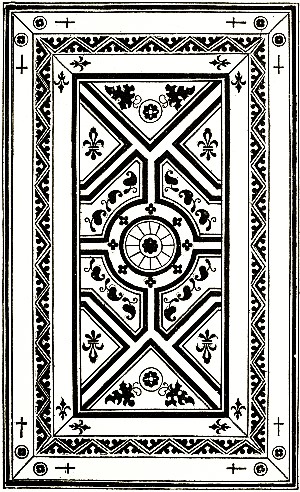
Modern Monastic.
MODERNIZED MONASTIC.
This style is now in great vogue, under the appellation of the antique. The materials employed are divinity calf and brown or Carmelite morocco, with very thick boards, edges either red, brown, or matted gilt; very high raised bands. The style of ornament is illustrated by Plate II., intended for a side-stamp to be done by the press. It can also be done by hand, with rolls, fillets, and hand-stamps, omitting the broad and narrow fillet, and substituting either a one or two-line, working the circles with gouges. The tools are all worked blind. This style of binding, when appropriate to the book, produces a very pleasing effect.
ARABESQUE.
"The term is more commonly applied to the species of ornament used in adorning the walls, pavements, and roofs of Moorish and Arabian buildings, consisting of an intricate heterogeneous admixture of fruits, flowers, scrolls, and other objects, to the exclusion of animals, the representation of which is forbidden by the Mohammedan religion. This kind of ornament is now frequently used in the adorning of books, plate, &c. Foliage very similar to that used by the Arabians, intermixed with griffins, &c., were frequently employed on the walls and friezes of temples, and on many of the ancient Greek vases; on the walls of the baths of Titus, at Pompeii, and many other places."—Craig's Universal Dictionary.
As regards book-finishing, we have looked into more than one authority, and are really unable to define what the "arabesque" style is or ought to be. The well-understood term "roan embossed" is, in our opinion, the nearest approach to it at the present day.
Plate III. is an adaptation of an old German design for embossing. The figure is raised, the plate being worked with a counter, in a powerful press.
3.
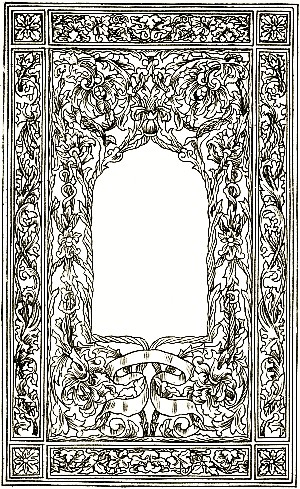
Old German Style for Embossed Work.
This style can only be executed upon publishers' work where there is a quantity of the same book to be done in this style. By it a good effect is produced upon an inferior material and at a trifling cost. The covers are embossed before they are applied to the volumes, and in order to preserve the sharpness of the design they must be covered with glue and not pressed afterwards.
ANTIQUE OAK AND OTHER BINDINGS.
Great varieties of style in the covers of bindings have been introduced within the last few years; but these must be left to the imitative powers of the skilful workman, as no written description would give the requisite information and guidance. Should he be desirous of executing these, he will do well to study some good specimen. Among others may be mentioned the Antique Oak Bindings, adopted by Mr. Murray, for his "Illuminated Prayer-Book," and Messrs. Longman and Co., for "Gray's Elegy." Also the Iron Binding,—viz.: covers in imitation of cast-iron,—in which Messrs. Longman and Co. have had bound the "Parables of our Lord." Bibles and Prayers are now frequently bound to imitate the antique, having heavy boards with clasps and corners, and finished in the monastic style.
GROLIER STYLE.
This beautiful style of ornament is so well illustrated by Plate IV. that it scarcely needs any remark. We will merely observe that this style is well calculated for hand-work, being entirely superficial in character. The pattern presented can be worked with a one-line fillet and gouges, with a few leaves of a conventional character. The design should be first traced upon paper of the proper size, the paper lightly tipped at the corners with paste upon the side, then worked with the fillet and gouges through the paper upon the leather. The paper is then removed, and the blind impression appears upon the side. All vestiges of the paper are carefully washed off, and the pattern pencilled in,—that is, each portion of the figure is carefully traced with a fine camel's-hair pencil saturated with glaire. When dry it is lightly passed over with a piece of cotton in which sweet oil has been dropped, and the gold leaf laid on. The pattern is then reworked upon the gold.
4.
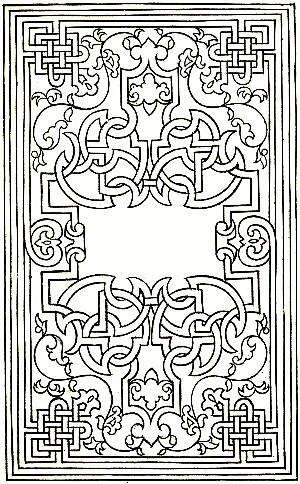
Grolier about 1530.
The design upon Plate V. is a modern elaboration of the Grolier, and is intended for a side-plate, to be executed by the stamping-press. It is well calculated for blind or blank stamping, the solid line producing by its intersections a fine effect. By omitting the inner and working the out lines, this elaboration of lines and circles can be worked by hand.
5.
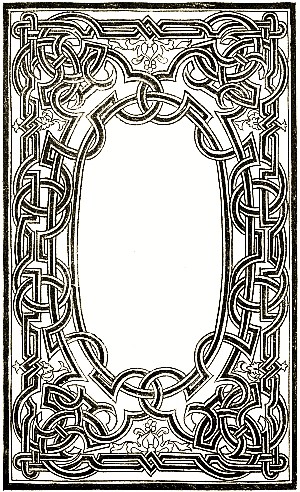
Modernized Grolier.
The Louis Quatorze is illustrated, by a pattern for a back, upon Plate VI. This can be worked either by hand-stamps or by the press. The centre pattern is a very pretty illustration of the prevailing style of backs for case-work. This must be stamped before the cover is applied to the book.
The third pattern for flat backs is adapted for hand-tools, and when executed upon light-coloured English calf produces a beautiful appearance. From its light, graceful character, it is well suited to modern poetry and light literature in general. This style gives scope to an almost endless variety of patterns, regulated only by the taste of the finisher.
6.
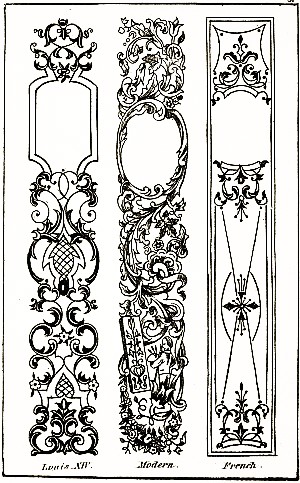
Louis XIV. Modern.French.
Plate VII. is a design drawn by Holbein for a side-ornament in metal. This beautiful pattern can be adapted either to hand or press work. Its graceful and harmonious proportions should be well studied by the young workman.
7.
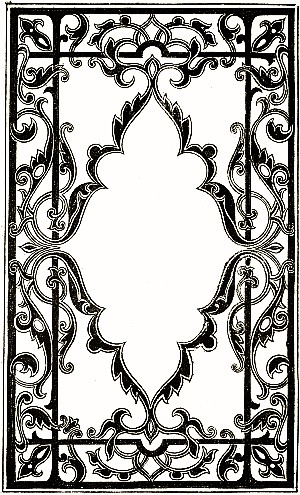
Drawn after a design by Holbein A.D. 1550.
Upon Plate VIII. will be found specimens of rolls and hand-stamps used in finishing. The numbers affixed refer to the order of arrangement in the Book of Patterns published by Gaskill, Copper & Fry, containing over two thousand specimens with their prices attached. They have also an immense number of patterns, executed since the publication of their book for binders in various parts of the country.
8.
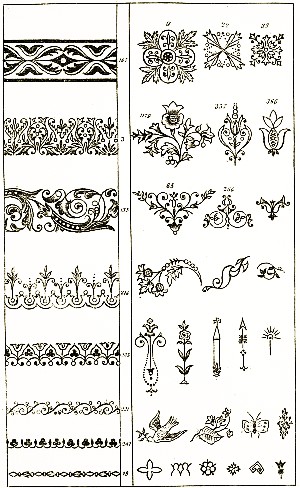
Selection from Gaskill, Copper & Fry's Book of Patterns (18 Minor S^t.)
Having given the prominent distinct styles,—of which there are, however, many combinations, both of style, ornament, and tooling, originating more nondescripts than we have space to treat upon,—we proceed to the gilding, trusting that what has been pointed out to the attention of the young workman will induce him to neglect no opportunities of becoming acquainted with the works of artists of celebrity, not for the purpose of servile imitation, but to examine their adaptations of ornamental art as a study, to enable him to trace superficial decoration back to its originators. Having acquired this knowledge, he may by his treatment of ornament take rank as an artist.
The examples given will be sufficient for the intellectual workman to conceive many patterns which his taste will suggest, forming an infinite variety of beautiful designs. In all combinations, a rigorous observance of the symmetrical proportions of the tools must be his first care, so that the union of any number of designs present a form agreeable and chaste. It would be superfluous to add more; but from the importance of the subject, on closing the directions for the ornamental department of binding, it may be repeated that there is no greater evidence of the ignorance or carelessness of the workman than an ornament of any kind unevenly or unequally worked. Let the young binder especially bear this in mind: it is a defect which nothing can effectually remedy; instead of an embellishment it is a detriment to the binding, and his reputation as a clever workman is consequently placed in jeopardy.
Preparatory to gilding, the back must be compassed off and carefully marked with a folding-stick and a straight-edge or piece of vellum, wherever it is intended to run a straight line. This serves as a guide when the gold is laid on. For work of the best class, the fillets must be first put in blind, and the tooling done in the same manner. For sides where the design is elaborate, or a degree of perfection in the tooling is desirable, the entire pattern must be first worked in blind, and, after being washed with a dilution of oxalic acid or a thin paste-wash, it must be carefully pencilled in with the glaire-pencil; but this comes more appropriately under the head of
PREPARATIONS FOR GILDING.
To operate successfully, it will be necessary that the workman provide himself with good size, glaire, and oil. The first is prepared by boiling fine vellum slips till a good size is produced, of a consistency that will lie equally on the volume without blotches or ropes, and must be used warm. The glaire is formed of the whites of eggs, beaten well with a frother till it is perfectly clear, and the froth taken off. This liquid will improve by keeping, and should never be used new if it can possibly be avoided. For morocco bindings, the glaire is sometimes diluted with water. The oil adopted by various binders is different. Some use palm-oil for calf, sweet oil for morocco or russia; others prefer hog's lard, or fine mould-candle, for light-coloured calf; but sweet oil is well adapted for almost every kind of leather. Vellum-size is the best preparation for coloured calf. On books thus prepared, the glaire must be applied two or three times, taking care that each coat is quite dry before the next is added, and that it lies perfectly even on the whole surface, free from globules or any substance whatever. Great care is required in preparing coloured calf; for, if there be too much body in the preparation, it will crack on the surface and present a bad appearance. Morocco and roan will not require more than one coat, and, where practicable, only on such parts of the morocco as are to be gilt. The state of the weather must ever determine the number of volumes to be proceeded with at one time, as in the winter double the number may be glaired to what the dryness of a summer's day will admit of, so as to work with safety and produce effect. A good paste-wash before glairing is always advisable, as it prevents the glaire from sinking into the leather.
In preparing glaire from the egg for immediate use, a few drops of oxalic acid added thereunto will be found to be of essential service.
The volumes being thus prepared, the operation of
GILDING THE BACK
Is commenced by oiling slightly, with a small piece of cotton, the whole length of the back. If the book is merely intended to be filleted for the economy of the gold, small strips are cut on the gold-cushion, attached to the heated fillet by rolling it slightly over, and affixed to the volume by passing it firmly on the lines previously marked. But if the back is to be fully ornamented, it will be necessary to cover it entirely with gold-leaf.
The hand-stamps should be disposed on the table before him, so as to be selected with the greatest facility, and in readiness for every purpose for which they may be required.
To lay on the gold, the workman takes a book of the metal, opens the outside leaf, and passes the knife underneath the gold; with this he raises it, carries it steadily on to the cushion, and spreads it perfectly even, by a light breath on the middle of the leaf, taking care also that not the least current of air has access to the room he may be operating in. Afterwards the gold must be cut with the gold-knife to the breadth and length of the places to be covered, by laying the edge upon it and moving the knife slightly backwards and forwards. Then rub upon the back the oil, and apply the gold upon the places to be ornamented with a cotton or tip, rubbed on the forehead or hair to give it a slight humidity and cause the gold to adhere. But if the whole of the back is to be gilt, it will be more economical to entirely cover it by cutting the gold in slips the breadth of the book and applying the back on it; afterwards press it close with the cotton, with which any breaks in the gold must also be covered, by placing small slips where required. The humidity of the hair or forehead will be sufficient to make the gold adhere to the cotton or other instrument with which it may be conveyed to the book. The fillet or roll must then be heated to a degree proper for the substance on which it is to be worked. Calf will require them hotter than morocco and roan, and these warmer than russia and vellum. To ascertain their proper heat, they are applied on a damp sponge, or rubbed with the finger wetted, and by the degree of boiling that the water makes, their fitness is known; but a little exercise and habit will render this easy of judging. To further insure this, the roll or pallet is passed over the cap of the headband; if too hot, the gold will be dull; if too cool, the impression will be bad, from the gold not adhering in every part.
After the gold is laid on, the volume is laid upon the side, with the back elevated, and the workman proceeds to mitre the fillets that run lengthwise of the back, commencing at the line that has been traced across the back, by pressing lightly with the point of the mitred roll and running it carefully till near the line that marks the end of the panel; then lift the fillet and turn it with the finger until the other or reverse mitre, or nick in the fillet, is reached; then place the fillet in the lines already gilt, adjusting it with the left hand until the extreme point of the mitre will just reach the line traced across. After both edges of the back have been done along the joint in this way, the volume is then placed evenly in the finishing-press, and the panels completed by mitreing the fillets that run across the back. The entire operation requires the utmost care, in order to have the lines parallel and the mitres perfectly even and true. No ornament that may be afterwards worked upon the back, beautiful as it may be, can atone for negligence or want of skill in the mitreing and running of the fillets. As a matter of economy, sometimes the back is run up; that is, instead of stopping where the lines or bands intersect, the roll is run up the back from one end to the other, without stopping; and, after wiping the gold off along the joint outside the fillet, it is run across the back on each side of the bands, and head and tail in the same manner. After the back is mitred, the finisher will proceed with the ornamental tools, and work them carefully off. In placing them, great attention should be paid to their occupying precisely the same place in each panel; and, in order to present an agreeable effect, the tools should correspond in detail, and there should be a geometrical fitness governing the selection and arrangement of the tools.
The judicious choice of ornaments for the back is of the utmost importance. For instance, such as represent animals, insects, or flowers, which are only proper for works of natural history, entomology, and botany, should never appear on the backs of works on general literature, as it would be an evidence of bad taste or carelessness.
Every tool should be beautiful in itself, because no accumulation of misshapen tools can make one beautiful ornament. There is no objection to scrolls, leaves, flowers, stops, or any of the usual kind of ornaments; only let them all be in themselves beautiful. It is appropriate to introduce a harp on a book of songs, a stag's head on a book on hunting, a recognised ecclesiastical pattern upon a book of divinity or a prayer-book; a Greek or Roman design upon a classical work, or a Gothic design upon a book on Gothic architecture.
Should it be desired to present on the back simply an ornamental lettering-piece at the head, diverging to a point towards the middle of the book, and the rest of the volume left plain, it will be necessary to impress the tools previous to glairing, and then apply the glaire with a camel's-hair pencil in the indentations the tools have formed. When dry, cover with gold and reimpress the tool in the marks previously made, and letter the title. This proceeding is adopted in every pattern where part of the back is intended to be left dull by being free from glaire.
The title must next engage attention, and the letters placed thereon, either singly or together, with brass type properly fixed in the hand-chase. If with single letters, the tail of the volume must be lowered about an inch, and the workman draw a thread of silk across the gold to direct the heads of the letters. Taking each singly, he places them on the back with the right hand, steadying the letter with the forefinger of the left. If the title is set in the chase, place the volume evenly in the press, and apply the title, guided by the thumb, firmly across. The title in either case must be justified, to produce the best effect, taking care to avoid, if possible, having two lines of the same length; and, where the title can be measured, as in the type it may, the exact centre should be ascertained before applying it heated on the gold. The back may now be considered finished. The gold which has not been impressed by the gilding tools must be well rubbed off with the gold-rag and minutely cleared off with a piece of fine flannel or India-rubber, so as to display the delicate lines of the ornaments as perfectly and clearly as possible. Attention should be paid to this particular; for, let a book be finished in the most tasteful manner possible, unless well cleared off the effect is entirely lost. If in calf, it must now be polished, and the squares and edges of the boards proceeded with.
GILDING THE SQUARES, ETC.
For gilding the edges of the boards, the gold may be taken as for the bands,—on the roll,—and the volume held firmly with the left hand; but, if large, put into the press between boards, so as not to injure the back. Where the ornament of the inside-square is simple, the like proceeding of applying the gold will be proper, resting the board open on an elevation equal to the thickness of the book. But if the square has been left large, with a leather joint, so as to admit of being more elaborately filled up, the gold must be laid on the whole space with the tip and pressed close with the cotton. The gilding is then proceeded with in the same manner as detailed in the directions for the side-ornaments.
GILDING THE SIDES.
The sides, from affording more ample space, are the part of the volume whereon the workman can and is expected to show his taste and skill in gilding. The proceedings are the same as before pointed out where a simple roll is the only ornament round; but where the pattern is extensive and the details minute, it is necessary to have the whole worked blind upon the volume before glairing, and then apply the gold. If one side is done at a time, the book is taken by the leaves with the left hand, the board intended to be covered resting on the thumb, and the gold laid on as for the squares, either over the whole side or on such parts as the pattern indicates. If the volume be small, the gold may be laid on both sides and the leaves of the volume placed in the finishing-press, allowing the boards to rest on its surface. This affords greater facility for placing uniformly and systematically the fillets, rolls, and tools necessary to complete the design on each side. Where the pattern has not been marked, and one side only proceeded with, the roll is run in a straight line, which should be made, previous to covering with gold, on the board by the joint of the back, the volume turned for the head and tail, and laid open upon the board for the fore-edge, to give it the firmness necessary.
Directions for executing the most elaborate designs have been previously given, whereby it will be perceived that it requires but taste, and a just observation of similarity of design and the geometrical proportions of the ornaments, to execute them to any extent. One variation from this rule will destroy the effect of the whole pattern: it will therefore be to the benefit of such as are not conversant fully with the art, to assist themselves with designs drawn on cartridge-paper, which may be marked through on the leather and the pattern executed in gold or blind as required. In all, the gilding will be the same, either to glaire over the whole cover after the design is stamped, or, if the plain part is to be left dull, by glairing the impressions only with a camel's-hair pencil.
GILDING ON SILK AND VELVET.
The proceedings necessary to be adopted for gilding on silk and velvet are, from the delicate nature of these substances, different from those laid down for gilding on leather. The glaire used on the latter would tend to stain, and therefore it is necessary to employ other means for fixing the gold. This is by drying the whites of eggs and reducing them to a powder, which is put into a small bottle and tightly tied over with a piece of fine muslin, by which means it is equally distributed on the space intended to be gilt. Gum-sandarac is now, however, more generally used for this purpose, although some use gum-copal. The powder being applied, the gold is cut in slips and taken on a roll of a circumference equal to the length of the space intended for it to be applied on. The design is then firmly impressed, and the superfluous gold brushed off with a soft brush or clean piece of cotton, and the other side alike executed. In lettering, or fixing single tools on the back, the same proceedings must be adopted, by taking the gold thereon and applying it to the back or side of the volume. Where the design is large, or elaborate work is required, it will be better executed in the following manner:—The design must be drawn on paper, and worked through on silk, after which the impression must be carefully glaired with a camel's-hair pencil; when dry, rub the parts intended for the gold with the finger passed through the hair or with a clean rag slightly oiled, and, after laying on the gold as directed for other styles, reimpress the tools, and whip off the superfluous gold with a clean flannel.
As there is no moisture in silk, the workman must not lay on at one time so much as he does on calf and other substances.
ILLUMINATED BINDING.
This style, an invention of the French, was for some time kept by them with the greatest secrecy. It is a binding of the utmost magnificence, uniting the varied beauties of the arabesque and gilt ornament, blended with the illuminated decorations seen on early MSS. before the invention of printing. When executed in the best manner, nothing can exceed the beauty of the whole coup-d'œil, rivalling, as it does, in splendour, the most elaborately-finished design of the painter. The time required to be devoted, on its first introduction, to a single specimen, appeared likely to confine this sort of ornament to the finest treasures of literature, and even to them in a limited degree. The improvements, however, in machinery and the rapid advance of the arts have, in a few years, brought this style into very general use for albums and other works where embellished covers are adopted; and even on the cheap roan bindings used for Bibles, Prayers, &c. it may be seen; though in effecting this cheapness it must be premised that a less durable method is adopted.
To execute the more elaborate designs, practice and a taste for the arts will here alone serve the workman; without these requisites it would be futile to make the attempt. But, as the proceedings require to be executed with the utmost care, we shall enter fully into such as are new, and, from their importance, at the risk of being considered prolix, again touch on those that may have been before treated of.
The description of one side will serve the purpose of making the proceedings fully understood. Whether the material be of morocco or white vellum, it must be washed, if required, perfectly clean, and left to dry. The first operation will be—if it be for stamp-work—to place the side on the bed of the stamping-press and boldly impress the design thereon. The most elegant, and capable of the greatest display of colour, are subjects of botany and natural history. The next step will be to glaire with a camel's-hair pencil such parts of the impression as it is intended shall be afterwards covered with gold. This done, the delicate operation of colouring may be proceeded with. In London and Paris this is executed by professed artists in no way conversant with book-binding. The colours to be used must be such as do not at all, or very slightly, fade on exposure to the air or sun, such as carmine, ultramarine, indigo, burnt sienna, gamboge, and sap-green. These must be prepared, with fine gum, in the same manner as for painting, and be lightly and delicately laid on such parts of the design as it is intended the colour should occupy, taking care that the ground-colour or leather is entirely hid. Let every thing be true to nature, each bird, plant, and flower its proper colour, and a general harmony prevail throughout. When finished, let the whole perfectly dry, and then, in the manner directed, lay gold on such parts as it is intended, in the reimpression of the plate, should be further embellished. Heat the plate, place the side again under it, and give it a firm and sharp impression. Rub off the superfluous gold, and the whole of the delicate lines of the ornament will be found beautifully gilt, the colours firmly fixed by the heat of the plate, and the rough edges of the colour completely effaced by the reimpression of the original design.
In executing the less expensive and more simple designs, the plate is impressed in gold on the side, and the parts left ungilt on the leather; afterwards coloured according to the taste of the workman.
For the best class of work, after the design is impressed, either by hand or the press, pieces are cut out of variously-coloured morocco, pared thin, and neatly pasted on the side, the design, when worked, entirely concealing the edges of the morocco. This is termed inlaid work.
BLIND TOOLING.
This is an ornamental operation, applied either before or after the book has been gilt and polished, and, if judiciously intermingled with the gold, will not fail to present a good effect. It is a style that has been much used of late years, and is executed in the same way and with the same tools as for gilding, but without any gold applied on the places thus ornamented. The rolls, pallets, and smaller tools, are applied by the hand, and the large plates with the press, with the same precautions as indicated in the previous section. If the pattern consists of straight lines, and the workman possesses a good eye, the best manner of executing it is by making use of a pallet, placing it firmly on the book, and sliding it to the opposite point. It remains, therefore, to consider such matters as more immediately apply to this style of decoration.
The tools for blind tooling should not be so warm as for gilding, and particularly for morocco. If it is wished to be left dull,—that is, free from glaire,—the particles attaching themselves over the edge of the gold ornaments must be removed with the end of the finger, wrapped over with a piece of fine cloth, and wetted. This will soon wash it clean, and when dry the blind ornaments may be proceeded with.
Graining may be properly considered as a blind ornament. This is where, by the means of wooden or metal plates, the sides of a book are marked with lines crossed over each other, so as to form innumerable small squares in imitation of russia, or in imitation of the grain of morocco, scales of fish, and other substances. The operation is performed by placing the volume between the two plates even by the groove of the back, in the standing-press, and pressing it tightly down, and so even that the plate will be impressed equally over the whole surface. Nothing will look worse than a bold impression in one place and a slight one in another; and therefore it becomes of importance to see that it is evenly pressed, as a second application of some kind of plates will never be found affixed to the same places.
MODERNIZED MONASTIC OR ANTIQUE.
This style, whether done by the hand or the press, is one that requires care and patience on the part of the workman, so as to bring up the tools black, without burning or otherwise injuring the leather. We have spent much time in experiments, so as to arrive at the most certain and perfect mode of producing the desired result. The style emanated from Mr. Hayday's bindery; and a volume executed in this style for a connoisseur in this city, with tooling of a brilliant black, fell into our hands some years since, and we at once set about attempting to produce the same effects. Our efforts were confined to hand-tooling for some time; and, although inferior in effect, they were generally well received; but we were far from being satisfied. We tried every substance that could be thought of, made the leather and tools hot and dry, or wet and cold, as reason seemed to point to one or the other as the proper method. We will now communicate the results of our labours:—In the first place, the material is of the greatest importance; and the finest effects cannot be produced except upon English calf or morocco. American calf is entirely out of the question for the purpose, as the morocco is too hard on the surface, and there is not sufficient colour in the body for the tools to draw and affix it by heat to the surface; but some kinds are better adapted for the purpose than others. To test this, apply the tip of the tongue to the leather, and if the dampness lies on the surface, without sinking in, reject it; but if the dampness strikes instantly into the leather,—the quicker the better,—the workman may proceed with some hopes of success. After the volume is covered and ready for finishing, wash it evenly over with clean water; and, as soon as the water ceases to lie upon the surface, apply the tool moderately heated; this will bring up the dark colour. Afterwards go over it again with the tool, so as to make the impressions clear and bright. There are, however, some colours, as well as particular manufactures, that will not come up black; and we were long satisfied that some colouring-matter was employed. We wrote to a friend in London, who sent us the material and the method of its use. The material was common printers' ink. His communication we now make public. "In the first place, the leather should be quite damp, and the tools used should be as hot as possible without the printers' ink. Then again impressed with the printers' ink upon the tools. We put the larger tools in again without ink. When the ink is used upon the tools, the leather should be rather damp, and the tools not very hot. When the pattern is worked in the manner described, it should be left until dry, and then brushed with a brush, not very stiff, which will give a brilliant gloss to the tooling." When using printers' ink, be careful not to get too much on the tools.
Let the young workman but follow the directions given, and, with a little patience and reflection, he will be able to do work of the character under consideration, fully equal to the efforts of the best workman, provided that the tools be worked true and even.
POLISHING.
The details of this operation, which is performed immediately after the gold ornaments have been worked, have been reserved in order that the whole of the ornamental department might be kept together. Morocco, roan, silk, and velvet, and the blind ornaments on any substance, must never be submitted to the action of the polisher. A smart rubbing with a piece of rough calf will be sufficient for the two former, and the velvet or silk will merely require cleaning with any smooth substance or with India-rubber.
There are two polishers,—one for the back and bands, and another for the sides. The oil applied on the cover previous to laying on the gold will be sufficient to make the polisher glide easily over the surface. The polisher must be heated, and well cleaned on a board, and passed quickly and evenly on the back, sides, or joints, as the case may be, taking especial care that it is not too hot, as the glaire would thereby be turned white and the work damaged in appearance, nor so cold as to give a bad polish.
The book, as gilt, must be first polished on the back, by taking it with the left hand, resting it on the table, and polished with the right hand by gliding backwards and forwards the smooth part of the polisher on the whole extent of the back. This not only polishes the surface, but smooths down the indentations formed upon the leather by the gilding-tools, bringing up the gilding to the surface. The polisher must be passed on such places only as it is wished to make brilliant, and great care taken not to touch the places intended to be left dull.
The sides are similarly polished, by laying the volume on the table, covered with baize, and passing the large iron quickly over, first from the fore-edge towards the groove, and then, by turning the volume in a contrary way, from the tail to the head.
If the joint requires polishing, the book is laid before the workman, the tail towards him, and the iron applied on the side next the groove, polishing the whole length of the board; then, turning round the volume, and bringing the fore-edge towards him, he polishes the side on the fore-edge, and, turning again, completes the whole by polishing the parts at the head and tail.
In addition to polishing, it is desirable to give to the sides the greatest possible smoothness by pressing them between polished tins or horns. These are placed on each side of the book even by the groove, put between pressing-boards, and screwed tightly in the press, and left for some time.
COLOURING.
Calf-skins of uniform tints, and also sprinkled, can now be obtained of English manufacturers; yet in many localities they are difficult to obtain. We therefore make known the chemical substances and ingredients required to execute them in the best manner. Marbling is a process that must be executed by the binder upon the cover, and, with many other revival styles, is again coming into vogue. The recipes given for the superior marbles and designs will, it is presumed, present this branch of the art on a higher footing, in a general point of view, than is usually accorded to it; and it is confidently asserted that not one of them will prove a failure, if attention to the directions be only given. Nothing has been omitted in the description of the substances best for use, the mode of preparing them, and the proceedings to be adopted, that can tend to give to the covers all the elegance and splendour of which they are susceptible. By the aid of these, assisted by some taste, the workman may vary the designs almost to infinity; but it must be admitted that, unless he is devoted to his art, no mere directions or casual advantages will enable him to succeed in the more complicated or delicate operations, while, with an ardour for it, all difficulties will be easily overcome.
CHEMICAL PREPARATIONS.
Under this head is included aqua regia, or killed spirits, nitric acid, marbling-water, and glaire prepared for marbling.
AQUA REGIA,
So called from its power to dissolve gold, is a mixture of nitic acid (aquafortis) and muriatic acid, (spirits of salts,) deprived of its burning qualities by block-tin, which it dissolves. It is called by the chemist acid nitro-muriatic: the muriatic also contains a portion of alkali, which gives to red a vinous tint, and for which colour it is principally used.
The two substances should be of the purest quality, of a concentration of thirty-three degrees for the nitric acid and of twenty degrees for the muriatic. They must be mixed with the greatest precaution. Having provided a clear glass bottle, the neck rather long, capable of holding twice the quantity to be prepared, place it upon a bed of sand, the opening at top, and pour in one part of pure nitric acid and three of muriatic. Let the first vapours dispel, and then cover the orifice with a small phial, which must not confine the vapour too closely, as the bottle would be liable to burst, but which retains as much as possible without risk. Of block-tin, an eighth part of the weight of the acid must then be dropped into the bottle, in small pieces, a little at a time, covering the orifice with the phial. The acid will immediately attack the tin and dissolve it, when a second portion must be put in with the same precaution, and so on till the whole is dissolved. Malacca tin is the best for use, and if pure there will be no sediment; but, as it cannot always be obtained, a black sediment will be left. The vapour having ceased, the acid must be poured into bottles and secured with glass stoppers, to preserve it. When used, a part is taken and mixed with one quarter of its weight of distilled water.
It is usual with some workmen to perform this operation in a common drinking-glass; but, as the vapour is thereby all dispersed, the composition loses a considerable portion of its best quality, for it will be observed, if performed in a bottle as above directed, that the vapour assumes a red tint, which does not escape if the neck of the bottle be of sufficient length.
ANOTHER.
Some binders adopt the following method; but, as it is not capable of producing an equal beauty and clearness of colour with the one above given, it will not be advisable to use. The former, too, will be equally effective to an indefinite period, while this will not preserve more than two or three months.
Put in a brown freestone pot two ounces of powdered sal-ammoniac, six ounces of fine Malacca tin, in strips or drops, twelve ounces of distilled water, and, last, a pound of nitric acid, of thirty-three degrees. Leave the whole till the tin is dissolved, and then pour off and bottle as above directed.
VITRIOL-WATER.
Vitriol, as sold in the pure state, will not be proper to use in marbling or sprinkling, as it would corrode and destroy the leather. It must be weakened at least in proportion of one ounce of vitriol to three of water.
MARBLING-WATER.
It is usual with many to use the water pure; but a few drops of potash liquid mixed with it will be found to produce better effect, the marble being rendered more distinct.
GLAIRE.
Put spirits of wine in a proportion of two drops to the whites of twelve eggs, and beat the whole well together till perfectly clear.
PREPARATIONS OF THE COLOURS.
The preparations used by different binders vary much, as will be seen by the recipes given for the same colours, which we judge necessary to put on record, that nothing connected with the subject should be omitted, premising that each colour may be depended upon for producing the most satisfactory results. It may be proper also to observe that the whole of the woods and other ingredients used should be previously powdered or reduced to small pieces, the colours being thereby much better extracted.
BLACK.
1. Dissolve half a pound of green copperas in two quarts of water. The oxide contained in the sulphate of iron will combine with the tanning of the leather, and produce a good black.
2. Boil in a cast-iron pot a quart of vinegar, with a quantity of rusty nails, or steel-filings, till reduced one-third, taking off the scum as it rises to the top. This liquid improves by age. To keep up the quantity, boil with more vinegar.
3. A cheaper liquid may be produced by boiling two pints of beer and two pints of water with two pounds of old iron and a pint of vinegar, scumming as before, and bottling for use.
BROWN.
1. Half a pound of good Dantzic or American potash dissolved in one quart of rain-water, and preserved in a bottle well corked.
2. Salts or oil of tartar, in the same proportions as above.
3. A beautiful brown may be procured from the green shells of walnuts. To prepare this, a quantity of the green shells, when the nuts are gathered, must be pounded in a mortar to extract the juice, and then put into a vessel capable of holding a sufficient quantity of water. The water being put in, the whole should be frequently stirred, and left to soak, with the vessel covered. Afterwards the liquid must be passed through a sieve, the juice well expressed, and bottled, with some common salt, for use. This liquid, after fermentation, will produce the best effects, for the uniform tints, as it tends to soften the leather, and will not corrode.
BLUE.
1. It is usual with many binders to use Scott's Liquid Blue, but it is necessary to know the preparation of the colour. Perhaps the best and most simple one known is one given by Poerner, which is as follows:—In four ounces of sulphuric acid, of 66 degrees, mix gradually one ounce of finely-powdered indigo, so as to form a sort of pulp. Place the vessel in another containing boiling water, for some hours, and then leave it to cool. Afterwards put to it a small portion of good potash, dry and finely powdered, stirring the whole well, and letting it rest for twenty-four hours, when bottled, and use as required. This colour will appear nearly black, but may be made to any shade by adding water to it. If any portion remain after being diluted, it must be put into a separate bottle, as if mixed with the first preparation the whole would be deteriorated.
2. A readier blue may be prepared by mixing one ounce of powdered indigo with two ounces of oil of vitriol, and letting it stand for twenty-four hours, and then adding twelve ounces of pure water.
PURPLE.
Boil half a pint of archill or logwood with vinegar and water, of each half a pint.
LILAC.
Same as for the purple, with the addition of about two table-spoonsful of potash.
VIOLET.
Half a pound of logwood chips and one ounce of Brazil dust, boiled over a good fire in four pints of water till reduced one-half, and left to clear. Then throw in one ounce of powdered alum and two grains of cream of tartar, and again boil till dissolved. This liquid must be used warm.
FAWN.
In two pints of water boil one ounce of tan, and a like portion of nutgall, till reduced to a pint.
YELLOW.
1. To one ounce of good caked saffron, turmeric, or French berries, add a portion of spirits of wine or aqua regia, and leave the mixture to macerate. This liquid is used cold, and may be varied to any shade by adding water when required.
2. In two pints of water put eight ounces of French berries, and boil till reduced one-half. Then pass it through a sieve or fine cotton, and add a small quantity of powdered alum, and again boil, using it warm.
ORANGE.
In a pint and a half of potash liquid, boil a quarter of a pound of fustic chips till reduced one-half; then put in an ounce of good annatto, well beaten, and, after boiling, a small portion of alum, and use warm.
GREEN.
1. Liquid blue and yellow mixed will best suit for general purposes.
2. Dissolve in a bottle one ounce of verdigris in an ounce of white wine vinegar, and place the whole before a fire for four or five days, frequently shaking the bottle.
RED.
There are three sorts of red,—viz.: common, fine, and scarlet.
Common.—1. In a tinned kettle boil half a pound of Brazil wood, eight grains of nutgalls, both powdered, and three pints of water, till the whole is reduced one-third. Then add powdered alum and sal-ammoniac, of each one ounce, and when dissolved strain through a sieve. This liquid must always be used warm.
2. Boil a quarter of a pound of Brazil dust, two ounces of powdered cochineal, and a little alum, in two pints of the best vinegar, till a bright red is produced. Use warm.
Fine.—1. In three pints of water boil half a pound of Brazil dust and half an ounce of powdered nutgalls. Pass the whole through a fine cotton, and replace the liquid on the fire, adding one ounce of powdered alum and half an ounce of sal-ammoniac. Give the whole another boil, and then add a portion of aqua regia, according to the shade desired, and use warm.
2. A quicker and cheaper proceeding is by putting in a cup a portion of Brazil wood, and adding to it the aqua regia, letting it stand for a quarter of an hour to extract the colour.
Scarlet.—To one ounce of white nutgalls and one ounce of cochineal, both finely powdered, add two pints of boiling water. After boiling some time, add half an ounce of aqua regia, and use warm.
MARBLING.
Before proceeding to a description of the marbles, and other designs on the covers coming under the general head of marbling, it will be proper to give a few directions relative to some important matters required in the way of preparation. As the success of many of the designs depends upon the quickness with which they are executed, it will be important that the colours, sponges, brushes, &c. are previously disposed in the best order, so as to be of the readiest access. Attention should be paid to the probable quantity that may be required of each colour, as many of them will not be available for use another time.
The books should all be previously washed with paste and water to which has been added a little pearlash liquid, and left to dry. After this they must be glaired equally over, and when dry placed upon the marbling-rods, the sides of the books extending over and the leaves hanging between. The rods must be placed on an elevation at the top, so as to allow the water to run gradually towards the bottom of the books; and, if the backs are required to be left plain, another rod, or piece of board, grooved to the shape of the back, placed on them. To avoid the scum arising from the beating of the brushes over the colours, it is better to rub the ends of the bristles on the palm of the hand, on which a little oil has been spread. These preliminaries being settled, the operation of marbling commences, for which we shall now give directions.
COMMON MARBLE.
The book being placed on the rods, throw on the water prepared for marbling in large drops, with a coarse brush, or bunch of quills, till the drops unite. Then, with a brush charged with the black liquid and beaten on the press-pin as directed for sprinkling the edges, a number of fine streaks are produced by throwing the colour equally over the cover. Afterwards the brown liquid must be similarly thrown over. When the veins are well struck into the leather, the water must be sponged off and the book placed to dry.
If the volume has been previously coloured with any of the preparations before described, and it is wished to produce a marble thereon, the brown must be thrown on first, and then the black; as without this precaution the marble would not strike, because of the acid which forms part of the colours. This observation being applicable to all the other designs, it will not be necessary again to repeat it.
ANOTHER.
Throw on the vinegar-black, then the brown, and lastly a sprinkle of vitriol-water.
PURPLE MARBLE.
Colour the cover two or three times with hot purple liquid, and, when dry, glaire. Then throw on water, and sprinkle with strong vitriol-water, which will form red veins.
STONE MARBLE.
After throwing on the water, sprinkle boldly with the black liquid; then, with a sponge charged with strong brown, drop the colour on the back in three or four places, so that it may run down each side in a broad stream, and afterwards operate with vitriol-water on the parts the brown has not touched.
GREEN AGATE.
Sprinkle black, in nine times its quantity of water, in large drops over the whole surface of the cover, and when the drops unite apply on the back at regular distances the green liquid, so that it may flow on the boards and unite with the black.
BLUE AGATE.
Proceed as above, only substituting blue in place of the green, weakened with water according to the shade required.
FAIR AGATE.
Commence by sprinkling black in small drops at a good distance from each other; afterwards sprinkle equally over large drops of weak potash.
AGATINE.
Proceed as for the green agate, and then sprinkle scarlet all over the cover; finally, throw on blue in small drops, weakened in four times the quantity of water.
LEVANT MARBLE.
After the water, throw on the back-brown in broad streaks as directed for the stone, and then in like manner the aqua regia. This will be found to imitate closely the Levant marble.
PORPHYRY VEIN.
Throw on large drops of black diluted in double the quantity of water. When the colour has struck well into the leather, sprinkle in the same manner brown mixed equally with water. Then apply a sprinkle of scarlet, and afterwards large spots of yellow, the liquid nearly boiling. While these colours are uniting, throw on weak blue, and then aqua regia, which, flowing together down the sides of the book, will form the vein distinctly.
RED PORPHYRY.
Sprinkle with black in eight times the quantity of water, very equal and in small spots. Let it dry, rub, and glaire. Then give two or three sprinkles of fine red, and one of scarlet, and again leave to dry. Finally, sprinkle scarlet in small spots as equally as possible.
GREEN PORPHYRY.
For this design the cover must be finely sprinkled over three separate times, leaving the colour to search and dry between each. The green must be brought to the shade required by mixing with water. To form a more elegant vein, sprinkle first with weak black, and afterwards with green, and when dry with fine red.
PORPHYRY.
This marble, imitating the eye of the partridge, is executed by throwing on black in eight times its volume of water, in small drops, but so close as to just run into each other. When the black begins to flow, sprinkle over brown mixed equally with water. Let it dry, wash the whole with a sponge, and before quite dry again give it two or three coats of fine red. After being dry and well rubbed, sprinkle equally over the surface large drops of aqua regia.
ANOTHER.
Colour the cover with red, yellow, blue, or green, and, when dry, with black diluted as above; let this also dry, and then sprinkle over large or small drops of aqua regia. The eye of the partridge is properly formed with blue sprinkled upon the weakened black, and, when dry, with the killed spirit or aqua regia.
ROCK.
Throw on large drops of black prepared as for the porphyry, and, when half dry, weakened potash in the same manner. When dry again, sprinkle on equally small spots of scarlet, and lastly aqua regia.
GRANITE.
Mix black in about fifty times its quantity of water, and sprinkle equally over very fine, repeating it as it dries five or six times. Then, in like manner, sprinkle over with brown, and, after rubbing well, glaire lightly. Finally, sprinkle finely over with aqua regia.
TREE-MARBLES.
These marbles, which were first executed in Germany, from whence they passed into England, are formed by bending the boards in the middle, so that the water and colours flow from the back and fore-edge to the centre, in the form of branches of trees. Those who have never seen the tree-marbles of Mr. Clarke, of London, can form but little idea of the beauty of which this style is susceptible. The name is also given to such as are made to imitate the grain of the wood.
WALNUT.
Formed by sprinkling black and brown only, as for the common marble.
CEDAR.
After sprinkling as for the walnut, and before perfectly dry, apply lightly a sponge presenting large holes dipped in orange upon various places on the cover, so as to form a description of clouds. Afterwards apply the fine red, with a similar sponge, nearly upon the same places, and when dry give the whole two or three coats of yellow, taking care that each penetrates evenly into the leather.
MAHOGANY.
The proceedings are nearly the same as for the walnut, the difference being merely in sprinkling the black more boldly, and, when perfectly dry, giving two or three uniform coats of red.
BOX.
In order to imitate the veins contained in box, the boards must be bent in five or six different places and in divers ways. After placing the book between the rods, throw on the water in small drops, and proceed as for the walnut. After being perfectly dry, throw water again in large drops, and sprinkle on small spots of blue, diluted equally with water; and, when again dry and rubbed well, apply the scarlet with a sponge as directed for the cedar. Finally, when dry, give two or three coats of orange, and the design is complete.
WAINSCOT.
Colour with strong brown, glaire, and place between the rods, with the boards flat. Throw on weak black in large spots, then brown in like manner, and, lastly, sprinkle boldly with vitriol-water.
VARIEGATED.
Marble as for the walnut, and then put on each board a circle, oval, or other figure, and apply weak black on the outer parts. When dry, give it a good coat of red, and, after throwing on spots of scarlet, take off the figures, and wash well the parts where the latter colour has been used. Finally, give the oval two coats of yellow, or other colour, with a camel's-hair brush.
MARBLING ON PAPER.
The sides of a half-bound book, which will be covered with paper, may be marbled to correspond with the effect produced on the leather by the action of the black and brown at the same time. This is performed by pasting firm white paper on the sides, and colouring with a mixture of four ounces of nut-galls and a small portion of powdered sal-ammoniac boiled well together, which will take the black and brown nearly equal to leather.
SPRINKLES.
This is another ornament on the covers of books, capable of being much varied. A few of the most general use are given, premising that any of the colours arranged as for the marbles above, or sprinkled on the uniform colours, will be productive of a beautiful effect. The books must be paste-washed over, but not glaired.
NUTMEG.
Sprinkle very finely with black and then with brown. If wished to produce a finer effect, give a sprinkle of vitriol-water.
RING.
Put about a teaspoonful of vitriol to a cup of the black, and sprinkle coarsely over. If the ring is not sufficiently strong, add more vitriol.
TORTOISE-SHELL.
Wash the cover with yellow, and sprinkle very boldly with black. When dry, spot with a sponge, as before directed, with blue, red, and black, each colour being left to dry before the next is applied.
In concluding the description of the marbles and sprinkles, it may be remarked that, with a little taste, the workman might vary the designs to upwards of one hundred different patterns; also that each colour should be allowed to properly strike into the leather before another is used. Panes, or blank spaces, are formed by placing squares, &c. of pasteboard on the sides, which prevents the colours touching the leather when sprinkling. After the design is completed, the covers should be well rubbed with a woollen cloth or the ball of the hand, to remove the whole of the refuse of the colour, which will be found to corrode on the surface of the leather.
UNIFORM COLOURS.
Before proceeding to execute any of the colours, the books must be well and evenly paste-washed, and left till perfectly dry. It will also be necessary to observe that the black will become darker in all the subsequent operations of colouring, glairing, and polishing, so that attention must be paid not to use this liquid too strong.
LIGHT BROWN.
Wash the cover with vitriol-water till perfectly uniform in colour, and then with brown to the shade desired.
ANOTHER.
Mix a small quantity of annatto with the potash liquid, and use hot. This will produce a beautiful tint.
DARK BROWN.
Colour with weak black till a slate-shade is produced, and then apply the brown three or four times, as taste may dictate.
Others might be added, but the proceedings are the same, varying only the quantity of colour according to the shade. The nut-brown liquid will produce beautiful tints.
CORINTHIAN GRAPE.
The proceedings are the same as for the last colour, adding two or three coats of fine red.
COMMON GRAPE.
Proceed as for the last, omitting the brown after the black.
BLUE.
After giving four or five coats of the chemical blue diluted with water, wash lightly with weakened aqua regia, which will take off the green reflection produced by the yellow tint of the leather.