SUGGESTIONS TO TEACHERS AND PUPILS ADDITIONAL STUDY TOPICS
Reading edition
Birds are to be found in almost “every corner of the earth.” Their study has a world wide interest and appeal. The following list is intended to serve as an aid in bringing to mind subjects that may be developed out-of-doors, or studied in the class room.
Vision of Birds: The keen power of sight of Hawks and Eagles; the Owl’s eye at night.
Variation in Structure of Bill: Adaptations of the sharp pointed, curved beak of the flesh-eating Hawks; the small, pointed bill of the insect-eating Warbler.
Variation in Structure of Feet: The strong grasping talons of flesh-eaters; the powerful “walking feet” of the Chicken; the perching feet of the Chickadee,
Habits of Cleanliness in Birds: Cleaning nests, bathing in water and dust.
5
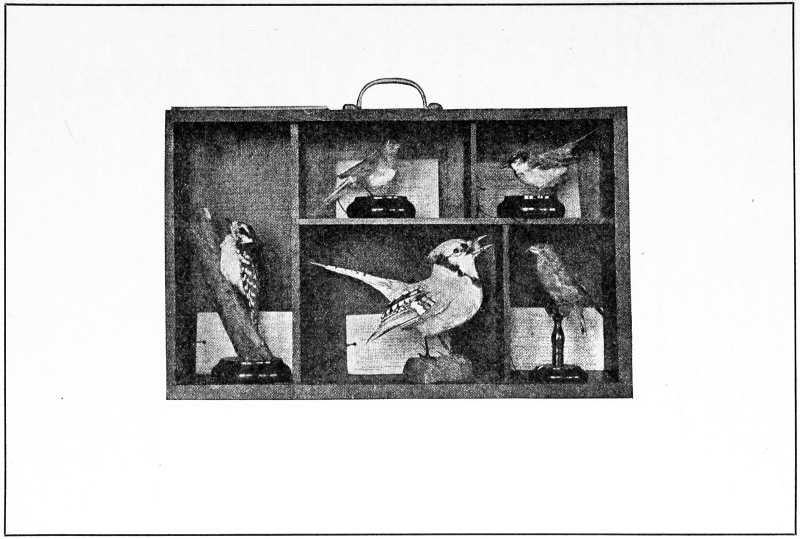
A NATURE-STUDY COLLECTION—THE BLUEJAY SET
The specimens are delivered to the school in a wooden carrying case about the size of an ordinary suitcase. The birds are mounted on individual pedestals and can easily be removed from the case. Thus the specimens may be used singly or collectively. They can be handled and seen from all sides.
6
The Flight of Birds: Powerful, sustained flight of the Condor; darting flight of flycatchers; suspension in air, or hovering flight of the Hummingbird and Sparrow Hawk.
Migration of Birds: Travels from one continent to another, often over wide expanse of water; journey of the Golden Plover.
Training of Young Birds by Their Parents: Young Barn Swallows forced into the air; Robins offering food to young and thus enticing them to leave the nest.
The Songs of Birds: The Parrots, Thrushes, Sparrows. Songs of male birds during breeding season, imitation and mimicry—Catbird; warning cries, call notes.
Care and Feeding of Young: Different methods employed by parents. The Pelican, the Robin, the Swallows, the Flicker.
Types of Nests: Construction, materials used, building location; nest of Bank Swallow, hanging nest of Baltimore Oriole, Crow’s nest.
Weapons of Fighting: Spurs, wings, bills, talons.
Protective Coloration: Similarity of plumage, color and markings to habitat.—the Wood Thrush, the Partridge.
Bird Houses: Different types, how made, how placed, how used.
Bird Conservation: Methods of preservation in various states. Laws for protection.
Relation of Birds to Agriculture: Insect eaters, seed eaters, rodent destroyers.
The Bird’s Feather: Feathers for study will be given to teachers upon request.
(Note). These are but a few of the subjects that might very well be considered.
7