OUTLINE FOR BIRD STUDY (Suggestions to Teachers and Pupils)
Reading edition
In observing birds out-of-doors or in the class room, with an idea of studying or identifying them, there are certain definite things to know and to remember. The following outline makes some suggestions of what to look for when a bird is seen for the first time, or when you are studying a mounted specimen or colored picture.
Movements: See whether the flyer hops or walks when it is on the ground. Does it hang upside down, move slowly or quickly, swim or creep? Remember that the same bird may have a different appearance at various times.
Disposition: Did you ever think of a bird in connection with its having a disposition? Notice whether it is unsuspicious, wary, social, solitary, etc.
Flight: Does the bird that flies over your head travel rapidly or slowly? Does it flap along or does it sail and soar? Maybe it undulates (flies up and then down in half-moon curves) as the Goldfinch does.
Song: There are many times when you may hear a bird but not see it. Thus you should listen for songs very carefully. Notice whether the song is continuous, short, loud, low, pleasing, unattractive, and whether it comes from the ground, from a higher perch, or from the air.
Call Notes: Nearly all birds have a Call Note that is different from the regular song. These notes may be of various sorts such as scolding, warning, alarm, signalling, as well as a number of others.
Size: In the field, you cannot run up to a wild bird and measure it with a ruler, but what you can do is to compare it in size with some other bird that you do know. Compare the unknown bird with an English Sparrow which is about 6 inches long, a Robin about 10 and a Crow 19 inches long. Remember, 6, 10 and 19.
Form: Note the shape of the bill, length of the tail, shape of wings.
8
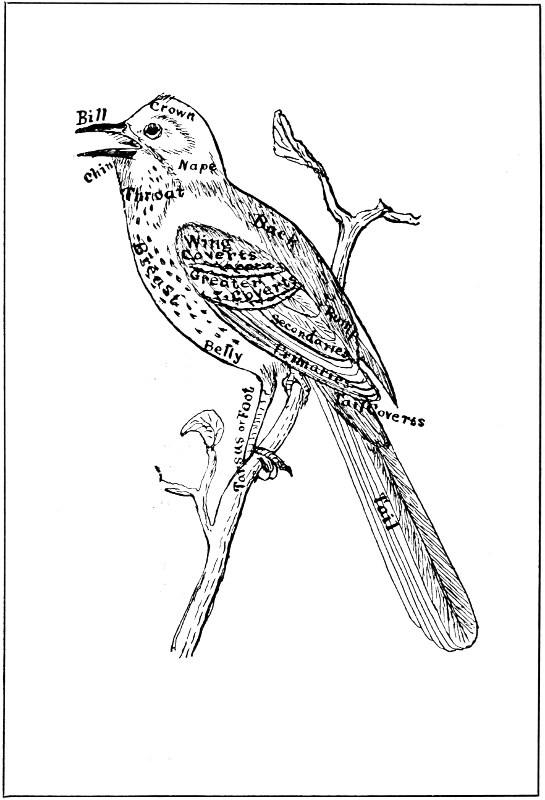
Bird with parts labeled
9
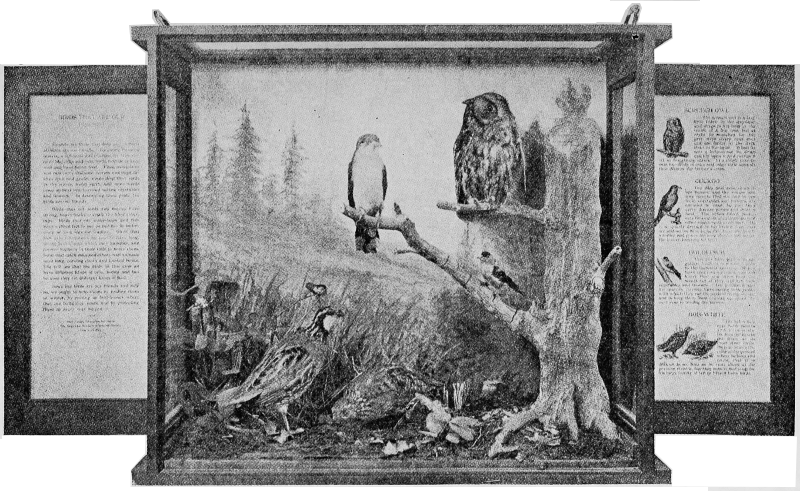
“BIRDS THAT ARE OUR FRIENDS”
One of the new “Habitat Group” circulating nature-study collections. The label-holders are hinged to the back of the case and close over the ends, protecting the glass during transportation. The label at the left is general and gives reasons why birds are our friends. That on the right deals with the habits and use of the specific birds in the case, each being identified by a simple drawing instead of by title or number.
10
Markings and Color: See just where the markings are. Remember that if a bird were seen without feathers, it would look quite a bit like any other animal. The next time you have a chicken after the feathers have been removed, look at it closely. The wings look like arms, and as a matter of fact, they have three “fingers,” which may be easily seen. The bird has a crown on its head; he has “cheeks,” a breast, a throat, a belly, and a rump as well as other external or outside parts. Do not say that you saw a bird that was “black and white and brown all over.” No one could tell you what sort of a bird that was. See—just what you are looking at. As with the Markings, you should know something of the parts of a bird before you are able to tell just where the colors occur. How many colors are there on the under side of the Robin?
Appearance: The bird may be alert, wide awake or pensive as though it had just lost a friend. Its tail may be drooped, its crest erected or its feathers ruffled.
Haunts: Where did you see the bird? Was it near the seashore, beside the river, in the woods, the fields, a place where the land was low and swampy or high and rocky, or was it down near the side of the lake?
Season: The time of year that the bird is seen is a very important thing to notice and to take into consideration. Look for the times when birds first arrive and when they leave. Did you see them in the winter, spring, summer, or fall? Are they permanent residents?
Food: When you walked through the pasture or through the park and saw a bird eating something, did you stop and try to discover what that food was? Was the bird eating berries, insects, seeds? How was this food secured?
Mating: Every bird has certain courtship habits. Note these antics.
Nesting: Observe the choice of nesting site, the materials used in the nests, such as mud, grass, leaves, and so on. Notice the construction, the number and the color of the eggs; and the incubation period, or the length of time the eggs take to 11 hatch; and above all things, do not in any way disturb any bird’s nest.
The Young: Watch and learn what food the young ones are given by the parents; how they are cared for; the time they remain in the nest; their cries, actions, first flights, and so on.
How to Find Birds:
(a)—When—The best times of day are early morning and late afternoon. Why is this true?
(b)—Where—A watered meadow with trees here and there attract birds. Learn this from observation.
(c)—How—Use common sense as to dress and general actions. Sit down and let the birds come to you.
Based on Dr. Frank M. Chapman’s “A Bird’s Biography,” p. 73—Bird Life, published by D. Appleton & Co., New York.
12