BOOK III
Reading edition
THE STATE
"What constitutes a state? . . . . Men who their duty know."
Philip Danvers, cattleman, nearing Fort Benton on his return from a round-up, found his thoughts reverting to the past. The spring day was like another that he remembered when he first caught sight of the frontier town more than a dozen years before. He noted the smoke of a railroad locomotive as it trailed into nothingness, and involuntarily he looked toward the Missouri River; but there was no boat steaming up the river, and the unfurrowed water brought a sadness to his face.
He recalled the doctor's vigorous opposition a few years previous, when the question of a railroad came before the residents of Fort Benton. Perhaps the doctor had been right in thinking that the river traffic would be destroyed, and with it the future of the town. Certainly his derided prophecy had been most literally fulfilled. Instead of becoming a second St. Louis, the village lay in undisturbed tranquillity, but little larger than when the Far West had brought the first recruits of the North West Mounted Police to its levees. To those who loved the place, who believed in it, the result caused by the changing conditions of Western life was well-nigh heartbreaking.
Instead of the terminus of a great waterway—the port where gold was brought by the ton to be shipped East from the territorial diggings; the stage where moved explorer, trader, miner and soldier—instead of being the logical metropolis of the entire Northwest, Fort Benton lay a drowsy little village, embowered in cottonwoods and dependent upon the cattlemen who made it their headquarters for shipping.
The lusty bull-whacker's yell, the mule-skinner's cry and the pop of long, biting whips were heard no more in the broad, sweeping curve of the Missouri. The levees were no longer crowded with bales of merchandise, piles of buffalo hides and boxes of gold. No steamers tied up to the rotting snubbing-posts; the bustle of the roustabouts, the oaths of the mates, the trader's activity had vanished forever, as irrevocably as the buffalo on the plains. Nothing in the prospect before him suggested to Danvers the well-remembered past except the old adobe fort on the water's edge. One bastion and a part of a wall recalled to the Anglo-American his first homesick night in the Northwest. Even the trading-posts on the river between Bismarck and Fort Benton were abandoned.
The man had altered as well. It was evident that the shy reserve of the Kentish youth had changed to the dignity of the reticent man. The military bearing remained; the eyes were steady and observant, as of old; but the youthful red and white of his face had been replaced by a clear tan, marked by lines of thought. In a country of bearded and seldom-shaved men, Philip's clean face added not a little to that look of distinction which had impressed the passengers on the Far West and gained the first enmity of Robert Burroughs.
Danvers was still unmarried. At rare intervals he read the old clipping of the two souls separated and seeking each other, but the legend had grown dim. The romantic dreams of boyhood were gone. He doubted that his heart would ever be roused again; that the ph[oe]nix flame of love would rise from the ashes of what he knew had been but the stirring of adolescent blood when he fancied that he loved Eva Thornhill. The home life of others had not impressed him as a dream fulfilled. The gradual disillusionment of the many was disheartening, and Latimer's worn, unhappy face was a constant reminder. Arthur Latimer! That blithe Southerner—believer in men—and women! Philip knew what had made him seek forgetfulness in the law and politics. The success of his friend, who had reached his goal, on the supreme bench, had gratified Danvers, and Latimer's enthusiasm and persistent belief in the ultimate good, when the builders and founders of the newly formed State should merge personal desires into one—one that had the best good of all for its incentive, tempered his dislike for American politics.
Not long after the round-up, Philip Danvers received a call from Wild Cat Bill, now known in Montana as the Honorable William Moore. His ability to promote big enterprises, whether floating a mining company or electing a friend to the legislature, was publicly known, and Danvers wondered silently what had brought the politician from Helena to the semi-deserted town of Fort Benton, and induced him to favor him with a call.
"Yes, Danvers," volunteered the affable Moore, "I just thought I'd take a few days off and see what the old place looked like."
Danvers noticed that he had dropped the vernacular, though his speech was characteristic of the West.
"It's always a pleasure to go back to the early days, when we roughed it together," Bill went on.
Philip doubted the pleasure. He recognized this sentiment as a very recent acquisition in the Honorable William Moore, and waited for further enlightenment as to the real purpose of the visit.
"The old bunch turned out pretty well, after all," Moore commented. "Robert Burroughs is a millionaire! Your sister was in luck, all right! And Bob was tickled to death when a baby came. A big girl by this time!"
A dangerous look—a look that made Wild Cat Bill remember the night of the dance at the trading-post—warned the Honorable William to drop personalities. The one fact that made the position of his sister tolerable to Danvers was the knowledge that Burroughs took pride in his wife and child and lavished his wealth upon them.
"And you and the doctor still cling to Fort Benton!" The next remark of the caller was spoken with commiseration. "Is the doctor still preaching its future?"
Danvers winced at what seemed a thrust at an old friend. "My cattle make it necessary for me to ship from Fort Benton and—I like the place," he acknowledged without apology.
"And Joe Hall—you recall Toe String Joe?"
There was ample reason why Philip Danvers should remember the disloyal trooper, dishonorably discharged.
"Queer idea of Joe's to enlist in the first place," continued Moore. "He made a much better miner. You're following his case in court, I suppose?"
A subtle change in expression made the cattleman aware that all his visitor's remarks had been preliminary to this one. It was, then, the famous case of Hall vs. Burroughs that for some reason Bill Moore thought worth a trip from Helena to discuss.
"Burroughs can't afford to lose that case," declared Moore.
"He'll lose it if Joe has fair play!" cried Danvers.
Philip felt no love for the recruit of early days, but his sense of justice asserted itself when he recalled the years that Burroughs had made a tool of Toe String Joe at Fort Macleod, and later robbed him of his mining claim at Helena. Burroughs had grub-staked him and secured a half interest. At a time when Joe was down sick, and hard pressed with debts, Burroughs rushed a sale with Eastern capitalists and forced Joe Hall to relinquish the claim for $25,000. When Joe discovered that it had brought $125,000, and that Burroughs had pocketed the difference, he went to law and won his suit. Burroughs had appealed, and now the case was before the Supreme Court.
"There are politics in the Supreme Court as well as elsewhere," ventured Moore, with a meaning look.
"It is usually thought otherwise, I believe."
"I don't know what's usually thought. I know it's a fact."
"Perhaps corruption can be found——"
"Perhaps!" sneered the caller. "I tell you politics is a matter of a-gittin' plenty while you're gittin'."
"I was not speaking of politics, but of corruption."
"What's the difference?" cynically. "Now, I say that Judge Latimer can be influenced."
"Indeed!"
"I'm thinking that it would be safe to approach him in this case of Bob's."
"Are you going to try it?" Danvers' tone continued impersonal.
The Honorable William Moore hurried on. He breathed as one having put forth more strength than was required—breathed as he had breathed when the detachment of Mounted Police rode up to the small trading-post where he had barely succeeded in concealing his smuggled whiskey. He laughed a little, threw his cigar away and put his thumbs firmly together with fingers clasped—a familiar mannerism.
"See here, Danvers! This case mustn't go against Burroughs. Bob's a good fellow. He did what any one else would have done. He wasn't looking out for Joe Hall. He did all the head-work, and at the time Joe was satisfied with the price. Of course you know that Bob's going to run for United States Senator next winter. And he's not over popular in Montana; you know how it is, moneyed interest against labor (so the common herd think), and this case has made more talk than everything else put together that Bob ever did."
"Well?" Philip's eyes had a gleam that Moore did not care to meet. Perhaps he had been too confidential. He walked about the room, nervously, his right hand grasping the rear of his coat. At last he forced himself to say bluntly:
"If you'll go to Judge Latimer and tell him how you feel—that Burroughs is your brother-in-law—that sort of talk, and that if the case goes against Bob, Latimer'll never get re-elected to the supreme bench—oh, you know what to say. Anyway, if you'll do this you'll be twenty-five thousand dollars better off—that's all; and I tell you, you'll need the money before next winter is over if this drouth continues. Your cattle must be in bad shape now. Just tell Latimer how you feel."
"How do you know how I feel about this case?" Danvers kept himself well under control, though he felt his blood pounding.
"It isn't so much what you feel as what you say."
Philip looked at the man.
"You haven't got the money, Bill."
"Haven't I?" boasted Moore. "Look at this!" He made a quick dive inside his coat. "Three packages of twenty-five thousand each!" He exulted as he displayed the bills. "They were handed to me just before I took the train, and——"
"Bill Moore," said the cattleman curiously, "did you think for a moment that I could be purchased?"
The Honorable Mr. Moore sparred.
"Or Arthur Latimer?" continued Danvers.
"What else am I here for?" cried Moore in a rage. "Every man's got his price. Latimer's poor as a church mouse. He's got a wife like a vampire. And as for you—I know cattle raising isn't all profit!"
"The trouble with you, Bill," said Danvers, dispassionately, "is that you judge every man by yourself. You can't understand a man like Judge Latimer—the thing would be impossible!"
"It's you who are judging by yourself! We all know you're a fanatic—or used to be. I thought perhaps you'd gotten over some of those notions. I know Judge Latimer as well as you do. If we don't get him one way, we'll take another. We're goin' to win!"
Danvers made no reply. The Honorable William waited for a moment, and then put back the packages he had flung on the table. He looked his surprise; he could not understand how he had been foiled with no anger.
"You say you know my standards," began Danvers, slowly. "Then why did you come to me?"
"We had to make the try; nobody could influence Judge Latimer like you."
"But what good would the money do him?" questioned Danvers, unable to follow the reasoning of the politician. "It would be found out and Latimer would be ruined."
"Oh, no, it wouldn't." Moore was hopeful again.
"Why didn't you approach him yourself?" It was an afterthought.
"It looks more natural for you to be interested in your brother-in-law. Bob said to see you."
"So this is his method of beginning a campaign for a seat in the United States Senate!"
"We knew we could trust you!" replied Moore.
And Danvers knew that the man believed he was paying a sincere tribute.
More than a month after this conversation Judge Latimer also paid a visit to Fort Benton and straightway sought his dearest friend.
"I wanted to get away from business, from—everything that distracts one," he explained, "and I wanted to see you, Phil, and the doctor, and dear old sleepy Fort Benton again."
He looked worn and distracted—thinner than Philip remembered him, and in need of something more than physical relaxation.
"Are you quite well, Arthur?" asked Danvers solicitously. "I'm going to have the doctor over to give you a thorough examination, and I'll see that you carry out all his directions. You don't take a bit of care of yourself!"
But in the evening, after a day in the open air, he brightened, and under the old spell of comradeship he took on the boyish manner that had been so marked a characteristic.
"And how are all our friends at Helena?" inquired the doctor, after he had secured a favorable report of Eva and the baby. "All well, of course, or I should have heard from them!" he went on, with the geniality that Latimer remembered so well. "And little Arthur—he must be quite a lad now——"
"Six—and so proud of his new sister," replied the father, with a note of pride that Danvers marked with thankfulness. The tenderness in the man's eyes told him that this little son was the sole balm of a harrassed life, and he wondered if even this great compensation was adequate for all the man had given—and lost.
"Why didn't you bring the little chap with you?" questioned the doctor.
"I did think of it," confessed Latimer, "but this is a business trip chiefly, if I must own up to it. I want to talk over the situation with someone I know—someone I can trust."
"Anything special?" asked the doctor.
"Politics!" replied the judge. "The political pot is beginning to get a scum on the top, preparatory to boiling."
"How domestic a simile!" jeered the doctor.
Latimer laughed. "We've been without a maid lately, and I've had a chance to see the inside workings of a kitchen. Not that it's Eva's fault," he added hastily. "Maids are hard to get."
"H-m-m," assented the doctor, judicially, and soon the three were deep in Montana politics.
The probable nominees for state officials were gone over, and Danvers remarked:
"You are sure of re-election, Arthur."
"No, I'm not; not even of nomination," objected the judge. "The Honorable William Moore has been to see me——"
Danvers shot him a keen glance, and the doctor listened curiously.
"He was interested in the Hall and Burroughs case." Latimer hesitated, and a spot of color suddenly burned in his cheeks. "Moore evidently thought it necessary to come to me and ask that Burroughs have fair play!"
The doctor laughed. It was an opportunity to tease the boy he loved; not a serious impeachment of the character of the judge of the Supreme Court.
"He offered me a hundred thousand dollars if I'd take a rest! Suggested Europe!" The judge's voice trembled.
"The devil he did!" burst from the physician.
"He raised his price by the time he got to you," commented Danvers.
"What?" Latimer whirled, amazed, toward the speaker.
"When Moore asked me to intercede with you for Burroughs he had only twenty-five thousand for each of us."
"What does Burroughs think I am?" groaned the judge. "He should know me better than to send Moore on his dirty business, but nothing I could say made any impression. He left, telling me to think it over."
"Do you know if he tried the others?"
"No. I've not mentioned the matter to anyone—except Eva. I was so outraged that I had to speak to someone. And she—she doesn't understand. She would enjoy a trip to Europe, and I—I can't give it to her."
His two friends were silent, and presently Latimer went on.
"And all this means that when it comes time to go before the convention this fall I shall have Burroughs and his cohorts against me."
"You seem sure of his opposition," remarked Danvers. "The case isn't decided yet. If it is in favor of Burroughs——"
"The decision was handed down this morning. It was in favor of Hall."
"Good!" chorused Danvers and the doctor.
"The election will turn out all right for you, too," prophesied the doctor, "and especially with Danvers to help. The judge and I have been plotting against you for some time, Phil," he explained. "We want you to go into politics."
Danvers shook his head.
"Wait a minute," urged the doctor. "It's like this, Danvers. You're an American, as much as we are. You have taken out your naturalization papers. You never think of leaving Montana. You have a splendid cattle business, and you love Fort Benton almost as much as I do."
The cattleman smiled as the doctor outlined his position, and owned that he did love the country of his adoption.
"And here's poor Latimer struggling on alone up there at Helena, while you and I devote our time to making a fortune——"
"What are you offered for lots in Fort Benton now, Doctor?" teased Latimer, with a flash of his old humor. "Let me explain, Phil," he said.
"I know it would be a sacrifice for you to leave your business here; you've made a success with your cattle, and I envy you the independent, care-free existence."
"You don't appreciate the difficulties with drouths and blizzards," put in Danvers, "to say nothing of competition and low prices."
"Nothing!" exclaimed Latimer, with a gesture of his hand that swept away such trivialities like mere cobwebs that annoy but do not obstruct the vision. "All this is nothing! It is the complications with men—the relations with people—that weary and sicken and break the heart! I've tried to put up a clean record, a straight fight; I've tried to give honest service, and it seems as if the odds were all against me!"
"What do you want?" asked Danvers, more moved at the sight of his friend's distress than the need of his country.
"We want to put you in the Legislature as the senator from Chouteau County!" cried Latimer, flushed and eager. "If only a better class of men would go into politics! I can't blame them for wanting to keep out, and yet what is our country coming to? What can one man do alone? If you or the doctor or men of that character were in office, it wouldn't be so hard a fight. And with you in Helena, Phil——"
The familiar name, in the soft voice of the Southerner, stirred the heart of Danvers like a caress. He was lonely, too—he had not realized how much so, till the hand of his friend was stretched out to him, not only for aid, but for companionship. His heart throbbed as it had not done since a woman fired his boyish imagination. In the long years on the range he had grown indifferent, and rejoiced in his lack of feeling. Now he was waking, he was ready to take up his work in the world of men, ready to open his heart at the call of one who would be his mate.
"I might be induced to run, since you put it so strongly," said Danvers, with a lightness that did not conceal from either of his friends the depth of his feeling.
"Thank you, Phil."
Danvers took the thin, nervous hand extended to him, and held it with a grasp that sent courage into the heart of Judge Latimer. It was a hand that had guided bucking bronchos and held lassoed steers, and the man weary with life's battles knew that a friend had come to his aid who would blench at no enemy.
"Do you need any more men?" inquired Danvers, with a tone of assurance and natural leadership that amazed them both.
"Do we need them? Can you produce any more? That is the question," said Latimer.
"There's always O'Dwyer, of course!" laughed Danvers.
"Is he as devoted as ever?" inquired Latimer.
"The same old worshipper," declared the doctor. "And, by George! now you speak of it, he wouldn't make a bad representative!"
The three men talked over the situation and planned a brief campaign, sending Arthur Latimer home, cheered and strengthened. Nevertheless, after they had said good-bye at the station, the doctor turned to Danvers with a heavy sigh.
"Latimer's heart is in bad condition. He's going to have trouble with it. And the nervous strain he lives under so constantly is more than I can reckon with. If he could rest at home—but I know how it was when they lived at Fort Benton!"
"Arthur has changed," said Danvers, sadly.
"I'll never forget," said the doctor, speaking more freely than ever before, "the time when Latimer first discovered that Eva did not care for him. He took it all to himself, and was broken-hearted because he had failed to keep her affections. Think of it!"
"Did she ever care for him?" Danvers could not resist asking.
"I hardly think so. I always had an idea that her heart—what there is of it—was captured by an army officer." He looked slyly at his companion as they walked through the gloom.
"Nothing so low in rank as a second lieutenant!" evaded Danvers.
"You were fortunate, after all, Philip, though it would have been better for Eva. She needed a master—and she took our gentle, sensitive, chivalrous Arthur! He will break; break like fine tempered steel when the strain becomes too great."
The summer sped hot and with but little rain. Some ten days before the state convention, the Doctor and Danvers went to Helena. A strong opposition to Judge Latimer's renomination had developed, which was not traceable to any definite source. Although Danvers avowed a dislike for politics, in reality he had the inherent instinct for political life characteristic of the upper-class Englishman, and he threw himself into the maelstrom with all his forces well in hand. Office-seeking was disgusting to him, but the fight for his friend seemed worth the effort.
In the midst of the political excitement, Mrs. Latimer gave a dinner-party, and Philip Danvers could not refuse his invitation without causing comment, and, what was of more consequence to his independent nature, wounding his friend Arthur. He had met Eva Latimer occasionally when they lived at Fort Benton, but had preferred to lure Arthur to his own quarters, or the doctor's office, for an old-time visit, rather than invade the formalities of the Latimer residence. Since his friend had been on the supreme bench Danvers had not often seen Eva, and now the great house in the suburbs of Helena—so much more elaborate than Latimer could afford, impressed him, as it had on previous calls, unpleasantly. It was not a home for Arthur; it was an establishment for social functions, and a burden of expense; yet Danvers knew it was the goal of Arthur's thoughts, where his little son awaited him at the close of the day.
Danvers rang the bell, not a moment too early; nevertheless he found the Western men standing self-conscious and ill at ease, waiting for the announcement of dinner. Arthur greeted him warmly, and Eva sparkled, smiled and chatted, moving among her guests and tactfully putting each at his best, while they waited for the last arrival—a Miss Blair, who was to be, so Philip learned, his own partner at dinner.
Presently the tardy one arrived, beautiful in her serene, straightforward gaze from under fine brows and a wealth of dark hair that caught threads of light even under the gas-jets, and made hurriedly breathless excuses to her hostess. Danvers was introduced to her immediately, and the dining-room was invaded.
"So awkward of me," she explained in an undertone. "I turned my ankle as I came across the lawn, and had to wait quite a bit before I could move. I was afraid at first I couldn't come to dinner, but I hated to disappoint Eva. Little Arthur must have left his hoop on the lawn, and I tripped on it. We live in the next house, and always come across lots. Doesn't that sound New England-y?" She laughed softly. "My brother says I'll never drop our Yankee phrases. I say pail for bucket, and path for trail, and the other day I said farm for ranch."
"Your voice has more of Old England than of New England," said Danvers, appreciatively. He had not spoken before except to acknowledge Mrs. Latimer's hurried introduction.
"Oh, thank you!" Miss Blair smiled, frankly pleased. "Not that I'm a bit of an Anglo-maniac," she hastened to affirm, "but, do you know," she leaned toward Danvers in an amusingly confidential way, "I've always felt mortified over my throaty voice—that is, I used to be."
Philip smiled, a smile that but few had ever seen. He listened with enjoyment. Something in his companion's tacit belief that he would understand her feeling was wonderfully pleasing. He seemed taken into her confidence at once as being worthy, and it did not lessen his pleasure to observe that the Honorable William Moore, who sat at the left of Miss Blair, received only the most formal recognition, despite his effort at conversation, to the neglect of his own dinner partner.
Wit and merriment flashed from one to another, and all but the host seemed overflowing with animation. Although Latimer looked after the needs of his guests, he was often preoccupied.
"Why so silent, judge?" asked the doctor in a lull of conversation.
"I beg your pardon," Arthur apologized. "I fear I was rude. Perhaps I was trying to work out the salvation of my country—from my own point of view."
"Planning for re-nomination?" asked Moore, innocently.
"And your ankle?" asked Danvers of Miss Blair, under cover of the laugh that followed Moore's attempt at wit. "I hope that you are not suffering from it." His observant eye had noted the smooth contour of the girl's face, but as the moments passed the natural lack of high coloring seemed to grow more colorless.
"It hurts—a little," confessed the girl. "But it is of no consequence. Mrs. Latimer's dinner must not be marred by my blundering in the dark. I should have come by the walk."
"You are thoughtful." Danvers looked again at the girl, and wished for the first time that he could use the small talk of society. Politics was debarred from the table conversation, but when they were again in the parlors Miss Blair turned to Danvers.
"Aren't you the senator from Chouteau?"
"Not yet," smiled Philip.
"Oh, but you will be. My brother says so."
"I'm glad some one is optimistic. I'm afraid I shall not be the deciding party."
"Who will be our United States senator?"
"That is hard to tell. So many straws sticking out of the tangle make it difficult to prophesy which will be pulled out."
"Your party is so split up this year," said the girl. "Which wing are you affiliated with?"
This was not "small talk," as Danvers recognized with an amused feeling that he had not expected a lady to know anything outside his preconceived idea of feminine chat.
"Montana politics have no wings," he quibbled.
Miss Blair laughed. "Really, haven't you decided which of the candidates you'll support for United States senator?" She ran over the names.
"That's rather a leading question, isn't it?" evaded Philip. "If a man asked me, I'd give him no satisfaction. I will say to you, though, that I am going to do my best to send some one to Washington who is pledged to place community interests before his own."
"I did not mean to ask impertinent questions, or to cross-examine," quavered Miss Blair. "One who finds out anything from you must have taken his thirty-third degree in Masonry. I am not trying my hand at lobbying," she added as an afterthought. "You mustn't think that. I'm just interested in the political situation. And brother Charlie won't talk politics with me any more than he'll recount his experiences as a freighter."
"Charlie? Brother Charlie?" A dim memory revived. "I beg your pardon! Is Scar Faced Charlie your brother?"
"Yes. Didn't you know?"
"Then you are the little girl——"
"Winifred. I thought you didn't recognize me, though I knew you at once. But you would scarcely remember me, while I—you know you saved my life."
"And to think that you have so changed—grown up! And that you are here! I remember asking for you when Charlie was in Fort Benton, shortly after I went there to live; but you were away at school. I don't recall ever hearing your brother called Blair, though as a matter of fact I wasn't thinking of your name. I was thinking of you!"
"What a pretty speech! And Mrs. Latimer is always telling what a woman-hater you are!"
"I was not aware that I was of enough importance to be the subject of Mrs. Latimer's strictures," replied Danvers, his brow contracting. "But I believe I do have that reputation," he added, and smiled into her unbelieving brown eyes.
"Moore is not running for office this year," said Danvers presently, finding it easier to talk of matters politic.
"No. Charlie wants a place in the Senate—perhaps you know." She changed the subject by asking, "Do you think that a man should ever vote for a candidate not in his own party?"
"If he votes for the better man—especially in local politics—yes. Is it a political crime in your eyes?"
"I believe most politicians think so." Miss Blair also resorted to evasion.
They were joined by other guests, and the conversation became general. The Honorable Mr. Moore, resplendent in a new dress suit, was saying pleasant things to his hostess.
"What a lucky dog the judge is, my dear Mrs. Latimer! You would carry off any situation. You deserve a wider field than this small Western city."
"Really?" cooed the flattered lady.
As she moved away, Moore's glance followed her, and a look of sudden inspiration illumined his shiny face. Wild Cat Bill, with his rotund form, resembled a domesticated house cat far more than the agile creature which had given him his frontier title. The incongruity struck Danvers, and he smiled at Winifred Blair as she drifted to another part of the room—a smile that she returned with a friendly nod of farewell. He did not see her again that evening, and not long afterward he and the doctor bade their hostess good-night.
"Not sorry you went, are you, Phil?" asked the doctor, as they walked to their hotel. "Goodness knows, Arthur and I labored hard enough to get you there."
"I have always disliked dinner parties." The observant doctor noticed the wording of the reply and drew his own conclusions.
"Come in and have a smoke with me," said the doctor, as they reached his room, and he bent over to insert the key. For years it had been Danvers' habit to drop into the physician's office during the late afternoon or evening, to talk or smoke in silence, as the case may be. To-night he followed the doctor, and sat down for a half-hour's chat.
"That was a fetching gown that Mrs. Latimer wore; I don't envy Arthur the bills!" remarked the astute doctor, as he filled his pipe.
"I didn't notice," was Philip's indifferent reply. "I never know what women have on."
"And how lovely Miss Blair looked in blue!"
"Soft rose!" came the correction from the man who never noticed.
The doctor's mouth twitched, but he smoked on in silence, and when he bade Philip good-night he gave him a God-bless-you pat on the shoulder, which the coming senator from Chouteau interpreted solely as due to his long friendship.
Danvers was wakeful that night, and a name sang through his drowsy brain until he roused, impatient.
"It was only her voice that interested me!" he exclaimed aloud. "She's probably like the rest of them." The nettle of one woman's fickleness had stung so deeply when he first took to the primrose path of love that he had never gone farther along the road leading to the solving of life's enigma, and now the overgrowth of other interests had almost obliterated the trail.
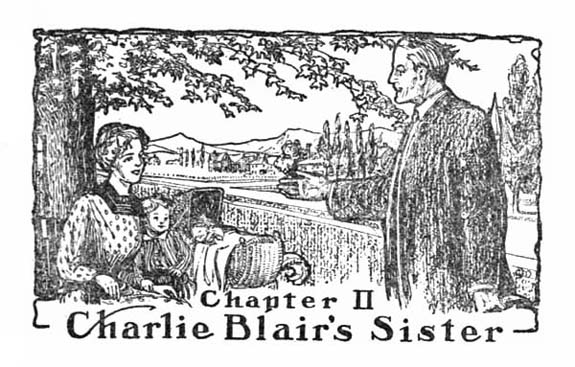
Although the days at Helena were busy ones for Philip Danvers, he found time before the convention to make his dinner call at the Latimer's. On the shaded lawn before the house he found Miss Blair entertaining little Arthur while she kept watch over the baby asleep in its carriage.
"Mrs. Latimer is away for the afternoon. She will be sorry to have missed you," exclaimed the girl, as Arthur ran to greet the visitor, always a favorite.
"You called on Aunt Winnie and me! Didn't you? Didn't you?" chanted the boy, tugging at the hand of the visitor.
"May I stay?" asked Danvers, smiling at the eager little man. "And how is the sprain?"
"Of course you may," assented Winifred brightly. "And as for the sprained ankle, wicked and deceitful creature that I am, I made it the excuse for not going with Mrs. Latimer. Good people, really good people, would think that I merited punishment for not doing my duty in my small sphere of life. Yet see! Instead of that I'm rewarded—here you come to entertain Arthur and me!"
"It is a bad example!" decided Danvers, with a stern eye that did not deceive anyone. He was amused at her naïveté, and had no wish to decry such open good-will.
"But I do limp! Don't I, Arthur?" Miss Blair appealed to the child, gravely.
He nodded and stooped to examine the low, narrow shoe, peeping from her sheer summer gown. Winifred pulled the foot back with a sudden flush. "I am, perhaps, helping along in this world as much as though I were playing cards, by staying with the children instead of their being with the maid," she said hastily.
Philip leaned over to look at the baby. Arthur pulled the parasol to one side proudly.
"Her name is Winifred," he announced.
"I believe I never saw a really little baby before," said Danvers, looking with awe at the tiny sleeper. "My sister and I were near of an age; we grew up together. How little babies are!"
Miss Blair laughed. "Winifred is a very nice baby—big for her few months of life. I'm very proud to be her godmother." Danvers watched as she pulled the fleecy covering around the sleeping child. With the act a maternal look came into her lovely face, unconscious as she was of scrutiny, and a thrill of manhood shook him deeply.
"So you did not care for the party?" inquired the caller, presently. "I thought all ladies adored card parties and enjoyed fighting for the prizes."
"Play cards when the mountains look like that?" Winifred rejoined. "It would be a sacrilege!"
"I do not care for cards myself," agreed Danvers.
"Wouldn't you like to be out there?" Winifred seemed scarcely to have heard him.
Following the direction of her gaze, he thought her wide-flung gesture a deserved tribute to the view. The Prickly Pear Valley lay before them, checkered in vivid green or sage-drab as water had been given or withheld. The Scratch Gravel Hills jutted impertinently into the middle distance; while on the far western side of the plain the Jefferson Range rose, tier on tier, the distances shading the climbing foothills, until the Bear's Tooth, a prominent, jagged peak, cleft the azure sky. A stretch of darker blue showed where the Missouri River, itself unseen, broke through the Gate of the Mountains. The view took one away from the affairs of men. On their side of the valley towered Mount Helena and Mount Ascension with auriferous gulches separating and leading up to the main range of the Rockies. As the foothills sank into the valley the gulches, washed of their golden treasure, were transformed into the streets of Helena—irregular, uneven, unpaved often; in the residence part of the town young trees ambitiously spread their slender branches; the main street and intersecting steeper ones were bordered with business blocks as ambitious, in their way, as the transplanted trees.
"'I will lift up mine eyes unto the hills,'" quoted Winifred, softly. "What a singer David was. But these mountains seem worthy of the grand old psalms."
"Yes," assented Danvers, simply; and he liked her better on this second meeting than he had at the dinner party—a crucial test where a woman is concerned.
"I never weary of looking," she breathed.
"I think—I never should, either," he declared, and looked—at her!
Unconscious of his gaze, she absently jogged the carriage while the baby slept, and Arthur, holding Danvers' hand, waited his turn.
"Mamma hates Helena," was his contribution.
"Sh-h-h!" warned Winifred.
"Then if I can't talk, make Uncle Phil show us a good time." The lad turned appealing, beautiful eyes toward Danvers, so like his father's that Philip drew him closer. "Tell us about the Crow Indians stealing the Blackfeet ponies." This was a favorite story.
"Not to-day, laddie," refused Philip, gently. "Miss Blair would not——"
"Yes, I should," contradicted Winifred.
"Aunt Winnie will just love to hear that story," affirmed Arthur. "I do! She tells me lots of stories. She was telling one when you came—the one I like the best of all. It had a be-u-ti-ful trooper in it who rescued her from a water-y grave!" The child's recital was as melodramatic as his words. "He held her just so!" Arthur illustrated by a tight clasp of the embarrassed girl. "Now, you tell one."
Philip saw that Winifred had a real interest in the old days, and while relieving her embarrassment by gratifying the little story-teller, he spoke of the Whoop Up Country.
Winifred had the rare gift of bringing out the best in people. Danvers needed such incentive; although denying it, he was a good conversationalist. Now his whole being responded to this clear-eyed, pleasant-voiced girl who sat in the low rocker beside him. She would understand. The few times he had essayed to speak to others of his service in the Mounted Police, he had met with such indifference that the words were killed; and with the exception of the Doctor, Danvers had never shared his experiences with any one. To the women he had met in Helena and Fort Benton that lonely life had brought a shudder, and to the men unpleasant reminiscences. So far as his associates of the early days were concerned it was a closed chapter.
To the child Winifred, Danvers had been a hero—handsome, debonair; to the woman Winifred, he found himself talking as easily as to the little girl who listened years before. The life at Fort Macleod was the one subject that would win Danvers from his silence, and in the next hour Miss Blair had good reason to think that she would not exchange this call for all the card parties in the world.
Presently he challenged, "You are bored?"
"I've been delightfully entertained. It is all fascinating to me. Charlie will seldom speak of the freighting days, and I remember very little of Fort Benton."
"The old place isn't big enough for most of us. The Macleod men are scattered, too."
"Have you ever been back?"
"Never! I could not bear to see the country fenced in, the old cottonwood barracks replaced, the railroad screaming in the silence, and Colonel Macleod dead. No, I shall never go back."
The baby awoke and diverted them, and soon the maid came for both children. Half-way to the house little Arthur ran back.
"I'm going to be a Police when I grow up," he announced. "I prayed about it last night. I know God'll fix it. I put it right to Him. It was peachy!"
"Arthur is always saying the drollest things," remarked Miss Blair as the child ran out of hearing distance. "Yesterday he told me that when he went fishing with his papa his fish wouldn't hook on tight."
"I'm afraid he'll find the same difficulty later in life," laughed Philip, and rose to say good-afternoon.
"I will not wait longer for Mrs. Latimer, but leave my card," he decided. "The doctor will be wondering what has become of me."
But the doctor found him very silent over his pipe that evening. The sight of Arthur Latimer's little son had wakened the old longing, the inborn desire of every Englishman to bestow the ancestral name upon the heir of his house. Philip Danvers! For eight generations a son had borne the name. Would he be the last to inherit it in this far country that had come to be his own?
On the Sunday spent in Helena the doctor proposed to Danvers that they give over politics and call at the Blairs. "They won't stand on formalities, and we both need to get our minds out of this political struggle. I'll be glad when I can go home to Fort Benton!"
"Charlie seems to be doing well in Helena," remarked Philip, as they approached the house next Judge Latimer's.
"He's up, then down. He isn't much of a business man, and hasn't head enough to keep in the swim. He worships that sister of his, and just now he's doing pretty well. I fancy that she knows nothing of his financial standing."
"I imagine Miss Blair knows more about Charlie's difficulties than either you or he give her credit for. She sees more than she tells."
The callers found brother and sister on the wide porch, and after the greetings and a half-hour of general conversation, Charlie Blair asked the doctor if he would come inside and give a little advice on a private matter.
"Good," cried Winifred. "For once I'm glad that Charlie can think of nothing but business. Now I can talk to Mr. Danvers."
"See that you do!" commanded Philip. "Yesterday I went away feeling like a garrulous dame; it is your turn to-day."
Winifred affected to reflect. "What shall be my theme—art, music, literature or our mutual friends?"
"Tell me of yourself."
"As a subject of conversation, that would be soon exhausted. Women, you know, are too idle to be good; too conventional to be bad."
"Indeed!" returned the cattleman, catching her mood. "I have known many women of that description. Pardon me, but I had imagined you were a different type."
"You say the nicest things! I feel that we are going to be very good friends."
Danvers bowed. "Thank you. I think we are."
She returned his frank gaze, and settled herself comfortably for an afternoon's enjoyment.
"Now talk!" she in turn commanded, with the sweeping imperialism she sometimes manifested toward a chance companion.
"I refuse. It is your turn."
"How you like to put on the mask of silence! Do you bolt the door to everyone but the doctor and Judge Latimer?"
"Thoughts are hard things to express, unless one forgets himself, and they come spontaneously."
"Go ahead and forget yourself, then!"
"You are inexorable," laughing. "Your demand makes me think of an Indian Council. Of course, you know that when they meet to discuss problems, they sit silent for hours. The avowed purpose of conferring paralyzes their tongues, apparently, as you have paralyzed mine. If I ever had an idea I could not produce it now."
"The Quakers have a prettier custom. They sit in silence till the spirit moves. I will be the spirit that moves you;" and so adroitly did she continue that unconsciously the man spoke of more serious things—his likings, his beliefs.
"Why did you become an American?" she asked at length, the question that had often puzzled her.
"My mother was an American." His voice took a note of tenderness which Winifred remembered long. "But when I left the service it was with no thought of choosing this as my country. I had no desire to return to England, however, and the chances for business seemed greater on this side of the line."
The girl's deep eyes gazed directly into his with flattering intentness.
"And so the years slipped by until I found that my interests were all here, and I could not leave, even if I had cared to. Isn't that true, judge?" he remarked, as Arthur Latimer came across the lawn. "You wanted to make a voter of me, for your own dark purposes——"
"Philip always hits the bull's-eye," admitted the judge, interrupting with a menacing gesture of affection at the implication. "You would not leave the State. That's just it. The most of us came into the Northwest, as we thought, to make a fortune and go back East or South to enjoy it. But whether we have made money or not, we discovered that we are here to stay. The old ties in other communities are gone. Old friends are dead. Old memories faded. We aren't all such enthusiasts as the doctor, who lives at Fort Benton for sheer love of the place, but——"
"I know just how he feels," cried Winifred, quick to defend her old friend. "I could go back there myself to live. We have a love-feast every time we speak of the dear old town, and that's every time I see him."
"I think," said Danvers, slowly, making sure of his words, "that I have come to love Montana more than my native land, though that was certainly very far from my feeling when I came back to Fort Benton as a civilian, and asked for work. I told the man that I was an Englishman, but I made a mistake. There was a long list of applicants ahead of me—Americans—to whom preference would be given. I thanked the manager, but from that day I determined to succeed without being forced into citizenship. I did succeed, and of my own choice I became an American!"
"Words, words! What are you talking about?" the doctor asked, breezily, as he appeared with Blair. "Let us into your charmed circle. I, for one, promise to be silent. Any occasion gains dignity by having an audience, and I'll promise not to be critical. I will consider your youth."
After a general laugh, the judge gave the trend of the conversation, and the doctor quite forgot his promise. The discussion of good citizenship became general, and presently Philip was appealed to for testimony on the subject of foreigners becoming naturalized.
"I hardly think I can tell you much that you do not already know," he said, "concerning Englishmen becoming American citizens. We must give the inhabitants of every great European country the credit for believing their own country to be the greatest. With the possible exception of Russia and Turkey, I am inclined to the opinion that they think their liberty is not infringed upon, any more than it should be; and they are, I suppose, contented with their lot. John Bull has every reason to think himself a favored being. He is proud of the institutions of his country—royalty, aristocracy. The knight, the 'squire, the merchant, manufacturer, skilled workman and laborer—each has his place. The laborer, cap in hand, bows to his master. So, too, aristocracy bends the knee to royalty—being taught to keep allotted rank in society, and to defer to those above. What is more, all have a supreme regard for the law itself, as well as for those who administer it."
Winifred listened. Her bright, upturned face was an incentive for Danvers to continue.
"When we Englishmen come to this country," he said, "knowing but little of the government, we care nothing for it. We generally come to better our condition financially, not politically. When we see the actions of political heelers at elections we are often astounded. We hear of Tweed, of Tammany, and it is not surprising that we have a certain contempt for American politics. If we watch very closely we see men elected to office who are entirely incompetent, and we even have suspicions of their honesty."
The girl laughed lightly.
"You choose to be very sarcastic," she commented. But Danvers had more to say.
"As time goes on we watch events, comparing the government of this country with that of our own. Little by little we are brought to feel that these States are being fairly well governed, after all. In my own case, when Judge Latimer asked me to take an active part in politics, I hesitated. But I had cast my lot in Fort Benton, and it seemed wrong to accept all that America had to give with no return from myself."
The Anglo-American looked around his circle of friends. Never before had he expressed himself so fully. He could not understand how he had been beguiled. But never before had he felt that a woman's brain would grasp every reason adduced, and understand—that was it; he felt that he was understood!
"Montana politics are like an Englishman's game—high. They smell to heaven," said Charlie Blair, after the men had further discussed the political situation.
"I don't believe that Montana is any worse than many other States," defended Winifred, quickly.
"We are building history," said the doctor, dreamily, "and history repeats itself. As the powerful nobles of Greece and Rome dictated harsh terms to the common people and ruined their nations, so it will be with us. Machine politics, money and whiskey, millionaires and monopolies—truly the outlook is depressing."
"You are not usually so pessimistic, doctor," reproached Winifred.
"Well"—Blair's contented philosophy was refreshing—"politicians seldom get more than one-fourth their money's worth, when they use it unlawfully. Three-quarters of it is wasted by giving it to hangers-on."
"Public men should be unhampered by demands for spoils."
"They invite the demands, Phil," replied the doctor, dryly. "If it were not openly known that a man could get a position as a corporation lawyer, or timekeeper in a big mine, or some other inducement, do you think any would-be senator, for instance, would be troubled by distributing 'spoils of office'?"
"He would not be troubled with superfluous votes, either," remarked the judge, caustically.
"Oh," cried Winifred, with a vision of what might be, "if only the candidates and the voters could be brought to see that public office is a public trust; that the honor of election is enough!"
"That is the way it is in England," answered Danvers. "There, for instance, a man is elected to a city council for his personal fitness and ability to hold office. No questioning of his political affiliations. No perquisites—no privileges. Only the honor of his fellow citizens, which is enough. It is the same in other positions, even in Parliament."
"Here comes Mrs. Latimer." Miss Blair rose and advanced to meet her friend. "I see by your eyes, Eva," she said gaily, "that I have to placate you for monopolizing all the men in sight."
Mrs. Latimer laughed, and the circle widened to admit her.
"You are talking of politics," she accused, lazily. "Either that or of Fort Macleod."
"Madam," the doctor affected remorse, "we were talking of politics. But when you burst upon our enchanted vision, as beautiful as when you dazzled us sixteen——"
"Oh, don't!" shuddered Eva. "Why—why will men be so exact as to dates? Why not say 'some years ago'?" She looked around rebelliously. "I will not grow old, even if you, dear doctor, have silvery hair, and Arthur's is growing thin, and Mr. Blair—well, I'll admit the years have dealt kindly with Charlie and Mr. Danvers."
"And with you, dear," added her husband, loyally.
"How do you like my gown?" asked Eva, turning to Miss Blair as the men began to talk of other subjects.
"It's lovely! You are so artistic! It must please your husband to have you so perfectly gowned."
"Oh, Arthur—as for one's husband, I simply can't imagine dressing for one man."
"I can," breathed the girl, her thoughts afield. But the sentiment was lost upon Eva.
"If I lived nine miles from nowhere I would dress and walk among the cow corrals or on the range for the cowboys—if there were no other men to admire me!"
"You say such dreadful things," Winifred answered, gently, "but I know you do not mean them."
"But I do!" wilfully.
"I have grown away from the East," the doctor was saying, when the ladies again listened. "I want more room than the crowded cities can give.
"'Room, room to turn 'round in, To breathe and be free.'
"I fancy the Puritans wanted physical as well as religious freedom, if the truth were known." He mused; then suddenly:
"How can you make one who has never experienced it feel the West?"
"You can't," laughed Latimer. "I tried once, but my companion looked bored, and I stopped. 'Oh, go on,' he said, politely; 'you are interested!'"
When the merriment had subsided, Eva exclaimed:
"I'm sick and tired of the West! I want to live in New York, Washington, abroad—anywhere but Montana!"
"I wish that we might, dear," said the judge, patiently; "perhaps we can some day."
"By the way," remarked Eva, her thoughts flying inconsequently to another subject, "I've promised to read a paper on 'The Judiciary of Montana' before our club to-morrow. Tell me all about it, Arthur, and I'll write the essay this evening." She looked at the group in surprise. What had she said to raise such shouts?
As soon as her husband could speak he wiped his eyes.
"It's a pretty big subject for me to discuss now," he said; "but I'll write something. That will be better than confusing your mind with it. These club-women," he went on indulgently, addressing the others, "are so fervid—so much in earnest."
"Are you a club-woman, too?" the doctor asked Winifred, and Danvers waited her reply.
"I used to be," dolefully. "But I am a renegade, or a degenerate. I was allowed to join the classic circle of a Dante Club, and for two years we (perhaps I'd better say I) agonized over the prescribed study—the course was sent out by the university. But when the third year arrived I wearied of well-doing. I was horrid, I know; but the subject was remote as to time, and dead as to issues. I like live topics, real issues—Montana politics, for instance."
"You might have joined the Current Events Club," reproached Mrs. Latimer. "To be sure, it's sometimes hard to find topics for the next meeting, but we get along. Club work broadens our minds and widens our sphere," she concluded, with a pretty air of triumph.
"And when topics fail—to write about," put in Blair, "you can talk. You ladies always find enough to talk about!"
"Why, Charlie Blair! You're just as horrid as you used to be!" responded Eva, hotly.
"Didn't I hear something about one lady's stabbing to death another lady's imported hat, just on account of too much talk at one of the club meetings?" Blair was persistent.
"That story about the hat has been grossly exaggerated! It is nothing but gossip."
"'Current Events,' too," murmured Charlie, properly deprecatory.
Not long afterwards Danvers made the first move toward breaking up the group.
"Must you be going?" Winifred rose also. "I suppose I shall not see you again before the Assembly meets. You'll be sure to be here then, as senator from Chouteau."
"Thank you for your optimism. May I call?"
"Certainly. I should feel hurt if you didn't. We are friends of many years' standing, you know."
Never before had he asked to call upon a lady. The importunity had always been on the other side.
Late in the evening the doctor came to Danvers' room for the good-night call; but the talk was wholly of Judge Latimer's interests.
"I'm afraid that Arthur will have a hard pull," regretted the old friend, "but we will do all we can for him. I've had a telegram calling me back to Fort Benton, and must leave on the midnight train."
Danvers walked to the little depot, a mile from the city proper, with his friend, and after the train pulled out he again thought of Winifred.
As he passed, on his way back to town, the huge piles of loose rock that the miners had left in their sluicing for gold in bygone days, his thoughts followed the girl back into the long years since he had first met her on the Far West—a child eager for sympathy. It was odd that he had never seen her in all that time—the years when he had unconsciously longed for friendship, and the sight of a woman's face—a white face. The rings from his cigar melted around him, softening his face until it took on the boyish fairness of youth.
The evening before the convention found Judge Latimer at the club in conference with his friends. His nomination seemed doubtful, yet there was a possibility that he might win, and Danvers was working hard and hopefully.
The Honorable William Moore had arrived from Butte that day, and as he greeted various members of the club, watched for a chance to approach Judge Latimer.
"What are the prospects?" he inquired, after a chat on politics in general. "I calculate you'll need the support of Silver Bow County, and we'd like to help you out."
"Of course, I shall be glad of your support," responded Latimer, who knew it would be impossible to win without this important section of Montana.
"Very well. What can you do for us—that is, for Burroughs?"
The judge moved uneasily. "It doesn't seem to me that I can do very much for a man who has practically the whole State at his command."
"You know what we want!" scowlingly.
"I shall have no influence."
"Bah! What's the use talking? He'll make it worth your while. Get Danvers to vote for Burroughs when it comes time to elect United States senator. He never will unless you can persuade him. You know his feeling toward Burroughs, although Bob's been a good husband and father. And there's Charlie Blair, get him pledged and he'll be elected; and——"
"Hold on, Moore!" Latimer's voice trembled with anger. "Why should you oppose me? Haven't my decisions always been just and——"
"I'm not saying anything about your decisions," broke in Moore, "although it would have paid you to be amenable. I knew the time would come when you'd want our political help."
"I don't want your help!" cried the judge, passionately. "If I should be elected through your instrumentality I should feel as though every man in the State believed that a decision handed down by the Supreme Court was tainted with your money. As yet the Supreme Court of Montana has been above suspicion, and so far as it is in my power, it shall remain so!" He struck out, his slight form quivering righteously.
Across the room Danvers saw him, and walked quickly toward the men.
"I want to speak to you, Arthur," he said, and drew the judge into the street.
"The elephant and the gazelle are trotting together," said Latimer, presently, trying to be facetious in an effort to regain control of himself. He looked up at his stalwart companion.
"Yes, and the gazelle is always looking for trouble when the elephant is around, so he can be pulled out!" returned Danvers, in the same strain; yet with the undercurrent of affection that always crept into his tone when speaking to Latimer.
Words failed the harassed judge as he attempted to reply. This friend of his! This dear friend!
"It is just as I thought, Phil," he remarked, after they had walked for a time in silence. "Burroughs will block me."
"That's bad; but it might be worse. Let me see. Who are the delegates from Silver Bow?"
"Bill Moore is the chairman. No need to specify the individual men, for every one of them will vote as instructed. Oh, Burroughs has that county well organized!"
"H-m-m!" mused Danvers, nodding affirmation. "Silver Bow is not the only county, and Moore is not the only chairman. I am chairman of the Chouteau County delegation, and we are solid for you. I have more or less influence in other counties," modestly. As they walked they canvassed the situation. Without Silver Bow it did look dubious.
Turning a corner they met O'Dwyer, ruddy and smiling as ever.
"Here's O'Dwyer!" cried Danvers. "He is always good in an emergency. His fertile brain will contrive some method of procedure that will land you safely on the bench for a second term."
A conference ensued. O'Dwyer shook his head doubtfully when he learned of Burroughs' strong following, but said nothing until the three were in Danvers' room.
"I heard Wild Cat Bill talking to yeh," he acknowledged, "and I think I've got something up my sleeve." But he refused to disclose his plans, only warning Danvers not to be surprised if he was late to the convention, and they separated.
The convention was called to order. Campaign issues did not appear to be of great moment; but when the chairman announced that the candidates for chief justice would now be considered, there suddenly arose so much controversy and ill-feeling that the meeting was adjourned until evening. An active canvass was begun by Danvers for Judge Latimer, and by Moore for his candidate. O'Dwyer of Chouteau County, seemingly not so much interested in the business in hand as in looking up old friends whom he had known at Fort Macleod, circulated joyously among the men. It was not long before he was cheek by jowl at the hotel bar with Wild Cat Bill (Moore never objected to the old nickname), and after sundry refreshments and their accompanying chasers, he proposed that they dine together. Mr. Moore was agreeable, and suggested a private room for the meal, being under the impression that O'Dwyer would look favorably on an effort to turn his allegiance from Latimer's candidacy.
As the dinner progressed he told O'Dwyer that he had in mind a lucrative position which Mr. Burroughs would gladly bestow on an old friend, if the Irishman saw fit to accept. Moore carefully explained, as the glasses were filled and emptied, that he had no ulterior motive. Oh, certainly not! O'Dwyer must not think that Burroughs ever offered a bribe, even in so small a matter as this of defeating Judge Latimer in state convention!
"Of course not!" agreed O'Dwyer, and surreptitiously glanced at his watch. He redoubled his efforts to be the good fellow, and apparently coincided with Moore's views on politics.
The clock in the court house struck half after eight. The convention was called to order, and Mrs. Latimer, thrilling with the sense of unknown possibilities, sat in the crowded gallery, and settled expectantly to the excitement of the balloting. Strong and spicy speeches were anticipated. Silver Bow, notoriously the hotbed of political agitation in the State, possessed in Mr. Moore a star speaker. He always had something to say, and was the chief factor in filling the ladies' gallery. His fiery remarks and impassioned appeals were as exhilarating as cocktails. Full well did Mr. Burroughs know the value of his trusted henchman, both in caucus and on the floor, and he had left his cause against Judge Latimer wholly in Moore's hands, with no understudy. He had made the trip over from Butte the day before, and now expectantly awaited the appearance of the Honorable William.
As the delegates and spectators listened to the blaring band they watched the rapidly filling seats and noted the tall staffs and placards indicating the various counties. Danvers looked in vain for Latimer; Burroughs for Moore.
O'Dwyer had not appeared, and the chairman of the Chouteau County delegation smiled as he thought of the Irishman's devotion to his friends, and the possible discomfiture of their common enemy. But Latimer's absence was disquieting. He had said something about little Arthur's having a cold, but surely that would not keep him from so important an occasion.
Nine o'clock. The chairman declared the convention ready to proceed. Burroughs, hovering near the doors of the auditorium, looked anxious as he saw Danvers rise to make his nomination speech for Judge Latimer. Moore—the invaluable Moore—was not in the hall. The moments were slipping by, and Burroughs hastily dispatched a messenger to his hotel and to the club.
As Danvers gave a simple, earnest recital of Judge Latimer's qualifications and the need for such men in the State of Montana, he saw the judge enter. He spoke of his devotion to his family, his business integrity, his high ideals; and ended with the plea that in this day of corruption in high places, his own State preserve her prestige by maintaining in office one who had been found able and incorruptible in discharging his duties as judge of the Supreme Court of the State of Montana.
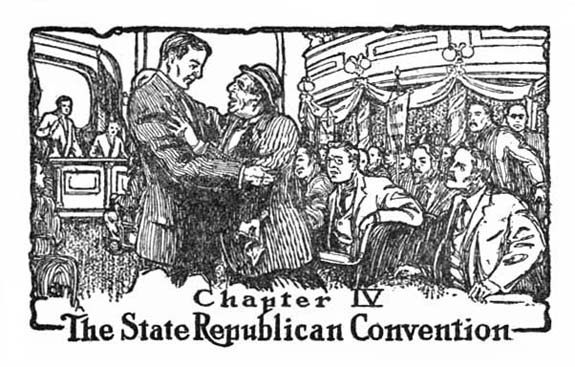
As Danvers returned to his seat he was met by the recalcitrant Moore, walking carefully, and blandly indifferent to Burroughs' angry oath with which he had been greeted at the door.
Danvers tried to avoid the wavering path, but the Honorable William had a set purpose in his muddled brain. He fell upon the neck of the delegate from Chouteau, and his arms met around Danvers' neck.
"I d'know yer name," he hiccoughed, enthusiastically, "but I know yeh're a gen'lmun." The unexpected followed. Holding himself upright by the embarrassed Danvers, he bellowed: "Mishter Chairman! I seconsh the nomination!"
Pandemonium ensued—laughter in the galleries, drowned by the roar of disapproval from Burroughs' candidate and his following. O'Dwyer hastily gained the recognition of the chairman and again seconded the nomination of Latimer, and the balloting began.
Burroughs, not being a delegate, had no place on the floor, and was powerless. The leaderless flock from Silver Bow made weak efforts to assert themselves, but O'Dwyer saw to it that Moore did not get to them until affairs were well settled. The first ballot was taken, and Latimer had a majority. He had received the nomination!
There were cheers and loud calls for Latimer, and he responded briefly. In the excitement Burroughs succeeded in enticing the torpid Bill into the lobby, and so effective were his words, emphasized by his fists, that Moore returned to the hall a chastened man, and demanded that the nomination be set aside. In the uproar Burroughs ventured onto the floor and yelled to the cheering delegation from Chouteau County, "Howl, ye hirelings!" He violently accused Danvers of collusion with O'Dwyer in detaining Mr. Moore.
O'Dwyer was in no mood to permit this. For years he had idolized the Englishman. In a moment he placed himself in front of the ex-trader, and reaching, grabbed for Burroughs' nose.
"Do I understand yeh're talkin' agin me friend, Philip Danvers?" he shouted, with a twist of the olfactory member. "If I hear anither whimper out of yez, I'll smash yeh one! I got Bill Moore drunk—I! Yeh can settle wid mesilf!"
In the tumult the meeting adjourned, and Danvers was glad to get out of the hall and have a word with his friend.
"Why were you so late, Arthur?" questioned Danvers, as soon as they had a moment together.
"My boy is not well," Arthur explained, as his eye roved anxiously around the circling balcony. "Eva had set her heart on hearing the nomination speeches, and so I stayed with the laddie until the last minute. I couldn't bear to leave him alone with the nurse-girl."
"Let me go for a doctor!" begged Danvers, anxious to be of some help.
"No, he isn't sick enough for that—I did call a physician about dinner time. Perhaps I'm foolish," he smiled wanly, "but if anything should happen——"
"Tut! tut!" Danvers put his hand on the stooping shoulders. "I'm going home on the midnight train, and I'll send the old doctor up to see the lad; or," with a sudden thought, "why not wire him? I will do it as I go to the station."
"Perhaps you'd better," agreed Latimer. "I wish he had remained here for the convention; but I know he will be glad to make the trip for the sake of the boy, and the sight of his face will do me good."
"You've been working too hard. Take it easy now and don't worry," counseled Danvers. "I shall be up again in a few weeks, and in the meantime write to me, Arthur."
He stood a moment as Judge Latimer waited for Eva. He felt, somehow, that his friend needed him. But his train would soon be due, and with a hearty hand-clasp he said good-night and hurried away for the Fort Benton express.
The days that followed the convention were like a dream to Danvers when he remembered them afterwards. He had scarcely picked up the old life at Fort Benton—looked over his cattle and gone over his neglected correspondence, when a telegram from the old doctor recalled him to Helena.
Arthur Latimer's tragedy had come, and Danvers, unfamiliar with death, knew no words of consolation for the father bereft of his firstborn. A numbness mercifully comes during those first hours, which makes it possible to move about and go through strange, meaningless ceremonies with a calm that surprises those who have not known the searing touch of the death angel.
A few days later he and the doctor were back at Fort Benton again, and life moved on as before. Only there was always the memory of Latimer's drawn face that no laddie's voice would lighten, no little hand caress.
The doctor hoped that the political campaign would occupy his thoughts for the present, but when the election went against Latimer he shook his head.
"Read this letter," he said to Danvers one evening. "It came to-day, and I should have sent for you if I hadn't felt so certain you would drop in. You're the one to go."
It was a letter from Winifred, and Danvers felt a peculiar sensation of satisfaction in seeing her handwriting, as if it gave him an added bond to their friendship.
But he forgot Winifred in his anxiety over the message her letter conveyed.
"I wish that you or Mr. Danvers could come to Helena," she wrote. "Judge Latimer is so changed since little Arthur's death that we sometimes fear for his reason. Since the election has gone against him there is no direct interest to take his attention and he has sunk into a deep melancholy. You could rouse him as no one else could. Please come—one or both of you."
Danvers read no further, but looked up to catch the doctor's eye. He nodded. "All right, doctor. I'll go to-night."
His heart was drawn still more closely to the stricken man. He longed to bring back to that sad face the smile that he remembered on the Far West, when Latimer's buoyancy had been like wine to his lonely heart. He felt confident that the friendship of one man for another could reach the heart of his friend, now closing against all human sympathy.
It was noon before Danvers reached Helena and made his way to Judge Latimer's residence. He was startled by the absence of life, the silence and drawn shades. Turning, he saw Miss Blair entering her own gate.
"I'm so glad you've come!" cried the girl, with unaffected pleasure, as he hastened towards her. "But didn't you know that the Latimers had gone to the hotel for the winter?"
Danvers had not known.
"Come in and have lunch with Charlie and me," she urged; "it will be ready in just a minute. Charlie will be here soon and will want to congratulate you on your majority."
"But Arthur—I feel I must get to him."
"Come in and telephone. He has opened offices down town and you may find him there. I call up Eva every morning, but Judge Latimer is out a great deal."
While she was speaking Danvers had followed her into the house. It was a homelike room; a canary's trill greeted them, and a glimpse of old-fashioned plants in the bay-window wakened memories of English homes. How different it was from his rooms at Fort Benton!
Winifred smiled brightly as she made him at home, and excused herself for a moment.
"And how is Judge Latimer?" questioned Danvers, as she reappeared from the dining-room with a big apron, which she fastened about her waist in a most businesslike manner.
"He needs cheering—needs loving! With the old routine of office suddenly lacking, and little Arthur gone, the man is lost—aimless. There seems to be nothing worth while—nothing to keep him with us! And there are other troubles—I don't understand them myself, but you will know how to help him. I'm so glad you have come!" she repeated, with a warmth that made his heart beat faster. What would it be like to find such a welcome for his own sake—and every night when he came home!
"Did you 'phone the office?" The words recalled him.
"Yes. He is down in the valley; the clerk didn't know when he would return."
"We won't wait for Charlie. He's often late, and I know you are anxious to find the judge."
After a few minutes' absence Winifred announced that luncheon was ready. As Philip held the curtains for her to precede him to the dining-room he looked longingly at the sweet-scented blossoms in the window.
"I have seen nothing more delightful in years," he explained. "I am old-fashioned enough not to care for palms or rubber plants."
"Another bond of friendship," smiled Winifred, lightly. "Shall I make the salad dressing, or would you prefer to mix it yourself?" she asked, after she had persuaded him to take the head of the table.
"I make a dressing that is the despair of my friends," she continued. "So I make them shut their eyes when I mix it, else my one accomplishment would be mine no longer."
Philip promised, with a smile, to "play fair." He delighted in the housewifely nonsense, and ate the salad, though he hated olive oil. "Salads are a woman's folly," he had once said. But he did not repeat it.
"How do you like it?" Her mood suited the visitor. The light conversation took his mind from the more serious purpose of his visit, and Winifred's accent implied accepted friendship. He needed this relaxation.
"I never cared for salads, before," he replied truthfully.
"Why did you eat it?"
"I ate it, and I liked it because you made it for me. I am not used to being waited upon, and I rather like the experience."
"You poor man!" Winifred sympathized without reflection. "It must be horrid not to have anyone to do things for you. I should think—I mean——" she colored as she met Philip's eyes, "I mean—Charlie says that I have spoiled him completely."
The advent of Blair relieved the girl from her condition of fragmentary speech, and they talked of the Latimers and the political outlook for the coming winter.
Danvers took his leave with a feeling of regret at parting from unexpectedly congenial friends. How little he had known of Blair—the good fellow. How cheery and unaffected Winifred was! The years were bridged which had separated him from his kind, and as he walked down the street he felt a glow of kindness toward all the world.
He called at the hotel, thinking Latimer might have returned, but Mrs. Latimer pettishly denied any knowledge of his whereabouts. He often went for long walks, she said, and seldom returned until late. "Won't you stay until he returns?" she invited, but Danvers pleaded business.
Twice during the afternoon Danvers ran up to the judge's office, but failed to find him until evening. Seeing a light in the inner office, he opened the door and entered.
The judge did not look up. He sat with his back to the door, and gazed intently at a revolver, while his hand played idly with the trigger.
Danvers stepped forward and silently reached for the weapon.
"No, no, Arthur! Not that!"
"Phil! You?" Latimer sprang from his chair. "Why—why——"
Danvers was shocked at the haggard face.
"I ran up from Fort Benton, Arthur, just to see you. I've been looking for you all the afternoon." He gently pushed the trembling man back into his chair.
"Why—why did you stop me? It would have been over—now—if——"
"Life is not so bad as that, old friend."
"Isn't it?" bitterly. "If you——"
"I can understand—I know. But you must promise me that you will not attempt this—again." Danvers spoke firmly, feeling that he could never leave his friend if he were not given a pledge.
The broken man looked into the kind eyes opposite. "You think me a coward, don't you? I promise."
"No," refuted Danvers, warmly. "You are worn out, mentally and physically; that is all. Take a run to the coast with me for a month or two——"
Latimer began to laugh, mirthlessly. "I couldn't take a run to Fort Benton, Phil. I haven't a dollar—not a dollar. I'm a ruined man!"
"Arthur!"
Latimer took a paper-knife and checked off his sentence. His voice was impersonal.
"You made a mistake, Phil, when you interrupted me. No, do not speak," he raised his hand. "I was in possession of what sanity I've had since Arthur——" He did not complete the sentence. "I've deliberately decided that a quick shot was the only solution of my problem. Boy gone; home gone; my dearest ambition frustrated; hopelessly in debt——"
"I can help you in that."
"And disbarment proceedings about to be instituted," finished Latimer.
"What!" ejaculated Danvers. "Who will institute them? On what grounds?"
"Burroughs. He has trumped up some infamous charge. I got a hint of it only this morning—a straight tip."
"He shall not do it! I shall have something to say to him—to the papers. He would not like to have them get hold of Moore's interviews with you and me on the matter of that Supreme Court decision. I——"
"Papers!" Latimer threw out his hands with a helpless gesture. "Burroughs owns every paper in the State!"
"Well, then, I have another card to play. You leave this matter to me. You are not going under, and you are not going to—die—not yet! Bob will drop the disbarment proceedings, I promise you; and if he is not amenable to reason—why—he does not own the Associated Press!" grimly.
"N-no. But I'm broke—ruined."
"What do you think a friend is for, Arthur?" said Danvers, reproachfully. "If I had had any idea that financial matters were troubling you, I would have fixed you out in short order!"
"I can't accept favors."
"Favors!" slightingly, to cover his feeling. "I shall be a Shylock—never you fear!" Then a hand, heavy with love, fell on Latimer's shoulder. "What is mine is yours, Arthur."
Within a week, not only were the judge's difficulties relieved, but the proposed disbarment proceedings were dropped.
"I had means," said Danvers, sternly, when pressed for details by the grateful judge, and none but Burroughs ever knew of the threatened exposure.
Before Danvers returned to Fort Benton, he had the pleasure of seeing Judge Latimer off for the East on legal work and knew that his low mental condition was replaced by a more healthy one. Mrs. Latimer he avoided. The gratitude of Winifred Blair came as a surprise, and strengthened their sympathy in this common cause. He called to say good-bye, but found her not at home, and he left Helena with a distinct feeling of disappointment.
The state election in November gave Danvers a handsome majority, and it was as the senator from Chouteau County that, early in the new year, he attended the governor's reception to the legislators. He came in late, and after paying his respects to the governor and his wife, wandered rather helplessly toward the hall, seeing many whom he knew, but finding little pleasure in their casual greetings.
Mr. and Mrs. Burroughs, as well as the Hon. William Moore, had come from Butte to attend the brilliant society function. Other acquaintances who now lived at the capital were among the guests whom Danvers recognized. His sister he seldom saw, and the lack of any common interest between them made it possible to meet her husband in only the most formal way.
Presently he saw Winifred Blair at the salad table, who, chancing to look up from her task, smiled invitingly.
"May I not serve you with salad?" she asked, as he approached.
"If you will make the dressing," recalling their lunch of the late summer.
"It is already dressed," laughed the girl.
"Then you will let me get you some punch; come with me for it."
She was perishing of thirst (by her own statement), and Danvers finding some one to take her place for a time, discovered a quiet corner of the library past which swept the tide of callers. Hither he enticed Miss Blair, and soon brought the refreshing drink. She sank on the window couch.
"How nice to be looked after," she said, gratefully. "I believe that you knew I was tired of the silly things one must say to men whom one never expects—or wants—to meet again."
"Never say silly things to me or I shall think I am in the category."
"Very well, I will not. I've always had to be to other people what they wanted me to be—what they expected. Somehow, with you—I am myself."
"You could not pay me a higher compliment."
For some minutes they chatted of the coming assembly and then wandered to the discussion of a book which denied love to be the greatest thing in the world. By that instinct which prompts men and women to talk of this one subject they enlarged on the topic, impersonally at first, as if it were a matter of the price of cattle.
"Then you do believe in the great passion?"
"Certainly; don't you?"
"I used to think that I did—years ago. But one sees the counterfeit so often."
"There could be no counterfeit unless the real existed."
"You are right. The real is so rare, then, that one despairs of knowing it." The subject grew more personal. "But we all want the genuine."
"I don't care for paste diamonds myself, no matter how well they imitate."
"You have had opportunity to discriminate?" tentatively.
"I—think so," Winifred replied, reflectively, as if he had asked whether she liked cucumbers, and his face clouded, for no reason. "Vicarious experience," she added, mischievously.
"Oh!"
"I have admired men; liked a few immensely," she admitted, frankly. "But the mysterious glow which comes—it has never enveloped me," she ended abruptly. "Since we are getting so personal, how about yourself?"
"I——" he hesitated.
"You needn't finish!" Winifred nodded, laughing. "Other men swear by the little god that they have never loved—never—until——" Once more Winifred found her facile tongue had led her into difficulties.
"Other men lie—I do not; yet you evidently do not believe me."
"Yes, I do! That is what I so like about you. People believe you, trust you, know where you are to be found."
"I know no other way," replied the Senator. "It is no merit. I simply find it awkward and inconvenient to prevaricate."
"You are to be congratulated," murmured the girl, ransacking her memory for another man who could say as much.
An eddy of the flowing stream of guests brought Mrs. Burroughs towards them. Mrs. Latimer, too, came into the deep window space, the ladies talking animatedly.
"Am I not right, Winnie?" appealed Mrs. Latimer, after the felicitations of the day had been exchanged. "I say that a woman has never had a love affair worthy of the name who hasn't had a lover called 'Jack.' Jack—the care-free; Jack—the debonair; Jack—the dare-devil! It's all in the name, Jack."
"Alas!" moaned Winifred, entering into the gay spirit of the moment. "Alack, woe is me! That I must confess my poverty before woman"—she glanced at Danvers—"and man! I've had lovers of many names—Henry and Jim and—and—Bi——" she seemed out of names—"and of many hues—Brown and Green and Black; but never a Jack for me!"
"If you haven't had an adorer by that name," laughed Mrs. Latimer, "it's because no man in the state answers to the name of Jack!" They all joined in the merriment, to Winifred's confusion.
"'Thou, too, Brutus!'" she quoted reproachfully. "What will Senator Danvers think of me, with such a reputation as you give."
"Suppose I have my name changed," suggested Danvers.
"Philip suits you very well," Miss Blair answered, sedately. "You intimated a few minutes ago that you were rather inexperienced," she went on daringly. "If this winter you will try for such a reputation as Mrs. Latimer gave me, I'll agree to meet you on the field of battle." As she concluded the doctor came up and the joke was explained to him. He turned to the Senator.
"You're too old to have your name changed, or to affect the tender passion, Phil. Leave that to younger men—to me! I'll have my name changed to Jack, right away; and as for loving, I have always loved thee!" bowing to Winifred.
A chorus of shrieks greeted the doctor's declaration.
"No," insisted Philip, when his voice could be heard, "I am going to enter the lists, inexperienced as I am."
The challenge in his eyes was good to see, but Winifred could not meet them. Delighted at the sight, the doctor changed the subject, and soon the group broke up.
As Danvers greeted others, he noticed Eva Latimer in earnest conversation with Mr. William Moore. He bowed in passing, but their lowered voices paused only long enough for the conventional greeting.
After making the round of the parlors, Danvers found the doctor and soon afterward they returned to their hotel.
The next morning Judge Latimer was surprised to find his wife taking a sudden interest in politics.
"Why is there so much opposition to Mr. Burroughs for United States senator?" she inquired.
"Several reasons," he answered, evasively, thinking she would not be interested to pursue the subject.
"But he will be elected."
"That remains to be seen."
"He has thirty pledged out of the whole ninety-four, and several——"
"How do you know? Where did you get your information?" Latimer spoke sharply.
"Mr. Moore—nobody talked of anything else, it seems to me," amended Mrs. Latimer, with what carelessness she could assume. "Since the legislators have been arriving I have heard nothing discussed so much as Mr. Burroughs' chances of winning the election."
"That comes of living in a hotel," said the judge, bitterly. "Burroughs' headquarters are on this floor, too, confound it! I wish we had not given up our home."
"I don't," cried Eva. "Politics are lots of fun! I had no idea how much until this winter. It's so exciting!"
She did not tell her husband that the Honorable William Moore had been at considerable pains to interest her in the coming struggle, even prolonging his frequent calls unduly, in giving her an insight (so far as he thought necessary) into the workings of practical politics as expounded and promulgated by Mr. Burroughs and himself. So delicately had he broached what had been in his mind since the night of Eva's dinner party that before she was aware she had promised that she would do what she could to forward Burroughs' cause with recalcitrant members. The political manager had assured her that his patron, in his gratitude, would make the reward for her services magnificently great.
Mrs. Latimer had not been cajoled into this without some scruples, for she well knew what her husband would think. She remembered, too, certain interviews of her own with Burroughs, which she would have liked to forget; but it was many years ago that he had made love to her, and she succeeded in allaying the troublesome reproaches of conscience by the justification of the urgent need of retrieving their fortunes. If Arthur could be made minister to some foreign capital (her ambition had vaulted to Berlin) he need never suspect her share in its offer.
Mr. Moore had told her that only a rich man could afford to be at the head of one of the larger legations, and had most thoughtfully placed certain mining shares in her name, whose value had already increased gratifyingly. When Arthur should ask her how he could accept such a position, she would triumphantly produce the fortune made from these shares, and explain that she had judiciously invested the small patrimony from her father's estate. It all seemed easy to the ambitious woman. Only a little effort to interest certain men—could anything be easier?
And the gold which she had found after Moore's last call! When she had sent him word he told her that he had its duplicate; to use the money, since she had found it. The temptation was great. Arthur was always complaining of unpaid accounts. She settled certain debts with a light heart. He would never think to inquire about them.
So now she merely looked misunderstood as she continued: "It is nothing to us, of course, whether Mr. Burroughs is elected; but"—she hesitated, not knowing how best to proceed—"I'm sure a word from you would have great influence with the members."
Latimer was dumfounded. Then he began to laugh.
"You would make a first-class lobbyist!" he said lightly. "Have a care! A word from you would be worth ten of mine." Then, more seriously: "Don't talk too much of this, Eva. It is going to be a bad business before a senator is elected. Ugly rumors are heard already. I know of——" He changed his words. "Mr. Burroughs is not respected among men of integrity. Not even among men of low standards. His wealth is his only asset. Unscrupulous, defying investigation——" He pulled himself up. Never before had he expressed so definite a judgment on the millionaire.
But though he cautioned his wife, Latimer had no suspicion that it might be necessary. She had lived purely on the surface, showing no interest in anything but dress, society, herself. It did not occur to him that ambition might render her something more than a butterfly. In this respect Moore read the woman more accurately.
That week Helena was billed for Italian opera. The announcement of Il Trovatore made Danvers' heart leap with desire to hear it once more. He knew it was doubtful whether the company could sing, but it could not be wholly bad.
When he first heard the opera, during a boyish holiday in London, it was at the height of its popularity, and every evening of his vacation found him enthralled in the boxes. The isolation of the frontier had but made the old music more loved, and Philip decided to make up a box party of his friends. Miss Blair had told him that she had never heard it in its entirety. She should be the guest of honor. Judge and Mrs. Latimer, Blair, the doctor from Fort Benton and O'Dwyer should complete the party.
"The opera has been given for the last twenty years," said Senator Danvers to Miss Blair, as she expressed herself delighted to accept his invitation. "You could hardly get a corporal's guard to go across the street to hear it in New York, I fancy; but it was the first opera I ever heard, and I love the old airs."
The theater was filling fast as Danvers held the curtain aside for his guests to enter the box. The distractions of the opposing forces at the capitol were, for the time, dismissed, and he listened with amusement to Miss Blair as he assisted to remove her light opera cloak.
"I've never been in a theater box before," she confessed. "It makes one feel exclusive, doesn't it? And, oh, dear! dreadfully self-conscious. Suppose I fall out—over the railing? I'm sure I shall bring disgrace upon us!" She looked gaily at her host. "Suppose I should fall over?" she repeated, her eyes wide with pretense.
"Somebody would catch you," said matter-of-fact Eva.
"If you think that you are growing dizzy from looking over that fearful, two-foot precipice," said Danvers, adopting Winifred's tone, "I'm going to be the one to save you from a tragic death! I'll go around now, and get ready to be a hero!"
"Don't! A lady in an opera box is worth two in the orchestra seats," paraphrased Winifred, blithely. "I will not fall out."
As Danvers pulled her chair a little further from the low rail, Winifred noticed his face change.
"What is it?" she asked, in quick response.
Philip smiled a little sadly. "'My heart is on the ground,'" he answered, using an expressive Indian phrase. "I cannot be light and witty. I am cursed with seriousness."
"Your friends like you just as you are." But in this frank avowal the senator found no consolation.
Danvers' enjoyment of the familiar opera was augmented by the appreciation shown on Winifred's earnest, mobile face. The company proved to be exceptionally good, the voices above the average, the acting intelligent and con amore. The passionate intensity of the Italians soon enthused Miss Blair into forgetfulness of those around her. While her brother and O'Dwyer sat stoically, the doctor contentedly, and Mrs. Latimer indifferent in her secret musing, Arthur and Philip followed, with her, the fortunes of Leonora. Not until the curtain fell on act three did she readily join in the chatter of her friends, and then only when Judge Latimer said to his wife: "You should have heard Phil sing 'Di quella pira' when we were at Fort Macleod. He reached that high note quite as easily as this Italian."
"Don't you believe him, Mrs. Latimer," besought Danvers. "Make allowance for his well-known partiality."
"Certainly," responded Eva, trying to make her tone indifferent. She never was quite sure of her voice when speaking directly to this man who ignored the past.
"Do you sing?" Winifred turned with a quick motion which was characteristic. "Do you, Senator Danvers?"
"I do not."
"But you did?"
"You bet he did!" blurted out O'Dwyer, ever ready to recite the good qualities of Danvers. Thereupon he told of the Christmas supper, Colonel Macleod's request, and the duet. "But they sang in English, so a Christian could understand—not this Dago lingo," he concluded. The Irishman's contempt for the soft Italian syllables was irresistible.
"Oh," sighed Winifred, after the laugh had died away, "I wish that I could have been at Fort Macleod that Christmas night!" she included Judge Latimer in her friendly glance.
"Mr. O'Dwyer did not tell you that he could sing!" chortled Latimer. But O'Dwyer begged to be spared, and after some good-natured raillery the judge acquiesced.
"Has that particular duet already been sung?" Winifred's eyes shone as she leaned toward her host. "If it has I shall insist upon its being repeated."
"You are so used to having people do as you ask that I believe you would," volunteered Eva.
"Of course I would. Everybody does as I wish."
"Perhaps that is because you do not ask impossible things," put in Senator Danvers. "But to relieve your anxiety, and to prevent your rising and asking for something that might be refused, I hasten to assure you that the duet has not been sung. Mr. O'Dwyer forgot to say that it was the Miserere that we tried to sing for dear old Colonel Macleod. I'm afraid we did it pretty poorly."
From this the conversation drifted to other matters.
"I don't see Mr. Burroughs, Senator Danvers, although your sister and niece are in one of the opposite boxes," said Eva, sweeping the house with her glasses. "Nor Mr. Moore, nor Senator Hall—although his wife is here," she added.