BOOK III (continued 2)
Reading edition
"Politics are more exciting than Italian opera, I fancy," said Winifred.
"The politicians are pretty busy," confirmed the judge.
"Whom do you think I saw on the street to-day, Danvers?" asked Blair, suddenly. "McDevitt!" he announced, waiting for no speculations.
"No!"
The men were surprised, for McDevitt, the missionary-trader, had long since been forgotten.
"He says that he lives in Montana now, somewhere near the Canadian line."
Just then a messenger boy brought a telegram for Danvers, who excused himself to read and answer it. As he returned the opening bars of Leonora's florid song sounded, and under cover of the music the doctor whispered to O'Dwyer: "You did better to-night in your whole-souled praise than when your elbow was sprained at Fort Macleod. This is the girl!"
"Betcher life she is! An' what's more, she's on!" The Irishman reverted to trooper slang in his ardor, and got a sharp nudge from the doctor in consequence.
The beautiful melodies followed in swift succession. Miss Blair gave a sigh of appreciation as the Miserere "Ah che la mort" was sung, and unconsciously put out her hand. The sleeve of her soft evening gown brushed Danvers' arm, and instantly his heart began to sing. Not so had he been stirred by Eva's conscious touch, years before. Eva had not struck the chord divine—this thrill revealed it.
"I want to live," breathed Winifred, "while there is such music and such love in the world. I don't care if it is old—the opera. Music and love never grow old."
As the duet ended, Winifred and Philip, each in the thrall of the divine song, looked deep into each other's eyes. Confused, startled, the spell was broken, and Winifred turned again to the stage.
When the Latimers were alone in their apartments the judge remarked on Danvers' generosity. "I never knew a man who so delighted in giving pleasure to other people. He sent tickets to a family of four to-night because he heard me speak of their love for music; and they'll never know their benefactor."
"You're always ready to sing the praises of Senator Danvers!" Mrs. Latimer stifled a yawn. "I really get tired of hearing his good qualities enumerated."
While Danvers and his friends were enjoying the opera Joseph Hall sat in a hotel office in Helena, watching the crowd and grumbling at the excitement and bustle of the politicians and hangers-on.
He was something of a power in the political affairs of the State, but to-night the swarming activity of the candidates for the appointive offices displeased him mightily. So did the well-organized methods of one man who wanted to go to Congress—Robert Burroughs. Hall did not belong to the party in power, although he had been elected from his county. As he saw Burroughs' friends hobnobbing with the country legislators he shut his eyes, cursing all men impartially. Like a thorn in the flesh the memory of Burroughs' trick and the resultant lawsuit pricked his anger into poisonous hate. Outwardly he showed no enmity, but revenge would be sweet. To be sure, he had won his suit and recovered his share of the proceeds from the sale of the mine, but the cause rankled, and had become a mania, not the less dangerous because it was nursed secretly.
In the jostling, good-natured throng of senators, representatives, boys who wanted to be pages, and girls who boldly or coyly tried to interest unintroduced men in their clerical abilities, Joe Hall saw no one with whom he cared to speak. Montana was not yet populous enough to make its leading men unknown to each other, especially the old-timers. As he rose to go he heard his name spoken, and turned to face a man whom he could not for the moment place.
"McDevitt!" he finally exclaimed.
"To command," was the fawning response. "May I speak to you for a moment?"
Hall hesitated; he thought that the man would hardly be seeking an office at the capital, and he motioned the Canadian to follow. They passed into a small room reserved for semi-private conversations.
"What shall it be?" he asked as they took seats at a small table.
"Lemonade." McDevitt had never drunk openly. Joe smiled grimly at the call-boy's amazement. Lemonade was not often called for at that hotel. Hall's own order was gin.
"Well?"
McDevitt was disconcerted. He had thought to receive a cordial greeting, forgetting that Joseph Hall had left the North West Mounted Police in disgrace, and might wish to ignore his past. He hesitated; then, seeing that there were to be no questionings, he began autobiographically:
"I've been living in Montana for some time. I run a little store. Say, look here," his voice changed to anxiety as he breathed his desire, "I'm here looking for a job. I'm no lobbyist, but I want a position at the capital."
"Oh, you do?"
"Yes. I thought maybe you could give me a good word. I know you're a leading light in Montana politics. I seen by the papers that you was State senator."
"Oh, you did?" Little encouragement could be gathered from the noncommittal responses. Hall's restless, drumming fingers and lowered gaze threw the suppliant out of countenance. McDevitt, in turn, grew silent and drank the last of his mild refreshment. Hall looked up, with shifty eyes.
"Can you pray?"
"Now?" gasped the startled ex-preacher.
Joe relaxed in spite of himself. "Well, not just now. This is not a church." The jingle of glasses in the adjoining bar corroborated his statement. "When were you in Macleod last?" The question came suddenly, with intent to surprise truth.
"Oh, some little time ago," evaded McDevitt, deftly. Why tell that he had been caught smuggling whiskey, and after serving his sentence had left Canada?
Hall looked at him, thoughtfully, with a curious cunning in his eyes.
"Then you don't happen to know where Bob Burroughs' squaw is?"
"Pine Coulee? Why—she's—that is—perhaps I could find out? What do you want to know for?" The caution of a possible bargain appeared.
Hall did not answer immediately, but went back to McDevitt's request.
"So you want a job? Why don't you go to Burroughs? He isn't in the Legislature, but he seems to be promising 'most everything to 'most everybody these days." Joe spoke bitterly, and light dawned on the not over acute McDevitt.
"H-m-m! Me asking Bob Burroughs for anything! I see myself!"
"Or him giving it!" supplemented Hall, remembering the rivalry of the traders. Again he did deliberate thinking. If he should place McDevitt it would be a small but irritating way to annoy Burroughs. He was not above seeking even infinitesimal means of stinging, and this chance encounter might lead to something more to his set purpose. So he went on: "Get you a job, eh? Se-ve-ri-al others want sinecures." He grew facetious as his thought took shape. "I'm out of it this year, Mac. Still, I think I've influence enough to help an old friend if——" His look suggested an exchange of favors.
McDevitt was shrewd enough to wait. Joe mused an appreciable time, beating his tattoo on the table. "Yes," he finally said, "they've got to give the minority something, and I know one of the members who can get what I want. He's owing me a little favor—see? I needn't figure in the deal at all, and Burroughs will be mad as thunder." Again he thrummed, decisively this time. "If I get you on the pay-roll as chaplain at five per (or whatever the legislators pay for prayers which, if answered, would put 'em out of business), I'll expect you to find Pine Coulee and Burroughs' half-breed brat. He must be a chunk of a youngster now, if he's alive. And," impressively, "after that I'll expect you to keep your mouth shut—see?"
"Oh, the 'breed's alive, all right," threw out the ex-preacher in the expansion of his soul at the thought of a comfortable per diem. "The hour I sign the pay-roll I'll tell yeh several surprisin' things. I'd like to get even, too. And as for talking too much with my mouth, I reckon selling whiskey in the Whoop Up Country after the Police came in taught me the necessity of occasionally being a mute."
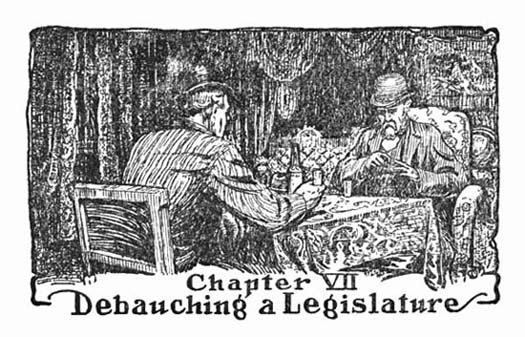
The rumors of vote-buying before the Legislature convened were forgotten in the facts of the days following. The first ballot for United States senator, as provided for by the Federal statutes, was cast in each branch of the Assembly separately on the second Tuesday after organization; and it was, as usual, scattered by honoring different men of State repute. The next day, and the next, the ballot was taken in joint session. The first test of each candidate's strength showed that Robert Burroughs had but thirty of the entire ninety-four. Thereafter began a systematized demoralization of the men of all parties who constituted the legislative assembly. Sumptuous headquarters were maintained at the leading hotel by Mr. Burroughs, and the Honorable William Moore, past master in chicanery and rascality, extended a well-filled hand to all who entered the spider's parlor. Burroughs was seldom in evidence. In fact, he was not often in the city.
"My friends are working for me," he would explain, nonchalantly. "I have placed myself in their hands completely. It is not necessary for me to trouble about the minor details. They have urged me to allow my name to be used; but, really, it is immaterial to me—I have other interests to look after." Then, plaintively, "I am far from well."
This last statement was a self-evident fact. Years of crafty plotting had seamed Burroughs' face with lines that come from secret connivings—an offer here, a lure there; a sword of Damocles held low; an iron hand and a velvet glove—all these things made for age in heavy retribution. He complained of the heat, of the cold; of his breathing and of his digestion. A sense of suffocating fullness oppressed him as he climbed the steep incline of the streets of the capital. Yet he retained his pride in the English girl whom he had married, as he avowed, to vent malice on her brother. His family affection was the one redeeming sentiment of his life. When he was away from Butte not a day passed that he did not communicate with his wife, either by post or telegraph. He took pains that no newspapers speaking ill of him should gain admittance to his house—a superfluous task, since politics were of no interest to his home-loving wife.
William Moore sometimes looked meditatively at his old friend as he fumed over trifles. Invariably after such reflection he saw to it that his own private exchequer was bettered from the flow of gold streaming from the millionaire's store. It was well to be on the safe side, thought the ex-wolfer, sagely. Yet on the whole his arduous work as Burroughs' manager was conscientiously done. These men had worked together too long for Moore not to feel a personal pride in his work of debauching a Legislature.
Other candidates there were, too, who used illegal methods to obtain votes. Not that no reputable man was a candidate; not that honest, incorruptible men could not be found in the legislative halls of Montana; but Moore's extravagance in behalf of his chief shattered all precedents, defied integrity and exposure and eclipsed the good that would not be submerged. In fact, his prodigality defeated its purpose; when men found that they could get five thousand dollars for a vote as easily as one thousand, they held their decision in abeyance until the consideration was increased fourfold. This not once, nor twice; not by one man, but by the indefinite many, until it was current talk that certain men had received one, five, ten, even fifteen thousand dollars for their votes. Why should legislators talk of "their duty," or "the principle of the thing," when a lifetime of ordinary business methods and dealings would bring but little more than might be obtained by speaking a man's name in joint assembly? To listen to any group of men discussing the political situation one unacquainted with the law would never mistrust that bribery in legislatures was a state's prison offense.
So wary did members become that Burroughs, possessing small faith in the impeccability of his fellow men, grew peevish at the delay in securing the requisite majority, while those who held Montana's best interests at heart breasted the tidal wave of corruption with sinking hearts.
As in every contest of its kind, the full vote for Burroughs was not cast at any joint assembly until Moore knew he had the number required to elect. In this way no legislator was sure from day to day of the man sitting beside him; some one known to be pledged to another candidate, or professing himself under no obligations to any man, would swaggeringly or shamefacedly, as the case might be, announce as his name was called from the alphabetical list by the brazen-voiced reader in front of the speaker's desk that his choice for a United States senator was Robert Burroughs.
Days went by, with no decisive vote; there was less good-fellowship, more caution; less talking, more secrecy; each member looking askance at his neighbor, wondering if he was or would be bought. Lobbies and halls of capitol, hotels, saloons and offices swarmed with men talking of Burroughs.
O'Dwyer, member from Chouteau County, took to walking in the middle of the streets to ward off Burroughs' emissaries—greatly to the amusement of his friends, in days when amusement was seldom indulged in by the small band of honest men in the Legislature. State Senator Danvers grew more grave as time went on. The onus of his party's opposition had fallen on him, for he was working for the governor's election as United States senator as against Burroughs, also a Republican. He felt more alone than at any time since he had lived in the Northwest, for the doctor was back at Fort Benton, and Judge Latimer away on professional matters.
Hall grew unctuous, and had many a sly wink with Chaplain McDevitt. Senator Blair was moody, restless and irritable, except in the hours which he spent with Mrs. Latimer. Winifred, in her anxiety, became a stranger to sleep, but she made no complaint of her haunting fear. A reserve, unnatural to her, became apparent.
With Eva Latimer it was different. She was intoxicated with the excitement, and missed no noon hour when the senate marched in, two by two, to the representatives' chamber for the daily balloting. With a list of the members of both houses in hand, she sat watching the proceedings and checking off each name on the roll-call. Her absorption in the varying sum totals for Burroughs made her unconscious of the glances in her direction; and Moore, secluded in his retreat, knew nothing of her open interest in the capitol. Often Senator Blair was at her side at the convening of the Legislature, or provided her a seat near his own, and in the intervals of routine work they would chat in low tones. She often cast furtive eyes at Danvers, eyes that revealed so much that those who watched her smiled meaningly. But Danvers, absorbed in his arduous duties, saw nothing personal in her self-revealing glance; he resented only her carelessness in protecting her absent husband's interests.
The contest was not without its amusing features. A nervous representative shied violently at a piece of writing paper one night which had been left on his floor by a careless chambermaid; for the member rooming next him had the night before opened his innocent eyes on a thousand-dollar bill miraculously floating through the transom. If bills of such denomination materialized as cleverly as roses at a medium's seance, what might not develop at any moment? It was disquieting! Beds were feverishly ripped open instead of being slept in; mattresses were overhauled and pillows uncased; chiffoniers were turned upside down in hope that bills were tacked on the bottom; envelopes in unfamiliar handwriting were opened cautiously, with no witnesses; papers were signed making one legislator an Indian agent, another a doctor in a coal camp, another a lawyer in a large corporation—all positions contingent on Burroughs' election. The list of pledged men grew, yet still Moore's outlay did not buy the United States senatorship for Robert Burroughs.
"Yes, the whole number of ninety-four," confided Moore, patiently, as Burroughs asked for the hundredth time how many members were in the Assembly. They were sitting before a large desk in the inner room of Burroughs' suite, and the Assembly had been in session nearly six weeks.
"I surely have forty-five of 'em now?" anxiously.
"That's the way I've got it figured," soothingly.
"Good men? Men who would vote for me anyway?" Burroughs had lately developed an exasperating desire to believe that some man was his friend with no thought of reward. Mr. Moore, knowing the aspirant's record and reputation, thought that this portended senility.
"Yes—I suppose so. Thirty of 'em, anyway."
"And the others?"
"Oh, so-so," indifferently. What did it matter?
"How many are there who can't be approached?"
"It's pretty hard to tell who can and who can't," parried Moore, cautiously, and lighted a cigar. "I fancy the lantern business would experience a gigantic boom if one went hunting for an honest man in politics."
"In Montana," supplemented Burroughs, smiling at his pleasantry.
"In Montana," acquiesced the arch-briber, suavely.
"How many more must I get?" This was a question that any child could answer, but Burroughs had a nervous desire to talk which irritated his companion almost beyond endurance. The day had been a trying one, and Burroughs asked for repetitions of statements and figures unceasingly.
"Three or four, to make certain," answered Moore, with what urbanity he could command at the moment.
"How much have you paid out already?" The change in subject was not so unexpected as might appear. Like most millionaires, the magnate kept closer account of his expenditures than many a working man.
"I haven't the exact figures. Men often come in and ask for money to grease their gabbers with, and I give it to them without making a note of the item."
"I wouldn't believe you under oath—unless I chose," Burroughs said, equably.
Moore shrugged his shoulders. It was all a matter of a day's exigencies.
"Seems to me we've got a lot of bribe-brokers who are earning easy money," continued the candidate for Congress.
"That's no dream. But the saloons must be worked, and the men who are talking for you all the time seem to think it is worth cash money right along. They've cultivated the politician's faculty of making themselves indispensable."
"Oh, well, that's all right. I'll go to Congress if it costs me—no one knows what it costs to buy a Legislature, but I'm going to find out this winter." Burroughs looked thoughtfully at a slip of paper on the desk, then raised his eyes.
"Haven't got O'Dwyer, I see."
"No."
"What do you think he'll do?"
"I'm no mind reader."
"Can't get Danvers?"
"What are you thinking of? Of course we can't get him. He's the head of the opposition. We won't even try. I've had one experience with him in that Hall case. That's enough for me, and," defiantly, "I rather admire him." Burroughs lifted his eyebrows. "Besides——"
"How about Joe Hall?" Burroughs interrupted.
"Joe will be in this evening. First time I've been able to get him to promise to come here. He's sore yet, Bob."
"That's all right. Better be liberal with him. I always liked Joe well enough. But he's sold out so often in politics that he's a little risky, after all. Weren't you out with him last night?"
Moore laughed admiringly. So Burroughs knew of a drive to a roadhouse and a convivial night. His chief kept an omniscient eye on everybody with whom he was dealing.
"Well, yes. I thought that I'd jolly him up a little without any hint of trying to get his vote. I had half a mind to commit suicide this morning, but my head was so sore that I hated to shoot a hole in it."
Burroughs grinned. "Joe's always telling of what he's done. According to his talk he's developed the State from cattle to copper—from sheep to sapphires. A man who's always telling what he's done isn't doing very much now. I'll bet he'll be the easiest in the bunch if you tackle him right."
"Don't be too sure. A man that's been everything from a Populist to a justice of the peace is likely to be hard to convince. Queer how McDevitt turned up this winter," Moore went on, after a drink. "Chaplain of the House, too!"
"I don't much like that!"
"Oh, we must throw something overboard to the sharks," said Moore, carelessly. "A member asked me to see that McDevitt got the job, and I thought it an easy way to get the member—see? Quite a number of the old Whoop Up crowd here this winter."
"Yes. Got Blair yet?"
"No. He'll be the toughest nut of all. He's hard up, but he's a pretty decent sort of man these days, and his sister has considerable influence over him. Besides, he feels in duty bound to stick to Danvers—the old story of Danvers saving his sister's life, you know."
"I suppose so," admitted Burroughs. "Get a woman after him."
"I have. Mrs. Latimer is interesting him in your behalf. But the idiot has lost his head over her, instead of taking her advice and voting for you."
"He's a fool!" snarled Burroughs, remembering Eva's dismissal of himself. "I thought the time would come when she'd be anxious to get my help—in some way! But get Blair—get him!" he repeated. "He'll do to take along as a political exhibit. I've never forgiven him for squealing in the matter of that whiskey in the Whoop Up Country. Fix it so his change of face will smirch Eva Latimer. That'll hurt her virtuous and law-upholding husband more than anything I can do to get even with that decision in re Hall. Offer him—anything in reason. He's probably banking on a big haul. Give it to him, and I'll see that his sister knows that he was bought like a steer in open market. Her scorn will be like hell for him. I can see that Danvers is gone on her. She'll send him flying if her brother gets bit—mark my words. Or, rather, Danvers would hardly want to marry her—the sister of a bribe-taker!"
"I hate to touch Charlie, or to offer him more than any of the others," objected Moore. "I'll try to get you elected without him. I will if I can, and in the meantime I don't give a hang if Mrs. Latimer's reputation is scorched."
"I know why you don't want to touch Blair. That sister of his is what you're after. Look out for Danvers if you undertake to stick your brand on her! But my interests must come first—remember. And as for Eva——" Bill let no smile indicate his mental amusement.
Mr. Burroughs had not been gone long before Senator Hall looked into the hospitably open door of the outer room.
"You here, Bill?"
"Yes. Walk right in." Moore stepped forward and stood aside for Hall to precede him to the inner room, closing and locking the door. "We'll not be interrupted here. I've been wanting to see you for six weeks—never made it until last night."
After a little talk of the weather and of the political outlook, Moore thought best to approach his subject boldly.
"How are you feeling towards Burroughs, Joe?"
"Just like a kitten—a soft, purry kitten." Hall was heartily metaphorical, as he opened his pocket knife mechanically. "If you want to feel my claws, just ask me to vote for that damn thief! You'll think that I live in four different atmospheres. You and Bob Burroughs may be able to buy the rest of the Legislature, but you can't buy me—so don't ask my price!" Senator Hall had thought long on what he should say when solicited by the Honorable William, and he had his bluster volubly perfect. "Any man but Burroughs may go to Congress, but he never shall!" He continued to pare his nails.
Moore was not at all deceived. He had heard men talk before, and he detected the false ring of Hall's words. Herein Joe miscalculated. He thought to deceive a man steeped in conspiracy and deceit. Nevertheless, Moore was politic, and made no haste.
"Why not forget bygones, Joe? You would have done the same thing yourself in your deal with Burroughs if you had had the first chance at those Easterners."
"Would I?" snorted Hall.
"Isn't there any inducement that we can offer you to support Burroughs?"
"None whatever. My constituents would hang me in effigy if I voted for him. I was on the stump last fall and went on record."
"Your constituents! The voters! What are they? Cattle driven into a chute! They don't know the true inwardness of State politics. There aren't six men who do."
"Politics must be purified," Hall announced, solemnly.
"That's so," acquiesced Moore. "Every politician I know, nearly, is so desirous of being purified that he steps right up here, as though this was the disinfecting vat! Our legislators seem to think that Burroughs is the Chief Purifier, and that I am the one who cares for the shorn lambs!"
"Well, I can't change now."
"You're mighty conscientious. If you had been as much so at Fort Macleod you probably wouldn't have been run out of the police for——"
"I'm as conscientious as most office-holders," Hall interrupted. Something in the twist given the words inspired Moore with renewed courage to press his point. After he had talked earnestly for several moments, his guest interrupted: "Where is Bob to-night? You said last night that he would be here."
"He's instructing the conscientious legislator."
Hall laughed, and it was not long before he allowed himself to say:
"Of course, if there's any money going, I want to get my share. I'd do as much for Burroughs' money as anybody."
After a guarantee of good faith had passed from a safe to his pocket he left. "What do I care whether Bob Burroughs goes to Congress or goes to hell?" he muttered delightedly, as he felt the roll of bills in his pocket. "I've got a pricker coming that will sting his rhinoceros hide! This money ain't half what's coming to me from that mining deal; take it all in all, I'll even up with him before the session closes. Just you wait, Joe," he apostrophized, as he entered the elevator; "just you wait until the time comes!"
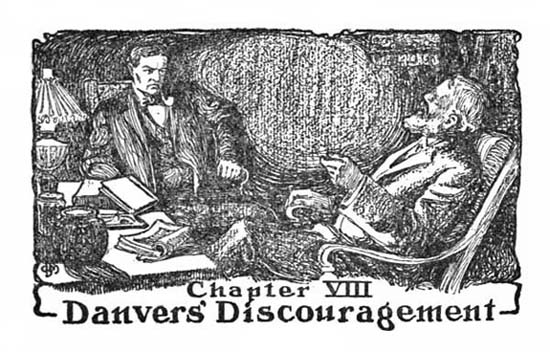
"Good evening, Senator!" Danvers was waiting at the elevator door as Hall stepped through it on the ground floor.
"Good evening, Senator," returned Joe, thinking how little Danvers had changed in appearance since he first came to Fort Benton.
The Senator from Chouteau County took the lift to the third floor. He went to the doctor's room, for he knew that his old friend from Fort Benton, who had but just come to the capital, would be waiting for the evening call and friendly smoke on the first day of his arrival. To-night the younger man was unusually silent, and after the first greetings nearly an hour passed before a word was spoken. But the doctor felt the silence—pregnant with the heart-ache of his friend, and at last he spoke.
"How goes it, Phil?"
"Pretty heavy luggage."
"He'll get it?" No need to be more specific.
"I'm afraid so," soberly. "I never dreamed it could be possible to mow down an Assembly as Burroughs is doing."
"He would sell his soul for the senatorship," affirmed the doctor, "and yet he pretends that he doesn't want the office. He would have people think that he is in mortal fear of being politically ravished, and all the while he, and every man that he can control, are actively engaged in promoting a campaign of ravishment."
"And Bill Moore is his chief procurer," added Danvers.
"But the whole Legislature can't be bought."
"Every one!"
"You include yourself there, Phil," smiled the doctor. "But I know what you mean. It's damnable!" The believer in mankind felt the foundations of the State totter.
"I did not mean to be quite so bitter, but I am sick of the lack of principle that I find in the men sent to Helena. Burroughs has a long string of men who are now scattering their votes, on the pretext that our Republican caucuses do not pledge them clearly to any one candidate. This split in the party is bad for Burroughs, of course, and he is not only trying to get my men away from the Governor, but is angling for members of the Democratic party." After a moment he smiled. "Of course we are sure of O'Dwyer!" He then named several others who could be depended upon not to enter Burroughs' camp, either by reason of their own integrity or the pledges they had given to other candidates. "So many in the field scatters the vote," he continued, "and that gives us a chance to work."
"How about Hall?" asked the doctor.
"Senator Hall seems safe. He is one enemy whom Bob cannot buy. I never saw a man hold the idea of revenge as Hall does."
"If Joe Hall doesn't vote for Burroughs it is the first time that he ever resisted easy money," quoth the doctor. "However, hate will make even money seem of small account. But Hall will do some dirty trick, one of these days, to get even on that mining deal. Those two are a good pair to draw to."
"As politics now are it would not be hard to find three of a kind," added Danvers.
The old man took up the evening paper, containing the list of the legislators and their city addresses. He checked off the names as he read, and presently looked up.
"As far as we can tell Burroughs is shy several votes for a majority."
"Looks that way."
"We don't know who Moore's holding back—worse luck! But we do know who are solid against Burroughs. By the way, what's Charlie Blair up to?"
"Politically or personally?"
"I think one means the other these days, according to all I hear."
"Possibly." After a moment Danvers added: "Blair has promised me on his honor not to vote for Burroughs. I do not think that he will deliberately go back on his word. As for—I can't speak of it, doctor! Poor Arthur!"
"Eva's not a bad woman—she's only an ambitious fool," asserted the doctor, touching one of the sore spots in Danvers' aching heart. "I can overlook a woman's folly if it is the result of an overwhelming passion—some women are as intense as men. But to play with fire—while she is as cold as ice—as calculating as a machine——" The speaker made a gesture of disgust. "Be sure that she is promised something she thinks worth her while, by Bob or by Moore, for her sudden interest in politics and—Charlie Blair. She is a good catspaw. I thought she was making eyes at Charlie at the opera, but I couldn't believe my own. She and Moore are working the members of this Legislature by concerted action, or I am very much mistaken."
"You haven't heard any open talk of Mrs. Latimer—Arthur would—I should fear for his reason—for his life—if scandal——"
"Well, I can't say there hasn't been any," compromised the doctor. "But there'll be more if she doesn't turn Blair down pretty quick. He's drinking, too; something he hasn't done since his sister came back from school to live with him. He could always stand liquor in abnormal quantities; but he can't stand"—abruptly he blurted it out—"first Eva knows there will be hell to pay—and I doubt if her credit is good."
"She doesn't care for him, then?"
"Nah!" The negative was drawn out contemptuously. "All she wants of Charlie is his vote for Burroughs. She never loved but one man in her life." A glance went to the senator, but he did not apply the words.
"Poor Winifred!" sighed the young man. The doctor caught the baptismal name.
"Winifred's a plucky woman. I'll wager she knows practically every move being made in all this rotten business—all," the old man added significantly. "Yet you would never mistrust it to see her. It is well to put on the cheerful face and tone, yet when in trouble is it best? It is deceiving to one's best friends, robbing them of the opportunity to extend sympathy. Winifred Blair is worrying over Charlie, yet she keeps her troubles to herself and cheats her friends of a just privilege."
"I wish," began Danvers, then closed his lips. No one should see his heart.
"I wish she would give you the right to protect her," said the doctor, heartily. "What has come between you two? I had thought——"
"I do not know," acknowledged the disconsolate lover. "She was friendly. We've seen each other quite a good deal. I thought she was one to understand. I cannot talk as most men do—I am aware of my failing."
His eyes were more eloquent than words, as he paused. "And now she hardly speaks to me—makes some trivial excuse to leave me with Charlie when I call; or if he is not there she pleads an engagement. You have noticed how Moore has been paying her marked attention? It is for her to choose——"
When Danvers began again it was of another phase of his trouble. "Miss Blair has doubtless heard of my financial loss, caused by that early snowstorm and later rain, which crusted the snow until my cattle were almost wiped out. My foreman wired me the night of the opera, you remember. Those that were not frozen were starved to death. My political life here in Helena is costing me a fortune."
Danvers rose and paced the floor. "It gives me the jigs, even to think of those cattle," he burst out. "Not the financial loss, you understand, but the suffering of dumb animals!"
"You did all you could, Phil."
"Yes. But what with a three years' drouth and no hay in the country, and the railroads blocked so that no feed could be shipped in, even if we could have gotten to the cattle on the range—oh, well——" The cattleman dropped to his chair with a sigh of helplessness.
The doctor took a new turn.
"I have known you for fifteen years or more, my boy, and I never knew you to be jealous before, much less unjust."
"I—unjust!" Danvers was startled. Never before had he faced such accusations.
"Yes, you. You should know Winifred Blair better than to think such thoughts as you are harboring."
"My experience with women has been unfortunate, probably; I do not pretend to understand them—they are too complex for me."
"Tut, tut!" The gentle friend tried to turn the tide. "Not Winnie. She is a woman to trust."
"But how can she have anything to do with Bill Moore? That is what I can't get over."
"You shouldn't speak so of Moore. It shows a spirit I'm sorry to see you cultivate. Go in and win. You have probably told Winifred something of your standards of public morality and the sacredness of the ballot, and she fears that Charlie will disgrace both himself and her. She perhaps fears your disgust if——"
"She is mistaken if she thinks so poorly of me. Her brother's conduct could never change my feeling for her; rather, pity would come to plead for love. Do you think she does care for me?"
"Do I? You had better ask her—not go tilting at political windmills when more important matters should be——"
"If Charlie's foolishness is the only thing in my way, I'll force him to be a man if I have to gag him in joint assembly!" cried the lover, joyously.
"What transformations love will work!" sighed the matchmaker after he had bidden the light-hearted Danvers good-night. "Standing practically alone against the might of Burroughs' millions—holding his scant forces by sheer force of character, yet downed by the mistaken attitude of a mere slip of a girl!"
The next afternoon Winifred lay back in a low chair before a leaping wood fire. She wanted to think, to puzzle out all that was taking place around her. She recognized, yet refused to accept the verdict of her common sense. She was no unsophisticated school girl; she was a woman of the world. The social and political atmosphere in which she moved seemed charged with dynamic possibilities. Her closed eyes suddenly brimmed with tears. Winifred let them fall unheeded, feeling miserable consolation in her self-pity, as women will.
Apart from the senatorial contest lay her personal interest in the game being played by the scheming Burroughs, the unscrupulous Moore and the ambitious Eva, on the one side, and her brother on the other. What chance had Charlie against such a combination? Robert Burroughs had judged truly; Blair's degradation would hurt Winifred inexpressibly. He had chuckled as he had watched the growing attachment between his brother-in-law and the girl, and thought of his vow. He realized that here was a way to bring vicarious suffering upon the man whose distinction had first roused his envy and whose rectitude had won his hatred.
As Winifred groped in the tangle of State and private intrigues that enmeshed her, the fire burned low and the snapping of an occasional spark checked and soothed until her mind slipped into more peaceful channels. She looked about the quiet room. The firelight threw her face into relief and accentuated the faint lines of pain that had come during the last few weeks; a pensive touch had been added to a countenance that combined loveliness with strength. The yellow puff-ball in the gilded cage by the window stirred drowsily, with a faint, comforting chirp. The white and gold of blossoming narcissi, rising from their sheaths of green, gleamed purely from a tabouret, and their incense filled the room.
Presently she took up events of recent occurrence with clearer mind. She had probably exaggerated the seeming coherence of disconnected happenings. She longed to think so. Eva took great interest in the senatorial contest. Should that be an indictment? She craved excitement—expected to hold the stage in any episode; her position as the wife of an eminent jurist gave her a certain prestige in the political arena where pretty women were not unwelcome. The power they wielded, whether consciously or not, was almost unlimited—Winifred had seen enough of the average legislator to appreciate that fact.
In thinking it over, Winifred admitted that Mrs. Latimer had known for many years Mr. Burroughs, Mr. Moore, Mr. Danvers and her brother Charlie—four of the men who were playing their part in the drama fast drawing to its climax. What cause for apprehension in this? Ever since the Latimers' marriage their home had been a rendezvous for the politicians of the State—at least, of Arthur's party. Surely Mrs. Latimer could receive the same guests, even if the judge was away—even if some among her satellites were men whose reputations excluded them from all but the very smartest set. If she talked politics she did so in the pursuit of her affirmed desire to learn of politics at first hand. It could not be that she would descend to the plane of a lobbyist! But what would Judge Latimer think of this surprising fervor? He would not care to express himself as opposed to Burroughs. Did not Eva care for her husband's opinions—for his reputation? Winifred did not feel called upon to judge her friend; she was only trying to account for the circumstantial evidence accumulating against Eva.
When the girl turned her thoughts to her brother, she was sucked into a whirling maelstrom. The doctor's opinion of her had been correct. She knew her brother and his fluctuating fortunes as only a sister of infinite love and infinite tact could know. But she never had dreamed that he could be enmeshed by the wiles of the wife of his friend. The crux of the whole matter lay in the possibility of saving him, not only from Eva's hypnotic charm, but from the less intricate and more thinly concealed machinations of Mr. Moore. Winifred felt her first smart of anger revive toward Mrs. Latimer as she recalled how ingenuously Charlie had been led to the juggernaut of Burroughs' ambition.
It was horrible—horrible! Afresh came the intolerable loathing of it all—this overshadowing political machine, that could scatter ruin in its wake even if it did not obtain control.
Winifred knew that Danvers was studying every move and checkmating where he could. She felt that if possible he would prevent this crime of buying a United States senatorship. He would protect Charlie. Through the doctor she learned how strong a bulwark of the State the senator from Chouteau County was proving to be. She gloried in these recitals, and longed to confide in her old friend, but always the woman's reticence withheld her.
Presently a tap came at the door, and Mrs. Latimer appeared on Winifred's invitation to enter.
"How fortunate," she said, "that you came to the hotel for the winter! It's not only more convenient for you and Charlie, but for me. Would you sit by baby for a half hour, Winnie, dear?" she entreated. "The nurse is out, and I must run downtown before six."
"Yes, indeed! I'd love to."
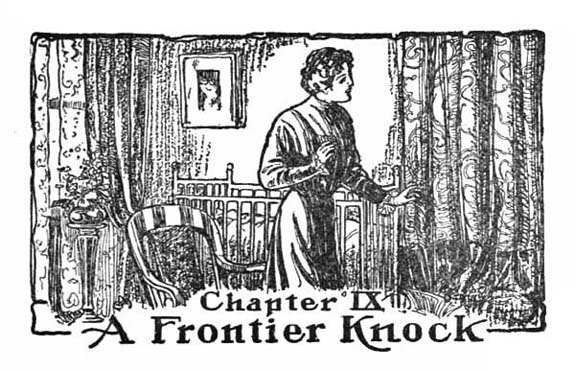
They passed into the Latimers' apartments, and when Eva finally left, Winifred sat down beside the crib where the child slept. Heavy portieres hung behind her, evidently covering the double doors leading into other rooms beyond. In the stillness she heard a voice.
"I tell you I don't want any paltry thousand dollars! I know of three men who've got five thousand. You promised——" The rest was indistinct. A soothing voice followed that Winifred recognized; then: "I don't care a damn if everybody can hear. I want what you promised if I vote for——" The speaker must have walked from the dividing wall, for the girl heard no more. After a time an almost inaudible scratch, scratch came from behind the draperies. Winifred rose in dismay, throwing down the book she was reading. Who was seeking entrance through this private door? It was evidently a preconcerted signal, for it came again, impatiently; then cautious footsteps retreated. Winifred choked the shudder that swept over her. Mr. Burroughs' headquarters took all the rooms on that side of the hall except those occupied by Judge Latimer and his family. She had heard the unmistakable voice of Mr. Moore. Had he used that frontier knock—a scratch on the door as he might scratch on the flap of a tent?
In a frenzy the girl walked through the suite.
"I will not believe—I will not!" she said to herself. "I do not understand; but it is all right—I'm sure it is. I'll stand by Eva—she shall not be talked about—shall not do foolish things. Oh, this contest! And poor Judge Latimer!" Her thoughts raced on. "How much worse if someone else had heard that signal! But it meant nothing—of course, it meant nothing!"
She smiled, with a conscious effort, when Mrs. Latimer returned, with apologies for delay; and resolved again not to abandon Eva to the innuendos that were already circulating.
"Shall we go down to dinner together, Eva?" she asked, gently. "I'm alone to-night; Charlie is dining at the club."
"Thank you, dear. I believe I'll have my dinner sent up. Thank you so much!"
After her lonely meal Winifred remembered her unfinished book, and thought to get it as she stepped from the elevator. She knocked lightly at Mrs. Latimer's door. She heard a faint rustle inside, then all was still. Again she gave a soft, playful battering of open palms on the panels; then she fled to her own apartments, and flung herself face downward on the pillowed couch, weeping as though her heart would break.
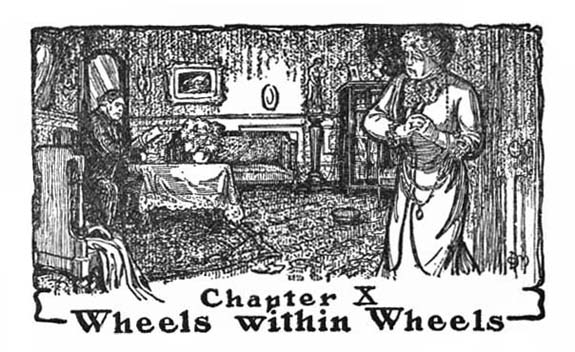
On the other side of the closed door stood Eva Latimer, lips parted, hands clasped on her breast in terror.
The Honorable William Moore came from between the portieres over the door which he had used for entrance from Burroughs' apartments into the Latimer suite.
"That's just like a woman!" he grumbled, as he returned to the Morris chair. "Fly to open a door!"
"But I didn't open it!"
"No, but you meant to," severely.
"I was frightened," pleaded Eva.
"No, you were not," contradicted Moore. "You wanted to get that door open. It wasn't necessary that it be opened at once. You should have given me time to get out of here into those rooms that Burroughs reserved for just such emergencies. It would never do for me to be found here. But, no! That door must be opened! I've noticed that trait in other women. They don't reason; they don't think. But they must have a door opened the moment there is a knock."
"It might have been Winnie. After you told me that you gave our signal—that you wanted to go over this list before dinner—I've been sick with fear that she heard your scratch. But evidently she didn't, for she asked no questions when I returned. I don't want her to suspect anything. I never wanted you to come through those connecting doors, anyway. Why not come openly, as everyone else does?"
"I tell you it would never do!" angrily. "Miss Blair had better suspect—than know," grimly. "What people don't see they can't prove."
"It might have been Arthur," still seeking justification.
"Well, it wasn't," replied the political manager, coolly. "Besides, he has a latch-key, and we should have heard its click. Now, let's get to work. I've got a dinner engagement with Charlie Blair to-night at eight-thirty. Here's the list. Let's check up."
The Honorable was very methodical, very systematic. He called off senators and representatives in alphabetical order, and checked or drew a line through their names as Eva told of her efforts in Burroughs' behalf.
"How do you do it?" asked the man with admiration, as she reported that one particularly obdurate senator, too rich to be influenced by money, had promised his vote.
"I told him frankly that it was a personal affair," admitted the fair lobbyist. "He knows women well enough to understand why I have never been satisfied to live in this little hill city——"
"And he thought it his duty to see that your brilliancy lighted wider domains—I see." Moore finished the sentence to suit himself.
"He was very nice about it," returned Eva, haughtily. "He thinks that Arthur should have some recognition from the government for all that he has done for the party; and he added that Arthur was too big a legal light to be eclipsed by the shadow of Mount Helena." She paused, evidently hesitating to speak further. "Can't you get the others on the list yourself? I'm getting tired of——" She was shaken by the unexpected knock; suddenly, but too late, she was afraid of what her husband would think—would say. Her aspirations seemed of small account after that tap that could not be answered.
"Get Charlie Blair's promise, and we'll be satisfied," said Moore, not unkindly. "You have done very well."
"Will Mr. Burroughs keep his promise? He knows that I——" Eva could not speak to Moore of her fear of the man whose money she would accept.
"Burroughs is all right. Words don't count, these days; it's money that turns the trick."
"But I want more than money. I want that place for Arthur."
"My dear lady," urbane William rose and bowed. "If Robert Burroughs is elected to the United States Senate, the judge shall be Minister to Berlin. It is practically arranged already. Bob's a big man in his party. What he asks for he'll get, never you fear. That is—in Washington."
"I'm glad to be assured." Mrs. Latimer intimated by a look that the interview was over, and rose. But Moore did not choose to go.
"When do you think that you can get Senator Blair? Heaven knows you've spent more time on him than on all the rest put together."
"I begin to wish that I had never seen Charlie Blair," petulantly.
"Oh-h! It's that way, eh? He's getting a little—a lit——"
"Don't you dare!" flashed Mrs. Latimer. "You promised to ask no questions."
"Pardon me. I said I didn't care what means you used," corrected Moore, with delicate emphasis. He added, reflectively: "Blair has always been something of a recluse; but I've noticed that when a Puritan once feels a little of the warmth of the devil's presence that he's rather loath to step out into the cold again." The look of anger from Mrs. Latimer made him change both tone and words. "We have depended on you to get Charlie," he said, reproachfully. "I never wanted to tackle him. You know how it is? I've never had but one weakness——"
"Yes. She was here this afternoon when you signaled," interrupted Eva, glad to repay him in ever so little for his insult. "What a pity that you could not have known it. You might have come in."
"Thank God I didn't!"
"Winifred is too good for you. Senator Danvers is the sort she will marry."
Not relishing the information, Moore turned to go. But he had one more sting. "It'll be pretty hard for you to see Danvers married, won't it?" Then, satisfied to see the quick flush on Eva's cheeks, he added casually: "I'll talk with Blair to-night. You needn't bother with him further." He knew how to frighten the woman. It was understood that she must follow instructions or receive no pay.
"Give me one more chance," begged Eva, trembling.
As Mr. Moore walked briskly toward the club where he was to have dinner with Blair he thought of all that underlay this winter's work, and it seemed but a continuance of the days of fur and whiskey smuggling in the Whoop Up Country. It was a series of wheels within wheels—this work of electing a man to Congress; and the man's soul reveled in the intrigue of it. He was quite content to be the one to superintend their revolutions and to watch the havoc which they might cause. Burroughs' vaulting ambition was the greatest need of all, but revolving around it were the triple, lesser desires of the ex-trader; of wreaking vengeance on Judge Latimer through his wife's folly; of causing Charlie Blair's downfall, to repay the old grudge of the Queen's evidence; and of wounding the hated Danvers through his friends, as well as separating him from Winifred.
And now but one vote was needed to give Burroughs his heart's desire. Moore had not told Eva this. But if Charlie could be secured to-night, to-morrow or the next day he would give the signal, and the men, bought but not yet delivered, would vote for Burroughs—and the battle be won! Oh, it was glorious! Bob was lucky. How often he had said it of himself. Yet sudden fear came. A certain Corsican had thought that he was the darling of the gods, and confused his luck with destiny. Had Burroughs made the same mistake? Certainly not. Moore's habitual confidence returned manifold. The opposition was divided among too many men to amount to anything more than to keep Burroughs in uncertainty, and no stretching of his imagination could conceive any one man fusing their warring elements. Moore already saw his winter's work crowned with success.
Blair was waiting on the club steps for his host, and the dinner was ready. They were unusually silent until the black coffee and the cigars were brought. Then Moore leaned forward to reach the cognac for his coffee and asked:
"How much does it cost you a year to live, Charlie? Expenses run pretty high?"
The questions were unexpected. Blair knew the motive of his host in giving a dinner, for Moore seldom entertained without an underlying reason. Certainly he never spent his own or Burroughs' money without expecting fair returns. But Charlie had thought the attack would be more direct. Therefore he answered lightly:
"I might reply as a colored man did who was asked how little he could live on. 'I live and work on three cents' worth of peanuts a day, but I'm a little hungry sometimes.'"
Mr. Moore smiled perfunctorily. He had no sense of humor.
"What have you been doing all summer?"
"Prospecting."
"Prospecting is like trying to raise money without security. Neither pans out."
"Precious little you know about either," retorted Blair.
"You're a poor man," said Moore, abruptly. The announcement struck the senator as superfluous. He nodded.
"I am familiar with the fact."
The Honorable William resolved to strike. He had never thought to speak to Charlie, but if Mrs. Latimer could not bring him to the point he would have to do it himself. One more member must be secured, and Blair was the only possible man. The other legislators who had not already succumbed seemed impregnable.
Moore became impatient as he remembered how easy it had seemed at first to secure enough votes to elect his chief.
"Charlie," he began, clearing his throat, "we want you in this fight we are making, and we want you hard. We are going to win. We are going to get the votes; if we don't get them one way, we're going to get them another."
"So I've understood."
The host felt on unstable ground at the noncommittal answer, but he boldly pushed ahead. No time to fear quicksands—the end of the session was too near! He dwelt on the good that Burroughs could do the State if he went to Congress, and finally repeated:
"Bob's going to be elected. He's gaining votes every day. But we need to get the thing over with, and—it will be to your financial interest to work with us." Moore played nervously with his teaspoon.
Senator Blair watched his smoke rings fade, and made no response. Both men were silent for a time. Moore occupied himself by placing, with infinite exactness, three cubes of sugar on his spoon and pouring brandy over them. When the liquor was fired the blue flame lighted his face weirdly. So might Mephistopheles have looked when tempting Faust. He was thinking that Blair had always been a failure, and always would be—slow, methodical, too dull to see his best interests. He was a plodder, content with moderate means, when infinite opportunities in Montana waited a man's grasp—if he was sharp enough.
But silent Charlie was thinking that his opportunity had come. During the past weeks he had observed, with his usual calm, the trend of events. He had been inclined to promise Mrs. Latimer the boon she asked, for he would be glad to promote Judge Latimer's advancement (remembering the fine that Latimer had paid at Fort Macleod), even if in doing so he should aid the man he hated for stealing his squaw. But Charlie was beginning to forget the judge's kindness in his passion for the judge's wife. He realized that as soon as he cast his vote for Burroughs all the advances and marks of favor which stamp a lobbyist of the sex without a franchise would be a thing of the past—an episode to be forgotten. He had quite lost sight of the commandment, "Thou shalt not covet thy neighbor's wife." Instead, he was dreaming over the fact of a possible possession.
Knowing too well the paucity of his bank account, he was tempted to play both sides—to make a big strike with Moore, and to press his half-repulsed, half-accepted passion until Eva Latimer should consent to his plans for the future. To sum the matter up: He meant to get more than anyone else from this business of electing a United States senator. Never mind Winifred. The lure of inviting eyes had so completely ensnared him that during these days of intrigue he had almost forgotten the existence of his sister in the alternate intoxication of Eva's companionship and the less dangerous one of liquor.
The host grew impatient as his guest made no effort to reopen the conversation. He drank his coffee with a jerk and drew an envelope from his pocket. It was stuffed with bills, and a torn corner showed the figures "1000." Moore pulled it out and threw it across the table. "There! That's what Burroughs and I do business with," he exclaimed. "'Tisn't so heavy as gold, nor as pretty; but it's a pretty good substitute. It's not intended to influence your vote," he hastened to add, as he noted the senator's expression; "it just shows you that my feelings are agreeable toward you—and that pretty sister of yours."
"Leave my sister out of it, please," commanded Blair, with dignity. "I can't use a thousand-dollar bank note. I'm not in the habit of flashing bills of that denomination."
"You will be if you tie to us," suggested the tempter. "Thousand-dollar bills will be as common in Helena in a few days as nickels in a contribution box. I'm about out of 'em myself, but the old man's bringing in a stack to-night. They come in right handy for contingent expenses."
"I suppose so," assented Blair, pocketing the money with a fine air of preoccupation that made the Honorable William smile the smile of the canary-nourished cat. "If there's any money going I'd like to get my share of it, of course, if it could be done without my sister knowing it. But I'll not vote for Burroughs until the last one. Perhaps then I'll see about changing if you are sure that you have a majority."
Moore rapidly ran over a list of names. "Will that satisfy you?" he demanded. "You see, I trust you. Every man I have named will vote for Burroughs whenever I say so. I may never call on them all—I won't unless I have to. But"—the pause was purposely impressive—"they are to have their money whether they are called upon or not, and so will you, provided that Burroughs is elected."
"You'll never make me believe that Joe Hall can be bought—not until I hear him give his vote for Robert Burroughs. I notice you have him listed. He hates Bob more than I do, and that's saying a good deal."
"He was the easiest one of the whole bunch. He was the cheapest, and he's afraid he won't earn his money."
"Does Burroughs sanction all this?" Senator Blair was amazed, not so much at the men bought as at the sum total that must have been expended. Why was Burroughs so anxious to go to Congress? He did not need the money that was popularly supposed to accrue to senators in Washington from land grants, timber lands and other large steals; he had millions already.
"Well, he's putting up the dough, but I don't trouble him with all the minor details," admitted Moore.
"Bob's not the only one who's offering good money for votes," said Blair.
"Who has approached you?"
"That's like asking who yelled fire at a theater. There are some seven candidates, and a thousand workers—I can't name them all."
"We expect to pay every member who votes for Burroughs—of his own party or not. The man who votes for him without being paid is a fool."
"Might as well have a red flag of auction placed on the speaker's desk." Senator Blair was inclined to moralize.
"Money is a legitimate source of influence in a Legislature." Moore was on the defensive.
"I judge that you think so, if no one else. But, see here! I can't vote for Burroughs, any way I see it!" (Moore thought of his vanished thousand-dollar bill!) "I've promised Danvers to vote for the Governor. My friendship for Phil—you know he saved my sister's life——"
"Friendship be damned! What difference does it make when you can get cash and get it easy? Say!" Moore leaned forward in his earnestness. "If you've been approached before, let me get my work in." He held up ten fingers as indicative of what he would pay.
"Ten thousand dollars doesn't make much of a stir in Montana," spoke Blair, scornfully.
"Fifteen, then!" The senator's eyes narrowed. "Twenty? Come, now! How's that? Burroughs will pay it. No one else has got that, Charlie."
"If Burroughs is good for twenty thousand, he's good for more."
"How much do you want? Spit it out!" The briber was disgusted. This was not the Blair whom he had known in Fort Benton days.
"I'm not soliciting nor making a proposition. But if my vote is worth anything it's worth twenty-five thousand—yes, thirty thousand dollars!" Blair, for the first time, looked Burroughs' manager in the eye. If he got that sum he could leave Montana—and not alone!
"Are you mad?" Moore was aghast. Even his own rapacity had not thought to hold up Burroughs for such a sum. Thirty thousand dollars for speaking a man's name in joint assembly! Thus he interpreted selling a vote.
"No, I'm not mad. But that is my price." Blair also rose, unexpectedly committed to a fixed statement.
"You'll never get it!" roared Moore. "I'll see you damned first! We'll find others who aren't so high-priced! You have over-reached this time, Charlie Blair!" And they parted in unfriendly fashion.
The next day the Honorable Mr. Moore notified Mrs. Latimer that all she had done for Mr. Burroughs would avail nothing if she failed to secure the vote of Senator Blair.
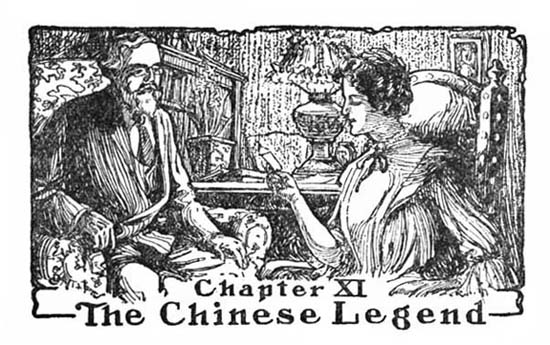
"Well, well, well! What does this mean?" The doctor looked in amazement at Miss Blair as she opened the door to his rap, the same evening that Moore gave his dinner to her brother. Traces of tears were to be seen; indeed, more tears seemed ready to fall, despite her effort to restrain them.
"Come right in, doctor!" Winifred made no pretense of answering his question, but busily engaged herself in pulling the easiest chair to the cheerful grate fire. "I believe that I am more glad to see you than anyone else in the world," she added, affectionately, as she motioned her caller to the comfortable corner. "Now we'll have a nice, long, cozy evening."
"What does this mean?" repeated the doctor, with the privilege of friendship, not to be put off.
"You should know better than to ask a woman why her eyes are red—it isn't polite! Are mine very red?" she asked, ruefully. Before he could answer: "Let us talk of Fort Benton, and of what good times we'll have when we are there again to live happy ever after. Really, I mean it," she said, earnestly, seeing his questioning face. "I want to forget—everything but Fort Benton."
Still her visitor looked at her keenly, until she sat silent under his scrutiny. He was not deceived. Nevertheless he humored her for the moment, knowing that she was no match for his astuteness when the time came to probe her hurt.
"Fort Benton, eh? You know the weak spot of the old doctor, you 'rastical'," whimsically. Then, more seriously: "I, too, wish we were there. Like you, I am sick of Helena. We were all happier, better off, in the little old trading-post—before—the railroads came." He ascribed all evils to the course of empire as exemplified in the steel rails of commerce. "The Latimers, the Burroughs, the Halls, Bill Moore, you and Charlie—every one of you moved away. Phil and I are the only ones left; and since he is in the Legislature I spend almost as much time in Helena as at Fort Benton."
"There's Mr. O'Dwyer."
"I forgot him. Yes, O'Dwyer stays near Danvers—he left the Police to go to him, you know." As he looked around the room he asked, "Where's Charlie to-night?"
"He's dining with Mr. Moore at the club."
"With Moore?" The doctor, surprised, repeated her words.
"Yes. I—didn't know—they weren't friends."
Something in her hesitation gave her visitor an opportunity to ask: "You do not care very much for the Honorable William?"
"No, I do not!" came the quick response.
"Yet he is accounted quite a ladies' man; and," tentatively, "I can see that he is quite infatuated."
"He can get un-infatuated," interrupted Winifred, with no pretense of misunderstanding.
The doctor was pleased at this outburst. He had been an observer of advances and repulses between these two. Now he was thinking of another affair whose recent complications were giving him much concern.
"You wouldn't call him a gentleman?"
"Oh, no. He's a politician."
"That's rather hard on the rest of us who are dabbling in politics."
"You know what I mean!" Winifred made a pretty moue, her chin upturned, showing clear against the leaping flame. As her companion noted her sweetness he almost longed for his bygone youth.
"I sometimes think I have missed a good deal by not marrying," mused the doctor, with seeming irrevelance. "But the rôle of husband was too exacting a one for me!"
Miss Blair gave his hand a gentle pressure which conveyed her disbelief.
"We bachelors are rather a forlorn class, when the years begin to count up; and as for the women who do not marry——" He left her to complete the observation.
"They are not all forlorn," defended Winifred. "But I will admit that the unsuspected longings of some of them are pathetic. Here is a case in point. I had a caller this very afternoon—a woman of middle age who used to work for us. She was in distress because she had received an offer of marriage. From a worldly standpoint she is foolish not to accept the man, for he is worthy of her, and could provide a home. When I ventured to say as much she cried, and showed me this clipping from some old paper. Shall I read it?"
The doctor assented, and Winifred rose and took a slip from the mantel.
"'There is an interesting old Chinese legend,'" she read, "'which relates how an angel sits with a long pole which he dips into the Sea of Love and lifts a drop of shining water. With an expert motion he turns one-half of this drop to the right, where it is immediately transformed into a soul; the other half to the left—a male and a female; and these two souls go seeking each other forever. The angel is so constantly occupied that he keeps no track of the souls that he separates, and they must depend upon their own intuition to recognize each other.'"
The old man reached for the paper as Winifred ceased. She was silent as he glanced it over.
"That old legend did not seem trite to her; it does not to me," said the girl, as the doctor looked up. "I asked her to leave it for me to copy."
"And the woman?" reminded the doctor.
"She stood before me, gaunt, unlovely, growing old. As I read her clipping she clasped her hands tensely. 'Don't you see why I don't marry him?' she cried, and all the romance and persistent hope of her lifetime came to her faded eyes. 'Because I want to find my other half. Because I want—Love.'"
"She is all right, and I respect her," said the doctor. "Too many women sacrifice their personality in loveless marriages."
"I am in doubt," speculated Winifred, "whether the women who lead colorless, unloved and unloving lives are not happier after all. They have fewer troubles. Men are very interesting, but they can make a woman's life so miserable, too."
More than a hint of pathos in this, thought the listener. "How about a girl making a man miserable?" he inquired. "A girl who has love—deep, sincere love waiting her recognition?" The surgeon took the knife resolutely.
"I don't know what you—I was speaking in general——"
"Somewhere in the Bible, I think, somebody goes about seeking whom he may devour. Nowadays women go about looking for trouble. I've known that kind before, Winnie, but I never saw anyone fairly gallop after it as you do."
"Why, doctor!"
"My dear," the friend put his hand caressingly on her own, "why do you repulse Danvers' love? Do not be offended," he said gently, as she pulled away.
She hid her face in her upturned hands. Suddenly it was sweet to feel the solicitude of a love so like what she had dreamed a father's might be.
"I can see, dear child. I know Philip as I know my own heart. I think I know you (so far as a man can understand a woman)," he stroked her hair fondly, "and you are making a mistake."
"No, I'm not," came in a whisper. "I—you don't know—about—Charlie——" Tears fell fast, relieving the suppressed anguish of weeks.
"Oh, yes, I do." His words fell like balm.
"Charlie has been so good to me all these years. I can't bear to see him—drift. You know—I can't say it——"
"Don't say it," counseled the doctor. "I understand perfectly."
"And yet," with quivering voice, "you ask me why I turn Mr. Danvers away! Can't you understand—knowing his love for Judge Latimer? Oh, what shall I do? What shall I do?" she gasped; but soon controlled herself. "And I'm afraid Charlie will vote for Mr. Burroughs because——"
"Exactly!" The doctor used the truth unsparingly. "Eva has secured many votes for Burroughs. But we'll hope that Charlie can be held in line. He has promised Danvers to vote for his candidate—the governor."
"Oh, but I'm afraid!" wailed the girl. "And if—oh, he would despise us both—we are of the same blood! If it were not for this dreadful contest I might be so happy!" Confession shone in her eyes.
"Thank God!" said the old man, reverently. "He has been good to you—both." He kissed the hand that trembled in his. "You have made me happy, too."
They sat in silent communion, the old man watching the play of emotion on the girl's sensitive face, now free from the look of anxiety that had been so apparent.
"Love is one long heartache," said the girl, plaintively. "Wouldn't you think, doctor, that if a man cared——"
"If that isn't just like a woman!" interrupted her companion, thinking he knew what Winifred was trying to say. "Women must have it in words. You want Philip to chatter away like a society man. He will talk fast enough when you quit your foolishness and give him a chance."
"I only wanted to say that he is undemonstrative," explained the girl, flaming red. "I should think that if he—oh, but I am glad he does not speak!" she interrupted herself, vehemently, remembering her brother's peril. "He must not speak!"
"Don't allow any false pride to come between you," urged the doctor. "Nothing kills a man's love so quickly as indifference, real or feigned."
"Do you think so?" She was glad to be impersonal again. "I imagined a little indifference piqued a man to further effort."
"The heat of propinquity feeds the flame of love," oracularly.
"I do not agree with you there, Doctor. I think men grow tired of women's solicitude and company."
"Of their wives?"
Winifred nodded.
"Precious few have the experience! But I agree with you that most married people see too much of each other. Men seem to realize the fact. That is why they go on hunting and fishing trips. Do they hunt? A few of the party, but the rest sit around and enjoy themselves, because they are a party of men. Women will never understand this feeling—this insulation, so to speak; it is the cause of much of the unhappiness we see. Most men fall short of the standard a woman demands from her husband. The first rapturous love, with its utterance and reciprocity, is expected to last after years of intimacy. In love, as in a dinner, comes the gradual relaxation, the ease of well-being, which is the greatest compliment (if she but knew it) to a woman's power to evoke and to hold love. She has not lost it; to reiterate what is a self-evident fact seems to the man unnecessary. A happy married life is one of content, comradeship, loyalty. Words are not needed where such conditions exist."
"I'll remember all you have said," sighed the girl, "but I shall never have an opportunity to prove it!"
"Nonsense, girl!" The comforter rose as he heard Charlie's voice in the outer hall. "You are depressed to-night. Life will look brighter to-morrow. These tangled trails are going to be straightened—I'm sure of it! Love will crystallize that Chinese legend into reality—for you and for Phil. Good-night! Good-night!"
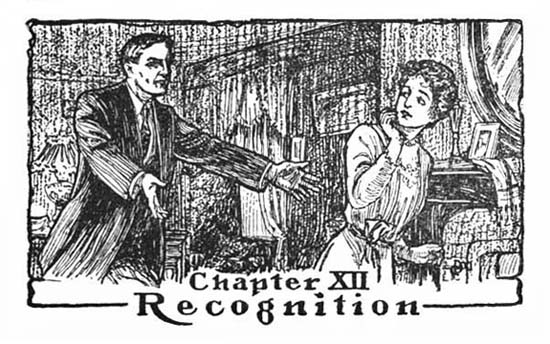
For years Danvers had shunned women. Yet he had not spent his life in melancholy over Eva's defection; known to many, but understood by few, his real nature withdrew from the light. His intuitive attitude toward strangers of either sex was a negative indifference that gave him time to estimate their character or their motives—a habit desirable enough in business, but unsatisfactory in social life.
The growth of his regard for Winifred had been so gradual that he had not thought it might prove to be love. Her unaffected interest in the only life he had enjoyed—the old days at Fort Macleod—had roused him from apathy, and her comprehension of his motives and activities exhilarated him. He delighted in her intelligent comradeship when discussing the real world.
One subject, only, did she avoid, and that but recently. State politics were never mentioned after her brother became the keystone to the situation. Though she had no proof that Charlie's vote was the one vote necessary to Burroughs' election, she had no doubt that it was a fact.
When this shadow of another's crime crept over the brightness of their friendship, Danvers was bewildered—repulsed by her unusual reserve. The doctor's explanation gave him somewhat of courage, and he had the fine perseverance that conquers.
A few days after he had talked with the doctor Danvers saw Miss Blair crossing the street just ahead of him. He hastened to overtake her—he would put an end to her coldness and her repulses. As he dodged a car, he noted in her walk the pride and courage that had recently been added to her bearing. He thought he understood her attitude toward him—toward the whole world; and a flood of loving pity swept over him. Reaching the other side of the street, he found that she had disappeared. He looked up and down in the dusk, but caught no further sight of the elusive Miss Blair; and after lingering on the street for a half hour, he returned to the hotel.
As he ascended the stairs to the first floor he caught a glimpse of Charlie Blair, just entering the Latimers' apartments. His vexation at Winifred's avoidance was a small matter to the anger that now flamed within. Small wonder that Miss Blair wished to meet no one while this folly was unchecked! Yet he felt that he must share her trouble, and resolved to make one more attempt to see her that evening.
She opened the door in response to his firm knock after dinner, hesitating perceptibly when she saw him. But Philip would not be denied, and entered with a determined resolution.
The girl's heart rose high—fluttered, and almost ceased to beat. He was going to speak; she must not allow it.
"Where did you go to-night?" he asked, as he put his hat and stick on the table. "I saw you on Warren street and tried to overtake you, but you disappeared. I prowled around hoping to find you again; and I had my new shoes on, too, and they hurt me."
The whimsical gaiety of the complaint took away Winifred's reserve, and without attempting to explain her disappearance, she smiled a welcome, though she soon fell silent under the burden of her heart.
Philip had called with a set purpose, yet he found no words as he sat before the smouldering fire. He had time, waiting for the moment of speech, to note the pathetic droop of her shoulders and the weariness of her beautiful eyes. Evidently the courage and strength of the day had been exhausted.
She played idly with a book, but laid it aside while she roused the half-burned wood into a shower of sparks.
Philip reached and took up the book abstractedly, and carelessly turned the leaves, wondering how he should say what was in his heart. A loose paper fluttered to the floor. He picked it up. It was the newspaper cutting that Winifred had saved, but had forgotten to copy, in the stress of her anxieties.
Danvers was about to replace it when something familiar made him scan it eagerly. Radiant with joy, he glanced at his companion, but Winifred stood at the mantel with averted face. He took out his note-book, found a little, old, yellow scrap, and held both slips in his hand as he rose. He drew the girl to him, startled, resisting.
"Haven't we found each other?" he asked, simply, showing her the twin copies of the legend, old, yet ever new. "This little clipping has been close to my heart for years—waiting for you, dear. Won't you take its place?"
Winifred was silent. She had guarded against all ordinary appeals, but this—how could she answer him? To refuse this tender sympathy, this yearning love, when she most needed it—the thought was bitterness!
Still silent she drew away from him, and lifted a face so drawn with suffering that Danvers was startled at the change.
"You do not love me?" he questioned, more to himself than to the shrinking woman. "You do not understand?"
He stood before her struggling with his disappointment—that she should fail to understand—she who had always felt his thought so subtly; it was this, almost as much as her lack of response to his love, that hurt him.
They stood before each other, separated by a thing which the woman would not put into words, and the man dared not question.
"Mr. Danvers—Philip," said the girl, gently, "I am sorry——" She hesitated at the trite words, her voice faltering as she looked up into his sad face; it had grown thin and tired these last days. She longed to go to him, to tell him that he should find rest at last. "No," she went on, finally, "I am not sorry that you found the clipping," she altered her words; "why should I not be honest with myself—and you?"
She spoke so simply, so easily, that Danvers almost believed that she did not care.
"You saved my life once, dear friend," she said, "and that makes me dare to ask you to be generous now. Do not judge me! Wait a little. Forget this evening, and let us go back to the old days. Will you?"
She smiled into his face, so sad a little smile in its evident effort at bravery, that he responded to her mood, eager to help her keep the mastery over her heart, that she might fight her battle in her own proud way. Almost, he was reconciled to her woman's judgment; and he sat down and talked of Fort Benton days.
For that hour Winifred was grateful to Danvers all her life; and when he rose to say good-night she was quite herself again.
"You will understand if I tell you that I must go now?" inquired Danvers. "Judge Latimer was to come in on Number Four, and I must see him to-night."
Winifred met his look with comprehension, and gave him her hand.
A faint sound reached them from the Latimer's apartment across the way as Danvers opened the door. He listened, then ran across the hall.
"What's that?" cried Winifred, startled.
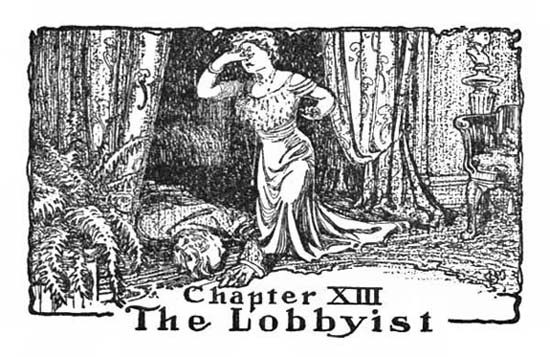
Fate, woman-like, cares not what means she employs to hurt. She takes what comes first to hand. Sometimes the more unlikely the weapon, the more effective is its use.
The same afternoon that Danvers tried to overtake Miss Blair, two talkative drummers boarded the west-bound train at a small Montana station, doubling back to Helena. As they entered the smoking compartment of a sleeper they found it empty save for a slight, weary-looking man who was gazing abstractedly at the wintry plains.
"Here, don't sit that side," said one; "the sun glares on the snow too much."
As the drummer spoke to his friend he gave a passing glance at the preoccupied stranger, and chanced to take the seat directly in front of him. The other followed his advice, facing him.
"What's doing in Helena? I've been gone a week, but I see by the paper you haven't elected a senator yet."
"Naw," returned his companion; "hadn't yesterday, when I took the train."
"Pretty stiff contest."
"Pretty slick man bound to win out."
"Wish I was a member, with all the swag there is floating 'round."
"Wish I was a member with a right pretty woman coaxing for my vote!"
"What's that? I hadn't heard of that yet." The speaker leaned forward, scenting scandal.
"Aw! It's no secret in Helena. It's the talk of the town."
"I never heard a word. I thought politics was free from petticoats out here."
"They never are—anywhere. You know Charlie Blair?"
The drummer interrogated shook his head.
"Well, he's a Helena man, and one of the State senators. There's a woman lobbyin' for Burroughs, so they say, and she's got Blair batty! Last man in the world you'd expect to be caught by a woman. They say he's a great friend of her husband's, too—Judge Latimer."
A stifled moan came from the seat behind the drummers.
"You don't say! Any talk about her before?"
"Search me!"
"Probably there's nothing in it," concluded the other, with unexpected charity. "You know how people surmise the worst. She doesn't care for him, I take it."
"Naw! At least, not if I size her up correct. She's a good-looker, all right; she was pointed out to me one night in the hotel dining-room. It was easy to see where she was stuck! She couldn't keep her eyes off a tall, good-looking fellow, that I was told was the senator from Chouteau County."
The other nodded. "I've heard of him. He's the head of the opposition to Burroughs in the Republican party. Danvers, his name is—Englishman—in the cattle business."
"I saw the situation right away. Bill Moore, Burroughs' political boss, you know, says that years ago they had an affair over in the Whoop Up Country—wherever that is, and——"
"Bozeman!" said the porter, interrupting the conversation.
"I got to see a man here," said one of the drummers. "Come along. It won't take but a minute. He'll be waiting on the platform; I wired him."
"That man looked bad," commented the other, jerking his thumb backward as they stepped from the car. "Did you notice how ghastly his face was? I thought for a moment he was going to speak to you."
They passed on, and the conductor, who followed a moment later, stopped abruptly at sight of the limp figure, and hurried into the next coach.
"Is there a doctor on board?" he asked. "A man has fainted—or had a stroke. It's Judge Latimer, of Helena."
And the instruments of fate never knew what a deadly blow they had delivered.
That evening Mrs. Latimer, exquisitely gowned and radiating magnetism, was again trying to persuade Senator Blair to vote for Mr. Burroughs.
"Burroughs is capable of more skulduggery than any man in the State," declared her caller, after they had talked somewhat of the senatorial candidate. "I can't see why you keep on harping on his fitness for the place."
"Do you know, I admire him," responded Mrs. Latimer, with apparent frankness. "He may be unscrupulous; but he has been successful. The end justifies the means, I think."
"I've promised Senator Danvers that I would not vote for Burroughs," affirmed Blair, stubbornly. Eva had treated him coolly for a few days, and he had practically decided that he wanted neither Judge Latimer's wife nor Burroughs' money. But as he gazed at the lady's ripe beauty he became more infatuated than before. He changed the subject abruptly. "I must go down to the valley to-morrow, after the session adjourns. Will you come with me for a ride?"
"Are you crazy?" Mrs. Latimer spoke with scorn.
"No one will see us," he pleaded. "I can pick you up where you used to live. You can wear a veil if you like. What do we care if we do meet somebody we know? You belong to the smart set—you can do anything you like." Charlie laughed loud.
"My dear friend," Eva began, cynically, believing that her position had so far made her exempt from comment, "the world is too suspicious. No man and woman can foregather without some pure soul interpreting that companionship to its own satisfaction. Besides, I expect Arthur any day now. He neither writes nor wires me just when he can come."
"You'll never do a thing to please me!" cried Blair, hotly. "I am the one who must grant favors. I——"
"Aren't you a man, and therefore to be compliant?" returned Eva, her smile tempering her insolence. Then, pleading, although her eyes grew no softer: "Only one thing do I ask, Senator. Please, please grant me that! Don't you care for me more than for Senator Danvers? Break your promise to him—for me." She was very enticing as she bent towards him, and he was conscious of the faint perfume about her.
"Mr. Burroughs needs your vote," she went on, persuasively; "and if you give it to him—as I've told you a hundred times—he has promised that he will provide for Arthur; and you like Arthur."
"And what do I get out of it?"
"You'll please me," was the caressing answer. "And—I never thought of it before," she hastened to add, as the scar grew more conspicuous—a sure register of his emotions—"why not ask Mr. Burroughs to get you to Berlin, too—as first secretary or something, if we go there?" She must throw him some encouragement. "I hate Helena. You do yourself. If we were in Berlin, we'd be where life is—a whirl of——"
"Madness," Senator Blair finished her sentence for her, thickly. "I do not have to go away from Helena for that sensation!" He lost control of himself. "You drive me mad, Eva! You are more tempting than ever! Give me one kiss—one—and I'll vote for Burroughs till hell freezes over!" The language of the frontier returned, in his abandon.
"Not now!" The temptress was thoroughly alarmed. She had thought to control any situation, but—Charlie's eyes—so near her own! "Perhaps—when you have voted for——" She must secure this man's vote for Burroughs, even if she bartered her self-respect.
"Now, by God! Now!"
"No! No!" In terror Eva gave a suppressed cry and turned to escape the arms of the man she had maddened. With his hot lips brushing her own she turned away her face in impotent writhing, and saw her husband standing in the doorway.
"Pardon me," apologized Latimer, courteously, as though in a trance. He stepped forward, closed the door and took off his coat and hat. He sat down absently, as if he had returned after only a few hours' absence. He took no notice of the presence of Senator Blair nor of his hasty exit. The scene he had interrupted seemed to have no meaning for him. He could not have told how he reached home, and his one thought was of Danvers—his supposed Judas—and of the wife who had lived a lie even while bearing his children.
But Eva could not know this, and strove hurriedly to form some excuse for her predicament.
Latimer made no response to her explanations. Instead he said, quite gently: "I'll go and see if little Arthur is asleep. I want to kiss him good-night," and disappeared through the portieres.
Eva stood motionless, voiceless, in chill terror at her husband's solicitude for the dead child! Had he forgotten—or was he going mad? What had happened? What was to happen?
When Latimer returned, his eyes had lost their dazed expression. "My name is a reproach—it is handed around by coarse gossips!" he said, hoarsely. His look went beyond accusation.
Eva suddenly sank to her knees in mortal fear. The tones were not loud, but she never could have believed that those mild, blue eyes would flash at her such a menace of death.
"Arthur!" she wailed; "what have you heard? Why have you come home like this? I have not been untrue? Who said so? I have not! I have lied to you sometimes about little things—but not now!"
The silence was terrible! She began again, miserably: "I've been helping Mr. Burroughs; but surely that's not—it was for your advancement—Arthur!—speak to me!" She broke into gasping sobs.
The pale, emaciated face above her never softened; the eyes never wavered. Yet a reasoning anguish crept into the insane glare. After all, nothing mattered except this one great pain in his heart. What was it he wanted to know? Yes—he remembered! The truth!—the truth!
"And Philip Danvers?"
The change in tone gave so great relief that Eva became hysterical, not understanding the obscure connection.
"Oh, Senator Danvers? He has had nothing to do with the lobbying. You know he is against Mr. Burroughs." She rose, again self-possessed, feeling herself able to explain all untoward circumstances.
"Come, you are worn from your journey. Lie here on the couch and I'll get you some wine."
But her husband resisted, dumbly, looking at her as a starving dog might look at the hand that had enticed him by pretending to offer food. Words came, at last, while he beat his hands together in agony.
"I cannot bear it—I cannot! They said you and Phil had an affair in the Whoop Up Country——"
"What are you saying?" came from Eva, sharply. She went from fear to fury. "You've been listening to some malicious gossip," she screamed; "and now you come home to frighten me into spasms!" The rage covered her fright. "There's not a word of truth in it!"
"Tell me the truth!" The God on high could not have been more mandatory.
The woman dared not lie again. Her anger, rather than her self-respect, brought the truth like a charge of dynamite from the muddy waters of her soul.
"Well, then, it is the truth! I was engaged to Philip Danvers at Fort Macleod. I threw him over afterwards, because he had no money and you had. Now are you satisfied?" The cruel desire to hurt gave this added thrust. "No? Then let me tell you that I have never loved you, never! I've always loved Philip Danvers—always—always—always!" Her voice rose in crescendo.
At last it was spoken. Eva stood at bay, her jewels glittering on bare shoulders and arms as balefully as her eyes flashed hate.
"God!" Latimer reeled, and put his hand on his heart, but recovered himself. "And Philip"—the words came in a chill whisper—"did he love—you?"
"You'd better ask him!" Eva was wholly beside herself, in the reaction of a weak woman's fear.
"Phil—my friend!" he choked, started and winced, putting his hand again over his heart; then fell heavily.
The woman screamed in fright and knelt beside him.
"Arthur, he never cared—after I dismissed him. He despised me. He despises me now—more than you ever can. Oh, God in heaven! What have I done?" Remorse followed swiftly on her anger.
Latimer was conscious as his wife raised his head. He had understood her confession, and although he could not speak he motioned for her to seek assistance; but the effort was too much, and he again sank back, moaning.
Eva laid him gently down, and flew to the door. As she opened it she fell against Danvers, coming from Winifred's side.
"You've killed him, at last!" Philip flayed her with word and look as she sped for other help; but he forgot her as he knelt and raised Latimer's head to his knee. He would have carried him to a couch, but Arthur motioned that he could not endure that pain. The look of trust that greeted Danvers was returned with one of love and fidelity.
With a sigh of utter content Latimer, by a supreme effort, raised his hands to Philip's shoulders.
"Arthur!" Danvers groaned, holding him close as he looked into the glazing eyes.
"Did I doubt you?" whispered the judge. "Forgive me—my dear—friend—Phil!"
When Senator Blair learned of Judge Latimer's death he thought himself its prime cause and suffered as only a man can who is not wholly heartless. How poorly he had rewarded the friendship which had relieved him in his need at Fort Macleod! All his passion for Mrs. Latimer had died in that fearful moment when he looked on the curiously passive husband in the doorway; remorse bit like acid into the depths of his heart. The meaning glances and the interrupted conversations that met him everywhere the morning after the judge's death drove him to solitude. He even avoided his sister, Danvers and the doctor; but most of all he shunned the Honorable Mr. Moore. He had had enough of temptation! He would not allow himself again to be approached!
His belief that in the sight of God he was a murderer made Blair collapse during the day. He was confined to his room; and it was then that he told the Fort Benton physician all that was haunting him, hour by hour. Blair did not attempt to palliate his sin, and although the doctor had known much and suspected more, he could hardly find it in his heart to forgive either Winifred's brother or the woman who had led him on. The only ray of mercy he felt was that matters were not so bad as he had feared between these old friends of his; but in his bitterness at Arthur's death, he would not give Blair the consolation of knowing that it was only a question of a short time, at best, when the judge's weak heart must have failed. Let him suffer! Arthur had! For the first time the lenient doctor did not want to relieve pain. Neither he nor Blair knew of what had taken place between Eva and her husband after Charlie had left their rooms.
The doctor's bitterness, however, was as nothing to the inward storm which shook Danvers when Eva, in the height of her hysterical remorse and fear of exposure, told him the sorry tale of her first flutterings around the arc-light of Mr. Burroughs' ambition; of her consent to aid Mr. Moore in his efforts to influence uncertain legislators to vote for Burroughs, and that gentleman's acceptance thereof; of the clandestine meetings in her apartments with the Honorable William, and of the more open but far less harmless friendship with Senator Blair, pursued until she was singed with the flame of her own kindling and nearly consumed by its fires. And lastly, her husband's reproaches; her miserable evasions and the hurt that she had deliberately given him. When she told her silent listener of that last half hour Danvers held himself forcibly in his fear of doing the woman bodily harm. That she should have done this cruel thing! Her indiscretions had been bad enough, but they had been prompted by an ambition second only to Mr. Burroughs'. But to turn the knife wantonly in Arthur's heart of gold!... How nearly his friend had gone from him, believing that he was false!... And now he was dead!... dead!