Front matter
Reading edition
E-text prepared by the Online Distributed Proofreading Team (http://www.pgdp.net) from page images generously made available by Internet Archive (http://www.archive.org)
Note: Images of the original pages are available through Internet Archive. See http://www.archive.org/details/literarypilgrima00wolfrich
A LITERARY PILGRIMAGE
SEVENTH EDITION
BY DR. WOLFE
Uniform with this volume
LITERARY SHRINES
THE HAUNTS OF SOME FAMOUS AMERICAN AUTHORS
Treating descriptively and reminiscently of the scenes amid which Hawthorne, Longfellow, Whittier, Emerson, and many other American authors lived and wrote
223 pages. Illustrated with four photogravures. $1.25
A LITERARY PILGRIMAGE AND LITERARY SHRINES
Two volumes in a box, $2.50
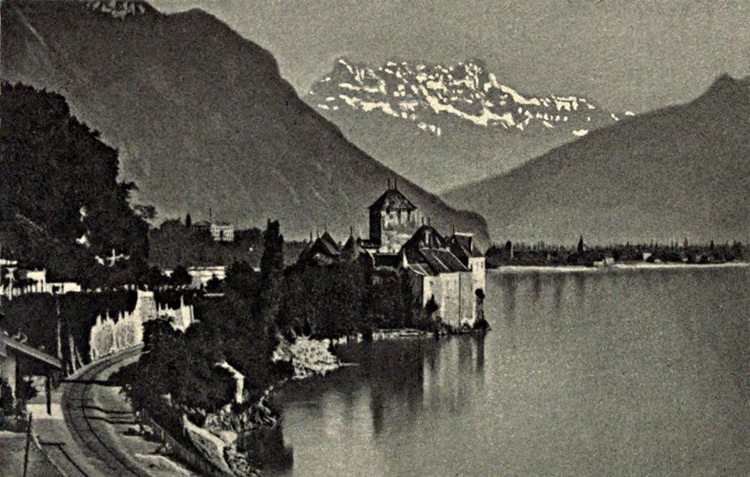
Castle of Chillon
A LITERARY PILGRIMAGE AMONG THE HAUNTS OF FAMOUS BRITISH AUTHORS
BY THEODORE F. WOLFE M.D.Ph.D.
AUTHOR OF LITERARY SHRINES ETC.

J. B. LIPPINCOTT COMPANY PHILADELPHIA MDCCCXCVI
Copyright, 1895, by Theodore F. Wolfe.
Printed by J. B. Lippincott Company, Philadelphia, U.S.A.
PREFACE
THE favor with which a few articles in the periodical press, similar to those herewith presented, have been received induces the hope that the present volume may prove acceptable. If some popular literary shrines which are inevitably included in the writer's personal itinerary are herein accorded but scant notice, it is for the reason that they have been already so oft described that portrayal of them is therefore purposely omitted from this account of a literary pilgrimage: even Stratford-on-Avon here for once escapes description. However, the initial paragraphs of these chapters lightly outline a series of literary rambles which the writer has found measurably complete and consecutive. The pilgrim is understood to make his start from London.
If these notes of his sojourns in the scenes hallowed by the presence of British authors or embalmed in their books shall prove pleasantly reminiscent to some who have fared to the same shrines, or helpfully suggestive to others who contemplate such pilgrimage, then
"not in vain He wore his sandal shoon and scallop-shell."
The writer is indebted to the publishers of the Home Journal for permission to reproduce one or two articles which have appeared in that periodical.
T. F. W.
CONTENTS
PAGE
Literary Hampstead and Highgate.
Haunt of Dickens—Steele—Pope—Keats—Baillie—Johnson—Hunt—Akenside—Shelley—Hogarth—Addison—Richardson—Gay—Besant—Du Maurier—Coleridge, etc.—Grave of George Eliot13
By Southwark and Thames-Side to Chelsea.
Chaucer—Shakespeare—Dickens—Walpole—Pepys—Eliot—Rossetti—Carlyle—Hunt—Gay—Smollett—Kingsley—Herbert—Dorset—Addison—Shaftesbury—Locke—Bolingbroke—Pope—Richardson, etc.24
The Scene of Gray's Elegy.
The Country Church-Yard—Tomb of Gray—Stoke-Pogis Church—Reverie and Reminiscence—Scenes of Milton—Waller—Porter—Coke—Denham39
Dickensland: Gad's Hill and about.
Chaucer's Pilgrims—Falstaff—Dickens's Abode—Study—Grounds—Walks—Neighbors—Guests—Scenes of Tales—Cobham—Rochester—Pip's Church-Yard—Satis House, etc.49
Some Haunts of Byron.
Birthplace—London Homes—Murray's Book-Store—Kensal Green—Harrow—Byron's Tomb—His Diadem Hill—Abode of his Star of Annesley—Portraits—Mementos62
The Home of Childe Harold.
Newstead—Byron's Apartments—Relics and Reminders—Ghosts—Ruins—The Young Oak—Dog's Tomb—Devil's Wood—Irving—Livingstone—Stanley—Joaquin Miller80
Warwickshire: the Loamshire of George Eliot.
Miss Mulock—Butler—Somervile—Dyer—Rugby—Homes of George Eliot—Scenes of Tales—Cheverel—Shepperton—Milly's Grave—Paddiford—Milby—Coventry, etc.—Characters—Incidents91
Yorkshire Shrines: Dotheboys Hall and Rokeby.
Village of Bowes—Dickens—Squeers's School—The Master and his Family—Haunt of Scott106
Sterne's Sweet Retirement.
Sutton—Crazy Castle—Yorick's Church—Parsonage—Where Tristram Shandy and the Sentimental Journey were written—Reminiscences—Newburgh Hall—Where Sterne died—Sepulchre111
Haworth and the Brontës.
The Village—Black Bull Inn—Church—Vicarage—Memory-haunted Rooms—Brontë Tomb—Moors—Brontë Cascade—Wuthering Heights—Humble Friends—Relic and Recollection121
Early Haunts of Robert Collyer: Eugene Aram.
Childhood Home—Ilkley Scenes, Friends, Smithy, Chapel—Bolton—Associations—Wordsworth—Rogers—Eliot—Turner—Aram's Homes—Schools—Place of the Murder—Gibbet—Probable Innocence136
Home of Sydney Smith.
Heslington—Foston, Twelve Miles from a Lemon—Church-Rector's Head—Study—Room-of-all-work—Grounds—Guests—Universal Scratcher—Immortal Chariot—Reminiscences148
Nithsdale Rambles.
Scott—Hogg—Wordsworth—Carlye's Birthplace—Homes—Grave—Burns's Haunts—Tomb—Jeanie Deans—Old Mortality, etc.—Annie Laurie's Birthplace—Habitation—Poet-Lover—Descendants161
A Niece of Robert Burns.
Her Burnsland Cottage—Reminiscences of Burns—Relics—Portraits—Letters—Recitations—Account of his Death—Memories of his Home—Of Bonnie Jean—Other Heroines181
Highland Mary: her Homes and Grave.
Birthplace—Personal Appearance—Relations to Burns—Abodes: Mauchline, Coilsfield, etc.—Scenes of Courtship and Parting—Mementos—Tomb by the Clyde194
Brontë Scenes in Brussels.
School—Class-Rooms—Dormitory—Garden—Scenes and Events of Villette and The Professor—M. Paul—Madame Beck—Memories of the Brontës—Confessional—Grave of Jessy Yorke207
Leman's Shrines.
Beloved of Littérateurs—Gibbon—D'Aubigné—Rousseau—Byron—Shelley—Dickens, etc.—Scenes of Childe Harold—Nouvelle Heloïse—Prisoner of Chillon—Land of Byron226
Châteaux of Ferney and Coppet.
Voltaire's Home, Church, Study, Garden, Relics—Literary Court of de Staël—Mementos—Famous Rooms, Guests—Schlegel—Shelley—Constant—Byron—Davy, etc.—De Staël's Tomb238
ILLUSTRATIONS
PAGE
Castle of ChillonFrontispiece.
Stoke-Pogis Church and Church-Yard 45
Newstead Abbey81
Home of Annie Laurie177
LITERARY HAMPSTEAD AND HIGHGATE
Haunt of Dickens—Steele—Pope—Keats—Baillie—Johnson—Hunt—Akenside—Shelley—Hogarth—Addison—Richardson—Gay—Besant—Du Maurier—Coleridge, etc.—Grave of George Eliot.
THE explorations which first brought renown to the immortal Pickwick were made among the uplands which border the valley of the Thames at the north of London: the illustrious creator of Pickwick loved to wander in the same region through the picturesque landscapes he made the scenes of many incidents of his fiction, and the literary prowler of to-day can hardly find a ramble more to his mind than that from the former home of Dickens or George Eliot by Regent's Park to Hampstead, and thence through the famous heath to Highgate. The way traverses storied ground and teems with historic associations, but these are, for us, lessened and subordinated by the appeal of memories of the famous authors who have loved and haunted this delightful region, and have imparted to it the tenderest charm. The acclivity of Hampstead has measurably resisted the encroachment of London, and has deflected the railroads with their disturbing tendencies, so that this old town probably retains more of its ancient character than any other of the near suburbs, and some of its quaint streets would scarcely be more quiet if they lay a hundred miles away from the metropolis. Off the highway by which we ascend the hill, we find many evidences of antiquity, old streets lined by rows of plain and sedate dwellings wearing an air of dignified sobriety which is not of this century, and which is in grateful contrast with the pert artificiality of the modern fabrics of the vicinage. Many old houses are draped with ivy or shrouded by trees of abundant foliage; some are shut in by depressing brick walls, over which float the perfumes of unseen flowers. A few of the older streets lie in perpetual crepuscule, being vaulted by gigantic elms and limes as opaque as arches of masonry.
Along the slope of Haverstock hill, where our ascent begins, we find the sometime homes of Percival, Stanfield, Rowland Hill, and the historian Palgrave. Near by is the cottage where dwelt Mrs. Barbauld, and the Roslyn House, where Sheridan, Pitt, Burke, and Fox were guests of Loughborough. Here, too, formerly stood the mansion where Steele entertained the poet of the "Dunciad," with Garth and other famed wits. On the hill-side a leafy lane leads out of High Street to the picturesque church of the parish, whose tower is a conspicuous landmark. Within this fane we find, against the wall on the right of the chancel, the beautiful marble bust recently erected by American admirers "To the Ever-living Memory" of the author of "Lamia" and "Hyperion." Here, too, is the plain memorial tablet of the poetess Joanna Baillie,Baillie who lived in an unpretentious mansion lately standing in the neighborhood, where she was visited by Wordsworth, Rogers, and others of potential genius. In the thickly tenanted church-yard she sleeps with her sister near the graves of Incledon, Erskine, and the historian Mackintosh. Below the church, on the westering slope, lies embowered Frognall, once the home of Gay,Johnson where Dr. Johnson lived and wrote "The Vanity of Human Wishes" in the house where the gifted Nichol now resides with the author of "Ships that Pass in the Night" for a neighbor and with the home of Besant in view from his study. Near the summit of Hampstead stands a sober old edifice which was of yore the Upper Flask tavern, where the famous Kit-Kat ClubKit-Kat Club held its summer séances, when such luminous spirits as Walpole, Prior, Dorset, Pope, Congreve, Swift, Steele, and Addison assembled here in the low-panelled rooms which we may still see, or beneath the old trees of the garden, and interchanged sallies of wit and fancy over their cakes and ale. To this inn Lovelace brought the "Clarissa Harlowe" of Richardson's famed romance, and here Steevens, the scholiast of Shakespeare, lived and died. Flask Walk, which leads out of the high street among old houses and greeneries, brings us to the shadowy Well Walk, with its overarching trees and with many living memories masoned into its dead walls. Here we see the little remnant of the once famous well which for a time made Hampstead a resort for the fashionable and the suffering. Among the fancied invalids who once dwelt in Well Walk was the spouse of Dr. Johnson. Akenside, Arbuthnot, and Mrs. Barbauld (editor of "Richardson's Correspondence") have sometime lived in this same little street; here the mother of Tennyson died, and here the sweet boy-poet Keats lodged and wrote "Endymion." At a house still to be seen in the vicinage he was for two years the guest of his friend Brown; here he wrote "Hyperion," "St. Agnes," and the "Ode to a Nightingale," and here he wasted in mortal illness, being at last removed to Rome only to die. Under the limes of Well Walk is a spot especially hallowed by the memory of Keats:Keats it was the object and limit of his walks in his later months, and here was placed a seat (which until lately was preserved and bore his name), where he sat for hours at a time beneath the whispering boughs, gazing, often through tears, upon the enchanting vista of wave-like woods and fields, the valley with its gleaming lakelets, and the farther slopes crowned by the spires of Highgate, which rise out of banks of foliage. The view is no less beautiful than when Keats's vision lingered lovingly upon it, although we must go into the open fields to behold it now.
The Heath
If we bestir ourselves to reach the summit of the heath before the accustomed pall shall have settled down upon the great city, the exertion will be abundantly rewarded by the prospect that greets us as we overlook the abodes of eight millions of souls. Such a view is possible nowhere else on earth: outspread before us lies the vast metropolis with its seven thousand miles of streets, while without and beyond this aggregation of houses we behold an expanse of landscape diversified with vale and hill, copse and field, village and park, extending for leagues in every direction and embracing portions of seven of England's populous shires. We see the great dome of St. Paul's and the tall towers of Westminster rising out of the mass of myriad roofs; the Crystal Palace glinting amid its green terraces; across the city we behold the verdured slopes of Surrey and, farther away, the higher hills of Sussex; our eyes follow the course of the Thames from imperial Windsor, whose battlements are misty in the distance of the western horizon, to its mouth at Gravesend; yonder at the right is Harrow, set on its classic hill-top, with its ancient church by which the boy Byron idled and dreamed; northward we see pretty Barnet, where "Oliver Twist" met the "Dodger;" nearer is romantic Highgate, and all around us lie the green slopes and leafy recesses of the heath. Through these strode the murderer Sykes of Dickens's tale, and from the higher parts of this common we may trace the way of his aimless flight from the pursuing eyes of Nancy,—through Islington and Highgate to Hendon and Hatfield, and thence to the place of his miserable death at Rotherhithe. There are hours of delightful strolling amid the mazes of the picturesque heath, with its alternations of heathered hills and flower-decked dales, its pretty pools, its braes of brambled gorse and pine, its tangle of countless paths. One will not wonder that it has been the resort of littérateurs from the time of Dryden till now: Pope, Goldsmith, and Johnson loved to ramble here; Hunt, Dickens, Collins, and Thackeray were familiar with these shady paths; Nichol, Besant, James, and Du Maurier are now to be seen among the walkers on the heath. A worn path bearing to the right conducts to the turf-carpeted vale where, in a little cottage whose site is now occupied by the inn, Leigh HuntLeigh Hunt lived for some years. Such guests as Lamb, Hazlitt, Coleridge, Hood, and Cornwall came to this humble home, and here Shelley met Keats, the "Adonais" of his elegy. Not far away lie the ponds of Pickwick's unwearied researches; and in another corner of the common we find an ancient tavern bowered with shrubbery, in whose garden Addison and Steele oft sipped their ale of a summer evening, and where is still cherished a portion of a tree planted by Hogarth. On an elevation of the heath stands "Jack Straw's Castle,"Jack Straw's Castle believed to mark the place of encampment of that rebel chieftain with his mob of peasantry. It is a curious old structure, with wainscoted walls, and was especially favored by Dickens, who often dined here with Maclise and Forster and read to them his MSS. or counselled with them concerning his plots. Out on the heath near by was found the corpse of Sadlier the speculator, who, after bankrupting thousands of confiding dupes, committed suicide here; his career suggested to Dickens the Merdle and his complaint of "Little Dorrit." Among the embowered dwellings beyond West Heath we find that in which Chatham was self-immured, the cottage in which Mrs. Coventry Patmore—the Angel in the House—died, the place where Crabbe sojourned with Hoare. This vicinage has been the delight of artists from the time of Gainsborough, and is still a favorite sketching ground: here lived Collins and Blake, and Constable dwelt not far away. The author of "Trilby," who has recently taken front rank in the literary profession, long had home and studio in a picturesque ivy-grown brick mansion of many angles and turrets, in a quiet street upon the other side of the hill; here among his treasures of art he commenced a third book soon to be published.
The highway which leads north from Jack Straw's affords an exhilarating walk, with a superb prospect upon either hand, and brings us to the historic Spaniard's Inn,The Spaniard's a pleasant wayside resort decked with vines and flowers, where pedestrians stop for refreshments. Dickens oft came to this place, and here we see the shady garden, with its tables and seats, where Mrs. Bardell held with her cronies the mild revel which was interrupted by the arrest of the widow for the costs in Bardell vs. Pickwick. The quiet of this ancient inn was disturbed one night by a fierce band of Gordon rioters, who rushed up the paths of the heath on their way to Mansfield's house, and stopped here to drink or destroy the contents of the inn-cellars,—an occurrence which is graphically described by Dickens in the looting of the Maypole Inn of Willet, in "Barnaby Rudge." Next to the Spaniard's once lived Erskine, and among the grand beeches of Caen Wood we see the house of Mansfield, where the daughter of Mary Montagu was mistress, and where illustrious guests like Pope, Southey, and Coleridge were entertained.
A farther walk through the noble wood brings us to the delightful suburb of Highgate, where we now vainly seek the Arundel House where the great Bacon died and find only the site of the simple cottage where Marvell, the "British Aristides," lived and wrote. The last home of the author of "Ancient Mariner" is in a row of pleasant houses on a shady street called The Grove, a little way from the high street, which was in Coleridge's time the great Northern coach-road from London. The houseHome of Coleridge is a neat brick structure of two stories, in which we may see the room where the poet lodged and where he breathed out his melancholy life. A pretty little patch of turf is in front of the dwelling, a larger garden, beloved by the poet, is at the back, and the trees which border the foot-walk were planted in his lifetime. To this cosy refuge he came to reside with his friends the Gilmans; here he was visited by Hunt, who once lodged in the next street, Lamb, Hazlitt, Wordsworth, Shelley, De Quincey, and others of like fame; and here, for nineteen years, "afflicted with manifold infirmities," he continued the struggle against a baneful habit, which ended only with his life. His grave was made not far away, in a portion of the church-yard which has since been overbuilt by a school, among whose crypt-like under-arches we find the tomb of stone, lying in pathetic and perpetual twilight, where the poet sleeps well without the lethean drug which ruined his life. On this hill lived "Copperfield" with Dora, and at its foot is the stone where Whittington sat and heard the bells recall him to London.
On the slope toward the city is the most beautiful of the London cemeteries, with a wealth of verdure and bloom. Within its hallowed shades lie the ashes of many whose memories are more fragrant than the flowers that deck their graves. In a beautiful spot which was beloved by the sweet singer in life we find the tomb of Parepa Rosa, tended by loving hands; not far away, among the mourning cypresses, lie Lyndhurst and the great Faraday. A plain tombstone erected by Dickens marks the sepulchre of his parents, and by it lies his daughter Dora, her gravestone bearing now, besides her simple epitaph prepared by her father, the name of the novelist himself and the names of two of his sons. Here, too, is the grave of Rossetti's young wife, whence his famous poems were exhumed. Among the many tombs of the enclosure, the one to which most pilgrims come is that of the immortal author of "Romola." On a verdant slope we find the spot where, upon a cold and stormy day which tested the affection of her friends, the mortal part of George EliotGrave of George Eliot was covered with flowers and lovingly laid beside the husband of her youth. Wreaths of flowers conceal the mound, and out of it rises a monument of gray granite bearing her name and years and the lines
"Of those immortal dead who live again In minds made better by their presence."
From the terraces above her bed we look over the busy metropolis, astir with its myriad pulses of life and passion, while its rumble and din sound in our ears in a murmurous monotone. As we linger amid the lengthening shadows until the sunset glory fades out of the sky above the heath and the lights of London gleam mistily through the smoke, we rejoice that we find the tomb of George Eliot, not in the aisles of Westminster, where some would have laid her, but in this open place, where the winds sigh a requiem through the swaying boughs, the birds swirl and twitter in the free azure above, and the silent stars nightly watch over her grave.
BY SOUTHWARK AND THAMES-SIDE TO CHELSEA
Chaucer—Shakespeare—Dickens—Walpole—Pepys—Eliot—Rossetti—Carlyle—Hunt—Gay—Smollett—Kingsley—Herbert—Dorset—Addison—Shaftesbury—Locke—Bolingbroke—Pope—Richardson, etc.
IF our way to Southwark be that of the pilgrims of Chaucer's time, by the London Bridge, we have on our right the dark reach of river where Lizzie Hexam was discovered in the opening of "Our Mutual Friend," rowing the boat of the bird of prey; on the right, too, we see the Iron Bridge where "Little Dorrit" dismissed young Chivery; and a few steps bring us to a scene of another of Dickens's romances, the landing-stairs at the end of London Bridge, where Nancy had the interview with "Oliver Twist's" friends which cost the outcast her life. Here, too, the boy Dickens used to await admission to the Marshalsea, often in company with the little servant of his father's family who figures in his fiction as the "orfling" of the Micawber household and the "Marchioness" of the Brass establishment in Bevis Marks. In the adjacent church of St. Saviour, part of which was standing when the Father of English poetry sojourned in the near Tabard inn,The Tabard is the effigied tomb of the poet Gower, a friend of Chaucer; here also lie buried Shakespeare's brother Edmund, an actor; Fletcher the dramatist, who lived close by; and Lawrence Fletcher, coparcener of Shakespeare in the Globe Theatre, which stood near at hand, on a portion of the site of the brewery which Dr. Johnson, executor of his friend Thrale, sold to Barclay and Perkins. The extensions of this establishment now cover the site of a church where Baxter preached, and the sepulchre of Cruden, author of the "Concordance." In near-by Zoar Street, Bunyan preached in a large chapel near the Falcon tavern, which was a resort of Shakespeare. Of the Tabard inn, whence Chaucer's Canterbury company set out, the pilgrim of to-day finds naught save the name on the sign of the new tavern which marks its site on Borough High Street; and the picturesque White Hart,White Hart which stood near by—an inn known to Shakespeare and mentioned in his dramas—where Jingle of "Pickwick," eloping with Miss Wardle, was overtaken and Sam Weller discovered, was not long ago degraded into a vulgar dram-shop. Near St. Thomas's Church in this neighborhood formerly stood the hospital in which Akenside was physician and Keats a student. A little farther along the High Street we come to a passage at the left leading into a paved yard which was the court of the Marshalsea,Marshalsea and the high wall at the right is believed to have been a part of the old prison where Dickens's father was confined in the rooms which the novelist assigns to William Dorrit, and where "Little Dorrit" was born and reared. In this court the Dickens children played, and under yonder pump by the wall Pancks cooled his head on a memorable occasion. Just beyond is St. George's Church, where "Little Dorrit" was baptized and married, with its vestry where she once slept with the register under her head; adjoining is the church-yard, once overlooked by the prison-windows of Dickens and Dorrit, where the disconsolate young Chivery expected to be untimely laid under a lugubrious epitaph. Another block brings us to dingy Lant Street—"out of Hight Street, right side the way"—where the boy Dickens lived in the back attic of the same shabby house in which Bob Sawyer afterward lodged and gave the party to Pickwick. Beyond the next turning stood King's Bench Prison, where Micawber was incarcerated by his stony-hearted creditors, and beyond this again we come to the tabernacle where Spurgeon preached. Turning at the site of Micawber's prison, the Borough Road conducts us, by the sponging-house where Hook was confined, to the Christ Church of Newman Hall,—successor to Rowland Hill: it is a beautiful edifice, erected largely by contributions from America, its handsome tower being designed as a monument to Abraham Lincoln and marked by a memorial tablet. A little way southward, we find among the buildings of Lambeth Palace the library of which Green, the historian of the "English People," was long custodian, and the ancient room where Essex and the poet Lovelace were imprisoned.
Thames-Side
Recrossing Father Thames and passing the oft-described shrines of Westminster we come to Millbank, the region into which Copperfield and Peggotty followed the wretched Martha and saved her from suicide. Out of Millbank Street, a few steps by a little thoroughfare bring us into the somnolent Smith Square in which stands the grotesque church of St. John, where Churchill once preached,—described in "Our Mutual Friend" as a "very hideous church with four towers, resembling some petrified monster on its back with its legs in the air." To this place came Charley Hexam and his school-master and Wrayburn, for here in front of the church, at a house near the corner, Lizzie Hexam—the best of all Dickens's women—lodged with Jenny Wren. It was a little house of two stories, and its dingy front room—the shopShop of Jenny Wren of the dolls' dress-maker—later was used as a cheap restaurant, where we once regaled ourselves with a dish of equivocal tea while we looked about us and recognized the half-door across which Wrayburn indolently leaned as he chatted with Lizzie, the seat in front of the wide window where Jenny sat at her work with her crutch leaning against the wall, the corner to which she consigned her "bad old child" in his drunken disgrace, the stairs which led to Lizzie's chamber,—objects all noted by the observant glance of Dickens as he peered for a moment through the door-way. Sauntering southward by Grosvenor Road, where Lizzie walked with her brother and Headstone, we have beside us on the left the river, glinting and shimmering in the morning sunlight and alive with every sort of craft that plies for trade or pleasure. It was along these curving reaches of the Thames that the merry parties of the olden time, destined like ourselves to Chelsea,Old Chelsea used to row over the miles that then intervened between London and the ancient village, and here, too, Franklin, then a printer in Bartholomew Close, once swam the entire distance from Chelsea to Blackfriars Bridge. The way along which we are strolling then lay in the open country, with leafy lanes leading aside among groves and sun-flecked fields. But woods and fields have disappeared under compact masses of brick and mortar, and the quaint old suburb is linked to the city by continuous streets and structures. Contact has not altogether destroyed the distinctive features of the ancient suburb, and we know when our walk has brought us to its borders. Few of its thoroughfares retain the dreamful quiet of the olden time, few of its rows of sombre and dignified dwellings have wholly escaped the modern eruption of ornate and staring architecture; the old and the new are curiously blended, but enough of the former remains to remind us that Chelsea is olden and not modern, and to revive for us the winsome associations with which the place is permeated. The suggestion of worshipful antiquity is seen in sedate, ivy entwined mansions of dusky-hued brick, in carefully kept old trees which in their saplinghood knew Pepys, Johnson, or Smollett, in quaint inns whose homely comforts were enjoyed by illustrious habitués in the long ago.
Our stroll beyond the Grosvenor Road brings us to the famous "Chelsea Physick Garden," presented to the Apothecaries' Society by Sloane, the founder of the British Museum, who was a medical student here; it was to this garden that Polyphilus of the "Rambler" was going to see a new plant in flower when he was diverted by meeting the chancellor's coach. At the adjoining hospital dwelt the gifted Mrs. Somerville, whose husband was a physician there; and the ancient mansion of dingy brick, in which WalpoleWalpole lived, and where Pope, Swift, Gay, and Mary Wortley Montagu were guests, is a portion of the infirmary,—the great drawing-room in which the brilliant company met being a hospital ward. A little way northward, by Sloane Street, we come to Hans Place, where, at No. 25, the sweet poetess Letitia Landon ("L. E. L.") was born in a tiny two-storied house; she attended school in a similar house of the same row, where Miss Mitford and the authoress of "Glenarvon" had before been pupils. Along the river again we find beyond the hospital a passage leading to the place of Paradise Row, where, in a little brick house, the witching Mancini was visited by Charles II. and poetized by the brilliant Evremond. Here, at the corner of Robinson's Lane, Pepys visited Robarte in "the prettiest contrived house" the diarist ever saw; not far away a comfortable old inn occupies the site of the dwelling of the historian Faulkner, in the neighborhood where the essayist Mary Astell—ridiculed by Swift, Addison, Steele, Smollett, and Congreve—had her modest home. Robert Walpole's later residence stood near Queen's Road West, and its grounds sloped to the river just below the Swan Tavern, near the bottom of the lane now called Swan Walk. It was at this river inn that Pepys "got affright" on being told of an eruption of the plague in Chelsea.
For a half-mile or so westward from the Swan, picturesque Cheyne Walk—beloved of the literati—stretches along the river-bank. Its many old houses, with their solemn-visaged fronts overlooking the river, their iron railings, dusky walls, tiled roofs, and curious dormer-windows, are impressive survivors of a past age. Homes of George Eliot and RossettiAt No. 4, a substantial brick house of four stories, with battlemented roof and with oaken carvings in the rooms, are preserved some relics of George Eliot, for this was her last home, and here she breathed out her life in the same room where Maclise, friend of Carlyle and Dickens, had died just a decade before. No. 16, a spacious dwelling with curved front and finely wrought iron railing and gate-way, was the home of Rossetti for the twenty years preceding his death. With these panelled rooms, which he filled with quaint and beautiful objects of art, are associated most of the memories of the gifted poet and painter. The large lower room was his studio, where one of his last occupations was painting a replica of "Beata Beatrix," the portrait of his wife, whose tragic death darkened his life. Around the fireplace in this room a brilliant company held the nightly séances which a participant styles feasts of the gods. Through the passage at the side the famous zebu was conveyed, and reconveyed after his assault upon the poet in the garden. The rooms above were sometime tenanted by Meredith, Swinburne, and Rossetti's brother and biographer, who was also Whitman's editor and advocate. Later, the essayist Watts, to whom Rossetti dedicated his greatest work, resided here to cherish his friend. The garden, where Rossetti kept his odd pets and where neighbors remember to have seen him walking in paint-bedaubed attire for hours together, is now mostly covered by a school. At first, many luminaries of letters and art came to him here,—Jones, Millais, Hunt, Gosse, Browning, Whistler, Morris, Oliver Madox Brown, whose death elicited Rossetti's "Untimely Lost," and others like them; later, when baneful narcotics had sadly changed his temperament, he dwelt in seclusion, exercising only in his garden and seeing such devoted friends as Watts, Knight, Hake, "The Manxman" Hall Caine, and the gifted sister, author of "Goblin Market," etc., who was pictured by Rossetti in his "Girlhood of Mary Virgin," and who lately died. In his study here he produced his best work; here he revised the poems exhumed from his wife's grave and wrote "The Stream's Secret" and other parts of the volume which made his fame and occasioned the battle between the bards Buchanan and Swinburne; here he wrote the magnificent "Rose Mary," "White Ship," etc., and completed the series of sonnets which has been pronounced "in its class the greatest gift poetry has received since Shakespeare."
No. 18 was the famous coffee-house and barber-shop of Sloane's servant Salter,—called "Don Saltero" by Gay, Evremond, Steele, Smollett, and the other wits who frequented his place. On the Embankment by this Cheyne Walk we find the statue of Carlyle; behind it is the dull little lane of Cheyne Row, whose quiet Carlyle thought "hardly inferior to Craigenputtock," and here at No. 5, later 24, a plain three-storied house of sullied brick,—even more dingy than its neighbors,—the pessimistic sage lived,Carlyle's House wrote, and scolded for half a century. All the wainscoted rooms are sombre and cheerless, but the memory-haunted study seems most depressing as we stand at Carlyle's hearth-stone and look upon the spot where he sat to write his many books. The garden was a pleasanter place, with bright flowers his wife planted, and the tree under which he loved to smoke and chat. Here Tennyson lounged with him, devoted to a long pipe and longer discourse; here Froude oft found him on the daily visits which enabled him to picture the seer, "warts and all;" here Dickens, Maclise, and Hunt saw him at his best, and here the latter wrote "Jenny Kissed Me,"—Jenny being Mrs. Carlyle. To Carlyle in this sombre home came Emerson, Ruskin, Tyndal, and a host of friends and disciples from all lands, and hither will come an endless procession of admirers, for many Carlyle belongings have been recovered, and the place is to be preserved as a memorial of the stern philosopher. Around the corner Hunt lived, in the curious little house Carlyle described, and here he studied and wrote in the upper front room. On the next block of the same street stood the home of Smollett,Smollett which was removed the year that Carlyle came to dwell in the vicinage. It was a spacious mansion which had been the Lawrence manor-house. Smollett wrote here "Count Fathom," "Clinker," and "Launcelot Greaves," and finished Hume's "England." Here Garrick, Johnson, Sterne, and other starry spirits were his guests, and here later lived the poet GayGay and wrote "The Shepherd's Week," "Rural Sports," and part of his comedies. In the cellars of some of the houses at the top of Lawrence Street may be seen remains of the ovens of the once famous Chelsea china-factory, where Dr. Johnson wrought for some time vainly trying to master the art of china-making,—his pieces always cracking in the oven: a service of china presented to him by the factorymen here was preserved in Holland House. A tasteful Queen Anne mansion with beautiful interior decorations, not far from the Carlyle house, was a domicile of the poet and æsthete Oscar Wilde. In the picturesque rectory of St. Luke's, a few rods north from Cheyne Row, the author of "Hypatia" and his scarcely less famed brother Henry, of "Ravenshoe," lived as boys, their father being the incumbent of the parish. Henry KingsleyKingsley presents, in his "Hillyars and Burtons," charming sketches of Chelsea as it existed in his boyhood. Overlooking the river at the foot of the adjoining street, we find Chelsea Church, one of the most curious and interesting of London's many fanes, albeit partially disfigured by modern changes. In its pulpit Donne, the poet-divine, preached at the funeral of the mother of George Herbert;Herbert at its altar the dramatist Colman was married. Among its many monuments we find the mural tablet of Sir Thomas More, a marble slab with an inscription by himself which formerly described him as "harassing to thieves, murderers, and heretics." Here lie the ancestors of the poet Sidney, and in the little church-yard are the graves of Shadwell the laureate, who died just back of the church, of the publisher of "Junius," and of a brother of Fielding. Leading back from the river here is Church Street, on which dwelt Swift, Atterbury, and Arbuthnot, while Steele had a little house near by. The next street is named for Sir John Danvers, whose house was at the top of the little street: his wife was the mother of the poet Herbert, who dwelt here for a time and wrote some of his earlier poems; Donne and the amiable angler Izaak Walton were frequent guests of Herbert's mother in this place. The adjacent street marks the place of Beaufort House, the palatial residence of Sir Thomas More, where he was visited by his much-married monarch; where the learned and colloquial author of "Encomium Moriæ," Erasmus, was sometime an inmate; and where, decades later, Thomas Sackville, Earl Dorset,Dorset wrote the earliest English tragedy, "Gorboduc." A time-worn structure between King's Road and the Thames was once the home of the bewitching Nell Gwynne, and in later years "became (not inappropriately) a gin-temple," as Carlyle said: this old edifice was also sometime occupied by Addison. Back of King's Road we find the venerable ShaftesburyShaftesbury House,—in which the famous earl wrote "Characteristics," Locke began his "Essay," and Addison produced some of his Spectator papers,—long transformed into a workhouse, in the grounds of which we are shown the place of "Locke's yew," recently removed. The Old World's End Tavern, by Riley Street, was the notorious resort of Congreve's "Love for Love;" the once ill-famed Cremorne Gardens, just beyond, were erst part of the estate of a granddaughter of William Penn, who was related to the Penns of Stoke-Pogis, where Gray wrote the "Elegy." A near-by little ivy-grown brick house, with wide windows in its front and an iron balcony upon its roof, was long the home of Turner, and in the upper room, through whose arched window he could look out upon the river, he died. From the water-edge here we see, upon the opposite shore, the old church where Blake was married and Bolingbroke was buried, and from whose vestry window Turner made his favorite sketches; near by is a portion of the ancient house where BolingbrokeBolingbroke was born and died, where he entertained such guests as Chesterfield, Swift, and Pope, and where the latter wrote part of the "Essay on Man." Beyond Chelsea we find at Fulham the spot where lived and died Richardson, who is said to have written "Clarissa Harlowe" here; and, near the river, the place of the home of Hook, and his mural tablet in the old church by which he lies, near the grave of the poet Vincent Bourne. Our ramble by Thames-side may be pleasantly prolonged through a region rife with the associations we esteem most precious. Our way lies among the sometime haunts of Cowley, Bulwer, Pepys, Thomson, Marryat, Pope, Hogarth, Tennyson, Fielding, "Junius," Garrick, and many another shining one. Some of lesser genius dwell now incarnate in this memory-haunted district by the river-side,—the radical Labouchère, living in Pope's famous villa, Stephens, and the author of "Aurora Floyd,"—but it is the memory of the mighty dead that impresses us as we saunter amid the scenes they loved and which inspired or witnessed the work for which the world gives them honor and homage; we find their accustomed resorts, the rural habitations where many of them dwelt and died, the dim church aisles or the turf-grown graves where they are laid at last in the dreamless sleep whose waking we may not know.
THE SCENE OF GRAY'S ELEGY
The Country Church-Yard—Tomb of Gray—Stoke-Pogis Church—Reverie and Reminiscence—Scenes of Milton—Waller—Porter—Coke—Denham.
The Country Church-Yard
OUR visit to the country church-yard where the ashes of Gray repose amid the scenes his muse immortalized is the culmination and the fitting end of a literary pilgrimage westward from London to Windsor and the nearer shrines of Thames-vale. Our way has led us to the sometime homes of Pope, Fielding, Shelley, Garrick, Burke, Richardson; to the birthplaces of Waller and Gibbon, the graves of "Junius," Hogarth, Thomson, and Penn; to the cottage where Jane Porter wrote her wondrous tales, and the ivy-grown church where Tennyson was married. Nearer the scene of the "Elegy" we visit other shrines: the Horton where Milton wrote his earlier works, "Masque of Comus," "Lycidas," "Arcades;" the Hallbarn where Waller composed the panegyric to Cromwell, the "Congratulation," and other once famous poems; the mansion where the Herschels studied and wrote. We have had the gray spire of Stoke-Pogis Church in view during this last day of our ramble. From the summit of the "Cooper's Hill" of Denham's best-known poem, from the battlements of Windsor and the windows of Eton, from the elm-shaded meads that border the Thames and the fields redolent of lime-trees and new-mown hay where we loitered, we have had tempting glimpses of that "ivy-mantled tower" that made us wish the winged hours more swift; for we have purposely deferred our visit to that sacred spot so that the even-tide and the hour the curfew tolled "the knell of parting day" across this peaceful landscape may find us amid the old graves where "the rude forefathers of the hamlet sleep." As we approach through verdant lanes bordered by fields where the ploughman is yet at his toil and the herds feed among the buttercups, the abundant ivy upon the tower gleams in the light of the declining sun, and the "yew-tree's shade" falls far aslant upon the mouldering turf-heaps. The sequestered God's-acre, consecrated by the genius of Gray, lies in languorous solitude, far removed from the highway and within the precincts of a grand park once the possession of descendants of Penn. Just without the enclosure stands a cenotaph erected by John Penn, grandson of the founder of Pennsylvania; it represents a sarcophagus and is ostensibly commemorative of Gray, but, as has been said, it "resembles nothing so much as a huge tea-caddy," and its inscription celebrates the builder more than the bard. Within the church-yard all is rest and peace; the strife and fever of life intrude not here; no sound of the busy world breaks in upon the hush that pervades this spot, and "all the air a solemn stillness holds." Something of the serenity which here pervades earth and sky steals into and uplifts the soul, and the demons of greed and passion are subdued and silenced as we stand above the tomb of Gray and realize all the imagery of the "Elegy." While our hearts are thrilling with the associations of the place and the hour, while the ashes of the tender poet rest at our feet and the objects that inspired the matchless poem surround us, we may hope to share in some measure the tenderer emotions to which the contemplation of this scene stirred his soul. As we ponder these objects, upon which his loving vision lingered, they seem strangely familiar; we feel that we have known them long and will love them alway.
One must visit this spot if he would appreciate the absolute fidelity to nature of the "Elegy:" its imagery is the exact reproduction of the scene lying about us, which is practically unchanged since that time so long ago when Gray drafted his poem here. Above us rises the square tower, mantled with ivy and surmounted by a tapering spire whose shadow now falls athwart the grave of the poet; here are the rugged elms with their foliage swaying in the summer breeze above the lowly graves; yonder by the church porch is the dark yew whose opaque shade covers the site of the poet's accustomed seat on the needle-carpeted sward; around us are scattered the mouldering heaps beneath which, "each in his narrow cell forever laid," sleep the rustic dead. Some of the humble mounds are unmarked by any token of memory or grief, but many bear the "frail memorials," often rude slabs of wood, which loving but unskilled hands have graven with "uncouth rhymes and shapeless sculpture," with the names and years of the unhonored dead, and "many a holy text that teach the rustic moralist to die." Some of these lowly graves hold the forefathers of families who, not content with the sequestered vale of life which sufficed for these simple folk, have sought on another shore largesses of fame or fortune unattainable here. Among the names "spelled by the unlettered muse" upon the stones around us we see those of Goddard, Perry, Gould, Cooper, Geer, and many others familiar to our American ears. The overarching glades of the woods which skirt the sacred precinct were the haunt of the "youth to fortune and to fame unknown;" the nodding beech, that "wreathes its old fantastic roots so high" in the grove at near-by Burnham, was his favorite tree, as it was that of Gray; afar through the haze of a golden after-glow we see the "antique towers" of Eton, the stately brow of Windsor, with its royal battlements, and nearer the wave of woods and fields and all the dream-like beauty of the landscape upon which the eyes of Gray so often dwelt, a landscape that literally glimmers in the fading light.
Tomb of Gray
A tablet set by Penn in the chancel wall beneath the mullioned window is inscribed, "Opposite this stone, in the same tomb upon which he so feelingly recorded his grief at the loss of a beloved parent, are deposited the remains of Thomas Gray, author of the Elegy written in a Country Church-yard." A few feet distant is the tomb he erected for his mother, which now conceals the ashes of the gentle poet. It is of the plainest and simplest, a low structure of brick, covered by a marble slab. No "storied urn or animated bust" is needed to perpetuate the name of him who made himself immortal; even his name is not graven upon the marble. We are come directly from the splendors of the royal chapels of Windsor, where costly sculpture, gilding, and superlative epitaphs mark the sepulchres of some who were mediocre or mendicant of mind and virtue, and we are, therefore, the more impressed by the fitting simplicity of the poet's tomb among the humble dead whose artless tale he told. At the grave of Gray, how tawdry seems the pomp of those kingly mausoleums, how mean some of the lives the bedizened monuments commemorate, of how little consequence that the world should know where such dust is hid from sight! At the grave of Gray, if anywhere the wide world round, we will correctly value the vanities, ambitions, and rewards of earth. Gray's desire to be buried here saved him from what some one has called the "misfortune of burial in Westminster." While the pilgrim vainly seeks in that national mausoleum the tombs of Shakespeare, Milton, Byron, Gray, Wordsworth, Thackeray, Coleridge, Eliot, and others of divine genius, and finds instead the graves of many sordid and impure, entombment there may be a misfortune. Happily the poet of the Elegy reposes in his church-yard, beside the beings he best loved, on the spot he frequented in life and hallowed by his genius, among those whose virtues he sang; here his grave perpetually emphasizes the sublime teachings of his verse and affords a most touching association. The only inscription upon the slab is the poet's tribute to his aunt, Mary Antrobus, and to "Dorothy Gray, the careful and tender mother of many children, of whom one alone had the misfortune to survive her." It has been our pleasure on a previous day to seek out amid the din of London the spot where, in a modest dwelling, this mother gave birth to the poet, and where she and Mary Antrobus sold laces to maintain the "many children."
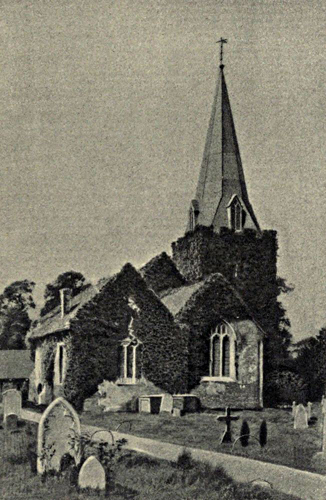
Stoke-Pogis Church
The Ivy-Mantled Church
Set upon a gentle eminence in the midst of this peaceful scene, the church has a picturesque beauty which harmonizes well with its environment. It is low and sombre, but age has given a dignity and grace which would make it attractive apart from its associations. Overrunning the walls, shrouding the crumbling battlements of the tower, clambering along the steep roofs, clinging to the highest gables, and festooning the stained windows, are masses of dark ivy, which conceal the inroads of time and impart to the whole structure a beauty that wins us completely. The tower is early English, the chancel is Norman, and the newer portions of the edifice were already old when Gray frequented the place. A path bordered by abundant roses leads from the gate-way of the enclosure to the quaint porch of timbers and the entrance to the church. Within, the light falls dimly at this hour upon the curious little galleries of the peasantry, the great pew of the Penns, the humbler place at the end of the south aisle where Gray came to pray, the huge mural tablet and the burial vault where the son of William Penn and his family sleep in death. In the park close by is the palace of the Penns, and the mansion where Charles I. was imprisoned and where Coke wrote some of his Commentaries and entertained his queen. Not far distant is the house—now a fine abode—which Gray shared for some years with his mother and aunt, and where his bedroom and study may still be seen. Farther away are the Beaconsfield which furnished the title of the gifted author of "Lothair," and the old church where Burke and Waller await the resurrection.
Discarded Stanzas
In the twilight we hastily sketch Gray's "ivy-mantled tower," and then sit by his tomb gazing upon the fading landscape and recalling the life of this divine poet and the lines of the matchless poem which was drafted here and with exquisite care revised and polished year after year before it was given to the world. It may not be generally known that he discarded six stanzas from the original draft,—among them this, written as the fourth stanza:
"Hark, how the sacred calm that breathes around Bids every fierce, tumultuous passion cease; In still small accents whispering from the ground A grateful earnest of eternal peace;"
this, from the reply of the "hoary-headed swain:"
"Him have we seen the greenwood side along While o'er the heath we hied, our labor done, Oft as the wood-lark piped her farewell song With wistful eyes pursue the setting sun;"
and this, from the description of the poet's grave:
"There scattered oft, the earliest of the year, By hands unseen, are showers of violets found; The redbreast loves to build and warble there, And little footsteps lightly print the ground."
We may judge what was the high standard of Gray, and what the transcending quality of the finished poem from which its author could, after years of deliberation, reject such stanzas. The Elegy is the expression in divinest poetry of the best conceptions of a noble soul upon the most serious topic on which human thought can dwell. No wonder that the world has literally learned by heart those precious lines; that they are the solace of the thoughtful and the bereft in every clime where mortals meditate on death; that the brave Wolfe, on the way to his triumphal death, should recite them in the darkness and declare he had rather be their author than the victor in the morrow's battle; that the great Webster, on his death-bed, should beg to hear them, and die at last with their melody sounding in his ears.
As the glow fades out of the darkening sky, the birds in the leafy elms one by one cease their songs, "the lowing herds wind slowly o'er the lea" to distant folds, the "drowsy tinklings" grow fainter, the summer wind sighing among the trees dies with the day, and the scene which seemed still before is noiseless now. In this hush we are content to leave this deathless poet and the spot he loved. We gather ivy from the old wall and a spray from the boughs of his dreaming yew, and take our way back to the busy haunts of men.
DICKENSLAND: GAD'S HILL AND ABOUT
Chaucer's Pilgrims—Falstaff—Dickens's Abode—Study—Grounds—Walks—Neighbors—Guests—Scenes of Tales—Cobham—Rochester—Pip's Church-Yard—Satis House, etc.
Gad's Hill House
"TO go to Gad's Hill," said Dickens, in a note of invitation, "you leave Charing Cross at nine o'clock by North Kent Railway for Higham." Guided by these directions and equipped with a letter from Dickens's son, we find ourselves gliding eastward among the chimneys of London and, a little later, emerging into the fields of Kent,—Jingle's region of "apples, cherries, hops, and women." The Thames is on our left; we pass many river-towns,—Dartford where Wat Tyler lived, Gravesend where Pocahontas died,—but most of our way is through the open country, where we have glimpses of fields, parks, and leafy lanes, with here and there picturesque camps of gypsies or of peripatetic rascals "goin' a-hoppin'." From wretched Higham a walk of half an hour among orchards and between hedges of wild-rose and honeysuckle brings us to the hill which Shakespeare and Dickens have made classic ground, and soon we see, above the tree-tops, the glittering vane which surmounted the home of the world's greatest novelist. The name Gad's (vagabond's) Hill is a survival of the time when the depredations of highwaymen upon "pilgrims going to Canterbury with rich offerings and traders riding to London with fat purses" gave to this spot the ill repute it had in Shakespeare's day: it was here he located Falstaff's great exploit. The tuft of evergreens which crowns the hill about Dickens's retreat is the remnant of thick woods once closely bordering the highway, in which the "men in buckram" lay concealed, and the robbery of the franklin was committed in front of the spot where the Dickens house stands. By this road passed Chaucer, who had property near by, gathering from the pilgrims his "Canterbury Tales." In all time to come the great master of romance who came here to live and die will be worthily associated with Shakespeare and Chaucer in the renown of Gad's Hill. In becoming possessor of this place, Dickens realized a dream of his boyhood and an ambition of his life. In one of his travellers' sketches he introduces a "queer small boy" (himself) gazing at Gad's Hill House and predicting his future ownership, which the author finds annoying "because it happens to be my house and I believe what he said was true." When at last the place was for sale, Dickens did not wait to examine it; he never was inside the house until he went to direct its repair. Eighteen hundred pounds was the price; a thousand more were expended for enlargement of the grounds and alterations of the house, which, despite his declaration that he had "stuck bits upon it in all manner of ways," did not greatly change it from what it was when it became the goal of his childish aspirations. At first it was his summer residence merely,—his wife came with him the first summer,—but three years later he sold Tavistock House, and Gad's Hill was thenceforth his home. From the bustle and din of the city he returned to the haunts of his boyhood to find restful quiet and time for leisurely work among these "blessed woods and fields" which had ever held his heart. For nine years after the death of Dickens Gad's Hill was occupied by his oldest son; its ownership has since twice or thrice changed.
Gad's Hill—House and Grounds
Its elevated site and commanding view render it one of the most conspicuous, as it is one of the most lovely, spots in Kent. The mansion is an unpretentious, old-fashioned, two-storied structure of fourteen rooms. Its brick walls are surmounted by Mansard roofs above which rises a bell-turret; a pillared portico, where Dickens sat with his family on summer evenings, shades the front entrance; wide bay-windows project upon either side; flowers and vines clamber upon the walls, and a delightfully home-like air pervades the place. It seems withal a modest seat for one who left half a million dollars at his death. At the right of the entrance-hall we see Dickens's library and study, a cosy room shown in the picture of "The Empty Chair:" here are shelves which held his books; the panels he decorated with counterfeit book-backs; the nook where perched the mounted remains of his raven, the "Grip" of "Barnaby Rudge." By this bay-window, whence he could look across the lawn to the cedars beyond the highway, stood his chair and the desk where he wrote many of the works by which the world will know him alway. Behind the study was his billiard-room, and upon the opposite side of the hall the parlor, with the dining-room adjoining it at the back, both bedecked with the many mirrors which delighted the master. Opening out of these rooms is a conservatory, paid for out of "the golden shower from America" and completed but a few days before Dickens's death, holding yet the ferns he tended. The dining-room was the scene of much of that emphatic hospitality which it pleased the novelist to dispense, his exuberant spirits making him the leader in all the jollity and conviviality of the board. Here he compounded for bibulous guests his famous "cider-cup of Gad's Hill," and at the same table he was stricken with death; on a couch beneath yonder window, the one nearest the hall, he died on the anniversary of the railway accident which so frightfully imperilled his life. From this window we look out upon a lawn decked with shrubbery and see across undulating cornfields his beloved Cobham. From the parquetted hall, stairs lead to the modest chambers,—that of Dickens being above the drawing-room. He lined the stairway with prints of Hogarth's works, and declared he never came down the stairs without pausing to wonder at the sagacity and skill which had produced the masterful pictures of human life. The house is invested with roses, and parterres of the red geraniums which the master loved are ranged upon every side. It was some fresh manifestation of his passion for these flowers that elicited from his daughter the averment, "Papa, I think when you are an angel your wings will be made of looking-glasses and your crown of scarlet geraniums." Beneath a rose-tree not far from the window where Dickens died, a bed blooming with blue lobelia holds the tiny grave of "Dick" and the tender memorial of the novelist to that "Best of Birds." The row of gleaming limes which shadow the porch was planted by Dickens's own hands. The pedestal of the sundial upon the lawn is a massive balustrade of the old stone bridge at near-by Rochester, which little David Copperfield crossed "foot-sore and weary" on his way to his aunt, and from which Pickwick contemplated the castle-ruin, the cathedral, the peaceful Medway. At the left of the mansion are the carriage-house and the school-room of Dickens's sons. In another portion of the grounds are his tennis-court and the bowling-green which he prepared, where he became a skilful and tireless player. The broad meadow beyond the lawn was a later purchase, and the many limes which beautify it were rooted by Dickens. Here numerous cricket matches were played, and he would watch the players or keep the score "the whole day long." It was in this meadow that he rehearsed his readings, and his talking, laughing, weeping, and gesticulating here "all to himself" excited among his neighbors suspicion of his insanity. From the front lawn a tunnel constructed by Dickens passes beneath the highway to "The Wilderness," a thickly wooded shrubbery, where magnificent cedars uprear their venerable forms and many sombre firs, survivors of the forest which erst covered the countryside, cluster upon the hill-top. Here Dickens's favorite dog, the "Linda" of his letters, lies buried. Amid the leafy seclusion of this retreat, and upon the very spot where Falstaff was routed by Hal and Poins ("the eleven men in buckram"), Dickens erected the chaletDickens's Chalet sent to him in pieces by Fechter, the upper room of which—up among the quivering boughs, where "birds and butterflies fly in and out, and green branches shoot in at the windows"—Dickens lined with mirrors and used as his study in summer. Of the work produced at Gad's Hill—"Two Cities," "Uncommercial Traveller," "Mutual Friend," "Edwin Drood," and many tales and sketches of "All the Year Round"—much was written in this leaf-environed nook; here the master wrought through the golden hours of his last day of conscious life, here he wrote his last paragraph and at the close of that June day let fall his pen, never to take it up again. From the place of the chalet we behold the view which delighted the heart of Dickens,—his desk was so placed that his eyes would rest upon this view whenever he raised them from his work,—the fields of waving corn, the green expanse of meadows, the sail-dotted river.
Many friends came to Dickens in this pleasant Kentish home,—Forster, Maclise, Reade, Macready, Leech, Collins, Yates, Hans Christian Andersen, Mr. and Mrs. Fields, Longfellow and his daughters, Fechter and his wife: some of them were guests here for many days together. The master was the most genial of hosts, apparently the happiest of men, with the hearty laugh which Montaigne says never comes from a bad heart. After the morning task in library or chalet he gave the rest of the day to exercise and recreation, often at games with his guests in the grounds, but taking daily in rain or shine the long walks which made his lithe figure and rapid gait familiar to all the cottagers and field-laborers of the countryside. It is pleasant to hear the loving testimony of these simple folk—many of them descendants of the "men of Kent" who followed the standard of Wat Tyler from Blackheath to London—concerning Dickens's uniform kindness, his helpful generosity, his scrupulous regard of the rights of inferiors, the traits which won their hearts. One rustic neighbor declares, "Dickens was a main good man, sir: it was a sorry day for the neighborhood when he was taken away." Near the gate of Gad's Hill House is a wayside inn, the "Sir John Falstaff," which for more than two centuries has stood for remembrance of that worthy's exploit at this place. Its weather-worn sign bears portraits of Falstaff and Prince Hal and a picture of the "Merry Wives of Windsor" putting Falstaff into the basket. The name of a son of the recent keeper of this hostelry, Edward Trood, doubtless suggested the title of the "Mystery" which must, alas! remain a mystery evermore.
From the inn a lane leads to a sightly summit surmounted by a monument which Dickens called "Andersen's Monument," because it was the resort of that illustrious author while a guest at Gad's Hill. Its far-reaching prospect is indeed alluring: on every hand vast, wave-like expanses of forest and orchard, moor and mead, sweep away to the horizon, while northward, beyond great cornfields and market-gardens, we see twenty miles of the Thames—"stealing steadily away to the ocean, like a man's life"—bordered here by a wilderness of low-lying marsh. A walk beloved of Dickens brings us to one of his favorite haunts,—a dreary church-yard on the margin of this marsh. It lies in the dismal, ague-haunted "hundred of Loo," a peninsula between the Thames and the Medway having a broad hem of desolate fens along the river-banks—a weird, little known region, whose ancient reputation was unsavory. A wooden finger on a post directs us to Cooling,—Dickens makes Pip say that this direction was never accepted, no one ever came,—a forlorn hamlet which straggles about the ruins of Cooling Castle. This was an ancient seat of the Cobhams; through a Cobham heiress it passed to Oldcastle, leader of the Lollards, who shut himself up here and was dragged hence to martyrdom. It is noteworthy that this Oldcastle has been thought to be the original of Falstaff, the hero of Gad's Hill. Of the stronghold little remains save the machicolated gate-way, flanked with ponderous round towers bearing quaint inscriptions. The water of the moat is green and stagnant, suggesting frogs and rheumatism, and the space it encloses is occupied by the cottage of a farmer. The forge and cottage of Joe Gargery are not found in the wretched village,—indeed, we should be sorry to find that splendid fellow and the good Betty so poorly housed,—but beyond the narrow street and at the verge of the marshes we come to a low, quaint, square-towered old church, which rises from a wind-swept, nettle-grown church-yard, the sceneScenes of Great Expectations of the opening chapter of "Great Expectations." Yonder mound, whose gravestone is inscribed to George Comfort, "Also Sarah, Wife of the Above," stands for the tomb of Pip's parents; and sunken in the grass at our feet is the row of little gravestones whose curious shape led Pip to believe that his little brothers (whose graves they marked) "had been born on their backs, with their hands in their trousers pockets, and had never taken them out in this stage of existence." Over this low wall which divides God's-acre from the marshes the convict climbed, and we, standing upon it, look across the scene of his chase and capture, which Pip witnessed from Joe's back. On this sombre autumn afternoon of our visit the landscape is startlingly like that the terrified boy beheld: we see the same far-stretching waste of marshes,The Marshes the intersecting dikes, the low, leaden line of the river beyond, dark mists hanging heavy over all, while the chill wind blows in our faces from its "savage lair" in the sea. Upon yonder flat tombstone in the far corner of the church-yard Dickens sat and lunched with Fields when he last walked to this place. Hidden now in the mists, but not far distant, and reached by a foot-path from the road to Chalk, is a dirty and dilapidated Thames-side inn, whose creaking sign-board reads, "Ship and Lobster:" this is The Ship of "Great Expectations," where Pip and his party slept the night preceding their attempt to put Magwich on the steamer, and the open river below the little causeway is the scene of their mischance and the transport's recapture.
Cobham
The walk which Dickens most enjoyed—the one which was his last before he died—was to and around Cobham, the seat of his friend Darnley. We follow the way once so familiar to his feet, through the noble park which the Pickwick Club found "so thoroughly delightful," on a June afternoon, by the stately old hall where lately stood Dickens's chalet, and farther, through majestic forest and open glade, to the place whence Pickwick—overcome by cold punch—was wheeled to the pound. Skirting the park on our return, we come to Cobham village and the neat Leather Bottle Inn to which the lovelorn Tupman retired to conceal his woe after his discomfiture at Manor Farm, and where Dickens himself, rambling in the neighborhood with Forster, lodged in 1841. Here is the little church-yard where Pickwick walked with Tupman and persuaded him to return to the world, and hard by the cottage of Bill Stumps, before which Pickwick made the immortal discovery which was "the pride of his friends and the envy of every antiquarian in this or any other country." Another favorite walk of Dickens conducts us, past a quaint, rambling mansion of dingy brick which served as the model for Satis House of "Great Expectations," to Rochester, the CloisterhamCloisterham of "Edwin Drood." Here we find the Bull Inn,—"good house, nice beds,"—where the Pickwick Club lodged, in rooms 13 and 19, and the ballroom, where Tupman and Jingle (the latter in Winkle's coat) danced with the widow and enraged little Slammer; the Watt's Charity of "The Uncommercial Traveller;" the picturesque castle-ruin which Dickens frequented and has so charmingly described. Here, too, is the gray old cathedral he loved, which appears in many of his tales, from Jingle's piquant account of it in "Pickwick" to that touching description of this ancient fane in the last lines of the master, written within sound of its bells and but a few hours before his death.
Land of Dickens
This region of sunny Kent, the scene of his earliest and latest years, may fitly be called The Land of Dickens, so intimately is it associated with his life and work. Here at near-by Chatham (whence he used to come to gaze longingly at Gad's Hill House), in a whitewashed cottage on Ordnance Place, he lived as a child; at yonder village of Chalk he spent his honeymoon, its expenses being defrayed by the sale of the first numbers of "Pickwick;" here were the habitual resorts of his holiday leisure; here was his latest home; here he died, and here he desired to be buried. This district was no less the life-haunt and home of his imagination and genius. The scenes of his most effective romances are laid here; into the fabric of many a tale and sketch his fancy has woven the familiar features of town and hamlet, field and forest, marsh and river, of the region he knew and loved so well; here his first tale opens, here his last tale ends.
SOME HAUNTS OF BYRON
Birthplace—London Homes—Murray's Book-Store—Kensal Green—Harrow—Byron's Tomb—His Diadem Hill—Abode of his Star of Annesley—Portraits—Mementos.
OF the places in and about great London which were associated with the brief life of Byron, the rage for improvement which holds nothing sacred has spared a few, and the quest for Byron-haunts is still fairly rewarded. Holles Street, where he was born, has not long been resigned to trade: we have known it as a somnolent little street whose grateful quiet—reached by a step from the tumult of De Quincey's "stony-hearted step-mother"—made it seem like a placid pool beside a riotous torrent. It is scarce a furlong in length, and from the shade of Cavendish Square at its extremity we could look, between bordering rows of modest dwellings, to the square where Ralph Nickleby lived and Mary Wortley Montagu died. At our right, a little way down the street, stood a small, plain, two-storied house of dingy brick,London Homes where the poet's mother lodged in the upper front room at the time of his birth. This dwelling was No. 16, later 24, and has now given place to a shop. An unpretentious tenement near Sloane Square was Byron's home during his pupilage with Dr. Glennie.
In the house No. 8 St. James Street, nearly opposite the place where Gibbon died, Byron had for some years a suite of rooms. Here he was convenient to Almack's aristocratic ballrooms and St. James Theatre, and was in the then, as it is now, centre of fashionable club-life. His residence here began when he came to London to publish "Bards and Reviewers," was resumed upon his return from the Levantine tour, and continued during the publication of the early cantos of "Childe Harold" and other poems written on that tour. In these rooms "Corsair," "The Giaour," and "Bride of Abydos" were written, the latter in a single night and with one quill. The last year of Byron's residence here was the period of his highest popularity, when he was the especial pet of London society queens, one of whom—who later wrote a book to defame him—was recognized in bifurcated masculine garb in these chambers. On the same street is the home of White's Club, the Bays' of "Pendennis," of which the present Lord Byron is a member, and on the site of the Carlton Club, Pall Mall, stood the Star and Garter tavern, where, in room No. 7 at the right on the first floor, the poet's predecessor killed his neighbor Chaworth, grand-uncle of Byron's "star of Annesley." Adjoining the Academy of Arts in Piccadilly is that "college of bachelors," the Albany apartment house where Dickens lodged "Fascination" Fledgeby and laid the scene of his flagellation by Lammle and the dressing of his wounds with pepper by Jenny Wren. Here the handsome suite A 2 was the abode of Byron for the year or so preceding his hapless marriage, and here "Lara" and "Hebrew Melodies" were written. The poet had passed the zenith of the social horizon, and the "Byron-madness" was waning, when he came to the Albany; still, the visits of fair admirers were vouchsafed him in these rooms. It was here that the girl whose story Guiccioli adduces as evidence of Byron's virtuous self-denial came to him for counsel. If the partiality of his mistress has unduly praised his conduct at this time, it is a thousandfold outweighed by the bitterness of another narrative—happily discredited, if not disproven—which indicates this same period as being that of the beginning of a liaison with his sister. To these rooms Moore was a daily visitant, and Canning then lodged on the second floor adjoining the suite E 1, where Macaulay wrote the "History of England" and many essays. Byron's last abode in London was a stately house in Piccadilly, opposite Green Park and not far from the then London sojourn of Scott. Byron's dwelling, now No. 139, belonged to the Duchess of Devon, and was known as 13 Piccadilly Terrace. To this elegant home he brought his bride after the "treacle-moon," and here passed the remainder of their brief period of cohabitation. Here "The Siege of Corinth," "Parisina," and many minor poems were penned, the MS. of some being in the handwriting of his wife. Here Augusta Leigh was a guest warmly welcomed by Lady Byron, despite her alleged knowledge of the "shocking misconduct" of Byron and his sister in this house. Here Ada, "sole daughter of his house and heart," was born, and from here, a few weeks later, his wife went forth, never to see him again. Some letters came from her to this home,—playful notes to Byron inviting him to follow her, affectionate epistles to the sister, then a final letter announcing her determination never to return. In the ten months during which Byron occupied this house it was nine times in possession of bailiffs on account of his debts. It has since been refaced and repaired, but the original rooms remain. Hamilton Place now leads from it to Hamilton Gardens, where stands a beautiful statue of Byron. To the mansion of Sir Edward Knatchbull, No. 25 Great George Street, a site now occupied by the Institute of Engineers, the corpse of Byron was brought upon its arrival from Greece; and here in the great parlors, but a few steps from the spot where the remains of Sheridan had lain eight years before, Byron's body lay in state while his friends vainly sought sepulture for it in Westminster.
Murray's
At No. 50 Albemarle Street, Piccadilly, not far from the Albany, is the establishment of John Murray, whose predecessor, John Murray II., published "Childe Harold" and all Byron's subsequent poems to the earlier cantos of "Don Juan." At this house the poet was a frequent and familiar lounger. Here, in a cosy drawing-room which is handsomely furnished and embellished, Murray used to hold a literary court, and here Byron first shook hands with the "great Wizard of the North" and met Moore, Canning, Southey, Gifford, and other littérateurs. Scott afterward wrote, "Byron and I met for an hour or two daily in Murray's drawing-room, and found much to say to each other." During his residence in London, Byron was customarily one of the coterie of authors—facetiously called the "four o'clock club"—which daily assembled in this room. The séances were frequented at one time or another by most of the stars of English letters, embracing, besides those above named, Campbell, Hallam, Crabbe, Lockhart, Disraeli, Irving, George Ticknor, etc. We find the room little changed since their time. Original portraits of that brilliant company look down from the walls of the room they haunted in life, and the visitor thrills with the thought that in some subtile sense their presence pervades it still. In this room Ada Byron, kept in ignorance of her father until womanhood, first saw his handwriting, and in yonder fireplace beneath his portrait, four days after intelligence of his death had reached London, the manuscript of his much-discussed "Memoirs" was burned at the desire of Lady Byron and in the presence of Moore and Byron's executor, Hobhouse, who had witnessed his hapless marriage. Until the death of Byron his relations with Murray were most cordial, and the present John Murray IV., grandson of Byron's publisher, possesses numerous letters of the poet, some of which were used in Moore's "Life." Perhaps most interesting of Byron's many rhyming epistles is the one commencing,—
"My dear Mr. Murray, You're in a blanked hurry To set up this ultimate canto,"
which announces the final completion of "Childe Harold." Among many mementos of Byron cherished in this famous room are the original MSS. of "Bards and Reviewers" and of most of his later poems. With them are other priceless MSS. of Scott, Swift, Gray, Southey, Livingstone, Irving, Motley, etc. The Murray III. who used to show us these treasures with reverent pride, and who could boast that he had known Byron, Scott, and Goethe, died not long ago. When we ask for the Bible popularly believed to have been given to Murray by Byron with a line so altered as to read "now Barabbas was a publisher," we are told this joke was Campbell's and was upon another publisher than Murray. Byron's signet-ring has passed to the possession of Pierre Barlow, Esq., of New York. Littérateurs still come to "Murray's den," though not so often as in the time when clubs were less popular: among those who may sometimes be met here are Argyll, Knight, Layard, Dufferin, Temple, Francis Darwin, etc. Murrays' was the home of the Review—"whose mission in life is to hang, draw, and Quarterly," as one victim avers—to which came Charlotte Brontë's burly Irish uncle with his shillalah in search of the harsh reviewer of "Jane Eyre," and haunted the place until he was turned away.
Kensal Green
A most delightful outing is the jaunt from Byron's London haunts, past Kensal Green, where we find the precious graves in which sleep Thackeray, Motley, Cunningham, Jameson, Hood, Hunt, Sydney Smith, and Mrs. Hawthorne,—the latter beneath ivy from her Wayside home and periwinkle from her husband's tomb on the piny hill-top at Concord,—to Harrow, the "Ida" of Byron's verse. Here is the ancient school of which Sheridan, Peel, Perceval, Trollope, and others famous in letters or politics were inmates; where Byron was for years "a troublesome and mischievous pupil" and made the acquaintance of Clare, Dorset, and others to whom some of his poems are addressed, and of Wildman who rescued his Newstead from ruin: the present Byron and the son of Ada Byron were also Harrow boys. Here may be seen some of the poet's worn and scribbled books; his name graven by him upon a panel of the oldest building; the Peachie tombstone—protected now by iron bars—which was his evening resort, where some of his stanzas were composed, and whence he beheld a landscape of enchanting beauty. Near this beloved spot, where Byron once desired to be entombed, sleeps a sinless child of sin, his daughter Allegra, born of Mrs. Shelley's sister. At Harrow,Harrow Byron repaid help upon his exercises by fighting for his assistant; his successes here were mainly pugilistic, but his battles were often those of younger and weaker boys, and the spot where he fought the tyrants of the school is pointed out with interest and pride.
In Notts, en route to Newstead, we lodge in an old mansion alleged to have been the abode of the poet in his school-vacations; we have the high authority of the landlord for the conviction that we occupy the room and the very bed oft used by Byron; but the credulity even of a pilgrim has a limit, and the agility of the fleas that now inhabit the bed forbids belief that they too are relics of the poet. Better authenticated are the Byron relics of a local society, among which are the boot-trees certified by his bootmaker to be those upon which the poet's boots were fitted. They are of interest as demonstrating that the asymmetry of his feet was much less than has been believed; one foot was shorter than its fellow, and the ankle was weak, but not deformed.
From Nottingham a winsome way along a smiling vale, with billowy hills swelling upon either hand, conducts us to the village of Hucknall. By its market-place an ancient church-tower rises from a grave-strewn enclosure; we enter the fane through a porch of ponderous timbers, and, traversing the dim aisle, approach the chancel and find there the tomb of Childe Harold.Tomb of Childe Harold A slab of blue marble, sent by the King of Greece and bearing the word Byron, is set in the pavement to mark the spot where, after the throes of his passion-tossed life, Byron lies among his kindred in "the dreamless sleep that lulls the dead." One who, as a lad, entered the vault at the burial of Ada Byron, indicates for us its size upon the pavement and the position of the coffins; Byron, in a coffin covered with velvet and resting upon benches of stone, lies between his mother and the "sole daughter of his house and heart;" at his feet a receptacle contains his heart and brain. His valet and the Little White Lady of Irving's narrative sleep in the yard near by. A marble tablet on the church wall describes Byron as the "Author of Childe Harold's Pilgrimage;" this was erected by his sister, and near it we saw a chaplet of faded laurel placed years ago by our "Bard of the Sierras." Byron's tomb has never been a popular shrine, but such Americans as Irving, Hawthorne, Halleck, Ludlow, Joaquin Miller, and William Winter have been reverent pilgrims. Once Byron's "Italian enchantress," la Guiccioli, was found weeping here and kissing the pavement which covers the lover of her youth.
Annesley Hall
Above Hucknall the ancestral domain of the Byrons lies upon the right, while upon the other hand extend the broad lands which were the heritage of Mary Ann Chaworth, Byron's "star of Annesley." From the boundary of the estates, where the poet sometimes met his youthful love, a stroll across a landscape parquetted with grain-field gold and meadow emerald brings us to the ancient seat of the time-honored race of which the maiden of Byron's "Dream"—the "Mary" of many poems—was the "last solitary scion left." It is now the property of her great-grandson. Most of her married life was passed elsewhere, and Annesley fell into the neglected condition which Irving describes. Mary's husband, the maligned Musters, instead of hating the place and seeking to destroy its identity, preferred it to his other property, and spent many years after his wife's death in restoring and beautifying it, taking pains to preserve the grounds and the main portion of the mansion in the condition in which his wife had known them in her maidenhood. This became the beloved home of his later years, and here he died. This mansion of the "Dream" stands upon an elevation overlooking many acres of picturesque park. It is a great, rambling pile of motley architecture, obviously erected by different generations of Chaworths to suit their varying needs and tastes, but the walls are overgrown with clambering vines, which conceal the touch of time and impart to the structure an aspect of harmonious beauty. The principal façade which presents along the court is imposing and stately, but on every side are pointed gables, stone balustrades, and picturesque walls. The interior arrangement of the body of the house remains precisely as Mary knew it, even the decorations of some of the rooms having been preserved by the considerate love of her husband and descendants; and here, despite the averment of a Byron-biographer that "every relic of her ancient family was sold and scattered to the winds," the Chaworth plate, portraits, and other belongings are religiously cherished. We were first invited to the place to see these while they were yet displayed by the maid in whose arms Mary died. Upon the walls of the great lower hall are many family pictures, among them that of the Chaworth whom Byron's great-uncle had slain. It was this portrait that Byron feared would come out of its frame to haunt him if he remained here over-night. From the hall low stairs lead to the apartments. At the right is Mary's sitting-room, where Byron spent many hours beside her, listening entranced while she played to him upon the piano which stood in the farther corner. It is a pleasant apartment, its windows looking out upon the garden-beds Mary tended, which we see now ablaze with the flowers known to have been her favorites. In this room, which "her smiles had made a heaven to him," Byron, years afterward, saw Mary for the last time and kissed for its mother's sake "the child that ought to have been his." On this occasion she made the inquiry which prompted the lines, "To Mrs. Musters, on being asked my reason for quitting England in the spring." This last painful interview is recalled in the poems "Well, Thou art Happy" and "I've seen my Bride Another's Bride." Above the hall is the large drawing-room, where we see several portraits of Mary, which represent her as a most beautiful woman, with a pathetically sweet and winning face,—by no means the "wicked-looking cat" which Byron's jealous wife described. Here, too, are pictures of her husband which fully justify his popular sobriquet, "handsome Jack Musters." Physically they were an admirably matched pair. Out of the drawing-room is the "antique oratory" of the poem, a small apartment above the entrance-porch, pictured as the scene of Byron's parting with Mary after her announcement of her betrothal. Byron was cordially welcomed at Annesley; the family were his relatives, and all of them, save that young lady herself, would gladly have had him marry the heiress. Among the guest-chambers is one, called of yore the blue room, which during one summer—after his fear of the family portraits had been subdued by the greater fear of meeting "bogles" on his homeward way—Byron often occupied. Here he incensed Nanny the housekeeper by allowing his dog to sleep upon the bed and soil her neat counterpanes. Another servant, "old Joe," tired of sitting up at night to wait upon him, finally frightened him away by means of some hideous nocturnal noises, which he assured the young poet proceeded from "spooks out of the kirk-yard,"—Byron's superstition doubtless suggesting the ruse.
Annesley Park
Giant trees overtop the chimneys and bower the walls of the venerable mansion. The garden which Irving found matted and wild was long ago restored by Musters to its former beauty of turf, foliage, and flower. A grand terrace,—one of the finest in England,—with brick walls and carved balustrades of stone mantled and draped with ivy, lies at the right, with broad steps leading down to the garden where Byron delighted to linger with Mary during the swift hours of one too brief summer. Beneath the terrace is a door, carefully protected by Musters and his descendants, which Byron daily used as a target and in which we see the marks of bullets from his pistol. The grounds are extensive and beautifully diversified by copses of great trees and grassy glades where deer feed amid myriad witcheries of leaf and bloom. Half a mile from the Hall is a shrine that will attract the sentimental prowler, Byron's diadem hill.Diadem Hill Projecting from the extremity of a long line of eminences, it is a landmark to the countryside and overlooks the living landscape which the poet depicted in lines throbbing with life and beauty. From its acclivity we see much of his ancestral Newstead, the adjoining fair acres of Annesley which he would have added to his own, the tower and chimneys of the Hall rising among clustering oaks: beyond these darkly wooded hills decline to the valley, along which we look—past parks, villages, and the church where Byron sleeps—to the spires of the city. As we contemplate the vista from the spot where stood the two bright "beings in the hues of youth," we have about us a ring of dark firs, the "diadem of trees in circular array" pictured in the "Dream," apparently unchanged since the day the maiden and the youth here met for the last time before her marriage. The Byron-writers have united in denouncing Musters for denuding this hill-top in a splenetic endeavor to prevent its identification as the scene of the interview described in the poem. In truth, we owe the preservation of the features which identify this romantic spot to the very hand which the author of "Crayon Miscellany" avers is "execrated by every poetic pilgrim." When natural causes were rapidly destroying the grove, Musters caused its removal and replaced it by saplings grown from cones of the old trees, each fir of the present beautiful diadem being sedulously rooted upon the site of its lineal ancestor. Musters had much greater reason to regard this spot with romantic tenderness than had the poet; here he enjoyed many stolen interviews with his sweetheart, for he was forbidden to see her in her home, and she, perverse and persistent in her passion for him, came here daily with the hope of meeting him and watched for his approach along the valley. Upon the very occasion the poem describes, she waited here, "Looking afar if yet her lover's steed kept pace with her expectancy," and merely tolerated the company of the "gaby" boy Byron until Musters might arrive. The latter had no reason for the irritable jealousy toward Byron which has been attributed to him, and there is no evidence that he evinced or entertained such a feeling. He freely invited the poet to his house, rode and swam with him, preserved the few Byron mementos at Annesley, and protected the tombs of Byron's ancestors at Colwick. So much of untruth has been published anent the Byron-Chaworth-MustersByron-Chaworth-Musters matter, and especially concerning the attitude of the lady toward Byron and the conditions of her subsequent life, that it is pleasant, even at this late day, to be able to record upon undoubted evidence that her loving admiration for her husband ceased only with her life.
On the bank of the silvery Trent, three miles from Nottingham, is Colwick Hall, where Mary's married life was spent. This was an ancient seat of the Byrons, said to have been lost by them at the card-table. Mary's home was an imposing mansion, with lofty cupola, balustraded roofs, and stately pediments upheld by Ionic columns. From the front windows we look across a wide expanse of sun-kissed meadow beyond the river, while at the back rocky cliffs rise steeply and are tufted by overhanging woods. The Hall was attacked and pillaged in 1831 by a Luddite mob, from whom poor Mary escaped half naked into the shrubbery and lay concealed in the cold wet night. The exposure and terror of this event impaired her reason, and caused her death the next year at Wiverton, another seat of the Chaworths, where her descendants reside. Close by the mansion at Colwick, now a summer resort, was the old gray church, with battlemented tower, where Mary was married, and where she lies in death with her husband and his kindred,Mary's Grave near the burial-vault of the ancestors of the lame boy who linked her name to deathless verse. At the side of the altar a beautiful monumental tablet, bearing a graceful female figure and a laudatory inscription, is placed in memory of the "star of Annesley," whose brightness went out in distraction and gloom.
To Byron's early passion and its failure we owe some of the sweetest and tenderest of his songs; and it has been believed that the memory of that defeat adapted his thoughts to their highest flights and gave added pathos and beauty to his noblest work. Thus all the world were gainers by his disappointment, and evidence is lacking that either the lady or the lover was a loser.
THE HOME OF CHILDE HAROLD
Newstead—Byron's Apartments—Relics and Reminders—Ghosts—Ruins—The Young Oak—Dog's Tomb—Devil's Wood—Irving—Livingstone—Stanley—Joaquin Miller.
HOWEVER alluring other haunts of Byron may be found, the "hall of his fathers" must remain paramount in the interest and affection of his admirers. The stanzas he addressed to that venerable pile, the graphic description in "Don Juan," the plaintive allusions in "Childe Harold," its own romantic history as a mediæval fortress and shrine, and its association with the bard who inherited its lands and dwelt beneath its battlements, render Newstead AbbeyThe Abbey a Mecca to which the steps of pilgrims tend. It came to the Byrons by royal gift, and in the middle of the last century was inherited by the poet's predecessor the Wicked Byron, who killed his neighbor of Annesley and so desolated the Abbey that the only spot sheltered from the storms was a corner of the scullery where he breathed out his wretched life. The poet occupied the place at intervals for twenty years, and then sold it to Colonel Wildman, who had been his form-fellow at Harrow, and to whom we are mainly indebted for the restoration of the edifice and the preservation of every memento of the poet and his race. At the death of Wildman the Abbey became the property of Colonel W. F. Webb, a sharer in Livingstone's explorations, who gathers here a brilliant circle of authors, artists, travellers, and wits whose gayety dispels the hoary and ghostly associations of the place.
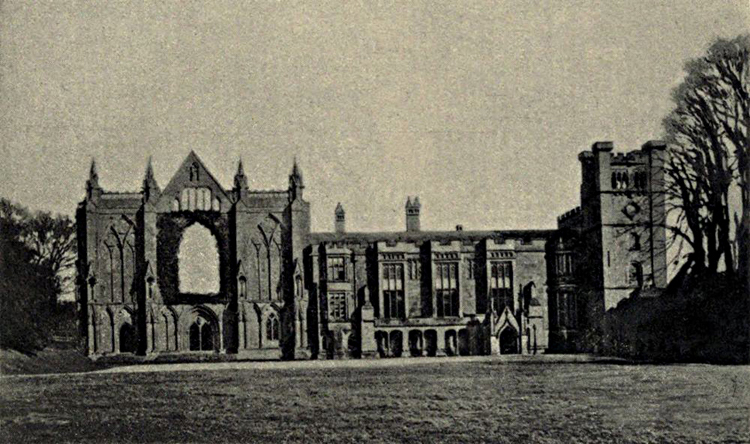
Newstead Abbey
Chapel Ruin
From the boundary of the estate a broad avenue, lined with noble trees, leads to an inner park of eight hundred acres, among whose sylvan beauties our way lies, through verdant glades and under leafy boughs whose shadows the sunshine prints upon the path, until we see, from the verge of the wood, the noble pile rising amid an environment of lawn and lake, grove and garden. It is a vast stone structure, composed of motley parts joined "by no quite lawful marriage of the arts" into an harmonious and impressive whole. The western façade is the one usually pictured, because it contains the Byron apartmentsByron's Apartments and best displays the characteristic features of the edifice, having a castellated tower at one extremity, while to the other is joined the ruined chapel front which, as an example of its style, is rivalled in architectural value only by St. Mary's at York. This Newstead fragment, retaining its perfect proportions, its noble windows, its gray statue of the Virgin and "God-born Child" in the high niche of the gable,—the whole draped and garlanded with ivy which conceals the scars of Cromwell's cannon-balls,—is a vision of unique beauty. From the Gothic door-way of the mansion we are admitted to a gallery with a low-vaulted roof of stone upheld by massive columns. This was the crypt of the abbot's dormitory; it adjoins the cloisters, and, like them, was used by the Wicked Byron as a stable for cattle. It is now adorned with the spoils of African deserts, trophies of the mighty huntsman who now inhabits the Abbey. One of these, the skin of a noble lion, is said to have belonged to a beast which had mutilated Livingstone and was standing above his body when a ball from Webb's rifle laid him low and saved the great explorer. From the crypt, stone stairs lead to the corridors above the cloisters: in Byron's time entrance was between a bear and a wolf chained on these stairs and menacing the guest from either side. Out of the corridor adjoining the chapel ruin a spiral stairway ascends to a plain and sombre suite of rooms, once the abbot's lodgings, but cherished now because they were the private apartments of Byron. His chamber is neither large nor elegant, its walls are plainly papered, and its single oriel window is shaded by a faded curtain. The room remains as Byron last occupied it: his carpet is upon the floor; the carved bedstead, with its gilt posts and lordly coronets, is the one brought by him from college; its curtains and coverings are those he used; above the mantel is the mirror which often reflected his handsome features. We sit in his embroidered arm-chair by the window, overlooking lawn and lake and the wood he planted, and write out upon his plain table the memoranda from which this article is prepared. The tourist is told that the chamber has never been used since Byron left it; but Irving occupied it for some time, as his letters to his brother declare, and a few years ago our Joaquin Miller lay here in Byron's bed, and saw, in the moonbeams sharply reflected from the mirror into his face, an explanation of the ghostly apparitions which Byron beheld in this glass. In the adjoining room are a portrait of the poet's "corporeal pastor," Jackson, in arena costume, and a painting of Byron's valet, Joe Murray, a bright-looking fellow of pleasing face and faultless attire. This room was sometime occupied by Byron's pretty page, whom the housekeeper believed to be a girl in masquerade: this page was introduced elsewhere as the poet's younger brother Gordon, and an attempt has been made to identify her with the mysterious "Thyrza" of his poems, and with "Astarte" also. The third room of the suite, Byron's dressing-room and study, was one of the haunts of the goblin friar who was heard stalking amid the dim cloisters or in the apartments above. Byron's room here is the Gothic chamber of the Norman abbey where "Don Juan" slept and dreamed of Aurora Raby, and the corridor is the "gallery of sombre hue" where he pursued the sable phantom and captured a very material duchess. Directly beneath is a panelled apartment of moderate dimensions which was Byron's dining-room and the scene of many a revel when the monk's skull, brimming with wine, was sent round by the poet's guests. His sideboard is still here, his heavy table remains in the middle of the room, and the famous skull, mounted as a drinking-cup and inscribed with the familiar anacreontic, is carefully preserved. The library is a stately and spacious apartment: here, among many mementos of the poet, Ada Byron first heard a poem of her father's; here Byron's Italian friend la Guiccioli made notes for her "Recollections," and here Livingstone penned portions of the books which record his explorations. In the grand hall we see the elevated chimney-piece beneath which Byron and his guests heaped so great a fire, on the first night of his occupancy of the Abbey, that its destruction was threatened. This superb apartment, the old dormitory of the monks, was used by the poet as a shooting-gallery, and was one of the haunts of his "Black Friar." The drawing-room of the mansion is palatial in dimensions and furnishing. Its panels and grotesque carvings have been restored, and this ancient room, once the refectory of the monks and later the hay-loft of the Wicked Byron, is now a marvel of elegance. Here is the familiar portrait of Byron at twenty-three, an earlier watercolor picturing him in college gown, and a later bust in marble. Here by her desire the body of Ada Byron lay in state, and from here it was borne to rest beside her father at near-by Hucknall, more than realizing the closing stanzas of the third canto of "Childe Harold."