Front matter (continued 3)
Reading edition
The church contains no memorial of any sort in memory of Smith. The decayed condition of this temple has long been a reproach to the resident gentry. Since those whose property interests are most concerned in the restoration of the church have declined to enter upon it, the good rector contemplates undertaking it at his own charge. Not long ago he was engaged upon the plans, and it may be that, by the time these pages reach the reader, Foston church as Smith knew it will have ceased to exist. The writer has a lively hope that some of the New World pilgrims who have marked other Old World shrines which else had been neglected, will set in these renovated walls an enduring memorial—of pictured glass or sculptured stone or graven metal—in remembrance of the illustrious author-divine who, during his best years, ministered in this lowly place to a congregation of rude and unlettered poor.
NITHSDALE RAMBLES
Scott—Hogg—Wordsworth—Carlyle's Birthplace—Homes—Grave—Burns's Haunts—Tomb—Jeanie Deans—Old Mortality, etc.—Annie Laurie's Birthplace—Habitation—Poet-Lover—Descendants.
FROM the "Heart of Mid-Lothian" and the many shrines of picturesque Edinburgh, once the literary capital of Britain, our saunterings bring us to other haunts of the "Wizard of the North:" to his oft described Abbotsford,—that baronial "romance in stone and lime,"—with its libraries and armories, its precious relics and more precious memories of its illustrious builder and occupant, who here literally "wrote himself to death;" to the dream-like, ivy-grown ruins of holy Melrose, whose beauties he sang and within whose crumbling walls he lingered and mused; to his tomb fittingly placed amid the ruined arches and mouldering pillars of Dryburgh Abbey, embowered by venerable trees and mantled by clinging vines. Strolling thence among the "Braes of Yarrow," the Yarrow of Wordsworth and Hamilton, through the haunts of Hogg the Ettrick Shepherd, and passing the Hartfell, we come into the dale of Annan, and follow that winsome water past Moffat, where lived Burns's daughter, to historic Applegarth, and thence by Lockerby approach Ecclefechan, the hamlet of Carlyle's birthCarlyle's Birthplace and sepulture. Among the lowly stone cottages on the straggling street of the rude village is a double dwelling with an arched passage-way through the middle of its lower story; this humble structure was erected by the stone-mason James Carlyle, and the northern end of it was his home when his illustrious son was born. Opening from the street is a narrow door; beside it is a diminutive window, with a similar one above and another over the arch. The exterior is now smartened somewhat,—the shillings of pilgrims would pay for that,—but the abode is pathetically small, bare, and poor. The one lower room is so contracted that the Carlyles could not all sit at the table, and Thomas used to eat his porridge outside the door. Some Carlyle relics from Cheyne Row—letters, portraits, pieces of china, study-lamp, tea-caddy, and other articles—are preserved in the room above, and adjoining it is the narrow chamber above the archway where the great historian, essayist, and cynic was born. In this comfortless home, and amid the dreary surroundings of this hard and rough village, which is little improved since the days of border war and pillage, he was reared. The stern savagery of the physical horizon of his boyhood here, and the hateful and uncongenial character of his environment at the most impressionable period of his life, may account to us for much of the morose cynicism of his later years. Further excuse for his petulance and his acerbities of tongue and temper is found in his dyspepsia, and a very limited experience of Ecclefechan cookery suffices to convince us that his indigestion was another unhappy sequence of his early life in this border hamlet. In "Sartor Resartus" he has vivaciously recorded some of the incidents and impressions of his childhood here,—notably the passage of the Carlisle coach, like "some terrestrial moon, coming from he knew not where, going he knew not whither." A shabby cross-street leads to the village graveyard, which was old a thousand years ago, and there, within a few rods of the spot of his birth, the great Carlyle is forever laidGrave, with his parents and kindred. The yard is a forlorn enclosure, huddled with hundreds of unmarked graves, and with other hundreds of crumbling memorials drooping aslant among the brambles which infest the place. The tombstone of Carlyle, within an iron railing, is a little more pretentious than those about it, but his grave seems neglected; daisies and coarse grass grow about it, and the only tokens of reverent memory it bears are placed by Americans, who constitute the majority of the pilgrims to this place. Not far from the kirk-yard is a lowly cottage, hardly better than a hut, in which dwelt Burns's "Lass of Ecclefechan."
By a transverse road from Lockerby we come to the ruined Lochmaben Castle of Bruce, and thence into Nithsdale and to Dumfries,Dumfries the ancient capital of southwestern Scotland. Here lived Edward Irving, and here Allan Cunningham toiled as a common mason; but the gray town is interesting to us chiefly because of its associations with Burns. Here are the tavern, familiar to us as the "howff," which he frequented, and where he made love to the bar-maid, "Anna of the Gowden Locks;" the parlor where his wit kept the table in a roar; the heavy chair in the "ingle neuk" where he habitually sat, and, in the room above, the lines to "Lovely Polly Stewart" graven by his hand upon the pane. From the inn a malodorous lane, named Burns Street, and oft threaded by the bard when he "wasna fou but just had plenty," leads to the poor dwellingBurns's Dwelling where lived and died the poet of his country and of mankind. An environment more repulsive and depressing, a spot more unworthy to be the home of a poet of nature, can scarcely be imagined. Here not a flower nor a green bough, not even a grass-blade, met his vision, not one beautiful object appeased his poetic taste; he saw only the squalid street infested by unwashed bairns and bordered by rows of mean cottages. How shall we extol the genius which in such an uncongenial atmosphere produced those exquisite poems which for a century have been read and loved in every clime? His own dwelling, a bare two-storied cottage, is hardly more decent than its neighbors. Within, we find a kitchen and sitting-room, small and low-ceiled; above, a windowed closet,—sometimes used by the poet as a study,—and the poor little chamber where he died, only thirty-seven years after he first saw the light in the clay biggin by his bonnie Doon.
The interior of St. Michael's Church has been refitted, and the sacristan can show us now only the site of Burns's seat, behind a great pillar which hid him from the preacher, and that of the Jenny on whose bonnet he saw the "crowlin'" pediculus. Through the crowded church-yard a path beaten by countless pilgrims from every quarter of the globe conducts to the place where he lies with "Bonnie Jean" and some of their children.Tomb The costly mausoleum which now covers his tomb—erected by those who had neglected or shunned him in his life—is to us less impressive than the poor little gravestone which the faithful Jean first placed above him, which now forms part of the pavement. The ambitious statue, designed to represent Genius throwing her mantle over Burns at the plough, suggests, as some one has said, that a bath-woman bringing a wet sheet to an unwilling patient had served as a model. Oddly enough, the grave of John Bushby, an attorney oft lampooned in Burns's verse, lies but a few feet from that of the poet.
Our ramble along the wimpling Nith lies for the most part in a second Burnsland, so closely is it associated with his personality and poetry. The beauties of the stream itself are celebrated in half a score of his songs. Every seat and scene are sung in his verse; every neighborhood and almost every house preserve some priceless relic or some touching reminiscence of the ploughman-bard. A short way above Dumfries we come to the picturesque ruin of Lincluden Abbey, at the meeting of the waters of Cluden and Nith. The crumbling walls are enshrouded in ivy and surrounded by giant trees, among which Burns loved to loiter. His "Evening View" and "Vision" commemorate this ruin, and the poem "Lincluden" was written here. In a tasteful cottage not far from the Abbey sojourned the Mrs. Goldie who communicated to Scott the incidents which he wrought into his "Heart of Mid-Lothian," and it was in the little kitchen of this cottage that the lady talked with Helen Walker, the original Jeanie Deans.Jeanie Deans In a poor little low-eaved dwelling, a mile or two up the valley, that heroine lived, keeping a dame's school and rearing chickens; and our course along the tuneful stream brings us to the ancient and sequestered kirk-yard of Irongray, where, among the grass-grown graves of the Covenanters, her ashes repose beneath a tombstone erected by Scott himself and marked by an inscription from his hand: "Respect the Grave of Poverty when associated with love of Truth and dear Affection." Farther in this lovely region we come to ancient Dunscore and the monument of Scott's "Old Mortality;" and beyond Moniaive we find, near the source of the Cairn, Craigenputtock—theCarlyle's Craigenputtock abode where "Thomas the Thunderer prepared his bolts" before he removed to London. This dreary place, "the loneliest in Britain," had been the abode of many generations of Mrs. Carlyle's ancestors,—among whom were "several black-guards but not one blockhead,"—and Carlyle rebuilt and furnished the house here to which he brought the bride he had wedded after his repulsion by his fair Rose-goddess, the Blumine of his "Romance." It is a severely plain and substantial two-storied structure of stone with steep gables. The entrance is under a little porch in the middle of the front; on either side is a single window, with another above it in the second story. There are comfortable and commodious rooms at each side of the entrance, and a large kitchen is joined at the back. Carlyle's study, a rather sombre apartment, with a dispiriting outlook, is at the left; a fireplace which the sage especially loved is in one wall, his writing-table stood near it, and here he sat and clothed in virile diction the brilliant thoughts which had come to him as he paced among his trees or loitered on the near hill-tops. The dining-room and parlor are on the other side, looking out upon wild and gloomy crags. Mrs. Carlyle's pen long ago introduced us to this interior, and, although all her furniture, except perhaps the kitchen "dresser," has been removed, we recognize the household nooks she has mentioned. The kitchen, which was the scene of her tearful housekeeping trials, seems most familiar; its chimney retains its abominable habits, but a recent incumbent, instead of crying as did Mrs. Carlyle, declared the "chimla made her feel like sweerin'." Great ash-trees, which were old when the sage dwelt beneath them, overtop the house; many beautiful flowers—some survivors of those planted by Carlyle and his wife—bloom in the yard. In front a wide field slopes away to a tributary of the Cairn, but sombre moorland hills rise at the back and cluster close about the house on either side, imparting to the place an indescribably depressing aspect: as we contemplate the desolate savagery of this wilderness, we can understand why one of Carlyle's predecessors here killed himself and others "took to drink."
The bare summit behind the house overlooks Carlyle's estate of a thousand acres and, beyond it, an expanse of bleak hills and black morasses. From the craggy brow on the left, the spot where Carlyle and Emerson sat and talked of the immortality of the soul, we see Dunscore and a superb vista of the valley towards Dumfries and the Wordsworth country. The isolation of this place—so complete that at one time not even a beggar came here for three months—was an advantage to Carlyle at this period. He speaks of it as a place of plain living and high thinking: life here appeared to him "an humble russet-coated epic," and long afterward he referred to the years of their stay in this waste as being "perhaps the happiest of their lives." This expresses his own feeling rather than that of his wife, whose discontent finds expression in many ways, notably in her poem "To a Swallow." Carlyle produced here some of his best work, including the matchless "Sartor Resartus," the essay on Burns, and several scintillant articles for the various reviews which denoted the rise of a new star of genius; but the period of his stay here was essentially one of study and thought, and, plenteous as it was in production, it was more prolific in preparation for the great work he had to do. To Carlyle in this solitude Jeffrey was a visitor, as well as "Christopher North," Hazlitt, and Edward Irving: hither, "like an angel from heaven," came Emerson to greet the new genius on the threshold of its career and to enjoy the "quiet night of clear, fine talk." Carlyle bequeathed this estate to the University of Edinburgh.
Another day, our ramble follows the winding Nith northward from Lincluden. As we proceed, the lovely and opulent dale, once the scene of clannish strife, presents an appearance of peaceful beauty, pervaded everywhere with the sentiment of Burns. In one enchanting spot the stream circles about the grounds of ancient Friars Carse,Friars Carse now a tasteful and pretty seat. It was erstwhile the residence of Burns's friend Riddel, to which the poet was warmly welcomed: here he composed the poem "Thou whom Chance may hither lead," and here he presided at the famous drinking-match which he told to future ages in "The Whistle." It is noteworthy that the first Scotch winner of the Whistle was father of Annie Laurie of the popular song, and that the contest here was between two of her grandnephews and her grandson,—the latter being victorious. Burns celebrated his friend of this old hermitage in seven of his poems; and the present proprietor carefully cherishes the window upon whose pane the bard inscribed "Lines written in Friars Carse." A little way beyond lies Druidical Holywood, where once dwelt the author of "De Sphæra," and next we find the Nith curving among the acres which Burns tilled in his happiest years, at Ellisland.Burns's Ellisland Embowered in roses and perched upon an eminence overhanging the stream is the plain little dwelling which he erected with his own hands for the reception of his bonnie Jean. It is little changed since the time he lived under its lowly roof. We think the rooms dingy and bare, but they are better than those of his abode at Alloway and Mossgiel, much better than those in which he died at Dumfries. In the largest of the apartments, by a window which looks down the dreamful valley, Burns had a rude table, and here he penned some of the most touchingly beautiful poetry of our language,—poems which he had pondered as he worked or walked afield. Adjoining the house is the yard where he produced the exquisite lines "To Mary in Heaven;" in this near-by field he met "The Wounded Hare" of his verse; in yonder path along the murmuring Nith he composed the immortal "Tam O'Shanter," laughing aloud the while at the pictures his fancy conjured; and all about us are reminders of the bard and of the idyllic life which here inspired his muse: it would repay a longer journey to see the spot where the one song "John Anderson, my Jo" was pondered and written.
A further jaunt amid varied beauties of woodland shade and meadow sunshine, of gentle dale and savage scaur, brings us past historic Closeburn to the neighborhood of Thornhill. Here at the Buccleuch Arms the illegitimate daughter of Burns was for thirty years a servant, and boasted of having had a chat with Scott among the burnished utensils of her kitchen. Two miles eastward Scott found the Balfour's Cave and Leap described in "Old Mortality." Middle Nithsdale expands into a broad valley, commanded by lofty Queensberry and lower green hills and diversified with upland brae, shadowy copse, sunny mead, and opulent plantation. This lovely region, dotted with pretty hamlets, embowered villas, and moss-grown ruins, and teeming with the charming associations of history and sentiment, holds for us a crowning interest which has drawn our steps into its romantic haunts: it was the birthplace and life-long home of Annie Laurie.Annie Laurie—Early Home On the right of the Nith, among the bonnie braes of the song, we find the ancient manor-house of Maxwelton, where the heroine was born. The first of her race to reside here was her great-grandfather, who in 1611 built additions to the old tower already existing. The marriage-stone of Annie Laurie's grandparents, John Laurie and Agnes Grierson, is set in the massive walls and graven with their initials, crest, and date. This Agnes was daughter of the bloody persecutor who figures in "Redgauntlet," and whose ashes lie in Dunscore kirk-yard, not far distant. Another stone in the Maxwelton house commemorates the marriage of Robert Laurie and Jean Riddel, the parents of the heroine of the song,—this Robert being the champion of Bacchus who won the Whistle from the noble Danish toper. In this ancient abode, according to a record made by her father, "At the pleasure of the Almighty God, my daughter Anna Laurie was born upon the 16th day of Decr., 1682 years, about six o'clock in the morning;" here the bonnie maiden grew to womanhood; here occurred the episode to which the world is indebted for the sweet song; from here she married and went to her future home, but a few miles away. In the last century much of the venerable edifice was destroyed, but the older portion, which had been part of a stronghold in the time of the border wars, remains intact since Annie dwelt within. This part is still called The Tower, and consists of a large rectangular structure, with a ponderous semi-circular fabric abutting it at one end, its fortress-like walls being five feet in thickness and clothed by a luxuriant growth of ivy. Newer portions have been added in varying styles, and the mansion is now an elegant and substantial seat. All about it lie terraced lawns, with parterres of flowers, noble trees, and banks of shrubbery: lovely grounds slope away from the house and command an enchanting view which must often have delighted the vision of the fair Annie. Her boudoir is in the second story of The Tower; it is a corner room, forming now an alcove of the drawing-room; it has a vaulted ceiling of stone, and its windows, pierced in the ponderous walls, look out through the ivy and across an expanse of sward, flower, and foliage to the wooded braes where she kept tryst with her lover. Among the treasures of the old house is a portrait of the bonnie heroine which shows her as an impressively beautiful woman, of lissome figure, large and tender eyes, long oval face with Grecian features, wide forehead framed by a profusion of dark-brown hair. Her hands, like her "fairy feet," were of exceptional smallness and beauty. The present owner of Maxwelton, to whom the writer is indebted for many courtesies, is Sir Emilius Laurie; from him and from the lineal descendants of the widely-sung Annie who still inhabit Nithsdale are derived the materials for this account of that winsome lady. The loverAnnie Laurie and her Lover who immortalized her was William Douglas of Fingland, and she requited him by breaking "her promise true" and marrying another man. Douglas is said to have been the hero of the song "Willie was a Wanton Wag;" he was one of the best swordsmen of his time, and his personal qualities gained him the patronage of the Queensberry family and secured him social advantages to which his lower rank and poverty constituted no claim. He and Annie met at an Edinburgh ball, and seem to have promptly become enamoured of each other. To separate them, Sir Robert quickly carried his family back to Nithsdale, but Douglas as quickly followed, and lurked in the vicinage for some months, clandestinely meeting his love among "Maxwelton's bonnie braes." Here the pair plighted troth, and when Douglas returned to Edinburgh, to assist in a projected Stuart uprising, he took with him the promise which he celebrated in the tender melody. The song was published in an Edinburgh paper and attracted much notice. Douglas's devotion to the Jacobites cost him his sweetheart; his political intrigues being suspected, he was forced to fly the country, and when, after some years passed in France, he secured pardon and returned, she was the wife of another. After giving "her promise true" to some other lovers, she married in 1709 Alexander Fergusson, a neighboring laird, who could not write poetry but had "muckle siller an' lan'" and a genealogy as long as Leviticus. Douglas and Annie never met again, and she makes but a single reference to him in her letters: being told of his return, she wrote to her sister, Mrs. Riddel, grandmother of Burns's friend, "I trust he has forsaken his treasonable opinions and is content."
Her Later Home
A stroll of but a few miles along a delightful way, fanned by the sweet summer winds, brings us to Craigdarrock, Annie Laurie's home for more than half a century. It is a spacious and handsome edifice of three stories, with dormer-windows in the hip-roof; a conservatory is connected at one end, bow-windows project from either side, and clambering vines cover the walls of the lower stories.
It is beautifully placed in a vale overlooking the winding stream, with the rugged Craigdarrock looming steeply in the background. Most of the mansion was built under the direction of Annie Laurie, and the gardens were laid out by her in their formal style: a delightful walk beneath the trees on the margin of the water was her favorite resort, and is still known by her name. Within the spacious rooms are preserved many of her belongings: curious furniture and hangings, quaint fineries of dress, her porcelain snuff-box, her will, a package of her letters written in the prim fashion of her time and signed "Anna." Through these epistles we look in vain for indications of the wit and genius which one naturally attributes to the possessor of the bright face which inspired a deathless song. In this house she lived happily with her husband, and was at once the Lady Bountiful and the matchmaker-in-ordinary for the whole countryside; here she died, aged seventy-nine. This estate has been handed down from father to son for fifteen generations, the present urbane laird, Captain Cutlar Fergusson, being a great-great-grandson of Annie Laurie and grandson of the hero of Burns's "Whistle." This famous trophy—a plain object in dark wood—is preserved here at Craigdarrock, and has not been challenged for since the bout which Burns witnessed.
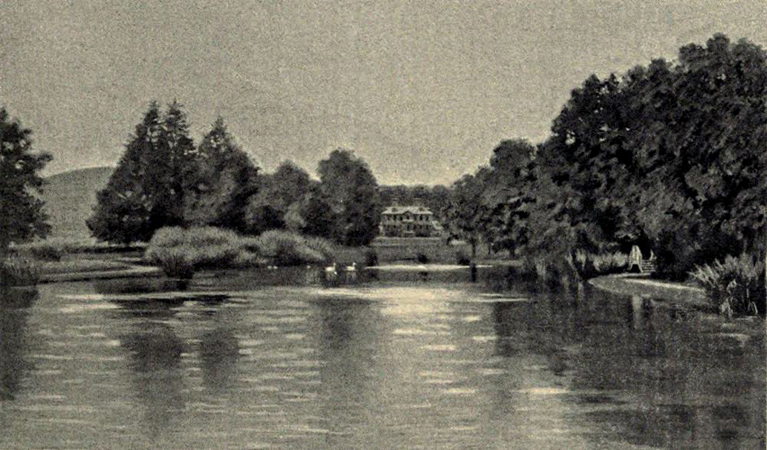
Home of Annie Laurie
Burial-place
In the now ruined church of Glencairn, hardly a mile from her birthplace, and not far from her later home, Annie Laurie worshipped, and in its yard, which has been a place of burial for a thousand years, she was laid with her husband, among the many generations of his kindred, by the gable-end of the ancient church. Her sepulchre was not marked, and it is to be feared the bones of the erst beauteous lady have been more than once disturbed in excavating for later interments in the crowded plot. From the summit of Craigdarrock we look upon the wilder beauty of the upper Nith, a region of moorland hills and dusky glens, where we may find the birthplace of "the Admirable Crichton," and beyond it the bleak domain where the poet Allan Ramsay first saw the light. Beyond this, again, the sweet Afton "flows amang its green braes," and we come to the Ayrshire shrines of Burns.
A few miles westward from Craigdarrock, and not so far from Carlyle's lonely den, is Fingland farm, the birthplace and home of Annie's poet-lover. It lies among sterile hills in the wild Glenkens of ancient Galloway, near the source of Ken water. From neighboring elevations we see Craigenputtock and the swelling Solway, and westward we look, across the dark fens and heathery hills of the region "blest with the smell of bog-myrtle and peat," almost to the Irish Sea. In this region Crockett was reared, and he pictures it in his charming tales "The Raiders" and "The Lilac Sunbonnet."
No trace of the peel-tower in which Douglas dwelt remains, but we know that it stood within an enclosing wall twenty yards square and one yard in thickness. The tower had projecting battlements; its apartments, placed above each other, were reached by a narrow, easily defended stair. In such a home and amid this most dismal environment Douglas grew to manhood, his poetic power unsuspected until it was called forth by the love and beauty of Annie Laurie. Later he wrote many poems, but diligent inquiry among the families of Buccleuch and Queensberry shows that few of his productions are now extant save the famous love-song. It is notable that he did not "lay doun his head and die" for the faithless Annie; instead, he made a runaway marriage with Elizabeth Clerk, of Glenborg, in his native Galloway, subsided into prosy country life, and reared a family of six children, of whom one, Archibald, rose to the rank of lieutenant-general in Brittany.
Annie Laurie—The Singer and the Song
Douglas's song was revised by Lady Scott, sister of the late Duke of Buccleuch, and published by her for the benefit of the widows and orphans made by the Crimean War. Lines of the original, for which the writer is indebted to a descendant of Annie Laurie, are hereto appended, that the reader may appreciate how much of the tender beauty of the popular version of the song is attributable to the poetic talent of Lady Scott.
"Maxwelton banks are bonnie, Where early fa's the dew, Where me and Annie Laurie Made up the promise true: Made up the promise true, And ne'er forget will I: And for bonnie Annie Laurie I'd lay doun my head and die. "She's backit like a peacock; She's breastit like a swan; She's jimp about the middle; Her waist ye weel may span: Her waist ye weel may span,— She has a rolling eye; And for bonnie Annie Laurie I'd lay doun my head and die."
A NIECE OF ROBERT BURNS
Her Burnsland Cottage—Reminiscences of Burns—Relics—Portraits—Letters—Recitations—Account of his Death—Memories of his Home—Of Bonnie Jean—Other Heroines.
IN the course of a summer ramble in Burnsland we had sought out the homes, the haunts, the tomb of the ploughman poet, and had bent at many a shrine hallowed by his memory or his song. From the cottage of "Bonnie Jean" and the tomb of "Holy Willie," the field of the "Mountain Daisy" and the church of the "Holy Fair," the birthplace of "Highland Mary" and the grave of "Mary Morison," we came to the shrines of auld Ayr, beside the sea. Here we find the "Twa Brigs" of his poem; the graves of the ministers satirized in "The Kirk's Alarm;" the old inn of "Tam O'Shanter," and the very room, with its ingle, where Tam and Souter Johnny "got fou thegither," and where we may sip the nappy from the wooden caup which Tam often drained. From Ayr a delightful stroll along the highway where Tam made his memorable ride, and where William Burns carried the howdie upon the pillion behind him on another stormy winter's night when the poet was born, brought us to the hamlet of Alloway and the place of Burns's early life. Here are the auld clay biggin, with its rude stone floor and roof of thatch, erected by the unskilled hands of his father, where the poet first saw the light, and where he laid the scene of the immortal "Cotter's Saturday Night;" the fields where his young hands toiled to aid his burdened sire; the kirk-yard where his kindred lie buried, some of their epitaphs written by him; the "auld haunted kirk,"—where Tam interrupted the witches' dance,—unknown save for the genius of the lad born by its roofless walls; the Burns monument, with its priceless relics; the ivy-grown bridge, four centuries old, whose arch spans the songful stream and across which Tam galloped in such sore peril, and its "key-stane," where Meg lost "her ain gray tail" to Nannie, fleetest of the pursuers; the enchanting "banks and braes of bonnie Doon," where Burns wandered a brown-eyed boy, and later found the inspiration of many of his exquisite strains. We have known few scenes more lovely than this in which his young life was passed: long and delightful is our lingering here, for interwoven with the many natural beauties are winsome memories of the bard whose spirit and genius pervade all the scene.
Miss Burns BeggReturning thence past the "thorn aboon the well" (the well is closed now) and the "meikle-stane" to the ancient ford "where in the snaw the chapman smoor'd," we made a détour southward, and came by a pleasant way—having in view on the right the picturesque ruin of Greenan Castle upon a cliff overhanging the sea—to Bridgeside cottage,Bridgeside Cot the home of Miss Isabella Burns Begg, niece of the poet and long his only surviving near relative. We found a cottage of stone, from whose thatched roof a dormer-window, brilliant with flowers, peeped out through the foliage which half concealed the tiny homelet. The trimmest of little maids admitted us at the gate and led along a path bordered with flowers to the cottage door, where stood Miss Begg beaming a welcome upon the pilgrims from America. We were ushered into a prettily furnished little room, upon whose walls hung a portrait of Burns, one of his sister Mrs. Begg, and some framed autograph letters of the bard, which the niece "knew by heart." She was the daughter and namesake of Burns's youngest and favorite sister, who married John Begg. We found her a singularly active and vivacious old lady, cheery and intelligent, and more than pleased to have secured appreciative auditors for her reminiscences of her gifted uncle. She was of slender habit, had a bright and winning face, soft gray hair partially concealed by a cap, and when she was seated beneath the Burns portrait we could see that her large dark eyes—now sparkling with merriment or misty with emotion, and again literally glowing with feeling—were like those on the canvas. Among the treasures of this room was a worn copy of Thomson's "Seasons," a favorite book of Burns, which he had freely annotated; his name in it is written "Burnes," as the family spelled it down to the publication of the bard's first volume. In the course of a long and pleasant chat we learned that Miss Begg had lived many years in the cottage, first with her mother and later with her sister Agnes,—named for Burns's mother,—who died before our visit and was laid beside her parents and the father of Burns in the kirk-yard of auld Alloway, where Miss Begg expected "soom day, please God an it be soon," to go to await the resurrection, thinking it an "ill hap" that she survived her sister. She innocently inquired if we "kenned her nephew Robert in America," and then explained that he and a niece of hers had formerly lived with her, but she had discovered that "they were sweetheartin' and wantin' to marry, which she wouldna allow, so they went to America," leaving her alone with her handmaiden. Most of her visitors had been Americans. She remembered the visits of Hawthorne, Grant, Stanley, and Helen Hunt Jackson,—the last with greatest pleasure,—and thought that "Americans care most about Burns." She mentioned the visit of a Virginian maid, who by rapturous praise of the uncle completely won the heart of the niece. The fair enthusiast had most of Burns's poems at her tongue's end, but insisted upon having them repeated by Miss Begg, and at parting exclaimed, after much kissing, "Oh, but I always pray God that when he takes me to heaven he will give me the place next to Burns." Apparently, Robin still has power to disturb the peace of "the lasses O." Yet we can well excuse the effusiveness of our compatriot: to have listened to the old lady as she sat under his portrait, her eyes twinkling or softening like his own, her voice thrilling with sympathetic feeling as she repeatedRecitations in his own sweet dialect the tender stanzas, "But pleasures are like poppies spread," "My Mary! dear departed shade!" and "Oh, happy love, when love like this is found," and others of like pathos and beauty, is a rapture not to be forgotten. She spoke quickly, and the Scottish accent kept one's ears on the alert, but it rendered the lines doubly effective and melodious. Many of the poems were inspired by special events of which Miss Begg had knowledge from her mother, which she recalled with evident relish. She distinctly remembered the bard's widow, "Bonnie Jean,"Bonnie Jean and often visited her in the poor home where he died. Jean had a sunny temper, a kind heart, a handsome figure, a fine voice, and lustrous eyes, but her brunette face was never bonnie. While she lacked intellectual appreciation of his genius, she was proud of and idolized him, finding ready excuse and forgiveness for his failings. When the frail "Anna with the Gowden Locks" bore him an illegitimate child, Jean cradled it with her own, and loyally averred to all visitors, "It's only a neebor's bairn I'm bringin' up." ("Ay, she must 'a' lo'ed him," was Miss Begg's comment on this part of her narrative.) Jean had told that in his last years the poet habitually wore a blue coat, with nankeen trousers (when the weather would allow), and his coat-collar was so high that his hat turned up at the back. Her account of the manner of his death is startling, and differs from that given by the biographers. He lay apparently asleep when "sweet Jessy"—to whom his last poem was written—approached, and, to remind him of his medicine, touched the cup to his lips; he started, drained the cup, then sprang headlong to the foot of the bed, threw his hands forward like one about to swim, and, falling on his face, expired with a groan. Jean saw him for the last time on the evening before his funeral, when his wasted body lay in a cheap coffin covered with flowers, his care-worn face framed by the wavy masses of his sable hair, then sprinkled with gray. At his death he left MSS. in the garret of his abode, which were scattered and lost because Jean was unable to take care of them,—a loss which must ever be deplored.
Reminiscences
One of the delights of Miss Begg's girlhood was the converse of Burns's mother concerning her first-born and favorite child, the poet, a theme of which she never tired. Miss Begg remembered her as a "chirk" old lady with snapping black eyes and an abundant stock of legends and ballads. She used to declare that Bobbie had often heard her sing "Auld Lang Syne" in his boyhood; hence it would appear that, at most, he only revised that precious old song. Miss Begg more than once heard the mother tell, with manifest gusto, this incident of their residence at Lochlea. Robert was already inclined to be wild, and between visiting his sweetheart Ellison Begbie—"the lass of the twa sparkling, roguish een"—and attending the Tarbolton club and Masonic lodge was abroad until an unseemly hour every night, and his mother or Isabella sat up to let him in. His anxious sire, the priest-like father of the "Cotter's Saturday Night," determined to administer an effectual rebuke to the son's misconduct,Burns' Youth and one night startled the mother by announcing significantly that he would wait to admit the lad. She lay for hours (Robert was later than ever that night), dreading the encounter between the two, till she heard the boy whistling "Tibbie Fowler" as he approached. Then the door opened: the father grimly demanded what had kept him so late; the son, for reply, gave a comical description of his meeting auld Hornie on the way home,—an adventure narrated in the "Address to the De'il,"—and next the mother heard the pair seat themselves by the fire, where for two hours the father roared with laughter at Robert's ludicrous account of the evening's doings at the club,—she, meanwhile, nearly choking with her efforts to restrain the laughter which might remind her husband of his intended reproof. Thereafter the lad stayed out as late as he pleased without rebuke. The niece had been told by her mother that Burns was deeply distressed at his father's death-bed by the old man's fears for the future of his wayward son; and when his father's death made Robert the head of the family, he every morning led the household in "the most beautiful prayers ever heard;" later, at Ellisland and elsewhere, he continued this practice, and on the Sabbath instructed them in the Catechism and Confession. Mrs. Begg's most pleasing recollections of her brother were associated with the farm-life at Mossgiel, where he so far gave her his confidence that she was allowed to see his poems in the course of their composition. He would ponder his stanzas during his labors afield, and when he came to the house for a meal he would go to the little garret where he and his brother Gilbert slept and hastily pen them upon a table which stood under the one little window. Here Isabella would find them, and, after repeated perusals, would arrange them in the drawer; and so it passed that her bright eyes were the first, besides his own, to see "The Twa Dogs," "Winter's Night," "The Bard's Epitaph," "The Cotter's Saturday Night," the satirical poems, and most of the productions which were published in his Kilmarnock volume. His sister testified that he was always affectionate to the family, and that after his removal to a home of his own he invariably brought a present for each when he revisited the farm, the present for his mother being always, despite his poverty, a costly pound of tea. Most of the receipts from his publishers were given to the family at Mossgiel.Mossgiel Miss Begg intimated that Burns's mother did not at first like his wife, because of the circumstances of the marriage, but Jean's stanch devotion to her husband won the heart of the doting mother, and they became warm friends and spent much time together after Burns's death. The niece believed that the accounts of his intemperance are mostly untrue. Her mother, who was twenty-five years old at the time of his decease, always asserted that she "never saw him fou," and believed it was his antagonism to the "unco' guid" that made them ready to believe and circulate any idle report to his discredit.
Mrs. Begg saw and liked "Highland Mary" at the house of Gavin Hamilton, and knew Miss Dunlop, the blooming Keith of Burns's "New-Year Day." Another of his heroines the niece had herself visited with her mother; this was Mrs. Jessy Thompson, née Lewars, who was a ministering angel in his final illness, and was repaid by the only thing he could bestow,—a song of exquisite sweetness, "Here's a health to ane I lo'e dear." Our informant had seen in that lady's hands the lines beginning "Thine be the volumes, Jessy fair," which the poet gave her with a present of books within a month of his death. Many other reminiscencesRecollections related by the niece are to be found in the biographies of the bard, and need not be repeated. The letters which hung upon her walls are not included in any published collection. She assisted us in copying the following to Burns's youngest brother:
A Letter of Burns
"Isle, Tuesday Evening.
"Dear William,—In my last I recommended that valuable apothegm, Learn taciturnity. It is certain that nobody can know our thoughts, and yet, from a slight observation of mankind, one would not think so. What mischiefs daily arise from silly garrulity and foolish confidence! There is an excellent Scots saying that a man's mind is his kingdom. It is certainly so, but how few can govern that kingdom with propriety! The serious mischiefs in Business which this Flux of language occasions do not come immediately to your situation, but in another point of view—the dignity of man—now is the time that will make or mar. Yours is the time of life for laying in habits. You cannot avoid it, tho' you will choose, and these habits will stick to your last end. At after-periods, even at so little advance as my years, 'tis true that one may still be very sharp-sighted to one's habitual failings and weaknesses, but to eradicate them, or even to amend them, is quite a different matter. Acquired at first by accident, they by-and-by begin to be, as it were, a necessary part of our existence. I have not time for more. Whatever you read, whatever you hear of that strange creature man, look into the living world about you, look to yourself, for the evidences of the fact or the application of the doctrine. I am ever yours,
"Robert Burns.
"Mr. William Burns, Saddler, Longtown."
The sentiment and style of this epistle are suggestive of the stilted conversations of Burns, recorded in Hugh Miller's "Recollections." Miss Begg was pleased by some account we could give her of American Burns monuments and festivals; she seemed reluctant to have us leave, called to us a cheery "God keep ye!" when we were without the gate, and stood looking after us until the intervening foliage hid her from our sight. As we walked Ayr-ward, while the sun was setting in a golden haze behind the hills of Arran, we felt that we had been very near to Burns that day,—had almost felt the thrill of his presence, the charm of his voice, and had in some measure made a personal acquaintance with him which would evermore move us to a tenderer regard for the man and a truer appreciation of his verse, as well as a fuller charity for his faults:
We know in part what he has done, God knows what he resisted.
For some months after our visit to Bridgeside, quaint letters—one of them containing a portrait of the worthy occupant of the cottage—followed us thence across the sea. These came at increasing intervals and then stopped; the kindly heart of the nieceDeath of Burns's Niece of Burns had ceased to beat on her eightieth birthday.
A recent pilgrim in Burnsland found an added line on the gravestone in the old kirk-yard, to tell that Isabella Burns Begg rests there in eternal peace. At Bridgeside, her once cherished garden is a waste and her tiny cottage has wholly disappeared. "So do things pass away like a tale that is told."
HIGHLAND MARY: HER HOMES AND GRAVE
Birthplace—Personal Appearance—Relations to Burns—Abodes: Mauchline, Coilsfield etc.—Scenes of Courtship and Parting—Mementos—Tomb by the Clyde.
THERE is no stronger proof of the transcending power of the genius of Burns than is found in the fact that, by a bare half dozen of his stanzas, an humble dairy servant—else unheard of outside her parish and forgotten at her death—is immortalized as a peeress of Petrarch's Laura and Dante's Beatrice, and has been for a century loved and mourned of all the world. We owe much of our tenderest poesy to the heroines whose charms have attuned the fancy and aroused the impassioned muse of enamoured bards; readers have always exhibited a natural avidity to realize the personality of the beings who inspired the tender lays,—prompted often by mere curiosity, but more often by a desire to appreciate the tastes and motives of the poets themselves. How little is known of Highland Mary, the most famous heroine of modern song, is shown by the brief, incoherent, and often contradictory allusions to her which the biographies of the ploughman-poet contain. This paper,—prepared during a sojourn in "The Land o' Burns,"—while it adds a little to our meagre knowledge of Mary Campbell, aims to present consecutively and congruously so much as may now be known of her brief life, her relations to the bard, and her sad, heroic death.
Birthplace—Early Home
She first saw the light in 1764, at Ardrossan, on the coast, fifteen miles northward from the "auld town of Ayr." Her parentage was of the humblest, her father being a sailor before the mast, and the poor dwelling which sheltered her was in no way superior to the meanest of those we find to-day on the narrow streets of her village. From her birthplace we see, across the Firth of Clyde, the beetling mountains of the Highlands, where she afterward dwelt, and southward the great mass of Ailsa Craig looming, a gigantic pyramid, out of the sea. Mary was named for her aunt, wife of Peter McPherson, a ship-carpenter of Greenock, in whose house Mary died. In her infancy her family removed to the vicinage of Dunoon, on the western shore of the Firth, eight miles below Greenock, leaving the oldest daughter at Ardrossan. Mary grew to young womanhood near Dunoon, then returned to Ayrshire, and found occupation at Coilsfield, near Tarbolton, where her acquaintance with Burns soon began. He told a lady that he first saw Mary while walking in the woods of Coilsfield, and first spoke with her at a rustic merry-making, and, "having the luck to win her regards from other suitors," they speedily became intimate. At this period of life Burns's "eternal propensity to fall into love" was unusually active, even for him, and his passion for Mary (at this time) was one of several which engaged his heart in the interval between the reign of Ellison Begbie—"the lass of the twa sparkling, roguish een"—and that of "Bonnie Jean." Mary subsequently became a servant in the house of Burns's landlord, Gavin Hamilton, a lawyer of Mauchline, who had early recognized the genius of the bard and admitted him to an intimate friendship, despite his inferior condition. When Hamilton was persecuted by the kirk, Burns, partly out of sympathy with him, wrote the satires, "Holy Willie's Prayer," "The Twa Herds," and "The Holy Fair," which served to unite the friends more closely, and brought the poet often to the house where Mary was an inmate. This house—a sombre structure of stone, little more pretentious than its neighbors—we found on the shabby street not far from Armour's cottage, the church of "The Holy Fair," and "Posie Nansie's" inn, where the "Jolly Beggars" used to congregate. Among the dingy rooms shown us in Hamilton's house was that in which he married Burns to "Bonnie Jean" Armour.
Personal Appearance
The bard's niece, Miss Begg, of Bridgeside, told the writer that she often heard Burns's mother describe Mary as she saw her at Hamilton's: she had a bonnie face, a complexion of unusual fairness, soft blue eyes, a profusion of shining hair which fell to her knees, a petite figure which made her seem younger than her twenty summers, a bright smile, and pleasing manners, which won the old lady's heart. This description is, in superlative phrase, corroborated by Lindsay in Hugh Miller's "Recollections:" she was "beautiful, sylph-like," her bust and neck were "exquisitely moulded," her arms and feet "had a statue-like symmetry and marble-like whiteness;" but it was in her lovely countenance that "nature seemed to have exhausted her utmost skill,"—"the loveliest creature I have ever seen," etc. All who have written of her have noticed her beauty, her good sense, her modesty and self-respect. But these qualities were now insufficient to hold the roving fancy of Burns, whose "susceptibility to immediate impressions" (so called by Byron, who had the same failing) passes belief. His first ephemeral fancy for Mary took little hold upon his heart, and the best that can be said of it is that it was more innocent than the loves which came before and after it. Within a stone's-throw of Mary dwelt Jean Armour, and when the former returned to Coilsfield,Betrothal and Parting he promptly fell in love with Jean, and solaced himself with her more buxom and compliant charms. It was a year or so later, when his intercourse with Jean had burdened him with grief and shame, that the tender and romantic affection for Mary came into his life. She was yet at Coilsfield, and while he was in hiding—his heart tortured by the apparent perfidy of Jean and all the countryside condemning his misconduct—his intimacy with Mary was renewed; his quickened vision now discerned her endearing attributes, her trust and sympathy were precious in his distress, and awoke in him an affection such as he never felt for any other woman. During a few brief weeks the lovers spent their evenings and Sabbaths together, loitering amid the
"Banks and braes and streams around The castle of Montgomery,"
talking of the golden days that were to be theirs when present troubles were past; then came the parting which the world will never forget, and Mary relinquished her service and went to her parents at Campbeltown,—a port of Cantyre behind "Arran's mountain isle." Of this parting Burns says, in a letter to Thomson, "We met by appointment on the second Sunday of May, in a sequestered spot on the Ayr, where we spent the day in taking farewell before she should embark for the West Highlands to prepare for our projected change of life." Lovers of Burns linger over this final parting, and detail the impressive ceremonials with which the pair solemnized their betrothal: they stood on either side of a brook, they laved their hands in the water and scattered it in the air to symbolize the purity of their intentions; clasping hands above an open Bible, they swore to be true to each other forever, then exchanged Bibles, and parted never to meet more. It is not strange that when death had left him nothing of her but her poor little Bible, a tress of her golden hair, and a tender memory of her love, the recollection of this farewell remained in his soul forever. He has pictured it in the exquisite lines of "Highland Mary" and "To Mary in Heaven."
Mementos
In the monument at Alloway—between the "auld haunted kirk" and the bridge where Maggie lost her tail—we are shown a memento of the parting; it is the Bible which Burns gave to Mary and above which their vows were said. At Mary's death it passed to her sister, at Ardrossan, who bequeathed it to her son William Anderson; subsequently it was carried to America by one of the family, whence it has been recovered to be treasured here. It is a pocket edition in two volumes, to one of which is attached a lock of poor Mary's shining hair. Within the cover of the first volume the hand of Burns has written, "And ye shall not swear by my name falsely, I am the Lord;" within the second, "Thou shalt not forswear thyself, but shalt perform unto the Lord thine oaths." Upon a blank leaf of each volume is Burns's Masonic signet, with the signature, "Robert Burns, Mossgiel," written beneath. Mary's spinning-wheel is preserved in the adjoining cottage. A few of her bright hairs, severed in her fatal fever, are among the treasures of the writer and lie before him as he pens these lines.
Coilsfield
A visit to the scenes of the brief passion of the pair is a pleasing incident of our Burns-pilgrimage. Coilsfield House is somewhat changed since Mary dwelt beneath its roof,—a great rambling edifice of gray weather-worn stone with a row of white pillars aligned along its façade, its massive walls embowered in foliage and environed by the grand woods which Burns and Mary knew so well. It was then a seat of Colonel Hugh Montgomerie, a patron of Burns. The name Coilsfield is derived from Coila, the traditional appellation of the district. The grounds comprise a billowy expanse of wood and sward; great reaches of turf, dotted with trees already venerable when the lovers here had their tryst a hundred years ago, slope away from the mansion to the Faile and border its murmuring course to the Ayr. Here we trace with romantic interest the wanderings of the pair during the swift hours of that last day of parting love, their lingering way 'neath the "wild wood's thickening green," by the pebbled shore of Ayr to the brooklet where their vows were made, and thence along the Faile to the woodland shades of Coilsfield, where, at the close of that winged day,Plans of the Lovers "pledging oft to meet again, they tore themselves asunder." Howitt found at Coilsfield a thorn-tree, called by all the country "Highland Mary's thorn," and believed to be the place of final parting; years ago the tree was notched and broken by souvenir seekers; if it be still in existence the present occupant of Coilsfield is unaware.
Burns's Regard for Mary
At the time of his parting with Mary, Burns had already resolved to emigrate to Jamaica, and it has been supposed, from his own statements and those of his biographers, that the pair planned to emigrate together; but Burns soon abandoned this project and, perhaps, all thought of marrying Mary. The song commencing "Will ye go to the Indies, my Mary?" has been quoted to show he expected her to accompany him, but he says, in an epistle to Thomson, that this was his farewell to her, and in another song, written while preparing to embark, he declares that it is leaving Mary that makes him wish to tarry. Further, we find that with the first nine pounds received from the sale of his poems he purchased a single passage to Jamaica,—manifestly having no intention of taking her with him. Her being at Greenock in October, en route to a new place of service at Glasgow, indicates she had no hope that he would marry her then, or soon. True, he afterward said she came to Greenock to meet him, but it is certain that he knew nothing of her being there until after her death. During the summer of 1786, while she was preparing to wed him, he indited two love-songs to her, but they are not more glowing than those of the same time to several inamoratas,—less impassioned than the "Farewell to Eliza" and allusions to Jean in "Farewell, old Scotia's bleak domains,"—and barely four weeks after his ardent and solemn parting with Mary we find him writing to Brice, "I do still love Jean to distraction." Poor Mary! Possibly the fever mercifully saved her from dying of a broken heart. The bard's anomalous affectional condition and conduct may perhaps be explained by assuming that he loved Mary with a refined and spiritual passion so different from his love for others—and especially from his conjugal love for Jean—that the passions could coexist in his heart. The alternative explanation is that his love for Mary, while she lived, was by no means the absorbing passion which he afterward believed it toc have been. When death had hallowed his memories of her love and of all their sweet intercourse,—beneficent death! that beautifies, ennobles, irradiates, in the remembrance of survivors, the loved ones its touch has taken,—then his soul, swelling with the passion that throbs in the strains of "To Mary in Heaven," would not own to itself that its love had ever been less.
Mary remained at Campbeltown during the summer of 1786. Coming to Greenock in the autumn, she found her brother sick of a malignant fever at the house of her aunt; bravely disregarding danger of contagion, she devoted herself to nursing him, and brought him to a safe convalescence only to be herself stricken by his malady and to rapidly sink and die,Her Death a sacrifice to her sisterly affection. By this time the success of his poems had determined Burns to remain in Scotland, and he returned to Mossgiel, where tidings of Mary's death reached him. His brother relates that when the letter was handed to him he went to the window to read it, then his face was observed to change suddenly, and he quickly went out without speaking. In June of the next year he made a solitary journey to the Highlands, apparently drawn by memory of Mary. If, indeed, he dropped a tear upon her neglected grave and visited her humble Highland home, we may almost forgive him the excesses of that tour, if not the renewed liaison with Jean which immediately preceded, and the amorous correspondence with "Clarinda" (Mrs. M'Lehose) which followed it.
Whatever the quality or degree of his passion for Mary living, his grief for her dead was deep and tender, and expired only with his life. Cherished in his heart, it manifested itself now in some passage of a letter, now in some pathetic burst of song,—like "The Lament" and "Highland Mary,"—and again in some emotional act. Of many such acts narrated to the writer by Burns's niece, the following is, perhaps, most striking. The poet attended the wedding of Kirstie Kirkpatrick, a favorite of his, who often sang his songs for him, and, after the wedded pair had retired, a lass of the company, being asked to sing, began "Highland Mary." Its effect upon Burns "was painful to witness; he started to his feet, prayed her in God's name to forbear, then hastened to the door of the marriage-chamber and entreated the bride to come and quiet his mind with a verse or two of 'Bonnie Doon.'" The lines "To Mary in Heaven" and the pathetic incidents of their composition show most touchingly how he mourned his fair-haired lassie years after she ceased to be. It was at Ellisland, October 20, 1789, the anniversary of Mary's death, an occasion which brought afresh to his heart memories of the tender past. Jean has told us of his increasing silence and unrest as the day declined, of his aimless wandering by Nithside at nightfall, of his rapt abstraction as he lay pillowed by the sheaves of his stack-yard, gazing entranced at the "lingering star" above him till the immortal song was born.
Her Grave
Poor Mary is laid in the burial-plot of her uncle in the west kirk-yard of Greenock, near Crawford Street; our pilgrimage in Burnsland may fitly end at her grave. A pathway, beaten by the feet of many reverent visitors, leads us to the spot. It is so pathetically different from the scenes she loved in life,—the heather-clad slopes of her Highland home, the seclusion of the wooded braes where she loitered with her poet-lover. Scant foliage is about her; few birds sing above her here. She lies by the wall; narrow streets hem in the enclosure; the air is sullied by smoke from factories and from steamers passing within a stone's-throw on the busy Clyde; the clanging of many hammers and the discordant din of machinery and traffic invade the place and sound in our ears as we muse above the ashes of the gentle lassie.
For half a century her grave was unmarked and neglected; then, by subscription, a monument of marble, twelve feet in height, and of graceful proportions, was raised. It bears a sculptured medallion representing Burns and Mary, with clasped hands, plighting their troth. Beneath is the simple inscription, read oft by eyes dim with tears:
Erected Over the Grave of
Highland Mary
1842.
"My Mary, dear departed shade, Where is thy place of blissful rest?"
BRONTË SCENES IN BRUSSELS
School—Class-Rooms—Dormitory—Garden—Scenes and Events of Villette and The Professor—M. Paul—Madame Beck—Memories of the Brontës—Confessional—Grave of Jessy Yorke.
WE had "done" Brussels after the approved fashion,—had faithfully visited the churches, palaces, museums, theatres, galleries, monuments; had duly admired the windows and carvings of the grand cathedral, the tower and tapestry and frescos and façade of the Hôtel de Ville, the stately halls and the gilded dome of the Courts of Justice, and the consummate beauty of the Bourse; had diligently sought out the naïve boy-fountain, and had made the usual excursion to the field of Waterloo.
This delightful task being conscientiously discharged, we proposed to devote our last day in the Belgian capital to the accomplishment of one of the cherished projects of our lives,—the searching out of the localities associated with Charlotte Brontë's unhappy school-life here, which she has so graphically portrayed. For our purpose no guide was needful, for the topography and local coloring of "Villette" and "The Professor" are as vivid and unmistakable as in the best work of Dickens himself. Proceeding from St. Gudule to the Rue Royale, and a short distance along that thoroughfare, we reached the parkThe Park and a locality familiar to Miss Brontë's readers. Seated in this lovely pleasure-ground, the gift of the Empress Maria Theresa, with its cool shade all about us, we noted the long avenues and the paths winding amid trees and shrubbery, the dark foliage ineffectually veiling the gleaming statuary and the sheen of bright fountains, "the stone basin with its clear depth, the thick-planted trees which framed this tremulous and rippled mirror," the groups of happy people filling the seats in secluded nooks or loitering in the mazes and listening to the music; we noted all this, and felt that Miss Brontë had revealed it to us long ago. It was across this park that Lucy Snowe was piloted from the bureau of the diligence by the chivalrous Dr. John on the night when she, despoiled, helpless, and solitary, arrived in Brussels. She found the park deserted, the paths miry, the water dripping from the trees. "In the double gloom of tree and fog she could not see her guide, and could only follow his tread" in the darkness. We recalled another scene under these same trees, on a night when the gate-way was "spanned by a flaming arch of massed stars." The park was a "forest with sparks of purple and ruby and golden fire gemming the foliage," and Lucy, driven from her couch by mental torture, wandered unrecognized amid the gay throng at the midnight concert of the Festival of the Martyrs and looked upon her lover, her friends the Brettons, and the secret junta of her enemies, Madame Beck, Madame Walravens, and Père Silas. The sense of familiarity with the vicinage grew as we observed our surroundings. Facing us, at the extremity of the park, was the palace of the king, in the small square across the Rue Royale at our right was the statue of General Béliard, and we knew that just behind it we should find the Brontë school; for "The Professor," standing by the statue, had looked down a great staircase to the door-way of the school, and poor Lucy on that forlorn first night in "Villette," to avoid a pair of ruffians, had hastened down a flight of steps from the Rue Royale and had come, not to the inn she sought, but to the pensionnat of Madame Beck. From the statue we descended, by a series of stone stairs, into a narrow street, old-fashioned and clean, quiet and secluded in the very heart of the great city, and just opposite the foot of the steps we came to the wide door of a spacious, quadrangular, stuccoed old mansion, with a bit of foliage showing over a high wall at one side.Héger Mansion A bright plate embellished the door and bore the name Héger. A Latin inscription in the wall of the house showed it to have been given to the Guild of Royal Archers by the Infanta Isabelle early in the seventeenth century. Long before that the garden had been the orchard and herbary of a convent and the Hospital for the Poor.
We were detained at the door long enough to remember Lucy standing there, trembling and anxious, awaiting admission, and then we too were "let in by a bonne in a smart cap," apparently a fit successor to the Rosine of other days, and entered the corridor. This was paved with blocks of black and white marble and had painted walls. It extended through the entire depth of the house, and at its farther extremity an open door afforded us a glimpse of the garden. We were ushered into the little salon at the left of the passage, the one often mentioned in "Villette,"Characters of Villette and here we made known our wish to see the garden and class-rooms, and met with a prompt refusal from the neat portress. We tried diplomacy (also lucre) without avail: it was the grandes vacances, M. Héger was engaged, we could not be gratified,—unless, indeed, we were patrons of the school. At this juncture a portly, ruddy-faced lady of middle age and most courteous of speech and manner appeared, and, addressing us in faultless English, introduced herself as Mdlle. Héger, co-directress of the school, and "wholly at our service." In response to our apologies for the intrusion and explanations of the desire which had prompted it, we received complaisant assurances of welcome; yet the manner of our entertainer indicated that she did not share in our admiration and enthusiasm for Charlotte Brontë and her books. In the subsequent conversation it appeared that Mademoiselle and her family hold decided opinions upon the subject,—something more than mere lack of admiration. She was familiar with the novels, and thought that, while they exhibit a talent certainly not above mediocrity, they reflect the injustice, the untruthfulness, and the ingratitude of their creator. We were obliged to confess to ourselves that the family have reason for this view, when we reflected that in the books Miss Brontë has assailed their religion and disparaged the school and the characters of the teachers and pupils, has depicted Madame HégerThe Hégers in the odious duad of Madame Beck and Mdlle. Reuter, has represented M. Héger as the scheming and deceitful Pelet and the preposterous Paul, Lucy Snowe's lover; that this lover was the husband of Madame Héger, and father of the family of children to whom Lucy was at first bonne d'enfants, and that possibly the daughter she has described as the thieving, vicious Désirée—"that tadpole Désirée Beck"—was this very lady now so politely entertaining us. To all this add the significant fact that "Villette" is an autobiographical novel, which "records the most vivid passages in Miss Brontë's own sad heart's history," not a few of the incidents being transcripts "from the darkest chapter of her own life," and the light which the consideration of this fact throws upon her relations with members of the family will help us to apprehend the stand-point from which the Hégers judge Miss Brontë and her work, and to excuse a natural resentment against one who has presented them in a decidedly bad light. How bad we realized when, during the ensuing chat, we called to mind just what she had written of them. As Madame Beck, Madame Héger had been represented as lying, deceitful, and shameless, as "watching and spying everywhere, peeping through every key-hole, listening behind every door," as duplicating Lucy's keys and secretly searching her bureau, as meanly abstracting her letters and reading them to others, as immodestly laying herself out to entrap the man to whom she had given her love unsought. It was some accession to the existing animosity between herself and Madame Héger which precipitated Miss Brontë's departure from the pensionnat. Mrs. Gaskell ascribes their mutual dislike to Charlotte's free expression of her aversion to the Catholic Church, of which Madame Héger was a devotee, and hence "wounded in her most cherished opinions;" but a later writer plainly intimates that Miss Brontë hated the woman who sat for Madame Beck because marriage had given to her the man whom Miss Brontë loved, and that "Madame Beck had need to be a detective in her own house." The death of Madame Héger had rendered the family, who held her only as a sacred memory, more keenly sensitive than ever to anything which would seem by implication to disparage her.
For himself, it would appear that M. Héger had less cause for resentment; for, although in "Villette" his double is pictured as "a waspish little despot," as detestably ugly, in his anger closely resembling "a black and sallow tiger," as having an "overmastering love of authority and public display," as playing the spy and reading purloined letters, and in the Brontë epistles Charlotte declares he is choleric and irritable, compels her to make her French translations without a dictionary or grammar, and then has "his eyes almost plucked out of his head" by the occasional English word she is obliged to introduce, etc., yet all this is partially atoned for by the warm praise she subsequently accords him for his goodness to her and his disinterested friendship, by the poignant regret she expresses at parting with him,—perhaps wholly expiated by the high compliment she pays him of making her heroine fall in love with him, or the higher compliment it is suspected she paid him of falling in love with him herself. One who reads the strange history of passion in "Villette," in conjunction with her letters, "will know more of the truth of her stay in Brussels than if a dozen biographers had undertaken to tell the whole tale." Still, M. Héger can hardly be pleased by having members of his school set forth as stupid, animal, and inferior, "their principles rotten to the core, steeped in systematic sensuality," by having his religion styled "besotted papistry, a piece of childish humbug," and the like. Something of the displeasure of the family was revealed in the course of our conversation with Mdlle. Héger, but the specific causes were but cursorily touched upon. She could have no personal recollectionRecollections of the Brontës of the Brontës; her knowledge of them was derived from her parents and the teachers,—presumably the "repulsive old maids" of Charlotte's letters. One teacher whom we saw in the school had been a classmate of Charlotte's here. The Brontës had not been popular with the school. Their "heretical" religion had something to do with this; but their manifest avoidance of the other pupils during hours of recreation, Mademoiselle thought, had been a more potent cause,—Emily, in particular, not speaking with her school-mates or teachers, except when obliged to do so. The other pupils thought them of outlandish accent and manners, and ridiculously old to be at school at all,—being twenty-four and twenty-six, and seeming even older. Their sombre and ugly costumes were fruitful causes of mirth to the gay young Belgian misses. The Brontës were not brilliant students, and none of their companions had ever suspected that they were geniuses. Of the two, Emily was considered to be the more talented, but she was obstinate and opinionated. Some of the pupils had been inclined to resist having Charlotte placed over them as teacher, and may have been mutinous. After her return from Haworth she taught English to M. Héger and his brother-in-law. M. Héger gave the sisters private lessons in French without charge, and for some time preserved their compositions, which Mrs. Gaskell copied. Mrs. Gaskell visited the pensionnat in quest of material for her biography of Charlotte, and received all the aid M. Héger could afford: the information thus obtained was, we were told, fairly used. Miss Brontë's letters from Brussels, so freely quoted in Mrs. Gaskell's "Life," were addressed to Ellen Nussy, a familiar friend of Charlotte's, whose signature we saw in the register at Haworth as witness to Miss Brontë's marriage. The Hégers had no suspicion that she had been so unhappy with them as these letters indicate, and she had assigned a totally different reason for her sudden return to England. She had been introduced to Madame Héger by Mrs. Jenkins, wife of the then chaplain of the British Embassy at the Court of Belgium; she had frequently visited that lady and other friends in Brussels,—among them Mary and Martha Taylor and the family of a Dr. —— (not "Dr. John"),—and therefore her life here need not have been so lonely and desolate as it was made to appear.
The Garden
The Hégers usually have a few English pupils in the school, but have never had an American. American tourists have before called to look at the garden, but the family are not pleased by the notoriety with which Miss Brontë has invested it. However, Mdlle. Héger kindly offered to conduct us over any portion of the establishment we might care to see, and led the way along the corridor to the narrow, high-walled garden. We found it smaller than in the time when Miss Brontë loitered here in weariness and solitude. Mdlle. Héger explained that, while the width remained the same, the erection of class-rooms for the day-pupils had diminished the length by some yards. Tall houses surrounded and shut it in on either side, making it close and sombre, and the noises of the great city all about it penetrated only as a far-away murmur. There was a plat of verdant turf in the centre, bordered by scant flowers and gravelled walks, along which shrubs of evergreen were irregularly disposed. A few seats were here and there within the shade, where, as in Miss Brontë's time, the externats ate the lunch brought with them to the school; and overlooking it all stood the great pear-trees, whose gnarled and deformed trunks were relics of the time of the convent. Beyond these and along the gray wall which bounded the farther side of the enclosure was the sheltered walk which was Miss Brontë's favorite retreat, the "allée défendue" of her novels. It was screened by shrubs and perfumed by flowers, and, being secure from the intrusion of pupils, we could well believe that Charlotte and her heroine found here restful seclusion. The coolness and quiet and, more than all, the throng of vivid associations which filled the place tempted us to linger. The garden was not a spacious nor even a pretty one, and yet it seemed to us singularly pleasing and familiar, as if we were revisiting it after an absence. Seated upon a rustic bench close at hand, possibly the very one which Lucy had "reclaimed from fungi and mould," how the memories came surging up in our minds! How often in the summer twilight poor Charlotte had lingered here in solitude after the day's burdens and trials with "stupid and impertinent" pupils! How often, with weary feet and a dreary heart, she had paced this secluded walk and thought, with longing, of the dear ones in far-away Haworth parsonage! In this sheltered corner her other self, Lucy, sat and listened to the distant chimes and thought forbidden thoughts and cherished impossible hopes. Here she met and talked with Dr. John. Deep beneath this "Methuselah of a pear-tree," the one nearest the end of the alley, lies the imprisoned dust of the poor nun who was buried alive ages ago for some sin against her vow, and whose perambulating ghost so disquieted poor Lucy. At the root of this same tree one miserable night Lucy buried her precious letters, and meant also to bury a grief and her great affection for Dr. John. Here she leant her brow against Methuselah's knotty trunk and uttered to herself those brave words of renunciation, "Good-night, Dr. John; you are good, you are beautiful, but you are not mine. Good-night, and God bless you!" Here she held pleasant converse with M. Paul, and with him, spellbound, saw the ghost of the nun descend from the leafy shadows overhead and, sweeping close past their wondering faces, disappear behind yonder screen of shrubbery into the darkness of the summer night. By that tall tree next the class-rooms the ghost was wont to ascend to meet its material sweetheart, Fanshawe, in the great garret beneath yonder sky-light,—the garret where Lucy retired to read Dr. John's letter, and wherein M. Paul confined her to learn her part in the vaudeville for Madame Beck's fête-day. In this nook where we sat "The Professor" had walked and talked with and almost made love to Mdlle. Reuter, and from yonder window overlooking the alley had seen that perfidious fair one in dalliance with Pelet beneath these pear-trees. From that window M. Paul watched Lucy as she sat or walked in the allée défendue, dogged by Madame Beck; from the same window were thrown the love-letters which fell at Lucy's feet sitting here. Leaves from the overhanging boughs were plucked for us as souvenirs of the place; then, reverently traversing once more the narrow alley so often traced in weariness by Charlotte Brontë, we turned away.School From the garden we entered the long and spacious class-room of the first and second divisions. A movable partition divided it across the middle when the classes were in session; the floor was of bare boards cleanly scoured. There were long ranges of desks and benches upon either side, and a lane through the middle led up to a raised platform at the end of the room, where the instructor's chair and desk were placed.
How quickly our fancy peopled the place! On these front seats sat the gay and indocile Belgian girls. There, "in the last row, in the quietest corner, sat Emily and Charlotte side by side, insensible to anything about them;" and at the same desk, "in the farthest seat of the farthest row," sat Mdlle. Henri during Crimsworth's English lessons. Here Lucy's desk was rummaged by PaulM. Paul and the tell-tale odor of cigars left behind. Here, after school-hours, Miss Brontë taught Héger English, he taught her French, and Paul taught Lucy arithmetic and (incidentally) love. This was the scene of their tête-à-têtes, of his efforts to persuade her into his religious faith, of their ludicrous supper of biscuit and baked apples, and of his final violent outbreak with Madame Beck, when she literally thrust herself between him and his love. From this platform Crimsworth and Lucy and Charlotte Brontë herself had given instruction to pupils whose insubordination had first to be confronted and overcome. Here Paul and Héger gave lectures upon literature, and Paul delivered his spiteful tirade against the English on the morning of his fête-day. Upon this desk were heaped his bouquets that morning; from its smooth surface poor Lucy dislodged and fractured his spectacles; and here, seated in Paul's chair, at Paul's desk, we saw and were presented to Paul Emanuel himself,—M. Héger.
School Scenes
It was something more than curiosity which made us alert to note the appearance and manner of this man, who has been so nearly associated with Miss Brontë in an intercourse which colored her subsequent life and determined her life-work, who has been made the hero of her novels and has been deemed the hero of her own heart's romance; and yet we were curious to know what manner of man it was who has been so much as suspected of being honored with the love and preference of the dainty Charlotte Brontë. During a short conversation with him we had opportunity to observe that in person this "wise, good, and religious" man must, at the time Miss Brontë knew him, have more closely resembled Pelet of "The Professor" than any other of her pen-portraits: indeed, after the lapse of more than forty years that delineation still, for the most part, aptly applied to him. He was of middle size, of rather spare habit of body; his face was fair and the features pleasing and regular, the cheeks were thin and the mouth flexible, the eyes—somewhat sunken—were mild blue and of singularly pleasant expression. We found him aged and somewhat infirm; his finely-shaped head was fringed with white hair, and partial baldness contributed reverence to his presence and tended to enhance the intellectual effect of his wide brow. In repose his countenance showed a hint of melancholy: as Miss Brontë said, his "physiognomy was fine et spirituelle;" one would hardly imagine it could ever resemble the "visage of a black and sallow tiger." His voice was low and soft, his bow still "very polite, not theatrical, scarcely French," his manner suave and courteous, his dress scrupulously neat. He accosted us in the language Miss Brontë taught him forty years ago, and his accent and diction honored her instruction. He was talking with some patrons, and, as his daughter had hinted that he was averse to speaking of Miss Brontë, we soon took leave of him and were shown other parts of the school. The other class-rooms, used for less advanced pupils, were smaller. In one of them Miss Brontë had ruled as monitress after her return from Haworth. The large dormitory of the pensionnat was above the long class-room, and in the time of the Brontës most of the boarders—about twenty in number—slept here. Their cots were arranged along either side, and the position of those occupied by the Brontës was pointed out to us at the extreme end of the room. It was here that Lucy suffered the horrors of hypochondria, so graphically portrayed in "Villette," and found the discarded costume of the spectral nun lying upon her bed, and here Miss Brontë passed those nights of wakeful misery which Mrs. Gaskell describes. A long, narrow room in front of the class-rooms was shown us as the réfectoire, where the Brontës, with the other boarders, took their meals, presided over by M. and Madame Héger, and where, during the evenings, the lessons for the ensuing days were prepared. Here were held the evening prayers which Charlotte used to avoid by escaping into the garden. This, too, was the scene of Paul's readings to teachers and pupils, and of some of his spasms of petulance, which readers of "Villette" will remember. From the réfectoire we passed again into the corridor, where we made our adieus to our affable conductress. She explained that, whereas this establishment had been both a pensionnat and an externat, having about seventy day-pupils and twenty boarders when Miss Brontë was here, it was after the death of Madame Héger used as a day-school only,—the pensionnat being in another street.
The genuine local color Miss Brontë gives in "Villette" enabled us to be sure that we had found the sombre old church where Lucy, arrested in passing by the sound of the bells, knelt upon the stone pavement, passing thence into the confessional of Père Silas. Certain it is that this old church lies upon the route she would take in the walk from the school to the Protestant cemetery, which she had set out to do that afternoon, and the narrow streets which lie beyond the church correspond to those in which she was lost.The Confessional Certain, too, it is said to be that this incident is taken from her own experience. Reid says, "During one of the long holidays, when her mind was restless and disturbed, she found sympathy, if not peace, in the counsels of a priest in the confessional, who soothed her troubled spirit without attempting to enmesh it in the folds of Romanism."
The Cemetery
Our way to the Protestant cemetery—a spot sadly familiar to Miss Brontë, and the usual termination of her walks—lay past the site of the Porte de Louvain and out to the hills beyond the old city limits. From our path we saw more than one tree-shrouded farm-house which might have been the place of Paul's breakfast with his school, and at least one quaint mansion, with green-tufted and terraced lawns, which might have served Miss Brontë as the model for La Terrasse, the suburban home of the Brettons and the temporary abode of the Taylor sisters whom she visited here. From the cemetery we beheld vistas of farther lines of hills, of intervening valleys, of farms and villas, and of the great city lying below. Miss Brontë has well described this place: "Here, on pages of stone and of brass, are written names, dates, last tributes of pomp or love, in English, French, German, and Latin." There are stone crosses all about, and great thickets of roses and yews; "cypresses that stand straight and mute, and willows that hang low and still;" and there are "dim garlands of everlasting flowers." Here "The Professor" found his long-sought sweetheart kneeling at a new-made grave under the overhanging trees. And here we found the shrine of poor Charlotte Brontë's many pilgrimages hither,—the burial-place of her friend and school-mate, the Jessy Yorke of "Shirley;" the spot where, under "green sod and a gray marble head-stone, cold, coffined, solitary, Jessy sleeps below."
LEMAN'S SHRINES
Beloved of Littérateurs—Gibbon—D'Aubigné—Rousseau—Byron—Shelley—Dickens, etc.—Scenes of Childe Harold—Nouvelle Heloïse—Prisoner of Chillon—Land of Byron.
A PILGRIMAGE in the track of Childe Harold brings us from the shores of Albion, by Belgium's capital and deadly Waterloo, along the castled Rhine and over mountain-pass to "Italia, home and grave of empires," and to the sublimer scenery of "Manfred," "Chillon," and the third canto of the pilgrim-poet's masterpiece; to his "silver-sheeted Staubbach" and "arrowy Rhone," "soaring Jungfrau" and "bleak Mont Blanc." We linger with especial pleasure on the shores of "placid Leman," in an enchanting region which teems with literary shrines and is pervaded with memories and associations—often so thrilling and vivid that they seem like veritable and sensible presences—of the brilliant number who have here had their haunts.Haunts of Littérateurs Here Calvin wrought his Commentaries; here Voltaire polished his darts; here Rousseau laid the scenes of his impassioned tale; here Dickens, Byron, and Shelley loitered and wrote; here Gibbon and de Staël, Schlegel and Constant, and many another scarcely less famous, lived and wrought the treasures of their knowledge and fancy into the literature of the world. A lingering voyage round the lake, like that of Byron and Shelley, is a delight to be remembered through a lifetime, and affords opportunity to visit the spots consecrated by genius upon these shores. At Geneva we find the inn where Byron lodged and first met the author of "Queen Mab," the house in which Rousseau was born, the place where d'Aubigné wrote his history, the sometime home of John Calvin. Near by, in a house presented by the Genevese after his release from the long imprisonment suffered on their account, dwelt Bonnivard, Byron's immortal "Prisoner of Chillon," and here he suffered from his procession of wives and finally died. Just beyond the site of the fortifications, on the east side of the city, is an eminence whose slopes are tastefully laid out with walks that wind, amid sward and shrub, to the observatory which crowns the summit and marks the site of Bonnivard's Priory of St. Victor, lost to him by his devotion to Genevan independence. Not far away is the public library, founded by his bequest of his modest collection of books and MSS. which we see here carefully preserved. Here also is an old portrait of the prisoner, which represents him as a reckless and jolly "good fellow" rather than a saintly hero, and accords better with his character as described by late writers than with the common conception of him.
Byron at Villa Diodati
Byron loved this Leman lake, and it is said his discontented sprite still walks its margins; certain it is he remains its poetic genius; his melody seems to wake in every breeze that stirs its surface. The Villa Diodati, a plain, quadrangular, three-storied mansion of moderate dimensions, standing on the shore a few miles from Geneva, was the handsome "Giaour's" first home after his separation from Lady Byron and his exile from England. It had been the residence of the Genevan Professor Diodati and the sojourn of his friend the poet Milton. Pleasant vineyards surround the place and slope away to the water, but there is little in the spot or its near environment to commend it to the fancy of a poet. Byron's study here was a sombre room at the back from which neither the lake nor the snowy peaks were visible, and here he wrote, besides many minor poems, "Manfred," "Prometheus," "Darkness," "Dream," and the third canto of "Childe Harold." Here also he wrote "Marriage of Belphegor," a tale setting forth his version of his own infelicitous marriage; but hearing that his wife was seriously ill, he burned it in his study fire. From here, by instigation of de Stael, he sent to Lady Byron ineffectual overtures for a reconciliation. His companion at the villa was an eccentric Italian physician, Polidori, who was uncle to the poet Rossetti, and who here quarrelled with Byron's guests and wrote "The Vampire," a weird production afterward attributed to Byron. Lovers of Byron owe much to his sojourn on Leman; he found in the inspiring landscapes here, especially in the environment of mountains, a power that profoundly stirred what his wife called "the angel in him." His letters recognize an afflatus breathed upon him by the "majesty around and above," and the quality of the poems here produced shows his yielding and response to that benign influence; many a gem of poetic thought was here begotten of lake and mount and cataract, which otherwise had never been. The insincere stanzas of some of his later poems would scarcely have been written on Leman. As we muse in the spots he frequented—wandering on the entrancing margins or floating on the crystal waters—and look thence upon the snow-crowned peaks, resplendent in the sunshine or roseate in the after-glow, we aspire to not only partake of his rapture in this sublime beauty, but to appreciate the deeper feelings to which it moved him.
Shelley
A villa near Byron's, and reached by a path through his grounds,—Maison Chapuis, of Mont Allegra,—was occupied that summer by the "impassioned Ariel of English verse," with Mary Shelley and her brunette relative Jane Clermont (the Claire of Shelley's journal), who after bore to Byron a daughter called Alba by the Shelleys, but later named by Byron Allegra, for the place where he had known the mother. At Mont Allegra "Bridge of Arve," "Intellectual Beauty," and Mrs. Shelley's weird "Frankenstein" were penned. Here Byron was a daily visitant, and the Shelleys were the usual companions of his excursions upon the lake of beauty, in a picturesque lateen-rigged boat which was the property of the poets and the counterpart of which we see moored by the Diodati shore, looking like a bit of the Levant transported to this tramontane water. The "white phantom" observed by telescopists on the opposite shore to sometimes embark with Byron, and which he gravely told Madame de Staël was his dog, was doubtless the frail Claire. The admonitions of de Staël anent his mode of life provoked Byron to take sure revenge by being attentive to her husband, which the overshadowing wife always resented as an affront upon herself. It is said the poet's observation of this pair prompted the couplet of "Don Juan:"
"But oh! ye lords of ladies intellectual, Inform us truly, have they not henpecked you all?"
Passing for the present the shrines of Ferney and Coppet, we find in picturesque Lausanne the quaint house in which VoltaireVoltaire lived several winters, and not far away the place where Secretan died a few months ago. Gibbon's dwelling has been demolished, but we find the place of his summer-house where the great history was completed, and of his famous rose-tree where Byron gathered roses long ago. Madame de Genlis narrates this incident of the great "Decliner and Faller" at Lausanne: he was enamoured of the comely Madame Crousaz, and, finding her alone, he knelt at her feet and besought her love. He received an unfavorable reply, but remained in his humble posture until the lady, after repeatedly requesting him to arise, discovered that his weight made it impossible, and summoned a servant to assist him to regain his feet. His obesity seems to have been a standing jest among his acquaintances: a sufferer from indigestion, due to lack of exercise, was advised by a witty friend to "walk twice around GibbonGibbon before breakfast." Several decades later another illustrious English man of letters sojourned in Lausanne. A pretty cottage-villa, with embowered walls and flower-shaded porticos which look from a mild eminence across the crescentic lake, was, in 1846, the dwelling of Dickens,Dickens who here wrote one of the matchless Christmas stories and a part of "Dombey and Son." From the magnificent slope of Lausanne the whole lake region is visible, with the dark Juras rising to the western horizon, the Alps of Savoy, and "the monarch of mountains with a diadem of snow" upholding the sky away in the south. At the foot of this slope is the port-town of Ouchy, a resort of Byron's in his sailing excursions; at the plain little Anchor inn near the quai (Byron called it a "wretched inn") he lodged, and here, being detained two days (June 26 and 27, 1816) by a storm which overtook him on his return from Chillon and Clarens, he wrote the touching "Prisoner of Chillon." In a parsonage not far from Lausanne was reared sweet Suzanne Curchod, erst fiancée of Gibbon, and later the mother of de Staël.
Eastward is "Clarens, birthplace of deep love," whose "air is the breath of passionate thought, whose trees take root in love;" about it lies the charming region which RousseauRousseau chose for his fiction and peopled with affections, and where Byron, Houghton, and Shelley loved to linger. Here the latter first read "Nouvelle Héloïse" amid the settings of its scenes; here Byron wrote many glowing lines, inspired by the beauty and romantic associations around him. From the vine-clad terraces which cling to the heights we behold the view which enraptured the poet,—a broad expanse of lacustrine beauty and Alpine sublimity, embracing the Leman shores from the Rhone to the Juras of Gex, the entire width of the "bleu impossible" lake and Alp piled on Alp beyond. Back of Clarens we find the spot of Rousseau's "Bosquet de Julie," and, at a little distance among embowering trees, the birthplace of a woman stranger than any fancied character of his fiction, the Madame de Warens of his "Confessions."
Prison of Chillon
Between Clarens and Villeneuve, on an isolated rock whose base is laved by Leman's waters, which "meet and flow a thousand feet in depth below," stands the grim prison of Chillon, the scene of Byron's poem. The fortress is an irregular pile of masonry, and, with its massive walls, loop-holed towers, and white battlements, is a picturesque object seen across wide reaches of the lake. The present structure is a hoary successor to a stronghold still more ancient: the prehistoric lake-dwellers here had a fortress and were succeeded by the Franks and Romans. Of the present structure, the Romanesque columns and the range of dungeons are known to have been in existence in 830, when Count Wala, a cousin of Charlemagne, for alluding to the wife of Louis the Debonair as "that adulterous woman," was incarcerated here. Thus Judith's reputation was vindicated and the earliest certain date of this fortress fixed. The present superstructure remains unchanged since the thirteenth century. It is now connected with the shore by a wooden structure which spans the moat and replaces the ancient drawbridge. Through a massive gate-way we enter a roughly-paved court, whence a bluff Savoyard conducts us through the romantic pile. Among the apartments of the ducal family we see the banqueting-hall where the dukes held roistering wassail; the kitchen on whose great hearth oxen were roasted whole; the Chamber of Inquisition where hapless prisoners were tortured to extort confession, this room being near the chamber of the duchess, into which—despite its thick wall—the shrieks of the tortured must have sometimes penetrated and disturbed Her Serene Highness. Outside her door is a post to which the wretches were bound, and it is scored by marks of the irons which cauterized their flesh; in a near corner stood a rack which rent them limb from limb. The crypt beneath, with its low arched vaults and its graceful pillars rising out of the rock, is the most interesting portion of the fortress. Referring to their architectural perfection, Longfellow once said these were the "most delightful dungeons he ever saw," but as we stand in their twilight gloom the horrors of their history weigh heavily on the heart. During this century the castle has been used as an arsenal, but occasionally also as a prison, and Byron found some of these "chambers of sorrow" tenanted at the time of his visits. One contracted cell is that in which the condemned passed their last night of life chained upon a rock, near the beam upon which they were strangled and the opening through which their bodies were thrust into the lake. Another vault contains a pit or well, with a spiral stair down which poor dupes stepped into a yawning depth and—eternity. A third chamber, so dark that its grotesque carvings are scarcely discernible and no missal could be read by daylight, was the chapel of the fortress. Traversing the succession of dungeons, we come to the last and largest, and reverently stand beside the column where Byron's prisoner was chained. This "dungeon deep and old" lies not beneath the level of the lake, as Byron believed, yet it is sufficiently dank and dismal to be the appropriate scene of the touching and tragic story which he located here. It is a long, crypt-like apartment, whose vaulted roof of rock is upheld by the "seven pillars of Gothic mould" aligned along the middle. It is dimly lighted by loop-holes pierced in the ponderous walls for the feudal bowmen; through these narrow apertures, where the prisoner "felt the winter's spray wash through the bars when winds were high," we look out, as did he, upon the distant town, "the lake with its white sails," the "mountains high," and the little Isle de Paix—"scarce broader than the dungeon floor"—gleaming like an emerald from a setting of amethyst. Here is Bonnivard's chain, scarce four feet long, and in the central pillar the ring which held it. The light, falling aslant "through the cleft of the thick wall" upon the floor, shows us the pathway worn in the rock by the pacing of the prisoner during the weary years, and reveals—graven on the column-stone by the poet's hand—the name Byron.