Chapter V · (continued 2)
Reading edition
"Two ways I love Thee: selfishly, And next, as worthy is of Thee. 'Tis selfish love that I do naught Save think on Thee with every thought; 'Tis purest love when Thou dost raise The veil to my adoring gaze. Not mine the praise in that or this, Thine is the praise in both, I wis."448
Whether genuine or not, these lines, with their mixture of devotion and speculation—the author distinguishes the illuminative from the contemplative life and manifestly regards the latter as the more excellent way—serve to mark the end of the ascetic school of Ṣúfiism and the rise of a new theosophy which, under the same name and still professing to be in full accord with the Koran and the Sunna, was founded to some extent upon ideas of extraneous origin—ideas irreconcilable with any revealed religion, and directly opposed to the severe and majestic simplicity of the Muḥammadan articles of faith.
The opening century of Islam was not favourable to literature. At first conquest, expansion, and organisation, then Umayyad literature. civil strife absorbed the nation's energies; then, under the Umayyads, the old pagan spirit asserted itself once more. Consequently the literature of this period consists almost exclusively of poetry, which bears few marks of Islamic influence. I need scarcely refer to the view which long prevailed in Europe that Muḥammad corrupted the taste of his countrymen by setting up the Koran as an incomparable model of poetic style, and by condemning the admired productions of the heathen bards and the art of poetry itself; nor remind my readers that in the first place the Koran is not poetical in form (so that it could not serve as a model of this The decline of Arabian poetry not due to Muḥammad. kind), and secondly, according to Muḥammadan belief, is the actual Word of God, therefore sui generis and beyond imitation. Again, the poets whom the Prophet condemned were his most dangerous opponents: he hated them not as poets but as propagators and defenders of false ideals, and because they ridiculed his teaching, while on the contrary he honoured and rewarded those who employed their talents in the right way. If the nomad minstrels and cavaliers who lived, as they sang, the free life of the desert were never equalled by the brilliant laureates of imperial Damascus and Baghdád, the causes of the decline cannot be traced to Muḥammad's personal attitude, but are due to various circumstances for which he is only responsible in so far as he founded a religious and political system that revolutionised Arabian society. The poets of the period with which we are now dealing follow slavishly in the footsteps of the ancients, as though Islam had never been. Instead of celebrating the splendid victories and heroic deeds of Moslem warriors, the bard living in a great city still weeps over the relics of his beloved's encampment in the wilderness, still rides away through The Umayyad poets. the sandy waste on the peerless camel, whose fine points he particularly describes; and if he should happen to be addressing the Caliph, it is ten to one that he will credit that august personage with all the virtues of a Bedouin Shaykh. "Fortunately the imitation of the antique qaṣída, at any rate with the greatest Umayyad poets, is to some extent only accessory to another form of art that excites our historical interest in a high degree: namely, the occasional poems (very numerous in almost all these writers), which are suggested by the mood of the moment and can shed a vivid light on contemporary history."449
The conquests made by the successors of the Prophet brought enormous wealth into Mecca and Medína, and Music and song in the Holy Cities. when the Umayyad aristocracy gained the upper hand in ‘Uthmán's Caliphate, these towns developed a voluptuous and dissolute life which broke through every restriction that Islam had imposed. The increase of luxury produced a corresponding refinement of the poetic art. Although music was not unknown to the pagan Arabs, it had hitherto been cultivated chiefly by foreigners, especially Greek and Persian singing-girls. But in the first century after the Hijra we hear of several Arab singers,450 natives of Mecca and Medína, who set favourite passages to music: henceforth the words and the melody are inseparably united, as we learn from the Kitábu ’l-Aghání or 'Book of Songs,' where hundreds of examples are to be found. Amidst the gay throng of pleasure-seekers women naturally played a prominent part, and love, which had hitherto formed in most cases merely the conventional prelude to an ode, now began to be sung for its own sake. In this Peninsular school, as it may be named in contrast with the bold and masculine strain of the great Provincial poets whom we are about to mention, the palm unquestionably belongs to ‘Umar b. Abí Rabí‘a († 719 a.d.), ‘Umar b. Abí Rabí‘a. the son of a rich Meccan merchant. He passed the best part of his life in the pursuit of noble dames, who alone inspired him to sing. His poetry was so seductive that it was regarded by devout Moslems as "the greatest crime ever committed against God," and so charming withal that ‘Abdulláh b. ‘Abbás, the Prophet's cousin and a famous authority on the Koran and the Traditions, could not refrain from getting by heart some erotic verses which ‘Umar recited to him.451 The Arabs said, with truth, that the tribe of Quraysh had won distinction in every field save poetry, but we must allow that ‘Umar b. Abí Rabí‘a is a clear exception to this rule. His diction, like that of Catullus, has all the unaffected ease of refined conversation. Here are a few lines:—
"Blame me no more, O comrades! but to-day Quietly with me beside the howdahs stay. Blame not my love for Zaynab, for to her And hers my heart is pledged a prisoner. Ah, can I ever think of how we met Once at al-Khayf, and feel no fond regret? My song of other women was but jest: She reigns alone, eclipsing all the rest. Hers is my love sincere, 'tis she the flame Of passion kindles—so, a truce to blame!"452
We have no space to dwell on the minor poets of the same school, al-‘Arjí (a kinsman of the Umayyads), al-Aḥwaṣ, and many others. It has been pointed out by Dr. C. Brockelmann that the love-poetry of this epoch is largely of popular origin; e.g., the songs attributed to Jamíl, in which Buthayna is addressed, and to Majnún—the hero of countless Love-ballads. Persian and Turkish romances which celebrate his love for Laylá—are true folk-songs such as occur in the Arabian Nights, and may be heard in the streets of Beyrout or on the banks of the Tigris at the present day. Many of them are extremely beautiful. I take the following verses from a poem which is said to have been composed by Jamíl:—
"Oh, might it flower anew, that youthful prime, And restore to us, Buthayna, the bygone time! And might we again be blest as we wont to be, When thy folk were nigh and grudged what thou gavest me! Shall I ever meet Buthayna alone again, Each of us full of love as a cloud of rain? Fast in her net was I when a lad, and till This day my love is growing and waxing still. I have spent my lifetime, waiting for her to speak, And the bloom of youth is faded from off my cheek; But I will not suffer that she my suit deny, My love remains undying, though all things die!"453
The names of al-Akhṭal, al-Farazdaq, and Jarír stand out pre-eminently in the list of Umayyad poets. They were men Poetry in the provinces. of a very different stamp from the languishing Minnesingers and carpet-knights who, like Jamíl, refused to battle except on the field of love. It is noteworthy that all three were born and bred in Mesopotamia. The motherland was exhausted; her ambitious and enterprising youth poured into the provinces, which now become the main centres of intellectual activity.
Farazdaq and Jarír are intimately connected by a peculiar rivalry—"Arcades ambo—id est, blackguards both." For many years they engaged in a public scolding-match (muháját), and as neither had any scruples on the score of decency, the foulest abuse was bandied to and fro between them—abuse, however, which is redeemed from vulgarity by its literary excellence, and by the marvellous skill which the satirists display in manipulating all the vituperative resources of the Arabic language. Soon these 'Flytings' (Naqá’iḍ) The Naqá’iḍ of Jarír and Farazdaq. were recited everywhere, and each poet had thousands of enthusiastic partisans who maintained that he was superior to his rival.454 One day Muhallab b. Abí Sufra, the governor of Khurásán, who was marching against the Azáriqa, a sect of the Khárijites, heard a great clamour and tumult in the camp. On inquiring its cause, he found that the soldiers had been fiercely disputing as to the comparative merits of Jarír and Farazdaq, and desired to submit the question to his decision. "Would you expose me," said Muhallab, "to be torn in pieces by these two dogs? I will not decide between them, but I will point out to you those who care not a whit for either of them. Go to the Azáriqa! They are Arabs General interest in poetry. who understand poetry and judge it aright." Next day, when the armies faced each other, an Azraqite named ‘Abída b. Hilál stepped forth from the ranks and offered single combat. One of Muhallab's men accepted the challenge, but before fighting he begged his adversary to inform him which was the better poet—Farazdaq or Jarír? "God confound you!" cried ‘Abída, "do you ask me about poetry instead of studying the Koran and the Sacred Law?" Then he quoted a verse by Jarír and gave judgment in his favour.455 This incident affords a striking proof that the taste for poetry, far from being confined to literary circles, was diffused throughout the whole nation, and was cultivated even amidst the fatigues and dangers of war. Parallel instances occur in the history of the Athenians, the most gifted people of the West, and possibly elsewhere, but imagine British soldiers discussing questions of that kind over the camp-fires!
Akhṭal joined in the fray. His sympathies were with Farazdaq, and the naqá’iḍ which he and Jarír composed against each other have come down to us. All these poets, like their Post-islamic brethren generally, were professional encomiasts, greedy, venal, and ready to revile any one who would not purchase their praise. Some further account of them may be interesting to the reader, especially as the anecdotes related by their biographers throw many curious sidelights on the manners of the time.
The oldest of the trio, Akhṭal (Ghiyáth b. Ghawth) of Taghlib, was a Christian, like most of his tribe—they had Akhṭal. long been settled in Mesopotamia—and remained in that faith to the end of his life, though the Caliph ‘Abdu ’l-Malik is said to have offered him a pension and 10,000 dirhems in cash if he would turn Moslem. His religion, however, was less a matter of principle than of convenience, and to him the supreme virtue of Christianity lay in the licence which it gave him to drink wine as often as he pleased. The stories told of him suggest grovelling devoutness combined with very easy morals, a phenomenon familiar to the student of mediæval Catholicism. It is related by one who was touring in Syria that he found Akhṭal confined in a church at Damascus, and pleaded his cause with the priest. The latter stopped beside Akhṭal and raising the staff on which he leaned—for he was an aged man—exclaimed: "O enemy of God, will you again defame people and satirise them and caluminate chaste women?" while the poet humbled himself and promised never to repeat the offence. When asked how it was that he, who was honoured by the Caliph and feared by all, behaved so submissively to this priest, he answered, "It is religion, it is religion."456 On another occasion, seeing the Bishop pass, he cried to his wife who was then pregnant, "Run after him and touch his robe." The poor woman only succeeded in touching the tail of the Bishop's ass, but Akhṭal consoled her with the remark, "He and the tail of his ass, there's no difference!"457 It is characteristic of the anti-Islamic spirit which appears so strongly in the Umayyads that their chosen laureate and champion should have been a Christian who was in truth a lineal descendant of the pagan bards. Pious Moslems might well be scandalised when he burst unannounced into the Caliph's presence, sumptuously attired in silk and wearing a cross of gold which was suspended from his neck by a golden chain, while drops of wine trickled from his beard,458 but their protests went unheeded at the court of Damascus, where nobody cared whether the author of a fine verse was a Moslem or a Christian, and where a poet was doubly welcome whose religion enabled him to serve his masters without any regard to Muḥammadan sentiment; so that, for example, when Yazíd I wished to take revenge on the people of Medína because one of their poets had addressed amatory verses to his sister, he turned to Akhṭal, who branded the Anṣár, the men who had brought about the triumph of Islam, in the famous lines—
"Quraysh have borne away all the honour and glory, And baseness alone is beneath the turbans of the Anṣár."459
We must remember that the poets were leaders of public opinion; their utterances took the place of political pamphlets or of party oratory for or against the Government of the day. On hearing Akhṭal's ode in praise of the Umayyad dynasty,460 ‘Abdu ’l-Malik ordered one of his clients to conduct the author through the streets of Damascus and to cry out, "Here is the poet of the Commander of the Faithful! Here is the best poet of the Arabs!"461 No wonder that he was a favourite at court and such an eminent personage that the great tribe of Bakr used to invite him to act as arbitrator whenever any controversy arose among them.462 Despite the luxury in which he lived, his wild Bedouin nature pined for freedom, and he frequently left the capital to visit his home in the desert, where he not only married and divorced several wives, but also threw himself with ardour into the feuds of his clan. We have already noticed the part which he played in the literary duel between Jarír and Farazdaq. From his deathbed he sent a final injunction to Farazdaq not to spare their common enemy.
Akhṭal is commended by Arabian critics for the number and excellence of his long poems, as well as for the purity, polish, and correctness of his style. Abú ‘Ubayda put him first among the poets of Islam, while the celebrated collector of Pre-islamic poetry, Abú ‘Amr b. al-‘Alá, declared that if Akhṭal had lived a single day in the Pagan Age he would not have preferred any one to him. His supremacy in panegyric was acknowledged by Farazdaq, and he himself claims to have surpassed all competitors in three styles, viz., panegyric, satire, and erotic poetry; but there is more justification for the boast that his satires might be recited virginibus—he does not add puerisque—without causing a blush.463
Hammám b. Ghálib, generally known as Farazdaq, belonged to the tribe of Tamím, and was born at Baṣra towards the end of ‘Umar's Caliphate, His grandfather, Ṣa‘ṣa‘a, won renown in Pre-islamic times by ransoming the lives of female infants whom their parents had condemned to die (on account of Farazdaq. which he received the title, Muḥyi ’l-Maw’údát, 'He who brings the buried girls to life'), and his father was likewise imbued with the old Bedouin traditions of liberality and honour, which were rapidly growing obsolete among the demoralised populace of ‘Iráq. Farazdaq was a mauvais sujet of the type represented by François Villon, reckless, dissolute, and thoroughly unprincipled: apart from his gift of vituperation, we find nothing in him to admire save his respect for his father's memory and his constant devotion to the House of ‘Alí, a devotion which he scorned to conceal; so that he was cast into prison by the Caliph Hishám for reciting in his presence a glowing panegyric on ‘Alí's grandson, Zaynu ’l-‘Ábidín. The tragic fate of Ḥusayn at Karbalá affected him deeply, and he called on his compatriots to acquit themselves like men—
"If ye avenge not him, the son of the best of you, Then fling, fling the sword away and naught but the spindle ply."464
While still a young man, he was expelled from his native city in consequence of the lampoons which he directed against a noble family of Baṣra, the Banú Nahshal. Thereupon he fled to Medína, where he plunged into gallantry and dissipation until a shameless description of one of his intrigues again drew upon him the sentence of banishment. His poems contain many references to his cousin Nawár, whom, by means of a discreditable trick, he forced to marry him when she was on the point of giving her hand to another. The pair were ever quarrelling, and at last Farazdaq consented to an irrevocable divorce, which was witnessed by Ḥasan of Baṣra, the famous theologian. No sooner was the act complete than Farazdaq began to wish it undone, and he spoke the following verses:—465
"I feel repentance like al-Kusa‘í,466 Now that Nawár has been divorced by me. She was my Paradise which I have lost, Like Adam when the Lord's command he crossed. I am one who wilfully puts out his eyes, Then dark to him the shining day doth rise!"
'The repentance of Farazdaq,' signifying bitter regret or disappointment, passed into a proverb. He died a few months before Jarír in 728 a.d., a year also made notable by the deaths of two illustrious divines, Ḥasan of Baṣra and Ibn Sírín.
Jarír b. ‘Atiyya belonged to Kulayb, a branch of the same tribe, Tamím, which produced Farazdaq. He was the court-poet Jarír. of Ḥajjáj, the dreaded governor of ‘Iráq, and eulogised his patron in such extravagant terms as to arouse the jealousy of the Caliph ‘Abdu ’l-Malik, who consequently received him, on his appearance at Damascus, with marked coldness and hauteur. But when, after several repulses, he at length obtained permission to recite a poem which he had composed in honour of the prince, and came to the verse—
"Are not ye the best of those who on camel ride, More open-handed than all in the world beside?"—
the Caliph sat up erect on his throne and exclaimed: "Let us be praised like this or in silence!"467 Jarír's fame as a satirist stood so high that to be worsted by him was reckoned a greater distinction than to vanquish any one else. The blind poet, Bashshár b. Burd († 783 a.d.), said: "I satirised Jarír, but he considered me too young for him to notice. Had he answered me, I should have been the finest poet in the world."468 The following anecdote shows that vituperation launched by a master like Jarír was a deadly and far-reaching weapon which degraded its victim in the eyes of his contemporaries, however he might deserve their esteem, and covered his family and tribe with lasting disgrace.
There was a poet of repute, well known by the name of Rá‘i ’l-ibil (Camel-herd), who loudly published his opinion that Farazdaq was superior to Jarír, although the latter had lauded his tribe, the Banú Numayr, whereas Farazdaq had made verses against them. One day Jarír met him and expostulated with him but got no reply. Rá‘í was riding a mule and was accompanied by his son, Jandal, who said to his father: "Why do you halt before this dog of the Banú Kulayb, as though you had anything to hope or fear from him?" At the same time he gave the mule a lash with his whip. The animal started violently and kicked Jarír, who was standing by, so that his cap fell to the ground. Rá‘í took no heed and went on his way. Jarír picked up the cap, brushed it, and replaced it on his head. Then he exclaimed in verse:—
"O Jandal! what will say Numayr of you When my dishonouring shaft has pierced thy sire?"
He returned home full of indignation, and after the evening prayer, having called for a jar of date-wine and a lamp, he set about his work. An old woman in the house heard him muttering, and mounted the stairs to see what ailed him. She found him crawling naked on his bed, by reason of that which was within him; so she ran down, crying "He is mad," and described what she had seen to the people of the house. "Get thee gone," they said, "we know what he is at." By daybreak Jarír had composed a satire of eighty verses against the Banú Numayr. When he finished the poem, he shouted triumphantly, "Allah Akbar!" and rode away to the place where he expected to find Rá‘í ’l-ibil and Farazdaq and their friends. He did not salute Rá‘í but immediately began to recite. While he was speaking Farazdaq and Rá‘í bowed their heads, and the rest of the company sat listening in silent mortification. When Jarír uttered the final words—
"Cast down thine eyes for shame! for thou art of Numayr—no peer of Ka‘b nor yet Kiláb"—
Rá‘í rose and hastened to his lodging as fast as his mule could carry him. "Saddle! Saddle!" he cried to his comrades; "you cannot stay here longer, Jarír has disgraced you all." They left Baṣra without delay to rejoin their tribe, who bitterly reproached Rá‘í for the ignominy which he had brought upon Numayr; and hundreds of years afterwards his name was still a byword among his people.469
Next, but next at a long interval, to the three great poets of this epoch comes Dhu ’l-Rumma (Ghaylán b. ‘Uqba), who Dhu ’l-Rumma. imitated the odes of the desert Arabs with tiresome and monotonous fidelity. The philologists of the following age delighted in his antique and difficult style, and praised him far above his merits. It was said that poetry began with Imru’u ’l-Qays and ended with Dhu ’l-Rumma; which is true in the sense that he is the last important representative of the pure Bedouin school.
Concerning the prose writers of the period we can make only a few general observations, inasmuch as their works Prose writers of the Umayyad period. have almost entirely perished.470 In this branch of literature the same secular, non-Muḥammadan spirit prevailed which has been mentioned as characteristic of the poets who flourished under the Umayyad dynasty, and of the dynasty itself. Historical studies were encouraged and promoted by the court of Damascus. We have referred elsewhere to ‘Abíd b. Sharya, a native of Yemen, whose business it was to dress up the old legends and purvey them in a readable form to the public. Another Yemenite of Persian descent, Wahb b. Munabbih, is responsible for a great deal of the fabulous lore belonging to the domain of Awá’il (Origins) which Moslem chroniclers commonly prefix to their historical works. There seems to have been an eager demand for narratives of the Early Wars of Islam (maghází). It is related that the Caliph ‘Abdu ’l-Malik, seeing one of these books in the hands of his son, ordered it to be burnt, and enjoined him to study the Koran instead. This anecdote shows on the part of ‘Abdu ’l-Malik a pious feeling with which he is seldom credited,471 but it shows also that histories of a legendary and popular character preceded those which were based, like the Maghází of Músá b. ‘Uqba († 758 a.d.) and Ibn Isḥáq's Biography of the Prophet, upon religious tradition. No work of the former class has been preserved. The strong theological influence which asserted itself in the second century of the Hijra was unfavourable to the development of an Arabian prose literature on national lines. In the meantime, however, learned doctors of divinity began to collect and write down the Ḥadíths. We have a solitary relic of this sort in the Kitábu ’l-Zuhd (Book of Asceticism) by Asad b. Músá († 749 a.d.). The most renowned traditionist of the Umayyad age is Muḥammad b. Muslim b. Shiháb al-Zuhrí († 742 a.d.), who distinguished himself by accepting judicial office under the tyrants; an act of complaisance to which his more stiff-necked and conscientious brethren declined to stoop.
It was the lust of conquest even more than missionary zeal that caused the Arabs to invade Syria and Persia and to settle on foreign soil, where they lived as soldiers at the expense of the native population whom they inevitably regarded as an inferior race. If the latter thought to win The non-Arabian Moslems. respect by embracing the religion of their conquerors, they found themselves sadly mistaken. The new converts were attached as clients (Mawálí, sing. Mawlá) to an Arab tribe: they could not become Moslems on any other footing. Far from obtaining the equal rights which they coveted, and which, according to the principles of Islam, they should have enjoyed, the Mawálí were treated by their aristocratic patrons with contempt, and had to submit to every kind of social degradation, while instead of being exempted from the capitation-tax paid by non-Moslems, they still remained liable to the ever-increasing exactions of Government officials. And these 'Clients,' be it remembered, were not ignorant serfs, but men whose culture was acknowledged by the Arabs themselves—men who formed the backbone of the influential learned class and ardently prosecuted those studies, Divinity and Jurisprudence, which were then held in highest esteem. Here was a situation full of danger. Against Shí‘ites and Khárijites the Umayyads might claim with some show of reason to represent the cause of law and order, if not of Islam; against the bitter cry of the oppressed Mawálí they had no argument save the sword.
We have referred above to the universal belief of Moslems in a Messiah and to the extraordinary influence of that belief on their religious and political history. No Presages of the Revolution. wonder that in this unhappy epoch thousands of people, utterly disgusted with life as they found it, should have indulged in visions of 'a good time coming,' which was expected to coincide with the end of the first century of the Hijra. Mysterious predictions, dark sayings attributed to Muḥammad himself, prophecies of war and deliverance floated to and fro. Men pored over apocryphal books, and asked whether the days of confusion and slaughter (al-harj), which, it is known, shall herald the appearance of the Mahdí, had not actually begun.
The final struggle was short and decisive. When it closed, the Umayyads and with them the dominion of the Arabs had passed away. Alike in politics and literature, the Persian race asserted its supremacy. We shall now relate the story of this Revolution as briefly as possible, leaving the results to be considered in a new chapter.
While the Shí‘ite missionaries (du‘át, sing. dá‘í) were actively engaged in canvassing for their party, which, as we The ‘Abbásids. have seen, recognised in ‘Alí and his descendants the only legitimate successors to Muḥammad, another branch of the Prophet's family—the ‘Abbásids—had entered the field with the secret intention of turning the labours of the ‘Alids to their own advantage. From their ancestor, ‘Abbás, the Prophet's uncle, they inherited those qualities of caution, duplicity, and worldly wisdom which ensure success in political intrigue. ‘Abdulláh, the son of ‘Abbás, devoted his talents to theology and interpretation of the Koran. He "passes for one of the strongest pillars of religious tradition; but, in the eyes of unprejudiced European research, he is only a crafty liar." His descendants "lived in deep retirement in Ḥumayma, a little place to the south of the Dead Sea, seemingly far withdrawn from the world, but which, on account of its proximity to the route by which Syrian pilgrims went to Mecca, afforded opportunities for communication with the remotest lands of Islam. From this centre they carried on ‘Abbásid propaganda in Khurásán. the propaganda in their own behalf with the utmost skill. They had genius enough to see that the best soil for their efforts was the distant Khurásán—that is, the extensive north-eastern provinces of the old Persian Empire."472 These countries were inhabited by a brave and high-spirited people who in consequence of their intolerable sufferings under the Umayyad tyranny, the devastation of their homes and the almost servile condition to which they had been reduced, were eager to join in any desperate enterprise that gave them hope of relief. Moreover, the Arabs in Khurásán were already to a large extent Persianised: they had Persian wives, wore trousers, drank wine, and kept the festivals of Nawrúz and Mihrgán; while the Persian language was generally understood and even spoken among them.473 Many interesting details as to the methods of the ‘Abbásid emissaries will be found in Van Vloten's admirable work.474 Starting from Kúfa, the residence of the Grand Master who directed the whole agitation, they went to and fro in the guise of merchants or pilgrims, cunningly adapting their doctrine to the intelligence of those whom they sought to enlist. Like the Shí‘ites, they canvassed for 'the House of the Prophet,' an ambiguous expression which might equally well be applied to the descendants of ‘Alí or of ‘Abbás, as is shown by the following table:—
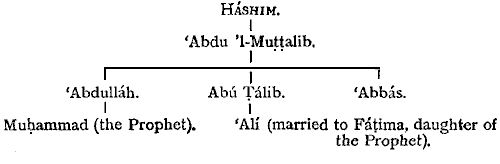
It was, of course, absolutely essential to the ‘Abbásids that they should be able to count on the support of the powerful Shí‘ite organisation, which, ever since the abortive The Shí‘ites join hands with the ‘Abbásids. rebellion headed by Mukhtár (see p. 218 supra) had drawn vast numbers of Persian Mawálí into its ranks. Now, of the two main parties of the Shí‘a, viz., the Háshimites or followers of Muḥammad Ibnu ’l-Ḥanafiyya, and the Imámites, who pinned their faith to the descendants of the Prophet through his daughter Fáṭima, the former had virtually identified themselves with the ‘Abbásids, inasmuch as the Imám Abú Háshim, who died in 716 a.d., bequeathed his hereditary rights to Muḥammad b. ‘Alí, the head of the House of ‘Abbás. It only remained to hoodwink the Imámites. Accordingly the ‘Abbásid emissaries were instructed to carry on their propaganda in the name of Háshim, the common ancestor of ‘Abbás and ‘Alí. By means of this ruse they obtained a free hand in Khurásán, and made such progress that the governor of that province, Naṣr b. Sayyár, wrote to the Umayyad Caliph, Marwán, asking for reinforcements, and informing him that two hundred thousand men had sworn allegiance to Abú Muslim, the principal ‘Abbásid agent. At the foot of his letter he added these lines:—
"I see the coal's red glow beneath the embers, And 'tis about to blaze! The rubbing of two sticks enkindles fire, And out of words come frays. 'Oh! is Umayya's House awake or sleeping?' I cry in sore amaze."475
We have other verses by this gallant and loyal officer in which he implores the Arab troops stationed in Khurásán, who were paralysed by tribal dissensions, to turn their swords against "a mixed rabble without religion or nobility":—
"'Death to the Arabs'—that is all their creed."476
These warnings, however, were of no avail, and on June 9th, a.d. 747, Abú Muslim displayed the black banner of the ‘Abbásids at Siqadanj, near Merv, which city he occupied a few months later. The triumphant advance of the armies of the Revolution towards Declaration of war. Damascus recalls the celebrated campaign of Cæsar, when after crossing the Rubicon he marched on Rome. Nor is Abú Muslim, though a freedman of obscure parentage—he was certainly no Arab—unworthy to be compared with the great patrician. "He united," says Nöldeke, "with an agitator's adroitness and perfect unscrupulosity in the choice of means the energy and clear outlook of a general and statesman, Abú Muslim. and even of a monarch."477 Grim, ruthless, disdaining the pleasures of ordinary men, he possessed the faculty in which Cæsar excelled of inspiring blind obedience and enthusiastic devotion. To complete the parallel, we may mention here that Abú Muslim was treacherously murdered by Manṣúr, the second Caliph of the House which he had raised to the throne, from motives exactly resembling those which Shakespeare has put in the mouth of Brutus—
"So Caesar may: Then, lest he may, prevent. And since the quarrel Will bear no colour for the thing he is, Fashion it thus: that what he is, augmented, Would run to these and these extremities; And therefore think him as a serpent's egg Which, hatched, would as his kind grow mischievous, And kill him in the shell."
The downfall of the Umayyads was hastened by the perfidy and selfishness of the Arabs on whom they relied: the old feud between Muḍar and Yemen broke out afresh, and while the Northern group remained loyal to the dynasty, those of Yemenite stock more or less openly threw in their lot with the Revolution. We need not attempt to trace the course of the unequal contest. Everywhere the Arabs, disheartened and divided, fell an easy prey to their adversaries, and all was lost when Marwán, the last Umayyad Caliph, sustained a crushing defeat on the River Záb in Babylonia (January, a.d. 750). Meanwhile Abu ’l-‘Abbás, the head of the rival House, had already received homage as Caliph (November, 749 a.d.). In the inaugural address which he delivered in the great Mosque of Kúfa, he called Accession of Abu ’l-‘Abbás al-Saffáḥ. himself al-Saffáḥ, i.e., 'the Blood-shedder,'478 and this title has deservedly stuck to him, though it might have been assumed with no less justice by his brother Mansúr and other members of his family. All Umayyads were remorselessly hunted down and massacred in cold blood—even those who surrendered only on the strength of the most solemn pledges that they had nothing to fear. A small remnant made their escape, or managed to find shelter until the storm of fury and vengeance, which spared neither the dead nor the living,479 had blown over. One stripling, named ‘Abdu ’l-Raḥmán, fled to North Africa, and after meeting with many perilous adventures founded a new Umayyad dynasty in Spain.