Volume 24 — CHAPTER IV. (continued 2)
Reading edition
A considerable portion of several of the later years of Stephenson’s life was spent in traveling in Europe, partly on business and partly for pleasure. During a visit to Belgium in 1845, he was received everywhere, and by all classes, from the king down to the humblest of his subjects, with such distinction as is rarely accorded even to the greatest men. He soon after visited Spain with Sir Joshua Walmsley, to report on a proposed railway from the capital to the Bay of Biscay. On this journey he was taken ill, and his health was permanently impaired. Thenceforward he devoted himself principally to the direction of his own property, which had become very considerable, and spent much of his time at the collieries and other works in which he had invested it. His son had now entirely relieved him of all business connected with railroads, and he had leisure to devote to self-improvement and social amusement. Among his friends he claimed Sir Robert Peel, his old acquaintance, now Sir William, Fairbairn, Dr. Buckland, and many others of the distinguished men of that time.
In August, 1848, Stephenson was attacked with intermittent fever, succeeded by hæmorrhage from the lungs, and died on the 12th of that month, at the age of sixty-six years, honored of all men, and secure of an undying fame. Soon after his death, statues were erected at Liverpool, London, and Newcastle, the cost of the second of which was defrayed by private subscriptions, including a contribution of about $1,500 by 3,150 workingmen—one of the finest tributes ever offered to the memory of a great man.
But the noblest monument is that which he himself erected by the establishment of a system of education and protection of his working-people at Clay Cross. He made it a condition of employment that every employé should contribute from five to twelve pence each fortnight to a fund, to which the works also made liberal contributions. From that fund it was directed that the expenses of free education of the children of the work-people, night-schools for those employed in the works, a reading-room and library, medical treatment, and a benevolent fund were to be defrayed. Music and cricket-clubs, and prize funds for the best garden, were also founded. The school, public hall, and the church of Clay Cross, and this noble system of support, are together a nobler monument than any statue or similar structure could be.
The character of George Stephenson was in every way admirable. Simple, earnest, and honorable; courageous, indomitable, and industrious; humorous, kind, and philanthropic, his memory will long be cherished, and will long prove an incentive to earnest effort and to the pursuit of an honorable fame with hundreds of the youth who, reading his simple yet absorbing story, as told by his biographer, shall in later years learn to know him.
After the death of his father, Robert Stephenson continued, as he had already done for several years, to conduct the business of building locomotives, as well as of constructing railroads. The work of locomotive engine-building was done at Newcastle, and for many years those works were the principal engine-building establishment of the world.
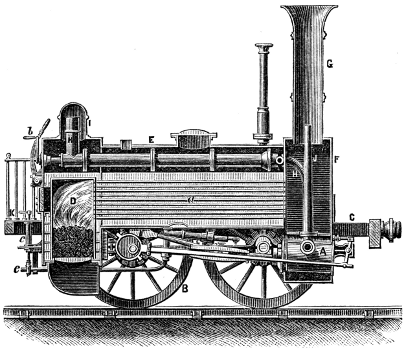
Fig. 57.—Stephenson’s Locomotive, 1833.
After their introduction on the Liverpool & Manchester road, the engines of the firm of Robert Stephenson & Co. were rapidly modified, until they assumed the form shown in Fig. 57, which remained standard until their gradual increase in weight compelled the builders to place a larger number of wheels beneath them, and make those other changes which finally resulted in the creation of distinct types for special kinds of work. In the engine of 1833, as shown above, the cylinders, A, are carried at the extreme forward end of the boiler, and the driving-wheels, B, are coupled directly to the connecting-rod of the engine and to each other. A buffer, C, extends in front, and the rear end of the boiler is formed into a rectangular fire-box, D, continuous with the shell, E, and the flame and gases pass to the connection and smoke-pipe, F, G, through a large number of small tubes, a. Steam is led to the cylinders by a steam-pipe, H H, to which it is admitted by the throttle-valve, b. A steam-dome, I, from which the steam is taken, assists by giving more steam-space far above the water-line, and thus furnishing dry steam. The exhaust steam issues with great velocity into the chimney from the pipe, J, giving great intensity of draught. The engine-driver stands on the platform, K, from which all the valves and handles are accessible. Feed-pumps, L, supply the boiler with water, which is drawn from the tender through the pipes, e, f.
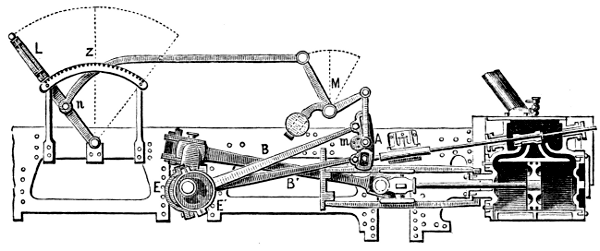
Fig. 58.—The Stephenson Valve-Gear, 1833.
The valve-gear was then substantially what it is to-day, the “Stephenson link” (Fig. 58). On the driving-axle were keyed two eccentrics, E, so set that the motion of the one was adapted to driving the valve when the engine was moving forward, and the other was arranged to move the valve when running backward. The former was connected, through its strap and the rod, B, to the upper end of a “strap-link,” A, while the second was similarly connected with the lower end. By means of a handle, L, and the link, n, and its connections, including the counterweighted bell-crank, M, this link could be raised or depressed, thus bringing the pin on the link-block, to which the valve-stem was connected, into action with either eccentric. Or, the link being set in mid-gear, the valve would cover both steam-ports of the cylinder, and the engine could move neither way. As shown, the engine is in position to run backward. A series of notches, Z, into either of which a catch on L could be dropped, enabled the driver to place the link where he chose. In intermediate positions, between mid-gear and full-gear, the motion of the valve is such as to produce expansion of the steam, and some gain in economy of working, although reducing the power of the engine.
The success of the railroad and the locomotive in Great Britain led to its rapid introduction in other countries. In France, as early as 1823, M. Beaunier was authorized to construct a line of rails from the coal-mines of St. Étienne to the Loire, using horses for the traction of his trains; and in 1826, MM. Seguin began a road from St. Étienne to Lyons. In 1832, engines built at Lyons were substituted for horses on these roads, but internal agitations interrupted the progress of the new system in France, and, for 10 years after the opening of the Manchester & Liverpool road, France remained without steam-transportation on land.
In Belgium the introduction of the locomotive was more promptly accomplished. Under the direction of Pierre Simon, an enterprising and well-informed young engineer, who had become known principally as an advocate of the even then familiar project of a canal across the Isthmus of Darien, very complete plans of railroad communication for the kingdom were prepared, in compliance with a decree dated July 31, 1834, and were promptly authorized. The road between Brussels and Mechlin was opened May 6, 1837, and other roads were soon built; and the railway system of Belgium was the first on the Continent of Europe.
The first German railroad worked with locomotive steam-engines was that between Nuremberg and Fürth, built under the direction of M. Denis. The other European countries soon followed in this rapid march of improvement.
In the United States, public attention had been directed to this subject, as has already been stated, very early in the present century, by Evans and Stevens. At that time the people of the United States, as was natural, closely watched every important series of events in the mother-country; and so remarkable and striking a change as that which was taking place in the time of Stephenson, in methods of communication and transportation, could not fail to attract general attention and awaken universal interest.
Notwithstanding the success of the early experiments of Evans and others, and in spite of the statesmanlike arguments of Stevens and Dearborn, and the earnest advocacy of the plan by all who were familiar with the revelations which were daily made of the power and capabilities of the steam-engine, it was not until after the opening of the Manchester & Liverpool road that any action was taken looking to the introduction of the locomotive. Colonel John Stevens, in 1825, had built a small locomotive, which he had placed on a circular railway before his house—now Hudson Terrace—at Hoboken, to prove that his statements had a basis of fact. This engine had two “lantern” tubular boilers, each composed of small iron tubes, arranged vertically in circles about the furnaces.[55] This exhibition had no other effect, however, than to create some interest in the subject, which aided in securing a rapid adoption of the railroad when once introduced.
The first line of rails in the New England States is said to have been laid down at Quincy, Mass., from the granite quarry to the Neponset River, three miles away, in 1826 and 1827. That between the coal-mines of Mauch Chunk, Pa., and the river Lehigh, nine miles distant, was built in 1827. In the following year the Delaware & Hudson Canal Company built a railroad from their mines to the termination of the canal at Honesdale. These roads were worked either by gravity or by horses and mules.
The competition at Rainhill, on the Liverpool and Manchester Railroad, had been so widely advertised, and promised to afford such conclusive evidence relative to the value of the locomotive steam-engine and the railroad, that engineers and others interested in the subject came from all parts of the world to witness the trial. Among the strangers present were Mr. Horatio Allen, then chief-engineer of the Delaware & Hudson Canal Company, and Mr. E. L. Miller, a resident of Charleston, S. C., who went from the United States for the express purpose of seeing the new machines tested.
Mr. Allen had been authorized to purchase, for the company with which he was connected, three locomotives and the iron for the road, and had already shipped one engine to the United States, and had set it at work on the road. This engine was received in New York in May, 1829, and its trial took place in August at Honesdale, Mr. Allen himself driving the engine. But the track proved too light for the locomotive, and it was laid up and never set at regular work. This engine was called the “Stourbridge Lion”; it was built by Foster, Rastrick & Co., of Stourbridge, England. During the summer of the next year, a small experimental engine, which was built in 1829 by Peter Cooper, of New York, was successfully tried on the Baltimore & Ohio Railroad, at Baltimore, making 13 miles in less than an hour, and moving, at some points on the road, at the rate of 18 miles an hour. One carriage carrying 36 passengers was attached. This was considered a working-model only, and was rated at one horse-power.
Ross Winans, writing of this trial of Cooper’s engine, makes a comparison with the work done by Stephenson’s “Rocket,” and claims a decided superiority for the former. He concluded that the trial established fully the practicability of using locomotives on the Baltimore & Ohio road at high speeds, and on all its curves and heavy gradients, without inconvenience or danger.
This engine had a vertical tubular boiler, and the draught was urged, like that of the “Novelty” at Liverpool, by mechanical means—a revolving fan. The single steam-cylinder was 31∕4 inches in diameter, and the stroke of piston 141∕2 inches. The wheels were 30 inches in diameter, and connected to the crank-shaft by gearing. The engine, on the trial, worked up to 1.43 horse-power, and drew a gross weight of 41∕2 tons. Mr. Cooper, unable to find such tubes as he needed for his boiler, used gun-barrels. The whole machine weighed less than a ton.
Messrs. Davis & Gartner, a little later, built the “York” for this road—a locomotive having also a vertical boiler, of very similar form to the modern steam fire-engine boiler, 51 inches in diameter, and containing 282 fire-tubes, 16 inches long, and tapering from 11∕2 inches diameter at the bottom to 11∕4 at the top, where the gases were discharged through a combustion-chamber into a steam-chimney. This engine weighed 31∕2 tons.
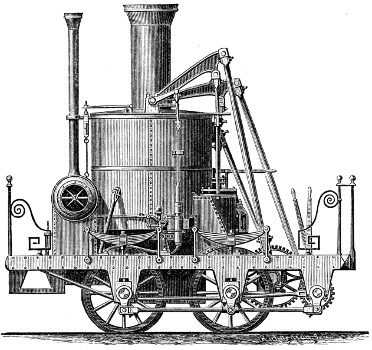
Fig. 59.—The “Atlantic,” 1882.
They subsequently built several “grasshopper” engines (Fig. 59), some of which ran many years, doing good work, and one or two of which are still in existence. The first—the “Atlantic”—was set at work in September, 1832, and hauled 50 tons from Baltimore 40 miles, over gradients having a maximum rise of 37 feet to the mile, and on curves having a minimum radius of 400 feet, at the rate of 12 to 15 miles an hour. This engine weighed 61∕2 tons, carried 50 pounds of steam—a pressure then common on both continents —and burned a ton of anthracite coal on the round trip. The blast was secured by a fan, and the valve-gear was worked by cams instead of eccentrics. This engine made the round trip at a cost of $16, doing the work of 42 horses, which had cost $33 per trip. The engine cost $4,500, and was designed by Phineas Davis, assisted by Ross Winans.
Mr. Miller, on his return from the Liverpool & Manchester trial, ordered a locomotive for the Charleston & Hamburg Railroad from the West Point Foundery. This engine was guaranteed by Mr. Miller to draw three times its weight at the rate of 10 miles an hour. It was built during the summer of 1830, from the plans of Mr. Miller, and reached Charleston in October. The trials were made in November and December.
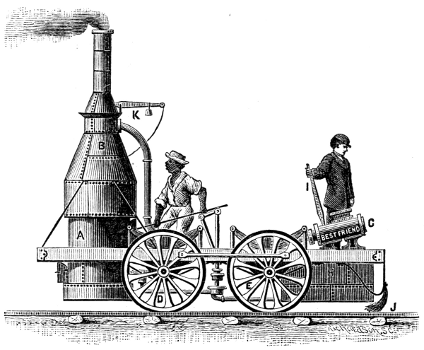
Fig. 60.—The “Best Friend,” 1830.
This engine (Fig. 60) had a vertical tubular boiler, in which the gases rose through a very high fire-box, into which large numbers of rods projected from the sides and top, and passed out through tubes leading them laterally outward into an outside jacket, through which they rose to the chimney. The steam-cylinders were two in number, 8 inches in diameter and of 16 inches stroke, inclined so as to connect with the driving-axle. The four wheels were all of the same size, 41∕2 feet in diameter, and connected by coupling-rods. The engine weighed 41∕2 tons. The “Best Friend,” as it was called, did excellent work until June, 1831, when the explosion of the boiler, in consequence of the recklessness of the fireman, unexpectedly closed its career.
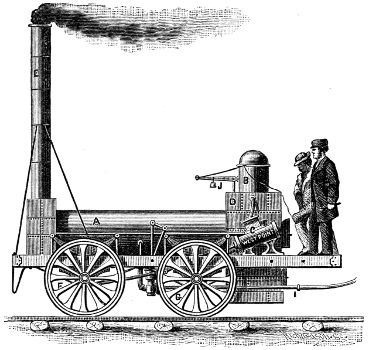
Fig. 61.—The “West Point,” 1831.
A second engine (Fig. 61) was built for this road, at the West Point Foundery, from plans furnished by Horatio Allen, and was received and set at work early in the spring of 1831. The engine, called the “West Point,” had a horizontal tubular boiler, but was in other respects very similar to the “Best Friend.” It is said to have done very good work.
The Mohawk & Hudson Railroad ordered an engine at about this time, also, of the West Point Foundery, and the trials, made in July and August, 1831, proved thoroughly successful.
This engine, the “De Witt Clinton,” was contracted for by John B. Jervis, and fitted up by David Matthew. It had two steam-cylinders, each 51∕2 inches in diameter and 16 inches stroke of piston. The connecting-rods were directly attached to a cranked axle, and turned four coupled wheels 41∕2 feet in diameter. These wheels had cast-iron hubs and wrought-iron spokes and tires. The tubes were of copper, 21∕2 inches in diameter and 6 feet long. The engine weighed 31∕2 tons, and hauled 5 cars at the rate of 30 miles an hour.
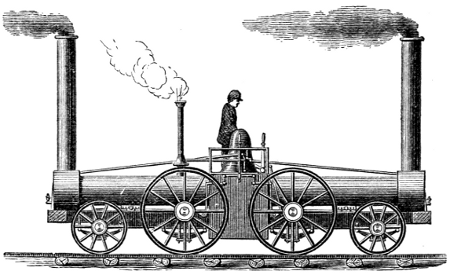
Fig. 62.—The “South Carolina,” 1831.
Another engine, the “South Carolina” (Fig. 62), was designed by Horatio Allen for the South Carolina Railroad, and completed late in the year 1831. This was the first eight-wheeled engine, and the prototype, also, of a peculiar and lately-revived form of engine.
In the summer of 1832, an engine built by Messrs. Davis & Gartner, of York, Pa., was put on the Baltimore & Ohio road, which at times attained a speed, unloaded, of 30 miles an hour. The engine weighed 31∕2 tons, and drew, usually, 4 cars, weighing altogether 14 tons, from Baltimore to Ellicott’s Mills, a distance of 13 miles, in the schedule-time, one hour.
Horatio Allen’s engine on the South Carolina Railroad is said to have been the first eight-wheeled engine ever built.
It was at about the time of which we are now writing that the first locomotive was built of what is now distinctively known as the American type—an engine with a “truck” or “bogie” under the forward end of the boiler. This was the “American” No. 1, built at the West Point Foundery, from plans furnished by John B. Jervis, Chief Engineer, for the Mohawk & Hudson Railroad. Ross Winans had already (1831) introduced the passenger-car with swiveling trucks.[56] It was completed in August, 1832, and is said by Mr. Matthew to have been an extremely fast and smooth-running engine. A mile a minute was repeatedly attained, and it is stated by the same authority,[57] that a speed of 80 miles an hour was sometimes made over a single mile. This engine had cylinders 91∕2 inches diameter, 16 inches stroke of piston, two pairs of driving-wheels, coupled, 5 feet in diameter each; and the truck had four 33-inch wheels. The boiler contained tubes 3 inches in diameter, and its fire-box was 5 feet long and 2 feet 10 inches wide. Robert Stephenson & Co. subsequently built a similar engine, from the plans of Mr. Jervis, and for the same road. It was set at work in 1833. In both engines the driving-wheels were behind the fire-box. This engine is another illustration of the fact—shown by the description already given of other and earlier engines—that the independence of the American mechanic, and the boldness and self-confidence which have to the present time distinguished him, were among the earliest of the fruits of our political independence and freedom.
These American engines were all designed to burn anthracite coal. The English locomotives all burned bituminous coal.
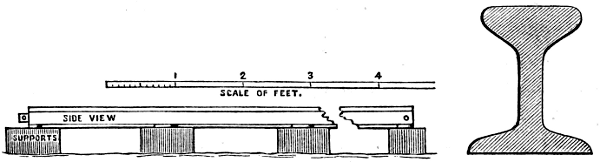
Fig. 63.—The “Stevens” Rail. Enlarged Section.
Robert L. Stevens, the President and Engineer of the Camden & Amboy Railroad, and a distinguished son of Colonel John Stevens, of Hoboken, was engaged, at the time of the opening of the Liverpool & Manchester Railroad, in the construction of the Camden & Amboy Railroad. It was here that the first of the now standard form of T-rail was laid down. It was of malleable iron, and of the form shown in the accompanying figure. It was designed by Mr. Stevens, and is known in the United States as the “Stevens” rail. In Europe, where it was introduced some years afterward, it is sometimes called the “Vignolles” rail. He purchased an engine of the Stephensons soon after the trial at Rainhill, and this engine, the “John Bull,” was set up on the then uncompleted road at Bordentown, in the year 1831. Its first public trial was made in November of that year. The road was opened for traffic, from end to end, two years later. This engine had steam-cylinders 9 inches in diameter, 2 feet stroke of piston, one pair of drivers 41∕2 feet in diameter, and weighed 10 tons. This engine, and that built by Phineas Davis for the Baltimore & Ohio Railroad, were exhibited at the Centennial Exhibition at Philadelphia, in the year 1876.
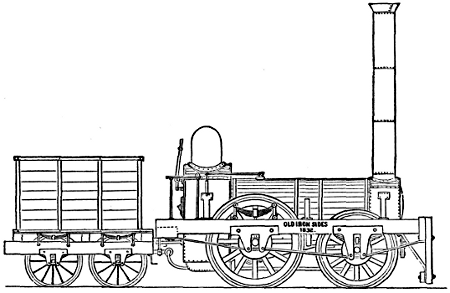
Fig. 64.—“Old Ironsides,” 1832.
Engines supplied to the Camden & Amboy Railroad subsequent to 1831 were built from the designs of Robert L. Stevens, in the shop of the Messrs. Stevens, at Hoboken. The other principal roads of the country, at first, very generally purchased their engines of the Baldwin Locomotive Works, then a small shop owned by Matthias W. Baldwin. Baldwin’s first engine was a little model built for Peale’s Museum, to illustrate to the visitors of that then well-known place of entertainment the character of the new motor, the success of which, at Rainhill, had just then excited the attention of the world. This was in 1831, and the successful working of this little model led to his receiving an order for an engine from the Philadelphia & Germantown Railroad. Mr. Baldwin, after studying the new engine of the Camden & Amboy road, made his plans, and built an engine (Fig. 64), completing it in the autumn of 1832, and setting it in operation November 23d of that year. It was kept at work on that line of road for a period of 20 years or more. This engine was of Stephenson’s “Planet” class, mounted on two driving-wheels 41∕2 feet in diameter each, and two separate wheels of the same size, uncoupled. The steam-cylinders were 91∕2 inches in diameter, 18 inches stroke of piston, and were placed horizontally on each side of the smoke-box. The boiler, 21∕2 feet in diameter, contained 72 copper tubes 11∕2 inches in diameter and 7 feet long. The engine cost the railroad company $3,500. On the trial, steam was raised in 20 minutes, and the maximum speed noted was 28 miles an hour. The engine subsequently attained a speed of over 30 miles. In 1834, Mr. Baldwin completed for Mr. E. L. Miller, of Charleston, a six-wheeled engine, the “E. L. Miller” (Fig. 65), with cylinders 10 inches in diameter and 16 inches stroke of piston. He made the boiler of this engine of a form which remained standard many years, with a high dome over the fire-box. At about the same time, he built the “Lancaster,” an engine resembling the “Miller,” for the State road to Columbia, and several others were soon contracted for and built. By the end of 1834, 5 engines had been built by him, and the construction of locomotive-engines had become one of the leading and most promising industries of the United States. Mr. William Norris established a shop in Philadelphia in 1832, which he gradually enlarged until it, like the Baldwin Works, became a large establishment. He usually built a six-wheeled engine, with a leading-truck or bogie, and placed his driving-wheels in front of the fire-box.
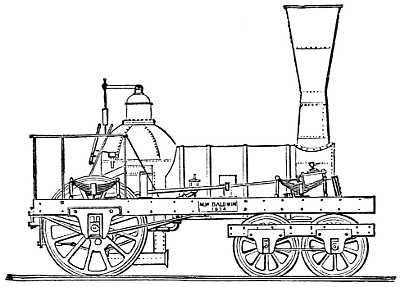
Fig. 65.—The “E. L. Miller,” 1834.
At this time the English locomotives were built to carry 60 pounds of steam. The American builders adopted pressures of 120 to 130 pounds per square inch, the now generally standard pressures throughout the world. In the years 1836 and 1837, Baldwin built 80 engines. They were of three classes: 1st, with cylinders 121∕2 inches in diameter and of 16 inches stroke, weighing 12 tons; 2d, with cylinders 12 by 16, and a weight of 101∕2 tons; and 3d, engines weighing 9 tons, and having steam-cylinders of 101∕2 inches diameter and of the same stroke. The driving-wheels were usually 41∕2 feet in diameter, and the cylinder “inside-connected” to cranked axles. A few “outside-connected” engines were made, this plan becoming generally adopted at a later period.
The railroads of the United States were very soon supplied with locomotive-engines built in America. In the year 1836, William Norris, who had two years before purchased the interest of Colonel Stephen H. Long, an army-officer who patented and built locomotives of his own design, built the “George Washington,” and set it at work. This engine, weighing 14,400 pounds, drew 19,200 pounds up an incline 2,800 feet long, rising 369 feet to the mile, at the speed of 151∕2 miles an hour. This showed an adhesion not far from one-third the weight on the driving-wheels. This was considered a very wonderful performance, and it produced such an impression at the time, that several copies of the “George Washington” were made, on orders from British railroads, and the result was the establishment of the reputation of the locomotive-engine builders of the United States upon a foundation which has never since failed them. The engine had Jervis’s forward-truck, now always seen under standard engines, which had already been placed under railroad-cars by Ross Winans.
In New England, the Locks & Canals Company, of Lowell, began building engines as early as 1834, copying the Stephenson engine. Hinckley & Drury, of Boston, commenced building an outside-connected engine in 1840, and their successors, the Boston Locomotive Works, became the largest manufacturing establishment of the kind in New England. Two years later, Ross Winans, the Baltimore builder, introduced some of his engines upon Eastern railroads, fitting them with upright boilers, and burning anthracite coal.
The changes which have been outlined produced the now typical American locomotive. It was necessarily given such form that it would work safely and efficiently on rough, ill-ballasted, and often sharply-winding tracks; and thus it soon became evident that the two pairs of coupled driving-wheels, carrying two-thirds the weight of the whole engine, the forward-truck, and the system of “equalizing” suspension-bars, by which the weight is distributed fairly among all the wheels, whatever the position of the engine, or whatever the irregularity of the track, made it the very best of all known types of locomotive for the railroads of a new country. Experience has shown it equally excellent on the smoothest and best of roads. The “cow-catcher,” placed in front to remove obstacles from the track, the bell, and the heavy whistle, are characteristics of the American engine also. The severity of winter-storms compelled the adoption of the “cab,” or house, and the use of wood for fuel led to the invention of the “spark-arrester” for that class of engines. The heavy grades on many roads led to the use of the “sand-box,” from which sand was sprinkled on the track, to prevent the slipping of the wheels.
In the year 1836, the now standard chilled wheel was introduced for cars and trucks; the single eccentric, which had been, until then, used on Baldwin engines, was displaced by the double eccentric, with hooks in place of the link; and, a year later, the iron frame took the place of the previously-used wooden frame on all engines.
The year 1837 introduced a period of great depression in all branches of industry, which continued until the year 1840, or later, and seriously checked all kinds of manufacturing, including the building of locomotives. On the revival of business, numbers of new locomotive-works were started, and in these establishments originated many new types of engine, each of the more successful of which was adapted to some peculiar set of conditions. This variety of type is still seen on nearly all of the principal roads.
The direction of change in the construction of locomotive-engines at the period at which this division of the subject terminates is very well indicated in a letter from Robert Stephenson to Robert L. Stevens, dated 1833, which is now preserved at the Stevens Institute of Technology. He writes: “I am sorry that the feeling in the United States in favor of light railways is so general. In England we are making every succeeding railway stronger and more substantial.” He adds: “Small engines are losing ground, and large ones are daily demonstrating that powerful engines are the most economical.” He gives a sketch of his latest engine, weighing nine tons, and capable, as he states, of “taking 100 tons, gross load, at the rate of 16 or 17 miles an hour on a level.” To-day there are engines built weighing 70 tons, and our locomotive-builders have standard sizes guaranteed to draw over 2,000 tons on a good and level track.