Chapter VII · THE INVASION OF THE CRIMEA.
Reading edition
Small results gained by the Allies—Sudden determination to attack Sevastopol—Russian position in the Trans-Caucasian provinces—Conditions under which the Crimea was invaded—The allied Armada sails from Varna to Eupatoria—Landing effected at “Old Fort”—The move to Sevastopol; the order of march—The enemy on the Alma river, opposes the advance of the Allies—Description of the field of battle; strength and position of the enemy—Commencement of the battle of the Alma—Advance of the Light and the Second Divisions—Deployment of the First Division—Advance of the Guards and Highland Brigades—Defeat of the Russians—No pursuit—Losses—Bravery and steadiness of the British troops—The Allies lose valuable time after the battle—Arriving at last before their objective, Sevastopol, they refuse to attack it—General description of Sevastopol.
Hitherto the Anglo-French Allies had done nothing in the great struggle, which had been raging between Russia and Turkey since the autumn of 1853, though they had been officially at war with the former for more than five months, and were preparing for the strife before hostilities had been declared. There was much cause for disappointment at this inglorious result; and it was humiliating to the gallant armies of the two foremost nations of Europe, to be sent to the East, merely to eat out their hearts in inactivity, when feats of valour against the enemy were performed almost within earshot of their camps. Nor was the excuse put forward for this apathy—the want of transport—of any value; for every member of the Government knew that transport is indispensable to an army’s motion, and that without it no campaign is possible. That it could have been obtained is not to be denied; and the conclusion is irresistible, that the intention of taking the field in earnest, did not enter into the calculations of our Cabinet. But now, when the enemy, driven out of the Principalities, effected his escape under the friendly cover of an Austrian force, when the Tsar, moreover, in no mood to sue for peace, still breathed defiance, our Government were placed in a 157difficulty. They had undertaken to make Russia submit; but their diplomacy was unsuccessful, and their demonstrations were disregarded; added to these failures, valuable time had slipped away, and the season was wasted. Something, then, had to be done at once to retrieve the past, for the country was losing its patience, and would brook no further vacillation. Hence a change in policy became inevitable.
The Government had been cautious, not to say timid; but they now entirely altered their demeanour. They suddenly became bold to the verge of rashness, and resolved at any price to take Sevastopol by a coup de main. It is true they were in complete ignorance of the strength, defences, armament, and capacity of that fortress; they knew little of its position, and nothing of the peninsula in which it is situated; and, while the transport of the army was more than defective, the commissariat and medical services were not in a much better condition. But these things seem to have pressed them lightly. Their opinion was strong, that Sevastopol was sure to fall, directly the Allied forces appeared before its ramparts; and its destruction, they doubted not, would bring about a peace, and cause the Tsar to relinquish his arrogant pretensions. As soon, therefore, as the raising of the siege of Silistria put an end to the war on Ottoman territory, they hastened to frame a despatch to Lord Raglan, dated June 29th, directing that an expedition against Sevastopol should be prepared. The despatch was so worded, that it left the British Commander little option but to comply. He therefore accepted the arduous undertaking which was pressed upon him, though he did so very much against his better judgment, and he announced his intention to the Government in a letter, dated July 19th.[217] It was early in September, as we have seen, before the armada was ready to sail from Varna.
There can be no doubt, that it was anomalous and very inconvenient to send out a military expedition to check Russian aggression with no rational plan of action. In the beginning of the 158year, the terror which the supposed omnipotence of the Emperor Nicholas inspired, made us believe that all our efforts would be required to save Turkey from certain and swift destruction. We even imagined that Constantinople was in imminent danger; and the French rushed to Gallipoli, to take up a flanking position against the hostile columns, which were almost immediately expected to assault that city. This was our only plan, and we trusted to events to develop another for us, should it be required. When, therefore, we found that the result of the war on the Danube had overturned all our preconceived ideas, we were unprepared for such an event; and we drifted towards the first plausible scheme put forward, irrespective of ways and means. Hence, the descent on Sevastopol was in the nature of an afterthought: a crude design, hastily proposed and rashly adopted, without reflection or calculation, and concerted without reference to the Commanders at the seat of war, who, nevertheless, were forced to accept it, and were held responsible for its execution.
After the collapse of the campaign in the Principalities, the urgent question naturally arose—where was Russia to be attacked, and how was she to be coerced by the Western Powers? There were vitally delicate joints in the armour of that Empire, not inaccessible to our resources, in Poland and in Finland. But the resuscitation of the oppressed northern nationalities formed no part of our policy; they were held to be beyond the scope of our aspirations. So we confined ourselves to a few inconclusive descents on the coast of the Baltic, and the enemy had no serious cause of disquietude in this important portion of his dominions. Our intervention, therefore, in these quarters need not further be discussed.[218] The army being in the Levant, principal operations were to be conducted there.[219] The Crimea, no doubt, occupies an important position in the Black Sea, and its conquest would necessarily cramp the future plans of Russian aggrandisement. But who 159was to hold it, if it were taken? Sevastopol, also, situated in the peninsula, is a land-locked harbour, and a base of naval operations, defended from the sea, and, in 1854, it was partially protected, on the land fronts, by some indifferent works. If there were a good prospect of rapidly capturing it, the design to do so had much to recommend it. Such an event would injure the prestige of Russia, on which she greatly relies for acquiring power; it would temporarily put an end to a secure harbour suitable to maintain her fleet in the Black Sea, and it would be one step towards the conquest of the Crimean Peninsula. But was the chance—the slender chance—of prompt success worth the risk? Why enchain our whole forces before the walls of a single and isolated fortress, if the coup de main were to miscarry, and a lengthened siege became necessary? Was not the Euxine in our sole possession, and, as long as this remained so, was not Sevastopol outside the sphere of military operations, and entirely innocuous?
Austria had been allowed to close the western theatre of operations against the belligerent Powers. But it never seemed to have occurred to them to cast a thought on that other theatre of war, which still lay open to their attack in Asia. During 1854, the Turks were in disorder there; acrimonious quarrels broke out among the leaders of their forces, and, though the Russians made no great progress, the fortunes of the war were deciding against our allies, to the detriment of the cause we had undertaken to defend. In this quarter, moreover, we had every prospect of success; we should have exposed ourselves to the least risk, and, if victory crowned our efforts there, we should have secured the most brilliant results. This field of operations, not distant from the Crimea, offered ample scope for our energies, and, as we approached it in 1855, though we did not avail ourselves of its advantages, a brief allusion to it must here be made.
The Caspian Sea is connected with the Euxine by a chain of lofty mountains (the Caucasus), which runs from Baku, on the former, to near Poti, on the latter, and then, taking a north-westerly direction, skirts the shore as far as Anapa, close to the straits of Yeni-kale. The Caucasus forms the natural southern limit of Russia, but, in the course of years, by the incomparable ability and, perhaps, by the unscrupulous character of the policy pursued at St. Petersburg, the frontiers of the Empire have been pushed south of these mountains, pressing upon Persia on the 160Araxes, and on the Ottoman Empire in Armenia. Now, communications with these Trans-Caucasian provinces (Mingrelia, Georgia, etc.) were insecure in 1854; for, inhabiting the northern slopes of the great range were vigorous, unsubdued races of hardy mountaineers, called by the general name Circassians, who for years had preserved their liberties and independence, in spite of the efforts of the Tsar to enthrall them. This eastern Switzerland had some claim upon our sympathy, if not because of the cause of freedom for which the people struggled, at least on account of the peculiar position they occupied on the Russian line of communications. Nor should it be forgotten that the subjugation of these mountaineers affected, in no slight degree, the tranquillity and the future security of India; for, until they were overcome, the systematic advance of Russia into Central Asia was not easily accomplished. Operations to support the Circassians and the kindred tribes in the Caucasus, had the advantage, then, of directly protecting, in the far East, those interests, to secure which, we had embarked in the war; and, if they had been successful, as they could not fail to be successful, even by the employment of a moderate force, the enemy must have lost Trans-Caucasia. The Russian Empire, considered to be safe from attack, was very vulnerable in this quarter, at a time when the mountain region was still unsubdued; and a blow struck there, making the Allies masters of the situation, would necessarily have enabled them to settle the Eastern Question as they thought best for the welfare of Europe. But the influence which was exercised over the Tsar’s aggressions in Turkey, by the brave races, who for so long held the passes against tremendous odds in defence of their homes, was scarcely recognized and hardly noticed in the West in 1854.[220]
We have already seen that, owing to the benevolence displayed by Austria to the Russians, the latter were enabled to retire from the 161Danube into Bessarabia unmolested by the pursuing Turks. This act on the part of a Power regarded as a friend by Great Britain, cost us dear shortly after this time. Its immediate consequences were, however, not unnoticed, and it was plain both to the allied Governments and to the Commanders, that the enemy would push his forces into the Crimea, without delay, if he got an inkling that an attempt on Sevastopol were imminent. Unfortunately the enemy got more than a hint as to our intentions. In order to prepare for the success of a coup de main on a position, it is evident that one essential condition to be observed is secrecy; nor is it immaterial to mislead the enemy by false attacks, alarms, and reports. But exactly the reverse took place. No demonstrations were made, and we blazoned our design to the whole world; the English press spoke of it freely and openly, since the end of June; and Marshal St. Arnaud had the imprudence to issue a vainglorious proclamation to his army, on the 25th of August, which ended with the following inflated words: “Bientôt nous saluerons ensemble les trois drapeaux réunis flottant sur les remparts de Sévastopol de notre cri national, Vive l'Empereur!”
A plan, previously concerted with the Officers who were to carry it out, upon so difficult a subject as the operation in hand, could not have been matured and adopted, unless the means of isolating the Crimea from the rest of Russia, had also been considered. There are two principal lines by which the peninsula is fed from the main land. The isthmus of Perekop and the Sea of Azof. The former, unconnected with the great river system of the Empire, was of service mainly to bring portions of the army of Bessarabia to the neighbourhood of Sevastopol. The latter, however, receiving the waters of the Don, served to take down reinforcements and supplies from the interior to the new seat of war. The despatch of the 29th of June already alluded to, contains a passage on this matter: “As all communications by sea are now in the hands of the Allied Powers, it becomes of importance to endeavour to cut off all communication by land, between the Crimea and the other parts of the Russian dominions.” It would have been fortunate if, in accordance with these instructions, we could have seized the narrow isthmus of Perekop, but we did not do so, and it remained open to the enemy. On the other hand, a small body of troops could have gained a footing near Kertch, and have maintained itself there; for, the Allied naval resources were more than ample to support it, to occupy and 162dominate the Sea of Azof, and to cut the Crimea off completely from the supplies sent down the river Don, from the large depôts and magazines established in its vicinity. Such an expedition, moreover, would have served to blind the enemy as to the intentions of the invaders with regard to Sevastopol, and have made him uncertain whether the ultimate aim was not to operate in the neighbourhood of the Caucasus. Having much to lose in this quarter, he was all the more sensitive to pressure there, and greater deception could thus have been practised on his fears.
That these expeditions did not take place at that time, is probably to be ascribed to the belief of the Commanders that the whole force was little enough, in order successfully to carry Sevastopol by storm. The orders they received from home did not contemplate a lengthy operation. Not for an instant did any one suppose, that it could last through the winter. It was late in the year; barely six weeks, or at least two months, of good weather could be expected to continue. It was known that the winter in the Black Sea region was intensely severe and cold; there was no provision made for the army against the terrible hardships which the snow, frost, and hurricanes of the Crimea must entail. The plan proposed to the allied Commanders was a short operation, and by them it was so accepted; it was a descent upon a coast, a march, and an assault. Fixing their eyes intently upon this plan, the importance of attacks on the enemy’s communications, dwindled in their estimation, and lost much of its value. Expeditions of this nature, were fitted rather to a regular siege, which might be expected to last for many months, and were scarcely essential to carry out the object which was then in hand, viz. to bring up every available battalion to the point, where a ready-prepared and decisive victory was to be gained.
These preliminary observations are necessary to a Regimental history, as an introduction to the events which are now to be recorded. For if they were not stated, it would be impossible for the reader to understand the reasons for the hardships, which our troops had soon to suffer, or to appreciate the glorious part they played in a calamitous war, where their fortitude and courage not only saved, but enhanced, the military greatness of Great Britain, and stood out in bright relief to so much that was unfortunate and damaging to our reputation as a nation of the first magnitude in Europe. It may in truth be stated, that to the British soldiers, and to the Officers who led them, the country owes it 163that a national catastrophe did not occur. Their discipline and dogged resolution never wavered for an instant, and they carried England unscathed through the ordeal. A history dealing with the actions of a Regiment engaged on that memorable occasion, would be sadly incomplete, if it failed to show this truth, or to describe the false positions in which the vital interests of this country became unhappily involved, and from which it was extricated solely by the manly bearing, and unflinching self-sacrifice of the army.
The armada, which left the shores of Bulgaria on the 7th of September, did not immediately sail to its destination; part of the Allied fleet had started before that date, but the whole met together on the 8th, and next day the British portion anchored in deep water some miles east of the Isle of Serpents. Lord Raglan now left to reconnoitre the coast, and to select a landing-place. His French colleague was ill, and could not accompany him. Proceeding from Balaklava to Eupatoria, he finally selected a stretch of sandy beach, covered by lagoons, at a spot marked on the maps as “Old Fort,” situated some twelve miles south of the latter town, and about twenty-five from Sevastopol.[221] Meanwhile, the Allied flotilla again got into communication, the slower sailing ships coming up to the rendez-vous. On the 12th, the magnificent and orderly array of the united fleets, occupying nearly nine miles of sea room, approached the Crimea, and converged on Old Fort; and then our men got a first welcome glimpse of the strange and unknown country they were about to invade. Next day, Eupatoria was summoned, and surrendered without a shot being fired; and on the 14th, exactly the forty-second anniversary of the triumphant entry of Napoleon I. into Moscow, the Allies began to land, the Turks on the right, then the French, and the British on the left.
The sea voyage braced up the health of the men; they were fast losing the lassitude and despondency that so lately oppressed them, and were regaining their usual strength, elasticity, and good spirits. “Notwithstanding there is no casting loose the foul fiend—cholera,” and many casualties were reported; but the Coldstream seem to have been spared by the scourge during the passage, though eight sick were unable to disembark, and were sent to the Simoon. A foretaste of cold weather was also unexpectedly experienced, for on the 12th, there was a hail-storm “abundantly accompanied by snow.”[222]
164Before leaving their ships, the troops had the temporary character of the expedition brought strongly before their imagination. The bât-horses, collected with difficulty at Scutari, were left behind in Bulgaria; there was no transport for regimental baggage, except an animal to carry the medicine-panniers. Officers loaded their haversacks and their persons with three days' salt pork, biscuit, and such indispensable articles, that a short campaign required. Dressed in tight-fitting swallow-tailed coatees, resplendent with gold lace, now sadly tarnished, their clothing was scarcely adapted to the harsh trials of actual warfare; added to which, they were weighted and encumbered, and had the appearance of “animated lumps of undigested packages, all cloak, bundle, and hairy cap.” Nor did the men fare any better. It appears that the only heavy part of the knapsack was its wooden frame, and this had been discarded some weeks before; when this was done, it served as a light and fairly good valise in which to carry the necessary kit safely and secure from rain. At the last moment, however, it was feared that the men were still too weak to carry even their lightened packs. But, instead of reducing the articles to be taken therein to a minimum, this minimum, in the shape of a pair of boots, a pair of socks, a shirt, and a forage cap, was ordered to be wrapped in the blanket and great coat; while the knapsack itself, designed to hold them, was left behind on board ship, together with all other articles of private property brought from Varna. Thus an unsightly and most inconvenient bundle was formed, ill-adapted to its purpose, and a doubtful place for the safe keeping of the few articles that were considered indispensable to the soldier’s welfare.[223] Three days' rations, some cooking utensils, wooden water-kegs, and sixty rounds of ammunition completed the personal equipment brought into the enemy’s country.
No. 3.
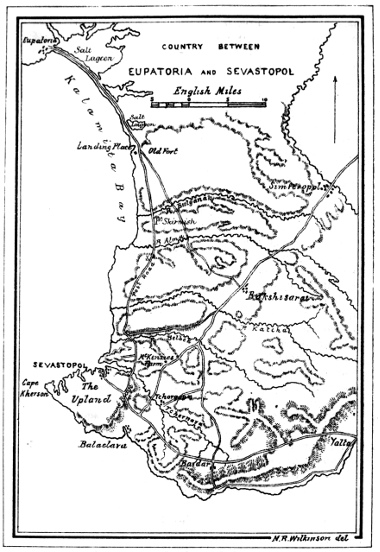
COUNTRY BETWEEN EUPATORIA AND SEVASTOPOL Compiled from Hamley’s Crimea by kind permission.
From the 14th to the 18th, the disembarkation of the Allies continued, observed by Cossack horsemen until driven away, and interrupted only by the rolling waves, which, tumbling on the beach, made it sometimes unsafe to land the horses and guns. The Light and First Divisions were on shore on the 14th; the Guards Brigade, remaining in formation till the afternoon, marched inland for about three miles, after the Light Division had started, where 165they bivouacked for the night. The morning was fine, but the evening turned very cold, the wind rose, and the rain came down in torrents, drenching all ranks and conditions, from the Divisional Commander, H.R.H. the Duke of Cambridge, to the youngest drummer. It was an inhospitable welcome that awaited our first night on the Crimean coast, but the men were in good heart, and made light of their misfortunes. On the 16th, a few tents were landed, but, for want of transport, they had to be returned on board the following day,—except one, which was retained for the sick, and was to be carried between the medicine-panniers on the hospital bât-horse. The story of the halt near Old Fort, would not have been complete had there been no “scare” to record. Was it ever wanting among troops, who for the first time await the approach of an enemy? Here it took place about midnight on the 16th, when an alarm was raised of the approach of Cossacks, and the troops turned out hurriedly; nor was it unlikely that the Russians would endeavour to attack the Allies, before they were ready to advance from the coast. Upon this occasion, however, a false report only had gained credence; there was no enemy in the vicinity, and the occurrence, though startling for the moment, doubtless, eventually served to steady the nerves of men who had never yet heard a shot fired in anger. In one way, things went smoothly enough, at all events in the camp of the Brigade, who, placed near a friendly Tartar village, bought small sheep at two shillings each, and fowls for fourpence or fivepence; but the dreaded cholera still hovered about, and one man of the Battalion died, after a few hours' sickness, on the 17th.
At last, early on the 19th, all arrangements being completed, the troops, horses, and guns landed, a small number (250) of country carts collected, and some cattle, sheep, and other supplies procured from the neighbourhood, the Allies began their march to Sevastopol, supported by the fleets that steamed slowly along the coast in the same direction. They numbered rather less than 60,000 men and 128 guns, and as the French and Turks had no cavalry with them, the united army had only one brigade (Lord Cardigan) to rely on. Marshal St. Arnaud marched near the sea; Bosquet’s division was in front, followed by Prince Napoleon on the left, by Canrobert on the right, and by Forey in rear; and, lastly, the Turks and the baggage and reserve ammunition, were in the open space which was surrounded by these four divisions. 166The British army moved on the left of the French, and were thus placed on the exposed flank; the Second and Light Divisions leading, the former nearest our allies, followed respectively by the Third and First Divisions, the Fourth marching after the First. The guns were on the right of their divisions, the infantry in double column of companies from the centre of battalions, and the cavalry divided, two regiments on the left flank, two covering the advance, and one in rear. This formation was adopted, because, the left of the Allies being undefended, it was not improbable that the enemy might venture to make an onslaught upon that flank from Simferopol. The weather was sultry, and the advance lay across a vast rolling plain, destitute of trees and shrubs, and swept bare of inhabitants and supplies by the Russian cavalry. After two hours, the heat affected some of the men, and, the ever-recurring plague of cholera still dogging their footsteps, victims to its ravages began to fall out.
“And now an astounding fact became patent to all—we had no ambulance! We had invaded an enemy’s country without means of transporting the sick and wounded, beyond a few stretchers in the hands of bandsmen and drum-boys! The sick and wounded of 27,000 British soldiers were to be carried bodily over burning steppes, where water was not, by drummers and fifers! These lads being physically unequal to the duty expected of them, we endeavoured to supply their places with files of the heavy-weighted soldiery: but of course this hard expedient broke down too; the work could not be done by human muscle, in fact; hence, tall fellows, not a few, were left behind, to take their chance of being picked up—God help them!”[224]
But in the afternoon the attention of the troops was diverted from these scenes of suffering; shots were heard in the front. The enemy was expected to take up a position near one of the rivers that flow at right angles across the Eupatoria post-road, on both sides of which the Allies were advancing; and here, at length, on the Bulganak, the divisions in rear thought that they were going to try conclusions with the enemy. In a very short time, however, the firing proved to be but a skirmish; for, after the expenditure of a few rounds, the Russians—6000 infantry, 2000 cavalry, and two batteries—moved back, before they had made us deploy 167much of our force, and left us in possession of the stream without further resistance. There we bivouacked for the night, in the full assurance that a great action would be fought on the following day.
According to an estimate of the enemy’s forces in the Crimea, made by the Foreign Office at home, it was computed that there were some 45,000 men near and in Sevastopol, excluding troops which might be drawn from the Caucasus and Bessarabia. Of this estimate Lord Raglan had been informed, but it seems he placed no great reliance upon it. He knew, however, that the Russians were relatively strong in cavalry, and that their army was commanded by Prince Menshikoff.
It was between nine and ten before the Allies moved from their bivouacs on the morning of the 20th, the British army bringing their left shoulders up, to get into closer communication with the French. On reaching the top of a grassy ridge which looks over the valley of the Alma, the position taken up by the enemy on the heights above that stream, first came into sight, and immediate preparations were made to dislodge him. The field of battle is a sloping plain from the north to the river, which is fordable in summer, from whence springs abruptly on the south bank, to a height of 300 to 400 feet, a commanding range of hills overlooking the plain, and running from the sea, for a distance of five miles, to a bluff called Kurgané Hill.[225] The river makes a trifling bend, forming a slightly re-entering angle towards these heights, on the western side of the Kurgané; and here the post-road crosses the stream, close to the village of Burliuk, by a wooden bridge, which had not been destroyed. This point marked the junction of the English right and the French left. On the French section of the field, the heights press close and cliff-like to the river, but they recede and become more accessible for a mile to the west of the angle mentioned. Roads available for guns ascend the hills at the mouth of the Alma, at the village of Almatamak, at a farm a mile further up, and again close to Burliuk, where, on the Russian side, the ground is more practicable; this last road leads to a height known as the Telegraph Hill. On the English section, the heights are further from the river, and the ascent is everywhere easy for all arms; but on that very account it was the more difficult to storm, for here the ground could be swept with fire, and the defenders had every facility for 168making counter-attacks. The tops of the hills form a wide plateau, stretching southwards towards the Katcha river, indented only near the angle, by a depression between the Kurgané and Telegraph Hills, through which the post-road rises, as it proceeds to Sevastopol.[226]
The Russian army, numerically weaker than the Allies, being 33,000 infantry, 3400 cavalry, and 120 guns, occupied the plateau. The main portion, 21,000 infantry, 3000 cavalry, and 84 guns, was placed on Kurgané and on the post-road, opposite the English section; the remainder, 12000 infantry, 400 cavalry, and 36 guns, near the post-road and on Telegraph Hill, were opposed to the French. The cavalry took post on the enemy’s right and rear, supported by horse artillery; but no troops were further to the west, where the ground was under fire from the war-ships. Menshikoff, however, forgot, though he had time at his disposal, to block the roads which ascend the cliff and the rough precipitous hillsides opposite the French position. Nor did he construct fieldworks on his front and right flank, contenting himself with only two gun-epaulments on Kurgané, one of which, about 300 yards from the river, was armed with 14 heavy guns of position.
There was a pause when the Allies approached the position they were about to assail, during which the troops refreshed themselves with cold pork and biscuits, after their march on a warm and glorious morning. In the interval, all eyes were turned to the heights that frowned in front, and saw in the distance the hostile sharpshooters extended along the river, in the vineyards and gardens, through which the advance was about to be made. Nor were we unconscious that the whole of our force was easily to be discerned, and our intentions to be divined by our antagonist; for we halted boldly on the sloping plain, in full view of the enemy, who, perched on the higher ground, was enabled to make his observations and to conceal much of his own order of battle from our anxious gaze. Meanwhile, the two Commanders-in-chief were concerting their plans. They had met before, but this was their final consultation. St. Arnaud had fixed and strong ideas on the situation; he was voluble in expressing them, and, though zealous and brave, he was somewhat shallow and self-opinionated. Lord Raglan’s first care was to insure a good understanding with his impetuous colleague. He was hampered by the alliance; and there was no supreme Commander to give a decision at this 169moment when unity of action was indispensably necessary. The Chiefs parted, and came to no definite conclusion; unless a hazy understanding can be called so, that the French were to try and turn the Russian left, but that the British could not do the same thing on the other flank “with such a body of cavalry as the enemy had in the plain.”[227]
At one o’clock Bosquet’s division advanced. One brigade with the artillery, pushed through Almatamak and up the road there; the remainder, and the Turks, some 10,000 men, crossed the Alma near its mouth, and, ascending the pathway that leads thence to the cliff, found themselves far from the battle-field, and never fired a shot during the action. Canrobert took his division along the road at the farm, and debouched on the plateau a mile to the west of Telegraph Hill; but his own artillery followed that of Bosquet, and were with the latter’s left brigade, a mile still further to the west. Prince Napoleon’s division was on Canrobert’s left, and made for Telegraph Hill; while Forey was in second line, in reserve. As the Turks were 7000 strong and the French 28,000, Marshal St. Arnaud had only 25,000 men and 68 guns in action.
The original formation of the British army had not been altered: the Second Division was on the right, the Light on the left, both in the first line, followed by the Third and First in the second line, the Fourth Division in reserve; four regiments of the cavalry covered the left, one followed in rear. The whole, 23,000 infantry, 1000 cavalry, and 60 guns—for part of the Fourth Division were still on the road from Old Fort—covered by the Rifles, now moved forward straight for the enemy’s strong position on Kurgané, the right being directed upon Burliuk. The Russian skirmishers retired, setting fire to that village as the first line approached; while the latter, coming nearly within range of the hostile artillery, deployed. But too little ground had been taken up, and, in spite of every effort to rectify the mistake, the battalions overlapped, and were dangerously crowded. Lord Raglan, in pursuance of the arrangement already made with St. Arnaud, now delayed the attack until the French had time to complete the movement they had begun; but the Marshal was impatient, and before his troops could produce any impression on the enemy’s left, he urged his colleague to wait no longer. In response to this strong request, Lord Raglan ordered his first line to advance.
170The Second Division (Sir De L. Evans) was delayed by the conflagration raging in Burliuk; but the Light Division (Sir G. Brown), breaking through the vines and fording the river, gained a footing on the south bank, disordered by the obstacles they met, by the want of space, and by the hot fire poured upon them. General Codrington, heading his brigade and two battalions that joined him—one of Buller’s and one of the Second Division—led them boldly up the slope under the fire of the battery behind the epaulment; while the rest of Buller’s brigade covered his left flank from a threatening movement observed in that direction. On his right were three of Evans’s battalions; the other two, under Adams, having crossed the Alma, below the burning village, pushed into the space to the west of the post-road. The Russians, seriously alarmed at Codrington’s impetuous onslaught, withdrew their heavy guns from the epaulment, except two, which they could not get away, and which were captured. Cheered by this retreat, the British gained the breastwork, and took possession of it; but they now found themselves face to face with large masses of the enemy’s infantry and cavalry, supported by field-guns. The gallant rush in the face of a tremendous fire had come to an end; it was the moment for supports to arrive; but as they were not close enough to be available at this critical moment, the attacking brigade was soon afterwards forced back to the foot of the slope.
Meanwhile, the First Division (Duke of Cambridge) deployed and halted just beyond effective range, watching with enthusiastic animation and breathless interest, the movements of their comrades in front of them. There was more room for them, as they were not overcrowded by the Third Division (Sir R. England), which took up a position somewhat in rear. On the right stood the Guards Brigade in their usual order—Grenadiers on the right, Coldstream on the left, and Scots Fusiliers in the centre; the Highlanders were formed on the left of the division. While they waited, spent round shot came bounding through the ranks like cricket balls. The men, longing to take part in the fray, were in exuberant spirits; the least trifle amused them, and a little Maltese terrier called “Toby,” belonging to the Coldstream drummers, drew loud laughter from the light-hearted soldiery as it gave chase to the Russian round shot which rolled slowly along the smooth ground.
At length Lieut.-Colonel Steele brought the order to advance, 171and never was it obeyed with greater alacrity and spirit, the whole division moving forward with admirable precision. Approaching the vineyards, the enemy directed his artillery upon our men; but they quickly pushed their way through the tangled shrubs, and over a low wall obstructing their path up to the Alma, which they immediately crossed, and here they found shelter from the fire of the Russians. As it had been impossible to reconnoitre the ground, each regiment had to take its chance of finding a favourable spot, or the reverse, for its passage; and it happened that the Coldstream reached the river, where it makes a large S-shaped bend, so that the greater part of the Battalion had to go through the water three times. Owing to the many obstructions in their way, all three Battalions were in considerable confusion when they arrived at the foot of the southern bank, and they at once began to reform their ranks. Colonel Upton, having halted the Coldstream, called out the markers to the front, quickly assembled the companies upon them, and then wheeled the Battalion into line, before making any further advance, in a manner that would have satisfied the most exacting drill-sergeant on parade in Hyde Park.[228]
Meanwhile Codrington’s brigade were still in front, clinging to the epaulment they had captured, and engaged in a very unequal struggle with the enemy. Their distress was apparent from the river, and General Bentinck immediately ordered the Scots Fusilier Guards to hurry to their relief before there had been sufficient time to reform their line, and while their ranks were still disordered and their companies mixed up. As they moved forward, they met General Codrington’s Aide-de-camp, who was sent to beg them to hasten to the front as quickly as possible, and they eagerly complied. Just at this moment a series of untoward circumstances occurred. The backward rush of some of the Light Division struck them with tremendous force; an order intended for the 23rd Fusiliers, “Retire Fusiliers!” was heard in the field, and was believed by many of the Fusilier Guards to apply to them; the enemy was close, and in hot pursuit, and his artillery was firing furiously upon them. It was a critical moment, and one that would have been fatal to any but the best troops; but in spite of the gallantry of the Officers, who, running forward, endeavoured to 172rally the men, two or three companies were swept back by the retreating brigade, and were carried away with them towards the river, while the remainder halted, opened fire, and held their ground.[229]
As this was going on, the other two Guards Battalions, now completely reformed and in proper order, advanced steadily forward up the hill. Coming into alignment with the Scots Fusilier Guards, and perceiving the hot engagement that was still raging, the left company of the Grenadiers was wheeled back, and fired across the front, while the Coldstream, without changing position, opened upon the Russians as soon as they got the opportunity, and the latter retired. Though there was a gap in the Brigade which could not be immediately closed, the Guards—
“continued to advance in lines absolutely unbroken, except where struck by the enemy’s shot; such French Officers on the hills on the right as, in an interval of inaction, were free to observe what our troops were doing, spoke of this advance of the Guards as something new to their minds, and very admirable.”[230]
Soon they reached the epaulment, firing as they advanced, the enemy giving way before them, and as they came up to the crest of the hill the three companies, previously mentioned, rejoined their Battalion, and the whole Brigade was again complete.[231] To 173our left, protecting the left flank of the British army, were the Highlanders in echelon of battalions from the right; and this magnificent corps, handled with great ability, fired into the hostile columns that passed them on their way to the epaulment (round which the fight centred in this quarter of the field), and contributed in no small degree, to lighten the task of the Guards.[232]
Nor had the British artillery been inactive; pressing forward, they took up positions wherever they were to be found, whence they fired either upon the enemy’s guns or into the solid masses of his infantry. At the moment when the Duke’s division appeared upon the slope, three of Evans’s battalions were engaged near the post-road; two more, under Adams, were further to the right, moving up the hill; England’s Division was crossing the river, and the Fourth Division (Sir G. Cathcart) was still in rear, as a reserve. The first onslaught of the Light Division had shaken the enemy; and now, when opposed to the steady advance of the Guards and Highlanders, he did not long maintain the contest. The Russians were unable to fight in line; they remained throughout the whole day in dense columns.[233] This faulty formation, adopted to suit the quality of their troops, gave them greater weight had they been able to come to close quarters with their antagonist, but it prevented them from using their muskets, and offered a large target to our fire. On the other hand, the fire of the two British brigades was fully developed. Moving as if on 174parade, the Guards in line kept up a continuous and well-aimed stream of lead, at short ranges, into the masses in front of them, while the Highlanders in echelon succeeded in striking the right flank of the enemy.[234] Unable to bear down on the thin lines that opposed them, the Russians wavered, and, with a ringing cheer, our men charged home, and drove them from the field. The English army had cleared the formidable position held by the enemy on Kurgané, as well as from that hill to the eastern slopes of the Telegraph, where the French had now arrived. Menshikoff’s troops fled from the field, and their retreat was so precipitate that it was not even covered by cavalry or artillery. For a short time our batteries played upon their ranks; but Lord Raglan’s request that Marshal St. Arnaud might complete the rout by sending forward his comparatively fresh troops, was met by a frivolous excuse, and there was no pursuit.
The British losses amounted to 106 Officers, 121 sergeants, and 1775 rank and file, total 2002, of whom were killed 25, 19, and 318 respectively. The French, who played a minor part in the action, exaggerated their casualties, which really numbered only 60 killed (including three Officers), and 500 wounded. The Russians put their losses at nearly 6000, but this was probably less than the truth. The Coldstream and the Highlanders had been protected to a great extent by the folds of the ground, and they were fortunately not under the direct fire of the Russian guns, as the other two Battalions of the Division had been. The casualties of the Scots Fusiliers have been already given; those of the Grenadier Guards amounted to 4 Officers and 137 men; the Highland Brigade (three battalions) lost 90 of all ranks. In the Coldstream there were two Officers and 27 men wounded,—of the former, Captain Cust, who succeeded Captain Byng as Aide-de-camp to Major-General Bentinck, died of his wounds immediately after the action; the other, Captain C. Baring, had his arm amputated.
No. 4.
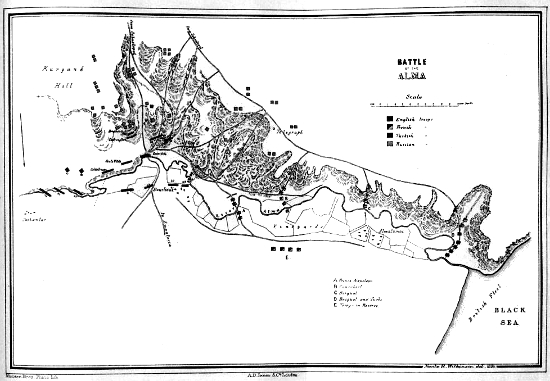
BATTLE OF THE ALMA A.D. Innes & Co. London
Military critics are disappointed with this battle, and condemn 175both sides for displaying little tactical knowledge or talent. Menshikoff left almost everything undone, to enable him to make a stand on the ground he had himself selected for barring the march of the Allies. The influence of St. Arnaud, who at this time was in bad health, seemed to damp the usual ardour of the French; and on this occasion they hardly maintained the high standard of their brilliant military reputation. We have seen that Lord Raglan and the Marshal had formed no definite plan of action before the fight began. If they intended to turn the enemy’s left, and drive him off the road to Sevastopol into the interior, the English attack was too soon delivered; and if they hoped to push him towards the sea, they took no measures to effect that object. They pursued neither of these courses, and a mere frontal attack was undertaken, which resulted in dislodging the Russians, but which, in the absence of a vigorous pursuit, involved them in no serious disaster. Lord Raglan, moreover, having ordered the first line to advance, took up a position well in front of his own army, within the ground occupied at that time by the enemy; in this exposed place he watched the course of the battle, but he ceased to be able to control it. Hence the co-operation between his divisional commanders, necessary to the attack, was wanting, and we missed the opportunity of inflicting a greater defeat upon the enemy than we succeeded in doing. Of the bravery of both the Officers and men, of the steadiness and discipline under fire of the rank and file, who for the first time were in action, but one opinion has ever been expressed.
“All, therefore, that we had to be proud of was the dash and valour of the regiments engaged. These were very conspicuous, and worthy of the traditions of the Peninsular days. A French Officer, who was viewing the field, where our men lay, as they had fallen, in ranks, with one of our naval Captains, observed to him, 'Well, you took the bull by the horns—our men could not have done it.'”[235]
As has been said, there was no pursuit after the battle, and the enemy was allowed to leave the field unmolested. This was the more unfortunate, since the retreat of the Russians degenerated into a rout. But worse followed, for the morning of the 23rd dawned before we stirred from the scene of our success, and two of the most valuable days of the campaign were irretrievably lost 176to the Allies. The fault was St. Arnaud’s, whom nothing could shake in his determination to remain where he was. Happily the strain of the alliance touched not the troops of either nation, and among them existed warm feelings of an honest camaraderie. Just as the First Division was about to fall in, a French brigade passed by on its southward march, and friendly expressions of mutual recognition and of good will were heard; from us, by lusty cheers and waving of bearskins and bonnets, and from them by hearty cries of “Vivent les Anglais! Vivent les Montagnards!”
Leaving the Alma, the approach to Sevastopol was made by easy stages. On the 23rd a halt was called at noon on the Katcha, where we had the mortification of learning that the heavy field-pieces, which had done us so much damage on the Kurgané heights, had left but four short hours before our arrival. Next day, we reached the Belbek, thirteen miles from the late field of battle, and within striking distance of Sevastopol, the goal of our ambition. And now a strange thing happened. Far from attacking the very position we had come to assail, we even refused to make a reconnaissance to ascertain the nature of its defences, and the force and quality of the enemy holding it.
The expedition, we have seen, was expressly designed to be a speedy operation, and every step taken with respect to it was governed by that one idea; otherwise, it would never have been undertaken in the autumn of 1854. Hence, a coast destitute of secure harbours wherein to form a base of operations, was not considered unsuitable as a landing-place; communications between the Crimea and the rest of the Russian Empire were not intercepted; a line of advance exposed to attack by a relieving army was not rejected; a late season of the year did not put an end to the enterprise; and hence, also, there was no provision made for the winter. These conditions were none of them in accordance with sound military science or practice; but they were accepted, and they led the army to the north side of Sevastopol—to the objective which the Allies designed to reach when they landed at Old Fort. Arriving there, the Anglo-French armies came face to face with an obstacle, some works loomed in the haze before them, and they began to deliberate. Counsellors, not consulted when the expedition was planned, were now admitted as advisers, and they naturally viewed the problem without reference to the past. We had lost touch with the defeated Menshikoff, and it was thought 177that he probably had his army safe behind the entrenchments in front; the attack might not succeed, a delay might occur, and at any rate it was dangerous to wait when we had no secure base in our rear. In short, the hazardous nature of the expedition which had been forced upon the allied Commanders from home, suddenly burst upon them with a vivid light never experienced before, and they had to recognize, although unfortunately they did not yet acknowledge, that the surprise had failed, that a lengthened siege was inevitable, and that the descent on the fortress, as originally conceived, was a snare and a delusion.
And yet, had the position been reconnoitred, some interesting facts would have been revealed. We should have found the defences weak, imperfectly armed, and garrisoned only by 11,000 men, whose weapons for the most part were antiquated flint-locks, while others were only provided with pikes or cutlasses.[236] The field-force that fought on the 20th was not there at all; it had hastily retired to the south side to re-organize itself after the disaster it had suffered.
The possession of the north side of Sevastopol offered the Allies considerable advantages.[237] The town, barracks, dockyards, and arsenal are built on the south side of an extensive creek, deep enough to float the largest ships of war, which runs from the sea in an easterly direction four miles inland, 1000 to 1200 yards in breadth. This inlet, forming the roadstead or harbour of Sevastopol, is defended at its mouth by several strong forts, some of those on the north side being perched on cliffs 100 feet high. The northern bank entirely commands the south side, and rises from the water’s edge more abruptly than the latter. These things were known to the Allies before they landed in the Crimea. It is obvious that, if the invaders could have established themselves on this northern bank, they would have taken the town and some of the forts in reverse; and that, if they could have brought up sufficient guns of the requisite calibre, the fortress itself would have been untenable, and the destruction of the ships in the harbour ensured by the force of plunging fire directed upon them.
While we lingered on the Alma, General Menshikoff had not been idle, and he determined to secure all the advantages which the Russian fleet of the Black Sea might be able to confer. It was hopeless to suppose that this fleet could cope with our own 178magnificent ships which lay outside the harbour; and indeed, ever since the battle of Sinope, it had been carefully kept out of harm’s way. The only use to which it could be put, was to convert it into an addition to the land defences of Sevastopol; but even then, it would be exposed to danger, for the enemy had a wholesome dread of what the historic daring of British seamen is capable of achieving when directed by an enterprising commander. On the night of the 22nd, therefore, he effectually barred the entrance of the roadstead by sinking seven vessels, and by constructing a boom across it, and thus he secured his shipping from any direct attack which our navy might have contemplated. Hence, the Russian war-ships became stationary floating batteries, and their function was to play their guns upon the ground that bordered the roadstead. For this device, also, the Allies must have been prepared, and might have taken it into consideration before even they started on the expedition. Now, the plateau on the top of the heights overlooking the town from the north, was much less (if at all) exposed to the enemy’s naval artillery than the ground over which the invaders must advance, if they meant to deliver their attack from the south; and the fire directed upon this plateau would be uncertain and inefficient, since considerable portions of it were out of sight of the ships below.
The British Admiral, Sir Edmond Lyons, at that time second in command, never lost sight of the original plan of invasion: he advocated strongly an attack upon the north side, and was prepared to take a prominent part in the action he expected to follow. If successful, the closing of the harbour was of trifling moment. This powerful co-operation was impossible on the south side. Lord Raglan agreed with the Admiral, and was also in favour of striking a blow from the north, as had always been intended. But he was in a position of great difficulty. Some of his own advisers were against the proposal, and the French Marshal, always unfavourable to activity in this quarter, was sinking under a disease that carried him off before the end of the month. The question whether this attack from the Belbek river would have brought about the immediate fall of Sevastopol, need not be further discussed; no attempt was made to ascertain whether it was practicable. Suffice it to say that General Todleben, who defended Sevastopol, afterwards expressed his deliberate opinion, and elaborately argued it out, that the northern plateau was untenable by the Russians, and that 179operations conducted against it would have led the Allies to a speedy success. Nevertheless, it is important to notice that the original design of taking Sevastopol by a coup de main under the effects of a surprise, was given up before even a reconnaissance was made to ascertain the strength of the objective, to which the Allies were committed by that very design. We shall now see that, refusing to pursue their plan, on account of the serious military errors it disclosed, the Allies were forced to adopt another plan, which equally, if not in a greater degree, violated the canons of the science of war.[238]
180h2 CHAPTER VIII. | BEFORE SEVASTOPOL.
Predicament in which the Allies found themselves—Flank march round Sevastopol—Occupation of Balaklava by the British and of Kamiesh Bay by the French—The Allies refuse to assault Sevastopol; they prefer to bombard it—Depression of the Russians, who fear a prompt assault—Description of the defences round the south side of Sevastopol; successful efforts of the enemy to strengthen them—Description of the upland of the Chersonese, occupied by the Allies; their position and labours—First bombardment and its results—No attack; a regular siege inevitable—Draft of Officers and men to the Coldstream arrive in the Crimea—Establishment of the Regiment—Russian reinforcements begin to arrive—Battle of Balaklava; Cavalry charges—Sortie of the Russians against the British right flank; its failure.
The Allies, at this juncture, found themselves placed in a strange predicament. Their plans had hitherto been successful, and nothing remained to be done except to justify their first resolutions by standing firm to their original purpose. The critical moment at length arrived, and then, in the very presence of the enemy, they changed their minds. They would not operate against the north of Sevastopol; they would attack it from the south, and form a secure base in the harbours of Balaklava and Kamiesh, that indent the coast of the upland plain, called by the ancients the Chersonese. In order to accomplish this new design, they had to march the united armies from the Belbek to the south-west corner of the peninsula, quite close to the fortress they intended to capture. Added to this, the ground over which they had to pass was unknown; they left behind them the broad, open, and treeless plains, where they could march in battle array, ready for emergencies; they now approached a woody, difficult, and intersected country, and had to adopt long columns of route in moving across it. According to the information in their possession, moreover, a hostile army was sheltered somewhere within the lines of Sevastopol; it was believed to be securely posted behind the 181entrenchments on the northern plateau. They did not wish to meet it there, and, to avoid doing so, they were obliged to have recourse to the only alternative, and to commit a bad military error. They exposed the right of their long columns and their rear to imminent danger, and, courting disaster, invited the Russians to fall upon them, in a position where partial defeat must prove fatal to their existence.
On the 25th the main body, preceded by a regiment of cavalry, a troop of horse artillery, and a battalion of Rifles, left the Belbek, and the perilous flank march commenced. It was carried out in a manner which would have given the fullest advantages to the enemy had he availed himself of them. The general direction was kept, often by consulting the compass; but the difficulties of the country, the thick woods, and the haste which urged us forward, disarranged the order of the troops. At one moment, indeed, the head-quarters, leading the whole advance, were followed by a long procession of thirty guns without supports, and offered a tempting and easy reward to Russian enterprise. But, slow though we may be to recognize it, a miracle does sometimes take place, and in this case it showed itself in the fact, that the extraordinary march proceeded onwards without the slightest mishap. Not only this, but the British even captured some twenty carts from the enemy, though they failed to get hold of the horses, which were cut away directly we came into sight. This meeting came about in a curious way. It happened, as we have seen, that Prince Menshikoff, far from taking post on the north plateau, was refitting his defeated army in the town of Sevastopol south of the roadstead. He came to the conclusion that he ought to preserve his communications with the interior of the Crimea, and support the advance of the reinforcements he expected to come from Bessarabia. At dawn on the 25th, therefore, he, too, emerged from his retreat, crossed the Tchernaya at Traktir Bridge, and, advancing to Mackenzie Farm, marched towards Bakshiserai. Thus it came about that the two contending armies, moving on the same day, and for some time advancing towards one another by the same road, crossed each other’s path, and that neither had the least conception of what the other was doing. It was fortunate that, in this curious game of blind man’s buff, Menshikoff did not strike our columns of route full in the flank; as it was, we justjust happened to drive our ram into the tip 182of his tail; for, as the head-quarter Staff, stumbling suddenly on the last portion of the enemy’s baggage train as it passed unconsciously by, stood wondering at the sight, a few of our guns hurried up to the rescue, unlimbered, and secured some of his unhorsed carts. Among the booty was a carriage belonging to one of the Russian Commanders, in which were stars, crosses, medals, uniform, French novels, and a portfolio “of coloured prints, the morality of which will not bear discussion.”
The experiences of the First Division on this march should not be omitted. After waiting ready equipped for two hours, the men at length moved off, at 8.30 in the morning, and plunged almost immediately into the forest.
“Everybody who has seen beaters pushing their way through a thick cover, may form a faint idea of the difficulties which beset, and the obstacles which retarded our progress. The heat was overpowering, not a breath of air percolated the dense vegetation. You scrambled on with arms uplifted to protect the face against the swinging back-handers dealt by the boughs; now your shakoe was dashed off, now the briars laid tenacious hold on your haversack, or on the tails of your coatee. It was as much as you could do to see the soldiers immediately on your right and left. For the time, military order was an impossibility, brigades and regiments got intermixed. Guardsmen, Rifles, and Highlanders straggled forward blindly, all in a ruck. There was much suffering, and some stout soldiers dropped involuntarily to the rear, to be heard of no more.”[239]
No. 5.
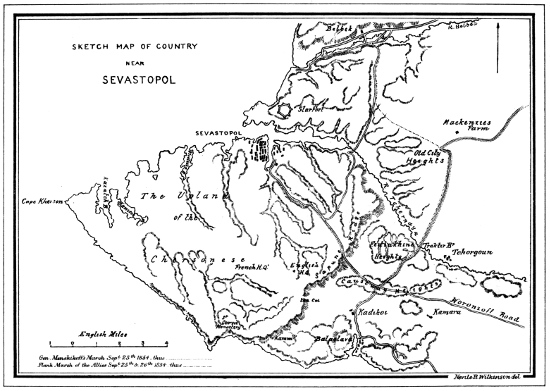
SKETCH MAP OF COUNTRY NEAR SEVASTOPOL Compiled from Hamley’s Crimea by kind permission. A.D. Innes & Co. London.
After four hours or more, the troops emerged on a lane blocked by the cavalry and baggage, and squeezed through. A little later they heard an explosion, and, pushing forward, they came upon the scene of the singular meeting that took place between the head-quarter Staff and the rear of the enemy’s army. Continuing along a tolerably good road, they approached the valley of the Tchernaya after dark, and, crossing it at Traktir Bridge, they finally bivouacked near the village of Tchorgun, at ten o’clock at night, “completely exhausted, parched with thirst, and their clothes much torn by struggling through the wood.” Indeed, they were fortunate, for it was one in the morning before the last British division reached its halting ground. The French, who followed their English allies, remained for the night midway on the wooded heights near Mackenzie Farm, where they suffered much from want of water. Next day the movement continued; 183and the cholera, that accompanied our troops without intermission, burst out with renewed malignity, and struck its victims down on the roadside along our line of march. After three hours, the division reached Kadikeui, about half a mile from Balaklava; while our ships, approaching, threw a few shells into an old Genoese fort, which commanded the harbour, and which was held by a handful of Greek troops in the Russian service; after a mere show of resistance, they surrendered without difficulty. The French also moved forward on the 26th, and established themselves on the Fediukhine heights near the Tchernaya. The Fourth Division, under Sir G. Cathcart, had been left behind on the Belbek, to embark the sick that remained there; on the same day (26th) he, too, started from his bivouac on the north of Sevastopol, and, following the track of the Allied armies, arrived on the Tchernaya without misadventure.
Thus the flank march was completed, and during the whole of the difficult and dangerous operation, lasting two days, the Russians stood by absolutely passive, and the Allies were entirely unmolested. Not a company was cut off, nor was a gun taken. This was the more remarkable since, perceiving the movement from a high tower in Sevastopol, they were accurately informed of our plan at midday of the 25th; General Menshikoff must also have known it, from the meeting that took place between the hostile armies near Mackenzie Farm. It was, indeed, fortunate that we had so forbearing an enemy.
Communications having now been fortunately re-established with the fleet, the British occupied the Bay of Balaklava, the French that of Kamiesh, where their respective bases of operations were formed. Thus we were placed on the right of the new line fronting northwards, and we were again posted upon the exposed flank. About this time, an event of importance occurred to the French. Marshal St. Arnaud got so ill, that he was obliged to give up his command, and to leave the seat of war. He was to be taken to Scutari, but he died on the passage. General Canrobert succeeded him—a valiant, honourable, and straightforward soldier, but one little fitted to take upon himself the onerous responsibilities of his new position.
The Allies now found themselves occupying a fertile country, almost entirely denuded of inhabitants, who fled at their approach, covered with highly cultivated gardens, orchards, and vineyards, 184which teemed with vegetables and fruit in great abundance. Never were troops so amply supplied as during the first few days of their stay in this land of plenty; but the good things did not last, they were soon exhausted, and could not be replaced. The men were not easily restrained from enjoying to the full the luxurious feast which lay before them, after the fatigues of the forced flank march; though it is to be feared they suffered from its effects, and from the fact that they were still without tents. Cholera continued, and diarrhœa (its pilot-fish) increased considerably.[240]
The idea seems to have been pretty general among the troops that the flank march was intended to shift the position of the united armies from a strong front of Sevastopol to a weaker side, and that the attack was only delayed until we got close to the southern defences of the town. It was confidently expected that the assault would be soon delivered, and the landing of the siege-train did not put an end to that hope. As days went by, however, it began to be realized that operations of a slower nature were to be begun, and that a siege, not an assault, was to be undertaken. This surmise was entirely correct; though the Chiefs of the armies still held to the belief that, when a bombardment by siege guns had taken place, the defences would be destroyed, and the town would then fall before the winter set in. Lord Raglan personally seems to have been disposed to make an immediate attempt against the enemy’s lines, without incurring this further delay; and this view was certainly shared and supported by Sir George Cathcart, and was also advocated by Sir Edmond Lyons. It was urged that the Russian fortifications were slight and weak at the end of September, when the Allies got within striking distance, and, though we should be stronger against them as soon as the siege batteries were constructed and armed, yet the time required to do so could be utilized by the defenders in so strengthening their works, that the advantages of a delay would accrue to them, and to our detriment. General Canrobert, however, was cautious, and was disinclined to run any risks just as the supreme command was vested in him by the French Emperor. Others, among the British advisers at head-quarters, held the opinion that it was dangerous to deliver an attack unless prepared 185by artillery fire; they feared that the attempt might cost us 500 men, which loss they hoped would not occur if a siege were opened in the regular manner. Lord Raglan was forced to concur.
During this time the Russian commanders, left in Sevastopol after General Menshikoff’s departure, were in a state of great depression, and believed that the town could not hold out against a vigorous assault. The entire garrison amounted to 35,850 men, made up of heterogeneous elements—one single battalion of regulars (750 men), militia, gunners, marines, seamen, and workmen. Of the latter, there were 5000—a useful body to create a fortress, if time were granted, but useless to repel an immediate attack. Of the sailors set free from the imprisoned fleet, there were 18,500, of whom a fourth part only were well trained or even decently armed.[241] The south side, moreover, does not lend itself easily to a good defence.[242] A creek, hardly half a mile broad, called the inner harbour, runs inland for nearly two miles from the main roadstead, terminating in three ravines which ascend the upland of the Chersonese. This inlet divides the town from a suburb, called the Karabelnaya, and as both had to be held against the Allies, there was a formidable obstacle obstructing communications between them. The French, based on Kamiesh Bay, were opposite the western portion of Sevastopol, that is the town itself, from the sea to the head of the inner harbour. The British army on the right, faced Karabelnaya, and were responsible for the ground from the inner harbour to Careenage Bay,—another inlet, half a mile long, which also terminates in a ravine indenting the upland,—where the enemy’s defences ended. The line held by the Russian garrison was about four miles in length: two miles from the sea to the head of the inner harbour, and the same distance onwards to Careenage Bay. On the 25th of September, this long line was imperfectly defended. On the French section, the gorges of the Quarantine and Artillery Forts had been closed, and three bastions or redoubts had been constructed between them and the head of the inner harbour, where the Flagstaff bastion stood, connected, with but little interruption, by a naked loopholed wall. On the British section, there were four works, which were unconnected by wall or entrenchment, known as the Redan, the Malakoff Tower, the Little Redan, and 186No. 1 Battery, near Careenage Bay. Of these the Malakoff was “a mere naked tower, without a glacis, exposed from head to foot, unsupported by the powerful batteries which were destined to flank it, and uncovered as yet by the works which afterwards closed up round its base.” The whole of the south side of Sevastopol, moreover, was armed with 172 guns, of which by far the greater number faced the French, and only a few the British position.[243]
The serious and very reasonable apprehension entertained by the Russian chiefs did not, however, prevent them from taking every measure to fortify their position, directly they understood that the Allies were approaching the south side in force. The greatest activity prevailed day and night in the garrison and among the inhabitants, the women and children taking their share of the labour, and thus the works designed by the Russian Engineer Officer, Todleben, were rapidly thrown up. The Anglo-French Commanders never interrupted these operations, nor did they make any demonstrations to try the quality of the defences; they contented themselves with distant reconnaissances, so that in a short time the entrenchments were greatly strengthened, especially the Malakoff, and began to look more formidable than had been the case before; the armament also was being changed, the lighter guns giving place to heavier ordnance drawn from the ships and arsenal.
The upland of the Chersonese, on which the Allies had established themselves, is a sloping plain, trending from a line of hills called the Sapuné Ridge, 500 to 700 feet high, that bounds it on the east, from the head of the roadstead of Sevastopol to a point on the coast some four miles west of Balaklava. The upland is scored by numerous ravines, running from the ridge in a general north-westerly direction to the town and coast; but on the eastern side of the ridge the ground falls abruptly and almost in a cliff-like manner into the valley of the Tchernaya river, which discharges itself into the roadstead. The distance from Balaklava to Sevastopol is nearly eight miles. Of the two roads connecting them, one, the Woronzoff road, was metalled, and, proceeding along the Causeway Heights, formed the main communication with the south of the Crimean peninsula; the other, a 187mere cart-track or pathway, more to the south, ascended the ridge over the “Col de Balaklava,” three miles from that place, and joined the Woronzoff road two miles further on, on the upland.
This extended position had to be defended from attacks that were to be feared from Menshikoff’s army. The latter, having left Sevastopol, was in easy communication with the town and was securely posted on very defensible ground, from whence it could advance upon the right of the Allies or upon our base at Balaklava. Moreover, the Russians would, before long, be strongly reinforced by troops which, as we have seen, were hurrying without opposition from Bessarabia into the Crimea; but when this event would take place was still uncertain. The Allies had lost all touch with the enemy’s army they had defeated at the Alma, and their hesitation to assault the weak defences that covered Sevastopol directly after the flank march, was in a measure due to their ignorance of what their opponent was doing. In reality he was then many miles away, and had no intention of resuming hostilities without further assistance; he was re-organizing his men, and waiting for the fresh forces he expected from the north.[244] Only for the moment, therefore, was the right flank of the invaders free from danger, and under no circumstances could it have been left unguarded.
The French divided their army into two Corps. The 3rd and 4th Divisions, under General Forey, formed the besieging force, and took post before Sevastopol, their right on the great ravine which runs into the inner harbour, their left on Streleska Bay. The 1st and 2nd Divisions, together with the Turkish contingent, constituted a Corps of observation, under General Bosquet, and were entrenched on the Sapuné Ridge, facing the east, between the Woronzoff road and the Col previously mentioned. The whole of the British army was engaged in the siege, before the suburb of Karabelnaya, the left on the ravine, in communication with the French, the right upon ground not far from the Sapuné heights. The defence of Balaklava was provided by the 93rd Regiment (withdrawn for the purpose from the Highland Brigade), 1,000 Marines, a battery of Artillery, and a body of Turks (3,500 of whom had been recently despatched to the Crimea, the remainder, two battalions, being lent by the French). These troops, which included a provisional battalion formed of 25 to 30 weakly men drawn from every regiment, were placed under the command of Sir Colin Campbell, who was detached 188from his brigade. In front of them, in the valley, was Lord Lucan’s cavalry division.
These measures did not, however, secure the right flank of the British siege-works. At this point, the cliff-like appearance of the heights overlooking the Tchernaya partially disappears, and the upland falls towards the roadstead and the river, in numerous spurs, intersected by ravines. This broken country was known to the Allies by the name of Inkerman, and along its foot there ran a road from Balaklava, which, skirting the Tchernaya to the roadstead, proceeded to Sevastopol along the southern shore of the latter. The river, moreover, was crossed at its mouth by a bridge and a causeway, over which another road led to Bakshiserai. This was a vulnerable point in the line adopted by the Allies, who far from being able to invest the place they intended to besiege, were too weak even to establish themselves upon the head of the roadstead, and prevent an irruption from the town, or an attack from the direction of Bakshiserai upon the right of their position. To guard this vital point, only a strong piquet was employed, and a battery of two guns of position, called the “Sandbag battery,” constructed to strengthen it, had soon to be disarmed, as it was found impracticable to support the guns by infantry. The flank, in short, was left undefended, because the whole of the British army was required to undertake the siege, and because Bosquet’s corps had entrenched themselves on an inaccessible position on the ridge, where no enemy could attack them, and where they could neither give efficient support to the defences of Balaklava, nor be of any immediate use should an onslaught be made on the unguarded spurs of Inkerman. In other words, we suffered from the effects of a divided command.[245]
We left the Guards Brigade, on the 26th of September, near Balaklava, at the end of the flank march. For the first few days there was little done. “Troops passive and grape-gorging, with the exception of strong fatigue parties engaged in the slow and laborious office of landing the siege guns from the transports, which now cram the harbour of Balaklava.”[246] On the 2nd of October, the First Division marched to the front, and about this time the British army was thus bivouacked before Sevastopol. The Second Division on the right, with the First in support, nearly 189a mile in rear; next came the Light Division, separated from them by the Careenage Ravine. These three divisions manned the British Right Attack. The Fourth and Third Divisions were posted south-west of Cathcart’s Hill, and continued the line to the west, in rear of the Left Attack, to the ravine, on the other side of which lay the French siege corps, near Mount Rodolph. The work of bringing up the battering train continued without interruption, and some heavy guns from the ships were drawn to the batteries by sailors, who, forming a brigade under command of Captains Lushington and Peel, took part in the operations which were soon to commence.
It was fortunate that tents were at last issued, on the 5th of October; for the men, having been constantly bivouacked since the disembarkation at Old Fort, nearly three weeks before, were again attacked by sickness. Cholera reappeared on the day after the troops stood on the upland plain before Sevastopol, and an Officer of the Coldstream, Captain Jolliffe, died of it on the 4th. It seems that the delay in providing shelter, even of an indifferent nature, was due to the want of transport, which still failed us; nothing apparently could induce our Government to give the army this indispensable requirement. The boon of again having a tent to cover them in the chilly autumn nights of the Crimea, was keenly appreciated by Officers and men; but comfort is a relative term, and, judged from the ordinary standpoint, the slight shelter which was supplied, was inadequate and insufficient.
On the 4th, Captain MacKinnon and a small detachment of convalescents, who had been left behind at Varna, reached the Battalion.
The constant labour which the Russians devoted to the improvement of their fortifications became apparent to regimental Officers, as they anxiously scanned the enemy’s works during their leisure time.
“Within the last few days,” writes Colonel Wilson, on the 7th, “an amazing change has taken place in the aspect of the town. The base of the Great Tower (the Malakoff) is now 'shored up' with earthworks; and defences of similar construction—some far advanced towards completion—are being thrown up along the entire line commencing at Careenage Bay on the east, and terminating near the cemetery on the west [near the Flagstaff bastion]. Hence, in the course of a week, if not sooner, Sevastopol will have assumed the likeness of a vast entrenched camp.”
190On the same day, it seemed to leak out, that “the place looked so much stronger than had been anticipated, that perhaps we might not take it this winter;” and it was devoutly hoped that precautionary measures would be taken in time, against “the onslaughts of Generals Rain, Frost, and Snow, no matter how great soever may be head-quarter confidence in the overwhelming efficacy of our opening fire.”[247]
It was, however, still officially considered that the projected bombardment would shatter the Russian defences, and that the speedy capture of Sevastopol would be the result. This opinion was also shared by many of the Officers of the British army, and every nerve was strained to make the operation a success. On the 10th we broke ground, and began the construction of three batteries. Two, known as Chapman’s and Gordon’s, called after the Engineer Officers in charge, were some 1400 yards from the Redan, and the trench connecting them became eventually the first parallel. Chapman’s battery, 41 guns, was placed on Green Hill, between two ravines that descend into the inner harbour, viz. the valley of the Shadow of Death and the Woronzoff ravine. Gordon’s battery, 26 guns, stood on Mount Woronzoff (also called Frenchman’s Hill), between the Woronzoff and the Docks ravines. On the next hill, between the Docks and the Careenage ravines, the Victoria or Lancaster battery was built, armed with 6 guns (5 of the Lancaster pattern), more than 2000 yards from the enemy’s lines. The French began their siege-works on the 9th, on Mount Rodolph, and placed 53 guns in battery, 1000 yards from the enemy’s fortifications. Thus the Allies had 126 guns in position, not counting the field artillery. The enemy had 118,—64 facing the French, and 54 the British,—besides 223 of lesser calibre.
The Battalion, in common with the other troops stationed before Sevastopol, took their full share in the construction of these batteries, by supplying working parties and covering guards to resist sorties. The operation was new to all ranks, who had received little training in these special duties, the greater part of which had to be performed at night. But any confusion incidental to the circumstances of the case speedily passed away, and from start to finish the men stuck to their work, and did it thoroughly, under a heavy and unreturned fire, that constantly poured upon them from dawn to dark from the Russian lines.
191
“On the 14th October,” Colonel Wilson writes, “the duties grew very hard. For myself I have been at work four nights out of five, and so have many others.... But in this respect, of course, the rank and file are the principal sufferers. To what insignificance do our hardships sink when compared with theirs! In the case of the private, downright manual labour—picking, shovelling, dragging, lifting—is superadded to watching. In his instance, no little dainties ... vary the nauseous salt junk, and the wish-wash of green coffee. In his instance, the tatters—which were a uniform once—only cover the wearer’s nakedness imperfectly: that ragged patchwork has long ceased to combat with the wind and rain.... Oh! what painful illustrations of the cheap and nasty principle, are those filthy dangling shreds and bursted seams! How one’s heart yearns toward the unflinching British 'common soldier' so sternly superior to privation, so proudly reckless of his life! Brave heart! unconquerable soul! Crimean hero, whom we cannot glorify too much!”[248]
The excellence of the work performed by the Brigade is thus described in a recent publication, already alluded to:—
“The spade work of the soldiers varied considerably, but from the Royal Engineers' journal of work done in Bulgaria, and from what I saw early in the siege, that of the Guards Brigade was undoubtedly amongst the best. This may have arisen from the memory of instruction at Chobham camp in 1853, or from regimental pride, or from both causes.... By the end of August the infantry had made six thousand gabions and seven hundred fascines; for every one of these passed as serviceable, the soldiers received 14d. and 7d. respectively, which included the labour of cutting and carrying the brushwood which was close at hand. In the Guards Brigade each section of three men produced three gabions daily; in the Line the average did not exceed one gabion daily per section. Throughout the long ensuing siege, the working parties in the trenches did well or badly in proportion to the efficiency of the Officers. When they sat and smoked, paying no attention to the men, the sergeants followed suit, and but little progress was made. On the other hand, when the Officers, keen and sympathetic, knew how to get cheerful work out of their men, the spirits of the directing Engineer Officer rose considerably.”[249]
The following extracts from Colonel Tower’s diary, give, 192moreover, an idea of the nature of some of the duties discharged by the men, and the conditions under which they were performed:—
“Oct. 14th. Paraded at 3 a.m. for a covering party in rear of Chapman’s battery. The enemy annoyed us very much all day, throwing shot and shell, but, by dint of creeping about and keeping well under the parapet, we all got safe back to camp at 6 a.m., after twenty-seven hours in the trenches.
”Oct. 16th. On covering party in rear of the sailors' battery. There was a large heap of stones, two to three feet high, behind which we laid down as flat as we could; about 10 a.m. a red flag was hoisted on the Redan, and immediately every gun they had mounted commenced pitching into our battery, ... for about half an hour, evidently to try their range. Every sort of missile they could cram into their guns came whistling over us and knocking our heap of stones about. We lay as still as mice, and the shot rattled about like hail, and went bounding away over the hill in our rear towards the camp; Goodlake and self, Francis Baring and Bob Lindsay were our party. In the middle of the jeu d’enfer, old Gordon the Engineer appeared walking over the open towards the battery, the shot striking the ground all round him; he never quickened his pace, and seemed perfectly unconscious of his imminent danger: but fortune favours the brave, and although he ought to have been struck fifty times, he coolly walked up the hill with the utmost indifference.”
In preparation for the bombardment, fixed to commence at 6.30 a.m. on the 17th of October, the troops were held in readiness in their camps to fall in at a moment’s notice, arrangements were made in case the army was ordered to move forward to assault the Russian position, scaling ladders, tools, etc., were collected, and a body of sharpshooters was specially organized. In the First Division, the latter were placed under Captain Goodlake of the Coldstream, whose gallant services soon earned for him the Victoria Cross.[250] But the first onslaught on Sebastopol failed to 193produce the results that were expected from it. The Allies found the enemy placed in far other circumstances than had been the case when they first presented themselves before the south side on the 26th of September. At that date the advantages gained by the battle of the Alma had not been entirely dissipated: the Crimean field army, under Menshikoff, was beaten, and was far away from the scene of hostilities, refitting and awaiting reinforcements; the garrison of Sevastopol—composed of a mere medley of details, imperfectly armed, and many of whom could scarcely be called “combatants”—was physically and morally weak; the entrenchments were slight and incomplete; the guns to oppose an attack were light. On the 17th of October a great change had been effected. The forces from Bessarabia were arriving; the Russians had been able to reconnoitre the valley of the Tchernaya, and to threaten our exposed right flank and our base of operations; they spared as many as 25,000 of the regular army to strengthen the garrison of the town; the morale of the latter had been raised; the defences were much improved—they assumed the appearance of genuine fortifications; the armament was greatly increased, and had been rendered formidable.
Nevertheless, the operation was an affair of great importance and magnitude. The Allied fleets took part in it in full force, though it was not possible for them to produce any real effect; for the land defences were out of their reach, and the sea forts were extremely strong. Still all the artillery the invaders could muster, discharged their thunders upon the fortifications which covered the south side of the town and the entrance of the roadstead. The French, subjected to a hotter and closer fire than we, suffered severely, and between ten and eleven in the morning, two explosions having occurred in their batteries, their guns were silenced. The British, on the other hand, were very successful. Directing their fire upon three of the enemy’s works, they inflicted considerable damage on the Flagstaff battery, silenced the Malakoff, and almost demolished the Redan, the salient of which was blown to pieces by the explosion of a powder magazine. The defences of the Karabelnaya were completely paralysed, an immediate assault was 194expected, and the troops to oppose it being demoralized, fell back in confusion.[251]
No. 6.
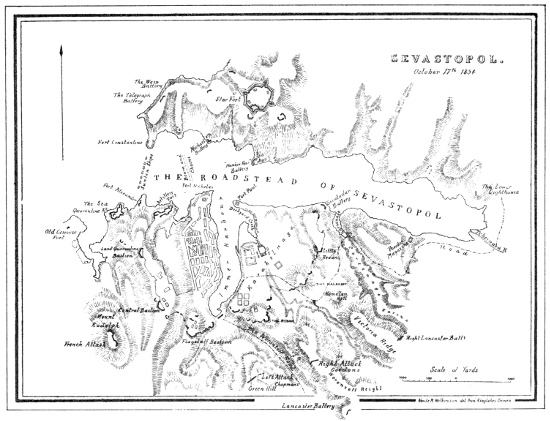
SEVASTOPOL October 17th 1854 By kind permission from Kinglake’s Crimea. A.D. Innes & Co. London
But no attack took place. The French were unable to advance against the lines which had silenced their siege guns. It was too much to ask them to allow us to go on, under cover of their friendly co-operation and support. The enemy, in a word, gained by the Anglo-French alliance, and the common interests were obscured under the pressure of inter-national courtesy. Thus a severe strain was still to weigh down the resources of the two Great Powers of Europe; an insignificant fortress was to baffle their united efforts; their armies were to be destroyed on the upland of the Chersonese by cold and famine; and, while our British Engineers alone could survey with complacency the results of their skill, evidenced by the speedy destruction of the defences around Karabelnaya, the Allies were not one whit nearer the accomplishment of their object than they had been before the bombardment began. Still the Chiefs of the invading forces were sanguine that their fire at last would tell, and would allow them to storm the place together, at points where each had breached the defences opposed to them; but in this expectation they were, as they deserved to be, disappointed. The bombardment was continued on the 18th, and the British batteries alone took part in it—for the French were not ready, and were improving their earthworks after the disaster of the day before,—not, however, against the wreck which we had created by the evening of the 17th, but on renewed and freshly armed defences that were repaired in the night by the ceaseless energy of the garrison, whose labours were undisturbed by any countermove on our part. Again, on the 19th, the united artillery fired on the hostile batteries with complete success on our side, but once more the French guns were silenced. The bootless bombardment continued till the 25th, ever with the same result: the lines covering the Karabelnaya were open to attack, but the forts opposite Mount Rodolph were unsubdued. Thus no advantage was gained, or indeed could be gained, under the rule which the Allies had imposed upon themselves to the benefit of the enemy, who, not slow to perceive the situation, took every advantage therefrom. A great display, therefore, was all that took place, which cost the Russians nearly 4000 men, while the Allies lost less than a fourth part of that number.
195As the fire proceeded from day to day, the attention of the First and Second Divisions was directed to their right flank.
“Started an hour before daybreak on outlying piquet on the heights to our rear, and was kept the whole day in a state of excitement by a large force of Russians, cavalry and artillery, in the plain below; some took up a position on the hills in front of Balaklava, and some remained near where we bivouacked at the Tchernaya bridge, evidently threatening Balaklava. Some of them advanced towards us, and brought some artillery and opened fire. Presently a battery of ours unlimbered in the bushes by my piquet, and got ready for action; the 2me Zouaves were also sent, and there was a report that the enemy was advancing up the Inkerman gorges; in short, we thought we were in for a scrimmage. But after a short time the Zouaves and artillery were sent back to their quarters, and I was left face to face with the Ruskis. After dark their fires blazed all over the plain, but nothing occurred. I was with my sentries all night. They evidently intend making an attack on Balaklava when we assault the town, which doubtless must take place soon.”[252]
The enemy, seen upon this occasion, was again observed by a piquet of the Coldstream on the 20th, among the Inkerman ruins (beyond the Tchernaya), mounting guns. Towards evening he opened fire, and directed his aim upon the camp of the Second Division, until the Sandbag battery, previously mentioned, was constructed, and armed with two 18-pounders. The British fire soon drove away the guns from the ruins, but the 18-pounders had to be removed to a less exposed position.
Nine Officers reached the Crimea and joined the Battalion on the 17th, the first day of the bombardment, viz. Lieut.-Colonels Newton, Cowell, and Halkett (who had left Bulgaria on promotion in July), Lieut.-Colonels Mark Wood, Dudley Carleton, and Lord A. Charles FitzRoy, and Lieutenants Heneage, Hon. W. Amherst, and Greville.
It should be stated here, that, on account of the war, the Regiment received an augmentation, first on the 13th of February, and again a little later. The establishments were as follows:—
Feb. 1st, Mar. 1st, Aug. 1st,
1854 ” ”
Colonel. 1 1 1
Lt.-Colonel. 1 1 1
Majors. 2 2 2
Captains. 16 16 20
Lieutenants. 20 20 24
Ensigns. 12 12 16
Adjutants. 2 2 2
Qr.-Masters. 2 2 2
Surgn.-Major. 1 1 1
Surgeon. 1 1 1
Assist.-Surgns. 2 3 4
Solicitor. 1 1 1
Sergeants. 72 88 118
Drummers. 37 37 46
Rank and File. 1280 1600 2200
2 Battns. 2 Battns. 2 Battns.
. 16 Cos. 16 Cos. 20 Cos.
196Of the twenty companies, twelve were at home and eight at the seat of war, but the latter were strong companies on paper, and the former weak; it was further ordered that the service Battalion was not to bear upon its strength less Officers than were required for 10 companies, the Adjutant not included.[253] Hence the two mounted Officers who, before the receipt of this order, were posted to companies in the field, were placed upon the 1st Battalion establishment, and nominally belonged to companies at home.
During the first few days of the operations against Sevastopol there were several casualties among the Officers of the Grenadier Guards. On the 16th, Captain Rowley was killed, and, two days later, the same fate overtook Colonel Hood, the gallant Commanding Officer who had greatly distinguished himself by his coolness and intrepidity at the Alma. The losses of the Coldstream at this moment were happily less. It was not till the 20th, that the first man was wounded in the trenches; but next day, Lord Dunkellin was unfortunately captured. Commanding a working party without arms—for at that time the men told off to dig were sent to the front unarmed,—he lost his way in the darkness, and, stumbling upon a piquet which he thought was English, he went forward by himself to ask where he was. As it happened, he found himself within the enemy’s lines, and was taken; his men, however, luckily escaped under cover of the night.[254]
Prince Menshikoff so far recovered from his defeat on the 20th of September, that he occupied the hills in the neighbourhood of Mackenzie Farm, and took possession of the roads leading therefrom into the valley of the Tchernaya on the 7th of October. He had good reason to be proud of the achievements of the garrison of Sevastopol, and to rejoice at his own singular good fortune. The town was fast growing into a powerful fortress, sufficiently strong to resist any sudden assault, and likely for months to occupy the energies of a far more numerous force than stood before it at that time. He himself was placed in an unassailable position. Secure as regards his communications with the interior of Russia 197and with Sevastopol, he not only received without difficulty the fresh forces that were hurrying to his assistance; but he also hemmed the invaders into a small corner of an exceedingly inhospitable country, restricted their enterprise, and threatened them with destruction in case a reverse were to happen to them. History, indeed, fails to record any great genius in this Russian General, nor were his troops of that high order to account for the immense advantages he gained at this moment. He was simply fortunate in the Governments and in the leaders of his antagonists, who, unable to combine to carry out any single plan, continually changed their intentions, until a surprise on the north side was converted into a lengthy siege (without investment) of the south side.