Chapter IV · THE WAR FOR INDEPENDENCE
Reading edition
Then, almost immediately, came the clash of arms. General Gage would not sit still and see the country round about him made ready for armed resistance without at least an effort to keep control of it. On the 19th of April he despatched eight hundred men to seize the military stores which the provincials had gathered at Concord, and there followed an instant rising of the country. Riders had sped through the country-side during the long night which preceded the movement of the troops, to give warning; and before the troops could finish their errand armed men beset them at almost every turn of the road, swarming by companies out of every hamlet and firing upon them from hedge and fence corner and village street as if they were outlaws running the gauntlet. The untrained villagers could not stand against them in the open road or upon the village greens, where at first they mustered, but they could make every way-side covert a sort of ambush, every narrow bridge a trap in which to catch them at a disadvantage. Their return to Boston quickened to a veritable rout, and they left close upon three hundred of their comrades, dead, wounded, or prisoners, behind them ere they reached the cover of their lines again. The news of their march and of the attack upon them had spread everywhere, and in every quarter the roads filled with the provincial minute men marching upon Boston. Those who had fired upon the troops and driven them within their lines did not go home again; those who came too late for the fighting stayed to see that there were no more sallies from the town; and the morning of the 20th disclosed a small army set down by the town in a sort of siege.
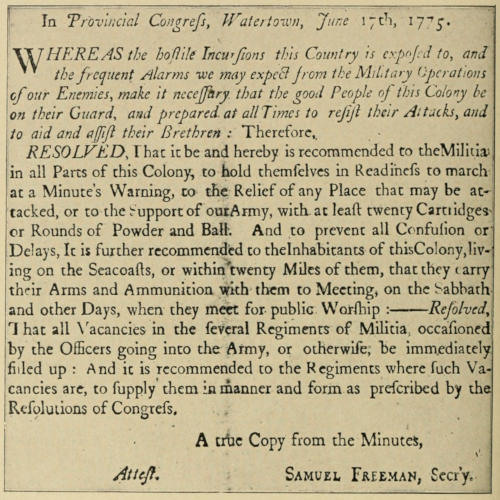
NOTICE TO MILITIA
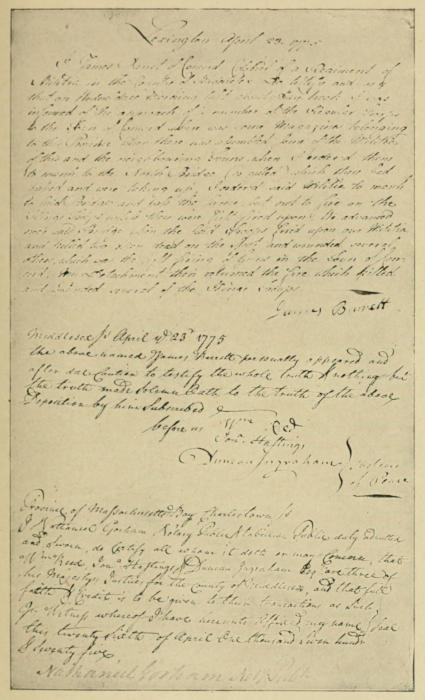
AN ACCOUNT OF THE CONCORD FIGHT
That same night of the 20th Lord Dunmore, in Virginia, landed a force of marines from an armed sloop in the river and seized the gunpowder stored at Williamsburg. There, too, the country rose,—under Mr. Henry himself as captain. They did not reach the scene soon enough to meet the marines,—there were no thick-set villages in that country-side to pour their armed men into the roads at a moment’s summons,—but they forced the earl, their governor, to pay for the powder he had ordered seized and taken off.
SIGNATURE OF ETHAN ALLEN
The rude muster at Boston expanded into a motley yeoman army of sixteen thousand men within the first week of its sudden rally, and settled in its place to watch the town until the general Congress of the colonies at Philadelphia should give it countenance, and a commander. On the day the Congress met (May 10, 1775), Ethan Allen walked into the unguarded gates of the fort at Ticonderoga, at the head of a little force out of Vermont, and took possession of the stout place “in the name of the Great Jehovah and the Continental Congress,” though he held a commission from neither; and two days later Crown Point, near by, was taken possession of in the same manner. When the Congress met it found itself no longer a mere “Congress of Committees,” assembled for conference and protest. Its appeals for better government, uttered the last autumn, its arguments for colonial privilege, its protestations of loyalty and its prayers for redress, had been, one and all, not so much rejected as put by with contempt by the King and his ministers; and the mere movement of affairs was hurrying the colonies which it represented into measures which would presently put the whole matter of its controversy with the government at home beyond the stage of debate. Its uneasy members did not neglect to state their rights again, in papers whose moderation and temper of peace no candid man could overlook or deny; but they prepared for action also quite as carefully, like practical men who did not deceive themselves even in the midst of hope.
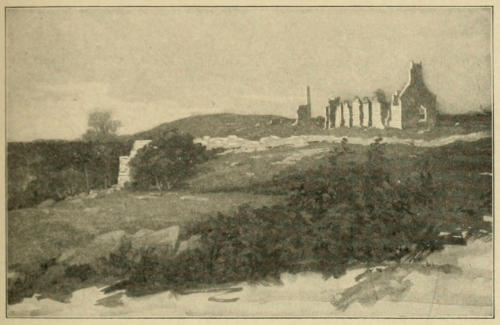
RUINS OF FORT TICONDEROGA
Colonel Washington had come to the Congress in his provincial uniform; and, if no one cared to ask a man with whom it was so obviously difficult to be familiar why he wore such a habit there, all were free to draw their own conclusions. It was, no doubt, his instinctive expression of personal feeling in the midst of all that was happening; and his service in the Congress was from first to last that of a soldier. Its committees consulted him almost every day upon some question of military preparation: the protection of the frontier against the Indians, the organization of a continental force, the management of a commissariat, the gathering of munitions, proper means of equipment, feasible plans of fortification. While they deliberated, his own colony passed openly into rebellion. The 1st of June saw Virginia’s last House of Burgesses assemble. By the 8th of the month Dunmore had fled his capital, rather than see a second time the anger of a Williamsburg mob, and was a fugitive upon one of his Majesty’s armed vessels lying in the river. The colony had thenceforth no government save such as it gave itself; and its delegates at Philadelphia knew that there was for them no turning back.
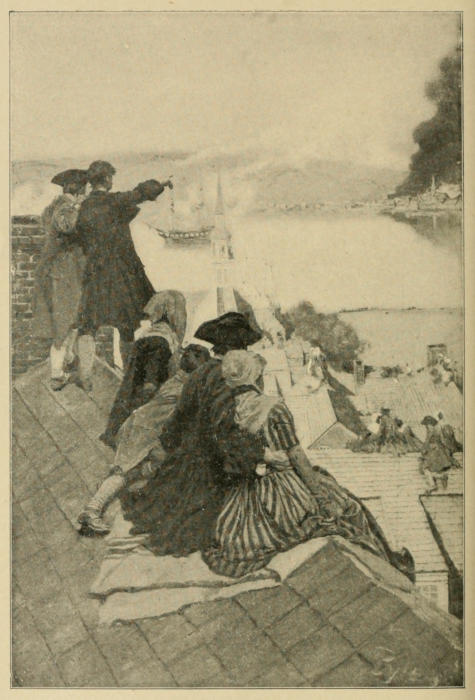
WATCHING THE FIGHT AT BUNKER HILL
On the 15th of June, on the motion of Mr. John Adams, the Congress chose Colonel Washington commander-in-chief of the American forces, and directed him to repair to Boston and assume command in the field. Two days later the British and the provincials met in a bloody and stubborn fight at Bunker Hill. On the 25th of May heavy reinforcements for General Gage had arrived from over sea which swelled the force of regulars in Boston to more than eight thousand men, and added three experienced general officers to Gage’s council: William Howe, Sir Henry Clinton, and John Burgoyne. The British commanders saw very well, what was indeed apparent enough to any soldier, that their position in Boston could be very effectively commanded to the north and south on either hand by cannon placed upon the heights of Charlestown or Dorchester, and determined to occupy Charlestown heights at once, the nearer and more threatening position. But so leisurely did they go about it that the provincials were beforehand in the project. The early morning light of the 17th of June disclosed them still at work there on trenches and redoubts which they had begun at midnight. The British did not stop to use either the guns of the fleet or any caution of indirect approach to dislodge them, but at once put three thousand men straight across the water to take the hill, whose crest the Americans were fortifying, by direct assault. It cost them a thousand men; and the colonials retired, outnumbered though they were, only because their powder gave out, not their pluck or steadfastness. When the thing was done, the British did not care to take another intrenched position from men who held their fire till they were within a few score yards of them and then volleyed with the definite and deadly aim of marksmen.
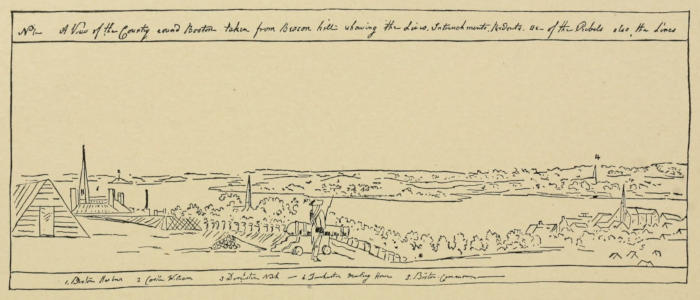
FROM BEACON HILL, 1775, NO. 1. (LOOKING TOWARDS DORCHESTER HEIGHTS)
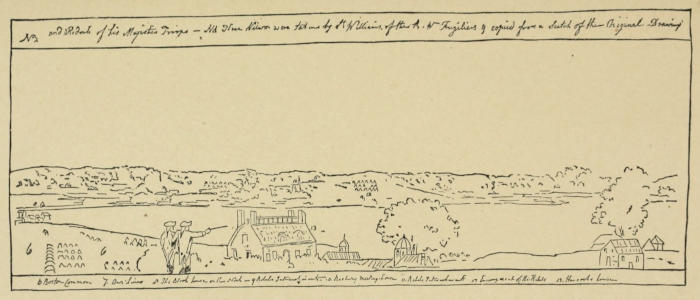
FROM BEACON HILL, 1775, NO. 2. (LOOKING TOWARDS ROXBURY)
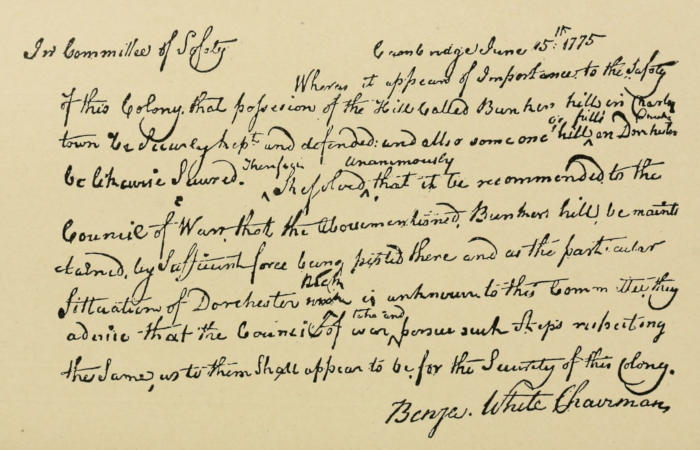
ORDER OF COMMITTEE OF SAFETY
Colonel Washington received his formal commission on the 19th, and was on horseback for the journey northward by the 21st. On the 3d of July he assumed command at Cambridge. In choosing Washington for the command of the raw levies of Massachusetts, Connecticut, Rhode Island, and New Hampshire set down in impromptu siege before Boston, Mr. John Adams and the other New Englanders who acted with him had meant, not only to secure the services of the most experienced soldier in America, but also, by taking a man out of the South, to give obvious proof of the union and co-operation of the colonies. They had chosen better than they knew. It was no small matter to have so noticeable a man of honor and breeding at the head of an army whose enemies deemed it a mere peasant mob and rowdy assemblage of rebels. Washington himself, with his notions of authority, his pride of breeding, his schooling in conduct and privilege, was far from pleased till he began to see below the surface, with the disorderly array he found of uncouth, intractable plough boys and farmers, one esteeming himself as good as another, with free-and-easy manners and a singular, half-indifferent insolence against authority or discipline.
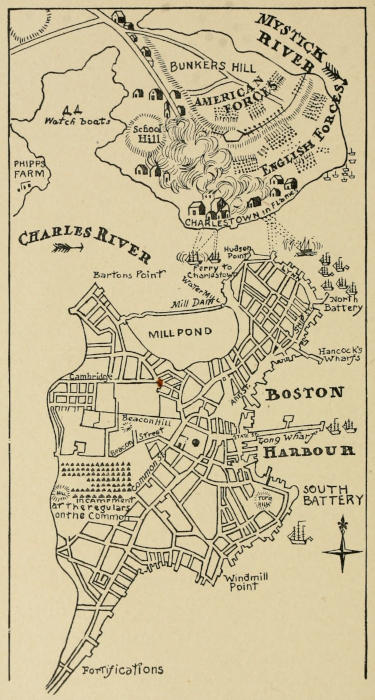
BOSTON AND BUNKER HILL, FROM A PRINT PUBLISHED IN 1781
“There are some fine fellows come from Virginia,” Joseph Reed, of Pennsylvania, had written of the Virginian delegates to the Congress at Philadelphia; “but they are very high. We understand they are the capital men of the colony.” It was good that one of the masterful group should ride all the public way from Philadelphia to Boston to take command of the army, the most conspicuous figure in the colonies, showing every one of the thousands who crowded to greet or see him as he passed how splendid a type of self-respecting gentlemen was now to be seen at the front of affairs, putting himself forward soberly and upon principle. The leaders of the revolt in Massachusetts were by no means all new men like John Adams or habitual agitators like Samuel Adams; many a man of substance and of old lineage had also identified himself with the popular cause. But new, unseasoned men were very numerous and very prominent there among those who had turned affairs upside down; a very great number of the best and oldest families of the colony had promptly ranged themselves on the side of the government; the revolution now at last on foot in that quarter could too easily be made to look like an affair of popular clamor, a mere rising of the country. It was of signal advantage to have high personal reputation and a strong flavor, as it were, of aristocratic distinction given it by this fortunate choice the Congress had made of a commander. It was no light matter to despise a cause which such men openly espoused and stood ready to fight for.
The British lay still till Washington came, and gave him the rest of the year, and all the winter till spring returned, in which to get his rude army into fighting shape,—why, no one could tell, not even their friends and spokesmen in Parliament. The Americans swarmed busy on every hand. It proved infinitely difficult for them to get supplies, particularly arms and ammunition; but slowly, very slowly, they came in. General Washington was but forty-three, and had an energy which was both imperative and infectious. His urgent, explicit, businesslike letters found their way to every man of influence and to every colonial committee or assembly from whom aid could come. Cannon were dragged all the way from Ticonderoga for his use. The hardy, danger-loving seamen of the coasts about him took very cheerfully to privateering; intercepted supply ships and even transports bound for Boston; brought English merchantmen into port as prizes; cut ships out from under the very guns of a British man-of-war here and there in quiet harbors. Food and munitions intended for the British regiments at Boston frequently found their way to General Washington’s camps instead, notwithstanding Boston harbor was often full of armed vessels which might have swept the coasts. The commanders in Boston felt beset, isolated, and uneasy, and hesitated painfully what to do.
The country at large was open to the insurgent forces, to move in as they pleased. In the autumn Colonel Montgomery, the gallant young Irish soldier who had served under Wolfe at Quebec, led a continental force northward through the wilderness; took the forts which guarded the northern approaches to Lake Champlain; and occupied Montreal, intercepting and taking the little garrison which left the place in boats to make its way down the river. Meanwhile Colonel Benedict Arnold was at the gates of Quebec, and Montgomery pushed forward to join him. Colonel Arnold had forced his way in from the coast through the thick forests of Maine, along the icy streams of the Kennebec and the Chaudière. The bitter journey had cost him quite a third of the little force with which Washington had sent him forth. He had but seven hundred men with whom to take the all but impregnable place, and Montgomery brought but a scant five hundred to assist him. But the two young commanders were not to be daunted. They loved daring, and touched all who followed them with their own indomitable spirit. In the black darkness of the night which preceded the last day of the year (December 31, 1775), amidst a blinding storm of snow, they threw themselves upon the defences of the place, and would have taken it had not Montgomery lost his life ere his men gained their final foothold within the walls. The Congress at Philadelphia had at least the satisfaction of receiving the colors of the Seventh Regiment of his Majesty’s regulars, taken at Fort Chambly, as a visible token of Montgomery’s exploits at the northern outlet of Champlain; and every added operation of the Americans, successful or unsuccessful, added to the feeling of isolation and uneasiness among the British at Boston.
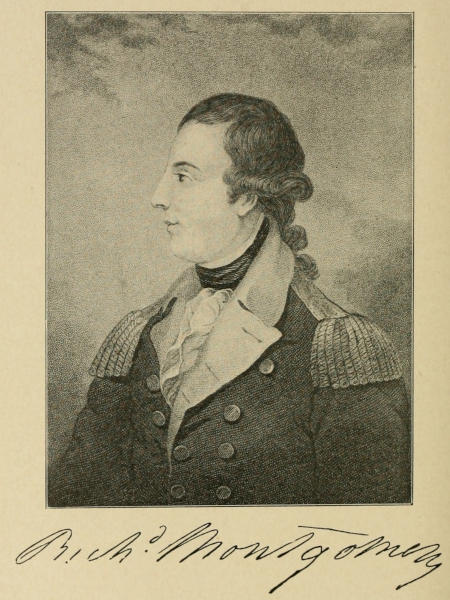
RICHARD MONTGOMERY
October 10, 1775, Sir William Howe superseded General Gage as commander-in-chief in the closely watched and invested town; but the change of commanders made little difference. Every one except the sailors, the foragers, the commissaries, the drill sergeants, the writing clerks, the colonial assemblies, the congressional and local committees, lay inactive till March came, 1776, and Washington was himself ready to take the offensive. At last he had such cannon and such tools and stores and wagons and teams as he had been asking and planning and waiting for the weary, anxious winter through. On the morning of the 5th of March the British saw workmen and ordnance and every sign of a strong force of provincials on Dorchester heights, and were as surprised as they had been, close upon a year before, to see men and trenches on Bunker Hill. Washington had done work in the night which it was already too late for them to undo; a storm beat the waters of the bay as the day wore on and made it impossible to put troops across to the attack in boats; Washington had all the day and another night in which to complete his defences; and by the morning of the 6th the British knew that the heights could not be taken without a risk and loss they could not afford. The town was rendered untenable at a stroke. With deep chagrin, Howe determined upon an immediate evacuation; and by the 17th he was aboard his ships,—eight thousand troops and more than a thousand loyalists who dared not stay. The stores and cannon, the ammunition, muskets, small-arms, gun carriages, and supplies of every kind which he found himself obliged to leave behind enriched Washington with an equipment more abundant than he could ever have hoped to see in his economical, ill-appointed camp at Cambridge.
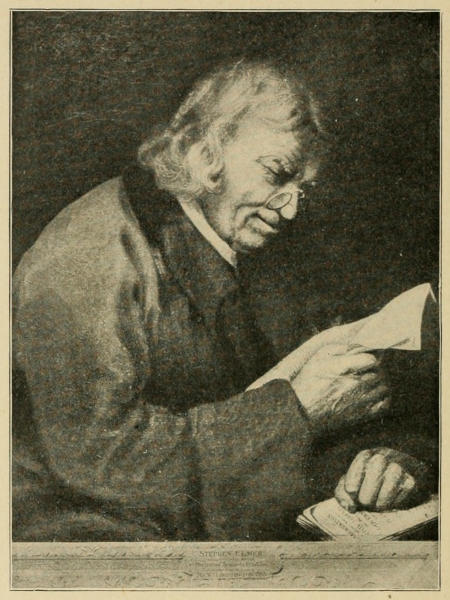
BENJAMIN FRANKLIN AS A POLITICIAN
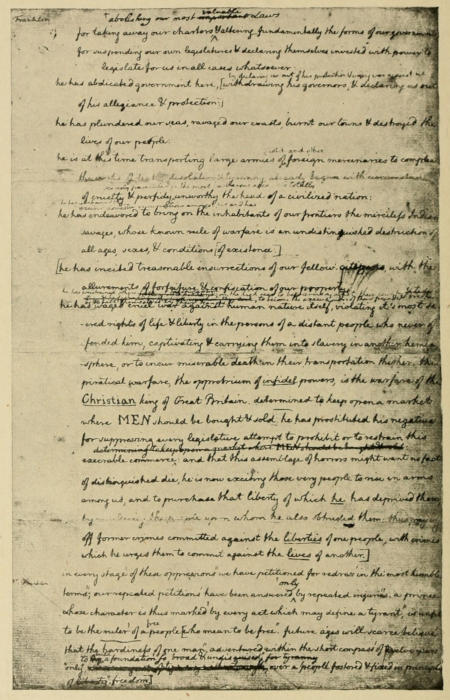
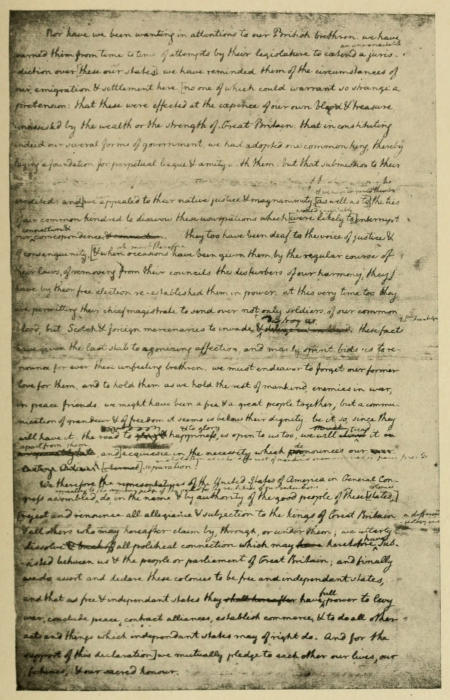
The only British army in America had withdrawn to Halifax: his Majesty’s troops had nowhere a foothold in the colonies. But that, every one knew, was only the first act in a struggle which must grow vastly greater and more tragical before it was ended. Washington knew very well that there was now no drawing back. Not since the affair at Bunker Hill had he deemed it possible to draw back; and now this initial success in arms had made the friends of revolution very bold everywhere. As spring warmed into summer it was easy to mark the growth in the spirit of independence. One of the first measures of the Continental Congress, after coming together for its third annual session in May, 1776, was to urge the several colonies to provide themselves with regular and permanent governments as independent states, instead of continuing to make shift with committees of safety for executives and provisional “provincial congresses” for legislatures, as they had done since their government under the crown had fallen to pieces; and they most of them promptly showed a disposition to take its advice. The resolution in which the Congress embodied this significant counsel plainly declared “that the exercise of every kind of authority under the crown ought to be totally suppressed,” and all the powers of government exercised under authority from the people of the colonies,—words themselves equivalent to a declaration for entire separation from Great Britain. Even in the colonies where loyalists mustered strongest the government of the crown had in fact almost everywhere been openly thrown off. But by midsummer it was deemed best to make a formal Declaration of Independence. North Carolina was the first to instruct her delegates to take that final and irretrievable step; but most of the other colonies were ready to follow her lead; and on July 4th Congress adopted the impressive Declaration which Mr. Jefferson had drawn up in the name of its committee.
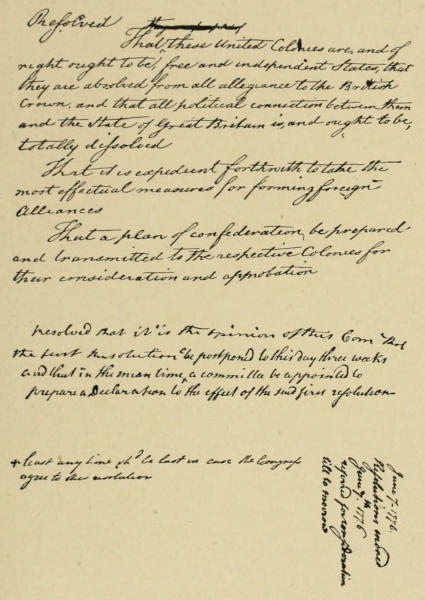
R. H. LEE’S RESOLUTION FOR INDEPENDENCE
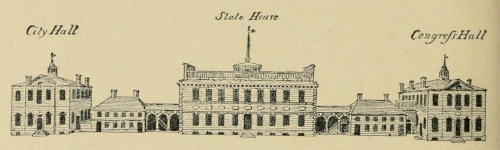
STATE HOUSE, PHILADELPHIA, 1778
Washington himself had urgently prayed that such a step be taken, and taken at once. It would not change, it would only acknowledge, existing facts; and it might a little simplify the anxious business he was about. He had an army which was always making and to be made, because the struggle had been calculated upon a short scale and the colonies which were contributing their half-drilled contingents to it were enlisting their men for only three months at a time. Sometimes the men would consent to re-enlist, sometimes they would not. They did as they pleased, of course, and would time and again take themselves off by whole companies at once when their three months’ term was up. Sir William Howe would come back, of course, with a force increased, perhaps irresistible: would come, Washington foresaw, not to Boston, where he could be cooped up and kept at bay, but to New York, to get control of the broad gateway of the Hudson, whose long valley had its head close to the waters of Lake George and Lake Champlain, and constituted an infinitely important strategic line drawn straight through the heart of the country, between New England, which was no doubt hopelessly rebellious, and the middle colonies, in which the crown could count its friends by the thousand. The Americans must meet him, apparently, with levies as raw and as hastily equipped as those out of which an army of siege had been improvised at Boston, each constituent part of which would fall to pieces and have to be put together again every three months.
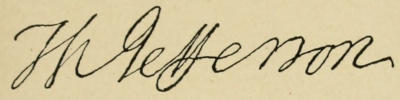
SIGNATURE OF THOMAS JEFFERSON
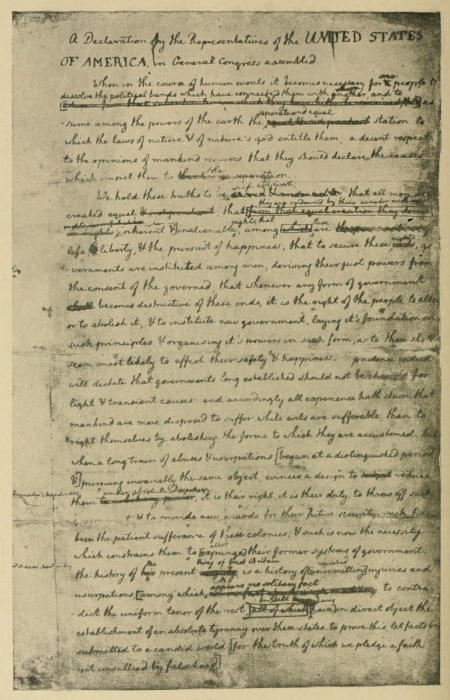
JEFFERSON’S ORIGINAL DRAFT OF THE DECLARATION OF INDEPENDENCE
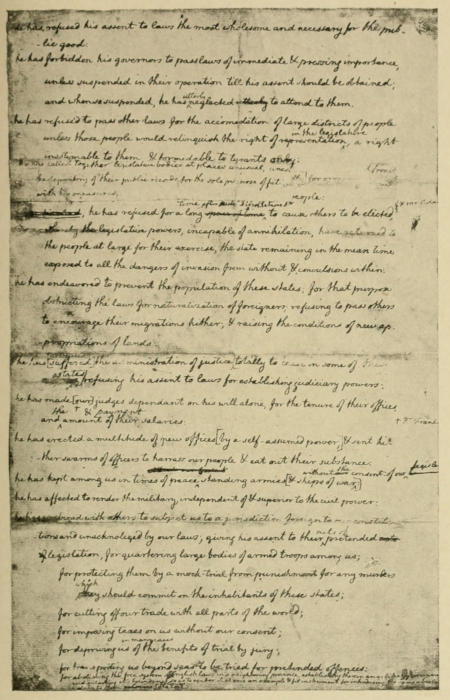
The worst of it was, that the country back of New York had not been, could not be, purged of active loyalists as the country round about Boston had been by the local “committees” of one sort or another and by the very active and masterful young men who had banded themselves together as “Sons of Liberty,” seeing much rich adventure, and for the present little responsibility, ahead of them in those days of government by resolution. Washington transferred his headquarters to New York early in April and set about his almost hopeless task with characteristic energy and fertility of resource; but there were spies without number all about him, and every country-side was full of enemies who waited for General Howe’s coming to give him trouble. The formal Declaration of Independence which the Congress adopted in July hardened the face and stiffened the resolution of every man who had definitely thrown in his lot with the popular cause, as Washington had foreseen that it would, just because it made resistance avowed rebellion, and left no way of retreat or compromise. But it also deeply grieved and alienated many a man of judgment and good feeling, and made party differences within the colonies just so much the more bitter and irreconcilable.
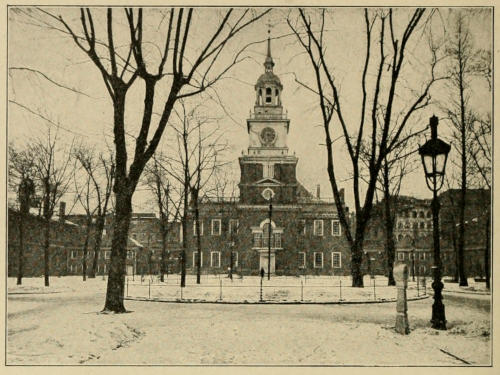
REAR VIEW OF INDEPENDENCE HALL
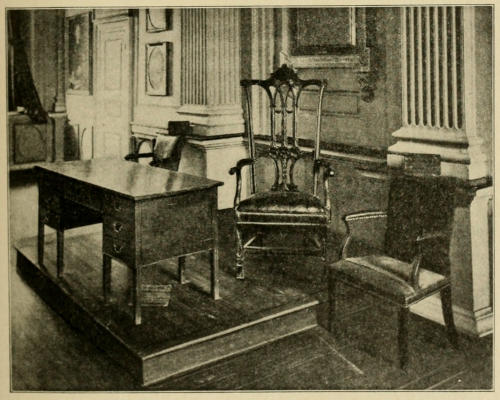
THE PRESIDENT’S CHAIR IN THE CONSTITUTIONAL CONVENTION
The first attempt of the British was made against Charleston in the south. A fleet under Sir Peter Parker came out of England with fresh troops commanded by the Earl of Cornwallis, was joined by transports and men-of-war from Halifax, bearing a force under Sir Henry Clinton, and, as June drew towards its close, delivered a combined attack, by land and sea, upon the fort on Sullivan’s Island, seeking to win its way past to the capture of Charleston itself. But they could not force a passage. Two of the ships,—one of them Sir Peter’s own flag-ship,—never came away again. Colonel Moultrie and Colonel Thompson beat off both the fleet and the troops landed from it; and the British went northward again to concentrate upon New York.
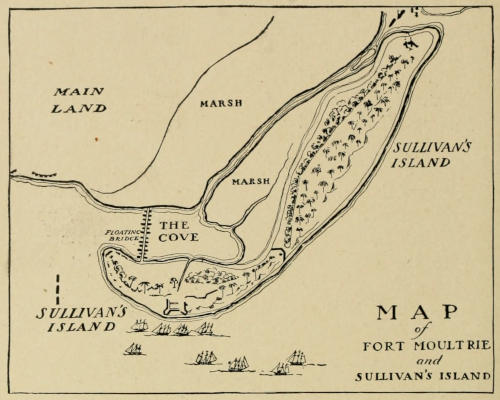
MAP OF SULLIVAN’S ISLAND
On the 28th of June,—the very day of the attack at Charleston,—Howe’s transports began to gather in the lower bay. A few days more, and there were thirty thousand troops waiting to be landed. It was impossible, with the force Washington had, to prevent their being put ashore at their commander’s convenience. It was impossible to close the Narrows, to keep their ships from the inner bay, or even to prevent their passing up the river as they pleased. Washington could only wait within the exposed town or within his trenches on Brooklyn heights, which commanded the town almost as Dorchester and Charlestown heights commanded Boston.
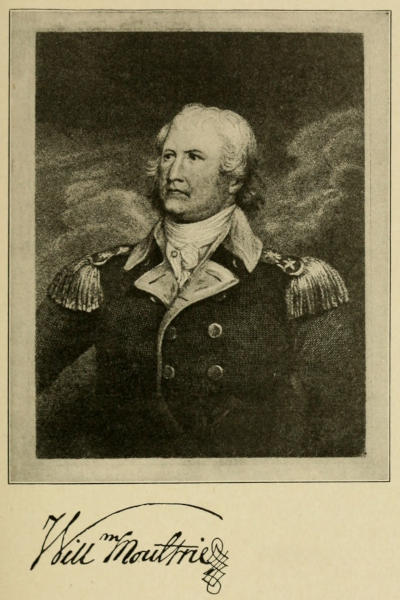
WILLIAM MOULTRIE
For a month and more Sir William waited, his troops most of them still upon the ships, until he should first attempt to fulfil his mission of peace and accommodation. His brother, Admiral Lord Howe, joined him there in July. They were authorized to offer unconditional pardon, even now, to all who would submit. The ministers in England could not have chosen commissioners of peace more acceptable to the Americans or more likely to be heard than the Howes. Not only were they men of honor, showing in all that they did the straightforward candor and the instinctive sense of duty that came with their breeding and their training in arms, but they were also brothers of that gallant young soldier who had come over almost twenty years ago to fight the French with Abercrombie, to be loved by every man who became his comrade, and to lose his life untimely fighting forward through the forests which lay about Ticonderoga, a knightly and heroic figure. But they could offer no concessions,—only pardon for utter submission, and, for all their honorable persistency, could find no one in authority among the Americans who would make the too exacting exchange. Their offers of pardon alternated with the movements of their troops and their steady successes in arms. Lord Howe issued his first overture of peace, in the form of a public proclamation offering pardon, immediately upon his arrival with his fleet at Sandy Hook, and followed it up at once with messages to the Congress at Philadelphia. Sir William Howe put his troops ashore on the 22d of August, and made ready to dislodge Washington from the heights of Brooklyn; but on the 23d he too, in his turn, made yet another offer of general pardon, by proclamation.
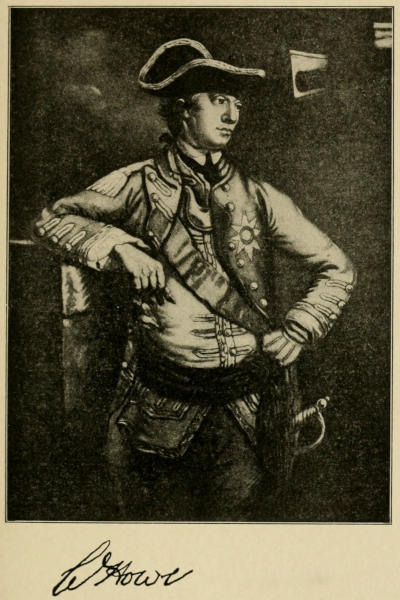
SIR WILLIAM HOWE
On the 27th he drove the American forces on Long Island in on their defences, and rendered the heights at once practically untenable. Washington had but eighteen thousand half-disciplined militiamen with which to hold the town and all the long shores of the open bay and river, and had put ten thousand of them across the river to hold Long Island and the defences on the heights. Sir William had put twenty thousand men ashore for the attack on the heights; and when Washington knew that his advanced guard was driven in, and saw Sir William, mindful of Bunker Hill, bestow his troops, not for an assault, but for an investment of the heights, he perceived at once how easily he might be cut off and trapped there, armed ships lying at hand which might at any moment completely command the river. Immediately, and as secretly as quickly, while a single night held, he withdrew every man and every gun, as suddenly and as successfully as he had seized the heights at Dorchester.
Again Sir William sent a message of conciliation to the Congress, by the hands of General Sullivan, his prisoner. On the 11th of September, before the next movement of arms, Dr. Franklin, Mr. John Adams, and Mr. Edward Rutledge met Lord Howe and Sir William, as commissioners from the Congress, to discuss possible terms of accommodation. Dr. Franklin had been in London until March. During the past winter he had more than once met Lord Howe in earnest conference about American affairs, the ministers wishing to find through him some way, if it were possible, of quieting the colonies. But the ministers had not been willing then to make the concessions which might have ended the trouble, and their commissioners were not authorized to make them now; and the conference with the representatives of the Congress came to nothing, as the conferences in London had come to nothing.
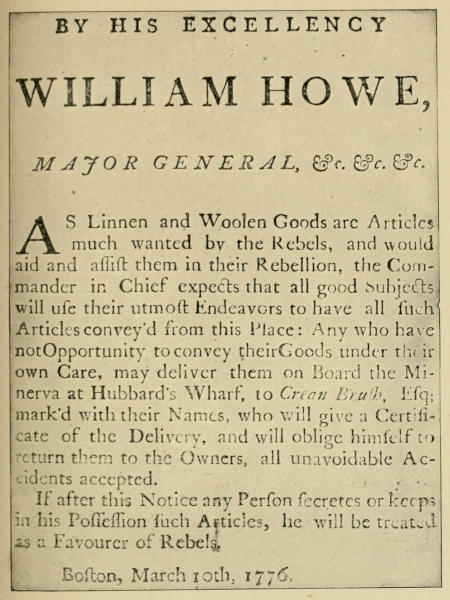
HOWE’S PROCLAMATION PREPARATORY TO LEAVING BOSTON
Washington could no more hold Manhattan Island with the forces at his command than he could hold Brooklyn heights. He had no choice in the end but to retire. General Howe was cautious, moved slowly, and handled his forces with little energy or decision; Washington made stand and fought at every point at which there was the least promise of success. His men and his commanders were shamefully demoralized by their defeat on Long Island, but he held them together with singular tact and authority: repulsed the enemy at Haarlem heights (September 16th), held his own before them at White Plains (October 28th),—and did not feel obliged to abandon the island until late in November, after General Greene had fatally blundered by suffering three thousand of the best trained men of the scant continental force, with invaluable artillery, small-arms, and stores, to be trapped and taken at Fort Washington (November 16th).
When he did at last withdraw, and leave Howe in complete control of the great port and its approaches, the situation was indeed alarming. He had been unspeakably stung and disquieted, as he withdrew mile by mile up the island, to see how uncertain his men were in the field,—how sometimes they would fight and sometimes they would not at the hot crisis of a critical encounter; and now things seemed to have gone utterly to pieces. He might at any moment be quite cut off from New England. While he still faced Howe on Manhattan Island, General Carleton, moving with a British force out of Canada, had driven Benedict Arnold up Champlain, despite stubborn and gallant resistance (October 11th and 13th), and on the 14th of October had occupied Crown Point. There he had stopped; and later news came that he had withdrawn. But apparently he could strike again almost when he pleased, and threaten all the long line of the Hudson even to where Howe lay at New York itself.
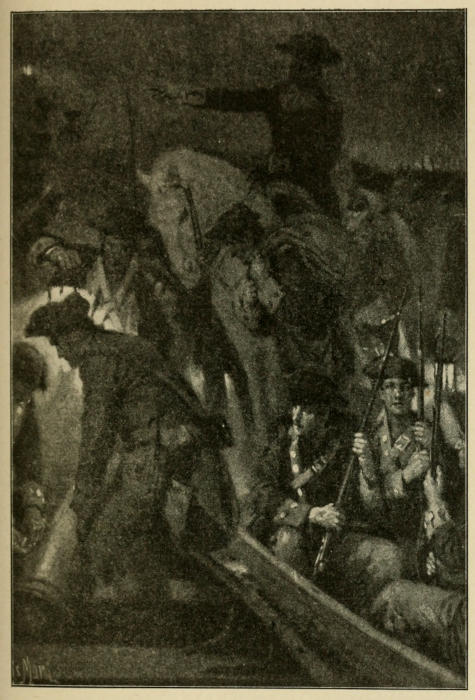
EVACUATION OF BROOKLYN HEIGHTS
It was not mere defeat, however, that put the cast almost of despair upon affairs as Washington saw them that dismal autumn. His forces seemed to melt away under his very eyes. Charles Lee, his chief subordinate in command, too much a soldier of fortune to be a man of honor, obeyed or disregarded his orders at his own discretion. When once it was known that General Washington had been obliged to abandon the Hudson, consternation and defection spread everywhere. On the 30th of November, when his defeat seemed complete, it might be final, the Howes joined in a fresh proclamation of pardon, inviting all, once again, to submit and be forgiven; and it looked for a little as if all who dared would take advantage of the offer and make their peace with the enemy,—for Washington now moved in a region where opinion had from the first been sharply divided. While defection spread he was in full retreat, with scarcely three thousand men all told in his demoralized force,—that handful ill-clad and stricken with disease, and dwindling fast by desertion,—an overwhelming body of the enemy, under Cornwallis, at his very heels as he went, so that he dared hardly so much as pause for rest until he had put the broad shelter of the Delaware behind him. “These are the times that try men’s souls,” cried Thomas Paine (December, 1776); “the summer soldier and the sunshine patriot” were falling away. One after another, that very summer, the delegates of the several states had put their names to the Declaration of Independence; but already there seemed small prospect of making it good. To not a few it already began to seem a piece of mere bravado, to be repented of.
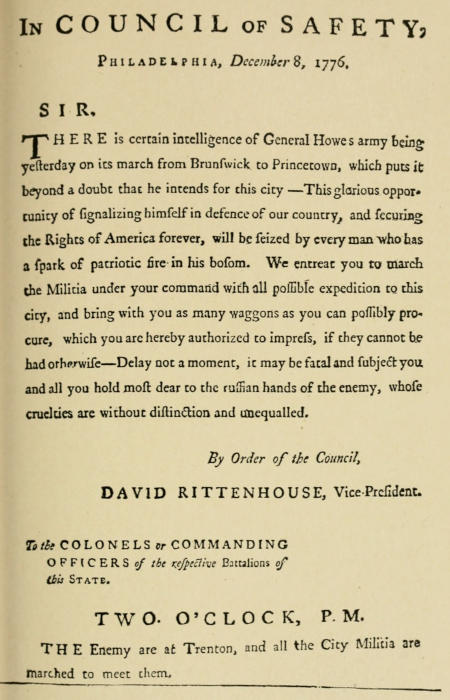
CIRCULAR OF PHILADELPHIA COUNCIL OF SAFETY
The real strength and hope of the cause lay in the steadfastness and the undaunted initiative of the indomitable Virginian whom the Congress had chosen for the chief command. He proved himself a maker as well as a commander of armies, struck oftenest when he was deemed most defeated, could not by any reverse be put out of the fighting. He was now for the first time to give the British commanders a real taste of his quality. What there was to be done he did himself. The British stopped at the Delaware; but their lines reached Burlington, within eighteen miles of Philadelphia, and from Trenton, which they held in some force, extended through Princeton to New Brunswick and their headquarters at New York. Philadelphia was stricken with utter panic. Sick and ragged soldiers poured in from Washington’s camp, living evidences of what straits he was in, and had to be succored and taken care of; the country roads were crowded with vehicles leaving the town laden with women and children and household goods; the Congress itself incontinently fled the place and betook itself to Baltimore. Washington’s military stores were in the town, but he could get no proper protection for them. It was at that very moment, nevertheless, that he showed all the world with what skill and audacity he could strike. By dint of every resolute and persistent effort he had before Christmas brought his little force to a fighting strength of some six thousand. More than half of these were men enlisted only until the new year should open, but he moved before that.
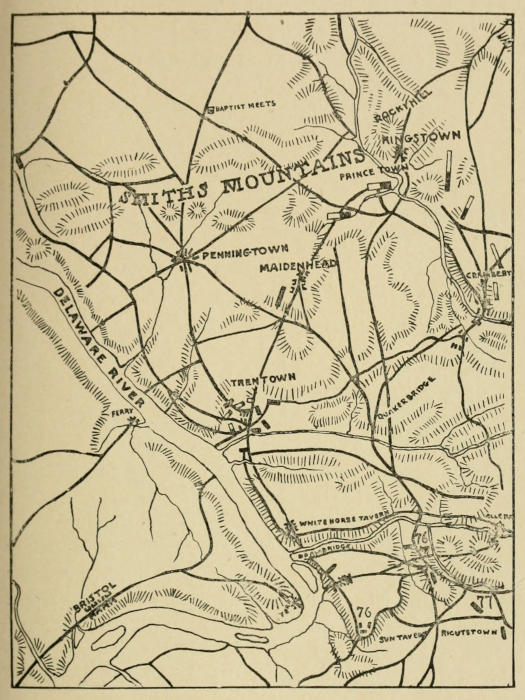
OPERATIONS AROUND TRENTON AND PRINCETON. NUMBERS 76 REPRESENT THE CAMPS OF GENERAL CORNWALLIS AND 77 THAT OF GENERAL KNYPHAUSEN ON THE 23D OF JUNE, 1777
During the night of Christmas Day, 1776, ferried by doughty fishermen from far Gloucester and Marblehead,—the same hardy fellows who had handled his boats the night he abandoned the heights of Brooklyn,—he got twenty-five hundred men across the river through pitchy darkness and pounding ice; and in the early light and frost of the next morning he took Trenton, with its garrison of nine hundred Hessians, at the point of the bayonet. There he waited,—keeping his unwilling militiamen to their service past the opening of the year by dint of imperative persuasion and a pledge of his own private fortune for their pay,—until Cornwallis came down post-haste out of New York with eight thousand men. Moving only to change his position a little, he dared to wait until his adversary was encamped, at nightfall of the 2d of January, 1777, within ear-shot of his trenches; then slipped northward in the night, easily beat the British detachment posted at Princeton, as the next day dawned and had its morning; and could have taken or destroyed Cornwallis’s stores at New Brunswick had his men been adequately shod to outstrip the British following hard behind them. As it was, he satisfied himself with having completely flanked and thwarted his foe, and withdrew safe to the heights of Morristown. The British had hastily retired from Burlington upon the taking of Trenton,—so hastily that they took neither their cannon nor even their heavier baggage away with them. Now they deemed it unsafe to take post anywhere south of New Brunswick, until spring should come and they could see what Washington meant to do. Once again, therefore, the Americans controlled New Jersey; and Washington ordered all who had accepted General Howe’s offer of pardon either to withdraw to the British lines or take the oath of allegiance to the United States. Daring and a touch of genius had turned despair into hope. Americans did not soon forget that sudden triumph of arms, or that the great Frederick of Prussia had said that that had been the most brilliant campaign of the century.
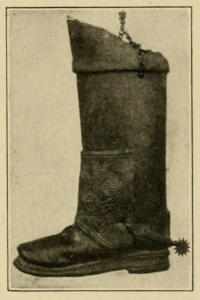
HESSIAN BOOT
A soldier’s eye could see quickly and plainly enough how the whole aspect of the war had been changed by those brief, sudden, unexpected strokes at Trenton and Princeton. Men near at hand, and looking for what a soldier would deem it no business of his to reckon with, saw that it had not only radically altered the military situation, but also the very atmosphere of the times for all concerned. The fighting at Trenton and Princeton had been of no great consequence in itself, but it had in every way put the war beyond its experimental stage. It had taught the British commanders with what sort of spirit and genius they had to deal, and how certain it was that their task must be carried to a finish not only by conquering marches and a mere occupation of the country, but by careful strategy and the long plans of a set campaign. Moreover, they now obviously had a country, and not an insurgent army merely, to conquer,—and a vast country at that. That surprising winter had set men’s sinews to what they had undertaken, on the one side as on the other.
In December (1776) it had looked as if all firmness had been unnerved and all hope turned to foreboding by the success of the British at New York and in the Jerseys. Joseph Galloway, of Pennsylvania, when that crisis came, took advantage of the opportunity to remove within the British lines and cast in his lot there with those who were ready to stake everything upon their loyalty and the success of the British arms. Others followed his example,—some out of panic, but many, it seemed, not out of fear, but out of principle. Only the other day Mr. Galloway had been the chief figure in the Congress of Committees which spoke for the colonies; for many a long day he had been the chief figure in the politics of his own colony; and many of those who made submission when he did were of families of the first dignity and consequence. They, like him, had been champions of colonial rights until it came to the point of rebellion. They would not follow further. Their example was imitated now, moreover, in their act of formal submission, by some who had played the part of patriot more boldly and with less compunction. Mr. Samuel Tucker, even, who until this untoward month had been president of New Jersey’s revolutionary committee of safety, made his submission. It seemed hard to find steadfastness anywhere.
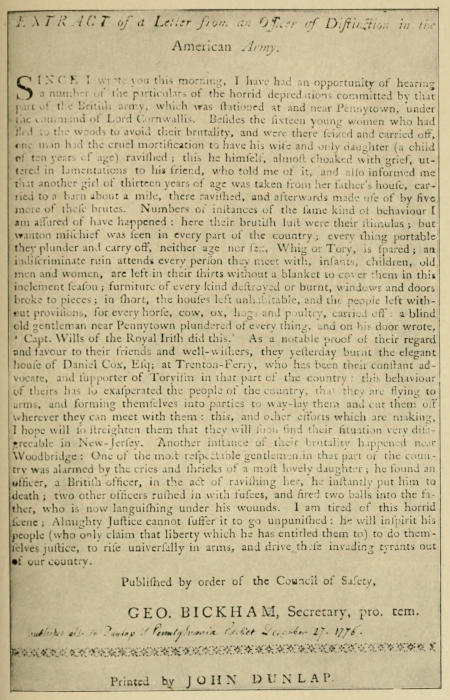
LETTER CONCERNING BRITISH OUTRAGES
But Washington’s genius and the license of the British soldiery had turned the tide at last, when it seemed upon the very point of becoming overwhelming. The occupation of the British, brief as it had been, had brought upon New York and the Jerseys experiences like those of a country overrun by a foreign soldiery permitted almost every license of conquest. When the ministers in England found themselves, in 1774, face to face with the revolt in the colonies, they could count but 17,547 men all told in the King’s forces; and when it came to sudden recruiting, they could obtain very few enlistments. They dared not risk conscription,—English opinion had never tolerated that, except to meet invasion. They sent to America, therefore, to reinforce General Howe, not only English soldiers as many as they could muster, but a great force of German troops as well, hired by the regiment, their trained officers included, from the Landgrave of Hesse-Cassel and other German princes, neighbors to the German dominions of the House of Hannover. It was close upon a thousand of these “Hessians” (for the colonists knew them all by that single name) that Washington had taken at Trenton, but not until they and their comrades had had time to make every country-side from New York to the Delaware dread and hate them. The British commanders had suffered their men, whether English or foreign, to plunder houses, insult and outrage women, destroy fields of grain, and help themselves to what the towns contained almost as they pleased; and had hardened the faces of ten of the angry colonists against them for every one who made submission and sought to put himself on their side, accordingly. Their marauding parties made little distinction between friend and foe, so they but got what they wanted. Washington could thank them for doing more to check defections from the patriotic party than he could possibly do for himself by carrying out the orders of the Congress to disarm all loyalists and bring recusants to a sharp reckoning.
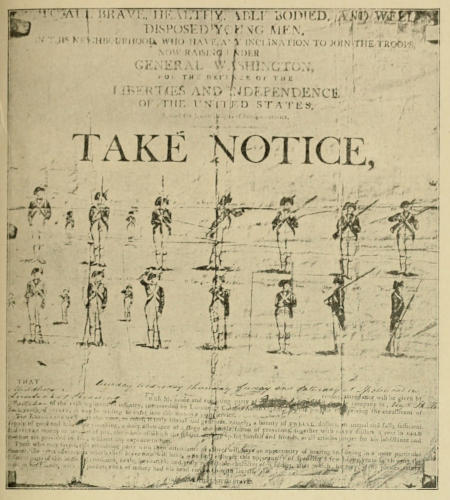
RECRUITING POSTER
Editor’s Note.—The blurred inscription at the bottom of the poster reads as follows:
That tuesday, wednesday, thursday, friday, and saturday, at Spotswood, in Middlesex county, attendance will be given by Lieutenant Reading, with his music and recruiting party of —— company in Major Shute’s Battalion of the 11th regiment of infantry, commanded by Lieutenant-Colonel Aaron Ogden, for the purpose of receiving the enrollment of such youth of spirit as may be willing to enter into this honourable service.
The Encouragement, at this time, to enlist is truly liberal and generous, namely, a bounty of twelve dollars, an annual and fully sufficient supply of good and handsome cloathing, a daily allowance of a large and ample ration of provisions, together with sixty dollars a year in gold and silver money on account of pay, the whole of which the soldier may lay up for himself and friends, as all articles proper for his subsistence and comfort are provided by law, without any expence to him.
Those who may favour this recruiting party with their attendance as above will have an opportunity of hearing and seeing in a more particular manner the great advantages which these brave men will have who shall embrace this opportunity of spending a few happy years in viewing the different parts of this beautiful continent, in the honourable and truly respectable character of a soldier, after which he may, if he pleases, return home to his friends, with his pockets full of money and his head covered with laurels.
GOD SAVE THE UNITED STATES.
And so the year 1777 dawned like a first year of settled war and revolution. For a little while, at the outset of the year, the Congress made Washington practical dictator in every affair that concerned the prosecution of the war. It authorized long enlistments, moreover, instead of the makeshift enrolments for three months which had hitherto kept Washington’s army always a-making and to be made, dissolving and reforming month by month. The Congress had, it is true, neither the energy nor the authority it needed. It could get little money to pay the troops; its agents seriously mismanaged the indispensable business of supplying the army with stores and clothing; and the men deserted by the score in disgust. Washington declared, in the summer of 1777, that he was losing more men by desertion than he was gaining by enlistment, do what he would. But these were difficulties of administration. In spite of all dangers and discouragements, it was evident that the continent was settling to its task. And the end of the year showed the struggle hopefully set forward another stage.
The military operations of that memorable year were a striking illustration of the magnitude of the task the British generals were set to accomplish, and of their singular lack of the energy, decision, and despatch necessary to accomplish it. They seemed like men who dallied and dreamed and did not mean to succeed. They planned like men of action, but then tarried and bungled at the execution of their plans. It was their purpose that year (1777) to strike from three several directions along the valley of the Hudson, and break once for all the connection between the New England colonies and their confederates. General Burgoyne was to move, with eight thousand men, down Lake Champlain; Colonel St. Leger, with a small but sufficient force, along a converging line down the valley of the Mohawk, from Oswego on Ontario; and General Howe was to meet them from the south, moving in strength up the Hudson. More than thirty-three thousand men would have effectually swept the whole of that great central valley, north and south, when their plan was executed. But it was not executed. The British commanders were to learn that, for their armies, the interior of the country was impracticable.
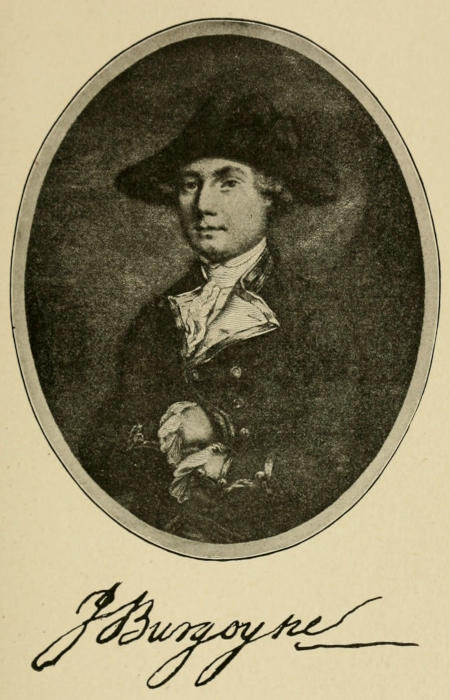
JOHN BURGOYNE
Both St. Leger and Burgoyne were baffled in that vast wilderness. It was simple enough for Burgoyne to descend the lakes and take once again the forts which guarded them. Even Ticonderoga he took without a blow struck. A precipitous height, which the Americans had supposed inaccessible by any sort of carriage, rose above the strong fortifications of the place beyond a narrow strip of water; the English dragged cannon to its summit; and General St. Clair promptly withdrew in the night, knowing his position to be no longer tenable. But it was another matter to penetrate the forests which lay about Lake George and the upper waters of the Hudson with militiamen out of every country-side within reach swarming thicker and thicker at every step the redcoats took into the depths of the perplexing region. A thousand men Burgoyne felt obliged to leave at Ticonderoga for the sake of his communications; close upon a thousand more he lost (August 16th) at Bennington, whither he had sent them to seize stores; and by the time he had reached the neighborhood of Saratoga with the six thousand left him, fully fourteen thousand provincials beset him. He had been told that the people of the country through which he was to pass would gladly give him aid and succor; that those quiet forests of Vermont and New York would even yield him, it might be, a regiment or two of loyalists wherewith to recruit his ranks when once his presence there should give the secluded settlers heart of grace to declare themselves openly for the King. Instead of that, he presently had a formidable force of provincial yeomanry out of Vermont dogging his steps under General Lincoln; a like levy, hurriedly drawn together out of New Hampshire and Massachusetts, beat and captured his best German troops at Bennington; the country was emptied of its people and of its cattle, was stripped of its forage even, as he advanced; and every step he took threatened to cut him off alike from his sources of supply and from his lines of retreat. It maddened the watchful men of those scattered homes to see him come with half a thousand savages at his front. It had been bad enough to see any invaders on that defenceless border: but the presence of the redskins put their homes and their lives in immediate and deadly peril, and they mustered as they would have mustered to meet a threat of massacre. Burgoyne himself would have checked his savage allies when the mischief had been done and it was too late; but he only provoked them to desert him and leave him without guides in an almost pathless wilderness, without appeasing the men their presence had brought swarming upon his flanks.
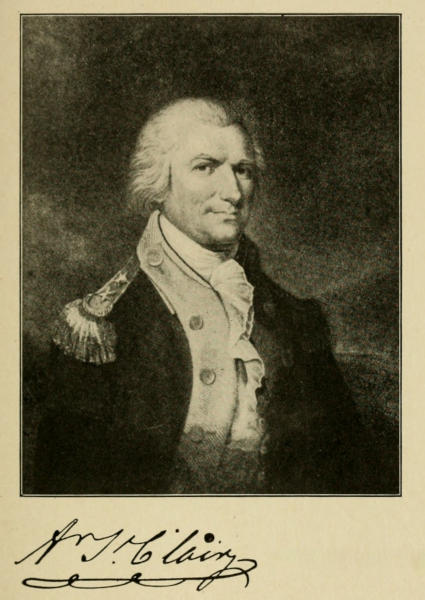
ARTHUR ST. CLAIR
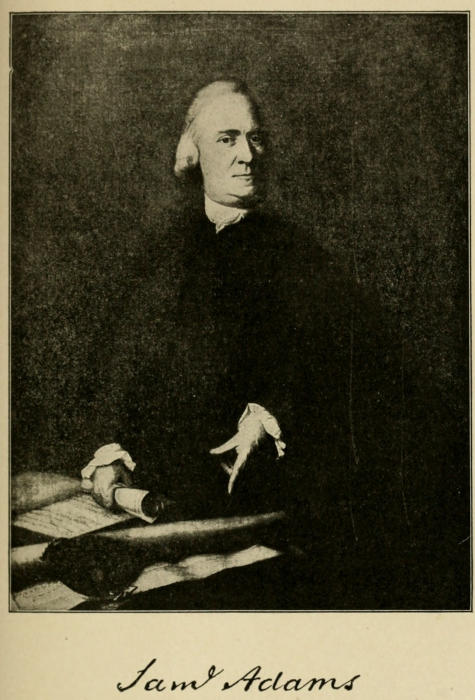
SAMUEL ADAMS
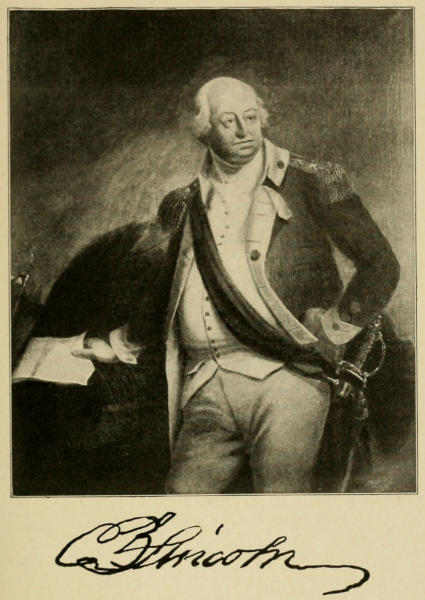
BENJAMIN LINCOLN
He pushed forward nevertheless, dogged, indomitable, determined to risk everything rather than fail of his rendezvous with Howe and St. Leger at the Hudson. And yet close upon the heels of his defeat and heavy loss at Bennington came news that St. Leger had already failed. Late in July, St. Leger had thrust his way cautiously through the forests from Oswego to the upper waters of the Mohawk; and there, on the 3d of August, he had set himself down to take Fort Stanwix, with its little garrison of six hundred men under Colonel Peter Gansevoort. There, if anywhere, in those northern forests by the Mohawk, might men who fought in the name of the King look to be bidden Godspeed and given efficient aid and counsel by the settlers of the country-side through which they moved. There William Johnson (Sir William since the French war) had reigned supreme for a long generation, his energy, subtlety, quick resource, and never failing power over men holding the restless Iroquois always to their loyalty to the English, the English always to their duty to the crown. Sir William had been dead these three years; but his son, Sir John, still held his ancient allies to their fealty and stood at the front of those who would not accept the revolution wrought at Boston and Williamsburg and Philadelphia. This war among the English sadly puzzled the red warriors of the forest. War between the king of the French and the king of the English they understood; it was a war of hostile peoples; but this war of the English against their chiefs? “You are two brothers,” they said, “of one blood.” The Mohawks deemed it some subtile treachery, as their great chief did, the redoubtable Joseph Brant, himself trained with the English boys in Mr. Wheelock’s school at Lebanon and taught to see the white man close at hand; and the Cayugas and Senecas followed them in their allegiance to the mighty sachem who “lived over the great lake,” their friend and ally time out of mind. The Onondagas held off, neutral. The Oneidas and Tuscaroras, among whom Mr. Kirkland was missionary, aided the patriots when they could, because he wished it, but would not take the war-path. There were white loyalists, too, as well as red, on that far frontier. Sir John Johnson was their leader. Their regiment of Royal Greens, together with John Butler’s Tory rangers, constituted the bulk of St. Leger’s motley force of seventeen hundred, red men and white. Scottish highlanders, stubborn Englishmen hot against the revolution, and restless Irishmen, for the nonce on the side of authority, filled their ranks.
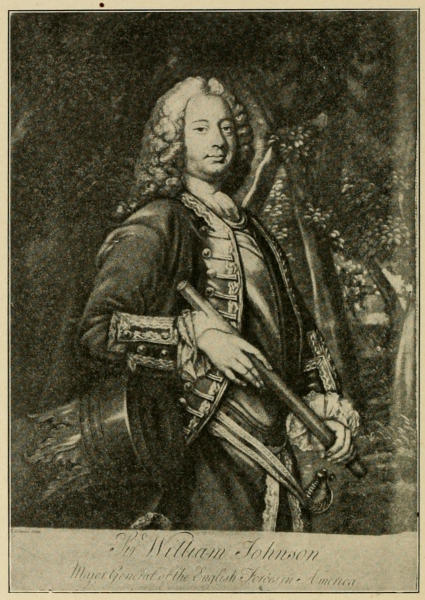
SIR WILLIAM JOHNSON
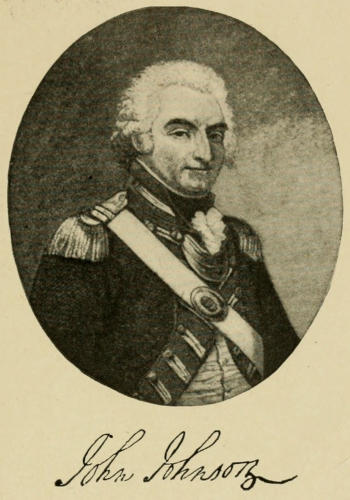
SIR JOHN JOHNSON
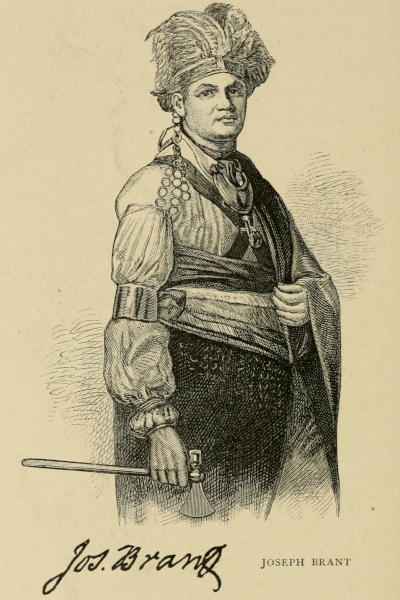
JOSEPH BRANT
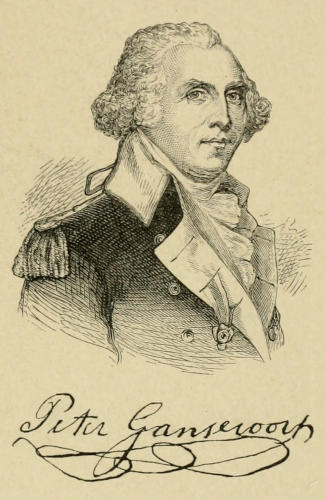
PETER GANSEVOORT
But even there, in Sir William Johnson’s one-time kingdom, enemies of King and Parliament mustered stronger yet, and showed quicker concert, freer, more instant union than the Tories. There were Dutch there, and Germans and Scots-Irish, who recked nothing of the older ties that had bound them when it came to the question whether they should yield in their own affairs to masters over sea. Peter Gansevoort commanded the little garrison at Stanwix; Nicholas Herkimer brought eight hundred men to his succor. Brant and Johnson trapped the stout-hearted German in a deadly ambush close by Oriskany as he came; but he beat them off. While that heroic struggle went forward there in the close ravine the hot morning through (August 6, 1777), Gansevoort made sally and sacked Sir John’s camp. Herkimer could come no further; but there came, instead, rumors that Burgoyne was foiled and taken and the whole American army on the road to Stanwix. It was only Benedict Arnold, with twelve hundred Massachusetts volunteers; but the rumors they industriously sent ahead of them carried the panic they had planned, and when they came there was no army to meet. St. Leger’s men were in full flight to Oswego, the very Indians who had been their allies harrying them as they went, in mere wanton savagery and disaffection.
Though he knew now that St. Leger could not come, though he knew nothing, and painfully conjectured a thousand things, of Sir William Howe’s promised movement below upon the river, Burgoyne pushed forward to the Hudson and crossed it (September 13, 1777), to face the Americans under General Gates upon the western bank. It was as safe to go forward as to turn back. Gates, secure within his intrenchments, would not strike; and he, his supplies instantly threatened behind him, could not wait. On the 19th of September he threw four thousand men forward through the forest to turn, if it were possible, the flank of General Gates’s army where it lay so still upon Bemis’s Heights by Stillwater. But Arnold was too quick for him. With three thousand men Arnold met and checked him, moving with all the quick audacity and impetuous dash of which he had given Guy Carleton a taste upon Champlain and at the gates of Quebec, Daniel Morgan and his Virginian riflemen again at his back as they had been at far Quebec. His stroke having failed, Burgoyne lay still for eighteen tedious days, waiting once more for Sir Henry Clinton, now at last, he knew, actually upon the river. On the 7th of October he struck again. Clinton came too slowly. Burgoyne’s lines of communication by the northern lakes, long threatened by General Lincoln and his Vermonters, were now actually cut off, and it was possible to calculate just how few days’ rations remained to make his campaign upon. He tried an attack with picked men, moving quickly; but overwhelming forces met him, and the inevitable Arnold, coming upon the field when he was already beaten, turned his defeat almost into a rout. He withdrew hopelessly towards Saratoga. Every crossing of the river he found heavily guarded against him. No succor came to him, or could come, it seemed, either from the west or from the south; he could find no safe way out of the wilderness; without aid, the odds were too great against him; and on the 17th of October he capitulated.
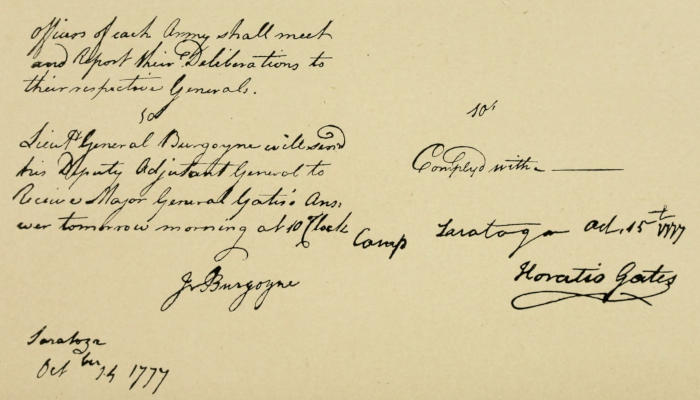
FACSIMILE OF CLOSING PARAGRAPHS OF BURGOYNE’S SURRENDER
General Howe had moved south instead of north. He fancied that it would bring him no small moral advantage to take Philadelphia, the “capital” of the insurgent confederacy; and he calculated that it ought to be easily possible to do so before Burgoyne would need him in the north. Early in June, accordingly, he attempted to cross the Jerseys; but Washington, striking from Morristown, threatened his flank in a way which made him hesitate and draw back. He returned to New York, and put eighteen thousand men aboard his transports, to get at Philadelphia by water from the south. It was the 25th of August, and Burgoyne was needing him sorely in the northern forests, before he had got ready for his land movement. He had gone all the long way round about into Chesapeake Bay, and had made his landing at the Head of Elk, in Maryland. Washington met him behind the fords of the Brandywine (September 11th), but could not withstand him. He could only delay him. Defeat no longer meant dismay for the Americans; Washington acted in force as steadily and effectively after defeat as after victory. It was the 27th of September before Sir William entered Philadelphia. He was hardly settled there before Washington attacked him again, at his outpost at Germantown, in the thick mist of the morning of the 4th of October, and would have taken the place had not the mist confused and misled his own troops. Meantime Burgoyne was trapped at Saratoga. On October 3d Sir Henry Clinton had begun at last the movement from New York for Burgoyne’s relief which ought to have been begun in midsummer,—carrying northward a strong fleet upon the river and an army of three thousand men. But it was too late. Burgoyne’s surrender was already inevitable. The net result of the campaign was the loss of the northern army and the occupation of Philadelphia. “Philadelphia has taken Howe,” laughed Dr. Franklin, in Paris, when they told him that Howe had taken Philadelphia.
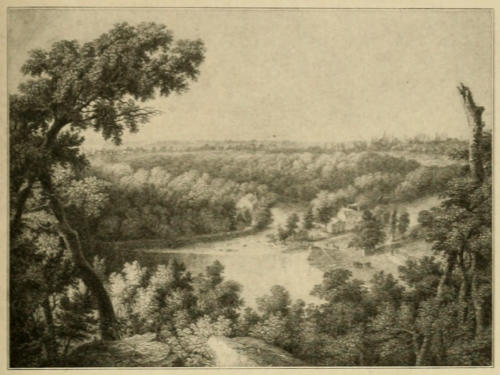
SCENE OF THE BATTLE OF THE BRANDYWINE
The long, slow year had been full of signs both good and bad. International forces were beginning to work in favor of the insurgent colonies. From the outset France and Spain had been willing to give them aid against England, their traditional rival and enemy. Since the summer of 1776 they had been promised French and Spanish assistance through Beaumarchais, acting ostensibly as the firm of “Roderigue Hortalez et Cie.,” but really as the secret agent of the two governments; and early in 1777 the fictitious firm had begun actually to despatch vessels laden with arms and ammunition to America. Private money also went into the venture, but governments were known to be behind it; and on January 5th, 1777, Mr. Franklin had arrived in Paris to assist in bringing France into still closer touch with the war for independence over sea. As the year drew towards its close the great Frederick of Prussia had forbidden troops hired in the other German states to cross Prussian territory to serve the English in America, and so had added his good-will to the French and Spanish money. French, and even German and Polish officers, too, volunteered for service in the American armies. It was the gallant Polish patriot Tadeusz Kosciuszko who had shown General Gates how to intrench himself upon Bemis’s Heights.
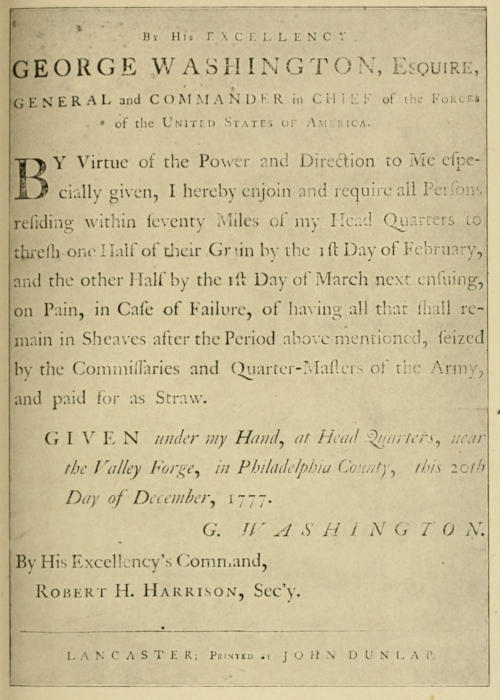
WASHINGTON’S PROCLAMATION
The winter was deeply disheartening, nevertheless, for Washington. Having failed in the mist at Germantown, he withdrew his army to Valley Forge, whence he could watch Howe at Philadelphia, and move as he moved, and yet himself feel safe against attack; but utter demoralization had fallen upon the Congress, sitting in a sort of exile at York, and his army was brought to such straits of privation and suffering in its exposed camp as he had never been obliged to see it endure before. There was plenty of food in the country; plenty even at the disposal of Congress and in the stores of its commissariat. The British had overrun very little of the fertile country; the crops had been abundant and laborers had not been lacking to gather them in,—especially there in thriving Pennsylvania. But the Congress had lost all vigor alike in counsel and in action. Men of initiative had withdrawn from it to serve their states in the reorganization of their several governments and in the command of forces in the field. Sometimes scarcely a dozen members could be got together to take part in its deliberations. It yielded to intrigue,—even to intrigue against Washington; allowed its executive committees, and most of all the commissary department, upon which the army depended, to fall into disorganization; listened to censures and bickerings rather than to plans of action; lost the respect of the states, upon which its authority depended; and left the army almost to shift for itself for sustenance. Fortunately it was a mild winter. Fortunately Washington was masterful and indomitable, and proved equal to checkmating at a single move those who intrigued in the Congress to displace him. Despite every bitter experience of that dark and anxious season, he had when spring came an army stronger and fitter for service than it had been when he took it into winter quarters. The lengthened term of service had given him at last an army which might be drilled, and foreign officers,—notably the capable Steuben,—had taught him how to drill it.
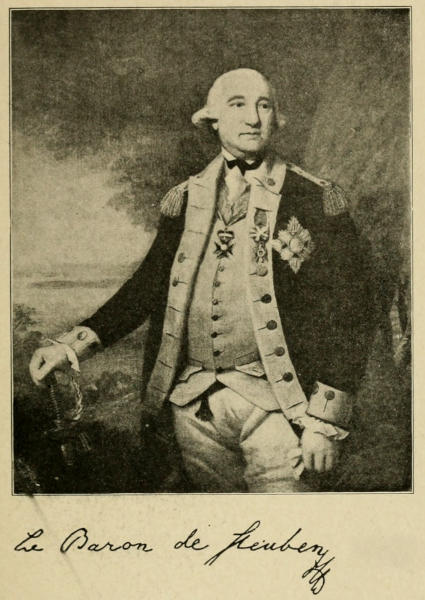
BARON DE STEUBEN
General Howe’s winter passed easily and merrily enough in Philadelphia. The place was full of people of means and influence who hoped as heartily as Mr. Galloway did for the success of the British arms. Some of the leading Quakers of the town, whose influence was all for an accommodation of the quarrel with the mother country, had been arrested the previous summer (1777) and sent south by the patriot leaders; but many more were left who were of their mind, and General Howe met something like a welcome when he came in the autumn. The fashionable young women of the town were delighted to look their best and to use their charms to the utmost at all the balls and social gatherings that marked the gay winter of his stay, and their parents were not displeased to see them shine there. But for the soldiers’ coats one would have thought that peace had come again.
But the minds of the ministers in England were not so much at ease. In February, 1778, Lord North introduced and pressed through Parliament conciliatory measures of the most radical sort, practically retracing every misjudged step taken with regard to the colonies since 1763; and commissioners of peace were sent to America with almost plenipotentiary powers of accommodation. But that very month a formal treaty of alliance was signed between France and the United States; by the time the peace commissioners reached Philadelphia, England had a war with France on her hands as well as a war with the colonies; there was no rejoicing in the camp at Valley Forge over the news of Lord North’s unexpected turn of purpose, but there was very keen rejoicing when news of the French alliance came. The Congress would not treat with the commissioners. Conciliation had come too late; for the colonies the aspect of the war was too hopeful.
When the commissioners reached Philadelphia they found General Clinton about to abandon it. Sir Henry Clinton had succeeded General Howe in chief command in May. His orders were to evacuate Philadelphia and concentrate his forces once more at New York. The town was as full of excitement and dismay at the prospect as it had been but a little more than a year ago at news of the British approach. When the army began to move, three thousand loyalists abandoned the town with it, going with the stores by sea, while Sir Henry took his fifteen thousand men overland through the Jerseys again.
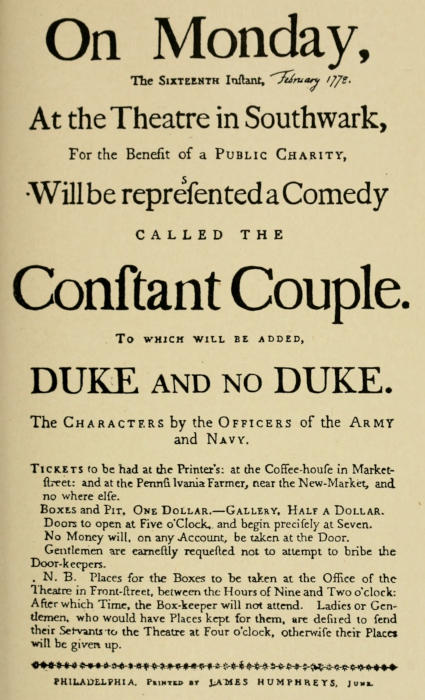
FACSIMILE OF PLAY BILL
When he moved, Washington moved also; outstripped him; caught him at a disadvantage at Monmouth Court House (June 28, 1778); and would inevitably have beaten him most seriously had not Charles Lee again disobeyed him and spoiled the decisive movement of the day,—Charles Lee, the soldier of fortune whom the Americans had honored and trusted. He had disobeyed before, when Washington was retreating hard pressed from New York. This time he seemed to play the coward. It was not known until afterwards that he had played the traitor, too. Clinton got off, but in a sort of rout, leaving his wounded behind him. “Clinton gained no advantage except to reach New York with the wreck of his army,” was the watchful Frederick’s comment over sea. “America is probably lost for England.”
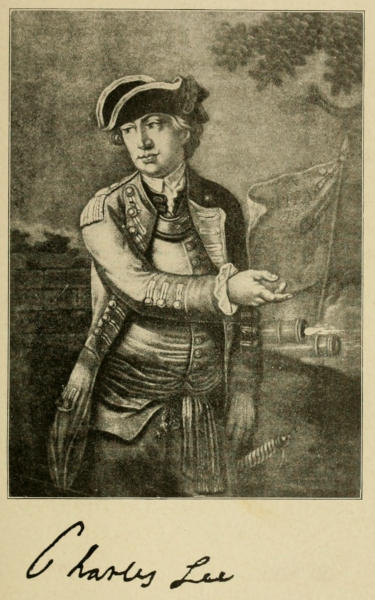
CHARLES LEE
Even the seas were no longer free for the movements of the British fleets, now that France was America’s ally and French fleets were gathering under orders for the American coast. Every month the war had lasted the English had found their commerce and their movement of stores and transports more and more embarrassed by the American privateersmen. There were bold and experienced seamen at every port of the long coast. The little vessels which were so easily set up and finished by skilful carpenters and riggers in almost any quiet inlet were sure to be fast and deftly handled when they got to sea; kept clear of his Majesty’s fleets and of too closely guarded harbors; cruised whithersoever the wits of their sagacious masters took them; and had generally to be heavily overmatched to be beaten. They had taken more than five hundred British soldiers from the transports before the Congress at Philadelphia had uttered its Declaration of Independence. Their prizes numbered more than four hundred and fifty the year of Saratoga and Brandywine and the fight in the morning’s mist at Germantown, though there were seventy ships of war upon the coast. The very coasts of England herself were not safe against them. Mr. Franklin went to France in the autumn of 1776 with his pocket full of blank letters of marque, and American privateersmen from out the French ports caught prizes enough in English waters to keep the commissioners in Paris well found in money for their plans. In January, 1778, Captain Rathburne, in the Providence, actually seized the fort in the harbor of Nassau in New Providence of the Bahamas, and took possession of town and shipping; and in the spring of that same year John Paul Jones performed the same daring feat at Whitehaven by Solway Firth in England itself.
These privateersmen, it turned out, were more to be feared for the present than the fleets of France. The Count d’Estaing was, indeed, despatched to America with twelve ships of the line and six frigates, with four thousand troops aboard; and his fleet appeared off Sandy Hook in midsummer, 1778, while Sir Henry Clinton was still fresh from his fright at Monmouth. But the too cautious admiral came and went, and that was all. He would not attempt an attack upon the English fleet within the bay at New York, though it was of scarcely half his strength. His pilots told him his larger ships could not cross the bar. Newport was the only other harbor the English held; and there he allowed Lord Howe to draw him off. A storm separated the fleets before they could come to terms, and his cruise ended peaceably in Boston harbor. But it was a heavy thing for England to have French fleets to reckon with, and embarrassments thickened very ominously about her. She had absolutely no hold on America, it seemed, outside the lines actually occupied by her armies at Newport and New York; the very sea was beset, for her merchantmen; and France was now kindled into war against her.
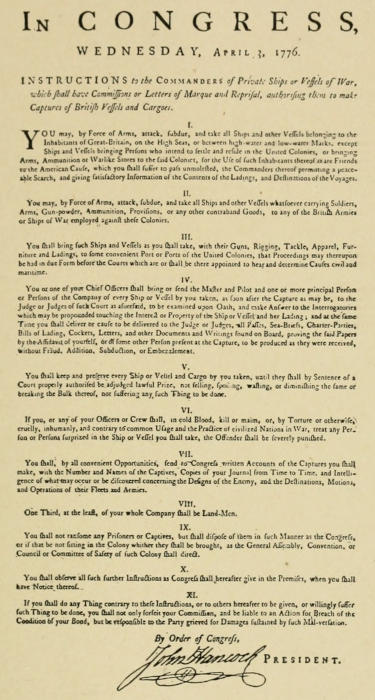
REDUCED FACSIMILE OF INSTRUCTIONS FROM CONGRESS TO PRIVATEERS
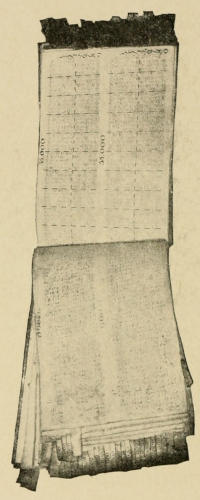
CONTINENTAL LOTTERY BOOK
And yet the Americans, too, were beset. They had not only their long coasts to watch and British armies to thwart and checkmate, but their western borders also to keep, against Tory and savage. The Iroquois country, in particular, and all the long valleys of the Mohawk, the Unadilla, and the Susquehanna, were filled with the terrors of raid and massacre throughout that disappointing and anxious summer of 1778. The stubborn loyalists of the forest country, with their temper still of the untamed highlands of old Scotland or of the intractable country-sides of old England, had been driven into exile by the uncompromising patriots, their neighbors, who outnumbered them. But they had not gone far. They had made their headquarters, the more dogged and determined of them, at Niagara, until this score should be settled. Sir John Johnson was still their leader, for all he had been so discomfited before Fort Stanwix; and John Butler and Walter Butler, father and son, men touched with the savagery of the redmen, their allies. Joseph Brant, that masterful spirit who was a sort of self-appointed king among the savage Mohawks, did not often willingly forget the precepts of that Christian creed to which good Mr. Wheelock had drawn him in his boyhood, and held the redmen back when he could from every wanton deed of blood; but the Butlers stopped at nothing, and white men and red made common cause against the border settlements. Their cruel strokes were dealt both far and near. Upon a day in July, 1778, never to be forgotten, twelve hundred men fell upon the far-away Wyoming Valley upon the Susquehanna and harried it from end to end until it was black and desolate. In November a like terrible fate fell upon peaceful Cherry Valley, close at hand. There could be no peace or quarter until the hands of these men were stayed.
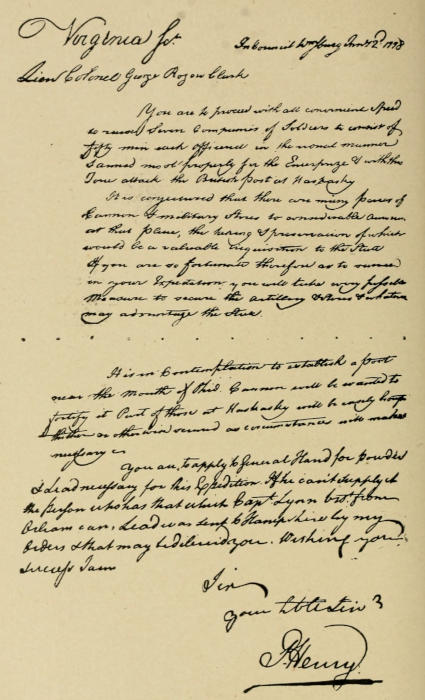
REDUCED FACSIMILE OF THE FIRST AND LAST PARTS OF PATRICK HENRY’S LETTER OF INSTRUCTIONS TO GEORGE ROGERS CLARK
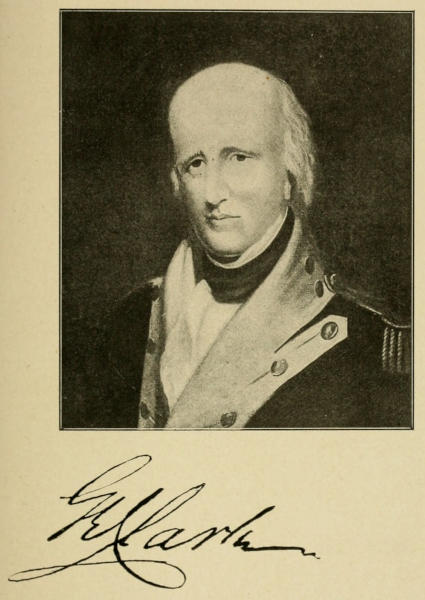
GEORGE ROGERS CLARK
But, though very slowly, the end came. The men who mustered in the patriotic ranks knew the forest and were masters of its warfare. They had only to turn to it in earnest to prevail. There were men upon the border, too, who needed but a little aid and countenance to work the work of pioneer statesmen on the western rivers. Most conspicuous among these was George Rogers Clark, the young Saxon giant who, in 1777, left his tasks as pioneer and surveyor on the lands which lay upon the south of the great river Ohio in far Kentucky, Virginia’s huge western county, and made his way back to the tide-water country to propose to Mr. Henry, now governor of the revolutionized commonwealth, an expedition for the conquest of the “Illinois country” which lay to the north of the river. He was but five-and-twenty, but he had got his stalwart stature where men came quickly into their powers, deep in the forests, where he had learned woodcraft and had already shown his mettle among men. Mr. Henry and Mr. Jefferson and Mr. Wythe and Mr. Madison, whom he consulted, approved his purpose very heartily. It was a thing which must be prepared for very quietly, and pushed, when once begun, with secrecy and quick despatch; but the mustering of men and the gathering of munitions and supplies were incidents which made no stir in those days of familiar war. Clark could bring together what force he pleased at Pittsburgh, and excite only the expectation that a new band of armed men were about to set out for the frontiers of Kentucky. In May, 1778, he was ready. He took but one hundred and eighty picked riflemen, a modest flotilla of small boats, and a few light pieces of artillery, but they sufficed. Before the summer was out he had gained easy mastery of the little settlements which lay to the northward upon the Mississippi and within the nearer valley of the Wabash. He had an infinitely pleasing way of winning the friendship of men upon any border, and the Frenchmen of the settlements of the Illinois country relished the change he promised them, liked well enough the prospect of being quit of the English power. There were few Englishmen to deal with.
When winter came Colonel Hamilton, the British commander at Detroit, came south into the forest with a motley force of five hundred men, mixed of regulars, Tories, and Indians, such as St. Leger had taken against Stanwix, and occupied Vincennes again, upon the Wabash; but Clark struck once more, sending his boats up the river and bringing his picked force straight across the frozen forests from Kaskaskia by the Mississippi; and by the end of February, 1779, Colonel Hamilton and all his levy were his prisoners. The Illinois country was added to Virginia, and the grant of her ancient charter, “up into the land, west and northwest,” seemed made good again by the daring of her frontiersmen. He could have taken Detroit itself, Clark declared, with but a few hundred men. While he cleared the northern rivers of the British arms a force like his own descended the Mississippi, seized Natchez, and cleared the southern reaches of the great stream.
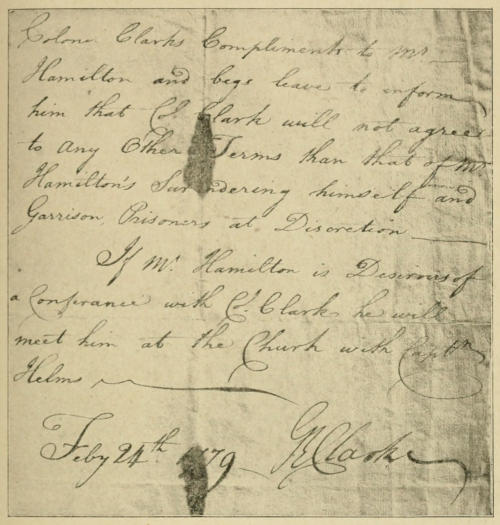
GEORGE CLARK’S FINAL SUMMONS TO COLONEL HAMILTON TO SURRENDER
That winter had witnessed a sharp shifting of the scene of the war in the east. The British commanders there had turned away from General Washington and the too closely guarded reaches of the Hudson to try for better fortune in the far south. In December, 1778, Clinton sent thirty-five hundred men from New York to the southern coasts by sea, and on the 29th Savannah was taken, with comparative ease, there being but a scant six hundred to defend it. The town once taken, it proved an easy matter, at that great remove from the centre of the American strength, to overrun the country back of it during the early weeks of 1779. But after that came delay again, and inaction, as of those who wait and doubt what next to do. The new year saw nothing else decisive done on either side. In April Spain made common cause with France against England; but Washington waited in vain the year through to see the fighting transferred to America. A few strategic movements about New York, where Clinton lay; a few raids by the British; a few sharp encounters that were not battles, and the year was over. The British made sallies here and there, to pillage and burn, to keep the country in awe and bring off whatever they could lay hands upon, striking sometimes along the coast as far as Connecticut and even the Chesapeake at the south; but armed bands were quick to muster to oppose and harass them wherever they went, and it was never safe for them to linger. Clinton thrust his lines out upon the river and fortified Stony Point; but Anthony Wayne stormed the place of a sudden, with twelve hundred men, and took it, with unshotted guns at the point of the bayonet before dawn on the morning of the 15th of July, and brought more than five hundred prisoners away with him, having come with that quick fury of reckless attack which made men call him Mad Anthony, and having as quickly withdrawn again. Harry Lee stormed Paulus Hook in like fashion, and the British were nowhere very easy within their lines. But, for the rest, there was little to break the monotony of waiting for news of the war at England’s door, where the fleets of the allies threatened her. Privateersmen were as busy as ever, and as much to be feared, almost, as the French cruisers themselves; but the formal operations of the war seemed vaguely postponed. Without the co-operation of a naval force it was impossible for Washington to do anything against Sir Henry at New York.
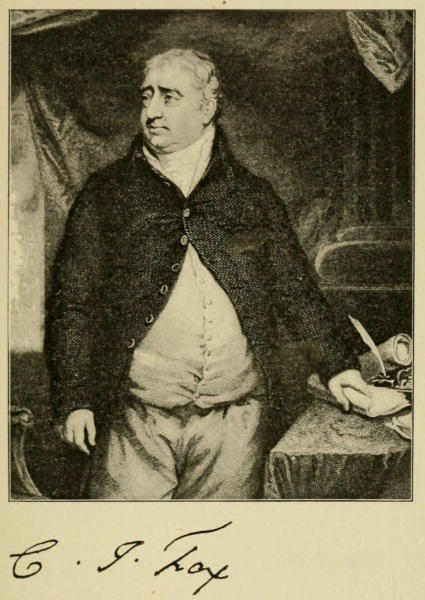
CHARLES JAMES FOX
While he waited, therefore, he despatched General Sullivan with five thousand men into the forest country of the Mohawk and the Susquehanna to make an end of the cruel mischief wrought upon defenceless homes by the bitter Tories and their red allies. The little army, sent forward in divisions, swept through the country it was bidden clear like men who searched stream and valley upon a journey of discovery; converged to meet their hunted foes, but fifteen hundred strong, where they lay at bay within a bend of the Chemung,—the full rally of the forest country, British regulars, Tory rangers, Indian braves, Johnson, the Butlers, Joseph Brant, every leader they acknowledged, united to direct them,—and overwhelmed them; ravaged the seats of Seneca and Cayuga far and near, till neither village nor any growing thing that they could find upon which men could subsist was left this side the Genesee; stopped short only of the final thing they had been bidden attempt, the capture of the stronghold at Niagara itself.
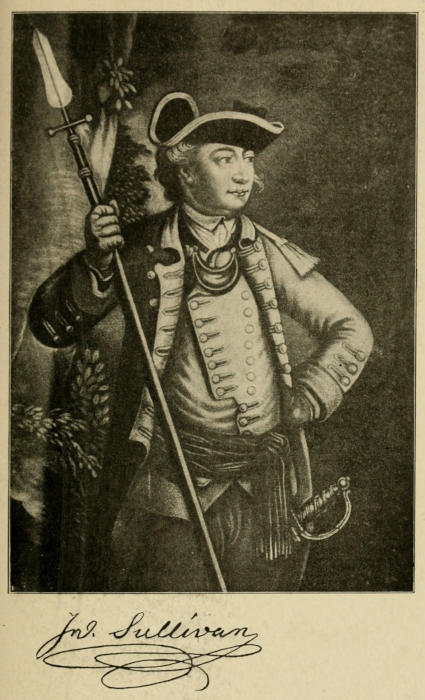
JOHN SULLIVAN
That was a summer’s reckoning which redmen far and near were not likely to forget. In April a little army of frontiersmen under Colonel Evan Shelby, that stout pioneer out of Maryland who brought hot Welsh blood to the task, swept suddenly along the northward reaches of the Tennessee and harried the country of the Chickamaugas, among whom Tories and British alike had been stirring war. In August, Colonel Brodhead, ordered to co-operate with General Sullivan, had taken six hundred men from his post at Fort Pitt, whence Clark had made his exit into the west, and had destroyed the Indian settlements by the Alleghany and upon French Creek, the old routes of the French from the lakes to the Ohio. Such work was never finished. The Indians were for a little dislodged, disconcerted, and put to sad straits to live; but they were not conquered. The terror bred a deeper thirst for vengeance among them, and a short respite of peace was sure to be followed when a new year came in with fresh flashes of war on the border, as lurid and ominous as ever. The danger was lessened, nevertheless. The final conquest of the Indian country was at least begun. The backwoodsmen were within sight of ultimate mastery when once peace should bring settlers crowding westward again.
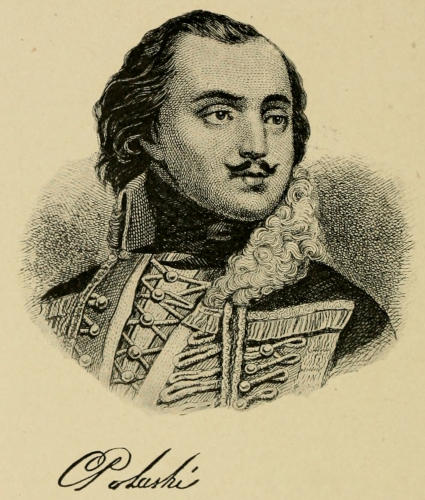
CASIMIR PULASKI
The fighting at sea that memorable year of doubt was of a like import,—full of daring and stubborn courage, planned and carried through with singular initiative and genius, quick with adventure, bright with every individual achievement, but of necessity without permanent consequence. Late in July, 1779, Captain Paul Jones had sailed from a port of France in command of a little squadron, half American, half French, with which the energy of Mr. Franklin had supplied him. His flag-ship, the Bon Homme Richard, was a worn-out French East Indiaman, fitted with forty guns, many of which were unserviceable; his French consorts were light craft, lightly armed; only one ship of the squadron was fully fit for the adventures he promised himself, having come fresh from the stocks in America, and she was intrusted to the command of a French captain who obeyed orders or not, as he pleased. But Jones was a man to work with what he had, and made even that improvised fleet suffice. With it he cruised the whole length of the western coast of Ireland and circled Scotland. Off Flamborough Head he fell in with the Serapis, 44, and the Countess of Scarborough, 20, the convoy of a fleet of merchantmen, and himself took the larger ship almost unassisted in a desperate fight after sunset, in the first watch of the night of the 23d of September. Neither ship survived the encounter forty-eight hours, so completely had they shot each other to pieces, and no man who followed the sea was likely to forget what he heard of that close grapple in the gathering night in the North Sea. “If I fall in with him again, I will make a lord of him,” Jones exclaimed, when he heard that the King had knighted Captain Pearson, of the Serapis, for the gallant fight.
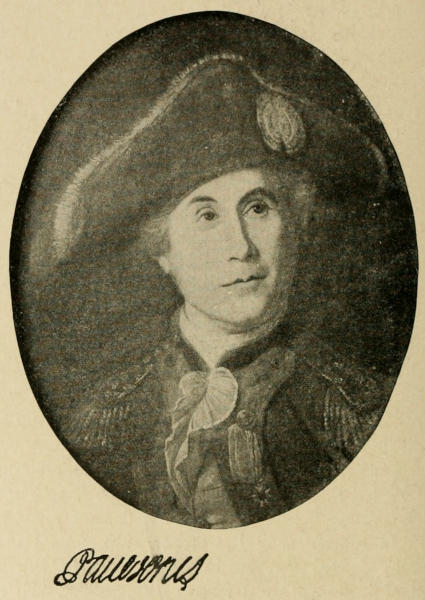
JOHN PAUL JONES
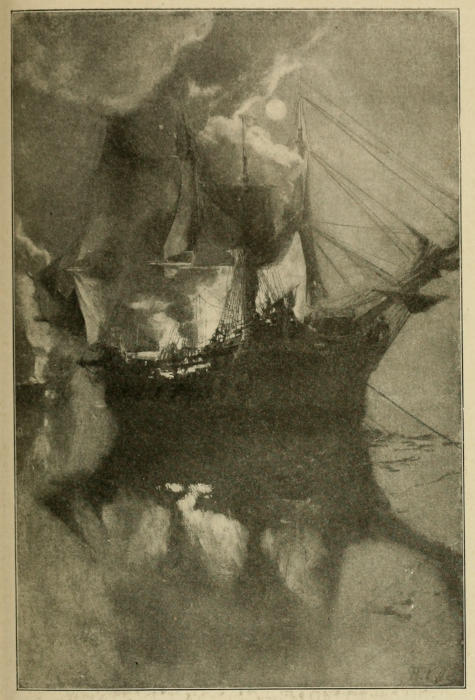
THE FIGHT BETWEEN BON HOMME RICHARD AND SERAPIS
For a little, in the autumn, it looked as if the naval aid for which General Washington waited had come at last. The Count d’Estaing was in the West Indies with a strong fleet, from an encounter with which the English commander in those waters had drawn off to port again to refit. The count was willing, while his hands were free, to co-operate in an attack upon the southern coast at Savannah. A portion of Washington’s army was sent south to join General Lincoln in South Carolina for the attempt. Count d’Estaing put six thousand troops aboard his fleet, and by the 16th of September was within the harbor. But he did not strike quickly or boldly enough, took the slow way of siege to reduce the place, suffered the English commander to make good both the rally of his scattered force and the fortification of his position, and had done nothing when it was high time for him to be back in the Indies to guard the possessions of his own king against the English. A last assault (October 9th) failed and he withdrew.
The next year a like disappointment was added. In midsummer a French fleet arrived upon the northern coast, but it proved impossible to use it. On the 10th of July a French squadron put in at Newport and landed a force of six thousand men under the Comte de Rochambeau; but a powerful British fleet presently blockaded the port, and Rochambeau could not prudently withdraw while the fleet was threatened. He had been ordered to put himself at General Washington’s disposal; but he could not do so till the blockade was raised. Meanwhile not only Georgia but the entire South seemed lost and given over to British control. In the spring, Clinton had concentrated all his forces once more at New York; and then, leaving that all-important place strong enough to keep Washington where he was, he had himself taken eight thousand men by sea to Charleston. Two thousand more troops, already in the South, joined him there, and by the 12th of May (1780) he had taken not only the place itself, but General Lincoln and three thousand men besides. South Carolina teemed with loyalists. Partisan bands, some serving one side, some the other, swept and harried the region from end to end. Wherever the British moved in force, they moved as they pleased, and were masters of the country. In June General Clinton deemed it already safe to take half his force back to New York, and Cornwallis was left to complete the work of subjugation.
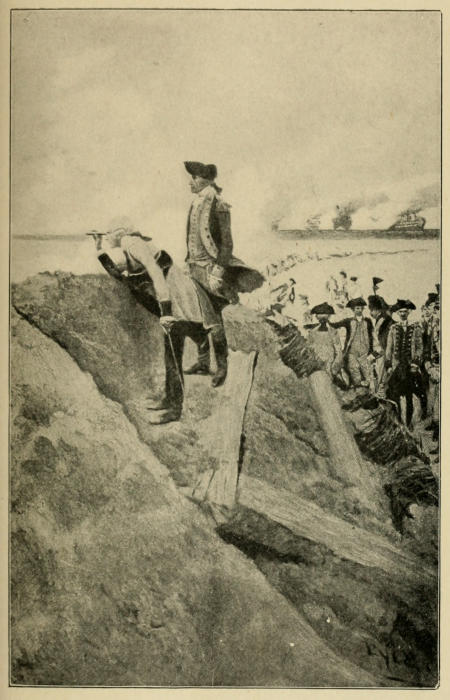
WASHINGTON AND ROCHAMBEAU IN THE TRENCHES AT YORKTOWN
That same month the Congress conferred the chief command in the South upon General Horatio Gates, who had been in command of the army to which Burgoyne had surrendered at Saratoga,—the army which Schuyler had made ready and which Morgan and Arnold had victoriously handled. Intriguers had sought, while Washington lay at Valley Forge, to substitute Gates for the commander-in-chief; now he was to show how happy a circumstance it was that that selfish intrigue had failed. He met Cornwallis at Camden, in South Carolina, his own force three thousand men, Cornwallis’s but two thousand, and was utterly, even shamefully, defeated (August 16, 1780). “We look on America as at our feet,” said Horace Walpole, complacently, when the news had made its way over sea.
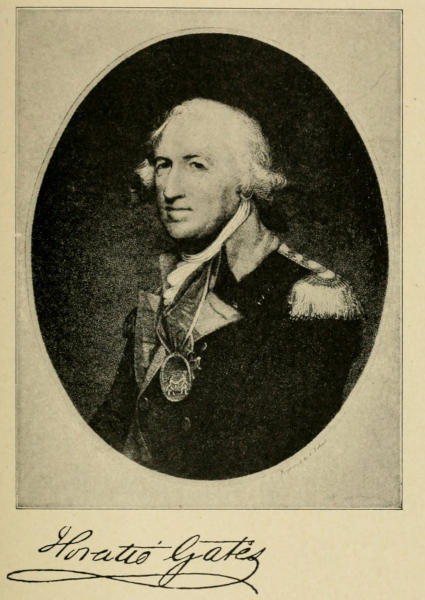
HORATIO GATES
And certainly it seemed as if that dark year brought nothing but disaster upon the Americans. It was now more evident than ever that they had no government worthy of the name. The Congress had no more authority now than it had had in 1774, when it was admitted to be nothing but a “Congress of the Committees of Correspondence”; and it was not now made up, as it had then been, of the first characters in America, the men of the greatest force and initiative in the patriotic party. It could advise, but it could not command; and the states, making their own expenditures, which seemed heavy enough, maintaining their own militia, guarding their own interests in the war, following their own leaders, often with open selfishness and indifference to the common cause, paid less and less heed to what it asked them to do. It could not raise money by taxation; it could raise very little by loan, having no legal power to make good its promises of repayment. Beaumarchais found to his heavy cost that it was next to impossible to recover the private moneys advanced through “Roderigue Hortalez et Cie.” The troops upon whom Washington and his generals depended were paid in “continental” paper money, which, by 1780, had grown so worthless that a bushel of wheat could scarcely be had for a month’s pay. Wholesale desertion began. Enlisted men by the score quit the demoralized camps. It was reckoned that as many as a full hundred a month went over to the enemy, if only to get food and shelter and clothing. Those who remained in the depleted ranks took what they needed from the farms about them, and grew sullen and mutinous. Promises of money and supplies proved as fruitless as promises of reinforcements from France.
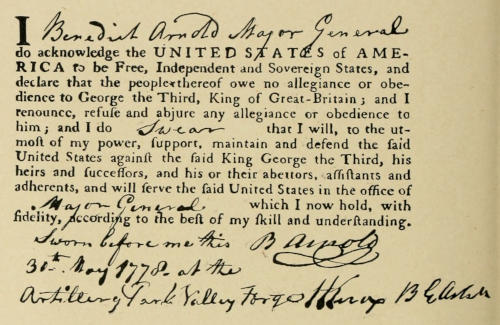
BENEDICT ARNOLD’S OATH OF ALLEGIANCE
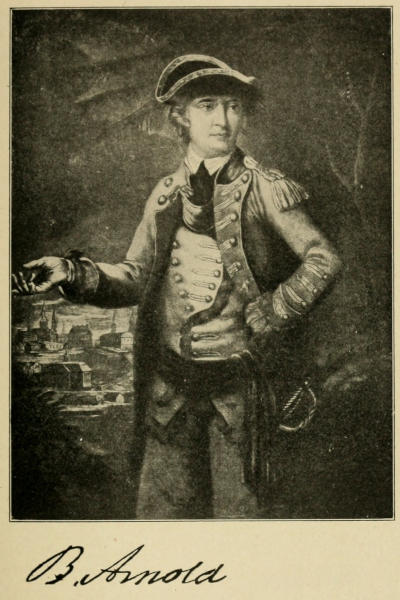
BENEDICT ARNOLD
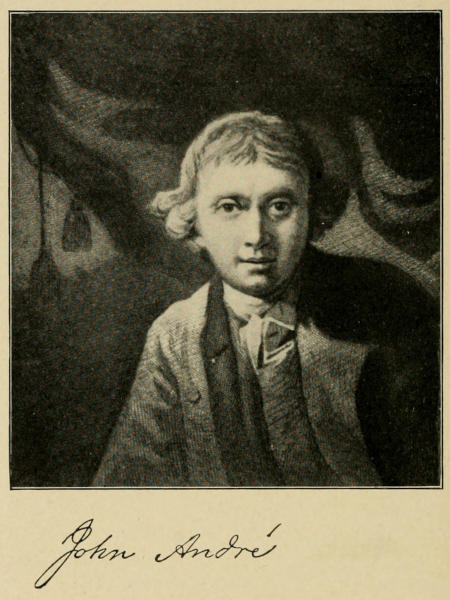
JOHN ANDRÉ
Even deliberate treason was added. Benedict Arnold, whom every soldier in the continental ranks deemed a hero because of the gallant things he had done at Quebec and Saratoga, and whom Washington had specially loved and trusted, entered into correspondence with the enemy, and plotted to give West Point and the posts dependent upon it into the hands of the British. Congress had been deeply unjust to him, promoting his juniors and inferiors and passing him over; a thousand slights had cut him; a thousand subtle forces of discouragement and of social temptation had been at work upon him, and he had yielded,—to pique, to bitter disappointment, to the disorders of a mind unstable, irritable, without nobility. His treason was discovered in time to be foiled, but the heart-breaking fact of it cut Washington to the quick, like a last and wellnigh fatal stroke of bitter dismay. Who could be trusted now? and where was strength to be got wherewith to carry the languishing work to a worthy finish?
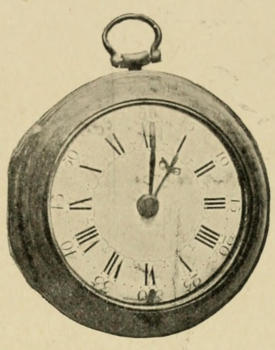
MAJOR ANDRÉ’S WATCH
It was the worst of all the bad signs of the times that no government could be agreed upon that would give the young states a real union, or assure them of harmony and co-operation in the exercise of the independence for which they were struggling. Definitive articles of confederation had been suggested as of course at the time the Declaration of Independence was adopted; and the next year (November 15, 1777) the Congress had adopted the plan which Mr. Dickinson had drawn up and which its committee had reported July 12, 1776. But the states did not all accept it, and without unanimous adoption it could not go into operation. All except Delaware and Maryland accepted it before the close of 1778, and Delaware added her ratification in 1779; but Maryland still held out,—waiting until the great states, like Virginia, should forego some part of their too great preponderance and advantage in the prospective partnership by transferring their claims to the great northwestern territories to the proposed government of the confederation; and her statesmanlike scruples still kept the country without a government throughout that all but hopeless year 1780.
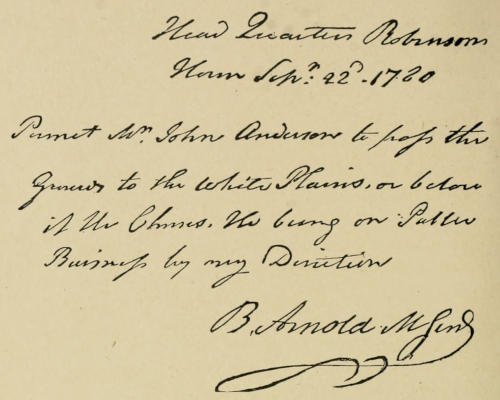
BENEDICT ARNOLD’S PASS TO MAJOR ANDRÉ
But the autumn showed a sudden turning of the tide. Cornwallis had ventured too far from his base of operations on the southern coast. He had gone deep into the country of the Carolinas, north of him, and was being beset almost as Burgoyne had been when he sought to cross the forests which lay about the upper waters of the Hudson. Gates had been promptly superseded after his disgraceful discomfiture and rout at Camden, and the most capable officers the long war had bred were now set to accomplish the task of forcing Cornwallis to a checkmate: Nathanael Greene, whose quality Washington had seen abundantly tested at Trenton and Princeton, at the Brandywine, at Germantown, and at Monmouth; the dashing Henry Lee, whom nature and the hard school of war had made a master of cavalry; the veteran and systematic Steuben; Morgan, who had won with Arnold in the fighting about Saratoga, and had kept his name unstained; and William Washington, a distant kinsman of the commander-in-chief, whom English soldiers were to remember with Lee as a master of light horsemen. The wide forests were full, too, of partisan bands, under leaders whom the British had found good reason to dread.
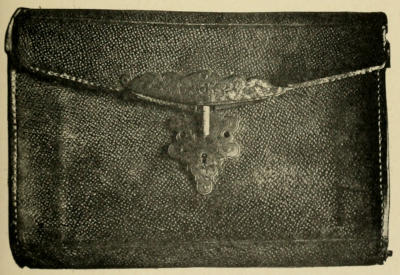
MAJOR ANDRÉ’S POCKET-BOOK
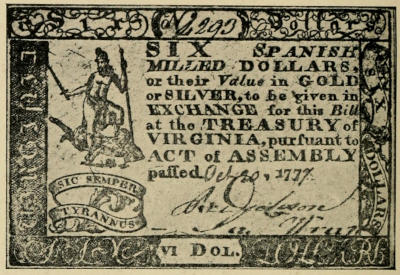
VIRGINIA COLONIAL CURRENCY
The conquest of the back country of the Carolinas was always doing and to be done. The scattered settlements and lonely plantations were, indeed, full of men who cared little for the quarrel with the mother country and held to their old allegiance as of course, giving to the King’s troops ready aid and welcome; and there were men there, as everywhere, who loved pillage and all lawless adventure, upon whom the stronger army could always count to go in its ranks upon an errand of subjugation; but there were also men who took their spirit and their principles from the new days that had come since the passage of the Stamp Act, and, though they were driven from their homes and left to shift for themselves for mere subsistence when the King’s forces were afield, they came back again when the King’s men were gone, and played the part, albeit without Indian allies, that the ousted Tories played in the forest country of New York. The English commanders at Savannah and Charleston had hit at last, nevertheless, upon effective means of holding, not their seaports merely, but the country itself. The forces they sent into the interior were made up, for the most part, of men recruited in America, and were under the command of officers fitted by school and temperament for their irregular duty of keeping a whole country-side in fearful discipline of submission. Many a formidable band of “Whigs” took the field against them, but were without a base of supplies, moved among men who spied upon them, and were no match in the long run for Tarleton and Ferguson,—Tarleton with his reckless, sudden onset and savage thoroughness of conquest, and Ferguson with his subtile gifts at once of mastery and of quiet judgment that made him capable of succeeding either as a soldier who compelled or as a gentleman who won men to go his way and do his will. South Carolina seemed once and again to lie almost quiet under these men.
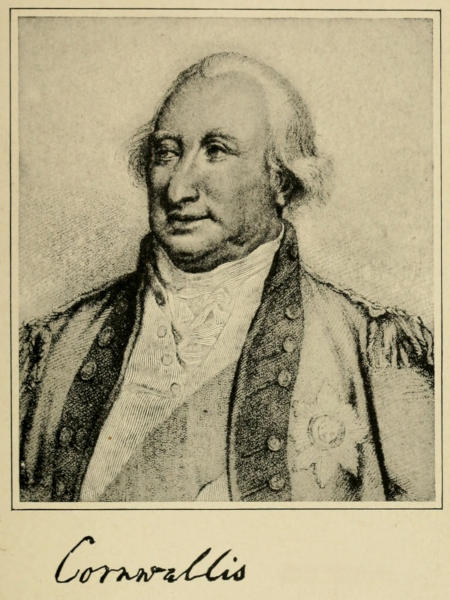
LORD CORNWALLIS
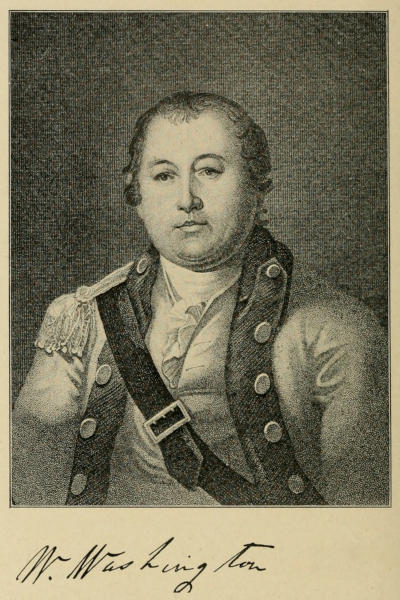
WILLIAM WASHINGTON
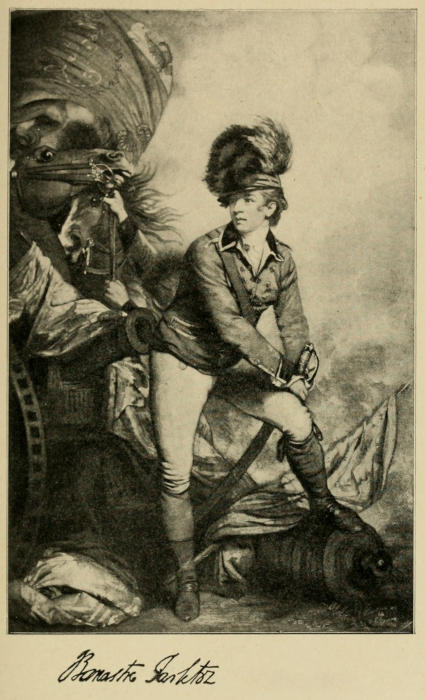
BANASTRE TARLETON
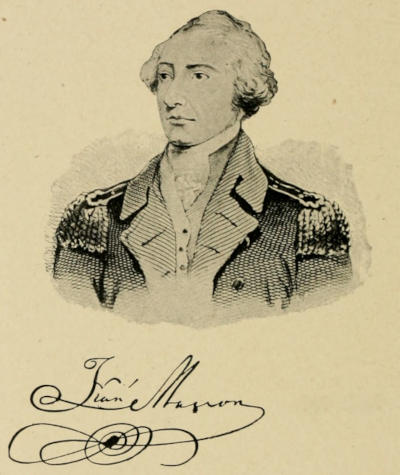
FRANCIS MARION
But Ferguson, for all he had the gifts of a soldier statesman, had gone too far. He had carried his persuasion of arms to the very foothills of the western mountains, and had sent his threats forward into the western country that lay beyond the passes of the mountains, where hardy frontiersmen of whom he knew almost nothing had so far kept their homes against the redmen without thought of turning to the east. His threats had angered and aroused them. They had put their riflemen from the back country of Carolina and Virginia into the saddle hundreds strong, had pushed league upon league through the passes of the mountains, from the far-off waters of the Holston, and had surrounded and utterly overwhelmed him at King’s Mountain (October 7, 1780). There he lost a thousand men and his own life. “A numerous army appeared on the frontier,” reported Lord Rawdon, “drawn from Nolachucky and other settlements beyond the mountains, whose very names had been unknown to us.” The hold of the British upon the inland settlements was of a sudden loosened, and Cornwallis had reason to know at once what a difference that made to him.
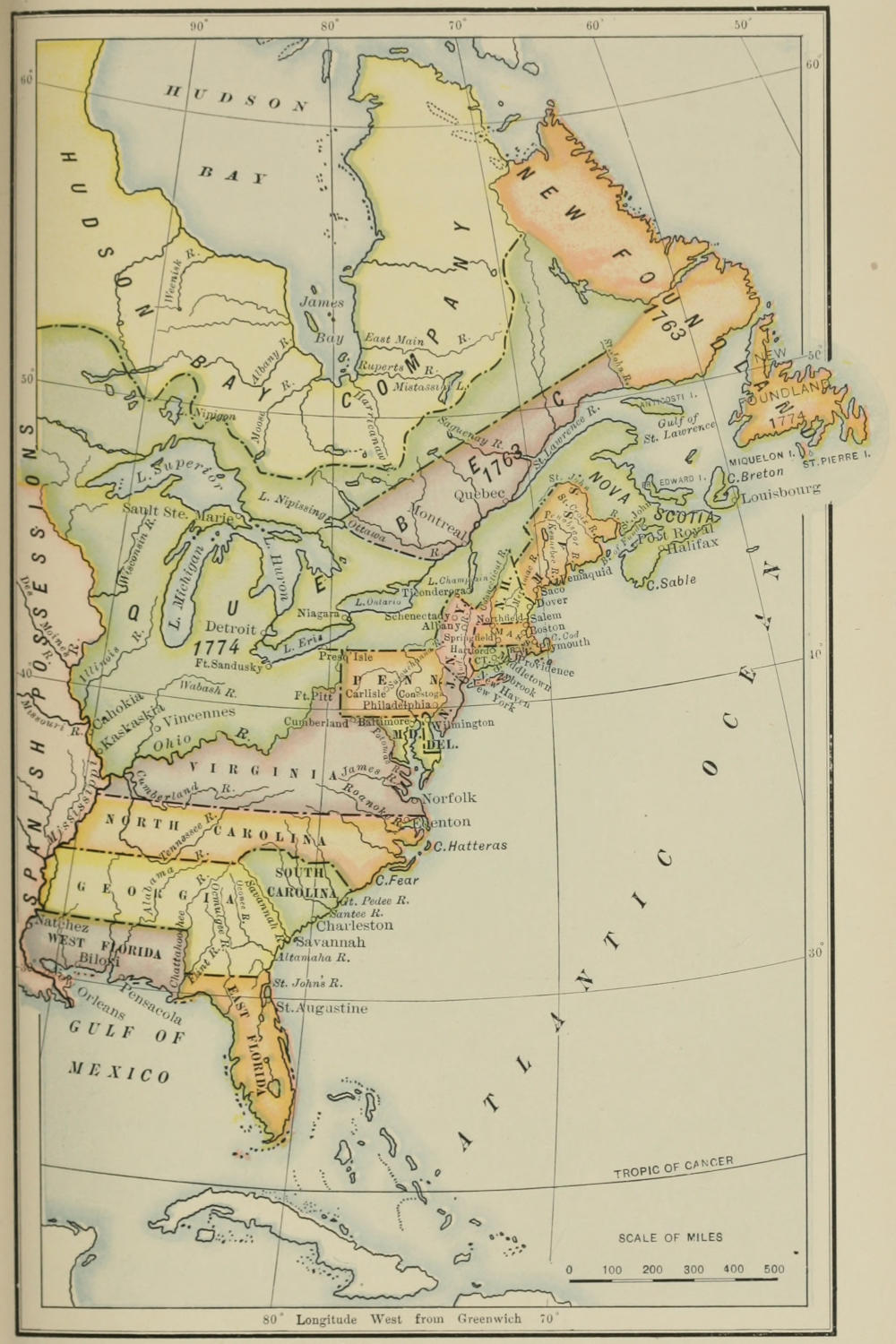
ENGLISH COLONIES, 1763-1775.
BORMAY & CO., N. Y.
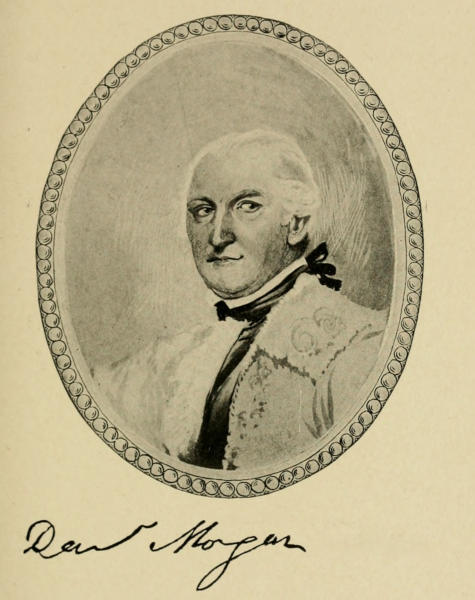
DANIEL MORGAN
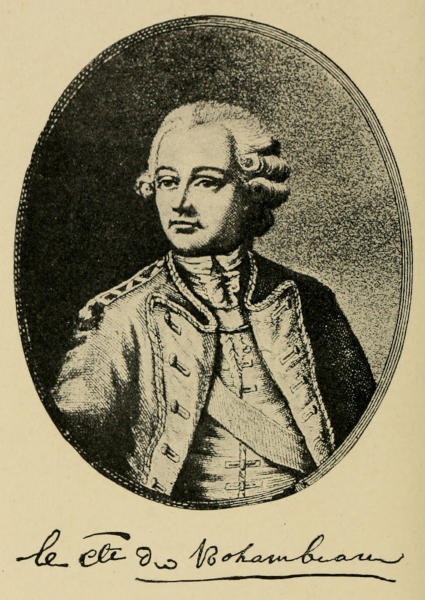
COUNT ROCHAMBEAU
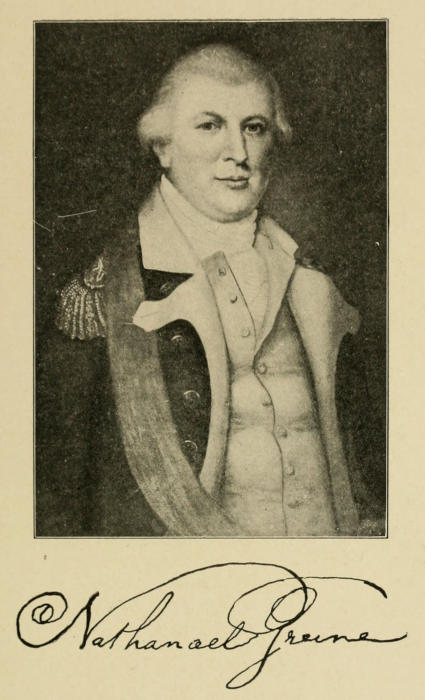
NATHANAEL GREENE
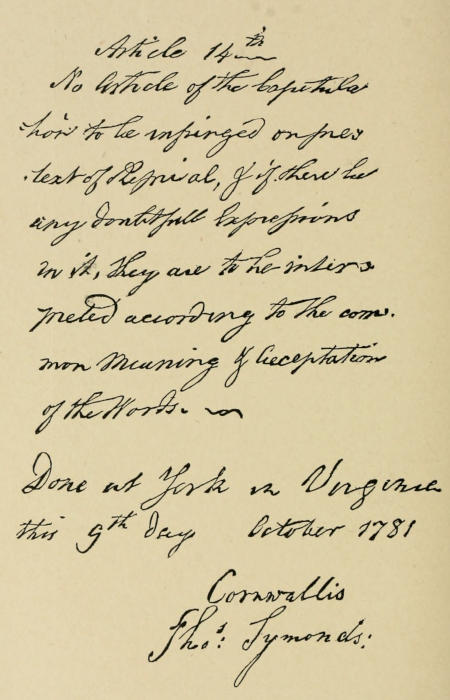
FACSIMILE OF THE LAST ARTICLE OF CAPITULATION AT YORKTOWN
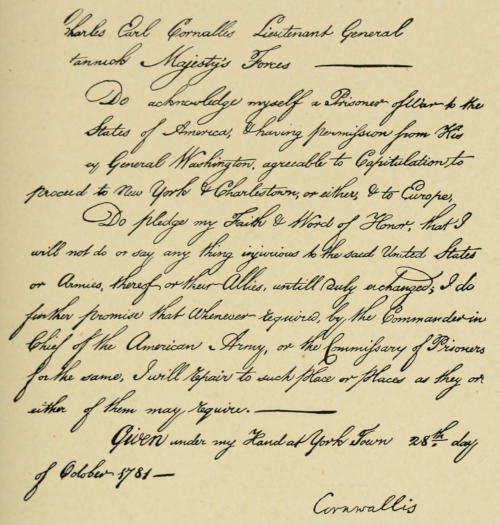
PAROLE OF CORNWALLIS
Early in December came General Greene to take the place of Gates, and new difficulties faced the English commander. Greene kept no single force afield, to be met and checkmated, but sent one part of his little army towards the coast to cut Cornwallis’s communications, and another southward against the inland posts and settlements where scattered garrisons lay between the commander-in-chief and his base at Charleston in the south. With the first detachment went Francis Marion, a man as formidable in strategy and sudden action as Ferguson, and the men who had attached themselves to him as if to a modern Robin Hood. With the second went Daniel Morgan, a man made after the fashion of the redoubtable frontiersmen who had brought Ferguson his day of doom at King’s Mountain. Tarleton was sent after Morgan with eleven hundred men, found him at the Cowpens (January 17, 1781), just within the border upon which King’s Mountain lay, and came back a fugitive, with only two hundred and seventy men. Greene drew his forces together again, and at Guilford Court House Cornwallis beat him, outnumbered though he was (March 15th). But to beat Greene, it seemed, was of no more avail than to beat General Washington. The country was no safer, the communications of the army were as seriously threatened, the defeated army was as steady and as well in hand after the battle as before; and the English withdrew to Wilmington, on the coast.
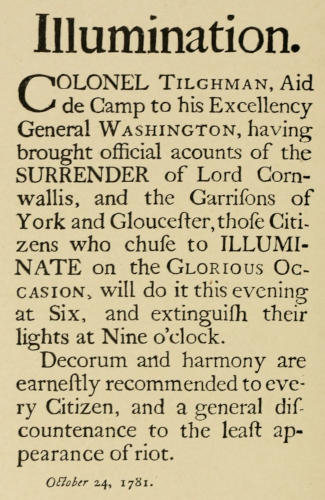
ORDER PERMITTING THE ILLUMINATION OF PHILADELPHIA
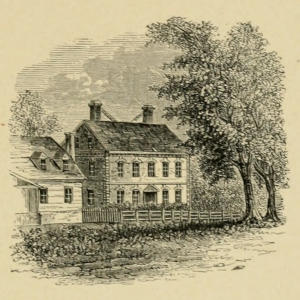
NELSON HOUSE, CORNWALLIS’S HEADQUARTERS, YORKTOWN
It seemed a hazardous thing to take an army thence southward again, with supplies, through the forests where Greene moved; news came that General Arnold was in Virginia with a considerable body of Clinton’s troops from New York, to anticipate what the southern commander had planned to do for the conquest of the Old Dominion when the Carolinas should have been “pacified” from end to end; and Cornwallis determined to move northward instead of southward, and join Arnold in Virginia. Greene moved a little way in his track, and then turned southward again against the garrisons of the inland posts. Lord Rawdon beat him at Hobkirk’s Hill (April 25th) and held him off at Eutaw Springs (September 8th); but both times the English withdrew to save their communications; and, though the work was slow in the doing, before winter came again they were shut within the fortifications of Charleston and the country-sides were once more in American possession, to be purged of loyalist bands at leisure.
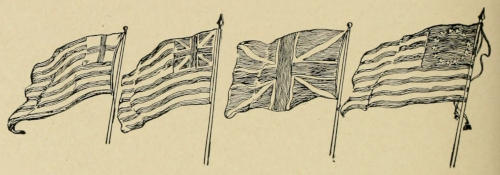
EVOLUTION OF THE AMERICAN FLAG
In Virginia, Lord Cornwallis moved for a little while freely and safely enough; but only for a little while. Baron Steuben had been busy, winter and spring, raising recruits there for an army of defence; General Washington hurried the Marquis de Lafayette southward with twelve hundred light infantry from his own command; and by midsummer, 1781, Lafayette was at the British front with a force strong enough to make it prudent that Cornwallis should concentrate his strength and once more make sure of his base of supplies at the coast. His watchful opponents out-manœuvred him, caught his forces once and again in detail, and made his outposts unsafe. By the first week in August he had withdrawn to the sea and had taken post behind intrenchments at Yorktown, something more than seven thousand strong.
There, upon the peninsula which he deemed his safest coign of vantage, he was trapped and taken. At last the French were at hand. The Comte de Grasse, with twenty-eight ships of the line, six frigates, and twenty thousand men, was in the West Indies. Washington had begged him to come at once either to New York or to the Chesapeake. In August he sent word that he would come to the Chesapeake. Thereupon Washington once again moved with the sudden directness he had shown at Trenton and Princeton. Rochambeau was free now to lend him aid. With four thousand Frenchmen and two thousand of his own continentals, Washington marched all the long four hundred miles straightway to the York River, in Virginia. There he found Cornwallis, as he had hoped and expected, already penned between Grasse’s fleet in the bay and Lafayette’s trenches across the peninsula. His six thousand men, added to Lafayette’s five thousand and the three thousand put ashore from the fleet, made short work enough of the siege, drawn closer and closer about the British; and by the 19th of October (1781) they accepted the inevitable and surrendered. The gallant Cornwallis himself could not withhold an expression of his admiration for the quick, consummate execution of the plans which had undone him, and avowed it with manly frankness to Washington. “But, after all,” he cried, “your Excellency’s achievements in New Jersey were such that nothing could surpass them.” He liked the mastery by which he had been outplayed and taken.
Here our general authorities are the same as for the period covered by the last chapter. But to these we now add Edward J. Lowell’s The United States of America, 1775-1782, in the seventh volume of Winsor’s Narrative and Critical History of America; John Jay’s Peace Negotiations, 1782-1783, in the same volume of Winsor; G. W. Greene’s Historical View of the American Revolution; the second volume of W. B. Weeden’s Economic and Social History of New England; P. O. Hutchinson’s Life and Letters of Thomas Revolution; Lorenzo Sabine’s Biographical Sketches of Adherents to the British Crown; George E. Ellis’s The Loyalists and their Fortunes, in the seventh volume of Winsor; Edward E. Hale’s Franklin in France; George Ticknor Curtis’s Constitutional History of the United States; and William H. Trescot’s Diplomacy of the American Revolution. Abundant references to authorities on the several campaigns of the revolutionary war may be found in Albert B. Hart and Edward Channing’s Guide to American History, an invaluable manual.
The sources for the period may be found in the contemporary pamphlets, speeches, and letters published at the time and since, among which may be mentioned, as of unusual individuality, Thomas Paine’s celebrated pamphlet entitled Common Sense, the writings of Joseph Galloway, some of which are reproduced in Stedman and Hutchinson’s Library of American Literature, and St. John de Crevecœur’s Letters from an American Farmer. Here again we rely, too, on the Journals of Congress and the Secret Journals of Congress; the Debates of Parliament; Peter Force’s American Archives; Hezekiah Niles’s Principles and Acts of the Revolution in America; The Annual Register; Jared Sparks’s Correspondence of the American Revolution and Diplomatic Correspondence of the American Revolution; Francis Wharton’s The Revolutionary Diplomatic Correspondence of the United States; Thomas Anburey’s Travels through the Interior Parts of America (1776-1781); the Marquis de Chastellux’s Travels in North America in the Years 1780, 1781, and 1782; and the Memoirs and Collections of the Historical Societies of the several original states.