Chapter I · COMMON UNDERTAKINGS (continued 2)
Reading edition
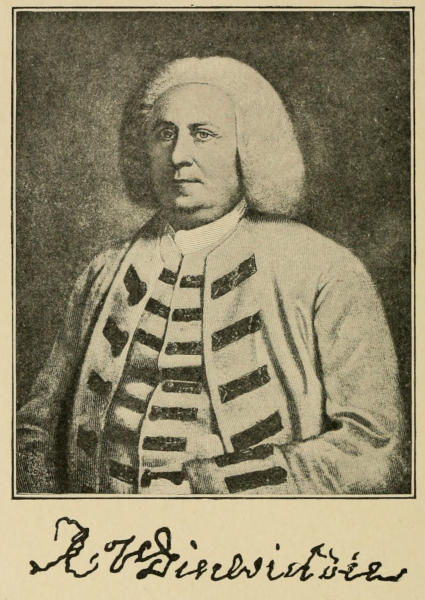
ROBERT DINWIDDIE
The message was carried in the dead of winter to the grave and courteous soldier who commanded at Fort Le Bœuf; and Washington tried the endurance even of the veteran frontiersman who accompanied him by the forced marches he made thither and back again through the dense and frosted woods, across frozen streams, and through the pathless, storm-beaten tangles of deep forests, where there was hardly so much as the track of a bison for their horses to walk in. He reported that the French had received him very graciously; but had claimed the Ohio as their own, had made no pretence that they would abandon it because the English bade them, and clearly meant to establish themselves where they were. Juniors among their officers had told him so very plainly as he sat with them after dinner in a house which they had seized from an English trader.
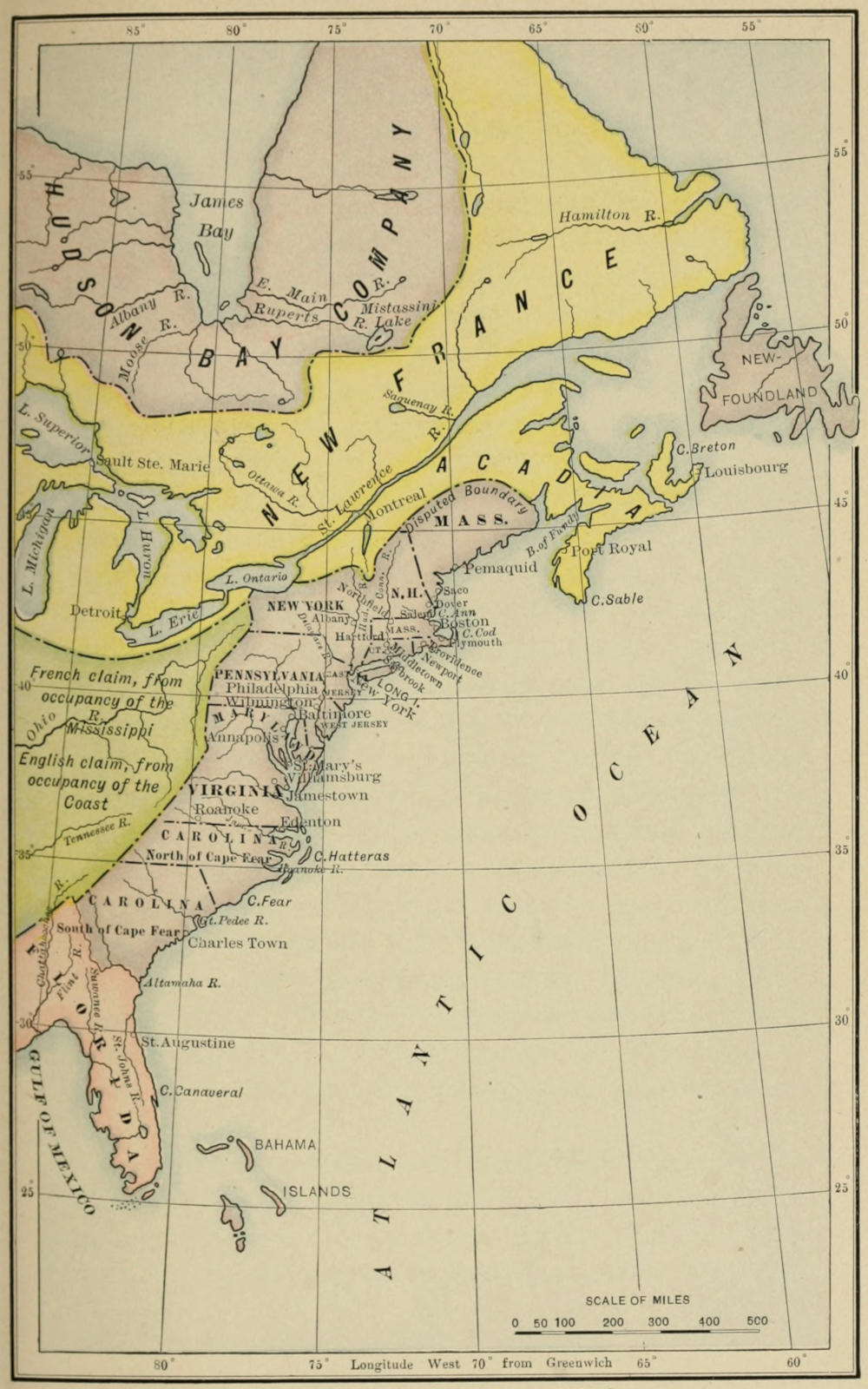
ENGLISH COLONIES, 1700.
BORMAY & CO., N. Y.
He was back at Williamsburg with his report by the middle of January, 1754; and the next month a small body of frontiersmen was hurried forward to make a clearing at the forks of the Ohio and begin the construction of fortifications there ere spring came, and the French. The French came, nevertheless, all too soon. By the 17th of April their canoes swarmed there, bearing five hundred men and field ordnance, and the forty Englishmen who held the rude, unfinished defences of the place had no choice but to retire or be blown into the water. The French knew the importance of the place as a key to the western lands, and they meant to have it, though they should take it by an open act of war. Their force there numbered fourteen hundred before summer came. They built a veritable fort, of the rough frontier pattern, but strong enough, as it seemed, to make the post secure, and waited to see what the English would do.
Dinwiddie had acted with good Scots capacity, as efficiently and as promptly as he could with the power he had. He was obliged to deal with a colonial assembly,—the French governors were not; and the Virginian burgesses thought of domestic matters when Dinwiddie’s thought was at the frontier. While Washington was deep in the forests, bearing his message, they quarrelled with the governor about the new fees which were charged since his coming for grants of the public land; and they refused him money because he would not yield in the matter. But when they knew how things actually stood in the West, and saw that the governor would levy troops for the exigency whether they acted with him or not, and pay for them out of his own pocket if necessary, they voted supplies.
There was no highway of open rivers for the Virginians, as for the French, by which they could descend to the forks of the Ohio; and Virginia had no troops ready as the French had. Raw levies of volunteers had first to be got together; and when they had been hastily gathered, clothed, and a little drilled, the first use to which it was necessary to put them was to cut a rough, mountainous road for themselves through the untouched forests which lay thick upon the towering Blue Ridge. It was painfully slow work, wrought at for week after week, and the French were safely intrenched at their fort “Duquesne” before the tired Virginian recruits had crossed the crest of the mountains. By midsummer they were ready to strike and drive the English back.
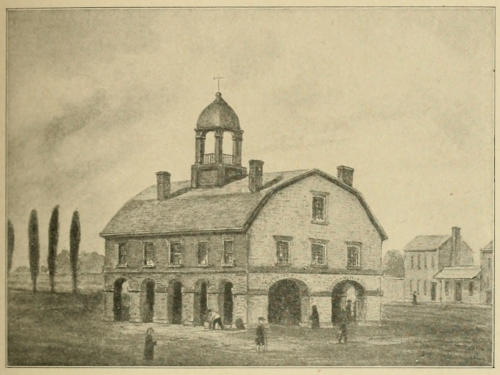
MERCHANTS’ EXCHANGE, NEW YORK, 1752-1799
Blood had been spilled between the rivals ere that. Washington was in command of the little force which had cut its way through the forest, and he did not understand that he had been sent into the West this time merely to bear a message. When, therefore, one day in May (28 May, 1754) he found a party of French lurking at his front in a thicketed glade, he did not hesitate to lead an attacking party of forty against them. The young commander of the French scouts was killed in the sharp encounter, and his thirty men were made prisoners. Men on both sides of the sea knew, when they heard that news, that war had begun. Young Washington had forced the hands of the statesmen in London and Paris, and all Europe presently took fire from the flame he had kindled. In July, Washington was obliged to retire. He had only three hundred and fifty men, all told, at the rudely intrenched camp which he had constructed in the open glade of “Great Meadows” as the best place to await reinforcements; and in July the French were upon him with a force of seven hundred. All day he fought (3 July, 1754), and in a drenching rain, the French firing from the edges of the woods, his own men in their shallow, flooded trenches in the open; but by night he knew he must give way. The French offered him an honorable capitulation, and the next day let him go untouched, men and arms, with such stores as he could carry.
It was a bad beginning at winning the West from the French; and all the worse because it showed how weak the English were at such work. The danger was not Virginia’s alone; it touched all the English in America; but the colonies could not co-operate, and, when they acted at all, acted sluggishly, as if war would wait for both parties to get ready. The assemblies of Pennsylvania and New York declared very coldly that they did not see what right the English crown had to the valley of the Ohio. Maryland had been about to raise a force, but had not yet done so when the fatal day at Great Meadows came. Two “independent companies” in the King’s pay had been ordered from New York, and a like company from South Carolina; and North Carolina had sent forward three hundred and fifty men; but only the single company from South Carolina had reached Great Meadows, where Washington was, before the French were upon him.
Dinwiddie and every other governor who heeded or wrote of the business told the ministers in England that they must act, and send the King’s own troops; and happily the ministers saw at last the importance of what should be won or lost in America. Troops were sent. For Europe it was the beginning of the Seven Years’ War (1755-1763), which was to see the great Frederick of Prussia prove his mastery in the field; which was to spread from Europe to Asia and to Africa; which was to wrest from the French for England both India and America. But for the colonists in America it was only “the French and Indian War.” Their own continent was the seat of their thoughts.
The beginnings the home government made were small and weak enough; but it did at least act, and it was likely that, should it keep long enough at the business, it would at last learn and do all that was necessary to make good its mastery against a weaker rival. By the 20th of February, 1755, transports were in the Chesapeake, bringing two regiments of the King’s regulars, to be sent against Duquesne. The French, too, were astir. Early in the spring eighteen French ships of war sailed for Canada, carrying six battalions and a new governor; and though the English put an equal fleet to sea to intercept them, the Frenchmen got into the St. Lawrence with a loss of but two of their ships, which had strayed from the fleet and been found by the English befogged and bewildered off the American coast. The scene was set for war both north and south.
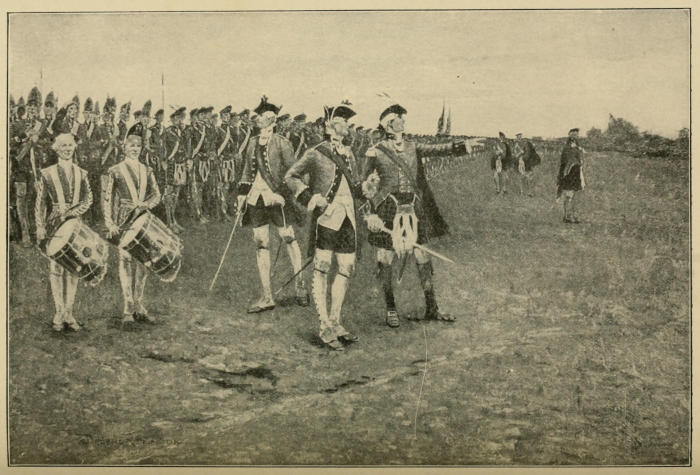
THE PLAINS OF ABRAHAM ON THE MORNING OF THE BATTLE
Major General Edward Braddock commanded the regiments sent to Virginia, and was commissioned to be commander-in-chief in America. He therefore called the principal colonial governors to a conference at Alexandria, his headquarters. By the middle of April five had come: Robert Dinwiddie, of course, the governor of Virginia; Robert Hunter Morris, whose thankless task it was to get war votes out of the Pennsylvanian assembly of Quakers and lethargic German farmers; Horatio Sharpe, the brave and energetic gentleman who was governor of Maryland; James DeLancey, the people’s governor, of New York; and William Shirley, governor of Massachusetts, past sixty, but as strenuous as Dinwiddie, and eager for the field though he had been bred a lawyer,—every inch “a gentleman and politician,” it was said. It was he who had done most to organize and expedite the attack on Louisbourg which had succeeded so handsomely ten years ago (1745). He would at any rate not fail for lack of self-confidence. The conference planned an attack on Niagara, to be led by Shirley himself, to cut the French off from Duquesne; an attack on Crown Point, to be led by Colonel William Johnson, of New York, whom the Mohawks would follow, to break the hold of the French on Champlain; an attack upon Beauséjour, in Acadia, under the leadership of Lieutenant-Colonel Monckton, of the King’s regulars; and a movement, under the command of General Braddock himself straight through the forests against Duquesne, by the way Washington had cut to Great Meadows.
It would have been much better had General Braddock chosen a route farther to the north, where the Pennsylvanian farmers of the frontier had begun to make roads and open the forests for the plough; but it made little difference, after all, which way he went: his temper and his training doomed him to fail. He lacked neither courage nor capacity, but he sadly lacked discretion. He meant to make his campaign in the wilderness by the rules of war he had learned in Europe, where the forests were cleared away and no subtile savages could dog or ambush an army; and he would take no advice from provincials. Few but Washington cared to volunteer advice, for the commander-in-chief was “a very Iroquois in disposition.” He took two thousand men into the wilderness, with artillery trains and baggage: fourteen hundred regulars, nearly five hundred Virginians, horse and foot, two independent companies from New York, and sailors from the transports to rig tackle to get his stores and field-pieces out of difficulties in the rough road. Washington went with the confident commander, by special invitation, to act as one of his aides, and was the only provincial officer whose advice was given so much as consideration during all the weary weeks in which the little army widened and levelled its way with axe and spade through the dense woods. And then the fatal day came which filled all the colonies with dismay.
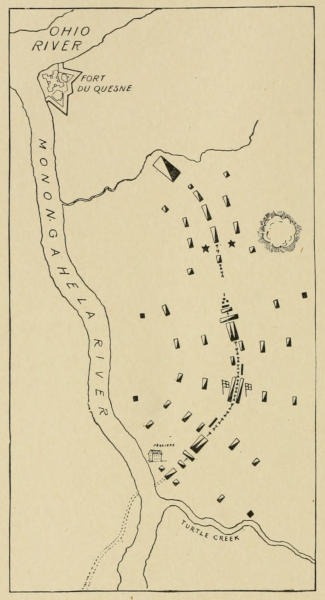
MAP OF BRADDOCK’S DEFEAT
The French commander at Duquesne had no such force as Braddock was bringing against him. He expected to be obliged to retire. But on the 9th of July the English general, with his advance force of twelve hundred men, forded the shallow Monongahela but eight miles from Duquesne, and striking into the trail which led to the fort, walked into an ambush. A thousand men,—Indians, chiefly, and Canadian provincials,—poured a deadly fire upon him from the thick cover of the woods on either hand. He would not open his order and meet the attack in forest fashion, as Washington begged him to do, but kept his men formed and crowded in the open spaces of the road, to be almost annihilated, and driven back, a mere remnant, in utter rout. It was shameful, pitiful. Washington and his Virginian rangers could with difficulty keep the rear when the rout came, and bring the stricken commander off, to die in the retreat. Dinwiddie could not persuade the officers left in command even to stay upon the Virginian frontier to keep the border settlements safe against the savages. It was Washington’s impossible task for the rest of the war to guard three hundred and fifty miles of frontier with a handful of half-fed provincial militia, where the little huts and tiny settlements of the Scots-Irish immigrants lay scattered far and wide among the foothills and valleys of the spreading mountain country, open everywhere to the swift and secret onset of the pitiless redskins.
Braddock’s papers, abandoned in the panic of the rout, fell into the hands of the French, and made known to them all the English plans. They were warned what to do, and did it as promptly as possible. Shirley gave up the attempt to take Niagara before reaching the lake. Johnson, assisted by Lyman, of Connecticut, met the French under Dieskau at Lake George, and drove them back (September 8, 1755),—the commander and part of the force the French had so hastily despatched to America in the spring,—and Dieskau himself fell into their hands; but they did not follow up their success or shake the hold of the French upon the line of lakes and streams which ran from the heart of New York, like a highway, to the valley of the St. Lawrence. The attack upon Beauséjour alone accomplished what was planned. A force of two thousand New England provincials, under Colonel Monckton and Colonel John Winslow, found the half-finished fortifications of the French on Beauséjour hill in their hands almost before their siege was fairly placed; and Acadia was more than ever secure.
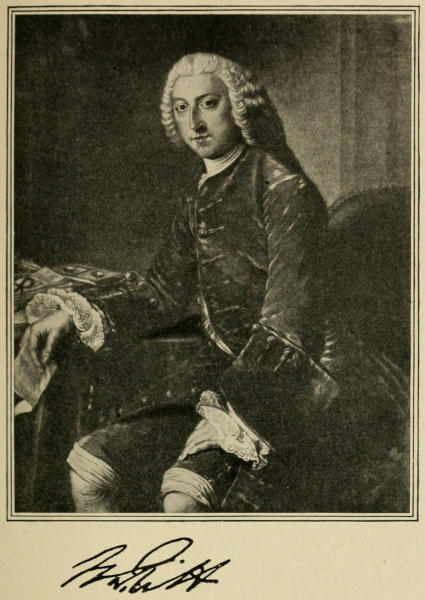
There followed nearly three years of unbroken failure and defeat. In 1756 the Marquis Montcalm succeeded Dieskau as commander in Canada, and the very year of his coming took and destroyed the English forts at Oswego. That same year the Earl of Loudon came over to take charge of the war for the English; but he did nothing effective. The government at home sent reinforcements, but nothing was done with them that counted for success. “I dread to hear from America,” exclaimed Pitt. In 1757 Loudon withdrew the best of his forces to the north, to make an attack on Louisbourg. Montcalm took advantage of the movement to capture Fort William Henry, the advanced post of the English on Lake George; and Loudon failed in his designs against Louisbourg. Even the stout and wily English frontiersmen of the northern border found themselves for a little while overmatched. In March, 1758, Robert Rogers, the doughty New Hampshire ranger whose successful exploits of daring all the northern border knew, was beaten by a scouting party from Ticonderoga, and barely came off with his life. The pouring in of troops, even of regulars from over sea, seemed to count for nothing. General James Abercrombie led an army of fifteen thousand men, six thousand of them regulars, against Ticonderoga, where Montcalm had less than four thousand; blundered at every critical point of the attack; lost two thousand men; and retired almost as if in flight (July, 1758).
WILLIAM PITT

SIGNATURE OF JAMES ABERCROMBIE
THE CAPITULATION OF LOUISBOURG
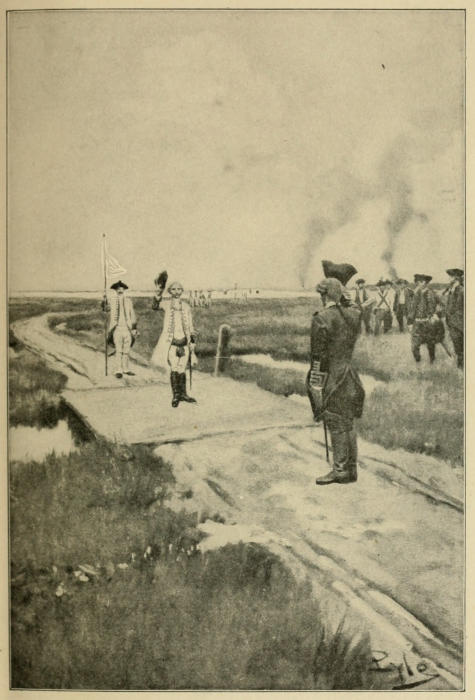
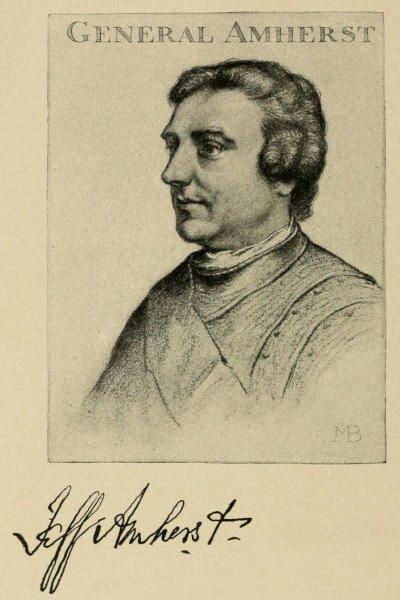
But that was the end of failure. The year 1757 had seen the great Pitt come into control of affairs in England, and no more incompetent men were chosen to command in America. Pitt had been mistaken in regard to Abercrombie, whom he had retained; but he made no more mistakes of that kind, and a war of failure was transformed into a war of victories, quick and decisive. Two more years, and the French no longer had possessions in America that any nation need covet. Pitt saw to it that the forces, as well as the talents, used were adequate. In July, 1758, a powerful fleet under Admiral Boscawen, and twelve thousand troops under General Jeffrey Amherst, whom Pitt had specially chosen for the command, invested and took Louisbourg. In August, Colonel John Bradstreet, with three thousand of Abercrombie’s men, drove the French from Fort Frontenac at Oswego. In November the French abandoned Fort Duquesne, upon the approach of a force under General Forbes and Colonel Washington. In June, 1759, Johnson captured the French fort at Niagara and cut the route to the Ohio,—where Fort Duquesne gave place to Fort Pitt. At midsummer General Amherst, after his thorough fashion, led eleven thousand men against Ticonderoga, and had the satisfaction of seeing the French retire before him. He cleared Lake George and captured and strengthened Crown Point upon Champlain. The French needed all their power in the north, for Pitt had sent Wolfe against Quebec. They had concentrated quite fourteen thousand men in and about the towering city ere Wolfe came with scarcely nine thousand (June 21, 1759), and their fortifications stood everywhere ready to defend the place. For close upon three months the English struck at their strength in vain, first here and then there, in their busy efforts to find a spot where to get a foothold against the massive stronghold,—Montcalm holding all the while within his defences to tire them out; until at last, upon a night in September which all the world remembers, Wolfe made his way by a path which lay within a deep ravine upward to the heights of Abraham, and there lost his life and won Canada for England (September 13, 1759).
JEFFREY AMHERST
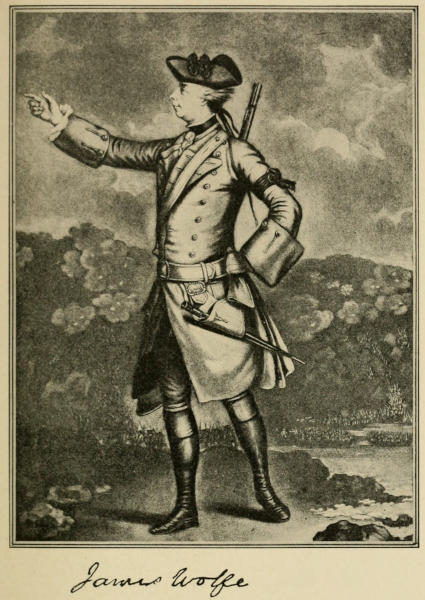
JAMES WOLFE
After that the rest of the task was simple enough. The next year Montreal was yielded up, all Canada passed into the hands of the English, and the war was practically over. There were yet three more years to wait before formal peace should be concluded, because the nations of Europe did not decide their affairs by the issue of battles and sieges in America; but for the English colonies the great struggle was ended. By the formal peace, signed in 1763, at Paris, England gained Canada, Nova Scotia, Cape Breton Island, and all the islands of the Gulf of St. Lawrence, the river and harbor of Mobile, and all the disputed lands of the continent, north and south, between the eastern mountain ranges and mid-stream of the Mississippi, except New Orleans,—besides the free navigation of the great river. From Spain she got Florida. France had the year before (1762) ceded to Spain her province of “Louisiana,” the great region beyond the Mississippi, whose extent and boundaries no man could tell. She was utterly stripped of her American possessions, and the English might look forward to a new age in their colonies.
The general authorities for the condition of the country and the movement of affairs during this period are the well known histories of Bancroft, Hildreth, and Bryant; the third volume of J. A. Doyle’s English Colonies in America; the third volume of J. G. Palfrey’s Compendious History of New England; W. B. Weeden’s Economic and Social History of New England; Mr. Barrett Wendell’s Cotton Mather; Mr. Eben G. Scott’s Development of Constitutional Liberty in the English Colonies of America; C. W. Baird’s Huguenot Emigration to America; James Russell Lowell’s New England Two Centuries Ago, in his Among My Books; Mr. Brooks Adams’s Emancipation of Massachusetts; Madame Knight’s Journal (1704); John Fontaine’s Diary, in the Memoirs of a Huguenot Family; and Benjamin Franklin’s Autobiography.
A more particular account of many of the transactions that fell within the period may be found in Justin Winsor’s New England, 1689-1763, in the fifth volume of Winsor’s Narrative and Critical History of America; Berthold Fernow’s Middle Colonies, Justin Winsor’s Maryland and Virginia, and William J. Rivers’s The Carolinas, in the same volume of Winsor; Charles C. Smith’s The Wars on the Seaboard: Acadia and Cape Breton, and Justin Winsor’s Struggle for the Great Valleys of North America, in the same volume of Winsor.
The chief authorities for the settlement and early history of Georgia are Bancroft, Hildreth, and Bryant; Charles C. Jones’s History of Georgia and English Colonization of Georgia in the fifth volume of Winsor’s Narrative and Critical History of America; W. E. H. Lecky’s History of England in the Eighteenth Century; Alexander Hewatt’s Historical Account of the Rise and Progress of the Colonies of South Carolina and Georgia, in Carroll’s Historical Collections of South Carolina; the first and second volumes of Peter Force’s Tracts and Other Papers relating to the Colonies in North America; and the Colonial Acts of Georgia.