MISSOURI AND THE CIVIL WAR.
Reading edition
Abraham Lincoln was elected President of the United States. Soon after the election they began to discuss the question of seceding from the Government. The author again took the field in opposition to secession, and delivered a number of speeches.
In a short time the people that had been the closest of friends and trusted a neighbor with the most sacred thing they possessed became bitter enemies and arrayed themselves against one another and as the discussion of the great question of war continued to grow more bitter the people appeared to align themselves for and against secession. The people soon grew so bitter that they often talked of fighting each other.
Before the firing on Ft. Sumpter and after several of the states had actually seceded the Union sentiment prevailed so strongly in the state of Missouri that Clabourn Jackson, the then acting Governor, was compelled to order an election in the state of Missouri to settle the matter by a vote, of the people as to whether Missouri should secede or remain in the Union. The author then took the stump and advocated that the state remain in the Union and manifest her loyalty to the preservation of the Union. In this campaign the feeling of the war grew more bitter. The result, however, of the election was that the state remained in the Union. In the mean time, Ft. Sumpter had been fired upon by the rebels.
Clabe Jackson, the Governor, appeared to be determined upon the state seceding either by fair or foul means. Without regarding a majority vote of the people of the state, Clabe Jackson, the then acting Governor, issued his proclamation convening the Legislature in extra session for the purpose of passing ordinances of secession.
At that time Gen. Frost was in the command of the militia and some state troops stationed in St. Louis Barracks but he was in heart and sympathy a rebel. Everything appeared to have been greased and prepared for the occasion.
As the Governor had the whole machinery of the state completely under his control he believed that it would be an easy matter for the legislature to pass ordinances of secession and carry the state out of the Union, but the Government authorities at Washington learned of the critical condition and deep laid scheme of the Governor to carry the state out of the Union and at once ordered Capt. Lyons of the Regular Army, (who afterward became General of the volunteer forces and fought the battle at Wilson Creek, Missouri) to come to St. Louis; he, being a captain in the Regular Army, outranked Gen. Frost, took possession of the troops, arms and amunitions, etc., reorganized and rapidly increased the army by volunteers.
On information reaching Gen. Lyons that the legislature had been convened in extra session he at once took his available troops and left St. Louis with the intention of surrounding the Capitol and taking the members of both houses, the Governor, with all his state officers, prisoners; when the Governor learned that the Government troops were en route for Jefferson City and their purpose, he ordered the bridge to be burned across the Gasconade river near its mouth, on what was then known as the North Pacific R. R. This delayed the troops for several hours. On their approach to Jefferson City the Governor and state officers and the members of both houses of the legislature and all the troops that had been ordered to the Capital by the Governor retreated to Boonville, Missouri.
I heard our representative in a speech delivered a short time afterwards, say they came so near getting him while he was getting out of Jefferson City that he lost his umbrella. Lyons pursued them and at Boonville they made a stand and on Lyon's arrival with his troops he attacked them and they fought for a short time. They again retreated, went into the extreme west part of the state to a place known as Lone Jack. There they made a stand again, Lyons still pursuing. He again attacked then at Lone Jack and after a short fight they retreated again into the State of Arkansas, and there Governor Jackson convened the legislature and they passed ordinances of secession declaring the State of Missouri out of the Union and that she was attached to the compact forming the Confederate States.
General Lyon returned to St. Louis, increasing his force considerably, several regiments being attached to his command from other states. The government ordered him to prepare his troops and move west to Springfield. The terminus of the South Missouri Pacific R. R., at that time was at Rolla, Missouri. While Lyon was massing his troops and preparing to march to Springfield the most intense excitement prevailed in the entire State of Missouri.
A Big Confederate Meeting at West Plains.
The Confederate authorities at once commenced recruiting for the Confederate service and the Confederate recruiting officers published a public meeting at West Plains about the first or tenth of July and while the Confederate authorities were moving, the union or loyal element of the country was not idle, but was watching every move, openly and secretly preparing for the conflict.
A few days before the meeting was to be held at West Plains the Confederates sent to the pinery and procured a long pine pole, hoisted it at the corner of Durham's store at the northwest corner of the public square and swung to the breeze the stars and bars. At the same time, or near the same time, the Union men sent to the pinery and procured a pole. They hoisted it on the northeast corner of East Main street by the corner of McGinty's store where the S. J. Langston Mercantile Co., building now stands and swung to the breeze the stars and stripes.
It was freely published throughout the county by the Rebels that if any Union man attempted to open his mouth on that day he would be shot as full of holes as a sifter bottom. There was a beautiful grove then growing just east of the branch on East Main street running from the town spring. Large preparations were made by the Rebels for the occasion. It was published that there would be leading Confederates from all over the state and different other states to speak on that day and one of the main features of the day would be recruiting for Confederate service. A big speaker's stand was erected with hundreds of seats. When the day arrived the town was crowded with people and the friends of both parties were armed and appeared to be ready for the conflict. The stars and bars attracted a great deal of attention, being the first flag that had ever been seen by the people that antagonized the stars and stripes and threatened to destroy the United States Government.
There was soon a number of determined men gathered under each flag. A number of their prominent speakers were on hand, among them Judge Price, of Springfield, known as "Wild Bill" Price. They readily took in the situation and saw that a conflict was imminent, and as they were not ready for it they met together in council and agreed that their men should not bring on the conflict on that day. Quite a number of the parties prepared themselves at the speaker's stand. When different speakers were introduced to address the people, many of the men would sit, either with their guns in their hands or with their guns near to them, and the most fiery and extreme speeches were made that I ever heard.
The author well remembers the speech of Judge William Price. He told them that the lopeared Dutch had reached Rolla, Missouri, the terminus of the railroad, and that they were complete heathens; that Abraham Lincoln had given the state of Missouri to them, if they would send enough lopeared Dutch to conquer the state, and that to his knowledge they had gone out into the country and taken men's wives and daughters and brought them into the camps, and that he saw them, in the presence of the mothers, run bayonets through their infant children and hoist them up and carry them around on their bayonets; that Abraham Lincoln had offered a reward for all of the preachers that were in favor of the South. He bursted into tears and asked the question, "I want to know who the man is, and the color of his hair, that won't enlist in the interest of his home, his wife, his children and everything that is sacred and good, to drive out lopeared Dutch, a certain class of Hessians, from our land." He urged them to come forward and place their names upon the rolls. Nearly all the preachers present placed their names on the recruiting list first.
The excitement grew still more bitter. In the afternoon they began to threaten openly that the stars and stripes should be hauled down; that no flag should be allowed to float in West Plains that countenances and tolerates heathen in our land. The Union men declared that the stars and stripes should not be lowered unless it was done over their dead bodies. Quite a number of Union men had assembled under the flag. The Union men were led by a man named Captain Lyle. He had been warned and cautioned by his friends not to open his mouth, for the reason that he would be shot full of holes. Late in the evening there was a lull in the speaking. The author walked up into the speaker's stand, called the attention of the people, saw a number of rifles grasped in their hands, and announced to them that they had been sitting all day listening to Confederate speeches, but on the next Saturday, if they would meet him at Black's store, about ten miles west of West Plains, they could hear Union speeches and the constitution of the United States would be read; thanked the crowd and stepped down. Quite a number of guns were raised in the hands of parties and a shower of groans and hisses, and remarks openly from a number that "We ought to shoot his black heart out now."
It appeared for a while that it would be impossible to evade a conflict of arms. A number of orders being sent to the Union men to draw down their flag or they would fire on it and the men who supported it, an answer was returned that the rebels were requested to draw down their flag as it was a stranger in the land and unless they lowered their flag the stars and stripes wouldn't be lowered an inch, unless it was done over their dead bodies. At last a proposition came that they would agree for the sake of averting bloodshed to commence lowering both flags at the same time which proposition was accepted; so wound up that day's proceedings.
On the Saturday following, the author, with several other Union speakers, met at Black's store where there were several rebel captains and lieutenants. The author made a speech in favor of remaining in the Union and stated that the attempt to secede by some of the states would eventually result in sad disaster, besides bringing untold suffering upon the people. Several other Union speeches were made after which the author read the constitution of the United States and urged that all lovers of republican form of government would comply with the demand of the supreme law of the land and, if necessary, sacrifice property and life in defence of the same; so ended that day's proceedings.
McBride Establishes Military Law.
As the organization of the confederates proceeded they still grew more bitter against the Union men and declared, by meeting and passing resolutions, that every Union man should show his colors in favor of the South or be hung as high as Hamen. In the meantime the Union men had secretly organized and met together, to take into consideration as to the time when they should act.
The prevailing sentiment was, that they should remain dormant and let the rebels shed the first blood, while the minority thought the time had come for action, and that they ought to act before the rebels crippled them and tied them up in such a manner that, when the time did come, they would be entirely helpless and at their mercy.
McBride, who had been elected judge of the 18th Judicial circuit, which included Howell county, whose home was in Texas county, was made Brigadier General of the Confederate forces and commenced organizing and massing his troops. On the arrival of the federal troops at Rolla, Missouri, he became fearful that they would attack him, rout him and destroy his forces, so he concluded to march south to West Plains and make his headquarters at that place until he could organize his forces and prepare for marching west, where he intended to join the forces of Gen. Sterling Price and Gen. McCullough who then were massing their forces to march on Springfield, Missouri, to attack the federal forces who were then stationed at Springfield under the command of Gen. Lyon and Gen. Seigle. On his arrival at West Plains he opened up headquarters, issued his proclamation that all Union men or any men that were unfriendly to the Confederate cause should come in and take the oath and the civil law was declared to be suspended and the military law completely in force.
Then was when the dark day and trouble began to hang over the Union people. As soon as it was known that the civil law was suspended little bunches of rebels organized all over the country and also in the state of Arkansas. In a short time after Gen. McBride's arrival in West Plains a man who was a door neighbor to the author came into his field where he was cutting wheat, asked him if he had seen the order of McBride. My answer was "No." He remarked, "Well, he has made a general order, requiring all Union men, especially those who have been open and active in behalf of the Union, to come in and take the oath, and unless they do they are going to hang them as high as Hamen." The author replied to him that he was a Union man and he knew it; he had been open and outspoken for the Union and had voted for McBride when he was elected Judge, but now he thought he was acting outside of the law and humanity.
I had neither violated the law of my land nor harmed any man and I didn't consider that McBride had any right to order me to take an oath to take up arms against my country or support those who had taken up arms. If this did become a general war, I thought they were making a blunder, for the Government, or the lopeared Dutch, as they termed them, would have the advantage in the way of transporting forage and commissaries and amunitions of war, while the Confederates would have to rely mostly for their resources upon the county; that I was a peace officer and while I was a strong Union man wasn't taking up arms and I thought that those who wanted to fight, if there had to be a fight, should go out into the open fields, and not force the war onto non-combatants, and that the country would suffer enough at best. Now you know I am a Union man, and I know that you are in favor of the Confederate cause, and I think this is the course that ought to be pursued at the present time. The Confederates are in control of the country, and they will come around and say they must have forage for the support of the army, and ask you if you know of any Union men; you could tell them, "My neighbor right here is a Union man, but he is not disposed to take up arms and go into the fight; take as little from him as you can possibly do with, and as little from myself; in return, if this war goes on, and the Federal authorities extend their jurisdiction, they would be out hunting rebels for the purpose of getting forage and commissaries, and I could say to them that my neighbor here is a rebel but take just as little as possible from him, and as little as possible from me, as we are going to have a hard time to get through the war any way. But if you pursue the policy you say has been adopted by the Confederates, you will force all non-combatants into arms or drive them from the country and completely depopulate it." He burst into a big laugh and remarked, "Your promises are like a broken stick, you will never see the lopeared Dutch in this country." I said to him, "My friend, if this war goes on, before the end of it you will see what you call lopeared Dutch as thick as blackbirds;" and we separated.
General Lyons Drives Rebels from Rolla.
About June 10, 1851, the rebels were having a big meeting at Rolla, Phelps county, Missouri, for the purpose of recruiting. General Lyons at St. Louis, learned of the meeting, and at once placed quite a force in the cars, well armed and closed them up so they would not be detected and started for Rolla with the intention of capturing the whole outfit.
On the day set for the rebel meeting, quite a number of them had assembled and a certain young lawyer was delivering an address, telling them that one southern man could whip five lopeared Dutch and all they wanted was just an opportunity; in the meantime Lyon's forces had reached Dillon, the next station east of Rolla about five miles distant. There the forces were taken from the cars and divided, some marching southwest and the others northwest, making a flank movement for the purpose of surrounding the whole place. While they were marching some person, who was a rebel, went with all the speed possible and informed the meeting that the Dutch were right upon them; that the woods were full of them and to get out of there as quick as possible, if they wanted to save their lives.
The lawyer who was addressing them sprang from the speakers stand and holloing at the top of his voice as he went, "Get away from here, the Dutch are upon us." It was said that the lawyer ran so fast that if a glass of water had been sat upon his coat tail it would not have spilled. They scattered to the woods in all directions. The Federal force came in; but their birds had all flown and left the citizens who had remained to tell the sad tale.
The rebel forces at once retreated to Salem, Missouri, where they again concentrated their force. The Federal scout, in a few days followed them to Salem, and there again routed them and they retreated directly to West Plains, joining the command of McBride at that place. The rebels, hurriedly, concentrated their forces from all the south and southeastern counties of Missouri and from the northern counties of Arkansas.
General McBride made an order to gather all the arms, amunitions, and horses that were fit for the service, as speedily as possible and the report was put in circulation that he had given the county over to the leading rebels, who resided in it, whose action, whatever they did touching the Union men, would be indorsed and carried out by General McBride. The leading rebels of the county at once sent out word that they were going to take all the arms, amunition and available horses from the Union men and that McBride required each and every one of them to report and take the oath at once, and if they failed to comply with said order, speedy action would be taken against them.
They would either be arrested, imprisoned or forced into the Confederate army to fight and their leaders would be hung.
On the issuing of the said order the wildest excitement prevailed among the Union men. They immediately met for the purpose of consultation as to what their final action would be. There were divers opinions among them; some of them were for acting at once; others (and a majority of them) were in favor of waiting until the rebels shed the first blood. Those who refused to report and take the oath had to place themselves in hiding at once. The rebels made a general move to raid, harass and capture the Union men. Then real danger confronted a man who claimed to be a Union man. The rebels had made a general amnesty, upon the condition that they would join the Confederate army and become loyal to the Confederate States. About two-thirds of the men who had been open and avowed Union men saw the danger that confronted them, and joined the Confederate army and claimed that they would be loyal to its cause. The remainder of the Union men were disarmed at once, except those who kept themselves concealed in the mountains and hills.
After they had completely disarmed them and forced many of them to join the Confederate service, had taken most of their horses, cattle and hogs for the use of the army, the leading rebels in the county claimed that they had organized for the purpose of ridding the country of all Union men who had refused to join the Confederate forces; that when McBride moved west he was going to leave the whole matter in their hands, and they intended to string up the Union men to limbs and shoot them, so they would soon be rid of the class of men who were friends of the lopeared Dutch and were nigger lovers.
The Testing of Loyal Hearts.
Small bunches of rebel troops came in from Arkansas and joined the bands that were raiding the country, and the Union men were hunted like wild beasts. Then set in the darkest day that ever any class of patriots, true to their government, had to confront.
The author remembers well when the Union men would meet together, that they took the proposition made by McBride into consideration, and it was discussed pro and con. Some men would say, "While I am a Union man and for the government, all that I have in the world is here in Howell county; my little home, my property and, above all, my wife and children. They have promised us protection provided we will join the rebel army. Had we not better accept the proposition and wait for results?" Others would arise, with tears dripping from their eyes, and remark that this state of affairs is hard indeed. "Can I afford to abandon my wife and children that I love so well and leave them unprotected in the midst of an open state of war, at the mercy of a mad and distracted people, who are thirsting for the loyal blood of the nation, and be alienated from them, perhaps, never more to see them?" Others would arise and remark that "We have seen this danger coming for months and we are satisfied that the worst has not come, and I know that I love my wife, my family, my little children, as I love my own heart; I love to meet them around my fireside and enjoy their sweet company, and I have delighted in laboring to furnish them food and raiment and shelter while they were growing into manhood and womanhood, but I have read and heard read that my highest duty was to God and my second duty was to my country; and the organic law of the nation requires at my hands that whenever it becomes necessary to preserve my government, that I owe to it my life, my honor and the welfare of my family; and the trying ordeal is now at hand and I don't know what the final result will be—if I am forced away from my family, I know they will be left at the mercy of an intolerant and unrelenting enemy, but I now and here lay my life, my family, my property and my future happiness upon the altar of my country, and let come what will, weal or woe, I intend, with all my feeble effort, to defend the stars and stripes, and stand up openly and courageously in defense of and for the preservation of the Union." That proposition prevailed and was unanimously adopted by the Union men.
At this time there was no government aid in reach of these loyal hearts, that were controlled by nothing but love of country. Uncle Sam could do nothing for them. They were completely surrounded in an enemy's country, and while they (the men), with what arms they had preserved, could by strategy evade the arrest and slaughter of themselves, their families were completely at the mercy of a mad and howling mob, thirsting for the blood of Union men.
While the loyal men in the North were enlisting in the interest of their country, Uncle Sam paid them $13.00 per month, clothed them, and their families were left in the care of friends; they knew nothing about the war, except what they read; but not so with the Union men who were surrounded in an enemy's country. They, without a single word of protection or comfort from the government for themselves or their families, but their love and devotion to their country led them to furnish themselves, to leave their families as best they could, at the mercy of a howling mob, for the defense of their country.
Rebels Defeated in Douglas County.
The loyal men in Douglas county and the north part of the county of Ozark were in the ascendency. A rebel force organized from the county of Howell, Missouri, and Fulton county, Arkansas, wanting to have some fun hunting Union men, learned that on Bryant's Fork on the north fork of White river in Ozark county there was a bunch of Union men. So they armed and equipped themselves, furnished themselves ropes, and marched to hunt the place these men were said to be. The Union men hearing of their intention hurriedly prepared a temporary barricade around the house, and about sixty of them gathered together with their squirrel rifles in readiness to repel the attack in case it was made. The rebel scout consisted of two hundred and fifty men.
Early in the morning reliable information reached the Union men that the rebel forces were well under way and would reach them some time in the afternoon. One of the Union men, who had always borne the reputation of being a brave man and would fight anything, became impatient as the time drew near that they were to be attacked. He had been a great hunter and was considered a first-class shot, and he remarked to the Union men, "I can't wait for the rebels to attack us, I want to get a shot at one so bad with Old Betsy (his gun). I know of a bald knob, about a quarter of a mile from here, where the rebel force is bound to pass. I am going there; place yourselves in waiting, and when you hear 'Old Betsey' belch, you may know there is one dead rebel, and be certain that they are coming." In about an hour after the man referred to had left, the rebel advance came in sight, but they never heard "Old Betsy" belch. They vigorously attacked the Union men inside their fortifications, and after fighting for about an hour, they retreated, leaving one man dead upon the field and one wounded. The Union men received no injury whatever. They became very uneasy in regard to their friend and "Old Betsy," supposing he had fallen into the hands of the enemy and they had used the rope on him. Search was made all along the line of march of the rebels for the missing man, but no information could be learned of his whereabouts. However, in about one week, news came from Douglas county that their friend and "Old Betsy" arrived safely at another rendezvous of Union men in Douglas county, about forty miles distant, and reported that the Union men had had a fight with the rebels, and they were all captured or killed, with the exception of himself, and he had made his escape after the fight.
Just before McBride broke camps to march west to join Gen. Price and Gen. McCullough, he made a general order that they arrest and seize every Union man possible, and after he left the country, that the committee who had been organized to take charge of the county, would at once exterminate every Union man who had failed to take the oath or to join the Confederate army, giving them full power as to what disposition they would make of them.
Rebels Capture Col. Monks.
On the 7th of July, 1861, one of my neighbors came to me and informed me that the time had come that every Union man had to show his colors and unless they reported and took the oath or joined the Confederate army, they would hang as high as Haman. While the Union men were on their guard and watching their movements, once in a while they would slip in home to see how the family was getting along. My family at that time consisted of a wife and four children, three girls and one boy. My wife had never been accustomed to staying alone and I came in home late on the evening of the 7th, thinking that I would leave the next morning before daylight. Sometime after the family had retired, not far from 11 o'clock in the night, I was awakened by a rapping on the door. My wife, suspecting who the parties were, answered them, and demanded to know what was wanted; one of them, who claimed to be an orderly sergeant, remarked that he wanted to know if Monks was at home. She replied that he was not. A man by the name of William Biffle, whom the author had been acquainted with for years, replied, "He is here, I know, for I coursed him into this house late yesterday evening." The author at once arose to his feet and remarked, "I am here, what is wanted?" A man by the name of Garrett Weaver, who claimed to be an orderly sergeant and in charge of the squad, also a neighbor to the author said, "I have been ordered by Gen. McBride to arrest you, bring you in and make you take the oath." I owned at that time a first-class rifle and there was also another rifle gun in the house. I took my gun into my hands and my wife took hold of the other gun. I told them that a general order had gone forth, so I was informed, that they wanted to hang all the leading Union men and "if that is your intention I will die before I surrender." Weaver replied they were not going to hang me, but they were just going to take me to McBride to take the oath and I should be protected. Upon those terms I agreed to surrender, made a light in the house and found that the house was surrounded by a posse of twenty-five rebels. As soon as the light was made, a part of them rushed into the house, took my gun and jerked the one my wife had in her hand out of her possession, almost throwing her to the floor, began a general search of the house for other arms and such things as they said the army needed.
As soon as I dressed, they ordered me to move. They didn't even give me time to say good-bye to my wife, nor to imprint a kiss upon the cheeks of my loving children. Closely surrounding me, they marched me about 250 yards, came to their horses, where two more of their posse guarded the horses, they having dismounted, to approach the house on foot so they might not be heard.
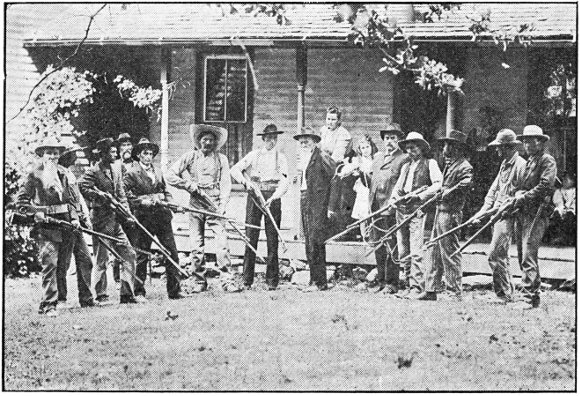
COL. MONKS ARRESTED AND TAKEN FROM HOME
"Billy, You Ought Not to be So Saucy."
When within a few feet of the horses the author was halted. It was just starlight. I noticed a man by the name of Wilburn Baker, a man with whom the author had been acquainted from a boy, go to the horn of one of the saddles, lift therefrom a coiled rope and move toward the author. The author quickly arrived at the conclusion that the time had come to enforce the order of hanging. Baker ordered the author seized by the arms, drew them behind him and securely tied him. The author asked, just as they had completed the tying, "What do you mean? Are you going to cage me?" Baker replied, "Billy, you ought not to be so saucy, for you don't know the danger you are in." I was at once ordered placed on a horse. One of the posse rode up to my side and placed the other end of the rope around his body and the posse moved west. A short time before daylight they arrived at the house of William Nicks, who was a rebel lieutenant. They dismounted and took the author into the house. There appeared to be a general rejoicing among them. Nicks said, "You have got him, have you? We had become uneasy about you, and thought it might have been possible that he had his Union forces around him and that you had met with disaster; but I feel satisfied that we have now captured the leader and the counselor of the Union forces and the remainder will be easily extinguished." Gen. McBride in the meantime, being uneasy for fear the Federal troops would attack him, had removed his forces from West Plains to the south part of Howell county, camping at what was known as the Flag pond.
I was closely guarded until daylight. McBride's forces had broken camp at the Flag pond on the morning of July 8th and were marching west with the intention of joining the forces of Gen. Price and Gen. McCullough, who were then moving in the direction of Springfield, Missouri, with the intention of attacking the Federal forces at that place, commanded by Gen. Lyon and Gen. Siegel. Very early on the morning of the 8th the party started in a southwest direction, with the author closely guarded. On coming near the head of Bennett's river, Fulton county, Arkansas, the posse commenced cheering and remarked: "Listen! Do you hear the drums and the fife? That is Gen. McBride's command moving west to kill them lopeared Dutch that you Union men have brought into the state of Missouri. Do you know what we are going to do with such men as you are? Those of you that we don't hang, the first fight that we get into with the lopeared Dutch, we will make breastworks out of to keep the bullets off of good men."
About one mile further we came in sight of the moving column. We rode along the line, when there was general cheering until we reached a company that was organized in Oregon county and commanded by Capt. Simpson. Simpson said, "Why have you brought a Union man in here alive! If my company had possession of him, he could not live ten minutes."
We soon reached a company commanded by Capt. Forshee which was organized in this county to whom the whole posse that made the arrest, belonged. The author was well acquainted with all of them and over half of them resided in the same settlement and were his neighbors. On reaching the company Captain Forshee walked out of the line and remarked to them "Why have you brought him in here alive?" Some of the posse remarked, that he had been a neighbor and they had all been friends up to the war and they hated to kill him. Forshee said "When I saw him at West Plains at the speaking when he got up and contended that there was a union and the government ought to be preserved, I wanted to shoot his black heart out of him and I feel the same way yet."
The author was kept in close confinement and on the night of the 8th the command went into camp near what is known as the old Steve Thompson farm. The author, with several other prisoners, was placed in the guard house and orders were given that he be closely guarded.
After they had taken their suppers, men that the author had been acquainted with from his boyhood, and men who had been acquainted with his relatives, came to the guard house in considerable numbers and remarked, "Hello, Monks?" "I never expected to see you under arrest." "What have you been doing that they have arrested you? I thought you was a good Democrat." "Have you left your party." "The Democratic party is in favor of the South." The author replied to them that when they thought he was a good Democrat they were right. But that he was not a slave to party and that he held country higher than party and if Democracy meant secession and nullification, that was one part of the principals of Democracy that he had never learned; that true Democracy, as understood by the author, taught every man that in case his country was invaded either externally or internally that he owed his honor and property in the support of it and for those reasons he was for the preservation of the Union at all hazards. Some remarked that "We ought to hang him right now without waiting any longer" Others remarked that "We have been acquainted with his people both on his mother's and father's side and they were all southern people and Democrats and they are all of them, almost, in favor of the South. It is strange indeed to see the course that he has taken." The author remarked that "There were always some shabby sheep in a flock and I suppose from your reasoning that I am one of them." They all retired, the officers giving orders that the most vigilant watch be kept over the prisoner. After he had retired a gentleman by the name of Joseph Teverbaugh who resided in Ozark county, a merchant and the owner of about twenty negroes, who had been well acquainted with the author from his boyhood, brought up the conversation as to what disposition they thought ought to be made of the author. The author could easily hear all the conversation inside of the guard line. Many opinions were expressed. Quite a number said, "Hang him outright." That was the only way to get shut of the Union men, to make short work of it, and forever rid the country of that element.
Others said that appeared to be too harsh, that they were in favor of taking him to Little Rock and confining him in the penitentiary until the war was over, for it wouldn't take but a short time to rid the country of the lopeared Dutch and those who were friends to them. Others remarked that "that would be too easy for a man who was in favor of the lopeared Dutch; that we are in favor of taking all like him right into the army and making them fight and if they won't fight, the first engagement we get into, pile them up and make breastworks out of them, so that they will catch bullets off of good men." At this juncture Teverbaugh remarked, "I have been acquainted with Billy from a boy and you never can force him to fight against what he believes to be right, that he was a good boy and since he has grown up to be a man he has been an honorable and straightforward man and quite an active man politically and my advice would be to confine him in the State Penitentiary until the war is over, for I tell you now if he ever gains his liberty you are going to have him to fight."
Sold as a Beef Cow.
On the morning of the 9th they broke camp and marched near the mouth of Bennett's river and went into camp at what was then known as Talbert's mill. A short time after we had been in camp Capt. Forshee, who had charge of the prisoners, came to the guard house and the author requested him that he be allowed to take the oath and return home, as his wife and children were almost scared to death owing to the reports that were currently circulated all through the country, his wife would believe they had hung him. The captain replied that they were not going to allow him to take the oath. They had plenty of proof against him, that he had been communicating to the lopeared Dutch and as soon as they had formed a junction with Price and McCullough he would be tried as a spy. He gave orders to the guard to see that he was kept in close confinement, and about 11 o'clock in the night as near as the author can guess, it being starlight, the Captain came down to the guard house in company with one of his men, Frank Morrison.
The author was lying on the ground pretending to be asleep. The Captain came inside of the guard, called out, "Monks, are you asleep?" The author raised up in a sitting position and said, "Captain what is wanted"? The Captain remarked, "I want you to go up to my camp fire," which was about 75 yards distance from the guard house. The author said, "Captain, this is a strange time of night to come down and order me to your camp fire." He said; "Not another word out of you, rise to your feet." He ordered Morrison to step behind him with the same gun that he had recently taken from the author and cock it and "if he makes a crooked step from here up to the camp fire shoot him through." The author heard Morrison cock the gun and about half way between the guard house and the camp fire the Captain remarked to the author, "Do you know Kasinger?" The author, suspecting that he was going to be delivered to a mob, said "I know him very well; we have grown up together from boys." The Captain said, "I thought he was a mighty nice man. I have sold you to him for a beef cow." The author remarked there was but one thing he was sorry for; that if he had known he was going to be delivered to a mob he never would have surrendered and had some satisfaction for his life. The Captain said, "I thought I was doing mighty well to sell a black Republican or a Union man for a beef cow where we have as many good men to feed, as we have here."
His camp fire was under a gum tree with a large top. The fires had all died down, it being in July and nothing but the stars were giving the light. On coming within two or three feet of the tree the Captain ordered the author to halt. He and Morrison walked about ten paces and said, "I have brought you up here to liberate you. We have got plenty of good men here to feed without feeding men who are friends to the lopeared Dutch." The author replied to the Captain, "you may think you are dealing with a fool. I have neither violated the civil nor military law; have demanded a trial and you refuse to give it to me. You can't bring me up here at this time of night and pretend to turn me loose for the purpose of escaping the responsibility of an officer and deliver me into the hands of a mob."
The Confederate Army or Hell.
The author was satisfied that he could then see a bunch of men standing in readiness. The Captain replied, "Sit down or you will be shot in half a minute." The author sat down and leaned against the tree. He had on strong summer clothing, wearing an alpaca vest and coat. In an instant, about twenty-five men, led by Kasinger, and a man by the name of William Sap, approached the author; Kasinger, holding a rope in his hand with a noose in it, walked up to the author, held the noose of the rope above his head and said, "Monks, you have half a minute to say you will join the army and fight, or go to hell, just which you please." The author replied that it was said that "hell was a hot place," but he had never been there, and that he had always been counted a truthful man until he had been arrested, and since his arrest he had been asked divers questions of the whereabouts of the lopeared Dutch, and that he had told them in every instance he knew nothing of them and had been cursed for a liar. "If I was to say that I would join the army and fight, I might have a cowardly set of legs and they might carry me away; and in the next place, I am a Union man, first, last and all the time. I suppose your intention is to hang me, and there is only one thing I am sorry for, and that is that I ever surrendered; but there is one consolation left, when you kill me you won't kill them all, and you will meet plenty of them that won't be disarmed as I am now."
Kasinger replied, "No damn foolishness, we mean business," and made an attempt to drop the noose over my head, which was warded off with my arms.
At this juncture the author appealed to the Captain for protection from the mob, saying that he was a prisoner, unarmed and helpless, and if he suffered him to be murdered by a mob his blood would be upon the Captain's head. No reply being made by the Captain, all of the parties being considerably under the influence of whiskey, Sap raised his left hand, pushed Kasinger back and remarked, "I have been shooting and wounding some of these black Republicans who are friends of the lopeared Dutch, but I intend to shoot the balance of them dead." At the same time he drew a pistol from his right-hand pocket, cocked it, stooped over, ran his fingers under the author's clothing, gave them a twist and commenced punching him around the chest with the muzzle of the revolver, and after, as the author thought, he had punched him some fifty or sixty times with the revolver, the author said to him, "William Sap, there is no question but that your intentions are to kill me, and you want to torture me to death. You know that if I was armed and on equal footing with you, you would not do this." He made a quick jerk with his left hand, intending to jerk the author upon his face, remarking to the Captain at the same time, "Captain, you promised him to us and we are going to take him." The author, with all force possible, leant against the tree, Sap's hold broke loose, tearing off all the buttons that were on the vest and coat.
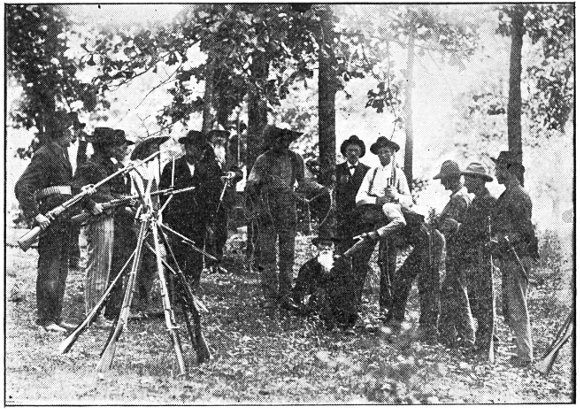
A NARROW ESCAPE FOR COL. MONKS.
The author again appealed to the Captain for protection from the mob. The Captain then remarked to Sap, "Hold on for a moment, I will take a vote of my company as to whether we will hang him or not." The company at that time was lying on the ground, most of them apparently asleep. The Captain called out aloud to his company, "Gentlemen, I am going now to take a vote of my company as to whether we will hang Monks or not. All in favor of it vote, aye; all opposed, no." He then took the affirmative vote and the negative vote. They appeared, to the author, to be almost evenly divided. Sap again remarked to the Captain "You promised him to us, we have bought him and paid for him and he is ours."
The author again appealed to the Captain for protection. The Captain replied to Sap, "He claims protection and as I am an officer and he a prisoner I reckon we had better keep him until we reach McCullough and Price and then we will try him for a spy and there is plenty of evidence against him to prove that he has been writing to the lopeared Dutch and after he is convicted will turn him over and you men can take charge of him." At this juncture a brother in-law of the Captain said, "Captain, I have one request to make of you. I want you to take Monks in the morning and tie him hard and fast, with his face to a tree, and let me shoot with a rest sixty yards and show you how I can spoil a black Republican's pate." The Captain replied, "As soon as he is convicted you can have the gratification of shooting him just as often as you please."
The Captain and Morrison again took charge of the author, carried him back and delivered him to the guard with instructions to the guard to be diligent in keeping him closely confined so that he would have no possible chance of escape. On the morning of the 10th we broke camp and went into camp that night just beyond where Mountain Home now stands. Dr. Emmons, of West Plains, who was a strong Union man and who afterwards became captain in the 6th Missouri Cavalry, attempted to go through to the Federal forces but was pursued by the rebels, captured somewhere in Texas county and brought back to the camp. He was also a prisoner at the same time; but being a master mason, was paroled to the limits of the camp and on the night of the 10th made his escape and got through to the Federal lines, enlisted and was made captain. Of him we will speak later.
In Camp at Yellville.
On July 11th they broke camp and reached Yellville, Marion county, and on the 13th reached Carrolton, a small town in Arkansas, and went into camp. The author well remembers the spring. It ran out of the steep, rocky gulch and the branch ran a little south of west and a beautiful grove of timber surrounded the spring. The prisoners were marched down within a few feet of the spring and there placed under guard. As usual, the abuse that had been continually heaped upon the prisoners during the march was renewed and in a short time a man who was said to be from one of the counties north of Rolla, Mo., commenced making a speech and inciting and encouraging the soldiers to mob the prisoners at once; that he had disguised himself and entered the camps of the lopeared Dutch at Rolla, and that to his own personal knowledge they had men's wives and daughters inside of their camps, committing all manner of offenses possible, and that they were heathens; didn't resemble American people at all and that he would not guard nor feed any man who was a friend to them; that they ought to be killed outright.
The men who enlisted in the Confederate army from Howell and adjoining counties, before starting, went to the blacksmith shops and had them large butcher knives made; made a belt and scabbard and buckled them around them, and said that they were going to scalp lopeared Dutch. In a short time the tenor of the above mentioned speech had incited over 400 men and it had become necessary to double the guard. The grove of timber was filled with men and boys looking over, expecting to see the prisoners mobbed every minute. There was a man who drew his pistol, others drew knives and made different attempts to break lines and mob the prisoners. The man in possession of the pistol declared that he intended to shoot them. He was on an elevated place and they called him "Red," and there were three or four men holding him to prevent his firing. The author remarked to him that: "The time will soon come when you will meet men who are not disarmed. You had better save your bravery until you meet them, and my opinion is that you won't need any man to hold you then." Just about this time on the north side of the spring—the land dropped toward the spring, on a descent of about 45 degrees—the author heard the voice of a man ordering the guard to "open the lines and let these ladies come in." The author at once arose to his feet and spoke out in an audible voice to the guard to give away and let the ladies come in and see a Northern monkey exhibited, that the monkeys grew a great deal larger in the north than they did in the south. At this juncture it appeared to take one more man to hold Red who said that "he would kill the saucy scoundrel if it took him a week to do it."
When the posse came in we saw that the ladies were accompanied by eight or ten Confederate officers with about fifteen ladies. All the ladies carried small Confederate flags, the first ones that the author had ever seen. On coming very close to the prisoners they halted and one of the officers remarked, "These are the Union men that are friends to the lopeared Dutch. Couldn't you tie the knot upon them to hang them?" I think almost everyone spoke out and said "we could." After heaping other epithets and abuse upon the prisoners they and the officers retired outside of the line. The speaker was still talking, urging and insisting that the prisoners should be mobbed at once, that they should not be permitted to live.
At about this stage of the proceedings a man's voice was heard on top of the bank saying, "Men, I believe your intentions are to kill these prisoners. You have all started out to fight and you don't know how soon you might be taken prisoner and you would not like to be treated in any such manner; I know Billy, (referring to the author) and all you have against him is the political side that he has taken and I order the orderly sergeant to double the guard around the prisoners so there will be no possible chance for the mob to get through, and move with the prisoners south to a large hewed log house and place the prisoners therein, and place a guard around the walls and suffer no man to approach the house without an order from the officers."
As the prisoner began to move, the excited soldiers, who were wanting to mob them, brought out an Indian yell, and it appeared to the author he could almost feel the ground shake. After they were put into the houses, among the prisoners were some who were deserters, the author whispered to the Union men and told them to lie down close to them so that they could not distinguish from the outside one from another. The author was informed by Maj. William Kelley, of the Confederate army, who resides at Rolla, Phelps county, Missouri, at the present time, that he was the officer who made the order to remove the prisoners into the house and place a heavy guard around them to prevent their being mobbed. This ended the excitement for the evening.
The author had always been a believer in the realities of religion. About one-tenth of the officers appeared to be Baptist and Methodist preachers, and frequently when they would go into camp would call a large number of the men together and very often take the prisoners and place them near by under a heavy guard, and then convene religious services. They always took for a text some subject in the Bible and the author remembers well of the taking of the subjects in the book of Joshua, where Joshua was commanded to pass around the fortifications of the enemy and blow the ram's horn and the fortifications fell, and, the God of Joshua was the same God that existed to-day and there was no question but that God was on the side of the South and all they had to do was to have faith and move on, attack the lopeared Dutch and God was sure to deliver them into their hands.
The author could not help but add, in his own mind, that when the attack is made that God set the earth to shaking and all around where the lopeared Dutch are standing that the earth will open and swallow them up just leave their heads above the surface; so that those Confederates who were so furious could take their big knives and scalp the Dutch as they had said on divers occasions they intended to do.
Makes His Escape.
The author was determined to make his escape whenever the opportunity offered; and he could learn all about the whereabouts of the Federal soldiers from the excited Confederate scouts who would ride along the lines and say that the lopeared Dutch were as thick as rats at Springfield, Missouri, moving around in every direction and they might be attacked at any time and General McBride was looking every day to be attacked by the Federal forces to cut off his forming a junction with Generals Price and McCullough.
In about four or five days they reached Berryville, near where the Eureka Springs are, and went into camp just west of Berryville right at the spurs of the Boston mountain. The prisoners were placed in the guard house near a little creek that was then dry. Captain Forshee's company went into camp next to the company commanded by Captain Galloway of Howell county. As the weather was very hot and dry and the author had been marched barefooted (one of his shoes having worn out) until his feet were badly blistered, he was lying down, feigning sickness. The guard has become a little careless. Just about sundown heavy thunder set in the west. The clouds continued to increase, the elements grew very dark. In the mean time they had put out a chain guard all around the encampment and said guard was about thirty steps from guard house. The low lands were all bottom, covered with heavy timber and a large oak had fallen across the creek and reached from bank to bank and the bark had all slipped off. About thirty feet from the top of the tree the foot of a steep mountain set in. The guard fire was about sixty yards south of the guardhouse. The clouds soon came up and a heavy rain set in, with terrific thunder and lightning, and as the army had temporary tents the guards all crawled in under the tents and left the author by the fire. The rain soon quenched the fire.
The chain guard were walking up and down the dry creek and they met at the log referred to. The author thought now was his time to make his escape, if ever; knowing that he would have to have a shoe, slipped to one of the tents, got hold of a shoe, and then the thought struck him that he would like to have a revolver, but on further examination found their revolvers to be placed in such a position that it was impossible to get one without waking the men. He then slipped to the butt of the log and heard the guard meet at the log and turn again on their beat. He at once crossed on the log on the other side, walked into the brush, reached the foot of the mountain about twenty steps distant and halted. Everything appeared to be quiet, the release around the guard fire were singing, whooping and holloing.
The author then took the mountain which was about one quarter of a mile high, and it always has appeared to the author that he crossed the log and went up the mountain as light as a cat. On reaching the top, still raining heavily, the thought came into his mind that "I am once more a free man, but I am in an enemy's country, without friends," and at once determined in my mind to reach Springfield, Missouri, if possible. I sat down, pulled on the shoe that I had taken and it just fitted without a sock; I then procured a dead stick for the purpose of holding before me as I traveled for fear I would walk off of some steep cliff or bluff, as it was very mountainous.
Having the guard fire for a criterion I moved northwest, soon struck the leading road west that the army was marching on, traveled the road for about one mile, came onto the pickets, surrounded the pickets, struck the road again, traveled all night until just gray day, directly west or nearly so. A slow rain continued all night. As soon as it became light enough to see I found myself in a country completely covered with pine timber. I turned square from the road, went about 350 yards up to the top of a high knob, found about one quarter of an acre level bench. A large pine had turned out by the roots and the hole was partially filled with old leaves. The author always had been afraid of a snake but the time had come when he had more fear of a man than a snake, so he rolled himself down into the hole in the leaves and at the time had become chilled with the steady rain. About 9 or 10 o'clock, as well as the author could guess, he heard the beat of the drum which told that the army was marching on the same road that he had traveled in the night. In a short time the army passed where the author was lying in the sink. The author could have raised himself up and have seen the procession pass but he had seen them just as often as he wanted to and he remained still. Late in the evening a company of about 65 men passed. The author was informed afterwards that they had been detailed to make search for the prisoner, with orders if they found him, to shoot him at once. The author was further informed by Confederates who belonged to the command that as soon next morning as it was reported that the author had made his escape that the chain guard declared that no man could have passed between them and they were satisfied that the author was still inside of the lines.
They at once made a large detail and commenced searching. There were quite a large number of box elders with very heavy, bushy tops. They said every single tree, every drift and possible place of hiding, was examined. Orders were at once issued by the commander, who sent word back to the home of the author, that he had made his escape and to watch for him and as soon as he came in home to arrest him and either shoot him or hang him at once.
In the afternoon of the same day it cleared off and just as soon as dark came, the author was determined to try to reach Springfield, being in a strange country and knowing that if he was re-captured it would be certain death. He knew somewhere about the distance he had traveled west. He located the north star which he used as his pilot or guide and set out for Springfield, having no arms of any kind, not even a pocket knife and had become very hungry. He came to a slippery-elm tree, took a rock, knocked off some of the bark, ate it and proceeded on his journey, traveling all night. When gray day appeared again, he went to a hickory grub, broke the grub off with a rock, cut the top off with a sharp edged rock, to be used for a weapon, placed himself in hiding, remained all day. As soon as night came, again he proceeded on his journey, traveled no roads except when they run in direction of the north star. On the second morning he went into a small cave surrounded by a thicket, about 10 o'clock in the day he found that he was near enough to some rebel command to hear the drilling. As soon as dark came on he proceeded on his journey. The nights were dark and only star light until the after part of the night. He went near a spring house, but when he got to it, there wasn't a drop of milk in it. He passed through an Irish potato patch, grabbed two or three small Irish potatoes and ate them; passed through a wheat field, rubbed out some dry wheat in his hand, ate that; ate a few leaves off of a cabbage. On the third morning, went into hiding, remained until the darkness came again and resumed the journey.
On the morning of the 4th at daylight I had reached an old trace, pulled off my clothes and wrung them and put them on again as the dew was very heavy and every morning my clothes would be wet. I went about 30 or 40 yards from the old trace and thought to myself, if I saw any person passing that was not armed, that I would approach and learn where I was. Hadn't been there more than a half hour when I heard a wagon coming. As soon as the wagon came in sight I saw that there was a lady driving, accompanied by a small girl and boy, I got up and moved into the road, walked on, and met the wagon, spoke to the lady. She stopped the wagon and I asked her if she would be kind enough to tell me where I was, that I had got lost, traveled all night and didn't know where I was. She told the author that he was in Stone county, Missouri, and asked him where he was from. I told her that I was from the state of Arkansas. She wanted to know if there was much excitement there. I told her that there was; that men were enlisting and going into the Confederate service and the people were generally excited over the prospect of war. I asked her if there was any excitement in this country. She replied that there was—that the rebels a day or two ago had run in, on White River, and killed four Union men and drove out about 40 head of cattle and "that's why I am going out here in this wagon. My husband belongs to the home guards and has come in home on a furlough and is afraid to knock around the place for fear he will be waylaid and shot by the rebels."
I then asked her if she would allow me to ask her a civil question. She replied that she would. I asked her what her politics were, and she told me that she was a Union woman. I told her, then, that I would tell her the truth; that the rebels had had me prisoner and that I had made my escape from them and had been traveling only in the night time; that this was the fourth morning since I had made my escape, and I asked her how far it was to the house; that she was the first person I had spoken to since I had made my escape. She said it was about 350 yards around the point, to go on down to the house, and as soon as she got some light wood she would be back. I went to the house, halloed at the fence, a man came to the door and invited me in. I walked in, and at once I began to look for arms, and to my great delight I saw a Springfield musket lying in the gun rack, with a cartridge box with the letters U. S. on it. O! the thrill of joy that passed through my mind. I had often heard the old adage quoted, that "a friend in need is a friend indeed," but had never before realized its full meaning. In a short time the lady returned. She went to work cooking, soon had me something to eat, but I had almost lost my appetite, having fasted so long.
After I ate something and while she was preparing provisions to carry with me the man told me there was but one place that we could cross White river without being placed in great danger of being captured by the rebels, for they were patrolling up and down the river every day. I told him I never had attempted to travel a foot in daylight since I had made my escape. He told me he thought if we could get safely across the river, he knew of an old trace that led across the mountains and intersected Taney county and as soon as we reached that settlement they all belonged to home guards and a man would be in no danger in making himself known.
The woman baked enough biscuit and tied up bacon and red onions with them, the author thought, to have lasted a hungry man three days, for him to carry with him and we at once, after taking leave of the good woman followed by her best wishes that I would get through to the Federal lines safely, started for White river, about two miles distant. Just before reaching the river he left the author standing in the road, went into the house near by and soon came out with two other men in company with him. On reaching the river where there was a canoe tied to the bank they stepped aside by themselves, held a short consultation; then all got into the canoe, carried me across the river, piloted me across the river bottom to where the old trace left the bottom; there we separated, they hoping that I would get through to the Federal lines safely. They didn't think there was any danger in traveling in daylight, because there wasn't a single settlement for the entire distance of 25 miles.
The author traveled on until dark had overtaken him. The moon gave no light until the after part of the night. The author laid down by the side of the road, took a nap, after the moon came up proceeded on his journey and in about two miles came to a house. Hallooing at the gate, a lady came to the door and said: "Come in." They appeared to have a very savage dog. I remarked to the lady that I believed the dog would bite me and noticed at the same time that she stood off to one side of the door. She remarked: "Go in; that dog will not bite you." As I stepped into the door I was confronted by a man standing in the middle of the floor in his night clothes with his old Springfield musket cocked and presented and he called out, "Halt!" The author halted, of course, and the next remark was, "Who are you and where is the balance of your crowd?" The author replied: "There is no balance of them and there is not much of myself left. The Confederates have had me prisoner and I have made my escape from them and I am now trying to reach Springfield, Missouri."
The man ordered his wife to strike a light, and after viewing the author critically, placed his Springfield musket near the bed and invited the author to take a seat, while he dressed himself. Being not more than two hours until daylight, his wife asked me to go to bed and rest. I told her that I wasn't fit to lie in bed; that I had lain on the ground like a hog ever since I had been arrested. She said that it didn't matter how dirty a Union man was, he was welcome to sleep in her bed, and to lie down and she would proceed at once to get breakfast; that there were some refugee wagons, about two miles distant, making their way to Springfield, and that she would have me up in time to reach them. Accordingly, after eating breakfast before daylight, and starting with the purpose to reach the wagons before they broke camp, the man remarked to the author, "My captain lives just this side of where the wagons are camped and I know he would love to see you and learn about the movements of the rebels."
When we got to the house, he hallooed and the captain came out, asked the author his name, where he lived and when he was taken prisoner. The author gave him his name and place of residence, and on learning that he was from Howell county, asked him if he was acquainted with a man by the name of Washington Galloway. The author informed him that he was well acquainted with him. He inquired as to which side he was on, the Confederate or Union. The author informed him that he was on the rebel side and was a captain commanding one of the rebel companies; that I saw him and had had a conversation with him on the evening before I made my escape. He said, "He is an own brother of mine. My name is Jesse Galloway;" and the tears ran from his eyes like a whipped child. He said, "Get down; you are not in a condition to travel any further at the present time." He gave me a change of clothing and had my clothes washed and sent me through to Springfield by one of his men on horseback.
About three weeks after I left him the rebels slipped up near his house, lay in ambush, and when he came out into the yard they shot him to death while he was holding an innocent child in his arms.
Arrives at Springfield.
On reaching Springfield, I was conducted directly to the head quarters of Gen. Lyon, gave him all the information in my possession and told him I had been entirely stripped, had no means with me for support and I would like to join the army. He remarked to me, "I don't want you to join the army; we intend to move south next spring and you are one of the men that will be in great demand. We have a position for you and the Government will pay you good wages."
A short time after I arrived I met a man by the name of Percy, a lawyer, who resided at West Plains, a bitter rebel, who was in there as a spy. I was alone and there were very few persons that I was acquainted with living in Springfield. Percy had been posing as a Union man and offered that if I would go with him, he would carry me safely through home; tried to get me to agree to go outside the lines with him after dark, but knowing that he was a bitter rebel and had been taking an active part in the rebel movement I discarded him as quick as possible. In a day or two Benjamin Alsup, who resided on Hutton Valley, Howell county, happened to meet him in town, and he being acquainted in and about Springfield, had him arrested at once. A man by the name of Moore, who was a strong Union man, lived about two miles from Springfield on the Wilson creek road took me home with him for the purpose of resting up. He was the owner of a fine dapple gray gelding four years old. He made Gen. Lyon a present of him. About five days before the Wilson Creek battle it was reported that the Rebels were on Cane creek, west of Springfield, in considerable force. Gen. Lyon moved out with a considerable force, riding the same horse, but on seeing the federal forces approaching they retreated. On the 8th day of August the rebels appeared in large force, being commanded by Gen. Price and Gen. McCullough.
General Lyon Killed at Wilson Creek.
Gen. Lyon sent out scouts with glasses for the purpose, if possible, of ascertaining their number. The rebels had gone into camp about ten miles from Springfield, with the avowed purpose of attacking Gen. Lyon the next day at Springfield, and as the scouts were not able with their glasses to see the largest force of rebels, which was encamped around a point out of sight, reported as to what they thought the number was. Lyon and Siegel came to the conclusion that by strategy they could easily whip them, so on the morning of the 10th, about midnight, they broke camp at Springfield, taking all of their available men. The morning being very foggy and misty, they easily surrounded the pickets and took them prisoners without the firing of a gun, then drew up and fired the artillery into them before they knew they were there.
So the memorable fight known as the battle of Wilson Creek was begun. Gen. Lyon rode the horse above referred to at the time he fell on the battlefield. Both the Confederate and Union side were founding all their future hopes upon the result of that battle, as to settling the question in Missouri. The author heard the artillery all day. Late in the evening word came to the Union men that Gen. Lyon had been killed and that the Federal army was retreating in the direction of Rolla, Missouri, and that all the Union men and the home guard would fall in and meet them at once. O! the scene that followed. Men would hurriedly ride around, meet their wives and children, tell them that the battle was lost and they were then retreating and they had only time to come around and bid them good-bye, and to do the best they could; that they didn't know that they would ever be permitted to see them again. We could hear the wife and children crying and sending up the most pitiful petitions to God to have mercy.
Everything on the Union side appeared to be dark, although it was a drawn battle and the rebels commenced retreating at the same time, and retreated about twenty-five miles west, but on learning that the Federal troops were retreating, they faced about, taking possession of the battle-ground and all of the southern and western portion of the state; and then the rebels, being encouraged by the late victory, determined to rid the country of all Union men at once.
About that time about 350 men mostly from Oregon county commanded by two very prominent men, made a scout into Ozark county, Missouri. On reaching the North fork of White river they went into camp at what was known as Jesse James' mill. The owner, a man of about 55 or 60 years of age, as good a man as resided in Ozark county, was charged with grinding grain for Union men and their families; at the time he, and a man by the name of Brown, were cutting sawlogs about two miles from home in the pinery. They went out and arrested them, arrested an old man by the name of Russell and several others, carried them to a man's house, who was a Union man, and had fled to prevent arrest. They took Brown and James about 300 yards from the house, procured a rope, hunted a long limb of a tree, rolled a big rock up to the first rope where it was tied to the limb, placed the noose around James' neck, stood him on the rock, rolled the rock from under him and left him swinging, rolled the rock to the next rope, stood Brown on it, placed the noose around his neck, rolled the rock out and left Brown swinging in the air, went to the third rope, placed Russell on the rock, and just as they aimed to adjust the noose, word came that the home guards and Federals were right upon them in considerable force. They fled, leaving Russell standing upon the rock and both Brown and James dangling in the air.
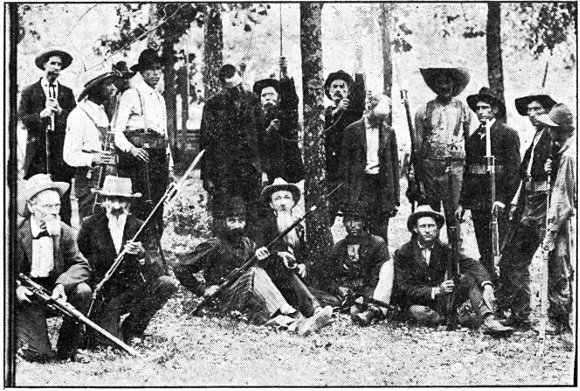
HANGING JESSE JAMES AND MR. BROWN.
Their Wives and Other Women Bury Them.
Every Union man now having fled in fear of his life, the next day the wives of Brown and James, with the help of a few other women, buried them as best they could. They dug graves underneath the swinging bodies, laid bed clothing in the graves and cut them loose. The bodies fell into the coffinless graves and the earth was replaced. So the author is satisfied that the bones of these men still remain in the lonely earth underneath where they met their untimely death with no charge against them except that they had been feeding Union men, with no one to bury them but their wives and a few other women who aided.
Some of the men who were in the scout and present when the hanging was done are still living in the counties of Howell and Oregon.
A General Jackson Soldier Shot Down.
A short time after this hanging there was a man by the name of Rhodes, who resided on the head of Bennett's Bayou in Howell county. He was about eighty years of age and had been a soldier under General Jackson. His head was perfectly white and he was very feeble. When he heard of the hanging of Brown and James he said openly that there was no civil war in that, and that the men who did it were guilty of murder.
Some two weeks from the date of the hanging of Brown and James, about twenty-five men, hearing of what he had said, organized themselves and commanded by Dr. Nunly and William Sapp, proceeded to the house of Rhodes, where he and his aged wife resided alone, called him out and told him they wanted him to go with them. His aged wife came out, and being acquainted with a part of the men, and knowing that they had participated in the hanging and shooting of a number of Union men, talked with them and asked: "You are not going to hurt my old man?" They said: "We just want him to go a piece with us over here." Ordering the old man to come along, they went over to a point about one quarter from the house and informed him of what he had said. There they shot him, cut his ears off and his heart out. Dr. Nunly remarked that he was going to take the heart home with him, pickle it and keep it so people could see how a black republican's heart looked.
They left him lying on the ground, proceeded directly to Joseph Spears', who resided about six miles west of town on the Yellville road, declaring that they were going to treat him the same way. They reached his house about two hours in the night, all full of whiskey. When they arrived there Spears was sick in bed. They dismounted, came in, ordered their suppers and their horses fed. Spears at that time owned a negro man, and he ordered him to put up the horses and feed them, and his wife to get them supper. After supper, they concluded to remain until morning. During the night they became sober, and concluded, since Spears owned a "nigger," that it could not be possible that he was a Union man, and the reports that they had heard that he was a Union man might be untrue, and they would let him alone until they could investigate further.
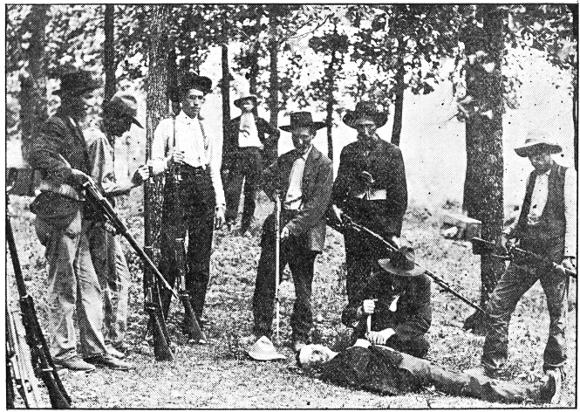
CUTTING OUT RHODES' HEART.
In the meantime, Rhodes not having returned home, and not a single Union man left in the country that Mrs. Rhodes could get to look after him, and having heard when they reached Joseph Spears' that the old man was not with them, although very feeble, she still continued the search; on the second day, about fifty yards from the road and about a quarter of a mile from home, while she was looking for him, she heard hogs squealing and grunting as though they were eating something. She proceeded to the place and found the hogs were just about to commence eating the remains of her husband. The Union men having fled, she notified some of the neighbors, and the women came in and helped dress the body and buried him the best they could; and neither at the taking down or burial of Brown and James and the burial of the old man Rhodes did a single rebel put in an appearance.
There never was a man arrested by the Confederate authorities, or a single word of condemnation uttered, but as far as could be heard there was general approval. It was said that the means used were desperate, but that was the only way to get rid of the men and strike terror to them so they could neither give aid nor countenance to the lopeared Dutch.
Benjamin Alsup Taken to Little Rock.
In a few days following they proceeded to arrest Benjamin Alsup, residing in Hutton Valley, who was a strong Union man, took him to Little Rock, placed him in the state penitentiary, and kept him there until after Little Rock fell into the hands of the Federals, when they exchanged him with other prisoners. While they had him in prison they worked him in a bark mill by the side of an old mule, with a strap around his breast and two leather hand holds. He pulled so much in the mill that his little finger was calloused and he almost entirely lost the use of it.
After they had hung, shot, captured and driven from the country all of the Union men, they called a public meeting for the purpose of taking into consideration what should be done with the families of the Union men, which meeting had a number of preachers in it. After discussing the premises, they arrived at the conclusion that if they let the families of the Union men, who had escaped and gone into the Federal lines, remain, they would return and bring in the lopeared Dutch. They didn't believe that both parties could ever live together, and as they now had the country completely rid of the Union men, they would force their families to leave. They at once appointed men, among whom were several preachers, to go to each one of the Union families and notify them that they would not be allowed to remain; because if they let them stay, their men would be trying to come back, and they didn't believe both parties could live together. They stated at the same time that they were really sorry for the women and children, but nobody was to blame but their husbands and sons, who had cast their lot with the lopeared Dutch. Also, as they had taken up arms against the Confederate states, all the property they had, both real and personal, was subject to confiscation and belonged to the Confederate authorities; but they would allow them to take enough of the property to carry them inside of the lines of the lopeared Dutch, where they supposed their men were and where they then could care for them.
Loyal Women Driven From Their Homes.
They said they might have a reasonable time to make preparations to leave the country, and if they didn't leave, they would be forced to do so, if they had to arrest them and carry them out.
The wildest excitement then prevailed among the women and children. They had no men to transact their business and make preparations to leave. Little had they thought, while they were chasing, arresting, hanging and shooting their men, that they, too, would become victims of the rebel hatred and be forced to leave house and home, not knowing where their men were or whether they were dead or alive. All they knew of their whereabouts was, that those who escaped arrest had left their homes, aiming to reach the nearest Federal lines.
Women were at once dispatched to reach the nearest Federal lines, if possible, and inform them of the Confederate order, and procure help to take them out. Their homes and houses were being continually raided by small bands of Confederates roaming over the country, claiming that they were hunting Union men, taking all classes of property that they might see proper to take, without any restraint whatever.
When the Union men heard that an order had been made requiring their families to leave, not thinking that a thing of that kind would ever occur, having left them with comfortable homes and plenty to eat, the wildest consternation reigned amongst them.
The Federal authorities were willing to give them aid, but were placed in such a condition that they needed every man in the field, and for that reason couldn't give them any help in getting out. The women had to speedily fit up as best they could, close their doors and start for the Federal lines, leaving the most of their property in the hands of the rebels. The rebels proceeded at once to take possession of and occupy most of the homes.
The suffering that followed the women and children is indescribable. They had to drive their own teams, take care of the little ones, travel through the storms, exposed to it all without a man to help them, nor could they hear a single word of comfort spoken by husband, son or friend. On reaching the Federal lines, all vacant houses and places of shelter were soon filled, and they were known and styled as refugees. Many of them went into soldier huts, where the soldiers had wintered and covered the tops of their huts with earth. They had to leave home with a small amount of rations, and on the road the rebels would stop them and make them divide up the little they had started with, and reaching the Federal lines they would be almost destitute of food and many of them very scantily clothed.
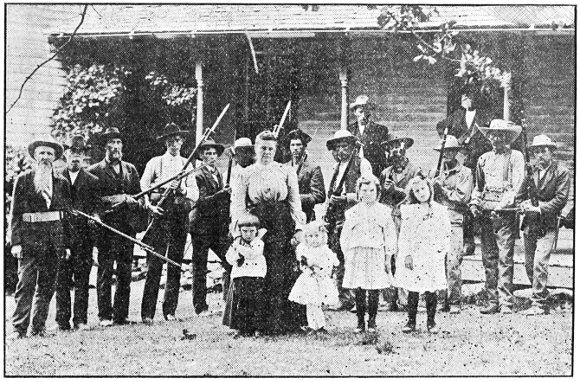
MRS. MONKS AND CHILDREN BEING DRIVEN FROM HOME.
They would at once commence inquiring for their husbands and sons. Numbers of them never found them, as they had been captured, killed and imprisoned while attempting to reach the Federal lines. O! The untold misery that then confronted them! After they had traveled and half starved and suffered from cold and exposure, promising themselves that when they reached the Federal lines they would again meet their loved ones who could again care for them, they were doomed to disappointment, in a large number of instances.
Those who did meet their husbands and sons were also disappointed; they had either joined the service or been employed by the government as guides and scouts, and the small amount of pay they received from the government, wouldn't provide food and raiment for their families. They were compelled to still be absent from their families, although they were suffering greatly for all of the necessaries of life and for clothing and shelter. The women's task of caring for and looking after the family and the little ones was just as great after they had reached the Federal lines as before. The government ordered that wherever aid could be given, rations should be issued to the families, and while the government did all it could in this way, it was not able to furnish shelter and houses for their comfort. Winter came on and they underwent untold suffering; disease set in from exposure, besides the contagious diseases of smallpox and measles, and hundreds of them died for want of proper attention, while their men were in the lines of the service of the government.
Here let the author speak a word in behalf of the devotion and patriotism manifested by those loyal women who had given their husbands and their sons to be placed upon the altar of the country, and sacrificed their homes and their firesides, had become exiles and wanderers, without home or shelter, had undergone untold suffering, had faced disease and death, had seen the little ones die, calling for papa, shivering with cold, suffering with hunger—all for the love of their country. Yet when they would see the Federal troops move by, with the stars and stripes unfurled, they would cheer the boys in blue as they would pass, and urge them to save the country they loved so well and had made so many sacrifices for and were still willing to suffer and wrestle with all the ills that a desperate war had brought upon the country, and wanted to live to once more be returned to their own hearthstones and be permitted to live under their own vine and fig tree, where no man dare molest them or make them afraid, to again enjoy all the sweet comforts of life.
We revere and honor every Federal soldier who enlisted in the interest of his country from the Northern States, where they knew nothing about war except what they read, their families being left in comfortable circumstances, with plenty to eat and wear and friends to speak works of comfort to them, while their husbands and sons had gone to the front and were willing to sacrifice themselves on the altar of their country, if it became necessary. But O! the comparison between the sacrifices made by the loyal element in those portions of the country where they were completely surrounded by the enemy.
Those who were willing to lay upon the altar of their country, their fathers and sons, their wives and children, their property and their sacred honor in support of the government they loved so well, with no protection from the government; no arms, amunitions, rations, clothing or pay from the government, was thought of for a moment. The only question that prompted, ruled and controlled them was their patriotism to their God and their country. When we come to compare the sacrifices, privations, suffering and services between the two classes of loyalists the first referred to, sink into insignificance.
O! never let us forget to honor and revere patriotism and sacrifices that were made by the loyal men and women that were surrounded in the enemy's country and continual fighting without and within. Their husbands and sons were shot and hung and imprisoned all over this country, whose bodies never were even honored with a burial. Orders being made by the rebels that they should not be buried; but yet they live and speak in thunder tones to the living. Let us plead with the living to revere and honor the stars and stripes that were maintained and supported by the blood and lives and sacrifices of the loyal men and women of the South.