MISSOURI AND THE CIVIL WAR. (continued 3)
Reading edition
On one occasion, when the weather was very cold and bleak, I knew of their capturing some of the Federal soldiers within one mile of the fort, kept them until the coldest part of the night, just before day, stripped them naked, turned them loose, and they were compelled to travel a mile before they could reach a fire, and they were almost frostbitten. Every Union man was driven away from his home and moved his family to different posts.
The author had declared that he and the rebels could not both remain in the country together; that he would either rout them or they would have to rout him, and for that reason every man that remained in the country would have to aid him in the work. So, in every instance, when he would send a force in pursuit of those raiding bands, he would order the scout to follow them, and when they divided to still continue pursuit of the most visible trail, and when they came in sight to not take time to count noses, but charge them and pursue them until they were completely annihilated. They would go into camp and move at their leisure, but not so when my scouts got in pursuit of them. In a number of instances they would overtake them from twenty to twenty-five miles from the wire road, in camp, having a jolly good time, and the first intimation they would have would be the boys in blue charging in amongst them, shooting right and left, and they would scatter in all directions.
It was but a short time until they remarked to some of the rebel sympathizers that they had never seen such a change in the movements of the Federal scouts; that they used to consider themselves safe from a Federal scout as soon as they left the main road and divided into small squads; but now they were in as much danger in the most secluded spot in the mountains as they were in the traveled roads; therefore, their commanders would have to change their tactics in regard to the scouts, and abandon that part of the country, as almost every scout that they had made to the wire road had proved disastrous since "Old Monks" had been placed in command of the post. In a short time, the Union men, who had been driven from the country, began to return and go onto their farms, and about five months after I had been placed in command of the post, the civil authorities came and held circuit court, Judge Waddle, of Springfield, then being circuit judge.
Skirmishes with the Rebels.
Some time in the summer, Col. Freeman, who was commanding the rebels in northeastern Arkansas, whose headquarters were near the Spring River mill, made a raid and threatened to capture the Federal forces that were then at the Licking post. I soon gained information of his intention, made every preparation to repel the attack, also informed the commander at Rolla of the intended raid. Col. Freeman, accompanied by other rebel commanders, concentrated all of the available rebel force then at his command, raided the country, came within about five miles of the post, learned that reinforcements had been sent to the post, countermarched and retreated to his headquarters near the head of Spring river.
A regiment of Federal troops, known as the Fifteenth Veterans, was sent as a reinforcement, with a part of the Fifth Missouri State Militia that was then stationed at Salem, with orders to remain at the post. I received orders to organize all of the available troops and pursue the rebel forces, and, if possible, to reach the Spring River mill, in Fulton county, Arkansas, and destroy the mill, which Freeman was using at that time for grinding meal. The Federal force composing the scout, aggregating about three hundred and fifty men, moved from the post at Licking. The author divided his forces, ordering one wing of them to move through Spring Valley, in Texas county; the other wing to move directly in the direction of Thomasville, with orders to form a junction about seven miles from Thomasville, where there was a rebel force stationed. On reaching the Wallace farm, in Oregon county, we came onto a force of rebels, commanded by James Jamison, who had met for the purpose of receiving ammunition which had been smuggled through from Ironton. After an engagement, the rebels fled, leaving one man dead; James Jamison received a flesh wound in the thigh. The Federal force which had been ordered through Spring Valley had had an engagement near the head of the valley, which had delayed them. The plans of the author had been frustrated by coming in contact with the rebels sooner than he expected. As they had retreated in the direction of Thomasville, where the main force was said to be stationed, I continued my march, and in about one mile came onto a rebel camp, where the rebels had cabins erected for quarters; here another spirited engagement took place, the rebels retreating in the direction of Thomasville, the Federal forces still pursuing.
Just above Thomasville the command encountered a strong picket force, fired upon the command, intending to halt it, but being satisfied that there was a trap laid I ordered a charge. The picket force retreated to the left, up a steep hill, and at once the whole rebel force opened fire from the side of the mountain; the bullets flew just above our heads like hail, one ball passing through my hat. We still continued the charge and on reaching the top of the hill, routed the whole rebel force and they again retreated. The author marched into Thomasville, selected his camping ground inside of Captain Olds' barn lot, giving us the advantage of the barn, in case we were attacked by a superior rebel force. I at once dispatched a forage train with strong escort to gather in all the forage possible, as it was very scarce in the country. After we had been in camp about an hour I inquired of Captain Olds if he knew of any corn. He said he did not. In about a half hour my attention was called by one of the captains pointing to a large smokehouse, and on looking, saw the soldiers taking down any amount of first-class corn. I informed the captain that Captain Olds had claimed that he had no corn; to take the quartermaster and let him place a guard over the corn, to see that it was not wasted, and that it was properly apportioned. In a short time the author saw Captain Olds coming. He went to one of the other captains and inquired who the commander was. He was informed that it was Capt. Monks. He came to the author laughing and remarked: "You found my corn, did you? I told you that I had none; I had to secrete it in that building to keep it so that the rebels could not find it." I just remarked to Captain Olds: "You needn't try to hide anything from these lopeared Dutch, for I don't care where you put it they will find it." The men who discovered the corn were all Germans and belonged to a German company. He asked us to feed just as sparingly as possible and leave him a part of the corn, which we did. He then attempted to warn the author of his danger and asked him if he intended to camp there for the night; said that Colonel Freeman had over one thousand men which he could concentrate within five or six hours and that he would cut the author's command all to pieces. The author replied to the captain that that was his business, that Freeman had come up on the scout and claimed that he was wanting a fight; the author prepared for him and expected to accommodate him but he changed his notion and retreated, devastating the country as he went, and now the author was hunting him and his forces and wanted to fight. If he came up that night and attacked the author's command that it would save any more trouble hunting him.
Just about that time the author saw the other part of the command approaching and called the attention of Captain Olds and asked him if he thought that was a part of Freeman's command. After looking a few minutes he said to the author: "They are Federal troops." I asked him if he thought we would be able to remain there until morning? He said that he thought we would and invited me to come into his house and eat supper. While at supper asked if we intended to march any further south. The author informed him that if his information was correct in regard to Freeman's forces we were about as far away from home as we ought to get and that we had better move back in the direction of the post. The author ordered the command to be ready to march by early daylight, next morning broke camp and moved in the direction of Spring river. On reaching the head of Warm fork of Spring river, we encountered another rebel force; had a short engagement, and they again retreated. On reaching the head of Spring river about the middle of the afternoon, we again met a rebel force; after considerable firing they retreated.
The author moved up near the mill and went into camp. The mill was grinding corn with quite a lot of corn on hand, but the miller left and retreated with the rebels. The author soon placed a substitute in his place and the boys had a fine time baking corn cakes.
After supper, some of the men had just retired to rest, when the rebels again made a fierce attack; after fighting for twenty or twenty-five minutes they retreated a short distance and went into camp, the river dividing the two forces. During the night the two pickets would dare each other to cross the river. During the night there came a heavy rain and made the Warm fork of Spring river swimming; there was no way to cross except on the mill dam.
The next morning about daylight the author ordered them to take the millstones and break them up and destroy the machinery so it would be impossible to grind; dismounted about one hundred men, placed them in hiding and marched away a short distance, thinking the rebels would cross over and we would surprise and capture them. But on seeing the Federals break camp and marching up on the west side of the river, they broke camp and marched up on the east side of the river. The author then mounted his men and marched up the Warm fork to where he effected a crossing, marched about ten miles, went into camp for the purpose of getting breakfast. Just after breakfast, the author noticed the advance of a rebel force march out on another road; as soon as they discovered that the Federals were in camp, they fell back and the author at once mounted his men. On the other road, as there was a considerable hill that hid them from sight, he formed his men in two lines in a V; detailed a strong advance force, ordered them to move onto the rebels and charge them, and in case they found that they were too strong, to retreat back between the lines for the purpose of drawing the rebel forces in between the lines. After a fierce conflict, lasting but a few minutes, the rebels again retreated, leaving a rebel Major dead upon the ground. We then marched into Thomasville and had another running fight with the rebels, went into camp and the next morning marched back in the direction of the post at Licking, reaching the post about 10 o'clock that night. The author again took command at the post and the Fifteenth Veterans returned to Rolla.
Ridding the Country of Bushwhackers.
It soon became very rare to hear of a rebel scout north of the mountain. Both rebel and Union men who claimed protection by the Federal authorities began to repair and improve their farms again. During the time that the author was in command of the post, which continued up to the time that peace was made, his command had routed and completely driven from the country all irregular and roving bands of rebels and bushwhackers and had had numbers of small engagements in which there had been from eighty to ninety of the most desperate class of men that ever lived, killed, which was shown in the adjutant general's report. After they had been driven out of the county, they located in the counties of Oregon, Shannon and Dent, and at once commenced pillaging and robbing all classes of citizens, irrespective of their political adherence. Col. Freeman sent a courier through the lines with a dispatch, stating the condition of affairs, and asking that an armistice be entered into between Col, Freeman's scouts and the scouts which might be sent out from the post, with an understanding that they were going to aid each other in routing and driving out these irregular bands.
While engaged in that work they were not to fire on each other, but to co-operate. The author was to enter into the agreement if it could be effected. Col. Freeman sent Capt. Cook into Oregon and Shannon counties to locate those roving guerrilla bands, and in some way, unknown to either Col. Freeman or myself, they gained the information, and while Capt. Cook was in Oregon county locating them, they waylaid him and killed him. Col. Freeman, realizing the fact that they had come into possession of the whole scheme, came to the conclusion that we had better abandon the agreement. He organized scouts and captured and shot some of the most desperate characters that were leaders, while the author kept a vigilant watch to keep them from crossing over into Texas or adjoining counties. At the time peace was made, it was admitted by the law-abiding people, irrespective of party, that the command of Col. Monks had completely rid the country of all irregular bands of rebels and had made it safe, in a short time after he had taken command of the post, for forage trains and all other classes of citizens to pass on the wire road from Rolla to Springfield unmolested, and that very often they passed through without an escort.
Battle at Mammoth Spring.
Col. Wood, commanding the Sixth Missouri cavalry, left Rolla on the 7th day of March, 1862, with about two hundred and fifty men, for the purpose of making a scout south into the counties of Oregon and Howell and Fulton county, Arkansas, to ascertain the strength of the rebel forces in that portion of the country; reached Licking and went into camp. The next morning he broke camp and marched to Jack's fork, in Shannon county, and on the morning of the 9th marched to Thomasville; on the 10th he marched to Mammoth Spring, Arkansas. On reaching Mammoth Spring they learned that there was a rebel force in camp on the south fork of Spring river, just below Salem, and on the morning of the 11th they broke camp and marched upon the rebels. On reaching the rebel encampment they found they had cut timber and blockaded the road, so that it was impossible to reach the forces, except on foot. In coming within a few hundred yards of the rebels, lying concealed behind the timbers, they opened fire upon the advance of the Federal forces. The Federal forces had two small pieces of artillery that they unlimbered and brought into use. The rebels having no artillery, were soon dislodged from the first line of works, and they stubbornly fell back about one quarter of a mile, and went in behind the second fortifications that had been hurriedly erected. After fighting for an hour and a half or two hours the Federal force being greatly outnumbered, and the rebels having themselves so obstructed, Col. Woods saw that it was useless to further continue the fight and retreated. On the next night he reached Howell Valley just below West Plains and went into camp and on the morning of the 13th they broke camp and marched in the direction of Houston, Missouri, reaching Houston sometime after night. The Federal loss in the battle referred to was seven killed and wounded. The Confederate loss was said to be twenty-five or thirty killed and wounded. Colonels Coleman and Woodside were commanding the Confederates.
Col. Woods being in command of the post at Houston, learning that there was considerable of a rebel force, standing at West Plains, Missouri, under the command of Coleman and others, organized a scout and on the 24th day of February, 1862, broke camp and marched in the direction of West Plains, for the purpose of attacking the rebel forces stationed at that place, taking two small mounted howitzers strapped on mules, made a forced march, and in the early part of the day on the 25th reached West Plains. West Plains had a frame court house in the center of the square where the present court house is located. The road at that time led due north where Washington avenue is located until it struck the hill; also there was a road which led east where East main street is now located and on passing what was known as the Thomas Howell farm, turned directly north in the direction of Gunters Valley. The rebels had a strong picket thrown out on both roads; a part of the rebel command was quartered in the court house. Woods being advised of the condition of the rebels and where they were all quartered, supposing that they would take advantage of the court house when the attack was made, selected a high position where the road first struck the hill, planted his artillery, divided his forces and made a flank movement, ordered them to strike the lower road and advance on the pickets and as soon as they were fired upon, to charge them, while he would remain with the other part of the force in readiness to dislodge them with his artillery in case they used the court house as a fortification. On the advance coming in sight of the rebel pickets, they fired and retreated with the Federal forces pursuing. The rebel forces at once rallied their forces and took possession of the courthouse. As soon as Col. Woods saw them file into the house he leveled his cannon and fired a shell which struck the house near its center and passed clear through; that was the first artillery that the rebel command ever had heard. They filed out of the house faster than they went into it; then Col. Woods moved with his forces directly upon the forces near the court house when a general engagement ensued. The rebels retreated west on the road near where West Main street is now located and a running fight was continued for about one mile, when Woods abandoned the pursuit, marched back into West Plains, and again returned to Houston. The losses on both sides were light, several, however, being killed or wounded.
"Uncle Tommy" and His Crutches.
I will relate an incident which occurred during the fight. Old "Uncle Tommy" Howell as he was familiarly known, resided just below the town spring a short distance from the road; he had a sister living with him who was an old maid, and was known as "Aunt Polly". Howell being one among the early settlers of Howell Valley, had taken an active part in organizing Howell county, which took its name from him and he had been once representative of the county. The author heard him relate the circumstance in a speech delivered in West Plains after the war was over. He said when the fight came up that he was sitting on his front porch: all at once he heard firing commence, and heard horses feet and saw the rebel pickets coming on full gallop horseback, with the Federals close onto them with pistols in hand firing on them; he had been afflicted with rheumatism for years and one of his legs was drawn crooked and he hadn't attempted to walk without a crutch for several years; when he saw the men coming and the others shooting at them, he supposed that every shot was killing a man; he said they came right by his door and he never became excited while they were passing; as soon as they got near the court house they then made a stand, where it appeared to him that there were thousands of shots being exchanged every minute. They had all passed his house and he was sitting there unmolested, when his sister, who was known as "Aunt Polly" ran out on the porch and cried out at the top of her voice "Lord a massy, Uncle Tommy, run for your life; you have been a public man and they will kill you, sure." He said it so excited him that he sprang to his feet. All below his house the valley was covered with hazel brush and snow was lying on the ground. He first looked toward where the firing was going on and said "My God! they certainly have got them very near all killed in this time" for he was under the impression that every shot killed a man. He started southwest from his house, ran about a quarter of a mile, jumped over behind a log; he had hardly gotten still when he imagined he heard the horses feet of the Federals in pursuit of him; he raised up and looked, could not see any person, so ran about another quarter, jumped over behind another log and as soon as he got still, the first thought came into his mind that they were still in pursuit, for he could hear the horses' feet, but on reflecting a moment he found that it was his heart beating; he said he could still hear the firing and he thought they intended to kill them all before they quit. He had a son-in-law by the name of Hardin Brown living on the Warm fork of Spring river, about twenty miles distant, and he started on foot and never stopped traveling until he reached his house. On reaching the house, his daughter asked him how, in the name of God, he ever got there without his crutches. He said that was the first time that he had thought of his crutches. He began to notice his legs and the crooked leg was just as straight as the well leg. He said that it completely cured him of his rheumatism and he had the use of that leg just the same as he ever did the other leg, and never used a crutch afterwards. After the war he removed to Oregon county and was elected to the legislature, and died a member of the legislature.
Disposing of Union Men.
In the spring of 1862 there was a man by the name of Mawhinney, living about six miles below West Plains, in Howell valley, a Union man, but who had taken no part either way, except to express an opinion. About fifteen men belonging to a rebel scout went to his house, called for their dinners, some of them had him shoe their horses, and after they had their horses shod and got their dinner, they told him that they wanted him to go with them. His wife said to them "It ain't possible that after you have been treated as kindly as you have been you are going to take Mr. Mawhinney prisoner; you men certainly will not hurt him." They made no reply, carried him about one half mile from his home, shot him off of his horse, took the horse and went on, leaving the body on the side of the road. His wife with what other help she could get brought him in and had him buried.
About two weeks afterwards, in the spring of 1862, there was a man by the name of Bacon who lived near West Plains, who has some relatives living in this county at the present time. He was a Union man but had taken no part either way, except to express himself openly in favor of the Union. There came a scout of about twenty men and arrested him, started west with him in the direction of South Fork, and on reaching the vicinity where Homeland is located, left the road a short distance, shot him off of his horse. Went on to a house about one mile distant, called for their dinner. The woman in preparing dinner fried some bacon; after they were seated at the table she passed the bacon to them; several of them remarked that they didn't want any, that they had had some bacon, but had just disposed of it a short time before they reached the house. After Bacon had laid where he fell dead for two or three days he was found and being considerably decomposed a hole was dug and the body placed into it and covered up, where his dust remains until the present day.
Union Supplies Captured by Rebels.
In the spring of 1862, the department commander reestablished the military post at Springfield. All of the commissaries and forage had to be conveyed from Rolla to Springfield, as the terminus of the railroad was at Rolla, by wagon trains, a distance of one hundred and twenty miles. It required a large escort of soldiers to guard the trains to prevent the rebels from capturing them. All of the country south of the wire road was in possession of the rebels. There was scarcely a wagon train that passed on the road without being attacked by the rebels. They made their attacks generally on the front and rear of the trains, and before the wagon masters could corral the trains, they would capture some of the wagons, make the teamsters drive into the woods, cut the mules loose from the wagons, take sacks of coffee, salt, sugar and other commissaries, tie them on the backs of the mules, divide into small bunches and retreat into the hills. Very often the escort would have to send back to Rolla for reinforcements. The train would be tied up from twelve to fifteen hours before it could move on. It became a mystery to the Federal commanders how the Confederates could concentrate a force of men numbering from fifty to three hundred, and the first intimation the escort would have, they, the rebels, would come out of the brush at some secluded spot, yelling, whooping and shooting, and charge upon the wagon train. They would generally capture more or less of the loaded wagons with the above results, and it became a question with the military authorities at Rolla and Springfield how to capture or rout these bands, and as to how they managed to keep that number of men near to the wire road and yet the Federals were unable to discover their hiding places.
About the 15th day of August, the department commander ordered Capt. Murphy to take five hundred men and two pieces of artillery and move south from Rolla; to go as far south as he thought it would be safe, without placing his men so far inside of the Confederate lines that they might be captured; and, if possible, to learn the rebel movements and location of their troops. Capt. Murphy broke camp at Rolla and moved south about fifteen miles, was fired on by the rebels from the brush, marched about twenty-five miles, went into camp; on the next morning resumed the march, hadn't marched more than five miles until they were fired on from the brush; they were fired on four or five times that day, and went into camp near Thomasville. The next day he threw out skirmish lines on each side of his command, and resumed the march down the Warm fork of Spring river. There was more or less skirmishing all day. He camped on the Warm fork and the next morning marched over to the Myatt, where we had quite a skirmish. The rebels again retreated in the direction of the Spring River mill, where they were said to have a thousand men.
Here the command countermarched back to Rolla, having captured fifty or sixty prisoners; the Federals had a few men wounded.
In the spring of 1862, the Federal troops advanced on Springfield from Rolla. The rebels retreated west and the Federals again established a military post at Springfield. The rebels continued to retreat west until they reached Prairie Grove, where they concentrated their forces and the memorable battle of that name was fought, the Federal troops being victorious. The Confederates retreated from the state.
The military post at Springfield being over one hundred miles west of Rolla, the terminus of the South Pacific railroad, three-fourths of the distance being in possession of the rebels, all the forage and commissaries had to be conveyed by wagon train. The main rebel forces having been driven from the state, and all of the country south of the wire road, with few exceptions, being in possession of the rebels, the Union men with their families having been driven from their homes. The leading Confederate officers met and held a council of war and decided to change their tactics. The first thing was to place two or three hundred well-armed Confederate soldiers south of and near the wire road leading from Rolla to Springfield, and so harass the wagon trains that the government wouldn't be able to get forage and commissaries through to Springfield, and thus force the Federals to abandon the post. In furtherance of this move, they ordered their soldiers to be taken near to the line of the road and divided into squads of from five to twenty-five men, conceal their arms and claim to be private citizens, live off the country and be so arranged that when a wagon train was about to leave Rolla, they could be called together on short notice; and when they wanted to make a more extensive raid, Confederate soldiers from as far south as the head of Spring river would march up and meet them and make a general raid.
The government had considerable trouble to learn the hiding places of these men, but they finally got officers who were acquainted with the country and men who were bona fide citizens, and knew who were citizens and who were not, and broke up their hiding places and drove them further south. It was learned that a part of this Confederate force was composed of men who claimed to be citizens when they were not making their raids.
Bravery of Captain Alsup.
In the summer of 1863, the Federal authorities established a military post at Clark's mill, in Douglas county, Missouri, on Bryant's fork of White river, erected a post and stationed some Illinois troops under the command of a Colonel, with Capt. Alsup's company, which was composed entirely of Douglas county citizens, in all about two hundred and fifty or three hundred men. Gen. Joe Shelby, a Confederate, with about five hundred troops, made a forced march from Arkansas and during the night time surrounded the fort, and the next morning had his artillery in readiness to open fire. He ordered a complete surrender of the garrison. The captain of the fort asked for a few minutes to consider the matter; at the expiration of the time, the Colonel in command agreed to surrender, stack up the guns and side arms in the fort, march his men outside and make an unconditional surrender. When the commander of the fort ordered his men and officers to stack their arms and march out, Capt. Lock Alsup and his company refused, and being cavalry, ordered his men to arm themselves and be ready to move whenever he ordered. While the commander of the fort was having the remainder of the garrison stack their arms, Capt. Alsup and his company made a bold dash for liberty, came out of the fort shooting right and left, took the rebels by surprise, broke the rebel line, went through, being mounted on good horses, retreated up Bryant's fork with the rebels in pursuit. While going through an old field that had grown up to burrs about as high as a man's head, Fritz Krause, father of the assistant postmaster at West Plains, was thrown from his horse, rolled under the burrs, the rebels passed by and never saw him. He laid in the burrs until dark, then made his escape and rejoined his company at Springfield. The rebels pursued them for about two miles, then returned to their command. Gen. Shelby paroled the prisoners, and such things as he could not carry with him he destroyed, the fort being burned. He resumed his march in the direction of Springfield and was reinforced by about five hundred troops. During this time, Capt. Alsup and his men had reached Springfield and, strange to say, hadn't lost a man; had a few slightly wounded. Gen. Brown, who was in command of the post at Springfield, was said to be a brother-in-law of Gen. Shelby, and on Shelby's arrival at Springfield he demanded the surrender of the garrison. The Federal troops held a consultation and concluded to fight. After a brief engagement, Gen. Shelby drew his troops off and moved north; there were several killed and wounded on both sides. Gen. Brown's arm was broken by a piece from a shell. Gen. Shelby continued his raid towards the Missouri river, had several small engagements and then retreated from the state. Capt. Alsup and his brave men should be held in memory by all comrades, especially by the loyal people of Douglas and Ozark counties, for their heroic action in charging through the rebel lines and making their escape after the post commander had attempted to deliver them into the hands of the rebels.
The fort at Clark's mill was never rebuilt. Capt. Alsup and the loyal men of Douglas and Ozark counties and part of Wright county built a temporary fort near the center of Douglas county, and old and young organized themselves into companies and armed themselves. With the help of Capt. Alsup's company, they appointed a few of their men as scouts, while the others worked in their fields. The scouts were out night and day along the state line and if a rebel scout attempted to raid the counties, notice was given all along the line and the men were all up in arms and ready to meet the raiders. It reminds one of reading the history of the early settlements along the Indian border. The settlers would build forts and put out sentinels; if the Indians were seen advancing, word was given and the families would hurry to the fort and the men arm themselves to drive the invaders back. So this organization, with some assistance from the post at Springfield, held Douglas and a part of Ozark and Wright counties during the remainder of the Civil War, and after the war was over, Douglas county gained the title of "Old Loyal Douglas County." These old soldiers and comrades are fast falling and very soon there will be none left to tell of the heroisms and sacrifices they made for the country they loved. Will these comrades and their sons and daughters be so ungrateful that they will let their heroism and sacrifices die with them and be forgotten, never to be written in history? The answer will be no, a thousand times no. The history of their heroism and sacrifices shall be written and go down to their children and their children's children, and may "Old Glory" ever wave over the country that they love so well and for which they made so many sacrifices.
Bushwhacking in Howell County.
The writer wants to say that there was not a Union man nor a single Union family left at home, from Batesville, Ark. to Rolla, Mo., a distance of two-hundred miles. The writer especially wants to speak for Howell County, Mo. The rebels took quite a number of Union men from their homes and shot them, some of them being old men. I will name a few of them that were shot: Morton R. Langston, the father of T. J. and S. J. Langston, while he was hauling wood; Jeff Langston, one of the firm of Langston Bros, was riding on the wood at the time his father was shot. I asked a leading rebel after the war, why they shot Langston. His reply was: "He talked too much." Shot Mawhinney, Bacon and a number of others. Now I want to say right here, notwithstanding the treatment the Union men received from the rebels, not a single Confederate was ever taken from his home and shot or otherwise injured during the whole Civil War and no truthful Confederate will say to the contrary. There never was but one Confederate hurt after being taken prisoner in Howell County and he wasn't a citizen of Howell County; was said to be a north Missouri bushwhacker, charged with being one of the parties that shot old Mr. Langston, Mawhinney and Bacon. A Federal scout in the year 1864 captured him below West Plains and the next morning they hung him to a smokehouse rafter. Notwithstanding a few of the friends of the bushwackers will tell to strangers that the writer shot a man in this county, by the name of Hawkins, in the lap of his family, which is a positive lie; the facts are these; Hawkins was one of the worst bushwhackers and murderers that ever lived in Howell County and was commanding a company of bushwackers at the time he was shot. A short time before he was shot he had captured one of his cousins, by the name of Washington Hawkins, a Federal soldier, and taken from him a fine mare with his saddle and rig complete.
In the spring of 1864, a battalion of the 11th Missouri Cavalry, commanded by Col. Woods, had been ordered to report to Col. Livingston at Batesville, Ark. The writer had been ordered to report at Rolla, Mo., with his command. Col. Woods had camped near West Plains the previous night, the next morning resumed his march towards Batesville; after he had passed West Plains a few miles, Hawkins and his bushwhackers fired on them from the brush and they continued to fire on them every few miles for sixteen miles. Our force met the force of Col. Woods at the state line where Col. Woods informed me how they had been firing upon his men all morning. He had taken a man prisoner by the name of William Krause, whom he turned over to me. Both forces resumed the march, he in the direction of Batesville, Ark., and I in the direction of Rolla, Mo. The prisoner told the writer that he knew the parties who had been firing on Col. Woods' command; that they had a camp by a pond in a secluded place, and were commanded by Hawkins and Yates; that it was about four miles almost west. I told Krause if he would place me on trail he could then go home. He did so and I then released him. Krause said there were about fifty rebels in the command.
We trailed them about two miles and came in sight of a house that belonged to old Mr. Newberry, a Union man. He and his family had been run off from home. I saw a horse hitched to the side of the door, and supposed there were more inside of the house; there was a skirt of timber that enabled us to get within about sixty yards of the house. I ordered my men, when we reached a given point, to charge upon the house, dismount and reach the wall of the house and demand the surrender of all persons that might be within. We were about fifteen feet from the door when Hawkins came out and attempted to mount his horse. The author demanded his surrender, but he drew his pistol to fire, the author having his pistol already in hand and presented, fired on him; the author was sitting in his saddle when he fired on him.
The men examined the house and found he was the only man in it. The horse he was riding was the one he had taken from his cousin, Washington Hawkins, a short time previous, with a government rig complete. Washington Hawkins resided at Bakersfield, Mo., and got his horse and rig again. We took the trail again, but dark came on us and we lost it. These are the facts surrounding the whole case, the killing of Hawkins, one of the worst bandits and guerrillas that ever roamed through South Missouri and led the worst band of men in the state. I had previously taken him prisoner and he took the oath of allegiance, went right back and joined his command and, if possible, he was worse than before. I must say that there are few men in Howell county that claim to be Confederates, who tell strangers that Monks shot Hawkins down in the lap of his family and that he, Hawkins, was a good man. The writer wants to say that no truthful Confederate will tell any such a thing; they will tell you that Hawkins was a bad man. Ask such Confederates as Capt. Howard, Mark Cooper, Judge Dryer, John Ledsinger, Harvey Kelow, Daniel Galloway, P. N. Gulley and a number of others, if Hawkins was a good man.
The writer wants to say that he don't believe all the Confederates were in favor of killing and driving out the families of Union men, but the most bitter element got in power and being backed by the order of Gen. McBride, to force all the Union men to join the Confederate service, or hang them, those Confederates who were opposed to such treatment were afraid to open their mouths for fear they would receive the same treatment. You don't hear these same men, that talked about Monks shooting Hawkins, say a word about Hawkins and his bushwhackers shooting Union men all over Howell county. There never were but two houses burned in Howell county by the Union men during the Civil war, and houses owned by these men had been previously burned by the Confederates. The town of West Plains was burned by the Confederates to keep the Federals from holding a post at West Plains.
The writer wants to say that on his return after the war, in the spring of 1866, he met the rebels, both those that had been officers and soldiers, and never spoke a harsh word to them, asked them if they thought both parties could now live together; their answer was, that they thought they could. All that they asked was that they be protected. The writer assured them that both Federal and Confederates would be protected by the civil laws and all they would be asked to do would be to aid in a strict enforcement of civil laws, which they readily promised to do. The Union men who had returned to their homes and the late Confederates joined together and went to building and repairing old church houses and school-houses and soon were found worshiping together in the same church and sending their children to the same school-houses and the old ties that had existed before the war were being re-united. The country appeared to be prosperous and the old war spirit appeared to be fast dying out among the people.
I suppose the writer holds more commissions than any other man in the state, both military and civil and there never was a charge preferred against the writer of any failure to discharge his duties by the government or state. While in the military service thousands of dollars passed through the hands of the writer for forage and commissaries and ordinance stores and clothing, every dollar was accounted for and all contraband property was turned over to the government. I never converted, to my own private use, five cents of any man's property or money, before or after the war, in the war, nor since the war.
The writer is now residing within about twenty-five miles of where his father located in the year 1844 and there are several persons yet living that have been intimately acquainted with the writer since his boyhood up to the present time, namely James Kellett, Sr., Marion Kellett, present county treasury of Howell county, Washington Hawkins of Bakersfield, Mo., and quite a number of others that have been acquainted with the writer from forty to fifty years. The writer wants to say right here that he is not ashamed of anything he did before the war, in the war, nor since the war, and on his return home to Howell county on meeting the late rebels; he never spoke a harsh word to one of them, but received them kindly and said to them that the civil laws should be strictly enforced against all alike, Confederate and Federal.
In the year 1861, sometime in the month of September, after the Federals retreated from Springfield, Mo. and the Confederates had taken possession of Springfield, there was one Capt. Brixey who was captain of a company of home guards residing in the edge of Webster County, Mo.; soon after the Confederates took possession of the post, they ordered a captain belonging to a Texas regiment to detail one company and proceed to the residence of Capt. Brixey and arrest him. Capt. Brixey having no notice of the approach of the scouts, he and one of his men were sitting in the house; the first they knew they had a line within thirty yards of his door, hailed them and presented their guns and demanded their surrender. Capt. Brixey said, "The —— you say." Both parties fired on each other about the same time, the man with Brixey fell dead, Brixey shot and killed the Confederate captain and wounded one or two other Confederates; he retreated through his house and into his orchard and made his escape; one of his arms was broken by the shot from the rebels from which he entirely recovered and lived many years afterwards, and has a son residing in this county at the present time.
Colonel Freeman's Second Raid.
Sometime in the Spring of 1862 Col. Freeman, not being satisfied with his first raid on the Federal troops at Salem, planned the second raid to attack the troops then stationed at Salem, Missouri; he organized his scout and compelled one Robert Bolin, who now resides in Howell County, to pilot him through the lines, as he, Bolin, had lived near Salem before the war. On reaching Salem, Col. Freeman halted his troops and planned his attack.
The Federal troops had no knowledge of the approach of any rebel forces; they were in squads around Salem. Freeman divided his forces and gave them a countersign and selected a spot near a deep ditch in the road and instructed them, if they were defeated and got scattered to concentrate at that ditch which was beyond the Federal lines a distance of some miles; on reaching the ditch they were to remain until they all were collected. After the first ones reached the place, it being dark, if they saw others approaching they would halt them and demand the countersign, and if they couldn't give it they were to fire on them without any further delay, knowing they were enemies. On reaching the public square they encountered a bunch of the Federal troops in a building; fired on them, wounded a few, a man by the name of Jacob Shoffler now residing in Howell County was in the house at the time, and they cut his clothes in about twenty different places with bullets and never drew blood; Maj. Santee was commanding, with one other officer. After they had rallied, all being in disorder, Maj. Santee ordered a charge on the rebels. Armed with an old pistol he met Col. Freeman of the Confederate side. Freeman had just shot out; Maj. Santee ordered his surrender. Col. Freeman started to run, Maj. Santee in close pursuit, snapped his old pistol, which failed to fire. He then threw the pistol at Col. Freeman, struck him somewhere between the shoulders, drew his sabre, and still continued the pursuit. There was a creek near by and a stone fence had been built along the side of it; the creek had been frozen over and a skiff of snow on it at the time. Just as Freeman reached the stone fence Maj. Santee made a thrust at him with his sabre, inflicting a slight wound; about that time, for the purpose of escaping, Col. Freeman sprang over the stone fence and lit into the creek. Maj. Santee, being on horseback, could not pursue any further. The rebels by this time were scattered in all directions, started to retreat. It being very dark, the first ones fifty or sixty in number reached the ditch, halted to wait for the remainder of them to collect. In a short time about thirty or forty more of them appeared in sight, retreating with considerable speed; they were halted, the countersign demanded. They had become so excited in the fight they had forgotten the countersign and failed to give it. So those who arrived first opened fire and wounded several of them, scattering them to the woods. They failed to concentrate until they had retreated south about 30 miles where they learned of the mistake they had made and that they had fired upon their own men. Maj. Santee being of the opinion that he had seriously wounded Freeman with his sabre, concluded to investigate. On reaching the stone fence where he made his leap they looked over into the creek on the ice and (Col. Freeman being a large man) it looked like a large ox had been thrown over from the hole that he made in the ice. They saw that he had crossed the creek and reached the other side and saw no signs of blood. In the engagement there were about five or six wounded and killed.
In the summer of 1863 there was a Federal scout organized at Springfield, commanded by Col. Holland. It was ordered to move by way of Douglas county, get reinforcements then stationed at the fort, and from there march through the county of Ozark. They entered the county of Fulton, Ark., where they had several small engagements. After considerable fighting and capturing a number of prisoners, they returned to Springfield; loss, killed and wounded, very small.
In the fall of 1863, Col. Tracy, with a force of rebels, made a raid from Fulton county, marched up through Ozark county, and on reaching the Union settlement in Douglas county, he shot and killed nearly every man he captured, robbed houses, took everything in the house and out of doors, and burned the houses as he went. After raiding and pillaging a number of houses, he came to a house where a Union man by the name of Mahan and one by the name of McCarty were working in the blacksmith shop, with their arms near them. They were members of the home guard. The rebels demanded the surrender of the two men, and as it was generally believed that if a man surrendered to those irregular forces that it was sure death, they refused to surrender. When the forces of Col. Tracy commenced firing through the cracks of the shop, the men returned the fire. Mahan killed one rebel, and they wounded two or three others. The rebels shot McCarty down, shooting him eight or ten times after he fell, knocked the door down and rushed upon Mahan, disarmed him, took him prisoner and then continued their retreat. After reaching Fulton county, near the bayou, they took Mahan into the woods, stripped him naked and shot him, leaving his body lying on the ground unburied. Strange to say, in regard to McCarty, after he had been shot eight or ten times and left for dead, he recovered from the wounds and became hearty and stout.
Some time in the early part of the spring of 1864, a man by the name of Mahan deserted from the 11th Missouri cavalry, stationed at Batesville, and on reaching Howell county, about two miles from where Valley Star school house is now located, a bunch of bushwhackers commanded by B. F. Hawkins and Thomas Yates captured him, took him into the woods a short distance, stripped him naked and shot him, leaving his body lying on the ground, unburied. After he had lain there nearly a week, a man now residing in Howell county took a hoe and shovel and raked up some rocks and pitched them upon the decomposed body and threw a few shovels of dirt on him. As it was but a short distance from the road, the stench from the decomposing body was offensive to persons who traveled by.
Col. Monks Enforces the Civil Law.
In the month of July, 1865, the author was ordered to declare the civil law in force in the counties of Texas, Dent, Shannon, Oregon, Howell, Ozark and Douglas and report to his regiment again at Springfield for the purpose of being discharged. The long-looked-for and final result of the war had come with victory couched upon every man who had borne his flag to the breeze of his country, and to those who had lain themselves on the altar of their country and died that it might live.
There was general rejoicing among the loyal people, that there was not a foot of territory on American soil but where the stars and stripes once more floated unmolested, either by foreign or domestic enemies, and while the Confederates had fought manfully for what they conceived to be right, and had laid many of their sons on the altar and sacrificed them to a cause that they believed to be right, yet a large majority of them rejoiced when they learned that the cruel war was over. Although their cause was forever lost, yet the country that they had loved so well and the flag still floated and invited them back as erring sons.
The 16th regiment, with a large number of other regiments, was discharged at Springfield. Then a scene ensued that Americans had never witnessed before; the blue and the grey began to meet and greet each other as friends and seemed to forget that just a few months previous they had been meeting each other armed, for the purpose of slaying one another. A general amnesty proclamation had been granted by Gen. Grant to all the rebels who had surrendered. Their officers and commanders should discharge them and they should be allowed to retain their side arms for their own protection and return home for the purpose of again building up and establishing their homes; again meet their wives, their children, fathers and mothers, neighbors and friends, and once more be united in all the ties of love; to again reinstate churches, and instead of studying and practicing the art of war, they should beat their swords into pruning hooks and aid in establishing and building up society and good government.
But, lo! one of the most sad and heartrending scenes confronted many Confederates and Federals on returning to the places where they had once had happy homes and sweet families, they were not found. During the terrible war, many of the loved ones that they had left behind had been called from time to eternity. The home had disappeared and nothing was left but the soil; all of the improvements being entirely destroyed. But they, with the courage of heroes, gathered the fragments of their families, went to work improving and building houses, refencing their farms, reerecting church houses and school houses, and in a short time the men who had lately been enemies and borne arms against each other, were again neighbors and friends, associating together, sending their children to the same school, becoming members of the same church; all experienced the difference between a civil war and peace and fraternity. Many of them expressed themselves that they had read of civil wars, but never realized the effect of civil war until after they had passed through the present one: but they could not understand why they called it "civil" war, for if there was anything civil about the war they never experienced that part of it.
The author's family had been residing at Rolla during most of the time of the war. He commenced making preparations to return to his home in Howell county in the fall of 1865. He began to organize an immigration party of men who wanted to locate in Howell county and a number of men who had left their homes in that county. Just a short time before the parties were ready to leave Rolla for Howell county, he was met by several men who asked: "Why, Monks, ain't you afraid to go back to Howell county? You have fought the rebels so bitterly and contested every inch of ground during the whole war, and some of them hate you so badly, that I would be afraid that they would kill me." The author replied that he felt like Gen. Putnam, when the British attempted to bribe him and said that the colonies never could succeed in gaining their independence, and that he had better return and renew his allegiance to the Crown. The General's reply was, "D—n a man that is not for his country." Now, my reply to you is, that I have forfeited almost all of my means and shattered the happiness of my family in contending and fighting for the preservation of the government; besides, myself and family have been exiled and banished from our home, and if the rebels had succeeded, all would have been gone. But now the government has been victorious in crushing the rebellion, liberty and protection have been once more guaranteed to every citizen, high or low, rich or poor, and, in the language of Gen. Putnam, I say, "D—n a man that is afraid to go back and enjoy the fruits of his victory."
Within a few days about twenty-five families left Rolla for West Plains, and on arriving at West Plains, went into camp. There was not a single building left in West Plains, as the Confederates had burned the whole town in time of the war, with the exception of one store building, which was burned by the Federal troops. The Confederates' object in burning the town was to prevent the Federals from establishing a post. The author procured some clapboards, built an addition to an old stable about two hundred yards south of where James' livery stable is now located.
Soon after we had reached West Plains and gone into camp, Capt. Howard, Capt. Nicks and a number of other rebels who were residing in the county, came in, met the author and said to him: "Captain. I am proud to meet you." The author replied, "I am proud to meet you. What do think now in regard to the two parties living together?" They said that they were satisfied that both parties could live together, that all they wanted was protection. The author remarked that the rebels had been in control of the country for several years, but the loyal men were going to take charge of it and run it now, and as the loyal men had been contending for the enforcement of the law and claimed that every American citizen was entitled to the protection of the law, the author could promise them that, if they would fall into line and help enforce the law, they should receive equal protection with any other class of citizens; to which they replied that they were willing to do so, but there were roving bands of rebels and guerrillas which had not been subject to the control of the Confederate authorities, and still refused to lay down their arms, and might yet cause some trouble.
The author was appointed sheriff of Howell county, W. Z. Buck circuit and county clerk and Peter Lemons, Judge Alsup and —— were appointed county judges. There had been an old school house about a quarter of a mile east of West Plains that was still standing. They met at that school house, organized and set the civil government of the county in working order. Soon after, Governor Fletcher ordered an election and the author was elected to the state legislature, tendered his resignation as sheriff, which was accepted and W. D. Mustion was appointed to the vacancy. In a few weeks the author went to Jefferson City, tendered his credentials and was sworn in and became a member of the legislature.
Everything, so far as Howell county was concerned, appeared to move off quietly, while the counties of Oregon and Shannon, with a few of the border counties, were entirely controlled by irregular bands of late rebels, who openly declared that the civil law should not be enforced in those counties; that the Confederacy was whipped, but they were not and they intended to live off the government; they were armed to the teeth.
During the winter of 1865 and the year 1866, Howell county settled up faster than ever it had at any period before the war; the men who had homes in it and had been forced away on account of the war, mostly returned and commenced to improve their farms. Their houses, outhouses and improvements, generally, having been destroyed, the soil was the only thing left. The town also built up rapidly and in the year 1866 the inhabitants had increased to six or eight hundred.
In the fall of 1866 at the general election the author was re-elected to the legislature and Capt. Alley, who had been a Confederate all through the war, was elected to the legislature from Oregon county. The author again qualified and was present in the legislature during the whole time, when the great question was brought up before the legislature, as to what disposition the State would make of the first liens held by the state on the different railroads for aid that had been given to the railroad corporations in the way of state bonds in 1850. In 1855 the state issued her bonds, delivered them to the companies and they went east and put them upon the market in New York and Boston to procure money to construct roads, and the bonds with all the accruing interest, were due the state.
Then for the first time the author learned that many of the men who had been selected to represent the people's interest in the State Legislature, failed to discharge the duties that their constituents had imposed upon them, betrayed their trust, and, through money, were entirely controlled in the interest of the railroad corporations. The author believing that it was one among the greatest duties that were imposed upon men of a representative government, to strictly contend and do all in his power to enact legislation in the interest of the people, therefore took a strong stand in favor of closing out all of the state liens against the different roads, held by the state. During the session of the winter of 1866 what was then known as the South Missouri Pacific, which terminated at Rolla, Missouri, was ordered to be closed out and the road declared forfeited. A resolution passed through both houses of the legislature ordering the Governor to seize it, and that said road be run by the state. In the meantime the Governor was to advertise and sell it. The Governor by authority of law advertised it and sold it for $550,000. Sometime in April the legislature adjourned, to meet in an adjourned session in December, 1867. The author returned home.
The immigration into the country rapidly increasing, prosperity appeared to be on every side; people had plenty of money, good crops, wheat was worth $1 to $1.50 per bushel, stock of all kinds brought first-class prices, peace so far as Howell county was concerned, prosperity and the bettering of the condition of society were moving hand in hand, and the author felt thankful that the war was over.
Outlaw Rule in Oregon and Shannon.
In the fall of 1867, the counties of Oregon and Shannon, were still controlled by those roving bands of outlaws who ruled the counties with an iron hand. A despotism, unequalled at any stage of the war, existed there. There was a public gathering in the fall of 1867 in Thomasville. Col. Jamison, one of the leaders of these outlawed bands rode into town at the head of about fifty men, well armed, shot two men's brains out, paraded the streets and swore that any man that attempted to enforce the civil law against them, would fare the same; rode out unmolested and there was not a single attempt made by the civil authorities to arrest one of them. In a few days Jamison with some of his men rode into town and a man by the name of Philip Arbogast, the father-in-law of Mr. Hill, one of the firm of Hill-Whitmire Mercantile Co., now doing business in West Plains, who had been a Confederate all through the war, remarked in the hearing of Jamison, that the war was over, and he believed that the civil law ought to be enforced. Jamison at once dismounted, cocked his pistol, approached Arbogast and commenced punching him with the muzzle of it until he inflicted some wounds remarking to him that if he ever heard of him uttering a word again in favor of the civil law being enforced that he would hunt him up and shoot his brains out.
Some time previous to that occurrence, two men who had been discharged from the Federal army and had once resided in Oregon county, came into the county to look at their old homes. Col. Jamison, with about forty men, arrested them, took them to the house of the sheriff, informed the sheriff that no "Feds" could ever reside in Oregon county, and no damn Black Republicans could ever cast a vote at any election that was held in the county; that they were going to make an example of the men, that others might take warning; that they were going to take them out far enough away that their stench would not annoy good Confederates. Accordingly, they started from the house, took them about one-half mile, stripped them naked, shot them to pieces, returned to the sheriff's house with the clothing, which was the uniform they had worn in the service, horse and mule and saddles which they had been riding; gave the mule to the sheriff, took the horse with them, published what they had done, and said that those men shouldn't be buried and that if any Confederate buried them, they would share the same fate.
Capt. Alley, who had been a Confederate all through the war, but was an honest man and wanted to see the law enforced, informed Governor Fletcher of the condition of the county. Governor Fletcher at once appointed him an enrolling officer, ordering him to enroll and organize the county into militia companies, to form a posse-comitatus to aid the sheriff in enforcing the law. As soon as he received his commission, he rode into the different townships, put up his notices requesting the people to meet him for the purpose of enrolling. Jamison, with about forty men, rode into the township where his first meeting was to be, posted another written notice on the same tree, the purport of which was that if Capt. Alley, the old, white-headed scoundrel, appeared on the day to carry out the orders of the Governor, he would meet him and shoot his old head off his shoulders. Alley, being satisfied that he would carry out his threat, went to the place before daylight and concealed himself nearby. About 10 o'clock on the day appointed, Jamison and about forty followers came charging in on their horses, revolvers in hand, cursing and declaring that they would like to see the old white-headed scoundrel put in an appearance so they could make an example of him; that they didn't intend to let any man enforce the law against them. As soon as they retired Alley returned home and wrote to the Governor again, stating the acts, conduct and threats that Jamison had openly made, and that troops would have to be sent into the counties to aid him and others in organizing, so the civil law could be enforced. He asked the Governor to appoint Capt. Monks to command the troops which he might send.
The author received a letter from the Governor informing him of the condition; also stated in the letter that while Howell county was peaceable and law abiding, that her citizens were not safe, by any means, while such a desperate band of outlaws were right at their very door, bidding defiance to the civil law, committing all manner of crimes from murder down and begging the author to consent to his being appointed Major of State troops; that he would make an order for the author to organize the men in the county of Howell and include Howell county in his order, declaring them to be under martial law especially when it had been requested by Capt. Alley, who had been a life-long Confederate. The author took the matter under advisement, and as Jamison, with his band of men, had threatened time and again to raid Howell county and kill the author with other Union men, he decided to give his consent to the Governor, wrote him while he reluctantly would consent to accept the appointment he had thought that he had discharged his duty in the late war and would not be required to take part in any further military operation.
Colonel Monks Commissioned by the Governor.
The governor at once appointed and commissioned the author Major of state troops and ordered him to at once proceed and organize a company of militia, and at the same time sent one hundred Springfield rifles and one hundred rounds of amunition for each gun. And soon as it was organized, he was to proceed to Oregon county, for the purpose of aiding and supporting Captain Alley who had been appointed enrolling officer of Oregon county, to enroll and form companies for the purpose of aiding the sheriff in enforcing the civil law. He was to pursue, arrest and drive out those roving bands of murderers from the counties of Oregon, Shannon and Dent. The author at once organized a company in Howell county, composed of men who had been in the Confederate and Federal service. On Jamison and others in Oregon county learning that the author had been appointed Major and that he was organizing, and the state was arming the men with orders to enter the counties of Oregon, Shannon and Dent to drive out the murdering bands and aid Captain Alley in organizing a posse comitatus to aid the sheriff in enforcing the civil law, they publicly declared that "old Monks might get into Oregon county but that he would never get out alive."
At that time there was a secret order in the counties of Oregon and Shannon known as the Sons of Liberty. The author was informed that on a certain night they would hold a meeting on Warm fork of Spring river. The author made a forced march and, on reaching the place where they had assembled, surrounded the house and took all the inmates prisoners, among them being the sheriff of the county and a few other prominent men. The next morning Capt. Alley met the author, put up his notices ordering every man to come in and enroll his name. The author remained over the next day near the place, got in possession of their papers, with a secret oath placed upon them, and the aims and objects, binding themselves together to prevent the enforcement of the civil law, and further binding themselves to capture or take property from any man who had been in the Federal army, and, when it became necessary to enforce it, to shoot men down. They claimed to have lawyers connected with it, so that if they should be arrested they were to make a pretense of a trial and allow no man to go onto the jury except those who belonged to the order.
Capt. Greer, who had been a Captain in the Confederate service all through the war, and afterwards was elected to the state legislature, remarked that, "I can soon tell whether those grips, obligations and oaths were in the organization known as the Sons of Liberty;" said that "Old Uncle Dickey" Boles, a short time previous, came to him and informed him that the Sons of Liberty were going to hold a meeting in a big sink on the mountain and they wanted him to come and join it; that he was looked upon as a business man and he didn't know anything about what was going on right at his door; that if he would come and join it, in a few years he would be a rich man. Capt. Greer said he replied to him, "Uncle Dickey, I have always been an honest man and have worked hard, and if a man can get rich in two or three years by joining that order, there must be something dishonest in it." Old Uncle Dickey replied: "You won't be in a bit of danger in joining it, for we are so organized that the civil law can't reach us." Capt. Greer said he had a son-in-law who was requested, at the same time he was, to attend the meeting, and that after the meeting he saw him and asked him what kind of an organization it was. He said his brother-in-law told him, "I dare not tell you; I took the bitterest oath that I have ever taken in my life not to reveal the workings of the order on penalty of death. But I will tell you enough; Captain, I know that you are an honest man and that that organization is a damn jay-hawking institution, and you want nothing to do with it." Captain Greer at once sent for his brother-in law; he came, and the signs, grips and by-laws that were captured at the place of the meeting were submitted to him and he said he believed they were word for word the same, and contained the very same oath that they swore him to on the night that he went to their meeting.
The author was informed that Jamison was then lying in wait on the road that led from Warm Fork to Frederick Fork township, the next place where Alley had notified them to meet, waiting for the author to pass with his men, so that he might fire on them from the brush. Then the hardest task confronted the author that he ever had had to meet, to study out a plan to prevent Jamison firing on his men from the brush as he marched by. He held four men as prisoners, whom he knew were Jamison's right-hand bowers; he had just been informed that Jamison had a spy then on the ground to learn the time the author would break camp and move in the direction of Fredericks Fork. He ordered a wagon brought up with three spring seats, took the four prisoners and set them in the two front seats, tied a small rope around their bodies and around each seat, with two guards in the back seat; then arrested Jamison's spy, informed him what his business was, which he admitted and said that Jamison was lying in wait to learn what time I would move out, and that he intended to fire on me as soon as I came within reach. I took him to the wagon and asked him if he was acquainted with the prisoners. He said that he was. "Well," said I, "I am going to release you and I want you to go and tell Jamison that, just as certain as he fires from the brush and kills one of my men, I will retaliate by killing these four men, whom I know are his right-hand bowers." The author also wrote a letter containing the same statement, and sent another man, who was a Confederate, with Jamison's spy, to see that the message was delivered.
On reaching Jamison, they delivered the message and informed him of what I had said, and told him that there was no possible chance for these men to escape, for there was a rope tied around each man's body and fastened to the spring seat, and they were also under a strong guard. The man who went to carry the dispatch said that after Jamison read it, he appeared to be in trouble and remarked: "Well, we will have to desist and not fire, for just as certain as we fire on him and kill some of his men, he is sure to kill our men." One of the prisoners, after he was placed in the wagon and heard the message sent to Jamison, remarked to the other prisoners: "We are dead men, for Jamison is sure to fire on them." We soon broke camp, and on reaching the place where Jamison had been waiting, saw the camp fire and where their horses had been tied and fed, but there was not a man to be seen, neither was there a gun fired.
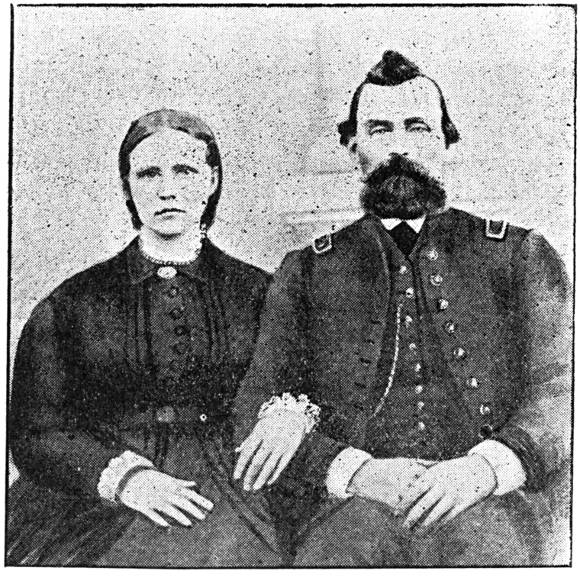
COL. AND MRS. MONKS AT CLOSE OF WAR.
On reaching Fredericks Fork township, Capt. Alley made a speech to the people and said, among other things, that the counties of Oregon and Shannon had been controlled by one of the most desperate class of men that ever lived. That they had ridden through the country on horseback, heavily armed, defying the enforcement of the civil law, intimidating the people, both Federal and Confederate alike, and committing all manner of crimes, robbing and murdering the people and boasting openly that the damn Confederacy was whipped, but that they were not and intended to live off the damn "Feds." Now the war is over and all good citizens, be they Federal or Confederate, should be in favor of the enforcement of the civil law. "I am ordered by the governor of the state to enroll all able-bodied men in the county to form a posse to aid the sheriff in enforcing the law in Oregon county; I am to organize companies to enforce the civil law. These bushwhackers and thieves have terrorized this county long enough. The governor has sent Capt. Monks, a man who is not afraid of bushwhackers and thieves, into this county to arrest these bushwhackers, thieves and murderers and bring them to justice. If the people of this county want the civil law enforced, they should aid Capt. Monks and his men to hunt these fellows down and either arrest them or drive them from the county. Our people have been present and saw these men commit all manner of crimes, from murder down to the smallest crime known to the criminal code. They have done this openly and the people were afraid to open their mouths or say a word against it, on penalty of death. I wrote the governor, stating the condition of affairs in this county, that neither person nor property were safe, and to send Capt. Monks to this county. And he has sent him and we have got the right man in the right place."
One of the prominent men of Oregon county went to Jefferson City to see the governor to procure the removal of the writer and have Col. A. J. Sea appointed in his place. He said to the governor that Capt. Monks was arresting some of the best men in Oregon county and had them prisoners. The governor showed him some of Capt. Alley's letters that he had written to the governor. The letters stated among other things that persons and property were at the mercy of these desperadoes and the county was being terrorized by James Jamison and his men; that they were robbing whom they pleased openly; that a day or two before he, Alley, wrote the letter, that Jamison shot a man's brains out in Thomasville, and dared any man to say he was in favor of the enforcement of the civil law, that he would serve him the same way. The governor asked him if those things were true, and he replied that they were; the governor said to him: "You are a leading man in that county and a citizen of Thomasville and never a word have you written to me that such terror and lawlessness existed in your county." He replied "Governor, I was afraid to." The governor replied to him, "when I send a man down there that is not afraid to handle those men without gloves, then here you come with a howl. Now I expected when I sent Capt. Monks down there, if he did his duty, that there would be a howl raised; I am satisfied that he is doing his duty. I am responsible for his acts and you men want to get rid of him; go home and tell your people to organize companies under Captain Alley and aid Captain Monks and his men in arresting and driving those bushwhackers and bandits out of your country and whenever Captain Monks reports to me that the person and property of your citizens are secure and that the civil law is being enforced, he will be removed, and not before."
They then employed Colonel A. J. Sea as an attorney. Some time during the night, while we were encamped on Fredericks Fork, some of the soldiers took the sheriff out and put a rope around his neck to make him tell where the bones of two soldiers were, who were murdered by Jamison and his men. He admitted that he knew where the bones of the two Federal soldiers were; that after they shot them Jamison gave him the mule and saddle that one man was riding; that he was afraid not to take them and promised as soon as the command reached Thomasville to go and show the bones. On the next morning after our arrival at Thomasville I procured a big box and placed it in a wagon and brought the sheriff from the guard house and set him on a box under a strong guard. About that time Colonel A. J. Sea came up and asked what we were going to do with that man. I told him "That is my business; when you was in the military service did you inform the civilians of your object and aims? You are a civilian now and I will give you five minutes to get outside of the lines or you will go into the guard house." He took me at my word and left at once.
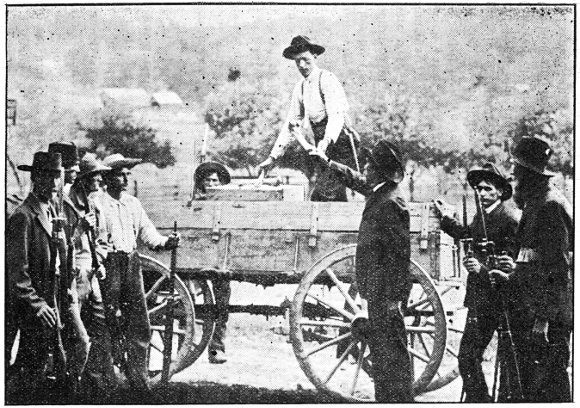
COLLECTING BONES OF TWO FEDERAL SOLDIERS SHOT BY COL. JAMISON AND MEN IN OREGON COUNTY.
The sheriff piloted the scout to the bones of the men that had been murdered, and the sheriff, aided by the scout, picked up the bones and placed them in the box. On examination it was found that three bullets had passed through one of the skulls, and the other skull appeared to have been shot all to pieces. I brought the bones in and caused them to be buried in a cemetery, about one mile west of Thomasville.
Captain Alley had completed the organization of two companies, one commanded by Captain Lasley and the other by Captain Bledsaw. The companies were mostly composed of men who had been late Confederates, as there were very few Union men in the county. They immediately fell in with my soldiers and a vigorous search was at once made for Jamison and his men. Being aided by men who were thoroughly acquainted with the county and knew just where to look for Jamison and his cut-throats, they agreed to keep on Jamison's track and arrest him and his men if possible, in Oregon county. I moved my troops up into Shannon county to prevent Jamison and his men from crossing over into Shannon and scouted that county to keep them from hiding there. The Oregon county companies shot and killed some of them and arrested others. Jameson and the others left the county and never have returned to it since.
But they left some of their sympathizers in the county, and the only weapons left them were their tongues; having no conscience or principle, and instigated by the wicked one, they began lying and preferring all manner of charges against the writer and his men who went into the county and, by the aid of the law-abiding citizens, drove out and arrested one of the worst set of men that ever lived, the savage not excepted, and restored the civil law, so that every citizen was secure in person and property.
The writer informed the governor that a large majority of the citizens, both Confederate and Federal, had nobly responded to his call, had organized two companies of militia to aid the sheriff in the enforcement of the civil law; Jamison and his bushwhackers had either been arrested, killed or driven from the county, and the strong arm of the military law was not needed any longer.
On December 25, 1867, the writer was ordered by the governor to withdraw his forces from the counties that had been placed under martial law and declare the civil law to be in full force and effect. I accordingly returned to Howell county and disbanded my soldiers.
During my march and stay in the counties of Oregon and Shannon, it was admitted by all honorable Confederates that I had enforced a strict discipline over my men and protected all classes of citizens in person and property, had paid the people for all forage and commissaries that were required for the soldiers, and had driven out the worst set of bushwhackers, thieves and murderers that ever lived.