ILLUSTRATIONS FOR CHAPTER VIII
Reading edition
Titian’s Assumption the Beginning of the Venetian Grand Style
Titian’s contemporaries were fully aware that the Assumption (1518) marked the beginning of the Grand Style at Venice and that the change was revolutionary. The critic Lodovico Dolce writes in his Dialogo della Pittura, Florence, 1735, p. 286 f. putting the words into the mouth of Aretino:
“After not much time [after the Fondaco frescoes, 1508] he was given to paint a great panel for the high altar of the Friars Minor; where Titian, still young, painted in oils the Virgin, who rises to heaven among many angels who accompany her, and above her he figured a God Father flanked by two angels. It seems really as if she rises with a face full of humility, and her robes fly lightly. At the bottom are the disciples who with various attitudes manifest joy and amazement, and are mostly larger than life, and assuredly in that picture is contained the grandeur and terribleness of Michelangelo, the pleasingness and grace of Raphael, with the coloring proper to nature, and, moreover, this was the first public work which he made in oils; and he made it in very little time, and young.”
“Thereupon the stupid painters and the vulgar herd who up to then had seen nothing but the cold and dead things of Giovanni Bellini, of Gentile, and of [Alvise] Vivarini (since Giorgione, working in oils, had not yet had any public work; and for the most part made no other works than half figures and portraits) which were without movement and without relief, spake great ill of that picture. Afterwards, as envy cooled, and opening their eyes a little to the truth, the people began to be amazed at the new manner discovered in Venice by Titian: and all the painters from then on strove to imitate it; but being off their own path, became confused. And surely it must seem a miracle that Titian, without having at that time seen the antiquities of Rome, which were the light of all the good painters, solely with that little spark, which he had discovered in the works of Giorgione, saw and perceived the idea of perfect painting.”
The general critical justness of this statement must condone its abundant overstatements and errors of fact.
446
Aurelio Luini on Titian’s Impressionism
“Aurelio Luini has excellently understood this art [of landscape] to whom it once happened that visiting Titian, and asking him his opinion about the background of trees, besides many reasons which he heard from him about making the foliage sparkle against the background, he saw one of his [Titian’s] wonderful landscapes which he had at home, which, having seen quietly, Aurelio thought a daubed up thing, but afterwards, having withdrawn to a distance, it seemed to him that the sun shone resplendently in it, making the paths retreat on this side and that; so that Aurelio had to say that he had never seen a rarer thing in the world in the way of landscapes.”
Lomazzo, Trattato, Milan, 1584, p. 474, 5.
On Belle Nature and the Antique
The Renaissance idea that Nature must be ennobled and corrected by the Antique is plainly formulated by Dolce, again under the name of Aretino, Dialogo, p. 190.
“One should then choose the most perfect form, imitating nature in part.... And partly one should imitate the beautiful marble and bronze figures of the ancient masters. Whereof who so shall taste and possess fully the marvellous perfection, will be able with certainty to correct many defects of nature, and make his pictures noteworthy and grateful to all. Inasmuch as the ancient things contain the entire perfection of art, and can be the exemplars of all beauty.”
This is one of the earliest full statements of the notion of belle nature, and of the antique as normative. The dogma persists with unabated rigor down to Sir Joshua Reynolds (see Illustration to Chapter VI, p. 316) and Jacques Louis David.
George Frederick Watts on the Greek Affinities of Venetian Painting
“The revival of the Greek Language and Greek Literature raised the long ebb into a wave that swept over civilized Europe. On its glittering crest the Venetian painters especially were lifted into the society of gods, goddesses, nymphs, and satyrs. They might see sky, sea and earth peopled with radiant beings; perhaps with a sort of semi-belief such as we accord to the Lorelei and fairies, creations that somehow easily worked in with creeds and experience. Anyhow, they might see 447Pan come dallying down the sparkling brook-side, now shouting to the laughing brown nymphs rustling through the reeds, and pretending to be afraid, now scattering a shower of notes from his pipes that would fall upon the ears as the brightness of the iris over a fountain falls upon the eye.”...
“It may seem strange if I place the Venetian school and Titian, with his liberal line—which, however, is by no means wanting in reticence—in closer relationship with Greek art of the great period than the more classical schools of Tuscany and Rome. Supposing one were to endeavor to paint a restoration of the pediments of the Parthenon, it would be possible to interpolate with figures by Titian, never with any by Poussin, or, I think, even by Raphael or Michael Angelo.”...
“In spite of extravagant and even absurd defects (for the great artist’s eyes no longer served him faithfully), when Titian, towards the end of his life painted the ‘Europa’ ... the muse who inspired Pheidias laid her hand on the old man’s shoulder, and she inspired the wealth of volume, ease of line, and glowing sense of nature’s exuberance.”
George Frederick Watts, his Life and Writings, London and New York, Vol. III., pp. 251, 253, 254.
450
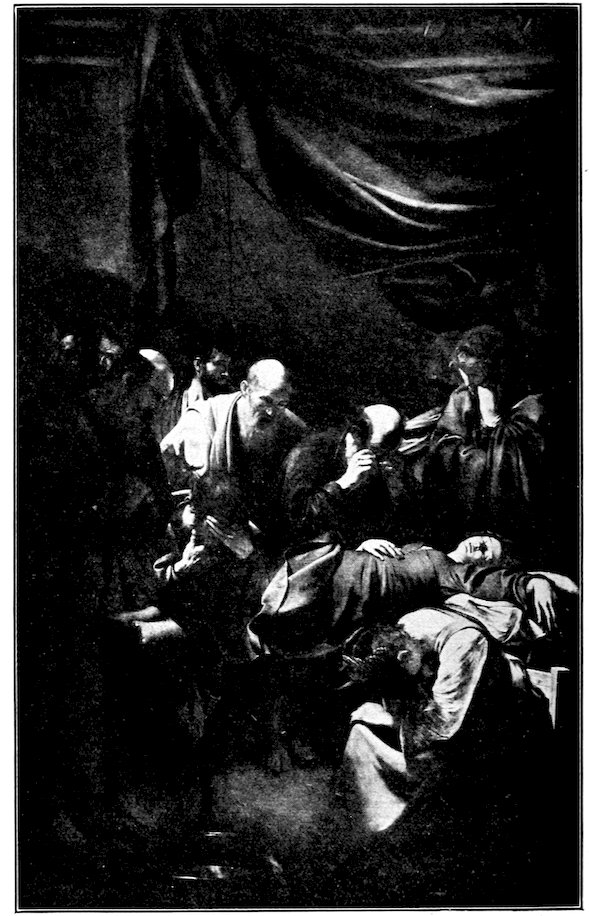
Fig. 309. Caravaggio. Death of the Virgin.—Louvre.
451