APPENDIX.
Reading edition
THIMBLEBY.
This parish is contiguous to Horncastle, but the village and church are distant about 1¼ miles from the town, in a north-westerly direction. Letters arrive at 8.30 a.m., from Horncastle, where are the nearest money order and telegraph office and railway station.
As to the name Thimbleby, given in Domesday Book as Stimbelbi, it doubtless meant originally the Bye (scotice “Byre”), or farmstead, of a thane, or owner, in pre-Norman times named stimel. [165] In the survey made by the Conqueror, A.D. 1085, there are two mentions of this parish, (1) It is included among the 1,442 lordships, or manors, of which King William took possession on his own behalf, ejecting the previous owners; none of whom, in this instance, are named. Under him it was occupied by 22 soc-men, or free tenants, and 18 villeins, or bondsmen, who cultivated 4½ carucates (540 acres), with 240 acres of meadow. This, however, did not comprise the whole parish, for (2) another mention gives Thimbleby among the lands granted by the Conqueror to Odo, Bishop of Baieux, who was half brother to King William, on his mother’s side, and was created by him Earl of Kent. His brother was Earl of Moretaine, and his sister Adeliza was Countess of Albermarle. He had been consecrated Bishop of Baieux before William’s conquest of England, in 1049. He was subsequently made Count Palatine and Justiciary of England. The old historian, Ordericus Vitalis, says “he was reputed to be the wisest man in England, and ‘totius Angliæ Vice-comes sub Rege, et . . . Regi secundus’”; and this was hardly an exaggeration, since he was granted by William 76 manors in Lincolnshire, besides 363 in other counties. But we have observed in several other instances how insecure was the tenure of property in those unsettled times, when might was deemed right, and this ambitious Prelate was no exception. He aspired to the Papacy, the highest ecclesiastical office in Christendom, and was about to start for Rome, with the view of securing it through his wealth, when he was arrested and imprisoned by his royal kinsman, and his estates confiscated.
The portion of Thimbleby granted to this Odo comprised 250 acres of cultivated land, with 12 acres of meadow and 30 acres of underwood. This was worked for him by three free tenants and five bondmen. [166a] On the attainder of Odo, this land passed again into the King’s hands, to be bestowed doubtless upon some other favourite follower. Accordingly we find that, shortly after this, the powerful Flemish noble, Drogo de Bevere, who had distinguished himself greatly at the battle of Hastings, along with many other manors in Lincolnshire, held that of Thimbleby. He was, by Royal Charter, Lord of all Holderness, and took his title de Bevere from Beverley, the chief town in that division. As is also related elsewhere, [166b] the Conqueror gave him his niece in marriage; but, being of a violent temperament, Drogo got rid of her by poison, and then, having thus incurred the anger of William, he fled the country. His estates, in turn, were probably confiscated, for we find that a few years later Stephen, Earl of Ambemarle, [166c] had five carucates (i.e. 600 acres) of land between Thimbleby, Langton and Coningsby.
This noble was distinguished for his piety, as well as his other great qualities. The chronicler describes him as “præclarus comes, et eximius monasteriorum fundator,” an illustrious earl and distinguished founder of monasteries. Among other such institutions he founded, on the feast of St. Hilary, A.D. 1139, the Priory of Thornton, in North Lincolnshire. This Stephen also received the lordship of Holderness, which had been held by Drogo. He was succeeded by his son William, who was surnamed Crassus, or “The Gross,” from his unwieldy frame. His great-granddaughter, Avelin, succeeding to the property in her turn, married Edmund, Earl of Lancaster, surnamed Gibbosus, or humpback. But they had no issue, and so, as the “Book of Meux Abbey” says, “for want of heirs the Earldom of Albemarle and the Honour of Holderness were seized (once again) into the King’s hands.” What became of the demesne of Thimbleby is not specified; but we find from the survey, already quoted, that in the same century Walter de Gaunt, son of Gilbert de Gaunt, [166d] held Thimbleby and other neighbouring parishes 24 carucates, or in all 2,880 acres of land. We have traced elsewhere [166e] the descent of the Willoughby family from the Gaunts, and about 100 years later (circa 1213, Survey, as before) William de Willoughby succeeded to these estates, including the demesne of Thimbleby. He was ancestor of the present Earl of Ancaster, and Lord Willoughby de Eresby, who now represents this division in Parliament. How long the estates, in whole or in part, remained with the Willoughbys is not clear; but we have evidence of their connection with Thimbleby nearly 100 years later, in a document dated 1302, [167a] concerning a dispute as to lands in Thimbleby, Langton, Woodhall, and several other parishes, between John de Bec and Robert Wylgherby, the two families being related; in which the said Robert surrenders to the said John all property in dispute, for his lifetime, on condition that, after his decease, the whole shall revert to the said John Willoughby, and his heirs, for ever. [167b]
From this time we find other names connected with the parish. Indeed prior to this, in a charter of Bardney Abbey, dated “at the Chapter of the Convent, on Sunday next after the Ascension of our Lord” (22nd May) 1281; we have among the witnesses, along with others belonging to Edlington, Wispington, and Baumber, “Master Bartholomew of Thimbleby,” and John Crayck of the same, the former being probably the Rector. [167c] This charter refers to certain lands and tenements, the gift to the abbey of “Walter, son of Gilbert, de Bolingbrog,” i.e. Walter, the son of Gilbert de Gaunt, already named. In another Bardney charter, dated four years later (30th Sept., 1285), we find again the same Thimbleby witnesses, with Alured of Woodhall, and others. [167d]
Three years later than this, in an official inquiry, held at Lincoln, as to certain knights’ fees, which belonged to Elyas de Rabayn and his wife Matilda (12th Nov., 1288), the jurors declare that “Robert de Rothwell holds in Thymelby and Horncastre,” certain “rents of assize, to be paid at the Feast of St. Michael, the Nativity of the Lord, Easter, and St. Botulph” (June 17), amounting to 12s.
A more interesting record is the following. We may premise that the Norman noble, St. Quintin (so named from a town of France, in the department of Aisne, the Augusta Veromanduorum of the Romans), came over among the followers of William the Conqueror, and his name appears in the famous “Battle Roll” of 1066. A Final Concord, of date A.D. 1293, states that on the Quindene of the purification of the Blessed Mary (i.e. the 5th day after), a dispute having arisen between Herbert de St. Quintin on the one part, and Ascelina de Waterville and Matilda de Diva on the other part, the two latter being tenants of 3½ carucates of land (i.e. 420 acres) in Thymeleby; it was settled that the said Ascelina and Matilda should acknowledge the said land to be the right of Herbert; and for this Herbert granted them, as his tenants, all the said lands, except six oxgangs (i.e. 90 acres) which were occupied in separate parcels, by Baldrick, Hogge, Alfsi, Godric, Walfric, and others; and for this the said Ascelina and Matilda gave him, in acknowledgment, 40 marks.
A few years after this date it would appear that the Bishop of Carlisle exercised a kind of ecclesiastical lordship over this parish. Thimbleby was in the soke of Horncastle, and Ralph de Rhodes, the former Lord of the demesne of Horncastle, with its appurtenances, West Ashby, High Toynton, &c., had granted these (by charter confirmed by Henry III., A.D. 1230) to Walter Mauclerk, Bishop of Carlisle, and his successors.
Accordingly in an old document of the early 14th century, we find that John de Halghton, Bishop of Carlisle, gave consent for William de Foletby to convey certain lands in Thimelby, Langton, and Horncastle, to the Abbot and Convent of Kirkstead, to provide two monks, to celebrate daily services for the souls of the faithful deceased. The witnesses were Richard de Wodehall, William de Polam (Poolham), and others. “Dated at Horncastre, on this day of St. Barnabas, 5 Ed. II., 11 June, A.D. 1312” [168a] This shows a connection with the monastery of Kirkstead, to which we shall refer hereafter.
We next come to a record of special interest, of rather later date. The family of Thimbleby, Thymelby, Thimoldby, &c., doubtless took their name from this parish, at a period lost in hoar antiquity. They acquired in course of time extensive property in various parts of the county. The chief branch of the family resided at Irnham Park, near Grantham, which was acquired (about 1510) by Richard Thimbleby, through his marriage with the heiress of Godfrey Hilton, whose ancestor, Sir Geoffrey Hilton, Knight, had obtained it by marriage with the heiress of the Luterels, a very ancient family, several members of which were summoned to Parliament as Barons, in the 12th century.
The earlier members of the Thimbleby family are called, expressly, Thomas de Thymelby, Nicholas de Thymbylby, and so forth, shewing their connection with this parish. The family name of Thimelby still survives in the neighbourhood of Spilsby.
The first mention of a Thimbleby, as an owner in Thimbleby, occurs in a Post Mortem Inquisition, held at Holtham (Haltham), on Friday next after the Feast of St. Matthew (Sept. 21), A.D. 1333; where the jurors say that Nicholas de Thymelby held, with certain other lands in the neighbourhood, two messuages and four acres of land in Thymelby, of the Bishop of Carlisle, and that the said Nicholas died on the Feast of the Purification (Feb. 2nd); and that his son Thomas, aged 19, was heir. [168b]
Then follow a grant of land and other privileges, by the Bishop of Carlisle, in Horncastle and Upper Toynton, to Thomas, son of Nicholas de Thymelby. Thomas presented to the Benefice of Ruckland in 1381. His son John married Joan, daughter of Sir Walter Taillebois; whose mother was daughter and heir of Gilbert Burdon (or Barradon), whose wife was sister and heir of Gilbert Umfraville, Earl of Angus. Thus the family kept growing in importance. [168c]
Our last mention of this family, in connection with Thimbleby, shows a still greater expansion. An Inquisition taken 12th August, 4 Ed. VI. (1550), after the death of Matthew Thimbleby, of Polam, Esq., shows that he married Anne, daughter of Sir John Hussey, and that he was seised of six manors besides that of Thimelby; also of lands in eight other parishes, with the advowsons of the churches of Tetforde, Farrafford, Ruckland, and Somersby. [168d] His widow married Sir Robert Savile, Knt.
Soon after the first mention of a Thymelby of Thimbleby, we find another family of some note connected with this parish. In an agreement made at “Langton near Horncaster, 8 August, A.D. 1370, Peter Skynner of Ely, and Alice his wife, for some consideration not named, surrender to William de Atherby and his heirs, all their rights in certain lands and tenements in Woodhall, Langton, Thymelby, Horncastre, Thornton,” &c. [169a] These lands had evidently been held by the said Peter Skynner and his wife.
The Skynners were a family of wealth and position. In 1315 Robert and Richard Skynner held the manor of Pinchbeck, near Spalding. [169b] They were also land owners in Hareby and Bolingbroke. Henry Skynner, by will, dated 29th May, 1612, leaves to his daughter Judith, all his copyhold in Harebie, to his brother, Sir Vincent Skynner, Knight, lands in Hareby and other places, with the advowson of the Benefice. Sir Vincent Skynner was Lord of the Manor of Thornton Curtis; he was in 1604 appointed by the crown Keeper of East Kirkby Park, as part of the Royal manor, or “Honour,” of Bolingbroke. His son William married a daughter of Sir Edward Coke, Knight, and was buried at Thornton Curtis, August 17th, A.D. 1626.
We find mention of another owner of land in Thimbleby, in the 15th century, whose apparent love of pelf would seem to have tempted him to defraud the king of his dues. A certain Thomas Knyght, of the City of Lincoln, Esquire, died in the 10th year of the reign of Henry VII. (A D 1495), seized of lands and tenements “in Thembleby,” and other places. At the Inquisition then held, the jurors found that he had alienated certain parts of the property, “the Royal license therefor not being obtained, to the prejudice and deception of the lord the King,” and the property passed to his son and heir William, who took possession, with “a like evasion of dues, to the King’s prejudice.” What penalty was imposed is not stated; but it was a somewhat remarkable coincidence, that, as shewn in another Inquisition made the following year (A.D. 1496), certain witnesses deposed that on the 20th day of June, A.D. 1476 (i.e. 19 years before his decease), the said Thomas Knyght, and his servants, about the middle of the night “broke and dug the soil of the parlour of his house, and found £1,000, and more, of the coinage of the Treasury . . . there placed and hidden,” which as “tresour-trove, by reason of the prerogative of the lord the King, ought to come to his use, &c.” This has all a very suspicious look, Knyght would not have ordered this search for the money if he had not himself known of its being there. It looks like a previous attempt at concealment, in some way to defraud the revenue, which Knyght himself afterwards felt was a failure, and that it was safer to exhume the hoard himself, rather than that public officials should do it. Altogether it would seem that “Thomas Knyght, of the City of Lincoln, Esquire,” was somewhat of a sordid character, and not a proprietor for Thimbleby to be proud of.
We now proceed to records more ecclesiastical. We have already noted that, with the consent of the Bishop of Carlisle, William de Foletby, in the 14th century conveyed lands in Thimbleby to the Abbot of Kirkstead. This would seem to imply a previous connection of this parish with that monastery, to attract the Thimbleby proprietor to it. Accordingly we find that, among the various properties of the Abbey, granted by Hugh Brito, its founder (A.D. 1139), and other benefactors, were 90 acres of land in Thimbleby, with the advowson of the Benefice. In those days there was only a very limited number of resident clergy in the country parishes, [170a] the churches being served largely by the monks of the monasteries. In some cases these were “itinerant clerks,” in other cases there was a “grange,” or dependency, of the monastery in the parish, having a “cell,” or “hermitage,” for a priest.
Thimbleby was not among the number of parishes which had a church before the conquest, as Edlington and several other neighbouring parishes had; but there is no doubt that a church was erected here soon after that period, which, like the neighbouring Woodhall, was connected with Kirkstead, and here, as at Woodhall, there are traces of a moated enclosure eastward of the church, which doubtless was the site of the grange.
The Abbot of Kirkstead exercised the powers of a superior lord here in a somewhat arbitrary fashion; it being complained against him before Royal Commissioners as early as the reign of Edward I., that he had erected here “furcœ,” or a gallows, on which various criminals had been executed; and that he had appropriated to himself the assize of bread and beer here, and at Horncastle. [170b] But “blessed are the peacemakers,” and the abbots, with wholesome influence, were able, when occasion served, to produce harmony out of discordant elements; as the following records show (quoted from Final Concords): “In three weeks from the day of the Nativity of the Blessed Mary, 10 Henry III. (28th Sept., A.D. 1226),” a dispute arising between Reginald, Rector of Thymelby, and Peter, son of John, tenant of a certain messuage and toft in Thymelby. Peter was induced to give up his claim, in favour of Reginald and his successors; and for this the said Reginald gave him one mark, in recognition of the concession. Which agreement was made in the presence of Henry, Abbot of Kirkstead, who himself gave to the church of Thymelby all right which he had in rent, which he was wont to receive; not however without an equivalent, which—being wise in his generation—he was careful to secure; for Reginald, in return, gave him a certain sum “to buy a rent in another place.”
The worldly wisdom of the same abbot appears again in the following Concord: On the morrow of St. Michael, 10 Henry III. (30th Sept. A.D. 1226); a dispute between Sarah, the wife of Alan de Tymelby, and Henry, Abbot of Kirkstead, about a certain meadow in Tymelby, was happily settled (it being to the soul’s peril to incur an abbot’s anathema!) by the said Sarah giving up all claim to the meadow in favour of the said Abbot, and his successors; in recognition of which he gave her one mark.
A gap now occurs in our history, which can only be filled in, for a time, by conjecture. On the dissolution of the monasteries by Henry VIII., the possessions of Kirkstead Abbey were granted by him to Charles Brandon, Duke of Suffolk; on whose death without issue, they reverted to the sovereign, and were re-granted to the Earl of Lincoln, of the Fiennes Clinton family, subsequently Dukes of Newcastle. The Abbey lands in Thimbleby are not, so far as we know, specially named in this grant, and therefore we are unable to say positively whether that family acquired property in Thimbleby or not; but they had undoubtedly property in Horncastle and neighbourhood. For instance the manor of Baumber remained in their hands, and Baumber Church continued to be the family burial place, until the 3rd Duke of Newcastle, late in the 18th century, sold that estate to T. Livesey, Esq.
A few years later, however, we have official evidence that the manor and advowson of Thimbleby were vested in the sovereign. By a deed (a copy of which is in the Rector’s possession) dated 10th April, 7 Edward VI. (A.D. 1553), of the Court of Augmentations, a toft and messuage in Thimbleby were granted by the King to John Welcome; also “the lordship and manor of Thimblebye, with all its rights, &c., lately belonging to the monastery of Kirkstead;” also “the advowson and right of patronage of the Rectory and Church of Thymmelbie, aforesaid.” In the next reign, of Mary, the benefice was presented, by the Queen herself, to William Brantinghame, being admitted on her nomination 19th Sept., 1554. [171a]
A deed of that reign, dated 6th Feb., 1 and 2 Philip and Mary (1554), grants certain lands belonging to the manor of Thimblebie, to Anthony Kyme, for 21 years, at 10s. per annum
Next, in the reign of Elizabeth, a deed dated 9th March, 4 Elizabeth (1562), grants certain tofts and lands to John Porter, for 21 years, at a rent of 18s. per annum; and finally, by deed dated June 30th, 1564, Elizabeth in consideration of the sum of £609 5s. 2d., confirms the above grants and leases to William Conyers and William Haber, both of the Middle Temple, the patronage of the Rectory, “to be held with the manor of Est Grenwich, in the countie of Kent, free of all duty or military service.”
After a further hiatus in the parish history, we find another link in the records. The former property of the Thimblebys, of Poolham, and elsewhere, had been sold to a member of the Bolles family, in 1600; and Mr. Weir [171b] tells us that in the reign of Charles II. the manor of Thimbleby belonged to Sir Robert Bolles, of Scampton. From Liber Regis we find that Sir John Bolles presented to the benefice of Thimbleby in 1697, and doubtless was Lord of the Manor. This Sir John sold his property, and according to the antiquarian, Browne Willis (Ecton’s Thesaurus), in the reign of Queen Anne, the patronage of the benefice belonged to “Mr. Kercheval”
In 1719 and 1725 John Hockin, Clerk, presented.
In 1720 the manor and advowson were bought by John Hotchkin, Esq., of Tixover; and a Thimbleby record, preserved with the registers, shows that the Hotchkins have presented from about that time till recently. In 1767 (Sept. 10th), Allen Corrance was admitted on the cession of John Kercheval, by Thomas Hotchkin, Esq., of Alexton, Co. Leicester. In 1778 William Holmes, M.A., was admitted to the rectory by John Hotchkin, Esq., of South Luffenham, on the death of Allen Corrance. In 1831 (Sept. 21st) Robert Charles Herbert Hotchkin, B.A., was instituted at the rectory, on the death of William Holmes, on the nomination of Thomas Hotchkin, Esq., of Tixover. The late T. J. Stafford Hotchkin, Esq., of Woodhall Manor, sold his property in Thimbleby and some other parishes in 1872; and the advowson of this benefice, then in his gift, was subsequently sold to the father of the present Rector, the Rev. C. A. Potter.
There is another name on record, connected with Thimbleby, which we have not yet mentioned. Among a list of the gentry of Lincolnshire, made on the Royal Herald’s Visitation of the County, in 1634, which is still preserved at the Heralds’ office, is the name of “Robert Frieston, of Thimbleby.” What position he held, or whether he was a land owner, in the parish, is not stated, but he ranked with Thomas Cressy (of a very old family), of Kirkby-on-Bain; the Dymokes of Scrivelsby, Haltham, and Kime; Heneage of Hainton, &c. [172a]
There is a smaller manor in this parish called the Hall-garth, the residence attached to which is a picturesque old thatched mansion, with an old-time garden, enclosed within high and thick hedges of yew, trimmed in Dutch fashion. It has also a large “stew,” or fish-pond, from which, doubtless, in Roman Catholic times, the owners drew their supply of carp and tench, for the numerous fast-days then observed. Old title deeds show that this was at one time crown property. [172b] At a later date it was owned by a family named Boulton, who also held land in Stixwould, where there is still the slab of a Boulton tomb in the pavement of the aisle of the church.
A slab, on the south side of Thimbleby Church, bears the inscription: “Here lyeth the body of Michael, the son of Mr. Michael and Elizabeth Boulton, buried the 7th of Septemr, 1692, ætatis suæ 7. His mother the 28th of May, Anno Dom. 1725, ætat suæ 61.” The Register has the following entries, “1725, Mrs. Boulton, ye wife of Mr. Mich. Boulton, buried May 28th.” “1738, Michael Boulton buried May 8th.” The last entry connected with this family is that of “Michael, son of Michael and Mary Boulton,” who was baptized in 1726 and buried in 1767.
These were the ancestors of the late Mr. Henry Boulton, of St. Mary’s Square, Horncastle. Michael Boulton, in 1719, left 40s. a year, from the Hall estate, at Bransby near Stow, for the education of poor children at Thimbleby; leaving also a bequest for the poor at Bransby.
At the beginning of the 19th century this manor was held jointly by Richard Elmhirst, Esq., of Usselby, and Mr. Thomas Kemp, the latter of whom resided at the Old Hall. [173a] There is a field at the west end of the village, now the property of H. N. Coates, Esq., traversed by mounds and ditches, which was formerly divided into three separate plots, belonging to Elmhirst, Kemp, and Hotchkin. The Kemps were of an old stock. In the Thimbleby Registers the first mention of them is in 1723, [173b] but their name implies a much greater antiquity. One theory has been that they were a Huguenot family, who came over to England at the time of the French massacre of Protestants, on St. Bartholomew’s day, 1572. Those refugees, in their enforced poverty, prosecuted various kinds of useful industries; and the Kemps, it is suggested, acquired their name from being kempsters, or comb makers.
But it is probable that the name had a much earlier origin. Kemp (Saxon Cempa) meant a soldier [173c] being connected with the Norman-French and modern English “Champion;” and although we might look back with pride to forefathers who suffered for their religion, it is pleasanter, if only in imagination, to regard them as having been a race of doughty warriors, sufficiently distinguished to win a name by their deeds. [173d]
Mr. Thomas Kemp, in the first half of the 19th century, was a wealthy bachelor, and added to the Hall-garth estate by the purchase, from time to time, of adjacent property. He lived in some style, with two maiden sisters to keep house for him. By his will the land at Thimbleby passed into the possession of his great nephew, Robert Edwin Kemp; another nephew, Samuel Harrison Kemp, inheriting most of the personal estate. But alas! liveried servants, crests and arms, and other emblems of wealth have become things of the past; for when this Robert died the property passed to his son, Thomas Kemp, in whose hands the patrimony speedily evaporated; and other members of the family are now dispersed, “their places knowing them no more,” save as a lingering memory, which will soon be gone.
The interesting old hall and the manor were then bought by Reuben Roberts, Esq., of Linden House, Horncastle, who resides there in the summer. He also owns other land in the parish. Other owners are E. Hassard, Esq., of Edlington Park; H. N. Coates, Esq., of Langton Manor; the trustees of the late Mr. Samuel Goe, and several smaller proprietors. Mrs. Tebbutt, of Horncastle, a relict of an old Thimbleby family, whose name appears frequently in the parish books, is now Lady of the Manor.
Some 200 yards east of the church and on the south side of the main road is a large field, the property of Mr. Henry N. Coates of Langton, which is known as “The Butts.” It has some fine trees, apparently the remains of an extensive avenue, which have been more numerous even within living memory. It has been sometimes called “The Park Close,” but the title “The Butts” is interesting, as probably indicating that it was formerly the site on which (in the words of a rhymer, it may be said):
England’s archers of old, Village wights true and bold, Unerring in hand and in eye, Learned skill in their craft With yew-bow and shaft, Wand to splinter, or pierce the bull’s-eye.
And while the youth gay, Rough rivals, essay To rive and riddle each butt, Sage sires stand by, And coy maidens cry, To welcome the winning shot.
Full many such scene Has been witnessed, I ween, In that whilome time-honoured spot, ’Neath the wide-spreading shade Of the green wood glade Which is still named the “Thimbleby Butt.”
In this “Butts” field rises a spring, which is the source of a small runnel, called “Daubeny’s Beck.” This bearing westward, for some distance forms the boundary between the parishes of Thimbleby and Langton, then flowing through Woodhall falls into the “Monk’s Beck,” at Poolham. The name “Daubeny” is doubtless a corruption of D’ Albini. The D’ Albinis held the Barony, and built the castle of Belvoir, and had other large possessions in this county and elsewhere; the name is not uncommon as a field name, &c. There is a field in Langton called “Daubeny’s (i.e. D’ Albini’s) Walk.”
In the grounds of Mr. W. A. Crowder, further to the east, near the Lincoln “Ramper,” as the highway is locally called, there was found, a few years ago, a so-called “Roman” tomb, somewhat rudely constructed of blocks of Spilsby sandstone. Within it was a human skeleton, with bones of a dog, a sword, and the head of a spear. In connection with this, we may also mention, that in the Rectory grounds there is an ancient well, of great depth, lined also with Spilsby sandstone, and said to be Roman; which in the immediate proximity of the Cornucastrum, or Roman fort of Banovallum, would not seem to be at all improbable.
An old parish book of Thimbleby, recently shown to the writer, proves the care which was taken by the parish officials, before the present poor law system was established, to secure the comfort and maintenance of poorer parishioners.
At a parish meeting, Nov. 1st, 1819, Thomas Kemp, Churchwarden, in the chair, it was ordered that John Sharp’s daughter was to have a gown and pettycoat, worsted for two pairs of stockings, and one blue apron. Four boys were to have two smocks each, and eight old people a strike of coals each per week. At another meeting Margaret Day was to have worsted for two pairs of socks for her two boys, herself to spin it; and one pair of shoes for her daughter. Robert Kemp, and his son Richard, in order to find them work were to be paid 2s. per day, to “gether” stones for the parish.
Again, Maria Day’s shoes were to be mended; Mary Atkin to have a pair of blankets, and her chamber window put in and thatched. Benj. Benton one pair of shoes, Willm. Adkin a waistcoat. Mary King’s family four shirts, two pairs of shoes, three frocks, three petticoats, and three dabs (i.e. pinafores). A pair of breeches for George Skipworth; Willm. Skipworth to have a spade.
Again, Mr. Thos. Kemp was “to be allowed £20 for the use of the poor-house, to be insured for £200 by the parish, and, when given up to be left in the same state.”
At a meeting on 7th August, 1820, Robert Dixon in the chair, it was ordered that all paupers receiving assistance should regularly attend Divine Service, and on their non-attendance the assistance should be stopped. Mary Todd was to receive her money (which had been stopped) having given satisfaction to the vestry for not attending the church. Mary Hobbins’ boy to be put to school. “To get the Lord’s Prayer, and the ‘I believe,’ put in the church at the parish expense.”
At a meeting held 27th August, 1830, Thomas Kemp in the chair, it was agreed that £75 be borrowed of Mr. Thos. Kemp, to pay Mrs. Farmer’s expenses to America, to be repaid by the parish, 30s. weekly, with legal interest. Church rates are now among the “has beens,” but in 1843 a rate was passed of “1d. in the pound for the support of the church, and 10d. in the pound for the highway repairs.”
In the churchyard, along the south side of the church, are a group of gravestones of the Kemp family. Eastward are several of the Marshall family, formerly numerous here, and in the neighbourhood, holding a respectable position, but now extinct. [175] There are also a number of tombs of the Todd family, respectable small farmers, resident in the parish, from the first notice of a burial, June 24th, 1738, down to recent years. The Tebbuts and Dixons were also resident, as tenants or small owners, for many years.
Among the marriage registers, which date from 1695, is the following note: “March 23, 1779, a marriage was attempted to be solemnized; but the intended bridegroom, to the great surprise of the congregation assembled, remaining away, the ceremony, &c. . . .” The rest is illegible.
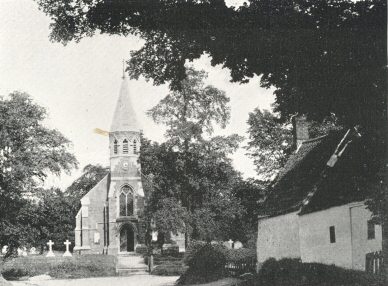
We have now to speak of the church. The present edifice stands on the site of a former 14th century church, which, judging by the remains that have been found, must have been of much larger dimensions, and consisted of nave, two aisles, chancel, and bell tower; the total breadth having been 52-ft. Several fragments of stained glass have, at various times, been found in digging graves, showing that this early church, like several others in the neighbourhood, had good coloured windows. This was taken down in 1744, and from the materials remaining a small fabric was erected in its place, consisting of nave and apsed chancel, with no pretensions whatever to architectural beauty. This (as has been generally the case with badly constructed edifices of that period) became also, in turn, so decayed that the present Rector, on entering on the benefice, decided to rebuild the church once more; and in 1879 the present structure was completed at a cost of over £1,000, in the best early Decorated style.
It consists of nave, chancel, organ chamber on the south, and an octagonal bell turret, designed by the late Mr. James Fowler, the Architect, and containing one small modern bell, graven with the date and initials of W. Carey, Churchwarden in 1744, [176a] who demolished the old church. The nave has three two-light windows, of the decorated style, in the north and south walls; there is a square-headed two-light window in the organ chamber; the chancel has a single-light window in the north and south walls, with a good east window of three lights, trefoiled, and with a triangle of trefoils above. In the north wall is a credence recess, and in the south wall are two stone sedilia. The tiles within the chancel rails are copied from ancient tiles, which were found some years ago, at Revesby Abbey. In the west front, over the door, is a large two-light window, and above it a clock, the only village church clock in the neighbourhood, by Smith of Derby. Within the west doorway, let into the north wall of the tower basement, is a fragment of an old battlement, having a shield in the centre, probably a relic from the original church. The font is modern, having a plain octagonal bowl, shaft, and pediment. The roof is of pitch pine, the timbers being supported by plain corbels. The lectern, chancel stalls, and communion table are of good modern oak
Used as a stile in the south fence of the churchyard is a large slab, on which, above ground, is the matrix of a former brass, representing one figure, with a broad transverse bar for an inscription, and connecting it with other figures, which are now below the ground. [176b]
The church plate includes an interesting paten, presented to the church in 1837, by the mother of the late Rector, but bearing hall-marks of 1727–8, with the letter M and a five-pointed star below. The chalice is still more interesting, as it bears an old Lincoln hall-mark, of date about 1570; there are only eight other known examples of this period in the county.
The rectory is a commodious house, built in 1839, doubtless on the site of the former monastic grange; it stands in an extensive garden, embowered among trees of goodly growth. A fine oil painting at the present time adorns the entrance hall. It is reputed to be by Spagnoletto, and was formerly in the monastery of St. Jerome, in Lisbon. Its size is 5-ft. by 4-ft., the subject being St. Jerome translating the Vulgate scriptures.
WEST ASHBY.
This parish, like High Toynton, Mareham-on-the-Hill and Wood Enderby, was formerly a hamlet of Horncastle, of which it adjoins the northern boundary. We find them all coupled together in an extract from the Testa de Nevill [folio 348 (556), quoted Lincs. Notes & Queries, vol. iii, p. 215] as follows: “The church of Horncastre, and of Askeby, and of Upper Thinton, and of Meringes, and of Hinderby, are of the gift of the Lord,” i.e. the Lord of the Manor. In Domesday Book it is called Aschebi. Queen Editha, wife of Edward the Confessor, who owned various lands in this neighbourhood, was Lady of this Manor, as well as that of Horncastle. She held here six carucates of land (or about 720 acres), besides which there were 45 soc-men, 5 villeins, and 13 bordars, with eight carucates (or about 960 acres), and 500 acres of meadow and pasture. (Domesday, “Soke of Horncastle.”)
Domesday also mentions that the Saxon thane, Chetelburn, who had property in Coningsby, Keal, Candlesby, Friskney, and other places in the county, had at Ashby “a mill worth 12s. yearly,” a very considerable sum in those days. The manor was afterwards held by the Conqueror himself (Domesday, “Property of the King”); and it would seem, although there is no direct evidence of it, that he bestowed the manor on one of his chief favourites, Ranulph de Paganall, who received from his sovereign extensive grants in the counties of Somerset, Devon, York, Northampton, and Lincoln, [177] including all the lands formerly held by the Saxon Merleswain, in this county and elsewhere. Ranulph Paganall founded (A.D. 1089) the Priory of the Holy Trinity in York, said to have been built on the site of a former Roman heathen temple; one of his family, Helias Pagnall, being subsequently Prior of this institution, and Canon of Selby. When the present Church of the Holy Trinity was restored in 1904, among other ancient monuments, was found the slab of the tomb of Ralph Ranulph, which is still preserved in the church, along with sculptures commemorative of St. Benedict, St. Martin of Tours, Prior Helias, and others. [178a]
Ranulph, by charter of that date, endowed the abbey with two-thirds of the tithes of Ashby; which was further confirmed by charters of 1100, 1125, and 1179. This Ranulph Paganall was Sheriff of Yorkshire. The last known representative of his family was William Paganall, summoned to Parliament as a Baron in the reign of Edward III. Dugdale states [178b] that the Priory of the Holy Trinity was made, by its founder, a dependency or cell of the greater monastery (marmonstier) of the above, St. Martin in Touraine; and by the Inquisition, taken at York, 34 Ed. I., it was found that he claimed no portion of the temporalities of the Priory, beyond the right to place an official there, during the vacancy of the priorate, as temporary custodian. The name Paganall became in later times softened into Paynell; they were at one time Lords of Bampton.
At a later period the manor of Ashby, probably with that of Horncastle, belonged to Gerard de Rhodes and his descendant, Ralph; since in a Charter Roll of 14 Henry III. (pt. i, M. 12), we find that King’s confirmation of a grant, made by the said Ralph, to Walter, Bishop of Carlisle, of “the manor of Horncastle, with the soke, and the advowsons of the churches, and all other things pertaining to the same in all places,” evidently including the churches of the hamlets as well as that of the town. Among the witnesses to this are Gervase, Archdeacon of Carlisle; and Henry de Capella; the latter name being noticeable because, as will be seen below, Ashby was called “Capella.” [178c]
The Abbey of Kirkstead had a grange in Ashby, which after the dissolution of the monasteries, was granted in the 5th year of Edward VI., to William Cecil, Lord Burghley, Lord High Treasurer of England; this is now part of the Ashby Thorpe estate. [178d] In 1820 this was the property of Mr. Joseph Rinder. It is now partly owned by the Booth family, and partly by the Smedley trustees.
The parish is still divided into Far Thorpe, Church Thorpe, and Middle Thorpe. Far Thorpe included the farms held by the late Mr. Griffin and Mr. Addison. Mr. Wattam’s house, which is moated, was the old Midthorpe Hall. As being a hamlet of Horncastle, the benefice was formerly called Ashby “Capella,” or the Ashby Chapelry; and like Horncastle, Wood Enderby, High Toynton, and Mareham is given in “Liber Regis” as in the patronage of the Bishop of Carlisle. Until recently it was a perpetual curacy, in value about £50 a year; but about 30 years ago, on the enfranchisement of certain episcopal lands, the Ecclesiastical Commissioners endowed it to the extent of £300 a year, and built a substantial vicarage. The patronage is now with the Lord Chancellor by exchange with Kirk Oswald, Cumberland.
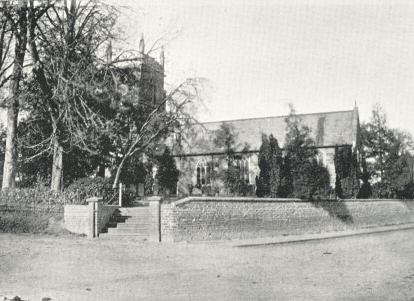
The church, All Saints, is of considerable size, being one of the largest village churches in the neighbourhood, mainly in the Perpendicular style, and substantially built, consisting of tower, nave, and chancel, the two latter of the same elevation throughout. The tower has three old bells, and a peal of eight tubular bells. Gervase Holles gives the inscriptions on the bells as being:
1. Sit nomen Domini benedictum.
2. Intonat e cælis vox campana Michaelis.
3. Sum rosa pulsata Mundi Maria vocata.
One of these was, some years ago, re-cast; and now bears the inscription “voco ad templum, date 1759.”
The main features of the church are as follows: the porch arch is semi-circular, Norman, the west window in the tower is unusually high, 12-ft. by 4-ft. in width, of three lights. The north aisle has four bays. The nave, in the south wall, has two three-light windows, the western one perpendicular and having pointed arch, the eastern square headed. In the north wall there is a three-light debased decorated window. In the west wall of the north aisle is a two-light window of coloured glass, in memory of Augustus Elmhirst; and in its eastern wall is a three-light memorial window to his sister, Mrs. Elizabeth Jane Ruck Keene. In the south wall of the chancel are two late four-centre two-light windows; and in the north wall a three-light flamboyant window. Gervase Holles mentions a north chancel window having “sa. a crosse between 4 cinquefoyles arg. . . .,” [179] but this has disappeared. The east window is modern, with three lights. A new window was erected, in 1907, in the north aisle (corresponding to a window inserted in 1905, in memory of General and Mrs. Elmhirst), by Mr. H. R. Elmhirst, to the memory of his late wife, Lilian Frances, nee Hatfeild; the artists were Powell and Sons; the subject Faith, Hope and Love represented by three figures.
The communion table has a very handsome cover, with red frontal, elaborately embroidered with old Roman work. A carved wooden reredos has recently been presented by Col. and Mrs. Stack. On a tablet on the north wall is an elaborate inscription, in memory of Lieutenant Richard Calthrop, who was killed at the siege of Algiers; erected by his mother and 10 surviving brothers and sisters; who are said to have lived to the remarkable average age of 85 years. There are various tablets commemorative of the families of Rockliffe, Drewry, Pierce and Elmhirst. There is a north door, as well as south, to the nave. The font is a plain octagonal one, perpendicular in style.
The church was restored and reseated in 1873; the tower being renovated in memory of Mrs. Barnard, otherwise known as “Claribel,” a well-known musical composer, connected with the Elmhirst family. It is lofty and massive, surmounted by four high pinnacles and large gurgoyles at the angles.
The register dates from 1561. [180a] The communion plate consists of a cup, with inscription “Ashby Chappell, 1758;” a paten presented by “Elizabeth Pierce, Christmas Day, 1841,” and flagon, given by the same, in 1859. She was the wife of the Vicar of that day, the Rev. W. M. Pierce, and an authoress. In the churchyard are the tombstones of John Thistlewood and his wife; he was brother of the Cato Street conspirator, and died at Louth, having formerly resided at Ashby and Wispington.
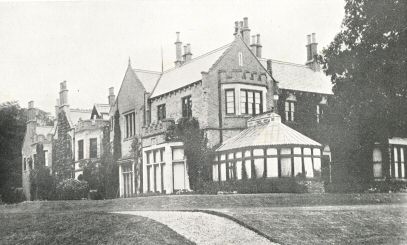
The late William Elmhirst, Esq., bought the lands here formerly belonging to the Bishops of Carlisle, and erected a handsome and substantial residence, in well-wooded grounds; which in later years passed by purchase to the Booth family, by whom it, and the estates attached, are now owned. It is at present occupied by Dr. and Mrs. Newstead. The Elmhirsts are at present represented by H. R. Elmhirst, Esq., son of the late General Charles Elmhirst, C.B., who resides at The Grove.
HIGH TOYNTON.
High Toynton is situated about 1½ miles from Horncastle, in an easterly direction, on the road to Partney and Spilsby. It would seem to have been formerly, like West Ashby, an appendage to the Manor of Horncastle. The old record [180b] says (as already quoted under West Ashby) “The church of Horncastre, and of Askeby, and of Upper Thinton, and of Maringes (Mareham), and of Hinderby, are of the gift of the lord,” i.e. the Lord of the Manor. As thus not being a separate manor, it is barely more than mentioned in Domesday Book, where it is called Todintune, and Tedingtone. Queen Editha, wife of Edward the Confessor, would be Lady of the Manor; but William the Conqueror took possession and held lands here, in demesne, with tenants and dependants.
That the manor afterwards, along with that of Horncastle, became the property of Gerard de Rhodes, is shewn by the following peculiar circumstances. In a Feet of Fines, at Lincoln, 9 Henry III., No. 52, it is recorded that an agreement was arranged in the King’s Court at Westminster, (3 Feb., A.D. 1224–5), between Henry del Ortiay and Sabina his wife, plaintiffs, and Ralph de Rhodes, a descendant of Gerard, defendant, whereby certain lands in Upper Tynton, Mareham, and other places, were recognized by the plaintiffs as the property of Ralph de Rhodes; they receiving, in lieu thereof, 100½ acres of land, and 11 acres of meadow, with appurtenances, all in Upper Tynton. These lands are further specified by name, as 24 acres next Graham (i.e. Greetham), 12 acres in culture called “Hethoten acre” (i.e. Heath of ten acres), 9 acres of land in “Pesewang” (i.e. Peas-field), 5½ acres in “Sex acre,” 7 acres in Leir-mewang (or low mead-field), 4 acres in culture of Lange landes, 6 acres in Whetewang (i.e. wheat-field), and 10 acres in Kruncewang (qy. crown’s-field?); and further plots not specially named. The peculiar feature however of their tenure was, that they and their heirs were “to have and to hold the said lands for ever . . . rendering therefor by the year one pair of gilt spurs, or 6d., at Easter, for all service and exaction.”
A Pipe Roll (14 Henry III., Lincoln) states that “Walter, Bishop of Carlisle, holds certain lands hereditarily of the aforesaid Ralph de Rhodes;” and in a Chancery Inquisition post mortem, 34 Edward III., 2nd Nrs., No. 29 (1360), mention is made of “Thomas, son of Nicholas de Thymelby, and John his younger brother, and their heirs,” as tenants of the Manor of Horncastle, “and of lands in Over Tynton,” which they “hold of the said Bishop.” These were scions of the wealthy family of the Thimblebyies, Lords of Poolham, and other estates. One of them married a daughter and co-heir of Sir William Fflete, Knt.; another married a daughter of Sir Walter Tailboys; this Sir Walter being the son of Henry Tailboys and his wife, Alianora, daughter and heir of Gilbert Burdon and his wife, Elizabeth, sister and heir of Gilbert Umfraville, Earl of Angus.
By a Close Roll, 20 Henry VII. (part 2 [No. 367] No. 33), it appears that Sir Thomas Dymmok, Knight, had recently purchased lands in Over Tynton, Nether Tynton, Maring next Horncastle, and other parishes; which he granted to his son Leo, and his heirs for ever.
Further, by a Chancery Inquisition post mortem, 24 Henry VII., No. 61, it is found that Humphrey Conyngesby, Sergeant at Law, and others instituted a suit on behalf of William Stavely, and others, by which he recovered to them the Manor of (apparently Upper) Taunton, the advowson of the church of Nether Taunton, about 2,700 acres of various land, and the rent of 4½ quarters of salt in Over Taunton, Nether Taunton, Tetford, and other parishes.
The Manor, with that of Horncastle, continued for a long period in the hands of the Bishops of Carlisle; who were patrons of the benefice until the creation of a bishopric of Manchester, in 1848, when their patronage in this neighbourhood was transferred to that See. The Manor, however, with that of Horncastle, had previously passed to Sir Joseph Banks, and came eventually to his successors, the Stanhopes. The benefice, until late years, was a very poor one, being a perpetual curacy, annexed to Mareham-on-the-Hill; their joint annual value being £160, without a residence. But when the episcopal property (the Bishop being Rector) was transferred to the Ecclesiastical Commissioners, they, with the aid of Queen Anne’s Bounty, raised the joint benefices to £300 a year; and in 1869 erected a good residence at Toynton, now occupied by the Vicar, the Rev. W. Shaw.
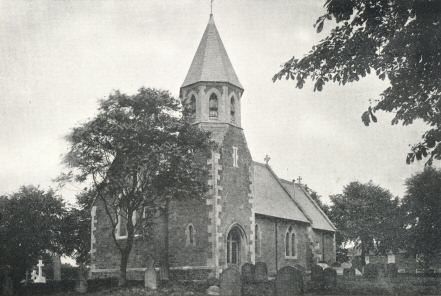
The church, dedicated to St. John the Baptist, was formerly a very mean structure, dating from the 18th century (1772), in the worst of styles, with wooden-framed windows, of large square panes of glass, and having a flat whitewashed ceiling. The timbers of this had become so decayed that a former curate-in-charge, mounting to the false roof, to examine them, fell through, among the square pews below. This incident led, not too soon, to the rebuilding of the fabric, at a cost of more than £1,200 in 1872, on the site of the previous building, as also of an original 13th century edifice. The present church is a substantial and neat structure in the early English style, thoroughly well kept, and with several pleasing features. It consists of nave, chancel, and porch, with tower and low spire. The nave has, in the north wall, two single-light narrow pointed windows, and at its eastern end a two-light window, having a quatrefoil above. In the south wall there is one single-light and one two-light window, corresponding to the above; the porch, taking place of a window at its western end.
The two-light window in the north wall has coloured glass, with various devices, one being a small copy of the famous Descent from the Cross, by Rubens, in Antwerp Cathedral; another the Royal Arms, with the initials V.R. below, and date 1848. The corresponding two-light window in the south wall has coloured glass “In memory of Eliza, wife of the Rev. T. Snead Hughes, late Vicar, she died March 9, 1872, aged 57.” The subjects in the two lights are the Ascension of our Lord, and the three women at the sepulchre, with an angel pointing upward. In the west wall of the nave are two pointed windows beneath a cusped circlet, all filled with coloured glass; the lower subjects being John the Baptist preaching in the wilderness, and the baptism of our Lord by John in the Jordan; the upper subject is the angel appearing to Zachariah; all three having reference to the patron saint of the church. An inscription states that these are a memorial to the late Mark Harrison and his wife Ann, erected by their family.
The font is of stone, octagonal, having four different kinds of crosses on the alternate faces, a circular shaft ending in octagon, and on octagonal pediment. Within the south porch, over the outer and inner doorways are old fragments of massive zigzag pattern, all that remains of a whilom Norman structure. The modern doorway arch, externally, has a dog-tooth moulding, with floriated finials. The tower, over the porch, is square below, octagonal above, with small lancet windows in each face, and is surmounted by a low spire; it contains one bell. The roof and sittings are of pitchpine.
The chancel arch is of massive stone, plain, and of wide span. In the east wall of the chancel are three narrow windows, the central higher than the other two; they have good coloured glass by Clayton and Bell. Beneath is a handsome reredos of Caen stone, erected in memory of the late Mr. Thomas Terrot Taylor. It has one large central device, the Agnus Dei within a circle, and on each side four divisions, containing a dove with olive leaf, Fleur de Lys, ears of corn, a passion flower, vine leaves and grapes, a crown, a rose, and a conventional flower. On each side are memorial tablets of the Ball family. In the south wall is a brass tablet in memory of Mr. Taylor, and a small pointed window. In the north wall is a doorway leading to the vestry. Within the vestry, lighted by a similar small pointed window, are three more Ball tablets, and a priest’s door. In the centre of the nave floor, close to the chancel step, is a large slab “In memory of the Rev. William Robinson, 22 years Incumbent, who died May 8, 1830, aged 56.” The register only dates from 1715, and contains no entries of special interest.
In a List of Institutions to Benefices, preserved at Lincoln, it is shewn that in 1562, on the resignation of the then Vicar, one John Howsone, Michael West, Clerk, was appointed to this vicarage, along with that of Nether Toynton, by Richard Bertie, Esq., the ancestor of the present Earl of Ancaster. This was probably by some private arrangement with the Bishop of Carlisle, as the Berties (as the Willoughbys are now) were patrons of Low Toynton, but not of Upper, or High, Toynton. He was instituted to the two benefices on July 9th of that year.
MAREHAM-ON-THE-HILL.
Of this parish, ecclesiastically annexed to High Toynton, little can be said. The name was anciently written Maringes, [183a] or Marun [183b]; the former probably from the low “marish,” or marsh, “ings,” i.e. meadows, the suffix being the Saxon “ham,” a homestead. It lies about two miles south-east from Horncastle, connected with High Toynton by footpath, and bridle road, across the fields barely a mile in length, but for carriages a detour of more than double that distance has to be made.
This parish, like High Toynton and West Ashby, is in the soke of Horncastle. In Domesday Book it is stated that the manor comprised 3 carucates, or about 360 acres of land, with 21 soc-men and 11 bordars, [183c] who had four carucates, or about 480 acres; there were further 60 acres of meadow, and, what no longer exists, 300 acres of underwood; which was a very large proportion, considering that in Scrivelsby, now a well wooded estate, closely adjoining, there were at that time only six acres of underwood.
Sir Lionel Dymoke, a scion of the Scrivelsby family, once resided in this parish. His will, dated 15th April, 1512, is a good specimen of the orthography of the period. The following are portions of it: “I leon Dymoke of maryng of the hill in the Countie of lincolne knyght being of good and hoole mynde make and ordigne my testament and Last will in forme following | First I bequeathe my soule to almyghty god and to the blessid virgine his mother seint Mary and to all the holy Company of heven | And forasmoch as no man is certeine of the houre of dethe nor what place he shall die in and nothyng so certeine as dethe | and for as moch as I by the kyngℓ pleasure shall goo in hys warrys in the parties by yonde the see | Therefore my body to be buryed where it shall please almyghty god | Also that I will that my Executours for the helth of my soule in as hasty tyme as they may after my deceas paye or do to be paid all and singler my detts . . . Also I bequethe and gyve to the Church warke of Maryng of al halowes vjs viijd and to the highe aulter there for tythes and oblacions forgoten xxd and to seint Jamys gild of maryng xxd . . . Also I gyve and bequethe to the Convent of the black Freris of Boston for a trentall [184a] to be song for me and all Christen Soules xs,” &c., &c. On 17th August, 1519 (when he was apparently on his death bed), witnesses certify that he added a codicil to be annexed, “saying these words in his mother tongue. I will that Sr John Heron knyght have my landes in nethertynton whether I lyve or dye . . . and if my wif or myne executōs thynk there be any thyng expressed in my wille oute of goode ordre I will it be reformed by Anne my wif as she and they thynke most pleasure to god profytt for my soule.” [184b]
As to the owners of the demesne nothing further is told us; but since in Testa de Nevill, already quoted, it is stated that “the churches of Horncastre, Askeby, Upper Thinton, Maringes, &c., are of the gift of the Lord.” Gerard de Rhodes was, doubtless, at one time, the common Lord of all those manors, as well as his descendant Ralph de Rhodes. Mr. Weir states that the manor at a later period belonged to Edward Marsh, Esquire, of Hundle House, in the county of Lincoln; by a descendant of whom it was sold to William Hudson, Esquire, of Gray’s Inn. In 1659 it was sold to one Duncombe, of whom it was purchased in 1688 by Sir Edmund Turnor, of Stoke Rochford, Knight; in whose family it still continues. Other proprietors are Richard Ward, Esq., and Dr. Parkinson.
In Domesday Book there is mention of “a church and priest,” the latter, therefore, being doubtless resident in the parish; although for many years there has been no residence for an incumbent. In 1830 the benefice was held, with High Toynton, by the Rev. E. R. H. G. Palmer, a relative of Viscount Halifax, who resided in Horncastle; in 1863 by the Rev. Isaac Hall, who did the same; and it was not till 1869 that a residence was erected at High Toynton for the united benefices.
Of the church, All Saints, we can only say that it stands in a good position, on high ground; that its walls are substantial, but that its style is of the meanest; it having been rebuilt in the early part of the 19th century (1813); and beyond a piscina, now in the north wall, it has no features of interest; having wooden-framed windows, square painted pews, walls whitewashed within and without, and a flat ceiling. It greatly needs renovation, being now almost a solitary representative, in the neighbourhood, of that very worst period of architectural decadence. With fairly good sandstone in the present walls, and probably more in the foundations of an earlier church, to be exhumed, and an abundance in situ not far away, restoration, or even re-erection, might be effected, at a moderate outlay.
The one bell hangs in a shabby bell turret. While repairs were being carried out in 1813 two nobles of Edward IV., two angels of Henry VII., and several silver coins of different reigns, contained in a leathern purse, were found concealed in the wall. [185a]
LOW TOYNTON.
Low Toynton lies about a mile from Horncastle to the north-east. It is approached through rich meadows, watered by the river Waring. [185b] The Rector is the Rev. J. W. Bayldon, M.A., of Sidney Sussex College, Cambridge. Overseers, G. E. Read and W. Scholey. Letters via Horncastle arrive at 8.30.
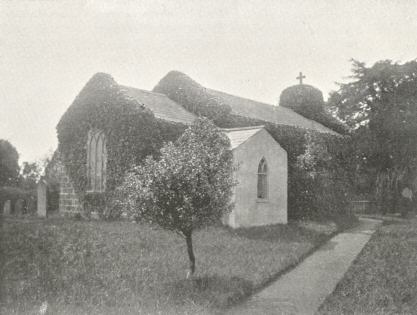
The church, dedicated to St. Peter, is a small structure with no pretention to architectural beauty, and almost entirely covered with ivy. It was rebuilt in 1811, a period when architectural taste was at its lowest ebb, and barbarisms in stone, brick, and mortar were very generally perpetrated. It was re-seated in 1863, during the incumbency of the Rev. E. M. Chapman. It consists of chancel, nave, vestry, and open belfry containing one bell. The chancel arch is the only remnant of a former Norman structure. The font is apparently a 14th century one, almost a replica of that in Huttoft Church, which is engraved in Lincs. Notes & Queries, vol. iii, p. 225. The bowl is octagonal, its faces filled with figures representing the Holy Trinity, the virgin and child, and the 12 apostles. The bowl is joined to the shaft by angelic figures round the lower part of it. The octagonal shaft has figures of St. Paul, Mary Magdalen, a bishop with chalice, another with scourge, and other subjects much mutilated, at the base are the winged lion, ox, man, and eagle, emblematical of the evangelists. The walls of the church are relieved by some coloured designs, and borders of ecclesiastical patterns, running round the windows, &c., originally executed by that genuine artist the late Rev. C. P. Terrot, Vicar of Wispington. These decorations have been recently (1898) renewed by Mr. C. Hensman, of Horncastle, when the church was thoroughly repaired, both inside and out; new panelling placed in the nave, and a new window in the vestry; and in the following year (1899) a new harmonium was purchased from Messrs. Chappell and Co., London.
The east window is filled with modern coloured glass, the subjects being the Transfiguration, the Crucifixion, and the Ascension. On the sill of the east window are placed, over the communion table, two handsomely carved old oak candlesticks, presented by the Rev. C. P. Terrot. On the north wall of the nave there is a small oval brass tablet, which was found in 1888, face downwards in the vestry floor. It bears the following inscription: “Here lyeth the body of Edward Rolleston, Esquir, who departed this life the 23rd of July, in the thirtey-fourth year of his age; interr’d underneath this place the 4th of August, A.D. 1687.” As 12 days elapsed between death and burial it is probable that he died abroad. The manor and whole parish, except the glebe, still belongs to the Rolleston family; the benefice being in the patronage of the Earl of Ancaster.
In the floor of the chancel are two memorial slabs, one of the Rev. R. Spranger, D.C.L., late Rector of Low Toynton and Creeton, who enlarged the rectory house, and was a munificent benefactor to the neighbourhood. Among other good deeds he built the bridge over the river Waring, on the road from Low Toynton to Horncastle. [186] He was a member of a family of some distinction; had a residence in London, as well as his rectory here; he was popularly said to drive the handsomest pair of horses in London; and there exists a portrait in oil of an ancestor, Chancellor Spranger, in one of the great galleries in Florence. Dr. Spranger was an intimate friend of J. Keble, the author of The Christian Year, and his son the Rev. Robert J. Spranger, Fellow of Exeter College, Oxford, spent the greater part of his life in Mr. Keble’s parish, Hursley, Hants, as a voluntary assistant in his clerical work.
The companion slab marks the last resting place of another rector, the Rev. J. Hutchinson, who died in 1788. His history is singular. Although well educated, he enlisted as a private in the army for foreign service; a commission however was subsequently obtained for him by his friends. He presently became attached to a lady who refused to marry a soldier. He then determined to take holy orders. Chance threw him in the way of a party of gentlemen at Manchester, one of them being the agent of Lord Willoughby. The latter stated that he had it in power, at that moment, to bestow a benefice, and that he would give it to anyone who could solve for him a particular problem. Mr. Hutchinson succeeded in doing this, and was eventually appointed Rector of Low Toynton. He held it, however, only 18 months, dying at an early age. Whether he married the lady is not stated.
In the List of Institutions to Benefices, preserved at Lincoln, it is recorded that in 1562 Michael West, Clerk, was appointed Rector of Nether Toynton and Vicar of Upper Toynton, by Richard Bertie, Esq., ancestor of the Earl of Ancaster. This must have been by some private arrangement with the Bishop of Carlisle, who was patron of High Toynton; the Berties (as the Willoughbies are now) being only patrons of Low Toynton. From Liber Regis we learn that the Earl of Lindsey appointed to the benefice in 1692, the Duke of Ancaster in 1778, Sir Peter Burrell and Lady Willoughby d’ Eresby in 1783.
The register dates from 1585. Under date 1717, Feb. 2nd, occurs the following entry: “Robert Willy, of Upper Toynton, did penance in the parish church of Lower Toynton, for the heinous and great sin of adultery.” A note in the baptismal register states that on July 18th, 1818, Bishop George (Tomline) confirmed at Horncastle 683 candidates, among them being five from Low Toynton. Confirmations were not held so frequently then as they now are. In this parish Mr. Thomas Gibson, Vicar of Horncastle, when turned out of his preferment by the Puritans, lived for some “two years but poorly, teaching a few pupils.”
Little is known of the early history of this parish or of its proprietors. In a Chancery Inquisition post mortem, 11 Henry VII., No. 123, taken at Partney, after the death of Isabella, wife of Richard Sapcote, Knight, the said Isabella is declared by the jurors to have died seized of the Manor of Nether Toynton, and of the advowson; and Joan, wife of William Nevill, of Rolleston, Notts., and others are declared to be daughters and heirs of the said Isabella; she herself being kinswoman and heir of William Plesington, son of Henry Plesington, Knight. [187a]
In a list of Lincolnshire names contained in the visitation of 1665–6, by William Dugdale, Esq., are Agnes Goodrick, daughter of Robert Goodrick, of Toynton, and Bridget and Elizabeth Rolston, daughters of Edward Rolston, of Toynton. [187b]
By a Chancery Inquisition of 38 Henry VIII. (1546), it was found that Thomas Dymoke, Esq., was seized of land in Over Toynton, Nether Toynton, Maring-upon the-Hill, and other parishes; and by an Inquisition of 36 Elizabeth, it was found that Robert Dymock, Esq., was seized of the Manors of ffuletby and Belchforde, and lands in Horncastle, Nether Tointon and Upper Tointon, and several other parishes. He died without issue 13th Sept., 1594, and his only sister, Anne, widow of Charles Bolle, of Haugh, succeeded to his property in Nether Toynton and elsewhere; and thus the connection of the Dymokes with Low Toynton ceased. [187c]
There is rather a curious feature in the following record. By a Chancery Inquisition post mortem, 24 Henry VII., No. 61, it is found that Humphrey Conyngsby, Sergeant at Law, and others, instituted a suit on behalf of William Stavely, and others, by which he recovered to them, among other properties, “the advowson of Nether Taunton, and the rent of 4½ quarters of salt, in Nether Taunton, Over Taunton, and other parishes.”
We now find another ancient name connected with this parish. The Newcomens (originally Le Newcomen, or the newcomer) of Saltfleetby, were one of our oldest Lincolnshire families. They are named in Yorke’s “Union of Honour,” and their pedigrees given in four Lincolnshire Visitations. The number of branches into which the race spread is remarkable. [188a] Andrew Newcomen lived in the time of Richard I., resident at Saltfleetby, where the headquarters of the family continued for many generations. Robert Newcomen (1304) married Alice, daughter of Sir William Somercotes, Knight. His son, also Robert, married Margaret, daughter of Sir William Hardingshall, Knight. Another Robert (1452) married Joane, daughter of Robert Craycroft, of Craycroft Hall. A daughter Katharine, of Brian Newcomen, married (1559) George Bolle, of Haugh, a family already mentioned as, a few years later, connected with Low Toynton. In 1540 we find Richard Newcomen residing at Nether Toynton. By his will, dated 3rd Sept., 1540, he requests that he may be buried in the church of St. Peter, Nether Toynton. He appoints the right worshipful Edward Dymoke, supervisor. His grandson, Samuel Newcomen, of Nether Toynton, married Frances, daughter of Thomas Massingberd, of Braytoft Hall, M.P. for Calais (1552). This branch of the family seems to have died out in the person of Thomas Newcomen (1592); [188b] but other branches spread over the neighbourhood, and were established at Bag Enderby, East Kirkby, Withern, and other places, and flourished throughout the 17th century. Another Newcomen early in the 18th century married a daughter of Sir Robert Barkham, Bart.
A renewal of connection with Low Toynton was made when the widow of Nicholas Newcomen married, circa 1700, the Honble. Charles Bertie, son of Robert, 4th Earl of Lindsey, patron of the benefice of Nether Toynton. Arthur Bocher, Esq., of Low Toynton, was in the Lincolnshire Rebellion of 1536, being brother-in-law of Thomas Moygne, one of the leaders in the movement.
Thus the parish of Low Toynton has had residents, proprietors, and rectors, to whom its present inhabitants may look back with some degree of pride and pleasure, although “their place now knoweth them no more.”
ROUGHTON.
This village stands on the west bank of the river Bain, about 4 miles to the south of Horncastle. It is bounded on the north by Thornton and Martin, on the east by Haltham and Dalderby, on the south by Kirkby-on-Bain, and on the west by Kirkstead, Kirkby, and Woodhall. The area is 1020 acres, rateable value £945, population 137, entirely agricultural. The soil is loam, on kimeridge clay, with “Bain terrace” gravel deposits.
The nearest railway stations are at Horncastle and Woodhall Spa, each about four miles distant. There is an award and map of Haltham and Roughton in the parish, and a copy at the County Council office, Lincoln. Three roads meet in the middle of the village, one from Horncastle, one to Woodhall Spa and Kirkstead, one to Kirkby-on-Bain, Coningsby and Tattershall.
Sir Henry Hawley, Bart., of Tumby Lawn, in the adjoining parish of Kirkby, is Lord of the Manor, but Lady Hartwell (daughter of the late Sir Henry Dymoke, the King’s Champion), and the executors of the Clinton family (now Clinton Baker) and the Rector own most of the soil; there being a few small proprietors. Roughton Hall, the property of Lady Hartwell, is occupied by F. G. Hayward, Esq.
The register dates from 1564. Peculiar entries are those of 43 burials for the years 1631–2, including those of the Rector and his two daughters, who died within a few days of each other; this was from the visitation called “The Plague,” or the “Black Death.” For some years before 1657 only civil marriages were valid in law, and Judge Filkin is named in the register as marrying the Rector of Roughton, John Barcroft, to Ann Coulen. In 1707 Mary Would is named as overseer of the parish, it being very unusual at that period for women to hold office. Another entry, in the overseer’s book, needs an explanation. “Simon Grant, for 1 day’s work of bages, 2s. 6d.;” and again, “Simon flint, for 1 day’s work of bages, 2s. 6d.” “Bage” was the turf, cut for burning; in this case being cut from the “church moor,” for the church fire. It was severe labour, often producing rupture of the labourer’s body, hence the high pay.
There is a charity named the “Chamerlayne Dole,” of 10s., given yearly to the poor, left by Martha Chamerlayn in 1702. It is a charge upon a cottage and garden owned by Mr. T. Jackson, of Horncastle.
The National School was established about 1860, in a building erected in 1834 as a Wesleyan Chapel. It was enlarged in 1872 and 1879. It is supported by a voluntary rate.
The Church, St. Margaret’s, is of no architectural beauty, being built of brick and sandstone. It consists of nave and chancel, with castellated tower, having one bell, also castellated parapets at the north and south corners of the east chancel wall. The font is Norman, circular, with circular pediment, having an old oak octagonal cover, cupola shaped, plain except slight carving round the rim. The fabric was newly roofed in 1870, when it was fitted with good open benches, the chancel paved with encaustic tiles, and the windows partly filled with stained glass; there are fragments of a former carved rood screen, the pulpit being of plain old oak.
In the chancel is a lengthy inscription, commemorative of Norreys Fynes; Esq., of Whitehall, in the adjoining parish of Martin. He was grandson of Sir Henry Clinton, eldest son of Henry, Earl of Lincoln, by his second wife, daughter of Sir Richard Morrison, and mother of Francis, Lord Norreys, afterwards Earl of Berkshire. He was a non-juror. He died January 10th, 1735–6, aged 74. There is a murial tablet to the memory of the Rev. Arthur Rockliffe, who died in 1798; another to Charles Pilkington, Esq., who died in 1798, and Abigail, his wife, who died in 1817.
The benefice is a discharged rectory, united to that of Haltham in 1741, and now held by the Rev. H. Spurrier, the patron being his son the Rev. H. C. M. Spurrier. The two benefices together are valued at £450 a year. There is a good rectory house. The church plate is modern. The village feast was discontinued about 50 years ago.
Peculiar field names are the Low Ings, Bottom Slabs, Carr Bottom, Church Moor, Honey Hole, Wong, Well-syke, Long Sand, Madam Clay, Sewer Close. [190a]
As to the early history of Roughton, Domesday Book gives it among the possessions of William the Conqueror, and also as belonging to Robert Despenser, his powerful steward, who probably held it under the king. A Chancery Inquisition post mortem, 22 Richard II., No. 13, A.D. 1399, shows that Ralph de Cromwell, jointly with his wife Matilda, held the adjoining Manor of Tumby, with appurtenances in Roughton and elsewhere. While another Inquisition of 13 Henry VII., No. 34, shows that the said Matilda died, “seised in fee tail of the same lands.” [190b]
In the reign of Elizabeth a family of Eastwoods resided here, since the name of Andrew Eastwood, of Roughton, appears in the list (published by T. C. Noble) of those gentry who contributed £25 to the Armada Fund. Other documents shew that at different periods the hall has been occupied by members of various county families, as Fynes (already named), Wichcote, Heneage, Dymoke, Pilkington, and Beaumont.
The register has the following entries, probably written by an illiterate parish clerk, “An the wife of Will. Hennag, was buered ye 9 of Feberery, 1729.” “Madame Elizabeth fines was buered May ye 29, 1730.”
Gervase Holles gives the following arms as existing in the church in his day.
Fenestra Australis Cancelli.
G. 3 lyons passant gardant, or . . . England
Verry a fesse G. fretty, or . . . Marmyon
Argent, a plaine crosse B. . . .
Or, a lyon rampant purpure. . . . Lacy
Chequy or and G., a chiefe ermyne . . . Tateshall
In Campanili.
Arg. a sword sheathed proper, a buckler appt., with girdle wrapped, hilte pomel, and neuf or. . . [190c]
HALTHAM.
This village is distant from Horncastle between four and five miles in a southerly direction, lying on the east side of the river Bain. It is bounded on the north by Dalderby and Scrivelsby, on the south by Kirkby and its hamlet of Fulsby, on the east by Scrivelsby, Wood Enderby and Wilksby, and on the west by Roughton. The area is 2380 acres, rateable value £1198. The soil is loam, with kimeridge clay below, and gravel deposits. Population 121, mainly agricultural.
The main roads lead to Dalderby, Scrivelsby, and Horncastle, to Kirkby, Mareham-le-Fen, Coningsby, and Tattershall, and to Wood Enderby, Wilksby, and Revesby. The nearest railway station is at Horncastle.
The Lord of the Manor was formerly the Champion Dymoke of Scrivelsby Court, but the late Rev. John Dymoke sold his estate in this parish, and the manor is now the property of Sir H. M. Hawley, Bart., of Tumby Lawn, in the adjoining parish of Kirkby; W. H. Trafford, Esq., owning the remainder, except 150 acres of glebe.
The benefice was united to that of Roughton in 1741, the two being now of the yearly value of £450, and held by the Rev. H. Spurrier. The patron is the rector’s eldest son, the Rev. H. C. M. Spurrier. There is an award and map of Haltham and Roughton, of date 1775. A village feast is held on St. Benedict’s Day (March 21), he being the patron saint of the church.
There are some peculiar field names; as the Far, Middle, and Near Redlands, arable; the Top and Lower Brock-holes (brock meaning a badger), arable; the Black Sands, pasture; the Top and Low Malingars, arable; the East, West, and South High Rimes, arable; the Pingle, meadow; the Croft, pasture; the Oaks, pasture; Wood Close Meadow, the Old Cow Pasture.
The register dates from 1561, and contains an entry for the year 1684: “This yeare plague in Haltham.” [191] There is a charity, the interest of £5, left by John Dymoke, Esq., of Haltham, who in 1634 is named among the Heralds’ List of Gentry, for yearly distribution by the overseers among the poor. The children attend the school at Roughton.
The church is one of the most interesting in the neighbourhood. The chancel was restored and an open roof put up in 1881, at a cost of £250. The nave was restored in 1891, at a cost of £300. The sanctuary was paved with Minton tiles by the late Lady Dymoke. The most remarkable feature is a semi-circular tympanum over the door in the south porch, which is of early Norman, or possibly Saxon date. It has sculptured on it in somewhat rude fashion a Maltese cross within a circle, a second circle running through the limbs of the cross, a square with three-quarter circles at its corners, and semicircles midway of each side, which form the extremities of another cross, and between the limbs are roundels. Below is a figure resembling a fish, also four rows of triangles, and other complicated devices. The east window is a very fine flamboyant one, of date about 1350. Some of the sittings have very old rudely-carved poppy heads of oak. There are very fine carved oak canopies over two long pews in the north aisle, for the Champion Dymokes and their servants. There is a piscina with two fronts in the south wall of the chancel, and a series of three stone sedilia, in the north wall is an aumbrey. There is an incised slab to one of the Dymokes. The tower has three bells, and the bell chamber is closed by ancient boarding, on which are the ten commandments in old characters, and very curious Royal Arms of Charles I. The church plate consists of pewter paten, silver flagon and chalice, with date 1764, given by Mr. John Dickinson.
In the village there is an old hostel, partly of the Tudor style, with pointed gable ends, projecting upper storey, and constructed externally of brick and woodwork.
As to the early history of this parish little is definitely known. According to Domesday Book it was among the possessions of the Conqueror, and his steward, Robert Dispenser, held it under him. Probably like other parishes in the soke of Horncastle, the manor was held by Gerbald d’ Escald, his grandson Gerard de Rhodes, his son Ralph de Rhodes, sold by him to the Bishop of Carlisle, &c. Of the ownership of Ralph de Rhodes we have evidence in a Feet of Fines, Lincoln, 9 Henry III., No. 52, containing an agreement between Henry del Ortiary and Sabina his wife, on the one hand, and Ralph de Rhodes, on the other hand, in which the former parties recognise the right of the said Ralph to certain lands in Haltham, Wood Enderby, Moorby, and other parishes in the soke. [192a]
Of other families of distinction once connected with this parish we have indications in the arms which Gervase Holles found in the church windows in his time (circa 1630, temp. Chas. I.), which we give here.
In Fenestris Cancelli.
Verry a fesse G. fretty, d’or . . . Marmyon
G. a cross sarcely, arg. . . . Beke
Sa. 2 lyons passant, arg. crowned, or . . . Dymoke
Or, a lyon rampant, double queue, sa . . . Welles
Sa. 3 flowres de lize betw. 6 crosse crosslets, fitchy, arg. . . .
G. 3 bars ermyne . . . Kirketon
Barry of 6, or and sa. . . .
Fenestræ Boreales.
B. a lyon’s head erased betw. 6 crosses, botony, arg. . . . Touthby
Arg. 2 bars G. a border, sa. . . .
Dymoke, each lyon charged sur l’ espale with an annulet . . . Dymoke
Ermyne on a bend G. a cinquefoil, or . . .
G. crosse crucilly fitchy, a lyon rampant, arg . . . La Warre
Or, a lyon rampant, double queue, sa. . . . Welles
Fenestræ Australes.
G. 3 water-bougets, arg. . . . Ros
Or on fesse G. 3 plates . . . Huntingfield
Quarterly or and G. a border sa. bezanty . . . Rochfort
Rochfort with a garbe in the 2nd quarter, arg. . . . Rochfort
Rochfort with an annulet in the 2nd quarter, arg. . . . Rochfort
Or, a manche G. . . . Hastings
G. a bend ermyne . . . Ry
Rochfort with an eagle displayed in the 2nd quarter, arg. . . . Rochfort
Arg. fretty of 6 pieces G. a canton ermyne . . .
In Fenestra Borealis Navis.
G. crosse crucilly fitchy, a lyon rampant, arg. . . . La Warre
Arg. on a bend, G. 3 gryphons heads erased, or . . .
In Campanili.
Joh’es Staines W. Jo. [192b]
MAREHAM-LE-FEN.
Mareham-le-Fen lies about six miles south from Horncastle, and five miles eastward of Tattershall station, with a population of more than 800. Letters via Boston arrive by mail cart at 7.30 a.m. This is the seat of a considerable industry, carried on by Mr. Titus Kime, as a grower of greatly improved varities of potatoes, agricultural seed, and, latterly on a large scale, of bulbs of different kinds, in which he seems likely to compete with the Dutch trade.
The church, which is dedicated to St. Helen, is a fine structure of oolite stone, probably one of the largest in the neighbourhood, except the collegiate church of Tattershall. It consists of tower, nave, north and south aisles, south porch and chancel. The body of the church was restored in 1873, and re-opened on June 13th of that year, at a cost of more than £2,000, by J. Banks Stanhope, Esq., Lord of the Manor; the then rector, the Rev. W. Sharpe restoring the chancel, and the parishioners and other friends the tower. The latter consists of three tiers, having a small square window in the south and north walls below, with a two-light floriated window on the west. In the tier above are two-light windows on all four faces. At the summit it has battlements and four tall pinnacles. There are three bells, the date of the largest being 1627. The body of the church is also battlemented, and has pinnacles, the westernmost of these having the figures, within a niche, of St. George and the dragon.
The south porch has an early English doorway within, the outer one being modern. In the moulding above the inner doorway is a curiously crowned head, probably representing the Empress Helena, the patron saint; other curious devices running down the moulding on each side. To the right of the inner doorway are initials M.S., date 1681. The font has a large octagonal bowl, with heads at the angles, and elaborate trefoil devices on the faces; the shaft is plain, octagonal, the pediment a stone cross.
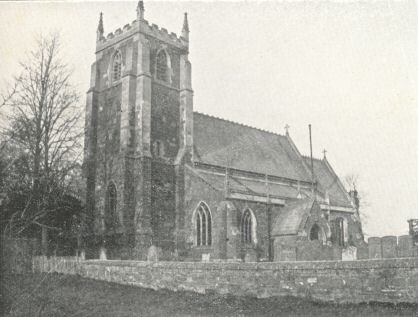
Both aisles have four lofty bays, with early English columns. In the north aisle is one three-light perpendicular trefoiled window, in its western wall; in the north wall, on each side of the north door, is a three-light perpendicular window, with mullions interlacing; and to the east a four-light round-headed trefoiled window. Over the north door is a tablet, with a Latin inscription, commemorative of the Rev. H. Sheppard, a former rector, who died 24th Jan., 1764, aged 62. Beneath it is a cherub with outspread wings. In the wall, east of the north door, is a tablet bearing the inscription: “This church was relighted in memory of Francis Thorpe, who lost his life, by an accident, while working in the church near this spot, 22nd Sept., 1892.” The south aisle, at the west end, has a three-light broad interlaced window. In the south wall, west of the porch, is a low doorway, now filled in, with step at its base, probably formerly leading to a parvis, or priest’s chamber. East of the porch are two round-headed three-light trefoiled perpendicular windows. In the chancel the east window, of coloured glass, is lofty, with three lights, and six trefoils above. The subjects are divided into upper and lower rows; the upper are the Ascension in the centre, with the Resurrection to the left, and to the right the disciples grouped round the virgin; the lower are the Crucifixion in the centre, Christ bearing His cross to the left, and the entombment to the right. This window was by Lavers, Barrand and Westlake; it was given in memory of the late Mr. Joseph Corbett, by his son, C. J. Corbett, Architect, of Imber Court, Surrey.
The reredos has three compartments; the central device is a cross, with rays of glory, and the monogram I.H.S.; on the right and left are doubly pointed, crocheted, arches; the device in the northernmost being a crown of thorns, with the three nails, surrounded by a circle; next to it three interlaced circles; on the south side interlaced triangles, and a plain cross. The east wall, up to the height of the reredos, is faced with alabaster.
In the south wall of the chancel is a wide stone seat, and above it a two-light trefoiled window. In the north chancel wall is a trefoiled credence table. There is a tablet to the memory of William Goodenough, formerly rector, Archdeacon of Carlisle (the benefice formerly being in the patronage of the Bishops of Carlisle), who died 13th Dec., 1854; and commemorating his wife Mary Anne, daughter of Dr. Samuel Goodenough, Bishop of Carlisle; she dying 3rd Jan., 1847, aged 75. The memorial was erected by their only surviving child, Mrs. Hawkins.
The choir sittings are of carved modern oak; the pulpit is also of the same, on a stone base, and the lectern. The chancel arch is lofty, the modern side columns having richly carved capitals. Some of the stones of the original arch were found built into the chimney of a cottage near at hand. The sittings in the nave, and the roof timbers, are of pitch pine. The base of the tower forms a roomy vestry.
In the churchyard is the lower part of the shaft of a cross, standing on an octagonal base. Opposite the east end of the south aisle is a tombstone in memory of James Roberts, “who sailed round the world in company with Sir Joseph Banks, in the years 1768–71, on board H.M.S. the Endeavour, Lieut. James Cook, Commander,” attending him “also on other voyages.” [194a] The tomb of Archdeacon Goodenough is on the north-east side of the church. Within a few feet of the south buttress of the tower is a fragment of an old tombstone, shewing part of a foliated cross on both sides, and the monogram I.H.S., in old characters, probably Saxon; Mareham being one of the 222 parishes in the county which had a church in Saxon times [194b]
Gervase Holles (temp. Chas. I.) gives the following arms and inscriptions, as existing in the church in his time. In the east window:
Empaled Arg’ a crosse sa. Arg. on a crosse G. a bezant. Arg, a crosse sa.
Empaled Quarterly arg. and G., on the 1st and 4th quarters a popinjay vert. membred and beked G.
In the western window on the left of the tower:
Orate pro a’ia Joh’is Tott, Agnet, et Helene, uxorum ejus, & specialiter pro Andrea Tott, Artium Baccalaureo, qui istam fenestram lapidari, necnon vitreari fecit.
Over the buttress, on the east side:
Quarterly Ufford and Beke . . . Willoughby
3 crosses portate . . .
2 chevrons between 3 roses . . .
A crosse . . .
A lyon passant . . .
“Domus mea domus orationis vocabitur, 1591.” [195a]
The register dates from 1558. An entry records that on 22nd Nov., 1685, a “Briefe was read and published, for Saresden in Oxfordshire, for loss valued at £1,449. Granted June 14th, 1686.” Another entry, under date 23rd Nov., 1685, is as follows: “Thomas Eresby of Revvesby maketh oath yt Theodosie, his daughter, who was buried in the churchyard upon Sunday last, was wound and wrapped up in woollen only, according to the late Act of Parliament, in yt case made.” In explanation of this it may be stated that in 1677 British and Irish woollens were prohibited in France, which injured the woollen trade very much; and in the next year (1678) in order to encourage the trade at home, it was enacted by 29 Charles II., c. 3, that all persons, except those who died of the plague, should be buried in wool, under a penalty of £5. [195b] Another entry states that a collection was made, the amount not known, to afford relief, after the great fire in London, Sept., 1666.
The rectory, adjoining the church, stands in a large, well wooded garden. It is a good substantial residence, rebuilt by Archdeacon Goodenough in 1818–19, and much improved in 1855. In the entrance hall are two old prints of the church and rectory before their restoration, dated 1785. They were presented to the late rector, Rev. W. Sharpe, by Alfred Cobbett, Esq., and they are preserved as heirlooms by the rectors for the time being. The Rev. F. J. Williamson is the present rector, late of Lydgate. The Bishop of Manchester is patron of the benefice; the patronage of this, and several other benefices in this neighbourhood, formerly held by the Bishops of Carlisle, being transferred to the See of Manchester some years after its creation, in 1848.
The national school, built in 1840, is endowed with nearly an acre of land, given by Archdeacon Goodenough; it was considerably enlarged by J. Banks Stanhope, Esq., in 1877. Some of the inhabitants are entitled to the benefits of the almshouses at Revesby. There is a navigable drain from the Witham, passing near the village, affording communication with New Bolingbroke and Boston. A former part of the parish is now included in the district of Wildmoor Fen.
In Liber Regis this parish is named “Marrow, alias Marym, alias Mareham in le Fen.” It is called in Domesday Book Meringe (or the sea-ing, i.e. sea-meadow). Another form was Marum; the Revesby Charters, Nos. 47 and 48, mention a piece of land, near the boundary of Marum, called “Mare Furlong,” and the grass (Psamma arenaria) which now grows on the sea banks is commonly called Marrum grass. All these names probably refer to the marish (Latin, mariscum), or marsh, character of the locality, caused by its proximity to the sea (le mer), which then came much nearer than it does now, and frequently flooded the land.
The manor was given by the Conqueror to the powerful Norman, Robert Despenser, who, as his name implies, was the King’s High Steward. He was the ancestor of the Despensers, Earls of Gloucester, and he held 15 manors in Lincolnshire alone, besides 17 in Leicestershire, and several in other counties. Much of the land of this parish was at a later period given to Revesby Abbey, and at the dissolution of the monasteries some of this was granted by Henry VIII, to Charles Brandon, Duke of Suffolk. [196a] In later times it became, by purchase, the property of Mr. Joseph Banks, M.P. for Grimsby, born in 1681, and eventually came to his distinguished descendant, Sir Joseph Banks; and on his death some of the Mareham land passed to the ancestors of the present Sir Henry M. Hawley. Other proprietors are now Major Gape, Messrs. J. R. Chapman, Joseph Lake, and other smaller owners.
Among the Lincolnshire gentry called upon (with the Massingberds, Heneages, and many others) to furnish “launces and light horse,” in the 16th century, when the Spanish armada was expected, was one “John May of Mairing,” who failed to present himself at the muster in 1584, but in 1586 supplied “one light horse.” [196b]
In Notes on Low Toynton mention is made of the old family of Newcomen, originally “of Salaby,” i.e. Saltfleetby, where many generations of them were buried, from the time of Richard I. They married into influential and titled families, in various parts of the county. Charles Newcomen lived at Hagnaby in 1634, and bought land in Revesby. A Newcomen lived in Mareham in the 17th century. They were connected, by marriage, with the family of Sir Joseph Banks, as Mr. Banks, grandfather of Sir Joseph, had a house in Lincoln, the adjoining one being occupied by Newcomen Wallis, Esq., and Mr. Banks married Catherine the widow of Mr. Wallis (see the Banks monument in Revesby church, north aisle), whose mother was daughter and co-heir of Nicholas Newcomen, Esq. [196c]
We here give a few old records in connection with this parish in the past. The Court Roll of Mareham-le-Fen (preserved among the documents of the Listers of Burwell) for 2 Elizabeth, shows that, at that date (A.D. 1559), Thomas Glenham, Esq. (variously written Glemham), had the Manor of Mareham. In the 23rd Elizabeth it is recorded that Charles Glenham, Esq., by his lawful attorney, Francis Colby, of Glenham Parva, Esq., granted leases for seven years to divers tenants in Mareham. Thomas owned also the Manors of Calceby, Belchford, Oxcomb, and Burwell; these he sold to Sir Matthew Lister, afterwards of Burwell. He married Amye, daughter of Sir Henry Parker. [196d]
In a suit, instituted 29th May, 1239, between William de Bavent, plaintiff, and Walter, Bishop of Carlisle, defendant, regarding the advowson of the church of “Merum,” the said William “quit claimed” all his right to the said advowson, to the bishop and his heirs for ever; and in return for this the bishop gave him 10 marks. In the old record, Testa de Nevill, folio 556 (circa 1326), Walter de Bavent held certain lands in Marum, “by service of falconry,” i.e. by providing yearly, in lieu of rent, one “gay goss-hawk,” or more, for the use of the Lord of the Manor. [196e]
Robert de Weston, Rector of Marum, by his will, dated 3rd March, 1389, requested that he might be buried in Marum Church. He bequeathed to the Mendicant Friars of Boston 6s. 8d. “to remember me in their masses,” to Lady Margaret Hawteyn, Nun of Ormsby, 10s.; to Trinity College, Cambridge, a book called “Johannes in Collectario,” to every fellow there 2s., and every scholar 1s. Among other bequests are to Mgr. Eudo la Zouch “12 cocliaria nova de argento” (i.e. 12 new spoons of silver); to “John Geune my clerk a missal of the new use of sarum”, and “masses for souls of Walter ffelsted, William Stel, and James de Medringham. Executors, Eudo la Zouch, John ffoston my chaplin, &c., the residue of my goods to be sold, as quickly as possible, communi pretio, so that the purchasers may be bound to pray for my soul.”