HENRY III. 1216–1272.
Reading edition
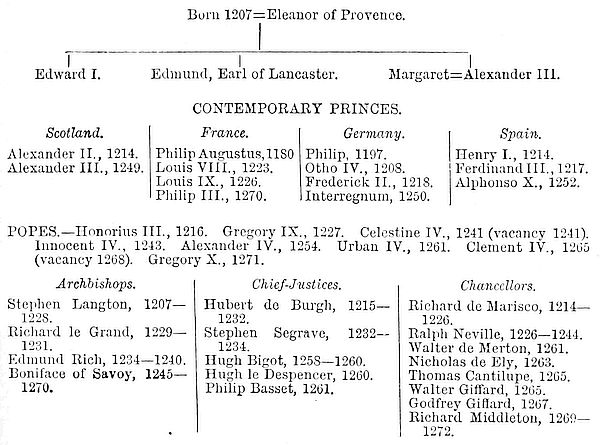
Born 1207 = Eleanor of Provence. | +-------------------+---+-------------------+ | | | Edward I. Edmund, Earl of Lancaster. Margaret = Alexander III. CONTEMPORARY PRINCES. _Scotland._ | _France._ | _Germany._ | _Spain._ | | | Alexander II., | Philip Augustus, | Philip, 1197. | Henry I., 1214. 1214. | 1180. | Otho IV., 1208. | Ferdinand III., Alexander III., | Louis VIII., 1223. | Frederick II., | 1217. 1249. | Louis IX., 1226. | 1218. | Alphonso X., | Philip III., 1270. | Interregnum, | 1252. | | 1250. | POPES.--Honorius III., 1216. Gregory IX., 1227. Celestine IV., 1241 (vacancy 1241). Innocent IV., 1243. Alexander IV., 1254. Urban IV., 1261. Clement IV., 1265 (vacancy 1268). Gregory X., 1271. _Archbishops._ | _Chief-Justices._ | _Chancellors._ | | Stephen Langton, | Hubert de Burgh, | Richard de Marisco, 1207–1228. | 1215–1232. | 1214–1226. Richard le Grand, | Stephen Segrave, | Ralph Neville, 1229–1231. | 1232–1234. | 1226–1244. Edmund Rich, | Hugh Bigot, | Walter de Merton, 1261. 1234–1240. | 1258–1260. | Nicholas de Ely, 1263. Boniface of Savoy, | Hugh le Despencer, | Thomas Cantilupe, 1265. 1245–1270. | 1260. | Walter Giffard, 1265. | Philip Basset, 1261. | Godfrey Giffard, 1267. | Richard Middleton, | 1269–1272.
Difficulties at Henry’s accession. Pembroke’s conciliatory measures. Fair of Lincoln. Louis leaves England.
Immediately upon the death of John, William Marshall, Earl of Pembroke, and Gualo, the Papal Legate, the leaders of John’s faithful followers, declared Prince Henry king. It was a moment of extreme danger. The Scotch had advanced as far as Carlisle, the Welsh were harassing the Marches, the East and South of England were in the hands of Louis and the revolted barons, the court could with difficulty uphold its influence in the West. But Marshall was a man of tried experience, of trustworthy character, and, though a firm adherent of the crown, no friend to tyranny. The presence of the French prince in England shocked all national prejudices. Pembroke set on foot a policy of conciliation, and attempted to unite all parties against the foreigner. He at once separated the cause of the young Henry from that of his father by accepting the Charter. He wrote friendly letters to the leaders of the revolted barons, and found assistance in the ecclesiastical weapons wielded by Gualo. One by one the insurgents, feeling themselves sure of constitutional treatment at the hands of Pembroke, joined the royal party. Pembroke found himself strong enough to risk a battle. Louis had received reinforcements, and with the insurgent nobles who still upheld his cause marched to Lincoln, where, though the town was in his possession, the castle still held out for the English king. Thither Pembroke betook himself, determined to bring on a decisive engagement. Gaining access to the town through the castle, his troops fell upon the French in the streets, and completely routed them, capturing nearly all the English leaders. London and its neighbourhood alone remained to Louis, and when a great French fleet, under Eustace the Monk, which was bringing him assistance, was completely defeated by Hubert de Burgh and D’Albiney, Louis felt that his cause was lost, and consented to treat. The English, who only wanted to get rid of him, granted easy terms, including the freedom of most of their prisoners. They even advanced 10,000 marks towards defraying the heavy fine which Gualo on the part of the Church demanded as an expiation for disobedience to the Roman See, and Louis was escorted with all honour to the sea coast, and retired.
With Louis the great obstacle to the settlement of the country was gone. Pembroke continued to act in a conciliatory spirit. A pardon was issued, including all political offenders; peace with Scotland was secured; and the Charter, together with the charter of the forests, was again signed. It underwent, however, some changes. The King was no longer acting under coercion; restrictions which Pembroke considered inexpedient were therefore removed. His object appears to have been to reproduce as far as possible the state of things existing in the reign of Henry II. The destruction of castles erected during the late reign was therefore ordered, and the clause of the Charter forbidding the levy of scutage without the consent of the barons omitted. The reconciliation thus effected was in fact the triumph of the crown; the offices were filled with adherents of John. But in the hands of Pembroke the regained power of the crown would have been constitutionally employed.
Papal attempt to govern by legates.
Pandulf’s government.
His fall.
His death opened the door to a strange attempt on the part of the Papal See. The influence of Gualo, the Papal Legate, had been great. It had been so because John’s resignation of his crown was regarded at Rome as no vain formality, but as a real cession. But Gualo, a man of somewhat weak character, was no match for Pembroke, and was unfitted to make good the authority which Rome was inclined to claim. He was recalled, and a much more energetic legate appointed in the person of Pandulf, now Bishop elect of Norwich. His appointment represents an effort on the part of Rome to govern England as a conquered province by means of its legates. The natural governor of England during the minority of the sovereign was the great justiciary Hubert de Burgh. But Pandulf assumed authority over him, and his letters amply prove how overbearingly he used it. His government was at first successful. The dangers of a French invasion were averted by a renewal for four years of the Peace of Chinon. The friendship of Scotland was secured by the marriage of Henry’s sister Jane with the Scotch king. A splendid coronation, and an ostentatious ceremonial at the removal of Becket’s bones to the Cathedral of Canterbury, seemed to show the restored grandeur both of King and Church; while a Bull from Pope Honorius commanded the restoration of the royal castles, which the poverty of the King had, in many instances, obliged him to pledge to their governors. But Pandulf’s conduct was too overbearing to be endured. Langton, as the head of the English Church, and therefore no friend to the immediate government of Rome, tried to curb him by demanding his obedience as one of his suffragan bishops. The Pope declared him free from this obedience so long as his consecration to the See of Norwich was uncompleted. Langton finally betook himself to Rome, and there, by what means we know not, succeeded in obtaining an order for his recall, accompanied by a promise that no resident legate should be appointed in England during his own lifetime.
Triumph of national part under Herbert de Burgh.
Hubert de Burgh at once took his proper position as regent, supported by the national Church; and the attempt at immediate rule from Rome may be said to have failed, though throughout the reign England was regarded as in a special manner a fief of the Papal See, and, as Pope Innocent IV. said afterwards, “a well of wealth from which Rome might draw unlimitedly.” For eight years Hubert ruled England well. He was unduly grasping of money, he was occasionally arbitrary, but on the whole his government was directed to the honest support of the Great Charter, and the destruction of that foreign influence under which England was suffering.
Parties in England.
Opposition barons at Leicester. 1223.
Resumption of royal castles.
Destruction of Faukes de Breauté. 1224.
The centre of this influence was Peter des Roches, who had the care of the King’s person. These two ministers, Hubert and Peter, were the representatives of the different sides of that quarrel which gives its tone to the whole reign. The characteristic feature of the period is the growth of national feeling. This feeling had been outraged by John by the introduction of foreign favourites. The claims of the Pope on England, the tyranny which he exercised on the national Church, and the constant bestowal of English livings upon foreigners, had a similar effect in shocking the feelings of the clergy. Thus while the Pope and King appear throughout the reign as the favourers of foreigners, the national party both in State and Church were closely connected. As yet, indeed, the King was too young for such a part; the representative of the foreign party was Des Roches. Round him gathered themselves all classes of malcontents, consisting chiefly of those foreign mercenaries whom John had raised to power, and who were occupying the royal castles, of Llewellyn of Wales in close connection with them, and of the nobles of Ireland. Des Roches’ influence at Rome secured for this party on most points the support of the Pope. For two years they were constantly thwarting the government of De Burgh. The necessities of the government had obliged him to be severe in the collection of money; but there was some slight colouring for the charge of undue severity which was laid against him. An uproar in London, headed by Constantine Fitz-Alulf, an old partisan of the French invaders, had been followed by the summary execution of that demagogue. Attacks both in Wales and in Ireland upon the property of William Marshall, who was thoroughly English in his views, were the first signs of the coming storm. A Bull which De Burgh obtained from Honorius declaring the King of age, and demanding the restitution of the castles, brought matters to a crisis. Under this provocation the barons and Peter des Roches proceeded to action. An attack on London was planned, but failed. But the discontented nobles openly appeared before the King; and Peter des Roches formally charged Hubert with treason, and demanded his dismissal. Led by the Earl of Chester, they retired, and kept Christmas with great pomp at Leicester. The Justiciary and the King determined to hold a rival meeting at Northampton. The royal appeal for help was warmly answered. The force collected at Northampton was too strong for the malcontents. Excommunication issued against them by Stephen Langton completed their discomfiture. They separated and obtained peace as a price of the surrender of the castles. There was one exception, Faukes de Breauté, who contrived to retain his strongholds. This man, a mercenary of John, had risen to be the sheriff of six counties, the governor of several castles, and a Baron of the Exchequer. Hubert determined to complete his victory by destroying him. His opportunity occurred, when Faukes’ brother William laid hands on the travelling justice Henry Braibroc and imprisoned him at Bedford. With extreme rapidity De Burgh marched against him and captured Bedford. Faukes fled to join his former comrades; but it was in vain that both Chester and Peter des Roches, now at one with the Justiciary, petitioned in his favour, De Burgh remained unmoved, and De Breauté was stripped of all his offices, and condemned to perpetual exile. He betook himself to Rome, where he managed to obtain the ear of the Court, and still further increased the difficulties of the English government.
Danger from France. Death of Phillip.
English neglect the opportunity.
Poitou remains French.
Although he had thus worsted his domestic enemies the Justiciary was surrounded with difficulties. Philip Augustus had died in 1223, and had been succeeded by his son Louis VIII., the old enemy of England. He had begun his reign with a threat of renewed war, to which the disturbed state of Poitou and Guienne afforded a constant opportunity. In those countries there was a succession of unceasing disputes between town and town and noble and noble; the country roughly forming itself into two parties, the towns and the nobles. In 1224, war had in fact broken out. Henry had sought the friendship of the German Emperor Frederick against France, and connected himself with Peter Duke of Brittany, and when Louis appeared at the head of a great army, nominally for a war against the Albigenses, it seemed probable that its real aim was the English provinces. Louis’ unexpected death changed the state of affairs. The new king was a child in the hands of his mother Blanche, and the French nobles took the opportunity to loosen the connection between themselves and the crown which Philip II. had established, and thus destroyed for the present the possibility of united national action. But although, on the first slackening of authority, all Poitou passed into the English hands, the chance of forming a united opposition among the discontented French nobles was allowed to pass unused. One by one even the old allies of the English returned to their allegiance to France. At length, Richard, the King’s brother, who had the title of Count of Poitou, and had commanded his army, joined in the general pacification.
Hubert’s continued power.
It was the financial difficulties of the government which had chiefly prevented the success of this war. The opposition to Hubert de Burgh was constant, and it had only been upon condition of again signing the Charter that the King had been able to raise a fifteenth for the French war. This tax was probably the first raised in strict accordance with the terms of the Charter. De Burgh was honestly desirous, in opposition to the arbitrary views of his rival Des Roches, that the King should rule constitutionally, and both by proclamation and by official letters he took care to spread a knowledge of the Charter in the country. Although Henry was declared of age in 1227, when he was twenty, the government of De Burgh practically continued. He was made Earl of Kent, and declared Justiciary for life; and his victory was completed by the absence of Peter des Roches, who thought it better to withdraw for a time to the Crusades. His rule was not very popular among the nobles: not only was he naturally disliked by the chiefs of the adverse party, he even quarrelled with Richard, the King’s brother, and with William Marshall. Such an act indeed as the following could scarcely have failed to make him enemies. An inquisition was issued to examine into the title deeds[35] of all tenants in chief, who were obliged to make good their titles by large payments. The sum derived from this inquiry amounted to £100,000.
Langton supports his policy.
Change of Popes: increased exactions.
The support which the Justiciary invariably received from Langton bears witness to the national character of his government. The Archbishop’s efforts to free the Church from its foreign slavery were perhaps even more laborious than those of the Justiciary. Already the system which reached such excesses afterwards had been established. Gualo and Pandulf had been but single instances of a number of Roman officials who had grown rich on gifts of English benefices; and now the Roman Court determined, under the pretext of raising money for the Crusade, to demand both in France and England two benefices in each diocese and each abbey for the exclusive use of Rome. In neither country was the demand allowed. Otho, a Papal legate, held a council in 1226 at Westminster, and brought forward the demand. The clergy would probably have had to yield, had not the Archbishop, by private negotiations with the Pope, succeeded in getting the Legate’s commission withdrawn. The clergy then expressly declared that by the laws of England they were free from such exactions. That England was allowed thus to escape, and that the exactions were comparatively so light in these first years of the reign, is due to the character of Honorius and to the interest which he always took in the young King, whom he regarded as his special vassal and ward. The case was different when he was succeeded by Gregory IX., the nephew of Innocent III., and the heir to his imperious temper. It was fortunate that his constant war with the German Emperor prevented him from meddling much with English politics.
Death of Langton. 1228.
But this period, during which England was governed by such patriotic leaders as De Burgh and Langton, working in harmony with one another, was coming to a close. In 1228, the Archbishop died, and was succeeded, after a disputed election, by Richard Chancellor of Lincoln, who was authoritatively nominated by the Pope. The new Archbishop did not live long, and was in his turn succeeded, also on the nomination of the Pope, by Edmund Rich, a man of great sanctity and singleness of purpose. In the following year, a quarrel occurred between the King and the Justiciary, which was probably the beginning of that nobleman’s fall.
Quarrel of Henry and De Burgh.
Henry’s false foreign policy.
Henry, now that he was of age, had become anxious to distinguish himself by regaining some of his continental dominions. To this he was pressed by the discontented French nobles, more especially by the Count of Toulouse, who was suffering from the Albigensian crusades, by the Counts of Brittany and of the provinces in the north-east of France. In other words, he was thinking of throwing England back into that position of entanglement and dependence which had hitherto prevented the formation of the national spirit. This was exactly opposed to the Justiciary’s views. He was unable to change the King’s mind; but when Henry arrived at Portsmouth, where his army was assembled, he found the ships insufficient for its transport. Full of rage, he turned upon Hubert, abusing him as a grey-haired traitor, and affirming that he was bribed by France. The expedition had to be postponed, which was fortunate, as the scutage which had been demanded from the Barons and the Church had indeed been granted, but not yet collected. It was not till the end of April 1230 that the armies sailed. Although the expedition was unwise in itself, it was well timed. With the exception of the Count of Champagne, nearly all the French Barons were in arms, or ready to rise, against the Queen Regent Blanche; but Henry was incapable of seizing the opportunity. He tried diplomacy instead of war, but it was in vain that he persuaded many of the Barons of Poitou to join him; Blanche found means to break up the confederation against her. This change in the aspect of affairs compelled Henry to make a truce, and before the end of the year he returned home, leaving a small army behind him.
Return of Des Roches.
Twenge’s riots.
Under pretext of continuing the war, a new scutage was demanded and granted, not without opposition from the clergy; but finally a peace for three years was concluded in July 1231, which was again renewed for five years in 1235. We may suppose, although Henry declared that he was on perfectly good terms with the Justiciary, that their great difference on foreign policy made his suspicious mind inclined to listen willingly to the insinuations of Des Roches, his evil genius, who in this year returned from the Crusade. Every difficulty of the Justiciary was artfully taken advantage of. Among other things laid to his charge was the insecure state of the Welsh borders. He was even represented as fostering a strange lawless opposition to the encroachment of Rome, which had been showing itself in the kingdom. A secret society, part lay, part clerical, had been formed to check the habit of granting English livings to foreign priests, thus not only destroying the funds of the English clergy, but overriding the rights of private patronage. The society wrote letters to all ecclesiastical bodies, threatening them with vengeance if they paid the incomes of the foreign interlopers. The associates did not confine themselves to threats; several foreign priests were robbed and outraged. The head of the conspiracy, Sir Robert Twenge, boldly justified his conduct to the King, and was allowed to depart unharmed, and carry his complaints direct to Rome. The rioters were said to have shown in their justification letters from the Justiciary.
Fall of De Burgh.
Effects of taking sanctuary.
It is scarcely possible that this could have been true; but, together with the disturbances on the Welsh Marches, it formed the chief among a series of very trivial charges which were brought against Hubert, and produced his fall. On the 29th of July 1232, he was suddenly suspended from all his offices. His place was taken by Stephen de Segrave, a close ally of Des Roches. Peter de Rivaux, probably the Bishop’s son, was made treasurer, and other favourites of the Bishop were raised to office. Hubert, aware of the strength of his enemies, took refuge in the Priory of Merton in Surrey. He was granted a few weeks to prepare his defence, and to get ready accounts which were demanded of all the money that had ever passed through his hands. Supposing that he was thus at liberty for the present, he went to Bury St. Edmunds to join his wife, but on his journey thither, at Brentwood, he was, by order of the Court, assaulted, and fled for refuge to the sanctuary of a neighbouring chapel. He was torn from his refuge, and hurried to London. The favour he had gained in the eyes of the people and his whole political aim are well shown in the words that are reported to have been used by a smith when ordered to put irons on him: “Is not this that true and noble Hubert who has so often snatched England from the devastating hand of the foreigners, and made England, England?” The Church obliged Henry to restore him to his sanctuary, and the love with which he was regarded was shown by the touching offer of his own chaplain, Luke, Bishop of Dublin, to give himself up in his place. The effect of taking sanctuary was, that the fugitive was bound to swear before the coroner that he would leave England for ever. This exile he was bound to seek within forty days, leaving the coast within a tide after his arrival there, or, if the wind made that impossible, walking daily into the sea to show his willingness to do so. Hubert could not bring himself to abjure England; he would not therefore leave his sanctuary, and being surrounded by his enemies, was starved into submission. He was treated mercifully; his Crown fiefs were taken from him, his own property he retained, but he was kept in confinement in the Castle of Devizes.
Revolution under Des Roches. 1233.
Earl of Pembroke upholds Hubert.
Once in command of the government, Peter des Roches pushed headlong to the attainment of his objects. The friends of De Burgh were swept from the Court. The offices were filled with foreigners. Henry was persuaded to bring over 2000 troops from France. But Hubert was not the only Englishman among the nobility. Richard Marshall of Pembroke, the second son of the great Regent, and now his representative, raised the voice of patriotism, and declared to the King that as long as foreigners were ruling none of his English counsellors would appear at Court. Des Roches answered insolently that the King and his foreigners would soon bring rebels to reason. At assemblies at Oxford and at Westminster the same sort of language was used. By Peter’s advice, the King began to proceed against his discontented subjects. He deprived Gilbert Basset of his property, and ordered the apprehension of his brother-in-law Siward; they fled to the Earl Marshall, their property fell to Rivaux. In August, a day was appointed for the delivery of hostages by the suspected nobles. Pembroke, the Marshall, hearing that there was a plot against his life, retired to his Welsh possessions. The King summoned troops to meet him at Gloucester. The Marshall and his friends were outlawed without trial; fresh foreign troops came thronging over, and civil war began. The King’s army did not fare well, and the clergy began to take up the cause of the Marshall. They protested against the confiscation of a peer’s property without trial. “There are no peers in England,” said Des Roches, “as in France; the King may sentence whom he will, and drive them from the country.” The clergy could not hear such absolute principles unmoved. They threatened Des Roches and his favourites with excommunication; and when the King demanded their censure upon the Marshall for an attack upon Gloucester, they said the city was his, and they found no grounds for censure.
Edmund of Canterbury causes Des Roches’ fall. 1234.
Henry becomes his own minister.
Meanwhile, afraid for his life, De Burgh had escaped from Devizes and again taken sanctuary. Again he was illegally torn from it, again the Church remonstrated, and he was again restored. A sudden inroad into Wiltshire under the Marshall’s friend Siward set him at liberty, and he immediately joined the Marshall at Strigul. Again and again the royal troops were worsted; and at length, in 1234, at a meeting of the clergy at Westminster, Archbishop Edmund took the matter up, explained to the King the wretched effects of trusting to his foreign counsellors, warned him that excommunication would most likely fall upon him too, and induced him at length to order the Bishop of Winchester to retire and attend to his spiritual work in his diocese. For a month longer the war went on, or rather attacks continued to be made upon the followers of Peter. But in May, news arrived that Richard Marshall had been treacherously killed in Ireland at the instigation of Des Roches. This was more than the King himself could bear, and the Archbishop received orders to restore to favour all those whom Des Roches had outlawed. Gilbert Marshall received the property and office of his late brother, and Hubert was allowed to retain the earldom of Kent and his own property. This change was followed by the removal of Peter’s creatures. After some years of absence, he himself returned to England, was received into favour, and died in his diocese in 1239.
The fall of Des Roches was not productive of such advantageous changes in the government as might have been expected. Segrave held for a few years the office of Justiciary. On his death the office was not renewed till after the Parliament at Oxford. Ralph Neville continued in more or less favour as Chancellor till 1244, when that office also fell into abeyance. The King practically became his own minister, and unfortunately his views of government had more in common with those of Des Roches than with those of De Burgh. It is true that the growing power of the Great Council, which was gradually gaining the name of Parliament, prevented any great infractions of the Charter, and compelled the King again and again to renew that document, though always in exchange for an aid. The frequency of renewal, however, seems to show repeated efforts on the part of the King to free himself from it; nor was the state of his treasury such as to enable him to do without legitimate sources of revenue. The real faults of his reign were not illegal extensions of the royal power, but the readiness with which he allowed and even joined in the exactions of the Papal See, and the total absence of national objects which distinguish his rule, which may be traced to his culpable partiality to foreigners. From the year 1236 till the Parliament of Oxford, these errors were continually on the increase.
Henry’s marriage.
Influence of the Queen’s uncles.
The first great influx of foreigners was caused by his marriage. In 1236, he married Eleanor, the second daughter of Count Raymond Berenger of Provence, and sister of the Queen of France. From that moment, the Court was in the hands of the Queen’s relatives. It was especially the Queen’s uncles into whose hands patronage fell. William, Bishop of Valence, was the first. To him was given the vast property of Richmond in Yorkshire, which had previously belonged to the Counts of Brittany, and the King had almost succeeded in securing for him the Bishopric of Winchester when news of his death was brought. He was succeeded by another uncle, Peter of Savoy. Richmond was handed on to him; Pevensey and Hastings were intrusted to him, and the wardship of the Earl of Warrenne, which completed his power in the south-east corner of England. To increase his influence, he brought over numbers of young foreign ladies, and married them to some of the great Earls of England. The death of Edmund Rich, Archbishop of Canterbury, in 1240, allowed the King to secure that See, after an interval of five years, for another of his uncles, Boniface, whose violence and warlike bearing, as well as his youth, made him a strange contrast to his predecessor. Peter de Aigue Blanche, another Savoyard, was made Bishop of Hereford, and afterwards became Henry’s disreputable agent in the business of the Sicilian monarchy. This lavish support of foreigners naturally caused great discontent in England, and was repeatedly the subject of complaints in the Great Council. Thus, in 1236 and 1237, there were three stormy councils, nor was the money the King required granted till the sanctions of the Magna Charta were again renewed. The arrival of the Cardinal Otho as Papal Legate did not mend matters; his efforts at reconciliation were useless, and he soon tuned his attention to collecting money for the Church. At this time, for a very short period, it seemed as if Richard Earl of Cornwall, the King’s brother, might have assumed the post of leader of the English party; but his patriotic efforts were short-lived. A few years after he married the Queen’s sister, and threw his influence upon the side of the foreigners.
Formation of a national party under Simon de Montfort.
A far greater man took the post he thus resigned. Simon de Montfort, destined to be the real national leader of England, was rising into importance. The sister and heiress of Count Robert of Leicester had married the Count of Montfort, and died in 1204. In 1215, the whole English property had been given to Ralph Earl of Chester. Simon de Montfort, the Conqueror of the Albigenses, never possessed it, but his eldest son Almaric, after the death of the Earl of Chester, in 1232, demanded the property and honours of Leicester for his younger brother Simon, who was thus acknowledged as the owner of the property. He held the bason of water as High-Steward at the Queen’s coronation, shortly after married the King’s sister, the widow of William, second Earl of Pembroke, and succeeded in getting that marriage acknowledged by Gregory IX. in 1238. Like all those who had to do with Henry, he was obliged to bear extraordinary changes of fortune from the fickle character of the King. An angry quarrel drove him abroad, and, in 1240, in company with Richard of Cornwall, he set out for the Holy Land.
Revival in the Church.
Grostête.
During their absence the government of England grew continually worse. Men began to weary of the personal government of the King. For several years the great offices of justiciary and chancellor had been left unfilled, and their duties performed by subordinate officials, upon whom the King lavished his favours. One of the chief of these was Mansell, who is said to have held no less than 700 livings, and to have been in the yearly receipt of 8000 marks. The Church was gradually driven to make common cause with the lay opposition. It was a time of spiritual revival. The great monastic orders had lapsed into the position of wealthy landowners. The work which in the early times they had so well performed, the civilization of the country districts, was over. They had become lazy and luxurious. The prelates had for the most part deserted their spiritual calling and become statesmen. The Church as a whole, as represented by the Pope, had misused its influence. Crusades had become the instruments of temporal aggrandizement, or of revenge upon the personal enemies of the Pope. A spiritual revival had been set on foot almost at the same time by St. Dominic and St. Francis d’Assisi, who had founded the two great orders of Dominicans and Franciscans, the Black and Grey Friars. The vow of poverty, evaded by the older orders, had become a reality. The establishments of the Friars had met with great success; thousands thronged to be enrolled in their orders. They had rapidly spread over Europe, and had lately arrived in England, and there begun their work of regeneration. They had laboured chiefly in the towns and among the most wretched outcasts of society, and had there called into life new religious energy, mingled with hatred towards their wealthy predecessors the old monks, and with a consciousness of personal equality in the sight of God, which tended much to strengthen the democratic feeling which supplied Simon de Montfort with his strongest support. Their teaching had not affected the lower classes alone; numbering among them many learned men, they speedily got possession of the education at Oxford, and found a friend in Grostête, the learned Bishop of Lincoln. The reforms which the Church demanded were carried out by him as far as possible in his diocese; and under his guidance, and that of Edmund Rich, the Church of England was becoming at once spiritual and national. The folly of the King, who filled the high ecclesiastical offices with foreign favourites, the exactions of the Pope, who, acting hand in hand with him, placed hundreds of benefices in the hands of Italian priests, compelled all that was best in the Church to throw itself absolutely on the side of the reformers.
Affairs of Poitou.
Loss of Poitou. 1243.
Prince Richard joins the foreign party.
Ecclesiastical and secular misgovernment went on side by side. Disastrous expeditions to France, and consequent exactions from the people, were intermingled with the visits of Papal emissaries, to wring from the wretched clergy contributions for the Papal war against the Hohenstaufen. In 1242, the King undertook to regain Poitou. Richard of Cornwall had been nominal Count of that province, when, in 1241, Louis gave his brother Alphonse the same title. The most important nobleman in the country was the Count de la Marche, who had married Henry’s mother. He at first did homage to the new Count, but afterwards, urged it is supposed by his ambitious wife, renounced his fealty, and demanded assistance from Henry. The King therefore landed in the following year in Gascony. De la Marche soon began to repent of what he had done, and Henry, never a very active warrior, was disheartened by his treachery. The armies at length met near Taillebourg, on the Charente. Afraid of being surrounded, Henry employed his brother Richard, who had gained general favour with the French by liberally ransoming prisoners in the Crusade, to secure an armistice. He took the opportunity of falling back to Saintes, where he was almost surprised by the pursuing enemy. After this he was gradually driven backwards to the Garonne, while Marche and his revolted barons again accepted their French lord. The year was wasted in fruitless negotiations with the discontented Count of Toulouse, and in collecting money and troops from England. Henry quarrelled with his own nobles, who gradually left his army; and early in 1243 returned to England, having accepted a peace, which deprived him of the whole of Poitou and of the Isle of Rhé. Gascony was now the only part of France remaining to the English. It was during this campaign that Richard of Cornwall met and married Sancha, the Queen’s sister, throwing up from this time all chance of leading the national party, and attaching himself to the foreigners.
Exactions in Church and State. 1244.
Council at Lyons.
Futile attempts to check exactions. 1246.
Such a war did not tend to the popularity of the King. The exchequer had been empty, money was stringently and often illegally exacted. A new Pope, Innocent IV., was elected, and the exactions from the English clergy resumed more vigorously than ever: for the Pope was carrying on the contest he had inherited against Frederick II., and was now summoning at Lyons the council his predecessor had failed to collect, in hopes of destroying for ever the power of the Hohenstaufen. His agent, Master Martin, travelled through England, pillaging the clergy till the English could bear it no longer, and the barons joined with the Church in demanding his dismissal. The foreign element in the Church too continued its baneful activity. Boniface, the Archbishop, laid waste his rich see, cutting down the timber and sending the profits abroad, while the King attempted, though in vain, to secure the Bishopric of Chichester for Robert de Passelewe. The nation determined to demand its rights at the Council of Lyons. The English ambassadors there took an opportunity of charging the Pope with not being contented with his Peter’s Pence and the yearly 1000 marks which John had promised, with sending his messengers to make further exactions, and with filling English benefices against the will of their patrons with Italian priests. 60,000 marks a year thus passed into the hands of foreigners, ignorant of the language, and mostly living abroad. The Pope vouchsafed no answer, but shortly afterwards issued a Bull forbidding pluralities, and promising to respect the rights of patrons. The Bull remained a dead letter; and the very next year 6000 marks were exacted, and foreign priests were as plentiful as ever, admitted to their benefices under what was spoken of as “non obstante” clauses, which set aside all previous Bulls. The feeling in England against the Pope, who exacted, and the King, who allowed the exactions, grew more and more determined.
Inroad of Poitevin favourites. 1247.
Discontent of Barons.
Continued misgovernment.
Tallages on the cities.
Diversion of the crusade. 1250.
In 1247 matters grew still worse. A fresh swarm of foreigners arrived in England; De la Marche was dead, and the King’s half-brothers came over and were at once received with favour and honoured with profuse gifts. Chief among them was William of Valence, and his brother Aymer, who, in the year 1250, was made Bishop of Winchester, though he was never consecrated. The foreign policy of England was by these men managed for their own interests. Thus on the death of Raymond Berenger, Provence was allowed to pass into the hands of Charles of Anjou, who had married the Queen’s youngest sister; and thus Henry made use of a crusade, on which he said that he was going, to demand large sums of money from the people. In 1248 the crisis seemed approaching. At a meeting of Parliament many charges were raised against the favourites; and the feeling against the King’s personal government, which had long been growing, found vent. In blind security, Henry continued his course. The King’s revenue, squandered in empty magnificence or lavish grants to his foreign friends, became more and more dilapidated. Money had to be borrowed. All men with an income of £20 were compelled to take up their knighthood; and afraid to have recourse to illegal aids from the nobility, the King turned upon the cities, more especially London, and demanded and obtained great tallages from them. The crusade constantly supplied him with an excuse for these exactions; yet even when the King of France was taken prisoner in Egypt, Henry and his crusaders made no movement. He contented himself with appointing a day for his expedition; the expedition itself did not take place. Innocent indeed had other ends in view; he was bent far more on the destruction of the Hohenstaufen than on the recovery of the Holy Sepulchre. Frederick II. had died in December 1250, and the Pope’s energies were now directed to driving those who remained of this family from their kingdom of the two Sicilies.
Montfort’s government of Gascony.
His quarrel with the King.
Far indeed from assisting Louis, Henry had regarded his absence as an opportunity for regaining his power in the south of France. Gascony was in a state of complete confusion, chiefly through the insurrections of Gaston of Bearn and assaults from the King of Navarre. To bring it into order, Henry had, in 1248, appointed Simon de Montfort his governor there. His government had been completely successful, and at length, in 1250, Gaston was sent a prisoner to England. In his foolish soft-heartedness, Henry at once pardoned and released him. But the vigorous government of Simon had excited the displeasure both of the nobles and of the towns. They sent an embassy under the Archbishop of Bordeaux to lay charges against him before Henry. The King, fickle and jealous, listened to them; and Leicester was summoned home. He had almost ruined himself in his efforts to carry on his government well, and an angry scene of personal recrimination occurred, the King charging him with treason, while Simon demanded repayment for the money he had expended. It shows the state of personal contempt into which the King had fallen, that Leicester could venture to give him the lie direct. But the King could not do without him; by the influence of the Earl of Cornwall the quarrel was adjusted, and De Montfort returned as he believed to his government. His back was scarcely turned when the King appointed in his place his young son Edward, and ordered the Gascons not to obey De Montfort. Feeling himself thus freed from his charge, De Montfort went to Paris. The opinion of his abilities was so high, that he was offered the regency of France; but slighted though he had been at home, he was still true to his adopted country, and declined the flattering offer.
By Leicester’s aid Gascony is saved.
Henry’s money difficulties.
Left to himself, Henry found the Gascons more than he could manage. He collected indeed much money for the expedition; the Charter being renewed as usual as the price of a grant. The Jews had to advance money, the towns were tallaged. But, after all, things would have gone badly had not Leicester again patriotically offered his services, and taken command of the disturbed province. With his assistance, and with money obtained from England, by dint of lying letters, narrating the extreme danger of the King from the approach of a vast army of Christians and Saracens under the King of Castile, peace was made with Alphonso X., at that time the King of Castile, and a marriage arranged between Edward and his daughter the Princess Eleanor. This expedition therefore had on the whole been successful; but it plunged the King still deeper into money difficulties, while his constant demands for money, and the dishonest means he had taken to secure it, had lowered him still further in the eyes of the people. His foolish ambition and his adherence to the Papal See completed what his long reign of misgovernment had begun.
The Pope offers Edmund the kingdom of Sicily. 1254.
Henry accepts Sicily on ruinous terms.
It has been said that the Pope’s chief object was to remove the Hohenstaufen from their Italian dominions. As early as 1252, seeking some prince whom he might set in their place, and being assured of the fidelity of the English King, he offered the throne of Sicily to Richard of Cornwall. That Prince, remembering that Henry, Frederick’s son, was his own nephew, and too prudent to trust himself blindly to the Pope, declined the offer. But when young Henry died in 1253, and Sicily fell into the hands of Conrad and of his half brother Manfred, the Pope repeated his offer to King Henry’s son Edmund. By him it was foolishly accepted; Conrad also died, and a great opportunity was opened for the Pope’s intrigues. There were three parties in Sicily: the German party, who upheld a son of Conrad, the Italian Gibellines, who obeyed Manfred, and the Sicilians, who followed Peter Rufus, the Emperor’s lieutenant. The Pope succeeded in bribing the leader of the German party, and his views seemed on the point of realization, when he died. He was succeeded by Alexander IV., who was reputed a moderate man, but who accepted all the arrangements of his predecessor. Henry had returned from Gascony, after a costly visit to Paris, deeply in debt. The Charter of London was again set aside, and a heavy tallage inflicted; the Jews were again compelled to pay large sums of money; and the Barons in Parliament were loudly complaining of grievances, and demanding the appointment of a Parliamentary Justiciary and Chancellor. In the midst of all these difficulties, the King was foolish enough to accept the Sicilies on ruinous terms. Two hundred ounces of gold yearly, and the support of 300 knights, were to be promised, the expenses of the war to be paid, and an army at once sent to claim the kingdom. The Pope kept the management of this war in his own hands, but the Bishop of Hereford, Henry’s envoy, was allowed to make the King responsible for the outlay. The Pope began immediately to send his creditors direct to Henry, and twice before the end of the year 1256, a Papal Legate of the name of Rustand had appeared in England, raised money of unknown value from the English Church, and freed the King from his Crusader’s oath, that he might employ his forces against Sicily.
Consequent exactions.
Terrible famine. 1257.
Parliament at length roused to resistance.
The English Church was indeed at his mercy. Boniface of Canterbury lived abroad, and was completely in the Papal interest, the Archbishopric of York was vacant, the Bishops of Winchester and Hereford were creatures of the King. Henry himself was acting in complete harmony with the Pope, who had several times granted him a tenth from the clergy, and had given him the incomes of all vacant benefices, and of intestates. The Church was driven into close union with the rapidly rising baronial opposition, and was obliged to regard its temporalities as ordinary baronies. Scotland and Wales were again becoming troublesome, and the lukewarmness of the English Barons prevented successful resistance to their inroads. To add to the difficulties of England, 1257 was a year of fearful want. The weather was so bad that the harvest stood rotting in the fields even in November. Wheat rose from two shillings to fifteen or twenty the quarter. The harvest of 1258 promised to be as bad. Thousands were dying of hunger.[36] And when, in the midst of this misery, the Pope’s Legate (who in 1257 had stated the amount of debt to the Pope to be 136,000 marks, and had succeeded in wringing 52,000 marks from the clergy) repeated his demand the following year, and threatened an interdict unless the debt was at once paid, Englishmen of all classes felt that the time for action had arrived, and, taking advantage of the absence of the Earl of Cornwall, who was abroad attempting to make good his election to the German Empire, the Barons assembled at a Parliament held at Westminster determined upon reform.
Parliament at Westminster.
It was a stormy scene. William de Valence and Simon de Montfort almost came to blows. William spoke of Montfort as “an old traitor, and the son of a traitor.” “No, no,” said Simon, “I am no traitor, nor traitor’s son; my father was very different from yours,” referring to the constant treasons of the old Count de la Marche. He then poured out his grievances, the squandering of the royal property on favourites, the folly, in the face of such financial difficulties, of accepting the Sicilian throne, and the admission of Papal legates to rob the clergy. At length a sort of compromise was arrived at, and aid was promised if the Pope would lower his demands, and the King on his side promised reform, a promise to which several of his chief favourites had to put their signatures. The King also pledged himself to give full consideration to the Barons’ demands at a Parliament to be assembled at Oxford at Whitsuntide, and to leave the question at issue to be decided by a commission of twelve from either side, whose verdict should be final.
Mad Parliament. 1258.
Provisions of Oxford.
On June 11th, this Parliament met. It is known by the name of “The Mad Parliament.” The Barons, of whom there were about a hundred,[37] appeared in arms, under the pretext of the war with Wales, in reality to overawe the King’s violent step-brothers. At that Parliament the promised commission of twenty-four was chosen. The King’s Commissioners, with the single exception of John of Plesseys, Earl of Warwick, were men pledged to the old evil courses, either by their relationship with the King or by the favours they had obtained from him. At the head of the Barons appeared Richard de Clare, Earl of Gloucester, the natural head of the English party, and De Montfort, himself indeed a foreigner, but of such high ability and character that he was indispensable to his party. To these twenty-four was intrusted the duty of securing reform. They were not like the twenty-five guardians of the Charter, pledges for the carrying out of the treaty, but a committee representing for the time the executive authority of the Crown. These Barons chose a council of four, John Mansell, the King’s secretary, the Earl of Warwick, and two Bigods (the Earl of Norfolk and his brother). These in their turn were to nominate a council of state or executive ministry of fifteen. The predominance of the baronial party is shown by the fact that of those fifteen two-thirds were on the Barons’ side.[38] This Council of fifteen produced the Provisions of Oxford, and appointed new officers. Hugh Bigod was chief justice, John of Peterborough, treasurer, Nicholas of Ely, chancellor. The royal castles were ordered to be placed in the hands of Englishmen; and three times a year a Parliament was to be held, consisting of the fifteen, and twelve members of the old twenty-four representative Barons. These are said to be representatives of the commonalty of England, but it does not as yet appear that the commonalty meant anything but the baronage. These Provisions were accepted and sworn to by the King, Prince Edward, and the Barons, and subsequently, on his return to England, by Richard, King of the Romans.
Opposition to the surrender of castles.
Exile of aliens.
Proclamation of the Provisions.
The article which demanded the surrender of castles by foreigners met with much opposition.[39] The King’s step-brothers refused to surrender theirs. Simon de Montfort, as a foreigner, on the other hand, showed a good example by surrendering two of those he had in charge.[40] When William de Valence refused this order, “I will have the castles,” said De Montfort, “or your head.” The threat was too serious to be disregarded; the foreigners crept off in the night, and went to Winchester, where they hoped that Aymer de Valence would afford them protection. The Barons at once pursued them. They were obliged to yield, and were exiled. The Barons then proceeded to check the bad government of the sheriffs. Four knights from each shire (a step towards the coming admission of the lower gentry to Parliament) were appointed to inquire into the question; and it was arranged that the sheriffs should be elected yearly. The Londoners readily accepted the new order of things; and finally, in October, the Provisions were solemnly proclaimed, together with the Magna Charta, in Latin, French and English. In this the King declared his full adhesion to the Oxford Ordinances. It was countersigned by thirteen of the fifteen counsellors. This is the first public document issued in the English language, and may be regarded as a sign of the real question at issue during the reign: Was England to be, in fact, England, and the English to be a nation?
Government of the Barons.
Final treaty with France. 1259.
The fifteen counsellors were intrusted with the duty of producing other reforms before the following Christmas. This they neglected to do, and it was only in October 1259 that they produced another series of Provisions. These by no means answered the expectations of the Barons, and were so moderate that, after the cessation of the war, they were incorporated in the Statute of Marlborough, 1267. They were chiefly directed to prevent encroachments on feudal rights. Prince Edward had earnestly pressed for the production of these Provisions. He was at this time a strong reformer, and it was perhaps on account of the inefficient character of the reforms now produced, that a quarrel arose between Leicester and Gloucester, in which, we are told, that Leicester was supported by Edward, Gloucester by the King. The government was meanwhile practically in the hands of the fifteen. They felt that their chief work was in England, and therefore freed themselves as much as possible from foreign complications. They made peace with Wales, entirely renounced all claims upon Sicily, and made a definitive treaty with France. By this treaty Bordeaux, Bayonne and Gascony, with the addition of the Bishoprics of Limoges, Cahors and Périgord, which the honesty of the French King restored, were to be held by England as fiefs of France; all claim on Normandy, Anjou, Touraine and Poitou was to be given up; and the King of France promised to give a sum of money for the maintenance of five hundred knights for two years, to be used only for the good of England or the Church. This last article proved afterwards a source of danger to the baronial cause.
Henry thinks of breaking the Provisions.
Pope’s absolution arrives.
Quarrel between De Clare and De Montfort.
Their whole government seems to have given satisfaction; but it was not likely that Henry should calmly submit to their domination. With the peculiar faculty of making his religion compatible with bad government and dishonesty, which was the characteristic of this King, he applied, almost immediately after the Parliament of Oxford, to the Pope for an absolution from his promises. A visit twice repeated to the King of France gave rise to the suspicion that he was concerting measures with that monarch; and, in 1261, he was certainly fortifying the Tower. In April of that year an answer of Alexander IV., entirely absolving him from his vows, reached him. He ordered it to be publicly read, proceeded to give some castles into the hands of foreigners, and proclaimed that he would no longer consent to the restraint imposed upon him. The Barons met at Kingston; and, unwilling to proceed to extremities, agreed to refer their differences to the King of France, whose character for honour stood high, though in this instance rumours were afloat that he was already pledged to the King’s interest.[41] The King would probably not have ventured on this course had not a quarrel arisen in the baronial party, which deprived them of their ablest leader. It is not certain what the cause of quarrel was, but as early as 1259, De Clare and Montfort had exchanged hot words, and from that time De Montfort had been very much abroad, and the leadership of the baronial party entirely in the hands of De Clare. In 1262, a second absolution reached the King, and was by his orders publicly promulgated by Mansell, by the Archbishop of Canterbury, and by the Bishop of Norwich.
Return of De Montfort.
Outbreak of hostilities.
But meanwhile a stronger leader than Richard Earl of Gloucester had appeared in England, and the King’s attempts at recovering his authority were peremptorily checked. The Earl of Leicester, hearing of the death of Gloucester, had returned from abroad, and found himself the unquestioned chief of the party. With himself he associated the late Earl’s son, young Gilbert de Clare, and matters soon seemed to be coming to extremities. Llewellyn of Wales, apparently in the baronial interest, attacked the lands of Roger de Mortimer and of that foreign Bishop of Hereford who had been the King’s agent at Rome. A general persecution of all those who could not speak English followed in the border counties. The Bishop of Hereford’s treasures were seized, and he himself had to fly abroad. At the same time the Bishop of Norwich, who was disliked for having published the absolution, was attacked. John Mansell was driven into France; while, on the other hand, Prince Edward, who had hitherto remained true to the Statutes of Oxford, was reconciled to his father, and appeared in arms against the barons. The people of London joined in the general disturbance. The Queen had to leave London and retire to Windsor. On her way thither, as she was passing up the river, she was assaulted and maltreated by the Londoners, an event which Prince Edward is said not to have forgotten.
Award of Amiens. 1264.
It fails.
While the parties were thus already beginning to appeal to arms, in January 1264, the King of France published his verdict at Amiens. It was entirely in favour of the Crown, and annulled the Provisions of Oxford, especially declaring that the King had right to employ aliens as the governors of his castles. The verdict was clear enough, and Henry believed that it put him entirely in the right. On the other hand a clause was added of which the Barons took hold to support their cause. By this it was asserted that the verdict was not intended to derogate in anything from the royal privileges, charters, liberties and laudable customs of the kingdom. With this loophole for variety of opinion, the award left the main question unsettled, although it enabled a certain number of those who were pledged to the Provisions, but disliked the Barons’ rule, to join the King. Among others, his brother Richard, the King of the Romans, took advantage of this opportunity. Still unwilling to press their claims to the uttermost, the Barons offered to accept the award, excepting only the one clause, which was in fact the point for which they were fighting, that, namely, which permitted the employment of aliens. The Londoners would not even go so far as this.
War, and battle of Lewes. May 14.
The Mise of Lewes.
The King refused their offer, and war became inevitable. It began by the capture of Northampton by Prince Edward, and gradually drifted southward, till the two armies met at Lewes. The King occupied the town, with the castle and priory; the Barons, the down to the west. The battle ended in a decisive victory for the Barons. Prince Edward, carried away by his anger against the Londoners, whom he despised and hated, was induced to pursue an advantage he had won over them too far. Richard, the King of the Romans, was misled into an attack upon a cage-shaped litter, which he believed to contain De Montfort, who had been wounded by a fall from his horse. De Montfort had purposely left it in his rear, together with his standards and baggage; it really contained only four refractory Londoners of the King’s party. These two errors on the part of the enemy secured the victory to De Montfort; and when Prince Edward returned from his pursuit, he found the battle lost, and the struggle only prolonged by the fighting round the castle at Lewes. De Montfort, evidently the victor, offered to put an end to the bloodshed by an immediate truce; and an agreement known as the Mise of Lewes was made, by which the questions at issue were to be settled by a court of arbitration consisting of two Frenchmen and one Englishman. The two Princes, Edward and Henry d’Almeyne, were to remain in captivity meanwhile, in exchange for their fathers, the King and his brother Richard, who had been taken prisoners; and the prisoners on both sides were to be released.
Appointment of revolutionary government.
De Montfort was for the time completely master of the country. He at once proceeded to act with vigour to bring the country into order. The King’s peace was proclaimed everywhere. The prisoners were exchanged, and till the open question with regard to the election of sheriffs should be settled, guardians of the peace were appointed for each county. In the offices thus created, as well as in those of the King’s Council, the friends and followers of Simon were put. A Parliament was then called, which assembled in June, at which it is probable that knights of the shire were present. At this Parliament a committee of three was appointed, who nominated nine others, in whose hands the government was to be placed. If the nine could not come to agreement, the final decision remained with the three, who were the Bishop of Chichester, Simon de Montfort, and Gilbert de Clare. At the same time the affairs of the Church were put in order, its grievances being left to the settlement of three bishops appointed by statute.
Exiles assemble at Damme.
Montfort desires final settlement.
De Montfort thus seemed in a fair way to make his position durable; but unfortunately three important men had made their escape from Lewes:—these were the Earl of Warrenne, Hugh Bigod and William de Valence. These three fugitives betook themselves to Damme, in Flanders, where the Queen, in company with the exiled foreigners, Archbishop Boniface, Bishop of Hereford, Peter of Savoy, and John Mansell, had assembled an army of hired troops. Great preparations were made to meet the expected invasion, but the winds were so contrary that the ill-provided army, weary of waiting, separated. The closeness of the danger, however, induced Simon to send ambassadors to France, to urge on the completion of the settlement according to the Mise of Lewes. The embassy was at the same time to try and make terms with the Papal Legate, who had been quickly despatched to uphold the cause of so good a vassal of Rome as Henry. They were unsuccessful in both their objects. The Queen had been beforehand with Louis, and the Legate, who shortly afterwards ascended the Papal throne as Clement IV., replied only by excommunication. The Bull, however, was taken by the mariners of the Cinque Ports before reaching England, and thrown into the sea; and the excommunication did not take effect.
Royalist movements on the Welsh Marches.
Meanwhile, the royalist barons on the Marches of Wales, especially Mortimer, Clifford and Leybourne, began to bestir themselves. Some of them even pushed as far as Wallingford, where Prince Edward was a prisoner, and attempted, though in vain, to liberate him. The liberation of this Prince was now the chief object of the royalists, and the pressure put upon Leicester was so great, that he had, though unwillingly, to consent to measures which should bring it about. There was indeed every reason to desire that he should be freed. The part he had played in the late disputes had been highly honourable; he had remained true to the Provisions of Oxford, till the breaking out of the war seemed to render it his imperative duty to assist his father; and from his subsequent conduct it is plain that, although he must have disliked the present restrictions upon the royal power, there was much in the national policy of the Barons with which he sympathized. All those who resented the assumption of power by Montfort, while desiring a reform in government, would have found in him a welcome leader.
Parliament of 1265.
It was principally for this object that the famous Parliament of 1265 was called. To it were summoned only twenty-three peers, friends of De Montfort, though the great Northern and Scotch barons, who had strongly supported the King at Lewes, also received safe conducts. Of the higher clergy there were no less than one hundred and eighteen, a number by no means unprecedented, but which seems to show how completely the Church sympathized with the Barons. There were also knights of the shires—two from each county. Even from the time of the commission for forming the Domesday Book, elected knights had been occasionally consulted upon the affairs of their county; since Henry II.’s reign, although they had never been properly summoned to Parliament, this practice had been more frequent. But the addition of two burghers from the chief cities was wholly new, and although the practice was not continued without a break, this, says Hallam, is the epoch at which the representation of the Commons becomes distinctly manifest. To De Montfort it was of the greatest importance that the general acquiescence of all important classes of the country in his government should be shown.
Conditions of the Prince’s liberation.
The assembly thus formed had first of all to consider what was to be done with the present insurgents and with the exiles, and, secondly, on what conditions Prince Edward might be with safety liberated. On the first point it was decreed that the barons of the Welsh Marches should be exiled to Ireland for three years, and the fugitives from Lewes were summoned to stand their trial before their peers, a summons to which, of course, they paid no attention. The other question was more important, but the conditions were finally arrived at on which the Prince might be set at liberty. There was to be complete amnesty for all that was past; the King and Prince were never to receive their former favourites; the royal castles were to be placed in trustworthy hands; the great charters of liberty were to be again established; the Prince was not to leave the country for three years, and must choose his council by the advice of government; and the county of Chester, with its castle, together with the castles of the Peak and Newcastle, were to be given up to De Montfort. For this, however, an equivalent was to be given from De Montfort’s county of Leicester. All these arrangements were made under the most solemn sanctions. On the last article much of the abuse of Leicester for avarice and self-seeking has been rested. But, in fact, the position of the lands commanding the Scotch and Welsh borders afforded a sufficient political reason for requiring their cession. A copy of this arrangement was sent to each sheriff, and the great charters of liberty publicly read, with a solemn threat of excommunication against all who should break them.
Defection of De Clare. He joins the Marchers.
Escape of Edward.
These arrangements tended to the establishment of a peaceful government and to the healing of faction; but unfortunately there was constant jealousy of De Montfort among his colleagues, arising probably in part from his foreign birth and royal connections, in part from the truly popular nature of his views, with which the Barons had but little sympathy. Again, as on a previous occasion, De Clare, the leader of the English Barons, deserted him, and began to intrigue with his enemies. At the same time, William de Valence landed in his lordship of Pembroke. By the instrumentality of Mortimer, Edward made his escape from Ludlow Castle; and the invaders, the Prince, the Lord Marchers, and Gloucester opened communications one with the other. The trick by which Edward effected his escape is well known. On pretence of racing, he wearied the horses of his guardians, and then galloped from them on a particularly swift horse that had just been sent him, which he had kept fresh. The danger had become so pressing that Leicester advanced against the invaders in the South of Wales: but while in that distant corner of the country, the Prince, with the men of Chester, who willingly joined their old governor, marched down the Severn and took Gloucester, thus cutting Leicester off from the rest of his supporters.
Leicester opposes Edward in Wales.
Defeat at Kenilworth.
De Montfort at once recognized that Edward was his chief enemy, and turned back to meet him, at the same time summoning to his aid his son the younger Simon, who was with an army at Dover. Had he executed this duty intrusted to him satisfactorily, Edward would either have been enclosed between the two armies, or De Montfort largely reinforced. As it was, he wasted some time at Kenilworth, his father’s chief stronghold, and foolishly suffered his troops to encamp outside the walls of the castle. A female spy brought Edward news of his enemy’s mistake, and a sudden onslaught scattered De Montfort’s reinforcement in disgraceful flight. Edward tried to check De Montfort’s return by breaking down all the bridges over the Severn, but a way was at length found to cross the river about four miles below Worcester, and the baronial army reached Evesham in the full expectation of speedily meeting their friends.
Battle of Evesham. Aug. 4.
As they marched out in the early morning on the 4th of August, they saw a well-ordered army approaching, and Leicester’s barber, who happened to be the longest-sighted man amongst then, at first recognized all the standards as belonging to young De Montfort; only after he had ascended a church-tower did he perceive the emblems of De Clare and Edward mingled with them. De Montfort was thus greatly outnumbered and surprised. As the enemy approached in three well-arrayed divisions, “Ah,” said he, “that arrangement is not your own, I have taught you how to fight.” Then, as it became evident that he had neither time nor men to secure the victory, he added, “God have mercy on our souls, for our bodies are the Prince’s.” The stories of the fidelity of his party are touching. He begged his partisans to fly while there was time. They refused to leave him, while his son Henry begged him to make good his retreat, and leave him alone to fight the battle. He was not a man to listen to such advice. At length the assault came. He saw the best of his followers and his son killed or disabled around him. But still, though his horse was killed under him, “like a giant,” says one, “like an impregnable tower for the liberties of England,” says another of the Chroniclers, he fought on, wielding his sword with both hands, till he fell overpowered by the assault of numbers. Three hours completed the battle, which was little else than a massacre. “Thus lamentably fell the flower of all knighthood, leaving an example of steadfastness to others. But since there is no curse more baleful than a domestic enemy, who can wonder at his fall? those who had eaten his bread lifted their heels against him, they who loved him by word of mouth lied in their throat.”[42]
Kenilworth and the Fens hold out. 1266.
Dictum of Kenilworth.
The victory produced a complete reaction in England. Castle after castle opened its gates to the royalists. At Kenilworth alone, which Simon had defended with extraordinary machines which his skill as an engineer had invented, and in the inaccessible marshes in the East of England, the baronial party still held out. The conqueror proceeded at once to act with reckless severity. The whole of Leicester’s property was confiscated and given to Prince Edward, all his followers were deprived of civil rights and property, and all acts of the government since the battle of Lewes were declared null. This was the work of a Parliament summoned at Winchester, where of course there is no sign either of county or of borough representation. After London, which made some opposition, was conquered, and for the time disfranchised, all efforts were directed against Kenilworth. This stronghold had become a centre from which, as from the Eastern Fens, disorderly bodies pushed out to wreak their vengeance on the King’s followers. The defence was heroic. It seemed plain that the reaction had been carried much too far. One party at all events of the royalists, with Prince Henry d’Almeyne and perhaps Prince Edward at its head, desired a more conciliatory policy, and at length, at the end of the year, a Commission of twelve was established to attempt to produce peace. Under their management, a Parliament and Convocation was held, the Magna Charta again acknowledged, even by the Papal Legate, and those who had been disinherited were allowed to regain their lands by paying a certain number of years’ income to the new possessors. The sons of Lord Derby and Leicester were alone excepted. In accordance with this arrangement, called the Dictum of Kenilworth, the castle was surrendered.
De Clare compels more moderate government.
Constitutional end of the reign.
The insurgents in the Fens afterwards submitted on the same terms, but not before Gilbert de Clare had again changed sides, making it plain to the government that however much jealousy of De Montfort might have broken the baronial moderate party, the feelings which had dictated the Provisions of Oxford were still unconquered. Under these circumstances it was found necessary to take further measures to insure moderation of government. In May 1267, Magna Charta was again enacted, and from this time forward kept. The offices were given into the hands of Englishmen, and Englishmen only. The Sicilian project had become impossible, indeed the crown had been given to Charles of Anjou; and, finally, Prince Edward, whose influence might have been dangerous, had withdrawn from England on a crusade, and taken many English nobles with him. The Barons’ war had thus, although in its outward form a failure, secured its main object—tolerable constitutional government, and the establishment of a national rule. In 1272 the King died.
Views of the people on the revolution.
It is always difficult to know how far the popular feeling is engaged in political revolutions. The great bulk of the nation is never the originator of such changes. The fate of a country is settled by the conduct and thought of its educated men, though the mass of the people plays a very prominent part as an instrument in the hands of its leaders. There is much to make us believe, however, that the movement of the Barons was in reality a national one. More particularly is this true in the case of Simon de Montfort. He is constantly spoken of by contemporary writers with admiration. “Il eime dreit, et att le tort,” (He loves right and hates the wrong), says one poet. “It should, however, be declared,” says the Chronicler of Melrose, “that no one in his senses would call Simon a traitor, for he was no traitor, but the most devout and faithful worshipper of the Church in England, the shield and defender of the kingdom, the enemy and expeller of aliens, although by birth he was one of them.” The Londoners were his devoted adherents, while the character of the Parliament which he summoned after the battle of Lewes was certainly popular. It seems fair to believe that he was the unselfish supporter of the national policy.
Again, all the writers of the time, with very few exceptions,[43] whether chroniclers or poets, were in favour of the baronial party. When some of the leaders seem flagging in their energy, they were cheered by such words as these,—
“O Comes Gloverniæ, comple quod cæpisti, Nisi claudas congruè, multos decepisti.” “O tu Comes le Bygot, pactum serva sanum Cum sis miles strenuus, nunc exerce manum. O vos magni proceres, qui vos obligatis, Observate firmiter illud quod juratis.”
Again, in one political poem of the day we have the question at issue argued out in a manner which shows the advance of political knowledge, and in a constitutional tone which would become a modern Whig. “All restraint does not deprive of liberty. He who is kept from falling so that he lives free from danger, reaps advantage from such keeping, nor is such a support slavery, but the safeguard of virtue. Therefore that it is permitted to a king all that is good, but that he dare not do evil—this is God’s gift.... If a prince love his subjects, he will be repaid with love; if he reign justly, he will be honoured; if he err, he ought to be recalled by them whom his unjust denial may have grieved, unless he be willing to be corrected; if he is willing to make amends, he ought to be raised up and aided by those same persons.... If a king be less wise than he ought to be, what advantage will the kingdom gain by his reign? Is he to seek by his own opinion on whom he should depend to have his failing supplied? If he alone choose, he will be easily deceived. Therefore let the community of the kingdom advise, and let it be known what the generality thinks, to whom their own laws are best known. Since it is their own affairs that are at stake, they will take more care and will act with an eye to their own peace.... We give the first place to the community; we say also that the law rules over the king’s dignity, for the law is the light without which he who rules will wander from the right path.”
That proclamations should be published in English is also a significant fact, and it may on the whole be considered that this war was practically the conclusion of foreign domination in England. It is the great honour of Edward I. to have perceived this so clearly, that he willingly accepted the new national line of policy which the Barons had marked out, and he may be regarded as our first purely national monarch.