HENRY II. 1154–1189.
Reading edition
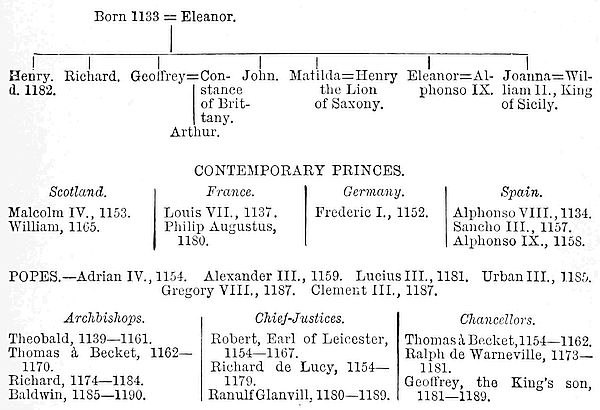
Born 1133 = Eleanor. | | +-------+-------+--+------------------+-----+------------------+ | | | | | | Henry. | Geoffrey = Constance John Matilda = Henry | d.1182. | | of Brittany. the Lion | Richard. | of Saxony. | Arthur. | | +------------------------------------+ | +-----------+-----------+ | | Eleanor = Alphonso IX. Joanna = William II., King of Sicily. CONTEMPORARY PRINCES. _Scotland._ | _France._ | _Germany._ | _Spain._ | | | Malcolm IV., | Louis VII., 1137. | Frederic I., | Alphonso VIII., 1134. 1153. | Philip Augustus, | 1152. | Sancho III., 1157. William, 1165. | 1180. | | Alphonso IX., 1158. POPES.--Adrian IV., 1154. Alexander III., 1159. Lucius III., 1181. Urban III., 1185. Gregory VIII., 1187. Clement III., 1187. _Archbishops._ | _Chief-Justices._ | _Chancellors._ | | Theobald, 1139–1161. | Robert, Earl of | Thomas à Becket, Thomas à Becket, | Leicester, 1154–1167. | 1154–1162. 1162–1170. | Richard de Lucy, | Ralph de Warneville, Richard, 1174–1184. | 1154–1179. | 1173–1181. Baldwin, 1185–1190. | Ranulf Glanville, | Geoffrey, the King’s | 1180–1189. | son, 1181–1189.
Main objects of Henry’s reign. First acts of his reign.
The consolidation of the nation was the great work of Henry of Anjou. He brought to it great gifts, sagacity, masterful courage, a legal and judicial mind; while his training, as the prince of widely extending countries, prevented the intrusion of petty local interests into his views for his people’s good. The lessons of the last reign were not lost on him. Before all things he desired a strong government and good order. In pursuing these objects he took for his model his grandfather and great-grandfather, and worked out in greater and more systematic detail the policy they had begun. And though in his efforts to subordinate the Church he may seem to have run counter to the legislation of his great-grandfather, it will be seen that in many points his policy was really the same. In the earlier part of his reign work lay ready to his hand, and the compromise at Winchester had already marked out his line of action. He could not immediately come to England, being detained by an insurrection in Guienne. But when he had settled this, and, by a humility of bearing he knew well how to feign, secured the friendship of Louis VII., he crossed the Channel, and at once proceeded with his reforms.
He restores order in the State.
He renewed the charter of the City of London; fixed a short period during which the Flemish auxiliaries, who had already probably begun to return home, should leave the country; recalled grants of the royal domains which had been made in Stephen’s reign; re-established the old number of limited earldoms; and proceeded to lay hands on both the royal castles which individual barons had appropriated and those private fastnesses with which the country had become covered. Their number is variously estimated, by some it is put as high as 1150. It was not without some opposition that he carried out this work. It was chiefly in the North and West that difficulty occurred. Before the year was over he had received the submission of William of Albemarle, who was nearly independent in Yorkshire. In February of the next year he expelled Peveril, who had been guilty among other things of poisoning the great Earl of Chester, from his Earldom of Nottingham. He followed up his success by compelling the border barons, Roger, son of Milo, Earl of Hereford, and Hugh Mortimer, a descendant of the same family as Robert de Belesme, to surrender their fastnesses. To complete his dominion at home he marched against Malcolm of Scotland, who was occupying the three Northern counties. These he compelled him to resign, obliging him to do homage for the county of Huntingdon, which he claimed as a descendant of the old Earl Waltheof. Throughout all the earlier part of the reign the Scotch King appears as a great English baron, following the King to his wars.
Friendship of Adrian IV.
Henry even thus early began to think of curbing the overgrown power of the Church; and Henry of Winchester, in fear of what might happen, thought it better to lay aside his episcopal robes and retire for a time to Clugny, from which, however, he was soon induced to return. An event, indeed, soon occurred which rendered the King’s position with the Church peculiarly strong. In 1154 Nicolas Breakspear ascended the Papal throne, the only Englishman who ever attained that honour. The connection between England and the Papal See, always close since the Conquest, was drawn even closer, and the Pope made a grant of the schismatical country Ireland to the English King; a grant the enjoyment of which Henry postponed till a more convenient season. Henry’s widely spread dominions kept him constantly moving, and in 1156 the affairs of his native county summoned him to France. He left his kingdom in charge of Robert of Leicester, his great justiciary.
The difficulty in Anjou arose from the claim raised by his younger brother Godfrey to that province. This claim rested upon a doubtful will, by which his father was said to have intended Anjou for Godfrey if Henry was called to the throne of England. By force of arms Henry reduced the country; and his brother withdrew on the receipt of certain payments, being shortly after called by the burghers of Nantes to become lord of their town. This affair was scarcely settled when Henry hurried back to England, there to complete his conquest of the Scotch King, by obliging him to surrender his strong castles of Bamborough, Newcastle and Carlisle, and again to do homage for Huntingdon, on which occasion, however, the clause “Salvis omnibus dignitatibus suis” was introduced into his oath. This, with the surrender of castles by Hugh Bigod in Norfolk, and of William, called of Warrenne, son of the late King, and Earl of Surrey, completed the subjugation of the feudal nobles, and rendered him absolute master of England.
Master of England, Henry attacks Wales.
Rise of Thomas à Becket.
He is employed in foreign negotiation. 1158.
Wales alone gave him further trouble. Thither, in 1157, he led an army against Owen Gwynneth at the instigation of his fugitive brother Cadwallader. The expedition was not successful; on this, as on subsequent occasions, Henry found it impossible to reduce the Welsh in their mountain strongholds. It is noteworthy, as affording the first instance of scutage, or money payment in exchange for personal service, which was in this instance demanded of knights holding from the clergy; and for the shameful flight of Henry de Essex, the royal standard-bearer, which gave rise afterwards to a remarkable judicial duel. In the year 1163 Robert de Montfort impeached Henry de Essex for cowardice and treachery. The matter came to the ordeal of battle, and Essex being conquered, forfeited all his lands, and retired as a monk to the Abbey of Reading. This, and the confiscation of the property of Peveril, already mentioned, are the only two instances of confiscation during the reign.
It was during this prosperous period of the King’s reign that Thomas à Becket becomes prominent. The son of a citizen of London, his talents had been early seen and employed by Archbishop Theobald. In 1143 he had succeeded in getting for his patron the legatine authority over England, and afterwards that Papal bull which prevented the crowning of King Stephen’s son Eustace. He was richly rewarded by livings in the Dioceses of Oxford, London, and Lincoln, and, in 1154, with the position of Archdeacon of Canterbury. The recommendation of the Primate soon placed him about Henry’s court. He was appointed chancellor, and as such was the chief clerk of the Curia Regis, kept the King’s seal, and had the management of vacant ecclesiastical benefices. He was further intrusted with the guardianship of the Tower of London, and with the castle of Eye in Berkhampstead, thus occupying a position partly secular, partly ecclesiastical. In this situation he exhibited all the splendour of a great noble; kept a magnificent table, followed the sports of the field, and was a proficient in knightly exercises. Henry found much pleasure in his society, and employed him in delicate negotiations. Thus, in the year 1158, he was sent to arrange a match between Margaret of France and Henry’s son Henry. His magnificent embassy dazzled the eyes of the Frenchmen and was completely successful. The object of the arrangement was to win the friendship of Louis, and prevent him from interfering with the King’s plans on Nantes, where he meant to make good his claim as successor to his brother Godfrey, who had lately died. A meeting with Louis was effected on the river Epte. Henry accompanied him back to Paris, and received from him the child princess, whom he intrusted to the care of Robert of Neuburg, Justiciary of Normandy. Strong in this new-formed friendship, Henry found no difficulty in securing Nantes, and thereby a hold upon Brittany.
Nevertheless there is war with France. 1159.
Interesting points in it.
Scotch King serves him.
Introduction of scutage.
In spite however of his apparent agreement with Louis he soon found himself at open war with him. Queen Eleanor’s grandfather, on going to the Crusades, had mortgaged the county of Toulouse to Raymond of St. Gilles. The mortgage money had not been repaid, as Raymond of St. Gilles still held the city. This nobleman had married the French King’s sister Constance. When therefore Henry raised the claim of his wife, the French King openly adopted the cause of Raymond.[20] Henry determined to have recourse to arms, and in 1159 raised an army for the purpose. The war is interesting, not so much in itself, as in two or three collateral points connected with it. Thus Malcolm of Scotland came with forty-five ships, and a Welsh prince likewise joined the army. Again, the presence of Becket at the head of an unusually well-equipped body of 700 men is mentioned. He is said to have urged the King to active measures against the French monarch. But Henry—who was surprised at finding his lately made friend in arms against him, and opposing with all his power a claim he had once himself urged, and who by no means wished to drive matters to extremity—showed some scruple in attacking his suzerain, and contented himself with gaining his object by laying waste the country and capturing the castles. At the same time he contracted an engagement between his son Richard and Berengaria, the daughter of Count Raymond of Barcelona, the son-in-law of the King of Aragon,[21] and in fact Governor of that country. But the most important point about the war was the introduction of the habit of money payments in exchange for military service. This measure had been adopted previously with respect to the Church in the war with Wales. On the present occasion the sum is said to have amounted to £180,000.[22] There were many advantages in the change. The King was enabled to hire mercenaries, and dispense with the irregular services of his feudal followers; he got contributions from the Church lands, and was enabled to do without the hated tax of the Danegelt, at the same time that he struck a blow at the military importance of his feudal barons.
Having reduced the State to order, Henry turns to the Church.
General friendship of England and France with the Pope.
Thus far the course of Henry’s reign had been one of unbroken prosperity. He had settled and increased his dominions both in England and on the Continent, had on the whole gained in his opposition to his suzerain the King of France, and had strengthened himself by prudent marriages for his children. He was henceforward, except for a very few years, to be plunged in disputes and difficulties. It has been mentioned that the Church in England had reached a position of great pre-eminence during the troubled period of Stephen’s reign. The policy of the Norman kings had been always to support the Church to the utmost, to keep on good terms with Rome, but at the same time to make good the supremacy of the power of the king in his own dominions. William the Conqueror, it will be remembered, had entirely separated the spiritual from the temporal jurisdiction. Before the arrival of the Normans, all offences not strictly ecclesiastical had been tried and punished in the County and Hundred courts, where both bishop and aldermen presided side by side. In withdrawing the bishop from the secular courts, William had desired to raise the character of the clergy by confining them more completely to spiritual matters. But an abuse had easily grown up, which produced a directly opposite effect. As the pretensions of the Church rose, not only were spiritual questions to be tried in the spiritual courts, but spiritual men were also withdrawn from the secular jurisdiction, and the doctrine became prevalent that the cleric could be only tried by his ecclesiastical superior.[23] Now ecclesiastical courts could not inflict corporal punishments. Censures, excommunications, and penances were their weapons. Consequently clerks might and did commit every sort of crime without suffering any punishment. To Henry’s love of justice and order this was most repugnant. But at the same time that he wished to curtail the license of the clergy, and to establish the superiority of the royal jurisdiction, he distinctly upheld the policy of his predecessors in supporting the Roman See. It was a critical time for that power. The great Frederick Barbarossa was upon the throne of Germany and attempting to establish with regard to himself and the Pope on a larger scale what Henry was anxious to do in England. With a comprehensive view of the struggle, he had invited the Kings of England and France to join him in united action for the establishment of the supremacy of the secular power. His overtures had not been received; and when, upon the death of Hadrian, in 1159, after a stormy conclave, the Italian party elected Rolando Bandinelli, under the title of Alexander III., and the imperial party Cardinal Octavian, as Victor IV., the two Western kings gave in their adhesion to Alexander. When expelled from Italy, they received him with extreme honour at Chateauroux, where they acted as his grooms, leading his horse between them. He finally found shelter in the French town of Sens.
Election of Becket to Archbishopric. 1161.
Becket upholds encroachments of the Church.
Henry produces Constitutions of Clarendon. 1164.
In 1161, Theobald the Archbishop died, and it seemed to Henry that the opportunity had arrived for carrying out his reforming plans. Without difficulty he secured the election of his Chancellor, believing that he would serve him still in that capacity. But such were not the views of Becket. He found himself in a position where he might not only serve but rival the King, and he at once became the ambitious and fanatical ecclesiastic. His manner of life was wholly changed, fasts and penances took the place of his former gaiety; the ostentation which he still exhibited was for others and not for himself; he scarcely touched food while his guests were feasting; and poor saints and beggars took the place of the courtiers who had formerly thronged his hall. He did not wait to be attacked, but himself began the quarrel with the King. He at once insisted on resigning his temporal offices. He then demanded homage from some barons whom he declared to be liegemen of the See of Canterbury and not of the King. He refused in bold outspoken words to pay the usual tax for the sheriff at a court at Woodstock. But these were only slight beginnings. A meeting of the clergy was held at Westminster, and the great subject of ecclesiastical jurisdictions was raised. A very bad instance had just excited the King’s attention. A clerk of the name of Philip Brois had committed a murder and received no punishment. At the assizes of Dunstable, Simon Fitz-Peter, the King’s Justice, had found him guilty of the murder, but Becket insisted on his being withdrawn from the secular jurisdiction, and sentenced him to two years’ loss of his benefice. To Henry this seemed at once an insult to his authority and a mere fostering of crime. He determined upon action, and demanded of the bishops whether they would accept the ancient customs of the country. Many of the clergy Henry knew he could rely upon, such for instance as Becket’s old enemy Roger of York, and Gilbert Foliot, Bishop of London. He did not expect to meet much opposition anywhere. With much persuasion Becket certainly accepted the customs. Henry, determined that there should be no question on this matter, caused these customs to be drawn up in the form of Constitutions, and presented to a great council held at Clarendon. There Becket distinctly broke his word and retracted.
Becket refuses them.
Bishops and laymen, knowing the King’s character, besought Becket not to risk the fortunes of the Church by further opposition. For a moment he seemed to yield, but the next day, when his final answer was to be given, he again refused to sign them. He stated his objections fully. His arguments were based principally on the Canon law of Gratian[24] and the False Decretals. The Body of Customs, as presented to him, consisted of sixteen clauses. By these, which did not pretend to be new legislation, but a recapitulation of the old practices of the country, the line was sharply drawn between criminal and ecclesiastical cases; the criminal clerk being amenable to the civil jurisdiction: questions with regard to land claimed by the clergy were to be referred to a jury: as also cases of crime where there was no accuser: the King was made the ultimate hearer of appeals, except by his own special leave: bishops were restrained from leaving the country without leave, or from excommunicating the King’s men: elections to bishoprics were to be held in the King’s chapel, in the presence and with the consent of those whom he should summon: and the newly-elected officer was to swear fealty to the King.[25] Other minor matters with regard to the position of the Church were also settled, but it is these chiefly which were to secure the supremacy of the crown. Becket is said to have particularly objected to any subordination of clerks to secular jurisdiction; to have held that one punishment for one offence was enough, and that the Church should look to; and to have regarded with displeasure any restrictions laid upon the right of clerical jurisdiction or excommunication.[26] Ultimately, however, he was certainly induced to accept and to seal them. On retiring from the council he at once began to show signs of repentance, and got absolution for what he had done from the Pope.
Lukewarmness of Alexander III.
The quarrel takes a legal turn.
Comes before the council.
Henry presses him with charges.
Becket leaves the court before judgment is given.
Alexander’s position was peculiar, and, as in the case of Anselm, it was too important to him in his present difficulties to retain the friendship of England for him to allow himself to side very strongly with Becket. Throughout the quarrel it is the Archbishop who urges the Pope onward, and not the Pope the Archbishop. Such lukewarmness suited neither party, and Henry summoned another council for 8th of October at Northampton. Two days before the council the Archbishop arrived. He did not receive the kiss of peace, and it was plain that matters were coming to extremities. Again the Archbishop began the attack. He lodged some complaint against a nobleman, and had justice promised him; but was then in his turn charged with delaying justice, in the case of an official of the Treasury called John the Marshall, who demanded a piece of land in his court. Marshall summoned him before the royal court, and he was now told that the case would come on before the council on the following day. On that day therefore the court sat in judgment upon the Archbishop. He was found guilty. The extreme penalty, which would have been the seizure of all his moveables, was remitted, and a heavy fine of £500 substituted. No sooner was this charge finished than a fresh charge was brought against him, and £300 demanded of him, which he had borrowed upon the castles of Eye and Berkhampstead. On the following day a sum of 500 marks, which he had borrowed for the expedition to Toulouse on the King’s security, was demanded. Becket declared it was a gift. He found fresh securities, and retired in dudgeon. He found his hall deserted by the knights and barons. Then followed the final blow. As chancellor he had had the administration of vacant ecclesiastical and baronial benefices; and now he was ordered to account for a sum of not less than 30,000 marks. On accepting the bishopric, he had been discharged from all liability by Prince Henry and Richard de Lucy the Justiciary. The demand was manifestly an unjust one, and the greater part of the bishops appealed against it. The temporal nobles refused to allow the appeal, as it had yet to be proved that the King was a party to the discharge. Sickness kept the Archbishop confined to his house for some days. Meanwhile the bishops attempted to make him yield, and finally for the most part deserted him, and betook themselves to the court. The Archbishop was determined to meet the charge in all the magnificence of his office, and went to the council with his cross and other insignia. The bishops, overawed by this unusual demonstration, which they regarded as a challenge to the King, went to him, leaving the accused Archbishop sitting alone with a few friends. They tried in vain to get the King’s demand lessened, and changed for the fine usual in Kent, which was only forty shillings. Henry, in wrath, merely asked whether the Archbishop had made up his mind to accept the Constitutions. Becket refused to plead upon any charge except that of John the Marshall, and at length openly declared that he placed himself and the Church under the guardianship of the Pope and of God. The disturbance was great. The King wished the bishops to declare the sentence. They earnestly entreated not to be called upon to judge their superior, and finally the duty was left to Robert of Leicester the Justiciary. But the Archbishop would not let him speak. “How can you judge me who appeal to a higher power? And do not thou Earl of Leicester venture to judge thy spiritual father!” He rose, and, leaning on his cross, swept from the hall. As cries of “traitor” arose behind him, his old worldly vehemence got the better of him, and he turned and cried, “Might I but wear weapons, I should soon know how to clear myself of the charge of treason.” As he passed on his way through the streets people knelt and demanded his blessing. A final answer was required of him the following day, but in the night, in the midst of wild weather, he secretly left Northampton, and after a difficult flight, on the 2nd of November contrived to cross to Gravelines.
He is received by the Pope. 1165.
On the very same night, an embassy, consisting of his chief enemies—the Bishops of York, London, Exeter, Chichester and Worcester, together with John of Oxford, the King’s chief adviser in this matter,—crossed to seek the Pope. The Archbishop put himself under the protection of the King of France at Soissons; and the two parties carried their case before the Pope at Sens, where John of Salisbury, Becket’s emissary, had already been winning him friends. The King’s embassy entreated that legates might be sent to finish the case in England. But Alexander, although the Peter’s Pence from England were absolutely necessary to him, refused their request. Upon receipt of this information, the King drove abroad all friends and dependants of the Archbishop, who had succeeded meanwhile in getting a favourable reception from Alexander. Till 1170 he remained abroad, carrying on his struggle with the King.
But Henry refuses to oppose Alexander.
Of course, during that time Henry could not afford to let his other business rest. But it is the quarrel with the Archbishop which gives its complexion to the history of those years. In 1165 the Pope was enabled to return to Italy, but Frederick of Germany, still refusing to acknowledge him, at an Assembly at Wurtzburg caused Cardinal Guido to be elected under the title of Pascal III. in the place of Octavian, who was just dead. Henry seized the opportunity. He had already forbidden all intercourse between England and the Pope, and he now despatched an embassy, headed by John of Oxford and Richard of Winchester, to attempt to act in consort with Frederick. This was in reply to a demand on the part of the Emperor, who had sent his chancellor, Reginald of Cologne, to ask for two of Henry’s daughters in marriage, the one for his son, the other for Henry the Lion of Saxony. The ambassadors declared that there were fifty bishops ready to accept the anti-pope. However, matters did not reach this point: Alexander still temporized. The clergy of England were very averse to deserting the legitimate Pope, and the old policy of the Norman kings had yet a strong hold upon Henry.
Meanwhile he attacks Wales, and secures Brittany. 1166.
Becket excommunicates his enemies.
Meanwhile, leaving the quarrel in abeyance, he again invaded Wales, again without much success. He was more successful in the following year in his designs on Brittany. “He dealt,” says the Chronicler,[27] “with the nobles of the district of Le Mans according to his pleasure, and the region of Brittany, and with their castles....” A treaty of marriage between his son Geoffrey, and Constance, the daughter of Conan of Brittany and Richmond, having been entered into, this Earl made a grant to him of the whole of Brittany, with the exception of Guingamp, which had descended to him from his grandfather. The King received the homage of all the barons of Brittany at Thouars. Thence he came to Rennes, and by taking possession of that city, the capital of Brittany, he became lord of the whole duchy. While thus triumphing, he received news that Becket, weary of the Pope’s procrastination, had gone to the Church at Vezelay, and there, after explaining the Constitutions of Clarendon, had excommunicated John of Oxford, Richard of Ilchester, and Richard de Lucy, the King’s Counsellors, and Joscelin of Balliol, and Ranulph de Broc, who had entered into possession of his confiscated estates. This step caused considerable anxiety, and the bishops and abbots of England met and appealed to the Pope, thus postponing the execution of the excommunication. The Archbishop, in reply, bid them carry the excommunication at once into effect, and at the same time excommunicated Godfrey Ridel, the Archdeacon of Canterbury, for not remitting to him the income of his see. In anger, the King threatened to expel from England the whole Cistercian order, as a punishment for allowing the Archbishop to dwell in their monastery. To avoid this, Becket withdrew to Sens.
The Pope temporizes.
The appeal however went on, and, to the surprise of every one, the Pope, who had perhaps been bribed, at length appointed legates to examine the dispute. In 1167, John of Oxford, the King’s ambassador, came home in triumph, declaring that the excommunications had been removed. Naturally therefore Becket dreaded the approach of the legates. By means of his influence with the French many obstacles were thrown in their way, and as a fresh declaration that his views were unchanged, he excommunicated Gilbert of London. At length the legates obtained meetings both with Becket and Henry. In neither instance were they satisfactory. Becket refused to withdraw the convenient words “saving our order,” and Henry would hear of no half measures. However, their temper was on the whole conciliatory, and they removed the excommunications conditionally. This friendly feeling on the part of the Pope was still further shown by his suspending the Archbishop for a time from the exercise of his office. In fact, the Pope had just been driven from Rome by Barbarossa, and Henry’s support was indispensable to him. All this made no difference to Becket, who, on Palm Sunday, repeated his excommunications, and contrived at length to get them smuggled over into England, where, with striking effect, Gilbert of London was suddenly suspended in the midst of the celebration of mass in his own church.
Critical position of Henry.
The political difficulties under which Henry was at this time struggling may have given fresh courage to the Archbishop, for, both during 1167 and 1168, there was war with Louis of France and with his other neighbours. The Count of Flanders was even threatening a descent on England, while the Counts of Marche, Angoulême, and Limousin, counting on the succour of the French, were laying waste Henry’s southern dominions. This difficulty he left in the hands of his General, Count Patrick of Salisbury, while he himself was called upon to suppress disturbances in Brittany. His fortunes were indeed at a very low ebb. In presence of these difficulties, Henry found it necessary to lower his tone; a peace with his enemies was patched up at Montmirail. There too a commission from the Pope awaited him, and he found himself obliged to consent virtually to the demands of Becket. As however he refused to give his refractory Archbishop the kiss of peace, which was regarded as the only sure sign of reconciliation, the quarrel was not yet terminated. Although the point at issue was a small one, both parties continued obstinate.
Coronation of Young Henry. June 14, 1170.
Finding this step unpopular, Henry submits.
Becket ventures to return to England.
His death. Dec. 29, 1170.
Henry, determined to show his authority, caused his son Henry to be crowned in England by the Archbishop of York. This was a distinct invasion of the rights of the Archbishop of Canterbury, for the coronation was performed in the southern province. It produced so great an outcry, that Henry felt he had gone too far, especially as he had neglected to have Henry’s wife, the French princess, crowned with him, which Louis regarded as a great insult. With this feeling against him, Henry consented to a meeting at Fretheval, and there yielded what was required of him, embracing the Archbishop, raising him from the ground, when he knelt before him, and holding his stirrup for him to remount. The quarrel seemed ended, but some slight delays occurred before Becket could return to England, and more than one warning message was sent to him that England was no safe place for him. When he demanded a safe conduct from Henry, it did not promise any true reconciliation that John of Oxford was sent as his escort. He ventured however, but found the feeling in England, among the laity at all events, very strong against him, and was bidden to withdraw to his city of Canterbury. Although conscious of the power of his enemies, he continued his obstinate course, excommunicated the Archbishop of York, De Broc, and other lay holders of the property of the See, whom he found it difficult to dispossess. When the King heard of this conduct, the anger which had been boiling within him, but which circumstances had obliged him to suppress, broke loose, and he accused his courtiers of caring nothing for him since they suffered this audacious priest to live. Four knights took him at his word, hurried across to England, collected followers among his enemies, and proceeding to Canterbury, demanded the immediate removal of the excommunication. The monks in terror hurried the Archbishop to the Cathedral, and wished to shut the doors, believing him then in safe sanctuary, but he would not allow any sign of weakness. Headed by the knights, the armed mob broke in, still demanded the removal of the excommunication, were still refused, and killed him at the altar.
The outcry which rose throughout Europe told Henry that he had lost his cause. He at once declared himself innocent, refused food, took on him all the outward signs of penitence, and despatched a mission to exculpate him at the court of the Pope. Though Alexander was very angry, he was persuaded to send legates for a formal inquiry. Henry did not await their coming, but as a means of employment and retirement, proceeded to carry out an intention he had long had of conquering Ireland.
Henry retires to the invasion of Ireland.
Condition of Ireland.
Invasion by Strongbow. 1169.
Henry himself invades Ireland. 1171.
Irish Church adopts Romish discipline. 1172.
His opportunity there indeed had fully come. The country, divided among petty chieftains, had from time to time been gathered under the command of one chief king. When his authority was at all strong, some little order existed; when he was weak, wild disorder reigned. The present holder of that position was Roderic O’Connor of Connaught. In 1153, Diarmid, or Dermot, King of Leinster, had carried off the wife of O’Ruark, Prince of Breffni, or Leitrim. When O’Connor gained the crown of Tara in 1166, he proceeded to punish the offender who fled to England, and, collecting round him some Welsh adventurers, returned home. Still unable to cope with his enemies, he sought Henry in Guienne, did homage to him, and received leave to collect an army in England. In 1169, the half-brothers Robert Fitz-Stephen and Maurice Fitz-Gerald crossed over to Wexford. This advance-guard was followed by a stronger party of Welshmen under Richard of Clare, Count of Strigul, surnamed Strongbow, who, deeply in debt, had lost his possessions in England, and was glad to seek some elsewhere. He took Waterford, and married Eva, Dermot’s daughter; while Dublin, which belonged to the Danes who had settled in Ireland, was captured by Milo of Cogan. In 1171 Dermot died, and Strongbow succeeded to the crown of Leitrim as his heir. Henry was not pleased with the rapid success of his vassal, and proceeded to deprive him of his English property. In vain were ambassadors sent to the King; he refused them admittance. It was only when the Earl surrendered Waterford, Dublin, and his other castles, to the King, that Henry secured to him his other conquests. Matters were in this condition when Henry determined himself to visit Ireland. After a month spent in preparation, he reached Waterford with a fleet of 400 ships in October. Here Strongbow did homage to him for Leinster, and several Irish princes acknowledged him for their chief. From Roderic O’Connor he had to be contented with such slight acknowledgment as the acceptance of his envoys, De Lacey and William Fitz-Aldelm, might imply. With the Church he was more successful. All the archbishops and bishops took the oath of fealty. At a synod held at Cashel the Roman discipline was introduced; and in 1174, bulls from Rome, authorizing the collection of Peter’s Pence and the conquest of the country, were received and accepted. In a wooden palace, built outside the walls of Dublin, Henry exhibited the splendours of the English crown, and granted out the conquered lands to his vassals. Hugh de Lacey received the Earldom of Meath, and was made Viceroy; Fitz-Bernard received Waterford, De Courcey and others were instructed to carry on the work of conquest; and English colonists were placed in Dublin and other devastated towns. Having made these arrangements, Henry returned to Normandy, where his presence was much required. But his conquest was by no means completed; disturbances arose at once upon his departure; nor was it till 1175 that Roderic was subdued. He then sent delegates to make his submission to the King at a council held at Windsor. A treaty was arranged, which acknowledged him as chief of all the Irish princes, with the exception of Henry and his knights. He consented to pay a yearly tribute. But except in the conquered countries, Irish law (the Brehon law as it was termed) held good throughout Ireland, and English law only within those provinces which had been thoroughly subdued and were called the English Pale.
Henry’s reconciliation with Rome. 1172.
It was partly to meet the Papal legates that Henry returned from Ireland. He met them at Avranches, and there swore that he had nothing to do with the murder of the Archbishop, and promised adhesion to Pope Alexander in opposition to the German anti-pope, free intercourse with Rome, the abrogation of the Constitutions of Clarendon, and personal attendance at a crusade, either in the East or in Spain, within three years, meanwhile paying the Templars to undertake this duty for him. Although this seemed a complete submission, it in fact left the question of the supremacy of the civil power open.
Great insurrection of 1174.
Crisis of the danger. 1174.
Henry’s penance at Canterbury.
Capture of the Scotch King at Alnwick.
Henry’s complete success.
All his dominions seemed now at peace, but a great danger was brewing. His son Henry, since his coronation, had already, at the instigation of the French King, his father-in-law, demanded the actual possession of some portion at least of his kingdom, and this combination caused him well-grounded apprehension. He took the opportunity of the general peace of his kingdom to negotiate a marriage for his son John with the daughter of Count Humbolt of Savoy, and promised to give with him as her dowry Chinon, Loudon, and Mirabeau. The young king Henry protested against this treaty, and suddenly disappearing from court, took refuge with Louis VII. at St. Denis. The old king understood only too well what this meant. Shortly, there was a universal insurrection throughout all his dominions. It is not difficult to understand. His domestic relations were not happy, although he was very fond of his children; his wife was constantly urging them to disobedience. His dominions were widespread, and consisted of various races; his hand was heavy upon the feudal nobility, when the English nobles had not yet forgotten the charms of the late reign; while the defeat which the King had sustained in his quarrel with Becket gave a false impression of his weakness. The discontent was very general. While Louis recognized the young Henry as the rightful king, and entered into his quarrel in company with the Counts of Blois, Boulogne, Flanders, and others, the nobles of Aquitaine rose in insurrection, the princes Richard and Geoffrey made common cause with the insurgents, William the Lion of Scotland was engaged to take part with them, and the great Earls of the middle and north of England, Leicester, Ferrars of Derby, Chester, and Bigod, joined in the general alliance. Henry, though alarmed, did not despair. His policy had led him to trust much to his auxiliaries, and with these he determined to withstand the feudal malcontents. Leaving his generals to resist the attack from Flanders and France, he won a great battle before Dol in Brittany, took the great Earl of Chester prisoner, and re-established his power in that province. Meanwhile, Leicester had been besieged by Lucy, his justiciary in England; the efforts of William the Lion, who demanded Northumberland and refused homage for Huntingdon, were thwarted by the brave defence of the border castles; and an invasion of Flemings from the East, headed by the Earl of Leicester, was defeated at Farnham, near Bury St. Edmunds. But the existing truce with France terminated at Easter; the king of that country was able to enter actively into the war; and Henry’s successes, and the large offers he made his sons, seemed alike unavailing. Hostilities began again, and Henry was obliged to take the command in person in his hereditary provinces, Maine and Anjou, where he was received with enthusiasm. The troops of his son Richard were conquered; while in England the King’s natural son, Geoffrey Plantagenet, and Richard de Lucy, made head against the nobles in the East and a fresh invasion from Scotland; but were still so pressed, that messengers were sent in haste to summon Henry across the Channel. It was indeed a moment of great danger. Philip of Flanders and his allies, to whom Kent had been promised, were assembling a fleet at Whitsand; the Scotch invaders had reached Alnwick. Henry hastened home. But before he proceeded to active measures, in deference to the popular feeling, which attributed his difficulties to the Divine anger at Becket’s death, he made a pilgrimage and did penance at the shrine of the martyr. Immediately after this while still in anxious doubt as to the fate of his kingdom, news was brought him that Ranulf de Glanvill had surprised the Scotch at Alnwick, and that William the Lion and many of his nobility were prisoners. A few days afterwards the town of Huntingdon was taken, and Hugh, the Bishop of Durham, who had joined the insurgents, conquered. By July all the English nobles had returned to their allegiance, and Prince David had withdrawn the Scotch troops. The same rapidity which saved England saved Normandy also. The sudden arrival of the King before Rouen raised the siege of that place, which had been hard pressed, and before long a peace between Henry and Louis was made, by which all the French conquests were restored, and the young King Henry’s dependants had to abjure the fealty which they had taken to him. The great insurrection which for a moment had threatened the existence of Henry’s monarchy was thus over. To his sons Henry was merciful. To Richard he granted two castles in Poitou, with half its revenues; to Geoffrey, similar terms in Brittany. They were required to renew their allegiance. William of Scotland was forced to content himself with harder terms. He was only released upon condition of appearing at York in the following year with all his barons, and swearing fealty to Henry as his suzerain. He and his brother did homage for Scotland, for Galloway, and for their English possessions; while the Scotch clergy acknowledged the supremacy of the Archbishop of York. In the following year the young Henry left his French patron and reconciled himself completely with his father.
Small diminution of Henry’s power, either temporal or ecclesiastical.
This outbreak may be regarded as a consequence of Henry’s defeat in his dispute with Becket. The King had shown how little that defeat had weakened his real power in temporal matters. His appointments to the vacant bishoprics, which were a necessary consequence of the termination of that quarrel, prove how little he had really lost even in influence. Of the six bishoprics which were filled up, three were given to avowed partisans of the King. Winchester fell to Richard of Ilchester; Ely, to Godfrey Ridel, Becket’s great opponent; and Lincoln to Geoffrey Plantagenet; while, shortly after, the Bishopric of Norwich was given to John of Oxford, who had been Henry’s chief agent throughout the Becket difficulty. Such disputes as still existed in the Church ceased to have political meaning, and assumed the form of quarrels between the monks and the secular clergy. It was thus that Richard, the Prior of Dover, a man in the royal interests, was elected to succeed Becket after a lengthened dispute between the monks of the Holy Trinity at Canterbury, who claimed the right of election, and the other bishops of the province. Henry’s influence was naturally employed in favour of the episcopal candidate, but he contrived to confine the dispute within the limits of the ecclesiastical body.
Henry’s judicial and constitutional changes.
The Curia Regis.
Itinerant justices.
The period which elapsed between the suppression of the great rebellion and the outbreak of the quarrel between Henry and his sons is the period of his greatest power. It is at this time that we find the greatest marks of his activity as a lawgiver. The year 1176 is marked by the great Assize of Northampton, an expansion of a similar Assize of Clarendon in the year 1166, the fruit perhaps of his experience in the late rebellion, and the knowledge gained by his inquiries into the conduct of the sheriffs in 1170. That inquiry, which was called for by the complaints of the exactions of the sheriffs, proved to him that their conduct had not been free from peculation, and led him to believe that the employment of local nobles as his chief officials was dangerous. He took the opportunity of making a general examination of the judicial system of the country, the fruit of which was the concentration and organization of the Curia Regis, and the arrangements embodied in the Assize of Northampton. The King’s court consisted originally, as has been already mentioned, of all those tenants who held their land direct from the crown (tenants in capite), and was the ordinary feudal court, and the natural parent of our present Parliament, and especially of the House of Lords. But for the ordinary despatch of business, whether judicial or financial, what may be regarded as a permanent committee of this body of immediate holders was employed. This committee consisted of the great officers of the household, such as the chancellor, treasurer, marshal and others, and other selected barons closely connected with the royal household. The head of this committee, or Curia Regis, was the great justiciary, the King’s representative. The royal chaplains or clerks were formed into a body of secretaries, at the head of which was the chancellor. The Curia Regis at first attended the King and had a twofold duty; when they sat as judges its members were called justices, in financial questions they sat in the exchequer[28] chamber, and were called barons. This administrative system, which had been organized in Henry I.’s reign, was entirely destroyed by the wild reign of Stephen. Its reconstitution was the great work of Henry II. In the earlier part of his reign the visitations were renewed upon the old system, the itinerant justice being usually either the great justiciary, chancellor, or some other great household officer. In the year 1168 four barons of the exchequer performed this duty; in 1176 the country was divided into six circuits. This number was not permanent, several alterations were made in it. Nor was the number of visitations thoroughly established. By Magna Charta in John’s reign commissions are promised four times a year, but shortly afterwards it would seem that the general journey of the itinerant justices was every seven years, until the reign of Edward I. It is to be remembered that these visitations were for all sorts of objects; for hearing civil cases, for inspecting the working of criminal jurisdiction, and, perhaps before all things, for arranging the financial matters of the country, and superintending the sheriffs in all matters connected with the exchequer. The itinerant justices during their circuits superseded the sheriff’s authority and presided in his courts. They were also allowed to enter and preside in the baronial courts. It has been mentioned that these courts were in most respects complete Hundreds. The two parallel systems, now on certain occasions presided over by the same official, were thus assimilated and brought into immediate connection with the central authority. This administrative organization gave rise to what is of much political importance, a new class of barons, new men who had risen by their talents and by the King’s favour, whose interests were therefore on the side of order and of the crown. At one period, in 1178, Henry II. appears to have found his new ministers untrustworthy, at all events in that year he restricted the Curia Regis to five persons, keeping the highest appellate jurisdiction in the hands of himself and the old Curia Regis, which may henceforth be regarded as the King’s ordinary council. The name Curia Regis has thus passed through three phases; a feudal court, a permanent committee of the feudal court, and a restricted committee of that committee. In these various bodies we have the sources of all the judicial bodies in England. The feudal court, with certain additions, became the Parliament; without those additions the Great Council, retaining its natural prerogative of final court of appeal, and represented now by the House of Lords. The permanent committee, or ordinary council, is represented by the privy council, still retaining some of its judicial powers. From its body of clerks, headed by the chancellor, arose the courts of Chancery. While the limited committee was divided shortly after the Magna Charta into three courts, the exchequer, the common pleas, and the king’s bench, at first with the same judges for all, but by the end of Edward III.’s reign with a separate staff.
Origin of jury.
Henry’s legal mind, which thus organized the administration, introduced many improvements In judicial procedure. It is to this reign that can be traced the origin of trial by jury. This method was not employed first in criminal cases, but in carrying out inquiries of various kinds. As soon as such inquiries came to be made on oath, the beginning of the jury system had arrived. As early as the great Domesday survey, the sheriff, barons, freeholders, the priest, the reeve, and six villeins of each township, had been all examined upon oath. Judicially this method of inquiry was first applied in civil cases. By the ordinance of the Grand Assize, a choice was given to any person whose right to the possession of land was called in question. He might either if he pleased defend his claims by the old-fashioned appeal to battle, or he might have his right examined by twelve freeholders on their oath, selected by four freeholders also on their oath, nominated by the sheriff. These sworn freeholders were evidently at first witnesses; twelve others were subsequently added to them, who, from their neighbourhood or other reasons, might be supposed to be better acquainted with the facts. This took place in Edward I.’s reign. The double jury was then separated, the original twelve playing their part as jurors of the present day, judging of the facts asserted by the second twelve, who represent the witnesses. In 1166, by the Assize of Clarendon, the same process was extended to criminal cases; that is to say, twelve lawful men from each hundred, and four from each township, were sworn to inquire whether there were any criminal, or receiver of criminals, in their district, and to present the same to the itinerant justices or to the sheriffs. These criminals were then put to the ordeal without further investigation. This was the origin of the grand jury. The abolition of ordeal rendered some substitute necessary, and ordinary trial by jury was the consequence.
Scutage.
Assize of arms.
The Assize of Northampton in 1176 was, as has been said, a repetition in stronger terms of the Assize of Clarendon. It is moreover interesting, as giving a notion of the duties of the itinerant justices, who on this occasion were six in number. Not only was the examination of crimes in their hands, but they had to arrange the law with regard to tenure of land, reliefs of heirs, dowers of widows, and other such matters, and to exact fealty from all classes of the commonwealth, and to see to the complete destruction of private castles, and the secure guardianship of those of the crown. These latter points were probably rendered necessary by the Rebellion of 1174. The same feeling of mistrust of his feudal barons which dictated these precautions was the cause of two other measures of this reign. The military service of the tenants in chief was changed into a money payment called scutage. This money enabled the King to hire men for his foreign wars, and to dispense with the service of his barons; while, by the Assize of Arms in 1181, the national militia of England, the old fyrd of the Saxons, to follow which was one of the duties of the trinoda necessitas, was reorganized, and the arms required of each class in the country carefully defined.
Henry’s importance in Europe.
Closing troubles with his sons and France.
At the same time that Henry was thus organizing his authority in England, his position in Europe was a great one. Two of his sons were married or betrothed to daughters of the King of France. Of his three daughters, the eldest was the wife of Henry the Lion of Saxony, the rival of Frederick Barbarossa; the second, Eleanor, was Queen of Castile; the third, Joanna, though still a child, was taken to Sicily as the bride of the Norman king of that country, which at this time was the dominant power of the Mediterranean. His importance indeed was such that he seemed of all the kings in Europe most firmly seated on his throne, and was selected on account of his power and character, as well as for family reasons, as arbitrator between Alphonso of Castile and his uncle Sancho of Navarre, and as the strongest ally to whom Henry the Lion could have recourse when he was stripped of his German possessions. This befell him in consequence of his desertion of Frederick Barbarossa before his invasion of Lombardy, which terminated in the great battle of Legnano. But in the midst of his greatness there were two dangers constantly besetting Henry; on the one hand was the King of France, on the other were his own children. Not only did the great power of a feudatory naturally excite the French King’s jealousy, Henry had pursued a crooked policy with regard to the marriage of his sons; he had refused to surrender to Louis the Vexin and Bourges as he had promised to do upon their marriages. There was thus a constant opportunity for quarrel. On the other hand, with regard to his sons, his measures had been still more unfortunate. Anxious to secure his succession, and conscious probably that his kingdom was too large to be held by one hand, he had caused his eldest son to be crowned, thus exciting the envy of his brothers; while, at the same time, he had given them large duchies, which rendered them nearly independent of him. In addition to this, his dislike for his wife had rendered her a constant enemy, while his foolish affection for his youngest son John gave still further cause of offence. When therefore, as was likely to happen, any of his sons determined to oppose him, they were certain of assistance from France, and of bad advice from their mother.
First war; against young Henry. 1183.
It is difficult to arrange the constant brief wars which characterized the close of his reign, complicated as they are by the rising interests in the affairs of the East, which were gradually bringing on the third Crusade. They may perhaps be divided into four; the first extending to the death of young Henry; the second to the death of Geoffrey of Brittany; the third from 1184 to a peace negotiated in the interests of the crusades in 1188; and the last, the quarrel with Richard and John, which terminated with the King’s death. The first of these broke out in 1183. Richard had entered with zest into the wild feudal life of Poitou and Aquitaine, and had been very successful there. He had even pushed his arms to Bayonne, in the territories of the Basques, and to the borders of Navarre. This had aroused the envy of his elder brother. This young prince, who regarded himself, and was regarded by many, as the flower of knighthood, was capable of any amount of hypocrisy and double dealing, and seems to have so far cajoled his father as to persuade him to demand from his younger brothers homage to the elder. This Richard positively refused to give. But his arbitrary rule in Poitou and Aquitaine had made him many enemies, at the head of whom was the wild intriguing noble, at once warrior and troubadour, Bertram de Born. With these young Henry allied himself, and, with the aid of his brother from Brittany, pressed so heavily upon Richard, that the old king had to come to his assistance. At this crisis the young king caught a fever and died, forgiven but unvisited by his father. The King took advantage of his son’s death to pursue his success, and succeeded in subjugating the refractory barons, and re-establishing peace. Conscious that the young King Philip II. of France, who had succeeded to the throne in 1180, and over whom he had once had much influence, had been mixed in his son’s rebellion, Henry tried to make peace with him too. Philip met the request by a demand for the restitution of Gisors and the dower of his sister Margaret, young Henry’s widow, and it was with much difficulty that temporary peace was patched up; but it was finally arranged that part of the dowry should be restored, and Gisors transferred to Richard on his marriage with the Princess Alice.
Second war; against Richard. 1184.
Third war. 1187.
Constantly unwise in his conduct to his sons, Henry now demanded from Richard, perhaps as a recompense for his assistance, a part of Aquitaine, to be given to his favourite son John. This Richard refused to give, and consequently both John and Geoffrey of Brittany attacked him. But though Geoffrey was thus ready enough to quarrel with his elder brother, it was from no love of his father that he did so. He, as well as Richard, was hurt by Henry’s evident partiality for John. He took the opportunity of putting in his own claim for Anjou. On Henry’s refusal, he at once fled to France, where he was as usual well received. His death relieved his father for the time from his opposition, but sowed the seed of further difficulties; for on the one hand his province Brittany was at once divided between the French and English faction, and on the other King Philip II. raised claims as overlord to the guardianship of his young son Arthur. There was a growing disinclination however on all sides to plunge into war; for the Pope was constantly urging a general peace, and the combination of Christian princes for the great Eastern Crusade. A succession of weak princes, and the unnatural and artificial character of the feudal kingdom of Jerusalem, together with the rise of the new Mahomedan power of the Saracens under Saladin, had reduced European power in the East to a very low ebb; and in 1184, Heraclius, the Bishop of Jerusalem, had found it necessary to come over, to attempt to persuade the Kings of England and France to embark in a new crusade. But to Henry, although under a pledge to join such an expedition, the idea of leaving his European dominions in their present critical situation was very distasteful, and he consequently postponed taking action. The feeling however that a crusade was imminent rendered hostilities more difficult; so that when, in 1187, the arbitrary behaviour of Richard in Aquitaine had produced fresh difficulties with France, which as usual terminated in the flight of Richard and the junction of his interests with those of his father, the news of the great battle of Hettin, in which the flower of the Christian army of Jerusalem had been entirely destroyed, and the arrival of William of Tyre for the purpose of exciting the enthusiasm of the West, put a sudden end to the hostilities; and, in 1188, the two kings met in perfect friendship under the old elm in the neighbourhood of Gisors, which was their usual place of treaty, and joined with apparent heartiness in taking the Cross. Upon this occasion Henry imposed upon England the tax, known as the Saladin tax, which was a tenth on all property, and in the collection of which the King’s officers were to work hand in hand with the Church.
Last war; with Richard and Philip. 1189.
But nothing could keep the restless Richard in order; before the year was over, he was engaged in fresh quarrels with Geoffrey of Lusignan and Raymond of Toulouse. After mutual demands for the ransom of some captives, Richard advanced in arms against Raymond, who applied to his suzerain Philip for assistance. This open attack on his dominions Philip could not put up with. At length he declared himself the open enemy of the English. It was in vain that his great feudatories reminded him that he was under the crusader’s vow, in vain that a meeting was held at Gisors. The enmity of the kings was only thereby inflamed, and, in token of his eternal hostility, Philip had the old elm of reconciliation hewn down. One would have supposed that Richard, the cause of the quarrel, would have clung to his father; nor is the reason for his not doing so very plain. Perhaps it may be traced to his father’s refusal to give him up Alice, the French King’s sister, for his wife, wishing it is said to make her his own; perhaps it was continued jealousy of his brother John. Certainly he did betake himself to the French court, and with him many others of Henry’s French feudatories fell away. Henry thus found himself in a difficult situation; broken in mind and body, his resources strained to the utmost by the late heavy taxation of England, and his nobles rapidly deserting him.
Henry’s disastrous peace and death.
His health appears to have influenced his mind. He remained inactive at Le Mans, while Philip overran Maine and threatened to besiege Tours. At length Le Mans, where Henry was with his son Geoffrey, was taken. The city where he had himself been born was the particular object of Henry’s love. He felt its loss as a heavy blow, and though he knew his weakness, could not bring himself to retreat to Normandy, where his chief strength lay. With a sudden accession of energy, he reappeared in Anjou. But his appearance had no effect. One by one the fortresses of Maine were captured, and Philip constantly approached Tours. When that town fell, Henry’s spirit was quite broken. He agreed to an interview with Richard and Philip on the plain of Colombières, to make his submission. Almost fainting, and held upon his horse by his attendants, in the midst of a violent thunderstorm, he met his undutiful son, and brought himself to give him the kiss of peace, whispering as he did so, however, “May God not let me die until I have taken me due vengeance on thee.” The terms of his submission were complete. He promised to give up the Princess Alice; he allowed his nobility to swear fealty for their lands to his son Richard; he promised to pay Philip 50,000 marks for the restoration of his conquests. He had asked, in exchange, for a list of those nobles who had joined Richard in rebellion. When he found at the head of the list the name of his beloved son John, his heart was broken. “I care no more for myself nor for the world,” he said. A day or two longer he lingered, and was carried to Chinon, murmuring at intervals, “Shame, shame, on a conquered king,” and there died, attended only by his natural son and Chancellor Geoffrey.[29]
Importance of the reign.
It is scarcely possible to place the importance of this reign too high, or to overvalue the work of Henry II. We find in his reign the organization of almost all departments of the government subsequently completed by Edward I. The arrangements of the Curia Regis and the reforms in judicial procedure have been already mentioned. The exchequer also was put on a new footing. It now becomes possible to see with some clearness the sources and amount of the royal revenue. To the revenues derived from the domain lands and from the Danegelt, the Norman kings had added feudal dues. Both the proceeds of the royal domain and of the Danegelt appear to have been farmed. The farm of the counties amounted in Henry II.’s reign, after the deductions caused by the grants both of Stephen and of Henry, to about £8000 a year. The Danegelt, originally two shillings on every hide, amounted in Henry I.’s reign to about £2500. As this is about a tenth of what the tax would have produced had it been fully exacted, it must probably also have been farmed to the sheriff, who collected what he could of it, and paid a fixed sum to the exchequer. This unsatisfactory tax came to an end in Henry II.’s reign, perhaps through the agency of Becket. The other source of revenue was the Donum and Auxilium, contributions paid by vassals to assist their lords. The first term applied to the counties, the second to the towns. These names became the general names of all irregular imposts, which are also sometimes called hidage, scutage, or tallage, the tallage being the aid raised from towns, the scutage the aid raised from knights’ fees, the hidage the aid raised from tenants in socage. The importance of the scutage as a commutation for military service has been already dwelt upon. Recourse appears to have been had to these scutages only three or four times during the reign. To these sources of revenue are to be added the fees from the law courts, and the incomes arising from feudal incidents, such as wardship, marriage, and reliefs. The whole income of the country was perhaps about £50,000. The taxes seem to have been assessed by Barons of the Exchequer, aided by the declaration of the knights as to their own holdings, by juries in the case of minor tenants. But it was not only in details of administration that Henry showed his character. He constantly summoned great councils, and as his power was so great and centralized that he could certainly have acted without them, this appears to show a fixed intention on his part to assume the position of a national and constitutional king. The general effect of his work at home was to form the nation. Normans became English. The English no longer felt themselves a conquered people. Their oppressors, the feudal nobility, were destroyed or kept in restraint. The new nobles were chiefly ministers of the crown, and all sections of the people looked to the King as the national representative. The importance of Henry’s reign abroad was scarcely less striking. His immense continental dominions made him one of the great powers of Europe. His close contact with France, and the difficulties which it produced, began the hereditary policy of opposition to that country which has characterized the whole of English history. On the other hand, though he may have had no clear view of what he was doing, he set on foot also the lasting friendships of the nation. The marriage of his daughter with the Guelph Duke brought England into constant friendship with Germany, and caused Otho, the son of Henry the Lion, to be brought up in England, and to be regarded as an English prince. The marriage of his other daughter with Spain set on foot that connection which lasted even beyond the Reformation. His work as a whole may be summed up in the words of Professor Stubbs: “He was faithful to the letter of his engagements. He recovered the demesne rights of the crown, so that his royal dignity did not depend for maintenance on constant taxation. He restored the usurped estates; he destroyed the illegal castles, and the system which they typified; he maintained the royal hold on the lawful ones, and the equality and uniformity of justice which their usurpers had subverted; he restored internal peace, and with it plenty, as the riches of England in the following reign amply testify. He arranged the administration of justice by enacting good laws and appointing faithful judges. He restored the currency; he encouraged commerce, he maintained the privileges of the towns; and, without encouraging an aggressive spirit, armed his people for self-defence. He sustained the form, and somewhat of the spirit of national representation. The clergy had grounds of complaint against him for very important reasons; but their chief complaints were caused by their preference for the immunities of their class to the common safeguard of justice.”