Chapter Seven THE EPOCH OF THE FIRST DIVISION OF CHINA (A.D. 220-580) (continued 2)
Reading edition
Thus in the years between 440 and 490 there were great changes not only in the economic but in the social sphere. The Toba declined in number and influence. Many of them married into rich families of the Chinese gentry and regarded themselves as no longer belonging to the Toba. In the course of time the court was completely sinified.
The Chinese at the court now formed the leading element, and they tried to persuade the emperor to claim dominion over all China, at least in theory, by installing his capital in Loyang, the old centre of China. This transfer had the advantage for them personally that the territories in which their properties were situated were close to that capital, so that the grain they produced found a ready market. And it was indeed no longer possible to rule the great Toba empire, now covering the whole of North China from North Shansi. The administrative staff was so great that the transport system was no longer able to bring in sufficient food. For the present capital did not lie on a navigable river, and all the grain had to be carted, an expensive and unsafe mode of transport. Ultimately, in 493-4, the Chinese gentry officials secured the transfer of the capital to Loyang. In the years 490 to 499 the Toba emperor Wen Ti (471-499) took further decisive steps required by the stage reached in internal development. All aliens were prohibited from using their own language in public life. Chinese became the official language. Chinese clothing and customs also became general. The system of administration which had largely followed a pattern developed by the Wei dynasty in the early third century, was changed and took a form which became the model for the T'ang dynasty in the seventh century. It is important to note that in this period, for the first time, an office for religious affairs was created which dealt mainly with Buddhistic monasteries. While after the Toba period such an office for religious affairs disappeared again, this idea was taken up later by Japan when Japan accepted a Chinese-type of administration.
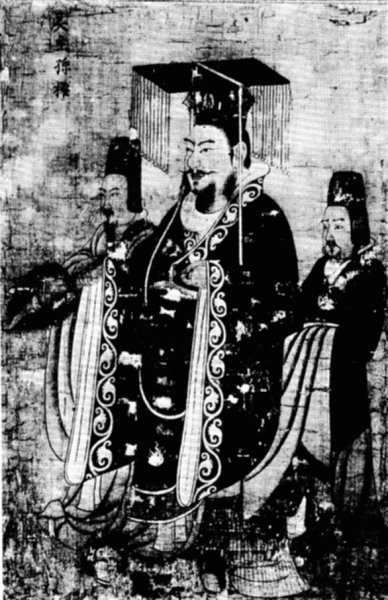
6 Sun Ch'üan, ruler of Wu. From a painting by Yen Li-pen (c. 640-680).
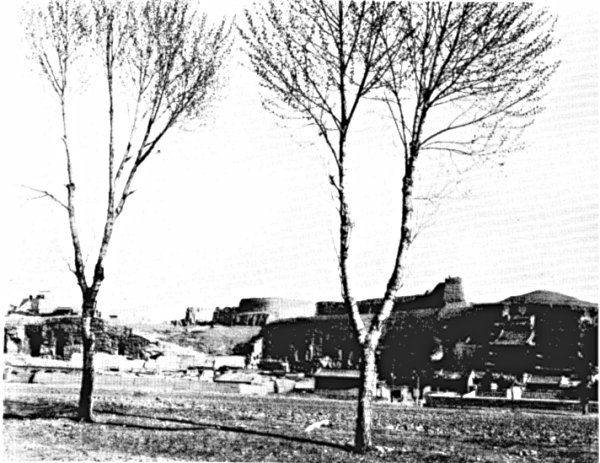
7 General view of the Buddhist cave-temples of Yün-kang. In the foreground, the present village; in the background, the rampart. Photo H. Hammer-Morrisson.
Owing to his bringing up, the emperor no longer regarded himself as Toba but as Chinese; he adopted the Chinese culture, acting as he was bound to do if he meant to be no longer an alien ruler in North China. Already he regarded himself as emperor of all China, so that the South Chinese empire was looked upon as a rebel state that had to be conquered. While, however, he succeeded in everything else, the campaign against the south failed except for some local successes.
The transfer of the capital to Loyang was a blow to the Toba nobles. Their herds became valueless, for animal products could not be carried over the long distance to the new capital. In Loyang the Toba nobles found themselves parted from their tribes, living in an unaccustomed climate and with nothing to do, for all important posts were occupied by Chinese. The government refused to allow them to return to the north. Those who did not become Chinese by finding their way into Chinese families grew visibly poorer and poorer.
5 Victory and retreat of Buddhism
What we said in regard to the religious position of the other alien peoples applied also to the Toba. As soon, however, as their empire grew, they, too, needed an "official" religion of their own. For a few years they had continued their old sacrifices to Heaven; then another course opened to them. The Toba, together with many Chinese living in the Toba empire, were all captured by Buddhism, and especially by its shamanist element. One element in their preference of Buddhism was certainly the fact that Buddhism accepted all foreigners alike—both the Toba and the Chinese were "foreign" converts to an essentially Indian religion; whereas the Confucianist Chinese always made the non-Chinese feel that in spite of all their attempts they were still "barbarians" and that only real Chinese could be real Confucianists.
Secondly, it can be assumed that the Toba rulers by fostering Buddhism intended to break the power of the Chinese gentry. A few centuries later, Buddhism was accepted by the Tibetan kings to break the power of the native nobility, by the Japanese to break the power of a federation of noble clans, and still later by the Burmese kings for the same reason. The acceptance of Buddhism by rulers in the Far East always meant also an attempt to create a more autocratic, absolutistic régime. Mahayana Buddhism, as an ideal, desired a society without clear-cut classes under one enlightened ruler; in such a society all believers could strive to attain the ultimate goal of salvation.
Throughout the early period of Buddhism in the Far East, the question had been discussed what should be the relations between the Buddhist monks and the emperor, whether they were subject to him or not. This was connected, of course, with the fact that to the early fourth century the Buddhist monks were foreigners who, in the view prevalent in the Far East, owed only a limited allegiance to the ruler of the land. The Buddhist monks at the Toba court now submitted to the emperor, regarding him as a reincarnation of Buddha. Thus the emperor became protector of Buddhism and a sort of god. This combination was a good substitute for the old Chinese theory that the emperor was the Son of Heaven; it increased the prestige and the splendour of the dynasty. At the same time the old shamanism was legitimized under a Buddhist reinterpretation. Thus Buddhism became a sort of official religion. The emperor appointed a Buddhist monk as head of the Buddhist state church, and through this "Pope" he conveyed endowments on a large scale to the church. T'an-yao, head of the state church since 460, induced the state to attach state slaves, i.e. enslaved family members of criminals, and their families to state temples. They were supposed to work on temple land and to produce for the upkeep of the temples and monasteries. Thus, the institution of "temple slaves" was created, an institution which existed in South Asia and Burma for a long time, and which greatly strengthened the economic position of Buddhism.
Like all Turkish peoples, the Toba possessed a myth according to which their ancestors came into the world from a sacred grotto. The Buddhists took advantage of this conception to construct, with money from the emperor, the vast and famous cave-temple of Yün-kang, in northern Shansi. If we come from the bare plains into the green river valley, we may see to this day hundreds of caves cut out of the steep cliffs of the river bank. Here monks lived in their cells, worshipping the deities of whom they had thousands of busts and reliefs sculptured in stone, some of more than life-size, some diminutive. The majestic impression made today by the figures does not correspond to their original effect, for they were covered with a layer of coloured stucco.
We know only few names of the artists and craftsmen who made these objects. Probably some at least were foreigners from Turkestan, for in spite of the predominantly Chinese character of these sculptures, some of them are reminiscent of works in Turkestan and even in the Near East. In the past the influences of the Near East on the Far East—influences traced back in the last resort to Greece—were greatly exaggerated; it was believed that Greek art, carried through Alexander's campaign as far as the present Afghanistan, degenerated there in the hands of Indian imitators (the so-called Gandhara art) and ultimately passed on in more and more distorted forms through Turkestan to China. Actually, however, some eight hundred years lay between Alexander's campaign and the Toba period sculptures at Yün-kang and, owing to the different cultural development, the contents of the Greek and the Toba-period art were entirely different. We may say, therefore, that suggestions came from the centre of the Greco-Bactrian culture (in the present Afghanistan) and were worked out by the Toba artists; old forms were filled with a new content, and the elements in the reliefs of Yün-kang that seem to us to be non-Chinese were the result of this synthesis of Western inspiration and Turkish initiative. It is interesting to observe that all steppe rulers showed special interest in sculpture and, as a rule, in architecture; after the Toba period, sculpture flourished in China in the T'ang period, the period of strong cultural influence from Turkish peoples, and there was a further advance of sculpture and of the cave-dwellers' worship in the period of the "Five Dynasties" (906-960; three of these dynasties were Turkish) and in the Mongol period.
But not all Buddhists joined the "Church", just as not all Taoists had joined the Church of Chang Ling's Taoism. Some Buddhists remained in the small towns and villages and suffered oppression from the central Church. These village Buddhist monks soon became instigators of a considerable series of attempts at revolution. Their Buddhism was of the so-called "Maitreya school", which promised the appearance on earth of a new Buddha who would do away with all suffering and introduce a Golden Age. The Chinese peasantry, exploited by the gentry, came to the support of these monks whose Messianism gave the poor a hope in this world. The nomad tribes also, abandoned by their nobles in the capital and wandering in poverty with their now worthless herds, joined these monks. We know of many revolts of Hun and Toba tribes in this period, revolts that had a religious appearance but in reality were simply the result of the extreme impoverishment of these remaining tribes.
In addition to these conflicts between state and popular Buddhism, clashes between Buddhists and representatives of organized Taoism occurred. Such fights, however, reflected more the power struggle between cliques than between religious groups. The most famous incident was the action against the Buddhists in 446 which brought destruction to many temples and monasteries and death to many monks. Here, a mighty Chinese gentry faction under the leadership of the Ts'ui family had united with the Taoist leader K'ou Ch'ien-chih against another faction under the leadership of the crown prince.
With the growing influence of the Chinese gentry, however, Confucianism gained ground again, until with the transfer of the capital to Loyang it gained a complete victory, taking the place of Buddhism and becoming once more as in the past the official religion of the state. This process shows us once more how closely the social order of the gentry was associated with Confucianism.
(E) Succession States of the Toba (A.D. 550-580): Northern Ch'i dynasty, Northern Chou dynasty
1 Reasons for the splitting of the Toba empire
Events now pursued their logical course. The contrast between the central power, now become entirely Chinese, and the remains of the tribes who were with their herds mainly in Shansi and the Ordos region and were hopelessly impoverished, grew more and more acute. From 530 onward the risings became more and more formidable. A few Toba who still remained with their old tribes placed themselves at the head of the rebels and conquered not only the whole of Shansi but also the capital, where there was a great massacre of Chinese and pro-Chinese Toba. The rebels were driven back; in this a man of the Kao family distinguished himself, and all the Chinese and pro-Chinese gathered round him. The Kao family, which may have been originally a Hsien-pi family, had its estates in eastern China and so was closely associated with the eastern Chinese gentry, who were the actual rulers of the Toba State. In 534 this group took the impotent emperor of their own creation to the city of Yeh in the east, where he reigned de jure for a further sixteen years. Then he was deposed, and Kao Yang made himself the first emperor of the Northern Ch'i dynasty (550-577).
The national Toba group, on the other hand, found another man of the imperial family and established him in the west. After a short time this puppet was removed from the throne and a man of the Yü-wen family made himself emperor, founding the "Northern Chou dynasty" (557-580). The Hsien-pi family of Yü-wen was a branch of the Hsien-pi, but was closely connected with the Huns and probably of Turkish origin. All the still existing remains of Toba tribes who had eluded sinification moved into this western empire.
The splitting of the Toba empire into these two separate realms was the result of the policy embarked on at the foundation of the empire. Once the tribal chieftains and nobles had been separated from their tribes and organized militarily, it was inevitable that the two elements should have different social destinies. The nobles could not hold their own against the Chinese; if they were not actually eliminated in one way or another, they disappeared into Chinese families. The rest, the people of the tribe, became destitute and were driven to revolt. The northern peoples had been unable to perpetuate either their tribal or their military organization, and the Toba had been equally unsuccessful in their attempt to perpetuate the two forms of organization alongside each other.
These social processes are of particular importance because the ethnical disappearance of the northern peoples in China had nothing to do with any racial inferiority or with any particular power of assimilation; it was a natural process resulting from the different economic, social, and cultural organizations of the northern peoples and the Chinese.
2 Appearance of the (Gök) Turks
The Toba had liberated themselves early in the fifth century from the Juan-juan peril. None of the fighting that followed was of any great importance. The Toba resorted to the old means of defence against nomads—they built great walls. Apart from that, after their move southward to Loyang, their new capital, they were no longer greatly interested in their northern territories. When the Toba empire split into the Ch'i and the Northern Chou, the remaining Juan-juan entered into treaties first with one realm and then with the other: each realm wanted to secure the help of the Juan-juan against the other.
Meanwhile there came unexpectedly to the fore in the north a people grouped round a nucleus tribe of Huns, the tribal union of the "T'u-chüeh", that is to say the Gök Turks, who began to pursue a policy of their own under their khan. In 546 they sent a mission to the western empire, then in the making, of the Northern Chou, and created the first bonds with it, following which the Northern Chou became allies of the Turks. The eastern empire, Ch'i, accordingly made terms with the Juan-juan, but in 552 the latter suffered a crushing defeat at the hands of the Turks, their former vassals. The remains of the Juan-juan either fled to the Ch'i state or went reluctantly into the land of the Chou. Soon there was friction between the Juan-juan and the Ch'i, and in 555 the Juan-juan in that state were annihilated. In response to pressure from the Turks, the Juan-juan in the western empire of the Northern Chou were delivered up to them and killed in the same year. The Juan-juan then disappeared from the history of the Far East. They broke up into their several tribes, some of which were admitted into the Turks' tribal league. A few years later the Turks also annihilated the Ephthalites, who had been allied with the Juan-juan; this made the Turks the dominant power in Central Asia. The Ephthalites (Yeh-ta, Haytal) were a mixed group which contained elements of the old Yüeh-chih and spoke an Indo-European language. Some scholars regard them as a branch of the Tocharians of Central Asia. One menace to the northern states of China had disappeared—that of the Juan-juan. Their place was taken by a much more dangerous power, the Turks.
3 The Northern Ch'i dynasty; the Northern Chou dynasty
In consequence of this development the main task of the Northern Chou state consisted in the attempt to come to some settlement with its powerful Turkish neighbours, and meanwhile to gain what it could from shrewd negotiations with its other neighbours. By means of intrigues and diplomacy it intervened with some success in the struggles in South China. One of the pretenders to the throne was given protection; he was installed in the present Hankow as a quasi-feudal lord depending on Chou, and there he founded the "Later Liang dynasty" (555-587). In this way Chou had brought the bulk of South China under its control without itself making any real contribution to that result.
Unlike the Chinese state of Ch'i, Chou followed the old Toba tradition. Old customs were revived, such as the old sacrifice to Heaven and the lifting of the emperor on to a carpet at his accession to the throne; family names that had been sinified were turned into Toba names again, and even Chinese were given Toba names; but in spite of this the inner cohesion had been destroyed. After two centuries it was no longer possible to go back to the old nomad, tribal life. There were also too many Chinese in the country, with whom close bonds had been forged which, in spite of all attempts, could not be broken. Consequently there was no choice but to organize a state essentially similar to that of the great Toba empire.
There is just as little of importance that can be said of the internal politics of the Ch'i dynasty. The rulers of that dynasty were thoroughly repulsive figures, with no positive achievements of any sort to their credit. Confucianism had been restored in accordance with the Chinese character of the state. It was a bad time for Buddhists, and especially for the followers of the popularized Taoism. In spite of this, about A.D. 555 great new Buddhist cave-temples were created in Lung-men, near Loyang, in imitation of the famous temples of Yün-kang.
The fighting with the western empire, the Northern Chou state, still continued, and Ch'i was seldom successful. In 563 Chou made preparations for a decisive blow against Ch'i, but suffered defeat because the Turks, who had promised aid, gave none and shortly afterwards began campaigns of their own against Ch'i. In 571 Ch'i had some success in the west against Chou, but then it lost parts of its territory to the South Chinese empire, and finally in 576-7 it was defeated by Chou in a great counter-offensive. Thus for some three years all North China was once more under a single rule, though of nothing approaching the strength of the Toba at the height of their power. For in all these campaigns the Turks had played an important part, and at the end they annexed further territory in the north of Ch'i, so that their power extended far into the east.
Meanwhile intrigue followed intrigue at the court of Chou; the mutual assassinations within the ruling group were as incessant as in the last years of the great Toba empire, until the real power passed from the emperor and his Toba entourage to a Chinese family, the Yang. Yang Chien's daughter was the wife of a Chou emperor; his son was married to a girl of the Hun family Tu-ku; her sister was the wife of the father of the Chou emperor. Amid this tangled relationship in the imperial house it is not surprising that Yang Chien should attain great power. The Tu-ku were a very old family of the Hun nobility; originally the name belonged to the Hun house from which the shan-yü had to be descended. This family still observed the traditions of the Hun rulers, and relationship with it was regarded as an honour even by the Chinese. Through their centuries of association with aristocratically organized foreign peoples, some of the notions of nobility had taken root among the Chinese gentry; to be related with old ruling houses was a welcome means of evidencing or securing a position of special distinction among the gentry. Yang Chien gained useful prestige from his family connections. After the leading Chinese cliques had regained predominance in the Chou empire, much as had happened before in the Toba empire, Yang Chien's position was strong enough to enable him to massacre the members of the imperial family and then, in 581, to declare himself emperor. Thus began the Sui dynasty, the first dynasty that was once more to rule all China.
But what had happened to the Toba? With the ending of the Chou empire they disappeared for all time, just as the Juan-juan had done a little earlier. So far as the tribes did not entirely disintegrate, the people of the tribes seem during the last years of Toba and Chou to have joined Turkish and other tribes. In any case, nothing more is heard of them as a people, and they themselves lived on under the name of the tribe that led the new tribal league.
Most of the Toba nobility, on the other hand, became Chinese. This process can be closely followed in the Chinese annals. The tribes that had disintegrated in the time of the Toba empire broke up into families of which some adopted the name of the tribe as their family name, while others chose Chinese family names. During the centuries that followed, in some cases indeed down to modern times, these families continue to appear, often playing an important part in Chinese history.
(F) The Southern Empires
1 Economic and social situation in the south
During the 260 years of alien rule in North China, the picture of South China also was full of change. When in 317 the Huns had destroyed the Chinese Chin dynasty in the north, a Chin prince who normally would not have become heir to the throne declared himself, under the name Yüan Ti, the first emperor of the "Eastern Chin dynasty" (317-419). The capital of this new southern empire adjoined the present Nanking. Countless members of the Chinese gentry had fled from the Huns at that time and had come into the southern empire. They had not done so out of loyalty to the Chinese dynasty or out of national feeling, but because they saw little prospect of attaining rank and influence at the courts of the alien rulers, and because it was to be feared that the aliens would turn the fields into pasturage, and also that they would make an end of the economic and monetary system which the gentry had evolved for their own benefit.
But the south was, of course, not uninhabited. There were already two groups living there—the old autochthonous population, consisting of Yao, Tai and Yüeh, and the earlier Chinese immigrants from the north, who had mainly arrived in the time of the Three Kingdoms, at the beginning of the third century A.D. The countless new immigrants now came into sharp conflict with the old-established earlier immigrants. Each group looked down on the other and abused it. The two immigrant groups in particular not only spoke different dialects but had developed differently in respect to manners and customs. A look for example at Formosa in the years after 1948 will certainly help in an understanding of this situation: analogous tensions developed between the new refugees, the old Chinese immigrants, and the native Formosan population. But let us return to the southern empires.
The two immigrant groups also differed economically and socially: the old immigrants were firmly established on the large properties they had acquired, and dominated their tenants, who were largely autochthones; or they had engaged in large-scale commerce. In any case, they possessed capital, and more capital than was usually possessed by the gentry of the north. Some of the new immigrants, on the other hand, were military people. They came with empty hands, and they had no land. They hoped that the government would give them positions in the military administration and so provide them with means; they tried to gain possession of the government and to exclude the old settlers as far as possible. The tension was increased by the effect of the influx of Chinese in bringing more land into cultivation, thus producing a boom period such as is produced by the opening up of colonial land. Everyone was in a hurry to grab as much land as possible. There was yet a further difference between the two groups of Chinese: the old settlers had long lost touch with the remainder of their families in the north. They had become South Chinese, and all their interests lay in the south. The new immigrants had left part of their families in the north under alien rule. Their interests still lay to some extent in the north. They were working for the reconquest of the north by military means; at times individuals or groups returned to the north, while others persuaded the rest of their relatives to come south. It would be wrong to suppose that there was no inter-communication between the two parts into which China had fallen. As soon as the Chinese gentry were able to regain any footing in the territories under alien rule, the official relations, often those of belligerency, proceeded alongside unofficial intercourse between individual families and family groupings, and these latter were, as a rule, in no way belligerent.
The lower stratum in the south consisted mainly of the remains of the original non-Chinese population, particularly in border and southern territories which had been newly annexed from time to time. In the centre of the southern state the way of life of the non-Chinese was very quickly assimilated to that of the Chinese, so that the aborigines were soon indistinguishable from Chinese. The remaining part of the lower class consisted of impoverished Chinese peasants. This whole lower section of the population rarely took any active and visible part in politics, except at times in the form of great popular risings.
Until the third century, the south had been of no great economic importance, in spite of the good climate and the extraordinary fertility of the Yangtze valley. The country had been too thinly settled, and the indigenous population had not become adapted to organized trade. After the move southward of the Chin dynasty the many immigrants had made the country of the lower Yangtze more thickly populated, but not over-populated. The top-heavy court with more than the necessary number of officials (because there was still hope for a re-conquest of the north which would mean many new jobs for administrators) was a great consumer; prices went up and stimulated local rice production. The estates of the southern gentry yielded more than before, and naturally much more than the small properties of the gentry in the north where, moreover, the climate is far less favourable. Thus the southern landowners were able to acquire great wealth, which ultimately made itself felt in the capital.
One very important development was characteristic in this period in the south, although it also occurred in the north. Already in pre-Han times, some rulers had gardens with fruit trees. The Han emperors had large hunting parks which were systematically stocked with rare animals; they also had gardens and hot-houses for the production of vegetables for the court. These "gardens" (yüan) were often called "manors" (pieh-yeh) and consisted of fruit plantations with luxurious buildings. We hear soon of water-cooled houses for the gentry, of artificial ponds for pleasure and fish breeding, artificial water-courses, artificial mountains, bamboo groves, and parks with parrots, ducks, and large animals. Here, the wealthy gentry of both north and south, relaxed from government work, surrounded by their friends and by women. These manors grew up in the hills, on the "village commons" where formerly the villagers had collected their firewood and had grazed their animals. Thus, the village commons begin to disappear. The original farm land was taxed, because it produced one of the two products subject to taxation, namely grain or mulberry leaves for silk production. But the village common had been and remained tax-free because it did not produce taxable things. While land-holdings on the farmland were legally restricted in their size, the "gardens" were unrestricted. Around A.D. 500 the ruler allowed high officials to have manors of three hundred mou size, while in the north a family consisting of husband and wife and children below fifteen years of age were allowed a farm of sixty mou only; but we hear of manors which were many times larger than the allowed size of three hundred. These manors began to play an important economic role, too: they were cultivated by tenants and produced fishes, vegetables, fruit and bamboo for the market, thus they gave more income than ordinary rice or wheat land.
With the creation of manors the total amount of land under cultivation increased, though not the amount of grain-producing land. We gain the impression that from c. the third century A.D. on to the eleventh century the intensity of cultivation was generally lower than in the period before.
The period from c. A.D. 300 on also seems to be the time of the second change in Chinese dietary habits. The first change occurred probably between 400 and 100 B.C. when the meat-eating Chinese reduced their meat intake greatly, gave up eating beef and mutton and changed over to some pork and dog meat. This first change was the result of increase of population and decrease of available land for pasturage. Cattle breeding in China was then reduced to the minimum of one cow or water-buffalo per farm for ploughing. Wheat was the main staple for the masses of the people. Between A.D. 300 and 600 rice became the main staple in the southern states although, theoretically, wheat could have been grown and some wheat probably was grown in the south. The vitamin and protein deficiencies which this change from wheat to rice brought forth, were made up by higher consumption of vegetables, especially beans, and partially also by eating of fish and sea food. In the north, rice became the staple food of the upper class, while wheat remained the main food of the lower classes. However, new forms of preparation of wheat, such as dumplings of different types, were introduced. The foreign rulers consumed more meat and milk products. Chinese had given up the use of milk products at the time of the first change, and took to them to some extent only in periods of foreign rule.
2 Struggles between cliques under the Eastern Chin dynasty (A.D. 317-419)
The officials immigrating from the north regarded the south as colonial country, and so as more or less uncivilized. They went into its provinces in order to get rich as quickly as possible, and they had no desire to live there for long: they had the same dislike of a provincial existence as had the families of the big landowners. Thus as a rule the bulk of the families remained in the capital, close to the court. Thither the products accumulated in the provinces were sent, and they found a ready sale, as the capital was also a great and long-established trading centre with a rich merchant class. Thus in the capital there was every conceivable luxury and every refinement of civilization. The people of the gentry class, who were maintained in the capital by relatives serving in the provinces as governors or senior officers, themselves held offices at court, though these gave them little to do. They had time at their disposal, and made use of it—in much worse intrigues than ever before, but also in music and poetry and in the social life of the harems. There is no question at all that the highest refinement of the civilization of the Far East between the fourth and the sixth century was to be found in South China, but the accompaniments of this over-refinement were terrible.
We cannot enter into all the intrigues recorded at this time. The details are, indeed, historically unimportant. They were concerned only with the affairs of the court and its entourage. Not a single ruler of the Eastern Chin dynasty possessed personal or political qualities of any importance. The rulers' power was extremely limited because, with the exception of the founder of the state, Yüan Ti, who had come rather earlier, they belonged to the group of the new immigrants, and so had no firm footing and were therefore caught at once in the net of the newly re-grouping gentry class.
The emperor Yüan Ti lived to see the first great rising. This rising (under Wang Tun) started in the region of the present Hankow, a region that today is one of the most important in China; it was already a centre of special activity. To it lead all the trade routes from the western provinces of Szechwan and Kweichow and from the central provinces of Hupei, Hunan, and Kiangsi. Normally the traffic from those provinces comes down the Yangtze, and thus in practice this region is united with that of the lower Yangtze, the environment of Nanking, so that Hankow might just as well have been the capital as Nanking. For this reason, in the period with which we are now concerned the region of the present Hankow was several times the place of origin of great risings whose aim was to gain control of the whole of the southern empire.
Wang Tun had grown rich and powerful in this region; he also had near relatives at the imperial court; so he was able to march against the capital. The emperor in his weakness was ready to abdicate but died before that stage was reached. His son, however, defeated Wang Tun with the aid of General Yü Liang (A.D. 323). Yü Liang was the empress's brother; he, too, came from a northern family. Yüan Ti's successor also died early, and the young son of Yü Liang's sister came to the throne as Emperor Ch'eng (326-342); his mother ruled as regent, but Yü Liang carried on the actual business of government. Against this clique rose Su Chün, another member of the northern gentry, who had made himself leader of a bandit gang in A.D. 300 but had then been given a military command by the dynasty. In 328 he captured the capital and kidnapped the emperor, but then fell before the counterthrust of the Yü Liang party. The domination of Yü Liang's clique continued after the death of the twenty-one-years-old emperor. His twenty-year-old brother was set in his place; he, too, died two years later, and his two-year-old son became emperor (Mu Ti, 345-361).
Meanwhile this clique was reinforced by the very important Huan family. This family came from the same city as the imperial house and was a very old gentry family of that city. One of the family attained a high post through personal friendship with Yü Liang: on his death his son Huan Wen came into special prominence as military commander.
Huan Wen, like Wang Tun and others before him, tried to secure a firm foundation for his power, once more in the west. In 347 he reconquered Szechwan and deposed the local dynasty. Following this, Huan Wen and the Yü family undertook several joint campaigns against northern states—the first reaction of the south against the north, which in the past had always been the aggressor. The first fighting took place directly to the north, where the collapse of the "Later Chao" seemed to make intervention easy. The main objective was the regaining of the regions of eastern Honan, northern Anhwei and Kiangsu, in which were the family seats of Huan's and the emperor's families, as well as that of the Hsieh family which also formed an important group in the court clique. The purpose of the northern campaigns was not, of course, merely to defend private interests of court cliques: the northern frontier was the weak spot of the southern empire, for its plains could easily be overrun. It was then observed that the new "Earlier Ch'in" state was trying to spread from the north-west eastwards into this plain, and Ch'in was attacked in an attempt to gain a more favourable frontier territory. These expeditions brought no important practical benefit to the south; and they were not embarked on with full force, because there was only the one court clique at the back of them, and that not whole-heartedly, since it was too much taken up with the politics of the court.
Huan Wen's power steadily grew in the period that followed. He sent his brothers and relatives to administer the regions along the upper Yangtze; those fertile regions were the basis of his power. In 371 he deposed the reigning emperor and appointed in his place a frail old prince who died a year later, as required, and was replaced by a child. The time had now come when Huan Wen might have ascended the throne himself, but he died. None of his family could assemble as much power as Huan Wen had done. The equality of strength of the Huan and the Hsieh saved the dynasty for a time.
In 383 came the great assault of the Tibetan Fu Chien against the south. As we know, the defence was carried out more by the methods of diplomacy and intrigue than by military means, and it led to the disaster in the north already described. The successes of the southern state especially strengthened the Hsieh family, whose generals had come to the fore. The emperor (Hsiao Wu Ti, 373-396), who had come to the throne as a child, played no part in events at any time during his reign. He occupied himself occasionally with Buddhism, and otherwise only with women and wine. He was followed by his five-year-old son. At this time there were some changes in the court clique. In the Huan family Huan Hsüan, a son of Huan Wen, came especially into prominence. He parted from the Hsieh family, which had been closest to the emperor, and united with the Wang (the empress's) and Yin families. The Wang, an old Shansi family, had already provided two empresses, and was therefore strongly represented at court. The Yin had worked at first with the Hsieh, especially as the two families came from the same region, but afterwards the Yin went over to Huan Hsüan. At first this new clique had success, but later one of its generals, Liu Lao-chih, went over to the Hsieh clique, and its power declined. Wang Kung was killed, and Yin Chung-k'an fell away from Huan Hsüan and was killed by him in 399. Huan Hsüan himself, however, held his own in the regions loyal to him. Liu Lao-chih had originally belonged to the Hsieh clique, and his family came from a region not far from that of the Hsieh. He was very ambitious, however, and always took the side which seemed most to his own interest. For a time he joined Huan Hsüan; then he went over to the Hsieh, and finally returned to Huan Hsüan in 402 when the latter reached the height of his power. At that moment Liu Lao-chih was responsible for the defence of the capital from Huan Hsüan, but instead he passed over to him. Thus Huan Hsüan conquered the capital, deposed the emperor, and began a dynasty of his own. Then came the reaction, led by an earlier subordinate of Liu Lao-chih, Liu Yü. It may be assumed that these two army commanders were in some way related, though the two branches of their family must have been long separated. Liu Yü had distinguished himself especially in the suppression of a great popular rising which, around the year 400, had brought wide stretches of Chinese territory under the rebels' power, beginning with the southern coast. This rising was the first in the south. It was led by members of a secret society which was a direct continuation of the "Yellow Turbans" of the latter part of the second century A.D. and of organized church-Taoism. The whole course of this rising of the exploited and ill-treated lower classes was very similar to that of the popular rising of the "Yellow Turbans". The movement spread as far as the neighbourhood of Canton, but in the end it was suppressed, mainly by Liu Yü.
Through these achievements Liu Yü's military power and political influence steadily increased; he became the exponent of all the cliques working against the Huan clique. He arranged for his supporters to dispose of Huan Hsüan's chief collaborators; and then, in 404, he himself marched on the capital. Huan Hsüan had to flee, and in his flight he was killed in the upper Yangtze region. The emperor was restored to his throne, but he had as little to say as ever, for the real power was Liu Yü's.
Before making himself emperor, Liu Yü began his great northern campaign, aimed at the conquest of the whole of western China. The Toba had promised to remain neutral, and in 415 he was able to conquer the "Later Ch'in" in Shensi. The first aim of this campaign was to make more accessible the trade routes to Central Asia, which up to now had led through the difficult mountain passes of Szechwan; to this end treaties of alliance had been concluded with the states in Kansu against the "Later Ch'in". In the second place, this war was intended to increase Liu Yü's military strength to such an extent that the imperial crown would be assured to him; and finally he hoped to cut the claws of pro-Huan Hsüan elements in the "Later Ch'in" kingdom who, for the sake of the link with Turkestan, had designs on Szechwan.
3 The Liu-Sung dynasty (A.D. 420-478) and the Southern Ch'i dynasty (479-501)
After his successes in 416-17 in Shensi, Liu Yü returned to the capital, and shortly after he lost the chief fruits of his victory to Ho-lien P'o-p'o, the Hun ruler in the north, while Liu Yü himself was occupied with the killing of the emperor (419) and the installation of a puppet. In 420 the puppet had to abdicate and Liu Yü became emperor. He called his dynasty the Sung dynasty, but to distinguish it from another and more famous Sung dynasty of later time his dynasty is also called the Liu-Sung dynasty.
The struggles and intrigues of cliques against each other continued as before. We shall pass quickly over this period after a glance at the nature of these internal struggles.
Part of the old imperial family and its following fled northwards from Liu Yü and surrendered to the Toba. There they agitated for a campaign of vengeance against South China, and they were supported at the court of the Toba by many families of the gentry with landed interests in the south. Thus long-continued fighting started between Sung and Toba, concerned mainly with the domains of the deposed imperial family and its following. This fighting brought little success to south China, and about 450 it produced among the Toba an economic and social crisis that brought the wars to a temporary close. In this pause the Sung turned to the extreme south, and tried to gain influence there and in Annam. The merchant class and the gentry families of the capital who were allied with it were those chiefly interested in this expansion.
About 450 began the Toba policy of shifting the central government to the region of the Yellow River, to Loyang; for this purpose the frontier had to be pushed farther south. Their great campaign brought the Toba in 450 down to the Yangtze. The Sung suffered a heavy defeat; they had to pay tribute, and the Toba annexed parts of their northern territory.
The Sung emperors who followed were as impotent as their predecessors and personally much more repulsive. Nothing happened at court but drinking, licentiousness, and continual murders.
From 460 onward there were a number of important risings of princes; in some of them the Toba had a hand. They hoped by supporting one or another of the pretenders to gain overlordship over the whole of the southern empire. In these struggles in the south the Hsiao family, thanks mainly to General Hsiao Tao-ch'eng, steadily gained in power, especially as the family was united by marriage with the imperial house. In 477 Hsiao Tao-ch'eng finally had the emperor killed by an accomplice, the son of a shamaness; he set a boy on the throne and made himself regent. Very soon after this the boy emperor and all the members of the imperial family were murdered, and Hsiao Tao-ch'eng created the "Southern Ch'i" dynasty (479-501). Once more the remaining followers of the deposed dynasty fled northward to the Toba, and at once fighting between Toba and the south began again.
This fighting ended with a victory for the Toba and with the final establishment of the Toba in the new capital of Loyang. South China was heavily defeated again and again, but never finally conquered. There were intervals of peace. In the years between 480 and 490 there was less disorder in the south, at all events in internal affairs. Princes were more often appointed to governorships, and the influence of the cliques was thus weakened. In spite of this, a stable régime was not built up, and in 494 a prince rose against the youthful emperor. This prince, with the help of his clique including the Ch'en family, which later attained importance, won the day, murdered the emperor, and became emperor himself. All that is recorded about him is that he fought unsuccessfully against the Toba, and that he had the whole of his own family killed out of fear that one of its members might act exactly as he had done. After his death there were conflicts between the emperor's few remaining relatives; in these the Toba again had a hand. The victor was a person named Hsiao Yen; he removed the reigning emperor in the usual way and made himself emperor. Although he belonged to the imperial family, he altered the name of the dynasty, and reigned from 502 as the first emperor of the "Liang dynasty".
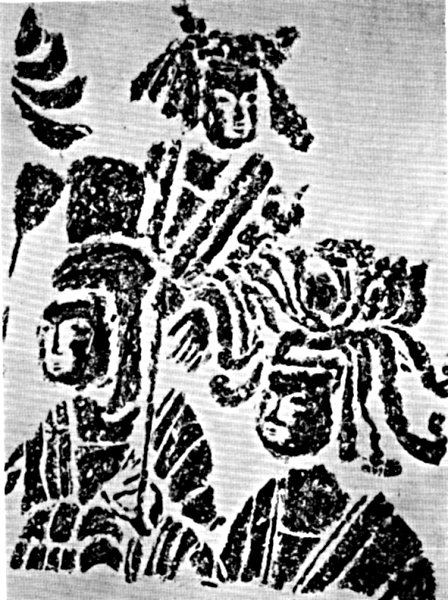
8 Detail from the Buddhist cave-reliefs of Lungmen. From a print in the author's possession.
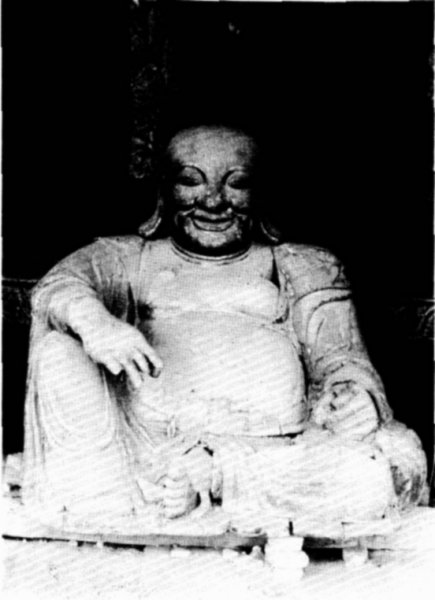
9 Statue of Mi-lo (Maitreya, the next future Buddha), in the 'Great Buddha Temple' at Chengting (Hopei). Photo H. Hammer-Morrisson.
4 The Liang dynasty (A.D. 502-556)
The fighting with the Toba continued until 515. As a rule the Toba were the more successful, not at least through the aid of princes of the deposed "Southern Ch'i dynasty" and their followers. Wars began also in the west, where the Toba tried to cut off the access of the Liang to the caravan routes to Turkestan. In 507, however, the Toba suffered an important defeat. The southern states had tried at all times to work with the Kansu states against the northern states; the Toba now followed suit and allied themselves with a large group of native chieftains of the south, whom they incited to move against the Liang. This produced great native unrest, especially in the provinces by the upper Yangtze. The natives, who were steadily pushed back by the Chinese peasants, were reduced to migrating into the mountain country or to working for the Chinese in semi-servile conditions; and they were ready for revolt and very glad to work with the Toba. The result of this unrest was not decisive, but it greatly reduced the strength of the regions along the upper Yangtze. Thus the main strength of the southern state was more than ever confined to the Nanking region.
The first emperor of the Liang dynasty, who assumed the name Wu Ti (502-549), became well known in the Western world owing to his love of literature and of Buddhism. After he had come to the throne with the aid of his followers, he took no further interest in politics; he left that to his court clique. From now on, however, the political initiative really belonged to the north. At this time there began in the Toba empire the risings of tribal leaders against the government which we have fully described above. One of these leaders, Hou Ching, who had become powerful as a military leader in the north, tried in 547 to conclude a private alliance with the Liang to strengthen his own position. At the same time the ruler of the northern state of the "Northern Ch'i", then in process of formation, himself wanted to negotiate an alliance with the Liang, in order to be able to get rid of Hou Ching. There was indecision in Liang. Hou Ching, who had been getting into difficulties, now negotiated with a dissatisfied prince in Liang, invaded the country in 548 with the prince's aid, captured the capital in 549, and killed Emperor Wu. Hou Ching now staged the usual spectacle: he put a puppet on the imperial throne, deposed him eighteen months later and made himself emperor.
This man of the Toba on the throne of South China was unable, however, to maintain his position; he had not sufficient backing. He was at war with the new rulers in the northern empire, and his own army, which was not very large, melted away; above all, he proceeded with excessive harshness against the helpers who had gained access for him to the Liang, and thereafter he failed to secure a following from among the leading cliques at court. In 552 he was driven out by a Chinese army led by one of the princes and was killed.
The new emperor had been a prince in the upper Yangtze region, and his closest associates were engaged there. They did not want to move to the distant capital, Nanking, because their private financial interests would have suffered. The emperor therefore remained in the city now called Hankow. He left the eastern territory in the hands of two powerful generals, one of whom belonged to the Ch'en family, which he no longer had the strength to remove. In this situation the generals in the east made themselves independent, and this naturally produced tension at once between the east and the west of the Liang empire; this tension was now exploited by the leaders of the Chou state then in the making in the north. On the invitation of a clique in the south and with its support, the Chou invaded the present province of Hupei and in 555 captured the Liang emperor's capital. They were now able to achieve their old ambition: a prince of the Chou dynasty was installed as a feudatory of the north, reigning until 587 in the present Hankow. He was permitted to call his quasi-feudal territory a kingdom and his dynasty, as we know already, the "Later Liang dynasty".
5 The Ch'en dynasty (A.D. 557-588) and its ending by the Sui
The more important of the independent generals in the east, Ch'en Pa-hsien, installed a shadow emperor, forced him to abdicate, and made himself emperor. The Ch'en dynasty which thus began was even feebler than the preceding dynasties. Its territory was confined to the lower Yangtze valley. Once more cliques and rival pretenders were at work and prevented any sort of constructive home policy. Abroad, certain advantages were gained in north China over the Northern Ch'i dynasty, but none of any great importance.
Meanwhile in the north Yang Chien had brought into power the Chinese Sui dynasty. It began by liquidating the quasi-feudal state of the "Later Liang". Then followed, in 588-9, the conquest of the Ch'en empire, almost without any serious resistance. This brought all China once more under united rule, and a period of 360 years of division was ended.
6 Cultural achievements of the south
For nearly three hundred years the southern empire had witnessed unceasing struggles between important cliques, making impossible any peaceful development within the country. Culturally, however, the period was rich in achievement. The court and the palaces of wealthy members of the gentry attracted scholars and poets, and the gentry themselves had time for artistic occupations. A large number of the best-known Chinese poets appeared in this period, and their works plainly reflect the conditions of that time: they are poems for the small circle of scholars among the gentry and for cultured patrons, spiced with quotations and allusions, elaborate in metre and construction, masterpieces of aesthetic sensitivity—but unintelligible except to highly educated members of the aristocracy. The works were of the most artificial type, far removed from all natural feeling.
Music, too, was never so assiduously cultivated as at this time. But the old Chinese music disappeared in the south as in the north, where dancing troupes and women musicians in the Sogdian commercial colonies of the province of Kansu established the music of western Turkestan. Here in the south, native courtesans brought the aboriginal, non-Chinese music to the court; Chinese poets wrote songs in Chinese for this music, and so the old Chinese music became unfashionable and was forgotten. The upper class, the gentry, bought these girls, often in large numbers, and organized them in troupes of singers and dancers, who had to appear on festal occasions and even at the court. For merchants and other people who lacked full social recognition there were brothels, a quite natural feature wherever there were considerable commercial colonies or collections of merchants, including the capital of the southern empire.
In their ideology, as will be remembered, the Chinese gentry were always in favour of Confucianism. Here in the south, however, the association with Confucianism was less serious, the southern gentry, with their relations with the merchant class, having acquired the character of "colonial" gentry. They were brought up as Confucians, but were interested in all sorts of different religious movements, and especially in Buddhism. A different type of Buddhism from that in the north had spread over most of the south, a meditative Buddhism that was very close ideologically to the original Taoism, and so fulfilled the same social functions as Taoism. Those who found the official life with its intrigues repulsive, occupied themselves with meditative Buddhism. The monks told of the sad fate of the wicked in the life to come, and industriously filled the gentry with apprehension, so that they tried to make up for their evil deeds by rich gifts to the monasteries. Many emperors in this period, especially Wu Ti of the Liang dynasty, inclined to Buddhism. Wu Ti turned to it especially in his old age, when he was shut out entirely from the tasks of a ruler and was no longer satisfied with the usual pleasures of the court. Several times he instituted Buddhist ceremonies of purification on a large scale in the hope of so securing forgiveness for the many murders he had committed.
Genuine Taoism also came to the fore again, and with it the popular religion with its magic, now amplified with the many local deities that had been taken over from the indigenous population of the south. For a time it became the fashion at court to pass the time in learned discussions between Confucians, Buddhists, and Taoists, which were quite similar to the debates between learned men centuries earlier at the wealthy little Indian courts. For the court clique this was more a matter of pastime than of religious controversy. It seems thoroughly in harmony with the political events that here, for the first time in the history of Chinese philosophy, materialist currents made their appearance, running parallel with Machiavellian theories of power for the benefit of the wealthiest of the gentry.
Principal dynasties of North and South China
North and South
Western Chin dynasty (A.D. 265-317)
NorthSouth
1. Earlier Chao (Hsiung-nu) 304-329 1. Eastern Chin (Chinese) 317-419
2. Later Chao (Hsiung-nu) 328-352
3. Earlier Ch'in (Tibetans) 351-394
4. Later Ch'in (Tibetans) 384-417
5. Western Ch'in (Hsiung-nu) 385-431
6. Earlier Yen (Hsien-pi) 352-370
7. Later Yen (Hsien-pi) 384-409
8. Western Yen (Hsien-pi) 384-395
9. Southern Yen (Hsien-pi) 398-410
10. Northern Yen (Hsien-pi)409-436
11. Tai (Toba)338-376
12. Earlier Liang (Chinese)313-376
13. Northern Liang (Hsiung-nu) 397-439
14. Western Liang (Chinese?)400-421
15. Later Liang (Tibetans)386-403
16. Southern Liang (Hsien-pi)379-414
17. Hsia (Hsiung-nu)407-431
18. Toba (Turks)385-550
2. Liu-Sung420-478
3. Southern Ch'i 479-501
19. Northern Ch'i (Chinese?)550-5764. Liang502-556
20. Northern Chou (Toba)557-5795. Ch'en557-588
21. Sui (Chinese)580-6186. Sui580-618