LEONARD W. KING, LITT.D., F.S.A.
Reading edition
Assistant Keeper of Egyptian and Assyrian Antiquities in the British Museum Professor of Assyrian and Babylonian Archæology in the University of London
WITH MAP, PLANS, AND ILLUSTRATIONS
LONDON
1915
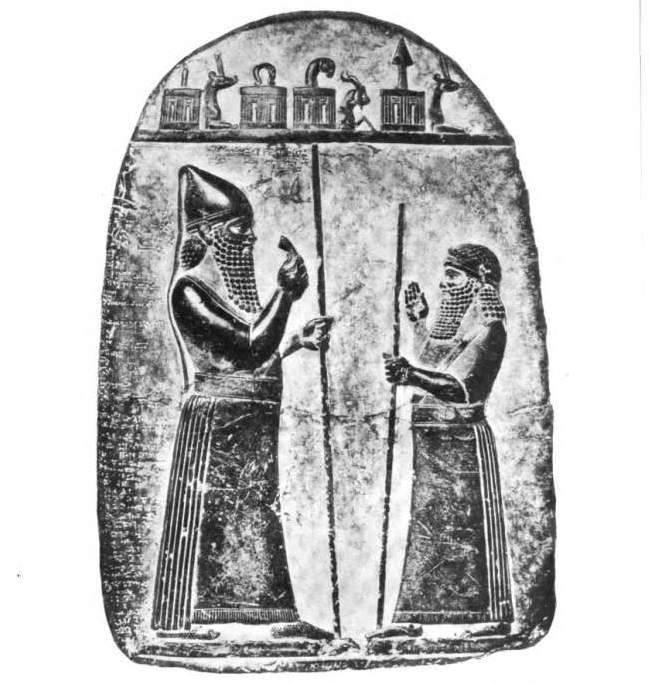
MERODACH-BALADAN II., KING OF BABYLON, MAKING A GRANT OF LAND TO BÊL-AKHÊ-ERBA, GOVERNOR OF BABYLON.
PREFACE
In the first volume of this work an account was given of the early races of Babylonia from prehistoric times to the foundation of the monarchy. It closed at the point when the city of Babylon was about to secure the permanent leadership under her dynasty of West-Semitic kings. The present volume describes the fortunes of Babylonia during the whole of the dynastic period, and it completes the history of the southern kingdom. Last autumn, in consequence of the war, it was decided to postpone its publication; but, at the request of the publishers, I have now finished it and seen it through the press. At a time when British troops are in occupation of Southern Mesopotamia, the appearance of a work upon its earlier history may perhaps not be considered altogether inopportune.
Thanks to recent excavation Babylon has ceased to be an abstraction, and we are now able to reconstitute the main features of one of the most famous cities of the ancient world. Unlike Ashur and Nineveh, the great capitals of Assyria, Babylon survived with but little change under the Achæmenian kings of Persia, and from the time of Herodotus onward we possess accounts of her magnificence, which recent research has in great part substantiated. It is true that we must modify the description Herodotus has left us of her size, but on all other points the accuracy of his information is confirmed. The Lion Frieze of the Citadel and the enamelled beasts of the Ishtar Gate enable us to understand something of the spell she cast. It is claimed that the site has been identified of her most famous building, the Hanging Gardens of the royal palace; and, if that should prove to be the case, they can hardly be said to have justified their reputation. Far more impressive is the Tower of Babel with its huge Peribolos, enclosing what has been aptly described as the Vatican of Babylon.
The majority of the buildings uncovered date from the Neo-Babylonian period, but they may be regarded as typical of Babylonian civilization as a whole. For temples were rebuilt again and again on the old lines, and religious conservatism retained the mud-brick walls and primitive decoration of earlier periods. Even Nabopolassar's royal palace must have borne a close resemblance to that of Hammurabi; and the street network of the city appears to have descended without much change from the time of the First Dynasty. The system which Hammurabi introduced into the legislation of his country may perhaps have been reflected in the earliest attempt at town-planning on a scientific basis. The most striking fact about Babylon's history is the continuity of her culture during the whole of the dynastic period. The principal modification which took place was in the system of land-tenure, the primitive custom of tribal or collective proprietorship giving place to private ownership under the policy of purchase and annexation deliberately pursued by the West-Semitic and Kassite conquerors. A parallel to the earlier system and its long survival may be seen in the village communities of India at the present day.
In contrast to that of Assyria, the history of Babylon is more concerned with the development and spread of a civilization than with the military achievements of a race. Her greatest period of power was under her first line of kings; and in after ages her foreign policy was dictated solely by her commercial needs. The letters from Boghaz Keui, like those from Tell el-Amarna, suggest that, in keeping her trade connexions open, she relied upon diplomacy in preference to force. That she could fight at need is proved by her long struggle with the northern kingdom, but in the later period her troops were never a match for the trained legions of Assyria. It is possible that Nabopolassar and his son owed their empire in great measure to the protecting arm of Media; and Nebuchadnezzar's success at Carchemish does not prove that the Babylonian character had suddenly changed. A recently recovered letter throws light on the unsatisfactory state of at least one section of the army during Nebuchadnezzar's later years, and incidentally it suggests that Gobryas, who facilitated the Persian occupation, may be identified with a Babylonian general of that name. With the fall of Media, he may perhaps have despaired of any successful opposition on his country's part.
Babylon's great wealth, due to her soil and semi-tropical climate, enabled her to survive successive foreign dominations and to impose her civilization on her conquerors. Her caravans carried that civilization far afield, and one of the most fascinating problems of her history is to trace the effect of such intercourse in the literary remains of other nations. Much recent research has been devoted to this subject, and the great value of its results has given rise in some quarters to the view that the religious development of Western Asia, and in a minor degree of Europe, was dominated by the influence of Babylon. The theory which underlies such speculation assumes a reading of the country's history which cannot be ignored. In the concluding chapter an estimate has been attempted of the extent to which the assumption is in harmony with historical research.
The delay in the publication of this volume has rendered it possible to incorporate recent discoveries, some of which have not as yet appeared in print. Professor A. T. Clay has been fortunate enough to acquire for the Yale University Collection a complete list of the early kings of Larsa, in addition to other documents with an important bearing on the history of Babylon. He is at present preparing the texts for publication, and has meanwhile very kindly sent me transcripts of the pertinent material with full permission to make use of them. The information afforded as to the overlapping of additional dynasties with the First Dynasty of Babylon has thrown new light on the circumstances which led to the rise of Babylon to power. But these and other recent discoveries, in their general effect, do not involve any drastic changes in the chronological scheme as a whole. They lead rather to local rearrangements, which to a great extent counterbalance one another. Under Babylon's later dynasties her history and that of Assyria are so closely inter-related that it is difficult to isolate the southern kingdom. An attempt has been made to indicate broadly the chief phases of the conflict, and the manner in which Babylonian interests alone were affected. In order to avoid needless repetition, a fuller treatment of the period is postponed to the third volume of this work. A combined account will then also be given of the literature and civilization of both countries.
I take this opportunity of expressing my thanks to Monsieur F. Thureau-Dangin, Conservateur-adjoint of the Museums of the Louvre, for allowing me last spring to study unpublished historical material in his charge. The information he placed at my disposal I found most useful during subsequent work in the Ottoman Museum at Constantinople shortly before the war. Reference has already been made to my indebtedness to Professor Clay, who has furnished me from time to time with other unpublished material, for which detailed acknowledgment is made in the course of this work. With Professor C. F. Burney I have discussed many of the problems connected with the influence of Babylon upon Hebrew literature; and I am indebted to Professor A. C. Headlam for permission to reprint portions of an article on that subject, which I contributed in 1912 to the Church Quarterly Review.
To Dr. E. A. Wallis Budge my thanks are due, as he suggested that I should write these histories, and he has given me the benefit of his advice. To him, as to Sir Frederic Kenyon and Mr. D. G. Hogarth, I am indebted for permission to make use of illustrations, which have appeared in official publications of the British Museum. My thanks are also due to Monsieur Ernest Leroux of Paris for allowing me to reproduce some of the plates from the "Mémoires de la Délégation en Perse," published by him under the editorship of Monsieur J. de Morgan; and to the Council and Secretary of the Society of Biblical Archæology for the loan of a block employed to illustrate a paper I contributed to their Proceedings. The greater number of the plates illustrating the excavations are from photographs taken on the spot; and the plans and drawings figured in the text are the work of Mr. E. J. Lambert and Mr. C. O. Waterhouse, who have spared no pains to ensure their accuracy. The designs upon the cover of this volume represent the two most prominent figures in Babylonian tradition. In the panel on the face of the cover the national hero Gilgamesh is portrayed, whose epic reflects the Babylonian heroic ideal. The panel on the back of the binding contains a figure of Marduk, the city-god of Babylon, grasping in his right hand the flaming sword with which he severed the dragon of chaos.
L. W. KING.
CONTENTS
CHAPTER I
INTRODUCTORY: BABYLON'S PLACE IN THE HISTORY OF ANTIQUITY
Babylon as a centre of civilization—Illustrations of foreign influence—Babylon's share in the origin of the culture she distributed—Causes which led to her rise as capital—Advantages of her geographical position—Transcontinental lines of traffic—The Euphrates route, the Royal Road, and the Gates of Zagros—Her supremacy based on the strategic and commercial qualities of her site—The political centre of gravity in Babylonia illustrated by the later capitals, Seleucia, Ctesiphon, and Baghdad—The Persian Gulf as barrier, and as channel of international commerce—Navigation on the Euphrates and the Tigris—Causes of Babylon's deposition—Her treatment by Cyrus, Alexander, and Seleucus—The Arab conquest of Mesopotamia instructive for comparison with the era of early city-states—Effect of slackening of international communications—Effect of restoration of commercial intercourse with the West—Three main periods of Babylon's foreign influence—Extent to which she moulded the cultural development of other races-Traces of contact in Hebrew religion and in Greek mythology—Recent speculation on the subject to be tested by the study of history 1
CHAPTER II
THE CITY OF BABYLON AND ITS REMAINS: A DISCUSSION OF THE RECENT EXCAVATIONS
The site of Babylon in popular tradition—Observations of Benjamin of Tudela and John Eldred—Exaggerations of early travellers—The description of Herodotus—Modern survey and excavation—Characteristics of Babylonian architecture—The architect's ideal—Comparison of Babylonian and Assyrian architectural design—Difficulties of Babylonian excavation—The extent of Babylon and the classical tradition—Remains of the ancient city—The Walls of Babylon—The Outer City-wall—The Mound Bâbil—The Ḳaṣr—The Inner City-wall—Imgur-Bêl and Nimitti-Bêl—Quay-walls and fortifications—Nebuchadnezzar's river-fortification—Change in the course of the Euphrates—Palaces of Nabopolassar and Nebuchadnezzar—The official courts of the palace—Al-Bît-shar-Bâbili—The Throne-Room and its enamelled façade—The private palace and the women's apartments—The Hanging Gardens of Babylon—The Ishtar Gate and its Bulls and Dragons—Later defences of the Southern Citadel —The Lion Frieze—The Procession Street—Temples of Babylon—E-makh, the temple of Ninmakh—Altars in the Babylonian and Hebrew cults—The unidentified temple—The temple of Ishtar of Akkad—Religious mural decoration—The temple of Ninib—E-sagila and the Tower of Babylon—The Peribolos or Sacred Precincts—E-zida and the Temple-tower of Borsippa—The Euphrates bridge—Merkes and the street net-work of Babylon—Strata of different periods—Early Babylonian town-planning—Material influence of the West-Semitic Dynasty—Continuity of Babylonian culture 14
CHAPTER III
THE DYNASTIES OF BABYLON: THE CHRONOLOGICAL SCHEME IN THE LIGHT OF RECENT DISCOVERIES
Chronology the skeleton of history—Principal defect in the Babylonian scheme—The Dynasties of Nîsin, Larsa and Babylon—Discovery of a List of the kings of Larsa—Introduction of fresh uncertainty—Relationship of the kings of Babylon and Nîsin—Absence of synchronisms—Evidence of date-formula?.—A fresh and sounder line of research—Double-dates supply the missing link for the chronology—The Nîsin era—Explanation of the double-dates—The problem of Rîm-Sin—Method of reconciling data—Another line of evidence—Archæological research and the Second Dynasty of the Kings' List—Date-formulæ of Hammurabi, Samsu-iluna and Iluma-ilum—Methods of fixing period of First Dynasty—Ammi-zaduga's omens from the planet Venus—Combinations of Venus, sun, and moon—Possibility of fixing period of observations—Alternative dates in their relation to historical results—The time of harvest in farming-out contracts of the period—Probable date for the First Dynasty—Re-examination of chronological notices in later texts—The Dynasties of Berossus and the beginning of his historical period—Effect of recent discoveries on the chronological scheme as a whole—Our new picture of the rise of Babylon 87
CHAPTER IV
THE WESTERN SEMITES AND THE FIRST DYNASTY OF BABYLON
Original home of the Amurru, or Western Semites—Arabia one of the main breeding-grounds of the human race—The great Semitic migrations and their cause—Evidence of diminution of rainfall in Arabia—The life of the pastoral nomad conditioned by the desert—The change from pastoral to agricultural life—Successive stages of Canaanite civilization—The neolithic inhabitants and the Amorite migration—Canaanites of history and their culture—Eastern Syria and the middle Euphrates—Recent excavations at Carchemish and its neighbourhood—Early Babylonian cylinder-seals on the Sajûr—Trade of Carchemish with Northern Babylonia—West Semitic settlements on the Khâbûr—The kingdom of Khana—The Amorite invasion of Babylonia—The Dynasties of Nîsin and Larsa—Recent discoveries at Ashur—Proto-Mitannians—The Western Semites in Babylon and their conflict with Assyria—Early struggles and methods of expansion—The Elamite conquest of Larsa—The three-cornered contest of Nîsin, Elam and Babylon—The fall of Nîsin and the duel between Babylon and Elam—Hammurabi's defeat of Rîm-Sin and the annexation of Sumer by Babylon—Extent of Hammurabi's empire—Hammurabi the founder of Babylon's greatness—His work as law-giver and administrator 119
CHAPTER V
THE AGE OF HAMMURABI AND ITS INFLUENCE ON LATER PERIODS
The energy of the Western Semite and his perpetuation of a dying culture—His age one of transition—Contemporaneous evidence on social and political conditions—The three grades in the social scale of Babylon—The nobles a racial aristocracy—Origin and rights of the middle class—Condition of slaves—Pastoral and agricultural life in early Babylonia—Regulations sanction long-established custom—The corvée for public works—Canals and fishing-rights—Methods of irrigation and their modern equivalents—Survival of the Babylonian plough and grain-drill—Importance of the date-palm and encouragement of plantations—Methods of transport by water—The commercial activities of Babylon and the larger cities—Partnerships for foreign trade—Life in the towns—Family life in early Babylonia—The position of women—Privileges enjoyed by votaries—The administration of justice—Relation of the crown and the priestly hierarchy under the Western Semites—The royal regulation of the calendar and the naming of the year—System of administration—Changes in the religious sphere and revision of the pantheon—Literary activity—The complete semitization of the country unaccompanied by any break in culture—Babylon's later civilization moulded by Hammurabi's age 162
CHAPTER VI
THE CLOSE OF THE FIRST DYNASTY OF BABYLON AND THE KINGS FROM THE COUNTRY OF THE SEA
Condition of the empire on Samsu-iluna's accession—Early Kassite raid the signal for revolt, assisted by Elamite invasion—Resources of Babylon strained in suppressing the rebellion—Rise of an independent kingdom in the Sea-Country on the littoral of the Persian Gulf—Capacity of the Sea-Country for defence and as a base for offensive operations—Sumerian elements in its population—Babylon's loss of territory and her struggle with the Sea-Country kings—Symptoms of decadence under the later West-Semitic kings of Babylon—The deification of royalty and increased luxury of ritual—Evidence of Babylon's growing wealth and artistic progress under foreign influence—Temporary restoration of Babylon's power under Ammi-ditana—Renewed activity of the Sea-Country followed by gradual decline of Babylon—The close of the West-Semitic dynasty brought about or hastened by Hittite invasion—Period of local dynasties following the fall of Babylon—Continued succession of the Sea-Country kings 197
CHAPTER VII
THE KASSITE DYNASTY AND ITS RELATIONS WITH EGYPT AND THE HITTITE EMPIRE
The Kassite conquest of Babylonia—The Kassites probably Aryans by race and akin to the later rulers of Mitanni—Character of their rule in Babylon—Their introduction of the horse into Western Asia—The Kassite conquest of the Sea-Country and its annexation to Babylon—Gap in our knowledge of the Kassite succession—The letters from Tell el-Amarna and Boghaz-Keui—Egypt and Western Asia at the close of the fifteenth century—Diplomacy and the balance of power—Dynastic marriages and international intercourse of the period—Amen-hetep III. and Kadashman-Enlil—Akhenaten and his policy of doles—Babylon's caravans in Syria—The correspondence of Burna-Buriash and Akhenaten—Egypt's loss of her Asiatic provinces—Rise of the Hittite Empire—The Hittites and their civilization—Their capital of Khatti—Their annexation of Mitanni and the Egyptian war—The relations of Khattusil with Kadashman-turgu and Kadashman-Enlil II.—Character of the Hittite correspondence—The growth of Assyria and her relations with Babylon—First phase in the long struggle of the two kingdoms —The later members of the Kassite Dynasty—Its fall to be traced to Elamite invasion—Economic conditions in Babylonia under the Kassites—Kudurru-inscriptions or boundary-stones—Their evidence on the Babylonian system of land-tenure—Gradual disappearance of tribal proprietorship as a result of West-Semitic and Kassite policy—Transition from collective to private ownership 214
CHAPTER VIII
THE LATER DYNASTIES AND THE ASSYRIAN DOMINATION
Spoils at Susa from the Elamite invasion—Recovery of her territory by Babylon under Nebuchadnezzar I.—Renewal of conflicts and treaties with Assyria—The devastation of Babylonia by the Sutû—Ephemeral Babylonian dynasties—The state of Sippar typical of the condition of the country—Renaissance of Assyria—The conquests of Ashur-uasir-pal and Babylon's abortive opposition—Babylonian art in the ninth century—Intervention of Shalmaneser III. in Babylonian politics—His campaign in Chaldea—The kingdom of Urartu and its effect on Assyrian expansion—Independence of provincial governments during a relaxation of central control—Temporary recovery of Babylon under Nabonassar—Gradual tightening of Assyria's grasp upon the southern kingdom—Character of her later empire—Tiglath-pileser IV.'s policy of deportation and its inherent weakness—The disappearance of Erartu as a buffer state—Sargon and Merodach-baladan—Sennacherib's attempt to destroy Babylon—Esarhaddon's reversal of his father's policy—The Assyrian conquest of Egypt—Ashur-bani-pal and the revolt of Shamash-shum-ukîn—The sack of Susa—Babylon under the Sargonids—The policies of encouragement and coercion—Effect of their alternation 252
CHAPTER IX
THE NEO-BABYLONIAN EMPIRE AND THE PERSIAN CONQUEST
Nabopolassar and his nascent kingdom—The Scythian invasion and its effects—The sons of Ashur-bani-pal—Nabopolassar and the Medes—The fall of Nineveh—Division of Assyrian territory—Babylon's conflict with Egypt—Nebuchadnezzar II. and the Battle of Carchemish—Capture of Jerusalem and deportation of the Jews—Occupation of Phoenicia and siege of Tyre—Nebuchadnezzar's later campaign in Egypt—Babylon and the Median suzerainty—Lydia under the successors of Ardys—Conflict of Cyaxares and Alyattes on the Halys and the intervention of Babylon—Nebuchadnezzar as builder—Condition of the Babylonian army in Nebuchadnezzar's closing years and under his successors—Gubaru, the general, and the governor of Gutium—Death of Neriglissar—Character of Nabonidus—The decaying empire under Median protection—The rise of Cyrus—His ease in possessing himself of Media, and the probable cause—His defeat and capture of Croesus and the fall of Lydia—His advance on Babylon—Possibility that Gobryas was a native Babylonian—His motive in facilitating the Persian occupation—Defeat and death of Belshazzar—Popularity of Cyrus in Babylon—Tranquillity of the country under Persian rule—Babylon's last bids for independence—Her later history—Survival of Babylonian cults into the Christian era 275
CHAPTER X
GREECE, PALESTINE, AND BABYLON: AN ESTIMATE OF CULTURAL INFLUENCE
Influence of Babylon still apparent in the modern world—The mother of astronomy, and the survival of her ancient system of time-division—The political and religious history of the Hebrews in the light of Babylonian research—Echoes from Babylonian legends in Greek mythology—The Babylonian conception of the universe—The astral theory and its comprehensive assumptions—Was Babylonian religion essentially a star-worship?—Application of historical test—Evolution of the Babylonian god—Origin of divine emblems and animal symbolism—World Ages and the astral theory—Late evidence and the earlier historical periods—The astral ages of the Twins, the Bull and the Ram—Suggested influence of each age upon the historical literature of antiquity—The Old Testament and the Odyssey under astral interpretation—Astronomical defects of the astral theory—The age of Babylonian astronomy—Hipparchus of Nicæa and the precession of the equinoxes—Hebrews and Babylonian astrology—Contrast of the Babylonian and Hellenic temperaments—Mesopotamia and the coast-lands of Asia Minor—Tales that are told 289
APPENDICES
I. A COMPARATIVE LIST OF THE DYNASTIES OF NISIX, LAKSA, AND BABYLON 318
II. A DYNASTIC LIST OF THE KINGS OF BABYLON 320
INDEX 323
LIST OF PLATES
I. Merodach-baladan II., King of Babylon, making a grant of land to Bêl-akhê-erba, governor of Babylon Frontispiece
II. (i) The temple-tower of E-zida at Borsippa. (ii) The Lion of Babylon on the Ḳaṣr Mound 18
III. The Throne Room in Nebuchadnezzar's palace at Babylon, showing the recess in the back wall where the throne once stood 39
IV. Eastern Towers of the Ishtar Gate, the portions preserved having formed the foundation of the final gateway 48
V. Trench showing a portion of the Sacred Way of Babylon, to the east of the Peribolos 61
VI. Two views of the Temple of Ninib in course of excavation 72
VII. Brick of Sin-idinnam, King of Larsa, recording the cutting of a canal and the restoration of the Temple of the Moon-god in the city of Ur 90
VIII. Hammurabi, King of Babylon, from a relief in the British Museum, dedicated on his behalf to the West Semitic goddess [Ash]ratum by Itur-ashdum, a provincial governor 97
IX. Brick of Warad-Sin, King of Larsa, recording building operations in the city of Ur 105
X. The Citadel Mound of Carchemish from the north-west 128
XI. Upper portion of the Code of Hammurabi, engraved with a scene representing the king receiving his laws from the Sun-god 144
XII.(i) Bronze cone and votive figure, (ii) Stone cylinder with a votive inscription of Warad-Sin, King of Larsa 153
XIII. Portion of the text of Hammurabi's Code, Columns 6-8 168
XIV. A modern gufa, a form of coracle described by Herodotus and represented on the monuments 177
XV. (i) A small kelek on the Tigris at Baghdad, (ii) Ferry-boats on the Euphrates at Birejik 184
XVI. Impressions of Babylonian cylinder-seals, engraved with mythological subjects 193
XVII. Impressions of Kassite cylinder-seals 199
XVIII. Brick of Sin-gashid, King of Erech, recording the building of his palace in that city 210
XIX. Head of a colossal statue of Amen-hetep III 220
XX. Hittite hieroglyphic inscription at Carchemish 241
XXI. Kassite kudurrus, or boundary-stones, set up in the reigns of Meli-Shipak II. and Nazi-maruttash 248
XXII. Divine emblems on the upper part of akudurru, or boundary-stone, engraved with a charter of privileges granted by Nebuchadnezzar I 255
XXIII. Memorial-tablet of Nabû-aplu-iddina, King of Babylon, recording his restoration of the Sun-temple at Sippar 260
XXIV. Shalmaneser III. receiving the submission of the Chaldeans, from the bronze sheathing of his Gates in the British Museum 269
XXV. Ashur-bani-pal, represented carrying a builder's basket, as the restorer of E-sagila, the temple of Marduk at Babylon 273
XXVI. Bronze door-step from E-zida, the temple of Nabû at Borsippa, inscribed with the name and titles of Nebuchadnezzar II. 278
XXVII. (i) Baked clay foundation-cylinder of Nabonidus, referring to the defeat of Astyages by Cyrus, (ii) Baked clay foundation-cylinder of Cyrus, recording his entry into Babylon "without battle and without fighting" 287
XXVIII. Impressions of Neo-Babylonian and Persian cylinder-seals 287
XXIX. Limestone statue of the god Nabû at Nimrûd292
XXX. Divine emblems sculptured on the lower portion of the boundary-stone engraved with a charter of Nebuchadnezzar I. (cp. Plate XXII.) 297
XXXI. Two views of a clay model of a sheep's liver with the surface divided up and labelled for purposes of divination 303
XXXII. A Neo-Babylonian treatise on astronomy, inscribed with classified lists of the principal stars and constellations, heliacal risings and settings, culminations in the south, etc. 311
ILLUSTRATIONS IN THE TEXT
1. Diagram to illustrate the political centre of gravity in Babylonia 8
2. Map of the neighbourhood of Babylon and Birs-Nimrûd; after the India Office Map 16
3. Plan of the ruins of Babylon; after Koldewey and Andrae 24
4. Ground-plan of part of the outer city-wall; after Koldewey and Andrae 26
5. Conjectural restoration of the Southern Citadel; after Andrae 29
6. Plan of the Southern Citadel; after Koldewey, Reuther, and Wetzel 31
7. Ground-plan of quay-walls and fortification-walls in the north-west corner of the Southern Citadel; after Koldewey 32
8. Section of the quay-walls and fortification-walls along the north front of the Southern Citadel; after Andrae 34
9. Plan of the Throne Room of Nebuchadnezzar II. and part of the private palace; after Koldewey 42
10. Design in enamelled brick from the façade of the Throne Room 44
11. Plan of the north-east corner of the palace with the Vaulted Building; after Koldewey 46
12. Bull in enamelled brick from the Ishtar Gate 50
13. Dragon in enamelled brick from the Ishtar Gate 51
14. Ground-plan of the Ishtar Gate; after Koldewey 52
15. Section of the Ishtar Gate; after Andrae 53
16. Diagram to show the arrangement of the beasts of the Ishtar Gate; after Koldewey 54
17. Enamelled fragment of the Ishtar Gate still in position 56
18. Plan of the later defences of the Citadel upon the north, showing the walls with the Lion Frieze and the Ishtar Gate 57
19. Lion from the frieze of the Sacred Way to the north of the Ishtar Gate 59
20. Ground-plan of E-makh, the temple of the goddess Ninmakh; after Andrae 64
21. Conjectural restoration of E-makh; after Andrae 65
22. Gold plaque, with architectural design, from a Neo-Babylonian burial; enlargement after photo, by Koldewey 67
23. Ground-plan of the unidentified temple known as "Z"; after Andrae 68
24. Conjectural restoration of the unidentified temple known as "Z"; after Andrae and Koldewey 69
25. Ground-plan of the temple of Ishtar of Akkad; after Reuther 70
20. Ground-plan of the temple of Ninib; after Andrae 71
27. Ground-plan of E-temen-anki and E-sagila; after Wetzel 74
28. Conjectural reconstruction of E-temen-anki and E-sagila; after Andrae 75
29. Ground-plan of E-zida and the temple-tower of Nabû at Borsippa; after Koldewey 78
30. Rough engraving of a temple-tower upon a boundary-stone 80
31. Plan of the Merkes Mound, showing part of the street network of Babylon; after Koldewey 82
32-33. Arabs of the seventh century b.c., from a sculpture in the Nineveh Gallery of the British Museum 123
34. Head of an archaic limestone figure from Ashur 137
35-30. Heads of archaic figures from Ashur and Tello 138
37-39. Examples of archaic sculpture from Ashur and Tello, exhibiting the same convention in the treatment of woollen garments 140
40. The Old Babylonian form of plough in use; after Clay 175
41. Assyrian kelek on the Tigris; after La yard 178
42. The Assyrian prototype of the gufa; from a bas-relief in the British Museum 179
43. Assyrian raft of logs on the Tigris; from a bas-relief in the British Museum 181
44. Swamp in Southern Babylonia, or the Sea-Country; after a bas-relief at Nineveh 201
45. The zebu or humped oxen of the Sea-Country; after a bas-relief from Nineveh in the British Museum 204
46. Akhenaten, with his queen and infant daughters, on the balcony of their palace; after N. de G. Davies 223
47-48. Representations of Hittites in Egyptian sculpture; after Meyer 226
49. Hittite foot-soldiers at the Battle of Kadesh; after Meyer 227
50. Hittite chieftain, a captive of Rameses III.; after Meyer 228
51. Figure, probably of a Hittite king, from the Royal Gate at Khatti; after a photo, by Puchstein 229
52. The Royal Gate of Khatti, the capital of the Hittites, viewed from the outside; after Puchstein 231
53. Conjectural restoration of a Hittite gateway viewed from outside; after Puchstein 232
54. Longitudinal section of the Lower Western Gateway at Khatti; after Puchstein 234
55. Transverse section of the Lower Western Gateway at Khatti; after Puchstein 235
56. One of the two sacred boats of Khonsu, the Egyptian Moongod, who journeyed into Cappadocia to cast out a devil from a Hittite princess; after Rosellini 238
57. Rameses II. offering incense to one of the boats of Khonsu before he started on his journey; after Rosellini 239
58. Scene representing Nabû-mukîn-apli sanctioning a transfer of landed property 258
59. Marduk and his dragon from a votive offering of Marduk-zakir-shum; after Weissbach 261
60. The Assyrian army in Chaldea, 851 b.c.; from the Gates of Shalmaneser in the British Museum 262
61. A Chaldean town of the ninth century b.c.; from the Gates of Shalmaneser 263
62-63. The tribute of the Chaldeans; from the Gates of Shalmaneser 264
64. Bas-relief of Shamash-rêsh-usur, governor of the lands of Sukhi and Mari; after a photo, by Weissbach 266
65. The god Adad from a votive offering dedicated in E-sagila by Esarhaddon; after Weissbach 271
66-68. The weather-god and two goddesses from an Assyrian bas-relief; after Layard 294
69. Figure of deity in portable shrine; after Layard 295
70. Sumerian harp, with the sound-case surmounted by the figure of a bull 298
71. The guardian lions of the Eastern Gate of Heaven, from the impression of a cylinder-seal in the Louvre; after Heuzey 299
72. Winged monster on enamelled frieze at Persepolis; after Dieulafoy 300
MAPS AND PLANS
I. Diagram to illustrate the political centre of gravity in Babylonia (Fig. 1) 8
II. Map of the neighbourhood of Babylon and Birs-Nimrûd (Fig. 2) 16
III. Plan of the ruins of Babylon (Fig. 3) 24
IV. Ground-plan of part of the outer city-wall (Fig. 4) 26
V. Plan of the Southern Citadel (Fig. 6) 31
VI. Ground-plan of quay-walls and fortification-walls in the N.W. corner of the S. Citadel (Fig. 7) 32
VII. Plan of the Throne Room of Nebuchadnezzar and part of the private palace (Fig. 9) 42
VIII. Plan of the N.E. corner of the palace with the Vaulted Building (Fig. 11) 46
IX. Ground-plan of the Ishtar Gate (Fig. 14) 52
X. Plan of the later defences of the Citadel upon the N., showing the walls with the Lion Frieze and the Ishtar Gate (Fig. 18) 57
XI. Ground-plan of E-makh, the temple of the goddess Ninmakh (Fig. 20) 64
XII. Ground-plan of the unidentified temple known as "Z" (Fig. 23) 68
XIII. Ground-plan of the temple of Ishtar of Akkad (Fig. 25) 70
XIV. Ground-plan of the temple of Ninib (Fig. 20) 71
XV. Ground-plan of E-temen-anki and E-sagila (Fig. 27) 74
XVI. Ground-plan of E-zida and the temple-tower of Nabii at Borsippa (Fig. 29) 78
XVII. Plan of the Merkes Mound, showing part of the street network of Babylon (Fig. 31) 83