Chapter X
Reading edition
GREECE, PALESTINE AND BABYLON: AN ESTIMATE OF CULTURAL INFLUENCE
During the Persian and Hellenistic periods Babylon exerted an influence upon contemporary races of which we may trace some survivals in the civilization of the modern world. She was the mother of astronomy, and the twelve divisions on the dial of our clocks and watches were ultimately derived, through Greek channels, from her ancient system of time-division. It was under the Neo-Babylonian kings that the Hebrew race first came into close contact with her culture, and there can be no doubt that the Jews, in the time of their captivity, renewed their interest in her mythology when they found it presented some parallels to their own. But in the course of this history it has been shown that, during far earlier periods, the civilization of Babylon had penetrated throughout a great part of Western Asia. It is admitted that, as a result of her westward expansion at the time of the First Dynasty, her culture had spread during subsequent periods to the Mediterranean coast-lands, and had moulded to some extent the development of those peoples with whom it came in contact. And since the religious element dominated her own activities in a greater measure than was the case with most other races of antiquity, it has been urged that many features in Hebrew religion and in Greek mythology can only be rightly explained by Babylonian beliefs in which they had their origin. It is the purpose of this chapter to examine a theory of Babylon's external influence, which has been propagated by a school of writers and has determined the direction of much recent research.
It is scarcely necessary to insist on the manner in which material drawn from Babylonian and Assyrian sources has helped to elucidate points in the political and religious history of Israel. Scarcely less striking, though not so numerous, are the echoes from Babylonian legends which have long been recognized as existing in Greek mythology. The best known example of direct borrowing is undoubtedly the myth of Adonis and Aphrodite, the main features of which correspond closely to the Babylonian legend of Tammuz and Ishtar. In this case not only the myth, but the accompanying festival and rites were also borrowed, passing to Greece by way of Byblos on the Syrian coast and Paphos in Cyprus, both centres of Astarte worship.[1] Another Greek legend, obviously of Babylonian origin, is that of Actseon, who is clearly to be identified with the shepherd, loved by Ishtar and changed by her into a leopard, so that he was hunted and killed by his own hounds.[2]
Some parallels have also long been pointed out between the national heroes Heracles and Gilgamesh. It is true that most races of antiquity possess stories of national heroes of superhuman strength and power, but there are certain features in the traditions concerning Heracles which may have some ultimate connexion with the Gilgamesh cycle of legends.[3] Less convincing is the analogy which has been suggested between Icarus and Etana, the Babylonian hero or demi-god, who succeeded in flying to the highest heaven only to fall headlong to the earth. For in Etana's case there is no question of human flight: he was carried to heaven by his friend the Eagle, to whose wings he clung while they mounted to heaven's gates. But the examples already referred to may suffice to illustrate the way in which it has long been agreed that Babylonian mythology may have left its impress on that of Greece.
But the views now held by a considerable body of scholars suggest a much broader extension of Babylonian influence than is implied by a series of isolated and fortuitous connexions; and, as the character of this influence is ex hypothesi astronomical, any attempt to define its limits with precision is a matter of some difficulty. For it will be obvious that, if we may assume an astronomical basis or background to any two mythologies, we at once detect a great number of common features the existence of which we should not otherwise have suspected. And the reason is not far to seek; for the astronomical phenomena with which we go to work are necessarily restricted in number, and they have to do duty many times over as a background in each system.[4] In spite of this disadvantage, which is inherent in their theory, Winckler and his school have rendered good service in working out the general relationship which was believed by the Babylonians to exist between the heavenly bodies and the earth.[5] He has shown sound reasons for assuming that, according to the tenets of Babylonian astrology, events and institutions on earth were in a certain sense copies of heavenly prototypes.
It is well known that the Babylonians, like the Hebrews, conceived the universe as consisting of three parts: the heaven above, the earth beneath, and the waters under the earth. The Babylonians gradually elaborated this conception of the universe, and traced in the heavens a parallel to the threefold division of earth, separating the universe into a heavenly and an earthly world. The earthly universe consisted as before of three divisions, that is to say the heaven (limited to the air or atmosphere above the earth), the earth itself, and the waters beneath it. Those corresponded in the heavenly world to the Northern heaven, the Zodiac, and the Southern heaven or heavenly ocean. By the later Babylonian period the greater gods had long become identified with the planets, and the lesser gods with the fixed stars, each deity having his special house or star in heaven in addition to his temple on earth. This idea appears to have been carried still further by the later Greek astrologers, by whom lands and cities in addition to temples were thought to have their cosmic counterparts.[6] But even for the Babylonians the moving stars were not merely symbols serving as interpreters to men of the divine will; their movements were the actual cause of events on earth. To use an apposite simile of Winckler, heaven was believed to be related to earth much as a moving object seen in a mirror was related to its reflection.[7]
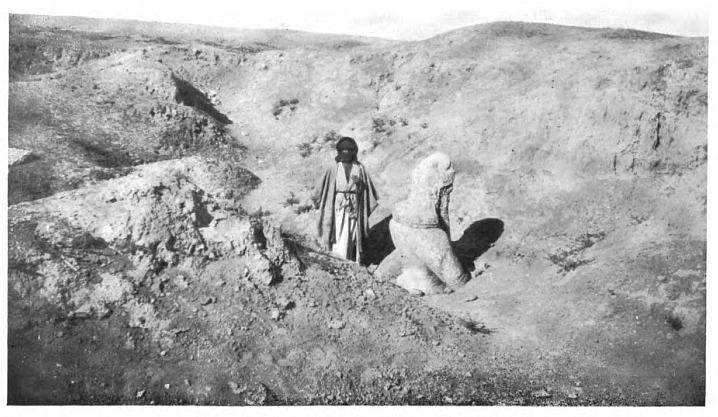
LIMESTONE STATUE OF THE GOD NABÛ AT NIMRÛD.
In order to illustrate the way in which these astral ideas are said to have supplied material to Greek mythology, a test instance may be selected, the suggested explanation of which involves one of the essential features of Winckler's astral system as he eventually elaborated it.[8] We will take the story of the Golden Lamb of Atreus and Thyestes, which is introduced by Euripides into one of the choruses in his Electra[9] According to the story, which is referred to, but not explicitly told, by Euripides, the Lamb with the Golden Fleece was brought by Pan to Atreus, and was regarded by the Argives as a sign that he was the true king. But his brother Thyestes, with the help of Atreus' wife, stole it and claimed to be king; so strife ensued, good was turned to evil, and the stars were shaken in their courses. It is curious that the theft of the Lamb should have such a special effect upon the heavens and the weather, for this is definitely stated in the second strophe and antistrophe of the chorus.[10] Though details are obscure, it is clear that we here have a legend with strongly marked astrological elements. The theft of the Lamb changes the sun's course, and from other lines in the chorus we gather that the alteration led to the present climatic conditions of the world, the rain-clouds flying northward and leaving "the seats of Amnion"—that is, the Libyan desert—parched and dewless.
In its original form the legend may well have been a story of the First Sin, after which the world was changed to its present state, both moral and atmospheric.[11] There is definite evidence that the Golden Lamb was identified with the constellation Aries; and since Babylon was admittedly the home of astrology, it is not an improbable suggestion, in spite of the reference to Ammon, that we should regard it as one of the lost legends of Babylon. According to Winckler's theory of the Babylonian religion, we should go further, and trace the origin of the legend to a convulsion in Babylonian thought which took place in the ninth and eighth centuries b.c. At this period, it is asserted, the sun at the vernal equinox was moving from the constellation Taurus into Aries, The bull, according to the theory, was identified with Marduk, the god of Babylon,[12] and all the time he was yielding his place to the Ram, Babylon was declining before the power of Assyria. The disorganization of the calendar and the seasons, due to the imperfect method of time-reckoning in vogue, was associated with this event, giving an impetus to a fresh birth of legends, one of which has found its way in a Greek dress into this chorus of Euripides. Or, as it has been put rather differently, the story is a piece of Babylonian astronomy misunderstood.
The theory underlying this interpretation of the legend is based on the axiom that the Babylonian religion was essentially a star-worship, and that behind every department of the national literature, secular as well as religious, lay the same astral conception of the universe. Before treating the theory in greater detail, it may be well to ascertain how far the history of the country substantiates this view. In the earliest period of which we have recovered material remains there can be no doubt that image-worship formed a characteristic feature of the Babylonian religious system, though we have no means of tracing its gradual evolution out of the fetish and stock-and-stone worship which necessarily preceded it.[13] The extraneous civilization, which the Sumerians introduced, most probably included cult-images of their gods, and these may well have been already anthropomorphic. Fashioned in the god's form, the image was believed to enshrine his presence, and for the Babylonians of all periods it never lost this animistic character.
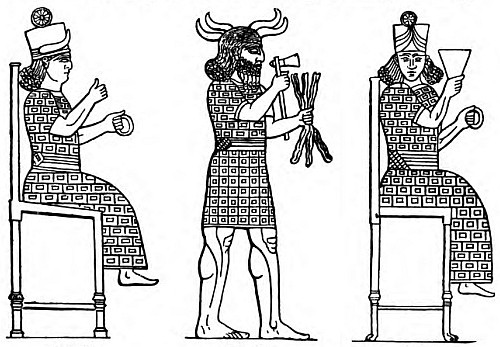
FIG. 66. FIG. 67. FIG. 68.
THE WEATHER-GOD AND TWO GODDESSES FROM AN ASSYRIAN BAS-RELIEF.
The goddesses wear the homed headdresses of Babylonian deities, and, as they are represented being carried by soldiers, they had probably been taken from a captured Babylonian town.
(After Layard.)
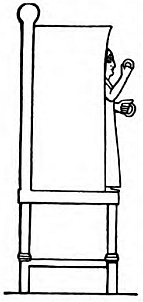
FIG. 69.
FIGURE OF DEITY IN SHRINE.
(After Layard.)
A tribal or city-god, in his earliest stage of development, was doubtless wholly identified with his cult-image. No more than one image of each was worshipped, and the idea of a god's existence apart from this visible form must have been of gradual growth.[14] The misfortunes of the material image, especially if unaccompanied by national disaster, would have fostered a belief in the god's existence apart from his visible body of wood or stone. And such a belief eventually developed into the Babylonian conception of a heavenly division of the universe, in which the great gods had their dwelling, making their presence manifest to men in the stars and planets that moved across the sky. But this development marked a great advance upon pure image-worship, and undoubtedly followed the growth of a pantheon out of a collection of separate and detached city-gods. We have no means of dating the association of some of the greater gods with natural forces. It would seem that, in the earlier Sumerian period, religious centres in the country were already associated with lunar and solar cults and with other divisions of nature-worship. But it is quite certain that, during all subsequent stages of Babylonian history, the divine image never degenerated into a mere symbol of divinity. Without consciously postulating a theory in explanation of his belief, the Babylonian found no difficulty in reconciling a localization of the divine person with his presence at other cult centres and ultimately with a separate life in the heavenly sphere.
That this was actually the case is proved by a number of historical examples. With the rise of Babylon we may note the important part which the actual image of Marduk played in each coronation ceremony and in the renewal of the king's oath at every subsequent Feast of the New Year; the hands of no other image than that in E-sagila would serve for the king to grasp. In Hammurabi's reign we see the Babylonian's conception of his visible gods reflected in his treatment of foreign images.[15] The international exchange of deities in the fourteenth and thirteenth centuries has already been referred to,[16] and the recovery of captured images was always recorded with enthusiasm.[17] For the images themselves constituted a nation's chief weapon of offence, and there was always the chance that, if properly treated by their captors, they might transfer their influence to the other side. This close connexion between the god and his image survived into the Neo-Babylonian period, and Nabonidus' offence in the eyes of the priesthood was simply that he ignored the feeling. Historical evidence thus suggests that the astral aspect of divinity in Babylonia was not an original feature of its religious system, and that it was never adopted to the exclusion of more primitive ideas.
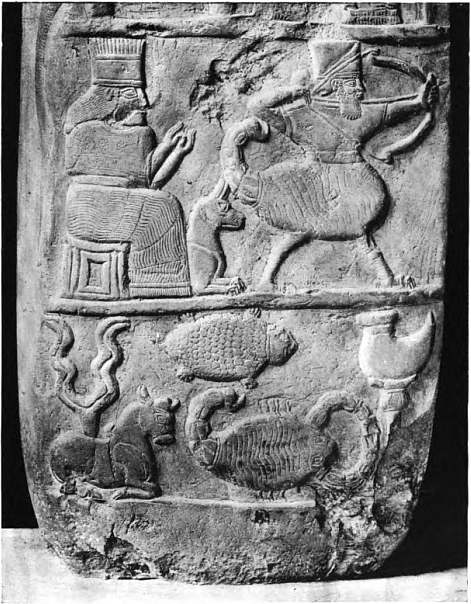
DIVINE EMBLEMS ON A CHARTER OF NEBUCHADNEZZAR I. Brit. Mus., No. 90838.
A similar result follows if we examine the relation of a Babylonian deity to his sculptured emblem, by means of which his authority or presence could in certain circumstances be secured or indicated. The origin of such emblems was not astrological, nor is it to be sought in liver-augury: they were not derived from fancied resemblances to animals or objects, presented either by constellations in heaven, or by markings on the liver of a victim. It is clear that they arose in the first instance from the characters or attributes assumed by the gods in the mythology; their transference to constellations was a secondary process, and their detection in liver-markings resulted, not in their own origin but in that of the omen.[18] In the earliest period the emblem of a city-god might symbolize his city's power,[19] and those of other deities expressed some quality in the character of their possessor, or were drawn from a weapon, object or animal with which they were associated in tradition.[20]
Another class of images were the animal forms, also drawn largely from the mythology, which adorned the earlier temples and were reproduced in enamelled brickwork on secular buildings by the Neo-Babylonian kings. Most of these, in the later as in the earlier periods, were placed near temple-entrances, and where stone was so plentiful that it could be used in bulk in the structure of buildings, the doorways themselves were carved in the same way. That animal forms were employed to symbolize sound is suggested by the representation of a great harp or lyre on a Sumerian-bas-relief, in which the figure of a bull surmounting the sound-case is evidently intended to suggest the peculiarly deep and vibrant tones of the instrument.[21] Moreover, on cylinder-seals engraved with the figure of the Sun-god emerging from the Eastern Gate of heaven, two lions are often set immediately above the opening doors, and in one specimen the gate-pivots rest upon a second pair arranged symmetrically below them.[22]
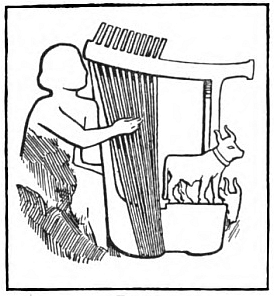
FIG. 70.
SUMERIAN HARP.
(After Déc. en Chald., pl. 23.)
The symbolism of these and similar monsters may well have been suggested by the grinding of the heavy doors in their stone sockets and the shrieking of thair bolts.[23] The noises suggested the cries of animals, which, in accordance with the tenets of primitive animism, were thought to inhabit the doors and gateways and to guard them. We may probably trace to this ancestry the colossal lions and winged bulls which flanked the doorways of Assyrian and Persian palaces, and, like the enamelled monsters of Babylon and Persepolis, continued to be reproduced as divine guardians of a building after their primitive associations had been forgotten or modified.[24]
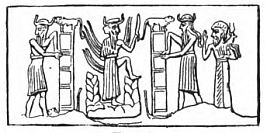
FIG. 71.
THE GUARDIAN LIONS OF THE EASTERN GATE OF HEAVEN.
(After Heuzey.)
Archæological evidence thus supports the view, already deduced from historical considerations, that astrology did not dominate the religious activities of Babylon. And an examination of the literature points to the same conclusion. Magic and divination bulk largely in the texts recovered, and in their case there is nothing to suggest an underlying astrological element.[25] We are the less inclined, therefore, to accept the axiom that an astral conception of the universe permeated and coloured Babylonian thought to such an extent, that not only myths and legends, but even historical events, were recorded in terms which reflect the movements of the sun, moon and planets and the other phenomena of the heavens. If we once grant this assumption, it might perhaps have followed, as the astral mythologists claim, that the beliefs of the Babylonian star-worshippers became the prevailing doctrine of the ancient East and left their traces broadcast upon the records of antiquity. But the original assumption appears to be unsound, and the theory can only find support by treating late evidence as applicable to all stages of Babylonian history.
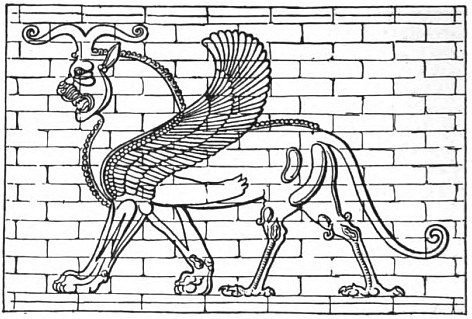
FIG. 72.
WINGED MONSTER ON ENAMELLED FRIEZE AT PERSEPOLIS.
(After Dieulafoy.)
The roots of the theory are placed in a purely imaginary age, where evidence for or against it is lacking. Thus the oldest monuments which have been recovered upon Babylonian sites are not considered relics of the early stages of Babylonian culture.[26] It is asserted that in the periods behind them there existed an elaborate and highly developed civilization, lying back in the darkness beyond the earliest extant records. In the total absence of material evidence, it is no difficult task to paint this age in colours which are shared by no other early or primitive race in the world's history. It is assumed that war and violence had no existence in Babylonia in this prehistoric time. Intellect dominated and controlled the passions of the primeval but highly gifted people, and in particular one form of intellectual conception based on a scientific knowledge of astronomy. It is postulated that a purely astronomical theory of the universe lay at the root of their civilization, and governed their whole thought and conduct. This was no teaching of a learned priesthood, but was a universally held belief which permeated every branch of the national and individual life. The theory in its perfect and uncorrupted state had perished with the other relics of its inventors. But it was inherited by the Semitic immigrants into Babylonia, and, though employed by them in an altered and corrupted form, has, it is said, left its traces in the later records. In this way the astral mythologist would explain the fragmentary character of his data, from which he claims to reconstruct the original beliefs in their entirety.
One such belief has been preserved by Seneca,[27] who, giving Berossus as his authority, refers to a Chaldean theory of a great year, a long cosmical period having, like the year, a summer and a winter. The summer is marked by a great conflagration produced by the conjunction of all the planets in Cancer, and the winter is characterized by a universal deluge caused by a similar conjunction of all the planets in Capricorn. The idea is evidently based on the conception that, as the succession of day and night corresponds to the changes of the seasons, so the year itself must correspond to greater cycles of time. Though Berossus is our earliest authority, the doctrine is regarded as a primitive Babylonian one. It is further argued that, even in the earliest period, the inhabitants of Babylonia conceived the history of the world to have been evolved in a series of successive ages, bearing the same relation to these aeons of the world-cycle as the year bore to them.
The theory of Ages of the World is familiar enough from the classical conception, first met with in Hesiod's "Works and Days,"[28] which profoundly influenced later Greek speculation. There is nothing particularly astral about Hesiod's conception of four ages, distinguished by the principal metals and showing progressive deterioration. But it is claimed that Hesiod's theory, and all parallel conceptions of World-Ages, are derived from a Babylonian prototype, Hesiod's Golden Age reflecting the general condition of prehistoric Babylonia. Assuming a close correspondence between the zodiac and the earth in early Babylonian thought, it is argued that the inhabitants of the country from the earliest periods divided the world's history into ages of about two thousand years each, according to the particular sign of the zodiac in which the sun stood each year at the vernal equinox, when the New Year's Festival was celebrated.[29] Although these ages are never named nor mentioned in the inscriptions, they are referred to by the astral mythologists as the Ages of the Twins, the Bull, and the Ram,[30] from the zodiacal constellations of Gemini, Taurus, and Aries.
This is a vital point of the theory and it postulates on the part of the early Babylonians a highly accurate knowledge of astronomy: it assumes a knowledge of the procession of the equinoxes, which could only be based on a very rigid system of astronomical observation and record.[31] But the ancient Babylonians are supposed to have been quite familiar with these facts, and to have traced a close connexion between them and the world's history. Certain myths are supposed to have characterized each of these world ages, not only affecting religious beliefs, but so obsessing Babylonian thought that they influenced historical writings. As the sun at the vernal equinox gradually progressed through the ecliptic constellations, so, according to the theory, the history of the world was believed to be evolved in harmony with its course, and the pre-ordained fate of the universe was slowly unrolled.
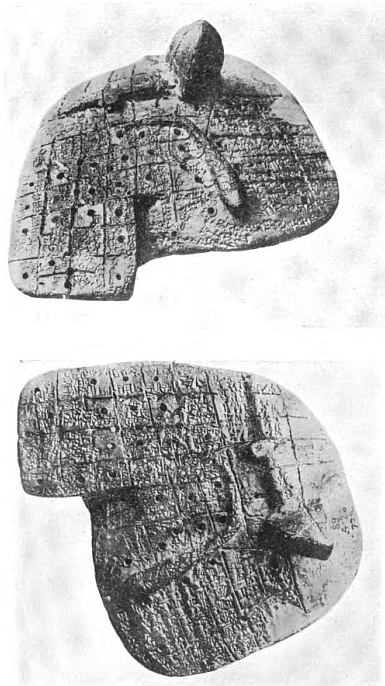
TWO VIEWS OF A CLAY MODEL OF A SHEEP'S LIVER, ANNOTATED FOR PURPOSES OF DIVINATION. Brit. Mus., No. 90668.
Up to this point the astral theory is very complete and, granting its original hypotheses, it goes smoothly enough. But as soon as its authors try to fit the existing legends to their theory, difficulties begin. In Babylonian mythology we find no pair of heroes who present any resemblance to the Dioscuri. But lunar cults were prominent in the earliest Babylonian epoch, and, in default of any closer parallel, the two phases of the waxing and the waning moon have been treated as characterizing the myths and legends of the Age of the Twins. Borrowing a term from music, they are described as the characteristic motif of the age. The second Age, that of the Bull, begins roughly with the rise of Babylon to power. There is very slender evidence for connecting Marduk, the god of Babylon, with the zodiacal constellation of the Bull, but the connexion is confidently assumed.[32] The Third Age, that of the Ram, presents even more difficulties than its two predecessors, for no amount of ingenuity can discover material for a Ram motif at Babylon. But Jupiter Amnion was represented with the head of a ram, and he is assumed to have been identical in his nature with Marduk. Thus the new reckoning is supposed to have passed over to Egypt, while Babylon remained unaffected.[33] The explanation put forward is that the Ram Age began at a time when the power of Babylon was on the decline; but why the Babylonians should therefore have ignored the true position of the sun at the vernal equinox is not quite obvious.
The foreign influence of Babylon's conception of the universe is said to have left its strongest imprint on Hebrew historical writing. It is claimed that the Biblical narratives relating to the earlier history of the Hebrews have in particular been influenced by the Babylonian myths of the universe, and that a great number of passages have in consequence an astral significance. This side of the subject has been worked out in detail by Dr. Alfred Jeremias,[34] and a few examples will suffice to illustrate the system of interpretation which is suggested. We will take one of the Babylonian legends which is said to be most frequently encountered in the Hebrew narratives, the Descent of the goddess Ishtar into the Underworld in search of her youthful husband Tammuz, which in its Babylonian form is unquestionably a nature-myth. There can be little doubt that in the myth Tammuz represents the vegetation of spring; this, after being parched up by the summer-heat, is absent from the earth during the winter months, until restored by the goddess of fertility. There is also no doubt that the cult of Tammuz eventually spread into Palestine, for Ezekiel in a vision saw women at the north gate of the temple at Jerusalem weeping for Tammuz.[35] We have already noted its arrival in Greece in the story of Adonis and Aphrodite.[36] In its Greek form the contest between Aphrodite and Persephone for the possession of Adonis reproduces the struggle between Ishtar and Ereshkigal in the Abode of the Dead; and the annual disappearance and reappearance of Tammuz gives rise in the Greek version to the decision of Zeus that Adonis should spend one part of the year above ground with Aphrodite and the other part underground with Persephone.[37] Such are the main facts, which are not disputed, concerning this particular Babylonian myth. We may now note the manner in which it is said that motifs from it are interwoven in the Old Testament with traditions concerning the early history of the Hebrews.
It is well known that in early Christian writings, such as the Syriac "Hymn of the Soul," a Gnostic composition of the second or third century A.D.,[38] the land of Egypt is sometimes referred to in a metaphorical or allegorical sense. It is suggested that the story of Abraham's journey with his wife Sarah into Egypt[39] may have been written, by a parallel system of allegory, in terms reflecting a descent into the underworld and a rescue from it. It is true that in the story Pharaoh's house is plagued, probably with sterility, a feature that recalls the cessation of fertility on earth while the goddess of love remains in the underworld. But the same motif is traced in the rescue of Lot from Sodom: here Sodom is the underworld. The pit into which Joseph is thrown by his brethren and the prison into which Potiphar casts him also represent the underworld: and his two fellow-prisoners, the chief baker and the chief butler, are two minor deities in Marduk's household.[40] The cave at Makkedah, in which the five kings of the Amorites hid themselves after their defeat by Joshua,[41] is said to have the same motif underlying it. In short, any cave, or prison, or state of misery mentioned in the Hebrew narratives may, according to astral interpretation, be taken as representing the underworld.[42]
The one other motif we will take from the Babylonian mythology is the Dragon-combat, since this illustrates the principal pattern, or system, on which the astral mythologist arranges his material. In the Babylonian story of the Creation it will be recalled how Tiamat, the dragon of chaos, revolted with Apsû, the god of the abyss, against the new and ordered ways of the gods; how Marduk, the champion of the gods, defeated her, and, cutting her body in half, used one half of her as a firmament for the heaven, and then proceeded to carry out his other works of creation.[43] The probability has long been noted that the Dragon-combat may have suggested certain metaphorical phrases or descriptions in Hebrew poetical and prophetic literature.[44] But the astral mythologist uses it as the dominant motif of his Age of Taurus; and, since this age began, according to his theory, before the period of Abraham, the Marduk myths are traced more frequently than any others in the Old Testament. The astral god plays the part of a deliverer in the mythology: hence any Biblical hero who is recorded to have rescued any one, or to have delivered his family or people, forms a convenient peg on which to hang a motif So too the birth of the founder of a dynasty, or of the inaugurator of a new age, is said to reflect the solar motif of the birth of the spring sun.[45]
In this process of detecting hidden motifs, numbers play an important part. To take one example, they are said to indicate that David's fight with Goliath reflects the myth of the Year-Cycle. The forty days during which Goliath, who is identified with the Dragon Tiamat,[46] drew near to the Israelites morning and evening are symbolical of winter. In the Hebrew text his height is given as six cubits and a span;[47] the figure is emended to read five cubits and a span, since otherwise the number would not correspond to the five and a quarter epagomenal days.[48] With the best will in the world to be convinced one cannot help feeling that, even assuming the soundness of the theory, its authors have let it run away with them. It cannot of course be denied that astrological conceptions may colour some of the stories in the Old Testament. The three hundred foxes, with firebrands tied to their brushes, with which Samson destroyed the standing corn of the Philistines, find a striking parallel in the ceremonial which took place annually in the circus at Rome during the Cerealia,[49] and may well be regarded as folk-mythology of astrological origin.[50] Elijah's chariot of fire may have been suggested by some astronomical phenomenon, perhaps a comet; it was probably the product of the same association of ideas as Medea's dragon-chariot, the gift of Helios. But this scarcely prepares us to accept such an allegorizing of details as is proposed in other passages.
Precisely the same principles of interpretation have been applied to the heroes of Greek legend. Professor Jensen of Marburg, in his work on the Babylonian epic of Gilgamesh, has attempted to trace almost every figure, not only in the Old Testament, but also in classical mythology, to a Babylonian source.[51] But his rather monotonous method of perceiving on all sides reflexions of his own hero Gilgamesh has already been criticized sufficiently, and we will take some examples from a more recent work by Dr. Carl Fries,[52] who has made other contributions of a less speculative character upon Greek and Oriental connexions. Elaborating a published suggestion of Professor Jensen, Dr. Fries has enthusiastically applied the astral method of interpretation to the Odyssey. Such an episode as the voyage of Odysseus to Hades, in order to consult the Theban prophet Teiresias, undoubtedly presents a close parallel to the journey of Gilgamesh to Xisuthros in Babylonian legend; and, though similar traditions are not uncommon in the epics of other races, the Greek form of the story may perhaps retain an echo from Babylon. But a far closer relationship than that is suggested.
The section of the Odyssey which is said to have been principally exposed to Babylonian influence is the sojourn of Odysseus in Scheria, the whole episode of his entertainment by the Phæacians being said to reflect the Babylonian Feast of the New Year. From the moment of his awakening on the island we begin to perceive astral motifs. In Nausicaa's choral game of ball with her maidens, the ball symbolizes the sun or moon which revolves from one side of heaven to the other; when it falls into the river it is the setting sun or moon. Odysseus, awakened by the maiden's shrill cry, comes forth from the darkness of the wood: he is the rising sun. The Way into the city which Nausicaa describes to Odysseus corresponds to the sacred Procession Street in Babylon, along which Marduk was carried from his temple through the city at the Feast of the New Year. The cult-image on its journey must be protected from the gaze of unconsecrated eyes; so Athene sheds a mist about Odysseus lest any of the Phæacians should accost him by the way. Other astral elements are suggested without a specially Babylonian colouring.[53]
We are not here concerned with Dr. Fries' theory on the origin of Greek tragedy, but we may note in passing that Odysseus, in relating his adventures, is the priestsinger at the festival of the Light-god. In other parts of the Odyssey Dr. Fries does not attempt to trace many astral motifs, though he certainly remarks that the adventures of Odysseus are merely survivals of astral myths, and, in spite of a hundred transformations, ultimately relate only to the journey of the Light-god over the heavenly ocean.[54] The closing scenes of the Odyssey also receive a thoroughly astrological interpretation, and moon- and sun-motifs appear promiscuously. From the speech of Antinous at the trial of the bow we know that the slaying of the wooers took place at the Feast of the New Moon, for after Eurymachus and the other wooers had failed to bend it, he makes the least an excuse for his proposal to postpone the trial till the morrow. This fact leads to the suggestion that in Odysseus returning at the Feast of the New Moon we are to recognize the Moon-god himself, who triumphs over the darkness with his bow or crescent. On the other hand, the twelve axes, through which the arrow flies, suggest, presumably by their number, the sun. Penelope wooed by the suitors is the moon whom the stars surround, and her weaving and unravelling of the web is a moon-motif. Then Odysseus as the sun draws near, and all the stars are eclipsed at his appearance.
In such hands the astral theory carries its own antidote, for one cannot but be struck with the ease with which it may be applied. There is generally no need to prove a mythological setting to the narrative; all that is necessary is to assume an astral meaning beneath the text.[55] In fact, one way of demonstrating its unsoundness has been to apply its methods to the records of the life of a historical personage.[56] But this argument amounts at best to a reductio ad absurdum, and the most damaging criticism has been directed from the purely astronomical side.
It is well known that the different ecliptic constellations which make up the signs of the zodiac do not each occupy thirty degrees of the ecliptic, but that some are longer and some shorter than others. Also, the constellations of the Babylonian astronomers during the late period did not completely coincide with ours. For instance, the most eastern star of our constellation Virgo was counted by the Babylonians of the Arsacid era as belonging to the next ecliptic constellation, Leo, since it was known as "the hind-foot of the lion."[57] But, fortunately for our purpose, not much doubt can exist as to the eastern limit of the Twins and the western limit of the Ram, which mark the beginning and end of the three World Ages of the astral mythologists. For the two bright stars, Castor and Pollux, from which the Twins receive their name were undoubtedly reckoned in that constellation by the Neo-Babylonians. And the easternmost star of our constellation of the Fishes (a piscium) was probably well beyond the Babylonian constellation of the Ham.
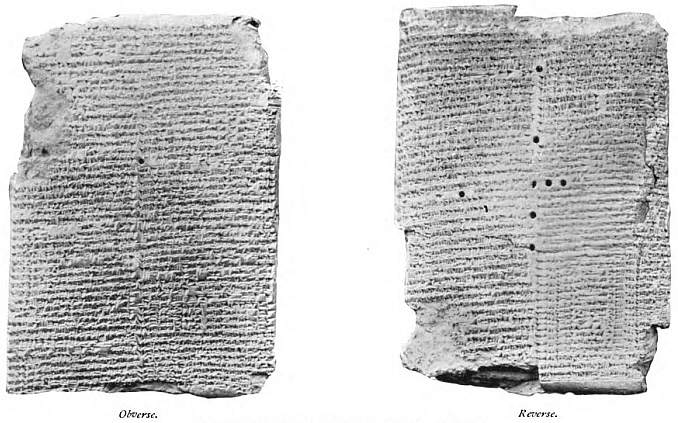
A NEO-BABYLONIAN TREATISE ON ASTRONOMY. Brit. Mus., No 86378.
Working on this assumption, and assuming thirty degrees to each of the three intervening constellations, Dr. Kugler has calculated the years in which the sun entered these signs of the zodiac at the vernal equinox, the points, that is to say, at which the astral World-Ages would have begun and ended. His figures entirely dispose of Winckler's claim to an astronomical basis for his astral system. The Age of the Twins, instead of ending, according to the theory, at about 2800 b.c., really ended in the year 4383 b.c. Thus the Age of the Bull began over fifteen hundred years before the birth of Sargon I., who is supposed to have inaugurated its beginning; and it ended in 2232 b.c.—that is, considerably before the birth of Hammurabi, under whom we are told the Bull Age motifs were principally developed. Moreover, from the time of the First Dynasty onwards down to the year 81 b.c.—that is to say, during the whole course of her history—Babylon was really living in the Age of the Ham, not in that of the Bull. Thus all the motifs and myths, which have been so ingeniously connected with the Bull sign of the zodiac, ought really to have been connected with the Ram. But even the astral mythologists admit that there is not a trace of a Ram-motif in the Babylonian mythology. Granting all the assumptions made by Winckler and his school with regard to the astronomical knowledge of the early Babylonians, the theory evolved from them is found to be baseless. Winckler's astronomy was at fault, and his three astrological World-Ages do not really correspond to his periods of history.[58]
Babylon was, indeed, the mother of astronomy no less than of astrology, and classical antiquity was indebted to her in no small measure: but, strictly speaking, her scientific observations do not date from a very early period. It is true we have evidence that, as early as the close of the third millennium, the astronomers recorded observations of the planet Venus,[59] and there is also a fragment of an early text which shows that they attempted to measure approximately the positions of the fixed stars. But their art of measuring remained for a long time primitive, and it was only the later Babylonians, of the period from the sixth to the first century b.c., who were enabled to fix with sufficient accuracy the movements of the planets, especially those of the moon, and by this means to found a reliable system of time-measurement. The mere fact that the astrological texts, even in the late Assyrian period, treat eclipses as possible on any day of the month, and use the term for any kind of obscuration of the sun and moon, is sufficient evidence that they had not at that time noted their regular occurrence and still had comparatively crude notions of astronomy.[60]
The earliest scientific document in the strict sense of the word dates from the second half of the sixth century, when we find for the first time that the relative positions of the sun and moon were calculated in advance, as well as the conjunction of the moon with the planets and of the planets with each other, their position being noted in the signs of the zodiac. But the tablets afford no evidence that the Babylonian astronomers possessed any knowledge of the precession of the equinoxes before the close of the second century b.c., and the traditional ascription of the discovery to Hipparchus of Nicæa, working between the years 161 and 126 b.c. on the observations of his Babylonian predecessors, may be accepted as accurate.[61]
There are, in short, no grounds for the theory that the Babylonians divided the history of the world into astral ages, nor that their myths and legends had any peculiar connexion with successive signs of the zodiac. That astrology formed an important section of the Babylonian religious system from an early period there can be no doubt; but at that time the stars and planets did not exercise any preponderating influence on religious belief, and many features of the system, for which an astral origin has been confidently assumed, must be traced to a simpler and more primitive association of ideas.[62] But the necessary modification of the astral theory still leaves open the possibility that Hebrew literature may have acquired a strong astrological tinge in the Exilic and post-Exilic periods. Were Jewish traditions affected in Babylon, for example, in some such way as the Mithraie legends from Persia? Since the astral theory has no claim to dictate the answer for us, the question must be decided by the ordinary rules of historical and literary evidence.
If we are to assume that Babylonian astrology exerted so marked an influence on the Jews of the Exile, we should at least expect to find some traces of it in practical matters and in terminology. And in this connexion there are certain facts which have never been fairly met by the astral mycologists.[63] It is true that the returning exiles under Zerubbabel had adopted the Babylonian names of the months for civil use; but the idea of hours—that is to say, the division of the day into equal parts—does not seem to have occurred to the Jews till long after the Exile, and even then there is no trace of the Babylonian double hour.[64] The other fact is still more significant. With the exception of a single reference to the planet Saturn by the prophet Amos,[65] none of the Hebrew names for the stars and constellations, which occur in the Old Testament, correspond to those we know were in use in Babylon. Such a tact is surely decisive against any wholesale adoption of astral mythology from Babylon on the part of the writers or redactors of the Old Testament, whether in pre-Exilic or in post-Exilic times. But it is quite compatible with the view that some of the imagery, and even certain lines of thought, occurring in the poetical and prophetic books of the Hebrews, betray a Babylonian colouring and may find their explanation in the cuneiform literature. There can be no doubt that the Babylonian texts have afforded invaluable assistance in the effort to trace the working of the oriental mind in antiquity.
With regard to the suggested influence of Babylon on Greek religious thought, it is essential to realize that the temperaments of the Babylonian and the Hellene were totally distinct, the fanatic and self-abasing spirit of the East contrasting vividly with the coolness, civic sobriety, and self-confidence of the West. This has been pointed out by Dr. Farnell,[66] who lays special emphasis on the total absence of any trace in Mesopotamian cults of those religious mysteries, which, as he has shown elsewhere, formed so essential a feature in Hellenic and Ægean society.[67] Another fact in which he would see significance is that the use of incense, universal from immemorial times in Babylonia, was not introduced into Greece before the eighth century b.c. This little product, it will be readily admitted, was much easier to import than Babylonian theology. Few will disagree with him in regarding the suggestion, that for long centuries the Hittite empire was a barrier between Mesopotamia and the coast-lands of Asia Minor,[68] as a sufficient reason for this check in the direct spread of Babylonian influence westward. But no political barrier is effective against the tales that are remembered by travelling merchants and are retold around the camp-fires of the caravan. That Babylon should have contributed in some degree to the rich store of legends current in various forms throughout the region of the eastern Mediterranean is what one would expect.
The cultural influence of Babylonia had from the earliest period penetrated eastward, and the civilization of Elam, her nearest neighbour, had been to a great extent moulded by that of Sumer. But even at that time the trade-routes had been open to the west, and before the rise of Babylon both soldier and merchant had passed from the lower Euphrates into Syria. With the expansion of the Western Semites the two regions were drawn into more intimate relationship, and the political control of the middle Euphrates, first established in the age of Hammurabi, was followed by an increased commercial traffic, which continued with few interruptions into the Neo-Babylonian and later periods. Babylon's foreign policy was always dominated by the necessity of keeping her connexion open with the west: and it was mainly due to her commercial enterprise, and not to any territorial ambitions, that her culture reached the farther limits of Palestine and has left some traces in Greek mythology.
APPENDICES
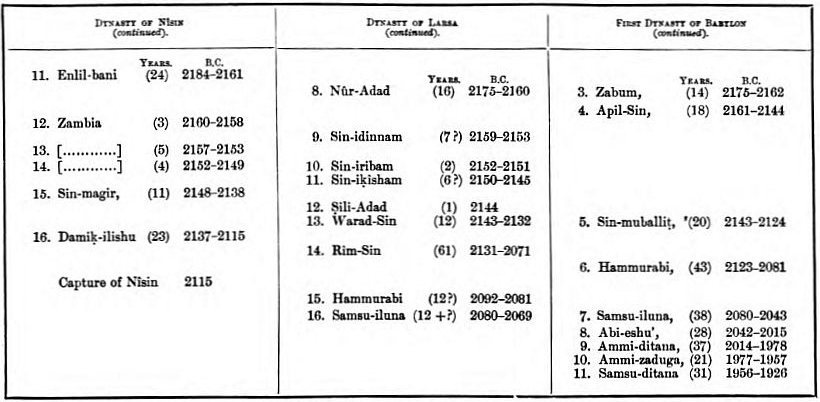
I.—A COMPARATIVE LIST OF THE DYNASTIES OF NÎSIN, LARSA AND BABYLON.
II.—A DYNASTIC LIST OF THE KINGS OF BABYLON.
EXPLANATORY NOTE.—A comma after a king's name implies that he was succeeded by his son. The figures within parentheses, which follow a king's name, indicate the number of years he ruled. Contemporaneous reigns are set opposite each other in the parallel columns, but their respective lengths are indicated only approximately by the spacing of the names.
I.—A COMPARATIVE LIST OF THE DYNASTIES OF NÎSIN, LARSA AND BABYLON.
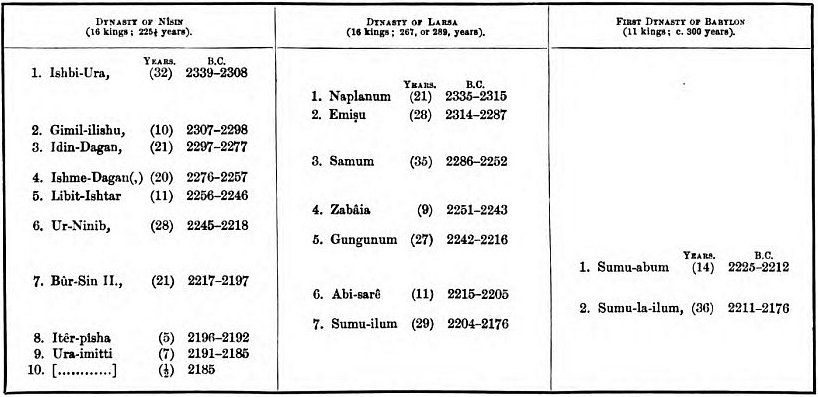
I. A COMPARATIVE LIST OF THE DYNASTIES OF NÎSIN, LARSA, AND BABYLON (continued).
II. A DYNASTIC LIST OF THE KINGS OF BABYLON.
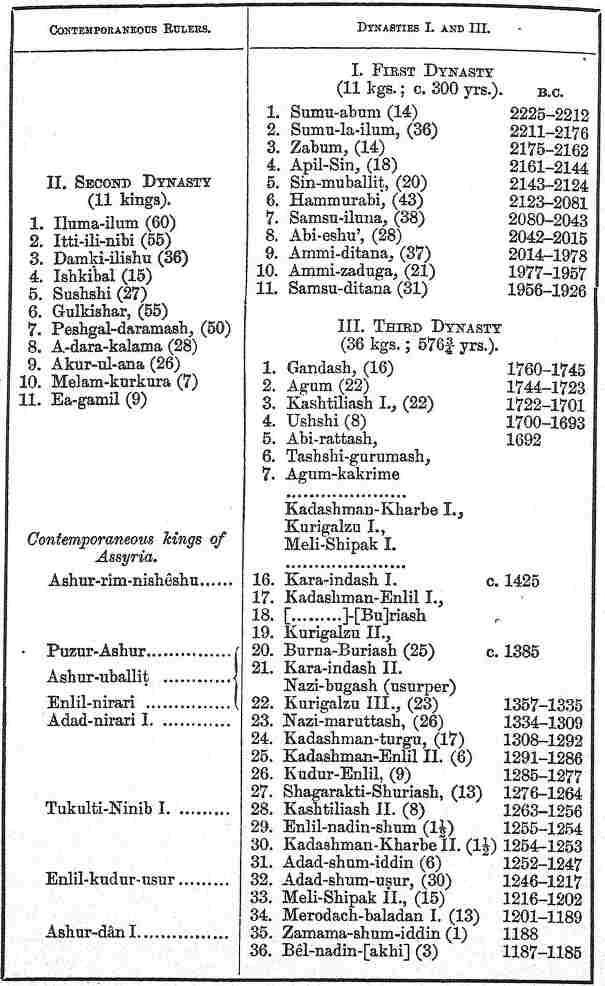
A comma after a king's name implies that he was succeeded by his son.
II. A DYNASTIC LIST OF THE KINOS OF BABYLON (continued).
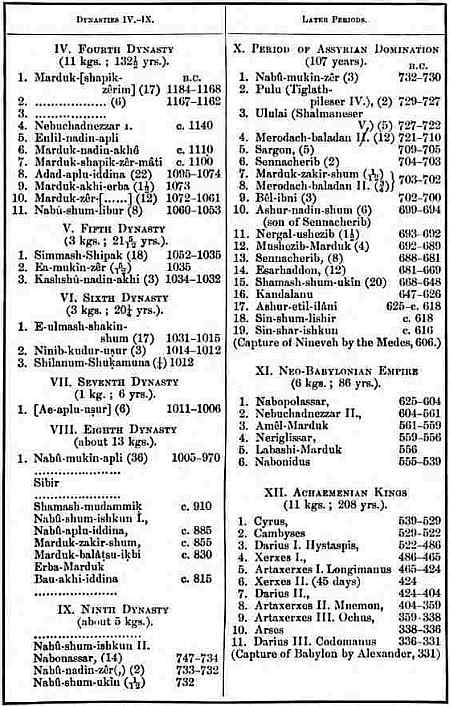
INDEX A-DARA-KALAMA, king of Second Dynasty, 202; in List, 320 Abba-dugga, priest of Lagash, 147 Abbasid Caliphate, 11 Abi-eshu', king of First Dynasty, 105, 205 f.; letters of, 171, 192; in List, 320 Abi-eshu' Canal, 205 Abi-rattash, king of Third Dynasty, 217 f.; in List, 320 Abi-sarê, king of Larsa, 89 f., 147; in List, 318 Abraham, 305 Abû Habba, 134, 143 Abû Hatab, 85 Abydenus, 115, 280 Abydos, 235 Achæmenian kings, 2, 8, 285 ff., 321 Actæon, 290 Adab, 159, 213 Adad, 148, 256; reading of name of, 150; representations of, 266, 271; see also E-namkhe, E-ugalgal Adad-aplu-iddina, king of Fourth Dynasty, 256 f.; in List, 321 Adad-nirari I., king of Assyria, 243; in List, 320 Adad-nirari III., king of Assyria, 259 Adad-nirari IV., king of Assyria, 265 Adad-rabi, of Nippur, 102 Adad-shar-ilâni, Kassite ambassador, 238 Adad-shum-iddin, king of Third Dynasty, 244; in List, 320 Adad-shum-usur, king of Third Dynasty, 244; in List, 320 Addis, Rev. W. E., 62 Aden, 121 Adhem, 212 Adini, Chaldean ruler, 263 Adonis, 290, 304 f. Adoption, laws of, 185 Ae-aplu-usur, king of Seventh Dynasty, 258; in List, 321 Africa, 120 Agade, see Akkad Agriculture, Babylonian, 167 ff. Agum I., king of Third Dynasty, 217; in List, 320 Agum, son of Kashtiliash I., 217 f. Agum-kakrime, king of Third Dynasty, 210, 218, 241, 290; genealogy of, 217; in List, 320 Ahîmer, mounds of, 143 Aia, goddess, 261 Aia-khegallum Canal, 153 Aibur-shabû, 30 Ak-su, 212 'Akarḳûf, 15 Akarsallu, 243 Akhenaten (Amen-hetep IV.), king of Egypt, 219; letters to, 220, 222; policy of, 222; and the Hittites, 234 Akhetaten, in Egypt, 219 Akhetaten, in Canaan, 225 Akhlamî, 260 Akia, Kassite ambassador, 225 Akkad, 3, 10 f., 118 f., 148 f.; in astrology, 140; as geographical term, 244 Akkad (Agade), 159; see also Ishtar Akshimakshu, rebel leader, 286 Akur-ul-ana, king of Second Dynasty, 202; in List, 320 Al-Bît-shar-Bâbili, 41 Al-'Irâkân, 10 Al-'Irâkayn, 10 Al-Madâin, 9 Alabaster jars, manufacture of, 41 Alcinous, 309 Aleppo, 14 f., 152 Alexander, the Great, 7 f., 73, 115 f., 287; in List, 321 Alman, 218 Alorus, 115 Altars, Babylonian, 61 f., 64, 66, 69: Hebrew, 62 Alyattes, king of Lydia, 279, 282 Amal, 204 Amanus, Alt., 262 Amarna, in Syria, 127 Amarna, in Egypt; see Tell el-Amarna Amasis, king of Egypt, 278 Amêl-Marduk, king of Babylon, 280; in List, 321 Amen-hetep III., king of Egypt, 219 ff., 230, 233; letters of, 220 f. Amen-hetep IV., king of Egypt, 111, 219; see also Akhenaten Ammi-baïl, king of Khana, 129 f. Ammi-ditana, king of First Dynasty, 84, 206 ff.; estimate of, 205; letter of, 191; in List, 320 Ammi-ditana Canal, 207 Ammi-zaduga, king of First Dynasty, 107 ff, 116 f., 206, 209; letters of, 168; in List, 320 Ammi-zaduga-nukhush-nishi Canal, 210 Ammon, 293 Amorite migration, 119 f. Amorites, raids of, 136, 182, 204 f. Amos, 313 Amraphel, king of Shinar, 159 Amurru, West-Semitic god, 150 Amurru, the Western Semites, 119 f., 125 f., 136, 152, 157, 203, 210, 237, 255; in astrology, 140; their quarter in Sippar, 207 Amursha-Dagan, of Khana, 131 An-am, king of Erech, 211 f. Anana, 23 Anatolia, 128 Andrae, W., 23, 25, 28, 33, 53, 64 f., 68, 71, 137 Animal forms, in Babylonian mythology, 297 f. Animism, 299 Anna-Bêl, 287 Anshan, in Elam, 282 Ante-chambers, to shrines, 64 Antinous, 309 Antiochus Soter, 287 Anu, 95, 155, 144, 146; see also E-anna Aphrodite, 290, 304 f. Apil-Sin, king of First Dynasty, 136, 149 f.; in List, 319 f. Appeal, right of, 185 Apries, king of Egypt, 277 f. Apsû, god of the abyss, 206 Arab conquest, of Mesopotamia, 10 Arabia, as cradle of the Semites, 119 f.; physiographical features of, 120 ff.; Southern, 121 Arabian coast, 6 Arabians, as nomads, 121 ff. Arad-Nannar, father-in-law of Rîm-Sin, 156 Arad-shasha, king of Erech, 212 Arad-sibitti, 258 f. Arakha, rebel leader, 286 Arakhab, Sumerian leader, 208 Arakhtu Canal, 205, 207; later employment of name, 34, 36 Arakhtu-wall, 74 Aramean migration, 120 Arameans, raids by, 4, 258 f., 264 f.; and Assyria, 260; and the Sutû,256 Arched doorway, in Babylon, 39 Arches, in vaulted building, 47 Architecture, Babylonian, 19; religious, 63, 66; military, 63, 66 f. Ardashir I., founder of Sassanian Empire, 9 Ardys, king of Lydia, 279 Argives, 293 Argos, 290 Ari-Teshub, Mitannian name, 139 Aries, 293 Arioch, king of Ellasar, 159 Aristotle, 116 Arkum, 204 Armenia, I, 262, 265; see also Urartu Arnuanta, Hittite king, 240 f. Arsacidæ, 9 Arses, king of Persia, 321 Artaxerxes I., Longimanus, king of Persia, 321 Artaxerxes II., Mnemon, king of Persia, 21, 321 Artaxerxes III., Ochus, king of Persia, 321 Artemis, 290 Aruna, Hittite town, 227 Aryans, as horse-keepers, 216 Arzawa, Hittite kingdom of, 230 Ashdod, 132 Ashduni-erim, king of Kish, 143 f. Ashera, 307 Ashir, god of Ashur, 139; see also Ashur Ashir-rîm-nishêshu, king of Assyria, 139; see also Ashur-rîm-nishêshu Ashnunnak, 157, 218; see also Tupliash Ashratum, 150 Ashukhi Canal, 143 Ashur, city, 21, 157 ff.; discoveries at, 20, 137 if.; early inhabitants of, 128, 140 Ashur-bani-pal, king of Assyria, 8, 31, 73, 113, 271 ff. Ashur-bêl-kala, king of Assyria, 254, 256 Ashur-dân I., king of Assyria, 244; in List, 320 Ashur-etil-ilâni, king of Assyria, 273; in List, 321 Ashur-nadin-shum, king of Babylon, 270; in List, 321 Ashur-naṣir-pal, king of Assyria, 257 ff; policy of, 262 Ashur-rêsh-ishi, king of Assyria, 112, 255 Ashur-rîm-nishêshu, king of Assyria, 242; in List, 320 Ashur-uballit, king of Assyria, 222 f., 243; in List, 320 Asiru, father of Pukhia, 212 Ass, as beast of burden, 122, 183, 215 Assault, penalties for, 105 Assyria, expansion of, 12, 205; and Babylon, 3 f., 157, 241 ff., 273; and Egypt, 210, 209, 272 f.; and Mitanni, 220 f., 241; and the Hittites, 239, 241, 243 Assyrian settlements, in Cappadocia, 227 Assyrians, racial character of, 141 Astarte worship, centres of, 290 Astrologers, Babylonian, 189; Greek, 292 Astrological texts, 140 Astrology, 291 f., 299 f. Astronomical omens, 100 f. Astronomy, Babylonian, 289, 311 ff. Astyages, king of Media, 282 Aten, Egyptian cult of, 219, 223 Athene, 309 Atlila, in Zamua, 259 Atreus, 292 f. Attica, 290 Aushpia, founder of temple of Ashir, 139 Aÿ, Egyptian priest, 223 Azariah, 14 Aziru, Syrian prince, 234 BA'ALÎM, of Canaan, 126; of Khana, 131 Bâb Bêlti, 40. Bâb-ilî, 14, 28 Babel, Tower of, 15 Babil, mound of, 14 ff., 22, 27; in plan, 23 Babylon, strategic position of, 4 ff.; remains of, 14 ff.; walls of, 21 ff, 29 ff.; size of, 27; plans of, 10, 23 Babylonia, climate of, 40, 170; fertility of, 167; names for, 244; political centre of gravity in, 3, 9 Babylonian Chronicle, 265 Babylonian language, I, 218 f. Baghdad, 5, 11, 14 f., 17, 22 Bahrein, 6 Baka, in Sukhi, 266 Bakâni, 263 Ball, Rev. C. J., 37 Banti-shinni, Amorite prince, 237 f. Bardiya, 285 Barges, Babylonian, 180 f. Barter, 196 Barzi, 149 Baṣra, 9 f., 11 Baṣu, 153, 155 Battlements, in architecture, 67 Bau, goddess, 297 Bau-akhi-iddina, king of Eighth Dynasty, 265; in List, 321 Bavian, 112 Be'er-sheba', 307 Bees, in Sukhi, 260 f. Behistun, 286 Bêl, taking hands of, 38, 296 Bêl-aplu-iddin, Babylonian general, 260 Bêl-ibni, king of Babylon. 270; in List, 321 Bêl-nadin-[akhi], king of Third Dynasty, 245; in List, 320 Bêl-shalti-Nannar, daughter of Nabonidus, 281 Bêl-shar-usur, see Belshazzar Bêl-shemeà, 212 Bêl-shum-ishkun, father of Neriglissar, 280 Bêl-simanni, rebel leader, 286 Belshazzar, 282 ff. Benjamin, of Tudela, 14 f. Bentresh, Hittite princess, 240 Berossus, 47, 280, 301; history of, 106; dynasties of, 114 ff. Beuyuk Kale, 230 Bevan, Prof. A. A., 305 Bevan, E. R., 7, 280 Bewsher, Lieut. J. B., 17 Bezold, Prof. C., 72, 107, 110, 219 Bird, of Bau, 297 Birds, as foundation-deposits, 63 Birizzarru, West-Semitic month, 131 Birs-Nimrûd, 15, 22; see also El-Birs, Borsippa Bismâya, 20, 138 Bît-Adini, 260 Bît-Bazi, 257 Bît-Iakin, 269 Bît-Karkara, 152 f., 159 Bît-Karziabku, 253 Bît-Khadippi, 260 Bît-Pir-Shadû-rabû, 248 Bît-rêsh, 287 Bît-Sikkamidu, 249 Bitti-Dagan, of Khana, 132 Black Sea, 5 Bliss, F. J., 125 Bloomfield, Prof. M.. 227 Boat-builders, 180 Boatmen, 180 f. Boats, of Khonsu, 238 ff. Boghaz Keui, 219, 230; letters from, 219 f., 239 f.; see also Khatti Boissier, A., 133, 154 f., 286 Borsippa, 60, 159, 259, 263 f.; temple-tower of, 77 f.; plan of, 16 Bosanquet, R. H. M., 106 Botta, Emil, 18 Boundary-stones, 241, 244 ff., 252 Breach of promise, of marriage, 186 Breasted, Prof. J. H., 111, 133, 219, 222, 235, 240 Breccia, for paving, 59 Bribery, punishment for, 189 Bride-price, 186 Bridge, over Euphrates, 47, 60, 74 f., 81; over canal, 37 Bridge-building, 249 Bridges-of-boats, 81, 202, 264 Bronze age, at Carchemish, 128 Bronze-casting, 207 Bronze step, from E-zida, 27, 77 Budge, Dr. E. A. Wallis, 111, 150, 176, 219, 235, 241 Builders, responsibilities of, 184 Building, art of, 19 f. Bull, in mythology, 55, 294, 303; in symbolism, 298 Bulls, enamelled, 50 f. Bunutakhtun-ila, vassal-ruler of Sippar, 143 Bûr-Sin II., king of Nîsin, 147; in List, 318 Burial, Neo-Babylonian, 66 f. Burna-Burariash, see Burna-Buriash 217 Burna-Buriash, king of Third Dynasty, 242 f.; date of, 110 f.; letters from, 220 ff.; in List, 320 Burna-Buriash, Kassite chieftain, 217 Burney, Prof. C. F., 290, 292, 307 Burrows, Prof. R. M., 293 Burusha, jewel-worker, 259 Bury, G. W., 121 Byblos, 290 CALENDAR, regulation of, 189 f. Callisthenes, 116 Cambyses, king of Persia, 285; in List, 321 Camel, introduction of, 122 Canaan, I; inhabitants of, 119 f., 124 ff.; civilization of, 124 ff.; Egyptian conquest of, 219 Canaanites, and Babylon, 224 f. Canals, repair of, 170 f. Cancer, constellation, 301 Cappadocia, 3 f., 227 Capricorn, constellation, 301 Caravans, 182 f., 225, 237 Carchemish, 128 f., 182, 227, 260, 262; Battle of, 277; excavations at, 127 Carchemisian, pottery-name, 128 Castor, star, 310 Cedar, in construction, 40, 52, 141, 263 Central Citadel, of Babylon, 28 Cerealia, 307 Chaldea, 262 ff, 270 Chaldeans, 257, 263 f.; of Nagitu, 270 Chedorlaomer, king of Elam, 159 Chief-baker, 305 Chief-butler, 305 Chiera, E., 92 ff, 102, 104, 150 ff, 155 f., 204 China, Great Wall of, 21; city-sites in, 22 Chronicles, 210 Chronology, 87 ff, 117 f. Cilicia, 230, 262 Cilician Gates, 4 f. Cimmerians, 269, 275, 279 Citadel, character of Babylonian, 27 Class privileges, 164 f. Clay, Prof. A. T., 91, 99, 150, 156, 245, 254, 282; discoveries of, 89 f., 94 ff, 148, 163, 287 Code, of Hammurabi, 160 f., 252; Prologue of, 158 f.; Sumerian, 163, 299 Collingwood, Lieut. W., 17 Columns, in decoration, 44 Combe, E., 164 Commercial life, 181 f., 195, 207, 237, 285 ff. Condamin, Père A., 129 Contracts, 41, 109, 163, 183 Copper, ratio of, to silver, 211 Corvée,193, 249, 253 Courts, of justice, 40 f.; of palace, 28, 30, 40 f. Cowell, P. H., 257 Craig, Prof. J. A., 107 Creation legends, 195, 306 Crœsus, king of Lydia, 282 Ctesias, 21, 24, 47 Ctesiphon, 5, 9, 11 Cult-images, of kings, 206 Cumont, Prof. Franz, 292, 312 Cuq, Prof. Edouard, 247, 250 Curses, on boundary-stones, 246 f. Curtius Rufus, 47, 49 Cuthah, 146 f., 149, 159, 263 Cyaxares, king of Media, 276, 278 f. Cylinder-seals, 127 f., 261, 271, 298 f. Cyprus, 290 Cyrene, 278 Cyrus, king of Persia, 282 ff., 286; in List, 321 DAGAN, 131, 136, 159 Dagan-takala, Canaanite prince, 132 Dagon, god of Ashdod, 132; as Ba'al of Khana, 131; cult of, on Euphrates, 132 Damascus, 11, 120, 262 Damik-Adad, in Akkad, 249 Damik-ilishu, king of Nîsin, 93 f., 97, 101, 153 ff., 209; in List, 319 Damki-ilishu, king of Second Dynasty, 208 f.; in List, 320 Darius I. Hystaspis, king of Persia, 7, 285 f.; in List, 321 Darius II., king of Persia, 321 Darius III., Codomanus, king of Persia, 287; in List, 321 Date-formulæ, 190 Date-palm, cultivation of, 177 David, 307 Davies, N. de G., 223 De Sarzec, E., 138 Deification of kings, 206 Dêlem, 141 Delitzsch, Prof. Friedrich, 6, 33, 35, 139, 151, 244 Deluge, 114 f. Deportation, Assyrian policy of, 267 f. Dêr, or Dûr-ilu, 145, 244, 253, 269 Dêr ez-Zôr, 129 f. Dhorme, Père Paul, 281 Diarbekr, 5 Dieulafoy, Marcel, 80 f. Dilbat, 141 f., 159; site of, 141 Dilmun, 6 Diodorus, 48 f., 81 Diorite, from Magan, 6 Dioscuri, 303 Disease, Babylonian conception of, 194 Divination, 299; lamb for, 206 Divorce, laws of, 185 f. Dog, of Gula, 297; votive figure of, 147 Double-dates, at Nîsin, 94 ff. Draco, constellation, 292 Dragon, of Marduk, 55, 261; of Nabû, 79; of the deep, 195 Dragon-combat, 306 Dragons, of chaos, 195, 306; enamelled, 51 f.; bronze, 52 Drainage, Babylonian system of, 45 Driver, Prof. S. R., 126 Drowning, as penalty, 185 Dudkhalia, Hittite king, 160, 240 Dungi, king of Ur, 145 Dûr-Abi-eshu', on Tigris, 205 Dûr-Ammi-ditana, on Zilakum Canal, 207 Dûr-Ammi-zaduga, on Euphrates, 209 Dûr-Ashur, in Zarnua, 259 Dûr-Enlil, in Sea-Country, 217 Dûr-Cula-dûru, in Akkad, 148 Dûr-gurgurri, on Tigris, 151, 189, 191 Dûr-Iabugani, in Akkad, 148 Dûr-ilu; see Dêr Dûr-Kurigalzu, in Akkad, 218, 256 Dûr-Lagaba, in Akkad, 148 Dûr-muti, 149 Dûr-Padda, in Akkad, 148 Dûr-Papsukal, 204 Dûr-Sin-muballit, 153 Dûr-Sin-muballit-abim-walidia, 158 Dûr-uṣi-ana-Ura, in Akkad, 148 Dûr-Zakar, fortress of Nippur, 147 f., 204 Dushratta, king of Mitanni, 221, 234 Dwellings, arrangement of, 41 f. E-ANNA, temple of Anu and Ishtar at Erech, 159, 211, 287 E-anna-shum-iddina, governor of Sea-Country, 255 f. E-apsû, temple of Enki at Eridu, 158 E-babbar, temple of Shamash at Sippar, 110, 149, 159, 201 E-babbar, temple of Shamash at Larsa, 151, 159 E-galmakh, temple at Nîsin, 159 E-gishshirgal, temple of Sin at Ur, 159, 200; temple of Sin at Babylon, 206 E-ibianu, temple, 149 E-kankal, temple of Lugal-banda and Ninsun at Erech, 211 E-khulkhul, temple of Sin at Harran, 276 E-kiku, temple of Ishtar at Babylon, 149 E-kua, shrine of Marduk in E-sagila, 72 E-kur, temple of Enlil at Nippur, 158 E-kur-shum-ushabshi, priest, 261 E-makh, temple of Nininakh in Babylon, 61 ff., 65; ground-plan of, 64; in plans, 23, 83 E-makh, temple at Adab, 159; E-malga-uruna, temple of Enlil at Dûr-Enlil, 217 f. E-meslam, temple of Nergal at Cuthah, 149, 159 E-mete-ursag, temple of Zamama at Kish, 159 E-mishmish, temple of Ishtar at Nineveh, 159 E-namkhe, temple of Adad at Babylon, 155 E-namtila, temple, 209 E-ninnû, temple of Ningirsu at Lagash, 153, 159, 299 E-patutila, temple of Ninib at Babylon, 23; ground-plan of, 71 E sagil-shadûni, reputed father of usurper, 250 E-sagila, temple of Marduk at Babylon, 28 f., 37, 80 f., 142, 149, 158, 283 f., 280 f.; remains of, 71 ff.; excavation of, 20 f.; orientation of, 69; plan of, 74; restoration of, 75; in plan, 23 E-temen-anki, temple-tower of E-sagila, 38, 60, 73 ff.; plan of, 74; restoration of, 75; in plan, 23; see also Tower of Babylon E-ugalgal, temple of Adad at Bît-Karkara, 159 E-ulmash, temple of Ishtar at Akkad (Agade), 159 E-ulmash-shakin-shum, king of Sixth Dynasty, 257; in List, 321 E-zida, temple of Nabû at Borsippa, 16, 78 f., 159, 279; plan of, 78; bronze step from, 27, 77 Ea, 73, 297; see also Enki Ea-gamil, king of Second Dynasty, 211 f., 217; in List, 202 Ea-mukîn-zêr, king of Fifth Dynasty, 257; in List, 321 Ea-nadin-[...], possibly king of Fourth Dynasty, 255 Ecbatana, 8, 286 Eclipses, solar, 257, 279 Ecliptic constellations, 310 f. Edina, in S. Babylonia, 255 Egypt, I, 4, 38, 41, 219 ff.; and Canaan, 120 f., 219; and Syria, 276 f.; and Assyria, 269, 272; and Lydia, 283; and Persia, 285; and the Hittites, 234 ff.; as Asiatic power, 219 ff.; irrigation in, 172; boundary-records of, 247; in early Christian writings, 305 Ekallâti, 256 Ekron, 270 El-Birs, 15; see also Birs-Nimrûd El-Ohêmir, see Aḥimer Elam, 7 f., 133, 315; and the Western Semites, 7, 150 ff.; and the later Kassites, 244, 252; in alliance with Babylon, 264, 209, 272; trade of, 5, 181; importations from, 207; goddesses of, 296; systems of writing in, 2; in astrology, 140 Eldred, John, 14 f. Electra, of Euripides, 293 Elijah, 307 Eltekeh, 270 Emblems, divine, 55, 79, 297; on boundary-stones, 246 f. Emisu, king of Larsa, 89 f., 134; in List, 318 Emutbal, 150, 154, 157, 198, 200 Enamelled brickwork, 43 Enamelling, process of, 57 Enannatum, chief priest in Ur, 135 Enki, 95, 155, 297; see also Ea, E-apsû Enlil, 95, 194; cult of, at Babylon, 155, 206; see aluo E-kur, E-malga-uruna, Nippur Enlil-bani, king of Nîsin, 148, 150; in List, 319 Enlil-kudur-usur, king of Assyria, 244; in List, 320 Enlil-nadin-apli, king of Fourth Dynasty, 112, 254 f.; in List, 320 Enlil-nadin-shum, king of Third Dynasty, 244; tablets of time of, 84; in List, 320 Enlil-nirari, king of Assyria, 243; in List, 320 Entemena, patesi of Lagash, 246; cult of deified, 206 Ephesus, 5 Equinoxes, precession of, 312 Erba-Murduk, king of Eighth Dynasty, 264, 269; in List, 321 Erech, 11, 113, 135, 147, 155, 159, 198 f., 287; local dynasty of, 211; Neo-Babylonian letter from, 281 Ereshkigal, 304 Eridu, 135, 147, 152 f., 155, 158; oracle of, 153, 158 Esarhaddon, 139, 269, 271 f.; Babylonian policy of, 271, 273; Black-Stone of, 176; in List, 321 Etana, 290 f. Ethics, Babylonian, 2 Euphrates, 4 f., 185; change in course of, 30, 37 f., 58; West Semitic settlements on, 157, 159; canalization of, 156; irrigation on, 173 f. Euphrates route, 4, 8 Euripides, 293, 311 Europe, Babylonian influence on, 12, 289 Euryalus, 309 Eurymachus 309 Eusebius, 114 f., 116, 276, 280 Evil spirit, possession by, 240 Exchange, medium of, 196 Exorcist, Babylonian, 240 Expansion-joint, in building, 19 Ezekiel, 62, 304 FAÇADE, of Nebuchadnezzar's Throne Room, 43 f. Faluja, 14 Family-life, in Babylonia, 184 ff. Fâra, 85, 300 Farming, Babylonian, 108 f. Farnell, Dr. L. R., 314 Feast, of New Year, 190, 254, 259, 296, 302, 308 Fetish, 294 Fillets, in temple-decoration, 63 Fishes, constellation, 310 f. Fishing-rights, 171 Flocks, tribute of, 168 Fortification-walls, 28, 32 f.; drainage of, 46 Foundation-deposits, 63 Foxes, with firebrands, 307 Frank, O., 176 Frankincense, 62 Frazer, Sir J. G., 290, 305, 307 Fries, Dr. Carl, 308 f. GABBARU-IBNI, in Sukhi, 266 Gagûm, Cloister of Sippar, 154, 207 Gate-house, of palace, 40 Gate-sockets, 63, 246 Gates, of Babylon, 27 Gaddash, see Gandash Gandash, founder of Third Dynasty, 216; in List, 320 Garrison-duty, 192 Garstang, Prof. John, 230 Gaugamela, 287 Gaumata, the Magian, 285 f. Gaza, 282 Genesis, 159 f., 305 Geshtinna, goddess of the plough, 176 Gezer, 126 Gift, deeds of, 129 ff. Gilead, 305 Gilgamesh, 212, 308; legends of, 290 Gimil-ilishu, king of Nîsin, 134; in List, 318 Girsu, 152 f., 155, 159 Glacial epoch, 124 Goat-fish, of Enki, 297 Gobryas, governor of Gutium, 283; see also Gubaru Golden Age, of Hesiod, 302 Golden Lamb, legend of, 292 f., 311 Goliath, 307 Grain-drill, Babylonian, 176 Granary, at Babylon, 158 Greece, and Babylon, 12, 287, 290, 314; and Persia, 286 f. Greek mythology, Babylonian influence on, 12, 289, 315 Greek names, as privilege, 287 Greek theatre, at Babylon, 287 Grooves, stepped, in temple-decoration, 63 Gubaru, Babylonian general, 281; governor of Gutuim, 281, 283 f. Gudea, patesi of Lagash, 6, 298 Gufa, prototype of, 179 f. Gula, 297 Gulkishar, king of Second Dynasty, 112 f., 202, 212; in List, 320 Gungunum, king of Larsa, 89 f., 135 f.; in List, 318 Gunkell, Prof. H., 300 Gutium, 139, 218, 283 Gutschmid, A. von, 115 Gypsum-plaster, as decoration, 43 HADES, 308 Hagen, O. E., 283 Hakluyt, Richard, 15 Halius, 309 Hall, H. P., 111, 126, 160, 219, 235, 277 Halys, 5, 229, 279 Hammam, in Syria, 127 Hammurabi, king of First Dynasty, 89 f., 99 ff., 103, 128, 130, 153 ff, 156 f., 290: character of, 100 f.; empire of, 158 f.; Babylon of, 20, 84 ff.; palace of, 86; Code of, 154, 158 f., 161 ff., 252; letters of, 181, 188 ff.; date of, 94, 110 f.; period of, 39, 162 ff., 315; in Lists, 319 f. Hammurabi-khegallum Canal, 155 Hammurabi-nukhush-nishi Canal, 158 Hammurabih, king of Khana, 130 Hananiah, 14 Handcock, P. S. P., 120 Hanging Gardens, of Babylon, 40 ff., 279 Harbour, of Babylon, 30 Harp, Sumerian, 298 Harran, 270, 282 Harûn-ar-Rashîd, 11 Hastings, Dr. James, 102 Haverfield, Prof. F. J., 22 Hebrew religion, 12; traditions. 159; law, 299 Hebrews, altars of, 62: and Babylonian mythology, 280 Helios, 307 Hera, 290 Heracles, 290 Herds, tribute of, 108 Herdsmen, Babylonian, 108 f. Herodotus. 4 f., 15, 21 f., 24, 20 f., 38, 61 f., 72, 76 f., 81, 85, 167, 177, 179, 270, 279 Hesiod, 302 Heuzey, Léon. 298 f. Hezekiah, king of Judah, 270 High places, Canaanite, 126 Hilla, 14, 23 Hilprecht, Prof. II. V., 91 f., 112, 134, 150, 208, 212, 242 Himyarite period, 121 Hincke, Prof. W. J., 246, 250 Hindîya Canal, 16 Hipparchus, of Nicæa, 312 Hire of land, system of, 167 Hit, 174 Hittite correspondence, character of, 239 f.; invasion, 3, 84, 210; states, 230; migration, 128 Hittite Empire, rise of, 220; history of, 229 ff.; fall of, 241; communications of, 5; as barrier, 314 Hittites, 3, 128, 234 ff., 243; racial character of, 226 f.; civilization of, 227 f.; art of, 228, 233; inscriptions and records of, 226 ff. Hogarth, D. G., 4 f., 120, 128, 276, 278, 282, 314; Carchemish excavations of, 127 Homer, see Odyssey Homera, mound of, 29, 31, 35; in plan, 23 Horse, introduction of, 122, 198, 215 f. Horses, export of, 224 House-property, in Babylon, 84 Houses, Babylonian, 184 How, Walter W., 5, 7, 21 Hrozný, F., 97 f., 150 Huber, E., 134 Humped cattle, 175, 202 Huntington, Ellsworth, 121 Hydra, constellation, 292 Hydraulic machine, 48 Hyksos, in Egypt, 132 f. IADI-khabum, antagonist of Samsu-iluna, 204 Iakhzir-ilum, of Kazallu, 146 Iakin, king of Sea-Country, 263 Ialman, Mt., 259 Ia'mu-Dagan, in Khana, 132 Iashma(?)-Dagan, 132 Iawium, vassal-ruler of Kish, 145 Iazi-Dagan, of Khana, 131 Ibkushu, priest, 94, 101 Icarus, 290 Idamaraz, 198 Idin-Dagan, king of Nîsin, 132, 134; in List, 318 Igi-kharsagga, 155 Igitlim, possibly a king of Khana, 130 Iluma-ila, vassal-ruler of Sippar, 143 Iluma-ilum, founder of Second Dynasty, 104 f., 199 f., 205; in List, 320 Ilu-shûma, king of Assyria, 136 Image-worship, Babylonian, 294 ff. Imgur-Bêl, wall of Babylon, 30 ff., 51 Immer, suggested reading of Adad's name, 150 Immerum, vassal-ruler of Sippar, 143 Incantations, 194 Incense, 314 India, and the Persian Gulf, 7; village communities of, 250 India Office, Babylonian map issued by, 16 Indra, Aryan god, 227 Infant-sacrifice, 127 Inheritance, laws of, 185 Intercalary months, 189 f. Ionia, cities of, 279 'Irâk, 9 f., 11 Iranian plateau, 5 Iranians, groups of, 282 Irnina Canal, 171 Irrigation, method of, 176 f. Irrigation-machines, 172 ff. Irsit-Bâbili, city-square of Babylon, 28 Isaiah, 292 Isharlim, king of Khana, 129 f. Ishbi-Ura, founder of Dynasty of Nîsin, 132 ff.; in List, 318 Ishhi-aswad, mound, 84; in plan, 23 Ishkhara, goddess, 297 Ishkibal, king of Second Dynasty, 202; in List, 320 Ishkun-Marduk, city, 207 Ishkur, suggested reading of Adad's name, 150 Ishme-Dagan, king of Nîsin, 132, 134 f.; in List, 318 Ishtar, of Akkad (Agade), 23, 69 f., 83 f., 159; of Ashur, 20, 137; of Babylon, 80, 149; of Bît-Karkara, 159; of Erech, 159; of Khallabu, 159; of Kibalbarru, 155; of Kish, 143; of Nineveh, 159, 221 f.; and Tammuz, 290; Descent of, 304; lion of, 55, 58 f.; representation of, 266; see also E-anna Ishtar Gate, at Babylon, 33, 51 ff., 57; beasts on, 50 f., 54 ff.; section of, 53; restoration of, 28; ground-plan of, 52; in plans, 30, 57 Isin, Dynasty of, 254 ff.; original form of name of, 91, 254; see also Nîsin Islam, 10, 120 Israel, 12, 290 Itêr-pîsha, king of Nîsin, 148; in List, 318 Itti-ili-nibi, king of Second Dynasty, 208; in List, 320 Itti-Marduk-balâtu, Kassite chief minister, 237 Itti-Marduk-balâtu, the Aramean, 256 Iturmer, local god of Tirḳa, 131 JASTROW, Prof. Morris, 101, 312 Jensen, Prof. P., 112, 308 Jerablus, 127 Jeremiah, 277, 280 Jeremias, Dr. Alfred, 292, 304 f., 307 Jericho, 126 Jerusalem, 277, 280 Jewish traditions, 313 f. Jews, captivity of, 277; of Baghdad, 14 Johns, Canon C. H. W., 131, 145, 162, 190, 304 Johns, Mrs. C. H. W., 18 Johnson, C. W., 179 Jones, Capt. J. Felix, 17 Jordan, 306 Joseph, 305 Josephus, 278, 280, 307 Joshua, 305 f. Josiah, king of Judah, 270 Judah, 270, 276 f. Judges, Babylonian, 188 Jumjumma, 23 Jupiter Ammon, 303 Justi, Prof. Ferdinand, 215 Justice, administration of, 188 f. KADASHMAN-ENLIL I., king of Third Dynasty, 220 f., 241 f.; in List, 320 Kadashman-Enlil II., king of Third Dynasty, 236 ff., 240, 243; in List, 320 Kadashman-Kharbe I., king of Third Dynasty, 241; in List, 320 Kadashman-Kharbe II., king of Third Dynasty, 244; in List, 320 Kadashman-turgu, king of Third Dynasty, 236 f.; in List, 320 Kadesh, Battle of, 227, 235 Kagmum, 157 Kandalanu, king of Babylon, 273; in List, 321; see Ashur-bani-pal Kâr-bêl-mâtâti, 259 Kâr-Irnina, 171 Kâr-Ishtar, 243 Kâr-Shamash, 149; on Tigris, 158; on Euphrates, 207 Kâr-Sippar, 204 Kara-indash I., king of Third Dynasty, 221, 241 f.; in List, 320 Kara-indash II., king of Third Dynasty, 243; in List, 320 Kara-Kuzal, 127 Karashtu, Babylonian general, 255 Karduniash, 244 Karnak, 220, 235 Kashbaran, 154 Kashdakh, in Khana, 130 Kashshû-nadin-akhi, king of Fifth Dynasty, 257; in List, 321 Kashtiliash I., king of Third Dynasty, 217; in List, 320 Kashtiliash II., king of Third Dynasty, 243 f.; in List, 320 Ḳaṣr, mound, 14, 16 f., 21 ff., 24, 27 f., 30 ff.; buildings on, 28 ff. Kassites, 3, 130 f., 197 f., 214 ff.; racial character of, 214 f.; introduction of horse by, 215 f.; Babylon of, 29 Kazallu, 144 ff., 149 Keleks, early, 178 f. Kesh, 155, 159 Khabilu, river, 150 Khabkha-tribe, 207 Khâbûr, 129 ff., 260 Khabur-ibal-bugash Canal, 130 Khalambû tribe, 140 Khalium, vassal-ruler of Kish, 145 Khallabu, 152, 159 Khalule, 271 Khana, kingdom of, 129 ff., 157, 210 f., 218 Khanî, 210; see also Khana Khanirabbat, 222 Khatti, Hittite capital, 229 ff.; site of, 219; communications of, 5; use of term, 210; see also Hittites Khattusil I., Hittite king, 230 Khattusil II, Hittite king, 236 ff., 243 Khinnatuni, in Canaan, 225 Khonsu, Egyptian Moon-god, 222, 238 ff. Khorsabad, 176 Khumbanigash, king of Elam, 209 Khurpatila, king of Elam, 243 Khurshitu, 212 Khuṣṣi, 254 Kibalbarru, 141, 144, 155 Kidin-Khutrutash, king of Elam, 244 Kikia, early ruler of Ashur, 139 Kinunu, West-Semitic month, 131 Kiriath-arba, 307 Kirmanshah, 5 Kish, 143 f., 159, 203 f. Kisurra, 85. 155, 199, 212 f. Knudtzon. Prof. J. A., 219. 221 f. 224 f., 230, 243 Kohler, Prof. J., 102 Koldewey, Dr. Robert, 17 f., 23, 25, 30, 32 f., 35, 46 ff., 50, 52 f., 67 f., 74, 76 f., 80, 83 Kudur-Enlil, king of Third Dynasty, 243; in List, 320 Kudur-Mabuk, ruler of Western Elam, 89, 113, 150 ff, 154, 156, 159; Adda of Amurru, 152 Kudur-Nankhundi, king of Elam, 113 Kudurrus, or boundary-stones, 241, 244, 245 ff. Kûfa, 9 f., 11 Kugler, Dr. F. X., 106 ff., 116, 310 ff Kurigalzu I., king of Third Dynasty, 241, 243; in List, 320 Kurigalzu II., king of Third Dynasty, 221, 224, 242; in List, 320 Kurigalzu III., king of Third Dynasty, 243; in List, 320 Kussar, Hittite city, 230 Kutir-Nakhkhunte, Elamite prince, 244, 252 Kweiresh, 23 LABASHI-MARDUK, king of Babylon, 281; in List, 321 Labynetus, 279; see Nebuchadnezzar II. Lachish, 270 Lagamal, goddess of Dilbat, 142 Lagash, 147, 152 f., 155, 159, 212 f. Land, sale of, 195 f. Land-tenure, system of, 167, 249 ff. Landowners, Babylonian, 167 f. Langdon, S., 37, 40, 52, 72, 92, 111, 145, 276, 280, 282, 290 Laodamas, 309 Lapis-lazuli, at time of First Dynasty, 207; Kassite export of, 224 Larsa, Dynasty and kings of, 89 ff., 110, 133 f., 147 f., 150 ff., 158 f., 198, 200; Sun-temple at, 135; tablets from, 156 Law, Babylonian, 299; systematization of, 196; spread of, 237 f. Lawrence, T. E., 127 Layard, Sir A. H., 17 f., 106, 295 f. Le Strange, G., 10 f. Lebanon, 72, 225; monolith from, 203 f. Legends, 195 Legislation, 2; see also Code, Law Lehmann-Haupt, Prof. C. F., 116 Leo, constellation, 310 Libil-khegalla Canal, 30, 37 Libit-Ishtar, king of Nîsin, 134 ff.; in List, 318 Libit-Ishtar, governor of Sippar, 136 Light-wells, 28, 44 Lightning-fork, of Adad, 297 Lion, of Ishtar, 55 Lion Frieze, at Babylon, 30, 57 ff. Lions, of the Sun-god, 298 f.; enamelled, 44 Lirish-gamium, daughter of Rîm-Sin, 156 Literature, Babylonian, 2, 194 f., 299 Liver-markings, 297; see also Divination Lot, 305 Lugal-banda, 211 Lugal-diri-tugab, 148 Lukhaia, on Arakhtu Canal, 205 Lulubu, 255 Lunar observations, 140 Luxor, 235 Lydia, 278 f., 282 f. MACALISTER, Prof. R. A. S., 125 Madâin, 9 f. Magan, 6 Magic, 240, 299 Magical formulæ, 194 Maitland, Gen. P. J., 121 Makkedah, 305 Malgûm, 154, 157, 159 Manabaltel, king, 212; Mananâ, vassal-king of Kish, 144 f. Manishtusu, Obelisk of, 247, 250 Manufactories, royal, 41 Mâr-irṣitim, of Nippur, 102 Marad, 153 Marduk, 146, 207; rise of, 194 f.; as creator, 306; in coronation-ceremony, 296; cult-images of, 218, 244, 271; emblem of, 79; dragon of, 55, 261; representation of, 261; see also E-kua, E-sagila, E-temen-anki Marduk-akhi-erba, king of Fourth Dynasty, 257; in List, 321 Marduk-aplu-iddina, see Merodach-baladan Marduk-balâṭsu-iḳbi, king of Eighth Dynasty, 264; in List, 321 Marduk-bêl-usâte, brother of Marduk-nadin-shum, 263 Marduk-nadin-akhê, king of Fourth Dynasty, 112, 254, 256; in List, 321 Marduk-shakin-shum, father of Erba-Marduk, 264 Marduk-shapik-zêr-mâti, king of Fourth Dynasty, 254,256; in List, 321 Marduk-shapik-zêrim, king, possibly founder, of Fourth Dynasty, 254; in List, 321 Marduk-zakir-shum, king of Eighth Dynasty, 261, 263; in List, 321 Marduk-zakir-shum, Babylonian rebel, 270; in List, 321 Marduk-zêr-[...], king of Fourth Dynasty, 257; in List, 321 Mari, 132, 157, 265 Marriage, laws of, 185 f.; for slaves, 166 f. Marriage-contract, 130 Marriage-portions, 185 Marsh-dwellers, 202 Marshes, Babylonian, 200 f. Mashkan-Ammi-ditana, 207 Mashkan-shabri, 151, 159 Mashtabba Canal, 156 Maspero, Sir Gaston, 111, 277 Mattiuaza, king of Mitanni, 234 Mê-Enlil Canal, 207 Mecca pilgrimage, 5 Medea, 307 Medes, 275 f., 282 Media, 278 f., 282 Medicine, a branch of magic, 240 Mediterranean, Eastern, 315; Euphrates route to, 4, 8; Assyria and the, 256, 273 Mediterranean race, 125 f. Megiddo, 126, 276 Meissner, Prof.B., 133, 139, 207 Melam-kurkura, king of Second Dynasty, 202; in List, 320 Meli-Shipak I., king of Third Dynasty, 241 f.; in List, 320 Meli-Shipak II., king of Third Dynasty, 176, 244; grant of land by, 248 f.; tablets of time of, 84; in List, 320 Memphis, 272, 285 Mera, 159 Mercenaries, Greek, 277 f. Merkes, Mound, 16, 29, 82 ff.; plan of, 83; in plan, 23 Merodach-baladan I., king of Third Dynasty, 78 f., 244; boundary-stone of, 248 f.; tablets of time of, 84; in List, 320 Merodach-baladan II., king of Babylon, 33, 269 f.; in List, 321 Meslam, temple of Mashkan-shabri, 159 Meyer, Prof. E., 6, 92, 104, 111, 114, 116, 142, 150, 160, 207, 211, 215, 226 f., 228 Middle class, Babylonian, 164 f. Migrations, causes of, 121 f. Mishael, 14 Mitanni, rulers of, I, 214; kingdom of, 220 f.; and Babylon, 224; and the Hittites, 23:5 f. Mitannians, racial character of, 227; and Subartu, 139 f. Mithraic legends, 313 Mitra, Aryan god, 227 Moat, of Babylon, 25 f. Moat-walls, 30, 57 Mohammed, 10 Money-lenders, 189, 191 f. Months, Babylonian and Jewish, 313; West-Semitic, 130 f. Moon, in astrology, 140 Moses, 306 Moslem conquest, 5, 9 Mosul, 14 Mother goddess, of Hittites, 228 Muballitat-Sherûa, Assyrian princess, 243 Mukayyar, 135, 150 Müller, Prof. Friedrich Max, 310 Mural decoration of temples, 69 f. Murray, Prof. Gilbert, 293 Mursil, Hittite king, 234 f. Mushezib-Marduk, king of Babylon, 270 f.; in List, 321 Muski, 241 Mutallu, Hittite king, 235 Muti-khurshana, antagonist of Sam-su-iluna, 204 Mutilation, penal, 165 f. Mutum-ilu, of Nippur, 102 Myres, Prof. J. L., 7, 121, 188 Mysteries, religious, 314 Mythology, astral, 291 f., 300 ff. NABONASSAR, king of Ninth Dynasty, 115, 267 f.; in List, 321 Nabonidus, king of Babylon, 281 ff., 297; character of, 281 f.; river-wall of, 37, 60. 74; chronology of, 110 f.; in List, 321 Nabopolassar, king of Babylon, 29, 35, 261, 274 ff.; palace of, 28, 30, 38 f.; quay-walls of, 32 ff. 36; bridge of, 81; possible tomb of, 66 f.; in List, 321 Nabû, 77 f.; emblem of, 79: see also E-zida Nabû-aplu-iddina, king of Eighth Dynasty. 257, 200 f. in List. 321 Nabû-aplu-uṣur, see Nabopolassar Nabû-kudurri-uṣur, see Nebuchadnezzar Nabû-mukîn-apli, founder of Eighth Dynasty, 258 f.; in List, 321 Nabù-mukîn-zêr, king of Babylon, 268; in List, 321; see also Ukîn-zêr Nabû-nadin-shum, priest, 261 Nabû-nadin-zêr, king of Ninth Dynasty, 268: in List, 321 Nabû-na'id, see Nabonidus Nabû-nasir, see Nabonassar Nabû-shum-ishkun I., king of Eighth Dynasty, 259; in List, 321 Nabû-shum-ishkun II., king of Ninth Dynasty, 267; in List, 321 Nabû-shum-libur, king of Fourth Dynasty; in List, 321 Nabû-shum-ukîn, king of Ninth Dynasty, 268; in List, 321 Nagitu, 270 Naharain, 227 Nahr-el-Kelb, 255 Namar, 253 Nanâ, image of, 113, 296 Nanga, 153 Nanking, 22 Nannar, 141, 145, 154 Naplanum, founder of Larsa Dynasty, 89 f., 133 f.; in List, 318 Nâr-sharri Canal, 154 Narâm-Sin, king of Akkad, 6; stele of, 252 Narâm-Sin, vassal-ruler of Sippar, 143 Nâsatya-twins, Aryan deities, 227 Nausicaa, 308 Nazi-bugash, Kassite usurper, 243; in List, 320 Nazi-maruttash, king of Third Dynasty, 175, 243, 248; in List, 320 Nebuchadnezzar I., king of Fourth Dynasty, 112, 245, 252 ff., 296; in List, 321 Nebuchadnezzar II., king of Babylon, 6 f., 276 ff.; palace of, 14, 28, 30, 38 ff.; throne-room of, 28, 42 ff.; buildings of, 32 f., 52, 73, 279 f.; bronze-step of, 27, 77; in List, 321 Necho, king of Egypt, 277 Neolithic age, in Canaan, 124 f. Nergal, 148 f., 211; see also E-meslam Nergal-shar-usur, see Neriglissar Nergal-sharezer, the Rab-mag, 280; see Neriglissar Nergal-ushezib, king of Babylon, 270; in List, 321 Neriglissar, king of Babylon, 72, 280 f.; bridge of, 37; in List, 321 New Year, see Feast Nidintu-Bêl, rebel leader, 286 Nikarkos (Anu-uballit), 287 Nîl Canal, 22 f. Nimitti-Bêl, wall of Babylon, 30 f., 32 ff., 51 Nin-Nîsin, 148 Nin-Sinna, 141 Ninaz, 154 Ninegal, 150 Nineveh, 4 f., 21, 157 ff, 221, 321, walls of, 276 Ningirsu, 298; emblem of, 297; see also E-ninnû Ninib, 70 f.; see also E-patutila Ninib-kudur-usur, king of Sixth Dynasty, 257; in List, 321 Ninlil, 94, 101 Ninmakh, of Babylon, 30, 52, 57, 148; see also E-makh Ninmakh, of Kesh, 155 Ninni, or Ishtar, 155; see also Ishtar Ninsun, 211 Nippur, 104 f., 135, 147, 149 f., 155, 158, 199, 202, 204, 244; and the suzerainty, 147; deification at, 206; effect of Babylon's control of, 194 f.; tablets from, 92 ff, 101 f., 104, 114, 156, 245 Nîsin, 151, 159, 198, 200, 208 f.; Dynasty of, 91, 103 f., 110, 132 ff.; fall of, 154; era of, 92 f., 97, 103; reading of name of, 91 Nobles, Babylonian, 163 f. Nomads, of Arabia, 121 ff. Northern Citadel, of Ḳaṣr, 57 f. Nubia, 285; gold of, 224 Numbers, sacred character of, 307 Nûr-Adad, king of Larsa, 89 f., 150; in List, 319 OANNES, 309 Oath-formulæ, 143 Odysseus, 308 f. Odyssey, 308 Officers, semi-military, 192 Officials, 181, 192 f. Omayyad Caliphate, 10 f. Omen-texts, 140, 210 Omens, 297; taking of the, 191; astronomical, 106 f. Opis, 256, 283 Oppert, Jules, 17, 22, 287 Oracle, of Eridu, 153, 158 Orientation, of temples, 69 Orontes, 235, 277 Ovid, 307 Oxen, bronze, 52 PADAN, 218 Pagirum, of Khana, 129 Palaces, Neo-Babylonian, 27 f., 38 ff, 45; in plan, 30 Palaeolithic age, in Canaan, 124 Palestine, 159, 220, 225 ff., 304, 315; excavations in, 123, 125 f. Palestine Exploration Fund, 125 Palm-trunks, as pillars, 44 Palmettes, in Neo-Babylonian decoration, 44 Pan, 293 Panelling, in Neo-Babylonian decoration, 59 Pantheon, revision of, 194 f. Paphos, 290 Papsukal, 63 Parthian Empire, 9; period, 82 Partnerships, for trade, 182 f. Passport, Babylonian, 220, 225 Pastoral life, in Babylonia, 169 Pelusium, 277, 285 Penelope, 309 Peribolos, of E-temen-anki, 73 fl; plan of, 74; restoration of, 75; in plan, 83 Persephone, 304 f. Persepolis, 8, 299 f. Persia, 5 f.; Achæmenian kings of, 2, 282 ff. Persian Gulf, traffic on, 6 f., 280 Persian period, Babylon of, 82 f. Peshgal-daramash, king of Second Dynasty, 202; in List, 320 Pétrie, Prof. W. M. Flinders, 111 Phæacians, 308 f. Pharaoh, 305 f. Philistines, 307 Philo, 310 Phoenicia, 62, 225, 235, 277 Phrygians, 241 Phulus, 115 Physicians, 240 Pietro della Valle, 15 Pinches, Dr. T. G., 212 Pindiya, 139 Place, Victor, 176 Plough, Babylonian form of, 175 f. Poebel, A., 102, 104, 114, 132, 135, 148, 156, 190, 204, 206, 208 Poetry, Babylonian, 2 Pognon, H., 142 Pollux, star, 310 Polybus, 309 Pompeii, 59 Poros, of Ptolemaic Canon, 116 Porphyrins, 116 Porter, Sir Robert Ker, 17 Prices, in kind, 195 Priesthood, 189 f. Priests, Egyptian, 238 ff. Priests' apartments, 64 Principal Citadel, of Ḳaṣr, 57 f. Procession Street, 59 f.; see also Sacred Road Proto-Mitannians, 128, 140 Pteria, 283 Ptolemaic Canon, 265, 268 Puchstein, Otto, 220, 229 ff., 232 f., 234 f. Pukhia, king of Khurshitu, 212 Pulu, king of Babylon, 116, 267 f.; in List, 321; see also Tiglath-pileser IV. Pumpelly, Raphael, 121 Puzur-Ashur, king of Assyria, 242 f.; in List, 320 QUAY-WALLS, at Babylon, 32 ff. RAB-MAG, 280 Rabikum, 154, 158 Rabim, 171 Radau, H., 245. Raḥaba, 130 Rakhabu, 191 Ram, constellation, 310 f. Rameses II., king of Egypt, 222, 226, 235, 239 f. Rameses III., king of Egypt, 228 Rammânu, "the thunderer," 150 Ramps, on Ḳaṣr, 30, 39, 57; or stairways, to roofs of temples, 61 Ramsay, Sir W. M., 4 Ranke, H., 136 Raphia, 269 Rassam, Hormuzd, 17, 141 Rawlinson, George. 176 Rawlinson, Sir H. C, 40, 52, 72, 106, 111, 113, 150 ff, 153, 155, 245, 287 Rebecca, 306 Red Sea, 306 Reliefs, bronze, 207 Rennet, Major, 17 Rent, in kind, 167, 195 Reports, to king, 168 Reuther, O., 30, 70 Revenue, 168 Rîa, Elamite god, 253 Ribanish, 206 Riblah, 277 Rich, C. J., 17 Rîm-Sin, king of Larsa, 88 ff., 97, 99 ff., 101, 103, 151, 153 ff., 198; wives and daughters of, 156; double-dates of, 94 f.; in List, 319 Rîm-Sin-Shala-bashtashu, wife of Rîm-Sin, 156 Ritti-Marduk, captain of chariots, 252 f. Ritual, Babylonian, 2 River-fortification, at Babylon, 80, 32, 37, 82 River-wall, of Nabonidus, 37, 74 Road-making, 249 Rock-sculptures, Hittite, 228 Rogers, Prof. R. W., History of, 14 f. Rome, 15, 307 Roofs, of Babylonian dwellings, 42 Rosellini, N.F.I.B., 238 f. Rosettes, in Neo-Babylonian decoration, 44 Royal Road, 4 f., 230 Rubatum, 153 SABAEAN kingdom, 121 Sabdanu, brother of Nabû-aplu-iddina, 260 Sabum, 199 Sacred Road or Way, in Babylon, 37, 39, 47, 51, 73, 80, 83; in plans, 30, 57, 74, 83; in restoration, 28 Sadyattes, king of Lydia, 279 Saggaratum, 204 Sailors, 180 f. Sajûr, 129 Sakhn, 73; in plan, 23 Sâlihîya, 129 Salmu, messenger of Burna-Buriash, 225 Samaria, 269 Sâmarrâ, 11 Samson, 307 Samsu-ditana, king of First Dynasty, 209 ff.; in List, 320 Samsu-iluna, king of First Dynasty, 84, 89 f., 97 f., 100 ff, 104 f., 148; reign of, 197 ff.; estimate of, 205; letter of, 171; image of deified, 209; in Lists, 319 f. Samsu-iluna-khegallum Canal, 197 Samsu-iluna-nagab-nukhush-nishi Canal, 197 Samuel, I. Book of, 307 Samum, king of Larsa, 89 f., 134; in List, 318 Sandbanks, ancient, in Euphrates, 37 Sangar, king of Carchemish, 260 Sarah, 305 Sarakos, 276; see also Sin-shar-ishkun Sardis, 282 f. Sargon, king of Akkad, 6, 127, 145 Sargon, king of Assyria, 6, 32 ff., 36, 269 ff.; in List, 321 Sargonids, Babylonian policy of, 4 Sarpanitum, 146, 218 Sarre, Prof. Friedrich, 130 Sassanian kings, 9 f. Saturn, planet, 313 Saunders, Telawney, 17 Sayce, Prof. A. H., 106, 126, 150, 160 Scheftelowitz, Isidor, 227 Scheil, Père V., 80, 95, 134, 139, 147, 156, 162, 212, 248, 281 Scheria, 308 Schiarparelli, G. V., 107, 313 Schöne, Dr. Richard, 17 Schorr, M., 129, 131, 143, 163, 190, 208 Schrader, Eberhard, 72, 219, 241 Schumacher, Dr. G., 125 Schwartz, E., 114 Scorpion, of Ishkhara, 297 Scourging, as punishment, 165 Scribes, 183 Scylax, of Caryanda, 7 Scythia, 286 Scythians, 274 f. Sea-Country, 200 ff.; kings of, 103 ff., 199 ff., 209; Kassite conquest of, 217 f.; Shalmaneser III. in, 263 Selby, Commander W. Beaumont, 17 Seleucia, 5, 8, 287 Seleucus, 7, 287 Sellin, Dr. E., 125 f. Semite, as adapter, 2 f. Semites, as nomads, 121 ff.; see also Western Semites Semitic migrations, 10 Seneca, 301 Sennacherib, king of Assyria, 6, 36, 60, 82, 174 f., 256, 270 f., 276; Babylonian policy of, 273; in List, 321 Serapis, 73 Sergi, Giuseppe, 126 Serpens, constellation, 292 Serpents, bronze, 72 Service-rooms, for temple-shrines, 64 Seti I., king of Egypt, 235 Sha-mamîtu, 258 f. Shabaka, king of Egypt, 269 Shadduf, in Mesopotamia, 172 Shadudu, of Sukhi, 260 Shag-dugga, 207 Shagarakti-Shuriash, king of Third Dynasty, 243; in List, 320 Shagga, 191 Shakanim, 171 Shakhnâ, 203 Shala, of Ekallâti, 256 Shalibi, 155 Shalmaneser I., king of Assyria, 139, 243 Shalmaneser III., king of Assyria, 257, 259 ff.; Gates of, 262 ff. Shalmaneser V., king of Assyria, 268 f.; see also Ululai Shamâia, Elamite priest, 253 f. Shamash, see Sun-god, E-babbar Shamash-erba, rebel leader, 286 Shamash-khegallum Canal, 145 Shamash-mudammik, king of Eighth Dynasty, 258; in List, 321 Shamash-rêsh-usur, governor of Sukhi and Ma'ri, 265 ff. Shamash-shum-ukîn, king of Babylon, 31, 271 ff.; in List, 321 Shamshi-Adad III., king of Assyria, 256 Shamshi-Adad IV., king of Assyria, 129, 131, 264 Shamûa, Elamite priest, 253 f. Shatt Atshar, 17 Shatt el-'Arab, 9 f. Shatt el-Hai, 9 f. Sheep-shearing, 168 Shepherds, in Babylonia, 168 Shergât, 19; excavations at, 137 Shewbread, 62 Shilanum-Shuḳamuna, king of Sixth Dynasty, 258; in List, 320 Ships, Babylonian, 180 f.; of Sennacherib,6, 270 Shirley, Anthony, 15 Shrines, of temples, 64 Shu-numum-dar Canal, 154 Shubareans, 139 Shubartu, 139; see also Subartu Shubbiluliuma, founder of Hittite Empire, 230, 233 f. Shunu'-rammu, 127 Shuruppak, 85, 212 f., 300 Shushinak, 296 Shushshi, king of Second Dynasty, 202; in List, 320 Shutruk-Nakhkhunte, king of Elam, 244, 252 Si[...]-Ninni, wife of Rîm-Sin, 156 Sibir, king, probably of Eighth Dynasty, 259 f.; in List, 321 Sidon, 277 Ṣili-Adad, king of Larsa, 89 f., 150 f.; in List, 319 Silver, as currency, 195 f.; purchasing power of, 211; its ratio to copper, 211 Simmash-Shipak, king of Fifth Dynasty, 257, 261; in List, 321 Simplicius, 116 Sin, 145, 148, 159, 206; see also E-gishshirgal, E-khulkhul Sin-gamil, king of Erech, 211 Sin-gashid, king of Erech, 211 Sin-idinnam, king of Larsa, 89 f., 99, 150; in List, 319 Sin-idinnam, governor of Larsa, 157, 296 Sin-iḳîsham, king of Larsa, 89 f., 99, 148, 151; in List, 319 Sin-iribam, king of Larsa, 89 f., 151; in List, 319 Sin-magir, king of Nîsin, 151; in List, 319 Sin-magir, father-in-law of Rîm-Sin, 156 Sin-muballit, king of First Dynasty, 92, 103, 151 fr.; in Lists, 319 f. Sin-muballit Canal, 153 Sin-shar-ishkun, king of Assyria, 273, 276; in List, 321 Sin-shum-lishir, king of Assyria, 273; in List, 321 Sinjar, village on site of Babylon, 23 f., 35 Sippar, 37, 134, 136, 142 ff., 149. 154 f., 158 f., 171, 192, 197, 200, 204, 207, 244,257, 200, 208, 282 f.; of Shamash, 250; of Ariunitum, 256 Sivas, 5 Skinner, Prof. J., 160 Slaves, 48, 139, 165 ff., 192 Smerdis, 285; see Bardiya Smith, George, 80, 106 Sodom, 305 Solomon, brazen altar of, 62 Soothsayers, 191 Soul, Hymn of the, 305 Southern Citadel, of Babylon, 24, 27 f., 38 ff., 57 f.; conjectural; restoration of, 28; plan of, 30 Sparta, 283 Spear-head, of Marduk, 79, 297 Spirits, evil, 194 Stairways, of E-temen-anki, 76 f.; or ramps, 57, 64 f. Stein, Sir M. Aurel, 121 Stilus, of Nabû, 79, 297 Stone-engraving, Babylonian, 261 Store-chambers, in temples, 64 Strabo, 47 f. Strassmaier, Father J. N., 278 Streck, Prof. M., 256 Streets, of Babylon, 29, 82 ff., 184 Stucken, E., 292 Su tribes, 135 Su-abu, 136; see Sumu-abum Subartu, 157; as early geographical term, 139; in later tradition, 140; non-Iranian population of, 214 Sugagi, 243 Sukhi, 154, 260, 265 Sukhi Canal, 266 Sumer, 3, 10 f., 20, 244 Sumerian towns, character of, 85 Sumerians, 134, 137 f., 201 f.; literature of, 194 f. Sumu-abum, founder of First Dynasty, 117, 136, 141 ff.; in Lists, 318, 320 Sumu-ditana, vassal-ruler of Kish, 145 Sumu-ilum, king of Larsa. 89 f., 147 f., 150; as king of 147 f., 147 f.; in List, 318 Sumu-la-ilum, king of First Dynasty, 143, 145 ff.; estimate of, 148 f.; fortresses of, 204; in Lists, 318, 320 Sumu-la-ilum Canal, 146 Sun-god, cult of, at Babylon, 149; as Ba'al of Khana; see also E-babbar Sun-god Tablet, 261 Surgeons, Babylonian, 193 f.; fees of, 165 Susa, 5, 8, 113, 273, 282, 287 Susiania, 2, 286 Sutû, 243, 256 f. Swamps, in S. Babylonia, 200 f. Symbolism, Babylonian, 298 f. Syncellus, 114 Synchronistic History, 241 ff., 265 Syria, 11, 127 f., 157, 220, 225 ff., 234 ff, 241, 262, 315; grain-drill of, 176; trade with, 4, 182; importations from, 207 TABLES, for offerings, 62 Tammuz, god, 290, 304 f. Tâmtum-khegallum, 149 Tariff, commercial, 211 Tarkundaraba, king of Arzawa, 230 Tarring the head, as punishment, 131 Tashshi-gurumash, king of Third Dynasty, 218; in List, 320 Taurus, range, 4, 225, 229 f., 262 Taurus, constellation, 293, 311 Tax-collectors, 191 f. Taxes, 248 f.; in kind, 195 Tearing in pieces, as punishment, 170 Teiresias, 308 Tell 'Amrân-ibn-'Ali, 16, 22 f., 72, 85; excavation of, 73 Tell 'Ashar, 129 Tell el-Amarna, 219; letters from, 132, 219 ff., 239 f. Tell 'Ishar, see Tell 'Ashar Tell Sifr, 92, 98, 102, 198 f. Tello, 20, 138, 140, 147 Temple-decoration, 62 f. Temple-revenues, 191 f. Temple towers, form of, 78 ff. Temples, at Babylon, 61 ff. Teredon, 280 Teritum, West-Semitic month, 131 Teshshub-'ari, 139 Teshub, 139, 228 Teumman, king of Elam, 272 Thales, of Miletus, 279 Thebes, 219, 240, 272 Theft, penalties for, 164, 169 f.; compensation for, 169 f., 172, 182 Thompson, R. C, 140, 285 f. Thothmes IV., king of Egypt, 221 Throne-room, of Nebuchadnezzar II., 42 ff.; in restoration, 28; plan of, 42 Thureau-Dangin, F., 89, 98, 105, 129, 143, 145, 147, 150 ff, 155 f., 211 f., 217, 242 f., 299 Thyestes, 292 f. Tiamat, 306 f. Tidal, king of "nations," 159 f. Tiglath-pileser I., king of Assyria, 112, 254, 256 Tiglath-pileser IV., king of Assyria, 116, 267 f.; policy of, 267 f.; in List, 321 Tigris, 4 f.; canalization of, 151,156; irrigation on, 172 f.; navigation of, 6 f., 287; damming of, 205 Time-division, system of, 289 Time-reckoning, systems of, 97, 190, 215 Tirka, 129 ff. Tishit-Enlil Canal, 155 Tower of Babel, see Babel Tower of Babylon, see E-temen-anki Towers, on walls of Babylon, 26, 31; in temple-decoration, 63 Town-life, 183 f. Town-planning, 85 f. Trade, 181 ff.; profits of, 182 f. Trade-routes, 4 f., 127, 315 Transport, by water, 170 Trefoils, in Babylonian decoration, 44 Tribal proprietorship, of land, 167, 250 f. Tribute, collection of, 191 f. Tu'mânu tribe, 266 Tukulti-Ashur, king of Assyria, 244 Tukulti-Ninib I., king of Assyria, 244; in List, 320 Tukulti-Ninib II., king of Assyria, 259 f. Tupliash, 157; see also Ashnunnak Turi-Dagan, of Khana, 132 Turkey, 214 Turukkum, 157 Tutu-khegallum Canal, 153 Tutul, 159 Tuz-khurmati, 212 Tylor, Prof. E. B., 177, 294 Tyre, 270, 277 UGARIT, 237 Ukîn-zêr, 116; see also Nabû-mukîn-zêr Ula-Burariash, see Ulam-Buriash Ulam-Buriash, Kassite chieftain, 217 f. Ululai, king of Babylon, 268; in List, 321; see Shalmaneser V Umma, 212 f. Umman-manda, 276 Umman-menanu, king of Elam, 271 Ungnad, Prof. A., 92, 98, 129 f., 132, 139, 143, 145, 162, 190, 215 f. Upêri, of Dilmun, 6 Ur, 89, 134 f., 147, 150 f., 152, 155, 159, 198 f.; latest dynasty of, 11, 113, 133; college of votaries at, 186, 281 Ur-kingala, scribe, 101 f. Ur-Ninib, king of Nîsin, 135 f., 147; in List, 318 Ura-imitti, king of Nîsin, 148; in List, 318 Urartians, I f., 265 Urartu, 265, 269, 275 Urash, of Dilbat, 142, 159 Urtaku, king of Elam, 272 Ushpia, founder of temple of Ashir, 139; see also Aushpia Ushshi, king of Third Dynasty, 217; in List, 320 Usipara, 211 VAN, Lake, I, 265 Varuna, Aryan god, 227 Vassal-cities, Babylon's treatment of, 143 f. Vaulted building, at Babylon, 46 ff.; plan of, 46 Venus, observations of, 106 ff., 312 Vestibules, to temples, 64 Virgo, constellation, 310 Virolleaud, Ch., 107 Volutes, in Neo-Babylonian decoration, 44 Votaries, privileges of, 186 ff.; of Sun-god, 128; at Ur, 186, 281 Votive offerings, 207 WALL, Captain of the, 32 Walls, of Babylon, 21 ff. Warad-Ibari, Kassite, 215 Warad-Sin, king of Larsa, 89 f., 113, 150 ff, 159; in List, 319 Warka, 211 Wâsit, 9 f. Water-supply, of palace, 44 f., 50 Water-wheels, 173 f. Watzinger, Dr. C., 126 Weather-god, Bull of, 55 Weber, Prof. Otto, 210 Wedge, of Nabû, 79, 297 Weidner, E. F., 292 Weights, 195 Weissbach, Prof. F. H., 24, 151, 242, 265, 286 Wells, J., 5, 7, 21 Wells, in palace, 44 f., 48; in temple, 66 Western Semites, 3, 12, 201, 315; in Babylonia, 132 ff., 142, 102 ff.; on the Khâbûr, 120 ff.; at Ashur, 141; origin of, 119 f.; names of, 142; aristocracy of, 168 f.; culture of, 132 f. Wetzel, F., 30, 74 Widows, rights of, 185 Windows, absence of, 41 f., 44 Wife, position of, 185 f. Winckler, Hugo, 97, 210, 219 f., 227, 234, 236, 238, 241, 245, 278, 291 ff., 311 Women, status of, 185 ff. Women's apartments, in palace, 45 Woolley, C. L., 127 World-Ages, 302, 311, 313 XERXES I., king of Persia, 41, 280 in List, 321 Xerxes II., king of Persia, 321 Xisuthros, 308 YAHWE, 62, 307 Yale Babylonian Collection, 94 f., 156, 254 Yasili Kaya, 228 Year, naming of the, 190 "Z.," temple known as, 68 f., 84; plan of, 68; restoration of, 69; position in plan, 23 Zabâia, king of Larsa, 89 f., 135; in List, 318 Zabilum, 155 Zahshali, 136 Zabuin, king of First Dynasty, 149, in Lists, 310 f. Zabzallat, 243 Zagros, Gates of, 5 Zakar, 147 Zakar-dada, 153 Zakku-igitlim, 180 Zakku-Isharlim. 130 Zamama, 148, 145; Court (or Terrace) of, 80; see E-mete-ursag Zamama-shum-iddin, king of Third Dynasty, 244 f.; in List, 320 Zambia, king of Nîsin, 150; in List, 319 Zamua, 259 Zanki, 255 Zarkhanum, 208 Zebu, or humped oxen, 175, 202 f. Zedekiah, king of Judah, 277 Zerubbabel, 313 Zeus, 72, 305 Zeus Belus, 38 Zîatum, scribe, 93 Ziggurats, 74; see Temple-towers Zilakum, city, 207 Zilakum Canal, 207 Zimmern, Prof. H., 290 Zodiac, signs of the, 310 ff. Zuliya, Mitannian name, 139 [...-akh]ê-iddina, possibly king of Eighth Dynasty, 259 [....]-[Bu]riash, king of Third Dynasty, 242; in List, 320