Chapter III · (continued 2)
Reading edition
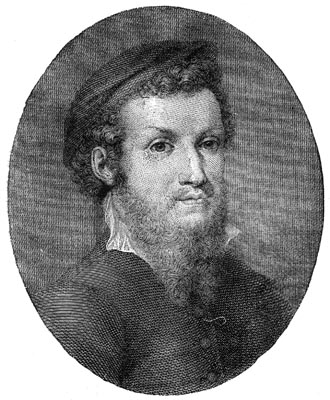
We come now to Antonio Allegri, called Correggio (1493-1534), who was born at the end of the fifteenth, but did his work in the beginning of the sixteenth century. His name of Correggio is that of his birth-place, and as he was not born at any of the great art centres, and did not adopt the precise manner of any school, he, with his followers, stand by themselves, and yet, because his principal works were done at Parma, he is sometimes said to be of the school of Parma.
When Correggio was thirteen years old he had learned to draw well. He studied under Andrea Mantegna and his son Francesco Mantegna. From these masters he learned to be very skilful in drawing, especially in foreshortening, or in representing objects seen aslant. But though he learned much of the science of art from his teachers, his grace and movement and his exquisite light and shade are all his own, for they did not possess these qualities.
Fig. 47.—Portrait of Correggio.
Foreshortening is so important that I must try to explain it; and, as Correggio is said to be the greatest master in this art since the days of the Greeks, it is quite proper for me to speak of it in connection with him. The art of foreshortening is that which makes different objects painted on a plane or flat surface appear as if they were at different distances from the eye of the person who is looking at the picture, or as scenes in nature appear, where one part is much farther off than another. To produce this effect it is often necessary to make an object—let us say, for example, an arm or a leg, look as if it was stretched forward, out of the canvas, directly toward the person who is looking at it. Now, the truth is that in order to produce this effect the object is often thrown backward in the drawing; sometimes also it is doubled up in an unnatural manner, and occupies a small space on the canvas, while it appears to be of life size when one looks at it. A “Christ in Glory” painted by Correggio in the cupola of the Church of San Giovanni Evangelista, in Parma, is a fine piece of foreshortening. The head is so thrown back, and the knees are so thrown forward, that the whole figure seems to be of life size; yet if the space from the top of the head to the soles of the feet were measured, it would be found to be much less than the height of the same figure would be if it were drawn in an erect position.
I have already explained the meaning of chiaro-scuro, and this delicate manner of passing from light to shade was another quality in the works of Correggio. It is even seen in his early works, as, for instance, in the beautiful Madonna di San Francesco, now at Dresden, which he painted when he was but eighteen years old.
When this master was twenty-six years old he married Girolama Nurlini, and about the same time he was summoned to Mantua by the Duke Federigo Gonzaga. During eleven years after his marriage he was occupied with works in Mantua, and with his great frescoes at Parma. In 1530 he returned to Correggio, and there passed the remainder of his life. That he held a high position is proved by certain records of his life, among which is the fact that in 1533 he was invited to be one of the witnesses of the marriage of the Lord of Correggio.
It is said that when this painter saw one of the great works of Raphael, he exclaimed, enthusiastically and thankfully, “I, too, am a painter!” and no doubt he then felt himself moved to attempt such works as should make his name known to all the world through future centuries. When Titian saw Correggio’s frescoes at Parma, he said: “Were I not Titian, I should wish to be Correggio.” Annibale Caracci, also a great artist, said of Correggio, more than a hundred years after his death, “He was the only painter!” and declared that the children he painted seemed to breathe and smile with such grace that one was forced to smile and be happy with them.
In 1534 Correggio died of a fever, and was buried in his family tomb in the Franciscan Convent of his native city. His grave is simply marked with his name and the date of his death.
Some of his oil-paintings are very famous. One at Dresden, representing the “Nativity of the Saviour,” is called the “Notte,” or night, because the only light on the picture comes from the halo of glory around the head of the Holy Child. Correggio’s “Reading Magdalen” is in the same gallery; probably no one picture exists which has been more universally admired than this.
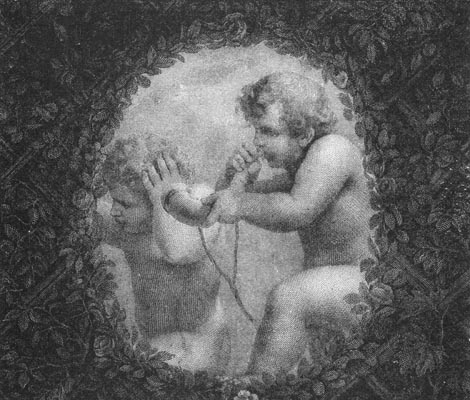
Fig. 48.—Upper Part of a Fresco by Correggio.
There was a large work of his representing “The Shepherds Adoring the Infant Saviour,” at Seville, in Spain. During the Peninsular War (1808-14) the people of that city sent many valuable things to Cadiz for safety, and this picture, on account of its size, was cut in two. By some accident the two parts were separated; but both were sold, and the purchaser of each was promised that the other portion should be given him. From this much trouble arose, because both purchasers determined to keep what they had, and each claimed that the whole belonged to him, and as they were equally obstinate, the two parts of the same work have never been reunited. Fortunately, each half makes a picture by itself.
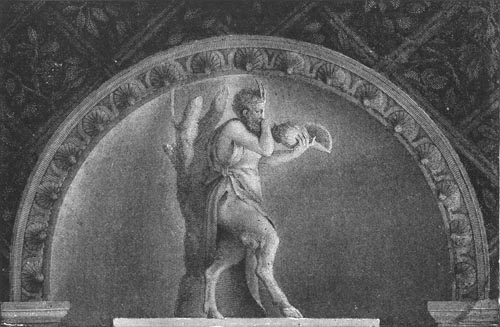
The frescoes at Parma are the greatest works of this master, and it is very interesting to visit that quaint old city; his works are in the Cathedral, the Church of St. John the Evangelist, and in the parlor of the Convent of the Benedictine Nuns. This last is a wonderful room. The ceiling is arched and high, and painted to represent an arbor of vines with sixteen oval openings, out of which frolicsome children are peeping, as if, in passing around behind the vines, they had stopped to look down into the room. The pictures here will make you understand the effect (Figs. 48 and 49). Beneath each of these openings or lunettes is a half-circular picture of some mythological story or personage. Upon the wall of the parlor, above the mantel, there is a picture of Diana, the goddess of the moon and the protector of young animals, which is a beautiful picture.
When Correggio worked on the frescoes at the Church of St. John, he lived much in the monastery connected with it. The monks became very fond of him, and made him a member of the Congregation Cassinensi; the poet Tasso also was a member of this fraternity. This membership gave him the right to share in the masses, prayers, and alms of the community, and after his death the same offices for the repose of his soul would be performed as if he had been a true monk.
Fig. 49.—Lower Part of a Fresco by Correggio.
The works of Correggio are very rarely sold. The madonna in the National Gallery, London, known as “La Vierge au Panier,” was formerly in the Royal Gallery at Madrid. During the French invasion of Spain, Mr. Wallace, an English artist, obtained it. It is painted on a panel, and is 13½ inches high by 10 inches wide. In 1813 it was offered for sale in London at twelve hundred pounds. In 1825 it was sold in Paris for eighty thousand francs, and soon after sold to the National Gallery for thirty-eight hundred pounds, or nearly nineteen thousand dollars.
A copy of the “Reading Magdalen” was sold to Earl Dudley for sixteen hundred pounds, or more than seven thousand dollars.
Correggio had but few pupils, but he had many imitators. The one most worthy of mention was Francesco Mazzuoli (1503-1540), called Il Parmigiano, or Parmigianino. He was not a great painter. The “Vision of St. Jerome,” in the National Gallery, London, is one of his best works. It is said that during the sack of Rome, in 1527, he was painting the figures of the Virgin and Child in this picture, and was so engrossed by his work that the invaders entered his studio, and surrounded him before he was aware of their approach. And they, for their part, were so moved by what they saw that they went away, and left him undisturbed.
Art writers often use the term “early masters.” This denotes Michael Angelo, Raphael, and other men so great that they were very prominent in the history of art, and were imitated by so many followers that they had an unusual effect upon the world. Titian may be called the last of these great masters of the early school, and his life was so long that he lived to see a great decline in art.
The painters of the close of the sixteenth century are called “Mannerists,” which means that they adopted or imitated the manner or style of some great master who had preceded them—and this was done in so cold and spiritless a way that it may be said that true artistic inspiration was dead in Italy. No one lived who, out of his own imagination, could fix upon the wall or the canvas such scenes as would befit a poet’s dream or serve to arouse the enthusiasm of those who saw the painted story born in the artist’s brain.
About 1600, the beginning of the seventeenth century, there arose a new movement in Italian art, which resulted in forming two schools between which there came to be much bitterness of feeling, and even deadly hatred. On one side there were those who wished to continue the study and imitation of the works of the old masters, but with this they united a study of nature. These men were called “Eclectics,” because they elected or chose certain parts of different systems of painting, and from these formed a new manner of their own.
Opposed to the Eclectics were the “Naturalists,” who insisted that nature only should be studied, and that everything should be represented in the most realistic way, and made to appear in the picture exactly as it did in reality, not being beautified or adorned by any play of fancy or imagination.
The chief school of the Eclectics, of whom I will first speak, was at Bologna, and is known also as the “school of the Caracci,” because Ludovico Caracci (1555-1619) was at the head of a large academy there, and was assisted by his nephews, Agostino Caracci (1558-1601) and Annibale Caracci (1560-1609), the latter being the greatest artist of the three. The lives of the Caracci are not of such interest as to require an account of them here, neither are their works so interesting that we may not leave these artists by saying that they have great consideration as the heads of the Eclectic Academy, and for the work they did in it at an important era in the history of Italian art; but the fruits of their work are shown in that of their scholars rather than in their own paintings, and in this view their influence can scarcely be overvalued.
The greatest of their scholars was Domenico Zampieri (1581-1641), called Domenichino, who was born at Bologna, and was instructed by Denis Calvert, who forbade his drawing after the works of Annibale Caracci. Domenico disobeyed this command, and was so severely treated by Calvert that he persuaded his father to take him from that master, and place him in the school of the Caracci. When he entered the Academy he was so dull that his fellow-pupils nicknamed him “The Ox;” but Annibale Caracci said: “Take care: this ox will surpass you all by and by, and will be an honor to his art.” Domenichino soon began to win many prizes in the school, and left it well trained and prepared for a brilliant career.
He gave much thought to his art, shunned private society, and if he went out at all he frequented public places where large numbers of people were gathered, thus affording him an opportunity to study their varying expressions. He also tried to feel in himself the emotions of the person he was painting. For instance, it is said that when he was painting the “Scourging of St. Andrew,” he threw himself into a passion, and used threatening gestures and high words. In the midst of this his master, Annibale Caracci, surprised him, and was so impressed with his method that he threw his arms about his pupil’s neck, exclaiming, “To-day, my Domenichino, thou art teaching me!”
The most celebrated work by Domenichino is the “Communion of St. Jerome,” in the Vatican. It is universally considered the second picture in Rome, the “Transfiguration,” by Raphael, being the only one that is placed before it. The scene it represents is just before the death of the saint, when he was borne into the chapel to receive the sacrament of the communion for the last time (Fig. 50).
Fig. 50.—Communion of St. Jerome.
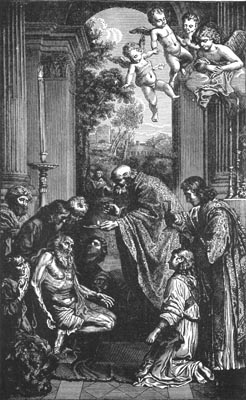
Domenichino was made very unhappy in Rome, on account of the jealousy of other artists, and he returned to Bologna. However, his fame had reached the court at Naples, and the viceroy of that city invited the artist to decorate the Chapel of St. Januarius. There was in Naples at that time an association of artists who had determined that no strange artist should be allowed to do work of any account in their city. As soon as Domenichino began his work, therefore, he received letters threatening his life. His colors were spoiled by having ruinous chemicals mixed with them, his sketches were stolen from his studio, and all sorts of insults and indignities were heaped upon him.
After a time, the painter was so disheartened that he fled to Rome; but the viceroy sent for him and took every precaution possible to protect him and enable him to work in peace. But just as all seemed to be going well he sickened and died, and it has always been said that he was poisoned. Be this as it may, there is no doubt that the fear, vexation, and anxiety of his life caused his death, and on this account his tormentors were his murderers.
The works of Domenichino are not numerous, and are not seen in as many galleries as are those of some Italian painters; but there are a considerable number scattered over Europe and very beautiful ones in several galleries in Rome.
The next painter of importance in the Eclectic school was Guido Reni (1575-1642), born at Bologna, and the son of a professor of music. His father intended that Guido also should be a musician, and the poor boy was much persecuted on account of his love for drawing. But after many struggles the boy came into the Caracci school, and was soon a favorite pupil there.
When still young he listened with great attention to a lecture from Annibale, in which he laid down the rules which should govern a true painter. Guido resolved to follow these rules closely, and soon he painted so well that he was accused of trying to establish a new system of painting. At last Ludovico Caracci turned against him and dismissed him from his school.
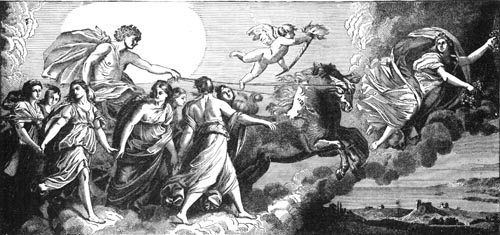
Fig. 51.—Aurora. By Guido Reni.
The young artist went to Rome; but his persecutions did not cease, and it seemed to be his fate to excite the jealousy of other painters. Now, when so much time has elapsed, we know that Guido was not a very great master, and had he painted in the days of Michael Angelo he would not have been thought so. But art had lowered its standard, and Guido’s works were suited to the taste of his time; he had a high conception of beauty, and he tried to reach it in his pictures.
In the course of his career Guido really painted in three styles. His earliest pictures are the strongest; those of his middle period are weaker, because he seemed only to strive to represent grace and sweetness; his latest pictures are careless and unequal in execution, for he grew indifferent to fame, and became so fond of gaming that he only painted in order to get money to spend in this sinful folly.
His masterpiece in Rome was the “Aurora,” on a ceiling of the Rospigliosi Palace; it represents the goddess of the dawn as floating before the chariot of Apollo, or Phœbus, the god of the sun. She scatters flowers upon the earth, he holds the reins over four piebald and white horses, while Cupid, with his lighted torch, floats just above them. Around the chariot dance seven graceful female figures which represent the Hours, or Horæ. I have been asked why seven was the number; the ancients had no fixed number for the Hours; sometimes they were spoken of as two, again three, and even in some cases as ten. It has always seemed to me that ten was the number chosen by Guido, for in that case there would naturally be three out of sight, on the side of the chariot which is not seen (Fig. 51).
Fig. 52.—Beatrice Cenci.
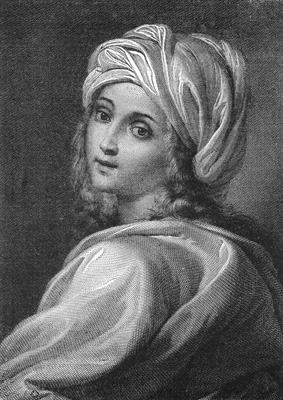
The portrait of Beatrice Cenci is another very celebrated picture by Guido; it is in the gallery of the Barberini Palace, in Rome (Fig. 52). The interest in the portrait of this unhappy girl is world-wide. She was the daughter of a wealthy Roman noble, who after the death of her mother married a second time, and treated the children of his first marriage in a brutal way. It is even said that he hired assassins to murder two of his sons on their return from a journey to Spain. The story also relates that his cruelty to Beatrice was such that, with the aid of her step-mother and her brother, she killed him. At all events, these three were accused of this crime and were executed for it in 1599. Other accounts say that he was murdered by robbers, and his wife and children were made to appear as if guilty. Clement VII. was the pope at that time, and in spite of his knowledge of the cruelty of the father he would not pardon them, though mercy was implored of him for this lovely girl. The reason given for this action of the pope’s is that he wished to confiscate the Cenci estates, which he could do if the family suffered the death penalty. So many reproductions of this sad face have been made that it is very familiar to us, and almost seems to have been the face of some one whom we have known.
Guido did not paint his St. Michael for the Cappucini in Rome until after he returned to his native city. When he sent the picture to the monks, he wrote: “I wish I had the wings of an angel to have ascended into Paradise, and there to have beholden the forms of those beautified spirits from which I might have copied my archangel; but not being able to mount so high, it was in vain for me to search for his resemblance here below, so that I was forced to make an introspection into my own mind, and into that idea of beauty which I have formed in my own imagination.”
We are told that he always tried to paint his ideal of beauty rather than to reproduce any human beauty that he had seen. He would pose his color-grinder, and draw his outlines from him, and then fill in with his own conceptions of what the head he was painting should be; this accounts for the sameness in his heads and faces.
His passion for gaming degraded the close of his life. It led him into great distresses, and for the sake of money he painted many pictures which are not worthy of his name. He had always received generous prices for his pictures, but he left many debts as a blot upon his memory. His works are seen in the galleries of Europe, and are always admired for their feeling, beauty, and grace.
Francesco Albani (1578-1660), born at Bologna, was another scholar of the Caracci school, and a friend of Guido Reni. There are many works of his in Rome. His pictures of landscapes with figures were his best works, and beauty was his characteristic. His own home had all the advantages for painting such works as he best succeeded in, such as Venus and the Loves, maids and boys, children and Cupids in unending variety.
His villa was surrounded by charming views. His wife was very handsome, and they had twelve lovely children, so lovely that it is said that other artists besides himself made use of them for models.
There were several other Eclectics of some importance of whom we shall not speak, but shall leave them with an account of Elisabetta Sirani (1640-1665), who also was born at Bologna, and is worthy of attention on account of her talents, while the story of her life adds another interest than that which she has as an artist.
She was an imitator of the attractive manner of Guido Reni. The heads of her madonnas and magdalens are charming, and, indeed, all her work speaks of the innate refinement of her nature. Her industry was marvellous, since she made one hundred and fifty pictures and etchings in a period of about ten years. Much has been said of the rapidity with which she worked, and one story relates that on a certain day the Duchess of Brunswick, the Duchess of Mirandola, and the Duke Cosimo de Medici, with other persons, met in her studio, and she sketched and shaded drawings of subjects which they named to her, with a skill and celerity which astonished and delighted her guests.
Her masterpiece is a picture of “St. Anthony Adoring the Virgin and Child,” which is in the Pinacoteca of Bologna. There are pictures by her in the Belvedere and Lichtenstein Galleries at Vienna, in the Hermitage at St. Petersburg, and in the Sciarra Palace, Rome.
In person Elisabetta Sirani was beautiful, and her character commanded the affection of all who knew her. She was a sweet singer, and her biographers increase her virtues by praising her taste in dress, and even her moderation in eating! She was skilful in domestic affairs, and was in the habit of rising early to perform her share in the household duties, never allowing her art to displace any occupation which properly made a part of her life. Her name has come down through more than two centuries as one whose “devoted filial affection, feminine grace, and artless benignity of manner added a lustre to her great talents, and completed a personality which her friends regarded as an ideal of perfection.”
She died very suddenly, and the cause of her death has never been known; but the theory that she was poisoned has been generally accepted. Several reasons for the crime have been given; one is that she was the victim of jealous artists, as Domenichino had been; another, that a princely lover whom she had scorned thus revenged himself. A servant-girl in her family was suspected of the crime, tried, and banished; but after a time she was recalled to Bologna at the request of the father of Elisabetta, for he saw no proof of the girl’s guilt. Thus the mystery was never solved, but the whole city of Bologna was saddened by her death. The day of her burial was one of public mourning; her funeral was attended with great pomp, and she was buried beside Guido Reni in the splendid church of the Dominicans. Poems and orations in her praise were numerous, and a book was published, called “Il Penello Lagrimate,” which contained these, with odes, anagrams, and epitaphs, in both Latin and Italian, all setting forth her charms and virtues. Her portrait in the Ercolani Gallery at Bologna represents her when occupied in painting her father’s portrait; according to this picture she had a tall, elegant figure, and a very pretty face. She had two sisters, Barbara and Anna Maria, who also were artists, but her fame was so much greater than theirs that she quite overshadowed them.
The earliest master of the Naturalists was Michael Angelo Amerigi, called Caravaggio, from the name of his birth-place (1569-1609). His life and character was not such as to make him an attractive study. His subjects and his manner of representing them combined in producing what has been called “the poetry of the repulsive.” He was wild in his nature and lived a wild life. His religious subjects, even, were coarse, though his color was vivid and his figures arranged with good effect. His “False Players” is one of his best works; it represents two men playing cards, while a third looks over the shoulder of one as if advising him what to play.
Naturally, his manner of painting was best suited to scenes from common life, though he made those coarse and sometimes painful; but when he attempted subjects of a higher order his works are positively offensive. Some of his sacred pictures were removed from the altars for which they were painted on account of their coarseness. His most celebrated work is the “Entombment of Christ,” at the Vatican; in the Gallery of the Capitol in Rome there is a “Fortune Teller,” which is also a fine work.
Next to Caravaggio came Giuseppe Ribera, called Il Spagnoletto (1588-1656). He was a native of Valencia, and when very young made his way to Rome, so that, although his education as an artist was wholly Italian, his familiar name arose from his Spanish origin. While living in miserable poverty in Rome, and industriously copying such frescoes as he could gain access to, he attracted the attention of a cardinal, who took him to his home, and made him comfortable. But the young painter soon ran away, and returned to his street life. The cardinal sought him out, and called him an “ungrateful little Spaniard;” but Ribera excused his conduct by saying that as soon as he was made comfortable and was well fed he lost all ambition to work, adding that it would require the spur of poverty to make him a good painter. The cardinal respected his courage, and the story being repeated to other artists, much interest was attracted to him.
Later he went to Naples, and joined the cabal there which had agreed to persecute the strange artists who should come to work in that city. If Ribera did not actually commit many of the crimes which were done there, he was responsible for them through his influence. His works are frequently so brutal in their subjects and treatment that one feels that he who painted them must have lost all the kindliness of his nature.
He married the daughter of a rich picture dealer, and became very rich himself. In 1630 he was made a member of the Academy of St. Luke, at Rome, and in 1648 Pope Innocent X. sent him the cross of the Order of Christ. Few Italian artists were better known in their own country, and many of his pictures were sent to Spain. His greatest excellence was in his knowledge of anatomy, and he painted subjects that enabled him to show this. Among his famous works are a “Descent from the Cross;” “The Flaying of St. Bartholomew;” “Ixion on the Wheel;” and “Cato of Utica.” His works are in all the famous galleries of the world.
Ribera’s greatest pupil was Salvator Rosa (1615-1673), the landscape painter, who was a very gifted man, being a poet and musician as well as an artist. His father was an educated man, and with his other relatives encouraged his son in his taste for art. When twenty years old he went to Rome, and with the exception of some intervals remained there during his life.
It is said that as a youth he associated much with bandits, and, when one considers the wildness of many of his scenes and the character of the figures in their midst, it is not difficult to believe that this may have been true. It is certain that he painted the portrait of the famous Masaniello more than once, and he is believed to have joined the Compagnia della Morte, of which Falcone, one of his masters, was the captain.
Salvator made many enemies by his independence and his inclination to satire. He wrote satires on various subjects which were not published until after his death, but it was known that he had written them. He married a Florentine woman, who was the mother of his two sons. When he died he was buried in the Church of Santa Maria degli Angeli, where a monument is erected to his memory.
He painted some historical subjects and portraits in which he followed the Naturalists, but his principal works were landscapes. Jagged rocks and mountains, wild dells and lonely defiles, with here and there robbers, hermits, or soldiers, make his most effective pictures. There is a deep sense of desolation, almost of fear, in them which is very impressive. Sometimes he painted serene landscapes and poetic figures; but his best works are not of this sort. His pictures are in the principal public and in some private galleries. He also left about ninety etchings which are masterly in execution and full of expression in the heads, while the atmosphere is soft. When his works are sold they bring great prices. A large landscape with Apollo and the Sibyl in the foreground brought eight thousand five hundred dollars in England years ago, and is now worth much more than that.
Early in the eighteenth century an artist named Antonio Canale (1697-1768), called Canaletto, began to make views of the city of Venice and scenes on the canals. He had two followers, Bernardo Bellotti (1720-1780), who was his nephew, and Francesco Guardi (1712-1793), and these three painters executed a large number of these pictures, which are found in many European galleries, and it is not always easy to distinguish their authorship. There is no doubt that many which were once attributed to the first master were really painted by his pupils.
Before the commencement of the eighteenth century the decline of the Renaissance school in Italy had begun; in fact, the painting of the seventeenth century came to be mere mechanical realism. For this reason the portraits were the best pictures of the time, as in them it was requisite to be true to the object represented.
Late in the eighteenth century a new impulse was given to Italian painting, chiefly through the influence of foreign artists such as Raphael Mengs, and the French painter David. In the beginning of our own century Lorenzo Benvenuti (1769-1844) executed some excellent frescoes in Florence, Siena, and Arezzo, which was his native city. He decorated the ceiling of the Medici Chapel in the Church of San Lorenzo in Florence, and Leopold II., Grand Duke of Tuscany, erected a tomb to this painter in the same church where he had spent so much time and talent. His portrait, painted by himself, is in the gallery of the Uffizi, at Florence. Vincenzio Cammuccini (1775-1844), too, was a celebrated master of his time. He was a Roman by birth, and became President of the Academy of St. Luke; he was also a member of the Institute of France, and received decorations from sovereigns of various countries. He made many copies from the works of the great masters. His portraits were so much admired as to be compared to those of Rubens and Tintoretto, and his ceiling frescoes in the Torlonia Palace, Rome, were among his important works, as was a “Presentation of Christ in the Temple,” painted for the Church of San Giovanni in Piacenza.
But there has been no true restoration of Italian art. The painting of Italy in our time has been largely a commercial enterprise rather than an outcome from artistic genius or impulse, and the few works which are exceptions to this rule are not sufficient to encourage the hope that this nation can again attain to her former rank or regain the fame of her past in the history of modern art.