Chapter XVI · LOTTERIES AND LOTTERY INSURANCES. (continued 2)
Reading edition
PUBLIC NOTICE.—The Licenses granted by 4th Geo. IV. cap. 60, to the Lottery-office-keepers, to sell and divide into shares State Lottery Tickets, will cease and determine on Wednesday the 18th of this month, when all the Six Prizes of £30,000, and every other prize, amounting to £389,000, must be decided, and all Lotteries end in this kingdom. Government, having already given extra time for the sale of tickets, will not grant an hour beyond the 18th instant.
Hazard was the rather appropriate name of another promoter whose advertisements are published just at this time; but they are, as are the others, small and unpretentious when in the newspapers, and are only noticeable as records of the finishing days of the great State Lottery. In the Times of October 13 there is this notice, which was repeated on the 16th and 17th, on the last-named date having the word “to-morrow” inserted instead of “next Wednesday:”—
DRAWING of the LOTTERY.—Whereas it is maliciously asserted by an Anonymous Correspondent in the Morning Chronicle of this day, that application would be made to the Lords of the Treasury for a further Postponement of the Lottery, the Public are most unequivocally and positively assured by the Contractors that no such application has been made, nor even contemplated; but on the contrary, it is absolutely and inevitably determined by Government, that this last of all lotteries shall and must be decided NEXT WEDNESDAY, 18th instant.
On the day before the drawing, the advertisements in the Times showed that great apathy existed, and that the tickets had not gone off well, as the office-keepers had evidently many yet left on hand. Even the advertisements have a dispirited appearance:—
FINISH of LOTTERIES.—SWIFT and Co. respectfully inform the Public that the last and only day of drawing the STATE LOTTERY is Wednesday the 18th of this month, when 6 prizes of 30,000l. and all the other capitals in the scheme will be determined. Every ticket will receive 5l. independent of any sum to which it may be entitled. In the last Lottery containing 30,000l. prizes Swift and Co. sold two out of four of them at their offices 11, Poultry; 1, Strand; and 31, Aldgate High-street.
It is almost evident that the Lottery was “played out” on its own merits, and that the interference of Parliament only hastened the end so far as concerns the important events. Another firm of contractors put forth a final appeal thus:—
THE LAST of ALL, TO-MORROW, 18th October.—J. and J. SIVEWRIGHT, Contractors, most positively assure the Public that—
To-morrow, Six of 30,000l. must be drawn. To-morrow, 389,000l. will be decided. To-morrow, all Lotteries end in this kingdom.
To gain a Prize of 30,000l. you must buy THIS DAY.
Tickets and Shares are selling by J. and J. SIVEWRIGHT, Contractors, 37, Cornhill; 11, Holborn; and 38, Haymarket; who shared and sold 12,478, a prize of 30,000l.; 3,613, 21,055l.; and in the last Lottery, 1,783, a prize of 21,000l.; and 3,925, a prize of 21,000l.
On the fatal day itself the only noticeable advertisement in the Times is that of Bish, which is the same as had been running for some little time, and which on the 18th of October 1826, with the word “this day,” instead of what had appeared before, stood thus, a specimen of the last newspaper appeal in regard to a forthcoming State lottery:—
THE inevitable and absolute FINISH of LOTTERIES, THIS DAY.—BISH, in soliciting for the last time the favours of his best friends, the Public, assures them that,
This Day, a Ticket must gain £30,000
This Day, a Half must gain 15,000
This Day a Quarter must gain 7,500
This Day an Eighth must gain 3,750
This Day a Sixteenth must gain 1,875
This Day, all the Six of £30,000 will be drawn, every number decided, and every ticket a Prize.
This Day, 18th instant, all lotteries end for ever.
Tickets and Shares are selling by BISH, Stockbroker, 4, Cornhill, and 9, Charing-cross, who shared and sold, within the last 12 months, 5 prizes of 30,000l. and 9 of 20,000l., and in the very last drawing, 3d of May, No. 1,833 (Class B), 21,000l., and 3,925 (Class A), 21,000l.
The following is the record of the last drawing, as published in the Thursday’s papers: “Yesterday afternoon, about half-past six o’clock, that old servant of the State, the lottery, breathed its last, having for a long period of years, ever since the days of Queen Anne, contributed largely towards the public revenue of the country. This event took place at Cooper’s Hall, Basinghall Street; and such was the anxiety on the part of the public to witness the last drawing of the lottery, that great numbers of persons were attracted to the spot, independently of those who had an interest in the proceedings. The gallery of Cooper’s Hall was crowded to excess long before the period fixed for the drawing (five o’clock), and the utmost anxiety was felt by those who had shares in the lottery for the arrival of the appointed hour. The annihilation of lotteries, it will be recollected, was determined on in the session of Parliament before last; and thus a source of revenue, bringing into the treasury the sums of £250,000 and £300,000 per annum will be dried up. This determination on the part of the Legislature is hailed by far the greatest portion of the public with joy, as it will put an end to a system which many believe to have fostered and encouraged the late speculations, the effects of which have been and are still severely felt. A deficiency in the public revenue to the extent of £250,000 annually will, however, be the consequence of the annihilation of lotteries, and it must remain for those who have strenuously supported the putting a stop to lotteries to provide for the deficiency.”—“Although that which ended yesterday was the last, if we are informed correctly the lottery-office keepers have been left with a great number of tickets remaining on their hands—a pretty strong proof that the public in general have now no relish for these schemes.”—“The concourse of persons in Basinghall Street was very great; indeed, the street was almost impassable, and everybody seemed desirous of ascertaining the fortunate numbers. In the gallery the greatest interest was excited, as the various prizes were drawn from the wheel; and as soon as a numbered ticket was drawn from the number wheel, every one looked with anxiety to his share, in order to ascertain if Fortune smiled on him. Only one instance occurred where a prize was drawn and a number held by any individual present. The fortunate person was a little man, who no sooner had learned that his number was a grand prize, than he buttoned up his coat, and coolly walked off without uttering a word. As the drawing proceeded disappointment began to succeed the hopes indulged by those who were present. On their entrance to the hall every face wore a cheerful appearance; but on the termination of the drawing a strong contrast was exhibited, and the features of each were strongly marked with dissatisfaction. The drawing commenced shortly after five o’clock, and ended at twenty minutes past six. The doors of the various lottery offices were also surrounded by persons awaiting the issue of the drawing.”
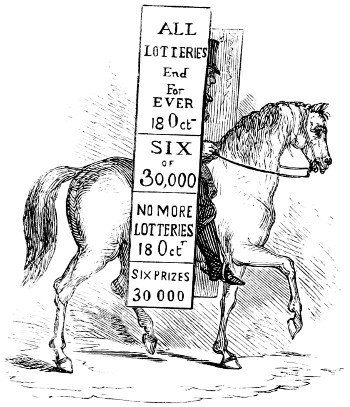
THE LAST OF THE LOTTERIES.
The Times, in a short leader—short and few were the leaders in the Times of that day—published on the Thursday, says: “Yesterday terminated the lotteries in this country—may we say for ever? We know not. Such a result will depend upon the wants of Government, and the morality of its ministers. However, we rejoice at their suspension,—a suspension which we hope we have in some degree assisted in effecting,—yet rejoice with fear. Looking at the Stock Exchange, at the time bargains, and at all the iniquities practised there, we have only to hope that the place of the lotteries may not be supplied by some more mischievous system of knavery. Time was when all the robberies were committed on the king’s highway. The lighting, watching, and general improvement of our roads, have nearly put an end to this practice; but housebreaking has unfortunately taken its place! And yet the people of England is not a gambling people like the French, as is evident from the fate of the last lottery. We have heard that hardly half the tickets were sold; from which it is evident, that the spirit of lottery-gambling was extinct before the system; and if that spirit had not been kept alive by incessant stimuli, it would have expired long ago.”
It may be as well to mention, though it is generally known, that an Act of the 9th and 10th Vict. was passed for legalising Art Union Lotteries within certain limits and under certain conditions. Though our chapter has run over its length, we can hardly conclude without quoting the wise words of Adam Smith on the subject of lotteries. “The chance of gain,” says he, “is by every man more or less overvalued, and the chance of loss is by most men undervalued. . . . The world neither ever saw, or ever will see, a perfectly fair lottery, or one in which the whole gain compensated the whole loss; because the undertaker could make nothing by it. In the State lotteries the tickets are really not worth the price which is paid by the original subscribers, and yet commonly sell in the market for twenty, thirty, and sometimes forty per cent. advance. The vain hope of gaining some of the greatest prizes is the sole cause of this demand. The soberest people scarce look upon it as a folly to pay a small sum for the chance of gaining ten or twenty thousand pounds; though they know that even that small sum is perhaps twenty or thirty per cent. more than the chance is worth. In a lottery in which no prize exceeds twenty pounds, though in other respects it approach much nearer to a perfectly fair one than the common State lotteries, there would not be the same demand for tickets. In order to have a better chance for some of the great prizes, some people purchase several tickets, and others small shares in a still greater number. There is not, however, a more certain proposition in mathematics, than that the more tickets you adventure upon the more likely you are to be a loser. Adventure upon all the tickets in the lottery, and you lose for certain; and the greater the number of your tickets the nearer you approach to this certainty.” Though this was written in reference to a state of affairs long past, the lesson is not without value nowadays.
October 18, 1826, saw the last of the State lotteries, but it was long before the smaller fry were eradicated. Conducted very quietly at first, but after a while their promoters growing bolder, lotteries for clothes, furniture, and, especially at Christmas-time, for food and drink, were openly advertised under the title of “sweeps” up to comparatively recent times. A few police prosecutions about a dozen years back improved these relics of a past day off the face of the earth. There were, however, still left what were called “specs,” which violated both the Betting-House Act and the Lottery Act, and the promoters of the chief of them in turn suffered under the majesty of the law about the period of the raid on the commission agents referred to in a previous chapter. Under the guises of picture and circular sales these turf lotteries are still continued, an advertisement in a sporting paper of June 1874 giving an address in Glasgow, informing all those whom it most concerns that the “East End Circular” has for disposal
30,000 circulars, at 1s. each; the profits, about £800, will be distributed on
THE DERBY.
2000 prizes. First, £300.
This circular needs no recommendation. It is a fortune to all who invest in it. The winners of all the large races have been sent in it. Every purchaser has a fair chance of securing the £200. For circulars, 1s. each, apply at once to E. Jones, 128, Renfield Street, Glasgow, or in person to any of his well-known agents.
Then follows a list of names of people living in various parts of the kingdom who are empowered to sell the circulars. Within the past twelvemonth certain small papers which added to their circulation by the presentation of coupons entitling the holders to shares in lotteries for prizes of all descriptions, received solemn warning from the Home Office, and had to discontinue their projects. That this was wise, considering the innocence of the arrangement, we do not think; that it was not impartial, the notice from which we have just quoted proves. For the Lottery Act extends to Scotland, even if the Betting Act does not.[45]