Chapter VIII · TRIBE IV—ANDROPOGONEÆ. (continued 2)
Reading edition
This grass grows all over the Presidency in open dry situations and is very widely distributed.
Distribution.—Throughout India—westward to tropical Africa.
29. Anthistiria, L. f.
(Themeda, Forsk.)
These are tall grasses, annual or perennial. Leaves are usually long and narrow. The inflorescence consists of racemes or panicles of fascicled spikes in the axils of spathiform bracts. The spikelets vary in number from six to eleven in a cluster, the four lowest being male or neuter, and forming an involucre with whorled or superposed pairs round either 1-sessile bisexual spikelet with two pedicelled spikelets or two superposed bisexual, the lower with one pedicelled, the upper with two.
The involucral spikelets are male or neuter, the largest, and consist of three glumes. The first glume is oblong, lanceolate, dorsally flattened, many-nerved, margins narrowly incurved and keels narrowly winged. The second glume is membranous, lanceolate, acute, 3-nerved, with ciliate margins. The third glume is hyaline, smaller than the second, 1-nerved or this glume may be absent, stamens have large anthers. The pedicelled spikelets are similar to the involucral in every respect but smaller, male or neuter, but the first glume is not winged on the keels. The bisexual (or female) spikelets are smaller than the involucrant spikelets, linear-oblong, subterete, obtuse with a rigidly bearded callus. There are four glumes in the spikelet. The first glume is terete, or dorsally compressed or channelled, coriaceous and at length hardened, margins incurved, dark brown to almost black when old. The second glume is as long as the first, linear, dorsally chartaceous, with broadly incurved membranous margins, 3-nerved. The third glume is very small, hyaline, 1-nerved, epaleate. The fourth glume is the flattened base of the awn, epaleate. The lodicules are two, cuneate. Anthers are rather small. Styles are laterally or terminally exserted. Grain is narrow, obovoid, biconvex, with two grooves on the anterior side and with a long embryo.
Anthistiria tremula, Nees.
This is an annual or perennial. Stems are stout or slender, erect or ascending from a creeping root-stock, simple or branched, 1 to 4 feet.
The leaf-sheath is smooth, compressed. The ligule is a narrow membrane.
The leaf-blade is linear-lanceolate, rigid, erect, acuminate with a setaceous tip, nearly smooth, varying in length from 6 to 20 inches and in breadth from 1/6 to 2/3 inch.
The inflorescence is an elongate panicle, 1 to 2 feet long, consisting of rather distant fascicles of spikes and bracts on capillary, flexuous peduncles; the spikes are sub-flabelliform or sub-globose, 1/2 to 1-1/2 inches broad, sometimes reduced to a few spikelets and bracts; the outer bracts are longer than the fascicles, 1 to 1-1/2 inches long, glabrous or hairy with ordinary or tubercle-based hairs; proper bracts are lanceolate, acute, compressed, glabrous or hairy with membranous margins.
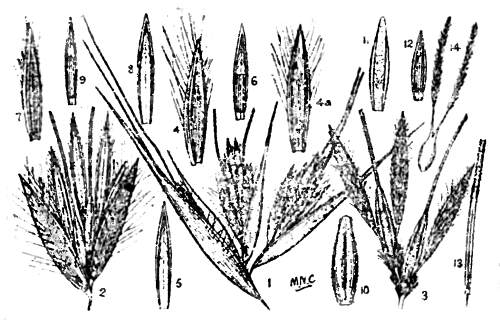
Fig. 165.—Anthistiria tremula. 1. Fascicles of three spikes with the outer bracts and proper bracts; 2. a spike without its proper bract; 3. the pedicelled and the bisexual spikelets without the involucral spikelets; 4, the first glume of the involucral spikelet with one wing only; 4a. the first glume of the involucral spikelet with wings to both the keels; 5 and 6. the second and the third glume of the involucral spikelet; 7, 8 and 9. the glumes of the bisexual spikelet; 10, 11, 12 and 13. glumes of the bisexual spikelet; 14. ovary.
The involucral spikelets are the longest, in contiguous superposed pairs, about 1/2 inch long, and the rachis of the spike is produced beyond these spikelets. There are three glumes. The first glume is linear-lanceolate, acute, covered with long, often tubercle-based hairs, many-nerved, margins narrowly incurved, and with narrow wings, on both the keels in one of each of the pairs of spikelets and on one keel only in the other of each of these pairs. The second glume is oblong-lanceolate, acute, margins thin and membranous, inflexed, ciliate above the middle, 3-nerved. The third glume is as long as the second, hyaline, very narrowly linear, 1-nerved. Stamens are three and the lodicules are cuneate.
The pedicelled spikelets are usually smaller than the involucral spikelets and similar to them. The first glume is winged on one side in the lowest spikelet and without wings in the others.
The bisexual or (female) spikelets are linear-oblong, obtuse, and the callus with reddish hairs. The first glume is scabrid, deeply channelled at the back, nerveless, narrowly truncate at the tip, and hispid near the apex. The second glume is as long as the first, linear, hyaline, 3-nerved, chartaceous at the back with the sides membranous and incurved. The third glume is small, hyaline, 1-nerved and epaleate. The fourth glume is the narrowed base of the awn which is 1/2 inch long.
This grass is very common in marshes and in wet low-lying places on the hills and occurs also in the plains in Malabar and South Kanara.
Distribution.—The Deccan Peninsula, from the Konkan and Central Provinces southward, and Ceylon.
30. Iseilema, Hack.
These grasses are either annual or perennial, with slender freely branching stems. The inflorescence is a panicle consisting of groups of dissimilar spikelets with compressed, boat-shaped spathes on peduncles. Spikelets are of two kinds, sessile and pedicelled. Each peduncle bears 4-pedicelled male or neuter spikelets in a regular whorl forming an involucel around 1 or 2 sessile bisexual spikelets and 2- or 3-pedicelled male spikelets. Involucral spikelets have 3 or 2 glumes, the first two glumes are somewhat similar, the first 3- to 5-nerved and the second 3-nerved, the third glume is one nerved and hyaline. Lodicules are cuneate and retuse. Anthers yellow dotted or tinged violet. Pedicelled spikelets inside the involucral similar to those of the involucral. Sessile spikelets are bisexual or sometimes female, 4-glumed and awned.
KEY TO THE SPECIES.
Panicle slender, lax; involucral spikelets 1/6 inch; pedicel slender, terete 1. I. laxum.
Panicle crowded, leafy; involucral spikelets 1/6 inch or more, very strongly nerved; pedicel harder, firmer and flattened 2. I. anthephoroides.
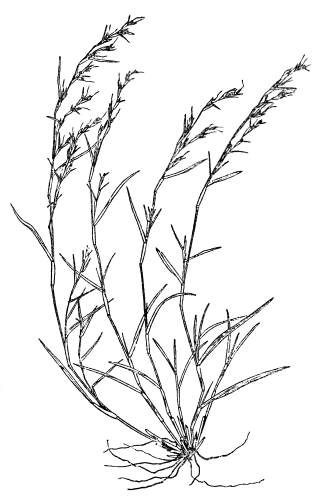
Fig. 166.—Iseilema laxum.
Iseilema laxum, Hack.
It is a tufted perennial grass with a stout, short, creeping root-stock. Stems are slender, branched, ascending, 6 to 24 inches long.
The leaf-sheaths are somewhat loose, glabrous. The ligule is a shortly ciliate membrane.
The leaf-blade is linear, obtuse, glabrous and ciliate near the base, 2 to 6 inches long. The leaf-blades in the upper portions of the branches are smaller.
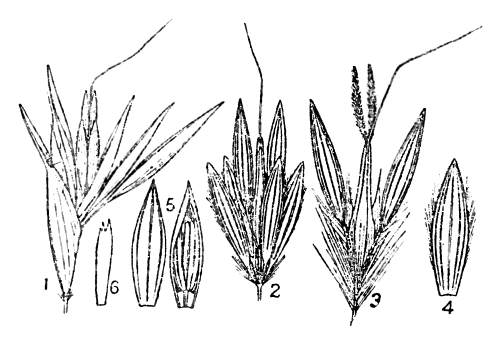
Fig. 167.—Iseilema laxum. 1. A cluster of spikelets with spathes. 2. a cluster consisting of the involucral spikelets and three inner spikelets; 3. the inner spikelets consisting of one sessile female or bisexual and 2-pedicelled male spikelets; 4, 5 and 6. the first, second and the third glume, respectively, of the involucral spikelet.
The inflorescence is a narrow long panicle bearing clusters of spikelets with spathes on slender peduncles, the outer spathes are narrow-lanceolate, glabrous or with a few hairs near the margin, 1/4 to 1 inch long; inner spathes are lanceolate, smaller with membranous margins. Each cluster consists of an involucel of 4 pedicelled spikelets forming a true whorl around 2 pedicelled and 1 sessile spikelets or 3 pedicelled and 2 sessile spikelets. The involucral spikelets are male, oblong-lanceolate, acute, with short flattened pedicels, bearded at the base, and have three glumes. The first glume is oblong-lanceolate, acute, 5- to 7-nerved and ciliate. The second glume is oblong-lanceolate, acuminate, equal or slightly shorter than the first, glabrous, 3-nerved and with infolded margins. The third glume is hyaline, linear, short, irregularly toothed at the apex. The inner pedicelled spikelets are similar to the involucral spikelets, but the third glume is very narrow, linear. The sessile spikelets are female, rarely bisexual, narrowly lanceolate, 1/5 inch long, glabrous and have four glumes. The first glume is lanceolate, chartaceous, truncate or 2-fid at the apex, faintly 5-nerved, with a few long hairs or glabrous, and with margins scaberulous towards the tip to about one-third the length of the glume. The second glume is lanceolate, acuminate, glabrous, sub-chartaceous, 3-nerved. The third glume is hyaline, nerveless, apex irregularly cut, short; sometimes this glume is wanting. The fourth glume is a very slender awn of about 1/2 inch.
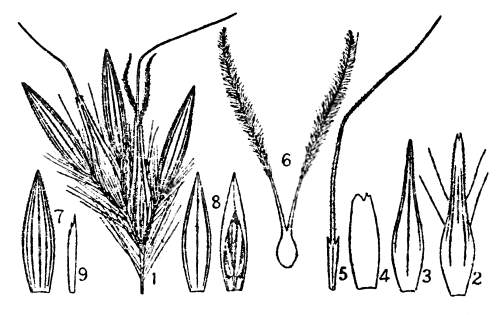
Fig. 168.—Iseilema laxum. 1. Inner spikelets consisting of 2-pedicelled male and two female or bisexual spikelets; 2, 3, 4 and 5. the first, second, third and the fourth glume, respectively, of the sessile spikelets; 6. ovary; 7, 8 and 9. the first, second and the third glume, respectively, of the inner pedicelled spikelet.
This is a widely spread common grass growing in somewhat moist situations. This is the well-known Chengali gaddi of the Telugu districts.
Distribution.—All over Madras and Bombay presidencies.
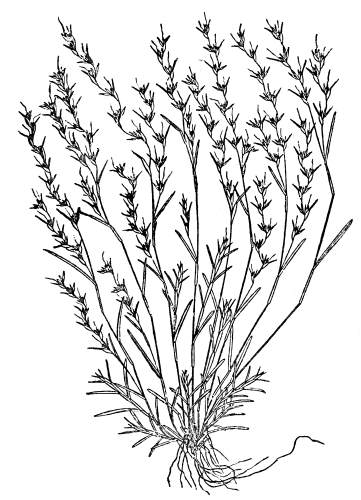
Fig. 169.—Iseilema anthephoroides.
Iseilema anthephoroides, Hack.
This is a perennial grass closely resembling Iseilema laxum in its habit, but shorter, stouter and branching more freely. The leaf is similar to that of I. laxum in all its parts.
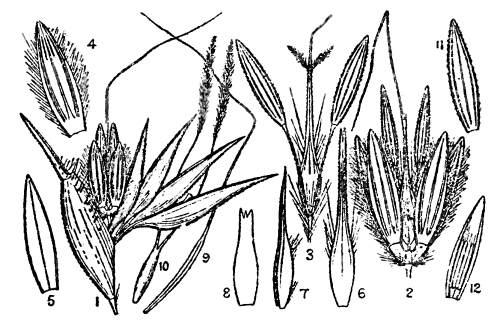
Fig. 170.—Iseilema anthephoroides. 1. A cluster of spikelets with spathes; 2. the involucral and the inner spikelets; 3. the inner spikelets; 4 and 5. the glumes of the involucral spikelets; 6, 7, 8 and 9. the four glumes, respectively, of the sessile spikelet; 10. ovary; 11 and 12. glumes of the inner pedicelled spikelets.
The pedicelled spikelets of the involucel have firmer harder, shorter and broader pedicels, thickly bearded and consist of two glumes only. The first glume is very strongly 5-nerved, coriaceous, oblong-lanceolate; with scaberulous infolded margins, with long cilia. The second glume is lanceolate, thin, 3-nerved, glabrous. The inner pedicelled spikelets are similar to the pedicelled spikelets of the involucel. The sessile spikelet has four glumes. The first glume is elliptic-lanceolate, apex drawn into a long narrow strip ending in two teeth or truncate, sparsely ciliate at the margins about the middle, faintly 3-nerved. The second glume is shorter than the first, lanceolate, drawn out into an acuminate point at the apex, hairy at the back. The third glume is hyaline, short, oblong, apex broad and irregularly toothed, nerveless. The fourth glume is an awn.
This is very common in the Deccan districts and grows on all kinds of soils. This is a good fodder grass.
Distribution.—Very common in the Ceded districts and Nellore.