STUART PERIOD (To William III.).
Reading edition
MALE COSTUMES.
James I.
Little change was made in the early part of this reign from the costumes worn at the end of Elizabeth’s reign. The peascod doublet, the conical-crowned hat, and the large trunk hose, also called “bombasted breeches,” slashed, quilted, stuffed, and laced, were worn as before. (Fig. 10.) The cowardly despotism of James led him to guard his person, at all times awkward and ungainly, with quilted and padded clothing in order that it might be dagger-proof. The “great round abominable breech,” as the satirists termed it, now tapered to the knee, and was slashed all over and covered with lace and embroidery, as shown in Fig. 10, which represents his Majesty, in 1614. Corsets were also worn at this time to give the required shape to the upper part of the body.
The hat of the period, a truncated cone, will also be noticed, with a feather at the side and turned-up brim. It was frequently ornamented with precious stones. With regard to the bombasted breeches, an amusing tale is told of a man who was being prosecuted at this time for having his breeches stuffed with prohibited articles, but he was acquitted because he proved to the satisfaction of his judges that his stuffing “consisted merely of a pair of sheets, two tablecloths, ten napkins, four shirts, a brush, a glass, a comb, and a night-cap.”
The ruff was sometimes exchanged for a wide, stiff collar, standing out horizontally and squarely, and starched and wired as usual, but plain instead of pleated, and it was sometimes edged, like the ruff, with lace. These collars were called “bands,” and were usually stiffened with yellow starch.
A slight alteration in costume was made in James’s reign. Short jackets or doublets were worn, and the trunk hose, instead of being slashed and laced, were covered with broad, loose strips, richly embroidered or adorned with buttons, displaying the silk or velvet trunk in the narrow intervals between the strips (see Plate 50, Fig. 1, which shows Prince Henry, the eldest son of James I.).
The clothes of the nobles were very gorgeous, being made of silk and velvet, and ornamented with lace, gold and gems. It was said that George Villiers, Duke of Buckingham, a favourite of James I., had a white velvet suit, decorated with diamonds valued at fourteen thousand pounds. Silk, worsted, and thread stockings were now almost universally worn.
In a comedy written in 1607, a gentleman’s wardrobe is thus enumerated: “A cloak lined with rich taffeta, a white satin suit, the jerkin covered with gold lace, a chain of pearl, a gilt rapier in an embroidered hanger, pearl-coloured silk stockings, and a pair of massive gilt spurs.”
Pure white costumes of silk, velvet, or cloth were very fashionable at this time.
Jewels were sometimes worn in the ears of gentlemen, and they also had a custom of allowing a long lock of hair, called a “love-lock,” to hang over upon the breast (Fig. 2).
The costume of a yeoman of the period consisted of a narrow-brimmed hat with flat crown, a doublet with large wings and short skirts, a girdle about his waist, trunk breeches, with hose drawn up to the thigh and gartered below the knees.
Charles I. and the Commonwealth.
It is said that the male costumes in this reign were “the most elegant and picturesque ever worn in England.” The characteristic costume worn by Charles in his portrait by Vandyke is often spoken of as the Vandyke costume and was introduced about the middle of his reign. In the earlier part, the fashions of his father, James I., were continued. The change from the “bombasted” or stuffed breeches to the elegant costume of this reign is ascribed to the refined tastes of Charles and his Queen, and also to the fact that the size of the stuffed breeches made it impossible for gentlemen to find seating accommodation at masques, etc., when each spectator took up the place of three persons in a rational attire.
At the commencement of the Civil War, the Royalist party or Cavaliers, and the Republican party or Roundheads, were as opposite in their costumes as they were diverse in their opinions.
“The Cavalier’s costume consisted of a doublet of rich materials, silk, satin, or velvet, with large, loose sleeves, slashed up the front, the collar covered with a falling band of the richest point lace. A short cloak was worn carelessly over one shoulder. Long breeches, fringed or pointed, met the broad tops of the boots, which were trimmed with lace or lawn. A broad-leaved Flemish beaver-hat with a rich hat-band and plume of feathers, was set on one side of the head, and a Spanish rapier hung from a magnificent baldrick or sword belt, worn sash-wise over the right shoulder.”
In the troubled times of this reign, the silk or velvet doublet was often exchanged for a richly-laced buff (leather) coat. A broad sash or satin scarf was tied round the waist in a large bow.
The beard was worn very peaked, with small, upturned moustache, and the hair was long in the neck, and sometimes powdered.
The extravagant costume worn by some is shown in Fig. 2, which depicts an exquisite of 1646. Among the most noticeable features in this costume are the “love-locks,” tied with ribbon, on either side of the head (which were a special abomination to the Puritans), the patches on the face, and the shirt protruding from the partly-open vest, the short breeches “ornamented with many dozens of points at the knees, and, above them, on either side, two great bunches of ribbon, of several colours.”
The tops of his boots are very large, fringed with lace, and turned down almost to the heels.
Very different from this figure was that of the Roundhead, with close-cropped hair, clothes of extreme simplicity, severe cut, and sober colours, as shown in Fig. 4.
It will be gathered from the foregoing remarks that the dress of the various classes of the community presented a considerable mixture.
When Cromwell was in power, the general tendency was towards plainness of attire.
Charles II.
When Charles II. ascended the throne, at the Restoration, great extravagance and folly were shown by his courtiers in their costume, after the stern rule of the Puritans, and many new fashions were introduced from France, where Charles had resided for so long a time. This was “the natural reaction after twenty years of uncertainty, gloom, and fanatical oppression. The doublet was made very short, open in front, without any waistcoat, showing a rich shirt, which bulged out in front over the waistband of the loose breeches, the latter, as well as the large, full sleeves, being ornamented with ribbons and points or laces.”
Beneath the knee hung long, drooping lace ruffles, and a falling collar of the richest lace enveloped the neck. A high-crowned hat, with a broad brim and a plume of feathers, still preserved its cavalier character. A short cloak, edged deep with gold lace was usually worn or carried over the arm. But the practice of copying French fashions gave rise to the monstrous “periwig,” a corruption of “perruque” or “peruke.” (Fig. 3.)
The periwig had, however, been worn in England for many years, but did not become fashionable until this reign.
With its introduction, there came a change in the form of the hat. “Down went the crown, and up went the brim at the sides,” and a kind of ruche of feathers replaced the waving plume of the Cavalier. This was, in fact, the first step towards the cocked hat of the 18th century.
A garment called the “petticoat breeches” was introduced into England in 1658. These are well illustrated in Figs. 6, 7, and 8 (from a drawing about 1658). The doublet, or jacket, which, in the early part of the reign, barely reached to the waist, was now lengthened, reaching the middle of the thighs, with sleeves to the elbows, terminated by rows and bunches of ribbon, from under which bulged forth the sleeves of the shirt, ruffed, and adorned also profusely with ribbons. When buttons and button holes were added down the front, it became a coat.
Neckcloths or cravats, of Brussels and Flanders lace, came into use towards the close of the reign, being tied in a knot, with the ends hanging down (Fig. 5).
The sober citizen of London was dressed in black coarse woollen, breeches, a broad skirted doublet, a girdle about the middle, and a short black coat. A broad-brimmed hat, with a great twisted hat-band, with a rose at the end of it, completed his costume, and the natural hair was worn uncovered by a wig.
James II. and William III.
There were few novelties in civil costumes during these reigns. The petticoat breeches were exchanged for those tied beneath the knee. The periwig became more monstrous, and it was the fashion for the beau to comb his wig in public just as a modern gallant would twirl his moustache.
Gentlemen appeared in little, low hats, with a bow at the side; and long coats and waistcoats were worn, with rows of buttons down the front, breeches, moderately wide, reaching to the knee, close stockings, and high-heeled shoes, with roses or buckles (Fig. 15).
The full-bottomed wig was worn by the learned professions. The broad brims of the hats were frequently turned up on two sides, and were ornamented with feathers or ribbons. “To turn up the brim or flap of the hat was to ‘cock’ it; the mode following the custom of the Duke of Monmouth was called ‘the Monmouth’ cock.”
The broad, falling bands around the neck were replaced by small Geneva bands, similar to those now worn by barristers.
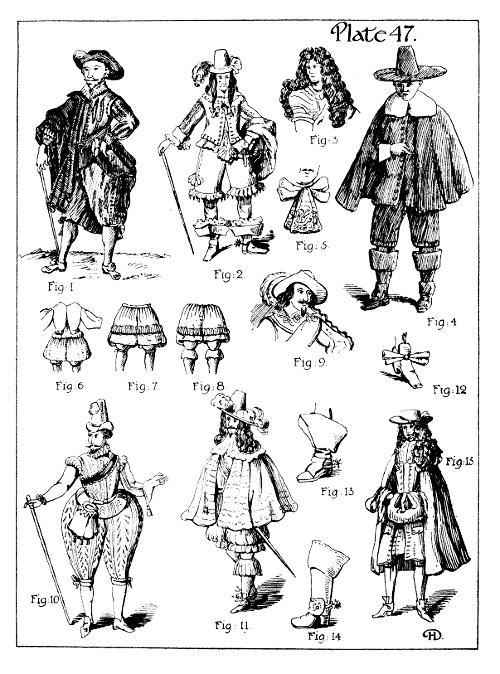
PLATE 47.
(Fig. 1): Costume of a gentleman of the time of Charles I., from a contemporary print. (Fig. 2): An exquisite of 1646, from a rare broadside, entitled “The Picture of an English Antick,” with all details of the costume exaggerated, patches on the face, and two love-locks tied with bows of ribbon. (Fig. 3): Head of George, Earl of Albemarle, showing the voluminous periwig of the time of James II. (Fig. 4): A Roundhead, from a print of 1649, showing the plainness and simplicity of costume adopted by the Puritans. (Fig. 5): Neckcloth which succeeded the ruff and band, and was generally worn by the courtiers during the reign of Charles II., by whom it was introduced from France. (Figs. 6, 7 and 8): “Petticoat breeches,” three types, as worn in 1656, 1658, and 1659, from Holmes’s “Contemporary Notebook on Costume,” preserved in the British Museum. (Fig. 9): Head of Sir Thomas Meautys, secretary to Sir Francis Bacon, showing a waved love-lock reaching to the elbow. (Fig. 10): King James I. in hunting costume, from “A Jewell for Gentrie,” published in 1614. He is shown wearing the stuffed or “bombasted” breeches. (Fig. 11): Costume of a Cavalier in the early part of Charles II.’s reign, from Ogilvie’s “Book of the Coronation.” (Fig. 12): A shoe (introduced from France), worn by the courtiers of Charles II., from a contemporary work, 1670. (Fig. 13): A boot with wide tops, worn in 1646, from a print of the time. (Fig. 14): A Jack-boot of the time of William III., such as was worn by the Cavalry of the time, from Meyrick’s “Arms and Armour.” (Fig. 15): Winter costume of a gentleman of the time of William III.
FEMALE COSTUMES.
James I.
The female costume of this reign presents few variations from that in use at the end of Elizabeth’s reign. The portrait of Anne of Denmark, Queen of James I. (Pl. 49, Fig. 1), in the general character of the dress, resembles that of Queen Elizabeth painted by Holbein. The enormous farthingale was worn throughout this reign by the nobility, the ruffs and collars worn at this time by the ladies being generally stiffened with yellow starch, like those of the gentleman.
“The fondness of ladies for painting their faces and exposing the bosom was severely reprimanded by the divines and satirists at the early part of the 17th century. While a ruff or band of immoderate size stretched forth from the neck, the front of the dress was cut away immediately beneath it, nearly to the waist, which made the fashion more noticeable, as all the other part of the bust was over-clothed, while the bosom was perfectly bare.”
Masks were worn by ladies on all public occasions, and it was considered a sign of impropriety to appear without them (Fig. 2).
The ruff went out of fashion during this reign, because Mrs. Annie Turner, a starcher of ruffs, who was executed for poisoning Sir Thomas Overbury, wore a starched ruff of the approved colour at her execution.
Charles I. and the Commonwealth.
There was little change in female costume at the beginning of this reign. The French hood and farthingale were still worn, and the high-crowned hat was generally worn by countrywomen and the wives of the citizens (Figs. 5 and 7), especially when they belonged to the Puritanical party. In the course of the reign of Charles, there came a change in female costume, contemporary with and as elegant as that which took place in the male costume.
The hood, the farthingale, and the starched bands disappeared. A good specimen of the new costume is given in Fig. 1, after Hollar. The dress is full, and falls gracefully about the body; the bodice is tight-fitting, and the sleeves are rich and full, but gathered at the wrist, and there is an elegant falling collar edged with lace.
The long petticoat was generally displayed in a certain measure by the robe, which was, at times, quite gathered up at the waist.
As a matter of course, the ladies of the Republican party, following the example set by their men folk, dressed very soberly, some of them adhering to old-fashioned articles of dress, such as the hood and high-crowned hat. A fashion introduced in the previous reign was that of wearing patches on the face. Fig. 3 gives a curious specimen of this fashionable absurdity. It excited the derision of the satirists, who repeatedly decried it in their works; but it continued in fashion for a long time—until the end of the 17th century.
The usual costume of a Puritan woman is shown in Fig. 5.
The female costume in the later years of the Protectorate is illustrated by Fig. 6 from the monumental effigy of Elizabeth Sacheverell, 1657 A.D., in Morley Church, Derbyshire.
Charles II.
With the Restoration, England threw off the sober, kill-joy aspect that it had worn, and the Court, with its gaiety, set the fashion in a studied negligence and elegant déshabille.
The glossy ringlets of the ladies, escaping from a simple bandeau of pearls, or adorned by a single rose, fell in graceful profusion upon bare, snowy necks, and the arms were bare to the elbow.
This was carried to such an extent that a book was published entitled “A Just and Seasonable Reprehension of Naked Breasts and Shoulders,” with a preface by Richard Baxter.
The richest and brightest materials were employed for the dresses and petticoats. The costume of this period is very well known from the portraits of the ladies of the Court by Sir Peter Lely (see Pl. 49, Fig. 2).
James II. and William III.
There was no change in female costume during the short and unfortunate reign of James, but when William and Mary ascended the throne, they and their entourage brought with them, as might be expected, a number of Dutch fashions. The very low-necked dresses were replaced by those with a formal stomacher.
The elegant full sleeve gave place to a tight one, with a cuff above the elbow, from which fell a profusion of lace in the form of ruffles.
The hair, which had been allowed to hang loose in ringlets, was now “put up” and combed from the forehead like a rising billow, and surmounted by piles of ribbons and lace. This was called the “commode,” and was sometimes covered by a lace scarf or veil that streamed down each side of the coiffure.
Stiff stays, tightly laced over the stomacher and very long in the waist, became fashionable, so that a lady’s body, from the shoulder to the hips, looked like the letter V.
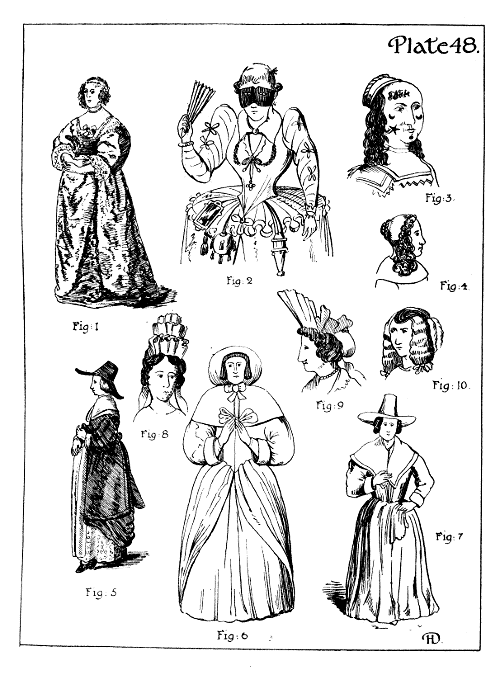
PLATE 48.
(Fig. 1): A lady of the Court of Charles I. (1643), after the engraver Hollar, wearing a lace collar on a low cut neck. The robe is not draped, and the hair is combed tightly back from the forehead and gathered in close rolls behind, being allowed to flow freely at the sides. (Fig. 2): A lady wearing a mask of the time of James I., from a contemporary print. She holds a folding bone fan in her right hand, and attached to her girdle, hanging over the farthingale, are a looking glass, a ball-shaped pomander (containing perfumes) with tassels, and a toilet case, probably of silver. In the Court of James I., which was very dissolute, the mask was worn on all public occasions by ladies; and those who appeared without it were called “bare-faced.” (Fig. 3): A lady wearing patches, from a woodcut in Bulwer’s “Artificial Changeling,” 1650. The custom of patching was introduced in the reign of James I. A coach, with a coachman and two horses, with postillions, appears on her forehead; both sides of her face have crescents upon them; a star is on one side of her mouth, and a plain circular patch on her chin. (Fig. 4): A lady of Charles I.’s reign, showing the arrangement of the hair, with a coif covering the head. (From a tomb in Morley Church, Derbyshire.) (Fig. 5): An English tradesman’s wife, 1649, after Hollar. (Fig. 6): Dress of an elderly lady of the middle class during the Protectorate. She wears a close hood and band, with ample gown. (From the effigy of Elizabeth Sacheverell, 1657, in Morley Church, Derbyshire.) (Fig. 7): A Puritan woman, 1646, from a contemporary print. (Fig. 8): A “Tower” head-dress, also known as a “Commode,” as worn at the close of the 17th century. It consisted of rows of lace stuck bolt upright over the forehead, rising one above the other, forming a kind of pyramid, with streaming lappets hanging over the shoulders from the head. The hair was combed upwards to form a support to the structure. (From a contemporary print.) (Fig. 9): Side view of a similar head-dress, of one “storey” only, backed by dark coloured ribbons, the hair at the front and sides being arranged in short, close curls. (From a contemporary print.) (Fig. 10): Head of a lady of the early time of Charles II., showing the method of dressing the hair with a “foretop” or tuft of hair turned up from the forehead. This fashion, being introduced by Catherine of Braganza, was probably Portuguese. (From a print in the Pepysian Library.)
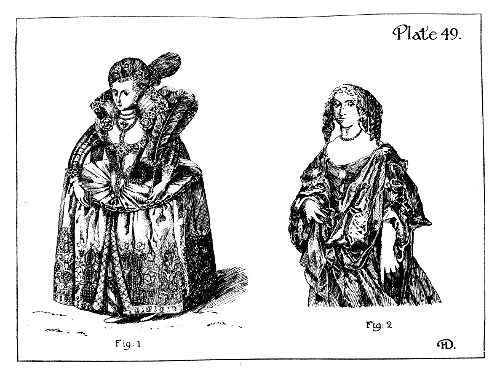
PLATE 49.
(Fig. 1): Anne of Denmark, Queen of James I. (from a contemporary portrait). This costume differs in no way from that worn at the Court at the end of Elizabeth’s reign. The farthingale, or enormous hooped petticoat, projected more at the sides than in front. It was absolutely flat on the top, with a series of radiating pleats upon the surface of it. The exquisite design in needlework upon the robe, with gems worked into the pattern, is shown clearly in the illustration. The ruff, composed of rich lace and needlework, stretches back from the neck, and the front of the dress is cut very low. The Queen holds a feathered fan and a book in her hands. (Fig. 2): A lady of the Court of Charles II. (from a contemporary portrait). There is the greatest contrast between the costume shown in Fig. 1 and this, the former being most uncomfortable and artificial. Fig. 2 shows the prevailing character of the female costume of this reign—unconfined ease. “The ringlets hang loosely upon the exposed neck, which is quite innocent of the transparent lawn of the band or the partlet. The gown is striking by its very simplicity, the sleeves being merely looped material covering the undersleeves of lawn.”
ARMS AND ARMOUR.
(To end of CHARLES II.)
James I.
During the reign of Elizabeth the decay of the use of armour had set in on account of the enormous weight and unwieldly nature of the harness.
It prevented free action, and, indeed, seriously crippled the physical frames of many of the wearers.
The increasing use of fire arms also tended to hasten the disuse of armour, for it became difficult to make plates that would be sufficiently strong to oppose a bullet, unless the armour were made of great thickness. By the end of the reign of James I. its use had been so modified that the armour of the heaviest cavalry terminated at the knees. Sometimes the arms were encased in armour, and occasionally complete armour was worn by the commanders.
A contemporary engraving of Prince Henry of Wales, the eldest son of James I. (Pl. 50, Fig. 1), shows the nature and extent of the armour usually worn.
Through the intercourse with Spain, the cavalry soldier was often termed a cavalier instead of lancer. The infantry consisted of pikemen, armed with pikes or spears 18ft. long, and musketeers, armed with fire arms. Before this reign, on account of their weight, a soldier carrying a fire arm also bore a forked rest in which to place the musket when firing it; but at this time the caliver or matchlock, that could be fired without a rest, came into use generally.
The musketeers were armed with long, rapier-like blades (for their personal defence), nicknamed a “sweyne’s feather” or a “hog’s bristle” (Fig. 9).
Charles I. and the Commonwealth.
During the struggle between King and people, the armour consisted, at the most, of helmet, backplate and breastplate, or cuirass, with tassets.
In fact, the only armour worn by many noblemen and gentlemen was a cuirass over a buff leather coat, with a helmet or hat to cover the head; and some entire regiments of cavalry were raised, attired in this fashion and named “Cuirassiers.” They were armed with a good sword, stiff, cutting, and sharp-pointed, and pistols hanging at the saddle.
The lancers carried a pike-shaped lance, about 18ft. long, a sword similar to that carried by the cuirassiers, and one or two pistols.
One class of cavalry was called dragoons, because they were armed with a fire arm shorter than that in general use, called a “dragon.”
The full length portrait of Sir Denner Strutt, 1641 (Fig. 10) from his tomb in Whalley Church, Essex, well illustrates the armour of the period as worn by officers in the field. The upper part of the body is completely armed, but the lower part is not so, as the back of the figure and the thighs, which would, in fact, be defended by the position of riding, could need no other protection in the field. The front of the thigh is covered, and the entire leg below the knee. A broad sword-belt passes across the chest, and the plain fashionable collar and long hair repose peacefully on the armed shoulders. Some officers wore helmets completely covering the head (Fig. 8), but often helmets of the form shown in Fig. 5 were in use. Flexible ear-pieces covered the cheeks, and overlapping plates (lobster-tailed) covered the back of the neck. The costume of a General of the Parliamentary Army (Lord Fairfax, General for the County of York) is shown in Fig. 2, where the only articles of armour he wears appear to be the cuirass and gauntlets, the former over a buff coat. His breeches also appear to be of buff leather, and large boots, with wide tops, encase his feet and legs. The modern fire-lock was invented about this time, and a spark being struck by a piece of steel from a flint, so that the spark fell upon the powder in the pan.
Charles II.
The military costume of this reign was nearly that worn in the Civil Wars.
The defensive armour of the cavalry consisted of “a back, breast, and pot (helmet), the two latter to be pistol proof.” As offensive arms they carried a sword and case of pistols with barrels not under 14 inches in length. The musketeers were ordered to carry a musket with a barrel not under three feet in length, a collar of bandoliers, and a sword.
During this reign the bayonet was first invented, at Bayonne, and was made like a dagger, with a round wooden hilt, screwed or merely stuck into the muzzle of the gun. It is now known as a “plug bayonet.” The gun could not be fired while the bayonet was fixed without the loss of the bayonet also.
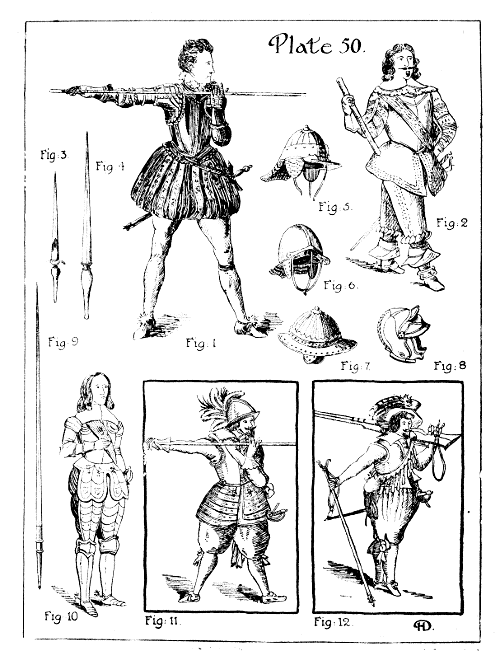
PLATE 50.
(Fig. 1): Henry, Prince of Wales, eldest son of James I. (from Drayton’s “Polyolbion”), showing the amount of armour that was generally worn. The Prince wears only armour to the waist, with large, bombasted trunk hose, and is represented as balancing a pike. (Fig. 2): Costume, with armour of “Ferdinand, Lord Fairfax, the father of the more celebrated Parliamentary General, who also served in the same cause, and was appointed General for the County of York.” He wears as armour only the cuirass and gauntlets. (Figs. 3 and 4): Plug bayonets (the earliest form), invented at Bayonne; formerly in the Meyrick collection. (Fig. 5): Single-barred helmet with “lobster-tail” neck piece and ear-pieces, usually worn by dragoons. (Fig. 6): Helmet with triple bars which protect the face, as worn by harquebussiers in 1645. (Fig. 7): Pot helmet or open head-piece, with cheeks, and a fluted ornament over the top, of the time of Cromwell. (Fig. 8): Close helmet of the time of Charles I., with ear-pieces and a perforated vizor which may be drawn down to cover the face. (Fig. 9): A “sweyne’s feather” or “hog’s bristle,” a kind of rapier, carried by the musketeer for his defence. (Fig. 10): Effigy of Sir Denner Strutt, 1641, from his tomb in Whatley Church, Essex, illustrating the armour of the period as worn by officers in the field. (Fig. 11): A pikeman of the time of James I. (from a broadside in the possession of the Society of Antiquaries). He wears a morion-shaped helmet with plumes, back and breast plates reaching to the waist, with two broad tassets fastened to the breast plate over padded knee breeches. He is armed with a long pike and sword. (Fig. 12): A musketeer of the time of James I. (from the same source as Fig. 11). Musketeers at first wore morions on the head, but, later on, large hats with plumes were adopted. This one is represented as wearing only back and breast plates, and he is armed with a musket and a sword. In his right hand he carries a rest for his musket, and slung over his shoulder he wears a bandolier or set of leather cases, in each of which a complete change of powder for a musket was carried, to facilitate the loading of the piece. This was used until the end of the 17th century, when the cartridge-box came into use.