PLANTAGENET COSTUME.
Reading edition
During the Plantagenet period, for the first times the effigies of English sovereigns give authentic representation of regal costume in form and colour (having been painted to imitate the actual clothing).
The Royal Robes of Henry II., Richard I., and John consist of (1) an undergarment with close-fitting sleeves; (2) a tunic-like garment with loose sleeves, called a dalmatica, which is girded round the waist by a belt; (3) a mantle, richly embroidered, covering all. The costume of the nobles was similar in form and style to these, stockings and chausses being worn, and the habit of “cross-gartering” the leg from the toe to above the knee was continued; but during the reigns of these soverigns, splendour of appearance was studied rather than quaintness of shape.
The costume of ladies consisted of (1) an under robe with sleeves, close-fitting at the wrist; (2) a loose garment, like the dalmatica, but without sleeves; (3) a mantle. A head-dress, called the wimple, was worn. This consisted of a piece of silk or linen passing under the chin, with the ends gathered overhead, and was first mentioned in the reign of John. It was worn with a veil hanging down by the sides of the face and over the back of the head.
A purse to hold money for the giving of alms was suspended from the girdle. It is worthy of note that the general costume of nuns at the present day is, in all but colour, the usual dress of women of the thirteenth century.
The dress of the lower classes did not vary much from that of the preceding period. It consisted of a plain tunic, strong boots, and a hood or hat for the head, with coarsely made gloves without separate fingers. A cap called a coif, fitting close to the head and fastened under the chin, was often worn by men of all classes.
During the reign of Henry III. the general costume of men consisted of the tunic, open in front to the waist, chausses or stockings and drawers. Mantles and cloaks were only used for State or for travelling, the materials used for these being very rich.
A garment called a super-totus (over-all), acting as an overcoat, was commonly worn. It consisted of a circular piece of cloth with a hole in the centre, through which the head was passed, and to it was often attached a hood or capuchon, which became very popular and held its own for about 300 years.
The costumes of women and of ordinary citizens were essentially the same as in the preceding reigns, but the hair of the ladies was gathered up into a network or caul of gold and silver filigree, instead of being arranged in plaits.
Edward I. dressed in a very plain manner, differing little from an ordinary citizen, and consequently there was little extravagance of dress in his reign. The ladies, however, wore their garments unconfined at the waist, very full, and with long trains.
On account of their extravagance in this respect, they were very much satirised by contemporary writers. They also wore a very ugly form of the wimple. There was no change in the dress of the lower classes excepting that a kind of smock frock, made generally of canvas or fustian, was worn by both sexes. Edward II., with his favourites, Gaveston and the Despensers, made the Court “a wild debauch of costume and foppish eccentricities.”
The costume of ladies changed very little during this reign, but the practice of wearing the head uncovered became more general.
In the costume of men, the greatest change was the displacement of the loose tunic or dalmatica by a garment called the côte-hardi, fitting tightly from the neck to the waist, with a skirt below.
The hood or capuchon was modified by the tail or point at the back, being extended until it reached to the waist, this tail being often wound round the neck in cold weather as a kind of muffler.
A similar kind of hood was also in use, covering the head and shoulders and reaching to the elbow.
In this reign a new source of authentic information is available in the brasses which are found in our churches. They are very well preserved, and show the details of costume very clearly and accurately. For this reason they are invaluable.
Edward III. has been called “the King who taught the English people how to dress,” and it is worthy of note that the costumes worn during his reign followed the lines of the body itself.
The use of the côti-hardi increased. It was often made of very expensive materials, and long narrow strips of white cloth called tippets were added to the sleeves, reaching from the elbow to the knee.
Many garments were parti-coloured, i.e., one side was one colour and the other side of another colour. It is interesting to note that black came into use as a mourning colour during the fourteenth century. A mantle was worn by men over the côti-hardi, reaching to the ankles and fastened on the right shoulder by several buttons, while the hood was fastened to the mantle. In this reign the chausses were made like trunk hose, and fitted tightly to the limbs. Pointed shoes were worn, and a curious form of hat with turned-up brim and tall feathers was introduced. The lower class of labourers dressed as their fancy guided them, so that all the fashions of preceding reigns may be recognised in their attire.
The ladies dressed very sumptuously during the reign of Edward III. An innovation in their costume was a kind of spencer or waistcoat, faced and bordered with fur, to which sometimes sleeves reaching to the waist were worn. The côti-hardi was also adopted as a feminine garment.
In the reign of Richard II. the costumes were ever changing, the King himself being the greatest fop, and extravagances in form and sumptuousness of material was carried to a remarkable excess. Holinshed says “he had one cote which he caused to be made for him of gold and (precious) stones, valued at 30,000 marks” (a mark being 13s. 4d.).
The famous portrait of Richard II. in Westminster Abbey is a fine example of the dress of an extravagant King of that time. The fashion of embroidering the dress with heraldic devices, family badges, initials, and mottoes became common during this period. The edges of the garments were also cut and scalloped, very richly decorated, and often set with precious stones.
The servants of the nobility were sumptuously attired, and there was universal extravagance throughout the nation. So extreme was the dress of the courtiers that it was said to be difficult to distinguish the sex of the wearer if the face were turned away. Costumes were not only worn wide and flowing, but they sometimes went to the other extreme, the garments being worn very short and tight-fitting.
The shoes were made with very long points called crackowes (so named from Cracow, in Poland). Sometimes the points were so long that they were fastened to the knee by chains of gold and silver.
Ladies’ dresses in this reign did not differ much from those of Edward III.’s, but tippets were discarded, and the dresses were ornamented, like the men’s, with heraldic devices, initials, etc.
Chaucer has given us the best information regarding the costumes of the different grades of English society during this reign.
The upper classes wore a short jupon, or tight-fitting vest, parti-coloured, with narrow waist belt and tight sleeves. A loose body garment, with full-hanging scalloped sleeves, was also worn. Over all was worn a great gown, trailing on the ground, with full, long sleeves and a high collar fitting tightly under the chin. Both hoods and felt caps were worn, and a peculiar variety of the latter was in fashion formed of strips arranged in fan fashion.
The hair of the men was worn long, and was curled with great care. The beard was forked, and the moustaches were long and drooping.
The lower orders varied little in their dress from that of the reign of Edward III.
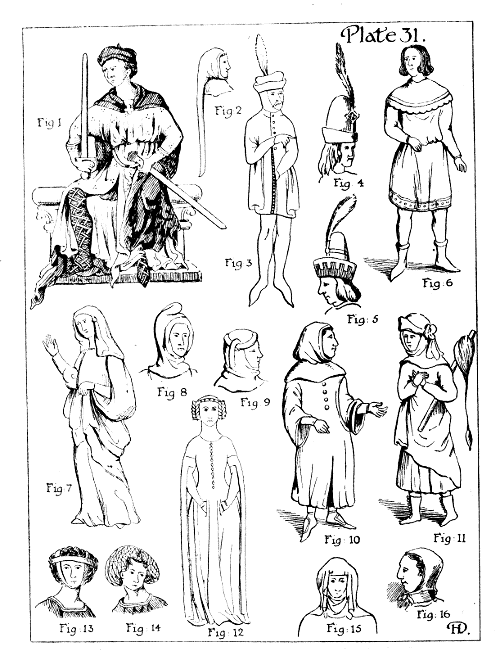
PLATE 31.
(Fig. 1): A nobleman of the thirteenth century. (MS. Bod. Auct. D., iv. 17.) A good example of the costume of the nobility of the time. The dalmatica is plainly shown, open up the front. In the MS. it is red, decorated with groups of spots, with a white lining. The mantle is blue; the long gloves are green. Red chausses are worn on the legs, with a cross-gartering of gold from the toes upwards. The hat is blue, and a small portion of the knickers is also shown. (Fig. 2): The hood or capuchon, with a long tail as worn in the reign of Edward II. (Fig. 3): Costume of a man in the reign of Edward III., from the brass of Robert Braunche, 1364, at King’s Lynn. He is dressed in the plain costume of the period, while a hat with a feather is worn over the hood. (Figs. 4 and 5): Hats of the time of Edward III., probably made of white felt, with coloured turned-up brims and long feathers. (Fig. 6): Costume of a youth in Early Plantagenet times. He wears an ornamental tippet round the neck, with a plain, bordered tunic, tight at the waist, and closed all round. He also wears chausses and high boots. (Fig. 7): Costume of a lady in the reign of Henry III., from Matthew Paris’s “Lives of the Offas.” (Cotton MS., Nero D 1.) The dress is very simple, there is an absence of ornament or decoration, and the gown is loose, falling to the feet in ample folds. (Figs. 8 and 9): Hoods at the time of Edward II. (Fig. 8): Shows the hood, closely fitting to the head and neck, with the point that usually hangs down drawn up over the head. (Fig 9): Shows the long tail of the hood wound around the head. (Figs. 10 and 11): The ordinary costume of the labouring classes during the time of Edward II. (Royal MS., 14 E 3.) The man wears a long gown, buttoned from the neck to the waist, with loose hanging sleeves below the elbow, showing the tight sleeve of the time. The head and shoulders are covered by a hood hanging down. The shoes reach to the ankle, are slightly ornamented, and have pointed toes. The woman carries a distaff, and wears a hood or kerchief swathed round the head and knotted at the side. She has a wide, short gown, which, being caught up under the arm, shows the under garment and high buttoned boots. (Fig 12): Bronze figure of a daughter of Edward III., from his tomb in Westminster Abbey (1377). She wears a dress, however, which was in vogue twenty years earlier. The hair is arranged in square plaits at the sides of the head. There is an absence of any decorative material round the low-cut neck, and she has vertical front pockets in her tightly fitting gown, with long streamers hanging from the arms down to the feet. (Figs. 13 and 14): Two methods of “doing the hair” in the time of Edward I. (Fig. 14): Shows the hair enclosed in a caul or net, and is spoken of as “the reticulated head-dress.” (Fig. 15): Head-dress from the Braunche Brass. (King’s Lynn, 1354.) (Fig. 16): The Coif.
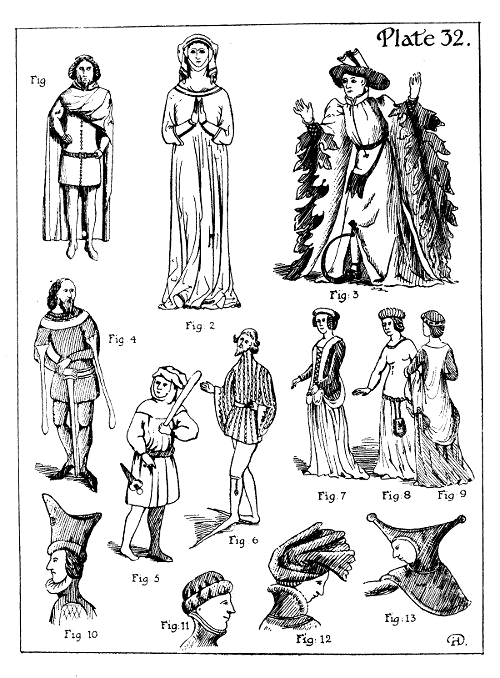
PLATE 32.
(Fig. 1): Bronze figure of Lionel Duke of Clarence (a son of Edward III.), from the tomb of the latter in Westminster Abbey (1377). It illustrates the ordinary costume of a gentleman at the end of the fourteenth century. He is attired in the côti-hardi or jupon, fastened down the front with buttons, and wears an ornamented girdle around the hips, while a large, full mantle reaches down to the ankles. The chausses are very similar in appearance to trunk hose, and fit tightly to the limbs; while the beard is forked after the fashion of the period. (Fig 2): Brass of Joan, Lady de Cobham, 1320, at Cobham, Kent. She wears a kind of wimple under the chin called the gorget (which copies a part of the knightly armour of the period), with a couvre-chef over the head falling on to the shoulders, completing the head-dress. She wears an under garment with tight-fitting sleeves, which are closely buttoned to the wrist, and a loose robe with loose sleeves terminating below the elbow. (Fig 3): A fop of the reign of Richard II., when the fashion of “cutting” the mantles in patterns reached a very absurd limit. The sleeves are cut at the edges into a number of acanthus-like lobes, and are lined with another colour. The robe has a high collar, is very full, and hangs in loose folds to the ground. The shoes, which are elaborately pierced and cut, are of the long-toed variety known as “crackowes,” and the point of the toe is fastened to the leg below the knee. He also carries a long purse or bag suspended from the girdle. (Harl. MS., 1319.) (Fig. 4): Costume of the early part of Edward III.’s reign. A semi-military dress with a breastplate worn under the côte-hardi. A very characteristic feature of the costume is formed by the tippets—long strips of white cloth, which are fastened to the arms above the elbow. (MS. 17 E vi.) (Fig. 5): Costume of a labourer of the better class of the time of Edward III. The tail of the hood is worn around the head. (Fig 6): Costume of a nobleman in the reign of Richard II., probably representing one of his royal uncles. (Royal MS., 20 B vi.) It shows another extravagant dress of the period. The gown is abbreviated to the hips; the sleeves are wide, and the chausses are tight-fitting to the limbs; while the shoes have long pointed toes. He wears a jewelled circlet around the forehead. (Figs. 7, 8, 9): Costumes of ladies in the reign of Richard II. (Fig. 7): Shows the sideless garment faced with fur, terminating in long, full skirts worn over the kirtle (or loose gown). (Fig. 9): Shows a lady with the outer sleeveless garment, so long as to be gathered up and carried under the arm. (Figs. 10, 11, 12): Various forms of head-dresses of men of the reign of Richard II. (Fig. 13): A singular kind of hood covering the head and shoulders, reaching to the elbows, and having pointed ends spreading out at each side. This was worn in the time of Edward III.