APPENDIX
Reading edition
Provinces and Prefectures
THE following list gives in detail the divisions of Japan into Provinces (Kuni), according to “Circuits”:—
Go-Kinai (Five Home Provinces). Yamashiro, Yamato, Kawachi, Izumi (or Senshiu), Settsu (or Sesshiu).
Tōkaidō (Eastern Sea Road). Iga, Ise, Shima, Owari, Mikawa, Tōtōmi, Suruga, Kai, Izu, Sagami, Musashi, Awa (or Bōshiu), Kazusa, Shimōsa, Hitachi.
Tōsandō (Eastern Mountain Road). Ōmi, Mino, Hida, Shinano (or Shinshiu), Kōzuke (or Jōshiu), Shimozuke, Iwaki, Iwashiro, Rikuzen, Rikuchū, Mutsu, Uzen, Ugo.
Hokurikudō (North Land Road). Wakasa, Echizen, Kaga, Noto, Etchū, Echigo, Sado Island.
Sanindō (Mountain Shade Road). Tamba, Tango, Tajima, Inaba, Hōki, Izumo, Iwami, Oki Islands.
Sanyōdō (Mountain Sunlight Road). Harima (or Banshiu), Mimasaka, Bizen, Bitchū, Bingo, Aki, Suwō, Nagata (or Chōshiu).
Nankaidō (Southern Sea Road). Kii (or Kishiu), Awaji Island, Awa, Sanuki, Iyo, Tosa (or Toshiu), of which the last four are in the island of Shikoku.
Saikaidō (Western Sea Road). Chikuzen, Chikugo, Buzen, Bungo, Hizen, Higo, Hyūga, Ōsumi, Satsuma (or Sasshiu), Iki Island, Tsushima Island, of which all except the last two are on the island of Kyūshiu.
METEOROLOGICAL TABLE OF JAPAN197
(25 Years) Central Meteorological Observatory (1876-1900)
35° 41´ N. Lat., 139° 46´ E. Long. Height, 70 feet. Inches and Fahrenheit degrees.
Jan. Feb. Mar. April.
Mean temperature 36.9 38.4 44.2 54.3
Mean max. temperature 46.8 47.5 53.4 62.9
Mean min. temperature 28.6 30.4 35.3 45.6
Absolute max. temp. 97.9 (July 14, 1891)
Absolute min. temp. 15.4 (Jan. 13, 1876)
Mean rainfall 2.14 3.03 4.32 5.04
No. rainy days 7.2 9.1 12.4 14.8
Days with snow 4.0 4.5 2.8 0.1
Mean barometer (reduced freez. point) 29.96 29.97 29.95 29.94
Mean direction of wind N.22°W. N.16°W. N.8°W. N.51°E.
May. June. July. Aug.
Mean temperature 61.9 68.8 75.8 78.2
Mean max. temperature 70.2 76.1 83.0 86.0
Mean min. temperature 53.5 62.2 69.6 71.8
Absolute max. temp.
Absolute min. temp.
Mean rainfall 5.91 6.52 5.01 4.37
No. rainy days 13.3 14.4 14.1 11.8
Days with snow ... ... ... ...
Mean barometer (reduced freez. point) 29.84 29.77 29.77 29.79
Mean direction of wind S.44°E. S.39°E. S.20°E. S.21°E.
Sept. Oct. Nov. Dec.
Mean temperature 71.6 60.3 50.1 41.3
Mean max. temperature 78.9 68.9 60.1 52.0
Mean min. temperature 65.5 53.1 41.7 32.4
Absolute max. temp.
Absolute min. temp.
Mean rainfall 8.12 7.07 4.35 2.02
No. rainy days 16.2 13.1 9.0 6.3
Days with snow ... ... 0.2 1.2
Mean barometer (reduced freez. point) 29.87 29.98 29.99 29.95
Mean direction of wind N.47°E. N.4°W. N.14°W. N.25°W.
Year.
Mean temperature 56.8
Mean max. temperature 65.5
Mean min. temperature 49.1
Absolute max. temp.
Absolute min. temp.
Mean rainfall 57.90
No. rainy days 141.6
Days with snow 12.8
Mean barometer (reduced freez. point) 29.90
Mean direction of wind N.1°W.
Hokkaidō (Northern Sea Road). Oshima, Shiribeshi, Iburi, Ishikari, Hitaka, Tokachi, Teshiwo, Kushiro, Nemuro, Kitami (all on the island of Yezo), and Chishima, or the Kurile Islands.
Ryūkyū (Loo Choo) Islands. This group constituted one, the 85th, Kuni.
The following is the list of Japanese Prefectures (Ken and Fu):—
The Fu number three: Tōkyō, Kyōto, and Ōsaka.
The Ken number forty-three: Kanagawa, Saitama, Chiba, Ibaraki, Tochigi, Gumma, Nagano, Yamanashi, Shizuoka, Aichi, Miye, Gifu, Shiga, Fukui, Ishikawa, Toyama, Niigata, Fukushima, Miyagi, Yamagata, Akita, Iwate, Aomori, Nara, Wakayama, Hyōgo, Okayama, Hiroshima, Yamaguchi, Shimane, Tottori, Tokushima, Kagawa, Ehime, Kōchi, Nagasaki, Saga, Fukuoka, Kumamoto, Ōita, Miyazaki, Kagoshima, and Okinawa (Ryūkyū Islands).
Hokkaidō and Formosa are at present administered as “territories” by the Imperial Government, although the former has recently been granted a small measure of local self-government.
Tables of Japanese Money, Weight, and Measure198
Length (Sashi). Japanese Weights and Measures.
As the use of the Japanese weights and measures is becoming more and more frequent in reports and books from the Far East, the following tables will be found useful to all persons who wish to ascertain the equivalents of the Japanese terms in similar terms in use in the United States and in England:—
LONG MEASURE (SASHI)
1 Mō (0.0001 Shaku) 0.000099 foot.
1 Rin (10 Mō) 0.00099 foot.
1 Bu (10 Rin) 1.4317 lines.
1 Sun (10 Bu) 1.1931 inches.
1 Shaku (10 Sun) 11.9305 inches.
1 Ken (6 Shaku) 1.9884 yards.
1 Jō (10 Shaku) 3.3140 yards.
1 Chō (60 Ken) 5.4229 chains (1.15 m.).
1 Ri (36 Chō) 2.4403 miles (2½ m.).
1 Kai-Ri (Marine Ri) 1.1507 miles.
DRY GOODS MEASURE (KUJIRA-JAKU)
1 Sun (0.1 Shaku) 1.4913 inches.
1 Shaku (10 Sun) 14.9130 inches.
1 Tan (about) 11 yards.
1 Hiki (about) 22 yards.
WEIGHT (HAKARI)
1 Mō 0.000008 pound (avoirdupois).
1 Rin (10 Mō) 0.000083 pound„
1 Fun (10 Rin) 5.7972 grains„
1 Momme (10 Fun) 2.12 drams„
1 Kin (160 Momme) 1.3251 pounds„
1 Kwan (1,000 Momme) 8.2817 pounds„
CAPACITY (MASU)
1 Shaku (10 Sai) 0.00397 gallon.
1 Gō (10 Shaku) 1.2706 gills; 0.0199 peck.
1 Shō (10 Gō) 1.5881 quarts; 0.1985 peck.
1 To (10 Shō) 3.9703 gallons; 1.9851 pecks.
1 Koku (10 To) 39.7033 gallons; 4.9629 bushels.
SUPERFICIAL MEASURE (TANBETSU)
1 Square Shaku about 1 square foot.
1 Tsubo (36 Square Shaku) 3.9538 square yards.
1 Se (30 Tsubo) about 119 square yards.
1 Tan (10 Se) 0.2451 acre.
1 Chō (10 Tan) 2.4507 acres.
1 Square Ki 5.9552 square miles.
MONEY
1 yen $0.4935
1 sen one-half cent.
Money, Weight, and Measure of Various Countries in Terms of those of Japanese
MONEY
English pound (20 shillings) 9.763 yen.
Shilling (12 pennies) 0.4881 „
Penny (4 farthings) 0.0407 „
Hong Kong dollar 0.949 „
American dollar (100 cents) 2.006 „
Cent 0.02 „
German mark 0.478 „
French franc 0.387 „
Chinese tael 1.298 „
Manila dollar 0.985 „
Mexican dollar 0.965 „
ENGLISH AND AMERICAN LENGTH
Mile (1,760 yards) 14 chō and 49 ken.
Yard (3 feet) 3 shaku.
Foot (12 inches) 1 shaku.
Inch 8 bu and 4 rin.
GERMAN, FRENCH, AUSTRIAN, AND ITALIAN LENGTH
Metre 3 shaku and 3 sun.
Centimetre (1-100 metre) 3 bu and 3 rin.
Millimetre (1-1000 metre) 3 rin and 3 mō.
ENGLISH CAPACITY
Gallon (liquid) 2 shō, 5 gō, and 2 shaku.
Bushel (wheat) 2 to and 1 gō.
AMERICAN CAPACITY
Gallon (liquid) 2shō and 1 gō.
Bushel (wheat) 1 to, 9 shō, and 5 gō.
Weight
ENGLISH AND AMERICAN (HEAVYWEIGHTS)
Ton (20 hundredweight, or 2,240 pounds) about 270 kwan and 946 momme.
Short ton (2,000 pounds) 241 kwan and 916 momme.
Hundredweight (112 pounds) 13 kwan and 547 momme.
Pound (16 ounces) 121 momme.
Ounce about 8 momme.
LIGHT WEIGHT
Pound 99 momme and 5 bu.
Ounce 8 momme and 3 bu.
Grain 1 rin and 7 mō.
Area
AMERICAN AND ENGLISH
Acre4 tan and 24 ho.
Arable Land in Japan199
The “Nichi Nichi Shimbun” argues that the real question for the Japanese to consider is development of agriculture, not a paltry lightening of the fiscal burden now imposed on agriculturists. When the area of cultivated land in the various countries of the world is compared with the total areas of those countries, startling figures result.
Ratio of Area of Cultivated Land to Total Area of Country
Belgium 53.9
Prussia 50.3
France 50.2
Germany 43.4
Denmark 42.5
Italy 39.9
Hungary 37.7
Austria 36.7
Spain 35.7
Holland 27.3
England 27.9
Portugal 24.9
European Russia 16.4
Japan 13.8
Japanese habitually plead that their extraordinarily low place on this list is the result, not of want of industry, but of natural obstacles, much of the surface of their islands consisting of mountains and hills which cannot be made arable. The “Nichi Nichi” alleges that such an excuse is merely partial, and that a little energy and resolution would soon change the situation. At any rate, the opposition offered by politicians to the present land tax is not in the genuine interests of agriculture, but in the interests of political popularity.
Mr. Megata, an official of the Finance Department and an expert statistician, has figured out that in 1901 more than 15,000,000 acres were in cultivation.
The actual yield of rice for ten years (1900-1909) is indicated in the following table:—
Koku.
1900 41,466,422
1901 46,914,434
1902 36,932,266
1903 46,473,298
1904 51,430,321
1905 38,172,560
1906 46,302,530
1907 49,052,065
1908 51,932,893
1909 52,437,662
Average 46,114,451
Fruit-Growing in Japan200
Fruits originally cultivated, and probably native in Japan, include the orange, pear, peach, sour plum, almond, grape, persimmon, loquat, pomegranate, ginko or salisburia, and fig. The mikan, or Japanese sweet orange, is smaller, sweeter, and less juicy than the oranges raised in America, and the thin membrane separating the sections of the fruit is tougher; it has a very pleasant flavor, and is much used for food by both natives and foreigners. It is cultivated all through the warmer regions of Japan, and is the most plentiful of the fruits raised there, being found in the markets from early autumn until late the following spring. The persimmon comes next to the orange in the number produced, and is a favorite with the natives, but its season is comparatively short. It closely resembles the persimmon of America’s Southern States. The sour plum is extensively cultivated and yields a good crop, but the other fruits named above, though more or less widely grown, are produced in much smaller quantities—the fig being most abundant and most valued of the less important fruits. The government has introduced peaches, pears, and grapes from Europe and America, and has found the soil and climate well adapted to their production, so that these are now cultivated in addition to the native varieties of the same fruits. Of the fruits wholly unknown in Japan until introduced from abroad, the apple has proved most successful, and it has become a chief product of some districts in the Hokkaidō, or northern island. The apples are of fine appearance and excellent flavor, and the trees yield a profit very encouraging to the cultivator, so that the area of their production is being increased. The natives eat fruit chiefly fresh, and its use as a table diet is not general, although increasing. The processes of drying and canning fruits are beginning to come into use, but only as a means of preserving the fruit for home consumption, not for export.
Factories in Japan201
No. of Factories. Aggregate Horse Power. No. of Factories without Motor Power.
1895 2,758 61,252 4,396
1896 3,037 64,429 4,603
1897 2,910 63,434 4,377
1898 2,964 79,016 4,131
1899 2,305 76,885 4,394
1900 2,388 95,392 4,896
1909 6,723 554,571 8,703
Factories with Motor Power
No. of Factories. Horse Power. No. of Operatives.
Silk reeling { 1,046 1,722 9,362 6,631 112,887202 102,071
Cotton and silk spinning { 117 112 12,523 20,463 56,417 80,107
Ships, machines, etc. { 155 198 2,577 4,190 16,654 18,131
Weaving { 25 56 3,005 2,596 7,924 9,588
Cement { 251 37 1,099 1,825 2,712 3,554
Printing { 30 15 246 531 3,233 5,224
Paper-mills { 11 18 3,097 3,398 1,761 2,909
Factories without Motor Power
No. of Factories. No. of Operatives.
Silk reeling { 636 496 17,614 14,077
Cotton and silk spinning { 2 21 38 542
Ships, machines, etc. { 188 99 4,512 3,195
Weaving { 1,025 1,245 28,900 34,965
Cement { 136 119 5,099 2,870
Printing { 103 95 2,784 2,617
Clearing-Houses of Japan
The following table shows the development of the clearing-house business in the two largest centres:—
First Half-Year of Total of Checks and Bills Cleared.
Tōkyō Yen. Ōsaka. Yen.
1895 131,600,000 34,500,000
1896 184,800,000 65,700,000
1897 250,300,000 72,200,000
1898 383,400,000 97,300,000
1899 433,800,000 161,600,000
1900 675,400,000 255,500,000
1901 565,000,000 263,700,000
1902 614,700,000 298,700,000
1903 756,100,000 395,900,000
1908 (whole year) 2,962,973,000 1,418,941,000
1910 (whole year) 3,841,380,000 2,028,605,000
Ship-Building in Japan203
Recent orders which have been placed in the hands of the Nagasaki Dockyard and Engine Works and the Kawasaki Dockyard Company, Limited, by the Nippon Yūsen Kaisha and the Ōsaka Shōsen Kaisha, serve to remind the resident of the rapid development of the ship-building industry in this country, while at the same time affording evidence of the growth of the country’s mercantile marine. The order placed with the first-named yard is for four large steamers of 6,000, 5,400, 2,500, and 1,900 tons, respectively, the largest vessels being intended for the Japan Mail Steamship Company’s European and Australian lines. Nor is the Ōsaka Shōsen Kaisha in a different position. This enterprising company also has found it necessary to order new vessels, and has found it economical to order them in Japan instead of from abroad. The fact is worthy of note, for it is the first time in the history of the country that orders for eight ocean-going steamers have been in hand at one time. This may, we trust, be held to indicate that the shipping and ship-building industries are in a healthy and prosperous state.
The contrast between the condition of the local ship-building trade now and that of a few years back is a striking one. Perhaps the first real impetus given to private ship-building here was due to the enterprise of the late Mr. E. C. Kirby, at whose yard at Onohama—the plant of which was subsequently removed to Kure—one large cruiser and several smaller gunboats and steamers were successfully launched. Since then, the yards at Kawasaki, Ōsaka, Ishikawajima, Uraga, and Nagasaki have taken up the work vigorously, and demonstrated beyond possibility of cavil their ability to turn out ocean-going craft, and large river steamers of the highest standard. With the productions of Ōsaka and Kōbe ship-building establishments trading regularly on the Yangtze, and 6,000-ton liners from the Nagasaki Shipbuilding Engine Works, making record voyages between Seattle and the Orient, and others running regularly between home ports and London, there is no longer room for surprise in viewing Japan-built steamers. There is no doubt that with the opening up of additional lines in the China and Japan seas, sufficient work for local ship-builders will be forthcoming for some years to come, and it is therefore unlikely that they will enter into serious competition in the near future with ship-building yards in Shanghai, Hongkong, and Singapore. The home demand seems likely to engage their activities for some years yet, though the presence of a 700-ton steamer for the Shanghai customs on the stocks at Kawasaki may be held to belie the prediction.... Although Japanese ship-builders may have quite enough to do in the near future to meet the home demand, a young rival has entered the lists against the great ship-building concerns of the West; and this in itself is no small credit to the nation, which is already able to plume itself upon having accomplished more in a generation than any other people in Asia or in the South Seas, and as much, relatively, as the American and English peoples whose homes are on the Pacific slope.
The Ōsaka Exhibition204
Considering that as recently as 1873 Japan had no such institution as a factory, and knew nothing whatever of iron foundries or machine shops, the Japanese-made machinery display at the exhibition at Ōsaka was astonishing. There we found silk-weaving and mat-making machines, electrical motors and generators, gas and oil engines, locomotives, electrical fittings, tools, beltings, match-making machine, lemonade-making machine, distilling machine, fire-brigade appliances, rice-cleaning machines, huge steam navvy, oil tanks, soap-making machines, printing machines, massive hoisting engine, tea-refining machinery, heavy mining machinery, and many other smaller machines, all of Japanese manufacture, admirably made and efficient.
In general manufactures the empire made a good showing. Straw braid; shibori, a beautiful stuff, making pretty dress material; woollen serges and woven silks, particularly a delicate fabric of mixed silk and cotton (the output of this fabric exceeding $1,500,000 per annum); cheap and good cotton blankets, Japanese towels, artistic designs in tiles and roofing materials, drainpipes, fireproof bricks. In drinkables, also of home manufacture, there was beer by the carload; sake, the famous native drink, enough to quench the thirst of an army.
One of the best exhibits was in clocks; some of them very handsome and very cheap, made by one or other of the twelve Japanese clock companies. The porcelain exhibition was good, consisting of beautiful vases, artistic porcelain trays, basins, teacups, etc. The exhibit of Japanese-made shoes was quite creditable. Other native manufactures exhibited were bamboo furniture, whatnots, over-mantels, fire screens, shell buttons, paper lanterns, fine silken rugs, shawls, paper, camphor, oils, soap, all kinds of sauces and relishes, silks of every hue and description, silk lace, gold and silver thread, linen, duck, tent cloths, ivory work, bronzes, lacquer and silver work, surgical instruments, pianos, organs, and other musical instruments, bicycles, gymnastic and athletic goods, microscopes, cameras, barometers, and almost every kind of educational apparatus.
The natural products of the country were exhibited to good advantage. Rice, tobacco (manufactured and un-manufactured), silkworms, various varieties of silk cocoons, tea, huge oranges, sugar, furs, woods, pearls, coral, fish (dried and salted). Mushrooms were a special exhibit of one prefecture, tea of another, and so on. The whole section of the agricultural experiment station was complete and admirable in every way.
In the foreign section we found weaving-machines (only introduced October, 1902, and already largely sold), German shoe-making and cigarette-making machines, and searchlights from Nuremberg, match and matchbox-making machines, rifles, wire samples, chemicals, perfumes, British-made electrical appliances, timber, paints, varnishes, gas and oil engines, steam-engines (British), a turbo-alternator (electric) from Newcastle-on-Tyne, rubber and steel goods from England, Maxim’s famous guns, fountain pens, typewriters, Indian cotton, American bone goods, American motor cars and bicycles, meat extracts, American provisions, American lighting and heating apparatus for railway carriages and street cars, refrigerator cars, Boston pile-sinking outfits, New York pumps, marine gasolene engine, and sewing-machines.
Canada also made a good exhibit of the cereals and food products of the Dominion, with the Canadian system of cold storage, and of pulp woods, furniture, and iron work.
Cost of Living in Japan
How Laborers Live
The following tables are from “The Labor World” for July 1, 1898. The editor sent a form to be filled out by the laborers themselves, to get accurate statistics of their lives and work. A few samples throw light upon the inner life of Japanese laborers:—
No. 1.—House, two rooms; a family,—man (30), wife (23), mother (53), two sisters (14 and 11); occupation, blacksmith.
Working days in a month 26
Working hours in a day 12
Daily wages $0.52
Monthly income 13.83
Monthly expenses 13.65
House rent, one month 0.96
Rice 5.76
Fuel and light 1.08
Vegetables. 0.87
Fish 0.96
Sake (rice beer) 0.24
Soy (Japanese sauce) 0.73
Tobacco 0.20
Hair cutting and dressing 0.83
Bath 0.88
Pin money 0.25
Sundries 0.89
No. 55.—House, two rooms, with kitchen; a family,—man (27), wife (25), boy (6), girl (2); business, iron worker.
Daily wages $0.25
Overtime income for one month 1.50
Monthly income 8.28
Monthly income 8.28
Monthly expense 9.44
House rent 0.75
Rice 3.25
Fuel and light 0.41
Vegetables 0.60
Fish 0.60
Soy and miso 0.23
Tobacco 0.25
Hair cutting and dressing 0.18
Bath 0.20
Pin money 0.60
Sundries, including interest on debt 2.37
Increase in Living Expense
The following interesting comparison between the cost of living in 1889 and 1899 is from “The Miyako”:
(Calculated monthly expenditure of a family of six members—a married couple, a parent, two children, and one servant—living with strict economy.)
1889. 1899.
yen. yen.
House rent (a house containing the furnished rooms of 6, 4½, and 2 mats, respectively 2.50 5.00
Cleaned rice (at the rate of 2 shō per day) 4.50 7.00
(1 to 3 shō per yen.) (8 shō 5 gō per yen.)
Soy 0.45 0.75
Salt and miso (including 1½ gō of salt and some miso) 0.40 0.70
Oils (3 shō of kerosene and 5 gō of vegetable oil) 0.45 0.69
Sugar 0.60 0.90
Milk (1 gō per day) 0.90 1.10
Newspaper (only 1) 0.25 0.35
School expenses (for 2 children) 0.80 0.90
Stationery expenditure (for the children) 0.60 0.90
Hair dressing 0.34 0.69
Price of bath (every other day for the family) 0.90 1.50
Vegetables 0.90 1.50
Fish food (9 messes for the family) 1.08 1.80
Beef (6 messes for the family, about 2/3 of 1 pound) 0.60 1.20
Tsukudani and other auxiliary foods (6 messes) 0.24 0.42
Tea 0.40 0.50
Fuel 1.00 1.80
Total 17.21 28.20
Security money for rent 7.00 15.00
These include necessaries, but if other petty expenses are taken into calculation, a family of 6 members as mentioned above will require a monthly income of at least 35 yen on which to maintain themselves decently.
Wages of Japanese Workmen
Following is a table of the average wages:—
1902. 1911.
yen. yen.
Carpenter per day .775 1.063
Plasterer „ .863 1.150
Painter „ .860 1.238
Tile Roofer „ .613 1.225
Roofer „ .913 1.213
Bricklayer „ .900 1.250
Furniture Maker „ .800 .988
Stone Mason „ .925 1.250
Gardener „ .600 .838
Paper Hanger „ .825 1.025
Matting Setter „ .900 1.175
Sawyer „ .863 1.088
Compositor „ .575 .750
Printer „ .400 .650
Wooden Clog Maker „ .638 .625
Cooper „ .700 .528
Fireman „ .550 .813
Coolie „ .450 .575
Jeweller „ .650 .650
Tailor, Jap. clothes „ .688 .738
205Cabinet Maker „ .550 .888
205Lacquerer „ .513 .600
205Shoemaker „ .750 1.038
205Harness Maker „ .675 1.038
205Cart Maker „ .550 .588
205Founder „ .813 .700
205Blacksmith „ .813 1.075
205Rice Pounder „ .375 .483
205Dyer per month 8.875 8.375
205Washerman „ 10.000 7.750
205Jap. Sock Maker „ 6.000 9.500
205Eur. Confectioner „ 9.750 13.000
205Male Servant „ 2.625 4.000
205Female Servant „ 2.000 3.250
205Tailor, Eur. clothes „ 17.625 30.000
Railways in Japan
The report on railway development shows that since the government constructed its first line of eighteen miles from Yokohama to Tōkyō in 1872, a great trunk line of 1,200 miles has been built, and the total mileage in the country increased to 6,042, which in 1910 handled 153,088,066 passengers and 25,815,000 tons of freight. Of this entire mileage, 506 miles are owned by private corporations, and 5,536 by the government, which was the pioneer in the movement to give the country modern land transportation. No private construction was done until 1883, when the government had 181 miles of railway under operation; and it was not until 1889 that private enterprise for a time led the governmental effort. The state railways to August, 1905, cost the sum of 85,573,511 yen, while the private systems represented a cost for construction to the same date of 191,230,291 yen. In 1910 the grand total had reached almost 577,000,000 yen.
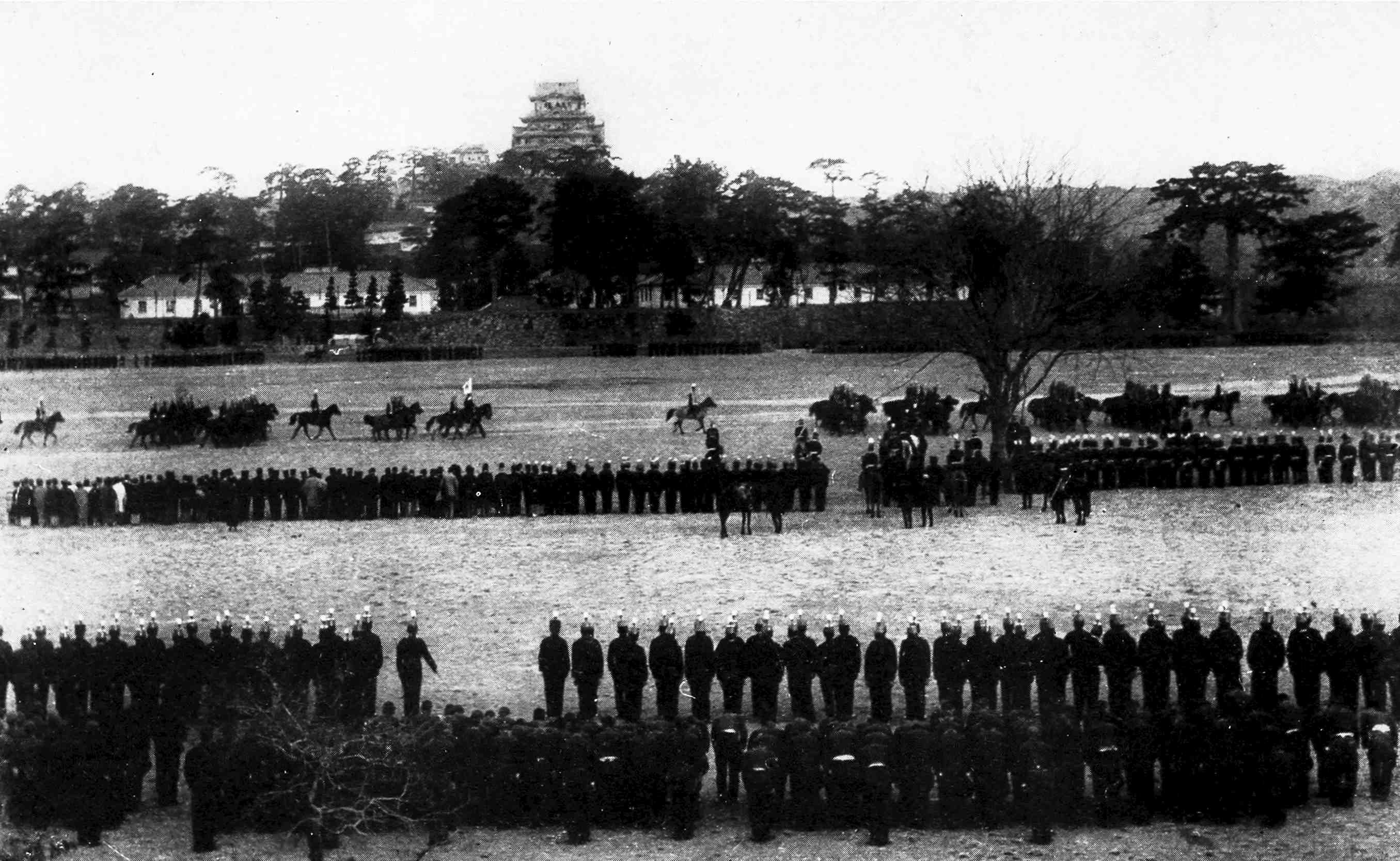
MILITARY REVIEW, HIMEJI
According to the reports made on the railways at the end of the year 1910 the gross earnings of both state and private railways for that year were 89,000,000 yen, the gross expenditures 46,796,000 yen, and the net profit over 43,700,000 yen.
The government has arranged plans for railway construction and development which involve an outlay of 174,523,365 yen, the construction to extend through eight years, and the improvements through twelve.
The line from Nagoya to Haichioji, near Tōkyō, opened to traffic in 1911, is about 224 miles long. The construction represents the best engineering skill, and an outlay of $17,500,000. It has ninety-five tunnels and 350 bridges.
The people of the country opposed the construction of the first line from Yokohama to Tokyo as a dangerous thing, and it was several years before public opposition to the innovation was entirely removed. Bond issues for railway construction were opposed, but the government insisted on its policy and finally won the people to its general support, so that by the end of the year 1908 on all lines there were 2,156 locomotives, 5,951 passenger coaches, and 34,045 freight cars in use.
Postal Savings in Japan206
It must be admitted at the outset that the system of postal savings in Japan cannot boast of any particularly brilliant record. The study of it reveals, however, a state of things which is not without some encouraging features. We give below the amounts of the deposits and some other items for every third year since the inauguration of the institution:—
Year. Deposits at the End of the Year. Yen. No. of Depositors. Amount per Depositor. Yen.
1875 15,000 1,800 8
1878 286,000 14,100 20
1881 821,000 38,900 21
1884 5,260,000 141,200 37
1887 18,213,000 568,800 31
1890 19,197,000 833,700 25
1893 26,155,000 1,060,200 24
1896 28,251,000 1,273,300 21
1899 23,455,000 1,397,600 16
1902 28,536,000 2,707,500 10
1905 54,754,096 5,858,560 9
1908 92,389,473 7,886,279 12
1911 200,000,000 12,000,000 17
The sudden drop between the years 1896 and 1902 is owing to the fact that the extraordinarily high interest offered by the ordinary banks during that period of monetary stringency diverted deposits from the Post Offices. The gradual fall in the general rates of interest since then has already begun to turn the tide back in favor of the Post Offices, as shown by the figures for late years. What is particularly satisfactory is the increase in the number of depositors, the increase in this respect being far more remarkable than the increase in the amount of the deposits, as shown by the decreasing amount per depositor. This means, if it means anything, that the advantages offered by the Postal Savings Bank are more and more extensively appreciated by the poorer classes.
The amount of deposits at the Postal Savings Bank seems to be steadily increasing, as is shown by the table. The figures for 1909, not given there, show 9,717,236 depositors, and 122,098,101 yen deposits.
Not altogether unsatisfactory as is this result of the official efforts to encourage the saving habit among the people, it must be noted that we are in this respect far behind some of the European countries. Consulting the statistics for the year 1898, we find the postal savings reached in that year to £120,000,000 in England, £33,000,000 in France, £21,000,000 in Belgium, £4,800,000 in Austria, £1,000,000 in Hungary, £2,700,000 in Holland, and £3,400,000 in Sweden. In spite of the great improvement effected in the system of late years, especially in the way of simplifying the official procedure connected with the acceptance and repayment of the deposits, much still remains to be done in order to bring the facilities provided by it within easy reach of the people by increasing the number of the Post Offices authorized to receive deposits throughout the country.
While speaking of savings, it may not be uninteresting to mention a few figures on the state of the deposits at the ordinary banks. We do not happen to have at hand the statistics covering all the banking concerns in the country. The “Ginkō Tsushin-Roku,” however, supplies us with reliable statistics up to February, 1902, so far as the principal banking centres are concerned. We find, then, that the total amount of deposits at the banks belonging to the clearing-houses of Tōkyō, Ōsaka, Kyōto, Nagoya, Yokohama, and Kōbe, stood at the end of February at 308,289,000 yen, made up as follows, not including the deposits at the Bank of Japan:
Yen.
Tōkyō 119,268,000
Ōsaka 75,824,000
Yokohama 49,280,000
Kōbe 23,423,000
Kyōto 22,616,000
Nagoya 17,878,000
In June, 1910, the Bank of Japan had a paid-up capital of 37,600,000 yen; in 1909 the deposits were 220,101,784 yen. At that time the Industrial Bank of Japan had deposits of 8,930,050 yen. The deposits in all the Japanese banks in 1909 amounted to 1,617,873,711 yen.
The Oil Industry in Japan207
Japan’s oil industry has a brilliant future before it. The use of kerosene in the country has grown at a wonderfully rapid pace. In the first year of Meiji the amount of oil imported was 639 koku. In 1901 it had reached 1,300,000 koku. The value of the oil imported in 1868 was only 7,236 yen; that imported in 1901 was 14 million yen.208 The following table shows the rate at which the import of kerosene into Japan increased:—
Years. Koku. Value. Yen.
1868 639 7,236
1872 8,936 160,608
1877 53,645 605,598
1882 413,644 2,320,905
1887 421,177 1,871,428
1892 653,785 3,328,398
1897 1,221,164 7,667,350
1900 1,356,846 14,162,652
1901 1,379,927 14,943,400
Notwithstanding the large supply that has come from abroad, of late years the demand for the Echigo oil has gone on increasing, as shown in the subjoined table, which covers seven years.
Years. Koku of Crude Petroleum. Value. Yen.
1895 158,334 526,976
1896 207,470 619,333
1897 257,614 668,677
1898 355,006 670,308
1899 544,583 1,450,904
1900 836,628 2,142,003
1901 1,115,807 2,345,916
It is calculated that about 5/10 of the total quantity of this crude petroleum was used for lighting purposes. It would seem, then, that Echigo supplied 3/10 of the total amount of oil used for lighting in Japan during the seven years, and that the remaining 7/10 came from abroad. Taking the year 1901, the value of the crude petroleum being 2,345,916 yen, it is estimated that when refined this amount of petroleum would fetch not less than 4 million yen. But the fact remains that the proportion of oil imported is still very large, so that there is room for a further great development of the business.
In 1908 Japan’s output of petroleum was 1,872,592 U. S. barrels. Echigo is by no means worked out: new fields are constantly being discovered in that province. Then petroleum has been found in Hokkaidō and in the Yamagata and Shizuoka prefectures. So that among Japan’s modern industries her oil trade may be pronounced to be full of promise. How the quality of the Japanese oil compares with the American and Russian brands, we are not told by the Jiji, but from other sources we gather that when properly refined Japanese petroleum is equal to the best American and Russian oils.
NATIONAL DEVELOPMENT.
The following table shows the national development in population, finance, trade, railway, vessels, telegraphs, savings, and currency, during the 30 years from 1872 to 1902.
Year. Population. (in Thousand) State Expenditure. Yen. Trade. Yen. Railway. Miles.
1872 33,210 57,730,025 43,204,462 18
1873 33,300 62,678,601 49,742,830 18
1874 33,625 82,269,528 42,779,120 38
1875 33,997 69,203,242 48,586,738 38
1876 34,338 59,308,956 51,676,296 65
1877 (unknown) 48,428,324 50,769,424 66
1878 „ 60,911,336 58,862,974 68
1879 35,768 60,317,578 61,128,772 73
1880 35,929 63,140,896 65,021,987 98
1881 36,358 71,460,321 62,250,133 122
1882 36,700 73,480,667 67,168,344 170
1883 37,017 83,106,859 64,712,861 244
1884 37,451 76,663,108 63,544,112 262
1885 37,868 61,115,313 66,503,659 353
1886 38,507 83,223,960 84,044,745 430
1887 39,069 79,453,036 96,711,932 593
1888 39,607 81,504,024 131,160,744 912
1889 40,072 79,713,671 136,164,472 1,136
1890 40,453 82,125,403 138,332,086 1,339
1891 40,718 83,558,891 142,454,540 1,716
1892 41,089 76,734,740 162,428,833 1,870
1893 41,388 84,581,872 177,970,036 1,938
1894 41,813 78,128,643 230,028,141 2,118
1895 42,270 85,317,179 265,372,756 2,290
1896 42,706 168,856,509 289,517,234 2,507
1897 43,228 223,678,844 382,435,848 2,948
1898 43,763 219,757,568 443,255,909 3,120
1899 44,260 254,165,537 435,331,802 3,638
1900 .... 292,726,996 491,691,839 3,855
1901 .... 266,856,824 508,166,187 4,026
1902 .... 275,751,194
Year. Vessels. Ton. Telegraphic Lines. Ri. Savings. Yen. Money in Circulation. Yen
1872 22,364 87 .... 132,611,498
1873 26,988 806 .... 159,423,361
1874 26,120 1,758 .... 157,660,830
1875 42,304 1,833 15,224 154,931,596
1876 40,248 2,156 41,845 163,692,344
1877 49,105 2,876 100,138 175,432,023
1878 43,899 3,512 286,289 221,994,874
1879 42,763 3,842 494,114 215,912,239
1880 41,215 4,489 662,091 203,994,171
1881 41,044 5,078 821,938 195,742,688
1882 42,107 5,477 1,058,225 186,376,681
1883 45,350 5,871 2,298,502 182,625,317
1884 49,845 6,122 5,260,484 177,978,053
1885 59,613 6,283 9,050,255 181,433,916
1886 63,314 6,353 15,462,054 198,557,838
1887 72,322 6,818 18,417,022 200,157,163
1888 81,066 7,588 20,142,169 207,825,609
1889 88,816 8,191 19,976,419 220,748,343
1890 93,812 9,250 19,197,942 205,408,438
1891 95,588 9,113 26,424,174 210,872,584
1892 102,301 9,920 30,031,483 219,848,385
1893 110,205 10,230 32,199.954 244,847,437
1894 169,414 11,502 32,772,652 256,088,534
1895 213,221 12,212 41,143,695 291,665,016
1896 227,841 15,431 46,693,884 307,461,803
1897 426,624 18,360 51,550,536 330,470,142
1898 464,246 20,561 52,532,992 285,589,698
1899 498,376 24,342 68,829,712 332,702,090
1900 534,239 27,390 72,897,286 318,280,814
1901 .... .... .... 306,315,006
1902
NOTE.—In expenditure, the figures from 1872 up to 1898 are taken from the settled account, and those of 1899, 1900, and 1901 from the actual account. 1902 is from the Budget. In railways, the figures show the mileages of the lines belonging to the government as well as those belonging to private firms opened to traffic at the end of the respective years. The tonnage of vessels shown in the table is that of steamers. Before 1896, the figures represented the aggregate amount of both registered and unregistered tonnage, while from that year up to 1902, the figures only represented registered tonnage. In savings, the figures show the total amount saved in the post offices as well in the savings banks at the end of the respective years. The figures from 1890 to 1900 indicate, however, the amounts of the postal savings only.
From the “Tōyō Keizai Shimpō” (Oriental Economist).
DEVELOPMENT OF THE FOREIGN TRADE OF JAPAN
From the official statistics we give a table of Japan’s foreign trade each year from 1868 to 1901, and for 1909.
Exports. Yen. Imports. Yen. Total. Yen.
1868 15,553,472 870 10,693,071 790 26,246,544 660
1869 12,908,977 990 20,783,633 090 33,692,611 080
1870 14,543,012 510 33,741,637 360 48,284,649 870
1871 17,968,608 660 21,916,727 650 39,885,336 310
1872 17,026,647 220 26,174,814 930 43,201,462 150
1873 21,635,440 850 28,107,390 030 49,742,830 880
1874 19,317,306 090 23,461,814 400 42,779,120 490
1875 18,611,110 610 29,975,627 620 48,586,738 230
1876 27,711,527 500 29,964,678 960 51,676,206 460
1877 23,348,521 600 27,420,902 950 50,769,424 650
1878 25,988,140 280 32,874,834 170 58,862,974 450
1879 28,175,770 190 32,953,002 390 61,128,772 580
1880 28,395,386 660 36,626,601 000 65,021,987 660
1881 31,058,887 930 31,191,246 020 62,250,133 950
1882 37,721,750 570 29,446,593 980 67,168,344 550
1883 36,268,019 590 28,444,841 780 64,712,861 370
1884 33,871,465 500 29,672,647 450 63,544,112 950
1885 37,146,691 430 29,356,967 920 66,503,659 350
1886 48,876,312 790 32,168,432 260 81,044,745 050
1887 52,407,681 150 44,304,251 690 96,711,932 840
1888 65,705,510 210 65,455,234 010 131,160,744 220
1889 70,060,705 820 66,103,766 600 136,164,472 420
1890 56,603,506 030 81,728,580 500 138,332,086 530
1891 79,527,272 340 62,927,268 380 142,454,540 720
1892 91,102,753 630 71,326,079 500 162,428,833 130
1893 89,712,864 590 88,257,171 710 177,970,036 300
1894 113,246,086 150 117,481,955 460 230,728,041 610
1895 136,112,177 920 129,260,578 280 265,372,756 200
1896 177,842,700 620 171,674,474 250 289,517,234 870
1897 163,135,077 320 219,300,771 640 382,435,848 960
1898 165,753,752 880 277,502,156 510 443,255,909 390
1899 214,929,894 310 220,401,925 990 435,331,820 300
1900 204,429,998 980 287,261,845 680 491,691,839 560
1901 252,349,542 100 255,816,644 700 508,166,187 800
1909 413,112,511 .. 394,198,843 .. 807,311,354
Imports Compared with Exports.
Increase. Yen. Decrease. Yen.
1868 ....... .. 4,860,401 080
1869 7,874,655
1870 19,198,624 850
1871 3,948,118 990
1872 9,148,167 710
1873 6,471,949 180
1874 4,144,508 310
1875 11,364,517 010
1876 ....... .. 3,746,848 540
1877 4,072,381 850
1878 6,886,693 890
1879 4,777,232 200
1880 8,231,214 340
1881 132,358 090
1882 ...... .. 8,275,156 590
1883 ...... .. 7,823,177 810
1884 ...... .. 4,198,818 050
1885 ...... .. 7,789,723 510
1886 ...... .. 16,707,880 530
1887 ...... .. 8,103,429 460
1888 ...... .. 250,276 200
1889 ...... .. 3,966,939 220
1890 25,125,074 470
1891 ...... .. 16,600,003 960
1892 ...... .. 19,776,674 130
1893 ...... .. 1,455,692 880
1894 4,235,869 310
1895 ...... .. 6,851,599 640
1896 53,831,713 680
1897 56,165,694 320
1898 111,748,403 630
1899 5,472,031 680
1900 82,831,851 600
1901 3,467,101 600
=1909=
The Wealth of Japan
The following estimate gives an idea of the wealth of Japan and its distribution:—
Land 7,000 millions yen.
Mines 500 „ „
Live-stock 80 „ „
Buildings 1,900 „ „
Furniture 400 „ „
Railroads 350 „ „
Warships and merchant-ships 250 „ „
Specie 200 „ „
Miscellaneous 300 „ „
Goods and other products 800 „ „
Total 11,080 „ „
The output of gold in 1908 was 168,883 ounces.
On the position Japanese occupy as regards the acquisition of wealth Mr. Kure Bunso, the well-known statistician, writes in the “Shakaigaku Zasshi” as follows: There are only two men in Japan who pay an income tax on over 250,000 yen. There are only 13 men in the whole country who pay on 39,000 yen, being in the proportion of 4 persons to every 100,000 inhabitants; only 67 who pay on 24,000 yen, being in the proportion of 2 persons to every 10,000 inhabitants; 96 persons who pay on 17,000 yen, being in the proportion of 2.8 persons to every 10,000 inhabitants; those who pay on 11,000 yen number 140, being in the proportion of 4 persons to every 10,000 inhabitants. Out of every 1,000 inhabitants there are only 7 persons who make 2,700 yen a year. Thus it is seen that when compared with the French and the English the Japanese are extremely poor. The Germans seem to be rich to the Japanese, though when compared with the French and English they are poor. General Grant, when in Japan nearly twenty years ago, remarked that Japan was fortunate in having such an equality among all classes of the people. He said that the gulf between the rich and the poor did not exist here. Equality may be all very well in its way, but, says Mr. Kure, a state of equality in which most of the people hardly have enough to live on is anything but desirable.209
The new building of the Mitsui Company in Tōkyō is constructed upon steel frames, and is the only one of its kind in the East. The Mitsui Bank is the oldest banking establishment in Japan, more than 200 years old. The building area is 2,600 square yards on a site covering 2½ acres.
Japanese Year Periods
It should be borne in mind that the Japanese year periods do not regularly correspond with the reigns of the Emperors, because “a new one was chosen whenever it was deemed necessary to commemorate an auspicious or ward off a malign event.” But hereafter the era will correspond with the reign of an Emperor. The names of some of these eras are quite famous, like the Elizabethan or the Victorian Era in English history. As the first era was a time of great reforms, it is known as the Taikwa Reformation; the Engi Era, in the tenth century, is celebrated for important legislation; the Genroku Era, in the seventeenth century, was “a period of great activity in various arts”; and the Tempō Era, of recent days, was “the last brilliant period of feudalism before its fall.” This name was also given to the large 8 rin piece coined in that era. The Wadō Era, in the fourteenth century, was so named on account of the discovery of copper; and the second era, Hakuchi, commemorates a “white pheasant,” presented to the Emperor.
LIST OF JAPANESE YEAR PERIODS.210
Name. Japanese Era.211 Christian Era.
Taikwa 1305 645
Hakuchi 1310 650
(Blank) 1315-1331 655-671
Sujaku 1332 672
Hakuhō 1332 672
Shuchō 1346 686
(Blank) 1347-1360 687-700
Daihō [Taihō] 1361 701
Keiun 1364 704
Wadō 1368 708
Reiki 1375 715
Yōrō 1377 717
Jinki [Shinki] 1384 724
Tembiō 1389 729
Tembiō shōhō 1409 749
Tembiō hoji 1417 757
Tembiō jingo 1425 765
Jingo keiun 1427 767
Hōki 1430 770
Tenō 1441 781
Enriaku 1442 782
Daidō 1466 806
Kōnin 1470 810
Tenchō 1484 824
Jōwa [Shōwa] 1494 834
Kajō [Kashō] 1508 848
Ninju 1511 851
Saikō 1514 854
Tenan 1517 857
Jōgwan [Jōkwan] 1519 859
Gwangiō [Genkei] 1537 877
Ninna [Ninwa] 1545 885
Kwampei 1549 889
Shōtai 1558 898
Engi 1561 901
Enchō 1583 923
Jōhei [Shōhei] 1591 931
Tengiō [Tenkei] 1598 938
Tenriaku 1607 947
Tentoku 1617 957
Ōwa 1621 961
Kōhō 1624 964
Anna 1628 968
Tenroku 1630 970
Ten-en 1633 973
Jōgen 1636 976
Tengen 1638 978
Eikwan 1643 983
Kwanna 1645 985
Eien 1647 987
Eiso [Eisho] 1649 989
Shōriaku 1650 990
Chōtoku 1655 995
Chōhō 1659 999
Kwankō 1664 1004
Chōwa 1672 1012
Kwannin 1677 1017
Ji-an 1681 1021
Manju 1684 1024
Chōgen 1688 1028
Chōriaku 1697 1037
Chōkiū 1700 1040
Kwantoku 1704 1044
Eijō [Eishō] 1706 1046
Tengi [Tenki] 1713 1053
Kōhei 1718 1058
Jiriaku 1725 1065
Enkiū 1729 1069
Jōhō [Shōhō] 1734 1074
Jōriaku [Shōreki] 1737 1077
Eiho 1741 1081
Otoku 1744 1084
Kwanji 1747 1087
Kahō 1754 1094
Eichō 1756 1096
Jōtoku [Shōtoku] 1757 1097
Kōwa 1759 1099
Chōji 1764 1104
Kajō [Kashō] 1766 1106
Tennin 1768 1108
Tenei 1770 1110
Eikiū 1773 1113
Genei 1778 1118
Hōan 1780 1120
Tenji 1784 1124
Daiji 1786 1126
Tenjō [Tenshō] 1791 1131
Chōjō [Chōshō] 1792 1132
Hōen 1795 1135
Eiji 1801 1141
Kōji 1802 1142
Tenyō 1804 1144
Kiū-an 1805 1145
Nimbiō 1811 1151
Kiūju 1814 1154
Hōgen 1816 1156
Heiji 1819 1159
Eiriaku 1820 1160
Ōhō 1821 1161
Chōkwan 1823 1163
Eiman 1825 1165
Ninan 1826 1166
Ka-ō 1829 1169
Jō-an [Shōan] 1831 1171
Angen 1835 1175
Jishō 1837 1177
Yōwa 1841 1181
Ju-ei 1842 1182
Genriaku 1844 1184
Bunji 1845 1185
Kenkiū 1850 1190
Shōji 1859 1199
Kennin 1861 1201
Genkiū 1864 1204
Kenei 1866 1206
Jōgen [Shōgen] 1867 1207
Kenriaku 1871 1211
Kempō 1873 1213
Jōkiū [Shōkiū] 1879 1219
Jō-ō 1882 1222
Gennin 1884 1224
Karoku 1885 1225
Antei 1887 1227
Kwangi 1889 1229
Jō-ei 1892 1232
Tempuku 1893 1233
Bunriaku 1894 1234
Katei 1895 1235
Riakunin 1898 1238
En-o 1899 1239
Ninji 1900 1240
Kwangen 1903 1243
Hōji 1907 1247
Kenchō 1909 1249
Kōgen 1916 1256
Shōka 1917 1257
Shōgen 1919 1259
Bunō 1920 1260
Kōchō 1921 1261
Bunei 1924 1264
Kenji 1935 1275
Kōan 1938 1278
Shō-ō 1948 1288
Einin 1953 1293
Shōan 1959 1299
Kengen 1962 1302
Kagen 1963 1303
Tokuji 1966 1306
Enkiō [En-kei] 1968 1308
Ōchō 1971 1311
Shōwa 1972 1312
Bumpō 1977 1317
Gen-ō 1979 1319
Genkō 1981 1321
Shōchū 1984 1324
Kariaku 1986 1326
Gentoku 1989 1329
Shōkiō [Shōkei] 1992 1332
Kemmu 1994 1334
Rekiō 1998 1338212
Kōei 2002 1342212
Jōwa 2005 1345212
Kwanō 2010 1350212
Bunna 2012 1352212
Embun 2016 1356212
Kōan 2021 1361212
Jōji 2022 1362212
Ōan 2028 1368212
Eiwa 2035 1375212
Kōreki 2039 1379212
Eitoku 2041 1381212
Shitoku 2044 1384212
Kakei 2047 1387212
Koō 2049 1389212
Engen 1996 1336213
Kōkoku 2000 1340213
Shōhei 2006 1346213
Kentoku 2030 1370213
Bunchū 2032 1372213
Tenju 2035 1375213
Kōwa 2041 1381213
Genchū 2044 1384213
Meitoku 2050 1390
Ō-ei 2054 1394
Shōchō 2088 1428
Eikiō 2089 1429
Kakitsu 2101 1441
Bunan 2104 1444
Hōtoku 2109 1449
Kōtoku 2112 1452
Kōshō 2115 1455
Chōroku 2117 1457
Kwanshō 2120 1460
Bunshō 2126 1466
Ōnin 2127 1467
Bummei 2129 1469
Chōkō 2147 1487
Entoku 2149 1489
Mei-ō 2152 1492
Bunki 2161 1501
Eishō 2164 1504
Dai-ei [Taiei] 2181 1521
Kōroku 2188 1528
Tembun 2192 1532
Kōji 2215 1555
Eiroku 2218 1558
Genki 2230 1570
Tenshō 2233 1573
Bunroku 2252 1592
Keichō 2256 1596
Genna 2275 1615
Kwanei 2284 1624
Shōhō 2304 1644
Kei-an 2308 1648
Jō-ō [Shō-ō] 2312 1652
Meireki 2315 1655
Manji 2318 1658
Kwambun 2321 1661
Empō 2333 1673
Tenna 2341 1681
Jōkiō 2344 1684
Genroku 2348 1688
Hō-ei 2364 1704
Shōtōku 2371 1711
Kiōhō 2376 1716
Gembun 2396 1736
Kwampō 2401 1741
Enkiō 2404 1744
Kwannen 2408 1748
Hōreki 2411 1751
Meiwa 2424 1764
Anei 2432 1772
Temmei 2441 1781
Kwansei 2449 1789
Kiōwa 2461 1801
Bunkwa 2464 1804
Bunsei 2478 1818
Tempō 2490 1830
Kōkwa 2504 1844
Ka-ei 2508 1848
Ansei 2514 1854
Manen 2520 1860
Bunkiū 2521 1861
Genji 2524 1864
Kei-ō 2525 1865
Meiji 2528 1868
Taishō 2572 1912
The names of these periods are made by the various combinations of 68 Chinese words of good omen.
There are, moreover, other expressions which more closely resemble such common Occidental phrases as the Victorian Era, the Elizabethan Era, the Age of Pericles, except that in the impersonal Orient such expressions are named more often from places. In Japanese history, for instance, it is very common to read of the Nara Epoch, the Heian Epoch, the Muromachi Period, the Kamakura Period, the Yedo Era, the Tōkyō Period (Modern Japan). Personal names are applied, however, in such cases as the Hōjō Era, the Ashikaga Period, the Tokugawa Era, the Fujiwara Period.
Chronological Table of Emperors and Empresses.214
1. Jimmu (660-585 B. C.)
2. Suizei (581-549)
3. Annei (548-511)
4. Itoku (510-477)
5. Kōshō (475-393)
6. Kōan (392-291)
7. Kōrei (290-215)
8. Kōgen (214-158)
9. Kaikwa (157-98)
10. Sujin (97-30)
11. Suinin (29 B. C.-70 A. D.)
12. Keikō (71-130 A. D.)
13. Seimu (131-190)
14. Chūai-(192-200)
[15. Jingō214 (201-269)]
16. Ōjin (270-310)
17. Nintoku (313-399)
18. Richū (400-405)
19. Hanzei (406-411)
20. Ingyō (412-453)
21. Ankō (454-456)
22. Yūryaku (457-479)
23. Seinei (480-484)
24. Kensō (485-487)
25. Ninken (488-498)
26. Muretsu (499-506)
27. Keitai (507-531)
28. Ankan (534-535)
29. Senkwa (536-539)
30. Kimmei (540-571)
31. Bidatsu (572-585)
32. Yōmei (586-587)
33. Sujun (588-592)
34. Suiko (593-628)
35. Jomei (629-641)
36. Kōgyoku (642-645)
37. Kōtoku (645-654)
38. Saimei (655-661)
39. Tenchi (668-671)
40. Kōbun (672)
41. Temmu (673-686)
42. Jitō (690-696)
43. Mommu (697-707)
44. Gemmyō (708-715)
45. Genshō (715-723)
46. Shōmu (724-748)
47. Kōken (749-758)
48. Junnin (758-764)
49. Shōtoku (765-770)
50. Kōnin (770-781)
51. Kwammu (782-806)
52. Heizei (806-809)
53. Saga (809-823)
54. Junna (823-833)
55. Nimmyō (833-850)
56. Montoku (850-858)
57. Seiwa (859-876)
58. Yōzei (877-884)
59. Kōkō (884-887)
60. Uda (888-897)
61. Daigo (897-930)
62. Sujaku (931-946)
63. Murakami (946-967)
64. Reizei (968-969)
65. Enyū (970-984)
66. Kwazan (985-986)
67. Ichijō (987-1011)
68. Sanjō (1012-1016)
69. Go-Ichijō215 (1016-1036)
70. Go-Sujaku (1037-1045)
71. Go-Reizei (1045-1068)
72. Go-Sanjō (1068-1072)
73. Shirakawa (1073-10861
74. Horikawa (1087-1107)
75. Toba (1108-1123)
76. Sutoku (1123-1141)
77. Konoye (1142-1155)
78. Go-Shirakawa (1155-1158)
79. Nijō (1159-1165)
80. Rokujō (1165-1168)
81. Takakura (1168-1180)
82. Antoku (1180-1185)
83. Go-Toba (1186-1198)
84. Tsuchimikado (1198-1210)
85. Juntoku (1211-1221)
86. Chūkyō (1221)
87. Go-Horikawa (1221-1232)
88. Shijō (1233-1242)
89. Go-Saga (1242-1246)
90. Go-Fukakusa (1246-1259)
91. Kameyama (1260-1274)
92. Go-Uda (1274-1287)
93. Fushimi (1288-1298)
94. Go-Fushimi (1298-1301)
95. Go-Nijo (1301-1308)
96. Hanazono (1308-1318)
97. Go-Daigo (1318-1338)
98. Go-Murakami (1339-1368)
[99. Chōkei (1368-1372)]
100. Go-Kameyama (1373-1392)
101. Go-Komatsu (1392-1412)
102. Shōkō (1412-1428)
103. Go-Hanazono (1428-1464)
104. Go-Tsuchimikado (1464-1500)
105. Go-Kashiwabara (1500-1526)
106. Go-Nara (1526-1557)
107. Ogimachi (1567-1586)
108. Go-Yōzei (1587-1611)
109. Go-Mizuno-o (1612-1629)
110. Myōshō (1630-1643)
111. Go-Kōmyō (1643-1654)
112. Go-Saiin (1655-1663)
113. Reigen (1663-1687)
114. Higashiyama (1687-1709)
115. Nakano-mikado (1709-1735)
116. Sakuramachi (1735-1747)
117. Momozono (1747-1762)
118. Go-Sakuramachi (1762-1770)
119. Go-Momozono (1771-1779)
120. Kōkaku (1779-1817)
121. Ninkō (1817-1846)
122. Kōmei (1846-1867)
123. Mutsuhito (1867-1912)
124. Yoshihito (1912- )
N.B.—Nos. 36 and 38 were the same empress; likewise Nos. 47 and 49.
We append also a list of the sovereigns of the “Northern Court” during the separation, as follows:
1. Kōgon (1331-1333)
2. Kōmyō (1336-1348)
3. Sukō (1349-1352)
4. Go-Kōgon (1352-1371)
5. Go-Enyu (1371-1382)
6. Go-Komatsu (1383-1392)
In 1392 Go-Komatsu became emperor over the reunited empire.
Ministerial Changes in Japan
The following table shows the Cabinet changes that have taken place since constitutional government was instituted:
Premier. Term of Office. Yrs. Mos.
Yamagata Dec. ’89-Apr. ’91 1 4
Matsukata May ’91-July ’92 1 2
Itō Aug. ’92-Aug. ’96 4 0
Matsukata Sept. ’96-Dec. ’97 1 3
Ito Jan. ’98-June ’98 0 5
Okuma-Itagaki June ’98-Oct. ’98 0 4
Yamagata Nov. ’98-Sept. ’00 1 10
Itō Oct. ’00-May ’01 0 7
Katsura June ’01-Dec. ’05 4 6
Saionji Jan. ’06-July ’08 2 6
Katsura July ’08-Aug. ’11 3 2
Saionji Sept. ’11-Dec. ’12 1 3
Katsura Dec. ’12-Feb. ’13 0 2
Yamamoto Feb. ’13-
In connection with this table, we wish to call attention to the fact that the average duration of eleven Ministries is less than two years; and that the average was considerably raised by the unusual length of the two Ministries which covered the periods of the wars with China and Russia, when political rivalries were buried. It is quite probable that, if foreign wars had not occurred to unify the nation, those Ministries would not have had a duration so greatly in excess of the average, especially as, at the outbreak of the wars, party feeling was running very high. In that case the general average would have been reduced by an increase in the number of cabinets. It should also be noticed that three of these Ministries (both Matsukata and the second Itō) came to an end on account of collision with the Diet, and that four Ministries (the Kuroda, the first and third Itō, and the first party Cabinet of Ōkuma and Itagaki) were broken up by internal dissensions; and the last Katsura (February, 1913) was forced out by popular revolt.
Japan’s House of Peers
Among its 373 members only 57 sit by hereditary right; namely, 14 Princes of the Blood, 13 Princes, and 30 Marquises. Among the remaining members, 150 are elected by the Counts, Viscounts, and Barons, 121 are Imperial nominees,—that is to say, men who have earned distinction by eminent services or attainments,—and 45 represent the highest tax-payers in the prefectures.
The Political Parties of Japan216
The idea of popular representation in the government of Japan may be said to have had its birth with the Restoration, although some thoughtful men had been turning their minds in that direction at an earlier date. His Imperial Majesty the present Emperor, in his oath on the occasion of his succession to the throne, made known his enlightened desire that men should meet in council from all parts of the country and all affairs of state be determined in accordance with public opinion. This pronouncement may be regarded as the starting-point of the movement for parliamentary representation. The germ of the present House of Peers and House of Representatives is found in the Gi-sei, a department of the government which was organized as early as June, 1868. The Kō-gi-jō, which was opened in the following year, was representative, not of the people, but of the governing authorities in the various localities. The members of the Sa-In, which replaced the Kō-gi-jō (or Shūgi-in) in September, 1871, were nominated by the Emperor and the council of state.
The history of political parties in Japan may conveniently be divided into four periods: (1) From the Restoration up to 1882, while as yet they were in embryo; (2) from the year 1882, when they for the first time took actual shape, until 1888; (3) from the organization of the Daidō-Danketsu in 1887 until 1898; (4) the period since the amalgamation of the two strongest parties to form the constitutional party in 1898.
During the early seventies discussion went on regarding the advisability of the formation of a popular assembly. In 1874 was formed the first political society, the Aikoku-tō, or patriotic society, from which later sprang the Liberal Party (Jiyu-tō). In the previous year a division had taken place in the ranks of the higher officials of the government. The one party was composed of those who desired rapid progress in domestic matters and a vigorous foreign policy; the other desired steady progress at home and conciliation abroad. The latter party retained control of the government, and the former went into opposition. Among the most important of the radical party was Itagaki of Kōchi Prefecture. He organized the first local society, and devoted himself constantly to the attainment of his end of bringing about parliamentary institutions in the country. We thus have Kōchi, and later on Hizen, working for the extension of the power of the people, while the government was in the main conducted by Satsuma and Chōshū men.
The agitation for popular representation, although checked for a time by the Satsuma Rebellion, gained strength in 1879 and 1880, and the government became convinced that the question could not longer be postponed. On the 12th of October, 1881, the Emperor promulgated the famous ordinance in which the promise was given that a parliament should actually be established in 1890. As a preparatory measure, Itō, in company with a number of junior officials, was despatched to Europe early in 1882 to study the political systems of the West. The promise of a parliament served to give a more definite purpose to the various political associations, and the year 1882 saw the formal organization of the three parties which, under various names, have continued almost uninterruptedly to occupy the field until the present time. The Jiyu-tō was the first organized, although not the first to be properly registered as a political association.
It is noticeable that the utterances of the various political parties when they first came into existence present in the main no features of a distinctive nature. All put forth excellent doctrines, but usually of extreme vagueness. The same characteristic has been noticeable throughout their history except when some temporary question of urgency has arisen. This is no doubt the reason why the grouping has constantly changed, one merging into another, and secessions occurring without apparent cause. 1883 and the following years saw a falling off in the interest in political parties,—doubtless a natural result of the over excitement which had just preceded, and of the apparent certainty of a parliament after 1890. The interest in politics and in parties revived, however, as the date assigned for the granting of the constitution approached.
Since the opening of the first Diet, the efforts of the parties have in general been directed towards the securing of control of the administration,—the establishment of parliamentary government. Except during the period of the war with China, when all party differences were for the time set aside, the parties have all been in more or less constant opposition to the government. Until within the last year or two, however, no party has possessed for any considerable length of time an absolute majority of the membership of the Lower House, sufficient to enable it to control the votes of that body. Political parties have now become a distinct power in the land which no statesman can afford entirely to neglect. From small and unruly beginnings, they have gradually progressed in influence and in organization. As by degrees they have been getting rid of their unruly and dangerous elements, and learning to a greater extent the lesson of responsibility, they have more and more gained the popular confidence. Possessing practically the power of the purse,—for in the Diet the House of Representatives has the first say as to the details of the budget presented by the government,—they have always to be reckoned with....
That there have been no distinct and well-defined party issues may be traced to the fact that feudalism gave place so suddenly to a modern state of society. The leaders of thought and those who have taken up the work of national rejuvenation have all been men of progressive tendencies. That the parties have frequently opposed the government in cases where opposition for its own sake has been the only recognizable principle cannot be denied. It must be remembered that they have all along been struggling for a share in the administration. The political parties have well illustrated the intensely democratic character of the Japanese people side by side with marked reverence for the Emperor. The desire for equality and the revolt against the controlling influence of a narrow coterie has all along been exhibited....
I217 may perhaps take this opportunity to mention two characteristics of Japanese political parties which have impressed themselves upon me in the course of my own, as yet comparatively slight, study of the politics of this country. As in so many other aspects of Japanese life, so also in politics, I think we can see a curious blending of Old Japan with the very latest and most advanced which the West has to offer. It was a remark of the most influential, if not the greatest, English political philosopher of the nineteenth century, John Stuart Mill, that, even if we could be assured that an autocrat, an all-powerful individual ruler, would govern more wisely than a popular government, we ought, nevertheless, to prefer the popular government for the educative effect which the effort to govern produces upon the people.
Now it will be found that there has been very much conscious or unconscious following of this idea in the progress of popular government in Japan. In marked contrast to the history of popular government in the West, where parliaments have been forced on the government from below for the protection of popular rights, popular representation has been granted from above in this country, and the people have grown up to it, or are in process of growing. The truth of this is not affected by the fact that contest between rival clans has been an ever controlling factor in the domestic politics of the country since Restoration days. The agitation of the parties has been not so much directed against the measures of the government as against the fact that the government is not controlled by the representatives of the people.
The element of Old Japan in the political parties is seen in the nature of political allegiance. What holds the parties together is men rather than measures. In Old Japan personal allegiance to one’s feudal lord was one of the strongest feelings of the individual, and sufficed to give a distinct character to the life of the time. The most important elements of feudalism, the political and economic organization of the society which was founded upon it, have passed away, but the sentimental part remains in the personal allegiance of men to their party leaders of to-day. What would the Seiyukai have been without Prince Itō, or the Progressive party without Count Ōkuma? No doubt other leaders would be forthcoming if these were not present, the names of the parties might be retained, but the membership would almost certainly undergo enormous changes.
Army Statistics of Japan218
Surgeon-Major Koike, in a lecture delivered before the Medical Union in the salon of the Musical College in Uyeno, gave some interesting figures relating to the casualties in the North-China campaign as compared with the China-Japan war of 1894-1895. These will be most easily understood by putting them into tabular form.
Total number of patients in the North-China campaign 22,080
Total number of deaths out of the above aggregate 1,137
(This, of course, is exclusive of those killed in the field; it shows only the sick and wounded.)
North-China Campaign. China-Japan War.
Percentage of deaths 5.1 8.1
Number of sick to each wounded man 5.5 4.1
Number of deaths from sickness to each death from wounds 2.3 9.7
Percentage of deaths among wounded men 3.2 3.9
Percentage of deaths among diseased men 4.2 8.4
Return of the Hiroshima Reserve Hospital
North-China Campaign.
Percentage of deaths among wounded men 2.1
Percentage of deaths among sick men 3.3
Comparative Figures (General)
Total percentage of deaths among wounded men:
Satsuma Rebellion 17.0
China-Japan War 9.7
North-China Campaign 4.6
Comparative Figures Showing the Percentage of Sick during the Occupation of Peking in the Winter
Russian troops 8.75 (typhoid, dysentery, syphilis).
French troops 5.42 (typhoid, syphilis).
German troops 5.33 (typhoid, syphilis, dysentery).
British troops 5.22 (sunstroke, diarrhœa, dysentery, and typhoid).
American troops 4.18 (dysentery, sunstroke, and syphilis).
Japanese troops 2.51 (kakke and typhoid).
Statistics of Russo-Japanese War.219
(Feb., 1904—May, 1905.)
Killed on field 43,892
Wounded with colors 145,527
Died of those wounds 9,054
Sick, including wounds, accidents, etc., not received on firing-line 162,556
Died of sickness and disease 7,433
Contagious diseases 10,565
Died of contagious diseases 4,557
Killed and died from wounds 52,946
Died from all diseases 11,992
Japanese Naval Increment220
Writing about naval increment, the “Nichi Nichi Shimbun” notes the increase of the Japanese Navy during recent years as follows:—
Total Tonnage.
1897 100,000
1898 134,000
1899 154,000
1900 204,000
1901 232,000
In the immediate future, the total tonnage will be raised to the post-bellum figure of 250,000 tons.221 Everybody agrees that Japan must not rest there. She has to keep up with the rapid additions made by other countries to their naval forces. That is not a matter of serious difficulty so far as ships are concerned: they can always be bought with money. But the men to man them is another problem. After the Restoration any number of recruits were obtainable for the army, as was natural in a country where a military feudalism had existed for centuries. The navy, however, could not be so easily supplied, maritime enterprise having been effectually checked under the Tokugawa rule. Difficulties about seamen may now be said to have been overcome. But that is not true of officers. Our contemporary here gives the following table:—
Year. Number of Officers and Men Actually Serving. Total Force, Including Reserves.
1895 14,463 17,140
1900 28,308 32,981
This shows an increment of only 100 per cent, whereas the increase of tonnage in the same time was 400 per cent.222 The great difficulty is to get a supply of officers for the lower ranks—midshipmen and lieutenants. The only college for educating these officers is at Edajima, where not more than 600 cadets can be accommodated. There, then, a change must be effected. It will probably take the form of organizing another naval college at Yokosuka, and making arrangements that the preliminary education of candidates shall be effected in the middle schools.
Japan’s Mercantile Marine223
The “Tōkyō Keizai” publishes some interesting statistics bearing on the development of our mercantile marine. It was 1870 or thereabouts that the Japanese began to turn their attention to the carrying trade in the modern sense of the term, but its growth was slow until the Chinese War of 1894-1895. The following table gives the figures for the eleven years from 1892 to 1902 inclusive:
Year. Tons.
1892 214,000
1893 325,000
1894 320,000
1895 386,000
1896 417,000
1897 486,000
1898 648,000
1899 796,000
1900 863,000
1901 917,000
1902 934,000224
From the comparative statistics published by our contemporary, it is noticed that, while in 1892 our mercantile fleet was the thirteenth in the world in point of tonnage, it had risen by 1901 to the eighth position. It is interesting to observe that it is rapidly coming up to the same relative status as that occupied by our naval fleet whose position is the seventh among the navies of the world.225
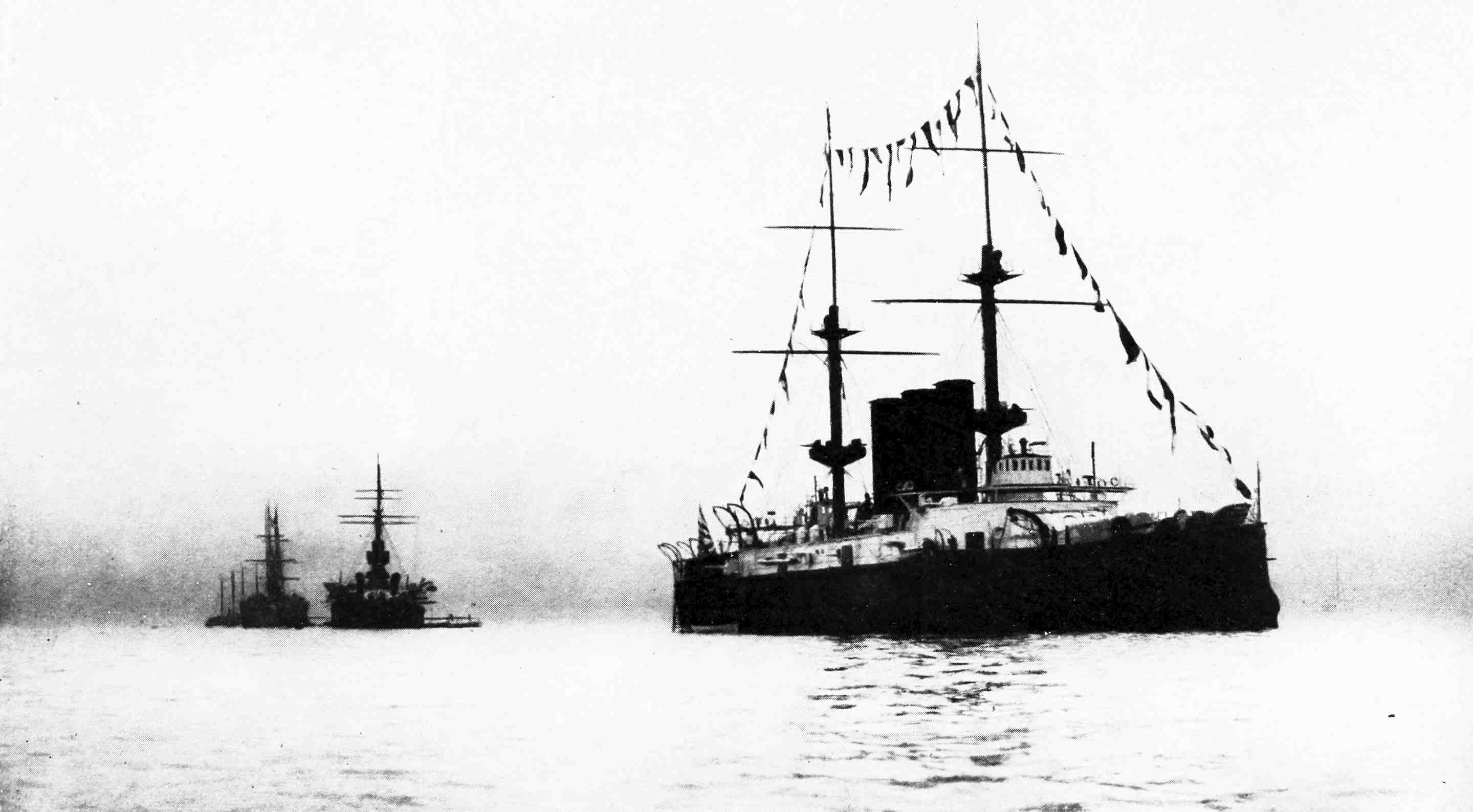
“SHIKISHIMA” IN NAVAL REVIEW, KŌBE
Treaty of Commerce and Navigation between Japan and the United States of America
Signed at Washington, 22nd day of the 11th month, 27th year of Meiji. Ratifications exchanged at that City, 21st day of the 3rd month, 28th year of Meiji.
His Majesty the Emperor of Japan and the President of the United States of America being equally desirous of maintaining the relations of good understanding which happily exist between them, by extending and increasing the intercourse between their respective States, and being convinced that this object cannot better be accomplished than by revising the Treaties hitherto existing between the two countries, have resolved to complete such a revision, based upon principles of equity and mutual benefit, and, for that purpose, have named as their Plenipotentiaries, that is to say: His Majesty the Emperor of Japan, Jushii Shinichiro Kurino, of the Order of the Sacred Treasure of the Fourth Class, and the President of the United States of America, Walter Q. Gresham, Secretary of State of the United States; who, after having communicated to each other their full powers, found to be in good and due form, have agreed upon and concluded the following Articles:—
Art. I.—The subjects or citizens of each of the two High Contracting Parties shall have full liberty to enter, travel, or reside in any part of the territories of the other Contracting Party, and shall enjoy full and perfect protection for their persons and property.
They shall have free access to the Courts of Justice in pursuit and defence of their rights; they shall be at liberty equally with native subjects or citizens to choose and employ lawyers, advocates, and representatives to pursue and defend their rights before such Courts, and in all other matters connected with the administration of justice they shall enjoy all the rights and privileges enjoyed by native subjects or citizens.
In whatever relates to rights of residence and travel; to the possession of goods and effects of any kind; to the succession to personal estate, by will or otherwise, and the disposal of property of any sort and in any manner whatsoever which they may lawfully acquire, the subjects or citizens of each Contracting Party shall enjoy in the territories of the other the same privileges, liberties, and rights, and shall be subject to no higher imposts or charges in those respects than native subjects or citizens, or subjects or citizens of the most favoured nation. The subjects or citizens of each of the Contracting Parties shall enjoy in the territories of the other entire liberty of conscience, and, subject to the laws, ordinances, and regulations, shall enjoy the right of private or public exercise of their worship, and also the right of burying their respective countrymen according to their religious customs, in such suitable and convenient places as may be established and maintained for that purpose.
They shall not be compelled, under any pretext whatsoever, to pay any charges or taxes other or higher than those that are, or may be, paid by native subjects or citizens, or subjects or citizens of the most favoured nation.
The subjects or citizens of either of the Contracting Parties residing in the territories of the other shall be exempted from all compulsory military service whatsoever, whether in the army, navy, national guard, or militia; from all contribution imposed in lieu of personal service; and from all forced loans or military exactions or contributions.
Art. II.—There shall be reciprocal freedom of commerce and navigation between the territories of the two High Contracting Parties.
The subjects or citizens of each of the Contracting Parties may trade in any part of the territories of the other by wholesale or retail in all kinds of produce, manufactures, and merchandize of lawful commerce, either in person or by agents, singly or in partnerships with foreigners or native subjects or citizens; and they may there own or hire and occupy houses, manufactories, warehouses, shops, and premises which may be necessary for them, and lease land for residential and commercial purposes, conforming themselves to the laws, police and customs regulations of the country like native subjects or citizens.
They shall have liberty freely to come with their ships and cargoes to all places, ports, and rivers in the territories of the other, which are or may be opened to foreign commerce, and shall enjoy, respectively, the same treatment in matters of commerce and navigation as native subjects or citizens, or subjects or citizens of the most favoured nation without having to pay taxes, imposts, or duties, of whatever nature or under whatever denomination levied in the name or for the profit of the Government, public functionaries, private individuals, corporations, or establishments of any kind, other or greater than those paid by native subjects or citizens or subjects or citizens of the most favoured nation.
It is, however, understood that the stipulations contained in this and the preceding Article do not in any way affect the laws, ordinances, and regulations with regard to trade, the immigration of labourers, police and public security which are in force or which may hereafter be enacted in either of the two countries.
Art. III.—The dwellings, manufactories, warehouses, and shops of the subjects or citizens of each of the High Contracting Parties in the territories of the other, and all premises appertaining thereto destined for purposes of residence or commerce, shall be respected.
It shall not be allowable to proceed to make a search of, or a domiciliary visit to, such dwellings and premises, or to examine or inspect books, papers, or accounts, except under the conditions and with the forms prescribed by the laws, ordinances, and regulations for subjects or citizens of the country.
Art. IV.—No other or higher duties shall be imposed on the importation into the territories of the United States of any article, the produce or manufacture of the territories of His Majesty the Emperor of Japan, from whatever place arriving; and no other or higher duties shall be imposed on the importation into the territories of His Majesty the Emperor of Japan of any article, the produce or manufacture of the United States, from whatever place arriving than on the like article produced or manufactured in any other foreign country; nor shall any prohibition be maintained or imposed on the importation of any article, the produce or manufacture of the territories of either of the High Contracting Parties, into the territories of the other, from whatever place arriving, which shall not equally extend to the importation of the like article, being the produce or manufacture of any other country. This last provision is not applicable to the sanitary and other prohibitions occasioned by the necessity of protecting the safety of persons, or of cattle, or plants useful to agriculture.
Art. V.—No other or higher duties or charges shall be imposed in the territories of either of the High Contracting Parties on the exportation of any article to the territories of the other than such as are, or may be, payable on the exportation of the like article to any other foreign country; nor shall any prohibition be imposed on the exportation of any article from the territories of either of the two High Contracting Parties to the territories of the other which shall not equally extend to the exportation of the like article to any other country.
Art. VI.—The subjects or citizens of each of the High Contracting Parties shall enjoy in the territories of the other exemption from all transit duties, and a perfect equality of treatment with native subjects or citizens in all that relates to warehousing, bounties, and drawbacks.
Art. VII.—All articles which are or may be legally imported into the ports of the territories of His Majesty the Emperor of Japan in Japanese vessels may likewise be imported into those ports in vessels of the United States, without being liable to any other or higher duties or charges of whatever denomination than if such articles were imported in Japanese vessels; and, reciprocally, all articles which are, or may be, legally imported into the ports of the territories of the United States in vessels of the United States may likewise be imported into those ports in Japanese vessels, without being liable to any other or higher duties or charges of whatever denomination than if such articles were imported in vessels of the United States. Such reciprocal equality of treatment shall take effect without distinction, whether such articles come directly from the place of origin or from any other place.
In the same manner, there shall be perfect equality of treatment in regard to exportation, so that the same export duties shall be paid, and the same bounties and drawbacks allowed, in the territories of either of the High Contracting Parties on the exportation of any article which is or may be legally exported therefrom, whether such exportation shall take place in Japanese vessels or in vessels of the United States, and whatever may be the place of destination, whether a port of either of the High Contracting Parties or of any third Power.
Art. VIII.—No duties of tonnage, harbour, pilotage, lighthouse, quarantine, or other similar or corresponding duties of whatever nature, or under whatever denomination levied in the name or for the profit of Government, public functionaries, private individuals, corporations, or establishments of any kind, shall be imposed in the ports of the territories of either country upon the vessels of the other country which shall not equally and under the same conditions be imposed in the like cases on national vessels in general or vessels of the most favoured nation. Such equality of treatment shall apply reciprocally to the respective vessels, from whatever port or place they may arrive, and whatever may be their place of destination.
Art. IX.—In all that regards the stationing, loading, and unloading of vessels in the ports, basins, docks, roadsteads, harbours, or rivers of the territories of the two countries, no privilege shall be granted to national vessels which shall not be equally granted to vessels of the other country; the intention of the High Contracting Parties being that in this respect also the respective vessels shall be treated on the footing of perfect equality.
Art. X.—The coasting trade of both the High Contracting Parties is excepted from the provisions of the present Treaty, and shall be regulated according to the laws, ordinances, and regulations of Japan and of the United States, respectively. It is, however, understood that Japanese subjects in the territories of the United States and citizens of the United States in the territories of His Majesty the Emperor of Japan shall enjoy in this respect the rights which are, or may be, granted under such laws, ordinances, and regulations to the subjects or citizens of any other country.
A Japanese vessel laden in a foreign country with cargo destined for two or more ports in the territories of the United States and a vessel of the United States laden in a foreign country with cargo destined for two or more ports in the territories of His Majesty the Emperor of Japan, may discharge a portion of her cargo at one port, and continue her voyage to the other port or ports of destination where foreign trade is permitted, for the purpose of landing the remainder of her original cargo there, subject always to the laws and custom-house regulations of the two countries.
The Japanese Government, however, agrees to allow vessels of the United States to continue, as heretofore, for the period of the duration of this Treaty, to carry cargo between the existing open ports of the Empire, excepting to or from the ports of Ōsaka, Niigata, and Ebisuminato.
Art. XI.—Any ship-of-war or merchant vessel of either of the High Contracting Parties which may be compelled by stress of weather, or by reason of any other distress, to take shelter in a port of the other, shall be at liberty to refit therein, to procure all necessary supplies, and to put to sea again, without paying any dues other than such as would be payable by national vessels. In case, however, the master of a merchant vessel should be under the necessity of disposing of a part of his cargo in order to defray the expenses, she shall be bound to conform to the regulations and tariffs of the place to which he may have come.
If any ship-of-war or merchant vessel of one of the High Contracting Parties should run aground or be wrecked upon the coasts of the other, the local authorities shall inform the Consul-General, Consul, Vice-Consul, or Consular Agent of the district of occurrence, or, if there be no such Consular officers, they shall inform the Consul-General, Consul, Vice-Consul, or Consular Agent of the nearest district.
All proceedings relative to the salvage of Japanese vessels wrecked or cast on shore in the territorial waters of the United States shall take place in accordance with the laws of the United States; and, reciprocally, all measures of salvage relative to vessels of the United States wrecked or cast on shore in the territorial waters of His Majesty the Emperor of Japan shall take place in accordance with the laws, ordinances, and regulations of Japan.
Such stranded or wrecked ship or vessel, and all parts thereof, and all furnitures and appurtenances belonging thereunto, and all goods and merchandize saved therefrom, including those which may have been cast into the sea, or the proceeds thereof, if sold, as well as all papers found on board such stranded or wrecked ship or vessel, shall be given up to the owners or their agents, when claimed by them. If such owners or agents are not on the spot, the same shall be delivered to the respective Consuls-General, Consuls, Vice-Consuls, or Consular Agents upon being claimed by them within the period fixed by the laws, ordinances, and regulations of the country, and such Consular officers, owners, or agents shall pay only the expenses incurred in the preservation of the property, together with the salvage or other expenses which would have been payable in the case of a wreck of a national vessel.
The goods and merchandize saved from the wreck shall be exempt from all the duties of the Customs unless cleared for consumption, in which case they shall pay the ordinary duties.
When a ship or vessel belonging to the subjects or citizens of one of the High Contracting Parties is stranded or wrecked in the territories of the other, the respective Consuls-General, Consuls, Vice-Consuls, and Consular Agents shall be authorized, in case the owner or master, or other agent of the owner, is not present, to lend their official assistance in order to afford the necessary assistance to the subjects or citizens of the respective States. The same rule shall apply in case the owner, master, or other agent is present, but requires such assistance to be given.
Art. XII.—All vessels which, according to Japanese law, are to be deemed Japanese vessels, and all vessels which, according to United States law, are to be deemed vessels of the United States, shall, for the purposes of this Treaty, be deemed Japanese vessels and vessels of the United States, respectively.
Art. XIII.—The Consuls-General, Consuls, Vice-Consular Agents of each of the High Contracting Parties, residing in the territories of the other, shall receive from the local authorities such assistance as can by law be given to them for the recovery of deserters from the vessels of their respective countries.
It is understood that this stipulation shall not apply to the subjects or citizens of the country where the desertion takes place.
Art. XIV.—The High Contracting Parties agree that, in all that concerns commerce and navigation any privilege, favour, or immunity which either High Contracting Party has actually granted, or may hereafter grant, to the Government, ships, subjects, or citizens of any other State, shall be extended to the Government, ships, subjects, or citizens of the other High Contracting Party, gratuitously, if the concession in favour of that other State shall have been gratuitous, and on the same or equivalent conditions if the concession shall have been conditional; it being their intention that the trade and navigation of each country shall be placed, in all respects, by the other on the footing of the most favoured nation.
Art. XV.—Each of the High Contracting Parties may appoint Consuls-General, Consuls, Vice-Consuls, Pro-Consuls, and Consular Agents, in all the ports, cities, and places of the other except in those where it may not be convenient to recognize such officers.
This exception, however, shall not be made in regard to one of the High Contracting Parties without being made likewise in regard to every other Power.
The Consuls-General, Consuls, Vice-Consuls, Pro-Consuls, and Consular Agents may exercise all functions, and shall enjoy all privileges, exemptions, and immunities which are, or may hereafter be, granted to Consular officers of the most favoured nation.
Art. XVI.—The subjects or citizens of each of the High Contracting Parties shall enjoy in the territories of the other the same protection as native subjects or citizens in regard to patents, trademarks, and designs, upon fulfilment of the formalities prescribed by law.
Art. XVII.—The High Contracting Parties agree to the following arrangement:—
The several Foreign Settlements in Japan shall, from the date this Treaty comes into force, be incorporated with the respective Japanese communes, and shall thenceforth form part of the general municipal system of Japan. The competent Japanese authorities shall thereupon assume all municipal obligations and duties in respect thereof, and the common funds and property, if any, belonging to such Settlements shall at the same time be transferred to the said Japanese authorities.
When such incorporation takes place, existing leases in perpetuity upon which property is now held in the said Settlements shall be confirmed, and no conditions whatever other than those contained in such existing leases shall be imposed in respect of such property. It is, however, understood that the Consular Authorities mentioned in the same are in all cases to be replaced by the Japanese Authorities. All lands which may previously have been granted by the Japanese Government free of rent for the public purposes of the said Settlements shall, subject to the right of eminent domain, be permanently reserved free of all taxes and charges for the public purposes for which they were originally set apart.
Art. XVIII.—The present Treaty shall, from the date it comes into force, be substituted in place of the Treaty of Peace and Amity concluded on the 3rd day of the 3rd month of the 7th year of Kayei corresponding to the 31st day of March, 1854; the Treaty of Amity and Commerce concluded on the 19th day of the 6th month of the 5th year of Ansei, corresponding to the 29th day of July, 1858; the Tariff Convention concluded on the 13th day of the 5th month of the 2nd year of Keio, corresponding to the 25th day of June, 1866; the Convention concluded on the 25th day of the 7th month of the 11th year of Meiji, corresponding to the 25th day of July, 1878, and all Arrangements and Agreements subsidiary thereto concluded or existing between the High Contracting Parties, and from the same date such Treaties, Conventions, Arrangements, and Agreements shall cease to be binding, and in consequence, the jurisdiction then exercised by Courts of the United States in Japan and all the exceptional privileges, exemptions, and immunities then enjoyed by citizens of the United States as a part of, or appurtenant to, such jurisdiction, shall absolutely and without notice cease and determine, and thereafter all such jurisdiction shall be assumed and exercised by Japanese Courts.
Art. XIX.—This Treaty shall go into operation on the 17th day of July, 1899, and shall remain in force for the period of twelve years from that date.
Either High Contracting Party shall have the right, at any time after eleven years shall have elapsed from the date it goes into operation, to give notice to the other of its intention to terminate the same, and at the expiration of twelve months after such notice is given this Treaty shall wholly cease and determine.
Art. XX.—This Treaty shall be ratified and the ratifications thereof shall be exchanged at Tokyo or Washington as soon as possible, and not later than six months after its signature.
In witness whereof, the respective Plenipotentiaries have signed the present Treaty in duplicate and have thereunto affixed their seals.
Done at the City of Washington the 22nd day of the 11th month of the 27th year of Meiji, corresponding to the 22nd day of November in the eighteen hundred and ninety-fourth year of the Christian era.
(Signed) Shinichiro Kurino. (L. S.) Walter Q. Gresham. (L. S.)
[Amendment to the Foregoing Treaty Proposed by the Government of the United States of America and Ratified with the Treaty.]
Art. XIX.—Clause 2, after the word “time” insert the word “thereafter” and strike out all after the word “time” down to and including the word “operation,” so that the clause will read: “Either High Contracting Party shall have the right, at any time thereafter, to give notice to the other of its intention to terminate the same, and at the expiration of twelve months after such notice is given this Treaty shall wholly cease and determine.”
Protocol
The Government of His Majesty the Emperor of Japan and the Government of the United States of America, deeming it advisable in the interests of both Countries to regulate certain special matters of mutual concern, apart from the Treaty of Commerce and Navigation signed this day, have, through their respective Plenipotentiaries, agreed upon the following stipulations:—
1.—It is agreed by the Contracting Parties that one month after the exchange of the ratifications of the Treaty of Commerce and Navigation signed this day, the Import Tariff now in operation in Japan in respect of goods and merchandize imported into Japan by the citizens of the United States shall cease to be binding. From the same date the General Statutory Tariff of Japan, shall, subject to the provisions of Article IX. of the Treaty of March 31, 1854, at present subsisting between the Contracting Parties, so long as said Treaty remains in force, and thereafter, subject to the provisions of Article IV. and Article XIV., of the Treaty signed this day, be applicable to goods and merchandize, being the growth, produce, or manufacture of the territories of the United States upon importation into Japan.
But nothing contained in this Protocol shall be held to limit or qualify the right of the Japanese Government to restrict or to prohibit the importation of adulterated drugs, medicines, food, or beverages; indecent or obscene prints, paintings, books, cards, lithographic or other engravings, photographs or any other indecent or obscene articles; articles in violation of patent, trademark, or copyright laws of Japan; or any other article which for sanitary reasons or in view of public security or morals, might offer any danger.
2.—The Japanese Government, pending the opening of the country to citizens of the United States, agrees to extend the existing passport system in such a manner as to allow citizens of the United States, on the production of a certificate of recommendation from the Representative of the United States at Tōkiō, or from any of the Consuls of the United States at the open ports in Japan, to obtain upon application passports available for any part of the country and for any period not exceeding twelve months, from the Imperial Japanese Foreign Office in Tōkiō, or from the Chief Authorities in the Prefecture in which an open port is situated, it being understood that the existing Rules and Regulations governing citizens of the United States who visit the interior of the Empire are to be maintained.
3.—The undersigned Plenipotentiaries have agreed that this Protocol shall be submitted to the two High Contracting Parties at the same time as the Treaty of Commerce and Navigation signed this day, and that when the said Treaty is ratified the agreements contained in the Protocol shall also equally be considered as approved, without the necessity of a further formal ratification.
It is agreed that this Protocol shall terminate at the same time the said Treaty ceases to be binding.
In witness whereof the respective Plenipotentiaries have signed the same and have affixed thereto their seals.
Done at Washington the 22nd day of the 11th month of the 27th year of Meiji, corresponding to the 22nd November, in the eighteen hundred and ninety-fourth year of the Christian era.
(Signed) Shinichiro Kurino. (L. S.) Walter Q. Gresham. (L. S.)
Imperial Rescript on the New Treaties
Governing Our realm by the abiding aid of Our ancestors’ achievements, which have enabled Us to secure the prosperity of Our people at home and to establish relations of close amity with the nations abroad, it is a source of heartfelt gratification to Us that, in the sequel of exhaustive planning and repeated negotiations, an agreement has been come to with the Powers, and the revision of the Treaties, Our long cherished aim, is to-day on the eve of becoming an accomplished fact; a result which, while it adds materially to the responsibilities of Our empire, will greatly strengthen the basis of Our friendship with foreign countries.
It is Our earnest wish that Our subjects, whose devoted loyalty in the discharge of their duties is conspicuous, should enter earnestly into Our sentiments in this matter, and, in compliance with the great policy of opening the country, should all unite with one heart to associate cordially with the peoples from afar, thus maintaining the character of the nation and enhancing the prestige of the empire.
In view of the responsibilities that devolve upon Us in giving effect to the new Treaties, it is Our will that Our Ministers of State, acting on Our behalf, should instruct Our officials of all classes to observe the utmost circumspection in the management of affairs, to the end that subjects and strangers alike may enjoy equal privileges and advantages, and that, every source of dissatisfaction being avoided, relations of peace and amity with all nations may be strengthened and consolidated in perpetuity.
(Imperial Sign Manual.) (Signatures of all the Cabinet Ministers.) (Dated) June 30th, 1899.
Schools in Japan226
The latest returns compiled by the educational authorities show that education in Japan is in a satisfactory condition. For instance the percentage of the children newly admitted to primary schools throughout the country out of every 100 of those who had attained the school-going age last month [March, 1903] was 93.78 for boys, 81.08 for girls, and 88.05 for boys and girls together, which show respectively an increase of 3.23, 9.18, and 6.38 against the figures for last year. Again, the different schools throughout the country totalled 29,335, while the teachers totalled 110,104, the attendance 5,265,006, and the graduates 911,621, representing respectively an increase of 473; 11,977; 339,333; and 112,737 as compared with the figures for the preceding year. [In 1909-10, these totals were 34,659; 172,228; 7,170,470; and 899,288.]
NUMBER OF SCHOOLS, ETC. IN JAPAN IN 1900-1901.227
By the government establishments are meant all institutions under the control of the Department of Education.
Statistical items relating to the Higher Normal School for Females are included among those for the Higher Normal School, and those relating to the three institutes for the training of technical teachers among those for technical schools.
No. of Schools.
Gov. Public. Private. Total.
Elementary schools 2 26,485 369 26,856
Blind and dumb schools 1 1 9 11
Normal schools .. 52 ... 52
Higher normal schools 2 ... ... 2
Middle schools 1 183 34 218
Higher female schools 1 44 7 52
Higher schools 7 ... ... 7
Imperial universities 2 ... ... 2
Special schools 3 4 41 48
Technical schools 9 265 23 297
Miscellaneous schools .. 122 1,195 1,317
Total 28 27,156 1,678 28,862
1899 27 27,051 1,639 28,717
1898 22 26,799 1,600 28,421
1897 22 26,753 1,677 28,452
1896 21 26,621 1,762 28,404
Instructors and Teachers.
Gov. Public. Private. Total.
Elementary schools 31 91,767 1,101 92,899
Blind and dumb schools 15 15 25 55
Normal schools ... 958 ... 958
Higher normal schools 110 ... ... 110
Middle schools 22 3,067 659 3,748
Higher female schools 19 525 114 658
Higher schools 345 ... ... 345
Imperial universities 291 ... ... 291
Special schools 128 81 734 943
Technical schools 238 1,382 137 1,757
Miscellaneous schools ... 90 4,273 4,363
Total 1,199 97,885 7,043 106,127
1899 1,128 92,286 6,692 100,106
1898 983 86,634 5,346 92,963
1897 913 81,632 5,310 87,855
1896 785 77,720 5,509 84,014
Students and Pupils.
Gov. Public. Private. Total.
Elementary schools 1,124 4,622,930 59,544 4,683,598
Blind and dumb schools 231 196 194 621
Normal schools ... 15,639 ... 15,639
Higher normal schools 803 ... ... 803
Middle schools 321 64,051 13,943 78,315
Higher female schools 306 9,746 1,932 11,984
Higher schoolS 5,684 ... ... 5,684
Imperial universities 3,240 ... ... 3,240
Special schools 968 1,447 10,985 13,400
Technical schools 1,730 23,599 2,126 27,455
Miscellaneous schools ... 4,817 80,117 84,934
Total 14,407 4,742,425 168,841 4,925,673
1899 13,230 4,339,490 160,614 4,513,334
1898 11,788 4,086,323 149,230 4,247,341
1897 10,839 4,005,164 152,714 4,168,717
1896 9,321 3,872,794 148,858 4,030,973
Graduates.
Gov. Public. Private. Total.
Elementary schools 318 736,907 8,580 745,805
Blind and dumb schools 14 8 12 34
Normal schools ... 7,323 ... 7,323
Higher normal schools 180 ... ... 180
Middle schools 40 5,584 2,163 7,787
Higher female schools 91 1,832 637 2,560
Higher schools 1,019 ... ... 1,019
Imperial universities 633 ... ... 633
Special schools 138 210 1,687 2,035
Technical schools 349 4,406 249 5,004
Miscellaneous schools ... 721 15,783 16,504
Total 2,782 756,991 29,111 788,884
1899 2,454 655,112 27,201 684,767
1898 2,129 600,528 23,486 626,143
1897 2,146 550,738 20,912 573,796
1896 1,819 507,969 20,419 530,207
Japan’s University for Women228
The most remarkable occurrence in Japan in the opening year of the Twentieth Century was the establishment of a University for Women. What does this mean? It means that the Twentieth Century is to be the century for women in Japan and perhaps in other parts of the Orient, just as the Nineteenth Century was the century for women in the Occident. This new University will be the centre of woman’s activity, social, educational, economical (and perhaps political?), in the future in Japan.
About ten years ago Mr. Naruse began to think about establishing a university for girls and went to America to inspect female institutions of learning. There he spent three years going about from place to place, and thus made a thorough observation and study of colleges for women in the United States of America. In 1894 he was encouraged to start the enterprise, in which his special friends were such men as Marquis Itō, Marquis Saionji, Counts Ōkuma and Itagaki, and Baron Utsumi, then Mayor of Ōsaka, now Home Minister.
Among the first promoters of the enterprise were well-to-do persons of Ōsaka, such as Mr. Dogura and Mrs. Hiroöka (of the Mitsui family). The idea was, and still is, to secure 300,000 yen, of which half should be used for property and half for endowment. It was also decided not to begin to build unless at least 100,000 yen had been raised. The money was obtained quite rapidly; and in this Mr. Naruse’s skill and tact were remarkable. Many not in sympathy with the idea of higher female education (like Baron Katō, ex-President of the Imperial University), were won over by Mr. Naruse’s presentation of the cause.
The problem of location was thoroughly discussed in Ōsaka, and at last it was unanimously agreed that Tōkyō, being the capital, was the most convenient place, because the institution was not local, for either Ōsaka or Tōkyō alone, but was national, for all Japan.
The faculty number forty-six in all, among whom are several professors of the Imperial University. The President is, of course, Mr. Naruse; and the Dean is Professor S. Aso, a Dōshisha alumnus. There are also several ladies; and it is the purpose to have as many lady teachers as possible.
There are three departments in the University course:
1. Department of Domestic Science.
2. Department of Japanese Literature.
3. Department of English Literature.
In the first department the greater part of the time is devoted to various branches of Applied and Domestic Science; in the second and third departments the largest number of hours is given up to Japanese and English respectively. Ethics, Sociology, Psychology, Education (including Child-Study) and Calisthenics are required studies in all departments; and Drawing, Music, and Science of Teaching, are electives in all cases.
The boarding-department includes seven “Houses,” each with a matron and a head cook. The girls live just as at home, and take turns in cooking.
This school is not, of course, to be compared with foreign universities, or the Imperial University; nor is it a copy of other universities; but it is intended to make this university just suited to the needs of the time and the social conditions of Japanese women. The standard will be gradually elevated. In the system of female education, it is a university, at least in germ.
It is the purpose as soon as possible to increase the number of courses; to add, for instance, pedagogy (including sociology, psychology, etc.), music, science, art, and calisthenics. It is intended also to extend the preparatory course downward, so that it shall include, not a Kōtō Gakkō only as at present, but also a Shō Gakkō (Grammar School) and a kindergarten. Thus the system of female education will be complete in all its grades: from three to six in the kindergarten; six years in the grammar school; five years in the secondary school (Kōtō Jō Gakkō); three years in the university; with a post-graduate course of three years. Then surely the institution will be worthy to be called a university.
Statistics of Christianity in Japan229
Under the title, “The Present State of Christianity,” the “Tōkyō Maishū Shinshi” publishes a number of statistics culled from the Rev. D. S. Spencer’s “Tidings from Japan.” Here is the “Maishū Shinshi’s” summary of Mr. Spencer’s report:
Missions. Missionaries. Native Pastors and Evangelists. Members.230
Protestant 789 494 50,512
Roman Catholic 229 98 55,824