Volume 1 — CHAPTER XXIX THE CLASS ELASMOBRANCHII OR SHARK-LIKE FISHES
Reading edition
The Sharks.—The gap between the lancelets and the lampreys is a very wide one. Assuming the primitive nature of both groups, this gap must represent the period necessary for the evolution of brain, skull, and elaborate sense organs. The interspace between the lampreys and the nearest fish-like forms which follow them in an ascending scale is not less remarkable. Between the lamprey and the shark we have the development of paired fins with their basal attachments of shoulder-girdle and pelvis, the formation of a lower jaw, the relegation of the teeth to the borders of the mouth, the development of separate vertebræ along the line of the notochord, the development of the gill-arches, and of an external covering of enameled points or placoid scales.
These traits of progress separate the Elasmobranchs from all lower vertebrates. For those animals which possess them, the class name of Pisces or fishes has been adopted by numerous authors. If this term is to be retained for technical purposes, it should be applied to the aquatic vertebrates above the lampreys and lancelets. We may, however, regard fish as a popular term only, rather than to restrict the name to members of a class called Pisces. From the bony fishes, on the other hand, the sharks are distinguished by the much less specialization of the skeleton, both as regards form and substance, by the lack of membrane bones, of air-bladder, and of true scales, and by various peculiarities of the skeleton itself. The upper jaw, for example, is formed not of maxillary and premaxillary, but of elements which in the lower fishes would be regarded as belonging to the palatine and pterygoid series. The lower jaw is formed not of several pieces, but of a cartilage called Meckel's cartilage, which in higher fishes precedes the development of a separate dentary bone. These structures are sometimes called primary jaws, as distinguished from secondary jaws or true jaws developed in addition to those bones in the Actinopteri or typical fishes. In the sharks the shoulder-girdle is attached, not to the skull, but to a vertebra at some distance behind it, leaving a distinct neck, such as is possessed or retained by the vertebrate higher than fishes. The shoulder-girdle itself is a continuous arch of cartilage, joining its fellow at the breast of the fish. Other peculiar traits will be mentioned later.
Characters of Elasmobranchs.—The essential character of the Elasmobranchs as a whole are these: The skeleton is cartilaginous, the skull without sutures, and the notochord more or less fully replaced or inclosed by vertebral segments. The jaws are peculiar in structure, as are also the teeth, which are usually highly specialized and found on the jaws only. There are no membrane bones; the shoulder-girdle is well developed, each half of one piece of cartilage, and the ventral fins, with the pelvic-girdle, are always present, always many-rayed, and abdominal in position. The skin is covered with placoid scales, or shagreen, or with bony bucklers, or else it is naked. It is never provided with imbricated scales. The tail is diphycercal, heterocercal, or else it degenerates into a whip-like organ, a form which has been called leptocercal. The gill-arches are 5, 6, or 7 in number, with often an accessory gill-slit or spiracle. The ventral fins in the males (except perhaps in certain primitive forms) are provided with elaborate cartilaginous appendages or claspers. The brain is elongate, its parts well separated, the optic nerves interlacing. The heart has a contractile arterial cone containing several rows of valves; the intestine has a spiral valve; the eggs are large, hatched within the body, or else deposited in a leathery case.
Classification of Elasmobranchs.—The group of sharks and their allies, rays, and Chimæras, is usually known collectively as Elasmobranchii (ἐλάσμος, blade or plate; βράγχος, gill). Other names applied to all or a part of this group are these: Selachii (σελαχός, a cartilage, the name also used by the Greeks for the gristle-fishes or sharks); Plagiostomi (πλαγιός, oblique; στόμα, mouth); Chondropterygii (χόνδρος, cartilage; πτερύξ, fin); and Antacea (ἀντακαῖος, sturgeon). They represent the most primitive known type of jaw-bearing vertebrates, or Gnathostomi (γνάθος, jaw; στόμα, mouth), the Chordates without jaws being sometimes called collectively Agnatha (ἀ-γνάθος, without jaws). These higher types of fishes have been also called collectively Lyrifera, the form of the two shoulder-girdles taken together being compared to that of a lyre. Through shark-like forms all the higher vertebrates must probably trace their descent. Sharks' teeth and fin-spines are found in all rocks from the Upper Silurian deposits to the present time, and while the majority of the genera are now extinct, the class has had a vigorous representation in all the seas, later Palæozoic, Mesozoic, and Cenozoic, as well as in recent times.
Most of the Elasmobranchs are large, coarse-fleshed, active animals feeding on fishes, hunting down their prey through superior strength and activity. But to this there are many exceptions, and the highly specialized modern shark of the type of the mackerel-shark or man-eater is by no means a fair type of the whole great class, some of the earliest types being diminutive, feeble, and toothless.
Subclasses of Elasmobranchs.—With the very earliest recognizable remains it is clear that the Elasmobranchs are already divided into two great divisions, the sharks and the Chimæras. These groups we may call subclasses, the Selachii and the Holocephali, or Chismopnea.
The Selachii, or sharks and rays, have the skull hyostylic, that is, with the quadrate bone grown fast to the palate which forms the upper jaw, the hyomandibular, acting as suspensorium to the lower jaw, being articulated directly to it.
The palato-quadrate apparatus, the front of which forms the upper jaw in the shark, is not fused to the cranium, although it is sometimes articulated with it. There are as many external gill-slits as there are gill-arches (5, 6, or 7), and the gills are adnate to the flesh of their own arches, without free tips. The cerebral hemispheres are grown together. The teeth are separated and usually strongly specialized, being primitively modified from the prickles or other defences of the skin. There is no frontal holder or bony hook on the forehead of the male.
The subclass Holocephali, or Chimæras, differ from the sharks in all this series of characters, and its separation as a distinct group goes back to the Devonian or even farther, the earliest known sharks having little more in common with Chimæras than the modern forms have.
The Selachii.—There have been many efforts to divide the sharks and rays into natural orders. Most writers have contented themselves with placing the sharks in one order (Squali or Galei or Pleurotremi) having the gill-openings on the side, and the rays in another (Rajæ, Batoidei, Hypotrema) having the gill-openings underneath. Of far more importance than this superficial character of adaptation are the distinctions drawn from the skeleton. Dr. Gill has used the attachment of the palato-quadrate apparatus as the basis of a classification. The Opistharthri (Hexanchidæ) have this structure articulated with the postorbital part of the skull. In the Prosarthri (Heterodontidæ) it is articulated with the preorbital part of the skull, while in the other sharks (Anarthri) it is not articulated at all. But these characters do not appear to be always important. Chlamydoselachus, for example, differs in this regard from Heptranchias, which in other respects it closely resembles. Yet, in general, the groups thus characterized are undoubtedly natural ones.
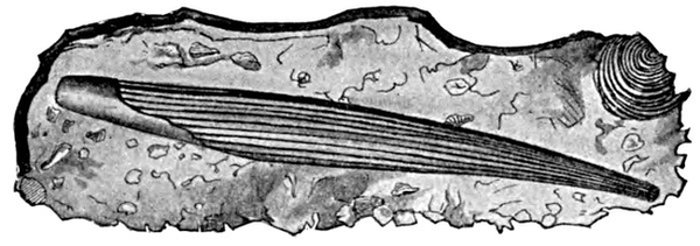
Fig. 298.—Fin-spine of Onchus tenuistriatus Agassiz. (After Zittel.)
Hasse's Classification of Elasmobranchs.—In 1882, Professor Carl Hasse proposed to subdivide the sharks on the basis of the structure of the individual vertebræ. In the lowest group, a hypothetical order of Polyospondyli, possibly represented by the fossil spines called Onchus, an undivided notochord, perhaps swollen at regular intervals, is assumed to have represented the vertebral column. In the Diplospondyli (Hexanchidæ) the imperfectly segmented vertebræ are joined in pairs, each pair having two neural arches. In the Asterospondyli or ordinary sharks each vertebra has its calcareous lamella radiating star-like from the central axis. In the Cyclospondyli (Squalidæ, etc.) the calcareous part forms a single ring about the axis, and in the Tectospondyli (Squatina, rays, etc.) it forms several rings. These groups again are natural and correspond fairly with those based on other characters. At the same time there is no far-reaching difference between Cyclospondyli and Tectospondyli, and the last-named section includes both sharks and rays.
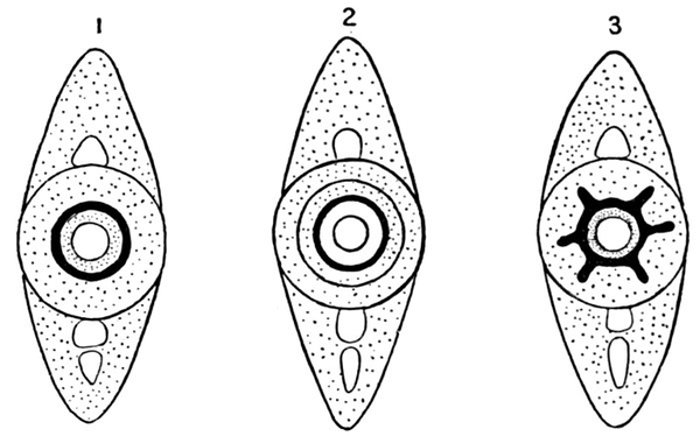
Fig. 299.—Section of vertebræ of sharks, showing calcification. (After Hasse.) 1. Cyclospondyli (Squalus); 2. Tectospondyli (Squatina); 3. Asterospondyli (Carcharias).
Nothing is known of the Polyospondyli, and they may never have existed at all. The Diplospondyli do not differ very widely from the earlier Asterospondyli (Cestraciontes) which, as a matter of fact, have preceded the Diplospondyli in point of time, if we can trust our present knowledge of the geological record.
Other Classifications of Elasmobranchs.—Characters more fundamental may be drawn from the structure of the pectoral fin. In this regard four distinct types appear. In Acanthoessus this fin consists of a stout, stiff spine, with a rayless membrane attached behind it. In Cladoselache the fin is low, with a very long base, like a fold of skin (ptychopterygium), and composed of feeble rays. In Pleuracanthus it is a jointed axis of many segments, with a fringe of slender fin-rays, corresponding in structure to all appearance to the pectoral fin of Dipnoans and Crossopterygians, the type called by Gegenbaur archipterygium on the hypothesis that it represents the primitive vertebrate limb.
In most sharks the fin has a fan-shape, with three of the basal segments larger than the others. Of these the mesopterygium is the central one, with the propterygium before it and the metapterygium behind. In the living sharks of the family of Heterodontidæ, this form of fin occurs and the teeth of the same general type constitute the earliest remains distinctly referable to sharks in the Devonian rocks.
Primitive Sharks.—Admitting that these four types of pectoral fin should constitute separate orders, we have next to consider which form is the most primitive and what is the line of descent. In this matter we have, in the phrase of Hæckel, only the "three ancestral documents, Palæontology, Morphology, and Ontogeny."
Unfortunately the evidence of these documents is incomplete and conflicting. So far as Palæontology is concerned, the fin of Cladoselache, with that of Acanthoessus, which may be derived from it, appears earliest, but the modern type of pectoral fin with the three basal segments is assumed to have accompanied the teeth of Psammodonts and Cochliodonts, while the fin of the Chimæra must have been developed in the Devonian. The jointed fin of Cladodus and Pleuracanthus may be a modification or degradation of the ordinary type of shark-fin.
Assuming, however, that the geological record is not perfect and that the fin of Cladoselache is not clearly shown to be primitive, we have next to consider the evidence drawn from morphology.
Those who with Balfour and others (see page 69) accept the theory that the paired fins are derived from a vertebral fold, will regard with Dean the fin of Cladoselache as coming nearest the theoretical primitive condition.
The pectoral fin in Acanthoessus Dean regards as a specialized derivative from a fin like that of Cladoselache, the fin-rays being gathered together at the front and joined together to form the thick spine characteristic of Acanthoessus. This view of the morphology of the fin of Acanthoessus is not accepted by Woodward, and several different suggestions have been recorded.
If with Gegenbaur we regard the paired fins as derived from the septa between the gill-slits, or with Kerr regard them as modified external gills, the whole theoretical relation of the parts is changed. The archipterygium of Pleuracanthus would be the nearest approach to the primitive pectoral limb, and from this group and its allies all the other sharks are descended. This central jointed axis of Pleuracanthus is regarded by Traquair as the equivalent of the metapterygium in ordinary sharks. (See Figs. 44, 45, 46.)
According to Traquair: "The median stern [of the archipterygium], simplified, shortened up and losing all its radials on the postaxial side, except in sometimes a few near the tip, becomes the metapterygium, while the mesopterygium and propterygium are formed by the fusion into two pieces of the basal joints of a number of preaxial radials, which have reached and become attached to the shoulder-girdle in front of the metapterygium."
According to Dr. Traquair, the pectoral fin in Cladodus neilsoni, a shark from the Coal Measures of Scotland, is "apparently a veritable uniserial archipterygium midway between the truly biserial one of Pleuracanthus and the pectoral fin of ordinary sharks." Other authors look on these matters differently, and Dr. Traquair admits that an opposite view is almost equally probable. Cope and Dean would derive the tribasal pectoral of ordinary sharks directly from the ptychopterygium or fan-like fold of Cladoselache, while Fritsch and Woodward would look upon it as derived in turn from the Ceratodus-like fin of Pleuracanthus, itself derived from the ptychopterygium or remains of a lateral fin-fold.
If the Dipnoans are descended from the Crossopterygians, as Dollo has tried to show, the archipterygium of Pleuracanthus has had a different origin from the similar-appearing limb of the Dipnoans, Dipterus and Ceratodus.
In such case the archipterygium would not be the primitive pectoral limb, but a structure which may have been independently evolved in two different groups.
In the view of Gegenbaur, the Crossopterygians and Dipnoans with all the higher vertebrates and the bony fishes would arise from the same primitive stock, ancestors, or allies of the Ichthyotomi, which group would also furnish the ancestors of the Chimæras. In support of this view, the primitive protocercal or diphycercal tail of Pleuracanthus may be brought in evidence as against the apparently more specialized heterocercal tail of Cladoselache. But this is not conclusive, as the diphycercal tail may arise separately in different groups through degeneration, as Dollo and Boulenger have shown.
The matter is one mainly of morphological interpretation, and no final answer can be given. On page 68 a summary of the various arguments may be found. Little light is given by embryology. The evidence of Palæontology, so far as it goes, certainly favors the view of Balfour. Omitting detached fin-spines and fragments of uncertain character, the earliest identifiable remains of sharks belong to the lower Devonian. These are allies of Acanthoessus. Cladoselache comes next in the Upper Devonian. Pleuracanthus appears with the teeth and spines supposed to belong to Cestraciont sharks, in the Carboniferous Age. The primitive-looking Notidani do not appear before the Triassic. For this reason the decision as to which is the most primitive type of shark must therefore rest unsettled for the present and perhaps for a long time to come.
The weight of authority at present seems to favor the view of Balfour, Wiedersheim, Boulenger, and Dean, that the pectoral limb has arisen from a lateral fold of skin. But weight of authority is not sufficient when evidence is confessedly lacking.
For our purpose, without taking sides in this controversy, we may follow Dean in allowing Cladoselache to stand as the most primitive of known sharks, thus arranging the Elasmobranchs and rays, recent and fossil, in six orders of unequal value—Pleuropterygii, Acanthodei, Ichthyotomi, Notidani, Asterospondyli, and Tectospondyli. Of these orders the first and second are closely related, as are also the fourth and fifth, the sixth being not far remote. The true sharks form the culmination of one series, the rays of another, while from the Ichthyotomi the Crossopterygians and their descendants may be descended. But this again is very hypothetical, or perhaps impossible; while, on the other hand, the relation of the Chimæras to the sharks is still far from clearly understood.
Order Pleuropterygii.—The order of Pleuropterygii of Dean (πλεύρον, side; πτερύξ, fin), called by Parker and Haswell Cladoselachea, consists of sharks in which the pectoral and ventral fins have each a very wide horizontal base (ptychopterygium), without jointed axis and without spine. There are no spines in any of the fins. The dorsal fin is low, and there were probably two of them. The notochord is persistent, without intercalary cartilage, such as appear in the higher sharks. The caudal fin is short, broad, and strongly heterocercal. Apparently the ventral fin is without claspers. The gill-openings were probably covered by a dermal fold. The teeth are weak, being modified denticles from the asperities of the skin. The lateral line is represented by an open groove. The family of Cladoselachidæ consists of a single genus Cladoselache from the Cleveland shale or Middle Devonian of Ohio. Cladoselache fyleri is the best-known species, reaching a length of about two feet. Dean regards this as the most primitive of the sharks, and the position of the pectorals and ventrals certainly lend weight to Balfour's theory that they were originally derived from a lateral fold of skin. I am recently informed by Dr. Dean that he has considerable evidence that in Cladoselache the anus was subterminal. If this statement is verified, it would go far to establish the primitive character of Cladoselache.
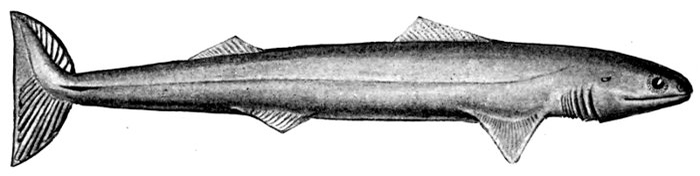
Fig. 300.—Cladoselache fyleri (Newberry), restored. Upper Devonian of Ohio. (After Dean.)
Order Acanthodei.—Near the Pleuropterygii, although much more highly developed, we may note the strange group of Acanthodei (ἀκανθώδης, spinous). These armed fishes were once placed among the Crossopterygians, but there seems no doubt that Woodward is right in regarding them as a highly specialized aberrant offshoot of the primitive sharks. In this group the paired fins consist each of a single stout spine, nearly or quite destitute of other rays. A similar spine is placed in front of the dorsal fin and one in front of the anal. According to Dean these spines are each produced by the growing together of all the fin-rays normally belonging to the fin, a view of their morphology not universally accepted.
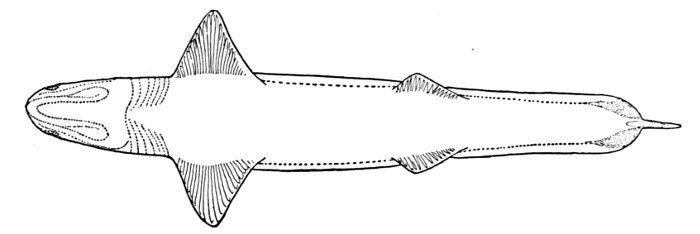
Fig. 301.—Cladoselache fyleri (Newberry), restored. Ventral view. (After Dean.)
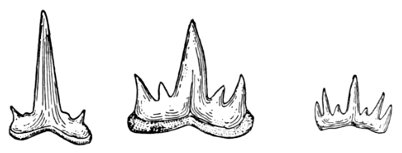
Fig. 302.—Teeth of Cladoselache fyleri (Newberry). (After Dean.)
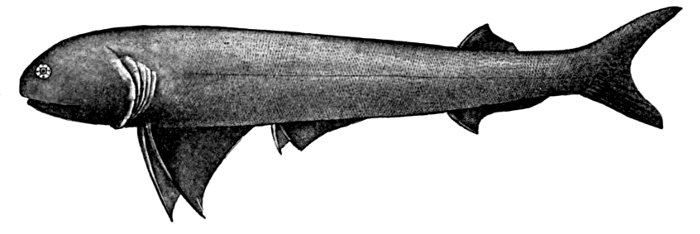
Fig. 303.—Acanthoessus wardi (Egerton). Carboniferous. Family Acanthoessidæ. (After Woodward.)
The dermal covering is highly specialized, the shagreen denticles being much enlarged and thickened, often set in little squares suggesting a checker-board. The skull is covered with small bony plates and membrane bones form a sort of ring about the eye. The teeth are few, large, and "degenerate in their fibrous structure." Some of the species have certainly no teeth at all. The tail is always heterocercal, or bent upward at tip as in the Cladoselache, not diphycercal, tapering and horizontal as in the Ichthyotomi.
The lower Acanthodeans, according to Woodward, "are the only vertebrates in which there are any structures in the adult apart from the two pairs of fins which may be plausibly interpreted as remnants of once continuous lateral folds. In Climatius, one of the most primitive genera (see Fig. 305), there exists, according to Woodward, and as first noticed by Cope, between the pectoral and pelvic (or ventral) fins a close and regular series of paired spines, in every respect identical with those supporting the appendages that presumably correspond to the two pairs of fins in the higher genera. They may even have supported fin membranes, though specimens sufficiently well preserved to determine this point have not yet been discovered. However, it is evident that dermal calcifications attained a greater development in the Acanthodei than in any of the more typical Elasmobranchs, and we may look for much additional information on the subject when the great fishes to which the undetermined Ichthyodorulites pertained became known." (See Fig. 305.)
The Acanthodei constitute three families. In the Acanthoessidæ there is but one short dorsal fin opposite the anal, and clavicular bones are absent. The gill-openings being provided with "frills" or collar-like margins, perhaps resembled those of the living genus Chlamydoselachus, the frilled shark. The pectoral spine is very strong, and about the eye is a ring of four plates. The body is elongate, tapering, and compressed. Acanthoessus of Agassiz, the name later changed by its author to Acanthodes, is the principal genus, found in the Devonian and Carboniferous.
The species of Acanthoessus are all small fishes rarely more than a foot long, with very small teeth or none, and with the skin well armed with a coat-of-mail. Acanthoessus bronni is the one longest known. In the earliest species known, from the Devonian, the ventral fins are almost as large as the pectorals and nearly midway between pectorals and anal. In the later species the pectoral fins become gradually larger and the ventrals move forward. In the Permian species the pectorals are enormous.
Traquairia pygmæa, from the Permian of Bohemia, is a diminutive sharklet three or four inches long with large scales, slender spines, and apparently no ventral fins.
In the genus Cheiracanthus the dorsal fin is placed before the anal. In Acanthodopsis the teeth are few, large, and triangular, and the fin-spines relatively large.
The Ischnacanthidæ have no clavicles, and two dorsal fins. Ischnacanthus gracilis of the Devonian has a few large conical teeth with small cusps between them.
The Diplacanthidæ, with two dorsal fins, possess bones interpreted as clavicles. The teeth are minute or absent. In Diplacanthus striatus and Diplacanthus longispinus of the Lower Devonian stout spines are attached to the shoulder-girdle between the pectoral spines below.
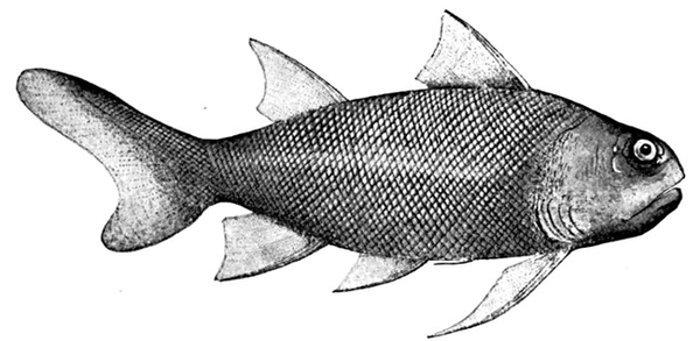
Fig. 304.—Diplacanthus crassissimus Duff. Devonian. Family Diplacanthidæ. (After Nicholson). (Restoration of jaws and gill-openings; after Traquair.)
In the very small sharks called Climatius the fin-spines are very strong, and a series of several free spines occurs, as above stated, on each side between the pectoral and ventral fins, a supposed trace of a former lateral fold. In Paraxus the first dorsal spine is enormously enlarged in size, the other spines remaining much as in Climatius.
Dean on Acanthodei.—In his latest treatise on these fishes, "The Devonian Lamprey," Dr. Dean unites the Pleuropterygii and Acanthodei in a single order under the former name, regarding Acanthoessus as an ally and perhaps descendant of the primitive Cladoselache. Dr. Dean observes:
"In the foregoing classification it will be noted that the Acanthodia are regarded as included under the first order of sharks, Pleuropterygii. To this arrangement Smith Woodward has already objected that the spines of Acanthodians cannot be regarded as the homologues of the radial elements of the Cladoselachian fin (which by a process of concrescence have become fused in its interior margin), since he believes the structure to be entirely dermal in origin. His criticism, however, does not seem to me to be well grounded, for, although all will admit that Acanthodian spines have become incrusted, and deeply incrusted, with a purely dermal calcification, it does not follow that the interior of the spine has not had primitively a non-dermal core. That the concrescence of the radial supporting elements of the fin took place pari passu with the development of a strengthening dermal support of the fin margin was the view expressly formulated in my previous paper on this subject. It is of interest in this connection to recall that the earliest types of Acanthodian spines were the widest, and those which, in spite of their incasing dermal calcification, suggest most clearly the parallel elements representing the component radial supports. There should also be recalled the many features in which the Acanthodians have been shown to resemble Cladoselache."
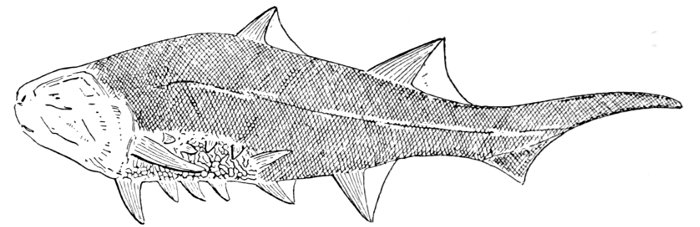
Fig. 305.—Climatius scutiger Egerton, restored. Family Diplacanthidæ. (After Powrie, per Zittel.)
From these primitive extinct types of shark we may proceed to those forms which have representatives among living fishes. From Cladoselache a fairly direct series extends through the Notidani and Cestraciontes, culminating in the Lamnoid and Galeoid sharks.
Still another series, destitute of anal fin, probably arising near the Acanthodei, reaches its highest development in the side branch of the Batoidei or rays. The Holocephali and Dipneusti must also find their origin in some of these primitive types, certainly not in any form of more highly specialized sharks.
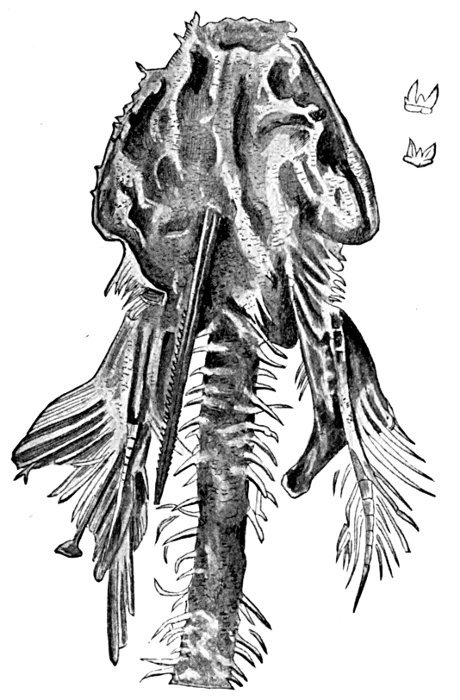
Fig. 306.—Pleuracanthus decheni Goldfuss. Family Pleuracanthidæ. (After Roemer, per Zittel.)
Woodward prefers to place the Tectospondyli next to the Ichthyotomi, leaving the specialized sharks to be treated later. There is, however, no linear system which can interpret natural affinities, and we follow custom in placing the dogfishes and rays at the end of the shark series.
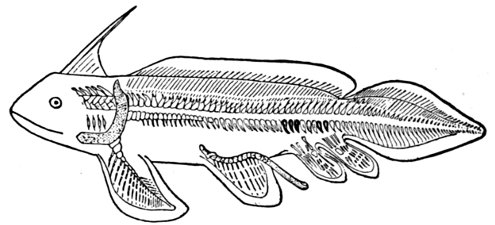
Fig. 307.—Pleuracanthus decheni, restored. (After Brongniart.) The anterior anal very hypothetical.
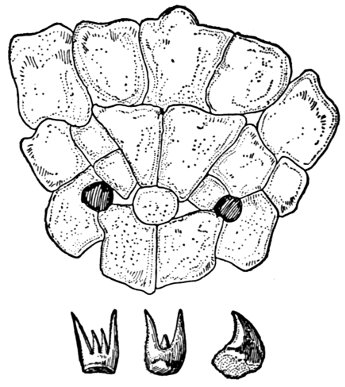
Fig. 308.—Head-bones and teeth of Pleuracanthus decheni Goldfuss. (After Davis, per Dean.)
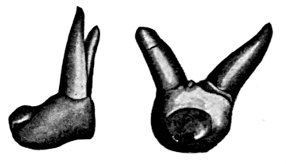
Fig. 309.—Teeth of Didymodus bohemicus Quenstadt. Carboniferous. Family Pleuracanthidæ. (After Zittel)
Order Ichthyotomi.—In the order Ichthyotomi (ἰχθύς, fish; τομός, cutting; named by Cope from the supposed segmentation of the cranium; called by Parker and Haswell Pleuracanthea) the very large pectoral fins are developed each as an archipterygium. Each fin consists of a long segmented axis fringed on one or both sides with fin-rays. The notochord is very simple, scarcely or never constricted, the calcifications of its sheath "arrested at the most primitive or rhachitomous stage, except in the tail." This is the best defined of the orders of sharks, and should perhaps rank rather as a subclass, as the Holocephali. Two families of Ichthyotomi are recognized by Woodward, the Pleuracanthidæ and the Cladodontidæ. In the Pleuracanthidæ the dorsal fin is long and low, continuous from head to tail, and the pectoral rays are in two rows. There is a long barbed spine with two rows of serrations at the nape. The body is slender, not depressed, and probably covered with smooth skin. The teeth have two or more blunt cusps, sometimes with a smaller one between and a blunt button behind. The interneural cartilages are more numerous than the neural spines. The genera are imperfectly known, the skeleton of Pleuracanthus decheni only being well preserved. This is the type of the genus called Xenacanthus which, according to Woodward, is identical with Pleuracanthus, a genus otherwise known from spines only. The denticles on the spine are straight or hooked backward, in Pleuracanthus (lævissimus), the spine being flattened. In Orthacanthus (cylindricus), the spine is cylindrical in section. The species called Dittodus and Didymodus are known from the teeth only. These resemble the teeth of Chlamydoselachus. It is not known that Dittodus possesses the nuchal spine, although detached spines like those of Pleuracanthus lie about in remains called Didymodus in the Permian rocks of Texas. In Dicranodus texensis the palato-quadrate articulates with the postorbital process of the cranium, as in the Hexanchidæ, and the hyomandibular is slender.
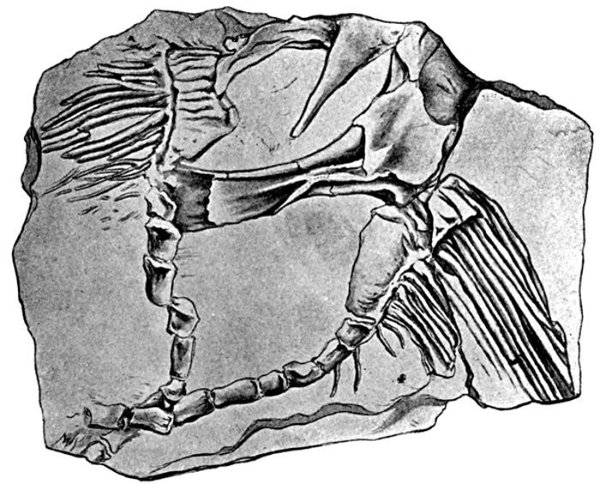
Fig. 310.—Shoulder-girdle and pectoral fins of Cladodus neilsoni Traquair.
A genus, Chondrenchelys, from the sub-Carboniferous of Scotland, is supposed to belong to the Pleuracanthidæ, from the resemblance of the skeleton. It has no nuchal spine, and no trace of paired fins is preserved.
The Cladodontidæ differ in having the "pectoral fin developed in the form of a uniserial archipterygium intermediate between the truly biserial one of Pleuracanthus and the pectoral fin of modern sharks." The numerous species are known mainly from detached teeth, especially abundant in America, the earliest being in the Lower Carboniferous. One species, Cladodus nelsoni (Fig. 310), described by Traquair, from the sub-Carboniferous of Scotland shows fairly the structure of the pectoral fin.
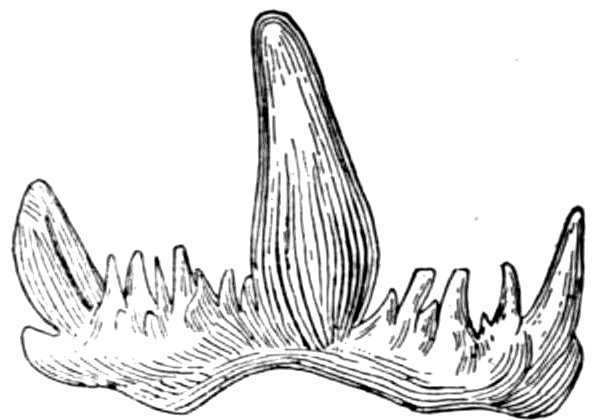
Fig. 311.—Teeth of Cladodus striatus Agassiz. (After Davis.) Carboniferous.
In Cladodus mirabilis the teeth are very robust, the crown consisting of a median principal cone and two or three large lateral cones on each side. The cones are fairly striate. In Lambdodus from Illinois there are no lateral cones. Other genera are Dicentrodus, Phœbodus, Carcharopsis, and Hybocladodus.