BRACHIOPODA.
Reading edition
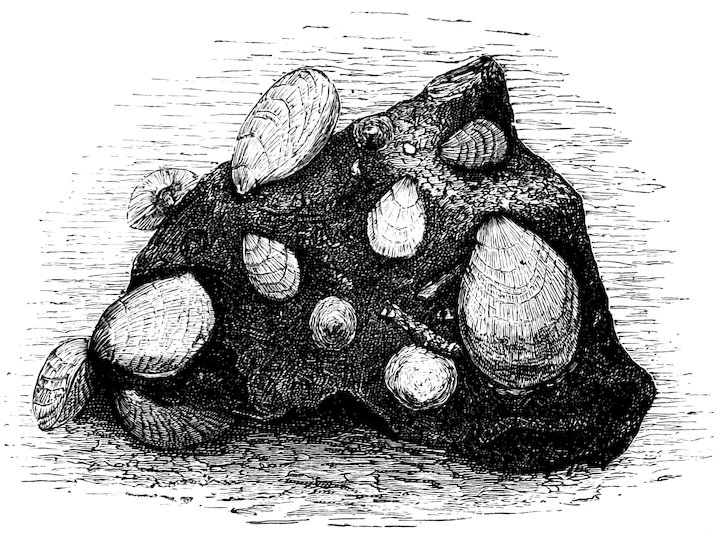
Fig. 1. British Brachiopods (Terebratula and Crania).
Small Table Case A against the west wall to left of main entrance.
The Brachiopoda, though presenting a certain outward resemblance to bivalved Mollusca, are quite distinct from this group. They are all marine, and all possess a bivalve shell. They grow attached to rocks (Fig. 1), usually by a horny peduncle or stalk passing between the two valves, or through a foramen in one of the latter; or, peduncle and foramen may be absent, one of the valves adhering by its surface to the rocks; some species of Lingula live in tubes in the sand or mud. They occur at all depths, from shallow water up to 2900 fathoms, but the largest number of species live at a depth of about 350 fathoms. Though found in all seas, the localities whence they have been obtained are comparatively few in number; but specimens are usually congregated in considerable numbers, in places where they do occur. The surviving species of Brachiopods constitute 75only a small remnant of a group that flourished abundantly in former epochs. There are about 150 recent, and over 6000 fossil species.
The Shell.—The valves of a Brachiopod shell differ from each other in size and shape, but each valve is in itself symmetrical, i.e., similar on each side of a middle line.
The valve through which the peduncle passes is termed the peduncle or ventral valve (Fig. 2, A), the other being the brachial or dorsal valve. The peduncle valve, which is usually the larger and uppermost, contains the bulk of the viscera; in the higher genera, calcareous bars or loops (Fig. 2, B) attached to the inner surface of the brachial valve form a support for the “arms” of the animal. The inner surface of the valves presents certain markings and depressions where the muscles have been attached (Fig. 6).
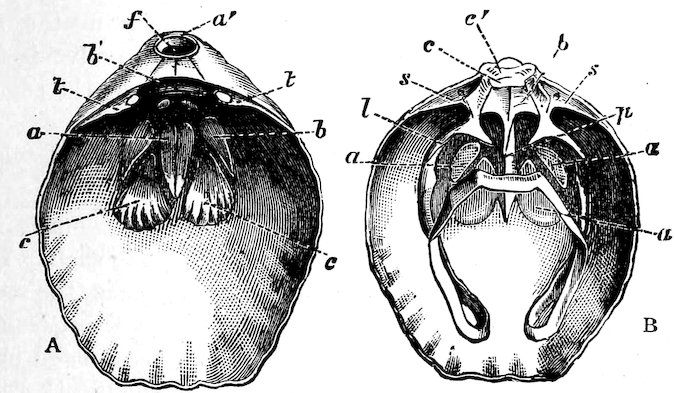
Fig. 2. Magellania flavescens. Australia. Interior of valves. A. Peduncle valve: f, foramen for peduncle, below which are the two small deltidial plates; t, hinge-teeth; a, b, c, muscle scars. B. Brachial valve, showing the reflected loop for support of the “arms.”
The shell is constructed of very minute prisms of calcareous substance imbedded in an organic matrix. In Lingula the shell is formed of alternating layers of horny and calcareous substance.
The shell-valves are either hingeless, or joined by a hinge in which teeth in the peduncle valve fit into sockets in the brachial valve. The Brachiopoda are primarily divided into two sections, Inarticulata and Articulata, based on the absence or presence of a hinge.
The division into Orders is based on the relation of the peduncle 76to the valves in its passage between them or through one of them. In the most primitive Brachiopoda (Lingulidæ), the peduncle simply passes out between the valves and not through a foramen or pore in one of them; hence the group is named Atremata (a, not, trema, pore). In the next group, including the families Discinidæ and Craniidæ, the peduncle passes through a fissure in the edge of the peduncle valve, the fissure in recent forms becoming closed round to form a slit-like foramen; this group is named Neotremata (neos, new, trema, pore). In the third group, Protremata (pro, in front of, trema, pore), which includes the Thecidiidæ, the peduncle lies at the apex of a triangular fissure in the peduncle valve, and secretes a calcareous plate to fill in the gap. In the fourth group, Telotremata (telos, final or complete, trema, pore), including the Terebratulidæ, etc., the triangular fissure in the peduncle valve is filled in by two calcareous plates termed deltidia, secreted by the edges of the mantle.
The valves are hingeless in the first two Orders (Inarticulata), and hinged in the last two (Articulata).
The Body.—The body usually occupies only a comparatively small space in the posterior or peduncle end of the shell. From each side of the body there is given off a thin expansion, the mantle which lines the inner surface of the shell. The space between the valves is termed the mantle-cavity. The mouth is situated in the centre of the front wall of the body or floor of the mantle-cavity. The front wall gives rise to a horseshoe-shaped platform surrounding the mouth and bearing on its upper edge ciliated tentacles, or cirri, which set up currents carrying food towards the mouth. In many genera the platform is produced into two coiled “arms” (Figs. 3 and 5), which fill up the mantle-cavity.
The name Brachiopoda (brachion, arm, pous, foot) was given to the group because these “arms” were supposed to be homologous with the Molluscan “foot.”
The mouth leads into a gullet, which opens into a stomach and intestine. In the more primitive forms the intestine terminates in a vent, but in the higher forms the distal end of the intestine has become atrophied, and consequently the gut ends blindly.
The body-cavity contains fluid, and is in communication with a system of sinuses in the lobes of the mantle (Fig. 5). Bands of muscles pass across from valve to valve. The peduncle consists of a horny outer sheath surrounding longitudinal and transverse bands of muscles.
77
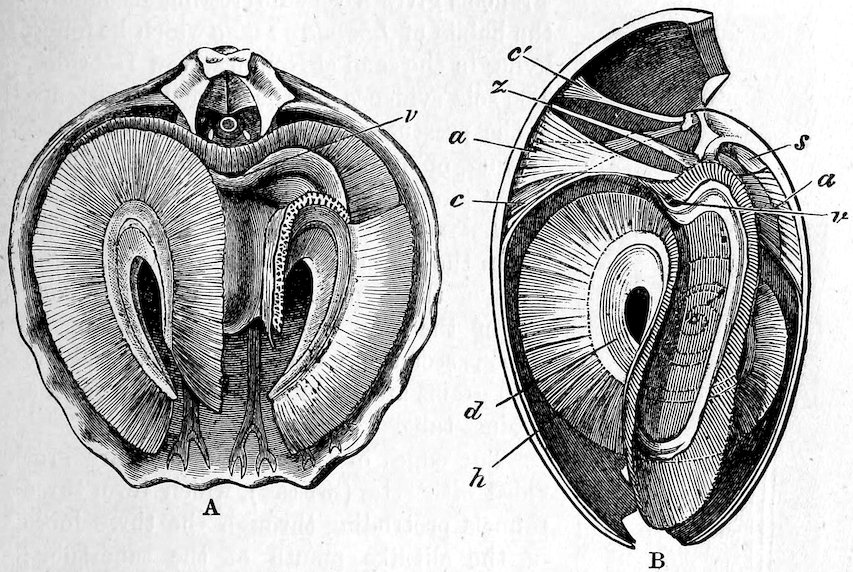
Fig. 3. Magellania flavescens. (After Davidson.) A. Interior of dorsal valve to show the “arms”; some of cirri removed on right side; v, mouth. B. Longitudinal section, with a portion of the animal.
The sexes are usually separate. The reproductive cells are formed in the body-cavity. The embryo swims freely for a short time before settling down and becoming fixed. The specimens exhibited in the case are arranged according to the following classification:—
Section I. Inarticulata. Order 1. Atremata. Fam. Lingulidæ.
Order 2. Neotremata. Fam. Discinidæ.
Fam. Craniidæ.
Section II. Articulata. Order 3. Protremata. Fam. Thecidiidæ.
Order 4. Telotremata. Fam. Rhynchonellidæ.
Fam. Terebratulidæ.
Fam. Terebratellidæ.
Section I.—Inarticulata.
Order 1.—Atremata. Family Lingulidæ.—The Lingulas possess emerald green or golden brown duck-bill-shaped shells. Having no 78hinge, the dead valves of dried shells easily fall apart. The peduncle, which is sometimes over six inches in length, passes between the pointed posterior borders of the valves. Dr. François gives a very interesting account of the habits of Lingula anatina which he found living in the sand at Noumea, New Hebrides. The sole evidence of the animal’s existence is the presence, on the surface of the sand or mud, of a small, three-lobed slit (Fig. 4, upper figure). The tube (Fig. 4) in which the Lingula lives is about four inches deep, flat in the upper half, rounded below. The walls of the upper flat portion simply consist of the sand with a surface coating of mucous secretion; but in the lower end the sand grains are agglutinated so as to form a distinct tube.
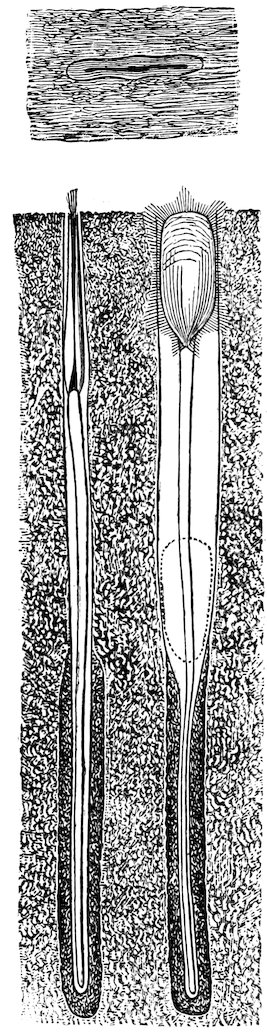
Fig. 4. Lingula anatina in tubes in the sand; upper figure shows trilobed opening on surface of sand. Dotted line in lower figure indicates position in retraction. (After François.)
The edges of the mantle-folds are provided with setæ (bristles), which form three funnels protruding through the three lobes of the slit-like mouth of the sand-tube; currents enter by the lateral funnels and leave by the central.
On the least alarm the animal is rapidly withdrawn as far as the centre of the tube (see the dotted line of the shell in the figure), the surface slit and upper part of the tube being obliterated. Each of the arms forms a spiral with several coils (Fig. 5). The Lingulidæ are of exceptional interest, in that they furnish a very remarkable example of “persistence of type.”
Shells of Lingula occur in the earliest Palæozoic strata, and so closely resemble those of the present day, that often no difference can be observed either in the shape of the valves or in the muscular impressions on their inner surface (Fig. 6).
Lingula occurs in the Indo-Pacific, Australia, China, Japan, and the Pacific Islands. Glottidia, a smaller form, with two small curved plates on the brachial and a ridge on the peduncle valve, is found on the American coast of the Pacific, and in the Atlantic.
79
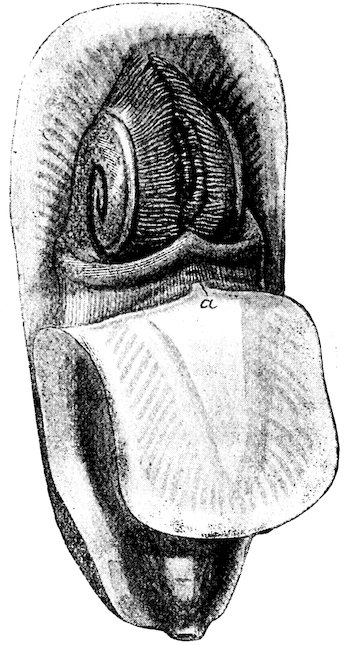
Fig. 5. Lingula anatina, removed from shell, mantle reflected, coiled arms separated slightly; a, mouth. (Marginal setæ omitted.) Ventral aspect, three-quarter face.
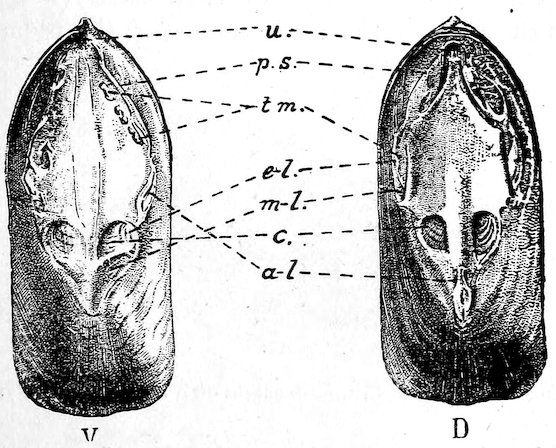
Fig. 16. Lingula anatina. Interior of valves showing muscle scars. V. Peduncle valve, D. Brachial valve.
80Order 2.—Neotremata. The Discinidæ includes two genera, Discina and Discinisca (Fig. 7), with orbicular conical shells, of horny calcareous composition; both valves are conical in the former genus, but in the latter the peduncle valve is flattened. Sometimes the embryos settle down on the parent shells, and we see a mass of shells in various stages of growth, as in the specimen of Discinisca lamellosa from Peru.
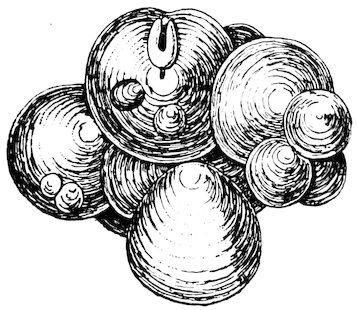
Fig. 7. Discinisca lamellosa. Peru. (After G. Sowerby.) A group of old and young specimens; largest showing foramen in peduncle valve, the rest showing brachial valves.
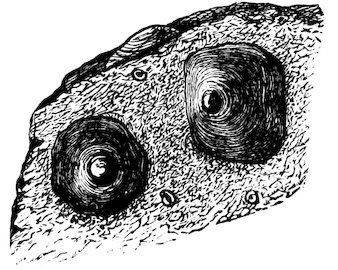
Fig. 8. Three specimens of Crania anomala on a stone. Loch Fyne.
The Craniidæ form small limpet-like shells (Fig. 8) closely adherent to the rocks by the whole surface of the peduncle valve; although this valve is so named, no peduncle or foramen is found in this family. The Neotremata, like the Lingulidæ, are remarkable 81examples of persistence of type, since forms very similar to the present day Discinas and Cranias occur in the Palæozoic, Ordovician and Silurian strata.
A piece of rock, with several specimens of Crania anomala attached, is exhibited.
Section II.—Articulata.
Order 3. Protremata.—This group, formerly very abundant, is now almost extinct, the Family Thecidiidæ representing the Order at the present day. Thecidium mediterraneum (Fig. 9) forms little oval boxes about a third of an inch in length, shaped somewhat like a pear cut in half (peduncle valve), and with a semicircular lid (brachial valve) working on a hinge on the upper flat surface. The foramen and peduncle are absent; but between the pointed end of the peduncle valve and the hinge is an area filled in by a calcareous plate characteristic of the Protremata.
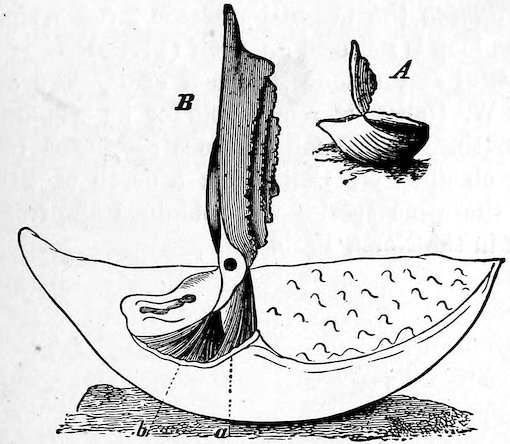
Fig. 9. Thecidium mediterraneum. A, natural size. B, section through shell. Magnified.
The brachial valve opens like the lid of a snuff-box, and shuts down on the least alarm with the rapidity of lightning. The peduncle valve is fixed on the rocks by its convex surface. The species is common in the Mediterranean in from 30 to 300 fathoms, and is also found in the West Indies.
82Order 4. Telotremata.—This group, which at the present day contains the largest number of species, includes the Lamp shells, so called from their resemblance to an ancient lamp. The valves are joined by a well-marked hinge, the peduncle passes through the peduncle valve through a foramen completed by two plates secreted by the mantle edges, and the brachial valve has attached to it a calcareous scaffolding of processes or loops for the support of the “arms.”
The shells in this group are frequently ridged. Their colour is usually white, but sometimes red or yellow; deep-sea forms are generally vitreous.
Rhynchonella psittacea has a black shell with a pointed incurved beak; each of the arms forms a many coiled spiral and can be protruded beyond the shell; the brachial skeleton is comparatively small and simple, consisting of two separate processes.
In Terebratulina the brachial skeleton forms a simple loop; in Magellania the loop is reflected on itself (Fig. 2).
The beautiful and unique specimen of Dyscolia wyvillii, from 390 fathoms W. Indies, is remarkable for its size, being over two inches in length. The small vitreous specimens of Terebratula wyvillii were obtained off Chili from a depth of 2160 fathoms; specimens of the same species were obtained also from a depth of 2900 fathoms in the North Pacific.
83