"A Gallant Grenadier" (continued 5)
Reading edition
“There,” replied Captain Nolan, with something akin to a sneer, and in tones which angered Lord Lucan. “There, my lord, is your enemy, and there your guns.” And he pointed away up the valley to the Russian batteries occupying a commanding position nearly two miles away.
It was a monstrous error, for how could horsemen hope to live and be effective after such a ride, when cannon fired directly into their front, while the heights on either side, converging to the apex occupied by the battery, were lined by more guns and by infantry in huge numbers. On whose shoulders rests the onus of the terrible error it is almost impossible to state. Had less ambiguous orders been issued it would never have occurred, and a deed of daring, unparalleled in war, would never have been recorded in the annals of heroic struggles to which England is ever adding.
Lord Lucan transmitted the order to Lord Cardigan in person. The latter saluted, and pointed out the desperate nature of the undertaking, but being told that there was no choice but to obey, turned and gave the command, “The brigade will advance!”
“By George! They are off,” cried Phil, who had been watching the Light Brigade intently. “Get ready, Tony. You were right; our chance has come at last.”
Both tightened their girths and prepared to dash out, for the direction the cavalry were taking would bring them close at hand.
“It’s a charge right enough,” cried Tony excitedly, “and I’m going to be one of ’em! Come out!” and with a whirr he dragged his sabre out of the sheath.
“Good heavens! look at what is happening!” cried Phil aghast. For the Light Brigade had suddenly swerved away from the Causeway heights. “I thought they were to attack the Turkish redoubts, but they are heading right up to the centre of the Russian army. It is madness! sheer suicide!”
At this moment they saw a horseman, the unhappy Nolan, gallop transversely across the now fast-galloping Light Brigade. He had discovered the terrible mistake, and attempted to set it right, but a shell from the battery in front burst with a roar in front of him, and killed him instantly.
“Now for it, Tony,” shouted Phil, kicking the ribs of his pony. “We’ll join our friends at all costs, and see more fighting before we die.”
“Hurrah! I’m with yer, young ’un! Who-hoop! at ’em for all we’re worth!”
Fortunately both ponies were fast and sturdy animals, and, still move fortunately, Phil and Tony had had good practice on horseback when with the menagerie. They thrashed the animals with the flat of their sabres, and, dashing down the hill, fell in beside the 4th light Dragoons, who, with the 11th and 8th Hussars, formed the second attacking line, the first being composed of the 17th Lancers and the 13th Light Dragoons.
Faster grew the pace, and still faster. Men sat close down on their saddles, and jerking their sword lanyards higher up their wrists, clutched the hilts, and stared straight before them with a look of enthusiasm in their eyes. The blood of the British cavalry was up, for as yet they rode silently, a warning sign to those whom they might come against, for your Englishman does not shriek aloud. He says things beneath his breath till the moment comes, and then what a shout he gives!
And as they charged, from either side and from the front, flame and smoke belched out, and the valley echoed with the sound of exploding cannon. Shells shrieked overhead, rolled like huge cricket-balls along the turf, and burst in the midst of the gallant horsemen, sweeping scores to the ground. And yet they did not flinch. Instead they dug their spurs still deeper, till they were actually racing for the Russian enemy.
What a sight! A green-clad valley, cloaked in eddying smoke, which was rent asunder every second by a blinding flash; and through it, all that remained of that galloping 600 now clearly visible, and a moment later plunging deep into the reek and smoke of the cannon.
Suddenly the guns in front ceased to fire. The first line, or rather what was left of it, rode over them and dashed pell-mell into the cavalry behind, breaking them and scattering them like chaff. And now came the moment for the second line, and for Phil and his friend. It was indeed a race, men and officers doing their utmost to outdistance the others. Long ago Phil had lost sight of his companion in the smoke, but now a riderless horse, frenzied by fear, came up and thundered along on either side of him. Suddenly a ringing “Tally-ho!” came from some officer in front, and with a roar of furious excitement the line rode over the smoking guns and dashed full into a huge mass of Russian cavalry.
Phil found himself still with the riderless horses alongside, amidst the men of the 11th Hussars. Standing in his stirrups, he leant over and cut savagely at the grey-coats which seemed to rise up on either side of him, while a loud hissing sound, produced by the excited Russians, filled the air around. There was a rush and a crash, and the horse on his right was swept away. He scarcely noticed it, but, seeing a comrade at that moment fall in front of him, he pulled his pony in with a jerk, and made such good play with his weapon that for a moment he kept the long Cossack lances from the fallen man.
Whack! A tremendous blow on his shoulder sent him flying from his saddle to the ground, where, looking up, he was just in time to see Tony standing in his stirrups with sabre raised on high. Down it came on the head of the man who had just struck him from his pony, and with a groan the Russian flopped upon his horse’s neck.
“Up! Up yer get!” shouted Tony, laying about him with a will. “Full yourself together, old man.”
Phil sprang to his feet, and, holding his sabre in his mouth, lifted the prostrate form of the trooper.
“Hold on here, Tony,” he cried. “That’s it. Now wait a minute. Those horsemen have cleared away.”
Rent asunder by the terrible British horse, the Russians had in fact opened out and retired, disclosing the bulk of their army forming into square close at hand. Phil took advantage of the lull.
A riderless horse stood close at hand, and in a few seconds he was in the saddle. Then he sheathed his sabre, and, riding up to Tony, said:
“Now, hand him up here. He’s stunned by the fall.”
“And what about getting back, mate?” asked Tony, still holding the man. “It’ll spoil yer chance. They are certain to come after us.”
“I’ll run the risk of that. Now, up with him, Tony,” answered Phil abruptly.
“Look here, old pal, this is my job,” said Tony stubbornly. “I owe yer a score, and I’ll take this fellow for yer.”
It was a generous impulse which prompted the gallant fellow, for to hamper one’s retreat with the body of a comrade was practically certain to lead to a fatal result. But Phil ended the matter promptly. His eyes gleamed savagely, and though, when all was over, he thanked Tony with tears in his eyes, yet now that his wishes were opposed, and he had set his heart on the matter, his temper got the better of him.
“Hand him over,” he hissed angrily. “Come, there is no time to waste; the men are falling-in again.”
Tony looked as though he could have wept, but he helped to pull the trooper up, and, having seen him into Phil’s arms, fell in behind, determined to bring his friend through or perish in the attempt.
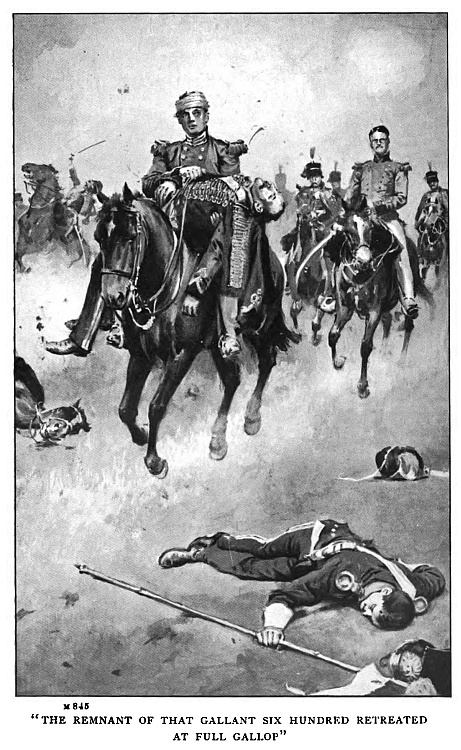
“Rally, men! rally!” the officers were shouting, and at the sound the troopers came hurrying up. There was a short pause to allow stragglers to regain the ranks, and then, setting their heads down the valley, the remnant of that gallant 600 retreated at full gallop.
Bang! bang! The guns were blazing at them again; from behind and on either side grape and shell came shrieking at them. Then suddenly came the gleam of lances in front, and there stood a body of cavalry prepared to hedge them in and make them prisoners. As well set a mouse to catch a lion! These were the men who had ridden into the very “jaws of death”, into “the gates of hell”; and was one single regiment of cavalry to bar their retreat when they had fearlessly attacked an immense army? Ridiculous! And bracing themselves once more, the British horsemen swept them on either side as if with a broom, and torn, shattered, bleeding, and exhausted, returned, still exulting, to their friends.
Heroes indeed! Well has it been said of them, “Honour the Light Brigade, noble six hundred!”
Chapter Sixteen.
Honour for the Brave.
Balaclava was saved, and the historical battle, which had, seen two memorable cavalry charges, ended with the return of the Light Brigade. But the redoubts on the Causeway heights still remained in the enemy’s hands, and Liprandi at once set about strengthening them, while battalions of grey-coated infantry bivouacked, there, ready for instant attack or defence. The Allies therefore found themselves confronted by a series of defences of formidable character, and barring their inlet to Sebastopol, while within the town was an army greater in number than their own, and from whom a sortie in force might be expected at any moment, thus pinching them between two bodies of troops, both within easy striking distance. And of no less importance to the invaders was the fact that winter was at hand, to be spent by them—and particularly by the British, who were to suffer all the torments of starvation and exposure, and amongst whom disease was destined to find many victims—in one long struggle with privation and misery.
But to return to Phil and his friend. Almost falling from their saddles with fatigue, they rode slowly towards the Chersonese heights when once they were out of range of the Russian guns. By a miracle neither had been hurt during the retreat, but already Phil felt the effects of the blow across his shoulder. His arm was stiff and almost powerless, while the sabre with which he had been struck had cut through his clothing and inflicted a nasty slash which had bled freely. However the blood had long since congealed, and a plentiful supply of strapping later on in the day did all that was necessary.
At the mouth of the valley an officer dressed in the same uniform, as the man Phil carried in his arms and accompanied by two troopers rode up to him.
“You can hand over our comrade to these men,” he said. “Now, corporal, what is your name and corps. By your tunics you should be Guardsmen; but how on earth you came to be with us in that glorious charge is more than I can understand.”
“We were taken prisoners at the Alma, sir,” Phil answered, “and were escaping and hoping to ride into the British lines upon two ponies which we captured, when the battle commenced. We both belong to the Grenadier Guards.”
The officer stared at Phil.
“Corporal Western by any chance?” he asked, with a lift of his eyebrows.
“Yes, sir,” that is my name, “and this is the friend who was captured with me.”
To the absolute astonishment of the two young soldiers the officer shook each in turn eagerly by the hand.
“Ah, my lads!” he said gaily, “we have heard of you already, and your friends, I guarantee, will give you a lively welcome. Let me tell you that the affair of the flag has gone through the allied camp. Lieutenant McNeil wrote a letter with all the particulars, and had it passed through to as by the courtesy of the Russian general I expect that there will be something waiting for you, and you thoroughly deserve it. As for this other matter, I shall take it in hand. You are a gallant fellow, Corporal Western, and saved that man’s liberty if not his life. Now I must be off, but some day I shall hope to hear all about the escape.”
“Can you tell us where the Guards are?” asked Phil, after having thanked the officer.
“Over there, Corporal;” and he pointed to a force of men returning along the Chersonese heights. “The First Division marched out early in the morning, and by cutting across here you will reach camp almost as soon as they do.”
The officer rode off, and Phil and his friend turned their tired animals to the heights and rode for the Guards’ camp in silence, their thoughts too much occupied by what they had heard to allow of speech. Sundry deep chuckles, however, told that Tony at least was immensely pleased at something that had occurred.
Half an hour later, looking more like beggars than Guardsmen, they rode into the camp.
“Let’s ride straight up to our own mess and get something to eat,” suggested Tony. “I am fairly empty, and longing for some grub.”
But the sight of two tattered Guardsmen riding through their lines was too much for their comrades.
“Why, who are they?” they shouted, rushing forward to meet them. Then, recognising them, a man in Phil’s company cried at the top of his voice, “Hi, come along, mates! Blow’d if Corporal Western and his pal ain’t come back to us. Where do yer come from, Corporal? And what’s happened to yer both since yer was taken?”
Men rushed forward and plied them with questions, and then, becoming enthusiastic, they lifted the two young fellows from their saddles and carried them shoulder-high through the camp.
It was a hearty greeting, for the men were anxious to do full honour to their two comrades who had gained distinction at the Alma. Very soon the babel had roused the officers, and before Phil and his friends could well collect their scattered senses, they were standing stiffly in front of the colonel and his adjutant, war-worn, weary and bedraggled, but for all that holding their heads erect, and quivering with excitement.
“What’s this? What is all this noise about? Who are these two men?” the former asked abruptly, gazing at them searchingly and failing to recognise them.
“They are the corporal and man who helped to rescue Lieutenant McNeil’s colours, sir,” the adjutant replied, looking at them proudly. “They belong to the regiment.”
“Ah!” and the colonel’s face beamed. “Two of our brave fellows! Yes, I recognise them now. My lads,” he continued earnestly, “many a brave act was done by our men at the Alma, but of all yours was the most conspicuous. We are proud to own you. You, Corporal, are promoted to full sergeant, and you,” addressing Tony, “to full corporal.”
Flushing with pleasure, Phil and his friend thanked the colonel and retired to their comrades, who had prepared a sumptuous feast for them.
“Here yer are, Corporal!” said one enthusiastic fellow, addressing Tony, and emphasising the corporal, “take a bite at this;” and he offered him a helping of a wonderful pie.
Tony blushed, and looked upon the point of exploding, for he was unused to his new title. But he took the helping and quickly caused it to disappear.
“Look here, mates,” he said, after a long pause, “I’m promoted corporal, and yer can call me that as much as yer like to-day, but after that it’s off. Remember that;” and he glowered round at them. “This here pal of mine,” he continued, pointing to Phil, “is a full sergeant, but that ain’t all—he’s a gent, and this very day he’s done what’ll bring him the gold lace of an officer. I tell yer all he saved a chap right up there by the Russian guns, when the Light Brigade charged, and brought him safely out. That’s what he did, and mind what I say, to-morrow or next day will see him an officer. Then I chucks the stripe and takes on as his servant.”
The honest fellow’s face shone with pleasure, while his comrades looked on in astonishment. Phil reached over and grasped his gallant old friend by the hand.
“Tony,” he said with a gulp, “you’re talking bosh. Of course I sha’n’t be an officer; besides, you helped to bring that wounded man out as well. But if ever I do get a commission I’d have you as my servant and true friend sooner than anyone.”
The men cheered eagerly.
“Hallo!” said one of them, recovering from his momentary excitement, “what’s this here about bringing a pal out? Yer talk about the Light Brigade. Spin us the yarn, mates, and don’t forget to tell us how you was taken, and how you gave them Russians the slip.”
Late that night, when all turned in, Phil and his friend were the heroes of the camp, and Tony, whose admiration for his friend had increased, if possible, during the past few trying days, blurted out to the man lying by his side that Phil would make as fine an officer as ever wore queen’s uniform, and that if anyone dared to gainsay this he would smash him to pieces. A loud snore was his only answer; but, relieved to some extent by this outburst, the noble-hearted fellow fell peacefully asleep.
When the orders for the army were published two days later, there was one portion which particularly attracted the attention of the Brigade of Guards.
Corporal Western, the paragraph ran, is promoted to sergeant for gallantry at the Alma in helping to save a colour.
Then it continued:
Sergeant Western, who was captured at the Alma, escaped from the enemy, and, taking part with his comrade in the memorable charge of the Light Brigade, rescued and brought out a wounded trooper. For this act of bravery he has been appointed an ensign in the 30th Foot.
The paragraph ended:
Lieutenant Western’s comrade, who was promoted to corporal, resigns that rank.
In a state of huge excitement Tony managed to secure a copy of the order, and rushing up to Phil, presented it with an elaborate salute and a face which worked with emotion.
“Congratulations, sir,” he said hoarsely. “You’re ensign in the 30th Foot.”
Phil hastily glanced at the order, and for the moment felt dizzy, for here, long before he could have expected it, was a commission.
Clutching Tony by the hand, he shook it warmly, while tears rose to his eyes.
“Thanks, my dear old friend!” he murmured, with a catch in his voice. “At length I have obtained what I wanted. But it will make no difference to us. Promise me that, Tony. We have been comrades so long, let us continue so, and if you still wish to be my servant, as you have often declared, why, come, by all means; I shall be more than glad to have you.”
“Spoken like a true ’un, mate,” growled Tony, sniffing suspiciously, and glaring round as much as to say that if anyone were even to suggest that emotion had got the better of him, he would do unutterable things.
“Beg pardon, sir, Colonel’s compliments, and will you go over and see him now,” said a stalwart orderly, approaching at this moment and saluting with such smartness that Phil nearly jumped out of his skin.
It was a moment of intense pleasure to all the fine fellows standing round. Here was a comrade who by his own bravery had obtained a commission from the ranks. They were intent on doing full honour to him, and though the strange anomaly of seeing an old friend, bearing sergeant’s stripes, saluted as an officer caused many to indulge in a secret grin, yet it was his right now, and they were determined upon seeing he had it.
Utterly bewildered, Phil made his way to the colonel’s quarters, where he received more congratulations.
“There now, we won’t worry you any more,” said the colonel kindly. “The adjutant will tell you what to do in the way of uniform, and, Western, my lad, remember this, the Grenadier Guards will always welcome a visit from you.”
At this moment the adjutant took Phil into his tent.
“Of course you must get some kind of uniform,” he said. “I dare say there will be no difficulty in obtaining the kit of one of the officers of the 30th killed at the Alma. I will send over and enquire. Meanwhile you can do as you like: mess with us, or go back to your old comrades for the night.”
Phil looked at his tattered and mud-stained garments.
“I think I’d rather do that,” he said. “Once I have the proper kit I shall feel more like an officer. At present I can scarcely believe it.”
Accordingly he returned to his messmates, who did full honour to him that night. An extra tot of rum had been secured, pipes were set going, and a pleasant evening was passed with songs round a blazing camp-fire.
The next day he was fortunate enough to obtain a complete kit of an officer of the 30th, and, buckling on his sword, strode over to their camp, where he was expected. His new comrades gave him a cordial welcome, and recognising that he was a gentleman, and, moreover, one whose pluck had already been tried, they made the most of him.
From that day Phil was kept remarkably busy. He had his share of outpost duty to do, and when not engaged in that he was in the trenches under continual fire, for the batteries on either side thundered all day long. Already the French had recovered from the explosion at Mount Rudolph, and, increasing their guns, were now ready to rejoin their allies in another attempt to reduce the fortress. Once the redoubts were destroyed, and the enemy’s cannon put out of action, there would be a general combined assault. November the 5th was settled upon as the date for the bombardment.
“How it will succeed I scarcely like to guess,” remarked Phil to Tony one afternoon as they trudged back to the camp after a long spell of duty in the trenches. “On the last occasion the fire we poured upon Sebastopol was simply terrific, and one would have thought that not a living being could have survived. And yet, though some of the Russian guns were silenced, the majority hammered away at us in return, and did no little damage. Look at the French battery. Mount Rudolph, as our allies called it, was simply blown to pieces.”
“Yes, sir, it was that,” Tony agreed. “And it was just that fact that prevented our capturing this place we’re sitting down in front of. That night we should have assaulted, but the explosion took the heart out of the Froggies, and when next morning came, and they were feeling a little more like themselves, why, the fortifications which our guns had knocked to pieces had been rebuilt. They’re hard-working chaps over there, and plucky too; but this time it’s going to be a case of ‘all up’ with them. You’ll see our guns smash them to pieces. Why, it was bad enough when we were prisoners in there, so what will it be how when the Allies have any number of guns in addition. Depend upon it, mate, we’ll do no end of damage with shot and shell, and then we’ll assault and capture the place.”
“I wish I thought so, Tony,” Phil answered doubtfully. “I cannot forget that the Russians are at least two to our one, which is just the opposite of what it should be, for a force assaulting a fortified place should always be of greater proportions than that defending. Then look at our trenches and the distance which intervenes between them and the Russian earthworks. Long before we can race across, it seems to me that the guns, which will be trained to sweep the open, will blow us to pieces. Still, we’ll have a good try if the orders come for an attack. But I shall be happier about our success if we can sap still closer, until little more than two hundred yards separate us from the Russians.”
Now the fear that the fortress might be taken at the next attempt had not failed to rouse the Russians. They recognised the necessity of diverting the attention of the Allies, and, moreover, receiving on November 4th large reinforcements from Odessa, they determined to march against the positions held by French and English, and if possible annihilate them, or at least drive them still farther south towards Balaclava, and so render the causeway leading from Sebastopol over the Tchernaya river less open to attack. By means of this causeway they replenished their garrison, which was daily diminished by the severe losses it suffered. This time the wily enemy chose a different field for their operations. At dawn on the 5th a huge force left the fortress and formed up on the Inkermann heights, beyond the Tchernaya. These heights, filled with caves, littered by massive boulders, and capped by grey battlemented walls, formed a background, bounded on the west by the Careenage ravine leading almost south, and on the north by the great harbour. Directly in front of the heights, and separated by a wide stretch of valley, was a horseshoe-shaped crest, behind which lay the Second Division. On its extreme right was the sandbag battery, without guns, and composed merely of a bank of earth, while between it and the Russian position was a conical hill, known as Shell Hill, which was very soon to be manned by some 100 Russian guns.
Combining with another force, the total numbers reaching nearly 40,000, the enemy advanced against our position, hoping to capture it, while the remainder of the field-army threatened the French from the Causeway heights and made a feint of attacking. The huge garrison within the fortress, too, were to take a part, for their orders were to fire steadily at the trenches, and if much confusion was noticed, to make a sortie and capture them. Thus it will be seen that nothing short of a complete and overwhelming defeat of the Allies was aimed at. Had it not failed, England’s reputation would have gone for ever, but November 5th was destined to be a glorious day. Scarcely 4000 were to keep at bay and cause awful losses to an enemy vastly outnumbering them, and that 4000 was composed of British infantry; alone, almost unaided, they were to beat back the enemy, and to their dogged pluck, their fierce lust for battle and disregard of death, and the fortunate assistance of a thick fog which obscured them and hid from the Russians the thinness of their ranks, they were to owe this glorious victory. There was no order, no scheme of defence. It was impossible in the circumstances. It was essentially a soldiers’ battle. Broken into knots and groups of anything from 200 to 20, our gallant fellows fought on, at first with a furious valour, white-hot in its intensity, and later, when almost dropping with fatigue, with a grim, undaunted firmness of purpose which stamped them as men—true men—of an unconquerable bull-dog breed.
Phil and Tony bore no small share in the battle, for, on the very evening before, it fell to the former’s lot to be on outpost duty.
“Take your men well up the valley and post them at wide intervals,” said the colonel before he started. “There is no saying when we may be attacked by the enemy, and, to tell the truth, I am uneasy. The Russians have tried to take Balaclava and failed; but they captured the Causeway heights, and from there they are constantly menacing the French. Supposing they were to take it into their heads to advance from Inkermann against this ridge here, there is only the Second Division to bar their progress, and what could we do against a horde when we barely number 4000? No, I tell you, Western, I am troubled and uneasy, and that is why I am so particular as to my orders. Post your men at wide intervals, and before leaving them settle upon some rallying-spot. I would suggest the barrier at the neck of the valley. In any case, if you notice any movement in the enemy’s camp, send me word and fall back slowly. The longer the delay the better.”
“Very well, sir. I understand perfectly,” Phil answered, and, raising his sword in salute, he turned and strode away to his tent.
“Bring along a rifle for me, Tony,” he said. “We may have trouble this evening, and if we do I’d rather return to my old friend. I know it well, and feel better able, to fight with a bayonet in front of me.”
“Right, sir!” was the cheerful answer. “Glad to hear that you wish to return to it. It’s won England’s battles, I reckon, and, compared to a sword, why, it’s—it’s worth a hundred of ’em. Look at yours. A regular toothpick to go out and fight with!”
With a disdainful toss of his head Tony picked up Phil’s latest weapon and drew it from the scabbard. Then, wiping its blade upon the tail of his tunic, he thrust it back and set about getting other matters ready. A handful of dry chips enclosed in a sack were placed in the middle of a small collection of sauce-pans and cups. Over these a couple of blankets and a small sheet of oiled canvas were laid and then rolled tightly. That done, the faithful fellow went across, to another tent, and returned with an extra rifle and bayonet. A large ammunition-pouch accompanied it, and in addition Tony provided his master with a haversack, into which a piece of bread and some half-cooked pork were thrust, so that, if by chance he were separated from his men and the bivouac, he would yet have something with which to keep away the pangs of hunger.
An hour later twenty-five men of the 30th foot fell in, their blankets over their shoulders, and canteens slung from their belts. Then Phil emerged from his tent, looking smart and soldier-like in his new uniform. A hasty inspection having satisfied him that each man was provided with ample ammunition, and prepared for a night’s outpost duty, he gave the order to march, and, slinging his rifle across his shoulder with a freedom and ease which told his men that he was well used to it, and had lately been one of themselves, he strode down the hill, and, crossing a wall of stone known as the “barrier”, which practically shut the mouth of the valley, he led his small command straight on towards the Russian camp.
“Halt!” he cried as soon as he had reached a spot much broken by boulders and overgrown by brushwood. “Now, my men, you will go on duty every two hours, one half relieving the other at the end of that time. You will post yourselves in a wide circle, some twenty paces apart from one another, and stretching well across the valley. If anyone hears a noise, he will inform those on his right and left and then come and let me know. I may tell you that trouble is expected. If it comes, stick to your positions to the last, and then fall back upon the barrier. That will be our rallying-place. Now, let the rear rank fall out and choose a good site on which to bivouac I will take the front rank on and post the sentries.”
Leaving the others to select some comfortable spot, Phil strode on with the front rank of his command, and only halted them when the brushwood showed signs of becoming too scanty to act as cover. Then he took each man individually, and, repeating his orders to him, placed him in the position he was to occupy.
That done to his satisfaction, he returned to the camp, to find that Tony had spread the blankets beneath an overhanging rock, and was already engaged preparing supper.
But Phil had other matters than his own comfort to think about.
“I am sure the colonel expects an attack,” he murmured, as he sat upon a boulder and gazed at the flames. “Something is about to happen. I have been put in the responsible position of commander of the outposts. If I fail in my duty the result might be terrible to the Allies, for if only the Russians could reach the camp of the Second Division without observation, nothing could stop them from driving the remaining troops from their camps and trenches down to Balaclava. Well, at any rate I am warned, and to make sure that my sentries are alert I will go round every hour.”
Accordingly, Phil spent a restless and watchful night, constantly passing from man to man and listening for movements of the enemy. But nothing seemed to disturb the silence save the moaning of the wind and the splash of rain as it beat upon the boulders.
Towards dawn, however, he fancied he heard sounds from the heights of Inkermann, and, posting himself amongst his men, he waited anxiously, vainly endeavouring to pierce the thick, white mist which had replaced the rain, and now filled the valley from end to end.
Tramp, tramp, tramp! What was that? The sound rolled dull and muffled along the valley. Scarcely had Phil time to ask the question when a battery of Russian guns, placed on an elevation in front, fired a perfect salvo, the shells shrieking overhead, and bunting near the camp of the Second Division; while at the same moment columns of grey-coated infantry loomed up in front and to either side, marching rapidly towards him.
Hastily lifting his rifle, Phil sighted for the central one and pulled the trigger. There was a flash, a sharp report, and the rattle of other rifles answering the Russian fire, and telling those in the English camp that the enemy was upon them, and that the battle of Inkermann had commenced.
Chapter Seventeen.
Against Overwhelming Odds.
Huge indeed was the Russian army which Phil and his outposts saw advancing upon them through the mists of the valley. Thousands of infantrymen were in each of the thick columns, while far behind were others, resting on their arms and waiting in reserve. To attempt to keep back such a force was ridiculous, but much could be done by resolute men to delay its march, and Phil decided to attempt this with the handful at his command.
“The columns to right and left I must leave to themselves,” he said hurriedly. “In any case they will march on and overlap me. But the central column is the biggest and most important, and, therefore, I will concentrate all my fire upon it. Pass the word along there for the men to close,” he shouted. Then, turning to his sergeant, he said: “Hurry back to the camp at once and warn them that three Russian columns are advancing. Say I will hold them in check as long as possible.”
Saluting hurriedly, the sergeant turned and ran back towards the barrier, leaving Phil and his handful of men face to face with the Russians.
Nothing daunted, and well knowing that much depended upon his exertions, for a long delay would enable the Second Division to get under arms and take up good positions, Phil concentrated his men, and with a rapid order formed them into line, the ends of which he swung backwards till they were in a semicircular formation.
“Now,” he said, standing in front of them with rifle at the slope over his shoulder, “about turn; retire ten yards, and when you are well in among the bushes, lie down and wait for the order to fire.”
Steadied by the example of coolness and determination shown them, the outpost-party swung about and retired into a thick belt of scrub, which, with the aid of the dense morning mist and numerous boulders, completely hid them. Each man at once threw himself upon the ground and waited, with rifle resting upon a stone.
Standing in their midst, Phil directed the greater part to pour their volleys into the central column, while a few files on the flanks engaged those on either side. Tingling with excitement, and filled with dogged determination to harass the Russians to the last, the men levelled their rifles and waited eagerly for the word.
And as they waited, the tramp of thousands of feet grew nearer and still nearer, while the low and buzzing hiss of excitement, which Russian soldiery indulge in when about to attack, seemed already to have passed beyond them. Suddenly, however, a puff of wind blew the mist away in long trailing flakes, and the central column appeared, marching at a rapid pace, and already within thirty yards of the outpost. Almost at the same moment the lateral columns came into sight, but separated by a little wider interval.
“Fire!” cried Phil in a loud voice.
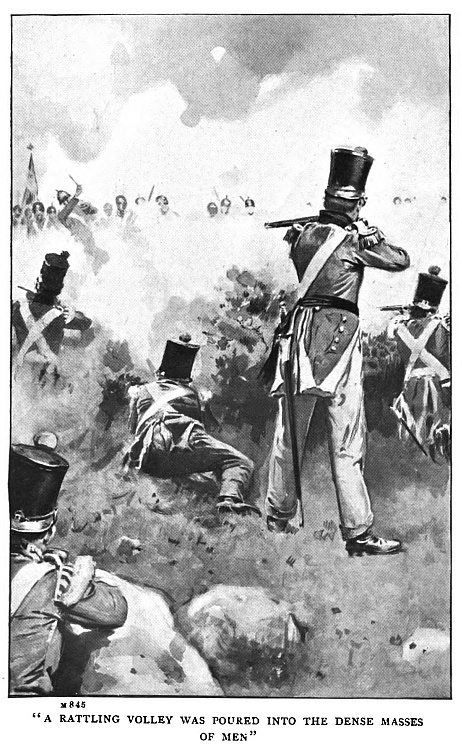
Instantly a rattling volley was poured into the dense masses of men, who came to an abrupt halt, while confusion and alarm spread through their ranks. Then officers rushed to the front, sword in hand, and called upon them to charge.
Flash! Another volley was poured into the struggling ranks, and men were seen to drop on either side.
Bending down so that the scrub just concealed them, Phil and his men rapidly reloaded, and had emptied their rifles again before the mist fell once more and hid the enemy from sight.
“Load again,” cried Phil. “Now, are you ready? Then follow me to the right. We will change our position before these fellows recover sufficiently to open fire.”
Running through the dense growth of bushes, the outpost-party soon took up a new position in front of one of the other columns, where, spreading out so as to pour their volleys into all three columns, they waited again for the command to fire.
Meanwhile shouts and oaths came in a perfect storm from the Russians, and their hiss of excitement rose to deafening pitch.
Then the mist was suddenly rent asunder by a flash of flame which ran along their front, and a hail of bullets was poured into the bushes where Phil and his party had lain not a minute before, sending a shower of twigs and leaves pattering to the ground, and striking the boulders with a series of sharp thuds, which told that but for the fortunate change of position, the outpost-party would have been decimated.
“Now we’ll give them another taste,” said Phil aloud. “Then we’ll retire some fifty yards and wait for them again.”
The movement proved even more successful than he could have hoped, for, bewildered by the mist, and fearful that they had stumbled upon a strong force of the Allies, the Russians still stood rooted to the spot, while the bullets tore remorselessly through their crowded ranks, doing awful execution at such close quarters. Standing in front of them, officers waved their swords gallantly and called upon them to advance, but, stricken by the fire and in dread of the British bayonet, the grey-coated host stood there doubtful and hesitating, and kept from flying only by the press of men behind, unaware as yet of the trouble which had befallen their comrades in advance.
“We’ll play the same game again, my men,” cried Phil coolly, as soon as the retirement had been carried out. “Then we’ll make for the barrier and rejoin our friends. The 80th is there by now, and will be ready to help us if we are in difficulties.”
“What’s that there, sir?” asked Tony suddenly, standing by his master’s side and pointing to the left. “That’s a column of Russians, I reckon, and if we’re to get back to friends alive we’d best be quick about it. See, they’re already behind us.”
Staring through the mist, Phil recognised with a start that the force of Russians to the left, suffering less from the galling fire of the British outposts, had recovered their wits, and, advancing up the valley, were tramping past him and already deploying between himself and the “barrier.”
“Get together, men,” he cried hastily. “Now, in two lines, and bayonets to the front! Keep your fire till at close quarters!”
Springing to their feet, the outpost-party hastily fell in, and, following Phil, who went some paces in front, retired at a ran, darting round boulders and clumps of brushwood, and keeping as much under cover as possible. But though they retired rapidly, the Russian ranks deployed even more quickly, and while those to the far left pushed on directly in their front, taking the course of a narrow ravine, others spread towards the centre, hoping there to join hands with their comrades.
And now an additional element of danger presented itself to Phil and his comrades. Behind them they had left the bulk of the enemy hesitating and uncertain how to act, and pouring an aimless and useless fire into the cover which had concealed those who had done them so great a mischief. At first firing independently and wildly, they had soon taken to well-ordered volleys, and, there being no answer to these and no more missiles of death flying through their ranks, they took courage and, coaxed by their officers, advanced. Arrived at the brushwood cover, they found not a single British soldier. Only deep footprints in the mud, and the litter of twigs brought down by their own bullets, could be seen, and recognising that they had been duped, they broke from a hiss of excitement into a roar of fury, and, breaking from control, dashed forward over boulder and scrub towards the British lines.
“Hark! What is that?” said Phil, holding up his hand to arrest his men. “What do those cries mean?”
“It’s the Russians coming,” answered Tony. “Listen: you can hear them tearing through the wood. Quick, or we’ll be taken. Look, there are men in front of us.”
A hasty glance told Phil that Tony was speaking only the truth, for at this moment a swarm of grey-coats could be seen between themselves and the barrier, and one of these, turning round at the moment, caught sight of the British outposts, and with a shout attracted his comrades’ attention.
“Get together, lads!” said Phil, with coolness and decision. “There, that will do. Now let me take my place on the right. Remember, keep your fire till the muzzles almost touch their coats, and then pull the triggers. Are you ready? Then charge!”
In a close and compact mass, and with bayonets well to the front, the little party dashed forward, and, directed by Phil, charged where the Russian ranks seemed thinnest. With eyes flashing, and courage roused to the highest, the men behaved with a coolness and disregard of danger which was magnificent. Waiting till the whites of the Russians’ eyes were distinct, they poured in a terrible volley, and then threw themselves upon the enemy with a shout. For five minutes a furious mêlée raged. Bayonets thrust the air wildly on every side, and death seemed in store for Phil and his small command. Struck by bullets, or thrust through by the steel, some of his gallant men fell before a minute had passed, but, undismayed, and filled only with an enthusiasm and fury which made them forget all else, the remainder wielded their weapons unceasingly, and, plunging ever forward, cut their way to the heart of the enemy, and then through its crowded ranks, until not a Russian lay between them and the barrier. Then turning fiercely they waited only to cast off a few who still clung to them, and, dashing them to the ground, took to their heels, and within a minute were over the barrier and lying full length upon the ground, panting and endeavouring to regain their breath ere the enemy were upon them.
As for Phil, he cast his rifle to the ground, and, seating himself upon a boulder, waved his arms at the officers surrounding him, and endeavoured to tell them how vast was the force about to attack the British camp.
“There, sit still and say nothing,” said the colonel who had spoken to him on the previous evening. “Thanks to the timely warning you sent by the sergeant, we are as prepared as it is possible to be, though our numbers are dangerously small. Still, we are ready, and we must thank you, Western, for delaying the enemy and so giving us time. Let me tell you you have done a gallant and most useful service for the army. Now, I see you are better. Take a small nip from this flask. It will help you to pull round.”
Phil did as he was directed, and just as the enemy reached the barrier had recovered his breath and strength sufficiently to snatch up his rifle again and join his company.
And now commenced a battle upon the fortunes of which depended the fate of the Allies. Here was an immense army marching in three columns upon a ridge held only by a division scarcely 4000 strong. In rear of it lay the French, at present wholly unable to help or reinforce, for, though not attacked, they sat in their trenches, menaced by Liprandi’s large force from the Causeway heights, captured on “Balaclava” day. And on their left the roar of cannon from the fortress could already be heard as they thundered at the British, while behind the masonry thousands of Russians were massed in preparation for a gigantic sortie upon the investing trenches.
No one could help that gallant 4000, for everywhere troops were urgently needed against threatened attack. But lack of numbers was fully compensated for by a courage which becomes even more remarkable as one thinks of it—courage sufficient to urge them to march over that crest, and, leaving their tents, amongst which cannon-shot were already hurtling, to descend the slope and advance against an army of huge proportions. Fortune favours the brave, indeed, for where can history show a brighter example? Eager for the fight, and reckless of the consequences, the British troops descended the ridge and threw themselves upon the enemy. The mist opened, and the Russians saw a double line of red, and faces furious with excitement and lust of battle, charging upon them, but next moment the British ranks were hidden. A breath of wind to dispel the vapour would have turned the fortunes of the battle, and changed glorious victory for the British into disastrous defeat. But there was no breeze, no puff of wind to clear the atmosphere, and, ignorant of the thinness of the opposing lines, and feeling sure that they were already face to face with the bulk of the allied army, the Russians came forward slowly and carefully. There was none of that dash and recklessness which would have brought them victory; instead, they paused, swayed this way and that, torn incessantly by volleys from rifles which, far superior to their own, caused ghastly slaughter in their ranks; and gave way whenever a company of England’s soldiers fell upon them.
Meanwhile what had happened at the barrier? Two hundred of the 30th Foot lay behind it, and alone met the central column with their bayonets. Rushing at the low wall of stones, swarms of grey-coated warriors attempted to climb it, only to be hurled back from the bayonets. Time and again did they renew the assault, but always with the same result. And all the while bullets pelted amongst them, so that at length, despairing of surmounting the barrier, they turned to the left and joined one of the lateral columns. All day long did that gallant handful of the 80th cling to their position, and almost incessantly were they called upon to oppose other bodies of Russian troops, who came to renew the combat. Worn out with their exertions, with blackened faces and blood-stained clothing, they threw themselves upon the miry ground and slept the sleep of exhaustion till another alarm was given, when, shaking off their drowsiness by an effort of will, they sprang to their feet once more, and, grasping rifles, again flung themselves upon the enemy. Gallant souls indeed they were, but not more brave and determined than their comrades upon that memorable battle-field. Sweeping by them on the right one Russian column fell upon the flank of the British and hurled it aside by sheer weight of numbers. Then, advancing rapidly, they wheeled to the left, and were within an ace of taking the division in rear. But again fortune favoured the British. Buller hurried up with reinforcements at this moment, and, falling upon them with bull-dog ferocity, pushed them back, then rent them in pieces, and sent them hurrying away in disorder.
And on the British right events of no small moment were taking place. Pushing past the barrier, with the 200 of the 30th growling on their flank, and constantly hurling volleys at them, an enormous column closed with the soldiers in red and pressed them up and up the hill till the crest and the sandbag battery were reached.
And now commenced a stage in the battle that is memorable, that stands out amongst all the glorious deeds of that splendid day as more glorious than all the rest. As if at school and struggling for the possession of some imaginary castle, British and Russians fought fiercely for the sandbag battery. A mere mound of earth, and having no guns, it was but a mark, a ridge upon the rolling crest, which attracted the eye. Foiled in their main attempt to force the enemy back and march on towards Balaclava, the Russians forgot the object of the day, and those in the neighbourhood of the battery straggled furiously for its possession. Frantic with rage and disappointment, and with noble courage, they hurled themselves upon it time and again, only to be as bravely met and dashed down the hill once more. Grim, bareheaded, and full of valour the Guards clustered round that battery and disputed its ownership with the Russians. Undaunted by the numbers advancing, time and again they hurled them back, and then stood leaning upon their rifles, and between their gasps for breath called to the Russians to come again, to mount the slope and capture the position. And the grey-coated host glared up at them across a stretch of beautiful green turf now piled high with poor lads who had fought their last fight. Yes, hundreds of fine men lay there, some barely more than boys, others in the prime of life, gaunt, raw-boned Russian linesmen, with ugly red streaks upon their faces, or big patches of like colour growing ever larger upon the grey cloth of their uniforms. Amongst them, too, still clutching rifles, and some even with hands clenched and tightly grasping their enemies, lay fine stalwart Guardsmen, young men in the pride of youth and strength, and veterans. Death had called them away, and just as many an eye would dim, and cheeks be moistened, in far-away Russian cabins for those near and dear who had gone, so in good old England women and lasses would soon be weeping for those gallant sons and brothers who had died for the country’s good.
For long hours the conflict raged round the battery, but though the Russians were in far greater numbers than the British, the Guardsmen budged not an inch; and when the day was done, stood victorious and proud owners of the position.
Meanwhile the orderly lines of the Second Division had been broken by sheer weight of numbers, and pushed back here and there; in other parts they pressed forward with irresistible valour into the enemy’s columns, and fought on in parties of two hundred, and often less—as few even as twenty,—with desperate courage and determination, and with a lust of battle and ferocity that was truly marvellous. Not once, but many times, these small groups flung themselves upon the enemy, and, thrusting and slashing on every side, cut their way to the very centre of the mass of grey, pushed on with assailants surrounding them, and at length passed to the other side, only to turn and bury themselves once more in the Russian ranks.
Late in the day, too, when the fate of the battle still hung in the balance, more artillery arrived, and, engaging the batteries on Gun Hill, caused them to retire. Then slowly and grudgingly the Russian infantry turned round and retreated in disorder to the heights of Inkermann, leaving an enormous number of killed and wounded behind them.
Oh for Scarlett’s Heavy Brigade, or the remainder even of that glorious 600 horse who had charged into “the gates of hell” on Balaclava day! One dash, one fierce charge amidst those retreating soldiers, and defeat would have been a rout, a decisive victory, which even at this date might well have led to the surrender of the fortress and the humbling of Russian pride.
But no horse were there, and the retreating forces of the Czar reached their bivouacs sullen and dispirited at their crushing defeat, but without suffering further injury save from the shell and plunging shot as the British guns opened upon the flying mass.
But that deep valley and the slopes leading to the ridge were piled with dead and wounded innumerable, for both sides had lost heavily, the Russian casualties amounting to many thousands.
Phil took his full share in the battle, while Tony hovered like a guardian angel near him, many a time turning aside a flashing bayonet meant for his friend.
One thrust, indeed, got home, the bayonet transfixing Phil’s thigh and bringing him to the ground.
With a roar Tony was upon the man and had knocked him senseless with a tremendous blow on the head from the stock of his rifle. Then, lifting Phil, he carried him into a safer position behind the barrier of stones.
“It’s nothing,” exclaimed Phil, with a smile. “Slit up my trousers and just tie your handkerchief round. That’s it. Now I think I shall be all right. The pain made me feel a little faint.”
Taking a pull at his flask, which contained weak brandy and water, he was soon on his feet again, and had taken his place in the fighting-line. When all was over, Tony helped him back to his tent, and fetched the regimental doctor, who bandaged the wound.
“It’s a simple flesh wound,” the latter said encouragingly, “and, if you rest a little, will give you no trouble beyond a little stiffness. The difficulty is to get you young fellows to sit still for a moment. But you must rest, and as there happens to be a convoy going to Balaclava in an hour’s time I’ll send you with it and have you put on one of the ships.”
“I’d rather stay here and get well,” said Phil eagerly. “After all, it’s only a scratch, and will be right in a week.”
“Now, I’m treating you, my boy,” the doctor exclaimed shortly, “and for your own good I shall send you on board ship, so there is an end of the matter.”
Phil resigned himself to what he thought was a hard fate, for he was anxious to stay with his regiment. But no doubt rest for a few days was required, and the doctor was right in insisting upon it.
“Pack up my things, Tony, and we’ll see whether I cannot get a lift in an araba,” he said. “The convoy is to start from the crest, so you might slip up and see what can be done.”
Tony did as he was told, and was able to secure a place for his master. Phil was then carried to the top of the hill, and, being lifted into the cart, was driven off. The convoy reached Balaclava at dawn, and Phil, with Tony in attendance, and some fifty other wounded men was sent on board a small schooner, which at once weighed anchor, and sailed out of the harbour.
“Nasty place that,” said the captain, a rough-faced, genial old sea-dog, jerking his thumb towards the harbour. “Safe as a house so long as the wind’s off shore; but once it begins to blow the other way, God help those aboard ship. There’ll be only bare rocky cliffs to welcome them if the vessels go ashore, and how could they help doing that, for the anchorage is notoriously unsafe? Can’t imagine why they stick there! There’s many a safer harbour hereabouts.”
The captain looked anxiously at the fine transports swinging to their cables, and then muttering “Thank heavens I shall be at sea and have a better chance than they!” nodded to Phil and dived below.
He was a knowing man, this sailor, and, being accustomed to the Black Sea, was well aware that the season for violent gales and storms of rain and snow had now arrived. That night indeed, and all the following day, it blew so fiercely that the vessel’s bowsprit carried away, and she was obliged to put back into Balaclava for repairs. A few days later she once more set sail.
“Don’t like the look of things,” muttered the captain, looking round anxiously as they sailed from the mouth of the harbour. “If it comes on to blow on-shore to-night it’ll be bad for them ships in there. But it isn’t my affair. The chap as is in command has been warned more than once already.”
“Do you think we are going to catch it again?” asked Phil.
“Can’t say for certain, but it looks precious like it; I wonder what the glass is doing?” and with an anxious expression the captain went to consult his barometer.
“Falling fast,” he said shortly, “and it’s getting much colder. We’re in for a dusting, I think. Mr King, get those sails taken off her, and make all taut. I’ll go my rounds in half an hour and see how things are.” He crossed the deck and fell into earnest conversation with his mate, leaving Phil to make his way aft and talk matters over with Tony.
The captain’s fears were not unfounded. That evening, November 14th, a gale of wind sprang up, blowing dead on-shore, and soon a terrific storm was raging. With her head jammed close up into it, the Columbine seemed to make fair progress; but soon darkness had obscured the cliffs, and there was nothing by which to judge their position.
“We’re far closer to those cliffs than I like,” Phil shouted in Tony’s ear. “Still, we seem to be getting well out to sea, and if only we can manage that we ought to be safe.”
“I’d rather be fighting the whole Russian army than knocking about here,” Tony roared back. “’Tain’t that only neither. This sea puts a chap off his grub, and we ain’t had such a lot of late as to let us afford it. Look what a rat I’m getting;” and with a comical air of despair he clutched the tunic he wore, to show that it was too large for him.
An hour passed, and it was very evident that the fury of the storm increased rather than diminished. Phil struggled on to the poop and found his way to the captain’s side.
“We’re in the hands of Providence, I reckon,” cried the old sailor reverently. “Every foot we make we lose to leeward, and away over in that direction are the cliffs. We’re running a trifle more along the coast now, for there’s not a ship that’s built that could face this gale. God help us, young man! We can do nothing more for ourselves.”
Three hours later a tremendous sea struck the ill-fated ship and smashed her rudder to pieces. Instantly she commenced to broach to.
“Get a grip of something to hold you up,” shouted the captain. “That’ll finish her. Good-bye, lad!”
Phil grasped his hand for the moment and looked into his face. It showed more clearly than a book could how desperate the situation was.
Leaving him, he crawled along to Tony.
“Get hold of a rope, old man,” he screamed in his ear. “She’s going fast towards the rocks.”
Whipping out their knives, they soon obtained two long pieces of stout cordage. With these they tied two of the large wooden gratings at the hatchway together, and obtaining some more rope, secured themselves to the woodwork, so that if the ship went down the hatchings would float away and support them.
Meanwhile huge billows of green water poured on board, thumping the ship till every timber quivered. Then one immense wave curled right over her and smashed her decks like an egg-shell. Immediately all was confusion. Shouts occasionally reached Phil’s ear, and he once caught sight of the grey-headed old captain kneeling in prayer. A moment later another wave turned the unfortunate Columbine completely over, and, filling at once, she sank like a stone.
Phil felt as though he was being smothered. The din of rushing water rang in his ears, and intense darkness surrounded him. He fought and kicked madly. Then something struck him sharply on the head, and he grasped the grating to which he was tied, and with an effort dragged himself upon it. Close alongside was the other grating, and upon it, clinging with all his might, was Tony. And thus, side by side, one now dancing on the summit of a wave, while the other hung in the trough, drenched with water of icy coldness and almost smothered by the surf and rain, they drifted fast towards those inhospitable black cliffs against which the tempest thundered.
Chapter Eighteen.
Saved from the Deep.
More than an hour of misery and terror passed as Tony and Phil clung, half-submerged, to their gratings, and as they held on, the sound of huge waves, breaking upon the iron-bound coast to which they were fast approaching, grew louder. Phil pulled upon the rope which kept their fragile rafts together and shortened it, bringing them close alongside one another.
“Good-bye, old man!” he shouted, between two gusts of wind.
Tony’s mouth opened and he bellowed something, but the words were carried away on the gale. Conversation, even by shouting, being hopeless, they once more fell into despairing silence.
“What has happened?” cried Phil half an hour later. “We seem to have left the crash of waves on the cliff behind us, and already the sea seems to be going down.”
Tony crept closer. “The wind ain’t going down,” he shouted hoarsely. “It’s blowing stronger if anything, and though we lies low in the water, we’re bowling along in fine style. Can’t make it out, mate; this sea going down looks as if we’d been washed into some sheltered cove. Anyway we shall know soon,” and he jerked his arm to the right, where already the black clouds were lifting.
Half an hour passed, when Phil suddenly caught sight of high cliffs to right and left, while on the summit of one of them seemed to be a fort, for the white masonry was distinctly visible. He stared through the gloom and sweeping sheets of spray, and thought he detected another fort on the opposite side. A few minutes later they were washed through a large opening in the cliffs, and the forts flashed by on either side; at the same moment the sea became still quieter, and the roar of the wind seemed left behind them.
“I think I saw a fort on either side,” cried Phil, “and as I know there is only one harbour on this coast with high cliffs and forts, I feel certain that we are drifting into Sebastopol. Great Scott! We shall be made prisoners again.”
Tony groaned. “Can’t be helped,” he shouted, suddenly brightening. “If we are, why, it’ll just give us the fun and excitement of escaping again. But, old friend, this here’s an escape from sudden and horrible death, and if it hadn’t been that the Almighty up there, above them black clouds, had been keeping His eye on us, we’d have been washing about amongst the fishes hours ago.”
Tony looked upwards to the sky, and his lips moved. Phil watched him curiously, and there, tossing on the storm-troubled water, offered up a prayer for his safety so far. Nor could he help contrasting Tony’s condition of mind as it was at that moment with what it had been when first he made his acquaintance in the menagerie many months before.
“Hallo! What’s that over there?” he suddenly shouted, catching sight of a dark mass in the water. “It looks like a piece of wreckage. Perhaps there is someone on it.”
Both stared at the object which, being much larger and higher out of the water, bore down upon them quickly. There was no doubt now that it was a portion of a ship, perhaps of the wrecked Columbine, and in the hope that it was, Phil and his friend dipped their hands in the water and slowly propelled themselves so as to lie in its path.
“I can see something red on it,” said Phil, shading his eyes. “Can you make anything out, Tony?”
“There’s a chap there in red breeches, or I’m an idiot, Phil. Yes, I can see him plainly. He’s tied to the wreckage, and as far as I make out there isn’t a move in him. Tell yer what, old man, that would be a safer place than these here gratings, and I advise that we swop.”
When the floating mass reached them, Phil and Tony sprang on to it, securing their gratings to it, and casting off the ropes with which they had fastened themselves. Lashed to a ring-bolt was a little, red-breeched French linesman, apparently dead.
Phil cut his lashings free, and turning him on to his back, tore his coat open. “Not dead yet,” he cried eagerly. “Lend a hand here, Tony. We’ll pull this fellow round. He is as cold as ice, so we’ll take his shirt off and rub his chest and arms. That ought to restore the circulation.”
Setting to work with a will they tore the clothing from the unconscious Frenchman, and chafed his body and limbs with such energy that soon there were obvious signs of returning consciousness, and moreover their exertions had made both of them thoroughly warm, whereas before they had been numbed with cold.
Suddenly their ally opened his eyes and stared round wildly.
“Mon Dieu!” he groaned, and seemed to relapse into unconsciousness. Once more opening his eyes he stared at Phil, and, recognising him as an English officer, stretched out his hand, while a look of relief and gladness overspread his face.
“Mon cher, mon cher!” he cried joyfully. “Ah, zis is ze grand plaisir. Ah!”
“Cheer up, my good fellow,” said Phil kindly, patting him on the shoulder, for, overcome by emotion, the little man had burst into tears. “Come, tell us how you came to be wrecked like us. You speak our language, so we shall be able to understand.”
“Oui, monsieur, I speak ze language of ze English. Ah, I speak ’im well!” laughed the Frenchman, with some pride. “Once I live in England three months and act as a waiter. You wish to know how I came here. Ah, c’est terrible!” And he covered his face with his hands.
“Now then, pull yerself together, little ’un!” exclaimed Tony encouragingly. “We’re all in the same box. Fire away and let’s have the yarn.”
“Eh, bien,” said the little man, sitting up. “I leave my beloved France six months ago, and sail for to fight ze perfide Russian. Then after ze battle for Balaclava,—monsieur, what horsemen terrible are yours—I get ze malade; ze—what you call ’im—ah, ze water and ze cold do catch me here;” and placing his hands on his stomach, he rolled his eyes till the whites alone showed, and groaned dismally. “Ze officer say, ‘mon pauvre garçon!’” he continued, “and send me on the ship Henri Cinq.”
“What! you don’t mean to say that that fine boat has gone down?” interrupted Phil.
“Alas, monsieur, it is true!” the Frenchman answered, lifting his hands. “Behold, all is peace; ze sun ’e shine so brightly. Then ze tempest come, ze ship fight bravely, and then rush on the land. ‘Sauve qui peut’, ze captain shout, and I tie myself here. Then I think of my country, and all is dark. I wake, and you are here, mon cher. Aha! what does he matter? Mais—ah, monsieur, mes pauvres camarades!” and once more the little man relapsed into tears.
Meanwhile the wreckage had been rapidly drifting, and as the darkness lifted it became perfectly evident that the harbour into which the gale had swept them was indeed that on the shore of which Sebastopol was built. Soon sentries noticed the wreckage, and before long boats had put off to secure it, for wood was of value for fires. To offer any opposition was hopeless; the three were lifted into one of the boats, and were rowed swiftly into the inner harbour, where they were handed over to a guard.
“Our second visit to this place,” said Tony disgustedly. “Blow’d if it ain’t the hardest luck as ever was. But I sha’n’t grumble no more. We’ve come safe through when other lads have gone to their last. I say we was saved by a miracle.”
“Yes, indeed,” agreed Phil. “We have much to be thankful for.”
“Then you have been prisonaire before?” asked the Frenchman, astonished.
“We only escaped a matter of three weeks ago,” answered Phil.
“You make ze escape, monsieur?” the little man repeated, lifting his eyebrows in his amazement. “Truly, you Englishmen are brave. Ha, ha!” he went on, clapping his hands, “what need I, Pierre Moutard, fear? We will make ze escape with each others, and we will snap ze fingers at our perfide enemy;” and, putting his arms akimbo and throwing his chin proudly in the air, he frowned at the nearest sentry as though he would eat him. The man answered with a hoarse growl, causing the Frenchman to start and take his place between Phil and Tony rather hurriedly.
“Aha, ze perfide!” they heard him mutter beneath his breath. “He think ’e frighten me.”
“I wonder where they will take us!” mused Phil. “If only they will be good enough to put us in the same prison as last time, I think we can guarantee that we will get out somehow.”
“That we will,” answered Tony with emphasis. “But what about this here Froggy with the red legs?” he asked in a cautious whisper. “He’s kind of tied himself on to us—made pals of us, yer see,—so I suppose he’ll have to escape with us too?”
He asked the question as though an escape had been already arranged.
“Heaps of time to think of that,” said Phil, with a laugh. “But I must say the little man seems rather nervous.”
“Pah! nervous! Just fancy getting frightened when one of these surly-looking guards growls at him. It’s disgusting, that’s what it is.”
“Well, we won’t worry about it now, Tony. Look out. Here come our orders.”
An officer joined the group at this moment, and closely inspected the prisoners.
“What has happened?” he asked, less gruffly than usual.
“We were wrecked by the storm and blown into the harbour,” answered Phil in his best Russian.
“Ah, you speak our language, sir! Good! You were wrecked, you say, and must therefore be cold and exhausted. Sergeant, take the prisoners into the guard-room, and bring this officer to my quarters. See that coffee and a glass of vodka are given to the other two. In half an hour you will call for my guest and march them all three to the prison-hall.”
The man saluted, and led Tony and Pierre away, while, taking Phil’s arm, the Russian led him on one side and asked how he happened to have the little Frenchman in his company.
A few minutes later he strode away, but rejoined Phil when the latter had been taken to the quarters set aside for officers.
“Sit down there, sir,” said the Russian, politely motioning Phil to a chair.
“Now we will have breakfast, and I am sure you must be in great need of food. You look quite exhausted.”
He struck a bell, and a meal of steaming hot fish and coffee was brought in, to which Phil did ample justice. Then a cigar was handed him, and he puffed at it with the greatest pleasure.
“It has been a terrible night, a truly awful gale,” remarked the officer after a few moments’ silence. “Even here we have suffered. Vessels have sunk in the harbour, and roofs have been torn from the houses, and many people killed in consequence. But at sea the unhappy English have met with a shocking disaster. It is said that along our coast and within the harbour of Balaclava no fewer than twenty-two fine transports have gone ashore, including the French ship Henri Cinq. Few lives have been saved, I fear, and how you and your comrades managed to escape is past belief. It is the fiercest storm we have experienced for years.”
Phil was struck dumb with consternation. “Twenty-two ships ashore!” he murmured in a broken voice. “How awful! All those lives lost, not to mention the stores.”
It was only too true. Twenty-two vessels had been wrecked, and of these the majority were filled with valuable stores of warm clothing and food, the former being urgently needed at that moment, for the cold weather had set in in earnest, and snow and sleet were falling.
“I grieve for you, sir,” said the officer kindly. “It is ill fortune indeed. But, if you feel so inclined, tell me how you came to be washed into our harbour? It must have been a terrible experience.”
Phil described the foundering of the Columbine and their miraculous escape.
“To be taken prisoner is always painful, Englishman,” the officer said consolingly, “but to be dashed upon the cliffs is to meet with a reception compared to which your comfort here will be perfect luxury. It is unfortunate for you, but war is always filled with misfortunes. I will see that you and the two men with you are given blankets, and I will speak to the prison official for you. For myself, I leave for the field-army to-night. Ah, I hear the sergeant! Farewell, sir, and the best of fortune!”
Phil thanked him suitably, and half an hour later found himself in his old prison. As before, there were a number of other soldiers present, who greeted them enthusiastically, and eagerly asked for news.
“Some of us have been here since a day or two after the Alma,” said their spokesman, “and we are dying for news. These Russian beggars won’t even give us a hint. But we keep our spirits up, and when there’s an extra heavy bombardment, we shout and sing till the guards get angry and come in and threaten to shoot. But we only laugh at them. It is the same if the food is bad; we kick up as much noise as possible, and in the end get what we want, for these fellows seem almost afraid of us.”
“Is there no chance of escape then?” asked Phil.
“Not a morsel, sir. We’ve had a try all round, but always failed. There was an officer here named McNeil. He was wounded, and in trying to escape got stuck again with a bayonet. Then an ugly little brute they call an inspector of the prison came in and struck him with his whip. He seemed to know him, too, and accused him of inciting us to escape. That afternoon the lieutenant was dragged away, and we have never seen him since.”
“Hum! that looks bad for us, Tony,” muttered Phil. “If it is Stackanoff, and he recognises us, it will be a bad business. He is sure to pay off old scores if possible.”
“Trust the brute,” growled Tony. “But if he tries to come any of his larks on us he’ll be getting a tap over the head like that fellow who found us hidden in the carriage.”
At this moment the door of the prison was thrown open, and some blankets were given to the new prisoners.
“Prepare for a visit from the inspector,” said the jailer curtly, “and see that everything is clean and straight, so that you do not disgrace me. It will mean evil for you if his excellency is not pleased.”
A yell of derision met this speech, for the English prisoners had already met with such poor entertainment that they could scarcely receive worse, and, moreover, finding that a noisy, mutinous line of conduct overawed their guards, they had long ago got quite out of hand.
“Don’t you go for to worry yerself, Whiskers,” cried one sturdy linesman. “This place ain’t no palace, so the cove who expects to find it such will be a fool. But it’s clean, and always will be, ’cos us chaps ain’t the sort to live in a pig-sty. Now hop away, Whiskers, and don’t fret. We’ll put it right with the inspector.”
The Russian looked round at the grinning faces, while Phil, who had translated his message, put the last speaker’s into Russian, taking the liberty, however, of making it more polite.
“Very well, do not fail me,” growled the jailer, showing his teeth. “It will be the worse for you if you do.”
“He will discover us as sure as we are alive!” remarked Phil as soon as the man had gone. “I mean Stackanoff, of course, for I suppose he is inspector. We must try to disguise ourselves.”
Accordingly he and Tony ruffled their hair and disarranged their clothing. Then they took a place amongst the prisoners, taking care to keep well in the background.
Suddenly the door was thrown open with a crash, and Stackanoff stalked in majestically, his little pig-like eyes glaring at the prisoners.
“Line them up,” he said, with an angry snap. “I wish to see if all are here.”
The prisoners fell into line, and Stackanoff slowly inspected them.
“Who is this?” he asked, as he came opposite Pierre. “This is a Frenchman.”
“He came with two other prisoners this morning, Excellency,” answered the jailer. “They were wrecked and washed into the harbour.”
“Fool! What do I care about their method of reaching here?” snarled Stackanoff, turning on the trembling man. “They are prisoners. That is good enough. Bring them before me.”
“It’s all up, Tony,” whispered Phil. “We are to be brought before him.”
“Let him take care, that’s all!” muttered Tony, looking daggers at the Russian. “I’ll down the fellow yet.”
Stackanoff stared at them spitefully when they were marched in front of him, but for the moment did not recognise them.
“Ha! what is this?” he suddenly exclaimed, gazing at Phil. “Your face I know. Who are you? Ah!—villain!” And suddenly realising that Phil was the Englishman who had thrown him from his saddle and brought him into disgrace, he drew his sword, and, mad with rage, threw himself upon him with tigerish fury.
Phil was helpless. Another moment and he would have been cut down, when Tony grappled with the angry Russian, and, picking him up like a child, turned him upside-down, and, using all his strength, held him there, cursing and screaming with rage, and with his head resting on the floor.
“Get hold of his sword, Phil,” he shouted. “Now I’ll let him up if he promises to behave.”
Phil snatched up the weapon, while Tony, now aided by a second prisoner, clung to the legs of the frantic Stackanoff, while the remainder looked on and laughed at the ridiculous scene till they were doubled up with merriment.
“You can let him go now,” said Phil quietly. “If he rushes at me again I shall set to work with my fists and give the brute a thrashing.”
Tony and his helper promptly released the inspector, and he doubled up in a heap on the floor. A second later he was on his feet, glaring savagely at Phil, his lips curling away from his teeth, and his hair and beard bristling with fury. But the steady stare with which Phil greeted him, and his air of preparation, caused the Russian to pause and think before attacking him again.
“Viper! Wretched Englishman!” he hissed. “You shall pay bitterly for this insult. Ah, you are dressed now as an officer! You were a private before. Your friend too has different uniform. You are spies—spies!” he shrieked, with a hideous laugh. “Yes, the tale of the shipwreck is a lie, and you two have been sent here to learn our plans. Take them away. They shall be severely dealt with.”
“Where to?” asked the jailer, who had looked on anxiously at the scene, not knowing how to act.
“Fool! To the cells, of course,” Stackanoff cried. “We have an empty one. Place them there, and take this Frenchman too. He also is a spy;” and he glared at poor Pierre as though he would kill him.
“What is it, monsieur?” the little man asked tremulously. “What are they about to do to ze prisonaires?”
“He says we are spies,” answered Phil.
“Ah, spies! He make ze lie. Pierre is no spy. But they will not believe, and we shall all die!” The poor little man threw himself on the floor and howled dismally.
“Come up, won’t yer?” exclaimed Tony with disgust, clutching him by the seat of his red breeches and hoisting him to his feet. “Ain’t it enough to know as you’re to come along with us? Ain’t that bad enough? Shout when you’re hurt, but till yer are hold yer tongue, or it’ll be the worse for yer.”
Pierre wept softly, his narrow shoulders and baggy breeches shaking with convulsive sobs. His chin was bowed upon his breast, and altogether the unhappy little Frenchman looked the very picture of despair.
“Pshaw! At least the Englishmen have courage!” scowled Stackanoff disdainfully. “Call the guard.”
Half a dozen armed Russians marched in and surrounded the prisoners. Then, followed by shouts of farewell and encouragement from their comrades, the three prisoners were taken to the opposite side of the town, close to the fortifications facing the British guns, which could be heard booming in the distance, while an occasional shell passed overhead.
“You see that,” said Stackanoff maliciously, drawing Phil’s attention to a group of low buildings which in parts were tumbled into ruins. “The cells are there, and perhaps a friendly message from your comrades on the heights may find you out. It would be best for you, for no man has yet insulted me and lived to boast of it.”
Phil did not deign to answer, but, looking closely at the buildings, noticed that they had indeed suffered heavily from the British fire. Walls were lying flat, roofs were broken, and a large brick chimney had been shorn off like a stick struck by a sword.
The escort halted opposite it, and a door was thrown open by a jailer.
“Place these three in number five cell, and come to me when you have done so,” said Stackanoff. “I have special instructions to give you as to their comfort,” he added cynically.
He turned on his heel and was gone, while Phil and his comrades followed the jailer down a steep flight of stone steps and entered a gallery. They stopped opposite a door studded with big nails. It was thrown open, and half a minute later had closed behind them with a harsh clang.
Chapter Nineteen.
You are Spies.
“We are properly bottled this time,” exclaimed Phil, with some concern, closely examining the cell into which they had been thrust. “Look at these walls, all of thick stone, and pierced by two tiny windows with grilles. It is a regular cage, and after a first look at it I should imagine escape will be impossible.”
“We was in a worse hole before,” cried Tony encouragingly. “And yer must remember there’s lots of ways of getting out besides digging holes in the wall. For instance, we might collar that surly-faced jailer and make a bolt for it. But it wants a bit of thinking out.”
“Consider now, monsieur,” chimed in Pierre in a plaintive voice. “To make ze escape from this—ah—I do not know ’is name, mais—maison—oui, maison—comprenez-vous, monsieur? To make ze escape will bring ze death to us, ze bang and ze bullet. Alas, it will be for ze no good!”
“Nonsense!” said Phil shortly. “If we want to get out we must chance that.”
“Mais, monsieur, we are so happy. Why should we make ze escape? See, ze wall is strong, and ze cannon will not reach us,” Pierre answered, with a shrug of his shoulders.
“Bah! thought you was for getting out?” cried Tony in disgust. “Look here, little ’un, if we tries the game you’re welcome to this here cell to yourself.”
Pierre subsided into silence, and commenced to make beds of the blankets, while Phil and Tony made a thorough inspection of the cell.
“Not a loophole for escape,” growled Tony. “I suppose we’ll have to dig our way out, for get away from here I will.”
“And I too, Tony,” Phil answered quietly. “There must be a way. What is this?” and he pointed to an open grate, upon the hearthstone of which were the long-cold embers of a fire. He put his head into it and looked up the chimney, but all was black as night. Suddenly a familiar voice, sounding a long way off, reached his ear.
“What can it be?” he cried, withdrawing his head. “I can hear that brute Stackanoff distinctly. Hush! I will get higher up into the chimney. Pierre, if you hear footsteps warn me in good time.” Phil crawled beneath the overhanging lip of the grate, and stood up in the chimney. Then, finding a rest for his feet, he gradually ascended. Suddenly his head struck against some brickwork, and by stretching out his hands he found that the chimney bent upward at an easy slope. Surmounting the corner he crept up with some difficulty. The voice now sounded much nearer, so he lay still and listened.
“Know, then, that I have set hands on your comrades, beggarly Englishman!” he heard Stackanoff cry in a cruel voice. “They have been taken as spies, and I hope will be shot. I promise you that you shall see the fun.”
“Wretch!” a weak voice replied, in tones which sounded like Lieutenant McNeil’s, “have you not already ill-treated me sufficiently, and must you now persecute my poor countrymen? Were it not for this wound, which lames me, I would spring upon you and crush the life from your miserable carcass. Leave me, you coward!”
A derisive laugh was the only answer, and, having waited in vain to hear more, Phil slipped back into the cell, looking more like a sweep than a British officer. He was greatly excited, and that, together with the fact that he was partially choked by soot, made it difficult to answer Tony’s eager question.
“What luck!” he cried at last. “This cell must communicate in some way with the next one, and in that is Lieutenant McNeil. Listen, and I will tell you what happened.”
Sitting on his blankets he rapidly communicated the words he had overheard.
“I’m going up there again,” he said, when some ten minutes had elapsed. “If this chimney allows us to reach the other cell, it will allow us, perhaps, to escape. Evidently our pleasant Stackanoff knows nothing about it. At any rate, if I can get into McNeil’s prison, and can find some way out for both of us, he comes with me. Poor chap! See how long he has been shut up.”
“What, another!” exclaimed Tony aghast. “Ain’t it bad enough to have this here Froggy? ain’t that hard enough? And now yer wants to take on another pal?”
Phil glared at him.
“Very well,” he said curtly, “we’ll not make the attempt. I am sorry, for I did not know you were a coward.”
“Call me a coward, me a funk!” cried the gallant Tony, springing from his blanket-bed and striking himself on the chest. “Me, yer old pal too!” He looked half-sorrowfully and half-angrily at Phil. Then his face suddenly flushed.
“So I am,” he cried hoarsely. “Ain’t the poor young officer in distress, and me wanting to desert him? Phil, old friend, here’s my hand. I won’t say another word against it.”
“That’s right,” said Phil, with a smile of relief. “I knew I had only to call you names to make you give way. Now I’ll go up again. Come and give me a lift.”
Climbing into the chimney he worked his way up laboriously. Soon his hand caught upon a sharp ridge of brick, and happening to look up at that moment, he saw a square patch of light with somewhat rugged margins.
“By George,” he muttered, “that must be the broken chimney.”
He turned over so as to be able to inspect it the better, and, with an exclamation of annoyance, noticed that several bars crossed the chimney some eight feet up.
“That will be our greatest difficulty,” he thought. “Still, they are only built into brick, and we ought to be able to loosen them. Now for the other cell.”
He felt the brickwork with his hands, and was delighted to find that it descended suddenly at an angle, showing that it corresponded to the part in which he was lying, and that two fireplaces were evidently arranged to pour their smoke through one common chimney. The flue down which he was looking then must communicate with the other cell.
“McNeil!” he cried softly. “McNeil!”
“Hallo! Who’s that?” came a muffled answer.
Phil repeated his name again more loudly.
“Come to the chimney!” he cried. “I am up here.”
A minute passed, and then the small patch of light which he could just discern beneath was suddenly obscured.
“Who are you? Whatever is happening?” McNeil asked in an eager whisper. “Hush! Speak low. The jailer lives close outside my cell.”
“Do you remember Corporal Western and his friend? The two who helped you with the flag?” asked Phil, making a funnel of his hands.
“Yes, of course I do. But who are you?”
“I am Corporal Western, or rather I was,” said Phil. “I am now a lieutenant in the 30th. But I will explain later. My friend and I, together with a Frenchman, were wrecked and blown ashore this morning. That brute Stackanoff recognised us, and has put us in the cell next to yours, with the accusation that we are spies.”
“Stackanoff! That man must die, Western,” the stern answer came. “He has treated me with the foulest brutality. I am half-starved, and altogether lame, for the second wound I received while trying to escape has festered, and I am racked with fever. For God’s sake get me out of this, old chap!”
“I mean to,” Phil cried cheerfully. “We have no idea how we shall get out yet, but we gave the Russians the slip once before, and will do so now. Be ready at any moment. But I will try to warn you in good time. Now I will slip back, but to-morrow I will come right down into your prison.”
Carefully lowering himself, it was not long before he was back in his own cell, and telling Tony all that had happened and what chances there were of escape.
“Speak low, mate,” said Tony cautiously. “Tell yer what it is. This ’ere Froggy”—and he nodded contemptuously at Pierre—“ain’t worth a bag of salt. My advice is, don’t tell him what we’re up to. You can see he ain’t got the pluck to get out of this, and he’s bound to know he’ll catch it if we get away and leave him. So he’ll round on us if we’re not careful.”
“Impossible!” exclaimed Phil.
“Look at the fellow then, and perhaps you’ll change your mind,” replied Tony in a whisper.
Pierre was lying disconsolately in his corner, and when Phil glanced at him the Frenchman’s eyes were shifty. He looked ill at ease, and was evidently deeply curious as to his fellow-prisoners’ movements.
“What for does monsieur mount ze chimney?” he asked peevishly. “Eef ze door open, what happen? Vraiment, ze bang;” and he shuddered at the thought that all would be shot.
“Look here,” said Phil sternly, and with hardly repressed anger and contempt, “that man Stackanoff has got us in his clutches, and if we are to live we must escape. I went up the chimney for that purpose, but could see no way out in that direction. If we find a loophole, you must decide whether to accompany us; but mind me, do not attempt to betray us, or we will break your neck!”
“Betray monsieur! Ah, non!” the little man cried, lifting his hands in expostulation. “Surely I will come with you. I will brave ze death.”
“Mind yer do then,” grunted Tony, looking searchingly at him.
But the incident, small as it was, was sufficient to put Phil and his friend on their guard, and after that they kept their counsels to themselves.
At dusk, the sour-faced jailer brought in some bread and a jug of water, and without answering Phil’s remarks that the cell was not fitted for officer or men, banged the door and locked it. Before he did so, Tony caught sight of six Russian soldiers standing in the doorway.
“No chance of rushing that when the jailer comes in,” he said shortly. “Never mind, the chimney’s good enough for me.”
The bread was now divided up, and they fell to hungrily. Then, when his wound had been dressed, Phil and his friends lay down. Fortunately for the former, the bayonet had made a clean thrust through the muscles, and though he suffered some pain, and was stiff, the wound was too slight to incommode him greatly.
The following morning, just as dawn was breaking, Phil slipped off his coat, climbed up the chimney, and slid down into the other cell, where he found McNeil sleeping soundly. He was shocked at the poor fellow’s appearance. He was greatly emaciated and intensely pallid. Phil woke him gently.
“Hush, keep quiet!” he said. “Here I am, come to have a chat with you.”
McNeil sat up with difficulty.
“Ah, Western!” he cried, grasping Phil by both hands, while his lips quivered, “yours is the first friendly grasp I have felt since I was taken prisoner. So you are now a subaltern, and have been taken prisoner for the second time? How did you escape? I sent a letter to say how gallantly you and your friend fought by my side for the flag.”
“Yes, and it reached the camp safely,” said Phil, “and I was promoted to sergeant, and my friend to corporal. But I will tell you all about it later. Now let me know about this brute Stackanoff.”
“Ah, he is a brute! See here, Western! He has refused me the help and advice of a doctor, and my wound daily gets worse and cripples me.”