"A Gallant Grenadier" (continued 4)
Reading edition
The next morning the Cossack lines were early astir, and horses and men were fully ready to set out when two officers came towards them, one dressed as a Cossack, and leading his horse. The men were quickly drawn up, and having explained that he was their new commander, the Cossack officer turned to his companion and formally handed over the two prisoners.
“There, comrade,” he said, “take them and look well after them. I heat they have already done harm enough, though, indeed, I cannot say much against them, for Stackanoff was too harsh with the wounded prisoner, and, besides, his dismissal has given me this command and a chance of distinguishing myself, and having my name brought before our master the Czar.”
The infantry officer answered that he hoped the long-looked-for opportunity would not take long in coming, and beckoning to four men who had followed him, ordered them to march the prisoners off.
Phil and Tony shook hands heartily with Vilnoff, and the former thanked him for his kindness.
“If ever we meet again, Vilnoff,” he said, “perhaps we shall be able to do as much for you, and in any case, when we get back to our friends, as we mean to do, we shall tell them how good one of the Cossack horsemen has been to us. Now, good-bye and good luck! I hope Stackanoff will do you no harm, and that before long you will be seeking the girl you spoke of near Moscow.”
“Ah!” the Russian grunted, while a broad grin overspread his usually grave features, “you give me hope, Englishman. Good-bye, and may the blessed Virgin see you safely to your friends!”
Phil and Tony were surrounded at this moment by their infantry guard, and marched smartly away to the rear of the camp. Here they were ordered to enter a large shed adjoining a farmhouse, and this they found was filled with other prisoners like themselves.
“Halloo, mates,” voices sang out, “when were you taken? What’s going to happen to us?”
Phil hastily explained, and then suddenly seeing the wounded officer who had borne the colour on the previous day, and who had been removed from the Cossack lines a few minutes after the brutal Stackanoff’s dismissal, he walked over to him and asked him how he felt.
“Much better, thanks to you, Corporal,” answered the young fellow. “The doctor dressed my wound, and then got this mattress for me. After all, it was only a flesh wound, and but for severe loss of blood I should have been all right and the colour saved. It is sad to think that it was captured.”
“The colour is all right,” answered Phil. “As I was dragged away I saw that the Highlanders had rescued it.”
“That’s good news! Excellent news!” exclaimed the young officer in tones of relief. “Look here, Corporal, my name is McNeil, and I am sending in an account of our little affair. The doctor here has promised to have it taken over to our lines under a flag of truce. What is your name and your friend’s? I am going to recommend you both for distinguished gallantry.”
Phil gave the required information, and after a few more words returned to Tony flushed with happiness and pride that he and his friend had so early won praise for their deeds.
Half an hour later four Russians entered, and, lifting the wounded officer, carried him outside, and with great gentleness placed him in an araba. The other prisoners were ordered to file out, and in a few minutes they were marching, surrounded by guards, for the grim fortress of Sebastopol. Phil and Tony longed to escape, for once behind the stone walls of Sebastopol there would be little hope. But no opportunity occurred, and by nightfall they, with their comrades, were safely under lock and key, the officer having been taken to separate quarters.
Chapter Twelve.
Close Prisoners.
It was a wearisome time that Phil and his friend spent in prison. Confined in a huge stone building, they passed the greater part of the day in a court-yard open to the sky. Here they discussed with their comrades every possible means of escape, but they could hit on no plan that was likely to be successful. The windows were small and heavily barred, sentries with loaded weapons stood all round the walls of the court-yard, and at night occupied a room commanding the prison, being separated from it by a wall perforated for rifle fire.
“Don’t worry, Tony, old chap,” said Phil one day, seeing that his friend was becoming despondent. “Our chance will come yet, and we shall get away. If we don’t, the Allies may take the place by storm and set us free. After all, we have little to complain of, for our quarters are moderately comfortable, and our food, though plain, is plentiful.”
“Right yer are, Phil! I’ll cheer up,” answered Tony brightly. “When I comes to think of it, we ain’t got much to grumble at. Think of them poor chaps as had arms and legs blown off at the Alma—we’re far better off than they. But I expects this being caged up ain’t for long, and any day the army will be breaking in, as you say, and setting us free.”
And indeed, had the prisoners but known it, the Allies were hard at work preparing to take the fortress and town. To do so from the north was, as has already been said, impossible, for the harbour was far too broad to allow of an effective bombardment, and, moreover, its northern shore was commanded by heavy batteries. Therefore, as we have seen, the Allies marched to the Chersonese heights, the British left resting upon Balaclava, while the French lay to our right. Opposite them was the southern face of Sebastopol, up till then undefended by very formidable works, though the plan of defences had long ago been sketched and partially executed. But no sooner was the object of the allied army discovered than hordes of Russians quickly transformed this side of the fortress, throwing up powerful earthworks, and arming them with guns drawn from the inexhaustible arsenals at the dockyard. And while they slaved, the British and French planned their own earthworks, and set fatigue-parties to work. By October 16th they were completed, and after a council of war, in which naval as well as military officers took part, it was decided that the bombardment should commence on the morrow, the batteries on the Chersonese heights doing their utmost to reduce the works in front of them, while the ships engaged the forts on the sea-face to distract attention. The cannonade was to be followed by a general assault.
A moment’s reflection will show the reader that nothing could have been wiser than a preliminary battering with cannon-shot, followed by an assault; but how the ships could have aided in one or the other it is difficult to understand. As the forts were placed on elevated plateaux, and in some cases on the cliffs, an assault by means of landing-parties was out of the question. Therefore the Russian commander would not, and did not, trouble to garrison them with infantry, but merely assured their having a sufficiency of gunners to replace possible casualties. Then again, compared with a heavily-armed stone fort, what is a wooden ship? It was a hopeless and a foolish undertaking, and it is not surprising that the allied fleet retired, having done little damage, although they had suffered severely themselves.
On shore things were perhaps a little more satisfactory. Three star shells fired from Mount Rudolph, the French battery, gave the signal for the bombardment at an early hour on October 17th, and from that moment for four awful hours the Allies’ combined 126 heavy guns poured a hail of shell into the Russian defences. These consisted of outworks and of various forts of formidable power known as the Flagstaff Bastion, the Malakoff, and the Redan, the whole armed with 118 guns, not to mention a thousand and more of lighter casting to be used in case of assault.
But for an untoward event Sebastopol might have fallen on that very day, and the Crimea as a campaign have sunk into comparative historical insignificance. After four hours’ firing a shell unluckily struck the magazine of Mount Rudolph, and with a roar which shook the surrounding camp the battery was destroyed. The French fire at once ceased, and was not renewed for two days. As for the British, they battered the Malakoff, reducing the stone-work to ruin, and silenced its guns. Soon afterwards the magazine of the Redan exploded, and though our fire still continued furiously, it was answered only feebly and at intervals, showing that the enemy too had suffered heavily like the French.
And now let us consider, before returning to Phil and his comrades, why an assault was not delivered either at once, or on the following morning. But for the calamity to the French this would have occurred; owing, however, to the destruction of their chief battery, and the consequent failure to destroy the defences in front of them, assault became almost impracticable, while now that they were to some extent demoralised, it was utterly hopeless. Also it must be borne in mind that the force in Sebastopol was greatly superior in numbers to the Allies, while an attack in rear by the Russian army in the field was always to be dreaded, and, as will be seen, was not long in actually occurring. As to an assault on the following day, dawn showed that it was useless to attempt it, for the brave and energetic enemy had already reconstructed the defences, and made good all the damage that had been done.
Almost a whole month had passed from the date of their incarceration, when one morning the prisoners in Sebastopol were awakened by a roar of exploding artillery.
“What’s that?” asked Phil, starting up suddenly and throwing off his blanket. “Listen, you fellows! Yes, there it goes again. That banging is the Russian artillery. Wait a minute and we shall hear our own at work.”
A moment later a distant, muttering growl told them that the Allies were answering the fire, while, had there been any doubt, a peculiar shriek overhead, which all had heard before, and the fall of a wall close at hand, told them that a shell from the far-off guns had found a mark.
“Blow me!” exclaimed Tony excitedly. “Supposing one of them shells found its way in here!”
“What, yer ain’t afraid!” jeered a big rifleman who was amongst the prisoners. “You ’as helped to save the colours, too!”
“Afraid! Booby! I’ll punch yer head if yer don’t mind what yer saying,” retorted Tony hotly. “It ain’t that I was thinking of, but of trying to get out of this. Supposing a hole got knocked in the wall, couldn’t we chaps climb through it, and shy bricks at the sentries. Then we’d make a rush for it. You may bet all these Russian soldiers are busy in the forts.”
A grunt of assent went round the gathered prisoners, and far from being nervous or anxious lest a shell should knock the house about their ears, they sat there longing to hear the crash and make a dash for liberty.
That such an eventuality might occur had evidently struck the Russians, for that night the doors of the prison were thrown open, and the prisoners ordered out with their blankets. Then they were marched under a strong guard to the harbour and ferried across.
“Where do we go?” Phil asked the soldier who sat in the boat by his side.
“That you will see,” was the gruff reply. “But you leave the Crimea at once, and I do not envy you your long march. It is fine weather now, but as you get north you will meet the rains and cold winds, and you will wish yourself back in Sebastopol.”
Arrived on the northern bank of the harbour, the prisoners were grouped together, and a meal of hot coffee and bread given them. Then they set out, two ranks of armed guards marching on either side, while some twenty fierce-looking Cossacks hovered here and there, only too ready and willing to transfix any man sufficiently foolhardy to attempt an escape.
“This won’t do,” muttered Phil, whose wits had been at work. “It won’t do,” he repeated almost unconsciously.
“What won’t?” asked Tony brusquely. “It ain’t over nice, I know, but I can’t see that anything’s extra wrong.”
“Where do you think we are marching to, Tony?” asked Phil. “You don’t know. Then I’ll tell you. We are going due north, out of the Crimea and into some part of the Russian interior. Once there, what chance shall we have of ever getting back?”
“There you puzzle me, Phil,” Tony answered, scratching his head. “I suppose it’s a long way off.”
“Yes, a long way, Tony; but that is not the difficulty. The weather is on the point of changing, and soon we shall have rain and snow. We must get away within the next few days or not at all, so keep your eyes open for the first chance that comes along.”
“Trust me, mate,” whispered Tony, unconsciously dropping his voice. “I don’t want to spend the next year or so in a Russian prison. A month’s been enough for me. But it’ll be a job to get away from these fellows: and what shall we do for food once we are free?”
“That we must chance, Tony. The main thing is to get safely away, and, of course, we must make the attempt when it is dark. To-night our guards, knowing we are close to the allied camp, will be extra watchful, but a couple of nights later, when we are well on the way, and the Russian field-army is between us and our friends, they are certain to become slack and careless about keeping a watch. That will be our time, and we must make the best of it. There are plenty of small farmhouses scattered about this part of the Crimea, for it is famous for its vineyards, and if the worst comes to the worst, we must break into one and obtain food in that way. In any case there are grapes to be had in abundance.”
Having agreed that it was useless to attempt an escape for two days or more, and that it was unnecessary to inform their comrades of their intentions—for where two might chance to slip away, it was hopeless for fifty or more to make the attempt,—Phil and Tony marched on stolidly. Amongst the prisoners were Riflemen, Guards, and Highlanders, some slightly wounded, and all more or less in a tattered and forlorn condition, for head-gear had been for the most part lost, and the bright red of tunics had long ago been dulled by lying on the dirt and mud.
That night they pressed on, and halted only when the field-army was reached. Then they bivouacked and waited till the following day, when the march was resumed in a leisurely manner, the guards, however, still keeping careful watch over their prisoners, while the fierce and restless Cossacks rode their shaggy ponies on either flank and kept a scowling eye on the captives.
Phil and Tony saved some portion of their meal of bread daily, cramming it into their pockets. But it was not till the third night that they dared to attempt an escape.
“Keep an eye on those Cossack fellows as we bivouack, Tony,” said Phil in an undertone, as the column came to a halt. “They are the ones we have most to fear. Up to this, I notice that half of them have nightly gone out as pickets, ready to cut off any escape, while the others have camped alongside us. If only we can see the positions the outposts take up, and get away from here without rousing an alarm, we ought to be able to hide up in some vineyard.”
Lying down on the ground, as if tired out, the two watched eagerly, and carefully noted the position of the Cossacks. Riding some three hundred yards from their comrades, each of these wiry horsemen leapt from his pony, removed the bit and slipped it under its jaw, and left it there with the reins on the neck, so that in a few moments it could be replaced. Girths were then loosened, and while the animal cropped the grass its watchful master trudged backwards and forwards, lance in hand, and with his face always turned towards the distant camp.
“Sebastopol lies over there,” said Phil, nodding in the direction they had come, “and we must make a bolt for it some other way. The outposts are certain to be more vigilant behind us. Look at that fellow over there on our right. I have had my eye on him these last two days; he is evidently lazy and careless of his duties, especially now that no Cossack officer is with the horsemen guarding us.”
Tony glanced in the direction indicated, and noted that the man Phil had called his attention to was standing by his pony’s side, with one elbow resting on the saddle, and his head on his hand, as if already asleep.
“Yes, that’s the beggar for us, Phil,” he whispered. “If we crawl over there we ought to be able to slip by him unawares. To-night will be fairly light—just sufficient for us to spot him at twenty yards,—and once we know where he is, it won’t be much of a job to slip between him and the next.”
At dusk a meal was served, and having eaten their portion, Phil and Tony threw themselves down upon a blanket, and spread the second over them, for the nights were already chilly, and they had discovered that with only one blanket apiece greater warmth and comfort could be obtained in this way.
“It won’t do to fall asleep now,” whispered Phil. “We have had a tiring uphill march, and are both in need of a snooze and inclined to take it. Let us talk about something interesting, so as to keep awake.”
Tony yawned loudly and rubbed his eyes.
“I was precious near off then,” he answered. “Tell yer what, Phil, teach me a few words of this Russian lingo. That’ll wake me up.”
Accordingly Phil commenced with the simpler words, and when Tony had heard and repeated as many as he was likely to remember, they commenced to chat about their life in the menagerie, taking care only to whisper, and keeping a vigilant watch upon the sentries close at hand.
“We must clear out of this about an hour before midnight,” whispered Phil. “The sentries are changed at twelve o’clock, and the Cossack outposts too. If we wait till then they are all sure to be wide-awake in expectation of relief, and after midnight there will be little chance of slipping past the fresh ones. As it is, I see it will be a far more difficult job than we had imagined.”
“That’s so,” grunted Tony, staring at the nearest sentry. “In course if we could get alongside that feller we could double him up like a rag before he’d got time to shout, and I doubt that the ones on either side can see him. But I fear it would be a failure. We’d never be able to get close enough to smash him before he pulled his trigger.”
“I have it, Tony,” whispered Phil after a few minutes’ silence, during which he cudgelled his brains for a means of escape. “We should never get away together, for where one might slip through two would be certain to be discovered. Fortunately many of our comrades are still moving about or sitting up talking, so that my little scheme has a chance of working. Tony, we must have a row and separate.”
“Have a row, Phil? That we don’t, while I can help it!” exclaimed Tony hotly.
“Not a real one, Tony,” answered Phil, with a smothered laugh. “We must pretend. Listen. It now wants two hours before we must make our attempt, and we must do our best to judge that time pretty nearly. No doubt the sentry has noticed that we have been lying quietly as if asleep, for he has passed close by us several times. Let us peep out, and wait till he is near again, then you must roll over and pull the blanket from me as if in your sleep. The movement is certain to attract his attention. I will then start up and tear the blanket away from you, and after that we can easily come to words and almost to blows. No doubt the sentry will watch us and enjoy our quarrel, and as soon as we have made sufficient noise, I will get up in a regular huff, pull my blanket from you, and go to the other end of the camp. Two hours later I shall do my best to creep between the sentries, and once through I will imitate the whinny of a horse. The men on guard will think it comes from one of the Cossack ponies, and are not likely to stir, while you, knowing it is my signal, will take the first chance of slipping through and joining me.”
A suppressed chuckle burst from Tony’s lips, and the blanket shook as he attempted to smother his amusement and delight.
“Phil, you’re a good ’un,” he stuttered. “Yer fairly walk away with it. Blest if yer ain’t the smartest chap I ever see! There ain’t nothing more to be said. It’s bound to work is that there scheme, so the sooner we has that row the better. But—look here, old man, how do we join one another out there in the dark?”
“That I was just going to mention, Tony. Once through, crawl on for a hundred yards, and then sit down. You must take care to go straight to your front. I am going to lie down over there on the right, and I shall know you are on the left. I shall give you a quarter of an hour to get through, and then I shall crawl over in your direction. If after a good search I fail to find you I will give another whinny, and you must crawl up to me. Now is everything clear?”
“Everything, mate,” answered Tony, with evident delight. “We just plays this little game, and then I waits for the signal. Once through, there comes that Cossack chap, and if he so much as flickers an eyelid, bust me if I don’t smash him like an egg. Now, mate, give us yer flipper, cos, yer know, things might go wrong, and I specks those Russian coves have a nasty way of shooting if they spots a fellow giving them the slip.”
Phil stretched out his hand, and meeting Tony’s, gave it a cordial grip. Then for some ten minutes the two lay still, Tony snoring heavily, while the sentry passed them twice on his beat, humming a tune as he did so. Close at hand were the other prisoners, some asleep, while others sat up round a fire smoking a last pipe.
“Now, here goes,” whispered Tony, and with a loud snort he rolled over on his opposite side, clutching the blanket and dragging it from Phil.
The action was beautifully timed, for the sentry was just opposite them and within a few paces, and halted to see what would happen.
Phil awoke suddenly, sat up, and shivered. Then he felt for the blanket as if expecting to find it over his knees, but failing to hit upon it he looked at his sleeping comrade, and instantly, and with an exclamation of wrath, seized the blanket and dragged it away.
“Here, what are yer up to?” growled Tony hoarsely, sitting up and grabbing at the blanket. “Want it all yerself, yer greedy beggar? Let go, will yer?” They struggled together, while their anger apparently rose till they were on the point of blows.
“Whose blanket is it then?” cried Phil angrily. “It’s mine, and I mean to have it. There’s yours; you’re lying on it. Stick to it, and I’ll stick to mine; but not here. I’ve had enough of you. Every night it’s the same. I’m getting worn out for want of sleep.”
“Hurrah! here’s them two bosom friends a-fighting,” laughed a linesman who formed one of the number round the fire. “Have it out, boys. We’re getting stale for want of a little fun, and now’s just the time for a fight.”
Phil and Tony took no notice of this encouragement, but, tearing the blanket angrily from his friend, Phil trudged away with it to the other end of the sleeping line, leaving the sentry, who had watched the whole scene, doubled up with laughter, which was loudly echoed by the men sitting round the fire.
“Stop that noise,” came a harsh voice at this moment from the tent occupied by the officer in charge of the party; and instantly the sentry commenced to tramp his beat, while the prisoners rose and went to their hard and uncomfortable couches.
Phil chose a spot between two sleeping figures on the right, and, throwing himself down, apparently fell into a deep sleep. But part of his face was uncovered, and his eyes were fixed in the direction of the sentry, whose figure was now indistinguishable in the darkness. A weary hour and a half dragged by, and then he prepared to make the attempt. Leaving his blanket, he crept on all-fours through the grass, and within five minutes was safely through the sentries, where, having put a sufficient distance between them and himself he sat down and indulged in a whinny—a curious collection of sounds which every school-boy is an adept at, having, no doubt, times out of number, tried the nerves of some irascible master by repeating them from the remote and unobserved depths of his class-room, together with cat-calls and other pleasantries. Half an hour later Phil and Tony had met, and were crawling away towards the Cossack outposts. Stealing through the long grass, and avoiding stones and small patches of corn which were spread thereabouts, they were soon near the post occupied by the horsemen.
“We’ll get alongside that wall,” whispered Phil, pulling Tony’s sleeve in the direction he meant. “It is not a long one, and by crawling to the end and squeezing against it, we ought to be able to see our gentleman without ourselves being observed.”
Accordingly they crept to the wall, which surrounded a potato field, and advancing cautiously were soon at the corner, where, lying side by side, they searched the darkness for the Cossack horseman.
“Can’t see him anywhere,” muttered Phil in an undertone.
“Here, what’s that?” asked Tony excitedly, pointing in front of him.
Before Phil had time to answer, there was a hoarse cry of astonishment, and a figure which had been leaning upon the wall just round the corner started out, and, lowering a lance, rushed at them. The weapon struck the ground between them, narrowly missing Phil’s arm. Next moment Tony had sprung at the Cossack with a low cry, and had felled him to the ground with a powerful blow from his fist.
“Didn’t I say I’d do for yer if yer winked yer blessed eye?” he said breathlessly. “Move again and I’ll stick yer through with the lance.”
But even if the Russian had been able to understand, he was not in the condition which would allow him to prove offensive, for the fist had crashed like a sledge-hammer into his face, and he now lay motionless and stunned upon the ground. Phil picked up the lance, and while they lay still, in case the slight noise should have aroused the next outpost he produced his knife and commenced to cut it in half. It was soon done, and, keeping the head armed with the spear-point, he handed the other to Tony, and they once more rose to their knees and crept stealthily away into the darkness. Ten minutes later they were walking briskly in the direction of Sebastopol.
Chapter Thirteen.
The Highroad to Liberty.
When they had placed half a mile or more between themselves and the Russian outposts, Phil caught Tony by the sleeve and came to a halt.
“We’ll have a breather and a consultation now, old chap,” he said with a cheery note in his voice. “We’re safely through so far, but there’s a lot to be done before we reach our comrades. It was bad luck our hitting up against that fellow, for when the outposts are relieved at midnight he will be found, and our flight discovered. So we may take it that we have barely an hour’s start.”
“It were bad luck,” agreed Tony, “but I don’t see as though it weren’t worser for him. We hit up against the beggar, but I can tell yer the knock he give us wasn’t nothing to the smasher I got in on his face. It fairly knocked the senses out of him, and will teach him to mind his own business in future.”
“Now, what’s to be done, Tony?” asked Phil. “We have an hour’s start, and barely that. I am for making across to the road, and trotting along it at our best pace. They are sure to send horsemen back by that way, and we shall be able to hear them if we keep our ears open. Then we will slip across the grass and hide up in some vineyard, where I expect we shall do well to stay until the search is over.”
“Look here, Phil, you’re bossing this show,” said Tony with some emphasis. “I haven’t a doubt but what yer proposes is the best, so let’s get off at once.”
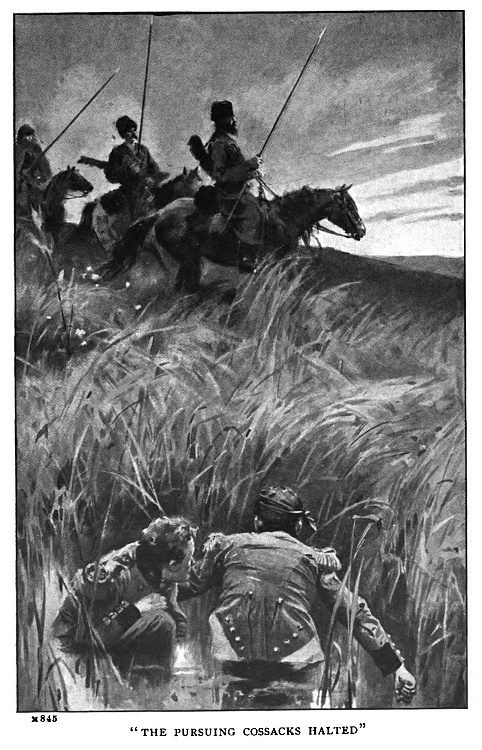
Having settled the point they promptly swung to the right, and soon were on the post-road. Then, taking to their heels, they ran steadily along it. Every ten minutes they halted for a few moments to listen, but, hearing nothing, set out again. In this way they had covered some five or six miles before shouts and galloping hoofs striking hard upon the road behind them caught their ears. Instantly they turned on to the grass, and, climbing a wall, ran through a large cultivated field and hid themselves in a patch of corn beyond. It was well that they did so, for when opposite the wall the pursuing Cossacks halted, while two of their number dismounted, and, vaulting over it, searched in its shadow for them.
Finding nothing they returned to their companions, and soon the beat of hoofs again resounded along the post-road. Phil and Tony were congratulating themselves on their safety thus far, when the latter, who had pushed his head up through the ears of corn, strained his eyes towards the road, and clutching Phil by the shoulders, whispered, “Hush! I hear something.” Both listened intently, but for some minutes could neither see nor hear anything; the moon, however, was rising, and very soon they were able to make out a solitary horseman patrolling the road.
“That settles it,” muttered Phil. “Of course by creeping up to the wall we might manage to silence that fellow, but it would do more harm than good. At present they are uncertain of our whereabouts, but his disappearance would tell them at once that we were in the immediate neighbourhood. As it is, I doubt if they will think we have got so far, for the sentries are certain to declare that they noticed our sleeping figures up to the last moment. Tony, we must make a move, and find some better hiding-place than this.”
Stealing through the corn-patch they were not long in reaching its margin, and then, to their chagrin, nothing but open fields met their view.
“I fear it means lying where we are,” said Phil dejectedly. “We might easily slip across unobserved, but as far as one can see in this light there is not a vineyard or cover of any sort in sight. We must do something, for a couple of horsemen would quickly rout us out of this.”
“I seem to remember some kind of house along this way,” muttered Tony, trying to recall the spot. “Yes, I’m sure of it, and it’s away over there, half a mile or more, I should think;” and he stretched his arm and pointed to the right.
“Then we’ll try to find it,” said Phil with decision. “There is nothing else for it, and we cannot be in a worse spot than we occupy now. I blame myself for not having kept a better watch on our surroundings as we passed along the road with our escort. That Cossack has ridden away a little, so now is our time; we’ll strike straight across, and trust to luck. We haven’t time to pick roads, for it will be dawn in another hour. If they come over here they are certain to see our footmarks, but no doubt we shall get on to grassy land soon, and that will throw them off the scent.”
Standing up for a few moments, to make sure that no enemy was near, they plunged into the fields and walked steadily on for an hour; but still no house was in sight. Half an hour later, when they were almost in despair, and when a faint flush in the east and a waning of the pale, silvery gleams of the moon heralded the approach of dawn, they caught sight of some outbuildings on their left, and were hurrying towards them, when Phil suddenly saw some ghostly-looking horsemen issuing from behind them, and clutching hold of Tony, dragged him forcibly into a narrow ditch which he was in the act of crossing.
“What’s up?” asked Tony, somewhat nettled; but Phil’s whispered reply, “Cossacks! Hush!” appeased him.
The ditch was half-filled with water, but a thorough sousing is preferable to captivity, and the two companions squeezed still closer into it, wedging themselves into its slime and mud, and thrusting their bodies as far as possible beneath the long grass and reeds which sprang from its bank, for a hasty glance and approaching sounds told them that the Russians would probably pass close at hand. Five minutes later their voices were audible, and a series of splashes and thuds told them that they had leapt the ditch a few yards higher up.
“They are not there, and you have led us a fine goose-chase!” Phil heard one of the Russians angrily exclaim. “What made you take us on such a fool’s errand, Petroff?”
“It is no fool’s errand,” another voice replied gruffly. “I distinctly saw two figures cross the land beyond. They are not at the farm, that is clear; but we shall catch them, and then they shall suffer. Pigs that all Englishmen are! I myself will tie them to a wheel and thrash them before their comrades. It will be a good example, and our master the Czar would approve of it.”
The speakers passed on, and Phil hastily interpreted what he had overheard.
“Whack us, will they?” muttered Tony, gritting his teeth. “That’s one more chalked up against these Cossack chaps. Pigs, indeed! Yah!” And his indignation being too great for words, he subsided into silence. Giving the patrol sufficient time to get well away, they sprang from the ditch, and hastily squeezing the water from their clothes, struck across to the outhouses. Beyond them and within fifty paces was a small farmhouse, standing in absolutely open fields, with not a sign of a vineyard or patch of cultivated ground, while fenced-in enclosures and distant bleating and lowing told that this was a grazing-farm, and that its owner did not trust to crops for his livelihood.
By this time the light was distinctly clearer and the night was rapidly drawing to a close; so that, if they were to escape observation, it was necessary that they should hide themselves away.
“The outhouses will be the best for us,” said Phil, thinking aloud. “Come along, Tony; we must see which one will suit us best. If they are merely empty huts, meant for cattle, they will be of no use to us, and we shall have to try the house, or get into an empty pig-sty or something of the sort.”
The first was simply an empty shed, and the second proved equally useless. The third was much larger than the others, and the big, closed doors showed it to be a coach-house.
“That will do, so we’ll get inside at once,” whispered Phil. “Just run round, Tony, and see if there’s a window close to the ground.”
While Phil knocked out the pin that held the hasp of the door, Tony went in search of a window, and returned to say that the only opening he could find was a trap-door high up, evidently leading to a hay-loft. But there was no ladder.
“Then we must find one,” said Phil quickly. “It will never do to get in and leave the door open. If we cannot find a ladder, perhaps there will be a piece of rope inside, and we can manage it like that.”
Tony disappeared again, while Phil, opening one of the huge doors, entered the shed. In it were several arabas and heavy carts run close together, while behind them, and pushed close against the wooden wall, was a dilapidated and old-fashioned four-wheeled carriage, completely covered in by an antiquated leather hood, and yet by its mere presence there proving that the owner was a moderately well-to-do person.
“Just the thing for us,” muttered Phil. “Now for a rope or a ladder.”
He hunted about in the dim light, and presently came across some harness, made of twisted hide, hanging close against the door. To take it down and buckle the traces together was only a few minutes’ work, and by that time Tony had returned, to dolefully inform his friend that he had searched everywhere without discovering a ladder, and that, in addition, while prowling round the house, he had seen a light moving, showing that its occupants were already astir.
“How’ll this do, Tony?” asked Phil, producing his improvised rope. “Now, who’s to do the climbing? You—or shall I be the one?”
Tony settled the question by stepping outside and closing the door, having taken the precaution to leave his stick with Phil. Then he jammed the hasp to, and, having replaced the pin, ran round till he was beneath the trap-door.
A series of niches had been left in the planks which formed the wall, and up these Phil rapidly swarmed, and gained the loft. Throwing the trap-door open, he lowered his rope, and sitting on the floor, with both feet wedged against the wall, called softly to Tony to climb. Two minutes later they were together.
“Now, Tony,” said Phil, “pick up a big armful of hay and toss it down. You will find an old coach in the corner of the shed. Take the hay there and make all comfortable, while I close and fasten the door, and put these traces back.”
Working rapidly, for there was no saying when a hot search might be made for them, it was not long before they were both comfortably ensconsed in the dilapidated coach, leaving the interior of the shed as they had found it.
“All we want now is a look-out,” said Phil thoughtfully. “You stay where you are, Tony, while I search for one. In any case I shall have plenty of time to get back to you, for no one could get in here without giving us plenty of warning.”
“Search away, old horse—search till yer find it. I’m as comfortable here as a prince in his palace,” exclaimed Tony, with a broad grin of contentment, throwing himself back upon the hay which filled the roomy carriage.
Phil opened the door and stepped out. Then he searched the walls thoroughly, finding many cracks and apertures by which he was able to obtain a clear view of his surroundings. Better than all, he discovered a long crevice between two planks directly behind their hiding-place.
Stepping into the carriage he closed the door, and, opening his knife, cut a large triangular slit in the leather covering. Through this, to Tony’s absolute bewilderment, he thrust his head, and stared through the aperture in the wall, to find that it commanded an excellent view of the farmhouse and surroundings.
“There you are, Tony,” he laughed, withdrawing his head. “That is our look-out, and one of us must be stationed there all day. This slit I have made is never likely to be noticed. Have a look yourself.”
Tony did so, but withdrew his head almost more quickly than he had thrust it out.
“Bust me! the Russians are already after us,” he cried. “See for yourself, Phil. They are hammering at the door of the farmhouse.”
Shouts, shrill hoots, and loud hangings reached their ears, and, glueing his eyes to the crevice, Phil saw that a party of horsemen had ridden up and halted before the farmhouse, and within a short distance of the outhouse in which he and his friend were hidden. A few moments later the door of the farmhouse was opened, and a man appeared looking somewhat startled.
“What do you want?” he asked angrily. “Am I to have no peace? It is scarcely an hour since you roused me in search of some of your beggarly prisoners who have escaped. Am I to be disturbed like this because you do not keep a careful watch?”
“Gently, old man, gently,” a rough fellow with a rasping voice answered. “We are but doing the duty of our country and our master, and you had better keep a civil and obliging tongue in your head. We know of farms very near at hand that are farms no longer. Don’t we, my comrades?” he asked with a brutal laugh. “They were burnt—by accident, perhaps—and their owner hangs to the nearest tree outside. Perchance—wretched man—of his own act, and perchance, my surly friend, because he was indiscreet.”
“What do you want, then?” asked the farmer in a more civil tone, evidently overawed by the black and lowering looks of the Cossacks, and by the covert threats which their spokesman had uttered.
“Something good and of your beat, my friend, for we are hungry; and after that we will search the farm once more.”
“Very well, come in if you will. Here, wife,” he shouted, “prepare a meal for these good fellows.”
“What’s all the noise about,” asked Tony impatiently, tugging at Phil’s arm.
Then when he had learnt he grumbled. “Something to eat. That’s what they’re after now, is it? Young ’un, the very mention of a meal makes me as hollow as the drum of our Grenadier band. Just keep an eye upon them till they are out of the way, and then we’ll fall to ourselves. We’ve only bread and water, but I feel like tackling anything.”
A little later the Cossacks had entered the house, leaving their ponies outside, unsaddled, and tied by the halter to a long rope attached to a ring in the door-post. A plentiful supply of corn had been given them, and while their masters were busy with knife and fork, they ate it hungrily, and having finished it, promptly drooped their heads and fell asleep, for the Cossack pony, though hardy and full of strength, is a long-suffering animal, and never knows how soon he may be called upon for work. Therefore, having been on the move most of the night, one and all took immediate advantage of the moment’s respite given them. As for Phil and Tony, stretching their legs and bunching a thick layer of hay beneath them, they set to work on the bread they had saved, and enjoyed their meal in spite of its being so simple.
An hour later there was a commotion outside, and Phil, who was on the watch, saw the Cossacks emerge from the farmhouse.
Then they separated, and in couples searched every corner of the house and its surroundings.
“This looks a likely kind of place,” said one of them, approaching the shed in which Phil and Tony were hidden. “Come, Petroff, we will enter it together. I would not for the wealth of the Czar undertake the search alone, for these English fools, though unarmed, are capable of killing us. See how our unlucky comrade was damaged by a blow from one of their fists. He says he remembers only thrusting at them with his lance, and then a flash in his eyes as of a thousand stars. Truly they are brutes who learn to strike down men with their clenched hand alone.”
“What is the good of entering there?” his companion answered surlily. “Can you not see, fool, that the door is pinned outside? There is no other entrance but the trap-door, so how can they be there, unless, indeed, they possess wings? For I know the ladder is within the farmhouse. Still, we will search the place, and then can honestly say that we have used every endeavour.”
A grating sound accompanied by loud creaking followed this as both doors were thrown wide-open to afford a better light.
Crouching close between the seats of their refuge, the two comrades waited breathlessly, stick in hand, and with fast-beating hearts, while the two Cossacks searched every corner of the dwelling.
“They are not here, as I said,” a voice cried from the loft. “This trap-door is bolted on the inside, and the big doors on the outside. It is clear that our trouble is for nothing. Still,” he added, having scrambled down by means of the niches, “were I escaping from our enemies this is the place I should choose, and that carriage over there is the roost I should take possession of. From its size it should form most comfortable quarters;” and as if to prove the truth of this, he crept between the carts, and, turning the handle, attempted to open the door.
“Hang on for your life, Tony,” whispered Phil, who had overheard all that passed. “This fellow is trying to pull the door open.”
Both at once clung to it, Phil grasping the handle inside, while Tony dug his fingers into the window slits and pulled with all his strength.
“Bah!” muttered the Cossack, disappointed in his attempt. “What is the use of a carriage with a door that does not open?” and, turning away, he and his companion left the outhouse.
“That was a near go, Phil, old horse,” whispered Tony excitedly. “I thought it was all up, and was ready to jump out and tackle the other beggar while you settled the fellow tugging at the door. We’d have downed ’em, too, but I suppose they’d have given warning to the others.”
“Certain to have done so, Tony. You may not know it, but the man who was doing his best to break in here is the gentleman who proposes to thrash us when we are captured.”
“Oh, he is, is he?” was Tony’s grim reply. “Wait a little while and I’ll settle the hash of that fine chap.”
A quarter of an hour later Phil saw the horsemen collect together, and, having saddled their ponies, they rode away from the farm, evidently to the no small satisfaction of the farmer. In half an hour two of them returned, and having unsaddled they turned their horses into a shed, and, carrying their saddles, banged at the farmhouse door again.
“What now?” surlily asked the owner, appearing.
“Only a lodging for the two of us,” one, a big burly fellow, the same that had attempted to open the carriage door, answered with an oath. “Come, master farmer, we want no trouble; accommodation for two, good feeding, and plenty of that vodka we have already tasted, are what we desire. We have been ordered here to keep a look-out for the runaways.”
With a growl of displeasure the man bade them enter, and nothing more of them was seen till the evening, when they appeared, evidently in an intoxicated condition.
That night Phil was lowered from the trap-door by Tony, and when he returned he brought a loaf of bread and a joint of meat, which he had abstracted through an open window of the farmhouse, and in addition, a pocketful of apples from a tiny orchard growing near.
The following day passed uneventfully. The two Cossacks made a thorough search of the surroundings, and once more returned to their beloved vodka.
That night again Phil went out in search of provender, but, in endeavouring to reach a plate of provisions which stood upon a shelf within the window, he upset a dish which clattered to the ground and smashed into a thousand pieces. Instantly a window was thrown open and a head put out.
Phil crept into the shadow and crouched low.
“Who is there?” a drunken voice called. “Comrade, there are thieves about. Rouse yourself.”
The window closed with a bang, and, darting across to the outhouse, Phil rapidly clambered up through the trap-door, and he and Tony having gained their hiding-place, once more waited anxiously for what was to follow. But the Cossacks evidently preferred the comfort of a warm room to searching for a thief who was, for all they knew, far away already. So, grumbling that they would see to it on the morrow, they turned in again, and soon all was quiet.
“We shall have to clear away from here, Tony,” said Phil as they waited. “The disappearance of food is certain to lead to suspicion, and we shall be caught. To-morrow night we will make a bolt for it.”
On the following morning it was evident that more than suspicion had been aroused, and a hot search was instituted, for, from what Phil overheard, none in the farmhouse doubted that the escaped prisoners were close at hand. Saddling up, the Cossacks searched every corner of the fields, and returned utterly baffled at mid-day. A feed of corn was tossed into the shed close at hand, and the ponies driven in ready for an instant start; then the Russians betook themselves to their favourite bottle, and when they reappeared were evidently the worse for its contents. But they were far from giving up the search.
“They must be close at hand,” the man, whose voice Phil had heard so often, exclaimed with an oath. “We must find them too, comrade, and then we shall be rewarded. Where can the fools be? Ah! let us try the coach-house again. These English, I have heard, are dense and slow, but perhaps these two have more wits than their brothers.”
“Tony, we’re done for, I fear,” said Phil, hastily withdrawing his head. “This shed is to be searched again.”
“We must just chance it then,” grunted Tony. “It’s a bad scrape we’re in, but we were lucky the other day. If this fellow does find us in here, why, we must just silence the two of them. It’s their lives or our liberty, and I’m determined to get out of their hands. Lie low, old boy, and if these coves spot us it’ll be the worse for them.”
Tony shook his stick threateningly, and was on the point of launching into an elaborate explanation of the exact punishment he would mete out to the Cossack who had promised his friends to thrash the fugitives, when the door of the shed was thrown open with a bang, and the two Russians reeled in.
“Search the loft, comrade,” said the big man authoritatively. “This spirit of our friend’s is good and powerful stuff, and my legs are none too steady.”
The man did as he was told, and, peeping through the window, Phil watched him laboriously climbing to the loft, looking as though he might lose his grip and fall at any moment.
The big man stood still for a second, stroking his beard. Then, evidently struck once more by the appearance of the covered carriage, he crept towards it.
“What is this?” he muttered loudly when a few paces away. “Is it the vodka, or did I turn that handle and leave it so?” With an effort he pulled himself together; suddenly remembering that he had indeed turned the handle and neglected to restore it to its usual position, and realising that it was now closed, he gave a drunken shout and rushed at the door.
Chapter Fourteen.
Almost Trapped.
The sight of a burly, black-bearded Russian of forbidding aspect, half-maddened moreover by drink, rushing at one’s hiding-place, is calculated to inspire the bravest with trepidation, and in the case of Phil and Tony it can be recorded, without fear of their incurring the epithet of coward, that both were more than a little alarmed for their safety. But they were in a cage—in an extremely tight corner without doubt—and, rendered desperate by the knowledge, and that recapture meant, if not death, certainly ill-treatment, they determined to make a light for it.
“Silence him at all costs,” Phil whispered rapidly. “Let him pull the door open, and then drag him in. I leave it to you to silence him, Tony.”
“Ay, I’ll do that, never fear,” was the hurried answer in a tone which showed that though a handkerchief as a gag had possibly occurred to the gallant Tony as a method, yet he knew of other and surer means.
A second later the handle was wrenched open, and the door flew back with a bang, while the Cossack almost fell into the carriage.
There was a swish and a sounding crash, and he flopped into the hay limply, stunned by a heavy blow from Tony’s club, which, had it not been for the thick astrakhan hat the Russian wore, would have settled his fate there and then.
His helpless body was instantly dragged into the corner and a hurried consultation held.
“We’ve got to fix up that other chap,” said Tony grimly. “Now his pal’s gone the fat’s in the fire.”
“No doubt about it, Tony,” agreed Phil. “We must silence both. Let us get out and wait near the door for the other fellow. We can leave this man for the present, for that crack you gave him will keep him quiet for a time.”
Tony chuckled.
“And he was the chap as was going to tie us up and whop us!” he said, with huge enjoyment. “He was going to give us a taste of the rope! He shall have some himself soon, but for the present the dose of stick will suit him.”
Shaking his club at the unconscious man, he followed Phil out of the carriage and closed the door. Both crawled beneath the cart till close to the niches down which the Russian must climb, and waited eagerly for his appearance. But there was not a sound above, and nothing but the certainty that he had ascended to the loft to convince them that he was there still.
“What has happened to him?” asked Phil. “Do you think he heard the noise below, and has escaped through the trap-door?”
“Not he,” Tony answered with assurance. “He’s up there, p’r’aps hiding, but most like dead asleep. Listen. Perhaps we’ll hear him.”
There was a minute’s silence, when both heard heavy snoring from the loft, and looked at one another, uncertain how to proceed.
“We’re in a fix,” said Phil shortly. “We dare not move out of this till nightfall, for the surrounding country is open; and we cannot leave this fellow asleep up there. He may pull himself together at any moment and search for his friend. Also if we climb up to him we are likely to rouse him, and he will give the alarm before he can be silenced.”
“Yes, it’s a real fix, Phil; but we’ve got to get out of it,” muttered Tony, scratching his head in bewilderment. “Why not sing out to him in his own lingo and tell him to come down?” he suddenly suggested. “Then as he gets close to the ground we can nobble him.”
“Of course; just the thing;” and Phil, who had heard Petroff address his friend as “Nicholas”, called to him in a low voice.
At first there was no response; but presently the man above moved, and they heard him grumble something, and evidently turn over to sleep again.
“Nicholas, here are the English. Remember our reward,” cried Phil in a harsh tone.
“Ah, what?” they heard the man say. Then there were sounds as if he had risen to his feet and fallen again. But he was evidently fully aroused, and soon his legs appeared through the opening above searching for the first of the niches. He found it, and commenced to descend, while Phil and Tony crept a little closer and prepared to dart out from beneath the shelter of the cart and overpower him. Suddenly there was an oath as one foot slipped from its hold, then a sharp cry of fear, and before either Phil or Tony could utter an exclamation, the unhappy Cossack, overpowered by drink, had lost his hold and fallen like a sack to the ground, where he lay huddled in a heap, while a crimson stream ran from his ears and nose.
Phil crept to his side and found that he was dead.
“We are saved our trouble,” he said sorrowfully. “The poor fellow has smashed his skull. What’s to be done, Tony?”
His friend looked blankly round and shook his head.
“Blest if I know, Phil! Here we are with two Russian coves, one of them dead, and here we’ve got to stick for a matter of four hours and more. It beats me. The farmer chap saw them both come in here, and it won’t take long for him to search. It’s a regular fixer.”
“And the worst of it is too, Tony, that if we are found with this dead man we shall be accused of having killed him. I have it. We’ll hoist him to the loft again, and place the other fellow alongside him. Then we’ll take up our quarters there. If we are discovered we can make a good fight for it, and if the farmer comes in search he may think his unwelcome visitors have left the shed to investigate some other spot and will return to his house.”
Tony looked at his friend as if to say, “Well, you’re a good ’un,” and, without venturing on a remark, stepped to the wall and returned with the traces which had already served as a rope. One of these was buckled round the dead man, and the other trace attached. Then both climbed into the loft and hoisted their burden after them. Another trip and the still unconscious figure of their enemy Petroff was dragged up beside them. The harness was returned to its peg, and with a hasty glance round to make sure that there was nothing about the shed to show that a struggle had taken place within it, Phil and Tony climbed into the hay-loft and sat down to regain their breath and rest after their exertions.
Two hours passed almost in silence, when Phil suddenly slapped his knee and gave a sharp exclamation of delight.
“We’ll reach our friends yet, old man,” he said enthusiastically. “I’ve thought the whole thing over and have decided what to do. At first I imagined that our best way would be to relieve these gentlemen of their clothing in exchange for ours. But it would not do. If we were captured it would mean a file of muskets at six in the morning, for we should certainly be condemned as spies.”
Tony grunted hoarsely, showing that he had a decided dislike to this arrangement.
“But though we do not take their clothes, we will make free with their swords and ponies,” continued Phil, “and so soon as it is dark we will get away from this. By riding at night, and making allowances for the wide détours we shall be compelled to undertake, we should reach our friends in three days at most. We have still a large piece of meat left, and with that and the bread that remains, and an occasional drink of water, we must be satisfied. Now we’ll secure this fellow. Slip down and get some of that harness, like a brick, will you, Tony?”
That evening, soon after dusk had fallen, two stealthy figures crept from the shed, and stole towards the outhouse in which the Cossack ponies were kept. The door was only latched, and, waiting merely to slip on the bridles and tighten the girths, the two adventurous Englishmen vaulted into the saddle and rode out into the night. They were not gone many minutes when the farmer, wondering at the prolonged absence of the Cossacks, and having seen them turn their ponies into the shed, came to see if the animals were still there, and, finding them gone, returned in anything but a pleasant mood to his house.
“Those two brutes are gone, wife,” he said testily. “They have not even thanked us for our hospitality, nor paid for the vodka which they drank. May it kill them then is all that I wish!”
Had he but known it, his unkind thought had already been partially accomplished, for in his hay-loft one of the Cossacks lay dead, a victim indeed to the fiery spirit, while the second, destined for many days to be sick in his house, and demand careful nursing and feeding at his expense, reclined, unconscious, in a heap of straw, bound hand and foot, but left ungagged, a circumstance of which he took advantage early in the morning by screaming for help at the top of his voice.
Once more returning to the post-road, Phil and Tony rode along it quietly, only the jangle of their Cossack swords breaking the silence. Three hours later a line of watch-fires in the distance told them that they were approaching the Russian field-army, and warned them to find some safe hiding-place.
“They are seven or eight miles away at least,” said Tony, “and we are lucky to have spotted them so soon.”
“Yes, Tony, we are,” Phil remarked thoughtfully. “We are still more lucky, for this side they will have only a few pickets and outposts, and we must be far outside their circle. Also they will not be expecting anything. I fancy our best course will be to ride to our left, keeping the lights at the same distance as now. Then we will choose some sort of a shelter, on high ground if possible, so that to-morrow we can see what direction to take. Once past those troops, Tony, and safely through the scouts who are certain to be watching our fellows, we shall be back in the British camp.”
“Safe in the British camp. Yes,” echoed Tony, “and I hopes stowing away the first decent feed for many a long day now. Coffee and bread’s all right, but my strength is just going for the want of meat.”
More than two hours later, and just before the dawn broke, they rode their ponies into a big vineyard situated on the slope of a hill which seemed to command the camp.
Daylight discovered a splendid panorama spread out before them, for they had been unconsciously but steadily ascending all night, and now were at such an elevation that they could see, beyond the Chersonese heights, Sebastopol in the far-off distance, merged in a haze of sea and land, and only distinguishable by the whiteness of its masonry; while directly beneath them, as it seemed, lay the Russian camp, seething with horses and troops, which were very soon to try the fortunes of war with their adversaries.
To the right of the Chersonese heights another line of rugged hills stretched as far as the river Tchernaya, which could be seen winding here and there, and flashing back the sun. Along these heights ran the Woronzoff road, branching off before it reached the river, and, running parallel and at some distance from it, deflected by other heights, known as the Kamara. To the right of these was a deep valley, the ever-memorable “Valley of the Shadow of Death”, opposite which, by straining their eyes and shading them with their hands, the broad folds of the grand flag of England could be distinguished flaunting in the breeze, even at that distance, so clear was the atmosphere.
Phil pointed it out to Tony.
“That’s the place for us,” he said shortly, “and we must manage to get into that valley. After that all will be plain sailing. But it’s a big job. I fancy I can make out earthworks along that road you see upon the heights, and, if I am not mistaken, there is a large camp to the right, resting by a collection of houses close to the river.”
Tony followed the direction of Phil’s finger, and gazed long and earnestly.
“It’s a camp, Phil,” he agreed, “and I suppose it ain’t likely to lie British. Tothers is earthworks, I think, and manned with guns, or I’m a wrong ’un. Look! you can see one against the sky-line. If they are our batteries, all the better. But in any case I am for steering clear of them, and cutting into the valley.”
“Yes, I think so too, Tony; and now, how to get there. We are well to the left of the Russian camp below us. By keeping still more so, we ought to reach that big clump of houses and vineyards you see over there before the morning, and next time the night falls I hope we shall be able to answer an English challenge.”
Had they but known it, Phil and Tony were to meet with more than one adventure before the well-known “Halt! Who goes there?” struck upon their ears, for this was the 23rd of October, and on the 25th that small camp down by the river Tchernaya was to be swollen by the emptying of the one directly below them, and the Russians were to try conclusions with the Allies.
It was destined to be a brilliant spectacle, and brimful of gallant deeds—one more striking than all the rest, and to find a lasting place in the history of our race, a deed of dare-devilry and sheer disregard of life and limb which Phil and Tony were never to forget, and the honour of their having taken part in it will ever be cherished by their descendants.
Having made a thorough survey of the scene below them, Phil and his friend removed the saddles and bridles from their ponies, and replaced the latter with a halter attached to the saddle. Then, finding a stream near at hand, Tony watered them and led them back to the vineyard, where he secured them in a part completely obscured from view. Meanwhile Phil crept out to a shed at the end of the vines, and returned with a large armful of hay. That done they ate some of their bread and meat, and, flinging themselves down in the shadow of the vines, were soon fast asleep.
The sun was low down in the heavens and fast sinking when Phil awoke, and, rubbing his eyes, kicked Tony playfully.
“Up you get, old chap,” he cried cheerfully. “We’ll have a meal, and then make for that clump of trees. Let us have one more good look at it before the night falls. See! by striking a little to the left we shall get into that narrow valley, and by keeping to it shall be going directly for our goal.”
Tony sprang to his feet, and, thrusting his stout stick through his belt, joined Phil in an open spot, from which, unseen, they could look down towards Sebastopol.
A curious figure he was too—more like a scarecrow than a British soldier. A short stubbly beard covered his chin, while a flaming red handkerchief was tied round his head in place of his bearskin, lost long ago now at the Alma. His red tunic was tattered and stained with mud, and his trousers hung in rags round his boots.
As for Phil, he was in no better plight; but still, strange to say, he looked spruce and neat beside his rough companion, the short fair down upon his cheeks scarcely showing, and contrasting most favourably with Tony’s spiky beard.
“Right again, young ’un!” agreed the latter, evidently in the highest spirits. “We’ll lie up over there to-night, and then make a dash for it. That sleep has just put new life into me, and now I’m ready for anything; and I tell yer, Phil, it’s got to be five to one afore I gives in to the Russians. Let’s have a look at this here toothpick;” and he dragged his sword, a heavy cavalry sabre, from its sheath. “Sharp as a razor,” he remarked, with a grim smile, feeling the edge. “All the better. It’s got plenty of weight too, and once I wants to use it, blest if I don’t make it cut clean through the head of one of our Cossack friends.”
He swished the sword round in the air, narrowly missing Phil in his eagerness. Then, thrusting it back into the sheath, he stalked across to the ponies and commenced to saddle up.
That night they reached the vineyard close against the heights bearing the Woronzoff road, and in it they passed the following day, devouring an abundance of grapes, which were perfectly ripe, and served to keep off the pangs of hunger, now that their bread and meat had disappeared.
When darkness fell again they were fully prepared for the last dash. A nek between two stunted hills forming the ridge of heights had been chosen, and through this they were to ride into the valley, and from there into the British camp. Crowning the heights they could discern three batteries, but no flag flew above them, though the fact that the guns, which were now clearly distinguishable, were turned towards the opposite Kamara heights, in occupation by the Russians, pointed conclusively to the fact that they were manned by the Allies.
“They are our batteries undoubtedly,” said Phil when discussing the question with his friend, “but for all that, I propose we slip between them, and make for our own camp. They may be occupied by the French or Turks, and as we could not answer their challenge, and our speech is as likely to be taken for Russian as for English, we should run a great chance of being shot or bayoneted before they discovered which side we belonged to. No, decidedly, I am for slipping through.”
Tony expressed his approval, and indeed it was the wisest course to take, for as it turned out the batteries were manned by Turks, who, on the following day, were to defend them valiantly, and the majority of whom were to lose their lives in doing so.
At last the moment for setting forth arrived, and the state of excitement into which Phil and Tony had worked themselves may be imagined. This was the last struggle for freedom, the trump card upon which their fortunes depended. If they failed to pass unnoticed through the ground intervening between themselves and the batteries no doubt a hoard of Cossack scouts would be quickly on their track, like vultures on their prey, for the waning light had shown numbers of these shaggy horsemen dotting the plain below. Still, the risk was no greater than that which they had already run, and, buoyed with the hope of liberty on the morrow, and, as Tony did not forget to mention again, a substantial meal for the first time for many a long day, they vaulted into their saddles and commenced to ride from the vineyard.
“Hark! What is that?” asked Phil suddenly, in a subdued tone of alarm. “I am certain I heard something over there;” and he pointed towards the Kamara heights.
Both listened intently, and distinctly heard the rumble of distant wheels, and a dull, heavy sound as though of a large force of men approaching.
“Back for our lives!” cried Phil excitedly. “It must be the Russian troops coming this way. We must watch them, Tony.”
“Ay, it’s the enemy right enough,” muttered Tony angrily. “Phil, them chaps is always coming up against us and spoiling our fun. First they stopped us from carrying that colour back, and then blest if a Cossack cove didn’t try for to keep us when we was bolting from the camp. He paid for that, he did, and I expect he’ll be more careful in the future. Then them drunken swabs turned us out of what was house and home, if yer can call an old rickety carriage such. Law! what a jolly time we give them too! And now they are after us again, the brutes!” and with a grunt of disgust Tony dragged the club from his belt, silently determining to fight the whole Russian army, if need be, and to help his comrade back to liberty.
“Hush! Can’t you keep quiet?” whispered Phil sharply. “Follow me through the vineyard. The road runs close beside the farther end, and we must hide there and watch.”
Somewhat abashed, Tony followed, and soon both were crouching within, a few yards of the road. A few minutes later a front guard of Cossacks passed like so many silent ghosts. Then field-guns and ammunition-wagons rumbled by, followed by battalions of infantry, and by regiments of Cossack horse. It was an impressive sight, especially when the Russian horsemen filed by, for in front of each regiment rode the commander, superbly mounted, and chanting a song, while behind him came other horsemen, clashing cymbals, to the accompaniment of which the whole regiment took up the refrain, and sang with voices far more melodious than could be expected from rough soldiers.
“There is some big movement on,” whispered Phil, “and I fear our difficulties in getting through will be vastly increased. Still, I am for trying to-night. To-morrow we might be hunted out of this. What do you say to our joining the stragglers, who are certain to follow the main body? The night is too dark for them to recognise us except when close at hand.”
“Seems to me a likely way out of the fix,” agreed Tony, after a moment’s consideration. “There won’t be many of them, and if one happens to spot us, why—it’ll be his own fault, Phil. Yes, we’ll follow, and by keeping reasonably near we shall see where these fellows bivouac, and have a better chance of slipping through.”
Accordingly they waited till the army had got a quarter of a mile away, and then fell in behind. Occasionally stragglers passed them, and once a squadron of horsemen galloped by; but, taking the two solitary figures for scouts, they swept on without a word. An hour later they were beyond the Russian camp and ascending the nek. No one seemed to be about, and they were not challenged. Once over the summit they turned abruptly to the left, and rode down into the valley, keeping close to the heights. But here again another difficulty faced them. Watch-fires twinkled in every direction, some undoubtedly being Russian, and, fearful of falling into the enemy’s hands, or what would perhaps be equally bad, stumbling against a French or Turkish outpost, and being shot before an explanation could be given, they once more selected a vineyard and bivouacked there till the day broke, hoping to be able then to make a dash for the British camp.
Chapter Fifteen.
Balaclava.
The dawn of October 25th broke dull and chill. Banks of fog hung over the heights, and the “Valley of the Shadow of Death” lay hidden in mist, as if cloaked already with a funeral pall. Blades of grass and leaves drooped with the added weight of the moisture, and Phil and Tony, crouching in their vineyard, shivered and longed for the sun to rise and bring warmth and cheerfulness.
A gentle breeze was blowing, and, freshening, it soon cleared the fog away, while the mist in the valley disappeared mysteriously a little later. It had scarcely done so when the boom of guns on the Russian side of the heights which the two friends had crossed during the night broke on their ears, while flashes from four points on the summit, and still louder reports, showed that the Turkish batteries, between which they had passed, were hotly engaged.
Situated as they were, close to the end of the Causeway heights, along which ran the Woronzoff road, Phil and his friend were in an excellent position to view a large portion of the historical battle which was now commencing. Facing across the valley, with the Chersonese height on their left, they looked towards the river Tchernaya, and a group of low hills, known as the Fedioukine heights, already manned by Russian guns and infantry. And now they gazed upon a wonderful sight. A Russian army of 25,000 infantry, 34 squadrons of cavalry, and 78 guns was commencing its march, intending to cross the Causeway heights, descend into the valley south of that ridge, and capture the harbour of Balaclava and all our stores of food and military equipment. And between them and their goal were interposed 4 Turkish batteries with 9 guns in all, the foremost being two miles in advance of its nearest infantry support, which consisted of some 500 of the 93rd Highlanders under command of the famous Sir Colin Campbell, a few Turks, and a battery of horse artillery. In addition, some 600 horsemen, belonging to Scarlett’s Heavy Brigade, lay in the valley south of the Causeway heights, while 600 sabres, composing the Light Brigade, sat on their horses at the opening of the Tchernaya valley—the valley now better known as that of the Shadow of Death, and within a short mile of Phil and Tony.
“What can be happening?” asked Phil, in a voice scarcely above a whisper. “The guns we hear must be those belonging to the army that marched past us last night, and the cavalry are certainly the same who sang while they filed by in the darkness. What does it all mean, Tony? There must be some huge movement afoot, for I have never seen so many men marching together, save when the Allies advanced on the Alma.”
“And now it’s the Russians advancing towards the camp of the Allies,” Tony answered thoughtfully. “What’s their game? you’re asking, Phil. Why shouldn’t it be Balaclava? The harbour is just chock-full of British shipping, and, if that was captured, where should we be without our stores of grub and ammunition? Nowhere. That’s their plan, I can tell you. Depend upon it, that is what they’re up to; but you’ll see how it will end. I give them a couple of hours to play about in, and after that our chaps will drive ’em off the field.”
“Then I hope we shall have a chance of joining friends soon, Tony, for to be compelled to sit here and watch the battle would be harder luck than we bargained for. But look at the Russian army. What a grand sight it makes!”
And indeed the greatest enemy of Russia, with mind morbidly awry with jealousy and dislike, could not look upon that advancing army and fail to admire.
Steadily, and with a swing which told of long practice in marching, the infantry advanced in thick columns, rifles at the slope and caps well set back upon their heads. And between them and on either flank rumbled heavy cannon, the drivers holding in their horses as yet, while they turned eager eyes to the left to watch their more fortunate companions who at the moment were engaging the Turkish redoubts. Beyond the guns, and away in front of all, rode the huge force of cavalry, squadron upon squadron, riding knee to knee and listening to the music of the guns and the jingle of their own equipment.
Amidst the cavalry the flash of polished brass would occasionally be seen, while sometimes, as the squadrons moved apart for the moment, a battery of small field-guns came to view, the bright metal sparkling in the sun. But though a casual glance might suggest the idea that these were merely toys, given to the cavalry to play with, yet the day was not to pass before the men who manned these tiny field-guns were to show that, protected by horsemen and capable of an extremely rapid advance and retreat, these same batteries became a formidable item when fired at moderately-close range.
“Yes, they make a very fine sight,” Phil admitted, to himself again, “and I only wish I thought that we could beat them as easily as Tony suggests. I wonder what our troops are doing!”
Turning his eyes to the left he swept them along the Chersonese heights, and saw a long line of infantry there hurrying towards Balaclava, while on an eminence to the left a brilliantly-dressed group suddenly appeared, and, lifting telescopes, fixed them upon the Russians. It was Lord Raglan and his staff.
Lowering his eyes still more, Phil swept them along the valley, and soon hit upon the Heavy Brigade, looking, even at that distance, a most formidable body of men, while their horses, laden with cavalry saddles of great weight and a considerable amount of kit, seemed huge when compared to the Cossack animals.
Passing from Scarlett’s famous “Heavies”, Phil’s eyes then lit upon the 600 troopers of the Light Brigade. Bright, gallant fellows they looked as they sat there jauntily upon their saddles and slowly rode up the valley. And little did Phil and Tony, and for the matter of that hundreds more who looked upon them in the early hours of that morning, imagine that, long ere the sun set again and the grey mist fell upon hill and valley, more than half of those fine horsemen would be silent and still for ever.
Slowly, and as if careless of the huge mass of the enemy, they rode up the valley till the mile which separated them from Phil and Tony was considerably decreased.
There were friends close at hand, and, saddling up hurriedly, the two prepared to gallop across to them. But now a turn in the fortune of battle changed their plans, for, gallantly clinging to their position, the Turks holding the battery on the extreme left nearest the Russians had been decimated by a storm of shell, while, before they could think of retiring, 11,000 grey-coated infantry came rushing up at them. What could a mere handful of men do in the circumstances? They broke and fled, and, seeing this, their comrades in the other redoubts also took to their heels. Instantly a cloud of Russian horse burst from their ranks, and, sweeping into the plain, made short work of the flying gunners.
Phil and Tony looked on, disconcerted, for to ride across to the Light Brigade now would mean almost certain destruction.
“Done again by those Cossacks!” grumbled Tony, who took all the enemy’s horsemen to be Cossacks. “Done brown this time, Phil!”
“We’ll have to wait, that’s all,” said Phil, with a sigh of resignation. “We are safe here, and it won’t be long before those fellows ride back. See! they are already riding up the heights on our right after the Turks who bolted into the other valley.”
This was the case, and to follow the movement we must for the moment leave the valley into which Phil looked, and ride with the Russian horsemen over the Causeway heights.
Scarcely heard upon the springy turf, the horses’ feet strike hard and ring with a sound of iron upon the beaten path, and then the thunder of a thousand hoofs dies down again as if by magic, and he who rides with the fiery Cossack horsemen hears only the dull stamp upon the yielding grass, and the clatter and jangle of sabres and accoutrements. And when the summit is topped, another valley comes into view, running almost parallel with that just left behind, and merely separated from it by the Causeway heights, the slopes of which gently fall in rolling stretches of green till the bottom is reached. From there the grass runs on, undulating in big waves, sometimes falling and sometimes rising, till at last an upward sweep brings the rider to a crest from which the narrow basin of Balaclava can be seen.
Yes, there it is, a fairy pool set in this wide stretch of green, and bearing upon its flashing surface a host of vessels, anchored and crowded close together. There, too, is its narrow entrance, scarcely wide enough to pass in two vessels side by side, and there, close beside its shores, is an array of huts already filled with stores, while outside, boxes of biscuit and barrels of salt pork are piled in huge stacks which overtop and completely swamp the dwellings.
And where is the defending force? Where are the men told off to protect this most important harbour and its valuable contents? The rider stares and gasps with astonishment when all he sees is a handful of kilted men standing to arms upon the sloping grass leading to the harbour. Long ago their paucity of numbers was known to the enemy, and now the Russian commander sends his Cossacks against them, hoping to sweep them aside and capture the harbour.
Rallying to their comrades, a thousand lances swept down against the thin line of 93rd Highlanders. It was a sufficiently imposing array to have scattered a stronger body of troops, but the brawny kilted warriors were maddened by the sight of the unhappy Turks being cut down in their flight, and moreover, at that moment a ludicrous affair set them roaring with laughter. They had received as supports some Turkish troops, and these, having no stomach for a cavalry encounter, fled from the ranks.
“Let ’em go,” muttered one Highlander, with a laugh. “We come out here to fight for those chaps, and see how they help us. We’ll turn the cowards into servants.”
But one at least was roused to indignation. One of the women of the regiment struggled amongst the Turks, belabouring them with a club, and, catching one big fellow at this moment, thrashed him soundly, ordering him between every stroke, and in shrill falsetto, to return to the fighting-line.
Roars of laughter and cheers ascended from the thin line of Highlanders, and laughing still they were, and bandying jokes with one another, when the Russians swept down upon them.
“Back, lads! back!” shouted Sir Colin, waving his sword, and having to do his utmost to keep his eager men from rushing down upon the enemy. Then came the sharp command to fire, and, a second discharge following, the Russians broke and fled.
And meanwhile the widely-separated regiments composing the heavy brigade of cavalry were quietly riding along the valley, keeping the Causeway heights on their left. Suddenly Scarlett, who was in advance with 300 of the Greys and Inniskillings, saw a perfect forest of lances upon the summit of the heights, and not more than 600 yards away. Three thousand Russian cavalry had just come into view, and, seeing the British horse, their trumpets rang out shrill, and like an avalanche they dashed down the slopes. Scarlett’s decision was taken in a moment. “In any case it must mean death and destruction,” he thought. “Better to meet the enemy face to face than ride across their front and be cut to pieces.”
“Left wheel into line,” the gallant old fellow shouted, and as calmly as if manoeuvring at home the squadrons took up their new position. And then—think of the audacity and coolness of the action—they were halted, while the officers, facing round, dressed the line, which had been somewhat broken by rough ground. And a stubborn line it proved to dress, for not a man but leaned forward in his saddle, cursing the delay, and eager to fly forward. Hoarse growls arose from the ranks, and troopers snatched angrily at their bridles, pulling their horses back upon their haunches, well knowing all the while that it was themselves and not the willing animals they bestrode that needed curbing at that moment.
“Had not Greys and Inniskillings led the field, charging side by side at Waterloo?” each man asked himself. “Yes, their ancestors were on that glorious battle-ground; and were they, their descendants, to be kept back now? 300 against 3000 charging down upon them. What mattered the odds?”
Well was it that Scarlett delayed no longer, for his men were out of hand. “Charge!” he roared, his eyes blazing with excitement.
His trumpeter sounded the call, and away went the gallant band, their fine old colonel fifty yards in advance of them, mounted on a remarkably big horse.
And the Russians, seeing this spectacle, halted. Three thousand of them halted and pondered—almost wavered with doubt.
Crash! The gallant old colonel had struck the mass and cleft into its very heart, and following him, with a fierce shout of exultation, 300 men rushed in, and were instantly lost to view, nothing but plunging horses and flashing swords being visible. Truly it was a marvellous sight, and the 93rd, together with the First and Fourth Divisions, who were marching down in support, held their breath and halted to see what next would happen. They had not long to wait. Gathering pace as they advanced, the 4th Dragoons, who were some way in rear of Scarlett’s 300, thundered down upon the Russian flank, and with never a pause swept right through the mass of cavalry from flank to flank, leaving a lane of wounded and killed and frantically struggling horses in its path.
Ah! it was grand work that Britain’s sons were doing for their Queen that day, but more was yet to follow, for with hoarse shouts and the fierce lust for battle in their eyes, the Royals, the 5th Dragoons, and another squadron of Inniskillings burst upon the Russians, cut their way to join their gallant colonel, and, crumpling the enemy on every side, finally put them to flight. Three thousand flying for their lives from a sixth of their numbers! Truly it was a great day for Britain, and at the final act a perfect torrent of hoarse cheers burst from the onlookers, head-gear was tossed into the air, and men turned and shook each other heartily by the hand, blessing the fact that these fine cavalry fellows were their brothers, and that they had the fortune to be their countrymen.
And now let us return to the valley on the right slope of which Phil and Tony lay in hiding. Unconscious of what had happened, and yet aware by the rattle of distant musketry and the heavy booming of guns that a battle of large proportions was in progress, they itched to be moving so as to rejoin the battalion of Grenadier Guards and take their share in the fight.
“Bother those fellows! When will they clear off and give us a chance?” exclaimed Phil impatiently, anathematising the Cossack skirmishers who still galloped about on the plain beneath in search of more fugitives.
“Why do not our horse attack them? The Light Brigade might easily sweep the whole lot up and give us the opportunity of joining them as they rode by. And we’d take it, Tony,” he added enthusiastically. “We have some scores to settle, and once the chance comes we’ll have a smack at those Cossacks.”
“Never fear, Phil. Take it easy, old horse. The day is only just beginning, and our chance will come. Do yer think all them cavalry of ours will sit still and do nothing? Bet yer life they’ll be sweeping up here soon. Ah! Glad we stuck here so long. Look at them fellers returning.”
Tony pointed to a horde of mounted Russians, the flower of their cavalry, which at this moment swarmed in disorder over the Causeway heights, and swept down into the Tchernaya valley, still too much unnerved to draw rein after their defeat by the Heavy Brigade.
“That looks well,” muttered Phil. “We saw those fellows ride over half an hour ago as cocksure of victory as possible. They’ve evidently had rough handling. Why on earth does not the commander of our Light Brigade charge them? He could take them in flank, and, broken as they are, he could cut them to pieces. Charge! Why don’t you charge?” he shouted excitedly, standing up and raising his voice to the highest pitch as though it could possibly reach right across to the Light Brigade.
“Come down,” cried Tony fiercely, dragging his friend to the ground. “I’m ashamed of yer, young ’un. You’ll be giving the whole show away, and one of them Cossack chaps will be riding for us. Wait and we’ll have a go at ’em yet. Yah! why don’t yer charge?” he said bitterly, shaking his fist at the distant British cavalry.
But though the Light Brigade were ready enough for anything, as was yet to be shown, their colonel still held them back. Posted as they were, at the mouth of the valley and on some rising ground, they too had witnessed every incident of the battle. They had seen the gallant charge of the ‘Heavies’, and they bit their lips and swore beneath their breath, itching to be let loose, and show their comrades that they too could ride straight, ay, and fight too, till death settled their account if need be. As the Russian cavalry came flying in clouds over the Causeway heights, their eagerness made them almost unmanageable, and loud growls of anger and vexation came from the ranks. But Lord Cardigan, who was in command, had orders to defend his position, and to strike at anything that came within distance of him. Undoubtedly this was the opportunity he should have taken, but he chose to forego it, and thereby allowed the Russians to escape, while his men looked on and fumed with rage and disappointment, and Tony and Phil hid in the vineyard and thought all manner of awful things.
But now the enemy commenced to remove the guns from the captured Turkish redoubt, and an order reached Lord Lucan—who commanded the combined brigades of cavalry, heavy and light—to recapture the Causeway heights. Lord Raglan had, however, omitted to provide the necessary infantry supports, and in consequence the movement was delayed. Then a second and more peremptory order was sent to Lord Lucan, by means of Nolan, a noted cavalry officer, who believed that all things were possible with that arm of the service.
Lord Raglan wishes the cavalry to advance rapidly to the front, it ran, and try to prevent the enemy carrying away the guns.
“To the front? What front? Surely not right up the valley and into the very jaws of the Russian army!” everyone will mutter.
Lord Lucan also was bewildered. Long ago the captured Turkish redoubts had sunk into insignificance, and the guns now most in evidence were those right up the valley. That too was “front” to Lord Lucan. Then what could be the meaning of this message? “Attack what? What guns are we to attack?” he asked anxiously, fixing his eyes upon the batteries on the Causeway heights, and then upon those at the tip of the valley.