George Manville Fenn (continued 4)
Reading edition
“Cree-ea-ea-ea-eak,” went the drawer as soon as I pulled it, after the lock had shot back with a loud noise like a small pistol; and at this dreadful sound I stopped and turned cold all down my back; for I felt sure that the Fraülein would hear it. So there I knelt upon the floor, trembling like a leaf, and not daring to move; for Clara cried “Hush!” very loudly, and I’m sure I did not know what would come next. In fact, I almost expected to see the bedroom door open, and the Fraülein standing there.
“You should have put some soap upon it,” whispered Clara.
“Yes, same as you did upon the basin,” I said, viciously, and that silenced her; though I believe the mischievous thing was chuckling to herself all the while.
At last, after five minutes had passed, which seemed like as many hours, everything was quite still, so I gave the drawer another pull.
“Craw-aw-aw-aw-awk,” it went, louder than before, and as if on purpose to annoy me; but I was so desperate that I gave the thing a horrible snatch, and pulled it out far enough, when I pushed in my hand and drew out the cord, hardly expecting to find it; but there it was, all right, and holding it tightly, I still knelt there trembling.
“Er-tchisher—er-tchisher,” came now, as loudly as possible, from Patty Smith’s bed; and then we heard the tiresome thing turn on one side.
We waited a little, and then I rose, and stood close to the door, waiting for Clara to join me; when if the stupid thing did not forget all about my open drawer, which I dare not attempt to close, and went blundering over it, making such a dreadful noise, that I rushed into bed and covered myself up; and, from the scuffling noise, I knew that she had done the same, for it was too dark to see.
“Oh, my shins!” said Clara, in a whisper.
Then I could hear her rubbing and laughing, not that I could see anything to laugh at; while if the Fraülein did not tap at the wall because we were so noisy, and with disappointment gnawing me, I knew that we must not stir for at least another half-hour, when it was quite late enough as it was.
“Oh, what a comfort it is that Patty is such a sleeper!” I thought to myself. And there I lay—wait, wait, wait, until I felt that we dared move, when I again cautiously slipped to the door, and, as I had taken the precaution of rubbing it well with pomatum, the lock went easy. Clara joined me, and then, drawing the door after us, we glided along the passage, hand in hand, listening at every step until we reached the end, where the empty room door was ajar, just as I had left it when we came up to bed. Then we slipped in so quietly that we hardly heard ourselves, and, pushing-to the door, I tried to secure it, but it would not fasten without making a noise; so, as we were right away from the other rooms, I left it, and went across and tried the window.
The hasp went rather hard, but I soon had it gliding up; and then I stood looking out into the dark night, and listening, till I heard a little soft cough from below, which I answered; when my heart began to beat very fast, for I knew that, after all, we were not too late, and he was there.
But there was no time to lose, and, as fast as I could, I undid the nasty tangley cord, which would keep getting itself in knots, and rustling about upon the floor, like a great, long, coiling snake. But I managed at last to have it hanging down, and began fishing about, like I used at Teddington, with papa, till I got a bite; for, after a bit, I felt it softly tugged at—just like the eels under the fishing punt—then it went jig, jig, two or three times, as it was shaken about, and then there was a long jerk, and a soft cough, as if for a signal; and I began to pull up something which grew heavier every moment.
It seemed very long, and I could have fancied that I had pulled all the cord in twice over; but more still kept coming, and I must have had it all close to the window, when Clara suddenly cried “Oh!” when, of course, I started and let go, and down it all went with a rush in amongst the carnations at the bottom.
“Oh, his poor head?” I thought, as I turned sharply round; when, what a task I did have to keep from shrieking!—for there, dimly seen in the open doorway, stood a figure in white, staring at us in the most dreadful way imaginable. There was something so still, and tall, and ghastly about the figure, seen there in the gloom, that I could not stir, neither could poor Clara, as we held tightly by one another while the thing glided softly into the room, closed the door, and stood there staring.
If I could only have sunk through the floor, I would not have cared. One moment I thought of rushing into one of the empty beds in the room; but I restrained myself, because there were no clothes upon them in which to bury oneself. The next moment I was for jumping out of the window to Achille; but it was too far; and we neither of us dared to go into hysterics and scream for help. So that we stood, frightened to death, till Clara sank down at my feet and buried her face in my lap, while I stood staring at the figure, which now came closer and closer as I walked away, Clara shuffling upon her knees to keep up to me.
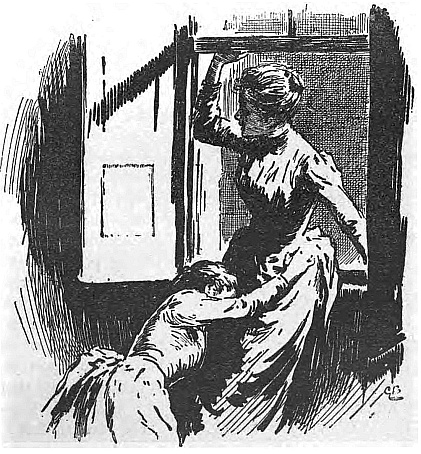
For a moment I thought that it might have been a teacher en déshabille; but the horrible silence soon showed that it was not. And at last, when I felt that I could bear no more, but must scream, having been walked right up to the wall by the hideous thing, it spoke, and the words seemed to act upon us both like magic, sending the blood coursing through our veins, making our hearts throb, and a warm glow to return where a moment before all was frozen and chilling; for just as I was sinking—feeling myself gliding slowly down upon kneeling Clara—I started up, for it said, in a loud, thrilling whisper—
“What are you two a-doing of?”
Then it sneezed.
Of course it was Patty Smith, who had pretended to be asleep, and watched all the time, following us along the passage, and thoroughly upsetting all one’s plans again. She could see plainly enough that we had the window open, and knew pretty well what was taking place; so we had to make a virtue of necessity, and tell her, in as few words as possible, all about it. Not that I think she would have told tales, even if we had not enlightened her; but we knew she would watch us, and find out for herself; so upon the principle of its being better to make a friend than an enemy, she was told all.
“Won’t you make your cold worse, dear?” said Clara. “You are not dressed.”
“I don’t care,” said the stupid thing; and then she stopped, while I went to the window again; and though I had lost my string, and knew that it was of no use to try any more that night, I gave a gentle cough and then waited a moment. I was about to cough again, but Patty, who was close behind me, sneezed once more loudly; and at last, after waiting a few minutes and coughing again and again, Clara and Patty both grumbled so about the cold that I was obliged reluctantly to close the window. After waiting for awhile, we one by one stole back to the bedroom, where Patty declared that it was such good fun, and that she would go with us next time—just as if we wanted her; while poor I laid my cheek upon my pillow, disappointed, disconsolate, and upset to such a degree that I could do nothing else but have a good quiet cry for I don’t know how long; but I know how wet my pillow grew, so that at last I was obliged to turn it before I could get to sleep.
And what was the use of going to sleep, to be in such trouble that I did not know what to do—dreams, dreams, dreams, and all of such a horrible kind! Now it was Achille in danger, now it was the white figure coming in at the door, and one moment Patty Smith, and then changing into Mrs Blunt and Miss Furness, Miss Sloman and the Fraülein; while, last of all, if it was not mamma, looking dreadfully cross, and then scolding me for my bad behaviour. Oh, it was terrible! And I don’t think that I ever before passed such a night.
Chapter Eighteen.
Memory the Eighteenth—In Terrible Suspense.
My spirits rose a little after breakfast the next morning, though I only smiled sadly as I thought of my many disappointments; but we had had a long talk with Patty, and she had faithfully promised never, upon any consideration, to divulge one of our secrets. Of course I did not like making another confidante; but, under the circumstances, what could one do?
“Ah!” said Patty; “but it was a great shame that you did not tell me before.”
“Why, we should have told you,” said Clara—a wicked storyteller—“only you do sleep so soundly, dear.”
Though, after all, perhaps that was nearly the truth; for, if she had not slept so soundly, we should have been obliged to let her into our secrets sooner.
This satisfied her, but it did not satisfy me; for the stupid creature must go about looking so knowing, and cunning, and deep, and laugh and leer at Clara, and nod and wink at me, all day long, till it was dreadfully aggravating, and enough to make anybody suspicious; and I almost wonder that one of the watchful dragons did not have something to say about it.
“Why, we shall be obliged to have her in the room all the time,” I said to Clara, as I was thinking of my next interview with Achille; that is, if I ever was to have another.
“Never mind, dear,” replied Clara; “it cannot matter much. She is very stupid, and I daresay that I can keep her in order.”
I contrived to let Achille know all when he came the next day, and gave him to understand that he might try again upon any night he liked; for the last was only a false alarm, and all would have gone well had I but only held tightly by the cord. I gave him the information, written in French, at the top of my exercise, while Miss Furness was in the room, when if he had not the audacity to call me up to his elbow—for he had seen it all in an instant—and if he did not point out and mark two or three mistakes in the note I had scribbled so hastily at the top about the last meeting. However, I suppose he wished me to speak his own language correctly; and none but the brave deserve the fair.
There was one thing, though, in our correspondence which I did not like—poor Achille never could take any interest in our English poets; so that, if one quoted a bit of Byron or Moore to him, it was good for nothing, while he, the tiresome man, was always filling up his notes with scraps of Molière, and I am sure I always praised them, and said that they were very beautiful.
And now once more came the night for meeting, with all its heart-throbbing flurry and excitement; but this time, apparently, without any of the terrible contretemps that had previously troubled us. Patty was in high glee, and sat on the edge of her bedstead, munching an Abernethy biscuit, and grinning; while her great eyes, instead of half closing, like anybody else’s would when they were laughing, became more round and wide open than ever. It seemed to be capital fun to her, and over and over again, when I glanced at her, she was giggling and laughing; and I do believe that, if I had not been there, she would have got up and danced about the room.
But it was time to start at last, and upon this occasion I had no noisy drawer to open, for I had a ball of new, stout string in my pocket. So, one at a time, we glided along the passage, Clara going first, Patty second, and I followed behind, to close our door as quietly as was possible.
“Pat, pat, pat,” and, with a gentle rustle, we passed along the passage, and stood at last in the little end room, while I am sure that no one could have heard our footsteps.
Clara made one effort to get rid of Patty before we started, but it was of no avail.
“Arn’t you afraid of catching a worse cold?” she said; “hadn’t you better stay in the bedroom, dear?”
For really she had a most miserable cold, and her eyes and nose looked as red as red.
“I sha’n’t catch any more cold than you will,” she cried, just as she had once before upon a similar occasion—“I want to see all the fun.”
Fancy calling it fun!
So we were obliged to suffer her presence; but I am afraid that I was uncharitable enough to wish that she might catch a bad sore throat for her pains, or else something that would keep her from coming again.
However, there we all were; and as soon as ever we were all in the little room, I secured the door with a fork that I had brought for the purpose, and then, pulling out my string, I unfastened the window, when, fortunately, it glided up beautifully.
Clara was the first to look out, and it not being a dark night, she popped in again directly, saying in a whisper—
“There he is. I can see him.”
“Let me look,” cried Patty Smith, quite out loud; and then, when her head was out of the window, if she did not give quite a loud cough, in not only a most indiscreet way, but, really, one that was most reprehensible.
I pulled her back as quickly as I could, and, in a whisper, gave her a good scolding. Then I tied my scissors to the end of the string, to make it go down quickly, and swinging them over the great ledge, I looked down; but I could not see poor Achille, for he had come close up to the house, and was, of course, out of sight beneath the cornice.
“But I shall see him soon,” I said to myself; and went on letting down the scissors till the string felt slack, and I knew that they touched the ground, when, just as before, I felt the string seized and jerked about, as if being attached to something; and well I knew what, though a half-fear took hold upon me now lest it should break the string, which was not so strong as I could have wished.
But now there was the signal; and I began to pull up the heavy rope ladder, cutting my poor little fingers with the string. At first it came up pretty quickly, but soon slower, for again it began to grow heavier; and at last, when I made sure that it must be nearly up, if it must not turn contrary against us, and catch against the cornice, and remain immovable.
What was I to do? It was of no use to pull and jerk; for, if we had pulled any harder, I’m sure that the string must have broken. If it had not been for Clara, I should have climbed out of the window, and stood upon the cornice, to set it at liberty, for she could easily have held my hand, so that I should really have been quite safe.
But she would not hear of this, and I don’t know what I should have done if I had not thought of lowering the ladder down a little way, and then trying again, when, to my great delight, up it came, and Clara soon had hold of a pair of great iron hooks, just the sort of hooks I expected to see; and on fixing them upon the sill, my side, we found that they fitted beautifully; so I threw myself upon them to hold them in their places, lest they should slip.
Just after that there was a sharp rustle of the rope, and then it was pulled tight; while now, making Clara hold one hook and Patty the other, I strained out as far as I could reach, so that I could see Achille mounting, slowly ascending, the dangerous thing; and, although we all held on as tightly as we could, when he was about a dozen feet from the ground the tiresome rope began to twist and spin round and round, so that the poor fellow was twisting just as if he was being roasted, and I’m sure he must have been as giddy as giddy.
Fortunately for him, he did not always go the same way round, but twisted back again, or else he must have dropped off. It was not as if he had been close up to the house, for then he could have touched the wall and stopped himself; but the cornice, which was a good width, kept him away, so that he swung clear. And perhaps, after all, it was quite as well, for he might else have gone right through one of the windows.
It was very shuddery and dreadful; but we poor girls could do nothing but grasp the rope and hold our breath, and, as Clara said, hold our tongues; though Patty would keep letting go, and staring out of the window when she was not wanted to.
“Won’t I tease him about this,” she said. “Only see, the first time he finds fault with my exercises.”
“Hush! you foolish child,” I exclaimed. “Good gracious me! you must never say a word to him about it, under any consideration.”
“Mustn’t I?” said Patty, as innocently as could be.
“No, of course not,” cried Clara; “that would ruin everything.”
For I was now reaching as far as could be out of the window, to see what poor Achille was about; for the rope seemed to be doing nothing, and did not jerk as if he was getting higher and higher. And then, oh, dear! if I could not just see one of his feet where his head was last time I looked; for he was sitting upon the sill of the first floor window—the best bedroom, which was, of course, empty—and, I suppose, resting himself.
All at once, though, I heard him whisper—
“Is de ting sauf?”
“Yes, yes,” I whispered in reply.
And then the rope crunched upon the cornice, as if he had again committed to it his weight, when I drew in my head and waited, trembling, for him to reach the window; and it did seem such a long time to come so short a distance; but, as he told me afterwards, the loops would keep slipping away when he wanted to put his feet in them, besides the rope spinning him round until he was giddy. At last I looked out again, and then drew back my head in agony; for if he was not hanging by one leg, head downwards, just like my poor Dick, the canary, did in London, when it caught its claw in the wire of the cage and could not get loose.
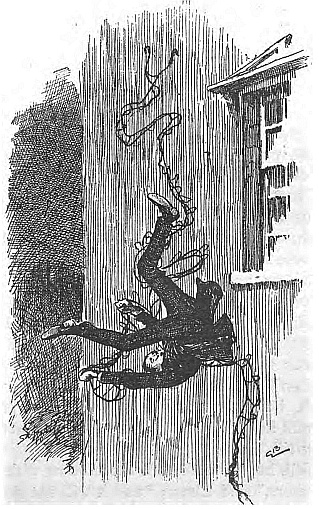
As I said, I drew in my head, quite in an agony of fear; but the rope jerked about so that I was obliged to gaze once more, and then I ejaculated, quite loudly—
“Oh, Achille!”
“Eh, yais, oui,” he exclaimed. “I ’ave put in mine’s foot.”
“In what—in what, mon cher?” I whispered.
“Oh,” he gasped, in a thick voice, “mais je suis giddy. I ’ave puts my foot trou de loops, and cannot get him back.”
“Oh, pray come in!” cried Clara, who had heard every word, and seemed quite horrified—“pray come in and shut the window. Let’s go away.”
“Oh, nonsense,” I said, “he will be hung: he will die! His head is hanging down, and his leg sticking up in the rope. He has slipped. Whatever shall we do?”
“Why don’t you cut the rope?” said Patty; but of course no one took any notice of her.
“Let’s unhook the things,” whispered Clara, “and then drop him down into the laurustinus.”
“Oh, how can you be so stupid!” I panted. “It would kill him: he’s right above the first floor window-sill.”
“Well, but we can’t shut the window with those things there,” said Clara; “and it will not do to be found out.”
I looked again, and there he still was twirling round just as if he was being roasted, and the rope shaking so that I thought it must break. I kept whispering to him, but he did not hear me; and just dim and indistinctly as he was seen, I could make out that he was trying to double himself up and get his hands to the rope.
I never, I’m sure, felt anything so dreadful before in my life as those few moments when he was struggling there, and me unable to help him; for, in addition to the horror, there was the pricking of my conscience, as it told me that this was all my fault, and that if he was killed I should have murdered him. Which was very dreadful, you know, when that last affair of the cistern, which he escaped from with a fearful drenching, ought to have been a warning to me to have spared him from running any more risks on my behalf.
I declare that I should have tried to slide down the rope to help him, or else to share his fate, if Clara had not restrained me once more; but she kept tightly hold of my waist, till there came up a sound like the gnashing together of teeth, the rope gave a terrible shake, and the iron hooks fell jingling upon the floor.
There was a crashing and rustling of leaves and branches, as if a heavy body had fallen amongst trees, and then all was still, except for a deep groan—a French groan—which came up, thrilling us all horribly; for the rope had come unfastened, and had slipped through the round rings of the hooks.
We all stood aghast for a few minutes; but at last I summoned up courage enough to lean out, and whisper loudly—
“Achille! mon ami Achille!” when, as if in answer, came a most doleful “H-ooo, o-o-o, ho-o-o-o!” which made one’s very blood run cold.
“That’s only an owl,” said Clara, the next minute.
“A howl!” said Patty; “that it wasn’t, it was a groan, just the same as the pigs give when they’re dying in our slaughter-house at home.”
I leaned out of the window as far as I could, once more, and was trying to pierce the darkness below, when all at once I heard a window to the right opening very gently, and squeaking as it ran up, and that window, I felt sure, was the lady principal’s; so, recollecting the night of the alarm from Clara’s basin—agonised though I was—I felt obliged to close ours quietly, pick up the two hooks, and then we all three glided back to our room—my heart chiding me the while for forsaking poor Achille in such a time of dire distress. But what could I do? To stay or to raise an alarm was to be found out, and perhaps—ay, perhaps!—poor fellow, he was not hurt, after all.
It was just as well that we did slip back, for we had hardly closed the door before the alarm bell on the top of the house began to ring, and we heard the Fraülein spring out of bed with a regular bump upon the floor.
We were not many seconds scuffling into bed; and, just as we lay down, we heard the Fraülein’s door open, and then there were voices talking and a good deal of buzzing about, for quite half an hour. But we thought it better not to go out; for, when Clara took a peep, Miss Furness was hunting several of the girls back into their rooms with—
“Nothing the matter, young ladies. Back to your dormitories.”
So we lay quite still, and listened; while I essayed to allay my horrible fears about poor Achille, and tried to fancy that every sigh of the wind among the branches was him stealing—no, I won’t say stealing, it looks so bad—hurrying away. Then we heard the Fraülein come in, and her bed creak loudly as she lay down; and once more all was quiet, and I felt sure that they could not have seen or heard anything, but I dared not get up once more to see. Clara said she was sure she heard Mrs Blunt talking to the policeman out of the window again. Perhaps she did, but I did not; though it was most likely, after the ringing of the alarm bell.
“What are you sobbing for?” said Clara, all at once.
“Oh, I know he’s killed,” I said.
“Pooh, nonsense,” she replied, in her unfeeling way, “he only went plop among the bushes; and they say exiles always manage to fall on their feet when they come to England, just like cats. He is not hurt, unless he has scratched that beautiful face of his a little bit.”
“Then you don’t think he is killed, dear?” I said, seeking for comfort, alas! where I was but little likely to find it, I’m sorry to say.
“Not I,” said Clara; “it was not far enough to fall.”
“I sha’n’t go no more,” drawled Patty; “it ain’t half such fun as I thought it was. Why didn’t he come right up?”
“Don’t be such a goose!” cried Clara to the noodle. “Why, didn’t he get his leg caught, and then didn’t the rope give way?”
“I’m sure I dunno,” said Patty, yawning; and then, in spite of all the trouble, we all dropped off fast asleep.
Chapter Nineteen.
Memory the Nineteenth—Our New Guardian.
For a few moments after I woke I could not make out what made me feel so heavy and dull. Of course, it was partly owing to their ringing that stupid bell down in the hall so early, for fear we should have a morsel too much sleep; but all at once, as upon other occasions, I remembered about the previous night and poor Achille; when, of course, the first thing I did was to rush to the window and throw it up, to try and catch a glimpse of the scene of the last night’s peril, when the first thing my eyes rested upon was that horrid Miss Furness taking her constitutional, and, of course, as soon as she saw me she must shake her finger angrily, because I appeared at the window with my hair all tumbled. I never saw anything like that woman. I always did compare her to an old puss, for she seemed as if she could do without sleep, and always got up at such unnatural hours in the morning, even when the weather was cold and dark, and wet, when it seemed her delight to go out splashing and puddling about in her goloshes; and somehow, or another, she never seemed to catch cold as anybody else would if she had acted in the same way. It must have cost her half her salary for green silk umbrellas; for James generally managed to spoil every one’s umbrella when they were given him to dry, and Miss Furness never would use any but the neatest and most genteel-looking parapluies, being the only thing in which she displayed good taste.
Of course I had a good look out as soon as I was quite ready to go down, when I could see that the flower bed was a great deal trampled, one of the bushes was quite crushed, so that I knew there would be a terrible to do about it as soon as it was noticed.
“Well, is he there?” said Clara, “or is it only his pieces? Do make haste down, and run and secure his heart, before they pick it up, and put it on a barrow to wheel away.”
“La!” said wide-open-mouthed Patty, staring; “he would not break, would he?”
“Oh, yes,” replied Clara. “French gentlemen are very fickle and brittle, so I should not at all wonder if he broke.”
“Better break himself than the jam pots,” I said, spitefully, when Clara coloured up terribly, as she always did when the Signor was in any way alluded to; for though I did not like to hurt her feelings about the jam when she was shut up, of course, she had not been at liberty long before she heard all about it I know it was mean on my part to retaliate as I did, but then she had no business to speak in that way; for it was too bad to make fun out of such trouble. Then, of course, she must turn quite huffy and cross, and go down without speaking; for some people never can bear to be joked themselves, even when their sole delight consists in tormenting other people.
I could not but think that poor Achille had escaped unhurt, though at times I went through the same suffering as I did on the morning after the discovery in the conservatory;—and really, when one comes to think of it, it is wonderful that no suspicion ever attached to either Achille or myself over that dreadful set-out. Breakfast over, I seemed to revive a little; though I must confess that what roused me more than anything was Miss Furness finding out that I looked pale and red-eyed, and saying that she thought I required medicine.
“For you know, Miss Bozerne, a little foresight is often the means of arresting a dangerous illness; so I think I shall call Mrs de Blount’s attention to your state.”
“Oh, please, don’t, ma’am,” I said. “I assure you that I feel particularly well this morning.”
But she only gave one of her self-satisfied smiles and bows; when in came the tall footman to say that the gardener wished to speak with “missus.”
“Missus” was not there, so the footman went elsewhere to find her; but the very mention of that gardener brought my heart to my mouth, as people say; though I really wonder whether that is true—I should like to know. Then I had a fit of trembling, for I made sure that he had found poor Achille, lying where he had crawled, with all his bones broken, in some out-of-the way corner of the garden; perhaps, possibly, to slake his fevered thirst in my favoured spot, close by the ferns, and the miserable fountain that never played, green and damp beneath the trees.
But I could not afford to think; for just then the door was opened, and Mrs Blunt stood with it ajar, talking to the gardener in the hall, and of course I wanted to catch what he said; when, just as if out of aggravation, the girls made a terrible buzzing noise. But I heard enough to tell me that it was all about the past night, and I caught a word here and there about bushes broken, and big footsteps, and trampled, and so on; while, as a conclusion to a conversation which had roused my spirits by telling me that poor Achille had not been found, Mrs Blunt placed a terrible damper upon all by saying—
“It must have been the policeman, gardener; and he shall be spoken to respecting being more careful. But for the future we’ll have a big dog, and he shall be let loose in the garden every night.”
I could have rained down tears upon my exercises, and washed out the ink from the paper, when I heard those words; for in imagination, like some gladiator of old, in the brutal arena, gazed upon by Roman maids and matrons, when battling with some fierce wild beast of the forest, I saw poor Achille struggling with a deep-mouthed, fang-toothed, steel-jawed bloodhound, fighting valiantly to have but a minute’s interview with me; while, dissolving-view-like, the scene seemed to change, and I saw him, torn and bleeding, expiring fast, and blessing me with his last words as his eyes closed. Then I was planting flowers upon his grave, watering them with my tears, and plaiting a wreath of immortelles to hang upon one corner of the stone that bore his name, ere I departed for Guisnes to take the veil and shut myself for ever from a world that had been to me one of woe and desolation.
“Oh, Achille! beloved, martyred Achille!” I muttered, with my eyes closed to keep in the tears, when I was snatched back to the realities of the present by the voice of Miss Furness, who snappishly exclaimed—
“Perhaps you had better go and lie down for an hour, Miss Bozerne, if you cannot get on with your exercise without taking a nap in between the lines.”
I sighed—oh, so bitter and despairing a sigh!—and then went on with my task, sadly, sorrowfully, and telling myself that all was indeed now lost, and ’twere vain to battle with fate, and I must learn to sit and sorrow till the sun should shine upon our love.
The dog came.
Such a wretch! I’m sure no one ever before possessed such a horrible, mongrel creature. Instead of being a large, noble-looking mastiff or hound, or Newfoundland dog, it was a descendant, I feel convinced, of the celebrated Snarleyyow that used to bite poor Smallbones, and devour his dinner. It was one of those dogs that you cannot pet for love, because they are so disagreeable, nor from fear, because they will not let you; for every advance made was met by a display of teeth; while if you bribed it with nice pieces of bread, they were snapped from your hand, and the escapes of your fingers were miraculous. I should have liked to have poisoned the nasty, fierce thing; but, of course, I dared not attempt such a deed. And what surprised me was Mrs Blunt being able to get one so soon, though the reason was plain enough—the wretch had belonged to a neighbour who was only too glad to get rid of it, and hearing that Mrs Blunt wanted a dog, jumped at the chance, and I know he must have gone away laughing and chuckling. We used to call the horrid wretch Cyclops, for he had only one eye; but such an eye! a fiery red orb, that seemed to burn, while the wretch was as big almost as a calf. I knew that poor Achille would never dare any more adventures now for my sake; and it did seem such cruel work, for a whole fortnight had passed since I had heard from or seen him, for when the lesson was due after our last adventure, there came a note from Mrs Jackney’s, saying that Monsieur de Tiraille had been taken ill the night before, and was now confined to his bed.
Only think! confined to his bed, and poor Laura unable to go to him to tend him, to comfort him, and smooth his pillow, at a time when he was in such a state of suffering, and all through me—all for my sake! I’m sure I was very much to be pitied, though no one seemed to care; while as for Clara, she grew unbearable, doing nothing but laugh.
Oh, yes, I knew well enough what was the matter, and so did two more; but, to make matters ten hundred times more aggravating, that lean Miss Furness must go about sighing, and saying that it was a bilious attack, and that England did not agree with Monsieur Achille like la belle France; and making believe that she was entirely in his confidence, when I don’t believe that he had done more than send word to Mrs Blunt herself. And then, as if out of sympathy, Miss Furness must needs make a fuss, and get permission to take the French class—she with her horrid, abominable accent, which was as much like pure French as a penny trumpet is like Sims Reeves’s G above the stave.
“Oh, yes,” she said, “she should be only too happy to take the class while poor Monsieur Achille was ill.”
And one way and another, the old fright made me so vexed that I should have liked to make her jealous by showing her one of Achille’s letters.
So, as I said before we had a dog in the place; and, oh, such a wretch! I’m sure that no one ever before saw such a beast, and there it was baying and howling the whole night through.
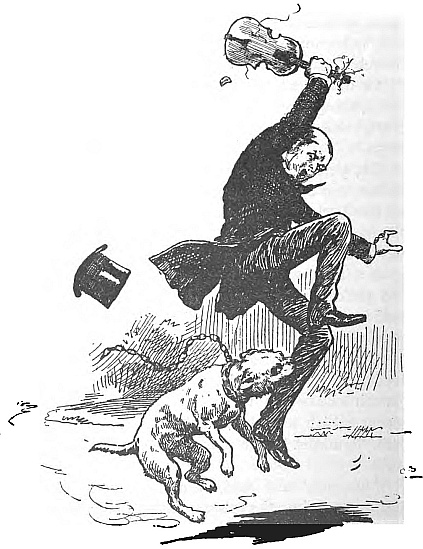
The very first day he came to inhabit the smart green kennel that Mrs Blunt had had bought, he worked his collar over his ears and got loose, driving the gardener nearly mad with the pranks he played amongst the flowers; when who should come but poor meek, quiet, innocent, tame Monsieur de Kittville. The wretch made at him, seizing him by the leg of his trousers; but how he ever did it without taking out a bit of his leg I can’t make out, for his things were always dreadfully tight; and there was the wretch of a dog hanging on and dragging back, snarling the while, and the poor little dancing master defending himself with his fiddle, and shrieking out—
“Brigand! Cochon! Diable de chien! Hola, ho! Au secours! I shall be déchiré! Call off te tog!”
And at every word he banged the great beast upon the head with the little fiddle, till it was broken all to bits; but still the dog held on, until the gardener and James ran to his assistance.
“He won’t hurt you, sir,” said the great, tall, stupid footman, grinning.
“But he ayve hurt me, dreadful,” cried the poor dancing master, capering about upon the gravel, and then stooping to tie his handkerchief over his leg, to hide the place where the dog had taken out a piece of the cloth, and was now coolly lying down and tearing it to pieces. “I am hurt! I am scare—I am fright horrible!” cried poor Monsieur de Kittville; “and my nerves and strings—oh, my nerves and strings—and my leetle feetle shall be broken all to pieces. Ah, Madame Bloont, Madame Bloont, why you keep such monster savage to attack vos amis? I shall not dare come for give lessons. I am ver bad, ver bad indeed.”
“Oh, dear, oh, dear! how can I sufficiently apologise?” exclaimed Mrs Blunt, who had hurried up, and now began tapping the great dog upon the head with her fan. “I am so extremely sorry, Monsieur de Kittville. Naughty dog, then, to try and bite its mistress’s friends.”
“Aha, madame,” said the poor little man, forgetting his trouble in his excessive politeness and gallantry—“mais ce n’est rien; just nosing at all; but I am agitate. If you will give me one leetle glass wine, I shall nevare forget your bonté.”
“Oh, yes, yes—pray come in,” said Mrs Blunt.
And then we all came round the poor, trembling little martyr; and although we could not help laughing, yet all the while we pitied the good-tempered, inoffensive little man, till he had had his glass of wine and gone away; for, of course, he gave no lesson that day, and I must chronicle the fact that Mrs Blunt gave him a guinea towards buying a new instrument.
“But, oh, Clara,” I said, when we were alone, “suppose that had been poor Achille?”
“Oh, what’s the good of supposing?” said Clara, pettishly. “It was not him, and that ought to be enough.”
“But it might have been, though,” I said; “and then, only think!”
“Think,” said Clara, “oh, yes, I’ll think. Why, he is sure to have him some day.”
“Don’t dear, pray,” I said.
“And then,” continued Clara, “he’ll fight the dog, and kill him as King Richard did the lion.”
“Oh, please, don’t tease,” I said humbly; “I wonder how he is.”
“Miss Furness says he is better,” said Clara.
“How dare Miss Furness know?” I cried, indignantly.
“Dear me! How jealous we are!” she said, in her vulgar, tantalising way. “How should I know?”
And, for the daughter of a titled lady, it was quite disgusting to hear of what common language she made use.
“I don’t believe that she knows a single bit about it at all,” I said, angrily; for it did seem so exasperating and strange for that old thing to know, while somebody else, whom he had promised to make—but there, I am not at liberty to say what he had promised.
“You may depend upon one thing,” said Clara, “and that is that your Achille will not be invulnerable to dogs’ bites; though, even if he is, he will be tender in the heel, which is the first part that he will show Mr Cyclops, if he comes. But you will see if he does not take good care not to come upon these grounds after dark—that is, as soon as he knows about the dog. By-the-by, dear, what a dislike the dog seems to have to anything French.”
“I’d kill the wretch if it bit him,” I said.
Clara laughed as if she did not believe me.
“I would,” I said; “but I’ll take care somehow to warn him, so that he shall run no such risks. For I would not have him bitten for the world.”
“Of course not—a darling?” said Clara, mockingly.
And then no more was said.
But matters went unfortunately, and I had no opportunity for warning poor Achille, who was attacked in his turn by the wretch of a dog—who really seemed, as Clara said, to have a dislike to everything French; while, by a kind of clairvoyance, the brute must have known that poor Achille was coming. For, by a strange coincidence—not the first either that occurred during my stay at the Cedars—the creature managed to get loose, and lay in wait just outside the shrubbery until he came, when he flew at him furiously, as I will tell.
Chapter Twenty.
Memory the Twentieth—The New Prisoner.
I had no idea that Achille was well enough to go on with the lessons, neither had anybody in the house; for Miss Furness had just summoned us all to the French class, and my mind was, to a certain extent, free from care and pre-occupation, when I heard a most horrible snarling and yelling, and crying for help. Of course I darted in agony to the window, when it was just as I had anticipated—just as I knew, by means of the electric current existing between our hearts—Achille was in peril; for the horrible dog had attacked him, and there he was in full flight.
As I reached the window, the wretch leaped upon him, seizing his coat, and tearing away a great piece of the skirt; but the next moment poor Achille made a bound, and caught at one of the boughs of the cedar he was beneath; and there he hung, with the horrible dog snapping and jumping at his toes every time they came low enough.
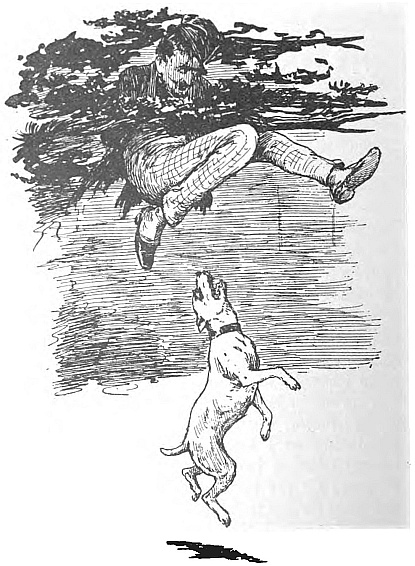
It was too bad of Clara, and whatever else I may look over, I can never forgive this; for she laughed out loudly in the most heartless way, and that set all the other girls off wildly, though Miss Furness, as soon as she saw what had happened, began to scream, and ran out of the room.
Only to think of it, for them all to be laughing, when the poor fellow must have been in agony! Now he contracted, now he hung down; then he drew himself up again, so that the dog could not reach him; but then, I suppose, from utter weariness, his poor legs dropped down again, and the vicious brute jumped at them, when of course poor Achille snatched them up again—who wouldn’t?—just as if he had been made of india-rubber, so Clara said. Such a shame, laughing at anyone when in torment! It was quite excruciating to see the poor fellow; and if I had dared I should have seized the poker and gone to his assistance. But, then, I was so horribly afraid of the wretched dog myself that I could not have gone near it; and there poor Achille still hung, suffering as it were a very martyrdom, with the dog snap, snap, snapping at his toes, so that I felt sure he would either be killed or frightfully torn. All at once, for I really could not keep it back, I gave a most horrible shriek, for though James was running to get hold of the dog, he was too late.
The beast—the dog I mean, not James—had taken advantage of poor Achille’s weariness, leaped up and seized him by one boot, when nature could bear no more weight, and I saw the unhappy sufferer fall right upon the dog; when there was a scuffle and noise of contention, and the cowardly animal ran yelping and limping off upon three legs; while Achille, looking pale and furious, stood straightening and brushing his clothes, and trying to put himself in a fit state to pay his visit.
That was the last I saw; for the next thing I remember is Mrs Blunt calling me a foolish, excitable girl; and they were sopping my face with cold water, making my hair all in such a wet mess, and the salts they held close to my nose were so strong that they nearly choked me.
“There, leave her now, young ladies, she is getting better,” said Mrs Blunt; for the horrible sick sensation was certainly going off, and I began to awaken to the feeling that Achille was safe. Then it struck me all at once that I must have fainted away from what I had seen, and the thoughts of those around being suspicious nerved me to rouse myself up and hide my confusion.
They wanted me to give up my French lesson that morning, but I declared that I was so much better that they let me go in, and I really did expect just a glance; but, no, he was like a piece of marble, and took not the slightest notice either of Clara or poor me. Then, too, he was as cross and snappish as could be, and found great fault, saying everything was disgracefully done, and that every one had been going back with the French ever since he had been away. But I did not mind that a bit; for I saw how it was making Miss Furness’s ears tingle, which was some consolation, seeing how hard she had been working us, and what a fuss she had been making, as if she were Monsieur Achille’s deputy; and really I was getting jealous of the tiresome old thing.
I took my snubbing very patiently; but I could not help feeling terribly angry when he rose to go, and, with an affectation of bashfulness, Miss Furness followed, simpering, looking, or rather trying to look, in our eyes, as if she were engaged. But I followed too, almost as soon as the door was closed; and to my rage and disgust I found the hall empty, with Achille’s hat still standing upon the table, so that he could not have gone.
“They must have gone into the drawing-room,” I muttered.
And then once more my head began to swim, for I felt raging—jealous; and it did seem a thing that, after all I had suffered and done for his sake, I was to be given up for a dreadful screwy thing, old enough to be my mother at the very least. But I would not faint this time, I was too angry; and stepping across the hall, I opened the drawing-room door, softly and quickly, and walked in just in time to see that base deceiver, Achille, kissing the hand of the old hypocrite. And how they did both flinch and cower before my indignant glance!
Miss Furness was, of course, the first to recover herself, and step forward in a vixenish manner, just as if she would have liked to bite.
“And pray, Miss Bozerne, what may be your business?” she exclaimed.
“Oh, I merely came for my wool-work,” I replied, in a tone of the most profound contempt; and, sweeping across the room, I fetched a piece of work that I knew to be under one of the chair cushions, and then I marched off, leaving Achille the very image of confusion, while as for Miss Furness, she was ready to fly at me with spite and anger.
I kept it up till I was outside the room, and had given the door a smart bang, when I rushed upstairs, and past Mrs Blunt, who called to me in vain to stop, and then to my bedroom, where I locked myself in, and had such a cry, as I dashed down the wool-work, and threw myself upon the bed, to lie with my burning cheek upon my pillow, and water it with my tears.
Rage, vexation, disappointment, love—I’m sure they were all mingled together, and sending me half wild. Only to think of his turning out a deceiver!—to leave me and go and pay court to a woman of forty, with a yellow skin, scraggy neck, and a temper of the most shrewish! I was so passionate then, that I jumped off the bed and ran to the glass, and if it too was not a deceiver, and did not tell me a story, I was handsome. But I vowed that I would be revenged for it all; and I stamped up and down the room, thinking of what would be the best way; but, somehow, I could not think of a plan then, so I lay down once more, and had another good cry.
“Never mind,” I said.
Then I raised myself upon my elbow, and just at that moment some one knocked.
“What is it?” I cried, after whoever it was had knocked four times, and would not go away.
“Mrs de Blount says that she requests you to descend directly,” said one of the younger pupils.
“Tell her I have a very bad headache,” I said, which really was a fact; and then I would not answer any more questions, for I was determined not to go down until all the marks of my crying had faded away, which I knew would not be for some time.
“Miss Furness won’t make me afraid of her any more,” I said to myself. “I’ve mastered her secret; and Achille dare not tell of me, for fear of betraying himself. I’ll serve them both out.”
I lay nursing up my wrath, till I felt obliged to cry again; and then, when I had done crying, I again picked up my wrath and nursed it; and so on, backwards and forwards, till all at once I started up, for there was one of those hideous German brass bands. A set of towy-headed, sleepy-faced boys were blaring out “Partant pour la Syrie” in the most horribly discordant manner, till James was sent to order them out of the grounds, when, to get the dreadful discords out of my head, and my mind more in tune, I took advantage of a permission lately given me by Mrs Blunt, and slipped quietly down into the drawing-room, which was now empty. Sitting down to the piano, I rattled away at “La Pluie de Perles” until my fingers ached again, when I took up something of Talexy’s, and I suppose it was all emotional, for I’m sure I never played so brilliantly before in my life—the notes seemed quite to sparkle under my fingers, and I kept on rattling away till I was tired, and dashed off the great finishing chords at the end.
Then I slammed down the piano, spun myself round upon the stool, and jumping up, I was about to make a pirouette, and what we girls, in happy, innocent, thoughtless days, used to call a cheese, when I gave a start, for Mrs Blunt was standing there with a lady in walking costume, who was smilingly inspecting me through a great gold eyeglass, just as if I were some curiosity; and, of course, instead of the pirouette, I made one of the spun-out, graceful obeisances so popular at the Cedars.
“One of our pupils,” said Mrs Blunt, in her most polite tones. “Mrs Campanelle Brassey—Miss Bozerne. Young and high-spirited, you see,” she continued, smiling benignantly upon me, just in the way that she had done when mamma was with me, and never since. “Young, happy, and light-hearted. Just at that age when life has no cares,”—couldn’t I have pinched her. “She adores melody—quite a daughter of the Muses.”
“Charming gyirl,” said the lady, smiling. “Sweetly featured—so gazelle-eyed. Most unaccountably like my Euphemia.”
“Indeed!” said Mrs Blunt. “How singular! They will, no doubt, be like sisters.”
“Charming for Euphemia, to be sure,” said Mrs Campanelle Brassey. “It will make the change from home so pleasant, and she will not pine.”
“No fear of that,” said Mrs Blunt—“ours is too home-like an abode.”
“No doubt,” said Mrs Campanelle Brassey. “And then there is that other charming gyirl—the one with the sweet, high-spirited features—the one you just now showed me. Lady—Lady—Lady Somebody’s daughter.”
“Lady Fitzacre’s,” said Mrs Blunt.
“To be sure,” said Mrs Campanelle Brassey. “Why, your establishment will be most enviable, Mrs Fortesquieu de Blount; for I’m sure that you will have the Three Graces within your walls.”
“Oh, fie!” exclaimed Mrs Blunt, playfully; “you are bringing quite a blush to the face of our young friend.”
My cheeks certainly were tingling, but it was only to hear them talk such twaddle; and I knew well enough now that they must have been looking on for some time, while Mrs Blunt only let me keep on strumming to show off before the visitor; for if it had been one of the girls who played badly, she would have been snubbed and sent off in a hurry for practising out of her turn.
For a moment, though, I felt a pang shoot through me—a jealous pang—as I thought that, if this new pupil came, she might bear off from me my Achille; while the next moment I was ready to laugh scornfully from the recollection that I had no Achille, that he was already another’s, that men were all false and deceivers, and that I could now turn satirical, and sympathise with Clara.
However, I showed none of the painful emotions sweeping through my breast, but took all in good part, and allowed Mrs Campanelle Brassey to tap me with her eyeglass, and kiss me on the cheek, which kiss was, after all, only a peck with her hooky nose; and then she must take what she called a fancy to me, and march me about with them all over the place, and call me “My love,” and “My sweet child,” and all that sort of stuff, when she was seeing me now for the first time; but, if I had been the most amiable of girls, but plain, like Grace Murray, instead of showy and dashing, she would not have taken the least mite of notice of me.
Yes: really, this is a dreadfully hypocritical world!
“My Euphemia will be charmed to know you, my love,” said Mrs Campanelle Brassey, looking at me as if I were good to eat, and she were a cannibal’s wife—“charmed, I’m sure.”
“I sha’n’t be charmed to know her,” I said to myself, “if she is as insincere as you.”
“I’m sure that you will soon be the best of friends. It will be so nice for her to have one to welcome her directly she leaves home, and, of course, we shall have the pleasure of seeing you on a visit at the Belfry during the vacation.”
Of course I thanked her, and thought that if I liked Euphemia I should very likely go home with her for a while, since all places now seemed the same to me, and I should require some délassement.
“This is one of our classrooms, my dear madam,” said Mrs Blunt, opening the door where all the girls were sitting, and just then Clara came across from the practice-room, with her music-book beneath her arm, for Mrs Blunt had taken care that Mrs Campanelle Brassey should not stand and hear her hammer away at the old ting-tang. Clara told me afterwards that she stopped as soon as the door opened. But then Clara never could play a bit, and I must say that she knew it, though, as I before said, her sketches were lovely.
“Charming, indeed,” said Mrs Campanelle Brassey, inspecting the girls through her glass, just as if it were a lens, and they were all so many cheese-mites.
Just then I exchanged glances with Miss Furness, but I was not going to be stared down; for feeling, as I did, fierce and defiant, I just contemptuously lowered my lids. Next moment the door was closed, and we went into the dining-room, and then upstairs to the dormitories.
“What a charming little nest!” exclaimed Mrs Campanelle Brassey, when we entered our room at last, after inspecting, I think, every chamber in the place—for everything really was kept beautifully nice, and neat, and clean; and, though plain, the furniture and carpets were tasty and nice—“what a charming little nest! Three beds, too! And pray who sleeps here?”
“Let me see,” said Mrs Blunt, affecting ignorance, “this is your room, is it not, my dear? Ah! yes, I remember; and you have Miss Fitzacre with you, and who else?”
“Miss Smith, ma’am,” I said, quietly.
“Ah, to be sure, Miss Smith,” said Mrs Blunt.
“Not a very aristocratic name,” said Mrs Campanelle Brassey, smiling, and twirling her eyeglass about. “Pity, now, that that bed is not at liberty; it would have been so charming for the three girls to have been together night and day. I suppose that you could not manage to change the present order, Mrs de Blount?”
“Shall I give up my bed, ma’am?” I said, quietly.
“Oh, dear me, no—by no means,” said Mrs Campanelle Brassey. “I thought, perhaps, as I had seen Lady Fitzacre’s daughter and yourself, and you seemed so much of an age, that it might have been possible for the young person of the name of—er—er—”
“Smith,” suggested Mrs Blunt.
“Yes—er—for her to be exchanged into another room.”
Mrs Blunt thought that perhaps if her young friend did not object to being separated she might possibly manage it. And really I hoped she would; for any one, even Celia Blang—little spy that she was—would have been better than poor Patty.
“But I really should not like to introduce my dear child here at the expense of doing violence to anybody’s feelings,” said Mrs Campanelle Brassey.
“Oh, no! I know you would not wish that,” said Mrs Blunt; “and really, if Miss Smith objected at all to being removed, I don’t think I could—er—I should like to—to—”
“I see, perfectly,” said Mrs Campanelle Brassey; “and I quite admire and appreciate your system, Mrs de Blount. But what does my young friend here say—would she object to such a change being made? Would she not miss her friend, the young person of the name of—er—Jones?”
“Smith,” corrected Mrs Blunt; for somehow the vulgarity of the name seemed too much for Mrs Campanelle Brassey.
“I should be very glad to see the change,” I said.
“And about Miss Fitzacre?” said Mrs Blunt, with such an air of hypocritical interest, looking all the while so innocent.
“Oh, I’m certain that she would be glad,” I rejoined. “In fact, ma’am, I have heard her say so. Miss Smith is very young, ma’am,” I said, modestly, “and has never been a companion or friend to us.”
And then I felt very much afraid lest Patty should hear of what I had said, and repay me by telling all she knew.
“No; I should never have expected that from what I have seen of your two charming pupils. Mrs de Blount, that they would have had feelings, sentiments, or emotions in common with a young person of the name of—Jones.”
“Then, if your daughter wishes it, my dear madam,” said Mrs Blunt, “I think we may venture to say that the matter is settled to your satisfaction. You see,” she continued, “that when a new pupil arrives, I look upon mine as quite a maternal charge—one that embraces all that a mother owes to her child, with that of the teacher and trainer of the young and budding intellect.”
“Exactly so,” said Mrs Campanelle Brassey, nodding her head.
“And therefore,” continued Mrs Blunt, apparently much encouraged—“therefore, my dear madam, I try to study pupils’ comfort and wishes, even in those which some people might consider trivial things. I study, as far as I can, the present as well as the future; so that when, strong-winged, these young birds take flight, they may always in their happy futures—”
“Certainly—happy futures,” said Mrs Campanelle Brassey, nodding her head; “certainly, after such training.”
“Happy futures, look back,” continued Mrs Blunt, “to the days when they were at the Cedars, and feel a tear dim their eye’s brightness—a tear, not of sorrow, but of regret.”
“Very true,” said Mrs Campanelle Brassey. “I quite agree with you, Mrs de Blount. Charming sentiments.”
“And therefore, you see, had there been any dislike to the alteration upon our young friend’s part,” said Mrs Blunt, “I should not have liked to make the change.”
Yes: she actually said all that, just as if she believed it, and even smiled at me as she spoke; while, I declare, I almost felt dumb-founded to hear what she said.
The Cedars certainly must have been a most delightful place to motherly eyes, for at every turn go where we would, Mrs Campanelle Brassey was lost in admiration, and found everything charming; and she did not scruple to say so, and to such an extent that I grew tired of hearing her. But that did not matter, for there was no getting away; and I had to go with her, into the dining-room again to have some cake and wine, which I had to ring for, and then go and sit down by the side of the visitor, who seemed to know by instinct which would be the softest couch.
James brought in the wine, and when I was asked, as a matter of course, I ought to have declined, and said, with a display of Cedar deportment, “No, thank you;” but I did not intend anything of the sort, and said “Yes,” for I knew that Mrs Blunt always had the best sherry brought out for the visitors, and was in consequence terribly stingy over it. So I said, “Yes, if you please,” and took a glass, while she was obliged to smile all the time; for I did not mean to be walked about, and talked at, and talked to all day for nothing.
But at last I was set at liberty, and went off to the schoolroom to discuss the coming of the new girl, who was so handsome and charming in every respect, till Miss Furness returned from the drawing-room, where she had been to be introduced, and desired us to pursue our studies, when, of course, we were all very industrious for quite five minutes.
Chapter Twenty One.
Memory the Twenty-First—I Suffer.
“I can’t think how mammas can be so silly as to believe all that is said by these lady principals,” said Clara. “And so there’s another new girl coming, just my age? I wonder how she will like Cedar mutton—all gristle and tiff-taff. I wish I was out of it, I do! And so it’s all off between you and Monsieur Achille, is it, dear? Well, I’m very glad, for it had got to be dreadfully tiring, really. Now, tell the truth, ain’t you glad yourself?”
“N-n-no, I don’t think I am,” I said. “It will be so dull now, with nothing to look forward to; and—heigho!—who would have thought that he would be so false?”
“Anybody, everybody,” said Clara; “and yet you were highly offended because I said French gentlemen were fickle and brittle. Never mind, dear, there will be some one else some day, and I shall be bridesmaid, after all.”
“Don’t talk such stuff,” I said, dolefully; while from the far distant past there seemed to rise up the reproachful countenance of Mr Saint Purre, as I had seen him last, and I could not help sighing; while if any one had asked me whether I was sighing about Monsieur de Tiraille or Theodore Saint Purre, I really don’t think that I could have told them.
Time slipped on—I can hardly tell you how, but it really did pass. I had been home for the Christmas vacation, and tried hard to keep from going back to the Cedars, but in vain. Mamma declared that it was all for my good, and was what she called inflexible. So, after a regular round of gaiety, I was back at the hateful place once more, with the old routine wheel going round, and round, and round, and seeming to grind all the skin off my temper, so that I grew cross, and fretful, and peevish. Forming our minds, indeed! They did form our minds there, and a very bad shape they made them into. I know I was one of the most amiable of girls when I went down there; while at home now I am melancholy, and irritable, and—and—well, I don’t know what.
Time went on—cold winterly days, when we could hardly smell the fire; and as to warming ourselves, we had better have been guilty of high treason. Mrs Blunt was better, and loved a good fire, getting quite close to it; but Miss Furness had a theory that too much warmth was unwholesome, and that after coals had been put on, a fire ought never to be poked; and I declare if that tiresome old thing used not to lock up the fire-irons in the book cupboard when she left the room, so that we should not touch the grate; and there we used to be, poking it with pieces of slate pencil till they broke, or burning the end of the big ruler by hammering the burning coals with that.
Wet days, when there was no walking. Northeasterly windy days, when Miss Furness’s nose turned more red than ever, and her eyes watered with the bleak breezes that she would face. Health was everything, she used to say, and perhaps she was right; but I know I would rather be poorly and comfortable than healthy and always in misery and pain.
Dull, dreary days, with lessons from this one and lessons from that one. Italian I made some progress with, and music I always did love; but as for French, of late that had been sadly neglected. I really blushed at times to take up my exercises to Monsieur de Tiraille; but he never uttered a word of praise or blame, but always sighed softly as he looked over them, while I was stern and obdurate as fate itself. No, I could not forgive him; and note after note that he would have had me take I pretended not to see, while as to those which he sent by Clara, I returned them unopened. I repeat I could not forgive; for he had wounded me deeply, and in my tenderest sensibilities, and I showed him always that I was entirely changed. I was sorry for him, for he looked very unhappy. Yes, I pitied him, and pitied his weakness that had tempted him to forsake me for Miss Furness. I could have suffered anything else at his hands—neglect, scorn, contempt; but to forsake me for her—oh, it was too bad! But I was resigned: might they be happy!
Yes, I said so; and then I smiled in bitter mockery, as I looked upon Miss Furness’s vinegary aspect, thought of her early morning walks, and cold, uncomfortable ways, and asked myself what there was in her to make a man happy, when, like a flash, the answer came—money! For I recollected the hints I had heard dropped of Mrs Blunt being sometimes in pecuniary difficulties, and borrowing of Miss Furness, who had been very saving, and had had one or two legacies left her; so that really, and truly, the establishment was more hers than Mrs Blunt’s; and if she had liked she could have laid claim to the concern, but perhaps was waiting her time. Yes, that must be the secret; and Achille must know it. Why, of course she had told him, and they had made their plans together. I had quite given him up; but somehow the idea of those two scheming and plotting for their future angered me terribly, and whenever I had such thoughts I used to be obliged to shed a few bitter tears; so that I grew quite to sympathise with Mrs Blunt, and could see plainly enough now why Miss Furness was allowed to assume so much, and to sleep on the first floor, besides being taken into consultation upon every important occasion, when the other teachers were nowhere, or only admitted upon sufferance.
How the romance of one’s life seemed to have passed away, while one was really living under a cloud!—and I knew now the meaning of the expression. And yet there was something resigned in my feelings, and I did not mind it so very much; for I was waiting for the end of my sojourn here. I had learned the truth of there being something pleasant in melancholy, and I was always repeating the words of the old song—
“Go! You may call it madness, folly, You shall not chase my grief away; There’s such a charm in Melancholy, I would not, if I could, be gay.”
I’m not sure whether that is quite right, but it is as I recollect from very, very long—ages ago; and it was about this time that I began to feel—oh, so old, and worn, and weary.
Yes, Achille tried hard to obtain my forgiveness; but I would not notice. He whispered to me more than once, over the lessons, that it was from motives of policy that he had so acted; but I would not hear him. And it was about this time that mamma began to send me word of how frequently Theodore Saint Purre used to call at Chester Square, and how kindly he always inquired after me; and it really was very kind of him, and almost looked as if he took an interest in me. But then, what interest could he feel in the poor, weak school-girl that I was? So I only sighed when mamma wrote, and tried, by being good friends with the new pupil, Euphemia Campanelle Brassey, to keep from being miserable about Monsieur de Tiraille—for I made a vow never to call him Achille any more. Then he must try to pique me by taking more notice of Clara and Euphemia; but he gained nothing by that movement, for I saw Miss Furness look crochet needles at him—which, I mean to say, is a far better simile than daggers, for they are old, exploded things that have gone off without noise; while crochet needles are things of the present, equally sharp, and more vicious, from being barbed. And then, too, I told Euphemia all about his treatment of me, while Clara already knew it, and laughed in his face, making him look so ashamed, when he had been trying to be so—so—so—well, what’s that word?—empressé; whilst the next time he came, Euphemia, who had felt a little flattered, regularly turned up her nose at him. Of course, I am speaking metaphorically, for Patty Smith was the only big girl who really could do that literally, but then it came natural to her. And it was such a good thing that we had got rid of Patty; for, as I have said before, I think, I never could look upon her, big as she was, as anything but a child; while she acted as a regular check upon all our little chats.
No, Monsieur de Tiraille gained nothing by that movement, only the holding of himself up to the scorn of the three eldest girls in the establishment; and after that it was that he took to sighing softly, and assuming the martyr, for he attacked the citadel of my poor heart in every conceivable way. But I fortified it with thoughts of the past, and regularly set him at defiance, my only regret—I think, I will not be sure upon that point—my only regret being that the poor exiles of whom he had written to me would suffer from this estrangement, for I knew that he could not do a great deal for them. And when I wondered whether Miss Furness would be generous, and help them out of her store, my heart whispered No, and I felt so pained and sorry, that I enclosed two sovereigns, all I had saved up, in a piece of paper, with the words—“For the poor exiles,” written inside, and gave it to him in that dear old, dog’s-eared, thumbed Nugent—dear to me from a thousand recollections!
The next time he came he was radiant with hope, but the arrows of his dark eyes glanced from the cold mail of pride with which I was armed now. I was as iron itself, while he seemed perfectly astounded. But he was mistaken: for the money sent was not in token of reconciliation, but so that others who were deserving should not suffer from our estrangement; and I can assure you that I felt very proud of my ability to crush down the love that, I am afraid, still burned in my breast.
In other respects matters went on very quietly at the Cedars; from being so fierce and snappish, Miss Furness was now quiet, and amiable, and smiling; and though I hated her most horribly, I tried to crush all my dislike down, and make the best of things. I found, too, now, that I was invited occasionally to take tea in the drawing-room, when Mrs Blunt had a few particular friends; and, altogether, they seemed to treat me differently to the way from which I suffered when I first came.
Then, too, Euphemia Campanelle Brassey being in our room made it a little better; but, for all that, I was dull, and wretched, and miserable. You know, it was so tiresome in the old days with Patty; we did not want to be always drinking Spanish liquorice water, and eating sour apples, and cakes, and gooseberries in bed—it was so childish. It was all very well sometimes; but then Patty was so ravenous, thinking of nothing else but eating, and always wanting to have what she called a feast, and making the room smell horribly of peppermint—which, in its way, is really as bad as onions. But Effie Campanelle Brassey really was a nice girl, and sensible; and, of course, as we were allowed no suppers, it was nice to have a little in our bedrooms; so we had one box that we used to call the larder, and took it in turns to keep it replenished. Sometimes we used to have sausage rolls, sometimes pork pies, and little tartlets that there was an old woman in the town used to make so nicely. But our greatest difficulty used to be about something to drink; for though we could bring home a paper bag in one hand and a parasol in the other, of course we could not carry a bottle, and you may be sure that we did not care for Spanish liquorice water, nor yet for lemonade. I should have liked bottled stout, though I did take almost a dislike to it after Patty Smith proposed to give me a Seidlitz powder, for the effervescence put me in mind of it. But, as a rule, we used to have wine—sherry or claret—in a dear, nice, champagney-looking bottle, with a silvery top, and a blue heraldic dragon sitting in a castle, with his head out of the top and his tail sticking out of the bottom—a scaly-looking dragon, like Richard Coeur de Lion’s legs in the old pictures; while the tail was all barbed like a crochet needle tied back to back to another crochet needle. And, oh, it was such fun! I believe those were the only merry times we had. The new servant always got the wine for us from a man in the town, and we used to lend her the key to put the bottle in the larder when she went up to make the beds; and I’m afraid to tell you how many bottles we drank, for it would be too shocking.
Effie Campanelle Brassey was a really dear girl, and could enter into matters so much better than Patty Smith, and it was a pleasure to sit in the dusk of a night and tell her all about our disappointments—for, of course, they were disappointments, the poor Signor being found out, and Achille proving so utterly lost to all proper feeling, and acting as he did with Miss Furness.
Chapter Twenty Two.
Memory the Twenty-Second—Weak Woman.
They say that it is natural for women to be weak, and of course they who said so must know best about it. So if woman is naturally weak, I do not think I need be very much ashamed of owning that I was the same as the rest of my sex, and willing at last to forgive poor Achille; for really he did begin to look so pale and distressed, so worn, and sallow, and miserable, and seemed so to humble himself before me, that I began to be afraid he was contemplating something dreadful. He appeared so dejected, and bent, and old, and directed at me such penitent looks, that no one with a heart beating within her breast could have resisted for long; and by degrees his sorrow began to melt away the hard, cold, icy armour in which I was encased, to sap the walls of the citadel of stone I had built round my heart, and one day—I could not help it—I could not resist the piteous look he directed at me, but forgave him with one quick, sharp glance, which brought almost a sob from his breast; while, though his eyes were cast down, I could see him swelling almost, as it were, with emotion, and I escaped from the room as soon as I possibly could, to try and calm the wild, fluttering sensation that pervaded my very being.
Then Clara laughed at me, and sneered, and flouted, and jeered; but I did not care, for something seemed always telling me that I loved him very dearly. But I made up my mind to refrain from all meetings, and to do nothing clandestine, except the correspondence with a few notes; though I knew that it was nonsense to think for a moment that papa or mamma would ever give their consent to my loving and being espoused by a French master.
And then began the notes again; while now that I think of it all, it seems perfectly wonderful that we were not found out, over and over and over again, for Achille grew so terribly barefaced—I mean in his ways, for of course he did not remove his beautiful beard. Sometimes it was Clara who had a note for me, sometimes Euphemia; and then I did not like it, for it did not seem nice for them to be the bearers of the notes; and if the thing had been possible, I declare that at such times I should have felt jealous; for I could not help thinking it possible that he had squeezed their hands when he had delivered the notes; and, as a matter of course, such a thing was too dreadful to contemplate for more than about half a minute at a time.
You may be sure I never asked them if such had been the case; but I know that I used to be snappish, and not like to say “thank you” for the missives, however welcome they might be. But they never knew the reason, only thought that perhaps something had put me a little out of temper.
And what notes those used to be!—all bewailing his inability to meet me; for it was quite out of the question to make any appointments, with that horrible dog ranging and roaming about like a fierce wolf, night after night; nearly driving the poor old gardener mad, too, with the mischief he did.
“I declare, miss,” the old man said to me, “I’d sooner set up and watch in the garden myself night after night, than hev that there blessed beast a-destroying of everythink. Certainly, there ain’t such a deal jest now; but what it will be when we comes to verbenas and bedding plants saints knows. Ribbon gardening, indeed!—the whole blessed garden’s torn to ribbons already. If some one would only poison him!”
“If some one would only poison him!” I mentally said, after him.
But no one did, and we had to content ourselves with notes. Yes, such notes!—not what they were of old—full of patriotism; but all the same, pressing me to fly with him, to be his, to leave this land of cold and fogs for his own sunny south, where all would be smiles, and beauty, and love, and blue skies, and emerald verdure, and sunshine. Oh, what a future he painted! It was quite enough to destroy one’s sleep for the night, for one could do nothing but lie in the wild waking dream of an excited imagination. And then, after such waking hours, there was a violent headache in the morning. What could I do, being so weak, and leaning towards him as I did then? I knew how wicked it was, and how grievous; but then, it all seemed like fate—like something that was to be; and I used to think that all would come right in the end, when mamma and papa would forgive me, and we should all be happy together.
“He knows that you will have a nice little sum of money when you come of age,” said Clara, spitefully.
“That I’m sure he doesn’t,” I said. “How can you talk such nonsense? Why, he don’t know anything about our position at home.”
“Why, how can you say so?” replied Clara, “when you told him in my hearing, one night down in the conservatory, months ago.”
And that was right, though I had not recalled it at the time; but it was too bad of Clara to try and make out that Achille was prompted by mercenary motives, when he was the very soul of generosity, and kept himself horribly poor by the amounts he gave away. And, besides, he was too much of a gentleman to care for money, except as regarded the good it would do to his fellow creatures.
But there, as it must have been seen all along, Clara always was petty, and spiteful, and full of little remarks of that sort, which she would throw at you, when they would come round, and hard, and prickly, just like one of those nasty, spikey chestnut shucks that will not bear to be handled. So I grew not to mind what she said; and when I told Achille, he used to laugh, and say that she was “une drôle de fille,” and, like me, he took no further notice of it.
I would not consent for such a time—months, and months, and months; but I knew that at last I should be compelled to yield, and go with him. “But not yet,” I said, “not yet,” and I drove it off as long as I could; but at last I gave up, and promised to be his—the promise that should make me another’s! And then began a week of such nervous excitement as was almost unbearable. Such foolish ideas, too, came into my head—some of them so childish that I was almost ashamed of them; such as wishing, like I had read of somewhere, to save up pieces of bread and butter, and to purchase a suit of boy’s clothes. In short, it seemed as if nothing but absurdities would come into my head.
I should have gone on as comfortably again if I could have taken Clara and Euphemia into my confidence; but upon this most momentous of undertakings I felt, and Achille agreed with me, that I should confide in no one; for this was, indeed, too serious a matter to trust to another. In fact, at times I felt that I could hardly trust myself; for I used to be like the wife of King Midas, and I declare that the knowledge was such a burden that it would have been a relief to have put one’s head down by the river, and whispered the secret. Every lesson day came a note; and there was the night settled, and everything arranged, before I could bring myself to believe that it was true; while all around me seemed strained, changed, and unnatural, and sometimes I really used to feel as if I were dreaming.
Chapter Twenty Three.
Memory the Twenty-Third—The Horror of my Blighted Life.
The night before the one appointed for my flight with Achille, I sat down and wrote two letters home—one the usual weekly affair, the other a tear-bedewed prayer for pardon. In it I detailed the full particulars of the step which I had taken, pointing out at the same time the uselessness of attempting pursuit; for long before I could be discovered I should be the wife of the man who possessed my heart, truly and thoroughly. Yes; that letter was tear-bedewed, and there was something very mournful in writing home upon such an occasion. But the die was cast, and I felt quite relieved when I had placed both letters in their envelopes; and then, leaving one for enclosure in the letter-bag of the house, I secured the other in my bosom, and soon after retired to rest.
Yes, I retired to rest, but not to sleep, and rose the next morning pale and dejected; while how I went through my lessons that day I cannot think now. However, to keep suspicion entirely at a distance, when Achille came we took not the slightest notice of one another; and, so that there should be no miscarriage of our undertaking, not so much as a single line passed from one to the other. But just as he was going I gave him one look, to show him that I was worthy of his trust, and, come what would, I should keep my word.
The time had already been fixed for twelve, so that with a carriage in waiting we could be driven across the country, twelve miles to the neighbouring town, where the main line of railway passed—ours at Allsham being but a branch. There we could catch the night mail as it whirled through—or rather, as it stopped; and then, conveyed to London, we could leave by an early train the same morning for Scotland. All this had been fixed by Achille, and conveyed to me in a note at his last lesson. And how deliciously romantic it all seemed, and how elated I felt, in spite of my trepidation! Away to Scotland, to be his—his own. And then, perhaps in sunny France, live a life like some golden dream, from which we could look back to the days of slavery at the Cedars. Oh, it was too much!—the thoughts of it even made me tremble; and as I lay pretending to be asleep that night, I thought my heart would have burst with its emotions, as it beat and bounded trying to be free.
Is it always so, that people will talk and do the very opposite to that which you wish? Upon other nights, when I wished for half an hour’s chat with Clara or Effie, they would be too sleepy to talk; but this night they seemed to be horribly wakeful, while the noises in the house went on as if they would never be still. I had been in quite a flutter for some time, owing to my having somehow mislaid the last note Achille had sent me. Where it could be I knew not, unless it had slipped down through my clothes; but that I looked at as impossible, and I lay hoping that it was still somewhere in my things. Every other letter, after ten readings, I had carefully destroyed; but this one I dared not burn, for fear that it should contain instructions that I might forget. Even though I had carefully learned it by heart, I still fancied that I might again wish to refer to it. The very thought of its being found put me in a cold perspiration; but things all grew so quiet at last, that my courage revived, and feeling now so thoroughly embarked in the undertaking, I summoned all my strength of mind and waited.
Twelve o’clock, and not a sound to be heard—not even the baying of the dog, which, in the excitement of the preparations, I had forgotten; and now it seemed that he would be the only stumbling-block in my way. But I was prepared to meet every danger; and slipping out of bed, I crept out of the room to the empty place at the end of the passage, where I had conveyed what few things I should require, for, of course, I had not undressed. And now—bonneted, shawled, and gloved, and with my reticule bag in my hand—I stood listening with beating pulses to the faint sounds yet to be heard in the house. Now it was the ticking of the clock, now the chirping of the crickets in the kitchen; while above all, heavily and loudly, came the beating of the rain upon the skylight, telling of how bitter a night it was, and I shuddered as I thought of poor Achille standing in the wet.
Our plans had been well made; and, screwing up my courage, I stepped along the passage, down to the first floor, and reached the large staircase window in safety, slided it up, and, to my intense joy, there was poor, wet Achille standing at the top of a strong step-ladder, ready to assist me down.
“Enfin, mon ange,” he whispered, as I climbed tremblingly upon the sill as quickly as possible; for I had heard words spoken at the foot of the stairs, and I knew directly what they meant, as dining-room and drawing-room doors were thrown open, and lights streamed out. Yes, I knew what Clara afterwards told me was the case—Miss Furness had picked up the note, and they were all collected in the hall and passage, ready to capture me when I descended, little thinking that the window mentioned meant that upon the first floor.
“Now dis foot—now dat,” he hissed through his teeth; and, somehow, I don’t know in what way, he guided me down the ladder, to which I clung tightly, wet as it was; and, as lights and faces appeared at the open window, Achille dragged the ladder down, and we were in full flight across the lawn; where he supported me with one hand, and trailed the ladder after us with the other.
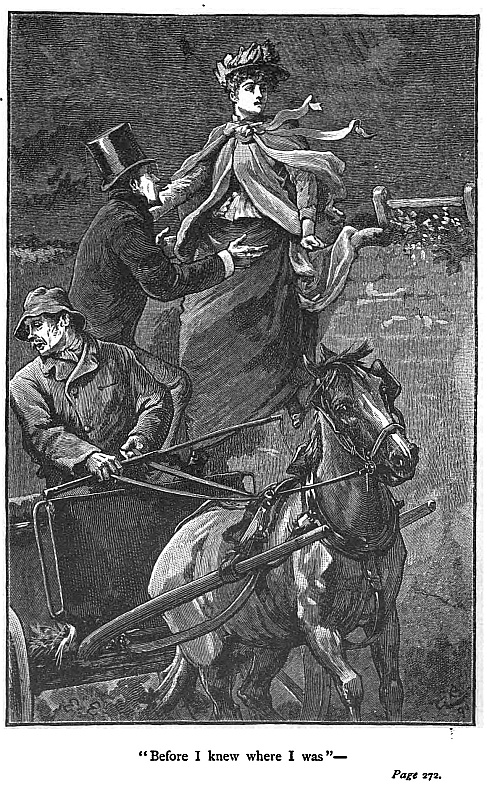
“Dere goes de confound bell,” cried Achille. “No, no,” he whispered, “not yet—don’t faint, mon ange.”
“But the dog? Where is the dog?” I exclaimed.
“Having one great pound of steaks and two mutton bones,” he replied.
And then, with the murmur of voices behind, and the bell ringing loudly, we hurried through the wet bushes to the wall, where he placed the ladder, and this time nerving myself, I mounted it boldly, and before I knew where I was I found myself helped down into a carriage drawn close up at the side—that is to say, into the cart; for Achille had been so unfortunate that he could not procure a post-chaise. There, with an umbrella to protect me from the inclemency of the weather, I sat upon the hard seat between Achille and the rough man who was the driver.
“That ere was the pleeceman as we passed,” growled the latter, directly after we had started.
“P’raps they shall want him at de house,” replied Achille, laughing.
Away onward we tore, for fully an hour and a half, through the dark night, and through the rain, which would keep coming, blown by the gusts, right underneath the umbrella, in spite of all he did to protect me. And in spite of all my efforts and the tender words of Achille—whispered to me in his own dear tongue—I could not keep from shivering; for somehow all this did not seem so very nice, and romantic, and pleasant.
Oh, that night! I shall never forget it, though it all seems whirled up together in one strange, gloomy dream of rain, and darkness, and wind, and cold, and a stumbling horse, and a rough, stably-smelling, wet driver, smoking a strong pipe, and shouting to the horse to “Harm!” Of wet straw, and Achille without a great coat, and the umbrella so blown by the wind that it took two hands to hold it, and the points would go into the driver’s eye and make him swear.
Then there was poor Achille, wet and suffering from the cold and waiting in the rain; and his hands so cramped with holding the umbrella; and the dreary, miserable station fire so low that it would not warm him. And after he had dismissed the man, he was too cold to get out his purse; but fortunately I was able to pay for the two first-class tickets to London. And then almost directly there was a vision of steam, and lights, and noise, and the fast train dashed into the wet station, where the rain kept flying from the wind, which seemed to hunt it along; and then we were inside one of the dark blue cloth lined carriages, where I could see by the dim light of the thick, scratchy, bubble lamp that there were two gentlemen. I felt so ill, and cold, and shivery, I should not have known how to keep up, if one them, seeing my wet state, had not kindly passed a little flask of sherry to Achille, who made me drink some.