George Manville Fenn (continued 3)
Reading edition
“Ladies, be kind enough to see that the drawing-room window is properly secured.”
Up I darted to reach my own room, and it was well that I made for the back staircase; for there, regularly fringing the balustrade of the best staircase, were all the younger pupils and the servants looking down and listening; while I could hear the sounds coming up from the hall, as my Lady Blunt and the teachers began again to storm at the poor silent girl, who never, that I could hear, answered them one single word, and in the act of slipping into my room, I nearly brushed the dress of one of the pupils.
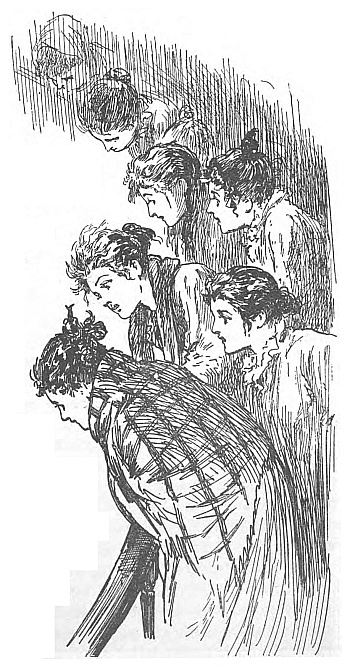
And now, if Clara would only be a martyr, I felt safe, as I stood inside our room, and listened for a few moments to the words which came up quite plainly in the still night.
“Once more, I insist upon knowing who it was,” shrieked Mrs Blunt, while her satellites added their feeble echoes.
“Tell, directly!” screamed Miss Sloman.
“Bad gell—bad gell!” croaked the Fraülein.
“You must confess,” cried Miss Furness, in shrill, treble tones.
“Who was it, Miss Fitzacre?” cried Mrs Blunt.
And then there was a stamp upon the floor, but not a word from Clara; and I dared stay for no more, but closed the door, listened to Patty snoring more loudly and ever, and then dashed to the washstand, recalling poor Clara’s smutty face, and sponged my own quickly. Then I slipped on my bonnet de nuit, and undressed quicker than I ever before did in my life. Then just as I had finished, I heard them coming up the stairs—scuffling of feet and shutting of doors as the pupils hurried into their rooms, some skirmishing at a terrible rate past my door; so I slipped into bed with my head turned towards the window, and lay there with my heart beating tumultuously.
“Now, if they only did not come here first, I’m safe,” I muttered.
I felt how exceedingly fortunate it was for me that Patty slept so soundly: for not only had she not seen me enter, but if she had slept all through the disturbance, and had not heard Clara go, why should I not have done the same? And I felt that it would help to remove suspicion from me.
They seemed a terribly long time coming, but I kept telling myself that Clara would not betray me; and I recalled with delight now that I had suffered punishment for her trick, when she moved the lady principal’s chair to her fall.
“But there,” I said to myself, “they shall tear me in pieces before they know anything I don’t, want to tell. But, oh, did poor Achille escape? and what was that fearful crash? I do hope it was the Signor, for poor Achille’s sake. But how wet whoever it was must have been!”
“And you will prepare your things for leaving early in the morning, Miss Fitzacre,” exclaimed Mrs Blunt, angrily, as she opened the door of the bedroom, and the light shone in. “Now, go to bed immediately. Is Miss Bozerne here?”
“Yes, ma’am,” I replied, just raising my head from the pillow.
“Oh! that is right,” said her ladyship; “and Miss Smith?”
There was no answer.
“Miss Smith! where is Miss Smith?” shrieked Lady Blunt from the door, evidently thinking that poor Patty was in the plot. “Miss Smith! Miss Smith!” she shrieked again.
“D-o-o-o-n’t—Be quiet!” muttered the sleepy-headed little thing.
“Oh! that will do,” said Mrs Blunt. “Don’t wake her. Miss Bozerne, you must excuse me for locking you in during the rest of the night; but if you object, perhaps Fraülein Liebeskinden will allow you to sleep with—”
“Oh no, thank you, ma’am,” I said, hastily; “I shall not mind.”
“Good night, then, Miss Bozerne,” she said, very shortly; while I felt such a hypocrite that I hardly knew what to do. “Lost girl!” she continued, as she shut the door, and turned the key, which she took away with her, leaving poor Clara standing, pale and motionless, in the centre of the room; but no sooner had the light disappeared, and shone no more in beneath the crack at the bottom of the door, than she gave one great sob—
“Oh! Laura,” she exclaimed; and then, throwing herself into my arms, she cried and sobbed so wildly and hysterically, that I was quite frightened.
For she was now giving vent to the pent-up feelings of the last quarter of an hour; but after awhile she calmed down, and with only a sob now and then to interrupt us—for, of course, I too could not help crying—we quietly talked the matter over.
“No; not a word,” said the poor girl, in answer to a question of mine—which, of course, you can guess—“not a word; they may send me away and punish me as they like, but not a word will I ever say about it.”
“Then they know nothing at all about me, or—” I stammered and stopped.
“You ought to have more confidence in me than to ask such a thing,” cried Clara, passionately, as she began to sob again. “You would not have betrayed me if you had been in my position; now, would you?”
I did not know. While, being naturally nervous, I was afraid perhaps I might, if put to the test; but I did not say so.
“What could have made that horrible crashing noise?” said Clara at last; “do you think it was the policeman, dear?”
“Perhaps it was,” I said; “but I know poor Achille went into the cistern. I pushed him in; and I’m afraid he must have been drowned, for I’m not sure that I heard him crawl out. Oh, dear! oh, dear!” I said at last, “what a passion is this love! I feel so old, and worn, and troubled I could die.”
“It would be ruin to the poor Signor to be found out,” murmured Clara—thinking more of her tiresome, old, brown Italian than of poor Achille. “Oh me! I know it was all my fault; but then how odd that the policeman should have had a meeting too! Or was he watching? Poor Giulio! would that I had never let him love me. I declared that I did not like him a bit to-night when we were together, and I had quite made up my mind never to meet him any more without he would talk of something else than beautiful Italy. Bother beautiful Italy! But now I half think I love him so dearly that I would dare anything for him. That I would.”
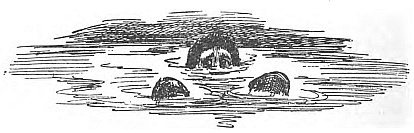
Poor girl! she grew so hysterical again, that I quite grieved for her, and told her so; and then, poor thing, she crept up close to me; and really it did seem so noble of her to take all the blame and trouble upon herself, while she was so considerate over it, that I could not help loving her very, very, very much for it all. But at last we both dropped off soundly asleep, just as the birds were beginning to twitter in the garden; and, feeling very dull and low-spirited, I was half wishing that I was a little bird myself, to sit and sing the day long, free from any trouble; no lessons to learn, no exercises to puzzle one’s brain, no cross lady principal or teachers, no mamma to send me to be finished. And it was just as I was half feeling that I could soar away into the blue arch of heaven, that I went into the deep sleep wherein I was tortured by seeing those eyes again—always those eyes—peering at me; but this time out of the deep black water of the cistern. By that I knew that I had drowned poor Achille, and that was to be my punishment—always to sit, unable to tear myself away, and be gazed at by those dreadful eyes from out of the deep, black water of the tank.
Chapter Twelve.
Memory the Twelfth—Than next Morning.
I have often awoke of a morning with the sensation of a heavy, pressing-down weight upon my mental faculties; and so it was after the dreadful catastrophe narrated in the last chapter. I opened my eyes, feeling—no, let me be truthful, I did not wake, for Patty Smith brought me to my senses by tapping my head with her nasty penetrating hair-brush—feeling, as I said before, feeling that the dull pressure upon me was caused by the dread truth that poor Achille really was drowned; while it was the Signor whom I had heard escaping. And so strong was the impression, and so nervous and so low did I feel with the adventures of the past night, that I turned quite miserable, and could not keep from crying.
The morning was enough to give anybody the horrors, for it rained heavily; and there were the poor birds, soaking wet, and with their feathers sticking close to their sides, hopping about upon the lawn, looking for worms. All over the window-panes, and hanging to the woodwork, were great tears, as if the clouds shared my trouble and sorrow; while all the flowers looked drooping and dirty, and splashed and miserable.
Then I began to think about Achille, and his coming to give his lesson that morning; and then about his being in the cistern, with those wonderful eyes looking out at me; when, there again, if there was not that tiresome old Tennyson’s poem getting into my poor, weary head, and, do what I would, I could not keep it out. There it was—buzz, buzz, buzz—“Dreary—and weary—and will not come, she said;” till at last I began to feel as if I was the real Mariana in the Moated Grange.
To make me worse, too, there was that poor Clara—pale-faced, red-eyed, and desolate-looking—sitting there dressed, and resting her hot head upon her hand as she gazed out of the window; and though I wished to comfort her, I felt to want the comfort more myself. At last I could bear it no longer, and, in place of weeping gently, I was so nervous, and low, and upset with the night’s troubles, that I sat down and had a regular good cry, and all the while with that great, stupid, fat, gawky goose of a Patty sitting and staring at me, with her head all on one side, as she was brushing out half of her hair, which she had not finished in all the time I had taken to dress.
“Don’t, Patty!” I half shrieked, at last—she was so tiresome.
“Well, I ain’t,” said Patty.
“But please don’t, then!” I exclaimed, angrily.
“Don’t what?” said the great, silly thing.
“Don’t stare so, and look so big and glumpy!” I exclaimed; for I felt as if I could have knocked off her tiresome head, only it was so horribly big; and I don’t care what anybody says, there never were anywhere before such a tempting pair of cheeks to slap as Patty’s—they always looked so round, and red, and soft, and pluffy.
“You ain’t well,” said the nasty, aggravating thing, in her silly, slow way. “Take one of my Seidlitz powders.”
“Ugh!” I shuddered at the very name of them. Just as if one of the nasty, prickly-water, nose-tickling things was going to do me any good at such a time as this.
It really was enough to make one hit her. I never did take a Seidlitz powder but once, and then it was just after reading “Undine” with the Fraülein, and my head was all full of water-nymphs, and gods, and “The Mummelsee and the Water Maidens,” and all sorts. And when I shut my eyes, and drank the fizzing-up thing, it all seemed to tickle my nose and lips; and I declare if I did not half fancy I was drinking the waters of the sparkling Rhine, and one of the water-gods had risen to kiss me, and that was his nasty prickly moustache I had felt. But to return to that dreadful morning when Patty wanted me to take one of her Seidlitz powders.
“Mix ’em in two glasses is best,” she went on, without taking any notice of my look of disgust—“the white paper in one, and the blue paper in the other, and then drink off the blue first, and wait while you count twenty, and then drink off the white one—slushions they call ’em. It does make you feel so droll, and does your head ever so much good. Do have one, dear!”
I know that I must have slapped her—nothing could have prevented it—if just then the door had not been unlocked, and that horrible Miss Furness came in.
“When you are ready, Miss Smith, you will descend with Miss Bozerne—I will wait for you,” said the screwy old thing; but she took not the slightest notice of poor Clara, who sat there by the window, with her forehead all wrinkled up, and looking at least ten years older. It was of no good for one’s heart to bleed for her, not a bit, with Miss Furness, who had undertaken to act the part of gaoler, there; so I gave the poor, suffering darling one last, meaning look, which was of no use, for it was wasted through the poor thing not looking up; and then I followed Miss Furness out of the room, side by side with Patty Smith, whose saucer eyes grew quite cheese-platish as she saw the door locked to keep poor Clara in; and then the tiresome thing kept bothering me in whispers to know what was the matter, for she was quite afraid of Miss Furness.
However, I answered nothing, and went into the miserable, dreary, damp-looking classroom with an aching heart, and waited till the breakfast bell rang. For there was a bell rung for everything, when there was not the slightest necessity for such nonsense, only it all aided to make the Cedars imposing, and advertised it to the country round. But when I went into the hall, to cross it to reach the breakfast-room, there were a couple of boxes and a bundle at the foot of the back stairs, and the tall page getting himself into a tangle with some cord as he pretended to be tying them up.
Just then the drawing-room door opened, and I heard Mrs Blunt say—
“And don’t apply to me for a character, whatever you do;” whilst, very red-eyed and weeping, out came Sarah Ann, the housemaid.
“Once more,” said Mrs Blunt, “do you mean to tell me who it was that I distinctly saw, with my very own eyes, standing upon the leads talking to you?”
But Ann only gave a sob and a gulp, and I knew then that they did not know who had come to see her; whilst I felt perfectly certain that it was the policeman, and, besides, the Signor and Achille must have seen what he was.
I was standing close to Miss Furness, who, as soon as she saw Ann, began to bridle up with virtuous indignation; and then set to and hunted the girls into the breakfast-room.
“Is Ann going away?” said Patty Smith, in her dawdly, sleepy way. “I like Ann. What’s she going away for, Miss Furness, please?”
“Hush!” exclaimed Miss Furness, in a horrified way. “Don’t ask such questions. She is a very wicked and hardened girl, and Mrs Fortesquieu de Blount has dismissed her, lest she should contaminate either of the other servants.”
“I’ll tell you all about it, presently,” whispered Celia Blang; but not in such a low voice but that the indignant Miss Furness overheard her.
“You will do nothing of the kind,” said the cross old maid, “and I desire that you instantly go back to your seat. If you know anything, you will be silent—silence is golden. Such things are not to be talked about, Miss Blang.”
Celia made a grimace behind her back, although she was said to be Miss Furness’s spy, and supposed to tell her everything; so Patty’s curiosity remained unsatisfied, while of course I pretended to know nothing at all about what had been going on.
Directly after breakfast, though, Patty had it all by heart, and came red-hot to tell me how that Clara had been caught trying to elope out of the conservatory, whilst Ann was talking from the tall staircase window, when Miss Sloman happened to hear a whispering—for she was lying awake with a bad fit of the toothache. So she went and alarmed the lady principal; and then, with Miss Furness and the Fraülein, they had all watched, and they found it out. Some one, too, had been in the tank, and the conservatory windows were broken, and that was all, except that Mrs Blunt had been writing to Lady Fitzacre—Clara’s mamma—and the poor girl was to be expelled; while for the present she was to be kept in her room till her mamma came, unless she would say who was the gentleman she was about to elope with—such stuff!—and then, if she would confess, she was to sit with Mrs Blunt, under surveillance, as they called it. When, leaving alone betraying the poor Signor, of course Clara preferred staying in her own room.
Such a miserable wet morning, and though I wanted to, very badly indeed, I could not get into the conservatory to set my poor mind at rest by poking down into the cistern with a blind lath; for if I had gone it might have raised suspicions.
Could he still be in the tank, and were my dreams in slumber right?
“Oh, how horrible!” I thought; “why, I should feel always like his murderer.”
But, there, I could not help it—it was fate, my fate, and his fate—my fate to be his murderess, his to be drowned; and I would have given worlds, if I had had them, to be able to faint, when about eleven o’clock the cook came to the door, and asked Mrs Blunt, in a strange, mysterious way, to please come into the conservatory. For the man servant had not come back from the station, and taking Ann’s boxes.
“Oh, he’s there, he’s there!” I muttered, as I wrung my hands beneath the table, and closed my eyes, thinking of the inquest and the other horrors to come; and seeing in imagination his wet body laid upon the white stones in the conservatory.
Oh, how I wanted to faint—how I tried to faint, and go off in a deep swoon, that should rest me for a while from the racking thoughts that troubled me. But I could not manage it anyhow; for of course nothing but the real thing would do at such a time as this.
Out went Mrs Blunt, to return in five minutes with what I thought to be a terribly pale face, as she beckoned out the three teachers who were most in her confidence, Miss Murray being considered too young and imprudent.
There! I never felt anything so agonising in my life—never; and I could not have borne it any longer anyhow. I’m sure, in another moment I must have been horribly hysterical and down upon the floor, tapping the boards with my heels, as I once saw mamma—and of course such things are hereditary—only I was saved by hearing a step upon the gravel. Then my heart leaped just after the fashion of that gentleman’s who wanted Maud to come into the garden so very badly. For there I could see the real eyes coming along the shrubbery, peeping over the fur collar of a long cloak, which hung down to the heels. And I felt so relieved, that a great heavy sob, that had been sticking in my throat all the morning, leaped out suddenly, and made Patty Smith look up and stare.
Then came tramping in Mrs Blunt and the three teachers, and as they whispered together, I was quite startled, for they talked about something being dragged out of the cistern with the tongs. And now I knew it could not be Achille, but made sure it was the poor Signor; when I felt nearly as bad as before, though I kept telling myself that it was quite impossible for them to have lifted the poor, dear, drowned dead man out with a pair of tongs—even if he was not so very stout. But there, my misery was again put an end to by the Fraülein, who said, out loud,—
“Oh, yes, it was. I see de mark—C. Fitzacre.”
And then I knew that it must have been one of Clara’s handkerchiefs that had been fished out, and “blessed my stars that my stars blessed me” by not letting it be my handkerchief that they had discovered.
There was a step in the hall, and how my heart fluttered!
“Monsieur Achille de Tiraille for the French lesson,” squeaked Miss Furness.
And soon after we were busy at work, going over the irregular verbs, and I could see Achille’s eyes wandering from face to face, as if to see whether there were any suspicion attaching to him. Then followed the reading and exercise correcting, while I could see plainly enough that he was terribly agitated—so much so, that he made at lest four mistakes himself, and passed over several in the pupils. And when he found that I did not give him a note with my exercise—one that should explain, I suppose, all that had since passed—when I had not had the eighth part of a chance to write one, he turned quite cross and pettish, and snapped one, and snubbed another. As for poor me, I could have cried, I could, only that all the teachers and Mrs Blunt were there, and Miss Furness looking triumphant. As a rule, all the teachers did not stay in the room while the French lessons were progressing, and this all tended towards making poor Achille fidgety and cross; but he need not have behaved quite so unkindly to me, for I’m sure I had been suffering quite enough upon his account, and so I should have liked to have told him if I had had the opportunity; while now that all this upset had come, I felt quite sorry for the disloyal thought that I had had, and should have been ready to do anything for his sake.
The lessons were nearly over, when all at once the door opened suddenly, and I saw poor Achille jump so that the pen with which he was correcting Patty Smith’s exercise made a long scrawling tail to one of the letters; but he recovered himself directly.
Well, the door opened suddenly, and the cook stood there, wiping her floury hands, for it was pasty-waster day, and she exclaimed loudly,—
“O’m! please’m! the little passage is all in a swim.”
“C-o-o-o-k!” exclaimed Mrs Blunt, in a dreadful voice, as if she meant to slay her upon the spot.
“O’m! please’m!” cried the cook again.
“Why, where is James, cook?” said Mrs Blunt, sternly.
“Cleaning hisself, mum,” said cook; “and as Hann’s gone, mum, I was obliged to come—not as I wanted to, I’m sure,” and cook looked very much ill-used.
Mrs Blunt jumped up, as much to get rid of the horrible apparition as anything; while cook continued,—
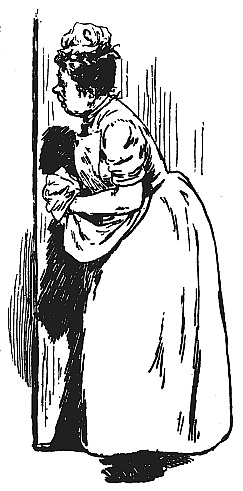
“There, do come, mum; it’s perfeckly dreadful!” and they went off together; when such a burst of exclamations followed that the three lady teachers rose and left the room, and I took the opportunity of Miss Murray’s back being turned to exchange glances with poor Achille, who had, at the least, been wet; while I longed, for poor Clara’s sake, to ask him about the Signor. But to speak was impossible, and there were too many eyes about for the glance to be long. So I let mine drop to my exercise, and then sat, with a strange, nervous sensation that I could not explain creeping over me, and it seemed like the forerunner of something about to happen.
Just then Miss Furness hurried in and out again, leaving the door ajar, so that from where I sat I could command a view of the little passage, and saw Mrs Blunt walk up, jingling her keys, and stepping upon the points of her toes over a little stream of water that was slowly flowing along. Then going up to the store-room door, I heard the key thrust in, as impelled by I know not what, I left my seat, and formed one of the group which stood looking upon the little stream that I could now see came from beneath the store-room door.
“The skylight must have been left open,” exclaimed Mrs Blunt, flinging open the door, and at the same moment the recollection of the crash flashed across my mind; for, as she flung open the door, in her pompous, bouncing way, and was about to step in, oh!—horror of horrors! how can I describe it all? There was the floor of the little room covered with broken glass, water, bits of putty, wood, and a mass of broken jam pots; and the little table, that had evidently stood beneath the skylight, had two of its legs broken off, and had slid its saccharine burden (that is better than saying load of jam) upon the floor in hideous ruin. Some pots were broken to pieces, some in half; while others had rolled to the other end of the room, and were staining their paper covers, or dyeing the water with their rich, cloying contents. But worse, far worse than all, with his face cut, scratched, and covered with dry blood, his shirt front and waistcoat all jam, crouching back in the farthest corner, was the poor Signor—regularly trapped when he had fallen through the skylight; for it was impossible for any one to have climbed up to the opening, through which the rain came like a shower bath, and there was no other way of exit.
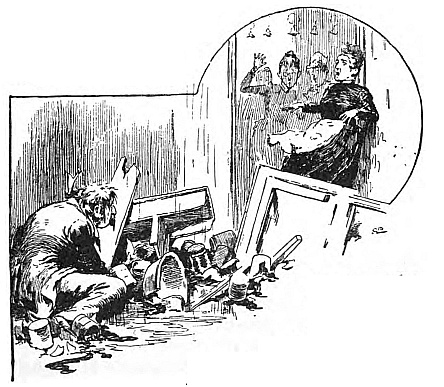
The lady principal shrieked, the lady teachers performed a trio of witch-screams—the most discordant ever uttered—and my Lady Blunt would have plashed down into the puddle, only, seeing how wet it was, she only reeled and clung to me, who felt ready to drop myself, as I leaned against the wall half swooning.
Alarmed by the shrieks, Achille came running out, looking, as I thought, very pale.
“Ladies, ladies!” he ejaculated, “ma foi, qu’est ce que c’est?”
“Help, help! Monsieur Achille,” gasped Mrs Blunt.
He hurried forward, and relieved me of my load.
“Fetch the police,” cried Miss Furness.
“Nein, nein—it is a mistake,” whispered the Fraülein, who had a penchant, I think, for the poor Signor.
“Signor Pazzoletto, it is thou!” exclaimed Achille, with an aspect of the most profound amazement as he caught sight of his unfortunate friend—an aspect which was, indeed, truthful.
For, as he afterwards told me, he had been so drenched in the cistern, and taken up with making his own escape, that he had thought no more of the poor Signor; while, being a wet morning, he had not sought his lodging—which was some distance from the town—before coming, though he was somewhat anxious to consult him upon the previous night’s alarm, and hardly dared to show himself. So—
“Signor Pazzoletto, it is thou!” he exclaimed, regularly taken aback, as the sailors say.
“Altro! altro!” ejaculated the poor man, who sadly wanted to make his escape, but could see no better chance now than there had been all the night.
For the passage was blocked, while in the hall were collected together all the pupils and the servants—that gawky James coming back and towering above all, like a horrible lamp-post in a crowd.
“My vinaigrette,” murmured Madame Blunt.
When if that dreadful Achille did not place another arm around her; and that nasty old thing liked it, I could see, far more than Miss Furness did, and hung upon him horribly, pretending to faint; when I could have given anything to have snatched her away.
“Pauvre chère dame” murmured Achille, giving me at the same moment a comical look out of the corner of his eye.
“Oh! Monsieur Achille,” said Mrs Blunt, feebly, “oh, help! Send away that wretch. Otez moi cet homme là.”
“Aha! yais! mais oui!” exclaimed Achille—the base deceiver, to play such a part!—“Sare, you are not business here. Madame dismiss. Take away yourself off. Cut yourself! Go!”
I give this just as Achille spoke it; for I cannot but feel angry at the deceitful part he had played.
The Signor looked at Achille, and gave him a diabolical grin—just as if he would have liked to stiletto him upon the spot, with one of the pieces of broken glass. Then he looked at me, bestowing upon me a meaning glance, as he made a rush past us all, and escaped by the front door; but not without splashing right through the puddle, and sending the water all over the Fraülein, so that she exclaimed most indignantly, until the front door closed with a heavy bang.
Chapter Thirteen.
Memory the Thirteenth—So very Wicked.
It was such a relief to know that the Signor was gone, and that, too, without betraying any one. I could see, too, that Achille revived, now that he felt that he was safe for the present, and redoubled his attentions to Mrs Blunt. I declare I believe he would have stood there holding her for an hour, and she letting him, if Miss Furness had not very officiously lent her aid as well; when the lady principal grew better at once, and allowed herself to be assisted into the breakfast-room, where, after much pressing, she consented to partake of a glass of sherry.
“Oh, Monsieur Achille,” she gasped, “such a serious matter—reputation of my establishment! You will be silent? Oh, dear me, what a dreadful upset.”
“Silent? Ma foi, oui, Madame Bloont. I will be close as box,” and he gave his shoulders a shrug, put his fingers to his lips, half-shut his eyes, and nodded his head a great many times over.
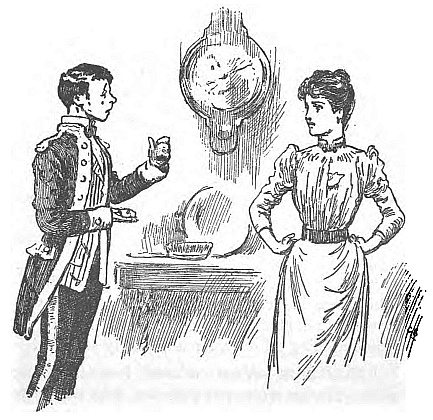
“I knew you would,” murmured Mrs Blunt; “and as to my lady assistants, I feel assured that I can depend upon them.”
“Oh, yes,” cried all these, in chorus.
“And you had better now return to the classroom, Miss Bozerne,” said Miss Furness, who had seemed in a fidget ever since I had followed them into the place.
“Ah, yes—please leave us now, Miss Bozerne,” said Mrs Blunt. “Of course we can depend upon you, my child?”
I promised all they wished, and was going across the hall, when I met James, with a piece of paper in his hand.
“Please, miss, where’s Monser Tirrel?—a boy just brought this for him.”
“I’ll take it in to him,” I said, with the blood seeming to run in a torrent to my heart; and there I stood, with the piece of a leaf of a pocket-book in my hand. It was not doubled up, and as I glanced down upon it I could see that it was scribbled over, evidently hastily, in pencil. I was about to carry it into the breakfast-room, when a word caught my eye; and telling myself it was not dishonourable, and that I had some right to know the secrets of Achille, I felt that I must read it through.
“He says that I am his own, so that I have a right to see his correspondence,” I said to myself, trying to find an excuse for the deceitful act; and then trembling all over, I read, hastily scrawled—
“Monsieur,—Vous m’avez insulté affreusement. Si vous n’êtes pas poltrone, vous serez, sans ami, dans les prairies au moulin à une heure.
“Giulio Pazzoletto.”
“Oh, horror!” I ejaculated, “it is a challenge; and if I give it to him, that horrid Italian will shoot or stab to death my poor Achille! What shall I do—what shall I do?”
There I stood, racked with anguish, till I heard footsteps approaching, when I fled into the schoolroom, where there was such a noise, and all the pupils flocked round me directly, to ask no end of questions; but I was so agitated that I could not speak. However, the first thing I did was to spitefully bite the wicked, murderous note into fragments, and scatter them about the place; and then, recalling Mrs Blunt’s last words, I was so retentive of the information the girls were all eager to acquire, that they one and all sided against me, and said I was “a proud, stuck-up, deceitful crocodile.”
“I don’t care, children,” I said, haughtily—for I was more at ease now that I knew he would not get the note—“I don’t care, children, Mrs Blunt said that I was not to talk about it.”
“Children, indeed!” exclaimed little pert Celia Blang—“why, that’s the very thing that would make you tell us all! ’Tisn’t that: it’s because you are so stuck-up, you and Clara Fitzy; but she’s shut up now, and is going to be sent away, and a good thing too; and now you’ll only have Patty Fatty to talk to, and I hope you’ll like it.”
“Hold your tongue, you pert, ill-natured thing,” I said; “I don’t believe that she will be sent away.”
“She will, though,” said Celia; “you see if she isn’t. But we don’t want you to tell us anything—we know all about it, don’t we, girls?”
“Know all about what?” I said, very coolly and contemptuously—for they all seemed quite girlish and childish to me, now that I was the repository of all that secrecy.
“Why all about it” said Celia—“about Ann, and some one at the window. Molly told me, and ever so much more that she heard from Ann before she went; and Ann was going to tell her something about some one in the garden—Clara Fitzy, or some one else—only she had not time before they bundled her off. But, there: I sha’n’t tell you any more.”
My ears tingled, as they say, when I heard that latter part about the garden. What an escape it seemed, to be sure! But I passed it all off, and took not a mite of notice; and just then, who should come in but Miss Furness, as I heard a well-known step go crunching along the gravel. Then it was lessons, lessons, till dinner-time; and lessons, lessons, till tea-time; and then lessons again, for the weather was too wet for a walk.
I only saw Clara of a night after that, and, poor thing, she was kept upon prison fare; for a letter came down from Lady Fitzacre, saying that she was too ill to travel at present, and that she left the punishment of the foolish, disobedient child entirely in the hands of Mrs Blunt. So there wasn’t a word said more about expelling her, for Mrs B. was too fond of the high terms and extras she was able to charge for parlour boarders. But they kept the poor thing a close prisoner upstairs for a week; and, to make her position more bearable, I bought her a cheap edition of “Moths,” and smuggled it up. Then I managed “In Maremma;” and whenever I went out, and could get to the pastrycook’s, I filled my pockets full of queen cakes, and sausage rolls, and raspberry jam tarts, and got the inside of my pocket of my silk dress in such a sticky mess, that I declare every time I put my hand in, it made me think of the poor Signor.
Of course, I told Clara everything that happened downstairs as soon as Patty was asleep, though she frightened me terribly by almost going into hysterics the first night, when I told her about the Signor being in the store-room; but I did not mention the jam then, for fear of hurting her feelings. She said I did quite right about the note; for she could never have been happy again if the Signor had killed Achille—just as if Achille was not a deal more likely to have killed the Signor!
I don’t know how the maids knew, but Molly told us that the Signor had quite left the place, and had not paid his lodging nor yet his washing bill; though I don’t want to be spiteful, but I don’t think that last could have been much, for I never caught sight of anything washable but a tiny bit of turn-down collar. And Molly knew—for James told her when he took the packet—that Mrs Blunt sent what salary was owing the same day, while I afterwards learned from Achille that they never met again; and really it was a very good thing for all parties concerned that the poor man went.
Yes! No! Let me see—yes, he told me upon the day I enclosed him the half-sovereign for the poor refugee family whose troubles in London Achille used to paint so vividly I remember he told me, too, that Signor Pazzoletto had gone away in his debt too, and that he was afraid the Signor was not an honourable man.
My poor Achille was very charitable, and kept himself terribly poor that way; but I could not help admiring his generosity towards his fellow exiles, and I used to give him, regularly, all I could from my pocket-money, after he had called my attention to these poor people’s condition; and I must say that papa was very liberal to me in that way, and I could always have a sovereign or two for the asking. Achille used to tell me that he added all he could, and that the poor people were so grateful, and used to write of me to him as “la belle ange.” He said that the mother was going to write and thank me some day, but she never did; while, I suppose from motives of delicacy, Achille never told me their names.
He was really exceedingly charitable, and was often finding out cases where a little money would be well bestowed; and once or twice I wanted to call myself, and see the poor creatures; but his diffidence was so great, that he would not tell me of their places of abode, for he would not be seen moving in such matters, preferring to perform his acts of kindness in secret.
Poor Clara was down and amongst us once more; while, as I before said, there was no more talk of her being expelled, for since the Signor had gone, Mrs Blunt thought that all would be right, and she would have no more trouble. And I must say that, for a long time Clara would never help me a bit in any way, now that she had lost her Giulio, but moped terribly, and seemed quite an altered girl—even going so far as to say bitter, cruel things. One day she quite upset me by declaring that Achille only wanted the money for himself, and that I had better be like her—give up all such folly and love-making: a most cruel, unjust, sour-grapey speech; for as to giving up her black-bearded, Italian-organ looking man, there was little giving up in the case.
At last, down came Lady Fitzacre, and there was such a to-do in the drawing-room; but Clara was so penitent that she was quite forgiven. And then I was had in to be introduced, and, of course, I expected that a lady with such a name would take after her daughter or that her daughter took after her—it don’t matter which—and be tall, aristocratic, and imposing; but, instead, she was a little, screwy, pale, squeezy body, with her upper teeth sticking out quite forward, so as to make her look ugly. But she was very pleasant and good-tempered, and made a great fuss over me, and told Mrs Blunt that she would sooner keep a powder magazine than have a troop of such man-killers to manage.
Then she kissed Clara, and said she was afraid that the poor thing was “a naughty, naughty girl,” and that it was “so shocking.”
“But very natural, Mrs de Blount,” I heard her whisper, and it set me thinking about what mamma would say when she found me out.
For I was not going to break with Achille just because there were obstacles thrown in our way. Of course, there were no more meetings to be held in the conservatory, and for a long time, a very long time, we had to be content with notes, and they could not always be delivered. As I hinted before, Clara would not help me a bit. She said she had promised her mamma that she would not engage in anything of the kind again, and she did not mean to break her word. Certainly, she said, she might perhaps come with me some night, or perhaps aid me a little; but it would not be at present, until she had quite got over her late shock. And then the stupid, romantic girl used to talk about her heart being a desert, and asked all sorts of questions about the convent at Guisnes, just as if she had serious thoughts of entering, and turning nun altogether; for she said there seemed no hope for her in the future.
There certainly was not much temptation for her to break her word to her mamma with the new Italian master, Signor Pompare. For of all the frights—oh, dear me! A great, overgrown, stuffy, fat pig; and instead of being dark-eyed, and with beautiful, glossy, black hair, he was actually quite sandy—bird-sandy—and very bald-headed; while his face, where the beautiful, silky, black beard should have been, was all close shaved, and soapy and shiny. And then, too, he used to take such lots of snuff; and there was a crinkly little hole in his upper lip, where he could not shave, and this was always half full of brown powder, so that we decided to call it the reservoir. When he breathed, you used to see the snuff puff out of the place in little tiny, tiny clouds, and fall in a brown bloom over his closely-shaven chin. Not much fear of any of the pupils taking a fancy to him, you would have thought; though I declare if Patty Smith did not say he was a very nice-looking man. But not that that meant anything, for the highest love to which Patty could ascend was love for something tasty to eat.
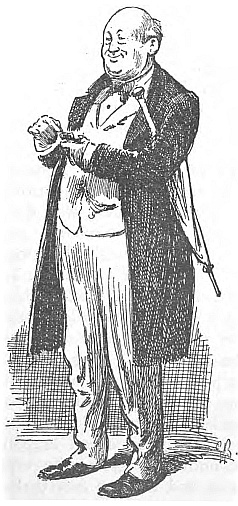
Actually, two months had passed since we had had an interview, and not one plan could I hit upon, though I had tortured my poor head until I grew quite desperate. Of course, I saw Achille every week for lessons, and twice on Sundays. But, then, all that seemed to count for nothing; and once more I was beginning to grow so miserable and dejected, a state from which his letters hardly seemed to revive me.
Any disloyal thoughts I may have had were thoroughly chased away by the difficulties we had encountered. But, still, leading such a quiet, regular life as we lived, it seemed very hard work to find words and remarks with which to fill up one’s notes. I declare that if they did not grow to be as difficult to write as Miss Furness’s essays; and I had to use the same adjectives over and over and over again, till I was quite ashamed of them, and almost wondered that they did not turn sour even though they were meant to be sweet and endearing. As for Achille’s notes—heigho! I could excuse him, knowing how difficult it was to find words myself; but towards the latter part of our dear intimacy, his letters grew to be either political, or else full of the sorrows of the poor people whose cause he espoused, and whose sufferings he tried, to use his own words, “to make a little softer.”
Of course it was too bad to gape, and keep his notes in one’s pocket until they grew quite worn before I opened them, and then to feel that I knew by heart all that he was going to say; but I could not help it, though I tried hard to love and appreciate the things which interested him, and pinched myself terribly to send him half-sovereigns for his “chèrs pauvres.” But, I don’t mind owning to it, I did not care a single button or pen nib for the French Royal family, though I did not like to tell him so when he asked me to subscribe for the poor descendants of the noblest of “la belle France.” I’m afraid I was not so patriotic as I should have been. I could not help it.
I did try; and no doubt in time I should have grown to have loved the same things as he did; but I did wish that he would have made his notes a little more—more—well, what shall I say?—there, less matter of fact and worldly, when I wanted them to be tender, and sympathising, and ethereal.
Yes—I grew quite disgusted, in spite of Clara’s nasty badinage; for she had recovered her spirits as I lost mine, and used to tell me to try her recipe, and I should soon be well again. But, of course, I treated her remarks as they deserved; and grew paler every day in spite of the pleasant country walks, though they were totally spoiled by our having to tramp along like a regiment of soldiers.
For my part, I should have liked to go wandering through the woods, spending ten minutes here and ten minutes there; now stopping to pluck a flower, and now to sit down upon some mossy fallen tree; or else to have lost myself amongst the embowering leaves. In short, I should have liked to do just as I pleased; while all the time the rule seemed to be that we should do just as some one else liked; and “some one else” was generally that detestable, screwy, old Miss Furness, with her “Keep together, young ladies,” or “Now, a little faster,” or “Straightforward,” or “To the right” Oh! it was so sickening, I declare that I would rather have sat up in the dormitory—pooh, such nonsense!—in the bedroom, and watched and envied the birds in the long, wavy boughs of the beautiful cedars. I know I could have contrived several meetings if it had not been for Miss Furness, who was always prying and peering about, as suspiciously as possible, though half of that was on purpose to annoy me, and because she knew that I did not like it.
But though Clara had at one time vowed that she would not help me, she never, in the slightest degree, went against any of my plans; but even went so far as to allow herself to be turned into a passive post-office—if I may use the expression—by holding a note for Achille in her French grammar, and bringing back another when she had had her regular scolding—for she certainly was very stupid over her French, though at one time she had manifested considerable ability over her Italian, while she sketched beautifully.
I managed the place for a meeting, at last; though, after all, it was but a very tiresome place, but, under the circumstances, better than nothing. There was no going out of a night now, even if we had felt so inclined; and, really and truly, after what we had gone through, I felt very little disposed to attempt such a thing again; for Miss Furness used to collect regularly every night all the downstairs keys in a basket, and then take them up to Mrs Blunt’s room; and I feel convinced that those four old tabbies used to have something hot in one of the bedrooms. Clara used to say that she could smell it; and yet they would all make a fuss at dinner about never touching ale or porter. All I know is, that Miss Furness’s nose never would have looked so red if she only drank water always. They used to think that we did not know of their sitting up of a night; but Clara and I soon found that out, for we began to lie and listen, and could tell well enough that the Fraülein was not in her own room; while every now and then, from some other part, we could hear her blowing her nose with a noise loud enough to alarm the whole house. There never was such a woman before for blowing noses, I’m sure. Why, she could blow her nose as loud as a churchwarden, or a Poor Law guardian, who, as it is well known, can, after county magistrates on the bench, make more noise than any one upon that particular organ. It was quite dreadful to hear the Fraülein trumpeting about, like one of those horrid brass things the soldiers play in the bands—stretching out, and pulling in, and working about, and looking so dangerous.
And now I am going to tell you about my plan for an interview; though I might have spared my poor brains all the trouble, for it never did either of us a bit of good, in spite of all my scheming and management I told you that the downstairs doors were always locked now of a night, and that Miss Furness collected all the keys, so that it was quite out of the question to think of trying to get into either of the lower rooms to talk out of the window; so I thought, and thought, and thought, and puzzled, and puzzled, and puzzled, and bored my poor brains, till at last I remembered the empty room at the end of the passage.
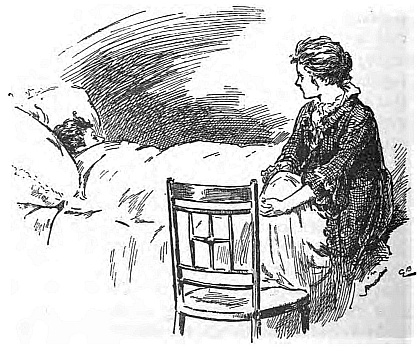
“Well, but how ever could he get up there to talk to you?” said Clara; “it’s a second floor window.”
“Why, come up a ladder, of course,” I said.
“But how is he to get one there?” said Clara. “Bring some bricklayers and scaffold poles, and have a scaffold made on purpose?”
“Why, a rope ladder, goosey,” I said. “Don’t you see?”
But Clara said she could not see, and that she believed that, excepting in ships, there were no such things as rope ladders, and all those that you read of in books were manufactured in people’s brains, and never helped anybody yet up to a window; while as to ladies eloping down them, that was all nonsense, for she did not think the woman was living who could get either up or down one of the swingle-swangle things. And then she said that it would not be safe; but I knew better, and told her so, for I was not going to have my plan set aside for a trifle. So then I set to and wrote a letter to Achille.
Since Clara had laughed so terribly, I had not liked to send money in the notes by her; and poor Achille had sent me such a despairing note, telling me how that he must see me—one of the most grievous, broken-hearted notes possible. I declare I don’t know what he did not say he would do if he could not see me soon.
Chapter Fourteen.
Memory the Fourteenth—Anticipated Joys.
I wrote and told Achille all my plans, using the top of the drawers for a writing desk, and letting Patty Smith think that I was doing an exercise; for I was so horribly deceitful, writing upon exercise paper, and referring now and then to dictionary and grammar, as if for different words. I told him he was to get hooks made that would fit over the inside of the window-sill, and he was to buy a rope ladder, and I would let down a string and draw it up, and hook it on, when he could easily run up and stand upon the great, wide ledge beneath the second floor windows—a large, ornamental cornice that ran nearly round the house—and there stop and talk to me whenever it was a dark night.
I soon managed, through Clara, for him to have the note; and the next time he came he was quite radiant with joy, and praised all the girls’ exercises, though some of them were really execrable I would not look at him, but soon after he was gone Clara slipped a note into my hand, which said that he would be under the window that night at half-past twelve, and that I was to be sure and have a ball of string ready to let down and draw up the ladder, which he had been obliged to make himself; for though he could buy cord enough everywhere in London, there was not such a thing as a rope ladder to be got.
“There, I told you so,” said Clara, laughing. “Rope ladder, indeed. I don’t believe people ever did sell such things; and you see now if he don’t stick halfway up, like a great fly in a spider’s web, till Lady Blunt comes, as the spider, and sticks a great knitting needle into his body to kill him. And then she’ll call all the other spiders, and all four of them will set to and devour your poor Achille—for they are almost ready to eat him every day, as it is.”
“Don’t talk such stuff,” I said pettishly, though I could not help thinking of Miss Furness and her penchant for Achille, though I knew he hated her.
It did sound so romantic and chivalrous, in spite of Clara’s ill-natured prattle, having one’s lover coming up a ladder of ropes in the stilly midnight hour, when all were dreaming around. It put me in mind of ladies’ bowers, and knights, and cavaliers, and elopements; and dreaming, as I did, I almost began to fancy myself a damsel in distress about to be rescued. I stood there, in our room, in such a sweet, rapt meditation—such a blissful, dreamy, musing fit—when that Clara brought me right down out of the I don’t know how manyeth heaven, by saying—
“And where’s your string?”
I had not thought of that, and it was a puzzle. I had plenty of crochet cotton, and bobbin, and Berlin wool; but then, they were none of them strong enough. Time to buy any there was none; for he was coming that night loaded with his dear ladder; while if I tried to get any from the kitchen, some one would be sure to ask what it was wanted for, then what could I say? And, besides, I had told so many dreadful stories already, and prevaricated so much, that I was quite ashamed.
The first thing I determined upon was to make a long plait of my coloured wools; but I soon found that there would not be one quarter enough; then I thought of the girls’ slate strings, which held the sponges, and determined to make a raid into the schoolroom and cut them all off, though I felt sure they would not be enough. If I could only have gone out and bought a ball, or sent James, it would have been all right; but that was impossible without first asking Mrs Blunt. Only the week before, a stupid boy’s kite came flapping over into the garden, with no end of string, which I might have cut off with my scissors; but I never imagined then that I should want any.
However, I did what I generally do when I want to think deeply, I took some eau de Cologne and bathed my temples, and then sat down before the glass, with my hair all thrown back, and my head resting upon my hand, trying to solve the problem, and wondering what Achille could see in me to like; while just then I remember wondering what had become of poor Mr Saint Purre.
What was I to do? that was the question. I might have cut ever so many strings off my clothes, but then I was sure they would not make half enough; and, after boring my poor brains all sorts of ways, I was quite in despair—for it did seem too bad to be put off by such a beggarly little trifle as a bit of string, when two or three of those little, cheating penny balls, that are made so big by winding a very little string round a very big hole would have set me up for good. I wanted Clara to smuggle the clothes line from the laundry, which would have done admirably; but the nasty thing would not, and tried to make fun of it all by declaring that it was in use; and she would not stir a peg. I could not go myself to see if what she said was true—at least, I dare not; and, there, if it was not tea-time, and we should be rung down in a few minutes. Once I thought of tearing up something into long shreds, and tying them together; and it seemed at last that that would be the plan, and I should have put it into execution, if all at once I had not had a bright thought flash through my head, and felt disposed to call out “Excelsior?” like mamma did when she saw Mrs Blunt’s horrid advertisement, and meant “Eureka” all the time.
And what do you think the happy thought was? Why, the lumber-room, where the girls’ school boxes were put, along with their cords; and I was just going to hurry off and collect a number, when clatter went the tea-bell, and we were obliged to go down.
I could not eat any of their odious bread and butter—thick and patchy—while the tea was as weak as weak. I declare I was so nervous that I never felt the place to be so vexatious before; and for the least provocation I should have burst out crying. I couldn’t help there being nothing to cry about—all I know is, that I felt in a regular crying fit; and the more of the nasty, mawkish warm tea I drank, the worse I was, for it all seemed changed into tears directly, and to be flooding my head; when, if it had been proper tea, of course my poor nerves would have been solaced.
Clara saw how put out I was, and kept treading on my foot, wanting me to look at Mrs Blunt’s front, which was all put on sideways; but I declare I could not have laughed if she had put it on backwards. Then that stupid Miss Sloman must go, seeing that I did not eat anything, and tell Mrs Blunt; and, of course, when she asked me, I was obliged to say I was not quite well, when the tiresome old thing must promise to send for Dr Boole if I were not better in the morning. A stupid old thing: she did not know that a dozen yards of good stout string would have made me feel quite in ecstasy.
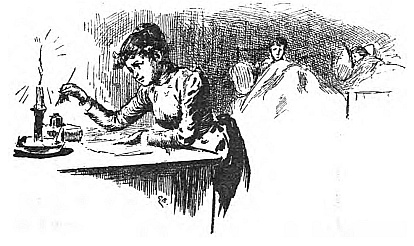
Bed-time at last; and, as a matter of course, because we wanted her to go to sleep soon, Patty Smith began to write a letter home for another cake and a bottle of currant wine; but Miss Furness must come prowling about and see the light, and she soon put a stop to that; when poor simple Patty did get such a scolding that she sobbed, and cried, and boo-ood, and said it was only for a cake she was writing. Then Miss Furness—a nasty, aggravating old puss—must turn round and scold Clara and me, as she said, for encouraging her, so as to get part of the cake ourselves. Couldn’t I have given her a shaking, that’s all! Why, it was enough to make anyone feel vicious.
At last, we lay there, listening to the different noises dying out in the house; and I could do nothing but cry for poor Achille’s disappointment—for the way to the lumber-room was through the one in which the cook slept, and of course it was impossible to get any cord; and I dare not throw a note out of the window to Achille, for fear that he might not find it in the dark, and if it fell into wrong hands all would have been made known. So there I lay, crying for some time, till the noises in the house one by one died out, and all was still, when I pictured poor Achille watching and waiting, and accusing me of perfidy and cruelty, for making him come and then disappointing him—for he never would imagine that I had been stopped for want of a piece of string. Then came the sound of an owl, hooting and screeching as if in contempt of me for going to bed; and I declare, at last, I was about to creep away to the empty room, and add to the poor fellow’s disappointment by opening the window and whispering to him—though I’m sure he could not have heard; when a strong feeling of stupor seemed to creep over me—a feeling that I could not fight against—while soon all was, as it were, a blank.
The next morning when I talked about it to Clara, she said it showed how much I cared for him to fall asleep. Just as if it was sleep, and I did not know the difference. But there, she always was so absurd! And poor Achille was disappointed, and we had to make another assignation.
Chapter Fifteen.
Memory the Fifteenth—’Twixt Cup and Lip.
Night again; and Achille—poor faithful, charitable, patient Achille—to be there once more watching in the dark that one blank window, that he hoped to see open. I could analyse his feelings as well, perhaps, as he could mine; and how I did pity him for his many disappointments! For nights and nights had passed without the rope ladder having been made available. Still, though, we were hopeful, and thought of others who had been long and patient sufferers for the same cause; while now, in the hope of a meeting, we waited once more. All was still within doors, and everything seemed propitious, for the night was excessively dark. The last door had shut some time before, and within the house the only thing stirring must have been a mouse or else, with our strained ears, as Clara and I lay waiting, dressed in bed, we must have heard it. But though all was so still in the house, it was not so out of doors. First of all there was a horrible cat “tuning its lay,” as Clara called it; and then she said its lay was terribly out of tune to want so much screwing up. Then the dog in the next yard must hear it, and begin to resent the disturbance, and bark at the cat, till I felt sure that pauvre Achille would not come, for the noise was dreadful—rest cat, bark dog; rest dog, howl cat, and so on. There was the chain rattling in and out of the kennel at a most terrible rate, while the creature barked furiously till it was tired, without having the slightest effect upon the cat, or cats, which kept on with the hideous howling, till the dog, evidently worn out, went to sleep.
Oh, it was uncomfortable lying there, so hot and tired with the exertion of dressing under the bed-clothes while lying down, so that Patty Smith should have no suspicion of what was going on and because we thought her awake; when, just as we had finished, she must begin to snore in the most vulgar, horrible way imaginable.
“That nasty cat is just under our window,” I whispered to Clara. “He’ll never come if there’s this noise.”
“I’ll serve it out,” whispered Clara; “only be quiet.”
“What are you going to do?” I said, but she would not answer; and I heard her get out of bed and go to the washstand, and pour ever so much water into the basin.
“Oh, pray don’t make any noise, dear. What are you going to do with that water?”
“Wait a bit, and you’ll see,” she whispered, tittering; and then she went and gently opened the window, when the noise of the nasty cat came up worse than ever.
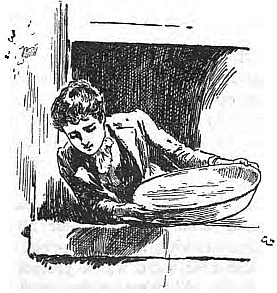
“You had better not throw out that water, dear,” I whispered; but she only giggled, and then I heard the water go down splash on to the gravel walk, and directly after—
“Oh!” exclaimed Clara. As she spoke up came the sounds of the falling basin, as it struck upon the gravel walk, and was shivered to atoms. Then came the sound of a hurried step upon the path, the rush of a heavy body through the shrubbery, all as plain as could be in the still night, and I knew that Clara had very nearly thrown the basin on poor Achille’s head, and it might have killed him. When as if that was not enough to frighten him away, there were two windows thrown open on the first floor, and at one was Miss Furness, ringing a bell and Miss Sloman screaming, and at the other my Lady Blunt, springing a watchman’s rattle, and making the most horrible din imaginable.
“Well, I really did not mean to do it, dear,” said Clara, as coolly as could be; “you see, the basin was soapy, and slipped.”
“What did you do it at all for, when you were asked not?” I gasped angrily; for it was really enough to drive any one out of her senses to be disappointed like this, time after time. All I hoped was, that poor Achille had escaped safely, and did not know from which window the missile came; for, only fancy, he might have thought that I had thrown it, and never forgiven me.
You never could have imagined such a disturbance to have proceeded from so small a cause. There were doors opening and shutting, girls screaming, bells ringing; and there we all were, at last, trembling and shaking upon the staircase and landings—all but Patty Smith, who would not get out of bed.
“Dere’s de police!” exclaimed the Fraülein, all at once; and directly after we could hear Mrs Blunt and Miss Furness talking to some one out of their windows; while now there was a profound silence fallen upon the shivering group, and I shuddered as I recognised the deep-toned voice out of doors, and knew it to be that of one familiar with the interior of the grounds.
“Search the garden thoroughly, policeman,” cried Mrs Blunt, from one window.
“Who’s there?” squealed Miss Furness, loudly.
“Why, it’s me, mum,” said the policeman.
“Oh, yes—I know, my good man,” said Miss Furness; “but I mean who was out there?”
“I’m going to look, aint I?” growled the man. “But there aint nobody out here now, even if there was at all. I aint seen anybody in the road.”
I did feel so glad to hear what he said, for I was all in a shiver lest my poor boy should be caught.
“He’s gone, mum,” said the low fellow, after he had been away about five minutes. “Aint not a soul ’cept me in the garding. What had he been up to, mum?”
“Oh, it was a dreadful noise out there,” cried Mrs Blunt, from behind the curtains. “It sounded like some one smashing in the dining-room windows. Pray look, policeman.”
All this conversation sounded quite plain to us on the stairs, for Mrs Blunt’s door and window were both open; and then I could hear the policeman’s heavy step on the gravel, crunching and crackling as he trod on and began kicking about the pieces of Clara’s broken basin.
“Why, here’s some one been shying the chayney outer window,” said the policeman. “Here’s most half a wash-hand basin and a whole stodge of bits squandered all over the gravel walk. That’s what you heerd, mum. The window is right enough.”
“It did sound like that,” squeaked Miss Furness.
“And that’s what it was, mum, if there was none of this here out afore.”
“Oh, no, my good man,” cries Mrs Blunt, getting less fearful and more dignified every moment—“the paths were quite clear this evening.”
“Then it’s some of your young ladies been a havin’ a lark,” said the low fellow.
I turned round to whisper to Clara, but she was gone. Directly after, though, she slipped back to my side, and I whispered to her, laying my hand upon her arm—
“Had you not better tell? Say that it was an accident.”
“Hold your tongue,” she whispered, pinching me.
Then we shrank into the background, for I was afraid some one would notice how bulky our dressing-gowns looked; for, of course, we had not had time to undress again.
We heard the policeman promise to keep an eye on the place, and to call in the morning. Then we heard his footsteps on the gravel, and the pieces of china cracking, windows shut down, and orders for us to go back to our rooms, as there was nothing to fear; when, as we were ascending the stairs, Mrs Blunt’s nightcapped head was thrust out of the door, and we heard her exclaim—
“I’ll investigate this disgraceful trick in the morning, young ladies.”
I trembled for poor Clara—almost as much as I did for Achille; for it seemed as though the poor girl was always to act as scapegoat; though, certainly, she really deserved to be in disgrace this time, for I begged her most earnestly not to throw out the water.
I would have given Clara half my basin with pleasure, if I could; but then, that would have been of no service. Judge, then, of my surprise when, after looking at Patty, fast asleep as if nothing had been the matter, I turned to Clara’s washstand, there was her basin, safe and sound, and the jug was standing in it!
As we upon the second floor all had small washstands and jugs and basins of the same pattern, I thought that, after all, she had taken mine; but she had not, nor yet Patty’s; and as she saw what I was looking at, she burst out laughing, and said—
“I slipped up and into the Fraülein’s room, and took hers; and now they may find out if they can. Of course, you won’t tell, darling? Promise me that.”
I felt so cross that I was ready to say I would; for I was disappointed, and though the thoughts of the meeting had taken away my appetite, now that it was not to be, I felt as hungry as possible. But it would have been cruel to have said anything, so, of course, I promised.
“Another disappointment for the poor French Verb,” whispered Clara, laughing.
“For shame,” I said, “to speak in so disrespectful a way.”
“But it does not much matter,” she said; “for he would have been afraid to climb up, when he found out really how high it was.”
“Don’t talk stuff!” I said; “he would get up if it were twice as high, for my sake. Why, look how Leander swam the Hellespont.”
“And I say,” cried Clara—laughing, and seeming in the highest of glee, which was too bad—“how cold and shivering he must have been when he got across. Bo-o-o-h?” she said, shuddering, “what a cold frog of a lover! I shouldn’t have liked that.”
“No,” I said, “you have no romance in your composition.”
“Haven’t I,” she said, “you don’t know; but I’m not so head over ears in love as you are.”
“Perhaps not,” I said, spitefully; “because you have no chance.”
“Pooh!” said Clara. “Why, I might have had Achille long before you came, if I had liked.”
“Perhaps, miss,” I exclaimed, with nothing more than reasonable anger, “the next time you mention that gentleman’s name you will prefix the Monsieur.”
“Certainly, ma’am,” said Clara, aggravating me with her mock courtesy.
“And whatever you do,” I said, “if you must tease, tell the truth.”
“That was the truth,” she replied.
“Don’t be such a wicked story,” I exclaimed. “I don’t believe it.”
I could not help thinking, after, that in my childish anger I had made use of childish language.
“I don’t care what you believe, and what you don’t believe,” said Clara, coolly; “and I’ve got—”
“If you young ladies are not silent this minute,” said Miss Furness, outside the door, “I shall be compelled to summon Mrs de Blount.”
As I lay wondering whether she had heard anything of our conversation, and what it was that Clara had got, and whether it was a letter Achille had sent her before I came, which I did not believe, and did not much care if he had, for he had not seen me then—Miss Furness stood listening at the door, while Clara would not answer my whispered questions, pretending to be offended; and I believe I heard Miss Furness sniff out in the cold passage just as I dropped off to sleep.
Chapter Sixteen.
Memory the Sixteenth—Pangs.
I meant in the last chapter to have told a great deal more; but so many of my troubles and misadventures kept creeping in, that I did not get in one-half of what I intended. What pains I took to gain an interview—or, rather, to grant the poor fellow an interview, though it would have been to me the reaching of a green oasis in my journey across life’s desert, when, for a short time, the gentle palm branches would have waved, as it were, in gentle motion above our heads, while our cheeks would have been fanned by the gentle breath of love.
Of course there was a terrible to do about the basin in the morning, but it so happened, luckily, that the cat was not beneath our window, but beyond the Fraülein’s; so that in trying to reach it, Clara had thrown the basin for some distance, and right past our neighbour’s window. The Fraülein declared that she had never opened hers; and, poor woman, she opened her mouth into quite a round O when told that she must have thrown it out. There was nothing to cast suspicion upon us, for it was more likely to have been Celia Blang, on the other side of the Fraülein; and so, at last, the matter dropped, and we heard no more of it then.
But I had such a delightful treat two days after; for while we were going down the High Street, Miss Furness must turn faint, and have to be helped into the first house at hand, to sit down and rest, and that was Mrs Jackney’s, the milliner’s; and there we were, four or five of us at once, in the little parlour—dear Achille’s “apartment meublée,” as he called it. He was from home, giving lessons somewhere, no doubt; but while they were bathing Miss Furness’s face, and giving her sniffs of salts, and glasses of water to drink, I had such a look round the place, and saw his dear old boots in one corner—the pair, I was sure, he must put on for ease and comfort of a night; and I was so glad to see them, for, if, instead, I had caught sight of a nice, handsomely worked pair of slippers, they would have given me quite a pang. Now I felt that the task—no, the pleasure—was left for me.
Then there was a dear, duck of an old coat hanging behind the door; and such nice, funny little holes in the elbows, where he had rested his arms upon the table while he studied; and there was his pipe, and two bits of cigars, and a few yellow paper-covered books, and one thing which did, I must own, make me feel a little uncomfortable, a scarlet and black smoking cap—at least, it had been scarlet once, and had evidently been made by a lady, and, of course, one would have liked to have known who was the maker.
At first, in remembrance of her bitter, teasing words, I thought that it might have been Clara; but it did not look new enough; for the scarlet was fast verging upon the black, and, no doubt, in a short time it would have been impossible to make out the pattern. But I was glad to see it; for it was a hint that Achille would soon require a new one, and I knew who would make it. However, I did not much care; and taking advantage of there being no one looking, I contrived to drop my handkerchief inside it; but directly after I trembled, and wanted to have it back again, for there was my name marked upon it in full, in ink, and I was afraid that his landlady, Mrs Jackney, might see it.
I had a good look at her, to see whether I need feel jealous, and found, to my great delight, that I need not; for she was worse in appearance than Miss Furness, but evidently a very pleasant body; though, all the same I should not have liked her to find my handkerchief. However, there was no getting it back; for Miss Furness was now able to sit up, and I was one of the first to be obliged to leave the room, and stand agonised in the passage, lest any one should find out what I had done. But nothing was seen, and I heard afterwards from Achille, in one of his notes—the best, I think, that he ever wrote to me—how fondly he prized the treasure; and I mentally declared that it was not a bad way of laying out the value of a pocket-handkerchief, and that he should soon have another.
It was all so horribly unfortunate. If we made an engagement to meet, something was sure to happen; while, in spite of the time that had now passed since the poor Signor left, not one short five minutes had poor Achille and I had together. It was enough to make me ever so fond and devoted; and though I might be trembling a little in my allegiance at one time, I was ready to become a martyr now for his sake. But, as I said before, the very fact of an assignation being made was the signal for, or precursor of, something to happen; so that, I’m sure, I was quite in a tremble, a few days after Miss Furness’s faint, when Achille gave me a few lines inside De Porquet, telling me, in a few simple words, that he was again that night about to try his fortune, when he hoped I should be able to assist him to benefit the poor exiles, who were now in a great state of distress. No one, to have found that scrap of paper, would have imagined that it was anything more than a piece torn off to act as book-mark, and he gave me the book with it standing right out, so that Miss Furness could see it quite plainly as he passed it right under her nose, saying—
“I have put a piece of paper where you shall go on, Miss Bozerne.”
When I looked at it there was only hastily scrawled—
“Mercredi, une heure,” and “the poor suffer want—les pauvres ont besoin.”
That was all, and it really seemed to be a bit of exercise, and nothing else. But then, I had the key in my heart, and could read it as he meant; though truly it was an exercise for me to find means to overtop all difficulties and meet him. I knew what he meant well enough—just as well as if he had written four pages, crossed, in his own niggling, little, scrimply, unintelligible, Frenchy hand. So I sat thinking of the six box cords tied together and hidden away in the bottom drawer, underneath my green silk, and tightly locked up to keep them from prying eyes.
Well, of course, I told Clara—though I may as well own that I really should not if I could have helped it. For she was anything but what I should have liked; and, of course, I did not care to be so teased. And there was my appetite so spoiled again that I could not eat, and poor me in such a fidget for the rest of the day, that I did not know what to do. I slipped upstairs three times to see if the cord was all right, and the knots tightly tied; and then, the last time, if I did not hear Miss Furness calling me, and come down in a flurry and leave the key in the drawer. I turned quite hot all over when I felt for it in my pocket, and was sure I had lost it somewhere; when if I could not get some more cord I should be stopped again. All at once I remembered that the thing must be stuck in the keyhole. So, as soon as the lesson with Miss Furness was over, I slipped to the back staircase, and was about halfway up, when I must meet that tiresome, fat, old Fraülein.
“Vots for you heere, Mees Bozerne?” croaked the tiresome old English killer. “Young ladies ’ave no beesness upstaer in de afternoon. Go you down.”
Of course I had to go down again, for I was breaking rules, and ought to have been at work at private study in the schoolroom till half an hour before tea-time.
“It’s too bad,” I muttered, as I began to descend—“too bad to send me to a place like this, where one may not even go up to one’s bedroom. I’m sure, I don’t feel in the least bit like a school-girl.”
Just then I heard Miss Sloman calling the Fraülein to “Come here, dear!” They always called one another, “my love,” and “dear,” in private, though I’m sure no one could have been more unamiable, or looked more ready to scratch and call names. So the Fraülein again ordered me to go down, and then turned back, evidently to go to Miss Sloman: so, seizing the opportunity, I slipped down into the hall, and began bounding up the front stairs like lightning, when if I did not literally run up against Mrs Blunt, and strike her right in the chest with my head, just as she had come out of her room—for I was not looking, but, with head down, bounding up two stairs at a time.
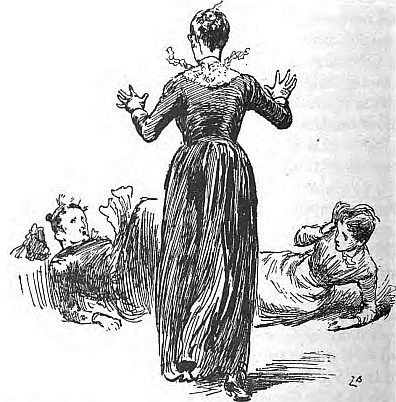
It was a crash! Poor woman, she could not get breath to speak for some time. But, there, she was not the only one hurt; for that horrible twisted vulcanite coronet was driven right into my poor head, and pained me terribly.
“Ach ten!” cried the Fraülein, who had heard the crash and exclamation on both sides, and now came waddling up; “I told you go down, ten, Miss Bozerne, and you come up to knock de lady principal.”
So I was, without a word to say in defence, sent down in the most dreadful disgrace. But there was some fun in it, after all; for Clara vowed that the poor woman received such a shock that two of her bones—stay bones—were broken, and she nearly swallowed her teeth. But that Clara always would exaggerate so dreadfully; and, of course, that was not true.
I was not going to be threatened with medicine this time because my appetite was bad, so I kept one slice of bread and butter upon my plate to bite at, though it was almost enough to choke me; and then I managed to draw two more slices over the edge of my plate into my lap, where my pocket-handkerchief was spread all ready; and then I wrapped them up, when I thought that no one was looking, and put them in my pocket; and so tea was got over, and I thought what a long time it would be till midnight.
We were all standing in the middle of the classroom before getting our books out for the evening studies, when if Patty Smith did not come up to me, and, without waiting to see whether I would or not, exclaimed—
“Lend me your handkerchief, Laura, dear—I won’t keep it a moment!”
Seizing one end, which stuck out of my pocket, she gave it a snatch, when away it flew, and one piece of bread and butter was slung across the room, and struck Miss Furness in the face; while the other went flop up against the window behind her, stuck upon the pane for a moment, and then fell—leaving a buttery mark where it had been, as a matter of course. I declare I never felt so much ashamed in my life; while there were all the girls tittering and giggling, and Miss Furness wiping her face and scolding terribly about my dreadfully unladylike behaviour, though nothing could have been more humiliating than what followed, for I’m sure I wished there was not such a thing as a piece of bread and butter upon the face of the earth; for said Miss Furness—
“And now, Miss Bozerne, come and pick up those pieces.”
I would have given anything to have been able to refuse; but what could I do? I do not see how I could have helped it, for I really felt obliged; and there I was kneeling down, humbled and penitent, to pick it up; and there were the tiresome, buttery pieces, all broken up into crumbs here and crumbs there, all over the place.
“For your sake, Achille?” I murmured to myself; and that made me bear it until I had picked up all I could, and held the scraps upon a piece of exercise paper, wondering what I had better do with them.
“You had better wipe the butter off that window with your handkerchief, Miss Bozerne,” said Miss Furness, stiffly. “Oh! and it’s of no use for you to make up those indignant grimaces, and look like that, Miss Bozerne,” she continued, in her nasty, vinegary way. “If young ladies are so forgetful of decorum, and cannot be content with a fair share of food at the tea table, but must gluttonously stoop to steal pieces off the plate to devour at abnormal times, they must expect to be spoken to.”
Just as if I had taken the horrid stuff to eat, when so great was my agitation that I could partake of nothing. So there I was, with my face and neck burning in a most “abnormal” way, as Miss Furness would have called it, wiping and smearing the butter about over the pane of glass, and hardly seeing what I was doing for the tears; when there was that Patty Smith staring at me with her great saucer eyes, and her mouth made round and open, as if it had been another eye, and Clara the whole time enjoying it all, and laughing at my discomfort. It was really much too bad, for it was all her fault: the wicked, mischievous, impish creature had seen me put the pieces of bread and butter into my pocket, and had actually set Patty to snatch the handkerchief out.
“The plan succeeded beyond my expectations, darling,” she exclaimed afterwards, when we were alone; and I did not slap her—which, without boasting, must, I think, show how forgiving a spirit I possess.
But, to return to the scene in the room. When I had finished smearing the window with my pretty little cambric handkerchief, I threw open the sash, and was going to fling out the little pieces of bread-crumbs for the poor little birds—
“Miss Bozerne!” exclaimed Miss Furness, “what are you about?”
“Going to give the crumbs to the birds, ma’am,” I said, humbly.
“Oh, dear me, no,” exclaimed the old puss, seizing upon what she considered a good opportunity for making an example of me, and giving a lesson to the other girls—for that seemed one of the aims of her life: to make lessons out of everything she said or did, till she was a perfect nuisance. “Oh, dear me, no—such waste cannot be allowed. Go and put the fragments upon one of the plates, which James or the cook will give you, and ask her to save them for your breakfast.”
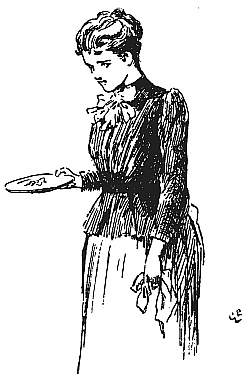
I could have cried with vexation; but I did not, though it was very, very, very hard work to keep the tears back.
“Oh, Achille! Achille!” I murmured again, “c’est pour toi!”
I walked out, like a martyr, bearing the pieces, with bent-down eyes, and gave them to the cook, telling her she was to throw them to the chickens. For I would not have given Miss Furness’s message if she had stood behind me.
Oh, yes, it was nice fun for the other girls, and dearly they used to enjoy seeing me humbled, because I always was rather distant, and would not make confidantes of ever so many; and when I went back, there they were upon the giggle, and Miss Furness not trying to check them one bit, as she would have done upon another occasion—which shows how partial and unjust she could be when she liked. But I soon forgot it all, engrossed as I was with the idea of what was coming that night. As to my next day’s lessons, after sitting before them for an hour, I believe that I knew less about them than when I took out my books; for right up at the top of one of the panes in the buttery window there was a spider spinning its net, and that set me thinking about poor Achille hanging in a web, and the four old lesson grinders being spiders to devour him. For there was the nasty creepy thing hanging by one of its strings ever so far down, and that made me think about the coming night and the rope ladder, till I could, in my overwrought fancy, imagine I saw poor Achille bobbing and swinging about, and ready to go through one of the window-panes every moment. Sometimes the very thought of it made my face burn, and my hands turn hot and damp as could be inside, just as they felt when one had shaken hands with Miss Furness, whose palm, in feel, was for all the world like the tail of a cod-fish.
Sometimes during that evening I felt in misery, and, I believe, all owing to that spider, and thinking of the danger of the feat to perform which I had lured poor Achille. I would have given anything to have been able to beg of him not to attempt it.
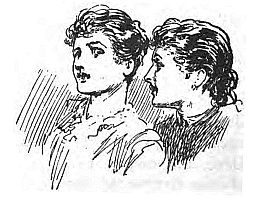
“Poor fly,” I thought—“poor, beautiful, fluttering, brightly painted fly; and have I been the means of weaving a net to lure thee to destruction? Oh, wretch that I am!”
And so I went on for some time, just as people do in books when they are very bad in their emotions; and that is one advantage in reading, only emotions are so much more eloquent than they would be, say, in an ignorant, unlettered person; and really, be it pleasure or pain, it is as well to be refined and make a grand display; for it is so much more satisfactory, even if the audience consists of self alone. At times, though, I was so elated that I could feel my eyes flash and sparkle with the thoughts that rushed through my brain; when, as if reading my heart, Clara would creep close, and nip my arm, and keep on whispering—
“I’ll tell—I’ll tell.”
Chapter Seventeen.
Memory the Seventeenth—In Dreadful Daring.
Bed-time at last, and me there, close shut up in our own room; but not before I had run to the end of the passage and tried the end door to see if it was open; and it was—it was! Clara was, after all said and done, nearly as much excited as poor I; and once she sighed, and said that she could almost have wished for the poor Signor to have been there, but I did not tell her I was very glad that he would not be. Then Miss Patty must want to know what we were whispering about, and declare that she would tell Miss Furness, for we were making fun of her; and turn huffy and cross, till she got into bed, and then lie staring with wide-open eyes at the window, just because we wanted her to go to sleep.
“Ma’s going to send me a cake on Toosday,” she said at last, after I had kissed and told her we were not laughing at her; and I must do her the credit of saying that she always was a most good-tempered creature, and never out of humour for long together. “And when my cake comes,” she continued, after five minutes’ thought, “I’ll spend fourpence in ginger beer, if you will each spend the same, and we’ll have a supper.”
“I do wish you would go to sleep, instead of keeping on bothering,” cried Clara.
“I dare say you do, Miss Consequence,” said Patty; “but I shall go to sleep when I like.”
And then, if she did not lie awake until nearly twelve, though we pretended to be both fast asleep, and would not answer any of her foolish, chattering questions, when, as usual, she began to snore; and after waiting until I felt quite sure that she was asleep, I jumped out of bed, and began to dress myself as quickly and quietly as possible. As soon as I had finished and then lain down once more, Clara got up too, and followed my example, even to the lying down again when she had finished; for it was too soon to go yet, and we both felt that it would be safer the nearer we were to the middle of the night; and of course one felt determined to do nothing this time to frustrate one’s designs.
We had tried more than once dressing in bed under the clothes, and, of course, lying down; but that really is such terribly hard work, as any one will find upon testing it, that we both soon gave it up, and waited till we felt sure of Patty being sound asleep; and she really was the heaviest sleeper I ever knew. So we both dressed in the dark; and that is bad enough, I can assure you—dreadfully awkward, for one gets one’s strings so crossed, and tied wrong, and in knots, and muddled about, till one is horribly uncomfortable, besides being twice as long as at any other time.
At last, I whispered to Clara that it was time to go, but there was no answer; and on getting off the bed and touching her, she quite started. For she had been asleep, and when I reproached her—
“Well, of course,” she said, peevishly; “it’s sleeping time, is it not?”
But she roused up directly after, and stood by my side, as I went down upon my knees by the bottom drawer, and tried to pull it out very gently, without making any noise, so as to get at the cord. For the key was in it all right when I came up, and I thought that I would leave it there, though I was all in a fidget for fear any one had been in and looked and seen the cord, while Patty was so curious that I dare not look to see; though if any one had taken it away, what should I have done?