THEOREME XI.
Thomas Salusbury translation
A Piramide or Cone, demitted with the Point downwards shal swim, with its Base downward shall sink.
A Piramide or Cone put into the Water, with the Point downward shall swimme, and the same put with the Base downwards shall sinke, and it shall be impossible to make it float.
Now the quite contrary would happen, if the difficulty of Penetrating the water, were that which had hindred the descent, for that the said Cone is far apter to pierce and penetrate with its sharp Point, than with its broad and spacious Base.
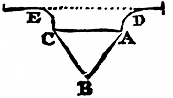
And, to demonstrate this, let the Cone be A B C, twice as grave as the water, and let its height be tripple to the height of the Rampart D A E C: I say, first, that being put lightly into the water with the Point downwards, it shall not descend to the bottom: for the Aeriall Cylinder contained betwixt the Ramparts D A C E, is equall in Mass to the Cone A B C; so that the whole Mass of the Solid compounded of the Air D A C E, and of the Cone A B C, shall be double to the Cone A C B: And, because the Cone A B C is supposed to be of Matter double in Gravity to the water, therefore as much water as the whole Masse D A B C E, placed beneath the Levell of the water, weighs as much as the Cone A B C: and, therefore, there shall be an Equilibrium, and the Cone A B C shall descend no lower. Now, I say farther, that the same Cone placed with the Base downwards, shall sink to the bottom, without any possibility of returning again, by any means to swimme.
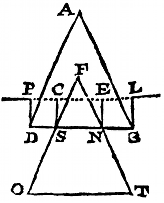
Let, therefore, the Cone be A B D, double in Gravity to the water, and let its height be tripple the height of the Rampart of water L B: It is already manifest, that it shall not stay wholly out of the water, because the Cylinder being comprehended betwixt the Ramparts L B D P, equall to the Cone A B D, and the Matter of the Cone, beig double in Gravity to the water, it is evident that the weight of the said Cone shall be double to the weight of the Mass of water equall to the Cylinder L B D P: Therefore it shall not rest in this state, but shall descend.
COROLARY I.
Much less shall the said Cone swim, if one immerge a part thereof.
I say farther; that much lesse shall the said Cone stay afloat, if one immerge a part thereof.
Which you may see, comparing with the water as well the part that shall immerge as the other above water. Let us therefore of the Cone A B D, submergeth part N T O S, and advance the Point N S F above water. The Altitude of the Cone F N S, shall either be more than half the whole Altitude of the Cone F T O, or it shall not be more: if it shall be more than half, the Cone F N S shall be more than half of the Cylinder E N S C: for the Altitude of the Cone F N S, shall be more than Sesquialter of the Altitude of the Cylinder E N S C: And, because the Matter of the Cone is supposed to be double in Specificall Gravity to the water, the water which would be contained within the Rampart E N S C, would be less grave absolutely than the Cone F N S; so that the whole Cone F N S cannot be sustained by the Rampart: But the part immerged N T O S, by being double in Specificall Gravity to the water, shall tend to the bottom: Therefore, the whole Cone F T O, as well in respect of the part submerged, as the part above water shall descend to the bottom. But if the Altitude of the Point F N S, shall be half the Altitude of the whole Cone F T O, the same Altitude of the said Cone F N S shall be Sesquialter to the Altitude E N: and, therefore, E N S C shall be double to the Cone F N S; and as much water in Mass as the Cylinder E N S C, would weigh as much as the part of the Cone F N S. But, because the other immerged part N T O S, is double in Gravity to the water, a Mass of water equall to that compounded of the Cylinder E N S C, and of the Solid N T O S, shall weigh less than the Cone F T O, by as much as the weight of a Mass of water equall to the Solid N T O S: Therefore, the Cone sha{l}l also descend. Again, because the Solid N T O S, is septuple to the Cone F N S, to which the Cylinder E S is double, the proportion of the Solid N T O S, shall be to the Cylinder E N S C, as seaven to two: Therefore, the whole Solid compounded of the Cylinder E N S C, and of the Solid N T O S, is much less than double the Solid N T O S: Therefore, the single Solid N T O S, is much graver than a Mass of water equall to the Mass, compounded of the Cylinder E N S C, and of N T O S.
COROLARY II.
Part of the Cones towards the Cuspis removed, it shall still sink.
From whence it followeth, that though one should remove and take away the part of the Cone F N S, the sole remainder N T O S would go to the bottom.
COROLARY III.
The more the Cone is immerged, the more impossible is its floating.
And if we should more depress the Cone F T O, it would be so much the more impossible that it should sustain it self afloat, the part submerged N T O S still encreasing, and the Mass of Air contained in the Rampart diminishing, which ever grows less, the more the Cone submergeth.
That Cone, therefore, that with its Base upwards, and its Cuspis downwards doth swimme, being dimitted with its Base downward must of necessity sinke. They have argued farre from the truth, therefore, who have ascribed the cause of Natation to waters resistance of Division, as to a passive principle, and to the breadth of the Figure, with which the division is to be made, as the Efficient.
I come in the fourth place, to collect and conclude the reason of that which I have proposed to the Adversaries, namely,