THEOREME IV.
Thomas Salusbury translation
The proportion of water requisite to make a Solid swim:
If a Solid, Cylinder, or Prisme, lesse grave specifically than the Water, being put into a Vessel, as above, of whatsoever greatnesse, and the Water, be afterwards infused, the Solid shall rest in the bottom, unraised, till the Water arrive to that part of the Altitude, of the said Prisme, to which its whole Altitude hath the same proportion, that the Specificall Gravity of the Water, hath to the Specificall Gravity of the said Solid: but infusing more Water, the Solid shall ascend.
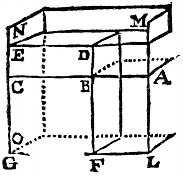
Let the Vessell be M L G N of any bigness, and let there be placed in it the Solid Prisme D F G E, less grave in specie than the water; and look what proportion the Specificall Gravity of the water, hath to that of the Prisme, such let the Altitude D F, have to the Altitude F B. I say, that infusing water to the Altitude F B, the Solid D G shall not float, but shall stand in Equilibrium, so, that that every little quantity of water, that is infused, shall raise it. Let the water, therefore, be infused to the Levell A B C; and; because the Specifick Gravity of the Solid D G, is to the Specifick Gravity of the water, as the altitude B F is to the altitude F D; that is, as the Mass B G to the Mass G D; as the proportion of the Mass B G is to the Mass G D, as the proportion of the Mass G D is to the Mass A F, they compose the Proportion of the Mass B G to the Mass A F. Therefore, the Mass B G is to the Mass A F, in a proportion compounded of the proportions of the Specifick Gravity of the Solid G D, to the Specifick Gravity of the water, and of the Mass G D to the Mass A F: But the same proportions of the Specifick Gravity of G D, to the Specifick Gravity of the water, and of the Mass G D to the Mass A F, do also by the precedent Lemma, compound the proportion of the absolute Gravity of the Solid D G, to the absolute Gravity of the Mass of the water A F: Therefore, as the Mass B G is to the Mass A F, so is the Absolute Gravity of the Solid D G, to the Absolute Gravity of the Mass of the water A F. But as the Mass B G is to the Mass A F; so is the Base of the Prisme D E, to the Surface of the water A B; and so is the descent of the water A B, to the Elevation of the Prisme D G; Therefore, the descent of the water is to the elevation of the Prisme, as the absolute Gravity of the Prisme, is to the absolute Gravity of the water: Therefore, the Moment resulting from the absolute Gravity of the water A F, and the Velocity of the Motion of declination, with which Moment it forceth the Prisme D G, to rise and ascend, is equall to the Moment that results from the absolute Gravity of the Prisme D G, and from the Velocity of the Motion, wherewith being raised, it would ascend: with which Moment it resists its being raised: because, therefore, such Moments are equall, there shall be an Equilibrium between the water and the Solid. And, it is manifest, that putting a little more water unto the other A F, it will increase the Gravity and Moment, whereupon the Prisme D G, shall be overcome, and elevated till that the only part B F remaines submerged. Which is that that was to be demonstrated.
COROLLARY I.
How far Solids less grave in specie than water, do submerge.
By what hath been demonstrated, it is manifest, that Solids less grave in specie than the water, submerge only so far, that as much water in Mass, as is the part of the Solid submerged, doth weigh absolutely as much as the whole Solid.
For, it being supposed, that the Specificall Gravity of the water, is to the Specificall Gravity of the Prisme D G, as the Altitude D F, is to the Altitude F B; that is, as the Solid D G is to the Solid B G; we might easily demonstrate, that as much water in Mass as is equall to the Solid B G, doth weigh absolutely as much as the whole Solid D G; For, by the Lemma foregoing, the Absolute Gravity of a Mass of water, equall to the Mass B G, hath to the Absolute Gravity of the Prisme D G, a proportion compounded of the proportions, of the Mass B G to the Mass G D, and of the Specifick Gravit{y} of the water, to the Specifick Gravity of the Prisme: But the Gravity in specie of the water, to the Gravity in specie of the Prisme, is supposed to be as the Mass G D to the Mass G B. Therefore, the Absolute Gravity of a Mass of water, equall to the Mass B G, is to the Absolute Gravity of the Solid D G, in a proportion compounded of the proportions, of the Mass B G to the Mass G D, and of the Mass D G to the Mass G B; which is a proportion of equalitie. The Absolute Gravity, therefore, of a Mass of Water equall to the part of the Mass of the Prisme B G, is equall to the Absolute Gravity of the whole Solid D G.
COROLLARY II.
A Rule to equilibrate Solids in the water.
It followes, moreover, that a Solid less grave than the water, being put into a Vessell of any imaginable greatness, and water being circumfused about it to such a height, that as much water in Mass, as is the part of the Solid submerged, do weigh absolutely as much as the whole Solid; it shall by that water be justly sustained, be the circumfused Water in quantity greater or lesser.
For, if the Cylinder or Prisme M, less grave than the water, v. gra. in Subsequiteriall proportion, shall be put into the capacious Vessell A B C D, and the water raised about it, to three quarters of its height, namely, to its Levell A D: it shall be sustained and exactly poysed in Equilibrium. The same will happen; if the Vessell E N S F were very small, so, that between the Vessell and the Solid M, there were but a very narrow space, and only capable of so much water, as the hundredth part of the Mass M, by which it should be likewise raised and erected, as before it had been elevated to three fourths of the height of the Solid: which to many at the first sight, may seem a notable Paradox, and beget a conceit, that the Demonstration of these effects, were sophisticall and fallacious: but, for those who so repute it, the Experiment is a means that may fully satisfie them. But he that shall but comprehend of what Importance Velocity of Motion is, and how it exactly compensates the defect and want of Gravity, will cease to wonder, in considering that at the elevation of the Solid M, the great Mass of water A B C D abateth very little, but the little Mass of water E N S F decreaseth very much, and in an instant, as the Solid M before did rise, howbeit for a very short space: Whereupon the Moment, compounded of the small Absolute Gravity of the water E N S F, and of its great Velocity in ebbing, equalizeth the Force and and Moment, that results from the composition of the immense Gravity of the water A B C D, with its great slownesse of ebbing; since that in the Elevation of the Sollid M, the abasement of the lesser water E S, is performed just so much more swiftly than the great Mass of water A C, as this is more in Mass than that which we thus demonstrate.

The proportion according to which water riseth and falls in different Vessels at the Immersion and Elevation of Solids.
In the rising of the Solid M, its elevation hath the same proportion to the circumfused water E N S F, that the Surface of the said water, hath to the Superficies or Base of the said Solid M; which Base hath the same proportion to the Surface of the water A D, that the abasement or ebbing of the water A C, hath to the rise or elevation of the said Solid M. Therefore, by Perturbation of proportion, in the ascent of the said Solid M, the abasement of the water A B C D, to the abasement of the water E N S F, hath the same proportion, that the Surface of the water E F, hath to the Surface of the water A D; that is, that the whole Mass of the water E N S F, hath to the whole Mass A B C D, being equally high: It is manifest, therefore, that in the expulsion and elevation of the Solid M, the water E N S F shall exceed in Velocity of Motion the water A B C D, asmuch as it on the other side is exceeded by that in quantity: whereupon their Moments in such operations, are mutually equall.
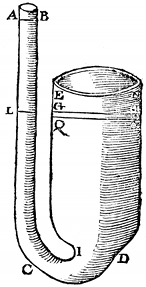
And, for ampler confirmation, and clearer explication of this, let us consider the present Figure, (which if I be not deceived, may serve to detect the errors of some Practick Mechanitians who upon a false foundation some times attempt impossible enterprizes,) in which, unto the large Vessell E I D F, the narrow Funnell or Pipe I C A B is continued, and suppose water infused into them, unto the Levell L G H, which water shall rest in this position, not without admiration in some, who cannot conceive how it can be, that the heavie charge of the great Mass of water G D, pressing downwards, should not elevate and repulse the little quantity of the other, contained in the Funnell or Pipe C L, by which the descent of it is resisted and hindered: But such wonder shall cease, if we begin to suppose the water G D to be abased only to Q D, and shall afterwards consider, what the water C L hath done, which to give place to the other, which is descended from the Levell G H, to the Levell Q O, shall of necessity have ascended in the same time, from the Levell L unto A B. And the ascent L B, shall be so much greater than the descent G Q, by how much the breadth of the Vessell G D, is greater than that of the Funnell I C; which, in summe, is as much as the water G D, is more than the water L C: but in regard that the Moment of the Velocity of the Motion, in one Moveable, compensates that of the Gravity of another what wonder is it, if the swift ascent of the lesser Water C L, shall resist the slow descent of the greater G D?
The same, therefore, happens in this operation, as in rhe Stilliard, in which a weight of two pounds counterpoyseth an other of 200, asoften as that shall move in the same time, a space 100 times greater than this: which falleth out when one Arme of the Beam is an hundred times as long as the other. Let the erroneous opinion of those therefore cease, who hold that a Ship is better, and easier born up in A ship flotes as well in ten Tun of Water as in an Ocean. a great abundance of water, then in a lesser quantity, (this was believed by Aristotle in his Problems, Sect. 23, Probl. 2.) it being on the contrary true, that its possible, that a Ship may as well float in ten Tun of water, as in an Ocean.
A Solid specifiaclly graver than the water, cannot be born up by any quantity of it.
But following our matter, I say, that by what hath been hitherto demonstrated, we may understand how, that
COROLLARY III.
One of the above named Solids, when more grave in specie than the water, can never be sustained, by any whatever quantity of it.
For having seen how that the Moment wherewith such a Solid, as grave in specie as the water, contrasts with the Moment of any Mass of water whatsoever, is able to retain it, even to its totall Submersion, without its ever ascending; it remaineth, manifest, that the water is far less able to raise it up, when it exceeds the same in specie: so, that though you infuse water till its totall Submersion, it shall still stay at the Bottome, and with such Gravity, and Resistance to Elevation, as is the excess of its Absolute Gravity, above the Absolute Gravity of a Mass equall to it, made of water, or of a Matter in specie equally grave with the water: and, though you should moreover adde never so much water above the Levell of that which equalizeth the Altitude of the Solid, it shall not, for all that, encrease the Pression, or Gravitation, of the parts circumfused about the said Solid, by which greater pression, it might come to be repulsed; because, the Resistance is not made, but only by those parts of the water, which at the Motion of the said Solid do also move, and these are those only, which are comprehended by the two Superficies equidistant to the Horizon, and their parallels, that comprehend the Altitude of the Solid immerged in the water.
I conceive, I have by this time sufficiently declared and opened the way to the contemplation of the true, intrinsecall and proper Causes of diverse Motions, and of the Rest of many Solid Bodies in diverse Mediums, and particularly in the water, shewing how all in effect, depend on the mutuall excesses of the Gravity of the Moveables and of the Mediums: and, that which did highly import, removing the Objection, which peradventure would have begotten much doubting, and scruple in some, about the verity of my Conclusion, namely, how that notwithstanding, that the excess of the Gravity of the water, above the Gravity of the Solid, demitted into it, be the cause of its floating and rising from the Bottom to the Surface, yet a quantity of water, that weighs not ten pounds, can raise a Solid that weighs above 100 pounds: in that we have demonstrated, That it sufficeth, that such difference be found between the Specificall Gravities of the Mediums and Moveables, let the particular and absolute Gravities be what they will: insomuch, that a Solid, provided that it be Specifically less grave than the water, although its absolute weight were 1000 pounds, yet may it be born up and elevated by ten pounds of water, and less: and on the contrary, another Solid, so that it be Specifically more grave than the water, though in absolute Gravity it were not above a pound, yet all the water in the Sea, cannot raise it from the Bottom, or float it. This sufficeth me, for my present occasion, to have, by the above declared Examples, discovered and demonstrated, without extending such matters farther, and, as I might have done, into a long Treatise: yea, but that there was a necessity of resolving the above proposed doubt, I should have contented my self with that only, which is demonstrated by Archimedes, in his first Book De Insidentibus humido: where in generall termes he infers and confirms the same Of Natation (a) Lib. 1, Prop. 4. (b) Id. Lib. 1. Prop. 3. (c) Id. Lib. 1. Prop. 3. Conclusions, namely, that Solids (a) less grave than water, swim or float upon it, the (b) more grave go to the Bottom, and the (c) equally grave rest indifferently in all places, yea, though they should be wholly under water.
The Authors defence of Archimedes his Doctrine, against the oppositions of Buonamico.
But, because that this Doctrine of Archimedes, perused, transcribed and examined by Signor Francesco Buonamico, in his fifth Book of Motion, Chap. 29, and afterwards by him confuted, might by the Authority of so renowned, and famous a Philosopher, be rendered dubious, and suspected of falsity; I have judged it necessary to defend it, if I am able so to do, and to clear Archimedes, from those censures, with which he appeareth to be charged. Buonamico rejecteth the Doctrine of Archimedes, first, as not consentaneous His first Objection against the Doctrine of Archimedes. with the Opinion of Aristotle, adding, that it was a strange thing to him, that the Water should exceed the Earth in Gravity, seeing on His Second Objection. the contrary, that the Gravity of water, increaseth, by means of the participation of Earth. And he subjoyns presently after, that he was His third Objection. not satisfied with the Reasons of Archimedes, as not being able with that Doctrine, to assign the cause whence it comes, that a Boat and a Vessell, which otherwise, floats above the water, doth sink to the Bottom, if once it be filled with water; that by reason of the equality of Gravity, between the water within it, and the other water without, it should stay a top; but yet, nevertheless, we see it to go to the Bottom.
He farther addes, that Aristotle had clearly confuted the Ancients, His fourth Objection. who said, that light Bodies moved upwards, driven by the impulse of The Ancients denyed Absolute Levity. the more grave Ambient: which if it were so, it should seem of necessity to follow, that all naturall Bodies are by nature heavy, and none light: For that the same would befall the Fire and Air, if put in the Bottom of the water. And, howbeit, Aristotle grants a Pulsion in the Elements, by which the Earth is reduced into a Sphericall Figure, yet nevertheless, in his judgement; it is not such that it can remove grave Bodies from their naturall places, but rather, that it send them toward the Centre, to which (as he somewhat obscurely continues to say,) the water principally moves, if it in the interim meet not with something that resists it, and, by its Gravity, thrusts it out of its place: in which case, if it cannot directly, yet at least as well as it can, it tends to the Centre: but it happens, that light Bodies by such Impulsion, do all ascend upward: but this properly they have by nature, as also, that other of swimming. He concludes, lastly, that he The causes of Natation & Submersion, according to the Peripateticks. concurs with Archimedes in his Conclusions; but not in the Causes, which he would referre to the facile and difficult Separation of the Medium, and to the predominance of the Elements, so that when the Moveable superates the power of the Medium; as for example, Lead doth the Continuity of water, it shall move thorow it, else not.
This is all that I have been able to collect, as produced against Archimedes by Signor Buonamico: who hath not well observed the Principles and Suppositions of Archimedes; which yet must be false, if the Doctrine be false, which depends upon them; but is contented to alledge therein some Inconveniences, and some Repugnances to the Doctrine and Opinion of Aristotle. In answer to which Objections, I say, first, That the being of Archimedes Doctrine, simply different The Authors answer to the first Objection. from the Doctrine of Aristotle, ought not to move any to suspect it, there being no cause, why the Authority of this should be preferred to the Authority of the other: but, because, where the decrees of Nature are indifferently exposed to the intellectuall eyes of each, the Authority of the one and the other, loseth all a{u}thenticalness of Perswasion, the absolute power residing in Reason; therefore I pass to that which he alledgeth in the second place, as an absurd consequent The Authors answer to the second Objection. of the Doctrine of Archimedes, namely, That water should be more grave than Earth. But I really find not, that ever Archimedes said such a thing, or that it can be rationally deduced from his Conclusions: and if that were manifest unto me, I verily believe, I should renounce his Doctrine, as most erroneous. Perhaps this Deduction of Buonamico, is founded upon that which he citeth of the Vessel, which swims as long as its voyd of water, but once full it sinks to the Bottom, and understanding it of a Vessel of Earth, he infers against Archimedes thus: Thou sayst that the Solids which swim, are less grave than water: this Vessell swimmeth: therefore, this Vessell is lesse grave than water. If this be the Illation. I easily answer, granting that this Vessell is lesse grave than water, and denying the other consequence, namely, that Earth is less Grave than Water. The Vessel that swims occupieth in the water, not only a place equall to the Mass of the Earth, of which it is formed; but equall to the Earth and to the Air together, contained in its concavity. And, if such a Mass compounded of Earth and Air, shall be less grave than such another quantity of water, it shall swim, and shall accord with the Doctrine of Archimedes; but if, again, removing the Air, the Vessell shall be filled with water, so that the Solid put in the water, be nothing but Earth, nor occupieth other place, than that which is only possest by Earth, it shall then go to the Bottom, by reason that the Earth is heavier than the water: and this corresponds well with the meaning of Archimedes. See the same effect illustrated, with such another Experiment, In pressing a Viall Glass to the Bottom of the water, when it is full of Air, it will meet with great resistance, because it is not the Glass alone, that is pressed under water, but together with the Glass a great Mass of Air, and such, that if you should take as much water, as the Mass of the Glass, and of the Air contained in it, you would have a weight much greater than that of the Viall, and of its Air: and, therefore, it will not submerge without great violence: but if we demit only the Glass into the water, which shall be when you shall fill the Glass with water, then shall the Glass descend to the Bottom; as superiour in Gravity to the water.
Returning, therefore, to our first purpose; I say, that Earth is more grave than water, and that therefore, a Solid of Earth goeth to the bottom of it; but one may possibly make a composition of Earth and Air, which shall be less grave than a like Mass of Water; and this shall swim: and yet both this and the other experiment shall very well accord with the Doctrine of Archimedes. But because that in my judgment it hath nothing of difficulty in it, I will not positively affirme that Signor Buonamico, would by such a discourse object unto Archimedes the absurdity of inferring by his doctrine, that Earth was less grave than Water, though I know not how to conceive what other accident he could have induced thence.
Perhaps such a Probleme (in my judgement false) was read by Signor Buonamico in some other Author, by whom peradventure it was attributed as a singular propertie, of some particular Water, and so comes now to be used with a double errour in confutation of Archimedes, since he saith no such thing, nor by him that did say it was it meant of the common Element of Water.
The Authors answer to the third Objection.
The third difficulty in the doctrine of Archimedes was, that he could not render a reason whence it arose, that a piece of Wood, and a Vessell of Wood, which otherwise floats, goeth to the bottom, if filled with Water. Signor Buonamico hath supposed that a Vessell of Wood, and of Wood that by nature swims, as before is said, goes to the bottom, if it be filled with water; of which he in the following Chapter, which is the 30 of the fifth Book copiously discourseth: but I (speaking alwayes without diminution of his singular Learning) dare in defence of Archimedes deny this experiment, being certain that a piece of Wood which by its nature sinks not in Water, shall not sinke though it be turned and converted into the forme of any Vessell whatsoever, and then filled with Water: and he that would readily see the Experiment in some other tractable Matter, and that is easily reduced into several Figures, may take pure Wax, and making it first into a Ball or other solid Figure, let him adde to it so much Lead as shall just carry it to the bottome, so that being a graine less it could not be able to sinke it, and making it afterwards into the forme of a Dish, and filling it with Water, he shall finde that without the said Lead it shall not sinke, and that with the Lead it shall descend with much slowness: & in short he shall satisfie himself, that the Water included makes no alteration. I say not all this while, but that its possible of Wood to make Barkes, which being filled with water, sinke; but that proceeds not through its Gravity, encreased by the Water, but rather from the Nailes and other Iron Workes, so that it no longer hath a Body less grave than Water, but one mixt of Iron and Wood, more grave than a like Masse of Water. Therefore let Signor Buonamico desist from desiring a reason of an effect, that is not in nature: yea if the sinking of the Woodden Vessell when its full of Water, may call in question the Doctrine of Archimedes, which he would not have you to follow, is on the contrary consonant and agreeable to the Doctrine of the Peripateticks, since it aptly assignes a reason why such a Vessell must, when its full of Water, descend to the bottom; converting the Argument the other way, we may with safety say that the Doctrine of Archimedes is true, since it aptly agreeth with true experiments, and question the other, whose Deductions are fastened upon erroneouss Conclusions. As for the other point hinted in this same Instance, where it seemes that Benonamico understands the same not only of a piece of wood, shaped in the forme of a Vessell, but also of massie Wood, which filled, scilicet, as I believe, he would say, soaked and steeped in Water, goes finally to the bottom that happens in some porose Woods, which, while their Porosity is replenished with Air, or other Matter less grave than Water, are Masses specificially less grave than the said Water, like as is that Viall of Glass whilest it is full of Air: but when, such light Matter departing, there succeedeth Water into the same Porosities and Cavities, there results a compound of Water and Glass more grave than a like Mass of Water: but the excess of its Gravity consists in the Matter of the Glass, and not in the Water, which cannot be graver than it self: so that which remaines of the Wood, the Air of its Cavities departing, if it shall be more grave in specie than Water, fil but its Porosities with Water, and you shall have a Compost of Water and of Wood more grave than Water, but not by vertue of the Water received into and imbibed by the Porosities, but of that Matter of the Wood which remains when the Air is departed: and being such it shall, according to the Doctrine of Archimedes, goe to the bottom, like as before, according to the same Doctrine it did swim.
The Authors answer to the fourth Objection.
As to that finally which presents itself in the fourth place, namely, that the Ancients have been heretofore confuted by Aristotle, who denying Positive and Absolute Levity, and truely esteeming all Bodies to be grave, said, that that which moved upward was driven by the circumambient Air, and therefore that also the Doctrine of Archimedes, as an adherent to such an Opinion was convicted and confuted: I answer first, that Signor Buonamico in my judgement hath imposed upon Archimedes, and deduced from his words more than ever he intended by them, or may from his Propositions be collected, in regard that Archimedes neither denies, nor admitteth Positive Levity, nor doth he so much as mention it: so that much less ought Buonamico to inferre, that he hath denyed that it might be the Cause and Principle of the Ascension of Fire, and other Light Bodies: Of Natation, Lib. 1. Prop. 7. having but only demonstrated, that Solid Bodies more grave than Water descend in it, according to the excess of their Gravity above the Gravity of that, he demonstrates likewise, how the less grave ascend in the same Water, accordng to its excess of Gravity, above the Of Natation, Lib. 1. Prop. 4. Gravity of them. So that the most that can be gathered from the Demonstration of Archimedes is, that like as the excess of the Gravity of the Moveable above the Gravity of the Water, is the Cause that it descends therein, so the excess of the Gravity of the water above that of the Moveable, is a sufficient Cause why it descends not, but rather betakes it self to swim: not enquiring whether of moving upwards there is, or is not any other Cause contrary to Gravity: nor doth Archimedes discourse less properly than if one should say: If the South Winde shall assault the Barke with greater Impetus than is the violence with which the Streame of the River carries it towards the South, the motion of it shall be towards the North: but if the Impetus of the Water shall overcome that of the Winde, its motion shall be towards the South. The discourse is excellent and would be unworthily contradicted by such as should oppose it, saying: Thou mis-alledgest as Cause of the motion of the Bark towards the South, the Impetus of the Stream of the Water above that of the South Winde; mis-alledgest I say, for it is the Force of the North Winde opposite to the South, that is able to drive the Bark towards the South. Such an Objection would be superfluous, because he which alledgeth for Cause of the Motion the Stream of the Water, denies not but that the Winde opposite to the South may do the same, but only affirmeth that the force of the Water prevailing over the South Wind, the Bark shall move towards the South: and saith no more than is true. And just thus when Archimedes saith, that the Gravity of the Water prevailing over that by which the moveable descends to the Bottom, such moveable shall be raised from the Bottom to the Surface alledgeth a very true Cause of such an Accident, nor doth he affirm or deny that there is, or is not, a vertue contrary to Gravity, called by some Levity, that hath also a power of moving some Matters upwards. Let therefore the Weapons of Signor Buonamico be directed against Plato, and other Ancients, who totally denying Levity, and Plato denyeth Positive Levity. taking all Bodies to be grave, say that the Motion upwards is made, not from an intrinsecal Principle of the Moveable, but only by the Impulse of the Medium; and let Archimedes and his Doctrine escape him, since he hath given him no Cause of quarelling with him. But if this Apologie, produced in defence of Archimedes, should seem to some insufficient to free him from the Objections and Arguments, produced by Aristotle against Plato, and the other Ancients, as if they did also fight against Archimedes, alledging the Impulse of the Water as the Cause of the swimming of some Bodies less grave than it, The Authors defence of the doctrine of Plato and the Ancients, who absolutely deny Levity: I would not question, but that I should be able to maintaine the Doctrine of Plato and those others to be most true, who absolutely deny Levity, and affirm no other Intrinsecal Principle of Motion to be in Elementary Bodies save only that towards the Centre of the Earth, According to Plato there is no Principle of the Motion, of descent in Naturall Bodies, save that to the Centre. nor no other Cause of moving upwards, speaking of that which hath the resemblance of natural Motion, but only the repulse of the Medium, fluid, and exceeding the Gravity of the Moveable: and as to the No cause of the motion of Ascent, save the Impulse of the Medium, exceeding the Moveable in Gravitie. Reasons of Aristotle on the contrary, I believe that I could be able fully to answer them, and I would assay to do it, if it were absolutely necessary to the present Matter, or were it not too long a Digression for this short Treatise. I will only say, that if there were in some of our Ellementary Bodies an Intrinsecall Principle and Naturall Inclination to shun the Centre of the Earth, and to move towards the Concave of the Moon, such Bodies, without doubt, would more swiftly ascend through those Mediums that least oppose the Velocity of the Moveable, and these are the more tenuous and subtle; as is, for example, the Air in comparison of the Water, we daily proving that we can with farre more expeditious Velocity move a Hand or a Board to and again in one than in the other: nevertheless, we Bodies ascend much swifter in the Water, than in the Air. never could finde any Body, that did not ascend much more swiftly in the water than in the Air. Yea of Bodies which we see continually to ascend in the Water, there is none that having arrived to the confines of the Air, do not wholly lose their Motion; even the Air it self, All Bodies ascending through Water, lose their Motion, comming to the confines of the Air. which rising with great Celerity through the Water, being once come to its Region it loseth all
The lighter Bodies ascend more swiftly through Water.
And, howbeit, Experience shewes, that the Bodies, successively less grave, do most expeditiously ascend in water, it cannot be doubted, but that the Ignean Exhalations do ascend more swiftly through the water, than doth the Air: which Air is seen by Experience to ascend more swiftly through the Water, than the Fiery Exhalations through the Air: Therefore, we must of necessity conclude, that the said Fiery Exhalations ascend thorow the Water more swiftly than doth the Air; & the Air ascends more swiftly thorow the Water, than Fire thorow the Air. Exhalations do much more expeditiously ascend through the Water, than through the Air; and that, consequently, they are moved by the Impulse of the Ambient Medium, and not by an intrinsick Principle that is in them, of avoiding the Centre of the Earth; to which other grave Bodies tend.
The Authors confutation of the Peripateticks Causes of Natation & Submersion.
To that which for a finall conclusion, Signor Buonamico produceth of going about to reduce the descending or not descending, to the easie and uneasie Division of the Medium, and to the predominancy of the Elements: I answer, as to the first part, that that cannot in any manner be admitted as a Cause, being that in none of the Fluid Mediums, as the Air, the Water, and other Liquids, there is any Resistance against Division, but all by every the least Force, are Water & other fluids void of Resistance against Division. divided and penetrated, as I will anon demonstrate: so, that of such Resistance of Division there can be no Act, since it self is not in being. As to the other part, I say, that the predominancy of the Elements in Moveables, is to be considered, as far as to the excesse The predominancy of Elements in Moveables to be considered only in relation to their excess or defect of Gravity in reference to the Medium. or defect of Gravity, in relation to the Medium: for in that Action, the Elements operate not, but only, so far as they are grave or light: therefore, to say that the Wood of the Firre sinks not, because Air predominateth in it, is no more than to say, because it is less grave than the Water. Yea, even the immediate Cause, is its being less grave than the Water: and it being under the predominancy of the Air, is the The immediate Cause of Natation is that the Moveable is less grave than the Water. Cause of its less Gravity: Therefore, he that alledgeth the predominancy of the Element for a Cause, brings the Cause of the Cause, and not the neerest and immediate Cause. Now, who knows not that the true Cause is the immediate, and not the mediate? Moreover, The Peripateticks alledge for the reason of Natation the Cause of the Cause. he that alledgeth Gravity, brings a Cause most perspicuous to Sence: Gravity a Cause most perspicuous to sence. The cause we may very easily assertain our selves; whether Ebony, for example, and Firre, be more or less grave than water: but whether Earth or Air predominates in them, who shall make that manifest? Certainly, no Experiment can better do it than to observe whether they swim or sink. So, that he who knows, not whether such a Solid swims, unless when he knows that Air predominates in it, knows not whether it swim, unless he sees it swim, for then he knows that it swims, when he knows that it is Air that predominates, but knows not that Air hath the predominance, unless he sees it swim: therefore, he knows not if it swims, till such time as he hath seen it swim.
Let us not then despise those Hints, though very dark, which Reason, after some contemplation, offereth to our Intelligence, and lets be content to be taught by Archimedes, that then any Body shall submerge in water, when it shall be specifically more grave than it, Lib 1. of Natation Prop. 7 and that if it shall be less grave, it shall of necessity swim, and Id. Lib. 1. Prop. 4. that it will rest indifferently in any place under water, if its Gravity be perfectly like to that of the water.
These things explained and proved, I come to consider that which Id. Lib 1. Prop. 3. offers it self, touching what the Diversity of figure given unto the said Moveable hath to do with these Motions and Rests; and proceed to affirme, that,