Front matter
Reading edition
"A daughter of Jehu, for behold she driveth furiously." [page 50]
Copyright, 1918, by
D. APPLETON AND COMPANY
Printed in the United States of America
TO
HENRIETTE AND MOLLY
WITH MUCH LOVE
CONTENTS
page
Prologue 1
chapter
I. Cyrus 5
II. Enter Kitty 17
III. Ross House 29
IV. The Home Guard 41
V. The Neighbors 51
VI. Johanna Ex Machina 67
VII. A Symposium 80
VIII. The Trivial Round 98
IX. The Skeleton in Cyrus' Cupboard 113
X. The Party 126
XI. On the Rialto 150
XII. Wilson Wimberley Wibird 167
XIII. Pilot 186
XIV. Johanna Rediviva 200
XV. Largely Literary 212
XVI. Psycho-Cardiac Processes 222
XVII. Kitty Sings 237
XVIII. Old Love and New 252
XIX. "The Trivial Round" 265
XX. The Pan-American 276
XXI. The Tribulations of Cyrus 289
XXII. The Duke of Lee 303
XXIII. Haste to the Wedding! 316
LIST OF ILLUSTRATIONS
"A daughter of Jehu, for she driveth furiously" Frontispiece
facing page
"Oh, Judge, I've come home, I've come home!" 18
"Filling his pockets with gold, Tom strolled happily through the streets of Peking, looking in at all the bazaars" 172
—then the Duke of Lee took his bride away 323
A DAUGHTER OF JEHU
PROLOGUE
The June sun, lighting up the yard of the big white house, lights up a pretty scene. To begin with, the yard is pretty in itself, with its stretch of emerald lawn, its trim gravel sweep, its linden tree, in which the bees are humming, its fragrant masses of purple lilac; but though one feels all these things, one looks at the people in the yard. Two ladies, in light summer dresses, sitting on the steps by the kitchen door; two children, riding a pony by turns, shrieking with glee. Both ladies are good to look at: one, she in the pale green muslin, is so lovely that it takes one's breath; like a dark lily, with her pale clear skin, her shadowy hair and eyes, her bending grace and languor. The other contrasts with her prettily enough: a tall, powerful young creature, vigor in every line of her, color flashing in her red-gold hair, in her dark blue eyes, in the shell-pink of her cheeks. She is in white, as befits her; this type should wear white always. A white dimity gown, made with absolute simplicity, this again contrasting with the green muslin, which is flounced and ruffled and lace-trimmed, as if the lily had clad herself in fronds of the lady fern. The two are talking earnestly together, their eyes on the shouting children.
"No, Eleanor! no! you are wrong. Kitty shall know nothing, if I can help it, but what is lovely. Think of St. Paul: 'Whatsoever things are pure, whatsoever things are lovely, whatsoever things are of good report; if there be any virtue, and if there be any praise, think on these things.' My Kitty shall think on these things, and on nothing else."
"Very well, my dear! but that will never do for my Tom. He must worship the God of things as they are. The public school for Tommy, the very minute he strikes six! He must rub shoulders with the ashman's children, the washerwoman's, the——"
"Eleanor! Kitty shall never know that the washerwoman has any children! She shall not touch, if I can help it, anything that is rude or squalid or ugly. No, no! My little flower shall be 'a gentlewoman of high quality'! And she shall marry the Duke of Lee, and go to the King's levee, or at least to the President's. I don't dare to say, you fierce republican, that I wish we had a King! Come here, Kitty my Pretty, and dance the 'Duke of Lee' with Tommy! He shall be the duke—you'd love to be a duke, wouldn't you, Tommy? See! now Kitty is a gentlewoman of high quality, and she picks up her petticoats—pick them up, Kitty!—and you make a low bow, so! left hand on your heart, Tom, right hand on your sword—so! Now dance, while I sing!"
The boy is perhaps eight years old, the girl six. Here, too, is contrast; Tommy Lee, a sturdy, square-shouldered, rosy urchin, Kitty Ross a slender windflower of a child, with all her mother's lissome grace, but with the fair hair and steady gray eyes of her father. They are both on the pony digging their heels into his side and shouting to him to "Go on! go won, Rosy Nanty!" Rosinante meanwhile, standing firm, revolving in his mind whether to rub them off gently against the fence, or to lie down and make believe go to sleep. They are his second generation of children; he knows all about them.
At the call, they slide down and come running. Everybody does what Mary Ross bids. Readily enough they take place opposite each other: they often dance together. Tom is a bit clumsy, but Kitty has grace enough for two, her mother thinks; indeed, so does Tom's mother. Now Mary Ross, leaning forward, claps her hands, and begins to sing:
"When the Duke of Lee would marriéd be To a gentlewoman of high quality, How happy would that gentlewoman be When she's blest with the duke's good company! Marry oo diddy glu, diddy glu glu glu, Diddy oo oo oo, diddy goo goo goo, Marry oo diddy goo, diddy oo oo oo, Marry oo, diddy glu, diddy glu! "And she shall have silks and satins for to wear; And a coach and six for to take the air; And she shall ride in St. James's Square; And no lady in the city shall with her compare! Marry oo, etc.
"And she shall go to the king's levee, And dance a minuet with his majestie; And she shall the very finest be Of all the great nobility! Marry oo," etc. 1
"Oh! Eleanor, aren't they darlings? Aren't they darlings? They simply are the Duke and the Gentlewoman! What if—oh, Eleanor, dear!"
The little creatures dance sedately, tiptoeing here, pirouetting there. The young mothers clap their hands in time to the quaint, old-world tune. The pony stamps and whinnies, rather vexed at being left out of the fun after all. The June sun, shining through the linden branches, thinks, perhaps, that he has seen nothing prettier that day, nor for many days.
Dance, little Duke! Dance, fairy Duchess! Sing and clap your hands, sweet, dark lily-lady! It is June, in the world and in your hearts; dance and sing while yet you may!
CHAPTER I cyrus
To understand this story, you must know something of the topography of Cyrus, which is like no other town in the State. (But every town says that of itself!)
In the middle is the Common; square, green, with intersecting gravel paths, each with its marshaled rows of maples, which in summer are just trees, but in autumn turn to bowers and towers of scarlet and gold. On one side of the Common are the Churches, Congregational and Baptist; on two others the Houses, whereof anon; the fourth side, that fronting west, is mostly occupied by the Mallow House, where Mr. Marshall Mallow reigns as king and landlord. Under the hill runs the Street proper, where are the "stores": Abram Hanks's, where you may buy everything from pins to poplin, from buttons to bonnet wire; the general store, kept by Orison and Aquila Wesley—peace to their memory! they are gone now, but one never forgets the large sign which gave their names in full, black on white, spelled over in wonder by generations of children; the "bookstore"—how proud we were of having a bookstore! Tinkham had none, nor Tupham. There were not many books in it, it is true; a selection of fifty-cent novels, chosen (it was always supposed) by Miss Almeria Bygood for their "tone." Parents were perfectly safe in buying a book for their children at Bygood's; "Bygones," Cissy Sharpe called them; some of the novels, the shopworn ones, were let out at two cents a day. My first novel, "John Halifax," came from Bygood's; I read "St. Elmo," too, and "Queechy," and learned from the latter that a heroine may weep on every page of two hundred and be none the worse for it. Mr. Bygood was very old even when I first remember him. He sat mostly in the back shop, reading the Farmers' Almanac; a venerable figure in a black frock coat with a high dickey. His blue eyes were full of kindness. If a child of his acquaintance (and what child was not?) came in to buy a paper or get a library book, he would utter a gentle bellow. Then Miss Almeria or Miss Egeria would give one a little push and say, "Go on, dear! Father wants to pass the time of day with you!"
One was not clear in one's mind as to what passing the time of day meant, but one went, and shook hands with Mr. Bygood—rather dreadful, this, because his hand shook, and the joints had chalk swellings—and said one was very well, thank you, and so was Father, and so was Mother. Then Mr. Bygood would say, "Do you mind your book, my dear? Always mind your book! Remember Goody Twoshoes!" The first part of this address was also puzzling, for to "mind" meant, in our vocabulary, A, to obey, as one's parents and elders, B, to dislike, as spiders and large, smooth green caterpillars. (We were told that they were Beautiful Works of Nature, but we knew better!) However, when we came to Goody Twoshoes, we were on safe ground, and could say heartily and sincerely, "Please show me, Mr. Bygood!"
Then Mr. Bygood's mild blue eyes would brighten, and he would open a queer old desk and take out a queer little old book—very old, for he had had it when he was a little boy, he said—only one could hardly think printing was invented then!—and read aloud in his high quavering voice the immortal tale of the little school mistress.
"Nothing could have supported little Margery under the affliction she was in for the loss of her brother but the pleasure she took in her two shoes. She ran to Mrs. Smith as soon as they were put on, and stroking down her ragged apron, cried out: 'Two Shoes, Ma'am; see Two Shoes!' And so she behaved to all the people she met, and by that means obtained the name of Little Goody Twoshoes."
This was for little girls. Mr. Bygood did not care much for boys as a rule; but when Tom Lee came in he always produced "Marmaduke Multiply," which was even older than Goody Twoshoes, and read to him from that. Dear Mr. Bygood! how kind he was! He had peppermints, too, sometimes, but I fear we were not always grateful for these: they were apt to be fuzzy, from carrying in his blue cotton handkerchief; and besides, was not Cheeseman's next door? But we have not come to Cheeseman's yet.
Miss Almeria and Miss Egeria kept the shop, sold the daily paper (that came from Tinkham; Tinkham was larger, we had to admit that, though otherwise—well, no matter!) and the Cyrus Centinel, our own weekly; besides pens and paper and the above-described books. They were dear ladies, Miss Almeria and Miss Egeria: we loved them both, and much of the romance of old-time Cyrus—long before our own time, Kitty Ross's and mine—clustered about them. Miss Almeria was tall and handsome, with jet-black hair and eyes of brilliant Irish blue. She had a fine figure and great dignity, yet her laugh was as merry as Kitty's own. Apparently, half Cyrus had wanted to marry Miss Almeria: it was matter of common knowledge that Mr. Mallow had asked her five times, and Mr. Jordano three. Hannah Sullivan, who did our chores and waited at our parties, was a warm partisan of Mr. Mallow's, and could never meet Miss Almeria without crying, "He'll die but he'll have ye!" Mr. Mallow did not look as if he would die, but one never could tell.
Miss Egeria was gentle and quiet, a still brook where her sister was a flashing rapid. She had her father's mild eyes and kind, hesitating way. She never seemed quite sure of anything, dear Miss Egeria, but would always appeal to her sister. "I wouldn't wonder but it rained to-morrow, would you, Almy?" And if Miss Almeria said crisply, "Nonsense, Gerie! there isn't a cloud in the sky," Miss Egeria would nod her curls with a gentle, "I wouldn't wonder if 'twas pleasant, after all!"
Miss Egeria, if not such a belle as Miss Almeria, had yet had her admirers. We all knew that the two gentlemen disrespectfully known as "Twinnies" had loved Miss Egeria and her alone, the greater part of their meek lives. They were not twins, not even brothers; but cousins and closest friends, Mr. Jason and Mr. Josiah Jebus. They kept the Crewel Shop: it had been opened under that name during the last craze for crewel work in the seventies, and had never changed. As Mr. Jason said, if they changed with every turn of fashion in fancy work, where would they be?
"Why not call it the Fancy Shop once for all, and stick to that?" Kitty Ross asked him once; but Mr. Jason shook his head. "That would sound frivolous, Katharine!" he said. "Josiah and I are not frivolous!"
They were not. They carried on their funny little business with a gravity and decorum that was all their own. Mr. Jason, as a rule, did the selling, matched the worsteds and yarns, advised the selection of patterns. Mr. Josiah embroidered. He had a club foot, and walked very lame, but his fingers were wonderfully nimble; we loved to watch him, as seated at his embroidery frame, half hidden by the green rep curtain which divided the front shop from the back (the latter was their living room), he sent his needle flying back and forth with what seemed to us miraculous speed.
The Crewel Shop was a tiny building, tucked in between Adams's and the Mallow House. A minute kitchen behind the back-shop-sitting-room, a bedroom above:—that was all, but it was enough for the little gentlemen. They never wanted to lose sight of each other; they had only one opinion between them on any subject. In this they differed from the Miss Bygoods. They did not appeal to each other; they simply said, "We think it will rain to-morrow." This was carried so far that one or the other might be heard, in "grippy" weather, to say, "We have a cold!" and Cissy Sharpe insisted—but one did not always believe Cissy implicitly—that that she had seen Mr. Jason on several occasions try to walk lame like Mr. Josiah.
This being so, it was no more than natural that both gentlemen should have loved the same lady. Our theory (a knot of school girls gossiping over their noonday buns and pickled limes, we had a theory to fit everything in town) was that they had never told their love, for fear of interfering with each other. If this was true, it might have been hard on Miss Egeria, supposing her to have cared for either; but we somehow doubted if she ever had. They were so very mild, and their wigs (exactly alike, and dressed every month by Mr. Beard the barber—so appropriately named, we thought!) were such a peculiar shade of pinkish brown, and so palpably made of jute!
My mother, who detested gossip, put an end one fine day to all our romancing about still-remaining possibilities for "Miss Bygoods" by telling us the simple truth; that the dear ladies had both lost their lovers in the Civil War, and had never thought of matrimony since. She added that Kitty and I were a pair of silly girls, and would much better study our algebra lesson than gossip about people who presumably knew their own affairs; Kitty and I went off with hanging heads, but more imbued than ever with sentimental melancholy.
We couldn't help it, we agreed: Cyrus certainly was a romantic place. There were so many interesting people; so many curious names! Mr. Very Jordano! How could a man be named Very Jordano and not be romantic? His mother was a Miss Very, but his father was—must be—of Italian descent. Look at Mr. Jordano's hair, and eyes, and the way he wore that picturesque cloak, such as no one else in Cyrus would ever think of wearing. Mr. Jordano had no objection to our looking at his hair and eyes and cloak: his Italian aspect was his joy and pride, and he cultivated it sedulously. "A poor scribbler!" he was wont to say of himself. "A poor country editor, sir; but in my veins flows the blood of—h'm! ha! nimporto!" and then he would glance over his shoulder mysteriously, as if to see whether he was being followed, and curl his long mustache, and hum "Santa Lucia" as fiercely as that plaintive air can be hummed. He edited the Centinel, as I have said, and signed his own articles "Italio." When, as sometimes happened, his spelling of Centinel was criticized, he would say: "It is the spelling used by Sir Walter Scott, sir! what is good enough for the Wizard of the North is good enough for me—tee! tee!"
I have left Cheeseman's till the last, but it was first in our hearts and our thoughts. Mr. Ivory Cheeseman's candy shop and kitchen was the delight and the despair of every child in Cyrus. We knew to a nicety the day each kind of candy was made. Monday was peppermint day, Tuesday was devoted to caramels, Wednesday to sticks, Thursday to drops, and so on. We timed our visits accordingly, and I fear we were shameless little beggars, for though we clutched our legitimate "nickel" tight, prepared to surrender it when we had made our choice, we knew very well that if we were "pretty-behaved," Uncle Ivory would probably ask us to taste those lemon drops or to see if that batch of cream ribbon wasn't a little mite better than common. Dear Uncle Ivory! how we loved him, spite of the sharp tongue that was the terror of "slack" or unmannerly children!
But this will never do. I am wandering all about Cyrus, shaking hands with everybody—I wish I could!—as if I still lived there, as if this were my own story; whereas, it is the story of Kitty Ross, and it is high time that I brought her in properly, instead of letting her whisk round an occasional corner, as she has hitherto been doing.
The story begins with Kitty's return to Cyrus after her mother's death. Her father had died two years before. Mrs. Ross—the gay, lovely, flower-like little lady, who had never felt a rough wind while he lived—could not stay long after him. She and Kitty went abroad, and wandered about here and there. Then came the panic, and most of the comfortable property Dr. Ross had left was swept away, I am not clear just how. Very little was left, and much of that little was invested in western railroads that paid no dividends. I will hurry over this part. Mrs. Ross drooped like a broken flower; drooped and died, and Kitty was left alone.
If Tom Lee had been at home that year, this story would never have been written; but Tom was in China, building railways. So Kitty came back alone to Cyrus, where she was born and bred. Cyrus people are the kindest in the world, I believe. They may be fond of gossip (I don't find that a thousand miles away it is less popular) and they may be a trifle stiff-necked, like their Puritan ancestors before them, but kind they certainly are. Ever since the news of Mrs. Ross's death came, Cyrus had been asking, what would Kitty do? The money was gone, practically gone, Judge Peters said. There was enough for her clothes and fal-lals, but little more, sir, little more. Something must be thought of. Some—thing—must—be—thought—of. The judge looked and spoke cheerfully, because he had already thought of something. He was Dr. Ross's executor, and who had a better right, he would like to know?
The Miss Bygoods, talking together in low tones, while Father nodded over the fire, voiced the same sentiment. The dear child! they said. Of course she could not stay in that great house alone, even with Sarepta. Sarepta was good and faithful, of course, and an excellent cook, as everyone knew; but she was no companion for Kitty, even if her temper were not—well, uncertain.
"I think the little blue room, Sister!" said Miss Almeria. "There are bluebirds on the paper, you know, and Kitty always made me think of a bluebird. Dear me! how pleasant to think of having a young creature in the house again!"
"And oh, sister!" Miss Egeria beamed softly over her tatting. "We can give her a little Society! Nothing elaborate, of course, only ice-cream and sponge-drops, but—wandering about the Continent as she has been—not that I mean a word in criticism of dear, sainted Mrs. Ross; no, indeed! but to meet Cyrus people, and have a little social life, will mean a great deal to dear Kitty. I mean when she puts on half mourning, of course."
Miss Almeria pondered.
"I wish there were more young people!" she said. "There is no better society than that of Cyrus, but—but we must acknowledge that most of our agreeable people are—a—mature, and Kitty is so young!"
"There is Wilson Wibird;" Miss Egeria spoke timidly. "Wilson is young."
Miss Almeria looked grave.
"Wilson is young!" she acknowledged with a dignified bend of her handsome head. "I fear there is little more to be said in his favor." She paused. Wilson Wibird had been in Egeria's Sunday School class, and she could not bear to think ill of him. Why give pain? thought Miss Almeria.
"I cannot think that Kitty would find him interesting!" she concluded.
Interesting, indeed! Miss Almeria had never heard Wilson Wibird shrieking from the gutter, "Ma! Ma! Kitty Ross knocked me down and trompled on me!"
"And there are the Chanters!" Miss Egeria spoke more confidently, as Miss Almeria's face lightened.
"Yes, there are the Chanters. They will be pleasant playmates for Kitty: they are young, and gay: I almost think—I fear—Zephine and Rodney may sometimes be a little too gay, sister, but perhaps not. Yes, the Chanters will certainly be a resource; still, my dear, we must acknowledge that there have been great changes in Cyrus. It is not what it was in our youth."
And Miss Egeria did acknowledge it meekly.
Mr. Marshall Mallow, at the Mallow House, made a careful examination of his rooms about this time; studying wall-papers, carpets and decorations, with meticulous care. One room, he decided, a pleasant corner room, facing south and west, could do with a new paper, and one or two nice "edgin's." "I don't care for these chromios," he said to Billy. (Billy was his clerk: if he had another name, I never knew it.) "They're too glarish. Give me a good edgin' or engravement!"
Mr. Mallow's English was all his own, but nobody minded, because he never said anything unkind in it. He overflowed with warmth, like the rising sun, which, indeed, he somewhat resembled, with his round, rosy face and polished head. He inherited the Mallow House from his father, who in turn had taken it from his father, who built it. It was a family affair. Since old Mrs. Mallow died, Mr. Marshall (known as "Marsh" among his intimates) had been his own housekeeper, major-domo and butler. "I don't want no woman gormineerin' over me!" he often said; but this was when youth was past, and with it all hope of Miss Almeria; or so we girls maintained.
The boarders at the Mallow House—but here I go wandering again. The boarders must wait.
CHAPTER II enter kitty
Judge Peters, tall and spare, in glossy frock coat and tall hat, met Kitty at the station. Miss Almeria Bygood was there, too, and Mr. Mallow. It was quite a getherin', the latter said: quite a getherin'. Gen'lly, he despised to see folks conjugating round the deepo, but this was an occasion, you see.
Mr. Very Jordano, notebook in hand, keeping a sharp lookout for the train, agreed with him.
"I expect Miss Kitty will be a distang young lady!" he said. "Traveled the world around; the world around. A select gathering is surely appropriate-tate-tate!"
It must not be supposed that Cyrus was a place of individual dialects. Most of us spoke ordinary English or good, strong, racy Yankee; it was only these two gentlemen who were peculiar in their speech. Mr. Jordano had formerly had an impediment; was, in fact, a confirmed stutterer, till he came to man's estate. The story went that one day, wishing to go to Tupham, he found himself wholly unable to ask for a ticket. He stood before the friendly station master, gasping, scarlet, but uttering no sound.
"Come, Very!" said Mr. Tosh. "Put a name to it! Where do you want to go? Train's due!"
"T-T-T-" stammered Mr. Very, "T-T-T-Damn it! I'll walk to Tupham!"
After this experience, he set himself, carefully and methodically, to remedy the defect: labored, suffered, finally conquered. I know not what his method was: I only know that he was apt to repeat the final syllable of a word, sometimes with singular effect. When he said, "Business is looking up-pup-pup," or "I fear I must be going now-wow-wow!" strangers were surprised. To us, it was as much a part of Mr. Jordano as his foreign idioms; foreign idiocies, Mrs. Sharpe called them. These were simply an assertion of his Italian descent. Nothing vexed him so much as to be addressed as "Jordan," a thing that happened now and then. "Names ending in O," he would say, "are invariably of Latin origin, Latin origin-gin-gin!"
He set great store by the letter "O," and seemed to think that it could not fail to impart a Latin tinge to whatever word it adorned. His favorite exclamation, "Nimporto!" (pronounced as spelled) was an example of his method, if it could be called a method. He knew little of French vowel sounds, nothing of accents; i was English i to him, long or short as might be, except when it was mysteriously a. Distingué was "distang," and so on. It is unlikely that he was acquainted with Mrs. Plornish, as he thought Dickens unrefined, and never read him; but his epithets sometimes rivaled those of that immortal lady.
Here is the train, and here is—a fine lady? a flounced and furbelowed Frenchwoman, as Mrs. Sharpe predicted? No! just Kitty! our own Kitty, rather pale, rather larger-eyed than usual (which was unreasonable!) sweet and simple in her dark gray dress.
"Very distang!" murmured Mr. Jordano, making a series of little bows over his note-book. "Oh, very distang, indeed!"
"Kitty! my dear child!" Miss Almeria had her in her arms, and the fair head drooped a moment on that kind black satin shoulder; but only for a moment; then Kitty was herself again.
"Dear Miss Almeria! how perfectly darling of you! Oh, Judge! Oh, Mr. Mallow, I am so glad to see you! And oh! if it isn't Mr. Jordano! How d'ye do, Mr. Jordano? Did you come to meet me, too? I do think you are the kindest people in the world! Oh, Judge, I've come home! I've come home!"
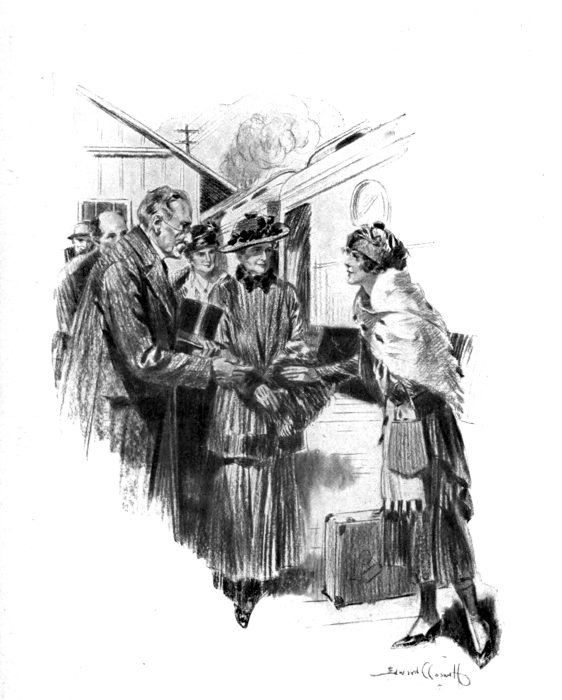
"Oh, Judge, I've come home! I've come home!"
Kitty's voice quavered, and the tears came into her gray eyes, but she winked them away resolutely. Judge Peters blew his nose with a long, sonorous note. He had had a little speech of welcome all ready in the back of his head; nothing formal, just distinctive enough to mark the occasion; but all he found to say, and that gruffly, without an atom of his beautiful Court manner, was: "How are you, Kitty? How are you? Glad to see you!"
Mr. Jordano was hardly more fortunate, even though he had written down his remarks the night before, and committed them to memory while shaving that morning. But he began bravely:
"Miss Kitty, I bid you welcome to your native heath! This day—a—every inhabitant of Cyrus—a—will be marked with a white letter and a red stone—I—I would say a red letter and a white stone-tone-tone. The Graces—a—the Muses——" Mr. Jordano hesitated and was lost. "Nimporto!" he said hastily. "I am glad to see you, Miss Kitty; you are looking well, my dear young lady, considering everything-ting-ting!"
Mr. Jordano retired in confusion, flourishing his note-book nervously. Mr. Mallow's turn had come. Taking both Kitty's hands, he shook them up and down solemnly, as if working a double pump.
"How are you, Kitty?" he said huskily. "Pretty well, thank ye! My bronical tubes don't conjingle, that's all. Well! well! well! how about it? Lots of water in the 'Tlantic Ocean, eh? Treat you pretty well, did they? Find anything better than the Mallow House in them foreign caravans? Bet you didn't!"
Here the Chanters swept round the corner, rosy, breathless, shouting, "Late, as usual!" and the reception was over. There could be no ceremony where the Chanters were. The three girls enveloped Kitty in exclamatory embraces: the three boys (well-grown youths, but always boys!) hovered about, as nearly embarrassed as Chanters could be, cracking their finger-joints and getting in a word when they could. It was something like this:
Trebles: "You dear, darling, delicious Thing! It is too simply heavenly to get you back! Oh, Kitty, it is so rapturous!"
Basses: "Great, Kitty! awf'lly glad!"
Trebles: "My dear, I can't believe it is you, though you do look so deliciously natural, you darling!"
Basses: "Corking, Kitty! looking awf'lly well!"
Trebles: "Isn't she? Only a scrap shadowy, but it makes her eyes all the bigger. Kitty! They are a mile round at least! I never saw—Oh, you precious Thing, I must kiss you again! Won't you give the boys just one—"
Basses: "Oh! I say!" Exeunt, blushing peony red.
It had been decided that Nelly Chanter should have tea that first night with Kitty. Miss Egeria Bygood had held an anxious consultation with Sarepta, the Ruler of Ross House. Miss Bygoods had hoped to have Kitty at their house this first evening; Miss Egeria advanced the proposition rather tremulously. What did Sarepta think? It would be such a pleasure to Father: Kitty had always been his favorite: there happened to be a sweetbread in the house—
Sarepta fixed her with an inscrutable pale blue eye.
"No'm! thankin' you all the same, but it can't be done. She's best off in her own home at the first of it. I've got everything provided. But it's real kind of you!" she added, relenting. "I'll tell her you asked her, and she'll be just as pleased."
"Oh!" Miss Egeria had been making little plaintive sounds, like a deprecating bird. "But do you think, Sarepta—won't it be sad for the dear child, all alone—not that you are not excellent company, Sarepta!"
"Ask Nelly Chanter!" Sarepta evidently had it all arranged in her mind. "I was goin' to send word to her, but if you would! She has the most sense of any of 'em. And she's young!"
Sarepta did not mean to be cruel, but the thing must be understood. It was understood: Miss Egeria bowed her head meekly.
John Tucker had waited till the first rush of Chanters was over. He now advanced quietly, and touching his hat with a twinkle of welcome, took possession of Kitty's bag.
"Glad to see you, Miss Kitty!" he said. "The checks, Miss? I'll see to your trunks. Pilot's round the corner."
"Oh, John!" Kitty's face broke into a wholly new combination of smiles. "Shake hands, John! Aren't you glad to see me? Oh, I am so glad to see you! How's Mary? And the children? Sarepta is well, of course! She wouldn't dare to be anything else, with me coming home: not that she ever was!"
Now, how exactly like John Tucker! All in a moment, with no word, with hardly a look, he had got Kitty away from the eager group of friends, each of whom was waiting for a little private word with her; had tucked her into the sleigh, given the checks to the expressman (who had rather hoped he might get a word and a glance, too), chirruped to Pilot, and whisked round the corner out of sight. Exactly like John Tucker!
"How mean of John!" cried Zephine Chanter. "Why, I hadn't time to see her dress, or anything!"
"John Tucker's movements are quick-wick-wick!" said Mr. Jordano. "We may as well be jogging, neighbors. Miss Almeria, may I accommodate my steps to yours as far as the corner?"
The little group dispersed, Miss Bygood and Mr. Jordano departing first, a stately pair.
"Aren't they too delicious?" demanded Zephine Chanter, looking after them. "Don't you think they might hit it off after all, Lina? Hannah Sullivan says he'll die but he'll have her!"
"Hannah Sullivan has said that of Mr. Mallow for twenty-five years, mother says!" Lina, the eldest and quietest of the Chanters, spoke reprovingly, "and—and I wouldn't, Zephine, if I were you!"
"I know you wouldn't, Sobersides dear; but I would, you see! Where's Nelly? Nell, mind you notice every stitch she has on. Disgusting of Sarepta to ask you instead of me—but perfectly right, you darling thing! Come on, girls! The boys have gone. Weren't they too craven! when, of course, they were dying to!"
Speeding along the level, jogging up the hill, John Tucker kept his eyes fixed steadily between Pilot's sharp-pricked ears, and kept up a steady stream of cheerful talk which enabled Kitty to cry quietly into her muff and no harm done. Yes, they was all well, he guessed. Mary had had one of them spells last summer, but she was rugged now, and the children similar. Sarepty was in her usual health, fur as he knew: he never knew anything to ail Sarepty. He didn't know but 'twas because she was so poor of flesh: nothin' for sickness to take holt of, or so it appeared. Bones wasn't liable to ail any, he guessed. What say?
"John Tucker, how you talk!" Kitty was actually laughing, a quavering little laugh, but still—"As if bones didn't ache when people have rheumatism! Dear me! how is old Mrs. Tosh, John?"
"I couldn't say, Miss Kitty; that is, not precisely. She ain't livin', Mis' Tosh ain't—at the present time!" John added gravely, with an air of guarding his words carefully. "She passed away—yes'm! 'Twas about the time we lost old Victory."
"Is Victory dead? Oh, John! the dear old horse! Why, she was the first horse I ever drove. Don't you remember Father giving me the reins, and dear Mother being so frightened?"
"I do, Miss!" John Tucker's face, which had been carefully wooden till now, broke into curiously carved wrinkles of laughter. "I'll remember that, I guess, long as I remember anything. Little tyke you was—excuse me, Miss Kitty!"
"I certainly was! go on, John!"
"Six years old, warn't you? Or not more'n seven anyhow. 'You may drive round to the stable, Daughterkin!' says Doctor, and puts the reins in your little mites of hands. 'Yes, Doctor,' says you. 'I'll drive round!' and you took them reins, and before any one could so much as wink, you was out of the yard, cuttin' down the ro'd full chisel—gee whiminy! I can see you now. Your Ma hollered right out, and I don't wonder, fraygile as she was. I know it took my breath away. Why, I never see anything go so quick. It appeared like you and Victory had got it fixed up between you, so to speak. Doctor himself was took aback, I could see that, the way he winked his eyes, but he wouldn't let on.
"'Don't be frightened, Mary,' he says. 'The little imp has a good grip, and Victory is as kind as kindness!' he says. All the same, I noticed he was lookin' pretty sharp up the ro'd! And when he see the old mare's nose come round the corner, gee whiminy! he slaps his leg and hollers out, 'A daughter of Jehu!' he says, quotin' Scriptur', I believe, the way he did. 'A daughter of Jehu, for behold she driveth furiously!'"
Kitty was laughing outright now.
"Dear Papa! I was a little imp, wasn't I, John?"
"Yes, Miss, you sure was. But yet—" John Tucker, cocking his head argumentatively, ventured for the first time to look at his companion, saw her face firm and cheerful, and went on with confidence—"but yet you knew what you was about well enough. You'd ben handlin' the ribbons a year or more goin' to and from the stable, 'longside o' me or your Pa: you was tough as hickory, and you was knowledgeable: there warn't nothing to be scared of. 'A daughter of Jehu!' says Doctor, 'for behold she driveth furiously. Here she comes, Mary! she's all right!' He laughed right out, and then he pulls his face straight, and looks mighty solemn, and you come lickety-split along the ro'd and turned in the gate as neat as a whistle, and pulls up front the door. I says to myself, 'Wal!' I says; 'that young one,' I says, 'is all right!' And so it has proved."
"Nice John! Thank you, John! And we've been friends ever since, haven't we? But Papa scolded me, didn't he?"
"He did, Miss. 'You little imp,' he says, 'I told you to drive round to the stable!' 'Yes, Papa dear,' you says: I can hear you now. 'So I did, dear Papa; round the square!' He had to laugh then, would he or wouldn't he!"
"Victory could have made just as good a turn without me!" said honest Kitty. "She was as wise as three ordinary horses; and she knew the way round that turn as well as the way into her own stall. She was pretty old even then, John, wasn't she?"
"Victory," said John Tucker, slowly, "was thirty-five years old when she died this spring. I set out to write you, but I couldn't seem to. Kind o' broke me up, losin' her. She was the first hoss ever I come to know and care for. Lemme see! I come to work for Doctor thirty years ago this winter. Victory was five years old, and she was a pictur! prettiest hoss I ever see, bar none. Well! now you might be—?"
"Twenty!" said Kitty.
"That's right! And Vict'ry was twenty that time you driv her round the square. She kep' smart right along up to the last week, old mare did: I didn't drive her any last summer, only once in a while, so's her feelin's wouldn't be hurt, seein' the other hosses go out. She'd whinny out just as askin'! 'Why ain't I goin' out?' she'd say, plain as any person need to speak. Then I'd put her in the light sulky and drive her up and down the ro'd a piece, and she'd antic round and toss up her head as if she was the President's wife goin' to meetin'."
"I hope she didn't suffer, John?"
"No'm! no! she died like a Christian, the old mare did. One night she wouldn't take her sugar; I allers gave her the sugar, like you told me, Miss Kitty—"
"Dear, good John! Thank you, John!"
"So I suspicioned what was comin', seein' her age and all. I told S'repty, and she brung out an extry good mash, but 'twas no use. Old mare laid down, and we set there with her. She looked at me real lovin', and put her nose in my hand, and I rubbed her, and S'repty rubbed her; and 'long about ten o'clock she just stretched out and passed away, same as if she was a person."
John Tucker cleared his throat and was silent for a few minutes; then he addressed Pilot, his present joy and pride, with some asperity:
"Git ap, you! No reason for your goin' to sleep that I know of. Miss Kitty—" he glanced sidelong at his companion—"the ro'd's first rate here on the level. I didn't know but you might like to drive a spell—"
"Oh, John!" Kitty looked down ruefully at the gray suède gloves which had seemed just the right thing for traveling. Pilot had a pretty solid mouth. "If I only had some decent gloves!" she sighed.
With a sheepish look, John Tucker fumbled in an outside pocket and pulled out a stout pair of leather gloves, fur-lined.
"S'repty wouldn't give 'em to me!" he chuckled; "but I remembered the drawer where you kep' 'em. You'll need 'em. I kep' him in yes'day a-puppose."
With a flashing, "Oh, John! You are a darling!" Kitty almost snatched the gloves from him. Another moment, and they were speeding along the level, a swallow-flight which brought the blood to the girl's pale cheeks and the light to her eyes.
"I tell ye!" chuckled John Tucker. "Gee whiminy! Go it, Miss Kitty, he's fresh: I kep' him in yes'day a-puppose."
Kitty chirruped; Pilot tossed his handsome head and sped on the faster.
"If I am a daughter of Jehu," said Kitty, "I might as well live up to my name, John Tucker!"
So it came to pass that when Kitty Ross came home to her father's house, it was with a rush and a swirl that brought Sarepta flying from the kitchen in a panic, dish-cloth in one hand, stove-lifter in the other.
"My land of the living!" cried Sarepta. "That John Tucker!"
CHAPTER III ross house
The Ross house stood—stands, thank heaven!—on the north side of the Common, between Judge Peters's and Madam Flynt's, its front windows facing due south. The main body of the house is of brick, the two wings and the portico with its Doric columns, of wood; all gleaming white, with blinds of exactly the right shade of green. The front fence (Cyrus has not done away with its fences; it would scorn to do so. "When I wish to move into my neighbor's yard," says Madam Flynt, "I shall ask his permission first." And Miss Almeria Bygood says, "I prefer to live on the street, not in it") is of iron, with chains and tassels elaborately looped; the posts of white brick, surmounted by wooden balls large enough for a child to sit on with some measure of comfort. The gate, a beautiful affair of handwrought iron (a testimonial to Dr. Ross from a grateful blacksmith) was made, one would think, to be swung on. Near the bottom were four grapevine circles, into which two pairs of small feet fitted perfectly; while the smooth bar across the top was manifestly intended for the resting of dimpled chins and the grasping of chubby hands. Then, its squeak! At the friendly sound, Kitty Ross glanced down, and all her childhood came flooding back.
"Ah, Tommy!" she sighed. "Ah, Duke! We are too big now, even if you were anywhere."
Then the door opened, and there stood Sarepta Darwin, just as she had stood at similar home-comings all Kitty's lifetime.
"Come in this minute, child!" she said. "You had the life nigh scared out of me. You, John Tucker, you'd ought to be ashamed of yourself, at your time of life!"
"That's just it, S'repty," chuckled John. "I've outgrown the sensation!"
"Don't scold, Sarepta dear!" said Kitty. "I've come home!"
Sarepta snorted, and turned her head away. No one had ever seen a tear in that wintry blue eye, and no one ever should. The idea!
"You're froze, I expect," she said severely, "speedin' like that in this cold. Come in to the fire! Nelly Chanter's comin' to supper with you and spend the night, but I thought you'd want to get your things off first."
Home! After all the wandering, all the longing: home at last! Kitty had enjoyed much of the time abroad. Endless wonder, endless beauty; she rejoiced to have seen it; but the place where she was born, the countryside where she belonged, meant more to her than all the glories of Europe and Asia. So long as her mother was with her, so long as anything strange or fair could lift the languid head or bring a gleam of light to the sad eyes, on they must go, wherever the brightest way seemed to point: but when it was over, and the weary body which held the gay, innocent, flower-like soul, was hid quietly in the churchyard at Vevey, there was but one thought in Kitty's mind. The English cousins, the kind Swiss friends, might plead as they would; they all wanted her; it would mean so much to them if she would make her home with them. Kitty thanked them all with tears, and took the next and swiftest steamer for home.
A plain square hall, with stairs going up at one side; old prints on the walls: Regulus and the Carthaginian Ambassadors, Cornelia, Mother of the Gracchi:—Kitty had a loving glance for all: the very oilcloth felt friendly under her feet. Had not Grandfather Ross laid it down fifty years ago, when oilcloth was oilcloth, and not, as dear Father used to say, brown paper and fish glue?
It was late January, but the Christmas wreaths still hung in the windows, the fir boughs over the picture-frames. The mail-table, with its scales and weights, the barometer, the hanging shelf where garden baskets and implements slept the long winter away—Kitty's glance took them all in lovingly.
"Fire's in the settin' room!" said Sarepta.
Kitty turned to the right, and entered the room she loved best in the world. Shabby, Mrs. Sharpe called the sitting room of Ross House. If it was shabby, no one but Mrs. Sharpe knew it. The rugs were worn, it is true, the original patterns lost in a warm blending of reds and blues, but they were still thick and soft, and only Sarepta knew of the mended places. The wallpaper had not been changed since the memory of man. Why should it be, when it was in perfect condition? And how much of it was visible anyhow? Mellow, rich, warm: one sought for other kindred words, feeling the friendly harmony of everything from the Piranesi etchings to the books which lined half the walls and lay on every available flat surface. The fireplace occupied most of one side, the fire leaped and crackled behind the high fender—not so high as it used to be, Kitty, when you and Tom "stumped" each other to climb on it and grimace at your reflections in the round balls of the andirons. A leather sofa stood before the fireplace: well! I grant that the sofa was shabby, but who cared? Never was another, old or new, to compare with it in comfort. Kitty sank down on it now, and stretched her hands to the blaze, and made a little sound, half moan, half coo, of utter thankfulness. Sarepta, erect in the doorway, hands folded over her spotless apron, had the air of waiting for something. Presently Kitty spoke over her shoulder, her eyes still fixed on the fire.
"She didn't suffer at all, Sarepta!"
Sarepta grunted.
"She just faded away quietly, like a flower. It was like—do you remember how I used to put the hollyhocks in the little black pool, under the trees? They didn't wither or crumple up, they just grew more transparent, day by day, till at last they seemed almost to melt into the water: it was more like that than anything else."
Sarepta grunted again. "Got your feet wet reg'lar every time you did it!" she said.
"She knew she was going," the clear lovely voice went on, as if repeating a lesson. "She asked me to—to leave her there, among the flowers: she was so tired, she thought it would trouble her in heaven to know that—it—was being carried about. And then—she said—'Go home, darling! Go home to—Sarepta and John Tucker: they will—take—care—'"
The clear voice faltered, broke: Sarepta Darwin threw her apron over her head and went away.
An hour later, a composed and cheerful Kitty was greeting Nelly Chanter, who came in rosy and breathless as usual, full of tender incoherence.
"Darling Kitty! so heavenly of Sarepta to ask me to come! I didn't mean to be—oh, Kitty, you are home again! I thought you never—what a perfectly delicious kitten!"
All the embarrassment was Nelly's, and she did not quite know what to make of the sensation, an unfamiliar one to Chanters; but she was, as Sarepta said, the most sensible of them, and followed Kitty's lead readily. The trunks had come, Kitty said; they wouldn't begin really to unpack, it was too near supper time, but she must just open the little leather one, and get out—come along!
Up the stairs they went, every step holding its greeting for Kitty, every touch of the carved rail sending its little thrill through her; round the turn, up to the landing, where the orange tree was in full fruitage—one, two, three,—twelve oranges!
"Do look, Nelly! Sarepta is a wonder, isn't she?"
Past the door from which the voice had always called as she went by, "Kitty my Pretty! is that you?"—silent now; the door open, of course, Sarepta knew enough for that, but not to be glanced at yet—not yet! So into her own room opposite, where the fire crackled as gayly as in the room below, and the curtains were drawn and the candles lighted.
The little leather trunk, being investigated, yielded up a lace blouse, the most exquisite dream of a thing, according to Nelly, that ever was seen. It couldn't be for her! no! It wasn't possible! Reassured on this point, Nelly was overwhelmed. How could she ever, ever, ever thank Kitty enough?
"Hush, Nelly! it isn't half pretty enough for you. Tell me about everybody! Your mother is well, you say? How is Madam Flynt?"
"Very well, except for her rheumatism. I saw her this morning: she sent her best love, and hopes you will come in to-morrow. She can't walk much in this slippery weather: she has been driving—" Nelly stopped suddenly, with a queer look: one would say a guilty look.
Kitty, now in her white wrapper, brushing out her long fair hair before the glass, and looking, Nelly thought, like a heavenly mermaid, did not see the look.
"Well, she wouldn't be driving next door anyhow," she said. "I'll run over right after breakfast. Let me see! I've seen all the dearest people, except your mother and Madam Flynt. Wasn't it darling of them to come to meet me? How handsome Miss Almeria looked! How are the Wibirds, Nell?"
"Much as usual, I think. Melissa is poorly, but she keeps on at the Library. I don't think she's having a very good winter. Poor Melissa!"
Nelly's rosy face clouded slightly.
"Wilson?" Kitty spoke low.
"Yes! pretty bad this winter, I'm afraid. Mrs. Wibird can't control him, nor any one else except Mr. Mallow and Billy."
"How's Mr. Cheeseman?"
"Oh, just the same! all agog to see you, like every one else. I was in there yesterday, and he was making every kind of candy you had ever liked since you were a baby, so he'd be sure to have the right thing on hand. And Mr. Bygood was so excited about your coming he got no nap yesterday, and Miss Egeria was so worried! But Miss Almeria told her joy was the best thing for the aged, so she cheered up. My dear, I think you'll have to go and see them all to-morrow, or they will all pass away, and there will be no Cyrus left. Kitty!"
"Yes, dear!"
At Nelly's explosive utterance of her name, Kitty, whose toilet had been progressing while they talked, paused, slipper in hand.
"What is it, Nelly?"
"Oh, nothing! that is—well, Mother just wanted me to say that we hope you will come to live with us!"
"Why, Nelly!"
Nelly went on with a rush. "I know the house is small and crowded, but just listen! The boys are dying to have you, simply dying! So they will sleep in the barn-chamber, and Zephine and I will take their room, and you will have ours. We've got it all planned out, and the boys have always wanted to have the barn-chamber, and they will fit it up themselves, so you see it will be the most convenient thing in the world, besides making us all so happy we want to dance whenever we think of it. Now, Kitty, say you'll think about it? Of course, you can't decide this moment, and of course the other houses are bigger, and you may say some of them are lonely—the people, not the houses!—but you will think about it, Kitty, won't you, and remember that we spoke first!"
Kitty's eyes were wide with astonishment, but full of affection.
"Of course I will, Nelly! Why, I never heard of anything so kind in my life. Thank your dear mother a thousand times, and tell her—but I shall tell her myself. There's the bell! Come along. I'm sure Sarepta has pop-overs for us!"
Sarepta had pop-overs for them, marvelous efflorescences of brown and gold, such as all Europe could not afford. Kitty exclaiming to this effect, Sarepta grimly supposed they hadn't the faculty, and drew attention to the creamed chicken and oysters, which were done the way Kitty used to like 'em, though Sarepta presumed she'd learned newer-fangled ways over there. Mebbe she wouldn't care. Reassured on this point, she handed the fried potatoes with a challenging air—she knew no one could beat her there—and retired, to count over every word Kitty had said and store it away for future need.
The girls fell to their supper as healthy, hungry girls should, and for a time conversation was chiefly exclamatory, dealing with the wonders of Sarepta's cookery. By and by, however, over the ice-cream which made it a "party," as they exclaimed with delight, and later, sitting on the sofa before the singing, purring fire, they had much talk, Kitty telling of things she had seen abroad, Nelly wondering, admiring, exclaiming. But always the talk would come back to Cyrus, the home of their hearts, and to the people who lived there. Only two thousand, all told, this including the three French families and the two "Polanders" down by the little woolen mill which was our one "industry," so that between them the two girls knew or knew of almost every one within the village limits. It was a farming community, save for the comfortable store-keepers, and the half dozen "tony" families as Mrs. Sharpe called them, whose ample mansions, white or yellow, had stood about the Common since Colonial days. Cyrus, her people were wont to say, did not grow: she remained. I don't know just why they were proud of this stationary quality, but they certainly were. For fifty years, the population had hardly changed; or to be accurate, it had changed in so gradual and regular a fashion that it always seemed the same. An accurate observer like Judge Peters would tell you that once in about thirty years there were more children: the schools were fuller, the wave of youth crept slowly up till street and meeting house blossomed with youths and maidens. Then, still gradually, the wave would recede: some of the lads went away to work, some of the lasses married "out-of-towners"; the numbers dwindled again, till in another thirty years another vigorous generation would come shouting to the front.
"And how is Savory Bite?" asked Kitty. "Does he still live alone?" (This gentleman's real name was Avery Bright, but he was never called by it.)
"My dear, yes! No one goes near him: where is the use, when he won't let any one in? He did our garden last spring, and was just the same, snapping your head off if you spoke to him. I have never been in the house, though I have peeped in the window sometimes. It's always neat as wax, I'll say that for Savory."
Kitty gave a little sudden laugh.
"I've been in it!" she said. "Tom and I got in one day through the cellar; he had left the door unlocked. We got up into the kitchen, and had a wonderful time. You know everything is painted blue, floor, tables, chairs, everything? Well, naughty Tom had a piece of chalk in his pocket, and what does he do but write on the blue table in big letters,
"'Savory Bite, Why not paint it white?'"
A silence fell: then Nelly asked the question which had been on her tongue twenty times, and twenty times kept back.
"Where is Tom, Kitty? Do you know?"
Kitty looked straight at her with honest eyes.
"I don't know, Nelly. I haven't heard one word from him. I wrote," she added, "when Father died—that was after Mrs. Lee's death, but I knew he was in Omaha, and I had his uncle's address—but I never had one word of answer."
If a writer could only tell all she knows! That letter, Kitty, in which you poured out your sad heart to the lad who had been brother, playmate and boy lover ever since you can remember, is in the pocket of his uncle's spring overcoat, now laid away in camphor, till the first of May, when he changes from winter to spring clothes, regardless of weather. His uncle is not a villain, far from it; he would gladly forward the letter, only he does not know it is there, nor will till the above date.
As for Tom's letter to you, Kitty, written about the same time, I don't know whose pocket that is in. He wrote it on board the steamer at San Francisco, and sent it back by the pilot: but it never reached you. It was a good letter, too. Tom knew nothing of Dr. Ross's death: full of his own recent loss of a beloved mother, he thought of you in your happy home with the two dear and delightful parents who seemed to belong almost equally to him—almost! He told you of his great "job"; he begged you to think of him whenever you had a minute to spare, but not to bother about writing, because he had no address to give beyond the Shanghai Bank, and he might not get back there for a year or two, from the way the job looked at this end. But you would know he was thinking about you, and you must be a good Cat and purr a great deal, and not scratch anybody except Wilson Wibird. And when he came back, Kitty—well, perhaps he'd better wait till then, but all the same you knew well enough, so he remained yours always, The Duke of Lee.
Yes, that letter would have comforted Kitty a great deal: it was a pity she did not get it.
Tom, meanwhile, building bridges in a remote province of northern China, supposed comfortably that she had got it, and thought of her daily with great contentment.
So things go—sometimes! And here is Sarepta with the bedroom candles.
CHAPTER IV the home guard
Early next morning, Nelly was off for her school. Kitty, after waving her good-bye from the gate, went back into the house; into the kitchen, where she knew Sarepta was expecting her. "You come out quick as you get shet of her!" had been the mandate, which Kitty would never have thought of disobeying.
"Dear kitchen!" she said. "I saw nothing like this, in Europe, Sarepta!"
"I expect not!" said Sarepta, with a lift of her chin. "Take a seat!"
Kitty sat down obediently in a Windsor chair, and looked about her with great content. Her eyes passed from the shining stove to the cupboard full of beautiful old blue crockery, the pride of Sarepta's heart; to the scarlet geraniums in the window, the yellow cat on her scarlet cushion. All good, all delightful. She had come home.
"But what is all this, Sarepta?" asked Kitty.
On the shining table sat a number of plump little bags, of stout unbleached cotton, bearing brief inscriptions in blackest ink. Kitty took them up one by one, and read in wonder: "Eggs," "Tomatoes," "Sarce."
"What in the world, Sarepta?"
Sarepta, standing rigid, her hands folded in her apron, made austere reply.
"There was no reason as I know of why things should go to waste. Your Ma wasn't fit to see to 'em before she went away. There wasn't no need she should. I should hope I knew something! This—" she took up the stoutest bag, "is the egg and chicken money. The hens has done real well; I've sold eggs and broilers and roosters. You count that!" She named a sum. "I expect it's right."
"Sarepta! you dear, good soul! How could you—"
"This is sarce!" Sarepta continued, taking up another bag. "Sugar was low and fruit was high, so I done well there too. I made two hundred glasses of currant jell, and three hundred of grape, and—"
"But, Sarepta! What did you do with them all?"
"Sold 'em! Mis' Flynt wasn't puttin' up, herself, this year, didn't want to bother with it. No more did Miss Bygoods. And Mr. Mallow gi' me the hull of his order, so you see—"
"I see!" Kitty became thoughtful. "Sarepta—"
"Well!" the answer was a snap, thrown backward over an uncompromising shoulder. Sarepta was suddenly very busy at the stove, rattling and raking with much commotion.
"Sarepta! You didn't—you didn't ask for these orders, did you?"
Sarepta turned round; her face was like an iceberg carved with a jackknife.
"Was your Pa satisfied with me?"
"Sarepta! You know he adored you!"
"Was your Ma satisfied with me?"
"Sarepta dear! Don't be cantankerous!"
"Was your Ma satisfied with me?"
"Of course she was! How can you—"
"I made sarce before you was born or thought of!" Sarepta's tone expressed finality. "I've always made it—and I've never took it!" she added with a grim chuckle which splintered the iceberg in a singular way. "Anything else?" Sarepta's tone was amiable, but conveyed the idea that she had things to do, however it might be with other people.
"Just one thing, Sarepta dear, and then I'll go. Have you taken your wages out of this money? If not, hadn't we better settle it now?"
Sarepta made no immediate reply. Instead, she examined the draughts of the stove one by one, with meticulous care. Apparently satisfied with their condition, she next proceeded to brush the stove top (which did not need brushing) and to fill the kettle with ostentatious zeal. Kitty waited patiently, enjoying the kitchen and stroking the yellow cat. Finally, Sarepta washed her hands elaborately, rolled them in her apron, and turned round. So turning, she displayed the iceberg set again in rigid lines. The words appeared to freeze as they dropped from her lips. Sarepta had come to this house with Kitty's Ma, she intimated, when first she come here a bride.
"Sarepta," Mrs. Ross had said, "this is my home, and it is yours, too, as long as you live." Was that so, or wasn't it?
"Yes, Sarepta, that is true."
"Well, then! I was offered a home, and I expect a home, long as I need it. When I want wages, I'll ask for 'em. It's likely I'd take 'em from a child like you."
"But—" cried Kitty.
"Butter!" replied Sarepta. Then they both felt better, for this was the give and take of Kitty's childhood.
"But I do wish you would be reasonable, Sarepta! John Tucker has always had his wages, hasn't he?"
"John Tucker has a wife and fam'ly. His wife has about as much gumption as a week-old guinea-pig, and the way that eldest boy of theirs is growin' up is enough to scare the feathers off a hen; he's got to have wages, of course. And I've had 'em, Kitty, all I wanted, and money in the bank. My uncle left me his farm and savin's, last year, if you have to know. And if I'm pestered any more—" Sarepta's voice dropped to an ominous note—"I'll go and live there!"
"There!" she added in a different tone. "You just let me do the way I want to, Kitty, and we'll get along first rate. I'm crotchety, but yet I mean well; only I can't bear to be crossed. Run along now, child, and take your money. I'd put it in the bank if I was you. I'm busy now," she added abruptly, as Kitty tried to speak. "Besides, that John Tucker wanted you should come out to the stable right away. Dinner at one o'clock!"
"Dear me!" sighed Kitty, as she made her way toward the stable. "I feel just like Alice in Wonderland: I never was ordered about so in my life. Dear old thing! I shall always be ten to her, I suppose. But her name ought to be Pomona: she's right out of 'Rudder Grange'! Now for John Tucker! I hope he hasn't been making sarce!"
John Tucker was wont to say, Sarepty's kitchen was all right, but give him the harness-room! He was in the harness-room now, and it certainly was a pleasant place. A quaint little stove, of antiquated pattern, faced the door, and in front of the stove were two comfortable wooden arm-chairs, one for John and one for a visitor. John generally had visitors, in his few spare hours. People came to ask him everything—except in the medical way—that they used to ask Dr. Ross. The window of the little room looked out on the garden, the glazed upper half of the door gave a cheerful prospect of the stable, with its white-swathed vehicles—the doctor's buggy, the little phaeton, the old carryall, rather past use, but a wonderful place to play house in. You could not see the two box-stalls from the harness-room, for they were on the same side of the stable; but you could hear Pilot and Dan stamping and talking to each other through the partition. Kitty had already visited them, and given them sugar, and rubbed their dear velvet noses, and wept a little on their sympathetic necks.
"Good morning, John! How cosy you look in here!"
"Good morning, Miss Kitty! Step in! step in! I'm pleased to see you. Take a seat, won't you?"
Kitty sat down obediently, as she had done in the kitchen. John's tone was not Sarepta's: he was never autocratic. When Kitty was three, he had advanced the opinion that "this filly must be druv with the snaffle!" and had regulated his words and ways accordingly.
"The horses look beautifully, John! Of course, they always do."
John expected the horses might look worse. He didn't know as they would be special easy to beat in this county—or State, either, come to that!
"What a beauty Pilot is! And dear old Dan is just as handsome in his way. I suppose they are quite valuable horses, John?"
"I s'pose they be!" John Tucker spoke gruffly, and turned his head away. Something in the girl's tone and wistful look made his eyes smart. He put too much pepper on that fur robe, he knowed he did when he done it. Thus John Tucker, muttering.
"I asked, John dear, because—" Kitty's hand was on his arm now, fingering his rough sleeve as she used to in the days when she sat on his knee and, being interrogated as to whose gal she was, replied, "Don Tutter's dal!"—"because—I suppose we ought to sell them, John Tucker, dear. There is very, very little money, you know. Was that what you wanted to see me about, John?"
"Miss Kitty!" John Tucker turned his rugged face toward her now, and it was aglow with feeling: "Don't sell them hosses! That was what I wanted to say to you, and I say it again. Don't sell them hosses! If money is needed, and I'm aware it is, there is more money to be made by keepin' them hosses than by sellin' 'em. Lemme tell you; don't be mad with me, Miss Kitty, for I done the best I knew how."
"Of course you did, John! As if you ever did anything else. Why do you look at me so strangely, John Tucker?"
"Miss Kitty, I say it again, I done the best I knew how. Now lemme tell you! You remember Flanagan?"
"Flanagan, the cab-driver? Of course I do! Why, I didn't see him at the station yesterday. Wasn't he there? He used to say he never missed a train."
"He's missed consid'ble many lately," said John Tucker grimly. "Flanagan's complaint is that he's dead. Yes, ma'am," in answer to Kitty's exclamation, "dropped off settin' right there in his team at the depot. Folks was surprised."
"I should think so! Why, Flanagan! Why, John, I should as soon think of the train's dying! What do people do without him?"
John Tucker cleared his throat elaborately.
"I happened to be there, and I drove the folks home that he'd come to fetch. That was the way it began."
"The way what began, John Tucker?"
John Tucker rose and looked out of the window.
"Wind's workin' round no'theast!" he muttered. "We shall have snow flyin' before night. Miss Kitty, you'll see it reasonable, I know you will. Take a look at it by and large!" He turned, and threw an appealing look at the girl. "Here was Flanagan dead, warn't he? And no insurance, so to speak. Hosses and cab sold to pay for the funeral and the board bill: hadn't no folks, Flanagan hadn't; boarded to Widow Peavey's. Well! there was the train to be met mornin' and night, and there was Madam Flynt to be took her airin', and Mr. Bygood sim'lar, to and from the store. The gals don't want him to walk up the hill, 'cause of his heart, and I dono as I blame 'em. Considerin' his age, you know. And—the hosses had to be exercised, no two ways about that."
He paused: Kitty's eyes were shining, and she took up the word eagerly.
"And you have been doing all this, John Tucker! You have been meeting the trains and taking the dear people to drive, while they are finding some one in Flanagan's place? You clever John! Why, I think it was a wonderful idea! Of course I am perfectly delighted. And have they found a new Flanagan yet? Because, of course, you'll go right on till they—"
John Tucker's face was almost as craggy as Sarepta's, as he faced Kitty again:
"Found?" he said gruffly. "They've found me. I'm Flanagan: you're Flanagan. Miss Kitty—" he lifted a newspaper from the little table, displaying sundry piles of silver coin, arranged in neat pyramids; the base "cart-wheels" dollars, the top dimes. "Here's your money!" said John. "All that's ben taken in this six months since Flanagan died. You can take out my wages, if you're a mind to, 'count of Mary and the children: the rest is yours, lawful money, well airned, if I say it. Don't—don't you cry, Miss Kitty! don't you now! I done the best I knew how. I talked it over with Judge Peters, and he said, 'Stu' boy'; 'twas the best I could do; Mis' Flynt the same, and Sarepty. Don't you cry, Miss Kitty!"
Kitty explained through her tears that she wasn't really crying; it was only because every one was so darling and kind, and—and—why did the tears come so easily? There had been none, until she came home; she had longed for them sometimes, when her head throbbed, and her eyes burned so hot and dry; now, the least thing brought them welling up, and every time some band seemed loosed from her heart.
"It seems very—very strange, John Tucker, dear, to be taking money from the neighbors!" Kitty dried her eyes and looked up. "I am going to be sensible, John, and I know you did the very best—but it does seem strange, John Tucker! do you think Father would like it?"
John Tucker's eyes were very blue and very bright.
"Miss Kitty, if there is one thing under the canopy that I am sure of, it's that Doctor would approve. Doctor, you see, was reasonable. He'd see right off that here on one side was hosses to be fed, and grain costin' thus and so; and hosses to be exercised, or they'd go lame and poor. And he'd see on the other side, here was folks needin' to be hauled, and no one to haul 'em. Well, then Doctor would say,—'pears like I could hear him, and have heard him right along, 'When you're dealin' with hosses,' he'd say, 'you need hoss sense.' And this is hoss sense, Miss Kitty, or I don't know it."
Kitty rose and held out her little hand, to be engulfed in John Tucker's huge brown one.
"That's enough, John Tucker!" she said; and up went her chin. "I can hear him, too. We will be partners, John: Tucker and Ross! Only you will do all the work, John Tucker dear, I know you will."
John Tucker, looking at her, fell into such a glowing state that the stove was nowhere beside him.
"Now there!" he said. "What did I tell you? She's her Pa's own gal!"
"And now I must go and see Madam Flynt! You say she knows all about the Great Plan, John?"
"And approves! Madam Flynt is a real sensible woman."
He followed Kitty out of the harness-room, and they moved instinctively to the stalls, where two dark satin heads were thrust eagerly forward, two velvet noses sneezed and sniffed in eager greeting.
"You darlings!" cried Kitty. "No, Dan, no more sugar. You are not a pet lamb any more, dear: you are a Horse of Business, and must realize your responsibilities. I shall drive Madam Flynt myself, John, most days."
"I thought likely you would!" chuckled John. "You'll have to go keerful, though, Miss Kitty; it's slow and sure with Madam Flynt. None of your Bible doin's with her along!"
"Bible doings? What do you mean, John Tucker?"
John Tucker chuckled again.
"I was only thinkin' of Doctor!" he said. "'A daughter of Jehu, for behold she driveth furiously'."
CHAPTER V the neighbors
Madam Flynt was evidently expecting Kitty. She was ready dressed and in the drawing-room: the large, bright room with its hangings of apple green and gold brocade, its gilded cornices and fire screen. Dr. Ross used to say that the room was an apple-tree bower, and Madam Flynt the apple; indeed, she did look like one, a Bellefleur, say, or a rosy Porter. A woman of sixty, large, massive, fair. Her hair was faded from the bright gold of her girlhood, but was still yellow; her eyes were China blue, her cheeks apple red. The color was so set in them (no one had ever seen Madam Flynt pale, even in sickness) that a stranger might well think it clumsy art, instead of—what shall I say, over-zealous Nature? The story ran that one day in her youth, walking along the street, she heard a stranger say after passing her, "Painted, by God!" She turned instantly.
"Yes, sir," she said calmly, "I am painted by God!"
Of course this was not in Cyrus: Cyrus people knew.
"Well, Kitty!" Madam Flynt held out a large, plump white hand, amply be-ringed. She was dressed in flowing robes of green and white, a most un-negligent "negligée," and was a pleasant sight enough. "Well, Kitty! You have to come to me, you see. I couldn't go down with the rest of the town to meet you. I am glad to see you, my dear. We have been too long without you, Kitty."
"Dear Madam Flynt, I am so glad to get home! How is the rheumatism?"
"The rheumatism is very well, Kitty, it thanks you: it's more vigorous than I am; but I do very well, on the whole, very well. I get my airing, which is the principal thing. John Tucker told you of our little arrangement? A very good plan! John Tucker is a sensible man. He and Sarepta are really an able pair. Pity he didn't marry her, instead of that poor creature, Mary Spinney. You had a good voyage, my dear?"
She talked easily, Kitty following her lead.
"Glad to hear it! And now, Kitty, I hope you are going to be a sensible girl, and do as I wish."
"As you wish, Madam Flynt? About the driving? Oh, surely! I am only too grateful. It is so dear of you—"
"Nothing of the kind! A business arrangement, nothing more. Flanagan was dead—I didn't kill him, did I? What I wish, Kitty, is quite another thing. I want you to come and live with me."
"Oh, Madam Flynt!"
"There is everything to be said in favor of the plan," Madam Flynt swept on, "and nothing against it, so far as I can see. You can manage your home affairs, John and Sarepta, the house and so on, as well here as there; you've only to step across the yard. I need a companion, and so do you."
Kitty opened wide eyes of astonishment.
"Madam Flynt! Has Miss Croly left you?"
"Miss Croly left me? Certainly not. Why should she leave me? Cornelia Croly is as old as I am, or very near it; she needs a companion, too. She grows more set every day of her life. Just move that poker, will you, Kitty? To the left side of the fireplace! Cornelia Croly will always put it at the right; she does it to assert herself; she told me so, in so many words. We both need a young person to keep us from biting each other, Kitty, and you are the person."
At this point, Miss Croly entered the room, beaming welcome. Tall, thin, upright, hard-favored, with the kindest eyes and the most obstinate chin imaginable. Dressed in gray alpaca by day, in purple alpaca by night, with little benefit of fashion; such was Miss Cornelia Croly, Madam Flynt's quondam schoolmate—her companion now these many years of her widowhood. The two made a singular contrast, yet complemented each other oddly. Kitty could never think of one without the other. Corolla and calyx, Dr. Ross used to call them.
Miss Croly had to hear all about Kitty's voyage; the sea had a fascination for her, though she had never ventured upon it.
"A storm! how thrilling! the wonders of the deep!" sighed Miss Croly, all in one breath. "You make it all so real, Kitty. I can hear the roar of the elements and the dash of the breakers—"
As she spoke, Miss Croly had taken up the poker, and after making a dab at the fire, was gently replacing it at the right of the fireplace, when Madam Flynt interrupted her.
"There are no breakers in mid-ocean, Cornelia! And will you kindly leave the poker where it was, on the left side?"
"Excuse me, my dear Clarissa, it is far more convenient on the right side. As attending to the fire is one of my little duties—a very pleasant one, I am sure—it seems not unreasonable for me to have the poker where I can use it. You grant that?"
Seeing Argument throned on both brows, Kitty rose hastily and made her excuses. She had several other visits to make; she would run in this evening, or surely to-morrow morning. Madam Flynt was the kindest of the kind, as she always was: yes, Kitty would think over very carefully what she had said, and would let her know: she thanked her ever and ever so much: good-bye! "Good-bye, Miss Croly! So glad to see you!"
Kitty shut the door on a rather awful "Cornelia!" and fled, only stopping a moment in the kitchen to greet the two maids, friends of her childhood, and to steal a cooky from under Sarah Cook's nose, to the huge delight of that kindly mammoth.
Down the street sped Kitty: the dear, friendly street, where every house smiled a welcome, every window shed a friendly blink. The Common was on her left, a smooth field of snow, crossed by two intersecting board walks. Every tree was a friend too: the bare, graceful branches were moving in the crisp breeze, and each seemed to wave her a welcome. There was the Earliest Maple! Kitty wondered what children drove their spiles and hung their pails now for the sap. She and Tom used to be rather odious, she feared, about that tree. They assumed ownership of all rights in it, both tapping and climbing. She recalled a keen frosty morning like this, when Wilson Wibird had "cut in" early, pulled out her spile and driven in his own. Tom came like a flame of fire across the Common, tore out the spile and threw it away, then pummeled Wilson till he ran shrieking home. Wilson always shrieked when any one touched him.
Where next? Judge Peters would be at his office: she would go down there. He was so wise, he would tell her what to say to Madam Flynt. Resisting the call of many a friendly housefront, Kitty went down the hill and turned into "the Street." There were several streets in Cyrus, be it understood, but only one that began with a capital.
The first person she met was Wilson Wibird himself. He was on the opposite sidewalk, and came across, waving his hand with a familiar gesture.
"Weedy, seedy, needy, greedy!" naughty Tom! But Wilson looked exactly the same, only a man instead of a hobbledehoy.
"Katrine! my one thought since I opened my eyes this morning. Welcome! a hundred thousand welcomes!"
Kitty gave Wilson her hand readily enough, but she did not altogether like his looks. His eyes were bloodshot, his speech thick; he seemed to waver a little as he spoke.
"How do you do, Wilson? How is your mother, and Melissa?"
"Less well than I, for they have not seen you, Katrine! You are more beautiful than ever," murmured Mr. Wibird. He cast on Kitty what he would have called a burning glance. To Kitty it looked rather like a leer, but she must not be unkind. But there was no earthly reason why Wilson Wibird should hold her hand, so she removed it firmly.
"I am going to see Judge Peters," she said: her tone was cheerfully matter-of-fact. "Give my love at home, and say I'll run in soon to see your mother."
"My way is yours!" Mr. Wibird announced, and fell into step, to Kitty's great annoyance. Wilson Wibird had been the butt of her childhood and Tom's; what on earth did he mean by assuming this tone?
They were just outside the Mallow House; at this moment the door opened, and Mr. Very Jordano came out. He had been taking his leisurely breakfast and reading his New York paper, sitting in the office with Marshall Mallow; and seeing the meeting between the two young people had exchanged a word with his host and crony, and hastened out.
"Good morning, Miss Kitty!" he said urbanely. "The sight of you is a refreshment indeed. Good morning, Wilson. Mr. Mallow would like to see you a moment, if you have a moment to spare-pare-pare!"
Mr. Jordano's tone was faintly ironical, as he fell into step with Kitty on the other side. Wilson Wibird glared at him.
"I have not!" he said sullenly. "I am escorting Miss Ross."
"That shall be my privilege!" Mr. Jordano bowed blandly to Kitty. "Go away, Wilson!" he added in a lower and different tone. "Go quite away-tay-tay! Or I'll call Billy!"
Involuntarily, Kitty quickened her pace, Mr. Jordano beside her. The other stood glowering, irresolute: suddenly the hotel door opened again, revealing Mr. Mallow, massive and rosy.
"You come here, Wilson!" he commanded. "Don't stand dilatorin' there! Come on in, you hear me?"
Mr. Mallow was Wilson Wibird's uncle; Mrs. Wibird had been a Mallow: moreover, such work as Wilson did was done for him. The young man, after kicking the curbstone sullenly for a moment, obeyed the summons and turned into the hotel.
Kitty turned to Mr. Jordano with a breath of relief.
"Quite so!" returned that gentleman. "He meant no harm: Wilson meant no harm, but nimporto! Miss Kitty, I welcome this opportunity for a word with you. You have been much in my thoughts, both during your absence and since your return. Miss Kitty, I feel assured that you have much of the deepest interest to impart-tart-tart. You will allow me the privilege of calling on you, I trust, some evening in the near future?"
"Oh, surely, Mr. Jordano! I shall be very glad indeed to see you."
"You have seen my country, Miss Kitty! Ah! counterio joyoso, would I might behold it! Italy, Miss Kitty! you have seen Italy?
"Yes, Mr. Jordano, Mother and I spent last winter in Italy."
"Ah! happy, happy—that is—" Mr. Jordano recollected himself, and changed his look of rapture for one of sympathy—" tender reminiscences! tender is the word. I shall take great pleasure in waiting upon you, Miss Kitty. It has occurred to me that you might-tite-tite—that you might be willing to contribute some Sketches of Travel to the Centinel. They would be eagerly welcomed, eagerly welcomed, by all Cyrus and adjoining towns: the Centinel, you may be aware, has a considerable circulation. Our editorials are copied—nimporto! but if you could give me some sketches, Miss Kitty, I should regard it as a choice boon. No laborioso, you understand; nothing that would burden your—a—elegant leisure: a scratch of the pen, a scratch of the pen! the light feminine touch. It would indeed be a choice boon. The honorarium—we could arrange at a later date-tate-tate. I should wish to be lib——"
"Oh, Mr. Jordano," cried downright Kitty, "I never wrote a word in my life, except just letters, and very few of them. Why, I couldn't! and as for writing for a newspaper—you take my breath away! But it's just as kind of you!" she cried. "I am ever so much obliged, Mr. Jordano. I wish I could, but I truly could not. I know I couldn't."
"Not at all! not at all!" Mr. Jordano was still bland, in spite of his evident disappointment. "The modesty of the sex, Miss Kitty. Perhaps you will be good enough to think it over. A—here we are at Judge Peters's, and I will leave you. I shall give myself the pleasure of calling—ah! good day-tay-tay!" And the good gentleman bowed himself off, having, indeed, stolen precious minutes from what he called the Ideals of Italio, his special contribution to the weekly Centinel.
Judge Peters, like Madam Flynt, was evidently expecting Kitty: as if every one in Cyrus were not! The office windows were as dusty as ever—Kitty half expected to see an inscription on them in a round childish hand:
"Tom-mee, Duke of Lee."
—but his desk was a miracle of tidiness. His own person was not more carefully attired than usual, because that would have been difficult: he was the picture of a dignified jurist as he sat with his hand in the breast of his coat, reading a law book of appalling size and weight.
His thin, somewhat austere countenance relaxed at sight of Kitty. He rose and came forward with extended hands, grasping hers cordially.
"My dear child! welcome again! My dear Kitty, I am heartily glad to see you."
He was: they all were: never was such a welcome, thought Kitty; another band snapped, and she looked up into the kindly face with a smile that was almost merry.
"Dear Judge Peters! you are so good; everybody is so good. Never was such a home-coming—"
A little stumble here, but only for a moment. Soon they were seated comfortably, the Judge in his chair, Kitty on a certain stool which had been hers ever since she was big enough to visit the "Dudds" in his office, which was long before she could speak his name plain. Kitty told her sad little story to a running commentary of "H'm!" "ha!" or "tut, tut!" which conveyed a sympathy that needed no words. Then the Judge took up the thread, and they went through many matters carefully and thoroughly. Kitty was clear-headed; he knew that; she had to know just where she stood. Yes, yes! There was something left, only a little, but a little was very different from nothing. Now the question was how they were to add to that little. John and Sarepta—yes! yes! good souls! good souls! they had consulted him. Very right, very proper. A nice little nest-egg, and John Tucker could carry on the business perfectly. The question was about Kitty herself. She—ah—had not heard from any of her relatives? True! she had but one, and—they need not go into that at present. Now, the Judge had a proposition to make: a—a business proposition. Here was he, a lone man, sixty years old and not getting any younger. He was lonely, very lonely, in that big house. It was absurd that he should be lonely in one house and Kitty in another; "absurd, you see that. Too many lonely people in Cyrus, as it is. I want you to come and live with me, Kitty. There! now don't answer at once: think it over! I never had a daughter of my own, but you have always been like a daughter to me, my dear. I think we could be very comfortable together: very comfortable. Another thing! I need help here, in the office; a—a—in point of fact, secretary! now, if you could manage to give me two or three hours a day—not too much; not enough to fatigue you, or interfere with your getting plenty of fresh air and exercise—and amusement, too, my dear, amusement, too, of course!—why, it would be a great help and comfort to me, and the salary—" he named a substantial sum—"would help to get—gloves, you know; fal-lals, my dear—toggery of various descriptions. Yes! well, my dear, how does it strike you?"
It struck Kitty as the kindest thought that ever was in the wide world. Why was every one so good to her? Why, Madam Flynt had asked her to come and live with her! but—
"That," Judge Peters struck in with some heat: "that is unnecessary! Clarissa—Madam Flynt—has a companion already. Cornelia Croly is an excellent person; they have lived together for twenty years; she cannot think of discharging Cornelia Croly! Monstrous!"
"Oh, no! no, indeed, Judge! She only thought—she seemed to think—they both needed some one a little younger—but I—oh no, indeed! I only promised to think it over."
"H'm!" the Judge was quite flushed: he rose and paced the floor. "The more you think it over, Kitty, the more unconscionable you will find it. Two women, used to each other for twenty years, fitting like ball and socket (I admit an occasional creak of the joint, but that only makes for variety): a young girl cooped up in that house, with two elderly women and a spaniel—monstrous, my dear! monstrous! Now my case——"
"But!" cried Kitty to herself, as she went down the stairs, after a solemn promise to think it over well, "the dear old darling things! not one of them seems to realize!"
Where next? Kitty looked up and down the street. One way was Cheeseman's, where one of her oldest friends would be looking for her, she knew: Mr. Cheeseman's, and the Twinnies: on the other—"Oh, I must see Miss Egeria and Mr. Bygood before any one else!" said Kitty, and turned back toward the Mallow House.
At Bygoods', she found the same air of happy expectation. Miss Egeria had been fluttering to the door every five minutes all the morning, looking up and down the street; now she came fluttering to meet Kitty, and folded her in a tender embrace, and wept over her. Mrs. Ross had been Miss Egeria's goddess, and for her sake, Kitty seemed to the dear lady only half mortal. She uttered little soft moans in which "Heaven," "saint," "crown of glory," and the like could be distinguished. It was Kitty who comforted her with soothing words and affectionate pats, and soon Miss Egeria collected herself and dried her eyes.
"Forgive me, dear child!" she said. "I am so glad, Kitty, so happy to see you! Sister is in back with Father; come right in, won't you dear? They are so eager——"
Here was Miss Almeria herself, stately and handsome, parting the curtains with a welcoming gesture: here was Mr. Bygood leaning forward in his armchair, his mild eyes shining, his lips trembling with eagerness. Such a welcome here, too, as never could be anywhere else except in dear Cyrus.
"Mr. Bygood, you have been growing younger!" Kitty spoke with decision. "I believe you have found the Fountain of Youth. I think you might give me a drop!"
"No, no, my dear!" Mr. Bygood quavered in high delight. "An old hulk, Kitty, left high and dry, high and dry.
"I came there again when the day was declining, The bark was still there, but the waters were gone.
You remember the song, my dear?"
"Indeed I do, Mr. Bygood. You are going to sing it to me the very first I come to tea. When may I come to tea, Miss Almegeria?" This was her child name for the two sisters. "I want Banbury cakes, please, and apple sauce with whipped cream."
"And fried oysters!" Miss Almeria beamed; Miss Egeria cooed, "You shall come to-night, if you will, Kitty. To-night and—presently!" Miss Almeria cast a warning look at her sister, on whose lips something seemed to be trembling. "Presently, Sister! Father's turn now; ours can wait!"
"I have brought you a little present, Mr. Bygood!" Kitty was pulling something from her pocket; a little parcel, white tissue paper neatly tied with blue ribbon. The old gentleman opened it with trembling fingers. Only a bit of Derbyshire spar, Kitty explained, for the Collection; but he exclaimed delightedly at sight of the pretty thing, a golden egg darting rays as the sunlight struck it; surely, the Phœnix's egg, or as near it as mortal eyes may hope to see. Kitty was thanked, blessed, questioned, thanked again. Then she begged for a sight of Goody Twoshoes, and got it, and Marmaduke Multiply, too, because poor Tom had been so fond of it. Yes, poor Tom! Nobody heard from him, which was very sad. If he had only stayed in Cyrus, Mr. Bygood said, it would have been so much better: so much better! The old gentleman sighed, and shook his white head, fumbling meantime in his pockets for peppermint drops.
"You know," Miss Egeria whispered to Kitty, "Father offered Thomas a position in the store!" Her tone implied affairs of Rothschildic scope. "It would have been such an opportunity for Thomas!"
"Hush, sister!" Miss Almeria spoke with some severity. "Thomas had his own views; I am told he considered Cyrus slow! It is true I did not hear him say it!" she added more gently.