Front matter (continued 5)
Reading edition
"Sit down!" commanded Bobby. "Sit still, Lissy, till I come back!" With the word, he slithered down the rock and set out running along the road at his best pace. It was a good pace; Bobby Chanter was the best runner in Corona. Even in her terror, Melissa noticed how beautifully he ran, how nobly he threw his head back, how splendid——what horse could cope with a Marathon runner? Then a new pang assailed her. She crouched on the rock and wrung her hands in an ecstasy of terror. He might be hurt, trying to stop the mad creature. He might be trampled on! Wicked, hateful horse! wicked girl to drive such a creature, risking lives that were more precious——
Bobby, reaching a curve in the road, saw Pilot skimming swallow-like along the next reach. At that moment, Kitty turned in her seat, and saw him. A flash, a smile, a wave of the hand—she shot round a second curve and vanished. Bobby Chanter stopped abruptly.
"She's got him under!" he muttered. "She's going to turn and come back."
He waited for some minutes, but in vain. No one came. Sorely puzzled, Bobby retraced his steps, looking over his shoulder from time to time. That horse wasn't bolting. She had him under control all right. What upon earth—Bobby positively scowled in his perplexity. Had Kitty meant to leave them behind? And why? Why? It was freakish; Kitty never used to be freakish. It was hardly even kind; poor little Lissy, scared to death there up on the rock. She would never have played Kitty a trick like that. She was very sweet. How her little hand trembled as it rested in his! A girl ought not to be too independent, though of course Kitty was the finest——
Bobby Chanter stopped short; the blood rushed singing up into his ears, and he stood in the middle of the road, as if he had been struck. What was that Kitty said to him, the last time he tried—A strange thing to say, he thought at the moment.
"Bobby, how foolish you are! I really wonder at you. You are like the man that lighted his lantern, a beautiful, clear, bright, little lantern, and then put it down and went after a will-o'-the-wisp."
"I don't in the least understand you, Kitty!" he had said ruefully, for her tone was almost sharp.
"No more did the bat; I mean the man!" snapped Kitty, and she turned her back and left him. It was at the Library door, and Melissa was just coming out. How pretty she looked that day, too; her eyes seemed to light up when she looked at a fellow! Was——was that what Kitty meant? He was walking again, faster now; thinking hard as he went, putting two and two together in a fashion new to his simple, objective mind.
Was that what Kitty meant? Other words of hers came flocking back to him.
"I want you to be happy, Bobby! You might be so happy, if you weren't just a little stupid, Bobby dear!"
That seemed rather cruel at the time, when he had pulled through those rotten exams. What if she hadn't meant that at all? What if——she was awfully fond of Lissy, he knew; and he knew she liked him, too, she said she did, though she never offered to be a sister to him, as Lissy did. Lissy had a rotten time at home, he guessed, with that Wilse, and her mother always putting him first. She was too soft and gentle to stand up for herself. What was that Kitty said again? He ought to have a sweet, gentle, feminine girl, not a daughter of Jehu, who drove furiously. He hadn't understood that, either. Had he been a Nut all this time? Hark! what was that?
A sound came to his ears; a breathless, sobbing wail.
"Bobby! oh! Bobby!! oh, my heart!"
A great clump of lilacs hid the road ahead. Hastening round it, he saw Melissa running toward him, crimson, panting, the tears rolling down her cheeks as she sobbed and ran and sobbed again.
"Allow two minutes!" says Mr. Ezra Barkley in an immortal Tale. Bobby did not allow one. In ten seconds he had gathered his little sweetheart in his arms, pulled her in behind the big lilac bush, and was soothing, comforting, pouring tender words into her ear.
"There, dear; there, Lissy! there, my little girl! You are my little girl, aren't you? My own dear little girl! Don't cry, sweetheart! What frightened you, Lissy?"
"Oh! oh!" sobbed Lissy. "I thought he would trample on you. I thought you would be lying on the road all dead and bleeding. Oh, Bobby! Bobby! Did he hurt you?"
"Did who hurt me, darling? Here! let's sit down! Put your dear little head on my shoulder; so! comfy? Did who hurt me, Lissy?"
"The dreadful horse! I thought he would trample on you! oh! oh!"
She started at Bobby's shout of laughter.
"Lissy! honestly! you didn't think I could catch Pilot? Gee! that is a good one!"
The great lilac bush had seen lovers in its day; sheltered them, too. A generation ago, it had marked a gateway; the cellar hole of the house still yawned in the field, half filled with wild raspberry bushes. If not Jemmy and Jessamy, at least Zekle and Huldy, or their prototypes, had sauntered down the lawn with arms linked, and had sat under the great bush, sheltered from lane and road by tossing, purple plumes. Yes, the lilac bush knew all about it, and bent kindly over Bobby and Lissy as they sat in their turn, hand in hand, pouring out the wonderful new story that had never, never, never been told before.
By and by (for not even new love could make Bobby unconscious of Dinner Time!) they walked home, and the road was paved with gold, and the skies above were diamond and sapphire, and the world was very fair.
And Kitty? If the truth must be told, they did not once think of Kitty till they reached the Wibird door. Then Melissa, with a conscience-stricken blush, wondered if Kitty was all right, and Bobby, with another, guessed she was. Then his honest heart smote him, and after one last look and handclasp, he went straight off to Ross House and told Kitty all about it. Then who so happy as Clotho Kitty? She took Bobby's hands and danced up and down the hall with him. She had not been so happy, she vowed, since she was probably arboreal. Never mind what she meant! She was just sitting down to dinner, all alone, and Bobby must and should sit down with her. They would have a feast, the Feast of Friendship. There was chicken pie!
"Come on, Bobby! we'll drink all our healths in pineapple lemonade. Sarepta! Sarepta! Put another plate, will you? Bobby is stopping to dinner!"
Sarepta laid another plate, outwardly grim, inwardly rejoicing. Men folks seemed to have more real understanding of pastry than what women-folks did, some way of it. She thawed visibly with every crunch of Bobby's enraptured teeth. She brought ham and tongue and little crisp home-made sausages the size of Bobby's little finger, over which he fairly groaned with delight.
"Honestly, Sarepta!" he kept saying. "Honestly! On the square now, I never did!"
When it came to fruit jelly with whipped cream, Bobby sighed deeply, and Kitty had an inspiration. She caught up the pretty dish and rose from table.
"You are to take this straight down to Lissy and eat it with her!" she commanded. "Hush! not a word! Sarepta, a fringed doily, please! Bobby is going to take this to——may I Bobby? Sarepta is a tomb of secrecy!——to his dear, sweet, darling Melissa, and eat it with her. One more glass, Bobby! Sarepta must have one too! To the health of Mr. and Mrs. Robert Chanter! Hip! hip! hooray!"
"Honestly, Kitty!" Bobby's voice faltered and broke. "Honestly! You are the greatest girl in the world—bar one, I'll have to say now, won't I? Good-bye! God bless you, Kitty!"
"Well, of all the Actions!" said Sarepta Darwin.
CHAPTER XIX "the trivial round"
I think the next month was the hardest that Kitty had to encounter in what she used afterward to call her Woful Waiting. Of course she missed Miss Johanna—I beg her pardon!—Mrs. Peters, wofully. Ever since she came back (after the first few days, that is) she had had this bright, sharp, cheery person to go to, to talk and take counsel with. I always supposed that one reason for Miss Johanna's taking to her bed was her wish to let Kitty live her own life. Indeed, she said as much one day while I was sitting with her.
"Yes!" she said, with her little brisk snap. "I see just as much of Kitty as she likes. I don't poke about in her house; I wouldn't have anybody poking about in mine. When she wants me, I am here, delighted to see her. When she doesn't—well, I am here just the same, and not downstairs under her feet. Blessings of the Bedridden, my dear. Appreciated by few, but tangible none the less."
My visit in beloved Cyrus had ended long before this, but Kitty had dropped a word now and then in her letters; and Nelly Chanter wrote me that they were all worried about her.
"She is as gay and cheery as ever, but she doesn't look right. I am perfectly sure she has lost pounds, though of course nothing would persuade her to be weighed. You see, that cat Cissy Sharpe got hold of a western paper somehow in Tinkham, with the account of the marriage of Thomas Leigh to a rich widow, millions, marble palaces, that kind of thing. She didn't show Kitty the paper, just told her about it in the street, and she said Kitty went white as milk and didn't say a word, just walked away, looking as if she were blind. Then she—Cissy—came to Lina and me, open-mouthed, as you can imagine: I tell you we gave it to her! And Lina, in her quiet way, cross-examined her and got out of her that it was Leigh and not Lee. Did you ever, Mary? Well, the next time I saw Kitty, I managed to lead up to it—talking about Bobby and Lissy (yes, we are all very fond of Lissy, and it is all right, though, of course, it was a blow at first, after all our hopes; but Bobby is so happy, of course we are too!) well, and so I spoke of the report, about Tom and the different spelling, said I didn't believe it was our Tom at all, and so forth and so on. She just listened, that little quiet way she has when she doesn't agree with you,—you know—her head a little on one side, looking down: and said yes, very likely. That was all I could get out of her; but, Mary, I think she has made up her mind that he isn't coming back; and I think her heart is breaking, and all ours are breaking for her."
This was partly true. Kitty did at this time make up her mind that Tom was not likely to come into her life again; she has told me that since, and that she was very unhappy for a while; but as to breaking her heart—Nelly always was sentimental. Kitty is not. She just looked the thing straight in the face—that reminds me of something she said, that puts it all in a nutshell. It was on my first visit after her marriage, and we were talking over our sewing, sitting on the old leather sofa. She spoke of the Woful Waiting.
"It wasn't really so bad!" she said. "It was—do you remember that verse in the 'Ancient Mariner' that always frightened me so?
"'Like one that on a lonesome road Doth walk in fear and dread, And having once turned round, walks on, And turns no more his head, Because he knows a frightful fiend Doth close behind him tread.'
"That used to come to me in the long passages upstairs, and I would run—oh, how I ran! Well, Mary, it was like that. Ever since I came back and found no word from Tom, I had felt this behind me. I had just seen it over my shoulder and I wouldn't turn round and look at it: I was afraid. But when I heard—that, you know; something definite, whether it was true or not—I turned square round and looked at it, and I found it wasn't so frightful after all. I wanted Tom to be happy, didn't I? I didn't want him back if he didn't want to come. I saw all the dear neighbors, so many of them living single—really most of them, Mary! Cyrus is the most unmarried place that ever was, I do believe! and all so good, and so happy and busy—why, I said, 'Goose! do try to have a little sense!' That helped me ever so much, Mary. I don't say I liked it, you know, but—well, it was easier because it was harder, if you see what I mean. And then—I began to do things, and that helped too."
I had heard of some of the things she began to do at this time. It was then that she began the Saturday picnics for the school children, taking a wagonload of them out with Old Crummles to some lovely pasture or woodpiece, and frolicking with them all the morning. Then would come the feast: always chicken pie, because Kitty thought children liked that better than anything else (except icecream, which was sloppy to take on picnics) currant buns and raspberry tartlets and lemonade in a stone jug. What times those children did have! Then, too, little by little, she found out all the "poor things" for miles around. Half-invalids, who needed carriage exercise; tired country women who had no horse and could not walk so far as the village for their errands; sad people with few "privileges," to whom a cheery call, a book or magazine or nosegay would change the hue of a whole day from drab to rose-color. Kitty found them all out, and took them "buggy-riding," or sat on their steps and told them gay little stories. Every child for ten miles round Cyrus knew her, and set up a shout of "Miskitty! Miskitty!" (the first syllable strongly accented!) "gimme a ride!" She loved them all, but John Tucker often wished there was no such a thing as young uns in the endurin' world.
She told me of a pleasant happening.
One day she brought old Mrs. Grieven in to do some shopping, and waited outside Cheeseman's while the old lady pottered in and out of the various stores. Just in front of her stood a peddler's wagon, very neat and trim, with a brown horse attached to it. A bag was attached to the horse's nose, and he was asleep. Kitty looked him over approvingly. A good horse; a bit cobby and stocky; no speed, she judged, but much steadiness, and—she added mentally, as the horse waked and turned an appraising eye on Dan—some intelligence. At this moment Mr. Cheeseman's door opened and a man came out; a tall, loose-jointed brown man, with a sea-going air about him. A new face to Kitty: she loved a new face; a good one, too. Their eyes met; the brown man made a little gesture, as friendly as it was courteous. His arms were full of glass jars, small and large, containing bright-hued candies; these he proceeded to stow away carefully on the shelves of the neat cupboard at the back of his wagon. Over the shelves were drawers, labeled "Lozenges," "Jujubes," etc., etc. These he filled with neat rolls and parcels produced from various pockets. As he worked he hummed and whistled under his breath, and presently broke into song, in a mellow baritone voice.
"'Now Renzo caught a fever, That's what Renzo caught, tiddy hi! It sot him all a-queever, So haul the bowline, haul!
He took to his bed and the doctor come, And give him a dose that sure was some, For it h'isted him off to Kingdom Come, So haul the bowline, haul!'"
Kitty was reserved enough in some ways, but she never could restrain her laughter; she gave a little crow at the fate of "Renzo," the conclusion, had she but known it, of an eventful life. The brown man turned with a responsive chuckle.
"There!" he said. "I was warblin', warn't I? You must excuse me, lady; I'm a sea-farin' man, and I have to warble, 'pears though: I b'lieve I warble in my sleep."
"It was so funny, I couldn't help laughing!" said Kitty. "Poor Renzo! is there any more about him?"
"Oh, my, yes! old Renzo! There's more songs and chanteys about him than you could shake a stick at. Renzo or Ranzo—I've heard much as a dozen of 'em. This one's the only one I know clear'n through, though."
"Oh! please! won't you sing it all for me?" Kitty leaned forward, her eyes aglow.
"Why, it ain't nothin' but an old sailor song, you understand, but you're welcome to it, such as 'tis."
Leaning comfortably against the back of his wagon, his brown gaze wandering placidly up and down the street, the brown man sang as follows:
"Now Renzo was a sailor; That's what Renzo was, tiddy hi! He surely warn't a tailor, So haul the bowline, haul!
He went adrift in Casco Bay, Mate to a mud-scow haulin' hay, And he come home late for his weddin' day, So haul the bowline, haul! "Now Renzo had a feedle, That's what Renzo had, tiddy hi! 'Twas humped up in the meedle, So haul the bowline, haul! He played a tune, and the old cow died, And the skipper and crew jumped over the side, And swum away on the slack of the tide, So haul the bowline, haul! "Now Renzo had a parrot, That's what Renzo had, tiddy hi! He liked a piece of carrot, So haul the bowline, haul! They gave him a turnip once instead, And he swore so loud he bust his head, And when he come to he was di-dum-dead, So haul the bowline, haul! "Now Renzo went a-clammin', That's what Renzo did, tiddy hi! His boots they kep' a-jammin', So haul the bowline, haul! They jammed so hard that he gave up beat, And went back home in his stockin' feet, And the woman she dressed him down complete, So haul the bowline, haul! "Now Renzo went a-smeltin', That's what Renzo did, tiddy hi! The ice was just a-meltin', So haul the bowline, haul!
He sot clear'n through, and he froze his toes, And a foot-long ice-kittle hung to his nose, And he says, 'Gol darn these oil-skin clo'es!' So haul the bowline, haul! "Now Renzo caught a fever, That's what Renzo caught, tiddy hi! It sot him all a-queever, So haul the bowline, haul! He took to his bed and the doctor come, And give him a dose that sure was some, For it h'isted him off to Kingdom Come. So haul the bowline, haul!"
"Oh! thank you!" cried Kitty. "Thank you ever so much!"
"I thank you," replied the brown man, "for listenin'. I expect you've had the hardest job of the two, if all was known."
He stepped to the head of the brown horse, felt of the bag and shook his head; the brown horse shook his.
"Hossy," he spoke slowly, in a singularly cordial, pleasant tone, "you ain't eat your dinner!"
The horse shook his head again and sneezed.
"You no call to sneeze!" said the brown man. "It's good feed, and you've had time enough. I can't wag your jaws for you! If you expect that, Hossy, you're liable to be disappointed right away! Sam'll be in forty conniptions now because I'm late!"
He took off the nose-bag and folded it deliberately, the brown horse continuing to sneeze protest. Looking up, he met Kitty's interested eyes again, and his face broke into a delightful smile.
"He's a mite choosy to-day!" he said, nodding toward the animal. "Sometimes he forgets he isn't a bein'. I expect I make of him more'n I should, but you know how 'tis. That's a fine hoss you're drivin', lady. A No. 1, I should rate him, clipper-built and copper—what I would say, he's an elegant hoss. Might I take the liberty of offerin' you a pep'mint, Miss? No offense, I hope; they're just out o' the pan."
The two talked horse happily for five minutes; then the brown man climbed somewhat laboriously into his wagon, and with "Good day! Pleased to have met up with you!" drove off. Kitty sprang down and ran into the shop.
"Uncle Ivory," she cried, "who is that nice man? Isn't he a perfect duck? Do tell me who he is!"
Mr. Cheeseman had watched the interview, and his eyes were twinkling.
"As to bein' a duck," he said slowly, "I couldn't say. I never see him without his stockin's. Feet may be web, for all I know. That's Calvin Parks," he added in a different tone. "He's what I might call, if I was put to it, the best man in this world. If he wasn't a gump, he'd be an angel. He peddles candy. I supply him reg'lar, and I tell ye, Kitty, I fairly look forward to the day he comes, once a week."
"I should think you would! Where does he live? Not in any Cyrus, surely?"
"He lives over yonder!" Mr. Cheeseman nodded toward a point of the compass. "Drives a candy route, and looks out for the Sill boys, him and his wife. Awful nice woman she is, too. You'd like Mary Parks. Try that pineapple ribbin; I expect it's good!"
At this point Mrs. Grieven appeared, lamenting. "Wesleys" had no yellow flannel, and it was a living shame, she must say, if she was to go without a flannel petticoat at her time of life.
"But he has other colors, Mrs. Grieven!" Kitty tried to console her. "I know he has red flannel, for I bought some the other day; and white he has too, and I think gray."
"I've worn yellow flannel for seventy-seven years," Mrs. Grieven replied; "and I'm not going to change at my time of life. Yellow flannel is healin' to the bones, and keeps off rheumatism; 'tis well known, and Orison Wesley ought to be ashamed to call himself a general store, and not keep——"
"We'll talk about it as we drive!" said Kitty brightly. "I think we must start now, Mrs. Grieven. The 'ribbon' is delicious, Mr. Cheeseman; thank you so much! Let me know when you expect Mr. Parks again, won't you?"
Uncle Ivory Cheeseman watched her as she drove off.
"Now she'll sup yellow flannel all the way to North Cyrus!" he commented; "and take it as if 'twas butter scotch. Them kind of folks, you sympathize with them, and they're all over you in a minute, like a wet dog on a cold day. It's one thing to be friendly, but,—well, the Bible says to suffer fools gladly, but it don't say to encourage 'em, and so I tell Calvin!"
He turned, and gave his mind to the molasses peppermints.
CHAPTER XX the pan-american
If little has been said hitherto of Miss Ruby Caddie, it is not because she was not an Institution of Cyrus; far from it! She was even more than that, though that would be enough for most people; she was a National Institution; she was the Pan-American! Miss Ruby spent her days in a box measuring eight feet by ten, glazed on two sides; one window giving on the street, the other on a small and dingy space which she called the Outer Office. The other two sides were profusely adorned with illuminated texts, of cheerful and admonitory nature. Miss Ruby's visitors were advised that this was Her Busy Day; that it was proper to Smile While You Wait: that
"When Time is withdrawn, Will Eternity dawn!"
etc., etc. The latter sentiment was also inscribed in letters of gold (decalcomania!) on a manuscript book which lay on Miss Ruby's desk, and which was further labeled "Timely Texts for Troublous Telegrams." This volume (a birthday present from Miss Pearl, who had spent a happy year in its compilation) was a constant help to Miss Ruby in discharging the responsibilities of her position, of which she was acutely conscious. The electric telegraph was to her sensitive nature no mere affair of keys, wires and switches: no, indeed! "It is a Mighty Force," the little lady was wont to say, shaking her flaxen ringlets impressively, "which through my agency raises the heart to the summit of joy or plunges it in the gulf of despair."
Holding these views, Miss Ruby felt it her duty to wing the joyful message with special shafts of cheer, and to prepare the way for the sorrowful one with remarks of a fortifying nature. She invariably began, "Good morning! (or afternoon, as the case might be). This is the Pan-American Telegraph Company." Then would follow, "Do not be alarmed! the news is of a cheering nature." And then the listener would learn that her Aunt Maria was coming that evening by the 8:3O train, or that John Henry had passed his college examinations. But were the message one of sorrowful import, Miss Ruby before delivering it would open the manuscript volume and select an appropriate sentence: then we might hear "Trouble is often benefit in disguise. Permit me to express my sympathy before delivering the following message. 'Your Aunt Maria passed away last night; a blessed release.'"
With these lofty views of her responsibilities, it need not be said that Miss Ruby was the soul of conscientiousness in regard to the winged words of which she was the transmitter. Not even to Miss Pearl, her twin sister and other self, would she breathe a whisper of what passed over the wires. Miss Pearl, equally conscientious, respected her sister's reserve. If questioned by some thoughtless neighbor, she would say, "My sister has her business, and I have mine. I should no more think of asking her about the messages she receives than she would ask me the amount of your bank deposit. We are in positions of Public Trust!"
Once only, in all the years of her service, was Miss Ruby tempted to break her rule of silence; that was on a certain June evening, not long after the events narrated in the last chapter. Miss Pearl had not visited the office that afternoon; it was "the birthday of Sister and Self," as she happily announced to all she met on her way home, and she must prepare for the Treat. The Treat consisted of creamcakes, bought at the bakery, as she hastened homeward; large pale yellow shells of brittle crust, irregularly paneled like alligator-skin, filled with a glutinous semi-liquid substance of irresistibly flowing nature. There were other delicacies of home manufacture; stuffed eggs, and what Miss Pearl called "lion's potatoes," with buttered toast and pickles; but the creamcakes were the real Treat, as they had been ever since the little Twins earned their first five cents apiece by picking berries for Madam Flynt. There were three creamcakes; two apiece would be too much; on the other hand, one was not quite enough; so the third was cut in two, with astonishing results in the way of swift pursuit and skillful capture (with spoons) of the glutinous substance before mentioned. The cakes were displayed upon a beautiful old platter of "flowed blue," the pride of the ladies' hearts. Have I said too much about the Treat? I always thought it so dear and funny! and I never can forget how I chanced in on an errand one Birthday evening, and found the Twins half way through their whole cakes. They held them in their hands, and darted from edge to edge as the custard threatened to overflow here or there. They offered me the third cake; dear little ladies!
On the evening in question, Miss Ruby was not in her usual spirits. She praised the "lovely supper," which Sister had prepared, and joined in the annual duet of admiration for and joy in the flowed blue platter, the pink lustre jug, and the sprigged tea-set. The sisters found it convenient, as I have said, to spend their winters at the Mallow House. It was economical, Mr. Mallow being more than liberal in his rates for "permanents"; it was also social, and saved much time in getting to and from their business, for their cottage was quite at the end of the village; but perhaps the happiest day of the year for the sisters was that on which they "got back to their dishes!"
"For there is nothing like your own!" said Miss Pearl, shaking her curls. "Not but what Mr. Mallow's pattern is handsome; it is, for them that likes a band. But when you have grown up with a sprig, nothing else is quite the same, seems as though."
Miss Ruby, as I say, joined in the duet, but not, her observant twin thought, with her customary heartiness. Neither did she show her usual keen enjoyment of the eggs (scrambled this time, with crisp curls of bacon surrounding them) and the lion's potatoes. She was absent-minded and took little notice even of the Sally Lunns. All this might have passed as the result of fatigue, or an exceptionally busy day; but when, on finishing her creamcake, Miss Ruby refused, positively refused, her half of the odd one, Miss Pearl spoke with conviction.
"Sister," she said, "you have something on your mind; do not deny it!"
"Sister," replied Miss Ruby, "I have. Do not press me! I cannot eat another morsel."
A troubled silence ensued. The table was cleared, the dishes washed and put away, but not to the customary accompaniment of cheerful babble. Miss Ruby sighed deeply over her "wiper," one of a set presented by Mr. Mallow as a birthday gift. Miss Pearl, the elder by half an hour in this world, and with all her maternal instinct centred in her sister, yearned to comfort her; but the bond of discretion and custom kept her silent. Anything that Sister felt at liberty to communicate, she would; far be it from Miss Pearl to intrude upon the sanctity of Office!
Miss Ruby was the first to break the silence.
"Let's we come out on the stoop!" she said. (The Misses Caddie never forgot that their father, the late lamented Cassius M. Caddie, had been a New York Merchant. They were only ten years old when he died, and their mother brought them back to her native Cyrus, but they said "stoop" for "porch" and "aquascutum" for "waterproof," as long as they lived.)
The sisters went out on the porch—I beg their pardon! the stoop!—and sat down on a bench at the side. It was a lovely evening; the air was full of peace and silence, broken now and then by a low call from some nesting bird. Miss Ruby sighed again.
"Sister," Miss Pearl spoke timidly; "could you feel to free your mind? You know that anything you might say would be sacred——"
"I know it well!" Miss Ruby touched her twin's shoulder lightly; it was in the nature of a caress; they had not been brought up to kiss.
"I will own this much to you, Sister, that never, in the course of my professional career, have I been so tempted to speak as I am this night."
She paused; Miss Pearl made a little sound expressive of sympathy and concern.
"It is not only," Miss Ruby went on, "the extra-ordinary nature of the message itself, though—well, Sister, you really never did!—but it is the feeling—" Miss Ruby glanced around her in the dusk and lowered her voice—"the feeling that the sanctity of the Office has been already violated."
"Sister Ruby! how could——"
"I feel it so to be! this much I can say, and will. Pearlie, the message was for Kitty Ross, from California. I delivered it by telephone as usual. 'Kitty,' I said, 'do not be alarmed; the message, though most unusual, is not otherwise than cheerful, if correctly transmitted, though of course at that distance it is impossible to be sure.' Then I gave her the words of the message——"
"Yes, Sister!" Miss Pearl's voice was tense with eagerness.
"The words of the message!" Miss Ruby seemed to be holding herself in forcible restraint. "I then asked her if it was clear, and she made answer that it was. To make quite sure, I asked her to repeat it, and she so did. Then she hung up; and—Sister, at that living moment of time, some one else hung up! I cannot be deceived;" as Miss Pearl uttered a cry of amazement, "and it is not the first time that it has happened, but I am resolved it shall be the last. That——"
"Good evening, girls!" a high-pitched voice broke in on Miss Ruby's low, impressive tones. Mrs. Sharpe appeared, slightly out of breath as usual.
"I thought I'd make a run in, and wish you joy; not that birthdays is all joy in this world, especially when you're on in years. You're gettin' quite gray, ain't you? Well, Ruby, what do you make of that message?"
Miss Ruby grew rigid. "To what do you allude, Sophia?" she asked.
Mrs. Sharpe laughed, a high excited titter. "That telephone!" she cried: "it is the beat! I keep tellin' and tellin' Jonas Chamberlain, and he doesn't do a thing about it. Everything that goes to Kitty Ross's goes right through my house. I s'posed you knew, of course. It's real annoying; I should think they would stop it. But—well, if that is so, girls, we shall see great times in Cyrus, what say, Pearlie?"
"I do not understand you!" Miss Pearl spoke stiffly.
"What!" Mrs. Sharpe bent forward eagerly, trying through the twilight to scrutinize the features of the twins. "You don't mean to say—you don't mean Ruby hasn't told you? Well! It's my belief that such things should be made public. The idea! Is this a Republic, I ask you, or a Monarchy? 'Coming, coach and six. Duke.' Did you ever? If that isn't English Aristocracy trying to lord it over——"
She stopped. The twin sisters had risen to their feet; their round spectacles glistened through the dim twilight.
"Sophia Sharpe!" Miss Ruby spoke slowly, her curls nodding emphasis. "Sophia Sharpe, you have tampered with the sanctity of Public Office. I forbid you to repeat what you have criminally—I repeat, criminally overheard!"
"You ought to be ashamed of yourself!" piped Miss Pearl, her bird-like voice shrill with indignation. "To cast reflection upon Sister's faithfulness in office!"
"Oh!" Mrs. Sharpe's tone was shriller yet. "I've come here to be instructed, have I? By two old maids, too, who have never had any encouragement that I know of to change their state! This is what I get by coming out of my way to wish you joy on your birthday! a precious day it is! so important to everybody! One sure thing, you've had enough of 'em, te hee! I guess my run-in will be a run-off, though you are so pleasant and hospitable, I'm sure!"
"Do not darken these doors again!" said Miss Pearl.
"Do not speak to me in the street!" said Miss Ruby. "The acquaintance is at an end!"
"I thank you for the favor!" the visitor flung back over her departing shoulder. "Of course it's been a great privilege to come traipsing out here to the other end of nowhere, but it's one I can dispense with, if I try hard; and as for speaking to two poor mildewed little old maids that stick to their jobs like seaweed to a rock, and that's kept there out of pity—out of pity!——"
The sound of the closing door checked her flow of eloquence; she departed.
This is the true story of the quarrel between the Misses Caddie, "two ladies as highly respected in our midst for their ability and discretion as beloved for their many endearing social qualities," as Mr. Jordano took occasion to say in the next Centinel, and one who from this time on was commonly spoken of as "that mean Sophia Sharpe!"
But the deed was done. Before morning all Cyrus knew that Kitty Ross was about to receive a visit from an English Nobleman, and that: A, he expected to be met by a coach and six horses, or, B, that his arrival by such conveyance was to be anticipated.
Before considering the effect of this news upon Cyrus, let us glance for a moment into Madam Flynt's parlor on the evening of the day just past. Madam Flynt was receiving a visitor; alone, Miss Croly having gone for the quiet stroll which was her delight on summer evenings. "With Nature!" the good lady would explain. "I love to stroll hand in hand with Nature: so vast, yet so benignant, in her gentler aspects." She recited poetry as she strolled, finding it most beneficial.
Madam Flynt's visitor stood by the door, declining a proffered seat; an apron thrown over her head announced in some subtle way that her visit was one of urgency; she spoke in low, emphatic tones.
"No'm! no! she wasn't feverish that I could see; I couldn't feel her pult, but her skin felt natural. She acted more like she was out of her mind. I thought I'd step over!"
"You were quite right, Sarepta! Tell me again just how it was, will you? I didn't quite take it in the first time."
Evidently nothing loth, Sarepta spoke as follows:
"It was five o'clock, or thereabouts. She had just come in from the stable; she feeds too much sugar to them hosses, and so I tell John Tucker, but of course he knew all about hosses before they was created. The telephone rang and she went. It was Ruby Caddie's voice. I could tell by the cackle; she sounds for all the world like our Black Spanish hen; of course I couldn't hear what she said. 'Yes,' says Kitty. 'Yes, quite clear! Yes, I understand entirely.' Then I judge Ruby asked her to repeat the message, for she says, kind o' singin' it, Madam Flynt, the way I never heard her speak before since she could speak: 'Comin', coach and six. Duke!'
"Well: Kitty covered her face with her two hands and stood there a spell: if you'll excuse me mentionin' it, as if she was prayin'! Then she hung up, and swung round, and see me standin' there. I had no idea of listenin' you understand, Madam Flynt. I would scorn the action. I was just passin' through the hall, and the sound of her voice—well, it was so peculiar, I just stopped in my steps. First of it when she looked up, she was white as my apurn: then, all in a flash, the child's face was like she was afire, so to express it; her eyes were shinin', and her cheeks—well, there! I expected to hear the flames cracklin'. She rushes up to me and takes my two hands. 'Dance, Sarepta!' she says, wild as a hawk. 'Dance! you must dance!' and she drags me up and down that hall—you know the stren'th of her wrists, drivin' like she does—till the breath was out of my body; and all the time she was singin', a crazy kind of jig tune she's ben singin' about the house this two weeks past till I thought I should fly. 'Do for the land's sake,' I'd say, 'sing something that has some sense to it!' It don't begin nor end anywhere, goes round and round like a cat's cradle—well, it's crazy, that's all there is to it! She sang and danced till her breath gave out; I was past speech or cry by that time. Then she throws her arms round me and hugs me till—well, I hadn't any breath, but if I had, I wouldn't of, if you understand what I mean: and then off she flings out the back door, and I heard her routin' round in the stable, and next thing out she comes with Pilot in the light wagon and off they go down the ro'd like Job's cat after a fish. That was two hours ago, and she ain't come back yet. I thought I'd step over——"
"Where is John Tucker?" asked Madam Flynt.
"Home sick, with the rheumatism. If he'd ben there, I don't know as I need to have troubled you; not that he has much sense, but still he has some. Hark! there! I do believe—yes'm, there she is; just turnin' into the yard. Thanks be! I must hasten back."
"You are a good soul, Sarepta Darwin!" Madam Flynt spoke with feeling. "You were very right to come over. Get Kitty to come in and see me in the morning, will you? Make some errand, so she won't know——"
"Yes'm, I will! I'll borry an egg or something; thank you, Madam Flynt! Good-night!"
Kitty, dancing into the kitchen half an hour later, found a grim figure sitting bolt upright, reading a religious paper of austere appearance. Her gay "Supper, please, Sarepta!" was rewarded with the information that there was no supper that Sarepta knew of. Supper was at six o'clock; if folks were here, they'd get it; if they preferred to get their victuals elsewhere, it was no concern of hers that she knew of. Kitty opened wide eyes.
"Oh! Excuse me for living!" she said. "Am I so very late? The moonlight is so heavenly, Sarepta, I think I was very good to come in at all; and of course I had to see to those Lambs before I had my own supper. John Tucker wanted to send Timmy over, but I wouldn't let him; I love to put them to bed once in a while. But no matter, Sarepta. I'll find a doughnut and some milk; don't bother. I'm not really hungry!"
Kitty's hand was on the buttery door when Sarepta intervened with a truly awful aspect.
"When you wish me to go, Kitty Ross, you can say so and I will. While I stay, I calc'late to attend to things in this kitchen. You go into the sittin'-room and I'll bring you a tray."
The tray, when brought, displayed a most tempting little meal: creamed chicken, buttered scones, cocoa and strawberry jam; but for once Kitty seemed hardly conscious of the good things. She looked up as if in a dream, her eyes soft and dewy.
"Are you very cross, Sarepta?" she asked. "I'm sorry I was late."
"Humph!" Sarepta apparently extremely cross, and busy setting down the tray.
"Don't you love me?" asked the girl, as she had been used to ask when she was six and wanted an extra cooky. No answer being returned, Kitty came out of her dream, her own alert, thoughtful self; looked and saw the grim lips quivering, the workworn hands trembling as they hovered about the tray.
"Sarepta!" Kitty sprang up, threw her arms round the neck of her faithful friend, and whispered three words in her ear.
"So you see!" she said.
Sarepta Darwin threw her apron over her head and departed, to hurry up to her room and lock her door. For this time, Sarepta was crying, and no one must ever know it. The idea!
CHAPTER XXI the tribulations of cyrus
The matter came up at Bygoods', next morning, and was discussed with due gravity and decorum: present, Miss Almeria behind the counter, Messrs. Mallow and Jordano in front of it; Mr. Bygood in his wheel-chair, enjoying a little Society in the front shop, before retiring to the slumbrous calm of the back. To these were soon added the Messrs. Jebus, who had been alarmed by a sudden incursion of Sharpes the night before, heralding the proximate over-running of Cyrus by dissolute nobles "cracking their whips round our ears and driving their wheels over our bodies if something isn't done about it!"
Mr. Josiah, in anxious squeaks, wanted to know what all this meant; hey? He was all upset; he didn't know as he could match his silks, this kind of thing going on; his hand fairly shook. They claimed Ruby Caddie had taken to her bed: was that so?
"It is so!" Miss Almeria inclined her head gravely. "Ruby is quite prostrated. My sister is with her, Pearl, of course, being unable to leave the Bank. It is very unfortunate, Mr. Jebus. The sanctity of the Office has been violated, you see, and Ruby feels it keenly. It was not in any way her fault: an unpardonable indiscretion——"
"What I say is," Mr. Mallow broke in,—"excuse me for interruptin', Miss Bygood; what I say is, that woman ought to be taken and ducked, sir! ducked in the hoss-pond for a common cormorant! She is a dirigo, that's what she is! a dirigo, sir!" (Mr. Mallow meant termagant and virago, but it did not matter; everybody understood.)
"Doubtless! doubtless!" Mr. Jordano waved his note-book anxiously. "Most ill-judged! most unfortunate-tate-tate! But as to the—if I may borrow a legal expression, the corpus delicti; as to the alleged message itself. Is that, does Miss Bygood consider, correctly reported? No indiscreeto, I beg to assure you! But if it has been made public—there seem to be two reports current, which in a measure conflict-tict-tict. Is it permissible to ask which is the correct—a—version?"
Miss Almeria pondered a moment, conscious that all eyes were fixed eagerly upon her.
"As the message has been made public," she said at last, "though feloniously so, feloniously so, I must consider——" she bowed to a general murmur of assent from the company—"it is perhaps best to be sure that it is correctly given. The words of the message were these: 'Coming; coach and six: Duke.' So much our friend, Miss Caddie, admits. As to the precise meaning of the message, she declines to express an opinion; very properly, in my judgment."
"Oh, quite so! quite so!" murmured Mr. Jordano.
"Very discreeto, I am sure. Hers not to reason why, hers but to do and—which we sincerely hope that estimable lady will refrain from—" Mr. Jordano became involved, and flourished the note-book nervously.
"Question is, what in hemp does it mean?" broke in Mr. Mallow again. "I beg you'll excuse me, Miss Bygood; that darned tattle-tale has got me all worked up; but I want to get to the bottom of this. Does it mean that the feller is comin' that way, drivin' six hosses—three pair, that would be, I presume—he wouldn't drive that number tantrum, most likely—because if it does, I'd have to get extry help, you see, Miss Almery. Or would he bring his own help with him, think? A Dook is next to a king, isn't he? Did you ever see a Dook, Mr. Bygood?"
Mr. Bygood, as was well known, had made several voyages in his early manhood, in the mystic character of ship's husband, and had visited Foreign Parts. All eyes turned on the old gentleman, who beamed gently through his spectacles. No, he had never seen a duke; that is, never in life, sir! He had seen the statue of the Duke of Wellington, in Hyde Park, London, England; it was considered very fine, he believed: very fine. A work of art, sir!
Mr. Jason Jebus, whose contribution to the conversation had been hitherto a running commentary of squeaks, now became articulate.
"I was in to Abram Hanks's just now to get me some lahstic for my boots—" (have I said that the partners wore elastic-sided Congress boots? They did; the difference between right and left was less obvious in these than in other boots, and Mr. Jason always wore out Mr. Josiah's left boots, which did not fit the club foot)—"and heclaimed the—individual—was comin' by rail, and wanted some one should meet him at the deepo with a coach and six horses. Cissy Sharpe told him, he said."
"Good reason for believin' 'tain't so!" snorted Mr. Mallow.
"Abram didn't let on he felt anyways sure of it," Mr. Jason continued. "He thought mebbe he'd dress up his window a mite on the chance—strangers, you know—and I didn't know but what I would. Like to have 'em see a tasty window, if they should come. Like to have Cyrus stores make as good appearance as any. Josiah has a handsome centrepiece just com——"
"Now! now!" Mr. Josiah put in testily. "Don't you go runnin' away with no notions, Jason! I ain't said I was willin' to put that piece in the winder, and I don't know as I am. There's consid'able blue in it, and blue won't stand a winder light, it perishes right out. Come on! we must be goin'. Give you good mornin', neighbors!"
Mr. Josiah stumped off, Mr. Jason twittering at his heels. Mr. Mallow looked after them with a tolerant smile.
"Now Jason will put in the day," he said, "publishin' up that winder. Start him and Abram Hanks, and we shall have the whole Street dandied up like Decoration Day. I guess the Mallow House will stay pretty much as it is, Dook or no Dook." (Oh, Mr. Mallow! Mr. Mallow! as if Hannah Sullivan were not at work at this moment "cleaning" your spotless paint, while Billy polishes the shining silver!) "I guess what suits the Boarders'll do for him, what say?"
"Indeed, yes, Mr. Mallow!" Miss Almeria cast a kind glance on "the Mine Host." "The Mallow House is always the perfection of order and taste. You would put him in the Bird of Paradise Room, I presume?"
"Yes'm; that is, I think so!" Mr. Mallow's brow was thoughtful. "It's the largest room, and the handsomest, most think. Me and Billy was lookin' things over this mornin'. He didn't know but the Castle Room would be the most suitable;" (the Mallow House rooms were named from the patterns of their wall-paper) "you know I put a resource in there last fall, kind o' balcove like, and he thought set the bed inside that, 'twould have the look of two rooms; but I don't know! Nor I don't know as we've got this matter rightly settled," he added with a laugh, "which way this feller is comin', if he is comin'. It may be all folderido, some fool kid monkeyin' with the telegraph, thinkin' he's all-fired smart. How 'bout that, Very?"
Mr. Jordano, on reflection, thought that improbable. The message was not such as a boy would be likely to invent: besides, the distance—he understood California was the source——
At this point Mr. Bygood, who had been dozing in his chair, looked up. "What does Kitty say?" he asked calmly.
The others looked at each other.
"Dear Father," said Miss Almeria gently; "under all the circumstances, it would be hardly suitable, I fear, to——"
Mr. Mallow colored high and cleared his throat nervously. "That's right!" he said. "That's right, Miss Bygood. I—I met Kitty this mornin', on my way down: I forgot to mention it. I didn't say anything, you understand: I only just threw it off, jokin' like. 'Well, Kitty,' I says. 'How's the British this mornin'?' She looks at me, Doctor all over; astonishin' the way she'll call him up sometimes. 'Pretty well, Mr. Mallow,' she says. 'As well as can be expected after Bunker Hill,' she says. We shan't get anything out of Kitty."
It was finally decided, Miss Almeria voicing the general opinion, that the less said about the momentous telegram the better. The dignity of Cyrus would be compromised by taking any notice of tidings received in a manner "equally irregular and reprehensible." Miss Almeria bent her handsome head at its severest angle.
"I am confident, dear friends," she concluded, "that silence is the only—shall I say attitude?—worthy of Cyrus in this emergency."
"Oh, quite so! quite so!" murmured Mr. Jordano with forlorn nobility. "You point us the skyward way, Miss Almeria, as ever!"
"That's right!" said Mr. Mallow. "Silence and Cyrus: both begin with C. Guess we can get along, even if he don't come at all, what say? Shall we toddle, Very? Good mornin', Mr. Bygood! mornin', Miss Bygood, and thank you kindly!"
John Tucker was perhaps the only person in Cyrus who knew nothing of the fateful telegram. He was having a suffering time, poor John, with rheumatism. He had struggled valiantly against it through the long winter and the perilous combination of extremes that we call spring in New England. He had managed to keep the knowledge of his ailment from Kitty, and had gone to the station in all weathers, steadfastly refusing to allow her to meet "them pesky trains." Now, however, when "the season of snows and sins" was over, and summer was here with her lap full of roses, the enemy clutched John Tucker in an iron grip and held him fast. He struggled out every day, and crept over to Ross House, where he sat, in stable or harness room, directing his son Tim, who did his fourteen-year-old best, but found "Pa" hard to satisfy. Tim felt fully equal to driving Old Crummles, or even Dan, to meet the trains, but was bidden briefly to "shut up" when he volunteered to do so. Kitty was all eagerness to drive herself, but John's face of misery at the suggestion smote her heart, and she engaged Amos Barrell, the blacksmith's stalwart son, to perform this duty, and to help in the stable when more help was needed. Amos was usually a silent youth, with little more to say than "Yep" and "Nope" and "That so?" but about this time he became conversational, not to say inquisitive. He wanted to know if they was any coaches in town. What was that big wagon there all kivered up? Was that a coach? Warn't? Well, he didn't hardly think—some said there was a coach in the stable out to Gaylords'. Was it sold, think, or was it there yet? Gramp said there used to be one to the Maller House when he was a boy, but he never heard of their puttin' more'n four hosses to it, Gramp said. Gramp allowed mebbe——
"Shut up!" said John Tucker. "Know what that means?"
Visitors came to the harness room, as usual; more than usual, in fact. John Tucker, his bones like red-hot iron within him, thought they came like grasshoppers in a hayfield. Orison Wesley sidled in, lank and lantern-jawed; sat upon a keg and sympathized with John's sufferings. He knew what 'twas; ketched you in the small of your back—gorry! he guessed he'd used a case of Carter's Chlorodyne Liniment last winter. The woman just slabbed it on; slabbed it on, sir. That was right; you wanted something that s'arched your vitals.
"How many hosses you drivin' now, Tucker?"
"I ain't drivin' none!" growled John, one eye on the clock.
"That's right! but I mean when you have your health? Lemme see! You've got three here, ain't you?"
John grunted assent.
"Drive 'em single mostly, do ye? Ever hitch 'em up together?"
What ye mean? Three hosses together? No! did ever you go up to the Asylum? Well, I wouldn't if I was you; they mightn't let you out again."
Mr. Wesley swayed to and fro on the keg, chuckling slowly. He could make allowances for a man's being a mite crotchetty with the rheumatiz. Besides, he had not got the information he sought.
"Ever drive more than three?" he droned on. "Ever drive six hosses, Tucker?"
John Tucker rose slowly and painfully, creaking in every joint.
"I've drove six jackasses," he said. "I drove 'em out of this stable. S'pose you foller 'em, Orison, and see where they've got to by this time! I'm goin' home to supper."
At the "Chantery," great excitement prevailed. The girls were all a-twitter, speculating on the probable age of the expected nobleman, his appearance—("He ought to be dark, of course, to contrast; and dark is so much more aristo——." "My dear! how absurd! every duke I ever read of was pure Saxon, with blue or gray eyes and fair hair swept back from a marble—")—the the probable date of his advent.
"My dear! he may be here to-morrow; just think! what shall we say to him? Will he expect us to curtsey, do you suppose?"
Thus Zephine, the least sensible of the girls.
"Well, we won't!" said Nelly stoutly. Nelly was engaged to Joe Myers now, and was not afraid of all the Dukes in creation. "I'll tell you what, girls! Kitty is coming to supper to-night: I asked her this morning. Mother, you said there would be plenty, didn't you? We'll ask her right out. I'm sure we know her well enough!"
"Ask what?" Mr. Chanter spoke abruptly, looking up from his Congregationalist. That was the most singular thing about Pa; you never could tell when he wouldn't hear, though generally you might discuss the most thrilling events in the (Cyrus) world without his taking the slightest notice.
"Ask what?" repeated the Reverend Timothy.
"Lor, Pa! how you startled us! Ask Kitty about this duke, or whatever he is, who is coming to see her. She is coming to supper to-night, and Nelly is going to ask her all about him, right straight out, and about the coach and six, and all."
"Nelly will do nothing of the sort." Mr. Chanter spoke with calm decision. "Kitty knows her own affairs; if she has anything to tell us, she will; if not, it is none of our business."
"Quite right!" nodded Mrs. Chanter over her basket. "Suppose we finish the stockings, girls! you will each want a whole pair to receive the Duke in, you know; perhaps Pa will read us a chapter of 'Pickwick' while we work."
What was to be done with parents like these? "Wax nine times out of ten," whispered Zephine to Lina, "and the tenth time cast iron with a twinkle!"
Kitty came to supper, looking so lovely that even these friends, who knew and loved her beauty so well, marveled at it. The girls worshiped openly; Rodney and Aristides heaved furtive sighs and cast shy glances over their cocoa-cups. The elders noticed with silent joy that a little pallor, a little drawn look about the sweet mouth, a little dark line under the eyes, that had troubled their kind hearts, was gone from the girl's face. She bloomed like one of her own June roses; her eyes shot gay sparkles; her laughter sounded every note of joyous mirth—but alas! for the girls! she said no word of dukes or coaches. At parting she kissed Mrs. Chanter with special warmth, and lingered a moment at the door looking at her host with shining eyes. "Would you mind if I kissed you, too?" she asked: and Mr. Chanter went back to his books with blurred spectacles and a lump in his throat. But Kitty made Rodney, her proud escort, race her all the way home, and honestly, he had no idea a girl could sprint like that.
Madam Flynt? That lady kept her own counsel in these days. She refused a visit from Mrs. Sharpe, sending word that she was specially engaged. So she was, up in her room, looking over her jewel-case, selecting certain emeralds, and being very short with Miss Croly, who deemed it her duty to touch lightly on the unwisdom (she did not say folly: the word would be discourteous!) of persons in later life wearing other than the simpler forms of jewelry. A chaste gold brooch, now——
It was intimated that when the lady's opinion was desired it would be asked for, and the friends parted—for half an hour.
Mrs. Sharpe, failing of entrance at Madam Flynt's, rang at the door of Ross House; continued to ring at intervals, for fifteen minutes, Kitty being out; finally went round to the back door and knocked. The door was opened three inches by Sarepta, a figure of granite.
"Oh, how do you do, Sarepta?" thus Mrs. Sharpe in honeyed tones. "I think the front door bell must be out of order. I've been ringing and ringing! Kitty at home?"
Kitty out: not likely to return before night. Sarepta attempted to close the door, but the visitor slipped an adroit foot into the opening.
"How well you're looking, Sarepta! I declare I think I must come in and make you a little visit, he! he!"
She tried to push the door, wider, but it was held in an iron grip; Sarepta, apparently, had not heard her remark.
"Ahem!" Mrs. Sharpe tried a new tack. "Expecting visitors, are you, Sarepta?"
"Not as I know of!"
"Oh, I understand! a visitor, I should have said. It's always well to be exact. Well, all I called for was to say, if you wanted to borrow anything, silver or the like of that, I hope you'll come to me, Sarepta. Mr. Sharpe was part English, you know; his grandfather came from the Provinces, and of course I'm acquainted with English ways. Perhaps I'd better come in and talk it over——"
"Excuse me! My bread is in the oven!" said Sarepta Darwin.
The door closed on a shriek.
"I scrouged her toe good!" Sarepta told Madam Flynt that night. "She bellered right out, and I was glad."
Perhaps the most complete summing up of the situation was given that evening by Miss Almeria Bygood as she sat with her sister over nine o'clock supper, that pleasant meal that still lingers in blessed Cyrus, where we dine at half-past twelve and sup at five or six. Molly had brought in the tray and drawn up the little round table between the two ladies as they sat with their feet on the embroidered fender-stool. (There was no fire, but they always sat there in the evening.) Pretty Molly, crisp and trim in her light print dress! Miss Bygoods did not hold with putting maids in black, especially young maids. "Why should they be made to ape the semblance of sorrow?" Miss Almeria asked with dignity. "We trust our service is not so arduous as to cause them the reality!"
They were talking of the duke, of course, over their cocoa and sponge drops: who, save Kitty and John Tucker, talked of anything else in this week of the Tribulations of Cyrus? They wondered, hoped, feared, wondered again. Would they lose their Kitty, the rose and jewel of their little world? Would this great nobleman carry her off, if not on his horse (Miss Egeria knew nothing of strong men from the north!) at least in his coach and six? Thus Miss Egeria, trembling, romantic.
Surely not, Miss Almeria replied gravely. A sense of propriety would assuredly not be wanting in a person of such lofty position. At the same time, it was most unfortunate that Johanna and Edward were absent.
"Most unfortunate!" Miss Egeria sighed. "Not only for the—the suitability of it, of course, in every way, but—well, Sister, Johanna has such an air, such knowledge of the world; and Edward is such an elegant man! I am sure the duke would not anywhere meet finer manners, and we would wish him to see Cyrus at its best!"
"Dear Sister!" Miss Almeria laid her slender hand, with its antique but costly rings, gently on Miss Egeria's cashmere sleeve; "have no fears on that score! there at least, if nowhere else, we may feel secure. In matters of courtesy and breeding—with one or two exceptions——" Miss Almeria closed her eyes; "Cyrus is always at its best!"
CHAPTER XXII the duke of lee
During the week that followed Cyrus was deeply impressed by the importance of fresh air and exercise. It walked abroad, at all hours of the day. Young Cyrus scoured the six roads that centred in the happy village, hung over fences, scanning the countryside, loitered about the station at train time. Mature Cyrus was genteelly busy in its front garden, tying up rose-bushes and removing (in gloves!) rose-beetles. Young and old alike found much business to be done in the Street. Abram Hanks drove a brisk trade in spools of thread and other small wares. Now and then something unusual was asked for, as when Nelly Chanter wanted some white mull, for a purpose unspecified.
"No, I ain't got any!" Mr. Hanks's tone expressed injury. "I had some, but them folks that was at the hotel last summer bought it all out on me!"
There was a positive run on Cheeseman's candy store; Uncle Ivory was almost annoyed by it. "Look at here, Sty!" he said one morning. "'Pears to me you've eat all the toffee that's likely to agree with you real good. That pan was full yesterday, and now look at it! I can't make it every day, you know. You ask the girls to make you up a pan of molasses at home, if you have to have any more!"
Aristides Chanter did feel that he needed special sustenance in the way of sweets. He knew, in his sixteen-year-old heart, that no one loved Kitty as he did; and now that Bobby was engaged to Melissa—well, Rod was only two years older; he didn't see but he had full as good a right—and anyhow, Rod was at college, and if this fellow was coming, Kitty's friends ought to be on the lookout for him; he might be an impostor, like the Ducal Decoy in that bloodhound yarn. Anyhow, it was awful poky hanging about the station, waiting for every train. Pa wouldn't let a fellow smoke, and a fellow must do something!
There was one person who haunted the station even more persistently than Aristides; this was Wilson Wibird. Wilson had become a rather deplorable figure in these days. He had resented bitterly Kitty's treatment of him on the occasion described in a previous chapter; he had also been badly frightened. Mr. Jordano might be a thought fantastic in certain aspects, but he was not a man to be trifled with; the stern admonition with which he had dismissed Wilson that day still rang in the ears of the rejected lover.
"Keep out of that lady's way-tay-tay, or it will be the worse for you-too-too!"
Wilson cowered under "Italio's" fiery glance, and slunk away, muttering curses that he dared not breathe aloud.
Uncle Marshall had been equally severe, on hearing from his friend of the occurrence. He told his nephew plainly that if ever he heard of his pestering Kitty Ross again he would not only discharge him on the spot, but would flounce (trounce) him till he couldn't tell whether he was a bluenette or a blondin.
Nor were these threats the only ones that rankled in Wilson's mind. Bobby Chanter, now one of the family, disapproved entirely of his manners and customs in the bosom of that family, especially of his bearing toward his sister. Kind soul that Bobby was, he would not make trouble for poor Mrs. Wibird: he knew what mothers were; his blue eyes softened at the thought. He merely intimated to Wilson "on the quiet" that from now on he, Wilson, would be civil and pleasant-spoken to Melissa, and would bring in coal and kindling wood for his mother, or he, Bobby, would know the reason why.
Smarting under these manifold injuries, Wilson sought consolation where—alas! he was in the habit of seeking it; but the cupboard bottle held no exhilaration for him nowadays. He grew more and more sullen, more and more morose, brooding over his wrongs. With limpet tenacity—I beg his pardon! with Iron Will—he still clung to the idea of marriage with Kitty, of the mastership of Ross House; but now he conjured up lurid pictures of the methods by which the conquest was to be obtained. His path might lie through Blood!
"I would wade through seas of it to conquer you, proud woman!" he hissed through his teeth, scowling desperately at the mirror. He thought he looked rather like Lucifer. He saw his uncle and that "dastard scribbler," as he mentally termed Mr. Jordano, lying with faces turned to the sky, a ghastly wound in their temples, from which the life blood welled. As for Billy—Wilson ground his teeth. Billy had "held him up" only that morning: held him by the collar with one hand and searched him with the other, confiscating the pocket-lurking bottle, and dismissing him with a friendly kick and "Better look out! better give up! goin' to the dogs, and no decent pup would look at you!"
The news of the expected advent of the "Duke," coming like a thunderclap, caused Wilson's cup of bitterness to overflow. On hearing it (Lissy came in full of the tidings. Wasn't it wonderful? Kitty deserved everything, of course, though Lissy understood the Aristocracy was commonly small and plain-looking. She didn't believe he would wear a coronet outside his hat, like they said; the idea!), Wilson retired to his room and locked the door. He would have double-locked it, as they did in stories, but did not know how.
This was the end! he intimated to the mirror. To live defeated, disgraced, robbed of his rights, or to pass in blood and flame, perchance not alone! He summoned up the scene. The train dashing into the station (Wilson leaned to the theory of arrival by train), the proud scion of an effete aristocracy alighting to find John Tucker perched on top of a "Tally Ho" with six spanking thoroughbreds tossing their heads and champing the bit. A fair, false face looks out of the coach window; a white, traitress hand waves. At that instant a slender Form springs forward with gesture of command. "Stay! one word—the last! Katrine, farewell! I go, but not alone!"
Two shots ring out. A shriek, a puff of smoke: two forms lie side by side, on the platform, and an agonizing woman flings herself on the bleeding breast of the last Wilson Wimberley Wibird—too late!
It sounds ludicrous: it was tragic. Weak minds can be desperate as well as strong ones, and poor Wilson, between drink and diseased vanity, was very near the edge of mania. So he hung about the station at every train hour; haggard, sodden, miserable; and really, the wonder is that no tragedy came of it. One might so easily have come, had it not been for that blessed rain.
The farmers had been saying for a month that what we wanted now was a nice warm rain. We got it, at the end of this week. It rained, and rained, and rained; one day, two days, three days. Not in showers or spurts, but in a steady, even downpour, without haste and without rest. For the first day, Cyrus held out bravely, tied up its roses and sped on its errands in waterproof and umbrella, hung about the station in mackintosh and rubber boots. The second day, the elders stayed indoors, looking anxiously out of window, listening eagerly for sound of hoofs or wheels; only young Cyrus patrolled the Street, and hung about the station. By evening of the third day, pretty much everybody had abandoned the Quest of the Duke, collective Cyrus expressing the opinion that no duke that ever was hatched was worth spoiling all your clothes and getting pneumonia for. It was on the evening of this third day that John Tucker gave up and took to his bed, his rheumatism taking an inflammatory turn. Kitty, alarmed at his condition, sent Amos Barrell off to Tinkham for Dr. Pettijohn, with rash orders not to come back without him. Amos found the doctor out of town, not to return till nine o'clock; obeyed orders, bestowed Dan in the livery-stable, and went to the "Movies." Briefly, when the 8:30 train was due, it was Kitty and Pilot who met it.
Number 47 was an express train, the pride of the Road; it was making its usual speed, and confidently expected to arrive "on the dot" at Cyrus and every other station on the line; nevertheless, to one passenger on board, Number 47 seemed the very limit of slowness. The tall broad-shouldered young man who sat in the furthest seat forward, elbows on knees, chin in hands, was deep in thought through most of the journey, but as eight o'clock drew near he waxed impatient. Call this an express train? If he ever let an accommodation—or a freight for that matter—crawl at this rate over any road he had anything to do with—good-night! Stopping at every back yard! to pick up the milk cans, he supposed! He fumed, looked at his watch (front and back: the latter seemed to interest him most, though the bright face that smiled at him from a kodak print had little to say about time), then plunged in thought again. Did she look like that now? he wondered. Had she changed much in these three years? Three years! it was a breath—it was an eternity!
"My soul! What if she—what if somebody else——"
He sprang up as if something had stung him; recollected himself, with a startled glance around him; met the interested gaze of a Vassar freshman across the aisle; sat down and with a shrug of his broad shoulders settled into his reverie again. Nonsense! that kind of girl—there was only one of the kind—wouldn't forget in three years, nor in thirteen. That last look she gave him, standing at the gate—he paused, letting the thought of it curl warm about his heart, sent the blood pulsing up into his ears. Beautiful ears, the Vassar freshman thought; they were all she could see now over his coat collar, except the thick crop of hay-colored hair. Kitty used to say that when the Cyrus hay-crop failed they could fall back on Tom's hair, and then she would quote with her own delicious twinkle, "Good hay, sweet hay, hath no fellow!"
If she had changed, Tom told himself severely, it could only be for the better. She was a woman now, his little girl: his little dancing gentlewoman of high quality. He hummed a tune between his teeth; whistled it; hummed it again. A quaint tune, with no special beginning or ending. A gentleman in the seat behind him became restive, shot irritated glances in his direction; was on the point of remonstrating when the tune ceased. The young man, glancing up, had caught a glimpse of himself in a wall mirror. Talk about change! what would Kitty say to him?
He stared straight into the wide-apart gray-blue eyes with their thick short lashes like a black fringe; noted the three deep lines ruled straight across the broad forehead; scrutinized the curious scar on the left cheek. "Well, you are a show!" muttered Tom.
Of course he couldn't help the scar; well, he couldn't help any of it, for that matter; but she might like to know about the scar. They almost got him that time! It was rum, that particular tribe taking a round piece out of an enemy's cheek and stringing 'em on a necklace to hang round the joss's neck. Gee! that was a close shave! His eyes narrowed, seeing strange things through their thick lashes. A camp in a mountain pass, snowbound; food gone, water low. Lowering faces of yellow men, huddled round a fire, casting evil looks at the two, the white man and his faithful "boy," guarding the water skin. Then the rush, five against two; the daggers gleaming, the wild cries, the shots—how the echoes went battering back and forth between the rock walls! then the shriek, the fall—Tom shut his eyes, and drew a quick breath. He was a kindly man. It was an ugly sight, that figure pitching headlong over the edge, its yellow robes fluttering back like the wings of some great swooping bird—bah!
"I had to kill him!" said Tom. "He almost got me, and anyway we couldn't have managed but four. All the same," he added, his eyes still on the bronzed face in the glass, "it is not precisely a ducal countenance that will greet you, Kitty my dear. Will you mind very much? You shall have the silks and satins all right, little girl.
"'And she shall have silks and satins for to wear, And a coach and six for to take the air.'"
(I wonder what I shall find at the station: Flanagan, I suppose, with the 'speed hoss.' I'll walk, if it holds up a bit.)
"'And she shall drive in St. James's Square, And no lady in the city shall with her compare—'"
"Oxcuse me, sair!"
Tom started, and turned in his seat, to behold a bearded and spectacled person of studious appearance, quivering with some strong emotion.
"I beg pardon?"
The gentleman's aspect relaxed slightly: Tom's speaking voice was of delightful quality, cordial and musical.
"Oxcuse me, sair!" the bearded one repeated. "I am a musician!"
Tom bowed slightly. "Awfully jolly, I'm sure!" he murmured. "Must be an interesting profession."
"Zat air zat you sing," the gentleman continued, "it is nossing: but nossing at all! it is no composeetion! ça m'agace les nerfs, jusqu' à la frénesie——"
"Mille pardons, Monsieur!"
Tom spoke excellent French. He was extremely sorry to have offended a musical ear; he was humming unconsciously. He explained that the air was an ancient one: an old English folk-song and dance.
"Ah!" the clouded brow cleared instantly. English! that explained itself. A great nation, but unmusical. Still, the song of the people, that revealed the heart; he in return asked a thousand pardons. Let Monsieur, he begged, continue to carol the artless chant of our Saxon neighbor highly respected. He begged, he insisted. Come, then! Let us hear the little air! it might—who knew?—be arranged——
"Tinkham!" shouted the brakeman.
The musician rose precipitately. His station! he was desolated to conclude an acquaintance so auspiciously begun. He gave piano lessons in Tinkham! His card: M. Anatole Beaulieu. Peutêtre——
"Au plaisir, Monsieur!"
Tom sat down laughing. "Five minutes more, and we should have been swearing eternal friendship and singing the 'Marseillaise.' Nice little fellow! give me the Caucasian every time! Only ten minutes now! I wonder if she'll like——"
Mr. Lee cast a surreptitious glance around him. There were very few people in the car now, and nobody was paying any attention to him. (The Vassar freshman had got out, with a backward glance.) He furtively drew from an inside pocket a small case, and inspected its contents. It certainly was a good stone: vieille roche, the Peking jeweler assured him, and he believed it. The setting was good, too; he thought she would like the setting. Of course nothing was good enough for Kitty, but——
"Ticket, please!"
Tom started, and looked up to meet the keen, quizzical gaze of a pair of extremely intelligent brown eyes.
"Some ring!" said the conductor. "Likely to give satisfaction, I should judge. Coming events cast their shadows before, what? Getting out at Cyrus, ain't you?"
Blushing absurdly for such a big brown creature, Tom handed over his ticket and pocketed the ring.
"I dare say you know how it is yourself!" he said with a half-laugh.
"Bet your life! married mine last fall. Wish you—suffering Moses! if this isn't Tom Lee, you may toast and butter me and I won't say one word. Well, well, well! you are a stranger! 'Member Bunty Jackson over to Tupham? That's me!"
Amid mutual greetings, friendly reminiscences, laughter and chaff, the train drew into Cyrus station, and Tom was bundled off, rather bewildered, with "Good luck, Tommy! see that you get her, and when you've got her——"
Exit train: manet Thomas Lee, portmanteau in hand, looking about him through a curtain of rain.
It was raining harder than it had all day; the rain came sluicing down in torrents; it flowed like a stream along the gleaming platform: it poured off the sou'-wester of the oil-skin clad figure standing with one hand on the neck of a mighty good horse, Tom observed. No Flanagan there! Flanagan must be dead. "Cab?" he asked. The boy—looked like a boy: might be anything, muffled like that: Flanagan's son, perhaps?—for all reply opened the door of the carryall. Tom was about to step in, when a man, appearing suddenly from nowhere, jostled rudely against him, and tried to thrust past him into the carriage.
"Here!" said Tom Lee. "Get out, will you? Where were you brought up?"
He had a glimpse of a white, furious face, that was somehow familiar; of eyes glaring at him in what looked like insane rage: what had he run into? Next moment his nostrils dilated; he sniffed, inhaling a pungent odor. Whiskey! That explained all.
"Poor devil thinks he's struck the patrol wagon!" he laughed. "Nothing like water to sober up on!" He put out his foot in a certain way he had learned in Japan; the intruder staggered and fell with a loud splash into the rain pool that had formed beside the platform.
"Drive on!" said Tom Lee. "He's all right! Dr. Ross's, please!"
It was a silent drive. Tom, full of his own thoughts, did not care to talk to Flanagan's boy or any other boy; his thoughts flew ahead on bright wings. Yet still his eyes took note through the dusk of rain of familiar objects. The full moon was behind the clouds, and mid-June evenings are never very dark. Here was the Street, empty and silent: who was night-watchman now, he wondered? What pranks he and Bobby Chanter used to play on big Andy Doolan! Bobby was a good sort. Tom hoped he was here still Ah! was that Cheeseman's? "Just wait, Uncle Ivory! I'll be down to-morrow, sure pop! What price molasses peppermints?"
Up the hill now; ah! there was the Common! Tom's heart was beating fast. Those lights, straight across, were hers. Ah! here was his own house, dark and shuttered. Poor mother! dearest mother! she would be glad he was coming home, even if she was not here to welcome him. She loved Kitty like her own daughter. She knew the hope of his heart; it was her own, too, she told him so the night before she went away. The sweet Lady would be pleased, too: the lovely dark-lily lady, his second mother. Everybody would be pleased, he thought; if only Kitty herself could put up with a brown, wrinkled, carved-up anatomy like himself. "Kitty! Kitty, do you hear? I am coming!"
The carriage stopped. The silent figure on the front seat swung lightly to the ground: the door was opened. A trembling voice spoke.
"Will your Grace step out, or shall I bring a foot-stool? Tom! Tom! don't! not in the street, my dear! my dear!"
CHAPTER XXIII haste to the wedding!
Well! that is really all. Tom had come home: those four little words hold the rest of Kitty Ross's story.
"The Duke of Lee Would married be To a gentlewoman of high quality."
And
"How happy would that gentlewoman be To be blessed with the Duke's good company!"
But—the refrain begins with "Marry!" Will you hear about the wedding? I came on for it, of course: I would have come ten times as far. Of course, too, if Tom had had his way, the way of his first masculine dash for possession, he and Kitty would have been married the morning after his arrival, with Sarepta for sole witness; but Kitty was firm. It would never do: Cyrus's feelings would be hurt.
"You don't know, darling, how perfectly angelic everybody has been to me, from the very moment I arrived. Why, Tom,—don't, dear! how can I talk when you—why, all these angel people wanted me to come and live with them!" Kitty very large-eyed with affectionate gratitude.
Tom opined it was like their impudence! and promptly repeated a manœuvre considered by him highly original, which resulted in the total eclipse of Kitty, all except the top of her little fair head. They were sitting on the old leather sofa in the sitting-room. It was a short sofa, and Kitty now decreed that Tom was to sit at the further end, and stay there, unless he would behave and listen to her. He couldn't hear unless he held her hand—both hands? What nonsense! Well, then——
"You see, dear! Cyrus is the blessedest place in the world, and the only place to live in; but there aren't many—many occasions, you see, Tom. Now a wedding is an occasion! Aunt Johanna's was delightful, but it had to be very small, because the Judge—I mean Uncle Edward—can't abide occasions."
"No more can I," said Tom.
"You'll have to abide them, sir! what are you a duke for, I should like to know? For me? That is no answer. Well—so—when I saw how disappointed they were—the Twinnies, and dear Miss Caddies, and the Chanter girls, and—oh, everybody except just the few people who had to be asked—I said then that if ever I should be married—though I never expected to be then—I would have a Real Wedding, and ask Everybody! Oh, Tommy! you know I heard——" Here followed an account of Tom's reported marriage to the cattle king's widow, marble palace and all. Tom shouted with laughter.
"Good old Mother Harris! Sixty years old, and weighs two hundred pounds; that is rich! She's married a Leigh all right: Tim, her head stockman. She's a good friend of mine, though, Kitty. Darling—Well, I have to have just one, after being married to Aunt Harris. Go on, you little precious, precious——"
"That's all!" said Kitty, demurely. "I want to have a Real Wedding, and to ask Everybody: Savory Bite and all, Tommy!"
So she had, and so she did. Some of the neighbors thought they would wait for the return of Judge and Mrs. Peters in September: but these did not know Tom Lee. Tom sent a cable the morning after his arrival. "Marry Kitty. When? Lee." The answer flashed back: "To-morrow. Joy. Peters." So that was all right.
It was the Reallest Wedding that ever was. The day was made on purpose, of diamond and sapphire and much fine gold of June sunshine. The church—I beg its pardon! the meeting-house; the beloved white box with its beautiful spire, its square pews, its towering pulpit, its everything that a meeting-house should have—was trimmed with masses of white lilac and spiræa, till, as the Centinel said next day, it was a Palace of Purity and a Temple of Troth. Madam Flynt gave the bride away; the dear bride, more lovely in her simple white gown than words can say. The bridegroom looked like Cortez the Conqueror, Miss Croly said: "So majestic, yet so affable, my love!" There were six bridesmaids in pink muslin; I myself, the three Chanters, Lissy Wibird, who was to be married next month, and—I wonder if anybody in the world except Kitty Ross would have asked Cissy Sharpe to stand up with her! We all protested, I am rather ashamed to remember; but Kitty said Cissy was a schoolmate just as much as the rest of us, and it would be unkind to leave her out; and I am bound to say it was the making over of Cissy, who really was pathetic in her adoration of Kitty ever after.
Mr. Jordano was head usher, cloak and all, very superb; the others were Mr. Mallow and Billy and the three Chanters. I don't know which was prouder, the eldest usher, or the youngest. Each thought it preposterous for the other to figure in "such a caparison," as Mr. Mallow put it, but that did not matter. Sixty and sixteen, Kitty loved them both: loved everybody, and Tom loved them because she did. They even had qualms of conscience about Wilson Wibird: but Wilson had left town shortly before.
Miss Croly played the wedding march, shedding so many happy tears that the notes were not all exactly right, but nobody minded; the choir sang, "The Voice That Breathed": Mr. Chanter kissed the bride; it was over, and Mr. and Mrs. Thomas Lee came down the aisle, smiling greetings on either hand. Then who so glorious as John Tucker, sitting on the box of the barouche (the only one in Cyrus!) holding the reins over Dan and Pilot, who wondered why they were harnessed together, but comported themselves with perfect dignity? White cockade in his hat, white bow on his whip, white rosettes on the horses' ears, brand new white reins—who so glorious as John Tucker? Rheumatism? He never heard of such a thing!
"Don't sit too straight, John!" said Tom. "You might strain your back!"
Roars of laughter from John Tucker at this subtle jest. So, through the Street (in case anybody had not been able to get to the church; but apparently everybody had!) up the hill, round the Common in state, to the door of Ross House.
And the door was opened by Sarepta, the faithful retainer, in her best dress, with tears in her faithful eyes? Nothing of the sort! If any one thought Sarepta could bother with doors to-day—no, Jenny couldn't either! Jenny could set the door open and then set down and beat them eggs. If folks didn't know enough to come in, they could stay out. The idea!
So the door stood wide open, as indeed was its summer habit, and in came the happy pair, and after them trooped Cyrus, which had walked across the Common while they were driving round through the Street. All Cyrus! except dear Miss Anne Peace, who had whipped up the back stairs so as to be ready to "help off" in the ladies' dressing-room. Why, would any one have believed it? Savory Bite came! Tom had called on him, it afterward transpired, and told him that if he didn't come, he would find his kitchen painted green some fine morning. So here he was, to the amazement of all, in decent black, cracking his finger-joints, sidling off if any one spoke to him, but evidently enjoying himself in his way. He spent much of the time in the upper room where the presents were displayed: the most delightful presents that any one ever had, Kitty thought. Madam Flynt's emeralds were perhaps the most valuable, from a pecuniary point of view (if one excepted the jewels that Tom had been producing at intervals ever since his return) but just as precious in Kitty's eyes was the Lowestoft tea-set, hitherto the pride of "Miss Bygoods'" china cupboard; the pink lustre jug over which the Misses Caddie shed tears at parting (yet which they gave so gladly!) the unparalleled collection of "wipers," roller-towels, and dusters, all hemmed by Mr. Mallow's own hands and tied up in dozens with pink ribbons: the centrepiece which Mr. Josiah Jebus regarded as the "shay-dove" of his professional life.
"But meanwhile in the kitchen Great deeds of arms were wrought; There S'repta the Dictator, And there Cheesemanius fought!"
as Tom said. Uncle Ivory Cheeseman had asked the privilege of frosting the cakes; asked it of Sarepta as one potentate of another, conferring and asking honor. Sarepta, who had hitherto refused all offers of assistance save from Sarah and Abby Ann, accepted this: royalty received royalty; Uncle Ivory ranged through the kitchen like the Frost King in person. According to Sarepta, he frosted everything he could lay hands on.
"My land!" she said. "I had to ketch him by the coat-tails to stop him from frosting the boned turkey! why, the man was fairly loony!"
Mr. Cheeseman was not so "loony" but that he could appreciate the triumphs of a fellow-artist. I fancy he did not really mean to frost the boned turkey: he certainly hung over it in fervent admiration, pronouncing it a work of art, sir! When it came to the café mousse, words failed him. He cast several thoughtful glances at Sarepta and finally asked in a casual way if she had ever thought of changing her state.
"No, I ain't!" said Sarepta.
After another glance, he didn't know but she was wise, and expected a single life was more handy like when one was used to it.
Well! the Olympian Banquet—I should say the wedding breakfast—was served, and was enjoyed as I cannot think any banquet ever was before. Mr. Mallow and Mr. Jordano made speeches, each in his own vein. The former said well! well! well! how about it? He expected if Kitty and Tom conjingled as well as what we and this dandy spread did, there wouldn't any divorcee lawyer make his fortune out of them, what say? He, Mr. Mallow, wasn't no hand at speechifyin', we all knew that, but he wished 'em joy—here the good man's voice quavered a little—and he looked to Mr. Jordano to speak up for him and the rest of us.
Mr. Jordano rose with dignity, his cloak thrown back over one shoulder in his best style. (Yes, it was funny to wear it at table, but he wanted to so dreadfully, I had not the heart to say "No!" when he consulted me!)
"Ladies and gentlemen-ten-ten!" He swept a splendid circular bow. "On this auspicious occasion, when the ashes—I would say the spirits of our fathers look down from the azure empyrean to hallow this union; when I gaze upon the countenances of the bride in her radiant youth-tooth-tooth, and of the groom in the—a—stalwart pride of his manhood; when I see highly esteemed neighbors—I will venture to say friends—("Hear! Hear!" and applause) gathered in festal garb-barb-barb about a banquet so, so—sumptuoso, if I may use the language of sunny Italy, as to impart a truly Olympian flavor to the occasion; I cannot but feel, in the words of the poet, the heart in my dumb breast flutter and sing-ting-ting. No poet, but a humble worshiper at the shrine of the Muses, I have ventured to—a—shall I say crystallize these flutterings—into——" Mr. Jordano produced a paper from beneath his cloak—"into the following brief roundelay." And clearing his throat nervously, the paper trembling in his fingers, the dear gentleman read as follows:
"A simple scribe, I yet imbibe Of Helicon a draught, And pray that doom o'er bride and groom The airs of Eden waft! Ay! may they capture of wedded rapture A homogeneous whole, Good angels shedding upon their wedding The blessings of the soul!"
This effusion was received with wild applause, and Mr. Jordano sat down very happy. Tom, his eyes dancing, replied briefly, making us all laugh. Then Kitty spoke a few tremulous words that made us all cry, herself included. Then she floated up the stairs, a white cloud (throwing back her bouquet, which dear Miss Croly caught!) and floated down a gray one, touched with morning rose; and then—then the Duke of Lee took his bride away, while we all waved our handkerchiefs and cried and laughed and showered blessings after them. And by and by he brought her back to live in blessed Cyrus, which really is the only place to live in, "and no lady in the City could with her compare!"
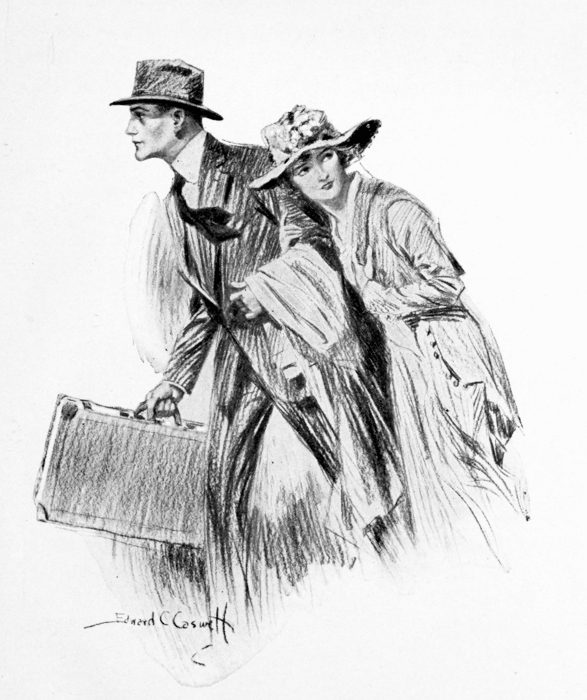
——then the Duke of Lee took his bride away.
Listen
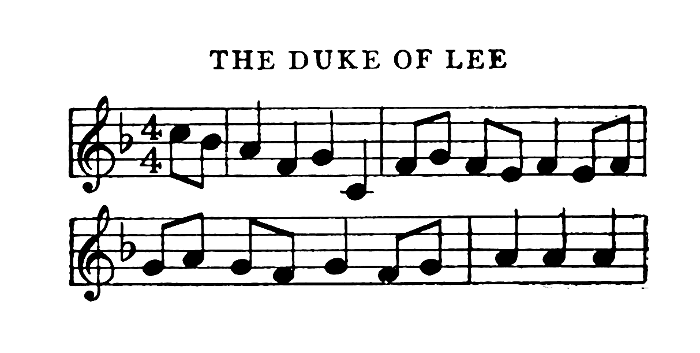
"Marry oo, diddy glu, Diddy glu, glu, glu: Diddy oo, oo, oo, Diddy goo, goo, goo! Marry oo, diddy goo, Diddy goo, goo, goo! Marry oo, diddy goo, diddy goo!"