Part 2 — PART II.
Reading edition
Literature and Art.
Notes from Books.
1.
“A great advantage is derived from the occasional practice of reading together, for each person selects different beauties and starts different objections: while the same passage perhaps awakens in each mind a different train of associated ideas, or raises different images for the purposes of illustration.”—Francis Horner.
2.
“C’est ainsi que je poursuis la communication de quelque esprit fameux, non afin qu’il m’enseigne mais afin que je le connaisse, et que le connaissant, s’il le faut, je l’imite.”—Montaigne.
DR. ARNOLD.
3.
I sat up till half-past two this morning reading Dr. Arnold’s “Life and Letters,” and have my soul full of him to-day.
On the whole I cannot say that the perusal of this admirable book has changed any notion in my mind, or added greatly to my stock of ideas. There was no height of inspiration, or eloquence, or power, to which I looked up; no profound depth of thought or feeling into which I looked down; no new lights; no new guides; no absolutely new aspects of things human or spiritual.
On the other hand, I never read a book of the kind with a more harmonious sense of pleasure and approbation,—if the word be not from me presumptuous. While I read page after page, the mind which was unfolded before me seemed to me a brother’s mind—the spirit, a kindred spirit. It was the improved, the elevated, the enlarged, the enriched, the every-way superior reflection of my own intelligence, but it was certainly that. I felt it so from beginning to end. Exactly the reverse was the feeling with which I laid down the Life and Letters of Southey. I was instructed, amused, interested; I profited and admired; but with the man Southey I had no sympathies: my mind stood off from his; the poetical intellect attracted, the material of the character repelled me. I liked the embroidery, but the texture was disagreeable, repugnant. Now with regard to Dr. Arnold, my entire sympathy with the character, with the material of the character, did not extend to all its manifestations. I liked the texture better than the embroidery;—perhaps, because of my feminine organisation.
Nor did my admiration of the intellect extend to the acceptance of all the opinions which emanated from it; perhaps because from the manner these were enunciated, or merely touched upon (in letters chiefly), I did not comprehend clearly the reasoning on which they may have been founded. Perhaps, if I had done so, I must have respected them more, perhaps have been convinced by them; so large, so candid, so rich in knowledge, and apparently so logical, was the mind which admitted them.
And yet this excellent, admirable man, seems to have feared God, in the common-place sense of the word fear. He considered the Jews as out of the pale of equality; he was against their political emancipation from a hatred of Judaism. He subscribed to the Athanasian Creed, which stuck even in George the Third’s orthodox throat. He believed in what Coleridge could not admit, in the existence of the spirit of evil as a person. He had an idea that the Church of God may be destroyed by an Antichrist; he speaks of such a consummation as possible, as probable, as impending; as if any institution really from God could be destroyed by an adverse power!—and he thought that a lawyer could not be a Christian.
4.
Certain passages filled me with astonishment as coming from a churchman, particularly what he says of the sacraments (vol. ii. pp. 75. 113.); and in another place, where he speaks of “the pestilent distinction between clergy and laity;” and where he says, “I hold that one form of Church government is exactly as much according to Christ’s will as another.” And in another place he speaks of the Anglican Church (with reference to Henry VIII. as its father, and Elizabeth as its foster-mother), as “the child of regal and aristocratical selfishness and unprincipled tyranny, who has never dared to speak boldly to the great, but has contented herself with lecturing the poor;” but he forgot at the moment the trial of the bishops in James’s time, and their noble stand against regal authority.
5.
With regard to conservatism (vol. ii. pp. 19. 62.), he seems to mean—as I understand the whole passage,—that it is a good instinct but a bad principle. Yet as a principle is it, as he says, “always wrong?” Though as the adversary of progress, it must be always wrong, yet as the adversary of change it may be sometimes right.
6.
He remarks that most of those who are above sectarianism are in general indifferent to Christianity, while almost all who profess to value Christianity seem, when they are brought to the test, to care only for their own sect. “Now,” he adds, “it is manifest to me, that all our education must be Christian, and not be sectarian.” Yet the whole aim of education up to this time has been, in this country, eminently sectarian, and every statesman who has attempted to place it on a broader basis has been either wrecked or stranded.
“All sects,” he says in another place, “have had among them marks of Christ’s Catholic Church in the graces of his Spirit and the confession of his name,” and he seems to wish that some one would compile a book showing side by side what professors of all sects have done for the good of Christ’s Church,—the martyrdoms, the missionary labours of Catholics, Protestants, Arians, &c.; “a grand field,” he calls it,—and so it were; but it lies fallow up to this time.
7.
“The philosophy of medicine, I imagine, is at zero; our practice is empirical, and seems hardly more than a course of guessing, more or less happy.” In another place (vol. ii. p. 72.), he says, “yet I honour medicine as the most beneficent of all professions.”
8.
He says (vol. ii. p. 42.), “Narrow-mindedness tends to wickedness, because it does not extend its watchfulness to every part of our moral nature.” “Thus, a man may have one or more virtues, such as are according to his favourite ideas, in great perfection; and still be nothing, because these ideas are his idols, and, worshipping them with all his heart, there is a portion of his heart, more or less considerable, left without its proper object, guide, and nourishment; and so this portion is left to the dominion of evil,” &c.
(One might ask how, if a man worship these ideas with all his heart, a portion could be left? but the sense is so excellent, I cannot quarrel with a slight inaccuracy in the expression. I never quite understood before why it is difficult to subscribe to the truth of the phrase “He is a good but a narrow-minded man,” but felt the incompatibility.)
9.
He says “the word useful implies the idea of good robbed of its nobleness.” Is this true? the useful is the good applied to practical purposes; it need not, therefore, be less noble. The nobleness lies in the spirit in which it is so applied.
10.
Benthamism (what is it?), Puritanism, Judaism, how he hates them! I suppose, because he fears God and fears for the Church of God. Hatred of all kinds seems to originate in fear.
11.
What he says of conscience, very remarkable!
“Men get embarrassed by the common cases of a misguided conscience: but a compass may be out of order as well as a conscience; and you can trace the deranging influence on the latter quite as surely as on the former. The needle may point due south if you hold a powerful magnet in that direction; still the compass, generally speaking, is a true and sure guide,” &c.; and then he adds, “he who believes his conscience to be God’s law, by obeying it obeys God.”
I think there would be much to say about all this passage relating to conscience, nor am I sure that I quite understand it. Derangement of the intellect is madness; is not derangement of the conscience also madness? might it not be induced, as we bring on a morbid state of the other faculties, by over use and abuse? by giving it more than its due share of power in the commonwealth of the mind? It should preside, not tyrannise; rule, not exercise a petty cramping despotism. A healthy courageous conscience gives to the powers, instincts, impulses, fair play; and having once settled the order of government with a strong hand, is not always meddling though always watchful.
Then again, how is conscience “God’s law?” Conscience is not the law, but the interpreter of the law; it does not teach the difference between right and wrong, it only impels us to do what we believe to be right, and smites us when we think we have been wrong. How is it that many have done wrong, and every day do wrong for conscience’ sake?—and does that sanctify the wrong in the eyes of God, as well as in those of John Huss?1
12.
“Prayer,” he says, “and kindly intercourse with the poor, are the two great safeguards of spiritual life—its more than food and raiment.”
True; but there is something higher than this fed and clothed spiritual life; something more difficult, yet less conscious.
13.
In allusion to Coleridge, he says very truly, that the power of contemplation becomes diseased and perverted when it is the main employment of life. But to the same great intellect he does beautiful justice in another passage. “Coleridge seemed to me to love truth really, and, therefore, truth presented herself to him, not negatively, as she does to many minds, who can see that the objections against her are unfounded, and therefore that she is to be received; but she filled him, as it were, heart and mind, imbuing him with her very self, so that all his being comprehended her fully, and loved her ardently; and that seems to me to be true wisdom.”
14.
Very fine is a passage wherein he speaks against meeting what is wrong and bad with negatives, with merely proving the wrong to be wrong, and the false to be false, without substituting for either the positively good and true.
15.
He contrasts as the two forms of the present danger to the Church and to society, the prevalent epicurean atheism, and the lying and formal spirit of priestcraft. He seems to have had an impression that the Church of God may be “utterly destroyed”(?), or, he asks, “must we look forward for centuries to come to the mere alternations of infidelity and superstition, scepticism, and Newmanism?” It is very curious to see two such men as Arnold and Carlyle both overwhelmed with a terror of the magnitude of the mischiefs they see impending over us. They are oppressed with the anticipation of evil as with a sense of personal calamity. Something alike, perhaps, in the temperaments of these two extraordinary men;—large conscientiousness, large destructiveness, and small hope: there was great mutual sympathy and admiration.
16.
Very admirable what he says in favour of comprehensive reading, against exclusive reading in one line of study. He says, “Preserve proportion in your reading, keep your view of men and things extensive, and depend upon it a mixed knowledge is not a superficial one; as far as it goes the views that it gives are true; but he who reads deeply in one class of writers only, gets views which are almost sure to be perverted, and which are not only narrow but false.”
17.
All his descriptions of natural scenery and beauty show his intense sensibility to them, but nowhere is there a trace of the love or the comprehension of art, as the reflection from the mind of man of the nature and the beauty he so loved. Thus, after dwelling on a scene of exquisite natural beauty, he says, “Much more beautiful, because made truly after God’s own image, are the forms and colours of kind, and wise, and holy thoughts, words, and actions;” that is to say—although he knew not or made not the application—Art, in the high sense of the word, for that is the embodying in beautiful hues and forms, what is kind, wise, and holy; in one word—good. In fact, he says himself, art, physical science, and natural history, were not included within the reach of his mind; the first for want of taste, the second for want of time, and the third for want of inclination.
18.
He says, “The whole subject of the brute creation is to me one of such painful mystery, that I dare not approach it.” This is very striking from such a man. How deep, consciously or unconsciously, does this feeling lie in many minds!
Bayle had already termed the acts, motives, and feelings of the lower order of animals, “un des plus profonds abîmes sur quoi notre raison peut s’exerciser.”
There is nothing, as I have sometimes thought, in which men so blindly sin as in their appreciation and treatment of the whole lower order of creatures. It is affirmed that love and mercy towards animals are not inculcated by any direct precept of Christianity, but surely they are included in its spirit; yet it has been remarked that cruelty towards animals is far more common in Western Christendom than in the East. With the Mahometan and Brahminical races humanity to animals, and the sacredness of life in all its forms, is much more of a religious principle than among ourselves.
Bacon, in his “Advancement of Learning,” does not think it beneath his philosophy to point out as a part of human morals, and a condition of human improvement, justice and mercy to the lower animals—“the extension of a noble and excellent principle of compassion to the creatures subject to man.” “The Turks,” he says, “though a cruel and sanguinary nation both in descent and discipline, give alms to brutes, and suffer them not to be tortured.”
It should seem as if the primitive Christians, by laying so much stress upon a future life in contradistinction to this life, and placing the lower creatures out of the pale of hope, placed them at the same time out of the pale of sympathy, and thus laid the foundation for this utter disregard of animals in the light of our fellow creatures. The definition of virtue among the early Christians was the same as Paley’s—that it was good performed for the sake of ensuring everlasting happiness—which of course excluded all the so-called brute creatures. Kind, loving, submissive, conscientious, much enduring, we know them to be; but because we deprive them of all stake in the future, because they have no selfish calculated aim, these are not virtues; yet if we say “a vicious horse,” why not say a virtuous horse?
The following passage, bearing curiously enough on the most abstruse part of the question, I found in Hallam’s Literature of the Middle Ages:—“Few,” he says, “at present, who believe in the immateriality of the human soul, would deny the same to an elephant; but it must be owned that the discoveries of zoology have pushed this to consequences which some might not readily adopt. The spiritual being of a sponge revolts a little our prejudices; yet there is no resting-place, and we must admit this, or be content to sink ourselves into a mass of medullary fibre. Brutes have been as slowly emancipated in philosophy as some classes of mankind have been in civil polity; their souls, we see, were almost universally disputed to them at the end of the seventeenth century, even by those who did not absolutely bring them down to machinery. Even within the recollection of many, it was common to deny them any kind of reasoning faculty, and to solve their most sagacious actions by the vague word instinct. We have come of late years to think better of our humble companions; and, as usual in similar cases, the preponderant bias seems rather too much of a levelling character.”
When natural philosophers speak of “the higher reason and more limited instincts of man,” as compared with animals, do they mean savage man or cultivated man? In the savage man the instincts have a power, a range, a certitude, like those of animals. As the mental faculties become expanded and refined the instincts become subordinate. In tame animals are the instincts as strong as in wild animals? Can we not, by a process of training, substitute an entirely different set of motives and habits?
Why, in managing animals, do men in general make brutes of themselves to address what is most brute in the lower creature, as if it had not been demonstrated that in using our higher faculties, our reason and benevolence, we develop sympathetically higher powers in them, and in subduing them through what is best within us, raise them and bring them nearer to ourselves?
In general the more we can gather of facts, the nearer we are to the elucidation of theoretic truth. But with regard to animals, the multiplication of facts only increases our difficulties and puts us to confusion.
“Can we otherwise explain animal instincts than by supposing that the Deity himself is virtually the active and present moving principle within them? If we deny them soul, we must admit that they have some spirit direct from God, what we call unerring instinct, which holds the place of it.” This is the opinion which Newton adopts. Then are we to infer that the reason of man removes him further from God than the animals, since we cannot offend God in our instincts, only in our reason? and that the superiority of the human animal lies in the power of sinning? Terrible power! terrible privilege! out of which we deduce the law of progress and the necessity for a future life.
The following passage bearing on the subject is from Bentham:—
“The day may come when the rest of the animal creation may acquire those rights which never could have been withholden from them but by the hand of tyranny. It may come one day to be recognised that the number of legs, the villosity of the skin, or the termination of the os sacrum, are reasons insufficient for abandoning a sensitive being to the caprice of a tormentor. What else is it that should trace the insuperable line? is it the faculty of reason, or, perhaps, the faculty of discourse? But a full-grown horse or dog is beyond comparison a more rational as well as a more conversable animal than an infant of a day, a week, or even a month old. But suppose the case were otherwise, what would it avail? The question is not, ‘can they reason?’ nor ‘can they speak?’ but ‘can they suffer?’”
I do not remember ever to have heard the kind and just treatment of animals enforced upon Christian principles or made the subject of a sermon.
19.
Once, when I was at Vienna, there was a dread of hydrophobia, and orders were given to massacre all the dogs which were found unclaimed or uncollared in the city or suburbs. Men were employed for this purpose, and they generally carried a short heavy stick, which they flung at the poor proscribed animal with such certain aim as either to kill or maim it mortally at one blow. It happened one day that, close to the edge of the river, near the Ferdinand’s-Brücke, one of these men flung his stick at a wretched dog, but with such bad aim that it fell into the river. The poor animal, following his instinct or his teaching, immediately plunged in, redeemed the stick, and laid it down at the feet of its owner, who, snatching it up, dashed out the creature’s brains.
I wonder what the Athenians would have done to such a man? they who banished the judge of the Areopagus because he flung away the bird which had sought shelter in his bosom?
20.
I return to Dr. Arnold. He laments the neglect of our cathedrals and the absurd confusion in so many men’s minds “between what is really Popery, and what is but wisdom and beauty adopted by the Roman Catholics and neglected by us.”
21.
He says, “Then, only, can opportunities of evil be taken from us, when we lose also all opportunity of doing or becoming good.” An obvious, even common place thought, well and tersely expressed. The inextricable co-relation and apparent antagonism of good and evil were never more strongly put.
22.
The defeat of Varus by the Germans, and the defeat of the moors by Charles Martel, he ranked as the two most important battles in the history of the world. I see why. The first, because it decided whether the north of Europe was to be completely Latinised; the second, because it decided whether all Europe was to be completely Mahomedanised.
23.
“How can he who labours hard for his daily bread—hardly and with doubtful success—be made wise and good, and therefore how can he be made happy? This question undoubtedly the Church was meant to solve; for Christ’s kingdom was to undo the evil of Adam’s sin; but the Church has not solved it nor attempted to do so, and no one else has gone about it rightly. How shall the poor man find time to be educated?”
This question, which “the Church has not yet solved,” men have now set their wits to solve for themselves.
24.
When in Italy he writes:—“It is almost awful to look at the beauty which surrounds me and then think of moral evil. It seems as if heaven and hell, instead of being separated by a great gulf from us and from each other, were close at hand and on each other’s confines.”
“Might but the sense of moral evil be as strong in me as is my delight in external beauty!”
A prayer I echo, Amen! if by the sense he mean the abhorrence of it; otherwise, to be perpetually haunted with the perception of moral evil were dreadful; yet, on the other hand, I am half ashamed sometimes of a conscious shrinking within myself from the sense of moral evil, merely as I should shrink from external filth and deformity, as hateful to perception and recollection, rather than as hateful to God and subversive of goodness.
25.
Here is a very striking passage. He says, “A great school is very trying; it never can present images of rest and peace; and when the spring and activity of youth are altogether unsanctified by anything pure and elevated in its desires, it becomes a spectacle that is dizzying and almost more morally distressing than the shouts and gambols of a set of lunatics. It is very startling to see so much of sin combined with so little of sorrow. In a parish, amongst the poor, whatever of sin exists there is sure also to be enough of suffering: poverty, sickness, and old age are mighty tamers and chastisers. But, with boys of the richer classes, one sees nothing but plenty, health, and youth; and these are really awful to behold, when one must feel that they are unblessed. On the other hand, few things are more beautiful than when one does see all holy and noble thoughts and principles, not the forced growth of pain, or infirmity, or privation, but springing up as by God’s immediate planting, in a sort of garden of all that is fresh and beautiful; full of so much hope for this world as well as for heaven.”
To this testimony of a schoolmaster let us add the testimony of a schoolboy. De Quincey thus describes in himself the transition from boyhood to manhood: “Then first and suddenly were brought powerfully before me the change which was worked in the aspects of society by the presence of woman; woman, pure, thoughtful, noble, coming before me as Pandora crowned with perfections. Right over against this ennobling spectacle, with equal suddenness, I placed the odious spectacle of schoolboy society—no matter in what region of the earth,—schoolboy society, so frivolous in the matter of its disputes, often so brutal in the manner; so childish and yet so remote from simplicity; so foolishly careless, and yet so revoltingly selfish; dedicated ostensibly to learning, and yet beyond any section of human beings so conspicuously ignorant.”
There is a reverse to this picture, as I hope and believe. If I have met with those who looked back on their school-days with horror, as having first contaminated them with “evil communication,” I have met with others whose remembrances were all of sunshine, of early friendships, of joyous sports.
Nor do I think that a large school composed wholly of girls is in any respect better. In the low languid tone of mind, the petulant tempers, the small spitefulnesses, the cowardly concealments, the compressed or ill-directed energies, the precocious vanities and affectations, many such congregations of Femmelettes would form a worthy pendant to the picture of boyish turbulence and vulgarity drawn by De Quincey.
I am convinced from my own recollections, and from all I have learned from experienced teachers in large schools, that one of the most fatal mistakes in the training of children has been the too early separation of the sexes. I say, has been, because I find that everywhere this most dangerous prejudice has been giving way before the light of truth and a more general acquaintance with that primal law of nature, which ought to teach us that the more we can assimilate on a large scale the public to the domestic training, the better for all. There exists still, the impression—in the higher classes especially—that in early education, the mixture of the two sexes would tend to make the girls masculine and the boys effeminate, but experience shows us that it is all the other way. Boys learn a manly and protecting tenderness, and the girls become at once more feminine and more truthful. Where this association has begun early enough, that is, before five years old, and has been continued till about ten or twelve, it has uniformly worked well; on this point the evidence is unanimous and decisive. So long ago as 1812, Francis Horner, in describing a school he visited at Enmore, near Bridgewater, speaks with approbation of the boys and the girls standing up together in the same class: it is the first mention, I find, of this innovation on the old collegiate, or charity-school plan,—itself a continuation of the monkish discipline. He says, “I liked much the placing the boys and girls together at an early age; it gave the boys a new spur to emulation.” When I have seen a class of girls stand up together, there has been a sort of empty tittering, a vacancy in the faces, an inertness, which made it, as I thought, very up-hill work for the teacher; so when it was a class of boys, there has been often a sluggishness—a tendency to ruffian tricks—requiring perpetual effort on the part of the master. In teaching a class of boys and girls, accustomed to stand up together, there is little or nothing of this. They are brighter, readier, better behaved; there is a kind of mutual influence working for good; and if there be emulation, it is not mingled with envy or jealousy. Mischief, such as might be apprehended, is in this case far less likely to arise than where boys and girls, habitually separated from infancy, are first thrown together, just at the age when the feelings are first awakened and the association has all the excitement of novelty. A very intelligent schoolmaster assured me that he had had more trouble with a class of fifty boys, than with a school of three hundred boys and girls together (in the midst of whom I found him); and that there were no inconveniences resulting which a wise and careful and efficient superintendence could not control. “There is,” said he, “not only more emulation, more quickness of brain, but altogether a superior healthiness of tone, body and mind, where the boys and girls are trained together till about ten years old; and it extends into their after life:—I should say because it is in accordance with the laws of God in forming us with mutual sympathies, moral and intellectual, and mutual dependence for help from the very beginning of life.”
What is curious enough, I find many people—fathers, mothers, teachers,—who are agreed that in the schools for the lower classes, the two sexes may be safely and advantageously associated, yet have a sort of horror of the idea of such an innovation in schools for the higher classes. One would like to know the reason for such a distinction, instead of being encountered, as is usual, by a sneer or a vile innuendo.
NIEBUHR.
LIFE AND LETTERS, 1852.
26.
In a letter to a young student in philology there are noble passages in which I truly sympathise. He says, among other things: “I wish you had less pleasure in satires, not excepting those of Horace. Turn to the works which elevate the heart, in which you contemplate great men and great events, and live in a higher world. Turn away from those which represent the mean and contemptible side of ordinary circumstances and degenerate days: they are not suitable for the young, who in ancient times would not have been suffered to have them in their hands. Homer, Æschylus, Sophocles, Pindar,—these are the poets for youth.” And again: “Do not read the ancient authors in order to make æsthetic reflections on them, but in order to drink in their spirit and to fill your soul with their thoughts; and in order to gain that by reading which you would have gained by reverently listening to the discourses of great men.”
We should turn to works of art with the same feeling.
On the whole, all my own educational experience has shown me the dangerous—in some cases fatal—effects on the childish intellect, where precocious criticism was encouraged, and where caricatures and ugly disproportioned figures, expressing vile or ridiculous emotions, were placed before the eyes of children, as a means of amusement.
If I were a legislator I would forbid travesties and ridiculous burlesques of Shakspeare’s finest and most serious dramas to be acted in our theatres. That this has been done and recently (as in the case of the Merchant of Venice) seems to me a national disgrace.
27.
It is strange, confounding, to hear Niebuhr speak thus of Goethe:—
“I am inclined to think that Goethe is utterly destitute of susceptibility to impressions from the fine arts.”(!!) He afterwards does more justice to Goethe—certainly one of the profoundest critics in art who ever lived; although I am inclined to think that his was an educated perception rather than a natural sensibility. Niebuhr’s criticism on Goethe’s Italian travels,—on Goethe’s want of sympathy with the people,—his regarding the whole country and nation simply as a sort of bazaar of art and antiquities, an exhibition of beauty and a recreation for himself: his habit of surveying all moral and intellectual greatness, all that speaks to the heart, with a kind of patronising superiority, as if created for his use,—and finding amusement in the folly, degeneracy, and corruption of the people;—all this appears to me admirable, and so far I had strong sympathy with Niebuhr; for I well remember that in reading Goethe’s “Italianische Reise,” I had the same perception of the artless and the superficial in point of feeling, in the midst of so much that was fine and valuable in criticism. It is well to be artistic in art, but not to walk about the world en artiste, studying humanity, and the deepest human interests, as if they were art.
Niebuhr afterwards says, in speaking of Rome, “I am sickened here of art, as I should be of sweetmeats instead of bread.” So it must be where art is separated wholly from morals.
28.
He speaks of the “wretched superstition,” and the “utter incapacity for piety” in the people of the Roman States.
Superstition and the want of piety go together; and the combination is not peculiar to the Italians, nor to the Roman Catholic faith.
29.
In speaking of the education of his son, he deprecates the learning by rote of hymns. “To a happy child, hymns deploring the misery of human life are without meaning.” (And worse.) “So likewise to a good child are those expressing self-accusation and contrition.” (He might have added, and self-applause.)
I am quite sure, from my own experience of children who have been allowed to learn penitential psalms and hymns, that they think of wickedness as a sort of thing which gives them self-importance.
30.
“Only what the mind takes in willingly can it assimilate with itself, and make its own, part of its life.”
A truism of the greatest value in education; but who thinks of it when cramming children’s minds with all sorts of distasteful heterogeneous things?
31.
“When reflection has become too one-sided and too domineering over a deeply feeling heart, it is apt to lead us into errors in our treatment of others.”
And all that follows—very wise! for the want of this reflection leaves us stranded and wrecked through feeling and perception merely.
32.
Very curious and interesting, as a trait of character and feeling, is the passage in which he represents himself, in the dangerous confinement of his second wife, as praying to his first wife for succour. “In my terrible anxiety,” he says, “I prayed most earnestly, and entreated my Milly, too, for help. I comforted Gretchen by telling her that Milly would send help. When she was at the worst, she sighed out, ‘Ah, cannot your Amelia send me a blessing?’”
This is curious from a Protestant and a philosopher. It shows that there may be something nearly allied to our common nature in the Roman Catholic invocation to the saints, and to the souls of the dead.
33.
Niebuhr, speaking of a lady (Madame von der Recke, I think,—the “Elise” of Goethe) who had patronised him, says, “I will receive roses and myrtles from female hands, but no laurels.”
This makes one smile; for most of the laurels which Niebuhr will receive in this country will be through female hands—through the admirable translation and arrangement of his life and letters by Susanna Winkworth.
34.
The following I read with cordial agreement:—“While I am ready to adopt any well-grounded opinion” (regarding, I suppose, mere facts, or speculations as to things), “my inmost soul revolts against receiving the judgment of others respecting persons; and whenever I have done so I have bitterly repented of it.”
35.
He says, “I cannot worship the abstraction of Virtue. She only charms me when she addresses herself to my heart, and speaks thus the love from which she springs. I really love nothing but what actually exists.”
What does actually exist to us but that which we believe in? and where we strongly love do we not believe sometimes in the unreal? is it not then the existing and the actual to us?
36.
“A faculty of a quite peculiar kind, and for which we have no word, is the recognition of the incomprehensible. It is something which distinguishes the seer from the ordinary learned man.”
But in religion this is faith. Does Niebuhr admit this kind of faith, “the recognition of the incomprehensible,” in philosophy, and not in religion? for he often complains of the want in himself of any faith but an historic faith.
37.
“In times of good fortune it is easy to appear great—nay, even to act greatly; but in misfortune very difficult. The greatest man will commit blunders in misfortune, because the want of proportion between his means and his ends progressively increases, and his inward strength is exhausted in fruitless efforts.”
This is true; but under all extremes of good or evil fortune we are apt to commit mistakes, because the tide of the mind does not flow equally, but rushes along impetuously in a flood, or brokenly and distractedly in a rocky channel, where its strength is exhausted in conflict and pain. The extreme pressure of circumstances will produce extremes of feeling in minds of a sensitive rather than a firm cast.
38.
This next passage is curious as a scholar’s opinion of “free trade” in the year 1810; though I believe the phrase “free trade” was not even invented at that time—certainly not in use in the statesman’s vocabulary.
“I presume you will admit that commerce is a good thing, and the first requisite in the life of any nation. It appears to me, that this much has now been palpably demonstrated, namely, that an advanced and complicated social condition like this in which we live can only be maintained by establishing mutual relationships between the most remote nations; and that the limitation of commerce would, like the sapping of a main pillar, inevitably occasion the fall of the whole edifice; and also that commerce is so essentially beneficial and in accordance with man’s nature, that the well-being of each nation is an advantage to all the nations that stand in connection with it.”
It is strange how long we have been (forty years, and more) in recognising these simple principles; and in Germany, where they were first enunciated, they are not recognised yet.
CHARACTER OF DEMADES.
(FROM NIEBUHR’s LECTURES.)
39.
“By his wit and his talent, and more especially by his gift as an improvisatore, he rose so high that he exercised a great influence upon the people, and sometimes was more popular even than Demosthenes. With a shamelessness amounting to honesty, he bluntly told the people everything he felt and what all the populace felt with him. When hearing such a man the populace felt at their ease: he gave them the feeling that they might be wicked without being disgraced, and this excites with such people a feeling of gratitude. There is a remarkable passage in Plato, where he shows that those who deliver hollow speeches, without being in earnest, have no power or influence; whereas others, who are devoid of mental culture, but say in a straightforward manner what they think and feel, exercise great power. It was this which in the eighteenth century gave the materialist philosophy in France such enormous influence with the higher classes; for they were told there was no need to be ashamed of the vulgarest sensuality; formerly people had been ashamed, but now a man learned that he might be a brutal sensualist, provided he did not offend against elegant manners and social conventionalism. People rejoiced at hearing a man openly and honestly say what they themselves felt. Demades was a remarkable character. He was not a bad man; and I like him much better than Eschines.”
What an excuse, what a sanction is here for the demagogues who direct the worst passions of men to the worst and the most selfish purposes, and the most debasing consequences! Demades “not a bad man?” then what is a bad man?

LORD BACON.
(1849.)
40.
“It was not the pure knowledge of nature and universality, but it was the proud knowledge of good and evil, with an intent in man to give the law unto himself, which was the form of the first temptation.”
But, in this sense, the first temptation is only the type of the perpetual and ever-present temptation—the temptation into which we are to fall through necessity, that we may rise through love.
41.
Here is an excellent passage—a severe commentary on the unsound, un-christian, unphilosophical distinction between morals and politics in government:—
“Although men bred in learning are perhaps to seek in points of convenience and reasons of state and accommodations for the present, yet, on the other hand, to recompense this they are perfect in those same plain grounds of religion, justice, honour, and moral virtue which, if they be well and watchfully pursued, there will be seldom use of those other expedients, no more than of physic in a sound, well-directed body.”
42.
“Now (in the time of Lord Bacon, that is,) now sciences are delivered to be believed and accepted, and not to be farther discovered; and therefore, sciences stand at a clog, and have done for many ages.”
In the present time, this is true only, or especially, of theology as an art, and divinity as a science; so made by the schoolmen of former ages, and not yet emancipated.
43.
“Generally he perceived in men of devout simplicity this opinion, that the secrets of nature were the secrets of God, part of that glory into which man is not to press too boldly.”
God has placed no limits to the exercise of the intellect he has given us on this side of the grave. But not the less will he keep his own secrets from us. Has he not proved it? who has opened that door to the knowledge of a future being which it has pleased him to keep shut fast, though watched by hope and by faith?
44.
The Christian philosophy of these latter times appears to be foreshadowed in the following sentence, where he speaks of such as have ventured to deduce and confirm the truth of the Christian religion from the principles and authorities of philosophers: “Thus with great pomp and solemnity celebrating the intermarriage of faith and sense as a lawful conjunction, and soothing the minds of men with a pleasing variety of matter, though, at the same time, rashly and unequally intermixing things divine and things human.”
This last common-place distinction seems to me, however, unworthy of Bacon. It should be banished—utterly set aside. Things which are divine should be human, and things which are human, divine; not as a mixture, “a medley,” in the sense of Bacon’s words, but an interfusion; for nothing that we esteem divine can be anything to us but as we make it ours, i. e. humanise it; and our humanity were a poor thing but for “the divinity that stirs within us.” We do injury to our own nature—we misconceive our relations to the Creator, to his universe, and to each other, so long as we separate and studiously keep wide apart the divine and the human.
45.
“Let no man, upon a weak conceit of sobriety or an ill-applied moderation, think or maintain that a man can search too far or be too well studied either in the book of God’s word or the book of God’s works.” Well advised! But then he goes on to warn men that they do not “unwisely mingle or confound their learnings together:” mischievous this contradistinction between God’s word and God’s works; since both, if emanating from him, must be equally true. And if there be one truth, then, to borrow his own words in another place, “the voice of nature will consent, whether the voice of man do so or not.”
46.
Apropos to education—here is a good illustration: “Were it not better for a man in a fair room to set up one great light or branching candlestick of lights, than to go about with a rushlight into every dark corner?”
And here is another: “It is one thing to set forth what ground lieth unmanured, and another to correct ill husbandry in that which is manured.”
47.
“It is without all controversy that learning doth make the minds of men gentle and generous, amiable, and pliant to government, whereas ignorance maketh them churlish, thwarting, and mutinous.”
48.
“An impatience of doubt and an unadvised haste to assertion without due and mature suspension of the judgment, is an error in the conduct of the understanding.”
“In contemplation, if a man begin with certainties he shall end in doubts, but if he will be content to begin with doubts he shall end in certainties.” Well said and profoundly true.
This is a celebrated and often-cited passage; an admitted principle in theory. I wish it were oftener applied in practice,—more especially in education. For it seems to me that in teaching children we ought not to be perpetually dogmatising. We ought not to be ever placing before them only the known and the definite; but to allow the unknown, the uncertain, the indefinite, to be suggested to their minds: it would do more for the growth of a truly religious feeling than all the catechisms of scientific facts and creeds of theological definitions that ever were taught in cut and dried question and answer. Why should not the young candid mind be allowed to reflect on the unknown, as such? on the doubtful, as such—open to inquiry and liable to discussion? Why will teachers suppose that in confessing their own ignorance or admitting uncertainties they must diminish the respect of their pupils, or their faith in truth? I should say from my own experience that the effect is just the reverse. I remember, when a child, hearing a very celebrated man profess his ignorance on some particular subject, and I felt awe-struck—it gave me a perception of the infinite,—as when looking up at the starry sky. What we unadvisedly cram into a child’s mind in the same form it has taken in our own, does not always healthily or immediately assimilate; it dissolves away in doubts, or it hardens into prejudice, instead of mingling with the life as truth ought to do. It is the early and habitual surrendering of the mind to authority, which makes it afterwards so ready for deception of all kinds.
49.
He speaks of “legends and narrations of miracles wrought by martyrs, hermits, monks, which, though they have had passage for a time by the ignorance of the people, the superstitious simplicity of some, and the politic toleration of others, holding them but as divine poesies; yet after a time they grew up to be esteemed but as old wives’ fables, to the great scandal and detriment of religion.”
Very ambiguous, surely. Does he mean that it was to the great scandal and detriment of religion that they existed at all? or that they came to be regarded as old wives’ fables?
50.
He says, farther on, “though truth and error are carefully to be separated, yet rarities and reports that seem incredible are not to be suppressed or denied to the memory of men.”
“For it is not yet known in what cases and how far effects attributed to superstition do participate of natural causes.”
51.
“To be speculative with another man to the end to know how to work him or wind him, proceedeth from a heart that is double and cloven, and not entire and ingenuous; which, as in friendship, it is a want of integrity, so towards princes or superiors it is a want of duty.” (No occasion, surely, for the distinction here drawn; inasmuch as the want of integrity involves the want of every duty.)
Then he speaks of “the stooping to points of necessity and convenience and outward basenesses,” as to be accounted “submission to the occasion, not to the person.” Vile distinction! an excuse to himself for his dedication to the King, and his flattery of Carr and Villiers.
52.
Our English Universities are only now beginning to show some sign (reluctant sign) of submitting to that re-examination which the great philosopher recommended two hundred and fifty years ago, when he says: “Inasmuch as most of the usages and orders of the universities were derived from more obscure times, it is the more requisite they be reexamined”—and more to the same purpose.
53.
“If that great Workmaster (God) had been of a human disposition, he would have cast the stars into some pleasant and beautiful works and orders like the frets in the roofs of houses; whereas, one can scarce find a posture in square or triangle or straight line amongst such an infinite number, so differing an harmony there is between the spirit of man and the spirit of nature.”
Perhaps if our human vision could be removed to a sufficient distance to contemplate the whole of what we now see in part, what appears disorder might appear beautiful order. The stars which now appear as if flung about at random, would perhaps be resolved into some exquisitely beautiful and regular edifice. The fly on the cornice, “whose feeble ray scarce spreads an inch around,” might as well discuss the proportions of the Parthenon as we the true figure and frame of God’s universe.
I remember seeing, through Lord Rosse’s telescope, one of those nebulæ which have hitherto appeared like small masses of vapour floating about in space. I saw it composed of thousands upon thousands of brilliant stars, and the effect to the eye—to mine at least—was as if I had had my hand full of diamonds, and suddenly unclosing it, and flinging them forth, they were dispersed as from a centre, in a kind of partly irregular, partly fan-like form; and I had a strange feeling of suspense and amazement while I looked, because they did not change their relative position, did not fall—though in act to fall—but seemed fixed in the very attitude of being flung forth into space;—it was most wondrous and beautiful to see!
54.
It is pleasant to me to think that Bacon’s stupendous intellect believed in the moral progress of human societies, because it is my own belief, and one that I would not for worlds resign. I indeed believe that each human being must here (or hereafter?) work out his own peculiar moral life: but also that the whole race has a progressive moral life: just as in our solar system every individual planet moves in its own orbit, while the whole system moves on together; we know not whither, we know not round what centre—“ma pur si muove!”
55.
Yet he says in another place, with equal wit and sublimity, “Every obtaining of a desire hath a show of advancement, as motion in a circle hath a show of progression.” Perhaps our movement may be spiral? and every revolution may bring us nearer and nearer to some divine centre in which we may be absorbed at last?
56.
He refers in this following passage to that theory of the angelic existences which we see expressed in ancient symbolic Art, first by variation of colour only, and later, by variety of expression and form. He says,—“We find, as far as credit is to be given to the celestial hierarchy of that supposed Dionysius, the senator of Athens, that the first place or degree is given to the Angels of Love, which are called Seraphim; the second to the Angels of Light, which are termed Cherubim; and the third, and so following, to Thrones, Principalities, and the rest (which are all angels of power and ministry); so as the angels of knowledge and illumination are placed before the angels of office and domination.”
—But the Angels of Love are first and over all. In other words, we have here in due order of precedence, 1. Love, 2. Knowledge, 3. Power,—the angelic Trinity, which, in unity, is our idea of God.
CHATEAUBRIAND.
(“MEMOIRES D’OUTRE TOMBE.” 1851.)
57.
Chateaubriand tells us that when his mother and sisters urged him to marry, he resisted strongly—he thought it too early; he says, with a peculiar naïveté, “Je ne me sentais aucune qualité de mari: toutes mes illusions étaient vivantes, rien n’était épuisé en moi, l’énergie même de mon existence avait doublé par mes courses,” &c.
So then the “existence épuisé” is to be kept for the wife! “la vie usée”—“la jeunesse abusée,” is good enough to make a husband! Chateaubriand, who in many passages of his book piques himself on his morality, seems quite unconscious that he has here given utterance to a sentiment the most profoundly immoral, the most fatal to both sexes, that even his immoral age had ever the effrontery to set forth.
58.
“Il paraît qu’on n’apprend pas à mourir en tuant les autres.”
Nor do we learn to suffer by inflicting pain: nothing so patient as pity.
59.
“Le cynisme des mœurs ramène dans la société, en annihilant le sens moral, une sorte de barbares; ces barbares de la civilisation, propres à détruire comme les Goths, n’ont pas la puissance de fonder comme eux; ceux-ci étaient les énormes enfants d’une nature vierge; ceux-là sont les avortons monstrueux d’une nature dépravée.”
We too often make the vulgar mistake that undisciplined or overgrown passions are a sign of strength; they are the signs of immaturity, of “enormous childhood.”—And the distinction (above) is well drawn and true. The real savage is that monstrous, malignant, abject thing, generated out of the rottenness and ferment of civilisation. And yet extremes meet: I remember seeing on the shores of Lake Huron some Indians of a distant tribe of Chippawas, who in appearance were just like those fearful abortions of humanity which crawl out of the darkness, filth, and ignorance of our great towns, just so miserable, so stupid, so cruel,—only, perhaps, less wicked.
60.
Chateaubriand was always comparing himself with Lord Byron—he hints more than once, that Lord Byron owed some of his inspiration to the perusal of his works—more especially to Renée. In this he was altogether mistaken.
61.
“Une intelligence supérieure n’enfante pas le mal sans douleur, parceque ce n’est pas son fruit naturel, et qu’elle ne devait pas le porter.”
62.
Madame de Coeslin (whom he describes as an impersonation of aristocratic morgue and all the pretension and prejudices of the ancien régime), “lisant dans un journal la mort de plusieurs rois, elle ôta ses lunettes et dit en se mouchant, ‘Il y a donc une épizootie sur ces bêtes à couronne!”
I once counted among my friends an elderly lady of high rank, who had spent the whole of a long life in intimacy with royal and princely personages. In three different courts she had filled offices of trust and offices of dignity. In referring to her experience she never either moralised or generalised; but her scorn of “ces bêtes à couronne,” was habitually expressed with just such a cool epigrammatic bluntness as that of Madame de Coeslin.
63.
“L’aristocratie a trois âges successifs; l’âge des supériorités, l’âge des priviléges, l’âge des vanités; sortie du premier, elle dégénère dans le second et s’éteint dans le dernier.”
In Germany they are still in the first epoch. In England we seem to have arrived at the second. In France they are verging on the third.
64.
Chateaubriand says of himself:—
“Dans le premier moment d’une offense je la sens à peine; mais elle se grave dans ma mémoire; son souvenir au lieu de décroître, s’augmente avec le temps. Il dort dans mon cœur des mois, des années entières, puis il se réveille à la moindre circonstance avec une force nouvelle, et ma blessure devient plus vive que le prémier jour: mais si je ne pardonne point à mes ennemis je ne leur fais aucun mal; je suis rancunier et ne suis point vindicatif.”
A very nice and true distinction in point of feeling and character, yet hardly to be expressed in English. We always attach the idea of malignity to the word rancour, whereas the French words rancune, rancunier, express the relentless without the vengeful or malignant spirit.
Such characters make me turn pale, as I have done at sight of a tomb in which an offending wretch had been buried alive. There is in them always something acute and deep and indomitable in the internal and exciting emotion; slow, scrupulous, and timid in the external demonstration. Cordelia is such a character.
65.
Chateaubriand says of his friend Pelletrie,—“Il n’avait pas précisément des vices, mais il était rongé d’une vermine de petits défauts dont on ne pouvait l’épurer.” I know such a man; and if he had committed a murder every morning, and a highway robbery every night,—if he had killed his father and eaten him with any possible sauce, he could not be more intolerable, more detestable than he is!
66.
“Un homme nous protège par ce qu’il vaut; une femme par ce que vous valez: voilà pourquoi de ces deux empires l’un est si odieux, l’autre si doux.”
67.
He says of Madame Roland, “Elle avait du caractère plutôt que du génie; le premier peut donner le second, le second ne peut donner le premier.” What does the man mean? this is a mistake surely. What the French call caractère never could give genius, nor genius, caractère. Au reste, I am not sure that Madame Roland—admirable creature!—had genius; but for talent, and caractère—first rate.
68.
“Soyons doux si nous voulons être regrettés. La hauteur du génie et les qualités supérieures ne sont pleurées que des anges.”
“Veillons bien sur notre caractère. Songeons que nous pouvons avec un attachement profond n’en pas moins empoisonner des jours que nous rachéterions au prix de tout notre sang. Quand nos amis sont descendus dans la tombe, quels moyens avons nous de réparer nos torts? nos inutiles regrets, nos vains repentirs, sont ils un remède aux peines que nous leurs avons faites? Ils auraient mieux aimé de nous un sourire pendant leur vie que toutes nos larmes après leur mort.”
69.
“L’amour est si bien la félicité qu’il est poursuivi de la chimère d’être toujours; il ne veut prononcer que des serments irrévocables; au défaut de ses joies, il cherche à éterniser ses douleurs; ange tombé, il parle encore le langage qu’il parlait au séjour incorruptible; son espérance est de ne cesser jamais. Dans sa double nature et dans sa double illusion, ici-bas il prétend se perpétuer par d’immortelles pensées et par des générations intarissables.”
70.
Madame d’Houdetot, after the death of Saint Lambert, always before she went to bed used to rap three times with her slipper on the floor, saying,—“Bon soir, mon ami; bon soir, bon soir!”
So then, she thought of her lover as gone down—not up?
BISHOP CUMBERLAND.
BISHOP OF PETERBOROUGH IN 1691.
71.
Bishop Cumberland founds the law of God, as revealed in the Scriptures, upon the general law of nature. He does not attempt to found the laws of nature upon the Bible. “We believe,” he says, “in the truth of Scripture, because it promotes and illustrates the fundamental laws of nature in the government of the world.”
Then does the Bishop mean here that the Bible is not the WORD nor the WILL of God, but the exposition of the WORD and the record of the WILL, so far as either could be rendered communicable to human comprehension through the medium of human language and intelligence?
There is a striking passage in Bunsen’s Hippolytus, which may be considered with reference to this opinion of the Bishop.
He (Bunsen) says, that “what relates the history of ‘the word of God’ in his humanity, and in this world, and what records its teachings, and warnings, and promises (that is, the Bible?) was mistaken for ‘the word of God’ itself, in its proper sense.”
Does he mean that we deem erroneously the collection of writings we call the Bible to be “the word of God;” whereas, in fact, it is “the history, the record of the word of God?” that is, of all that God has spoken to man—in various revelations—through human life—by human deeds?—because this is surely a most important and momentous distinction.
72.
According to Bishop Cumberland, benevolence, in its large sense,—that is, a regard for all GOOD, universal and particular,—is the primary law of nature; and justice is one form, and a secondary form, of this law: a moral virtue, not a law of nature,—if I understand his meaning rightly.
Then which would he place highest, the law of nature or the moral law?
If you place them in contradistinction, then are we to conclude that the law of nature precedes the moral law, but that the moral law supersedes the law of nature? Yet no law of nature (as I understand the word) can be superseded, though the moral law may be based upon it, and in that sense may be above it.
73.
In this following passage the Bishop seems to have anticipated what in more modern times has been called the “greatest happiness principle.” He says:—
“The good of all rational beings is a complex whole, being nothing but the aggregate of good enjoyed by each.” “We can only act in our proper spheres, labouring to do good, but this labour will be fruitless, or rather mischievous, if we do not keep in mind the higher gradations which terminate in universal benevolence. Thus, no man must seek his own pleasure or advantage otherwise than as his family permits; or provide for his family to the detriment of his country; or promote the good of his country at the expense of mankind; or serve mankind, if it were possible, without regard to the majesty of God.”
74.
Paley deems the recognition of a future state so essential that he even makes the definition of virtue to consist in this, that it is good performed for the sake of everlasting happiness. That is to say, he makes it a sort of bargain between God and man, a contract, or a covenant, instead of that obedience to a primal law, from which if we stray in will, we do so at the necessary expense of our happiness. Bishop Cumberland has no reference to this doctrine of Paley’s;—seems, indeed, to set it aside altogether, as contrary to the essence of virtue.
On the whole, this good Bishop appears to have treated ethics not as an ecclesiastic, but as Bacon treated natural philosophy;—the pervading spirit is the perpetual appeal to experience, and not to authority.
COMTE’S PHILOSOPHY.
1852.
75.
Comte makes out three elements of progress, “les philosophes, les prolétaires, et les femmes;”—types of intellect, material activity, and sentiment.
From Woman, he says, is to proceed the preponderance of the social duties and affections over egotism and ambition. (La prépondérance de la sociabilité sur la personalité.) He adds:—“Ce sexe est certainement supérieure au notre quant à l’attribut le plus fondamentale de l’espèce humaine, la tendence de faire prévaloir la sociabilité sur la personalité.”
76.
“S’il ne fallait qu’aimer comme dans l’Utopie Chrétienne, sur une vie future affranchie de toute égoïste necessité matérielle, la femme régnerait; mais il faut surtout agir et penser pour combattre contre les rigueurs de notre vraie destinée: dès-lors l’homme doit commander malgré sa moindre moralité.”
“Malgré?” Sometimes man commands because of the “moindre moralité:”—it spares much time in scruples.
77.
“L’influence feminine devient l’auxiliaire indispensable de tout pouvoir spirituel, comme le moyen âge l’a tant montré.”
“Au moyen âge la Catholicisme occidentale ébaucha la systématisation de la puissance morale en superposant à l’ordre pratique une libre autorité spirituelle, habituellement secondée par les femmes.”
78.
“La Force, proprement dite, c’est ce qui régit les actes, sans régler les volontés.”
Herein lies a distinction between Force and Power; for Power, properly so called, does both.
79.
He insists throughout on the predominance of sociabilité over personalité—and what is that but the Christian law philosophised? and again, “Il n’y a de directement morale dans notre nature que l’amour.” Where did he get this, if not in the Epistle of St. John?
“Celui qui se croirait indépendant des autres dans ses affections, ses pensées, ou ses actes, ne pourrait même formuler un tel blasphème sans une contradiction immédiate—puisque son langage même ne lui appartient pas.”
80.
He says that if the women regret the age of chivalry, it is not for the external homage then paid to them, but because “l’élément le plus moral de l’humanité” (woman, to wit), “doit préférer à tout autre le seul régime qui érigea directement en principe la préponderance de la morale sur la politique. Si elles regrettent leur douce influence antérieure, c’est surtout comme s’effaçant aujourd’hui sous un grossier égoïsme.
“Leurs vœux spontanés seconderont toujours les efforts directes des philosophes et des prolétaires pour transformer enfin les débats politiques en transactions sociales en faisant prévaloir les dévoirs sur les droits.”
This is admirable; for we are all inclined to think more about our rights (and our wrongs too) than about our duties.
81.
“Si donc aimer nous satisfait mieux que d’être aimé, cela constate la supériorité naturelle des affections désintéressées.”
Meaning—what is true—that the love we bear to another, much more fills the whole soul and is more a possession of an actuating principle, than the love of another for us:—but both are necessary to the complement of our moral life. The first is as the air we breathe; the last is as our daily bread.
82.
He says that the only true and firm friendship is that between man and woman, because it is the only affection “exempte de toute concurrence actuelle ou possible.”
In this I am inclined to agree with him, and to regret that our conventional morality or immorality, and the too early severance of the two sexes in education, place men and women in such a relation to each other, socially, as to render such friendships difficult and rare.
83.
“En vérité l’amour ne saurait être profond, s’il n’est pas pur.”
Christianity, he says, “a favorisé l’essor de la véritable passion, tandisque le polythéisme consacrait surtout les appétits.”
He is speaking here as teacher, philosopher, and legislator, not as poet or sentimentalist. Perhaps it will come to be recognised sooner or later, that what people are pleased to call the romance of life is founded on the deepest and most immutable laws of our being, and that any system of ecclesiastical polity, or civil legislation, or moral philosophy, which takes no account of the primal instincts and affections, which are the springs of life and on which God made the continuation of his world to depend, must of necessity fail.
I have just read a volume of Psychological Essays by one of the most celebrated of living surgeons, and closed the book with a feeling of amazement: a long life spent in physiological experiences, dissecting dead bodies, and mending broken bones, has then led him, at last, to some of the most obvious, most commonly known facts in mental philosophy? So some of our profound politicians, after a long life spent in governing and reforming men, may arrive, at last, at some of the commonest facts in social morals.
84.
He contends for the indissolubility of marriage, and against divorce; and he thinks that education should be in the hands of women to the age of ten or twelve, “Afin que le cœur y prévale toujours sur l’esprit:” all very excellent principles, but supposing a hypothetical social and moral state, from which we are as yet far removed. What he says, however, of the indissolubility of the marriage bond is so beautiful and eloquent, and so in accordance with my own moral theories, that I cannot help extracting it from a mass of heavy and sometimes unintelligible matter. He begins by laying it down as a principle that the “amélioration morale de l’homme constitue la principale mission de la femme,” and that “une telle destination indique aussitôt que le lien conjugal doit être unique et indissoluble, afin que les relations domestiques puissent acquérir la plénitude et la fixité qu’exige leur efficacité morale.” This, however, supposes the holiest and completest of all bonds to be sealed on terms of equality, not that the latter end of a man’s life, la vie usée et la jeunesse épuisée, are to be tacked on to the beginning of a woman’s fresh and innocent existence; for then influences are reversed, and instead of the amelioration of the masculine, we have the demoralisation of the feminine, nature. He supposes the possibility of circumstances which demand a personal separation, but even then sans permettre un nouveau mariage. In such a case his religion imposes on the innocent victim (whether man or woman) “une chasteté compatible d’ailleurs avec la plus profonde tendresse. Si cette condition lui semble rigoureuse, il doit l’accepter, d’abord, en vue de l’ordre général; puis, comme une juste conséquence de son erreur primitive.”
There would be much to say upon all this, if it were worth while to discuss a theory which it is not possible to reduce to general practice. We cannot imagine the possibility of a second marriage where the first, though perhaps unhappy or early ruptured, has been, not a personal relation only, but an interfusion of our moral being,—of the deepest impulses of life—with those of another; these we cannot have a second time to surrender to a second object;—but this might be left to Nature and her holy instincts to settle. However, he goes on in a strain of eloquence and dignity, quite unusual with him, to this effect:—“Ce n’est que par l’assurance d’une inaltérable perpetuité que les liens intimes peuvent acquérir la consistance et la plénitude indispensable à leur efficacité morale. La plus méprisable des sectes éphémères que suscita l’anarchie moderne (the Mormons, for instance?) me parait être celle qui voulut ériger l’inconstance en condition de bonheur.”.... “Entre deux êtres aussi complexes et aussi divers que l’homme et la femme, ce n’est pas trop de toute la vie pour se bien connaître et s’aimer dignement. Loin de taxer d’illusion la haute idée que deux vrais époux se forment souvent l’un de l’autre, je l’ai presque toujours attribuée à l’appréciation plus profonde que procure seule une pleine intimité, que d’ailleurs développe des qualités inconnues aux indifférents. On doit même regarder comme très-honorable pour notre espèce, cette grande estime que ses membres s’inspirent mutuellement quand ils s’étudient beaucoup. Car la haine et l’indifférence mériteraient seules le reproche d’aveuglement qu’une appréciation superficielle applique à l’amour. Il faut donc juger pleinement conforme à la nature humaine l’institution qui prolonge au-delà du tombeau l’indentification de deux dignes époux.”
He lays down as one of the primal instincts of human kind “l’homme doit nourrir la femme.” This may have been, as he says, a universal instinct; perhaps it ought to be one of our social ordinations; perhaps it may be so at some future time; but we know that it is not a present fact; that the woman must in many cases maintain herself or perish, and she asks nothing more than to be allowed to do so.
However, I agree with Comte that the position of a woman, enriched and independent by her own labour, is anomalous and seldom happy. It is a remark I have heard somewhere, and it appears to me true, that there exists no being so hard, so keen, so calculating, so unscrupulous, so merciless in money matters as the wife of a Parisian shopkeeper, where she holds the purse and manages the concern, as is generally the case.
85.
Here is a passage wherein he attacks that egotism which with many good people enters so largely into the notion of another world:—which Paley inculcated, and which Coleridge ridiculed, when he spoke of “this worldliness,” and the “other worldliness.”
“La sagesse sacerdotale, digne organe de l’instinct public, y avait intimement rattaché les principales obligations sociales à titre de condition indispensable du salut personnel: mais la récompense infinie promise ainsi à tous les sacrifices ne pouvait jamais permettre une affection pleinement désinteressée.”
This perpetual iteration of a system of future reward and punishment, as a principle of our religion and a motive of action, has in some sort demoralised Christianity; especially in minds where love is not a chief element, and which do not love Christ for his love’s sake, but for his power’s sake, and because judgment and punishment are supposed to be in his hand.
86.
Putting the test of revelation out of the question, and dealing with the philosopher philosophically, the best refutation of Comte’s system is contained in the following criticism: it seems to me final.
“In limiting religion to the relations in which we stand to each other, and towards Humanity, Comte omits one very important consideration. Even upon his own showing, this Humanity can only be the supreme being of our planet, it cannot be the Supreme Being of the Universe. Now, although in this our terrestrial sojourn, all we can distinctly know must be limited to the sphere of our planet; yet, standing on this ball and looking forth into infinitude, we know that it is but an atom of the infinitude, and that the humanity we worship here, cannot extend its dominion there. If our relations to humanity may be systematised into a cultus, and made a religion as they have formerly been made a morality, and if the whole of our practical priesthood be limited to this religion, there will, nevertheless remain for us, outlying this terrestrial sphere,—the sphere of the infinite, in which our thoughts must wander, and our emotions will follow our thoughts; so that besides the religion of humanity there must ever be a religion of the Universe. Or, to bring this conception within ordinary language, there must ever remain the old distinctions between religion and morality, our relations to God, and our relations towards man. The only difference being, that in the old theology moral precepts were inculcated with a view to a celestial habitat; in the new, the moral precepts are inculcated with a view to the general progress of the race.”—Westminster Review.
In fact the doctrine of the non-plurality of worlds as recently set forth by an eminent professor and D. D. would exactly harmonise with Comte’s “Culte du Positif,” as not merely limiting our sympathies to this one form of intellectual being, but our religious notions to this one habitable orb.
But to those who take other views, the argument above contains the philosophical objection to Comte’s system, as such; and I repeat, that it seems to me unanswerable; but there are excellent things in his theory, notwithstanding;—things that make us pause and think. In some parts it is like Christianity with Christ, as a personalité, omitted. For Christ the humanised divine, he substitutes an abstract deified humanity. 1854.
GOETHE.
(DICHTUNG UND WAHRHEIT.)
87.
“As a man embraces the determination to become a soldier and go to the wars, bravely resolved to bear dangers, and difficulties, and wounds, and death itself, but at the same time never anticipating the particular form in which those evils may surprise us in an extremely unpleasant manner;—just so we rush into authorship!”
88.
Goethe says of Lavater, “that the conception of humanity which had been formed in himself, and in his own humanity, was so akin to the living image of Christ, that it was impossible for him to conceive how a man could live and breathe without being a Christian. He had, so to speak, a physical affinity with Christianity; it was to him a necessity, not only morally, but from organisation.”
Lavater’s individual feeling was, perhaps, but an anticipation of that which may become general, universal. As we rise in the scale of being, as we become more gentle, spiritualised, refined, and intelligent, will not our “physical affinity” with the religion of Christ become more and more apparent, till it is less a doctrine than a principle of life? So its Divine Author knew, who prepared it for us, and is preparing and moulding us through progressive improvement to comprehend and receive it.
89.
Goethe speaks of “polishing up life with the varnish of fiction;” the artistic turn of the man’s mind showed itself in this love of creating an effect in his own eyes and in the eyes of others. But what can fiction—what can poetry do for life, but present some one or two out of the multitudinous aspects of that grand, beautiful, terrible, and infinite mystery? or by life, does he mean here the mere external forms of society?—for it is not clear.
HAZLITT’S “LIBER AMORIS.”
1827.
90.
Is love, like faith, ennobled through its own depth and fervour and sincerity? or is it ennobled through the nobility, and degraded through the degradation of its object? Is it with love as with worship? Is it a religion, and holy when the object is pure and good? Is it a superstition, and unholy when the object is impure and unworthy?
Of all the histories I have read of the aberrations of human passion, nothing ever so struck me with a sort of amazed and painful pity as Hazlitt’s “Liber Amoris.” The man was in love with a servant girl, who in the eyes of others possessed no particular charms of mind or person, yet did the mighty love of this strong, masculine, and gifted being, lift her into a sort of goddess-ship; and make his idolatry in its intense earnestness and reality assume something of the sublimity of an act of faith, and in its expression take a flight equal to anything that poetry or fiction have left us. It was all so terribly real, he sued with such a vehemence, he suffered with such resistance, that the powerful intellect reeled, tempest-tost, and might have foundered but for the gift of expression. He might have said like Tasso—like Goethe rather—“Gab mir ein Gott zu sagen was ich leide!” And this faculty of utterance, eloquent utterance, was perhaps the only thing which saved life, or reason, or both. In such moods of passion, the poor uneducated man, dumb in the midst of the strife and the storm, unable to comprehend his intolerable pain or make it comprehended, throws himself in a blind fury on the cause of his torture, or hangs himself in his neckcloth.
91.
Hazlitt takes up his pen, dips it in fire and thus he writes:—
“Perfect love has this advantage in it, that it leaves the possessor of it nothing farther to desire. There is one object (at least), in which the soul finds absolute content;—for which it seeks to live or dares to die. The heart has, as it were, filled up the moulds of the imagination; the truth of passion keeps pace with, and outvies, the extravagance of mere language. There are no words so fine, no flattery so soft, that there is not a sentiment beyond them that it is impossible to express, at the bottom of the heart where true love is. What idle sounds the common phrases adorable creature, divinity, angel, are! What a proud reflection it is to have a feeling answering to all these, rooted in the breast, unalterable, unutterable, to which all other feelings are light and vain! Perfect love reposes on the object of its choice, like the halcyon on the wave, and the air of heaven is around it!”
92.
“She stood (while I pleaded my cause before her with all the earnestness and fondness in the world) with the tears trickling from her eye-lashes, her head drooping, her attitude fixed, with the finest expression that ever was seen of mixed regret, pity, and stubborn resolution, but without speaking a word—without altering a feature. It was like a petrifaction of a human face in the softest moment of passion.”
93.
“Shall I not love her,” he exclaims, “for herself alone, in spite of fickleness and folly? to love her for her regard for me, is not to love her but myself. She has robbed me of herself, shall she also rob me of my love of her? did I not live on her smile? is it less sweet because it is withdrawn from me? Did I not adore her every grace? and does she bend less enchantingly because she has turned from me to another? Is my love then in the power of fortune or of her caprice? No, I will have it lasting as it is pure; and I will make a goddess of her, and build a temple to her in my heart, and worship her on indestructible altars, and raise statues to her, and my homage shall be unblemished as her unrivalled symmetry of form. And when that fails, the memory of it shall survive, and my bosom shall be proof to scorn as hers has been to pity; and I will pursue her with an unrelenting love, and sue to be her slave and tend her steps without notice, and without reward; and serve her living, and mourn for her when dead; and thus my love will have shown itself superior to her hate, and I shall triumph and then die. This is my idea of the only true and heroic love, and such is mine for her.”
Hazlitt, when he wrote all this, seemed to himself full of high and calm resolve. The hand did not fail, the pen did not stagger over the paper in a formless scrawl, yet the brain was reeling like a tower in an earthquake. “Passion,” as it has been well said, “when in a state of solemn and omnipotent vehemence, always appears to be calmness to him whom it domineers;” not unfrequently to others also, as the tide at its highest flood looks tranquil, and “neither way inclines.”
THE NIGHTINGALE.
94.
Reading the Life and Letters of Francis Horner, in the midst of a correspondence about Statistics and Bullion, and Political Economy, and the Balance of Parties, I came upon the following exquisite passage in a letter to his friend Mrs. Spencer:—
“I was amused by your interrogatory to me about the Nightingale’s note. You meant to put me in a dilemma with my politics on one side and my gallantry on the other. Of course you consider it as a plaintive note, and you were in hopes that no idolater of Charles Fox would venture to agree with that opinion. In this difficulty I must make the best escape I can by saying, that it seems to me neither cheerful nor melancholy,—but always according to the circumstances in which you hear it, the scenery, your own temper of mind, and so on. I settled it so with myself early in this month, when I heard them every night and all day long at Wells. In daylight, when all the other birds are in active concert, the Nightingale only strikes you as the most active, emulous, and successful of the whole band. At night, especially if it is a calm one, with light enough to give you a wide indistinct view, the solitary music of this bird takes quite another character, from all the associations of the scene, from the languor one feels at the close of the day, and from the stillness of spirits and elevation of mind which comes upon one when walking out at that time. But it is not always so—different circumstances will vary in every possible way the effect. Will the Nightingale’s note sound alike to the man who is going on an adventure to meet his mistress (supposing he heeds it at all), and when he loiters along upon his return? The last time I heard the Nightingale it was an experiment of another sort. It was after a thunderstorm in a mild night, while there was silent lightning opening every few minutes, first on one side of the heavens then on the other. The careless little fellow was piping away in the midst of all this terror. To me, there was no melancholy in his note, but a sort of sublimity; yet it was the same song which I had heard in the morning, and which then seemed nothing but bustle.”
And in the same spirit Portia moralises:—
The nightingale, if she should sing by day, When every goose is cackling, would be thought No better a musician than the wren. How many things by season, seasoned are To their right praise and true perfection!
Nor will Coleridge allow the song of the nightingale to be always plaintive,—“most musical, most melancholy;” he defies the epithet though it be Milton’s.
’Tis the merry nightingale, That crowds and hurries and precipitates With thick fast warble his delicious notes, As he were fearful that an April night Would be too short for him to utter forth His love-chaunt, and disburthen his full soul Of all its music.
As a poetical commentary on these beautiful passages, every reader of Joanna Baillie will remember the night scene in De Montfort, where the cry of the Owl suggests such different feelings and associations to the two men who listen to it, under such different circumstances. To De Montfort it is the screech-owl, foreboding death and horror,—and he stands and shudders at the “instinctive wailing.” To Rezenvelt it is the sound which recalls his boyish days, when he merrily mimicked the night-bird till it returned him cry for cry,—and he pauses to listen with a fanciful delight.
THACKERAY’S LECTURES ON THE ENGLISH HUMORISTS
(1833.)
95.
A lecture should not read like an essay; and, therefore, it surprises me that these lectures so carefully prepared, so skilfully adapted to meet the requirements of oral delivery, should be such agreeable reading. As lectures, they wanted only a little more point, and emphasis and animation on the part of the speaker: as essays, they atone in eloquence and earnestness for what they want in finish and purity of style.
Genius and sunshine have this in common that they are the two most precious gifts of heaven to earth, and are dispensed equally to the just and the unjust. What struck me most in these lectures, when I heard them, (and it strikes me now in turning over the written pages,) is this: we deal here with writers and artists, yet the purpose, from beginning to end, is not artistic nor critical, but moral. Thackeray tells us himself that he has not assembled his hearers to bring them better acquainted with the writings of these writers, or to illustrate the wit of these wits, or to enhance the humour of these humourists;—no; but to deal justice on the men as men—to tell us how they lived, and loved, suffered and made suffer, who still have power to pain or to please; to settle their claims to our praise or blame, our love or hate, whose right to fame was settled long ago, and remains undisputed. This is his purpose. Thus then he has laid down and acted on the principle that “morals have something to do with art;” that there is a moral account to be settled with men of genius; that the power and the right remains with us to do justice on those who being dead yet rule our spirits from their urns; to try them by a standard which perhaps neither themselves, nor those around them, would have admitted. Did Swift when he bullied men, lampooned women, trampled over decency and humanity, flung round him filth and fire, did he anticipate the time when before a company of intellectual men, and thinking, feeling women, in both hemispheres, he should be called up to judgment, hands bound, tongue-tied? Where be now his gibes? and where his terrors? Thackeray turns him forth, a spectacle, a lesson, a warning; probes the lacerated self-love, holds up to scorn, or pity more intolerable, the miserable egotism, the half-distempered brain. O Stella! O Vanessa! are you not avenged?
Then Sterne—how he takes to pieces his feigned originality, his feigned benevolence, his feigned misanthropy—all feigned!—the licentious parson, the trader in sentiment, the fashionable lion of his day, the man without a heart for those who loved him, without a conscience for those who trusted him! yet the same man who gave us the pathos of “Le Fevre,” and the humours of “Uncle Toby!” Sad is it? ungrateful is it? ungracious is it?—well, it cannot be helped; you cannot stifle the conscience of humanity. You might as well exclaim against any natural result of any natural law. Fancy a hundred years hence some brave, honest, human-hearted Thackeray standing up to discourse before our great-great-grandchildren in the same spirit, with the same stern truth, on the wits, and the poets and the artists of the present time! Hard is your fate, O ye men and women of genius! very hard and pitiful, if ye must be subjected to the scalpel of such a dissector! You, gifted sinner, whoever you may be, walking among us now in all the impunity of conventional forbearance, dealing in oracles and sentimentalisms, performing great things, teaching good things, you are set up as one of the lights of the world:—Lo! another time comes; the torch is taken out of your hand, and held up to your face. What! is it a mask, and not a face? “Off, off ye lendings!” O God! how much wiser, as well as better, not to study how to seem, but how to be! How much wiser and better, not to have to shudder before the truth as it oozes out from a thousand unguessed, unguarded apertures, staining your lawn or your ermine; not to have to tremble at the thought of that future Thackeray, who “shall pluck out the heart of your mystery,” and shall anatomise you, and deliver lectures upon you, to illustrate the standard of morals and manners in Queen Victoria’s reign!
In these lectures, some fine and feeling and discriminative passages on character, make amends for certain offences and inconsistencies in the novels; I mean especially in regard to the female portraits. No woman resents his Rebecca—inimitable Becky!—no woman but feels and acknowledges with a shiver the completeness of that wonderful and finished artistic creation; but every woman resents the selfish inane Amelia, and would be inclined to quote and to apply the author’s own words when speaking of ‘Tom Jones:’—“I can’t say that I think Amelia a virtuous character. I can’t say but I think Mr. Thackeray’s evident liking and admiration for his Amelia shows that the great humourist’s moral sense was blunted by his life, and that here in art and ethics there is a great error. If it be right to have a heroine whom we are to admire, let us take care at least that she is admirable.”
Laura, in ‘Pendennis,’ is a yet more fatal mistake. She is drawn with every generous feeling, every good gift. We do not complain that she loves that poor creature Pendennis, for she loved him in her childhood. She grew up with that love in her heart; it came between her and the perception of his faults; it is a necessity indivisible from her nature. Hallowed, through its constancy, therein alone would lie its best excuse, its beauty and its truth. But Laura, faithless to that first affection; Laura, waked up to the appreciation of a far more manly and noble nature, in love with Warrington, and then going back to Pendennis, and marrying him! Such infirmity might be true of some women, but not of such a woman as Laura; we resent the inconsistency, the indelicacy of the portrait.
And then Lady Castlewood,—so evidently a favourite of the author, what shall we say of her? The virtuous woman, par excellence, who “never sins and never forgives,” who never resents, nor relents, nor repents; the mother, who is the rival of her daughter; the mother, who for years is the confidante of a man’s delirious passion for her own child, and then consoles him by marrying him herself! O Mr. Thackeray! this will never do! such women may exist, but to hold them up as examples of excellence, and fit objects of our best sympathies, is a fault, and proves a low standard in ethics and in art. “When an author presents to us a heroine whom we are called upon to admire, let him at least take care that she is admirable.” If in these, and in some other instances, Thackeray has given us cause of offence, in the lectures we may thank him for some amends: he has shown us what he conceives true womanhood and true manliness ought to be; so with this expression of gratitude, and a far deeper debt of gratitude left unexpressed, I close his book, and say, good night!
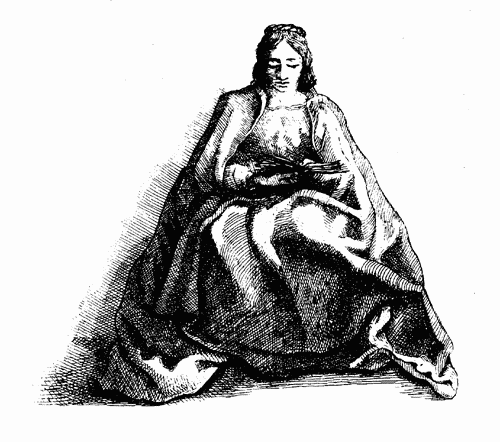
Notes on Art.
96.
Sometimes, in thoughtful moments, I am struck by those beautiful analogies between things apparently dissimilar—those awful approximations between things apparently far asunder—which many people would call fanciful and imaginary, but they seem to bring all God’s creation, spiritual and material, into one comprehensive whole; they give me, thus associated, a glimpse, a perception of that overwhelming unity which we call the universe, the multitudinous ONE.
Thus the principle of the highest ideal in art, as conceived by the Greeks, and unsurpassed in its purity and beauty, lay in considering well the characteristics which distinguish the human form from the brute form; and then, in rendering the human form, the first aim was to soften down, or, if possible, throw out wholly, those characteristics which belong to the brute nature, or are common to the brute and the man; and the next, to bring into prominence and even enlarge the proportions of those manifestations of forms which distinguish humanity; till, at last, the human merged into the divine, and the God in look, in limb, in feature, stood revealed.
Let us now suppose this broad principle which the Greeks applied to form, ethically carried out, and made the basis of all education—the training of men as a race. Suppose we started with the general axiom that all propensities which we have in common with the lower animals are to be kept subordinate, and so far as is consistent with the truth of nature refined away; and that all the qualities which elevate, all the aspirations which ally us with the spiritual, are to be cultivated and rendered more and more prominent, till at last the human being, in faculties as well as form, approaches the God-like—I only say—suppose?——
Again: it has been said of natural philosophy (Zoology) that in order to make any real progress in the science, as such, we must more and more disregard differences, and more and more attend to the obscured but essential conditions which are revealed in resemblances, in the constant and similar relations of primitive structure. Now if the same principle were carried out in theology, in morals, in art, as well as in science, should we not come nearer to the essential truth in all?
97.
“There is an instinctive sense of propriety and reality in every mind; and it is not true, as some great authority has said, that in art we are satisfied with contemplating the work without thinking of the artist. On the contrary, the artist himself is one great object in the work. It is as embodying the energies and excellences of the human mind, as exhibiting the efforts of genius, as symbolising high feeling, that we most value the creations of art; without design the representations of art are merely fantastical, and without the thought of a design acting upon fixed principles in accordance with a high standard of goodness and truth, half the charm of design is lost.”
98.
“Art, used collectively for painting, sculpture, architecture, and music, is the mediatress between, and reconciler of, nature and man. It is, therefore, the power of humanising nature, of infusing the thoughts and passions of man into everything which is the object of his contemplation. Colour, form, motion, sound, are the elements which it combines, and it stamps them into unity in the mould of a moral idea.”
This is Coleridge’s definition:—Art then is nature, humanised; and in proportion as humanity is elevated by the interfusion into our life of noble aims and pure affections will art be spiritualised and moralised.