Part 1 — PART I. (continued 2)
Reading edition

“Au milieu de tous les obstacles que la nature et la société out semés sur les pas de la femme, la seule condition de repos pour elle est de s’entourer de barrières que les passions ne puissent franchir; incapable de s’approprier l’existence, elle est toujours semblable a la Chinoise dont les pieds ont été mutilés et pour laquelle toute liberté est un leurre, toute espace ouverte une cause de chute. En attendant que l’éducation ait donné aux femmes leur véritable place, malheur à celles qui brisent les lisses accoutumées! pour elles l’indépendance ne sera, comme la gloire, qu’un deuil éclatant du bonheur!”—B. Constant.
This also is one of those common-places of well-sounding eloquence, in which a fallacy is so wrapt up in words we have to dig it out. If this be true, it is true only so long as you compress the feet and compress the intellect,—no longer.
Here is another:—
“L’expérience lui avait appris que quel que fut leur âge, ou leur caractère, toutes les femmes vivaient avec le même rêve, et qu’elles avaient toutes au fond du cœur un roman commencé dont elles attendaient jusqu’à la mort le héros, comme les juifs attendent le Messie.”
This “roman commencé,” (et qui ne finit jamais), is true as regards women who are idle, and who have not replaced dreams by duties. And what are the “barrières” which passion cannot overleap, from the moment it has subjugated the will? How fine, how true that scene in Calderon’s “Magico Prodigioso,” where Justina conquers the fiend only by not consenting to ill!
——“This agony Of passion which afflicts my heart and soul May sweep imagination in its storm; The will is firm.”
And the baffled demon shrinks back,—
“Woman, thou hast subdued me Only by not owning thyself subdued!”

A friend of mine was once using some mincing elegancies of language to describe a high degree of moral turpitude, when a man near her interposed, with stern sarcasm, “Speak out! Give things their proper names! Half words are the perdition of women!”

“I observe,” said Sydney Smith, “that generally about the age of forty, women get tired of being virtuous and men of being honest.” This was said and received with a laugh as one of his good things; but, like many of his good things, how dreadfully true! And why? because, generally, education has made the virtue of the woman and the honesty of the man a matter of external opinion, not a law of the inward life.
Dante, in his lowest hell, has placed those who have betrayed women; and in the lowest deep of the lowest deep those who have betrayed trust.
Inveterate sensuality, which has the effect of utterly stupifying and brutifying lower minds, gives to natures more sensitively or more powerfully organised a horrible dash of ferocity. For there is an awful relation between animal blood-thirstiness and the proneness to sensuality, and in some sensualists a sort of feline propensity to torment and lacerate the prey they have not the appetite to devour.
“La Chevalerie faisait une tentative qui n’a jamais réussi, quoique souvent essayée; la tentative de se servir des passions humaines, et particulièrement de l’amour pour conduire l’homme à la vertu. Dans cette route l’homme s’arrête toujours en chemin. L’amour inspire beaucoup de bons sentiments—le courage, le dévouement, le sacrifice des biens et de la vie; mais il ne se sacrifie pas lui-même, et c’est là que la faiblesse humaine reprend ses droits.”—St. Marc-Girardin.
I am not sure that this well-sounding remark is true—or, if true, it is true of the mere passion, not of love in its highest phase, which is self-sacrificing, which has its essence in the capability of self-sacrifice.
“Love was given, Encouraged, sanctioned, chiefly for this end; For this the passion to excess was driven, That self might be annull’d.”
In every mind where there is a strong tendency to fear, there is a strong capacity to hate. Those who dwell in fear dwell next door to hate; and I think it is the cowardice of women which makes them such intense haters.
Our present social opinion says to the man, “You may be a vulgar brutal sensualist, and use the basest means to attain the basest ends; but so long as you do not offend against conventional good manners you shall be held blameless.” And to the woman it says, “You shall be guilty of nothing but of yielding to the softest impulses of tenderness, of relenting pity; but if you cannot add hypocrisy you shall be punished as the most desperate criminal.”

96.
“It is worthy of notice that the external expressions appropriated to certain feelings undergo change at different periods of life and in different constitutions. The child cries and sobs from fear or pain, the adult more generally from sudden grief or warm affection, or sympathy with the feeling of others.”—Dr. Holland.
Those who have been accustomed to observe the ways of children will doubt the accuracy of this remark, though from the high authority of one of the most accomplished physiologists of our time. Children cry from grief, and from sympathy with grief, at a very early age. I have seen an infant in its mother’s arms, before it could speak, begin to whimper and cry when it looked up in her face, which was disturbed and bathed with tears; and that has always appeared to me an exquisite touch of most truthful nature in Wordsworth’s description of the desolation of Margaret:—
“Her little child Had from its mother caught the trick of grief, And sighed amid its playthings.”
97.
“Letters,” said Sir James Mackintosh, “must not be on a subject. Lady Mary Wortley’s letters on her journey to Constantinople are an admirable book of travels, but they are not letters. A meeting to discuss a question of science is not conversation, nor are papers written to another to inform or discuss, letters. Conversation is relaxation, not business, and must never appear to be occupation;—nor must letters.”
“A masculine character may be a defect in a female, but a masculine genius is still a praise to a writer of whatever sex. The feminine graces of Madame de Sevigné’s genius are exquisitely charming, but the philosophy and eloquence of Madame de Staël are above the distinctions of sex.”

98.
Of the wars between Napoleon and the Holy Alliance, Madame de Staël once said with most admirable and prophetic sense:—“It is a contest between a man who is the enemy of liberty, and a system which is equally its enemy.” But it is easier to get rid of a man than of a system: witness the Russians, who assassinate their czars one after another, but cannot get rid of their system.

99.
The Empress Elizabeth of Russia during the war with Sweden commanded the old Hetman of the Cossacks to come to court on his way to Finland. “If the Emperor, your father,” said the Hetman, “had taken my advice, your Majesty would not now have been annoyed by the Swedes.” “What was your advice?” asked the Empress. “To put all the nobility to death, and transplant the people into Russia.” “But that,” said the Empress, “would have been cruel!” “I do not see that,” he replied quietly; “they are all dead now, and they would only have been dead if my advice had been taken.”
Something strangely comprehensive and unanswerable in this barbarian logic!

100.
It was the Abbé Boileau who said of the Jesuits, that they had lengthened the Creed and shortened the Decalogue. The same witty ecclesiastic being asked why he always wrote in Latin, took a pinch of snuff, and answered gravely, “Why, for fear the bishops should read me!”

101.
When Talleyrand once visited a certain reprobate friend of his, who was ill of cholera, the patient exclaimed in his agony, “Je sens les tourmens de l’enfer!”
“Déjà?” said Talleyrand.
Much in a word! I remember seeing a pretty French vaudeville wherein a lady is by some accident or contrivance shut up perforce with a lover she has rejected. She frets at the contretemps. He makes use of the occasion to plead his cause. The cruel fair one will not relent. Still he pleads—still she turns away. At length they are interrupted.
“Déjà!” exclaims the lady, in an accent we may suppose to be very different from that of Talleyrand; and on the intonation of this one word, pronounced as only an accomplished French actress could pronounce it, depends the dénouement of the piece.

102.
Louis XVI. sent a distinguished physician over to England to inquire into the management of our hospitals. He praised them much, but added, “Il y manque deux choses; nos curés et nos hospitalières;” that is, he felt the want of the religious element in the official and medical treatment of the sick. A want which, I think, is felt at present and will be supplied.

103.
Those who have the largest horizon of thought, the most extended vision in regard to the relation of things, are not remarkable for self-reliance and ready judgment. A man who sees limitedly and clearly, is more sure of himself, and more direct in his dealings with circumstances and with others, than a man whose many-sided capacity embraces an immense extent of objects and objections,—just as, they say, a horse with blinkers more surely chooses his path, and is less likely to shy.

104.
What we truly and earnestly aspire to be, that in some sense we are. The mere aspiration, by changing the frame of the mind, for the moment realises itself.
105.
There are no such self-deceivers as those who think they reason when they only feel.
106.
There are moments when the liberty of the inner life, opposed to the trammels of the outer, becomes too oppressive: moments when we wish that our mental horizon were less extended, thought less free; when we long to put the discursive soul into a narrow path like a railway, and force it to run on in a straight line to some determined goal.
107.
If the deepest and best affections which God has given us sometimes brood over the heart like doves of peace,—they sometimes suck out our life-blood like vampires.
108.
To a Frenchman the words that express things seem often to suffice for the things themselves, and he pronounces the words amour, grâce, sensibilité, as if with a relish in his mouth—as if he tasted them—as if he possessed them.
109.
There are many good qualities, and valuable ones too, which hardly deserve the name of virtues. The word Virtue was synonymous in the old time with valour, and seems to imply contest; not merely passive goodness, but active resistance to evil. I wonder sometimes why it is that we so continually hear the phrase, “a virtuous woman,” and scarcely ever that of a “virtuous man,” except in poetry or from the pulpit.
110.
A lie, though it be killed and dead, can sting sometimes,—like a dead wasp.
111.
“On me dit toute la journée dans le monde, telle opinion, telle idée, sont reçues. On ne sait donc pas qu’en fait d’opinion, et d’idées j’aime beaucoup mieux les choses qui sont rejettées que celles qui sont reçues?”
112.
“Sense can support herself handsomely in most countries on some eighteenpence a day, but for phantasy, planets and solar systems will not suffice.” And thence do you infer the superiority of sense over phantasy? Shallow reasoning! God who made the soul of man of sufficient capacity to embrace whole worlds and systems of worlds, gave us thereby a foretaste of our immortality.

113.
“Faith in the hereafter is as necessary for the intellectual as the moral character, and to the man of letters as well as to the Christian, the present forms but the slightest portion of his existence.”—Southey.
Goethe did not think so. “Genutzt dem Augenblick,” “Use the present,” was his favourite maxim; and always this notion of sacrificing or slighting the present seems to me a great mistake. It ought to be the most important part of our existence, as it is the only part of it over which we have power. It is in the present only that we absolve the past and lay the foundation for the future.
114.
“Je allseitigen, je individueller,” is a beautiful significant phrase, quite untranslateable, used, I think, by Rahel (Madame Varnhagen). It means that the more the mind can multiply on every side its capacities of thinking and feeling, the more individual, the more original, that mind becomes.
115.
“I wonder,” said C., “that facts should be called stubborn things.” I wonder, too, seeing you can always oppose a fact with another fact, and that nothing is so easy as to twist, pervert, and argue or misrepresent a fact into twenty different forms. “Il n’y a rien qui s’arrange aussi facilement que les faits,”—Nothing so tractable as facts,—said Benjamin Constant. True; so long as facts are only material,—or as one should say, mere matter of fact,—you can modify them to a purpose, turn them upside down and inside out; but once vivify a fact with a feeling, and it stands up before us a living and a very stubborn thing.

116.
Every human being is born to influence some other human being; or many, or all human beings, in proportion to the extent and power of the sympathies, rather than of the intellect.
It was said, and very beautifully said, that “one man’s wit becomes all men’s wisdom.” Even more true is it that one man’s virtue becomes a standard which raises our anticipation of possible goodness in all men.
117.
It is curious that the memory, most retentive of images, should yet be much more retentive of feelings than of facts: for instance, we remember with such intense vividness a period of suffering, that it seems even to renew itself through the medium of thought; yet, at the same time, we perhaps find difficulty in recalling, with any distinctness, the causes of that pain.
118.
“Truth has never manifested itself to me in such a broad stream of light as seems to be poured upon some minds. Truth has appeared to my mental eye, like a vivid, yet small and trembling star in a storm, now appearing for a moment with a beauty that enraptured, now lost in such clouds, as, had I less faith, might make me suspect that the previous clear sight had been a delusion.”—Blanco White.
Very exquisite in the aptness as well as poetry of the comparison! Some walk by daylight, some walk by starlight. Those who see the sun do not see the stars; those who see the stars do not see the sun.
He says in another place:—
“I am averse to too much activity of the imagination on the future life. I hope to die full of confidence that no evil awaits me: but any picture of a future life distresses me. I feel as if an eternity of existence were already an insupportable burden on my soul.”
How characteristic of that lassitude of the soul and sickness of the heart which “asks not happiness, but longs for rest!”
119.
“Those are the worst of suicides who voluntarily and prepensely stab or suffocate their fame when God hath commanded them to stand on high for an example.”

120.
Carlyle thus apostrophised a celebrated orator, who abused his gift of eloquence to insincere purposes of vanity, self-interest, and expediency:—“You blasphemous scoundrel! God gave you that gifted tongue of yours, and set it between your teeth, to make known your true meaning to us, not to be rattled like a muffin-man’s bell!”
121.
I think, with Carlyle, that a lie should be trampled on and extinguished wherever found. I am for fumigating the atmosphere when I suspect that falsehood, like pestilence, breathes around me. A. thinks this is too young a feeling, and that as the truth is sure to conquer in the end, it is not worth while to fight every separate lie, or fling a torch into every infected hole. Perhaps not, so far as we are ourselves concerned; but we should think of others. While secure in our own antidote, or wise in our own caution, we should not leave the miasma to poison the healthful, or the briars to entangle the unwary. There is no occasion perhaps for truth to sally forth like a knight-errant tilting at every vizor, but neither should she sit self-assured in her tower of strength, leaving pitfalls outside her gate for the blind to fall into.

122.
“There is a way to separate memory from imagination—we may narrate without painting. I am convinced that the mind can employ certain indistinct signs to represent even its most vivid impressions; that instead of picture writing, it can use something like algebraic symbols: such is the language of the soul when the paroxysm of pain has passed, and the wounds it received formerly are skinned over, not healed:—it is a language very opposite to that used by the poet and the novel-writer.”—Blanco White.
True; but a language in which the soul can converse only with itself; or else a language more conventional than words, and like paper as a tender for gold, more capable of being defaced and falsified. There is a proverb we have heard quoted: “Speech is silver, silence is golden.” But better is the silver diffused than the talent of gold buried.
123.
However distinguished and gifted, mentally and morally, we find that in conduct and in our external relations with, society there is ever a levelling influence at work. Seldom in our relations with the world, and in the ordinary commerce of life, are the best and highest within us brought forth; for the whole system of social intercourse is levelling. As it is said that law knows no distinction of persons but that which it has itself instituted; so of society it may be said, that it allows of no distinction but those which it can recognise—external distinctions.
We hear it said that general society—the world, as it is called—and a public school, are excellent educators; because in one the man, in the other the boy, “finds, as the phrase is, his own level.” He does not; he finds the level of others. That may be good for those below mediocrity, but for those above it bad: and it is for those we should most care, for if once brought down in early life by the levelling influence of numbers, they seldom rise again, or only partially. Nothing so dangerous as to be perpetually measuring ourselves against what is beneath us, feeling our superiority to that which we force ourselves to assimilate to. This has been the perdition of many a schoolboy and many a man.
124.
“Il me semble que le plus noble rapport entre le ciel et la terre, le plus beau don que Dieu ait fait à l’homme, la pensée, l’inspiration, se décompose en quelque sorte dès qu’elle est descendue dans son âme. Elle y vient simple et désintéressée; il la reproduit corrompue par tous les intérêts auxquels il l’associe; elle lui a été confiée pour la multiplier à l’avantage de tous; il la publie au profit de son amour-propre.”—Madame de Saint-Aulaire.
There would be much to say about this, for it is not always, nor generally, amour-propre or interest; it is the desire of sympathy, which impels the artist mind to the utterance in words, or the expression in form, of that thought or inspiration which God has sent into his soul.
125.
Milton’s Eve is the type of the masculine standard of perfection in woman; a graceful figure, an abundance of fine hair, much “coy submission,” and such a degree of unreasoning wilfulness as shall risk perdition.
And the woman’s standard for the man is Adam, who rules and demands subjection, and is so indulgent that he gives up to blandishment what he would refuse to reason, and what his own reason condemns.
126.
Every subject which excites discussion impels to thought. Every expression of a mind humbly seeking truth, not assuming to have found it, helps the seeker after truth.
128.
As a man just released from the rack stands bruised and broken,—bleeding at every pore, and dislocated in every limb, and raises his eyes to heaven, and says, “God be praised! I suffer no more!” because to that past sharp agony the respite comes like peace—like sleep,—so we stand, after some great wrench in our best affections, where they have been torn up by the root; when the conflict is over, and the tension of the heart-strings is relaxed, then comes a sort of rest,—but of what kind?
129.
To trust religiously, to hope humbly, to desire nobly, to think rationally, to will resolutely, and to work earnestly,—may this be mine.
A REVELATION OF CHILDHOOD.
(FROM A LETTER.)
We are all interested in this great question of popular education; but I see others much more sanguine than I am. They hope for some immediate good result from all that is thought, written, spoken on the subject day after day. I see such results as possible, probable, but far, far off. All this talk is of systems and methods, institutions, school houses, schoolmasters, schoolmistresses, school books; the ways and the means by which we are to instruct, inform, manage, mould, regulate, that which lies in most cases beyond our reach—the spirit sent from God. What do we know of the mystery of child-nature, child-life? What, indeed, do we know of any life? All life we acknowledge to be an awful mystery, but child-life we treat as if it were no mystery whatever—just so much material placed in our hands to be fashioned to a certain form according to our will or our prejudices,—fitted to certain purposes according to our notions of expediency. Till we know how to reverence childhood we shall do no good. Educators commit the same mistake with regard to childhood that theologians commit with regard to our present earthly existence; thinking of it, treating of it, as of little value or significance in itself, only transient, and preparatory to some condition of being which is to follow—as if it were something separate from us and to be left behind us as the creature casts its skin. But as in the sight of God this life is also something for its own sake, so in the estimation of Christ, childhood was something for its own sake,—something holy and beautiful in itself, and dear to him. He saw it not merely as the germ of something to grow out of it, but as perfect and lovely in itself as the flower which precedes the fruit. We misunderstand childhood, and we misuse it; we delight in it, and we pamper it; we spoil it ingeniously, we neglect it sinfully; at the best we trifle with it as a plaything which we can pull to pieces and put together at pleasure—ignorant, reckless, presumptuous that we are!
And if we are perpetually making the grossest mistakes in the physical and practical management of childhood, how much more in regard to what is spiritual! What do we know of that which lies in the minds of children? we know only what we put there. The world of instincts, perceptions, experiences, pleasures, and pains, lying there without self-consciousness,—sometimes helplessly mute, sometimes so imperfectly expressed, that we quite mistake the manifestation—what do we know of all this? How shall we come at the understanding of it? The child lives, and does not contemplate its own life. It can give no account of that inward, busy, perpetual activity of the growing faculties and feelings which it is of so much importance that we should know. To lead children by questionings to think about their own identity, or observe their own feelings, is to teach them to be artificial. To waken self-consciousness before you awaken conscience is the beginning of incalculable mischief. Introspection is always, as a habit, unhealthy: introspection in childhood, fatally so. How shall we come at a knowledge of life such as it is when it first gushes from its mysterious fountain head? We cannot reascend the stream. We all, however we may remember the external scenes lived through in our infancy, either do not, or cannot, consult that part of our nature which remains indissolubly connected with the inward life of that time. We so forget it, that we know not how to deal with the child-nature when it comes under our power. We seldom reason about children from natural laws, or psychological data. Unconsciously we confound our matured experience with our memory: we attribute to children what is not possible, exact from them what is impossible;—ignore many things which the child has neither words to express, nor the will nor the power to manifest. The quickness with which children perceive, the keenness with which they suffer, the tenacity with which they remember, I have never seen fully appreciated. What misery we cause to children, what mischief we do them by bringing our own minds, habits, artificial prejudices and senile experiences, to bear on their young life, and cramp and overshadow it—it is fearful!
Of all the wrongs and anomalies that afflict our earth, a sinful childhood, a suffering childhood, are among the worst.
O ye men! who sit in committees, and are called upon to legislate for children,—for children who are the offspring of diseased or degenerate humanity, or the victims of a yet more diseased society,—do you, when you take evidence from jailors, and policemen, and parish schoolmasters, and doctors of divinity, do you ever call up, also, the wise physician, the thoughtful physiologist, the experienced mother? You have accumulated facts, great blue books full of facts, but till you know in what fixed and uniform principles of nature to seek their solution, your facts remain a dead letter.
I say nothing here of teaching, though very few in truth understand that lowest part of our duty to children. Men, it is generally allowed, teach better than women because they have been better taught the things they teach. Women train better than men because of their quick instinctive perceptions and sympathies, and greater tenderness and patience. In schools and in families I would have some things taught by men, and some by women: but we will here put aside the art, the act of teaching: we will turn aside from the droves of children in national schools and reformatory asylums, and turn to the individual child, brought up within the guarded circle of a home or a select school, watched by an intelligent, a conscientious influence. How shall we deal with that spirit which has come out of nature’s hands unless we remember what we were ourselves in the past? What sympathy can we have with that state of being which we regard as immature, so long as we commit the double mistake of sometimes attributing to children motives which could only spring from our adult experience, and sometimes denying to them the same intuitive tempers and feelings which actuate and agitate our maturer life? We do not sufficiently consider that our life is not made up of separate parts, but is one—is a progressive whole. When we talk of leaving our childhood behind us, we might as well say that the river flowing onward to the sea had left the fountain behind.
121.
I will here put together some recollections of my own child-life; not because it was in any respect an exceptional or remarkable existence, but for a reason exactly the reverse, because it was like that of many children; at least I have met with many children who throve or suffered from the same or similar unseen causes even under external conditions and management every way dissimilar. Facts, therefore, which can be relied on, may be generally useful as hints towards a theory of conduct in education. What I shall say here shall be simply the truth so far as it goes; not something between the false and the true, garnished for effect,—not something half-remembered, half-imagined,—but plain, absolute, matter of fact.
No; certainly I was not an extraordinary child. I have had something to do with children, and have met with several more remarkable for quickness of talent, and precocity of feeling. If any thing in particular, I believe I was particularly naughty,—at least so it was said twenty times a day. But looking back now, I do not think I was particular even in this respect; I perpetrated not more than the usual amount of mischief—so called—which every lively active child perpetrates between five and ten years old. I had the usual desire to know, and the usual dislike to learn; the usual love of fairy tales, and hatred of French exercises. But not of what I learned, but of what I did not learn; not of what they taught me, but of what they could not teach me; not of what was open, apparent, manageable, but of the under current, the hidden, the unmanaged or unmanageable, I have to speak, and you, my friend, to hear and turn to account, if you will, and how you will. As we grow old the experiences of infancy come back upon us with a strange vividness. There is a period when the overflowing, tumultuous life of our youth rises up between us and those first years; but as the torrent subsides in its bed we can look across the impassable gulf to that haunted fairy land which we shall never more approach, and never more forget!
In memory I can go back to a very early age. I perfectly remember being sung to sleep, and can remember even the tune which was sung to me—blessings on the voice that sang it! I was an affectionate, but not, as I now think, a loveable nor an attractive child. I did not, like the little Mozart, ask of every one around me, “Do you love me?” The instinctive question was, rather, “Can I love you?” Yet certainly I was not more than six years old when I suffered from the fear of not being loved where I had attached myself, and from the idea that another was preferred before me, such anguish as had nearly killed me. Whether those around me regarded it as a fit of ill-temper, or a fit of illness, I do not know. I could not then have given a name to the pang that fevered me. I knew not the cause, but never forgot the suffering. It left a deeper impression than childish passions usually do; and the recollection was so far salutary, that in after life I guarded myself against the approaches of that hateful, deformed, agonising thing which men call jealousy, as I would from an attack of cramp or cholera. If such self-knowledge has not saved me from the pain, at least it has saved me from the demoralising effects of the passion, by a wholesome terror, and even a sort of disgust.
With a good temper, there was the capacity of strong, deep, silent resentment, and a vindictive spirit of rather a peculiar kind. I recollect that when one of those set over me inflicted what then appeared a most horrible injury and injustice, the thoughts of vengeance haunted my fancy for months: but it was an inverted sort of vengeance. I imagined the house of my enemy on fire, and rushed through the flames to rescue her. She was drowning, and I leaped into the deep water to draw her forth. She was pining in prison, and I forced bars and bolts to deliver her. If this were magnanimity, it was not the less vengeance; for, observe, I always fancied evil, and shame, and humiliation to my adversary; to myself the rôle of superiority and gratified pride. For several years this sort of burning resentment against wrong done to myself and others, though it took no mean or cruel form, was a source of intense, untold suffering. No one was aware of it. I was left to settle it; and my mind righted itself I hardly know how: not certainly by religious influences—they passed over my mind, and did not at the time sink into it,—and as for earthly counsel or comfort, I never had either when most needed. And as it fared with me then, so it has been in after life; so it has been, must be, with all those who, in fighting out alone the pitched battle between principle and passion, will accept no intervention between the infinite within them and the infinite above them; so it has been, must be, with all strong natures. Will it be said that victory in the struggle brings increase of strength? It may be so with some who survive the contest; but then, how many sink! how many are crippled morally for life! how many, strengthened in some particular faculties, suffer in losing the harmony of the character as a whole! This is one of the points in which the matured mind may help the childish nature at strife with itself. It is impossible to say how far this sort of vindictiveness might have penetrated and hardened into the character, if I had been of a timid or retiring nature. It was expelled at last by no outer influences, but by a growing sense of power and self-reliance.
In regard to truth—always such a difficulty in education,—I certainly had, as a child, and like most children, confused ideas about it. I had a more distinct and absolute idea of honour than of truth,—a mistake into which our conventional morality leads those who educate and those who are educated. I knew very well, in a general way, that to tell a lie was wicked; to lie for my own profit or pleasure, or to the hurt of others, was, according to my infant code of morals, worse than wicked—it was dishonourable. But I had no compunction about telling fictions;—inventing scenes and circumstances, which I related as real, and with a keen sense of triumphant enjoyment in seeing the listener taken in by a most artful and ingenious concatenation of impossibilities. In this respect “Ferdinand Mendez Pinto, that liar of the first magnitude,” was nothing in comparison to me. I must have been twelve years old before my conscience was first awakened up to a sense of the necessity of truth as a principle, as well as its holiness as a virtue. Afterwards, having to set right the minds of others cleared my own mind on this and some other important points.
I do not think I was naturally obstinate, but remember going without food all day, and being sent hungry and exhausted to bed, because I would not do some trifling thing required of me. I think it was to recite some lines I knew by heart. I was punished as wilfully obstinate: but what no one knew then, and what I know now as the fact, was, that after refusing to do what was required, and bearing anger and threats in consequence, I lost the power to do it. I became stone: the will was petrified, and I absolutely could not comply. They might have hacked me in pieces before my lips could have unclosed to utterance. The obstinacy was not in the mind, but on the nerves; and I am persuaded that what we call obstinacy in children, and grownup people, too, is often something of this kind, and that it may be increased, by mismanagement, by persistence, or what is called firmness, in the controlling power, into disease, or something near to it.
There was in my childish mind another cause of suffering besides those I have mentioned, less acute, but more permanent and always unacknowledged. It was fear—fear of darkness and supernatural influences. As long as I can remember anything, I remember these horrors of my infancy. How they had been awakened I do not know; they were never revealed. I had heard other children ridiculed for such fears, and held my peace. At first these haunting, thrilling, stifling terrors were vague; afterwards the form varied; but one of the most permanent was the ghost in Hamlet. There was a volume of Shakspeare lying about, in which was an engraving I have not seen since, but it remains distinct in my mind as a picture. On one side stood Hamlet with his hair on end, literally “like quills upon the fretful porcupine,” and one hand with all the fingers outspread. On the other strided the ghost, encased in armour with nodding plumes; one finger pointing forwards, and all surrounded with a supernatural light. O that spectre! for three years it followed me up and down the dark staircase, or stood by my bed: only the blessed light had power to exorcise it. How it was that I knew, while I trembled and quaked, that it was unreal, never cried out, never expostulated, never confessed, I do not know. The figure of Apollyon looming over Christian, which I had found in an old edition of the “Pilgrim’s Progress,” was also a great torment. But worse, perhaps, were certain phantasms without shape, things like the vision in Job—“A spirit passed before my face; it stood still, but I could not discern the form thereof:”—and if not intelligible voices, there were strange unaccountable sounds filling the air around with a sort of mysterious life. In daylight I was not only fearless, but audacious, inclined to defy all power and brave all danger,—that is, all danger I could see. I remember volunteering to lead the way through a herd of cattle (among which was a dangerous bull, the terror of the neighbourhood) armed only with a little stick; but first I said the Lord’s Prayer fervently. In the ghastly night I never prayed; terror stifled prayer. These visionary sufferings, in some form or other, pursued me till I was nearly twelve years old. If I had not possessed a strong constitution and a strong understanding, which rejected and contemned my own fears, even while they shook me, I had been destroyed. How much weaker children suffer in this way, I have since known; and have known how to bring them help and strength, through sympathy and knowledge, the sympathy that soothes and does not encourage—the knowledge that dispels, and does not suggest, the evil.
People, in general, even those who have been much interested in education, are not aware of the sacred duty of truth, exact truth in their intercourse with children. Limit what you tell them according to the measure of their faculties; but let what you say be the truth. Accuracy not merely as to fact, but well-considered accuracy in the use of words, is essential with children. I have read some wise book on the treatment of the insane, in which absolute veracity and accuracy in speaking is prescribed as a curative principle; and deception for any purpose is deprecated as almost fatal to the health of the patient. Now, it is a good sanatory principle, that what is curative is preventive; and that an unhealthy state of mind, leading to madness, may, in some organisations, be induced by that sort of uncertainty and perplexity which grows up where the mind has not been accustomed to truth in its external relations. It is like breathing for a continuance an impure or confined air.
Of the mischief that may be done to a childish mind by a falsehood uttered in thoughtless gaiety, I remember an absurd and yet a painful instance. A visitor was turning over, for a little girl, some prints, one of which represented an Indian widow springing into the fire kindled for the funeral pile of her husband. It was thus explained to the child, who asked innocently, whether, if her father died, her mother would be burned? The person to whom the question was addressed, a lively, amiable woman, was probably much amused by the question, and an swered, giddily, “Oh, of course,—certainly!” and was believed implicitly. But thenceforth, for many weary months, the mind of that child was haunted and tortured by the image of her mother springing into the devouring flames, and consumed by fire, with all the accessories of the picture, particularly the drums beating to drown her cries. In a weaker organisation, the results might have been permanent and serious. But to proceed.
These terrors I have described had an existence external to myself: I had no power over them to shape them by my will, and their power over me vanished gradually before a more dangerous infatuation,—the propensity to reverie. This shaping spirit of imagination began when I was about eight or nine years old to haunt my inner life. I can truly say that, from ten years old to fourteen or fifteen, I lived a double existence; one outward, linking me with the external sensible world, the other inward, creating a world to and for itself, conscious to itself only. I carried on for whole years a series of actions, scenes, and adventures; one springing out of another, and coloured and modified by increasing knowledge. This habit grew so upon me, that there were moments—as when I came to some crisis in my imaginary adventures,—when I was not more awake to outward things than in sleep,—scarcely took cognisance of the beings around me. When punished for idleness by being placed in solitary confinement (the worst of all punishments for children), the intended penance was nothing less than a delight and an emancipation, giving me up to my dreams. I had a very strict and very accomplished governess, one of the cleverest women I have ever met with in my life; but nothing of this was known or even suspected by her, and I exulted in possessing something which her power could not reach. My reveries were my real life: it was an unhealthy state of things.
Those who are engaged in the training of children will perhaps pause here. It may be said, in the first place, How are we to reach those recesses of the inner life which the God who made us keeps from every eye but his own? As when we walk over the field in spring we are aware of a thousand influences and processes at work of which we have no exact knowledge or clear perception, yet must watch and use accordingly,—so it is with education. And secondly, it may be asked, if such secret processes be working unconscious mischief, where the remedy? The remedy is in employment. Then the mother or the teacher echoes with astonishment, “Employment! the child is employed from morning till night; she is learning a dozen sciences and languages; she has masters and lessons for every hour of every day: with her pencil, her piano, her books, her companions, her birds, her flowers,—what can she want more?” An energetic child even at a very early age, and yet farther as the physical organisation is developed, wants something more and something better; employment which shall bring with it the bond of a higher duty than that which centres in self and self-improvement; employment which shall not merely cultivate the understanding, but strengthen and elevate the conscience; employment for the higher and more generous faculties; employment addressed to the sympathies; employment which has the aim of utility, not pretended, but real, obvious, direct utility. A girl who as a mere child is not always being taught or being amused, whose mind is early restrained by the bond of definite duty, and thrown out of the limit of self, will not in after years be subject to fancies that disturb or to reveries that absorb, and the present and the actual will have that power they ought to have as combined in due degree with desire and anticipation.
The Roman Catholic priesthood understand this well: employment, which enlists with the spiritual the sympathetic part of our being, is a means through which they guide both young and adult minds. Physicians who have to manage various states of mental and moral disease understand this well; they speak of the necessity of employment (not mere amusement) as a curative means, but of employment with the direct aim of usefulness, apprehended and appreciated by the patient, else it is nothing. It is the same with children. Such employment, chosen with reference to utility, and in harmony with the faculties, would prove in many cases either preventive or curative. In my own case, as I now think, it would have been both.
There was a time when it was thought essential that women should know something of cookery, something of medicine, something of surgery. If all these things are far better understood now than heretofore, is that a reason why a well educated woman should be left wholly ignorant of them? A knowledge of what people call “common things”—of the elements of physiology, of the conditions of health, of the qualities, nutritive or remedial, of substances commonly used as food or medicine, and the most economical and most beneficial way of applying both,—these should form a part of the system of every girls’ school—whether for the higher or the lower classes. At present you shall see a girl studying chemistry, and attending Faraday’s lectures, who would be puzzled to compound a rice-pudding or a cup of barley-water: and a girl who could work quickly a complicated sum in the Rule of Three, afterwards wasting a fourth of her husband’s wages through want of management.
In my own case, how much of the practical and the sympathetic in my nature was exhausted in airy visions!
As to the stuff out of which my waking dreams were composed, I cannot tell you much. I have a remembrance that I was always a princess-heroine in the disguise of a knight, a sort of Clorinda or Britomart, going about to redress the wrongs of the poor, fight giants, and kill dragons; or founding a society in some far-off solitude or desolate island, which would have rivalled that of Gonsalez, where there were to be no tears, no tasks, and no laws,—except those which I made myself,—no caged birds nor tormented kittens.
Enough of the pains, and mistakes, and vagaries of childhood; let me tell of some of its pleasures equally unguessed and unexpressed. A great, and exquisite source of enjoyment arose out of an early, instinctive, boundless delight in external beauty. How this went hand in hand with my terrors and reveries, how it could coexist with them, I cannot tell now—it was so; and if this sympathy with the external, living, beautiful world, had been properly, scientifically cultivated, and directed to useful definite purposes, it would have been the best remedy for much that was morbid: this was not the case, and we were, unhappily for me, too early removed from the country to a town residence. I can remember, however, that in very early years the appearances of nature did truly “haunt me like a passion;” the stars were to me as the gates of heaven; the rolling of the wave to the shore, the graceful weeds and grasses bending before the breeze as they grew by the wayside; the minute and delicate forms of insects; the trembling shadows of boughs and leaves dancing on the ground in the highest noon; these were to me perfect pleasures of which the imagery now in my mind is distinct. Wordsworth’s poem of “The Daffodils,” the one beginning—
“I wandered lonely as a cloud,”
may appear to some unintelligible or overcharged, but to me it was a vivid truth, a simple fact; and if Wordsworth had been then in my hands I think I must have loved him. It was this intense sense of beauty which gave the first zest to poetry: I love it, not because it told me what I did not know, but because it helped me to words in which to clothe my own knowledge and perceptions, and reflected back the pictures unconsciously hoarded up in my mind. This was what made Thomson’s “Seasons” a favourite book when I first began to read for my own amusement, and before I could understand one half of it; St. Pierre’s “Indian Cottage” (“La Chaumière Indienne”) was also charming, either because it reflected my dreams, or gave me new stuff for them in pictures of an external world quite different from that I inhabited,—palm-trees, elephants, tigers, dark-turbaned men with flowing draperies; and the “Arabian Nights” completed my Oriental intoxication, which lasted for a long time.
I have said little of the impressions left by books, and of my first religious notions. A friend of mine had once the wise idea of collecting together a variety of evidence as to the impressions left by certain books on childish or immature minds: If carried out, it would have been one of the most valuable additions to educational experience ever made. For myself I did not much care about the books put into my hands, nor imbibe much information from them. I had a great taste, I am sorry to say, for forbidden books; yet it was not the forbidden books that did the mischief, except in their being read furtively. I remember impressions of vice and cruelty from some parts of the Old Testament and Goldsmith’s “History of England,” which I shudder to recall. Shakspeare was on the forbidden shelf. I had read him all through between seven and ten years old. He never did me any moral mischief. He never soiled my mind with any disordered image. What was exceptionable and coarse in language I passed by without attaching any meaning whatever to it. How it might have been if I had read Shakspeare first when I was fifteen or sixteen, I do not know; perhaps the occasional coarsenesses and obscurities might have shocked the delicacy or puzzled the intelligence of that sensitive and inquiring age. But at nine or ten I had no comprehension of what was unseemly; what might be obscure in words to wordy commentators, was to me lighted up by the idea I found or interpreted for myself—right or wrong.
No; I repeat, Shakspeare—bless him!—never did me any moral mischief. Though the Witches in Macbeth troubled me,—though the Ghost in Hamlet terrified me (the picture that is,—for the spirit in Shakspeare was solemn and pathetic, not hideous),—though poor little Arthur cost me an ocean of tears,—yet much that was obscure, and all that was painful and revolting was merged on the whole in the vivid presence of a new, beautiful, vigorous, living world. The plays which I now think the most wonderful produced comparatively little effect on my fancy: Romeo and Juliet, Othello, Macbeth, struck me then less than the historical plays, and far less than the Midsummer Night’s Dream and Cymbeline. It may be thought, perhaps, that Falstaff is not a character to strike a child, or to be understood by a child:—no; surely not. To me Falstaff was not witty and wicked—only irresistibly fat and funny; and I remember lying on the ground rolling with laughter over some of the scenes in Henry the Fourth,—the mock play, and the seven men in buckram. But The Tempest and Cymbeline were the plays I liked best and knew best.
Altogether I should say that in my early years books were known to me, not as such, not for their general contents, but for some especial image or picture I had picked out of them and assimilated to my own mind and mixed up with my own life. For example out of Homer’s Odyssey (lent to me by the parish clerk) I had the picture of Nasicaa and her maidens going down in their chariots to wash their linen: so that when the first time I went to the Pitti Palace, and could hardly see the pictures through blinding tears, I saw that picture of Rubens, which all remember who have been at Florence, and it flashed delight and refreshment through those remembered childish associations. The Syrens and Polypheme left also vivid pictures on my fancy. The Iliad, on the contrary, wearied me, except the parting of Hector and Andromache, in which the child, scared by its father’s dazzling helm and nodding crest, remains a vivid image in my mind from that time.
The same parish clerk—a curious fellow in his way—lent me also some religious tracts and stories, by Hannah More. It is most certain that more moral mischief was done to me by some of these than by all Shakspeare’s plays together. These so-called pious tracts first introduced me to a knowledge of the vices of vulgar life, and the excitements of a vulgar religion,—the fear of being hanged and the fear of hell became co-existent in my mind; and the teaching resolved itself into this,—that it was not by being naughty, but by being found out, that I was to incur the risk of both. My fairy world was better!
About Religion:—I was taught religion as children used to be taught it in my younger days, and are taught it still in some cases, I believe—through the medium of creeds and catechisms. I read the Bible too early, and too indiscriminately, and too irreverently. Even the New Testament was too early placed in my hands; too early made a lesson book, as the custom then was. The letter of the Scriptures—the words—were familiarised to me by sermonising and dogmatising, long before I could enter into the spirit. Meantime, happily, another religion was growing up in my heart, which, strangely enough, seemed to me quite apart from that which was taught,—which, indeed, I never in any way regarded as the same which I was taught when I stood up wearily on a Sunday to repeat the collect and say the catechism. It was quite another thing. Not only the taught religion and the sentiment of faith and adoration were never combined, but it never for years entered into my head to combine them; the first remained extraneous, the latter had gradually taken root in my life, even from the moment my mother joined my little hands in prayer. The histories out of the Bible (the Parables especially) were, however, enchanting to me, though my interpretation of them was in some instances the very reverse of correct or orthodox. To my infant conception our Lord was a being who had come down from heaven to make people good, and to tell them beautiful stories. And though no pains were spared to indoctrinate me, and all my pastors and masters took it for granted that my ideas were quite satisfactory, nothing could be more confused and heterodox.
It is a common observation that girls of lively talents are apt to grow pert and satirical. I fell into this danger when about ten years old. Sallies at the expense of certain people, ill-looking, or ill-dressed, or ridiculous, or foolish, had been laughed at and applauded in company, until, without being naturally malignant, I ran some risk of becoming so from sheer vanity.
The fables which appeal to our higher moral sympathies may sometimes do as much for us as the truths of science. So thought our Saviour when he taught the multitude in parables.
A good clergyman who lived near us, a famous Persian scholar, took it into his head to teach me Persian (I was then about seven years old), and I set to work with infinite delight and earnestness. All I learned was soon forgotten; but a few years afterwards, happening to stumble on a volume of Sir William Jones’s works—his Persian grammar—it revived my Orientalism, and I began to study it eagerly. Among the exercises given was a Persian fable or poem—one of those traditions of our Lord which are preserved in the East. The beautiful apologue of “St. Peter and the Cherries,” which Goethe has versified or imitated, is a well known example. This fable I allude to was something similar, but I have not met with the original these forty years, and must give it here from memory.
“Jesus,” says the story, “arrived one evening at the gates of a certain city, and he sent his disciples forward to prepare supper, while he himself, intent on doing good, walked through the streets into the market place.
“And he saw at the corner of the market some people gathered together looking at an object on the ground; and he drew near to see what it might be. It was a dead dog, with a halter round his neck, by which he appeared to have been dragged through the dirt; and a viler, a more abject, a more unclean thing, never met the eyes of man.
“And those who stood by looked on with abhorrence.
“‘Faugh!’ said one, stopping his nose; ‘it pollutes the air.’ ‘How long,’ said another, ‘shall this foul beast offend our sight?’ ‘Look at his torn hide,’ said a third; ‘one could not even cut a shoe out of it.’ ‘And his ears,’ said a fourth, ‘all draggled and bleeding!’ ‘No doubt,’ said a fifth, ‘he hath been hanged for thieving!’
“And Jesus heard them, and looking down compassionately on the dead creature, he said, ‘Pearls are not equal to the whiteness of his teeth!’
“Then the people turned towards him with amazement, and said among themselves, ‘Who is this? this must be Jesus of Nazareth, for only He could find something to pity and approve even in a dead dog;’ and being ashamed, they bowed their heads before him, and went each on his way.”
I can recall, at this hour, the vivid, yet softening and pathetic impression left on my fancy by this old Eastern story. It struck me as exquisitely humorous, as well as exquisitely beautiful. It gave me a pain in my conscience, for it seemed thenceforward so easy and so vulgar to say satirical things, and so much nobler to be benign and merciful, and I took the lesson so home, that I was in great danger of falling into the opposite extreme,—of seeking the beautiful even in the midst of the corrupt and the repulsive. Pity, a large element in my composition, might have easily degenerated into weakness, threatening to subvert hatred of evil in trying to find excuses for it; and whether my mind has ever completely righted itself, I am not sure.
Educators are not always aware, I think, how acute are the perceptions, and how permanent the memories, of children. I remember experiments tried upon my temper and feelings, and how I was made aware of this, by their being repeated, and, in some instances, spoken of, before me. Music, to which I was early and peculiarly sensitive, was sometimes made the medium of these experiments. Discordant sounds were not only hateful, but made me turn white and cold, and sent the blood backward to my heart; and certain tunes had a curious effect, I cannot now account for: for though, when heard for the first time, they had little effect, they became intolerable by repetition; they turned up some hidden emotion within me too strong to be borne. It could not have been from association, which I believe to be a principal element in the emotion excited by music. I was too young for that. What associations could such a baby have had with pleasure or with pain? Or could it be possible that associations with some former state of existence awoke up to sound? That our life “hath elsewhere its beginning, and cometh from afar,” is a belief or at least an instinct, in some minds, which music, and only music, seems to thrill into consciousness. At this time, when I was about five or six years old, Mrs. Arkwright—she was then Fanny Kemble—used to come to our house, and used to entrance me with her singing. I had a sort of adoration for her, such as an ecstatic votary might have for a Saint Cecilia. I trembled with pleasure when I only heard her step. But her voice!—it has charmed hundreds since; whom has it ever moved to a more genuine passion of delight than the little child that crept silent and tremulous to her side? And she was fond of me,—fond of singing to me, and, it must be confessed, fond also of playing these experiments on me. The music of “Paul and Virginia” was then in vogue, and there was one air—a very simple air—in that opera, which, after the first few bars, always made me stop my ears and rush out of the room. I became at last aware that this was sometimes done by particular desire to please my parents, or amuse and interest others by the display of such vehement emotion. My infant conscience became perplexed between the reality of the feeling and the exhibition of it. People are not always aware of the injury done to children by repeating before them things they say, or describing things they do: words and actions, spontaneous and unconscious, become thenceforth artificial and conscious. I can speak of the injury done to myself, between five and eight years old. There was some danger of my becoming a precocious actress,—danger of permanent mischief such as I have seen done to other children,—but I was saved by the recoil of resistance and resentment excited in my mind.
This is enough. All that has been told here refers to a period between five and ten years old.
THE INDIAN HUNTER AND THE FIRE.
(FROM THE GERMAN.)
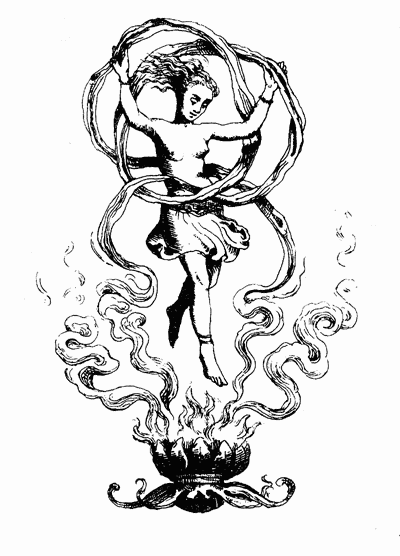
Once upon a time the lightning from heaven fell upon a tree standing in the old primeval forest and kindled it, so that it flamed on high. And it happened that a young hunter, who had lost his path in that wilderness, beheld the gleam of the flames from a distance, and, forcing his way through the thicket, he flung himself down in rapture before the blazing tree.
“O divine light and warmth!” he exclaimed, stretching forth his arms. “O blessed! O heaven-descended Fire! let me thank thee! let me adore thee! Giver of a new existence, quickening thro’ every pulse, how lost, how cold, how dark have I dwelt without thee! Restorer of my life! remain ever near me, and, through thy benign and celestial influence, send love and joy to illuminate my soul!”
And the Fire answered and said to him, “It is true that my birth is from heaven, but I am now, through mingling with earthly elements, subdued to earthly influences; therefore, beware how you choose me for thy friend, without having first studied my twofold nature. O youth! take heed lest what appear to thee now a blessing, may be turned, at some future time, to fiery pain and death.” And the youth replied, “No! O no! thou blessed Fire, this could never be. Am I then so senseless, so inconstant, so thankless? O believe it not! Let me stay near thee; let me be thy priest, to watch and tend thee truly. Ofttimes in my wild wintry life, when the chill darkness encompassed me, and the ice-blast lifted my hair, have I dreamed of the soft summer breath,—of the sunshine that should light up the world within me and the world around me. But still that time came not. It seemed ever far, far off; and I had perished utterly before the light and the warmth had reached me, had it not been for thee!”
Thus the youth poured forth his soul, and the Fire answered him in murmured tones, while her beams with a softer radiance played over his cheek and brow: “Be it so then. Yet do thou watch me constantly and minister to me carefully; neglect me not, leave me not to myself, lest the light and warmth in which thou so delightest fail thee suddenly, and there be no redress; and O watch thyself also! beware lest thou too ardently stir up my impatient fiery being! beware lest thou heap too much fuel upon me; once more beware, lest, instead of life, and love, and joy, I bring thee only death and burning pain!” And the youth passionately vowed to keep her behest: and in the beginning all went well. How often, for hours together, would he lie gazing entranced toward the radiant beneficent Fire, basking in her warmth, and throwing now a leafy spray, now a fragment of dry wood, anon a handful of odorous gums, as incense, upon the flame, which gracefully curling and waving upwards, quivering and sparkling, seemed to whisper in return divine oracles; or he fancied he beheld, while gazing into the glowing depths, marvellous shapes, fairy visions dancing and glancing along. Then he would sing to her songs full of love, and she, responding to the song she had herself inspired, sometimes replied, in softest whispers, so loving and so low, that even the jealous listening woods could not overhear; at other times she would shoot up suddenly in rapturous splendour, like a pillar of light, and revealed to him all the wonders and the beauties which lay around him, hitherto veiled from his sight.
But at length, as he became accustomed to the glory and the warmth, and nothing more was left for the fire to bestow, or her light to reveal, then he began to weary and to dream again of the morning, and to long for the sun-beams; and it was to him as if the fire stood between him and the sun’s light, and he reproached her therefore, and he became moody and ungrateful; and the fire was no longer the same, but unquiet and changeful, sometimes flickering unsteadily, sometimes throwing out a lurid glare. And when the youth, forgetful of his ministry, left the flame unfed and unsustained, so that ofttimes she drooped and waned, and crept in dying gleams along the damp ground, his heart would fail him with a sudden remorse, and he would cast on the fuel with such a rough and lavish hand that the indignant fire hissed thereat, and burst forth in a smoky sullen gleam,—then died away again. Then the youth, half sorrowful, half impatient, would remember how bright, how glowing, how dazzling was the flame in those former happy days, when it played over his chilled and wearied limbs, and shed its warmth upon his brow, and he desired eagerly to recall that once inspiring glow. And he stirred up the embers violently till they burned him, and then he grew angry, and then again he wearied of all the watching and the care which the subtle, celestial, tameless element required at his hand: and at length, one day in a sullen mood, he snatched up a pitcher of water from the fountain and poured it hastily on the yet living flame.——
For one moment it arose blazing towards heaven, shed a last gleam upon the pale brow of the youth, and then sank down in darkness extinguished for ever!
PAULINA. from an unfinished tale, 1823. And think’st thou that the fond o’erflowing love I bear thee in my heart could ever be Repaid by careless smiles that round thee rove, And beam on others as they beam on me? Oh, could I speak to thee! could I but tell The nameless thoughts that in my bosom swell, And struggle for expression! or set free From the o’er mastering spirit’s proud control The pain that throbs in silence at my soul, Perhaps—yet no—I will not sue, nor bend, To win a heartless pity—Let it end! I have been near thee still at morn, at eve; Have mark’d thee in thy joy, have seen thee grieve; Have seen thee gay with triumph, sick with fears, Radiant in beauty, desolate in tears: And communed with thy heart, till I made mine The echo and the mirror unto thine. And I have sat and looked into thine eyes As men on earth look to the starry skies, That seek to read in Heaven their human destinies! Too quickly I read mine,—I knew it well,— I judg’d not of thy heart by all it gave, But all that it withheld; and I could tell The very sea-mark where affection’s wave Would cease to flow, or flow to ebb again, And knew my lavish love was pour’d in vain, As fruitless streams o’er sandy deserts melt, Unrecompensed, unvalued, and unfelt! ****

LINES.—1840.
Take me, my mother Earth, to thy cold breast, And fold me there in everlasting rest, The long day is o’er! I’m weary, I would sleep— But deep, deep, Never to waken more! I have had joy and sorrow; I have proved What life could give; have lov’d, have been belov’d; I am sick, and heart sore, And weary,—let me sleep! But deep, deep, Never to waken more! To thy dark chambers, mother Earth, I come, Prepare my dreamless bed in my last home; Shut down the marble door, And leave me,—let me sleep! But deep, deep, Never to waken more! Now I lie down,—I close my aching eyes, If on this night another morn must rise, Wake me not, I implore! I only ask to sleep, And deep, deep, Never to waken more!
Theological Fragments.
1.
THE HERMIT AND THE MINSTREL.
(A PARABLE, FROM ST. JEROME.)
A certain holy anchorite had passed a long life in a cave of the Thebaid, remote from all communion with men; and eschewing, as he would the gates of Hell, even the very presence of a woman; and he fasted and prayed, and performed many and severe penances; and his whole thought was how he should make himself of account in the sight of God, that he might enter into his paradise.
And having lived this life for three score and ten years he was puffed up with the notion of his own great virtue and sanctity, and, like to St. Anthony, he besought the Lord to show him what saint he should emulate as greater than himself, thinking perhaps, in his heart, that the Lord would answer that none was greater or holier. And the same night the angel of God appeared to him, and said, “If thou wouldst excel all others in virtue and sanctity, thou must strive to be like a certain minstrel who goes begging and singing from door to door.”
And the holy man was in great astonishment, and he arose and took his staff and ran forth in search of this minstrel; and when he had found him he questioned him earnestly, saying, “Tell me, I pray thee, my brother, what good works thou hast performed in thy lifetime, and by what prayers and penances thou hast made thyself acceptable to God?”
And the man, greatly wondering and ashamed to be so questioned, hung down his head as he replied, “I beseech thee, holy father, mock me not! I have performed no good works, and as to praying, alas! sinner that I am, I am not worthy to pray. I do nothing but go about from door to door amusing the people with my viol and my flute.”
And the holy man insisted and said, “Nay, but peradventure in the midst of this thy evil life thou hast done some good works?” And the minstrel replied, “I know of nothing good that I have done.” And the hermit, wondering more and more, said, “How hast thou become a beggar: hast thou spent thy substance in riotous living, like most others of thy calling?” and the man answering, said, “Nay; but there was a poor woman whom I found running hither and thither in distraction, for her husband and her children had been sold into slavery to pay a debt. And the woman being very fair, certain sons of Belial pursued after her; so I took her home to my hut and protected her from them, and I gave her all I possessed to redeem her family, and conducted her in safety to the city, where she was reunited to her husband and children. But what of that, my father; is there a man who would not have done the same?”
And the hermit, hearing the minstrel speak these words, wept bitterly, saying, “For my part, I have not done so much good in all my life; and yet they call me a man of God, and thou art only a poor minstrel!”
At Vienna, some years ago, I saw a picture by Von Schwind, which was conceived in the spirit of this old apologue. It exhibited the lives of two twin brothers diverging from the cradle. One of them, by profound study, becomes a most learned and skilful physician, and ministers to the sick; attaining to great riches and honours through his labours and his philanthropy. The other brother, who has no turn for study, becomes a poor fiddler, and spends his life in consoling, by his music, sufferings beyond the reach of the healing art. In the end, the two brothers meet at the close of life. He who had been fiddling through the world is sick and worn out: his brother prescribes for him, and is seen culling simples for his restoration, while the fiddler touches his instrument for the solace of his kind physician.
It is in such representations that painting did once speak, and might again speak to the hearts of the people.
Another version of the same thought, we find in De Berenger’s pretty ballad, “Les deux Sœurs de Charité.”
2.
When I was a child, and read Milton for the first time, his Pandemonium seemed to me a magnificent place. It struck me more than his Paradise, for that was beautiful, but Pandemonium was terrible and beautiful too. The wondrous fabric that “from the earth rose like an exhalation to the sound of dulcet symphonies and voices sweet,”—the splendid piles of architecture sweeping line beyond line, “Cornice and frieze with bossy sculptures graven,”—realised a certain picture of Palmyra I had once seen, and which had taken possession of my imagination: then the throne, outshining the wealth of Ormuz and of Ind,—the flood of light streaming from “starry lamps and blazing cressets” quite threw the flames of perdition into the shade. As it was said of Erskine, that he always spoke of Satan with respect, as of a great statesman out of place, a sort of leader of the Opposition; so to me the grand arch-fiend was a hero, like my then favourite Greeks and Romans, a Cymon, a Curtius, a Decius, devoting himself for the good of his country;—such was the moral confusion created in my mind. Pandemonium inspired no horror; on the contrary, my fancy revelled in the artistic beauty of the creation. I felt that I should like to go and see it; so that, in fact, if Milton meant to inspire abhorrence, he has failed, even to the height of his sublimity. Dante has succeeded better. Those who dwell with complacency on the doctrine of eternal punishments must delight in the ferocity and the ingenuity of his grim inventions, worthy of a vengeful theology. Wicked latitudinarians may shudder and shiver at the images called up—grotesque, abominable, hideous—but then Dante himself would sternly rebuke them for making their human sympathies a measure for the judgments of God, and compassion only a veil for treason and rebellion:—
“Chi è piu scellerato di colui Ch’ al giudicio divin passion porta?”
“Who can show greater wickedness than he Whose passion by the will of God is moved?”
However, it must be said in favour of Dante’s Inferno, that no one ever wished to go there.
These be the Christian poets! but they must yield in depth of imagined horrors to the Christian Fathers. Tertullian (writing in the second century) not only sends the wicked into that dolorous region of despair, but makes the endless measureless torture of the doomed a part of the joys of the redeemed. The spectacle is to give them the same sort of delight as the heathen took in their games, and Pandemonium is to be as a vast amphitheatre for the amusement of the New Jerusalem. “How magnificent,” exclaims this pious doctor of the Church, “will be the scale of that game! With what admiration, what laughter, what glee, what triumph, shall I behold so many mighty monarchs, who had been given out as received into the skies, moaning in unfathomable gloom! Persecutors of the Christians liquefying amid shooting spires of flame! Philosophers blushing before their disciples amid those ruddy fires! Then,” he goes on, still alluding to the amphitheatre, “then is the time to hear the tragedians doubly pathetic, now that they bewail their own agonies! To observe actors released by the fierceness of their torments from all restraints on their gestures! Then may we admire the charioteer glowing all over in his car of torture, and watch the wrestlers struggling, not in the gymnasium but with flames!” And he asks exultingly, “What prætor, or consul, or questor, or priest, can purchase you by his munificence a game of triumph like this?”
And even more terrible are the imaginations of good Bishop Taylor, who distils the essence from all sins, all miseries, all sorrows, all terrors, all plagues, and mingles them in one chalice of wrath and vengeance to be held to the lips and forced down the unwilling throats of the doomed “with violence of devils and accursed spirits!” Are these mere words? Did any one ever fancy or try to realise what they express?
3.
I was surprised to find this passage in one of Southey’s letters:—
“A Catholic Establishment would be the best, perhaps the only means of civilising Ireland. Jesuits and Benedictines, though they would not enlighten the savages, would humanise them and bring the country into cultivation. A petition that asked for this, saying plainly, ‘We are Papists, and will be so, and this is the best thing that can be done for us and you too,’—such a petition I would support, considering what the present condition of Ireland is, how wretchedly it has always been governed, and how hopeless the prospect.” (1805.)
Southey was thinking of what the religious orders had done for Paraguay; whether he would have penned the same sentiments twenty or even ten years later, is more than doubtful.
4.
The old monks and penitents—dirty, ugly, emaciated old fellows they were!—spent their days in speaking and preaching of their own and others’ sinfulness, yet seem to have had ever present before them a standard of beauty, brightness, beneficence, aspirations which nothing earthly could satisfy, which made their ideas of sinfulness and misery comparative, and their scale was graduated from themselves upwards. We philosophers reverse this. We teach and preach the spiritual dignity, the lofty capabilities of humanity. Yet, by some mistake, we seem to be always speculating on the amount of evil which may or can be endured, and on the amount of wickedness which may or must be tolerated; and our scale is graduated from ourselves downwards.
5.
“So long as the ancient mythology had any separate establishment in the empire, the spiritual worship which our religion demands, and so essentially implies as only fitting for it, was preserved in its purity by means of the salutary contrast; but no sooner had the Church become completely triumphant and exclusive, and the parallel of Pagan idolatry totally removed, than the old constitutional appetite revived in all its original force, and after a short but famous struggle with the Iconoclasts, an image worship was established, and consecrated by bulls and canons, which, in whatever light it is regarded, differed in no respect but the names of its objects from that which had existed for so many ages as the chief characteristic of the religious faith of the Gentiles.”—H. Nelson Coleridge.
I think, with submission, that it differed in sentiment; for in the mythology of the Pagans the worship was to beauty, immortality, and power, and in the Christian mythology—if I may call it so—of the Middle Ages, the worship was to purity, self-denial, and charity.
6.
“A narrow half-enlightened reason may easily make sport of all those forms in which religious faith has been clothed by human imagination, and ask why they are retained, and why one should be preferred to another? It is sufficient to reply, that some forms there must be if Religion is to endure as a social influence, and that the forms already in existence are the best, if they are in unison with human sympathies, and express, with the breadth and vagueness which every popular utterance must from its nature possess, the interior convictions of the general mind. What would become of the most sacred truth if all the forms which have harboured it were destroyed at once by an unrelenting reason, and it were driven naked and shivering about the earth till some clever logician had devised a suitable abode for its reception? It is on these outward forms of religion that the spirit of artistic beauty descends and moulds them into fitting expressions of the invisible grace and majesty of spiritual truth.”—Prospective Review, Feb. 24. 1845.
7.
“Have not Dying Christs taught fortitude to the virtuous sufferer? Have not Holy Families cherished and ennobled domestic affections? The tender genius of the Christian morality, even in its most degenerate state, has made the Mother and her Child the highest objects of affectionate superstition. How much has that beautiful superstition by the pencils of great artists contributed to humanise mankind?”—Sir James Mackintosh, writing in 1802.
8.
I remember once at Merton College Chapel (May, 1844), while Archdeacon Manning was preaching an eloquent sermon on the eternity of reward and punishment in the future life, I was looking at the row of windows opposite, and I saw that there were seven, all different in pattern and construction, yet all harmonising with each other and with the building of which they formed a part;—a symbol they might have been of differences in the Church of Christ. From the varied windows opposite I looked down to the faces of the congregation, all upturned to the preacher, with expression how different! Faith, hope, fear, in the open mouths and expanded eyelids of some; a sort of silent protest in the compressed lips and knitted brows of others; a speculative inquiry and interest, or merely admiring acquiescence in others; as the high or low, the wide or contracted head prevailed; and all this diversity in organisation, in habits of thought, in expression, harmonised for the time by one predominant object, one feeling! the hungry sheep looking up to be fed! When I sigh over apparent disagreement, let me think of those windows in Merton College Chapel, and the same light from heaven streaming through them all!—and of that assemblage of human faces, uplifted with the same aspiration one and all!
9.
I have just read the article (by Sterling, I believe), in the “Edinburgh Review” for July; and as it chanced, this same evening, Dr. Channing’s “Discourse on the Church,” and Captain Maconochie’s “Report on Secondary Punishments” from Sydney, came before me.
And as I laid them down, one after another, this thought struck me:—that about the same time, in three different and far divided regions of the globe, three men, one military, the other an ecclesiastic, the third a lawyer, and belonging apparently to different religious denominations, all gave utterance to nearly the same sentiments in regard to a Christian Church. Channing says, “A church destined to endure through all ages, to act on all, to blend itself with new forms of society, and with the highest improvements of the race, cannot be expected to ordain an immutable mode of administration, but must leave its modes of worship and communion to conform themselves silently and gradually to the wants and progress of humanity. The rites and arrangements which suit one period lose their significance or efficiency in another; the forms which minister to the mind now may fetter it hereafter, and must give place to its free unfolding,” &c., and more to the same purpose.
The reviewer says, “We believe that in the judgment of an enlightened charity, many Christian societies who are accustomed to denounce each others’ errors, will at length come to be regarded as members in common of one great and comprehensive Church, in which diversity of forms are harmonised by an all-pervading unity of spirit.” And more to the same purpose. The soldier and reformer says, “I believe there may be error because there must be imperfection in the religious faith of the best among us; but that the degree of this error is not vital in any Christian denomination seems demonstrable by the best fruits of faith—good works—being evidenced by all.”
It is pleasant to see benign spirits divided in opinion, but harmonised by faith, thus standing hand in hand upon a shore of peace, and looking out together in serene hope for the dawning of a better day, instead of rushing forth, each with his own farthing candle, under pretence of illuminating the world—every one even more intent on putting out his neighbour’s light than on guarding his own.
(Nov. 15. 1841.)
While the idea of possible harmony in the universal Church of Christ (by which I mean all who accept His teaching and are glad to bear His name) is gaining ground theoretically, practically it seems more and more distant; since 1841 (when the above was written) the divergence is greater than ever; and, as in politics, moderate opinions appear (since 1848) to merge on either side into the extremes of ultra conservatism and ultra radicalism, as fear of the past or hope of the future predominate, so it is in the Church. The sort of dualism which prevails in politics and religion might give some colour to Lord Lindsay’s theory of “progress through antagonism.”
10.
I incline to agree with those who think it a great mistake to consider the present conditions or conception of Christianity as complete and final: like the human soul to which it was fitted by Divine love and wisdom, it has an immeasurable capacity of development, and “The Lord hath more truth yet to break forth out of his Holy Word.”
11.
The nations of the present age want not less religion, but more. They do not wish for less community with the Apostolic times, but for more; but above all, they want their wounds healed by a Christianity showing a life-renewing vitality allied to reason and conscience, and ready and able to reform the social relations of life, beginning with the domestic and culminating with the political. They want no negations, but positive reconstruction—no conventionality, but an honest bonâ fide foundation, deep as the human mind, and a structure free and organic as nature. In the meantime let no national form be urged as identical with divine truth, let no dogmatic formula oppress conscience and reason, and let no corporation of priests, no set of dogmatists, sow discord and hatred in the sacred communities of domestic and national life. This view cannot be obtained without national efforts, Christian education, free institutions, and social reforms. Then no zeal will be called Christian which is not hallowed by charity,—no faith Christian which is not sanctioned by reason.”—Hippolitus.
“Any author who in our time treats theological and ecclesiastical subjects frankly, and therefore with reference to the problems of the age, must expect to be ignored, and if that cannot be done, abused and reviled.”
The same is true of moral subjects on which strong prejudices (or shall I say strong convictions?) exist in minds not very strong.
It is not perhaps of so much consequence what we believe, as it is important that we believe; that we do not affect to believe, and so belie our own souls. Belief is not always in our power, but truth is.
12.
It seems an arbitrary limitation of the design of Christianity to assume, as Priestley does, that “it consists solely in the revelation of a future life confirmed by the bodily resurrection of Christ.” This is truly a very material view of Christianity. If I were to be sure of annihilation I should not be less certain of the truth of Christianity as a system of morals exquisitely adapted for the improvement and happiness of man as an individual; and equally adapted to conduce to the amelioration and progressive happiness of mankind as a species.

NOTES FROM VARIOUS SERMONS,
MADE ON THE SPOT;
SHOWING SOME THINGS IN WHICH ALL GOOD MEN ARE AGREED.
I.
From a Roman Catholic Sermon.
When travelling in Ireland, I stayed over one Sunday in a certain town in the north, and rambled out early in the morning. It was cold and wet, the streets empty and quiet, but the sound of voices drew me in one direction, down a court where was a Roman Catholic chapel. It was so crowded that many of the congregation stood round the door. I remarked among them a number of soldiers and most miserable-looking women. All made way for me with true national courtesy, and I entered at the moment the priest was finishing mass, and about to begin his sermon. There was no pulpit, and he stood on the step of the altar; a fine-looking man, with a bright face, a sonorous voice, and a very strong Irish accent. His text was from Matt. v. 43, 44.
He began by explaining what Christ really meant by the words “Love thy neighbour.” Then drew a picture in contrast of hatred and dissension, commencing with dissension in families, between kindred, and between husband and wife. Then made a most touching appeal in behalf of children brought up in an atmosphere of contention where no love is. “God help them! God pity them! small chance for them of being either good or happy! for their young hearts are saddened and soured with strife, and they eat their bread in bitterness!”
Then he preached patience to the wives, indulgence to the husbands, and denounced scolds and quarrelsome women in a manner that seemed to glance at recent events: “When ye are found in the streets vilifying and slandering one another, ay, and fighting and tearing each other’s hair, do ye think ye’re women? no, ye’re not! ye’re devils incarnate, and ye’ll go where the devils will be fit companions for ye!” &c. (Here some women near me, with long black hair streaming down, fell upon their knees, sobbing with contrition.) He then went on, in the same strain of homely eloquence, to the evils of political and religious hatred, and quoted the text, “If it be possible, as much as lieth in you, live peaceably with all men.” “I’m a Catholic,” he went on, “and I believe in the truth of my own religion above all others. I’m convinced, by long study and observation, it’s the best that is; but what then? Do ye think I hate my neighbour because he thinks differently? Do ye think I mane to force my religion down other people’s throats? If I were to preach such uncharity to ye, my people, you wouldn’t listen to me, ye oughtn’t to listen to me. Did Jesus Christ force His religion down other people’s throats? Not He! He endured all, He was kind to all, even to the wicked Jews that afterwards crucified Him.” “If you say you can’t love your neighbour because he’s your enemy, and has injured you, what does that mane? ‘ye can’t! ye can’t!’ as if that excuse will serve God? hav’n’t ye done more and worse against Him? and didn’t He send His only Son into the world to redeem ye? My good people, you’re all sprung from one stock, all sons of Adam, all related to one another. When God created Eve, mightn’t He have made her out of any thing, a stock or a stone, or out of nothing at all, at all? but He took one of Adam’s ribs and moulded her out of that, and gave her to him, just to show that we’re all from one original, all related together, men and women, Catholics and Protestants, Jews and Turks and Christians; all bone of one bone, and flesh of one flesh!” He then insisted and demonstrated that all the miseries of life, all the sorrows and mistakes of men, women, and children; and, in particular, all the disasters of Ireland, the bankrupt landlords, the religious dissensions, the fights domestic and political, the rich without thought for the poor, and the poor without food or work, all arose from nothing but the want of love. “Down on your knees,” he exclaimed, “and ask God’s mercy and pardon; and as ye hope to find it, ask pardon one of another for every angry word ye have spoken, for every uncharitable thought that has come into your minds; and if any man or woman have aught against his neighbour, no matter what, let it be plucked out of his heart before he laves this place, let it be forgotten at the door of this chapel. Let me, your pastor, have no more rason to be ashamed of you; as if I were set over wild bastes, instead of Christian men and women!”
After more in this fervid strain, which I cannot recollect, he gave his blessing in the same earnest heartfelt manner. I never saw a congregation more attentive, more reverent, and apparently more touched and edified. (1848.)
II.
From another Roman Catholic Sermon, delivered in the private chapel of a Nobleman.
This Discourse was preached on the festival of St. John the Baptist, and was a summary of his doctrine, life, and character. The text was taken from St. Luke, iii. 9. to 14.; in which St. John answers the question of the people, “what shall we do then?” by a brief exposition of their several duties.
“What is most remarkable in all this,” said the priest, “is truly that there is nothing very remarkable in it. The Baptist required from his hearers very simple and very familiar duties,—such as he was not the first to preach, such as had been recognised as duties by all religions; and do you think that those who were neither Jews nor Christians were therefore left without any religion? No! never did God leave any of his creatures without religion; they could not utter the words right, wrong,—beautiful, hateful, without recognising a religion written by God on their hearts from the beginning—a religion which existed before the preaching of John, before the coming of Christ, and of which the appearance of John and the doctrine and sacrifice of Christ, were but the fulfilment. For Christ came to fulfil the law, not to destroy it. Do you ask what law? Not the law of Moses, but the universal law of God’s moral truth written in our hearts. It is, my friends, a folly to talk of natural religion as of something different from revealed religion.
“The great proof of the truth of John’s mission lies in its comprehensiveness: men and women, artisans and soldiers, the rich and the poor, the young and the old, gathered to him in the wilderness; and he included all in his teaching, for he was sent to all; and the best proof of the truth of his teaching lies in its harmony with that law already written in the heart and the conscience of men. When Christ came afterwards, he preached a doctrine more sublime, with a more authoritative voice; but here, also, the best proof we have of the truth of that divine teaching lies in this—that he had prepared from the beginning the heart and the conscience of man to harmonise with it.”